
Judges 13:25

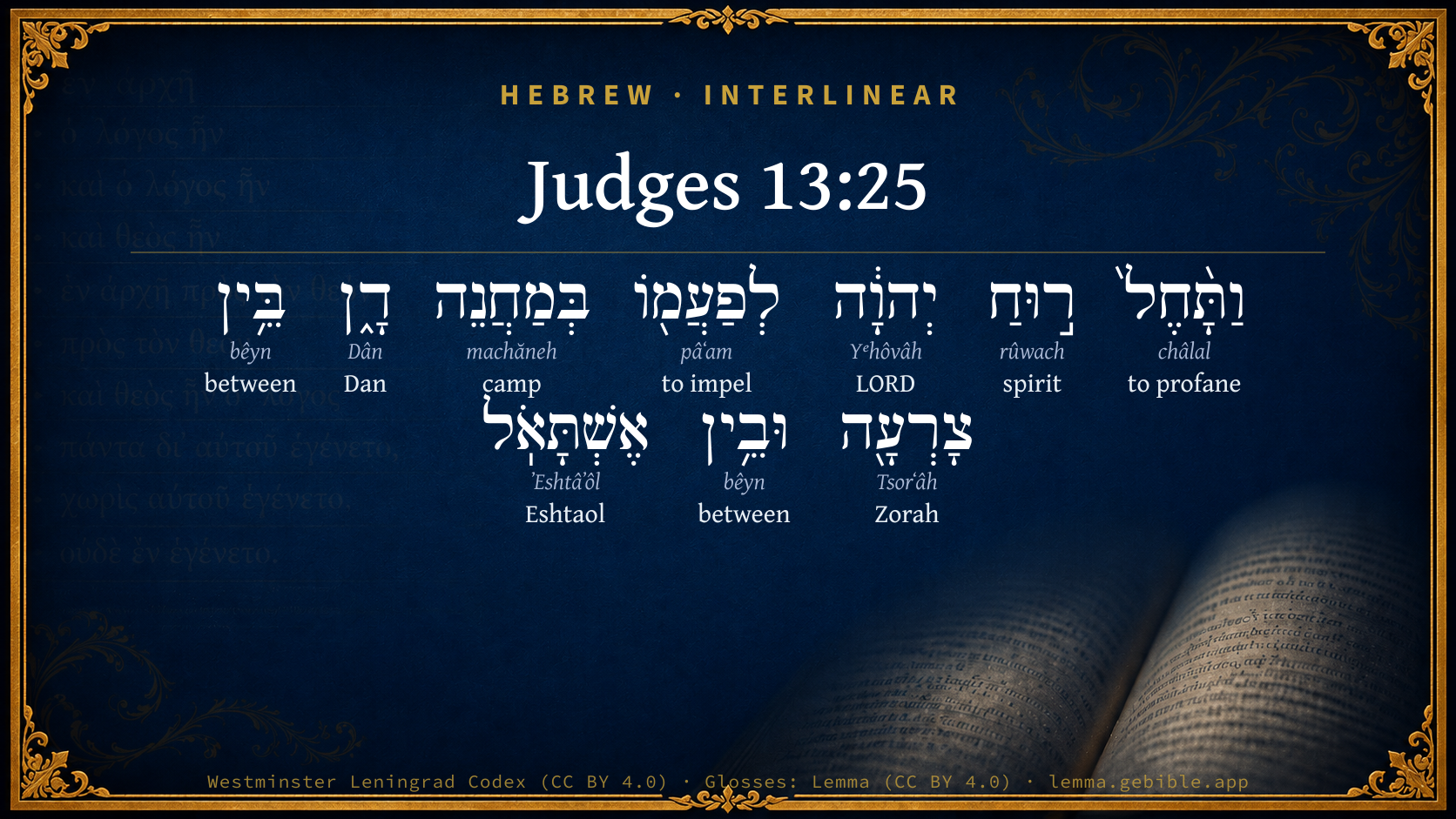
Hebrew (Westminster Leningrad Codex) Judges 13:25 appears in the Hebrew Old Testament. The text above is from the Westminster Leningrad Codex. Each word links to its Strong’s number, a concise gloss, and parsing drawn from the Open Scriptures Hebrew Bible morphology. Click any word for its full Brown-Driver-Briggs (BDB) entry.
Download image
Cite this verse

Judges 13:25 (World English Bible). Public Domain. Lemma interlinear Bible study tool, https://lemma.gebible.app/v/judges/13/25.

Show BibTeX & RIS
BibTeX
RIS
English Translation
The Spirit of Yahweh began to move him in Mahaneh-dan, between Zorah and Eshtaol.
World English Bible · Public Domain
Download a study sheet

One document with this verse’s original text, its word-by-word gloss line, the meaning frame, cross-references with their text, attributed commentary, and full source and license credits — printable, and it pastes into notes with its structure intact.

This verse Autodidact and up

Study sheet (.html) Plain text (.txt)

A passage Seminary Student

Up to 50 verses in one chapter. A passage sheet keeps up to 6 commentary sources and 12 cross-references per verse, in the order this page ranks them, and says so on the sheet whenever that leaves anything out. Ask for a single verse and you get the Autodidact verse sheet above.

Everything on this page stays free to read, with no account — the sheet is a download of what is already on screen, not access to it.

Want to remove ads? Support Godless Engineer
Compare translations 3

The same verse in 3 English versions, stacked beneath the original-language interlinear above. Click any original word for its lexicon entry.

Each is an independent rendering of the whole verse — the interlinear is not word-aligned to these translations.

Highlighted words mark where these versions differ — a whole-verse word diff, not a word-by-word alignment.

  • World English Bible Public Domain
    The Spirit of Yahweh began to move him in Mahaneh-dan, between Zorah and Eshtaol.
  • King James Version Public Domain
    And the Spirit of the LORD began to move him at times in the camp of Dan between Zorah and Eshtaol.
  • unfoldingWord Literal Text CC BY-SA 4.0
    And the Spirit of Yahweh began to agitate him in Mahaneh Dan, between Zorah and between Eshtaol.

unfoldingWord Literal Text — © unfoldingWord, licensed CC BY-SA 4.0. Word-aligned USFM3 via Door43 (git.door43.org/unfoldingWord/en_ult).

Versions to compare (up to 4)

3 of 4 selected

Show all 18 translations

Every available English version of this verse, each an independent rendering of the whole verse.

  • World English Bible Public Domain
    The Spirit of Yahweh began to move him in Mahaneh-dan, between Zorah and Eshtaol.
  • Berean Standard Bible Public Domain
    And the Spirit of the LORD began to stir him at Mahaneh-dan, between Zorah and Eshtaol.
  • Majority Standard Bible Public Domain
    And the Spirit of the LORD began to stir him at Mahaneh-dan, between Zorah and Eshtaol.
  • King James Version Public Domain
    And the Spirit of the LORD began to move him at times in the camp of Dan between Zorah and Eshtaol.
  • American Standard Version (1901) Public Domain
    And the Spirit of Jehovah began to move him in Mahaneh-dan, between Zorah and Eshtaol.
  • Revised Version (1885) Public Domain
    And the spirit of the LORD began to move him in Mahaneh-dan, between Zorah and Eshtaol.
  • Geneva Bible (1599) Public Domain
    And the Spirite of the Lord beganne to strengthen him in the host of Dan, betweene Zorah, and Eshtaol.
  • Douay-Rheims (1899) Public Domain
    And the spirit of the Lord began to be with him in the camp of Dan, between Saraa and Esthaol.
  • Young's Literal Translation Public Domain
    and the Spirit of Jehovah beginneth to move him in the camp of Dan, between Zorah and Eshtaol.
  • Literal Standard Version CC BY-SA 4.0
    and the Spirit of YHWH begins to move him in the camp of Dan, between Zorah and Eshtaol.
  • Unlocked Literal Bible CC BY-SA 4.0
    Yahweh's Spirit began to stir him in Mahaneh Dan, between Zorah and Eshtaol.
  • unfoldingWord Literal Text CC BY-SA 4.0
    And the Spirit of Yahweh began to agitate him in Mahaneh Dan, between Zorah and between Eshtaol.
  • Darby Bible Public Domain
    And the Spirit of the LORD began to stir him in Ma'haneh-dan, between Zorah and Esh'ta-ol.
  • World Messianic Bible Public Domain
    The LORD’s Spirit began to move him in Mahaneh Dan, between Zorah and Eshtaol.
  • Webster's Bible Public Domain
    And the Spirit of the LORD began to move him at times in the camp of Dan, between Zorah and Eshtaol.
  • Free Bible Version CC BY-SA 4.0
    The Spirit of the Lord began to prompt him at Mahaneh Dan, a place between Zorah and Eshtaol.
  • Bible in Basic English Public Domain
    And the spirit of the Lord first came on him in Mahaneh-dan, between Zorah and Eshtaol.
  • JPS Tanakh (1917) Public Domain
    And the spirit of the LORD began to move him in Mahaneh-dan, between Zorah and Eshtaol.

Literal Standard Version (2020), Covenant Press — licensed CC BY-SA 4.0. Text via the HelloAO Bible API (eBible.org). Unlocked Literal Bible (unfoldingWord) — licensed CC BY-SA 4.0. Text via the HelloAO Bible API (eBible.org). unfoldingWord Literal Text — © unfoldingWord, licensed CC BY-SA 4.0. Word-aligned USFM3 via Door43 (git.door43.org/unfoldingWord/en_ult). Free Bible Version, Dr. Jonathan Gallagher — licensed CC BY-SA 4.0. Text via the HelloAO Bible API (eBible.org).

Word by word

More ways to search: Search by grammar → Find every occurrence → Compare this word →

Practice this passage: Drill this verse → Learn its vocabulary →

לְפַעֲמ֖וֹ
pâʻam
H6470
“to impel · him”
Preposition + Verb, Qal, Infinitive Construct + Suffix, Personal, 3rd Person, Masculine, Singular
Part of Speech
Preposition + Verb
Stem
Qal
Form
Infinitive Construct
Full BDB Definition

Origin: a primitive root

TWOT: 1793

to thrust, impel, push, beat persistently - (Qal) to impel - (Niphal) to be beaten, be disturbed - (Hithpael) to be disturbed
  1. וַתָּ֨חֶל֙ châlal H2490 “and · to profane” Conjunction + Verb, Hiphil, Sequential Imperfect, 3rd Person, Feminine, Singular
  2. ר֣וּחַ rûwach H7307 “spirit of” Noun, Common, Both, Singular, Construct
  3. יְהוָ֔ה Yᵉhôvâh H3068 “LORD” Noun, Proper
  4. בְּמַחֲנֵה machăneh H4264 “in/at · camp” Preposition + Noun, Proper
  5. דָ֑ן Dân H1835 “Dan” Noun, Proper
  6. בֵּ֥ין bêyn H996 “between” Preposition
  7. צָרְעָ֖ה Tsorʻâh H6881 “Zorah” Noun, Proper
  8. וּבֵ֥ין bêyn H996 “and · between” Conjunction + Preposition
  9. אֶשְׁתָּאֹֽל ʼEshtâʼôl H847 “Eshtaol” Noun, Proper

About this verse

These counts appear in no published source. They are computed here, from the morphology-tagged text and Lemma’s own curated glosses. What Lemma adds →

10
words
9
distinct lemmas
Historical
section

Notable vocabulary

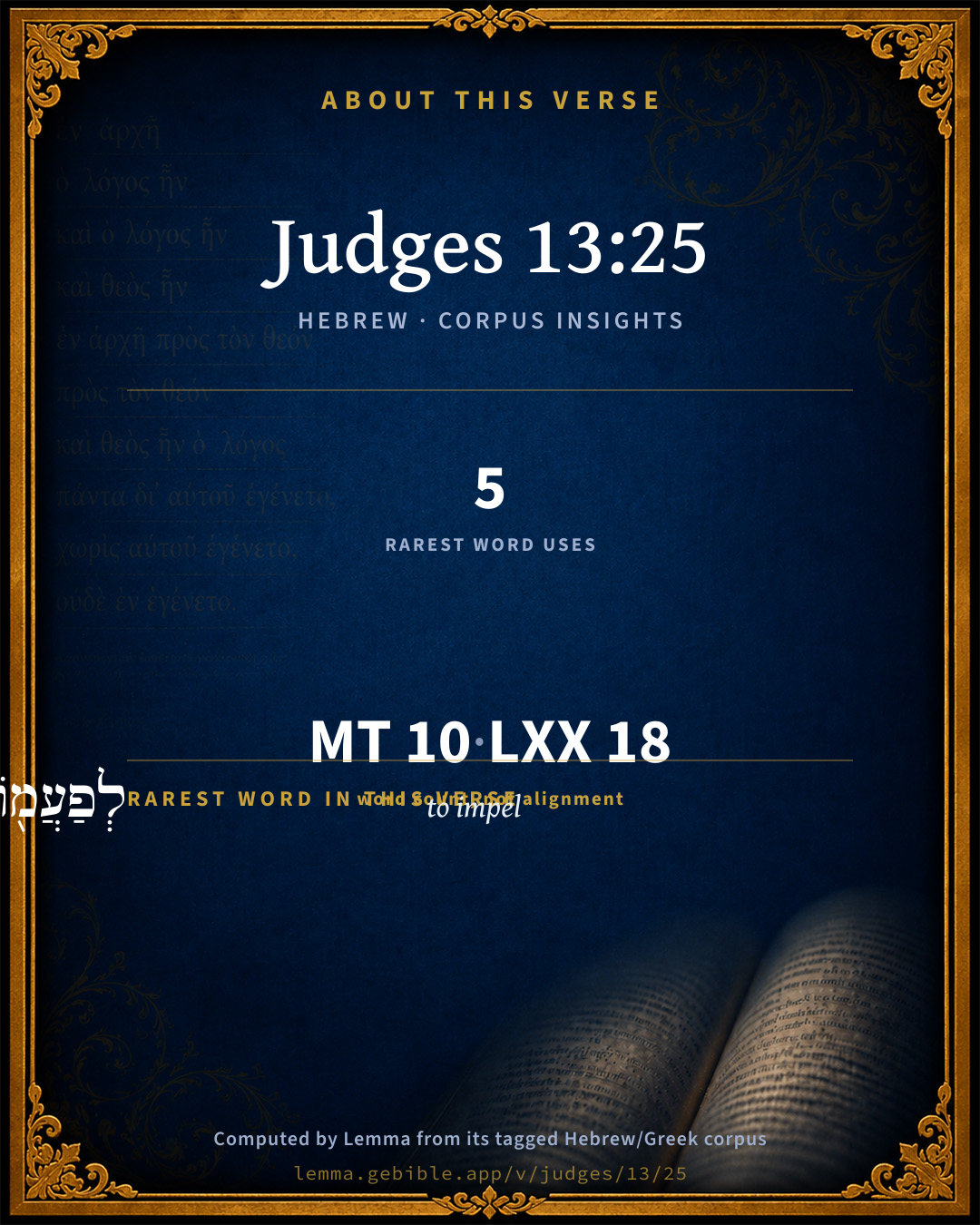
The rarest word here is לְפַעֲמ֖וֹ to impel H6470 — appearing just 5 times in the whole Hebrew Bible.

Shared distinctive vocabulary

לְפַעֲמ֖וֹ to impel H6470 occurs in 5 verses of the Hebrew Bible. Also found in:

Grammatical profile

  • 2 verbs
  • 6 nouns
  • 2 prepositions

Verb forms

  • וַתָּ֨חֶל֙ Hiphil · Sequential Imperfect
  • לְפַעֲמ֖וֹ Qal · Infinitive Construct

Repetition

A word recurs within this verse — often emphatic in Hebrew:

  • בֵּ֥ין between H996 ×2

Hebrew & Septuagint length

In English translation the verse runs 14 words from the Hebrew and 22 from the Septuagint (LXX English) — the Septuagint runs noticeably longer here. See the side-by-side →

A rough comparison of the two English renderings, which tokenize alike — not a word-level alignment.

Word counts can differ between the Hebrew and the Greek without any difference in meaning — e.g. the Hebrew direct-object marker אֵת has no separate Greek word, and Greek often adds the article ὁ.

In the original languages it is 10 Hebrew tokens and 18 Greek tokens — but the two are counted differently (Hebrew bundles its prefixes and suffixes into one token; the Greek is in lemma form), so that isn’t a like-for-like length.

Cross-references

8

Topical passages linked to Judges 13:25 in the Treasury of Scripture Knowledge — connected by theme and wording, ordered by reader-vote popularity; previews shown in the World English Bible.

  • Judges 3:10 The Spirit of Yahweh came on him, and he judged Israel; and he went out to war, and Yahweh delivered Cushan Rishathaim king of Mesopotamia into his hand: and his hand prevailed against Cushan Rishathaim.
  • Joshua 15:33 In the lowland, Eshtaol, and Zorah, and Ashnah,
  • John 3:34 For he whom God has sent speaks the words of God; for God gives the Spirit without measure.
  • Judges 6:34 But the Spirit of Yahweh came on Gideon; and he blew a trumpet; and Abiezer was gathered together after him.
  • Judges 11:29 Then the Spirit of Yahweh came on Jephthah, and he passed over Gilead and Manasseh, and passed over Mizpeh of Gilead, and from Mizpeh of Gilead he passed over to the children of Ammon.
  • Judges 18:11–12 There set forth from there of the family of the Danites, out of Zorah and out of Eshtaol, six hundred men girt with weapons of war.
  • 1 Samuel 11:6 The Spirit of God came mightily on Saul when he heard those words, and his anger was kindled greatly.
  • Matthew 4:1 Then Jesus was led up by the Spirit into the wilderness to be tempted by the devil.

Cross-references courtesy of OpenBible.info (CC BY 4.0).

Hebrew and Greek witnesses Masoretic Hebrew ↔ Greek Septuagint

The same verse in the two great witnesses to the Old Testament, shown verse-for-verse.

Here the Septuagint runs noticeably longer than the Hebrew — LXX2012 (modern English Septuagint) 22 words vs World English Bible 14. A rough length comparison of the two English translations, not a word-level alignment — read both below.

These are two independent witnesses, not word-aligned to each other, and the Septuagint is shown in lemma (dictionary) form.

Hebrew Judges 13:25 Masoretic · Westminster Leningrad Codex

וַתָּ֨חֶל֙ ר֣וּחַ יְהוָ֔ה לְפַעֲמ֖וֹ בְּמַחֲנֵה דָ֑ן בֵּ֥ין צָרְעָ֖ה וּבֵ֥ין אֶשְׁתָּאֹֽל

The Spirit of Yahweh began to move him in Mahaneh-dan, between Zorah and Eshtaol.

World English Bible · Public Domain

Greek LXX Judges 13:25 Septuagint · lemma form

καί ἄρχω πνεῦμα κύριος συν ἐκπορεύομαι αὐτός ἐν παρεμβολή δαν καί ἀνά μέσος σαραα καί ἀνά μέσος εσθαολ

And the Spirit of the Lord began to go out with him in the camp of Dan, and between Saraa and Esthaol.

LXX2012 (modern English Septuagint) · Public Domain

On this verse, Ellicott's Commentary for English Readers discusses the Septuagint’s reading. Read the note in Commentary ↓

Hebrew: Westminster Leningrad Codex (CC BY 4.0). Greek: Septuagint (public domain); English from LXX2012 (modern English Septuagint) (Public Domain). How the Septuagint differs from the Hebrew →

Targum (Aramaic paraphrase)

1

The Targum is the ancient Jewish Aramaic paraphrase of the Hebrew Scriptures — an interpretive translation, not the Hebrew text itself. Onkelos (literal) and Pseudo-Jonathan (expansive) render the Torah, and Jonathan the Prophets. Coverage is partial: where no permissively-licensed English translation exists for a verse, only the Aramaic is shown. This is verse-level text, not a word-by-word alignment to the Hebrew.

  1. Targum Jonathan Prophets (Joshua–Malachi)
    וּשְׁרִיאַת רוּחַ גְבוּרָא מִן קֳדָם יְיָ לְתַקָפוּתֵיהּ בְּמַשִׁרְיַת דָן בֵּין צָרְעָה וּבֵין אֶשְׁתָּאֹל:

    (no public-domain English translation for this verse)

    Targum Jonathan — Aramaic: “Mikraot Gedolot” (public domain). English: “Sefaria Community Translation” (CC0 1.0 (public-domain dedication)); “London "Chaldee Paraphrase," 1871” (public domain). Text via Sefaria.

Commentary

Notes on Judges 13:25 from classic Christian and Jewish commentators (each source and its license shown beneath its notes). The classic Christian expositions comment on the surrounding passage and are grouped to its opening verse, so a note may address several verses; the Jewish commentaries on the Tanakh (Rashi and others) are per-verse, so they appear only where the commentator wrote on this verse.

Lemma curates 59 commentaries, every one of them public domain or Creative Commons licensed, each selected and text-cleaned for this edition rather than reprinted as found. About our sources →

Trapp's Complete Commentary

John Trapp

Jdg 13:25 And the Spirit of the LORD began to move him at times in the camp of Dan between Zorah and Eshtaol.

Ver. 25. And the Spirit of the Lord began to move him at times.] Or, Hither and thither, as the bells which hung in the skirts of Aaron’s garment. Those bells have their name (pagnamon) from pagham {a} here used; because they were shaken to and fro.

In the camp of Dan.] Whence some think he is called Bedan; {1Sa 12:11} others quasi Ben Dan, the son of Dan.

{a} Agere sive impellere, verberare ut incus, quae nominatur "Pagnain" {Isa 41:7}

John Trapp, A Commentary or Exposition upon All the Books of the Old and New Testament (1647–1656) — public domain. Text from a community e-Sword module.

Geneva Bible (1599)

Geneva Bible translators

Or, to come upon him at divers times.

Geneva Bible (1599) marginal notes — public domain. Text via Bolls.life.

Jamieson, Fausset & Brown

Robert Jamieson, A. R. Fausset & David Brown

the Spirit of the Lord began to move him at times--not, probably, as it moved the prophets, who were charged with an inspired message, but kindling in his youthful bosom a spirit of high and devoted patriotism.

Eshtaol--the free city. It, as well as Zorah, stood on the border between Judah and Dan.

Next: Judges Chapter 14

Jamieson, Fausset & Brown — Commentary Critical and Explanatory on the Whole Bible (1871) — public domain (CC PDM 1.0). Text via the HelloAO Bible API.

Adam Clarke's Commentary

Verse 25. The Spirit of the Lord began to move him] He felt the degrading bondage of his countrymen, and a strong desire to accomplish something for their deliverance. These feelings and motions he had from the Divine Spirit.

Camp of Dan] Probably the place where his parents dwelt; for they were Danites, and the place is supposed to have its name from its being the spot where the Danites stopped when they sent some men of their company to rob Micah of his teraphim, c. See Jdg 18:13-20.

As he had these influences between Zorah and Eshtaol, it is evident that this was while he dwelt at home with his parents for Zorah was the place where his father dwelt; see Jdg 13:2. Thus God began, from his infancy, to qualify him for the work to which he had called him.

Adam Clarke's Commentary on the Bible (1810–1826) — public domain. Text from a community e-Sword/MySword module.

Ellicott's Commentary for English Readers

(25) The Spirit of the Lord.—Jdg_3:10. The Targum of Jonathan paraphrases it rightly, “The spirit of courage from Jehovah.” Amos (Amo_2:11) ranks Nazarites with prophets. “Different as may be their mode of action, they agree in a belief, which strings up every power to its highest tension, that they are Jehovah’s very own, consecrated to Him by a wholly special calling” (Ewald).

Began to move him.—Literally, to agitate or thrust him (paham, Gen_41:8; Dan_2:1). The word implies vehement and overwhelming impulses to noble deeds (“fing an ihn zu treiben,” Luther), which, however, only came over him “at times” (Jdg_14:6; Jdg_15:14; Jdg_16:20). The LXX. rendering, “to go with him,” comes from a wrong reading.

In the camp of Dan.—Rather, in Mahaneh-dan. Doubtless the name originated in the migration of this hard-pressed tribe, which is mentioned in Jdg_18:11-12, but which took place long before this time. The sites of Mahaneh-dan and Eshtaol have not been identified. In his hatred to the enemies of his country, Samson is the Hannibal of the Hebrews.

A Bible Commentary for English Readers, edited by Charles John Ellicott (1878–1897) — public domain. Text from a community e-Sword module.

The Cambridge Bible for Schools and Colleges

gen. ed. J. J. S. Perowne

25. the spirit of the Lord] See on Jdg_3:13. The superhuman power of Jehovah began to stir him to daring feats against the Philistines; cf. St Mar_1:12 ‘the Spirit driveth him forth.’ The pass, of the verb (in a trans, sense only here) is rendered ‘was troubled’ in Gen_41:8, Psa_77:4 etc.

Mahaneh-dan] here lies in the heart of the Danite settlements; but according to Jdg_18:12 it was situated in Judah, at Kiriath-jearim or behind it, i.e. on the western side, and the six hundred, starting from Zorah and Eshtaol, are said to have reached Mahaneh-dan on their march to the north. A temporary encampment outside the Danite district might naturally receive the name of Dan’s Camp, but not a place among the seats of the tribe. As it is unlikely that there were two places called Dan’s Camp in this part of the country, we must suppose that there is something wrong about the name here. Perhaps for Mahaneh-dan we should read Manahath-dan, a happy suggestion made by Mr S. A. Cook [Notes on O.T. Hist., p. 88 and Encycl. Bibl. s.v.); cf. 1Ch_2:52; 1Ch_2:54, and see above on Jdg_13:2. It is to be noticed that the grave of Manoah, the ancestor of the Manahathites, occupied exactly the position described in this verse, Jdg_16:31.

Eshtaol] Generally named with Zorah (Jdg_13:2); the two places were evidently close together. Zorah is certainly Ṣar‘a; and Eshtaol may have stood on the site of Eshû‘ about 1½ m. to the N.E., up the valley which branches off northwards from the W. eṣ-Ṣarâr (Sorek). Both places overlook the broad basin of the W. eṣ-Ṣarâr near its entrance into the Judaean highlands.

The Cambridge Bible for Schools and Colleges (gen. ed. J. J. S. Perowne; Cambridge University Press, 1878–1918) — public domain. Text from a community e-Sword module.

John Gill's Exposition

And the Spirit of the Lord began to move him at times in the camp of Dan,.... To go out into it, in order to be trained up in and inured to military exercises; or it began to "strike" his mind, inject thoughts into it, and impress it with them concerning doing great things for the people of God in time to come; and for the present put him upon doing strange and wonderful exploits, which were omens of what was to be done by him hereafter; and these were done by him now and then, not always, but as the Spirit of God came upon him, under the impulse of which he did them, and by the strength he gave him; so the Targum,"and the Spirit of strength from the Lord began to strengthen him.''This camp of Dan was either a camp formed in that tribe, to prevent the incursions of the Philistines; or rather, since it does not seem that Israel had strength enough to resist them, they having got the power over them, this was the name of a place called Mahanehdan near Kirjathjearim, from the Danites encamping in it, when they went to besiege Laish, Jdg 18:11 for the fact was done before this time, though related afterwards:

between Zorah and Eshtaol; which were two cities in the tribe of Dan, and upon the borders of the tribe of Judah; of which see Jos 15:33. It may be observed, that as the tribe of Dan lay near to the Philistines, and so liable to their ravages, and might be most oppressed by them, so a deliverer of Israel was raised up in this tribe.

Next: Judges Chapter 14

John Gill's Exposition of the Whole Bible (1746–1763) — public domain (CC PDM 1.0). Text via the HelloAO Bible API.

Albert Barnes' Notes on the Bible

In the camp of Dan - Rather, “Mahaneh-Dan” (see the margin). The impulses of the Spirit of the Lord perhaps took the shape of burning indignation at the subjection of his brethren, and thoughts and plans for their deliverance, but especially showed themselves in feats of strength (Jdg 14:6; Jdg 15:14; Jdg 16:30. Compare Act 7:23-25).

Albert Barnes' Notes on the Bible (1834–1885) — public domain. Text from a community e-Sword/MySword module.

Haydock's Catholic Bible Commentary

To be. Septuagint, "to walk along." Jonathan, "to sanctify." Samson began to manifest an eager desire to deliver his brethren. (Calmet) --- Dan, as it was called from those 600 men who encamped here, when they were going to take Lais, chap. xviii. 12. (Haydock) --- God inspired him to commence the liberation of his country, when he was about 17 years old, (Usher) or 20 according to Salien. Then he entered upon his judicial authority, and punished the wrongs which the Philistines did him in person, as well as his countrymen. The seven years wandering of Æneas had terminated in his death just before, at the river Numicus. (Halicar. 1; Salien, in the year before Christ 1176.) (Haydock)

George Leo Haydock (1774–1849), Haydock's Catholic Family Bible and Commentary, 1859 edition — public domain. Excludes Psalms (Douay-Rheims chapter numbering differs from Protestant) and Deuterocanonical books (Catholic canon only).

Matthew Poole's English Annotations

To move him at times, i.e. to stir him up to heroical designs; to show forth his power in him in the frame of his mind, and in the strength of his body, discovered to his neighbours in extraordinary actions; to incline his heart to great attempts to the help and deliverance of God’s people; and to give some essays of it to his brethren, and to seek all opportunities for it, as he did in the next chapter.

In the camp of Dan; a place so called, either from the expedition of the Danites, Jdg 18:11,12; which though placed after this history, was done before it; or from some other camp which the Danites had formed there at this time, to give some check to the incursions of the Philistines.

Matthew Poole's English Annotations on the Holy Bible (1683–1685) — public domain. Text from a community e-Sword/MySword module.

Whedon's Commentary on the Bible

Daniel D. Whedon

25. Spirit of the Lord began to move him — Literally, began to strike him; that is, to urge or impel him to perform marvellous feats of strength. He may have rent many a lion in his youthful days, and such feats had as much to do in developing his faith in God, and preparing him to smite the Philistines, as David’s smiting of the lion and the bear had in preparing him to cope with Goliath. 1Sa_17:37.

Camp of Dan — In Jdg_18:12, the word is rendered as a proper name, Mahaneh-Dan. It was the district belonging to the Danites lying between Zorah and Eshtaol. This latter place has not been clearly identified with any modern site, but probably lay between Zorah and Kirjath-jearim. Compare Jdg_18:12, and Jos_15:33.

Daniel D. Whedon (gen. ed.), Commentary on the Old and New Testaments (1874–1909) — public domain. Text from a community e-Sword module.

The Pulpit Commentary

The Spirit of the Lord, etc. See Jud_1:3:10, note. To move him to urge and impel him to strange actions by fits and starts. It is an uncommon expression. In Gen_41:8 the passive of the verb means to be troubled or agitated, and the substantive is the common word for a time in the phrases time after time, twice, thrice (according to the number specified), other times, etc. ; also a footstep; and its derivatives mean an anvil, a bell. The idea is that of sudden, single impulses, such as are described in the following chapters. In the camp of Dan, or, as in Jud_1:18:12, Mahaneh-Dan, where the reason of the name is explained. For Zorah see ver. 2, note. Eshtaol has not hitherto been identified with any existing place, but it ought to lie east or north of Mahaneh-Dan, since this last was between Zorah and Eshtaol. (see note on Jud_1:18:12) Kustul, a conical hill one hour west of Jerusalem, has been suggested.

The Pulpit Commentary (1880–1919), ed. H.D.M. Spence-Jones & Joseph S. Exell — public domain. Text from a community e-Sword module.

John Wesley's Explanatory Notes

To move - That is, to stir him up to heroical designs; to shew forth its power in the frame of his mind, and in the strength of his body, discovered to his neighbours in extraordinary actions; to encline his heart to great attempts for the help and deliverance of God's people, to give some essays of it to his brethren, and to seek all opportunities for it. Of Daniel - A place so called, either from the expedition of the Danites, chap. xviii, 11, 12, which though placed after this history, was done before it: or from some other camp which the Danites had formed there, to give some check to the incursions of the Philistines.

John Wesley, Explanatory Notes Upon the Whole Bible (1754–1765) — public domain. Text via the GEBible commentary corpus.

Keil & Delitzsch

C. F. Keil & F. Delitzsch

When he had grown up, the Spirit of Jehovah began to thrust him in the camp of Dan. פּעם, to thrust, denoting the operation of the Spirit of God within him, which took possession of him suddenly, and impelled him to put forth supernatural powers. Mahaneh-dan, the camp of Dan, was the name given to the district in which the Danites who emigrated, according to Jdg 18:12, from the inheritance of their tribe, had pitched their encampment behind, i.e., to the west of, Kirjath-jearim, or according to this verse, between Zorea and Eshtaol. The situation cannot be determined precisely, as the situation of Eshtaol itself has not been discovered yet (see at Jos 15:33). It was there that Samson lived with his parents, judging from Jdg 16:31. The meaning of this verse, which forms the introduction to the following account of the acts of Samson, is simply that Samson was there seized by the Spirit of Jehovah, and impelled to commence the conflict with the Philistines.

Keil & Delitzsch — Biblical Commentary on the Old Testament (1861–1891) — public domain (CC PDM 1.0). Text via the HelloAO Bible API. (Old Testament only.)

Rashi

Rabbi Shlomo Yitzchaki (Rashi)

Pulsating within him. Visiting him intermittently.

Rashi on the Tanakh — English translations: “The Judaica Press complete Tanach with Rashi, translated by A. J. Rosenberg” (CC BY 4.0); “Pentateuch with Rashi's commentary by M. Rosenbaum and A.M. Silbermann, 1929-1934” (public domain); “The Metsudah Tanach series, Lakewood, N.J” (CC BY 4.0); and “The Book of Joshua, Metsudah Publications, 1997” (CC BY 4.0). Text via Sefaria.

Lesson kit

Teaching starters — assembled from the data on this page, not authored interpretation. Every prompt links to the verse data it draws on. Edit before teaching.

Judges, in the Historical, opens this verse with 10 words (9 distinct Hebrew lemmas). Its most distinctive word is pâʻam (“to impel”). The Greek Septuagint runs longer here. A historical commentator’s framing appears above. Read the whole chapter for the surrounding context.

Discussion questions

  1. The word pâʻam carries the sense “to impel.” How does it shape the verse?
  2. How does Genesis 41:8, which shares the word «to impel», read alongside this verse?
  3. What does the repetition of “between” (2× in this one verse) do in this verse?
  4. The Septuagint runs longer here than the Hebrew. What might account for the difference?
  5. These translations render this verse differently; the difference is in the English rendering, not the original. What questions does that raise?
  6. «וַתָּ֨חֶל֙» is a Hiphil Sequential Imperfect verb. How does that grammatical form shape the action described?
  7. Compare how Trapp's Complete Commentary and Geneva Bible (1599) read this verse. Where do they agree or differ?

Things to notice

Reading settings

Reading text

Shown beneath each verse's original-language words.

Old Testament
Old Testament edition

Read the OT as the Masoretic Hebrew (MT) or the Greek Septuagint (LXX).

English shown for the Greek Septuagint (in the Hebrew ↔ Greek comparison).

Comparing translations? Open the Compare panel on any verse page to stack up to four side by side.