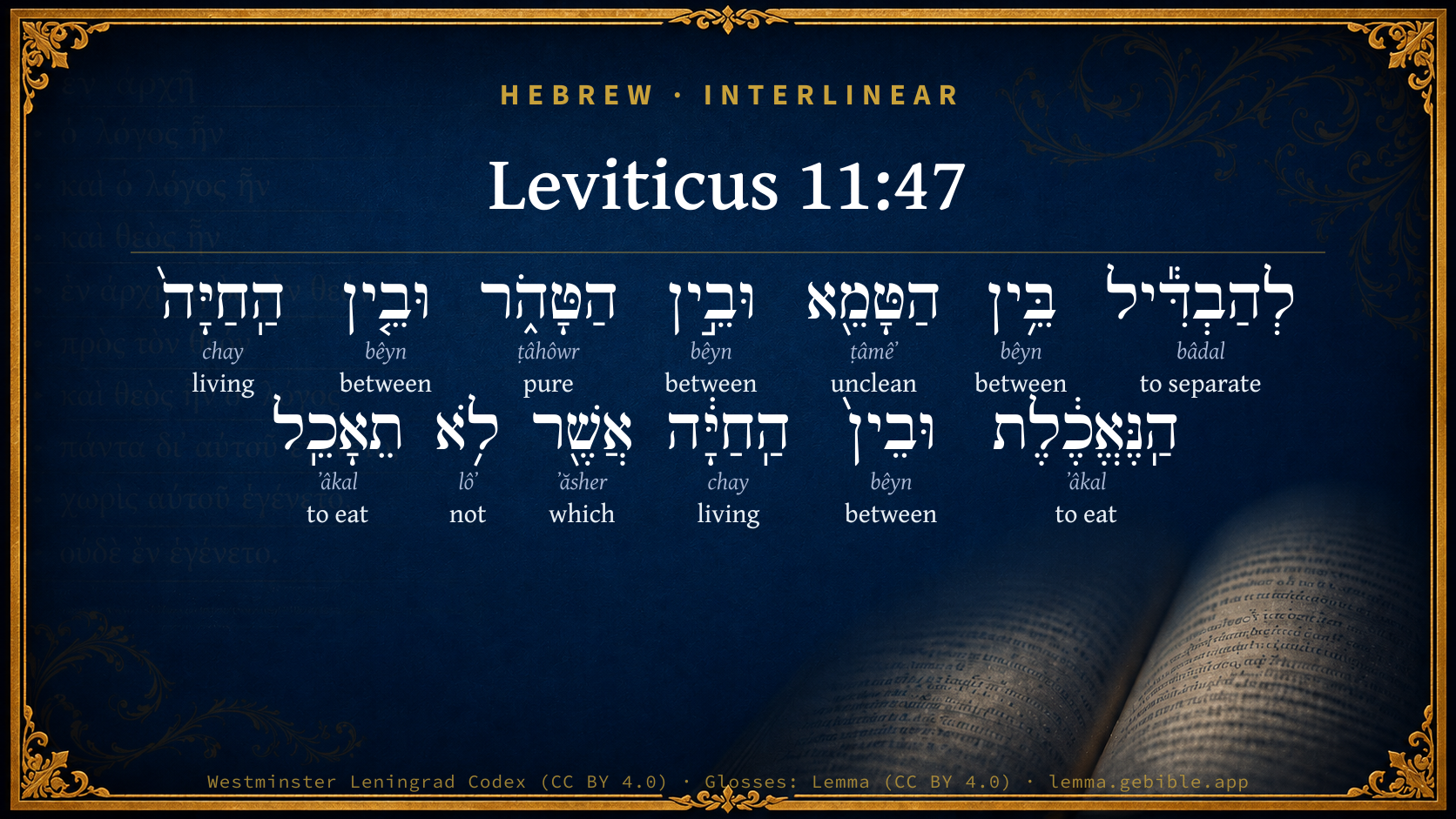
Leviticus 11:47

Hebrew (Westminster Leningrad Codex) Leviticus 11:47 appears in the Hebrew Old Testament. The text above is from the Westminster Leningrad Codex. Each word links to its Strong’s number, a concise gloss, and parsing drawn from the Open Scriptures Hebrew Bible morphology. Click any word for its full Brown-Driver-Briggs (BDB) entry.
Download image
Cite this verse

Leviticus 11:47 (World English Bible). Public Domain. Lemma interlinear Bible study tool, https://lemma.gebible.app/v/leviticus/11/47.

Show BibTeX & RIS
BibTeX
RIS
English Translation
to make a distinction between the unclean and the clean, and between the living thing that may be eaten and the living thing that may not be eaten.'"
World English Bible · Public Domain
Download a study sheet

One document with this verse’s original text, its word-by-word gloss line, the meaning frame, cross-references with their text, attributed commentary, and full source and license credits — printable, and it pastes into notes with its structure intact.

This verse Autodidact and up

Study sheet (.html) Plain text (.txt)

A passage Seminary Student

Up to 50 verses in one chapter. A passage sheet keeps up to 6 commentary sources and 12 cross-references per verse, in the order this page ranks them, and says so on the sheet whenever that leaves anything out. Ask for a single verse and you get the Autodidact verse sheet above.

Everything on this page stays free to read, with no account — the sheet is a download of what is already on screen, not access to it.

Want to remove ads? Support Godless Engineer
Compare translations 3

The same verse in 3 English versions, stacked beneath the original-language interlinear above. Click any original word for its lexicon entry.

Each is an independent rendering of the whole verse — the interlinear is not word-aligned to these translations.

Highlighted words mark where these versions differ — a whole-verse word diff, not a word-by-word alignment.

  • World English Bible Public Domain
    to make a distinction between the unclean and the clean, and between the living thing that may be eaten and the living thing that may not be eaten.'"
  • King James Version Public Domain
    To make a difference between the unclean and the clean, and between the beast that may be eaten and the beast that may not be eaten.
  • unfoldingWord Literal Text CC BY-SA 4.0
    to separate between the unclean and between the clean and between the living thing, the one being eaten, and between the living thing that shall not be eaten.’”

unfoldingWord Literal Text — © unfoldingWord, licensed CC BY-SA 4.0. Word-aligned USFM3 via Door43 (git.door43.org/unfoldingWord/en_ult).

Versions to compare (up to 4)

3 of 4 selected

Show all 18 translations

Every available English version of this verse, each an independent rendering of the whole verse.

  • World English Bible Public Domain
    to make a distinction between the unclean and the clean, and between the living thing that may be eaten and the living thing that may not be eaten.'"
  • Berean Standard Bible Public Domain
    You must distinguish between the unclean and the clean, between animals that may be eaten and those that may not.’”
  • Majority Standard Bible Public Domain
    You must distinguish between the unclean and the clean, between animals that may be eaten and those that may not.’”
  • King James Version Public Domain
    To make a difference between the unclean and the clean, and between the beast that may be eaten and the beast that may not be eaten.
  • American Standard Version (1901) Public Domain
    to make a distinction between the unclean and the clean, and between the living thing that may be eaten and the living thing that may not be eaten.
  • Revised Version (1885) Public Domain
    to make a difference between the unclean and the clean, and between the living thing that may be eaten and the living thing that may not be eaten.
  • Geneva Bible (1599) Public Domain
    That there may be a difference betweene the vncleane and cleane, and betweene the beast that may be eaten, and the beast that ought not to be eaten.
  • Douay-Rheims (1899) Public Domain
    That you may know the differences of the clean, and unclean, and know what you ought to eat, and what to refuse.
  • Young's Literal Translation Public Domain
    to make separation between the unclean and the pure, and between the beast that is eaten, and the beast that is not eaten.'
  • Literal Standard Version CC BY-SA 4.0
    to make separation between the unclean and the pure, and between the beast that is eaten, and the beast that is not eaten.”
  • Unlocked Literal Bible CC BY-SA 4.0
    for which a distinction is to be made between the unclean and the clean, and between the living things that may be eaten and the living things that may not be eaten.'”
  • unfoldingWord Literal Text CC BY-SA 4.0
    to separate between the unclean and between the clean and between the living thing, the one being eaten, and between the living thing that shall not be eaten.’”
  • Darby Bible Public Domain
    to make a difference between the unclean and the clean, and between the beast that is to be eaten and the beast that is not to be eaten.
  • World Messianic Bible Public Domain
    to make a distinction between the unclean and the clean, and between the living thing that may be eaten and the living thing that may not be eaten.’”
  • Webster's Bible Public Domain
    To make a difference between the unclean and the clean, and between the beast that may be eaten and the beast that may not be eaten.
  • Free Bible Version CC BY-SA 4.0
    You must recognize the difference between unclean and clean, between those animals that can be eaten and those that can't.”
  • Bible in Basic English Public Domain
    Marking out the unclean from the clean, and the living thing which may be used for food from that which may not.
  • JPS Tanakh (1917) Public Domain
    to make a difference between the unclean and the clean, and between the living thing that may be eaten and the living thing that may not be eaten.

Literal Standard Version (2020), Covenant Press — licensed CC BY-SA 4.0. Text via the HelloAO Bible API (eBible.org). Unlocked Literal Bible (unfoldingWord) — licensed CC BY-SA 4.0. Text via the HelloAO Bible API (eBible.org). unfoldingWord Literal Text — © unfoldingWord, licensed CC BY-SA 4.0. Word-aligned USFM3 via Door43 (git.door43.org/unfoldingWord/en_ult). Free Bible Version, Dr. Jonathan Gallagher — licensed CC BY-SA 4.0. Text via the HelloAO Bible API (eBible.org).

Word by word

More ways to search: Search by grammar → Find every occurrence → Compare this word →

Practice this passage: Drill this verse → Learn its vocabulary →

לְהַבְדִּ֕יל
bâdal
H914
“to separate”
Preposition + Verb, Hiphil, Infinitive Construct
Part of Speech
Preposition + Verb
Stem
Hiphil
Form
Infinitive Construct
Full BDB Definition

Origin: a primitive root

TWOT: 203

to divide, separate - (Hiphil) - to divide, separate, sever - to separate, set apart - to make a distinction, difference - to divide into parts - (Niphal) - to separate oneself from (reflexive of 1a2) - to withdraw from - to separate oneself unto - to be separated - to be excluded - to be set apart
  1. בֵּ֥ין bêyn H996 “between” Preposition
  2. הַטָּמֵ֖א ṭâmêʼ H2931 “the · unclean” Particle, Definite Article + Adjective, Adjective, Masculine, Singular, Absolute
  3. וּבֵ֣ין bêyn H996 “and · between” Conjunction + Preposition
  4. הַטָּהֹ֑ר ṭâhôwr H2889 “the · pure” Particle, Definite Article + Adjective, Adjective, Masculine, Singular, Absolute
  5. וּבֵ֤ין bêyn H996 “and · between” Conjunction + Preposition
  6. הַֽחַיָּה֙ chay H2416 “the · living” Particle, Definite Article + Noun, Common, Feminine, Singular, Absolute
  7. הַֽנֶּאֱכֶ֔לֶת ʼâkal H398 “the · eaten” Particle, Definite Article + Verb, Niphal, Participle Passive, Feminine, Singular, Absolute
  8. וּבֵין֙ bêyn H996 “and · between” Conjunction + Preposition
  9. הַֽחַיָּ֔ה chay H2416 “the · living” Particle, Definite Article + Noun, Common, Feminine, Singular, Absolute
  10. אֲשֶׁ֖ר ʼăsher H834 “which” Particle, Relative
  11. לֹ֥א lôʼ H3808 “not” Particle, Negative
  12. תֵאָכֵֽל ʼâkal H398 “to eat” Verb, Niphal, Imperfect, 3rd Person, Feminine, Singular

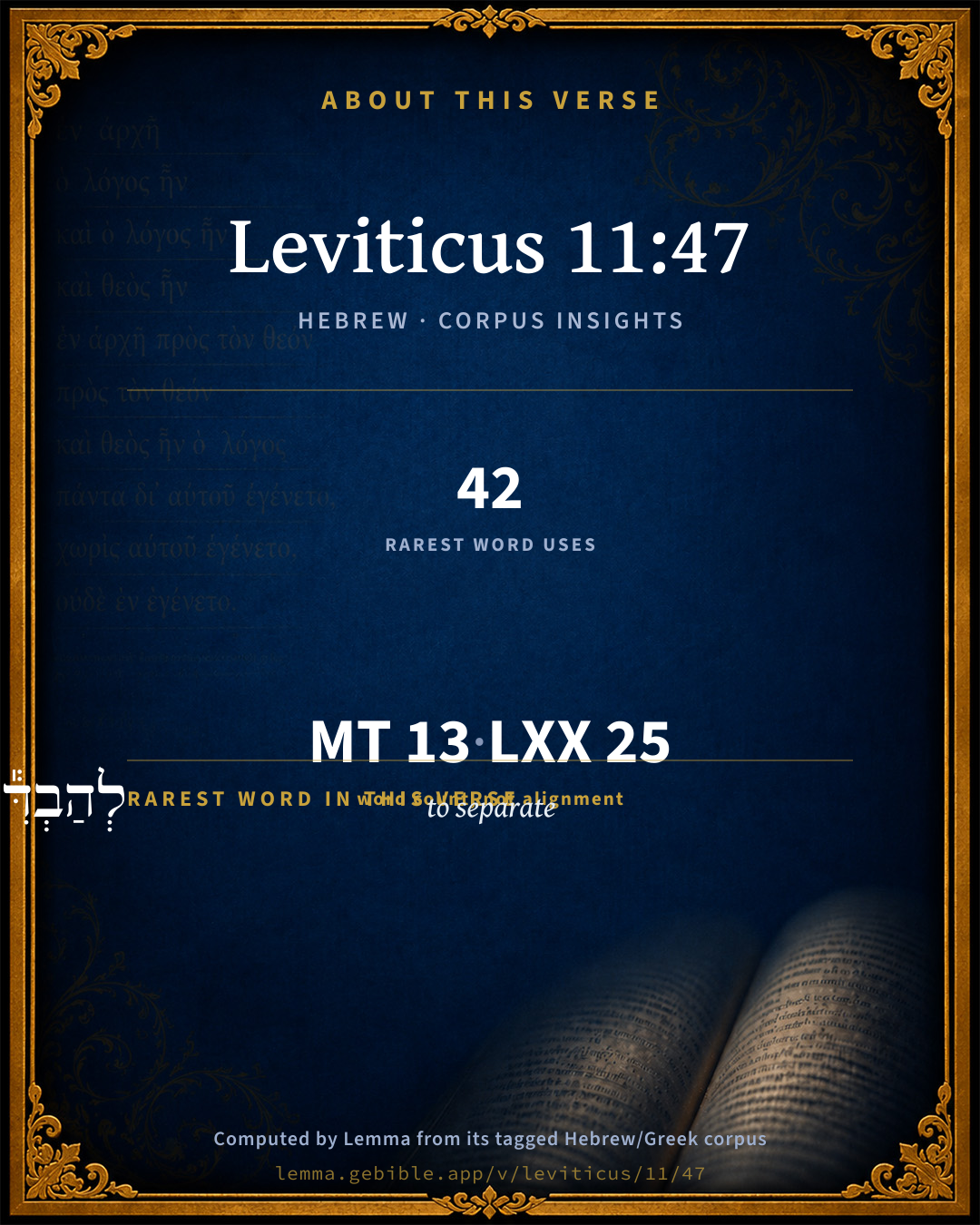
About this verse

These counts appear in no published source. They are computed here, from the morphology-tagged text and Lemma’s own curated glosses. What Lemma adds →

13
words
8
distinct lemmas
Pentateuch
section

Shared distinctive vocabulary

לְהַבְדִּ֕יל to separate H914 occurs in 40 verses of the Hebrew Bible. Also found in:

Grammatical profile

  • 3 verbs
  • 2 nouns
  • 2 adjectives
  • 4 prepositions
  • 2 particles

Verb forms

  • לְהַבְדִּ֕יל Hiphil · Infinitive Construct
  • הַֽנֶּאֱכֶ֔לֶת Niphal · Participle Passive
  • תֵאָכֵֽל Niphal · Imperfect

Repetition

Words recur within this verse — often emphatic in Hebrew:

  • בֵּ֥ין between H996 ×4
  • הַֽחַיָּה֙ living H2416 ×2
  • הַֽנֶּאֱכֶ֔לֶת to eat H398 ×2

Hebrew & Septuagint length

In English translation the verse runs 28 words from the Hebrew and 32 from the Septuagint (LXX English) — closely comparable.

A rough comparison of the two English renderings, which tokenize alike — not a word-level alignment.

Word counts can differ between the Hebrew and the Greek without any difference in meaning — e.g. the Hebrew direct-object marker אֵת has no separate Greek word, and Greek often adds the article ὁ.

In the original languages it is 13 Hebrew tokens and 25 Greek tokens — but the two are counted differently (Hebrew bundles its prefixes and suffixes into one token; the Greek is in lemma form), so that isn’t a like-for-like length.

Cross-references

5

Topical passages linked to Leviticus 11:47 in the Treasury of Scripture Knowledge — connected by theme and wording, ordered by reader-vote popularity; previews shown in the World English Bible.

  • Leviticus 10:10 and that you are to make a distinction between the holy and the common, and between the unclean and the clean;
  • Ezekiel 44:23 They shall teach my people the difference between the holy and the common, and cause them to discern between the unclean and the clean.
  • Romans 14:13–23 Therefore let's not judge one another any more, but judge this rather, that no man put a stumbling block in his brother's way, or an occasion for falling.
  • Malachi 3:18 Then you shall return and discern between the righteous and the wicked, between him who serves God and him who doesn't serve him.
  • Romans 14:2–3 One man has faith to eat all things, but he who is weak eats only vegetables.

Cross-references courtesy of OpenBible.info (CC BY 4.0).

Hebrew and Greek witnesses Masoretic Hebrew ↔ Greek Septuagint

The same verse in the two great witnesses to the Old Testament, shown verse-for-verse.

These are two independent witnesses, not word-aligned to each other, and the Septuagint is shown in lemma (dictionary) form.

Hebrew Leviticus 11:47 Masoretic · Westminster Leningrad Codex

לְהַבְדִּ֕יל בֵּ֥ין הַטָּמֵ֖א וּבֵ֣ין הַטָּהֹ֑ר וּבֵ֤ין הַֽחַיָּה֙ הַֽנֶּאֱכֶ֔לֶת וּבֵין֙ הַֽחַיָּ֔ה אֲשֶׁ֖ר לֹ֥א תֵאָכֵֽל

to make a distinction between the unclean and the clean, and between the living thing that may be eaten and the living thing that may not be eaten.'"

World English Bible · Public Domain

Greek LXX Leviticus 11:47 Septuagint · lemma form

διαστέλλω ἀνά μέσος ὁ ἀκάθαρτος καί ἀνά μέσος ὁ καθαρός καί ἀνά μέσος ὁ ζωογονέω ὁ ἐσθίω καί ἀνά μέσος ὁ ζωογονέω ὁ μή ἐσθίω

to distinguish between the unclean and the clean; and between those that bring forth alive, such as should be eaten, and those that bring forth alive, such as should not be eaten.

LXX2012 (modern English Septuagint) · Public Domain

On this verse, Ellicott's Commentary for English Readers discusses the Septuagint’s reading. Read the note in Commentary ↓

Hebrew: Westminster Leningrad Codex (CC BY 4.0). Greek: Septuagint (public domain); English from LXX2012 (modern English Septuagint) (Public Domain). How the Septuagint differs from the Hebrew →

Targum (Aramaic paraphrase)

2

The Targum is the ancient Jewish Aramaic paraphrase of the Hebrew Scriptures — an interpretive translation, not the Hebrew text itself. Onkelos (literal) and Pseudo-Jonathan (expansive) render the Torah, and Jonathan the Prophets. Coverage is partial: where no permissively-licensed English translation exists for a verse, only the Aramaic is shown. This is verse-level text, not a word-by-word alignment to the Hebrew.

  1. Targum Onkelos Torah (Genesis–Deuteronomy)
    לְאַפְרָשָׁא בֵּין מְסָאָבָא וּבֵין דַכְיָא וּבֵין חַיְתָא דְמִתְאַכְלָא וּבֵין חַיְתָא דִי לָא מִתְאַכְלָא

    (no public-domain English translation for this verse)

    Targum Onkelos — Aramaic: “Onkelos Genesis” (public domain); “Onkelos Exodus” (public domain); “Onkelos Leviticus” (public domain); “Onkelos Numbers” (public domain); “Onkelos Deuteronomy” (public domain). English: “Sefaria Community Translation” (CC0 1.0 (public-domain dedication)); “J.W. Etheridge. The Targums of Onkelos and Jonathan Ben Uzziel on the Pentateuch. London: Longmans, Green, 1862” (public domain). Text via Sefaria.

  2. Targum Pseudo-Jonathan Torah (Genesis–Deuteronomy)
    לְאַפְרָשָׁא בֵּינֵי מְסָאֲבָא וּבֵינֵי דַכְיָא בֵּינֵי חַיְיתָא דְמִיכַשְׁרָא לְאִיתְאַכְלָא וּבֵינֵי חַיְיתָא דְלָא מִיכַשְׁרָא לְאִיתְאַכְלָא

    for making distinction between the unclean and the clean; between the animal whose flesh may be eaten, and the animal whose flesh may not be eaten.

    Targum Pseudo-Jonathan — Aramaic: “Targum Jonathan on Genesis” (public domain); “Targum Jonathan on Exodus” (public domain); “Targum Jonathan on Leviticus” (public domain); “Targum Jonathan on Numbers” (public domain); “Targum Jonathan on Deuteronomy” (public domain). English: “The Targum of Jonathan ben Uzziel, trans. J. W. Etheridge, London, 1862” (public domain). Text via Sefaria.

Commentary

Notes on Leviticus 11:47 from classic Christian and Jewish commentators (each source and its license shown beneath its notes). The classic Christian expositions comment on the surrounding passage and are grouped to its opening verse, so a note may address several verses; the Jewish commentaries on the Tanakh (Rashi and others) are per-verse, so they appear only where the commentator wrote on this verse.

Lemma curates 59 commentaries, every one of them public domain or Creative Commons licensed, each selected and text-cleaned for this edition rather than reprinted as found. About our sources →

Trapp's Complete Commentary

John Trapp

Lev 11:47 To make a difference between the unclean and the clean, and between the beast that may be eaten and the beast that may not be eaten.

Ver. 47. To make a difference.] Ministers also in their discourses should put a difference, and take out "the precious from the vile," {Jer 15:19} as did Zuinglius; who, when he inveighed most vehemently against sin, would usually come in with this clause, Probe vir, haec nihil ad te, This is not intended to thee, thou godly man.

John Trapp, A Commentary or Exposition upon All the Books of the Old and New Testament (1647–1656) — public domain. Text from a community e-Sword module.

Jamieson, Fausset & Brown

Robert Jamieson, A. R. Fausset & David Brown

make a difference between the unclean and the clean--that is, between animals used and not used for food. It is probable that the laws contained in this chapter were not entirely new, but only gave the sanction of divine enactment to ancient usages. Some of the prohibited animals have, on physiological grounds, been everywhere rejected by the general sense or experience of mankind; while others may have been declared unclean from their unwholesomeness in warm countries or from some reasons, which are now imperfectly known, connected with contemporary idolatry.

Next: Leviticus Chapter 12

Jamieson, Fausset & Brown — Commentary Critical and Explanatory on the Whole Bible (1871) — public domain (CC PDM 1.0). Text via the HelloAO Bible API.

Ellicott's Commentary for English Readers

(47) To make a difference.—Better, that ye may put difference, as the Authorised Version renders the same word in Lev_10:10. That is, the design of the dietary law is to enable both the administrators of the law and the people to distinguish, by the characteristics and criteria specified above, between what is clean and unclean.

And between the beast that may be eaten.—From the fact that the same word, “beast,” is used in both clauses with regard to the animal which may be eaten and the one which may not be eaten without the qualifying adjunct “clean” and “unclean,” the administrators of the law during the second Temple concluded that the same clean animal is meant in both instances, under different conditions. The clean animal may be eaten when it is in a healthy state, but the same animal may not be eaten when it has organic defects, or is diseased. Hence they enacted the following canon: an animal is perfectly sound when it is capable of conceiving and bringing forth young. This is the reason why the LXX. renders the word beast here by viviparous.

A Bible Commentary for English Readers, edited by Charles John Ellicott (1878–1897) — public domain. Text from a community e-Sword module.

John Gill's Exposition

To make a difference between the unclean and the clean,.... Whether of beasts, fish, fowl, and flying creeping things:

and between the beast that may be eaten, and the beast that may not be eaten; the former clause takes in all in general, this instances in a particular sort of creatures; and the first mentioned of which, that might be eaten, are, that part the hoof, are cloven footed, and chew the cud; and that might not, that chew the cud, but divide not the hoof, or divide the hoof, but chew not the cud; and now, by such like descriptions and distinctions of the creatures treated of, the Israelites would be able to make a difference between the one and the other, and know what was to be eaten, and what not.

Next: Leviticus Chapter 12

John Gill's Exposition of the Whole Bible (1746–1763) — public domain (CC PDM 1.0). Text via the HelloAO Bible API.

Rashi

Rabbi Shlomo Yitzchaki (Rashi)

להבדיל TO MAKE A DISTINCTION — Not that one should only learn the laws, but it is a command that you should know and recognize the differences and be expert in them (Sifra, Shemini, Chapter 12 6).

‎הטהור‎‎ בין הטמא ‎ובין‎ BETWEEN THE UNCLEAN AND THE CLEAN — Is it necessary to say. that one should understand to distinguish between the ass and the cow? Have they not already been closely defined as to their distinguishing characteristics? But the meaning is: that you should thoroughly understand to distinguish between what is unclean for you and what is clean for you (i. e. between what is forbidden and what is permitted to you) — between the case of an animal only half of whose wind-pipe has been cut through by the knife, and the case when the greater part has been cut through (in the former case the animal is forbidden, in the latter it is permitted as food) (Sifra, Shemini, Chapter 12 7).

ובין החיה הנאכלת AND BETWEEN AN ANIMAL THAT MAY BE EATEN — Is it necessary to say that one should learn to distinguish between a stag and a wild ass? Have not these already been closely defined as to their distinguishing characteristics? But the meaning is: that you should thoroughly understand to distinguish between the case when there have arisen in it (in the animal) signs by which one might regard it as forbidden (טרפה) and yet it is permitted as food (כשרה), and the case when there have arisen in it signs by which one might regard it as forbidden and because of which it is actually unfitted to be eaten (Sifra, Shemini, Chapter 12 8).

Rashi on the Tanakh — English translations: “The Judaica Press complete Tanach with Rashi, translated by A. J. Rosenberg” (CC BY 4.0); “Pentateuch with Rashi's commentary by M. Rosenbaum and A.M. Silbermann, 1929-1934” (public domain); “The Metsudah Tanach series, Lakewood, N.J” (CC BY 4.0); and “The Book of Joshua, Metsudah Publications, 1997” (CC BY 4.0). Text via Sefaria.

Ramban (Nachmanides)

Rabbi Moshe ben Nachman (Ramban / Nachmanides)

TO MAKE A DISTINCTION BETWEEN THE UNCLEAN AND THE CLEAN. This means that we should distinguish between all things mentioned above, between the unclean and the clean, with regard to impurity[through contact]. AND BETWEEN THE ANIMAL THAT MAY BE EATEN. This is connected with the word “soul” mentioned [in the preceding verse], thus meaning: “and between the living animal that may be eaten.” Scripture is thus stating that we should distinguish as far as eating is concerned, between the living animal that may be eaten according to the Torah in the waters and upon the earth, and the animal in them that may not be eaten. In the Torath Kohanim the Rabbis said:. “And ‘hachayah’ (the beast) that may not be eaten. The Sages say, this establishes a prohibition against eating a [forbidden type of] beast.” (beast) is included in the term beheimah (cattle), as explained above in Verse 24, yet Scripture mentioned here a specific prohibition with regard to a forbidden chayah. If so, there is a special negative commandment regarding it.Now Rashi wrote: “To make a distinction between the unclean and the clean. Is it necessary to tell us to distinguish between the cow and the ass? Have they not clearly been defined already [by distinguishing signs]? But the meaning is: [to make a distinction between] that which is forbidden for you and that which is permitted for you, between the case of an animal of which only half of the windpipe was cut, [in which case, even if he cut through the whole gullet, it may not be eaten], and the case of an animal of which the greater part of the windpipe [or the entire windpipe] was cut through, [in addition to the gullet, or the greater part of it being cut through, which is permitted to be eaten].” There [in Tractate Chullin] it is taught: “And how much is there between half and the greater part of it? As much as a hair’s breadth,” [and it is this which requires ‘making a distinction’]. Do not be disturbed here because of that which they said there in the Gemara that it must be “a greater part which is apparent to the eyes” [thus a mere hair’s breadth would not be sufficient], for the meaning of that was only in order to exclude the opinion of the Sage who says that half and half is treated as if the majority [was cut through]; therefore they said that the part cut through must actually be a greater part, which is apparent to the eyes, not a half which we only treat in our minds [as the greater part], and we say that “the greater part” was cut through since the part not cut through is not larger than it [the part which was cut through]. But so long as more than half was [actually] cut through, it may be eaten, even if it be only by as much as a hair’s breadth, as is clearly explained in that Beraitha, and as it emerges from the discussion of the Gemara.Tazria

Ramban (Nachmanides) on the Tanakh — English translation: “Commentary on the Torah by Ramban (Nachmanides). Translated and annotated by Charles B. Chavel. New York, Shilo Pub. House, 1971-1976” (CC BY 4.0). Text via Sefaria.

Lesson kit

Teaching starters — assembled from the data on this page, not authored interpretation. Every prompt links to the verse data it draws on. Edit before teaching.

Leviticus, in the Pentateuch, opens this verse with 13 words (8 distinct Hebrew lemmas). Its most distinctive word is bâdal (“to separate”). A historical commentator’s framing appears above. Read the whole chapter for the surrounding context.

Discussion questions

  1. The word bâdal carries the sense “to separate.” How does it shape the verse?
  2. How does Genesis 1:4, which shares the word «to separate», read alongside this verse?
  3. What does the repetition of “between” (4× in this one verse) do in this verse?
  4. These translations render this verse differently; the difference is in the English rendering, not the original. What questions does that raise?
  5. «לְהַבְדִּ֕יל» is a Hiphil Infinitive Construct verb. How does that grammatical form shape the action described?
  6. Compare how Trapp's Complete Commentary and Jamieson, Fausset & Brown read this verse. Where do they agree or differ?

Things to notice

Reading settings

Reading text

Shown beneath each verse's original-language words.

Old Testament
Old Testament edition

Read the OT as the Masoretic Hebrew (MT) or the Greek Septuagint (LXX).

English shown for the Greek Septuagint (in the Hebrew ↔ Greek comparison).

Comparing translations? Open the Compare panel on any verse page to stack up to four side by side.