
Song of Solomon 2:3

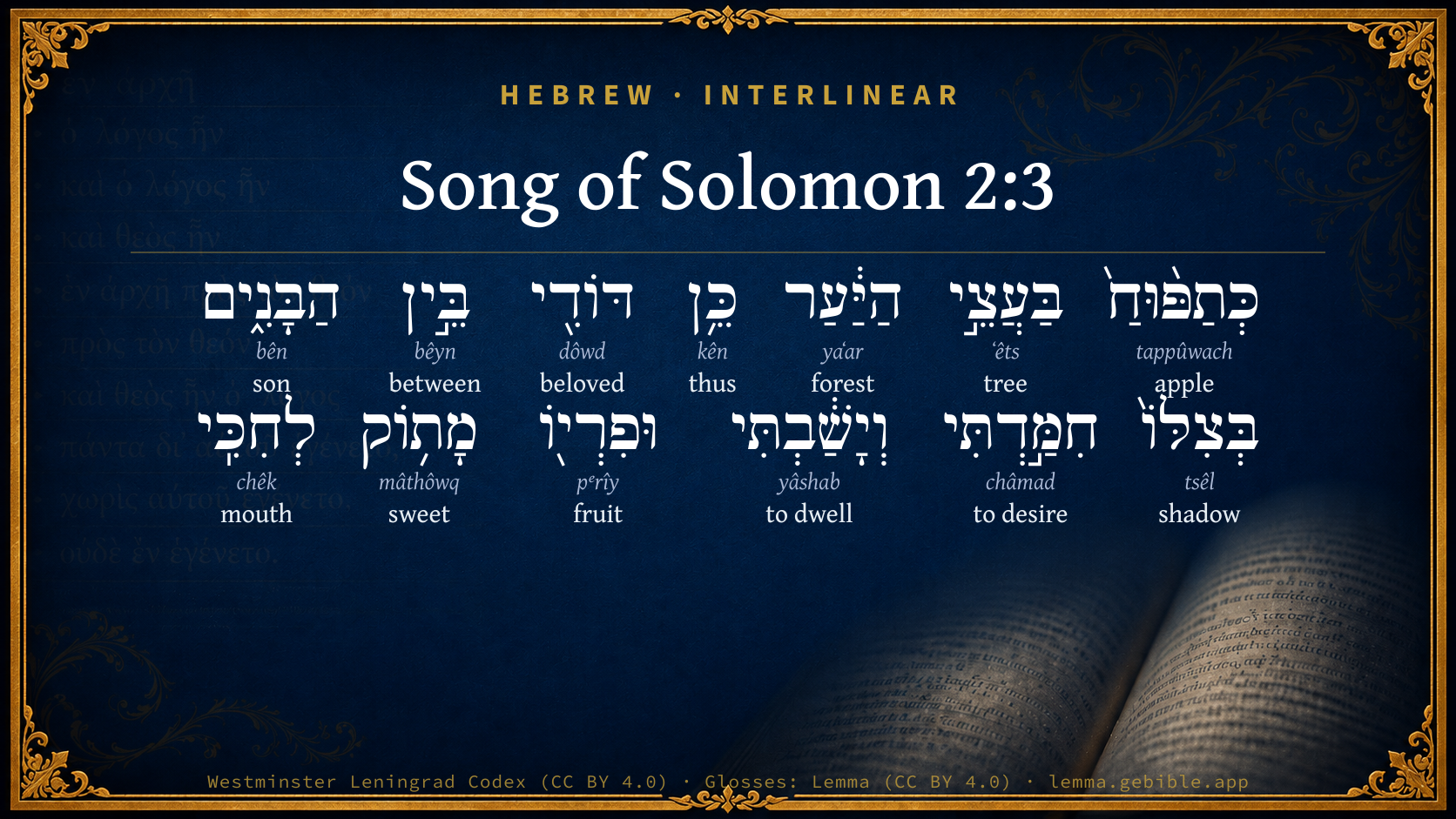
Hebrew (Westminster Leningrad Codex) Song of Solomon 2:3 appears in the Hebrew Old Testament. The text above is from the Westminster Leningrad Codex. Each word links to its Strong’s number, a concise gloss, and parsing drawn from the Open Scriptures Hebrew Bible morphology. Click any word for its full Brown-Driver-Briggs (BDB) entry.
Download image
Cite this verse

Song of Solomon 2:3 (World English Bible). Public Domain. Lemma interlinear Bible study tool, https://lemma.gebible.app/v/song-of-solomon/2/3.

Show BibTeX & RIS
BibTeX
RIS
English Translation
As the apple tree among the trees of the wood, So is my beloved among the sons. I sat down under his shadow with great delight, His fruit was sweet to my taste.
World English Bible · Public Domain
Download a study sheet

One document with this verse’s original text, its word-by-word gloss line, the meaning frame, cross-references with their text, attributed commentary, and full source and license credits — printable, and it pastes into notes with its structure intact.

This verse Autodidact and up

Study sheet (.html) Plain text (.txt)

A passage Seminary Student

Up to 50 verses in one chapter. A passage sheet keeps up to 6 commentary sources and 12 cross-references per verse, in the order this page ranks them, and says so on the sheet whenever that leaves anything out. Ask for a single verse and you get the Autodidact verse sheet above.

Everything on this page stays free to read, with no account — the sheet is a download of what is already on screen, not access to it.

Want to remove ads? Support Godless Engineer
Compare translations 3

The same verse in 3 English versions, stacked beneath the original-language interlinear above. Click any original word for its lexicon entry.

Each is an independent rendering of the whole verse — the interlinear is not word-aligned to these translations.

Highlighted words mark where these versions differ — a whole-verse word diff, not a word-by-word alignment.

  • World English Bible Public Domain
    As the apple tree among the trees of the wood, So is my beloved among the sons. I sat down under his shadow with great delight, His fruit was sweet to my taste.
  • King James Version Public Domain
    As the apple tree among the trees of the wood, so is my beloved among the sons. I sat down under his shadow with great delight, and his fruit was sweet to my taste.
  • unfoldingWord Literal Text CC BY-SA 4.0
    Like an apple tree among the trees of the forest, so my beloved among the sons. In his shadow I greatly delighted, and I sat, and his fruit sweet to my palate.

unfoldingWord Literal Text — © unfoldingWord, licensed CC BY-SA 4.0. Word-aligned USFM3 via Door43 (git.door43.org/unfoldingWord/en_ult).

Versions to compare (up to 4)

3 of 4 selected

Show all 18 translations

Every available English version of this verse, each an independent rendering of the whole verse.

  • World English Bible Public Domain
    As the apple tree among the trees of the wood, So is my beloved among the sons. I sat down under his shadow with great delight, His fruit was sweet to my taste.
  • Berean Standard Bible Public Domain
    Like an apple tree among the trees of the forest is my beloved among the young men. I delight to sit in his shade, and his fruit is sweet to my taste.
  • Majority Standard Bible Public Domain
    Like an apple tree among the trees of the forest is my beloved among the young men. I delight to sit in his shade, and his fruit is sweet to my taste.
  • King James Version Public Domain
    As the apple tree among the trees of the wood, so is my beloved among the sons. I sat down under his shadow with great delight, and his fruit was sweet to my taste.
  • American Standard Version (1901) Public Domain
    As the apple-tree among the trees of the wood, So is my beloved among the sons. I sat down under his shadow with great delight, And his fruit was sweet to my taste.
  • Revised Version (1885) Public Domain
    As the apple tree among the trees of the wood, so is my beloved among the sons. I sat down under his shadow with great delight, and his fruit was sweet to my taste.
  • Geneva Bible (1599) Public Domain
    Like the apple tree among the trees of the forest, so is my welbeloued among the sonnes of men: vnder his shadow had I delite, and sate downe: and his fruite was sweete vnto my mouth.
  • Douay-Rheims (1899) Public Domain
    As the apple tree among the trees of the woods, so is my beloved among the sons. I sat down under his shadow, whom I desired: and his fruit was sweet to my palate.
  • Young's Literal Translation Public Domain
    As a citron among trees of the forest, So `is' my beloved among the sons, In his shade I delighted, and sat down, And his fruit `is' sweet to my palate.
  • Literal Standard Version CC BY-SA 4.0
    As a citron among trees of the forest, || So [is] my beloved among the sons, || In his shade I delighted, and sat down, || And his fruit [is] sweet to my palate.
  • Unlocked Literal Bible CC BY-SA 4.0
    As an apricot tree among the trees of the forest, so is my beloved among the young men. I sit down under his shadow with great delight, and his fruit is sweet to my taste.
  • unfoldingWord Literal Text CC BY-SA 4.0
    Like an apple tree among the trees of the forest, so my beloved among the sons. In his shadow I greatly delighted, and I sat, and his fruit sweet to my palate.
  • Darby Bible Public Domain
    As the apple-tree among the trees of the wood, So is my beloved among the sons: In his shadow have I rapture and sit down; And his fruit is sweet to my taste.
  • World Messianic Bible Public Domain
    As the apple tree among the trees of the wood, so is my beloved among the sons. I sat down under his shadow with great delight, his fruit was sweet to my taste.
  • Webster's Bible Public Domain
    As the apple-tree among the trees of the wood, so is my beloved among the sons. I sat down under his shadow with great delight, and his fruit was sweet to my taste.
  • Free Bible Version CC BY-SA 4.0
    My love is like an apple tree among the forest trees, compared to other young men. I love to sit down in his shade and his fruit tastes sweet to me.
  • Bible in Basic English Public Domain
    As the apple-tree among the trees of the wood, so is my loved one among the sons. I took my rest under his shade with great delight, and his fruit was sweet to my taste.
  • JPS Tanakh (1917) Public Domain
    As an apple-tree among the trees of the wood, so is my beloved among the sons. Under its shadow I delighted to sit, and its fruit was sweet to my taste.

Literal Standard Version (2020), Covenant Press — licensed CC BY-SA 4.0. Text via the HelloAO Bible API (eBible.org). Unlocked Literal Bible (unfoldingWord) — licensed CC BY-SA 4.0. Text via the HelloAO Bible API (eBible.org). unfoldingWord Literal Text — © unfoldingWord, licensed CC BY-SA 4.0. Word-aligned USFM3 via Door43 (git.door43.org/unfoldingWord/en_ult). Free Bible Version, Dr. Jonathan Gallagher — licensed CC BY-SA 4.0. Text via the HelloAO Bible API (eBible.org).

Word by word

More ways to search: Search by grammar → Find every occurrence → Compare this word →

Practice this passage: Drill this verse → Learn its vocabulary →

כְּתַפּ֨וּחַ֙
tappûwach
H8598
“like/as · apple”
Preposition + Noun, Common, Masculine, Singular, Absolute
Part of Speech
Preposition + Noun
Type
Common
Gender
Masculine
Number
Singular
State
Absolute
Full BDB Definition

Origin: from H5301

TWOT: 1390c

apple, apple tree - apple tree - apples
  1. בַּעֲצֵ֣י ʻêts H6086 “in/at · trees of” Preposition + Noun, Common, Masculine, Plural, Construct
  2. הַיַּ֔עַר yaʻar H3293 “the · forest” Particle, Definite Article + Noun, Common, Masculine, Singular, Absolute
  3. כֵּ֥ן kên H3651 “thus” Particle, Demonstrative
  4. דּוֹדִ֖י dôwd H1730 “beloved · my” Noun, Common, Masculine, Singular, Construct + Suffix, Personal, 1st Person, Common, Singular
  5. בֵּ֣ין bêyn H996 “between” Preposition
  6. הַבָּנִ֑ים bên H1121 “the · sons” Particle, Definite Article + Noun, Common, Masculine, Plural, Absolute
  7. בְּצִלּוֹ֙ tsêl H6738 “in/at · shadow · his” Preposition + Noun, Common, Masculine, Singular, Construct + Suffix, Personal, 3rd Person, Masculine, Singular
  8. חִמַּ֣דְתִּי châmad H2530 “to desire” Verb, Piel, Perfect, 1st Person, Common, Singular
  9. וְיָשַׁ֔בְתִּי yâshab H3427 “and · to dwell” Conjunction + Verb, Qal, Perfect, 1st Person, Common, Singular
  10. וּפִרְי֖וֹ pᵉrîy H6529 “and · fruit · his” Conjunction + Noun, Common, Masculine, Singular, Construct + Suffix, Personal, 3rd Person, Masculine, Singular
  11. מָת֥וֹק mâthôwq H4966 “sweet” Adjective, Adjective, Masculine, Singular, Absolute
  12. לְחִכִּֽי chêk H2441 “to/for · mouth · my” Preposition + Noun, Common, Masculine, Singular, Construct + Suffix, Personal, 1st Person, Common, Singular

About this verse

These counts appear in no published source. They are computed here, from the morphology-tagged text and Lemma’s own curated glosses. What Lemma adds →

13
words
13
distinct lemmas
Wisdom
section

Notable vocabulary

The rarest word here is כְּתַפּ֨וּחַ֙ apple H8598 — appearing just 6 times in the whole Hebrew Bible.

Shared distinctive vocabulary

כְּתַפּ֨וּחַ֙ apple H8598 occurs in 6 verses of the Hebrew Bible. Also found in:

Grammatical profile

  • 2 verbs
  • 8 nouns
  • 1 adjective
  • 1 preposition
  • 1 particle

Verb forms

  • חִמַּ֣דְתִּי Piel · Perfect
  • וְיָשַׁ֔בְתִּי Qal · Perfect

Hebrew & Septuagint length

In English translation the verse runs 33 words from the Hebrew and 31 from the Septuagint (LXX English) — closely comparable.

A rough comparison of the two English renderings, which tokenize alike — not a word-level alignment.

Word counts can differ between the Hebrew and the Greek without any difference in meaning — e.g. the Hebrew direct-object marker אֵת has no separate Greek word, and Greek often adds the article ὁ.

Cross-references

27

Topical passages linked to Song of Solomon 2:3 in the Treasury of Scripture Knowledge — connected by theme and wording, ordered by reader-vote popularity; previews shown in the World English Bible.

  • Song of Solomon 8:5 Who is this who comes up from the wilderness, Leaning on her beloved? Under the apple tree I aroused you. There your mother conceived you. There she was in labor and bore you.
  • Isaiah 25:4 For you have been a stronghold to the poor, a stronghold to the needy in his distress, a refuge from the storm, a shade from the heat, when the blast of the awesome ones is as a storm against the wall.
  • Isaiah 32:2 A man shall be as a hiding-place from the wind, and a covert from the tempest, as streams of water in a dry place, as the shade of a great rock in a weary land.
  • Hebrews 1:1–6 God, having in the past spoken to the fathers through the prophets at many times and in various ways,
  • Hebrews 12:2 looking to Jesus, the author and perfecter of faith, who for the joy that was set before him endured the cross, despising shame, and has sat down at the right hand of the throne of God.
  • John 1:14–18 The Word became flesh, and lived among us. We saw his glory, such glory as of the one and only Son of the Father, full of grace and truth.
  • Psalms 91:1 He who dwells in the secret place of the Most High Will rest in the shadow of the Almighty.
  • Song of Solomon 2:5 Strengthen me with raisins, Refresh me with apples; For I am faint with love.
  • Song of Solomon 4:16 Awake, north wind; and come, you south; Blow on my garden, that its spices may flow out. Let my beloved come into his garden, And taste his precious fruits. Lover
  • Song of Solomon 5:9–10 How is your beloved better than another beloved, You fairest among women? How is your beloved better than another beloved, That you do so adjure us? Beloved
  • Song of Solomon 5:16 His mouth is sweetness; Yes, he is altogether lovely. This is my beloved, and this is my friend, Daughters of Jerusalem. Friends
  • Isaiah 4:2 In that day, Yahweh's branch will be beautiful and glorious, and the fruit of the land will be the beauty and glory of the survivors of Israel.
  • Isaiah 4:6 There will be a pavilion for a shade in the daytime from the heat, and for a refuge and for a shelter from storm and from rain.
  • Ezekiel 47:12 By the river on the bank of it, on this side and on that side, shall grow every tree for food, whose leaf shall not wither, neither shall the fruit of it fail: it shall bring forth new fruit every month, because the waters of it issue out of the sanctuary; and the fruit of it shall be for food, and the leaf of it for healing.
  • John 3:29–31 He who has the bride is the bridegroom; but the friend of the bridegroom, who stands and hears him, rejoices greatly because of the bridegroom's voice. This, my joy, therefore is made full.
  • John 15:1–8 "I am the true vine, and my Father is the farmer.
  • Hebrews 3:1–6 Therefore, holy brothers, partakers of a heavenly calling, consider the Apostle and High Priest of our confession, Jesus;
  • Hebrews 7:23–26 Many, indeed, have been made priests, because they are hindered from continuing by death.
  • 1 John 1:3–4 that which we have seen and heard we declare to you, that you also may have fellowship with us. Yes, and our fellowship is with the Father, and with his Son, Jesus Christ.
  • Genesis 3:22–24 Yahweh God said, "Behold, the man has become like one of us, knowing good and evil. Now, lest he put forth his hand, and also take of the tree of life, and eat, and live forever..."
  • Judges 9:15 The bramble said to the trees, If in truth you anoint me king over you, then come and take refuge in my shade; and if not, let fire come out of the bramble, and devour the cedars of Lebanon.
  • Judges 9:19–20 if you then have dealt truly and righteously with Jerubbaal and with his house this day, then rejoice you in Abimelech, and let him also rejoice in you:
  • Psalms 45:2 You are the most excellent of the sons of men. Grace has anointed your lips, Therefore God has blessed you forever.
  • Psalms 57:1 Be merciful to me, God, be merciful to me, For my soul takes refuge in you. Yes, in the shadow of your wings, I will take refuge, Until disaster has passed.
  • Psalms 89:6 For who in the skies can be compared to Yahweh? Who among the sons of the heavenly beings is like Yahweh,
  • Ezekiel 17:23–24 in the mountain of the height of Israel will I plant it; and it shall bring forth boughs, and bear fruit, and be a goodly cedar: and under it shall dwell all birds of every wing; in the shade of the branches of it shall they dwell.
  • Revelation 22:1–2 He showed me a river of water of life, clear as crystal, proceeding out of the throne of God and of the Lamb,

Cross-references courtesy of OpenBible.info (CC BY 4.0).

Hebrew and Greek witnesses Masoretic Hebrew ↔ Greek Septuagint

The same verse in the two great witnesses to the Old Testament, shown verse-for-verse.

These are two independent witnesses, not word-aligned to each other, and the Septuagint is shown in lemma (dictionary) form.

Hebrew Song of Solomon 2:3 Masoretic · Westminster Leningrad Codex

כְּתַפּ֨וּחַ֙ בַּעֲצֵ֣י הַיַּ֔עַר כֵּ֥ן דּוֹדִ֖י בֵּ֣ין הַבָּנִ֑ים בְּצִלּוֹ֙ חִמַּ֣דְתִּי וְיָשַׁ֔בְתִּי וּפִרְי֖וֹ מָת֥וֹק לְחִכִּֽי

As the apple tree among the trees of the wood, So is my beloved among the sons. I sat down under his shadow with great delight, His fruit was sweet to my taste.

World English Bible · Public Domain

Greek LXX Song of Solomon 2:3 Septuagint · lemma form

ὡς μῆλον ἐν ὁ ξύλον ὁ δρυμός οὕτως ἀδελφιδός ἐγώ ἀνά μέσος ὁ υἱός ἐν ὁ σκιά αὐτός ἐπιθυμέω καί καταἵζω καί καρπός αὐτός γλυκύς ἐν λάρυγξ ἐγώ

As the apple among the trees of the wood, so is my kinsman among the sons. I desired his shadow, and sat down, and his fruit was sweet in my throat.

LXX2012 (modern English Septuagint) · Public Domain

On this verse, Ellicott's Commentary for English Readers discusses the Septuagint’s reading. Read the note in Commentary ↓

Hebrew: Westminster Leningrad Codex (CC BY 4.0). Greek: Septuagint (public domain); English from LXX2012 (modern English Septuagint) (Public Domain). How the Septuagint differs from the Hebrew →

Commentary

Notes on Song of Solomon 2:3 from classic Christian and Jewish commentators (each source and its license shown beneath its notes). The classic Christian expositions comment on the surrounding passage and are grouped to its opening verse, so a note may address several verses; the Jewish commentaries on the Tanakh (Rashi and others) are per-verse, so they appear only where the commentator wrote on this verse.

Lemma curates 59 commentaries, every one of them public domain or Creative Commons licensed, each selected and text-cleaned for this edition rather than reprinted as found. About our sources →

Ellicott's Commentary for English Readers

(3) Apple tree.—So the LXX. and Vulg.; Heb., tappuach. Out of the six times that the word is used, four occur in this book, the other two being Pro_25:11—“apple of gold”—Joe_1:12, where it is joined with vine, fig, &c, as suffering from drought. It has been very variously identified. The quince, the citron, the apple, and the apricot have each had their advocates.

The apple may be set aside, because the Palestine fruit usually called the apple is really the quince, the climate being too hot for our apple. (But see Thornson, The Land and the Book, p. 546.) The requirements to be satisfied are (1) grateful shade, Son_2:3; (2) agreeable taste, Son_2:3-5; (3) sweet perfume, Son_7:8; (4) golden appearance, Pro_25:11. The quince is preferred by many, as being by the ancients consecrated to love, but it does not satisfy (2), being astringent and unpleasant to the taste till cooked. The citron does not, according to Thomson and Tristram, satisfy (1); but according to Rev. W. Drake, in Smith’s Bible Dictionary, “it is a large and beautiful tree, gives a deep and refreshing shade, and is laden with golden-coloured fruit.” The apricot meets all the requirements, and is, with the exception of the fig, the most abundant fruit of the country. “In highlands and lowlands alike, by the shores of the Mediterranean and on the banks of the Jordan, in the nooks of Judiæa, under the heights of Lebanon, in the recesses of Galilee, and in the glades of Gilead, the apricot flourishes, and yields a crop of prodigious abundance. Many times have we pitched our tents in its shade, and spread our carpets secure from the rays of the sun. . . . There can scarcely be a more deliciously-perfumed fruit; and what can better fit the epithet of Solomon, ‘apples of gold in pictures of silver,’ than its golden fruit as its branches bend under the weight, in their setting of bright yet pale foliage?” (Tristram, Nat. Hist. of Bible, p. 335).

Among the sons—i.e., among other young men.

A Bible Commentary for English Readers, edited by Charles John Ellicott (1878–1897) — public domain. Text from a community e-Sword module.

Trapp's Complete Commentary

John Trapp

Son 2:3 As the apple tree among the trees of the wood, so [is] my beloved among the sons. I sat down under his shadow with great delight, and his fruit [was] sweet to my taste.

Ver. 3. As the apple tree among the trees, &c.] Among wild trees, moss begrown trees, trees that bring not forth food for men, but mast for hogs. Such is every natural man. {Rom 11:24} "Ephraim is an empty vine, he beareth fruit to himself," {Hos 10:1} paltry hedge fruit. Oaks bring forth apples, such as they are, and acorns. But what saith our Saviour; Joh 15:2, "Every branch in me that beareth not fruit, he taketh away"; and "without me ye can do nothing." {Joh 15:5} That is a true saying (though Spiera the expositor censures it for a cruel sentence), Omnis vita infidelium peccatum est, et nihil bonum sine summo bono, {a} The whole life of an unbeliever is sin, neither is there anything good without Christ the chiefest good. Here he is fitly compared by the Church to an "apple tree," which yields both shade and food to the weary and hungry traveller, furnisheth him with whatsoever heart can wish or need require. Christ is cornucopia, a universal good, all-sufficient and satisfactory, proportionable, and every way fitting to our necessities. It is not with Christ as with Isaac, that had but one blessing, for "in him are hid all the treasures of wisdom," {Col 2:3} and whatsoever worth. So that, as a friend of Cyrus in Xenophon, being asked where his treasure was, answered, οπου Kυρος φιλος, where Cyrus is my friend; so may a Christian better answer to the like question, σπου Kυριος φιλος, where the Lord Christ is my friend; for as sine Deo omnis copia est egestas, without Christ all plenty is scarcity, so with him there can be no want of anything that is good. "In the fulness of his sufficiency he is in want, "saith Job of a wicked man. Contrariwise the godly, in the fulness of his want, is in an all-sufficiency; because he is in Christ, who hath filled παντα εν πασι {Col 3:11} - the neuter gender, not only all the hearts of his people, but all things; he hath filled up that emptiness that was before in the creature, and made it satisfactory.

I sat down under his shadow with great delight.] Heb., I delighted and sat down. The Church, being scorched with troubles without and terrors within, ran to Christ for shelter, and found singular comfort. {Psa 91:1 Isa 25:4} Tua praesentia, Domine Laurentio ipsam craticulam dulcem fecit, saith an ancient. Philip, Landgrave of Hesse, being a long time prisoner under Charles V, was demanded what upheld him all that time? Respondit, divinas martyrum consolationes se sensisse, he answered, that Christ came in to him with such cordials as kept up his spirits above belief. There be divine comforts that are felt by the suffering saints that others taste not of, nor themselves neither at other times. When the child is sick, out come the preserves and deserts; never sits he so much on his mother’s lap and in her bosom as then.

And his fruit was sweet to my taste,] i.e., His word and promises, which I rolled as sugar under my tongue, and sucked therehence more sweetness than Samson did from his honeycomb. {Psa 19:10; Psa 119:103 Jer 15:16} Luther said he would not live in paradise if he might without the Word, at cum verbo etiam in inferno facile est vivere, saith he, {b} but with the Word he could live even in hell itself. True it is that those that have not the spouse’s palate find no such sweetness in Christ or his promises. Most men are so full gorged with the devil’s dainties, so surfeited with sin’s deserts, that they find no more relish in the good Word of God than in the white of an egg, or in a dry chip. These feed upon that now that they must, without repentance, digest in hell; {c} there will be bitterness in the end. Whereas they that, by sucking those full strutting breasts of consolation, the promises, have "tasted and seen how good the Lord Christ is," as their souls are satisfied with fat things, full of marrow, with the very best of the best, {Isa 25:6} so he shall make them to "drink abundantly of the river of his pleasures," {Psa 36:8} he shall take them into his wine cellar and fill them with gladness.

{a} Aug. De Vera Innocen., cap. 56.

{b} Oper. Lat., tom. iv.

{c} Multi in terris manducant quod apud inferos digerunt. - Aug.

John Trapp, A Commentary or Exposition upon All the Books of the Old and New Testament (1647–1656) — public domain. Text from a community e-Sword module.

The Biblical Illustrator

Joseph S. Exell

Son_2:3

As the apple tree among the trees of the wood, so is my Beloved among the sons.

The apple tree in the wood

The point of the metaphor is this. There are many trees of the forest, and they all have their uses, but when one is hungry, and faint, and thirsty, the forest trees yield no succour, and we must look elsewhere: they yield shelter, but not refreshing nutriment. If, however, in the midst of the wood one discovers an apple tree, he there finds the refreshment which he needs; his thirst is alleviated, and his hunger removed. Even so the Church here means to say that there are many things in the world which yield us a kind of satisfaction--many men, many truths, many institutions, many earthly comforts, but there are none which yield us the full solace which the soul requires; none which can give to the heart the spiritual food for which it hungers; Jesus Christ alone supplies the needs of the sons of men.

I. First, then, our text speaks of the tree which the fainting soul most desires. Suppose you appeal to yonder stately tree which is the greatest of them all, the king of the forest, unequalled in greatness or girth; admire its stupendous limbs, its gnarled roots, its bossy bark, the vast area beneath its boughs. You look up at it and think what a puny creature you are, and how brief has been your life compared with its duration. You try to contemplate the storms which have swept over it, and the suns which have shone upon it. Great, however, as it is, it cannot help you: if it were a thousand times higher, and its topmost boughs swept the stars, yet it could minister no aid to you. This is a fit picture of the attempt to find consolation in systems of religion which are recommended to you because they are greatly followed. Suppose that in your wanderings to and fro you come upon another tree which is said to be the oldest in the forest. We all of us have a veneration for age. Antiquity has many charms. I scarcely know, if antiquity and novelty should run a race for popular favour, which might win. There are some things which are so old as to be rotten, worm-eaten, and fit only to be put away. Many things called ancient are but clever counterfeits, or wherein they are true they are but the bones and the carcases of that which once was good when life filled it with energy and power. It may be that in the midst of the forest, while you are hungry and thirsty, you come upon a strangely beautiful tree: its proportions are exact, and as you gaze upon it from a distance you exclaim, How wonderful are the works of God! and you begin to think of those trees of the Lord which are full of sap, the cedars of Lebanon Which He hath planted. But beauty can never satisfy hunger, and when a man is dying of thirst it is vain to talk to him of symmetry and taste. He wants food. We will pursue our investigations in the forest, and while we are doing so we shall, come upon some very wonderful trees. I have seen just lately instances in which branches are curiously interlaced with one another; the beech sends forth a long drooping bough, and lest it should not be able to support itself, another bough strikes up from below to buttress it, or descends from above and clasps it, and the boughs actually grow into one another. Strange things may be observed in the undisturbed woods, which are not to be seen in our hedgerow trees, or discerned in our gardens; trees have odd habits of their own, and grow marvellously if left to their own sweet wills. I have stood under them and said, How can this be? This is singular indeed! How could they grow like this? What wondrous inter lacings, and intertwinings, and gnarlings, and knottings! Yes, but if a man were hungry and thirsty, he would not be satisfied with curiosities. You remember when you first came to that precious tree whereon the Saviour died, and found that your sin was blotted out, and that you were accepted in the Beloved, and were made to be henceforth an heir of heaven. Oh, the lusciousness of the fruit which you gathered then! Oh, the delightful quiet of the shadow under which you sat that day; blessed be His name! You had searched among the other trees, but you found no fruit there: you tried to rest in the shadow of other boughs, but you never rested till on that blood-stained tree of the cross you saw your sin put away and your salvation secured, and then you rested and were satisfied. But the Lord Jesus Christ has not only satisfied us as to the past, see what He has done for us as to the present! Why, I know sick people who are far more happy in their sickness than worldlings are in their health; and I know poor men who are infinitely more at peace, and more contented, than rich men who have not the Saviour. Jesus Christ alone satisfies us for the past and delights us for the present. And then as to the future. The man who has found Christ looks forward to it not merely with complacency, not simply without a dread, but with a joyous expectancy and hope. Those things which make others tremble make us glad.

II. The spouse spoke of the tree which she most desired; the wonder was that she found it. It was an apple tree, but it was not in a garden; a fruit tree, but not in a vineyard; it was among the trees of the wood. Who would know of so great a rarity as an apple tree in a wood if he were not first told of it? So Jesus Christ at this present day is not known to all mankind. Even in our own country you will not find it a difficult thing to meet with persons who are totally ignorant of Christ. Where the greatest light is, there the shadows are deepest. Men nearest to the church are often furthest from God. You cannot easily find an apple tree in a great forest. If you were put down in the middle of a forest and told there was an apple tree there, you might wander for many a day before you discovered it, and often go over your own footsteps, lost in endless mazes, but you would not find the object of your search; and so, though there be a Saviour, men have not found the Saviour, and there may even be souls here present who long for that which Jesus is able to give, and yet have not discovered Him. You know all about Him in the letter of His Word, but you cannot find Him spiritually, and I hear you cry, Oh, that I knew where I might find Him. Now, is it not a strange place for an apple tree to be found in- in a wood? We seldom hear of such a thing; an apple tree should grow in a garden. How should it be found in a forest? And is it not a strange thing that a Saviour should be found for us among men--not among angels? Ye shall search for a Saviour amongst the helmed cherubim and sworded seraphim as long as you will, but there is none there. The Saviour is found in a manger at Bethlehem, in a carpenters shop at Nazareth; amongst the poor and needy is He seen while He sojourns amongst the sons of men. Not among you, O ye cedars, not among you, O mighty oaks, but amongst the bushes of the desert, amongst the trees accursed was Jesus found. He made His grave with the wicked. Now, there is some thing very sweet about this, because a wood is the very place where we most love to find Christ growing. If I had come the other day upon an apple tree in the forest, and it had happened to be the time of ripe fruit, I should have felt no compunction of conscience in taking whatsoever I was able to reach, for a tree growing in the forest is free to all comers. Should there be a hungry one beneath its bough, he need not say, May I? when his mouth waters at the golden fruit, he need not say, It would be stealing; I am unfit to take it; I am unworthy of it. Man, if there be an apple tree in the forest, no man can keep it for himself or deny your right to it, for each wanderer has a right to what fruit he can gather. Christ has no barriers around Him to keep you from Him. If there be any they are of your own making. Whoever shall come shall be welcome to this priceless apple tree. There is some comfort, therefore, in thinking that He grows among the trees Of the wood.

III. It was little wonder that when the spouse, all hungry and faint, did come upon this apple tree in the forest she acted as she did. Straightway she sat down under its shadow, with great delight, and its fruit was sweet unto her taste. She looked up at it; that was the first thing she did, and she perceived that it met her double want. The sun was hot, there was the shadow: she was faint, there was the fruit. Now, see how Jesus meets all the wants of all who come to Him. Is it not delightful to sit down beneath the scarlet canopy of the Saviours blood, and feel, God cannot smite me: He has smitten His Son; payment He cannot demand the second time: if Jesus suffered in my stead, how can God make me suffer again for sin? Where were the justice of the Most High to punish an immaculate, Substitute, and then punish men for whom that Substitute endured His wrath I This is the cool, calm, holy shadow under which we abide. But then, the spouse also found that she herself was thirsty, and that the fruit of the tree exactly met her case. Our inner life wants sustenance and food; now, in the Lord Jesus is life, and the bread of life. One thing more is to be noted: the spouse, when she had begun to enjoy the provision and the shade, and had sat down under it as if she intended to say, I never mean to leave this place; in this delicious shadow I mean to repose for ever, then she also began to tell of it to others. In the text she describes Christ as the apple tree, and gives her reason for so calling Him--I sat down under His shadow with great delight, and His fruit was sweet to my taste. Experience must be the ground upon which we found our descriptions. Now, I beseech you who have found the Saviour to be telling others what you know about Him, and try to lead others to look at Him. You cannot make them feed upon Him, but God can, and if you can lead them to the tree, who knows but God will give them spiritual hunger, and will lead them to feed as you have fed. (C. H. Spurgeon.)

I sat down under His shadow with great delight, and His fruit was sweet to my taste.

The Churchs experience

I. what it is to sit down under the shadow of Christ with great delight.

1. A shadow is not prized by men, till some heat scorch them. The Church is here represented as faint and parched with heat. Our addresses to Christ always begin with a sense of our own want and misery. Ease is sweet to the burdened soul, and none seek rest in Christ to any purpose, but those that feel the load of their own sins (Mat_11:28).

2. That which scorcheth poor distressed souls, is a sense of Gods wrath: observe how fitly God s wrath is set forth by the scorching of the sun. Gods goodness is exceeding great and large; yet this good God hath His wrath, which is set forth to us by the notions of a consuming fire (Heb_12:29), and a burning oven (Mal_4:1). The wrath of the living God is a dreadful thing, which consumeth and drieth up all, without recovery, unless we get a shelter from it.

3. Scorched souls can find no shelter nor refreshing shadow among the creatures; but only by coming to the spiritual apple tree, who is the Lord Jesus Christ.

4. Christ is a complete and comfortable shadow, the only screen between us and wrath. In Him alone we find refreshing, ease, and comfort.

5. Faith is necessary, that we may have the comfort of our shadow; for we make use of Christ by faith. There are three acts of faith:

(1) They choose, consent, and own Christ as the only shadow.

(2) They earnestly run to it. And

(3) compose and quiet their hearts under it.

6. They meet not only with coolness, but fruit; as an apple under an apple tree to one that sits under its shadow in a great heat.

II. What these fruits are. They are the benefits and privileges which we have by Christ.

1. Here is fruit. Christ received of the Father the fulness of power and of the Spirit, for the benefit of the redeemed, that He might shower down the streams of grace on all that repair to Him for relief and succour. Now, what these fruits are; in the general, we may tell you, all that is worth the having; we have from Jesus Christ: all the blessings of this present life, and of the world to come. More particularly. There are many choice and excellent fruits which believers receive from Him.

(1) The pardon of all our sins (Eph_1:7).

(2) Peace with God (Rom_5:1).

(3) Adoption into Gods family (Joh_1:12; 1Jn_3:1).

(4) The heirs of glory (Rom_8:17).

(5) The Holy Ghost is given, not only to sanctify us at first, but to dwell in our hearts, as a constant inhabitant, as in His own Temple (1Co_6:19).

(6) Peace of conscience, and joy in the Holy Ghost: for this is a great privilege of Christs kingdom (Rom_12:17).

(7) Access to God, with assurance of welcome and audience (Psa_50:15; Heb_4:15-16; 1Jn_5:14).

2. His fruits: for a threefold reason: Because purchased by Him: all these privileges were procured for us by His blood, death, and sufferings.

3. These are sweet unto a believers taste. Believers have a taste of the goodness of Christ. They do experimentally find a great deal of comfort and sweetness in Him (1Pe_2:2-3). Christs fruits are very sweet to their taste, because of the suitableness of the fruit to the prepared appetite: they have a hungry conscience, and so can sooner taste that sweetness. A Christian hath another spirit than the spirit of this world. A sanctified soul can taste the sweetness of spiritual things, word, sacraments, graces, hopes. Yea, the way of obedience is sweet to them (Pro_3:17). It is wonderful, comfortable, and filleth their hearts in a satisfying manner, when they can have any experience of Gods love in Christ, in the Word, or meditation, or prayer, or sacraments (Psa_63:6). Besides the attractive goodness of the object, there is inclination in their own souls to it.

I. Here is an invitation to draw us to Christ.

1. As He is a shadow. This notion is like to prevail with none but those who are scorched with Gods wrath, or loaden with the burden of sin; with them that are either of a troubled, or of a tender conscience. They long to sit down under His shadow indeed, and to get a taste of His pleasant fruits. Yet I must speak to all to begin here. The fruits are neither eaten, nor the sweetness of them felt, till we come under His shadow, and delightfully sit under His righteousness.

2. With respect to pleasant fruit (Psa_34:8). We entertain black thoughts of the ways of God, as if religion were a sour thing, and there were no pleasure and delight for those that submit to it. O taste and see I You will find enough in Christ to spoil the gust and relish of all other pleasures.

II. Do we ever sit down under His shadow, so as to find His fruit sweet unto our taste? You may try your state, and discern it by your relish of spiritual things.

III. Direction to us in our special addresses to God. The practice of the spouse is then in season. Come and sit down under His shadow, and eat of His fruits. (T. Manton, D. D.)

Suitable improvement of Christ the Apple Tree

I. The way of relief for poor sinners, under all scorchings to which they are exposed, is to sit down in, and by faith to repose themselves under Christs shadow.

1. Show what need sinners have of a shadow to cover them. The world is turned a hot country all over to the sons of fallen Adam, witness the spiritual blackness upon all faces (Amo_9:7). Adams fall has changed the temperature of the air which we breathe. God Himself, the sun of the world, whose influences were enlightening, cheering, comforting and warming to innocent men, is become a consuming, fire to the workers of iniquity.

2. Show how Christ became a shadow for poor stoners in this ease.

(1) He was fitted to afford a shadow from that heat, by His assuming our nature, in that He being God was incarnate and became man. Good news to poor sinners in this weary land. There is a root sprung out of the dry ground, and it is become a tree of life; the name of it is the tree of life; and it casts a shadow, a defence, for guilty creatures under it, from the heat of wrath from Heaven.

(2) He actually affords a shadow for needy sinners by virtue of His complete satisfaction to law and justice.

(a) He received all the scorching beams of wrath on Himself, that so He might keep them from His people.

(b) He exhausted them. He drank the cup of wrath from the brim to the bottom.

(c) And now through Him, the comfortable influences of Heaven are bestowed and conveyed to those under His shadow, through Him as the channel of conveyance.

(3) He is by Divine appointment made a public shadow for all the inhabitants of the weary land; so that it is lawful for them and every one of them to come in by faith and take shelter under, it, whatever they are or have been.

3. Show what it is to sit down under Christs shadow. It is the soul fleeing to Jesus Christ for a refuge, coming unto Him on the call of the Gospel, and receiving Him and uniting with Him by believing on His name. And this notion of faith bears,

(1) The soul being sensibly scorched and uneasy in itself. Though all may, yet none will come under Christs shadow but sensible sinners.

(2) That the soul finds no shadow anywhere else.

(3) A discovery of Christs shadow to the poor outcast that can get lodging nowhere else.

(4) It imports that the soul goes under Christs shadow for shelter and rest. This is the renouncing of all other refuges, and betaking oneself to the covert of blood alone.

(5) It imports the soul abiding under Christs shadow.

II. Christs fruit relisheth well with those who, by faith, sit down under His shadow.

1. Show some things imported in this doctrine.

(1) It imports that there is in Christ Jesus a suitable fulness for the soul.

(2) They must put themselves under the covert of His blood and righteousness, who would partake of His fruits.

(3) Those to whom Christ is a shadow and defence from the wrath of God and curse of the law He also feeds. There is no separating of the justifying blood and sanctifying Spirit.

(4) When we sit down under Christs shadow by faith, it corrects the vitiated taste, cools the distempered heat of the soul, and brings it to a holy temperature; so as spiritual things which before were tasteless as the white of an egg, become sweet to their taste.

(5) Faith, trust, and confidence, in the Lord Jesus Christ, produce sweet experiences at length of the Lords goodness to the soul. This is the way the soul sucks the sweet and nourishment out of the precious promises, while unbelief as it expects nothing from Him, gets as little.

2. Show what are Christs fruits which are so sweet to the taste of those that sit under His shadow. These are all the benefits, privileges, graces, comforts, and fulness of the covenant, making His people happy here and hereafter.

(1) There is an inexhaustible fulness of them that will serve to feed all the saints, in time and through all the ages of eternity. Therefore they are called the unsearchable riches of Christ (Eph_3:8).

(2) There is a variety of them, suited to all the possible cases of those that are under Christs shadow.

3. Show why Christs fruit relisheth so well with those who by faith do partake of it.

(1) Because it is suitable to their case, which drove them under Christs shadow.

(2) Because this fruit is proper food for their new nature.

(3) Because the real experience of Christs fruits communicated to the soul, always leaves a sweet relish of them behind it. (T. Boston, D. D.)

His fruit was sweet to my taste.--

The fruitfulness of Christ

The fruit borne by Christ, the Tree of Life, the Living Vine, the Apple Tree among the trees of the wood, may be regarded under three aspects, relating to His character, work, influence.

I. Character. The Lord Jesus possesses excellence in Himself, apart from the relation in which He stands to us. His own personal nature preceded and qualified Him for His entire mediatorial work. The manifestation of this excellence shone forth in His earthly life. Words, acts, miracles were but the outward exhibitions of what He was within. He was hidden, concealed from earthly gaze, visible only to His Father. As seen thus, however, He was spotless, and Divine Omniscience declared itself well pleased with Him. The soul of Christ, that human spirit, which, in its powers and faculties, was like ours, and which became an offering for sin, was most holy. And His life! this was the embodiment of His pure spirit, its outward working, the channel through which its sympathies flowed out upon the world around. How perfect this; recollect it was life like ours; in the same world, subject to the same laws, physical and mental, as our own. It was far less favour ably circumstanced than ours. It was the first of its kind; there was no previous example for Christ to imitate, no perfect model to copy. It was also surrounded by sin. It was without sympathy too. The loneliness of Christ in these respects was most painful, and itself a test of virtue. That virtue had no external support from custom, habit, friendly countenance. Not only Scribes and Pharisees sought to ensnare, entangle, and catch Him in His talk, the prince of the world came. And how He did resist! What conflict in doing this He had to pass through, how sorely He was tried, what strong crying and tears were wrung from His mighty spirit,--is what none of us can know; but He did resist all; and spite of all there shone forth a character the most radiant earth has ever exhibited, and one which now fills heaven with light and lustre superior to all else which it contains.

II. Work. One of the names by which prophecy foretold the Messiah was Emmanuel, God with us. One of the expressions by which the apostle declares the purport of His work, is in the corresponding sentiment, He was made sin for us. What tongue can express, what imagination conceive, the grandeur of this work I It spans eternity, past and to come. It rescues humanity, and makes it Godlike. Nothing nobler, grander, purer, has been devised, even by God Himself. It is His chief work, His masterpiece, His last and greatest conception; and of it all, Christ is the Alpha and Omega, the beginning, the ending, the first and the last. It is His operation, His fruit, that which here we may find most delectable, which through eternity we shall feast upon and find sweet to our taste.

III. Influence. By this I mean not so much what the Saviour is in Himself, nor what He is for us, though there is influence from both, as the power which He exerts upon us. How vast the influence the Saviour has been ever exerting in our world! Kings, emperors, dynasties, mighty forms of government, have risen and decayed, apparently subject only to natural laws of progress and dissolution. The Saviour has been guiding all. They have been His servants; and although they thought not so, nor did their hearts mean so, He has by them been working out His purposes, and using them as His agents. While His general influence has thus been exerted on the world, its choicest modes of operation have been reserved for the Church. What streams of Divine influence, like waters from a fountain, or beams from the sun, have ever been flowing from Christ. As there is no diminution in the suns power though it has been pouring forth its radiance for six thousand years; as the ocean is to-day as mighty as ever, though it has been ever diffusing freshness and health, so, and far more certainly, is there no diminution in Christ. (J. Viney, D. D.)

The Biblical Illustrator, edited by Joseph S. Exell (c. 1880s–1900s) — public domain. Text from a community e-Sword module.

Joseph Benson's Commentary

Son 2:3. As the apple-tree — Whose fruit is very pleasant and wholesome; among the trees of the wood — Which are barren. I sat down under his shadow — I confidently reposed myself under his protection. His fruit was sweet to my taste — The benefits which I received by him, namely, remission of sins, faith, grace, and assurance of glory.

Joseph Benson's Commentary on the Old and New Testaments (1811–1818) — public domain. Text from a community e-Sword module.

Tyndale Open Study Notes

Tyndale Open Resources

2:3 As she is the finest of small, beautiful flowers, he is like a larger and stronger apple tree. An apple tree is a sensuous image in the ancient Near East because of its delicious fruit and pleasant fragrance. In the intense heat of the Middle Eastern climate, a tree’s shade is more than refreshing; it can be life-saving (cp. Jon 4:6; Matt 13:32).

Tyndale Open Study Notes — © Tyndale Open Resources, licensed CC BY-SA 4.0. Text via the HelloAO Bible API.

Geneva Bible (1599)

Geneva Bible translators

The spouse testifieth her great desire toward her husband, but her strength faileth her, and therefore she desireth to be comforted, and felt it.

Geneva Bible (1599) marginal notes — public domain. Text via Bolls.life.

Adam Clarke's Commentary

Verse 3. As the apple tree] The bride returns the compliment, and says, As the apple or citron tree is among the trees of the wood, so is the bridegroom among all other men.

I sat down under his shadow] I am become his spouse, and my union with him makes me indescribably happy.

Adam Clarke's Commentary on the Bible (1810–1826) — public domain. Text from a community e-Sword/MySword module.

The Cambridge Bible for Schools and Colleges

gen. ed. J. J. S. Perowne

3. the apple tree] The Heb. word is tappûach. Tristram, Fauna and Flora of Palestine, p. 294, takes it to mean the apricot; while Delitzsch, in his commentary on Proverbs, suggests the citron or orange, but neither view has more than a slight support. As between apple, which is held to be the tree meant, by Löw, Prof. Robertson Smith, Dr Post in Hastings’ Bible Dictionary, and Prof. Driver on Joe_1:12, and quince, which is supported by the authors of the article ‘Apple’ in the Encycl. Bibl. and others, it is difficult to choose. A strong argument against the quince is contained in the last clause of the verse. The quince is not sweet, but rather bitter, and as the reference here is to the fruit in its natural state, we cannot get over the difficulty by saying that it is delicious when sweetened. Dr Post, who is a medical man living in Syria, remarks that to-day sick persons almost invariably ask the doctor if they may have an apple, and if he objects they urge their case with the plea that they want it only to smell. This is strikingly parallel to what we have in Son_2:5, and on the whole we would decide for apple tree.

I sat down under his shadow with great delight] Lit. In his shadow I delighted and sat down. The A.V. gives the sense of the Heb. accurately, as the two verbs are intended here to express one idea, and the second verb, as is usual in such constructions, is the principal one.

his fruit] i.e. the joy of loving converse with him.

3–7. In these verses the Shulammite replies, but turns her thoughts away from her royal lover to her betrothed, and compares him as contrasted with other young men to a fruitful and shady tappûach tree among the other trees of the wood.

The Cambridge Bible for Schools and Colleges (gen. ed. J. J. S. Perowne; Cambridge University Press, 1878–1918) — public domain. Text from a community e-Sword module.

Albert Barnes' Notes on the Bible

The bride’s answer: “As the ‘tappuach’ with its fragrant fruit excels the barren trees of the wild wood, so my beloved his associates and friends etc.” תפוח tappûach may in early Hebrew have been a generic name for apple, quince, citron, orange etc.

Son 2:4

His banner - As the standard is the rallying-point and guide of the individual soldier, so the bride, transplanted from a lowly station to new scenes of unaccustomed splendor, finds support and safety in the known attachment of her beloved. His “love” is her “banner.” The thought is similar to that expressed in the name “Jehovah-nissi” (see the Exo 17:15 note).

Son 2:5

Flagons - More probably cakes of raisins or dried grapes (2Sa 6:19 note; 1Ch 16:3; Hos 3:1). For an instance of the reviving power of dried fruit, see 1Sa 30:12.

Son 2:6

Render as a wish or prayer: “O that his left hand were under my head, and that his right hand did embrace me!” Let him draw me to him with entire affection. Compare Deu 33:27; Pro 4:8.

Son 2:7

Render: “I adjure you ... by the gazelles, or by the hinds of the field, that ye stir not up nor awaken love until it please.” The King James Version, “my love,” is misleading. The affection or passion in itself, not its object, is here meant. This adjuration, three times significantly introduced as a concluding formula (marginal references), expresses one of the main thoughts of the poem; namely, that genuine love is a shy and gentle affection which dreads intrusion and scrutiny; hence the allusion to the gazelles and hinds, shy and timid creatures.

The complementary thought is that of Son 8:6-7, where love is again described, and by the bride, as a fiery principle.

Albert Barnes' Notes on the Bible (1834–1885) — public domain. Text from a community e-Sword/MySword module.

Haydock's Catholic Bible Commentary

As. The Church praises Christ, resting secure under his protection. (Worthington)

George Leo Haydock (1774–1849), Haydock's Catholic Family Bible and Commentary, 1859 edition — public domain. Excludes Psalms (Douay-Rheims chapter numbering differs from Protestant) and Deuterocanonical books (Catholic canon only).

Matthew Poole's English Annotations

As the apple tree, whose fruit is very pleasant and wholesome,

among the trees of the wood, which are either barren, or bear ungrateful and worthless fruit.

I sat down under his shadow; being weary and heavy laden with manifold sins and troubles, inward and outward, I confidently reposed myself under his protection, (which is commonly signified by a shadow, as Isa 4:6; 25:4, &c.,) and by him was defended from the scorching heat of God’s wrath and from the curse of his fiery law, and from the mischief or hurt of all sorts of distresses. His fruit; the benefits which I received by him, the clear, and full, and certain knowledge of God’s will, and the way of salvation, adoption, and remission of sins, faith and repentance, and all manner of grace, and assurance of glory. Thus he was to me both a sun and a shield, as is said, Psa 84:11.

Matthew Poole's English Annotations on the Holy Bible (1683–1685) — public domain. Text from a community e-Sword/MySword module.

Whedon's Commentary on the Bible

Daniel D. Whedon

3. As the apple tree — The Enamoured terminates with this verse her rehearsal, and then resumes her direct narrative. The apple tree is a native of Asia. Its ample foliage and rich blossoms and fruit make it not only beautiful in itself, but a grateful object of possession. The praise of the preceding verse is fairly answered. The verbs here denote habitual action, I used to sit, etc. The company of the Beloved was like the shade of such a tree. By a natural rhetoric we gradually lose the tree from sight, and think only of him whose presence was like it, —

“Whose breath lent sweetness to the gale

And music to the grove.”

Daniel D. Whedon (gen. ed.), Commentary on the Old and New Testaments (1874–1909) — public domain. Text from a community e-Sword module.

The Pulpit Commentary

As the apple tree among the trees of the wood, so is my beloved among the sons. I sat down under his shadow with great delight, and his fruit was sweet to my taste. That these are the words of the bride there can be no doubt. The apple tree is noted for the fragrance of its blossom and the sweetness of its fruit; hence the name tappuach, from the root naphach, "to breathe sweetly." The trees of the wood or forest are specially referred to, because they are generally wild, and their fruit sour and rough, and many have no fruit or flower. The Chaldee renders, "citron;" Rosenmuller and others, "quince." The word is rare. (see Pro_25:11Jo Pro_1:12) It is sometimes the tree itself, at other times the fruit. It occurs in proper names, as, (Jos_12:17) "The King of Tappuah," etc., and that shows that it was very early known in Palestine. It occurs frequently in the Talmud. The word is masculine, while "lily" is feminine. "I sat with delight" is expressed in true Hebrew phrase, "I delighted and sat," the intensity of feeling being expressed by the piel of the verb. By the shadow is intended both protection and refreshment; by the fruit, enjoyment. Perhaps we may go further, and say there is here a symbolical representation of the spiritual life, as both that of trust and participation. The greatness and goodness of the tree of life protects and covers the sinner, while the inner nature and Divine virtue of the Saviour comes forth in delicious fruits, in his character, words, ministry, and spiritual gifts. If there is any truth in the typical view, it must be found in such passages as this, where the metaphor is so simple and apt, and has been incorporated with all religious language as the vehicle of faith and love. Hymnology abounds in such ideas and analogies.

"His shadow.

St. Bernard takes this as telling of the Passion of Christ, and especially of the time when, as he hung on the cross, there was "darkness over all the land." Now, it does not mean this, but rather, as the whole context of the verso tells, of the cool shelter from the sun"s fierce heat and glare which the speaker enjoyed beneath the o"erarching of the boughs of the tree under which she had seated herself. Hence it tells of "the shadow of the Almighty," of which Psalm 91 so fully speaks. Therefore let us take this

I ITS TRUE MEANING. "Man is born to trouble;" he needs shelter continually. The sun smites him by day; the fierce heat of life"s cares and distresses often make him faint and weary. Now:

1. There are other shelters which men often choose. The world offers many.

(1) Its riches. Men think, if they can only get these, they will be protected from all harm, both they and theirs. Hence men struggle after them incessantly.

(2) Its friends. If we can gather round us a sufficient number of these, and of the right kind, we sit down under that shadow with great delight.

(3) Its pleasures also. Men plunge into them as into some leafy covert, where they can hide themselves from the darts of all kinds of pursuing pains. But are not all these what the prophet calls "walls daubed with untempered mortar;" or, as in another place another prophet speaks, "battlements" which are "not the Lord"s"?

2. But what harm they do us! They are short-lived, and when our sorest need comes these Jonah gourds have all withered. And at the best they are but imperfect. They can for a while affect our circumstances, but the soul, the true seat of all trouble, they cannot better, but only make worse. For they do us this wrong also they come between us and man"s only true Shelter, "the shadow of the Almighty." They hinder our seeing and our seeking it, and then, sooner or later, do assuredly fail us themselves. Under the image of "cisterns, broken cisterns, which can bold no water," and for the sake of which men in their folly forsake the fountain of living waters, Jeremiah mourns the same infatuation.

3. But the Lord is alone mans true Defence. The failure of others, the unvaried protection that this affords, is proof incontestable. This blessed shadow, whilst Israel rested in it, sheltered them from all evil; and it does so still for every one that "dwelteth in the secret place of the Most High every one, that is, who abides in the trust of him of whom the secret place told. That secret place was the inner chamber in the tabernacle which was known as the most holy place, and which was emphatically secret, for it was never entered but once a year, and then by the high priest alone. But it told of man"s need of God"s grace, and of that grace provided for him. To trust, then, in that God was, and is, to dwell "under the shadow of the Almighty." May that happy lot be ours!

II THE MEANING IT HAS SUGGESTED. The shadow of the cross, the shadow into which our Lord entered during his Passion especially.

1. It was his shadow. See the agony in the garden; hear the cry from the cross, "My God, my God, why hast," etc.? Read Psalm 22, which tells of those dread hours. We read, once and again, in the Gospels of his being troubled, of his sighing, of his tears. Anticipating his death, he said, "Now is my soul troubled." Yes, what wonder that he feared as he entered that dark shadow!

2. But we may sit under it with great delight," and its fruit is sweet to our taste.

(1) For that shadow has flown away. The cross is taken down. In its special form the Passion is past. Now, "on his head" is not the crown of thorns, but the "many crowns" of his people"s love. With great delight do they think of this.

(2) And dark as that shadow was, it was the background on which shone out resplendently the love of the heart of God. Man had never really seen that love but for that shadow.

(3) And because of all that has come forth from that shadow. Who can reckon up in order or number the sweet fruits of that tree on which the Saviour hung? Have they not been, are they not, and will they not yet more be, blessed for man? What of redeeming force for all men was not set in motion by that act of redemption? Well, therefore, may even those who look not upon our Lord as we do, nevertheless sing, "In the cross of Christ I glory.

3. But his shadow may, will, must, be ours. For we also are to take up our cross and follow after him. We have to "know the fellowship of his sufferings, and to be made conformable to his death." "All that into God"s kingdom come Must enter by this door.

In some this fellowship with his sufferings has been manifest to all in that which they have been called upon to endure. In others, outwardly, there may not have been much, if anything, to tell of such fellowship. But there is the spiritual cross, as real, as sharp, as heavy, as repellent to our nature, as the outward and visible one. And who may escape that? But:

4. We may sit under such shadow with great delight.

(1) Men have done so (cf. "I glory in tribulations also"). And St. Paul again, throughout the Epistle to the Philippians, whose keynote is joy. Yet he was in prison and in peril of his life all the while. And his experience has been that of "a great multitude which no man can number, out of," etc.

(2) Why is this? Because it has been his shadow. The reason of suffering is the measure of its power over us. Does the fond mother, watching night after night by the bed of her fever-stricken, darling child, think much or complain of her sufferings? Does she not glory in them if they can but help her child? And so if our shadow be his shadow, that which he has bidden us bear, then because it is his we shall "sit down under it with," etc. St. Paul sprang towards it, counted all things but loss that he might attain to the excellency of its knowledge; so he speaks of it with almost rapture, with certainly no complaint. He was one of those who "sat down under... to his taste." Then let it be our sole care to see that the shadows which draw over all lives, and which will darken ours sometimes, be his shadow, and then all will be well. S.C.

The pre-eminence of Immanuel.

In Eastern lands, far more than in Western, men are dependent on ripe fruit to allay their hunger. A man may walk all day among the oaks of Bashan or among the cedars of Lebanon, and find no food. To discover an apple tree or a citron tree among the trees of the forest would come as a surprise as a meal direct from Heaven. Equally true is it that men wander from teacher to teacher, from one religious system to another, in quest of saving knowledge, and find it nowhere, until they find Jesus, the Christ. In search of soul-rest and soul-purity, men try practical morality, asceticism, bodily mortification, Church sacraments; but they are doomed to disappointment. For Jesus, the Son of God, is the only Saviour, and, apart from him, the soul is starved, diseased, undone. "As the citron tree among the trees of the wood, so is my Beloved among the sons.

I THE SUPERLATIVE EXCELLENCE OF JESUS CHRIST.

1. Here is the idea of rareness. The event was rare to find a citron tree among forest trees. So Jesus stands alone. As Adam stood alone, the head of a new order of life, the Head of the human race; so Jesus is without a parallel, the covenant Head of the new family. He is "the only begotten Son." By nature and by right, as well as by transcendent goodness, he is unapproachable. In him alone "dwells the fulness of the Godhead bodily." He is the God-Man: "God manifest in the flesh." "Let all the angels of God worship him.

2. Here is implied delicious fragrance. The blossom of the citron is not only beautiful to the eye; it is sweet and refreshing to the nostril. And it is a constant perfume. While ripe fruit is found on some branches, fresh blossoms are adorning others. Impressive emblem this of the rich fragrance of Immanuel"s love. With the sweetness of his disposition nothing can compare. It spreads today from the frozen plains of Greenland to the sultry cities of Burmah. From the equator to the poles, the fragrance of the Saviour"s love is diffused. It refreshes the fainting; it revives again those "who are ready to perish." Some kinds of apples are named "nonpareils." Jesus is the real "Nonpareil;" he has no equal.

3. The figure suggests fruitfulness. This is a theme that will loosen into eloquence every Christian tongue. Every part of Christ"s nature is fruitful. The woman, afflicted with old disease in Canaan, found fruitful blessing even in the hem of his garment. He is fruitful as a Teacher, for his words dispel all the perplexities and fears of the human family; he is fruitful as a Healer, for his gracious virtue cures every disease of body and of soul; he is fruitful as our Priest, for his one sacrifice atones for every sin; he is fruitful as Intercessor, for his righteous pleadings always prevail; he is fruitful as a King, for his reign brings order, content melt, righteousness, peace; he is fruitful as a Friend, for all that he has he shares with his saints. For fruitfulness he is the Vine.

II THE SUPERLATIVE USEFULNESS OF JESUS CHRIST. "I sat down under his shadow with great delight, and his fruit was sweet to my taste." Jesus is not simply excellence in his Person; his virtues are suited to the needs of men.

1. There is shady rest. The dwellers in the temperate zone can little appreciate what shade is to dwellers in the tropics. The fierce heat of noon means exhaustion, pain, fever. Rest in cool shade is like life from the dead. And the rest which Jesus gives is more precious yet. It is rest from the gloomy fear of hell; it is rest from the drudgery of sin; it is rest from slavish toil to work out a personal righteousness; it is rest from anxious, worldly care.

2. This fruitfulness of Christ is life giving. All other trees in the wood are impotent to sustain life. This is the tree of health the tree of life. This is the grand prerogative of our Immanuel: "I am the Resurrection and the Life;" "I am come that ye may have life, and have it more abundantly;" "I give unto my sheep eternal life, and they shall never perish;" "Because I live, ye shall live also." And Jesus has always acted up to his word. A myriad human souls in heaven today join in the testimony, "Once we were dead; now, by Christ"s grace, we live." "Thanks be unto God for his unspeakable Gift.

3. Jesus Christ, as the citron tree, imparts joy. "I sat down under his shadow with great delight." It is an unusual joy, an overflowing blessedness. The joy which Christ gives is real, pure, ennobling, abiding. He gives to men "his own joy." Do men rejoice when pain yields to medicine, and new health flows in? Do men rejoice in the brightness of spring, or amid the plenty of autumn? Do men rejoice on their marriage morn, or when fortune crowns their toil with large success? In Christ"s smile all joys are rolled into one. He who has Christ has a pledge of heaven. This joy is a "joy unspeakable.

4. Jesus Christ is eminently adapted to our needs. As the ripe fruit of the citron tree was exquisitely suited to travellers in those hot climes, so Jesus is precisely suited to our necessities. You cannot mention a want of yours which Jesus is not competent to satisfy. He is Light for our darkness, Strength for our weakness, Food for our hunger, Rest for our weariness, Freedom for our bondage, Pardon for our guilt, Purity for our uncleanness, Hope for our despondency. As a well made key fits a lock, so Jesus fits all my needs. I want no other Saviour. He "is all my salvation, and all my desire" Fitness is God"s sign manual. D.

Shadow and fruit.

Pleasant was it at noon to quit the close tent pitched upon the open plain, and to seek the shelter of the spreading tree; pleasant, beneath this refuge from the scorching heat, to partake of the cool and juicy fruit plucked from its boughs. No wonder that the Church has delighted to find in the apple or citron tree, chief in value among the trees of the grove, an emblem of that "Plant of Renown," the Lord and Saviour himself, who has sheltered multitudes beneath his guardian presence, and supplied multitudes from his abundant sufficiency.

I CHRIST"S SUPREMACY ASSERTED. As the noble citron in the orchard towers above the lesser trees, so is the Saviour exalted above all human teachers and leaders of men, and even above all inspired seers and prophets. This supremacy

(1) results from his very nature;

(2) is affirmed upon Divine authority;

(3) has proved itself in the history of the Church; and

(4) is made evident in the experience of every individual friend and disciple of the Lord.

II CHRIST"S PROTECTION EXPERIENCED. The bride not only looked up to her royal bridegroom with reverence and with pride; she placed herself beneath his guardian care. He was her husband, in whose palace she abode, and in whose keeping she felt secure. He was to her as the spreading tree which protects from noonday heat. So the spiritual spouse of the Divine Bridegroom rests secure beneath the guardianship of her rightful Lord. "Oppressed with noontide"s scorching heat, To yonder cross I flee; Beneath its shelter take my seat No shade like this for me.

III CHRIST"S SWEETNESS ENJOYED. The tree that yields the shelter supplies also the fruit, which is "sweet to the taste." And the soul partakes of Christ, feeding upon him by faith. As the fruit enters into the body, is assimilated, and refreshes the system, in like manner our Divine Lord condescends to become the life and nourishment of his people. His sacramental love brings health and nourishment, vigour and revival, satisfaction and joy, to the spiritual nature of such as participate by faith in his sacrifice and in his spirit. Such are happy, for they "taste and see that the Lord is good. T.

The Pulpit Commentary (1880–1919), ed. H.D.M. Spence-Jones & Joseph S. Exell — public domain. Text from a community e-Sword module.

John Wesley's Explanatory Notes

The apple-tree - Whose fruit is very pleasant and wholesome. The trees - Which are barren. I sat - I confidently reposed myself under his protection. His fruit - The benefits which I received by him, remission of sins, faith, grace, and assurance of glory.

John Wesley, Explanatory Notes Upon the Whole Bible (1754–1765) — public domain. Text via the GEBible commentary corpus.

unfoldingWord translationNotes

Door43 World Missions Community

As an apricot tree ... the young men

People enjoy the fruit of an apricot tree, but the trees of the forest do not bear fruit. The woman enjoys being with the man, but not with the other young men. (See: Simile)

apricot tree

a tree that produces a small yellow fruit that is very sweet. If your readers will not know what this is, you could use the word for another fruit tree or the general word "fruit tree."

the forest

The Hebrew word here refers to land where trees grow for which people have no use.

my beloved

This phrase refers to the man whom the woman loves. In some languages it may be more natural for her to refer to him as "my lover." See how you translated this in Song of Songs 1:13. AT: "my dear one" or "my lover"

I sit down under his shadow with great delight

The woman finds great joy and comfort in being so near to the man. (See: Metaphor)

his fruit is sweet to my taste

The woman enjoys eating sweet fruit, and she enjoys being near to the man. (See: Metaphor)

the house of wine

Possible meanings are 1) the very large room where the king would serve many people large meals with wine or 2) a small booth in a vineyard where the man and woman could be alone together.

his banner over me was love

Possible meanings are 1) the banner is a metonym for a military escort. And, the military escort is a metaphor that represents the man's love which gives courage to the woman who was nervous to enter the large room where the king served many people. AT: "but his loving protection guided me and gave me courage" or 2) the woman knew that the man wanted to make love to her from the way he looked at her. AT: "he looked at me lovingly" or "when he looked at me, I knew he wanted to make love to me" or 3) they made love. AT: "he lovingly covered me" (See: Metonymy and Metaphor)

translationWords

beloved

shadow

fruit

love

unfoldingWord translationNotes — © Distant Shores Media and the Door43 World Missions Community, licensed CC BY-SA 4.0. Source: git.door43.org/Door43/en_tn.

Rashi

Rabbi Shlomo Yitzchaki (Rashi)

As an apple tree among the trees of the forest When an apple tree is among trees that do not bear fruit, it is more beloved than them all, for its fruit is good in both taste and fragrance.

so is my beloved among the sons among the young men. The allegory is that so is the Holy One, blessed be He, chosen above all the gods. Therefore, in His shade I delighted and sat. The Midrash Aggadah (Song Rabbah), [states]: This apple tree—all flee from it because it has no shade. So did all the nations flee from the Holy One, blessed be He, at the giving of the Torah, but I in His shade I delighted and sat.

Rashi on the Tanakh — English translations: “The Judaica Press complete Tanach with Rashi, translated by A. J. Rosenberg” (CC BY 4.0); “Pentateuch with Rashi's commentary by M. Rosenbaum and A.M. Silbermann, 1929-1934” (public domain); “The Metsudah Tanach series, Lakewood, N.J” (CC BY 4.0); and “The Book of Joshua, Metsudah Publications, 1997” (CC BY 4.0). Text via Sefaria.

Lesson kit

Teaching starters — assembled from the data on this page, not authored interpretation. Every prompt links to the verse data it draws on. Edit before teaching.

Song of Solomon, in the Wisdom, opens this verse with 13 words (13 distinct Hebrew lemmas). Its most distinctive word is tappûwach (“apple”). A historical commentator’s framing appears above. Read the whole chapter for the surrounding context.

Discussion questions

  1. The word tappûwach carries the sense “apple.” How does it shape the verse?
  2. Proverbs 25:11 shares the word «apple» with this verse. How do the two illuminate each other?
  3. These translations render this verse differently; the difference is in the English rendering, not the original. What questions does that raise?
  4. The verb «חִמַּ֣דְתִּי» is Piel Perfect. How does its form color the action?
  5. Reading how Ellicott's Commentary for English Readers and Trapp's Complete Commentary read this verse, where do the two commentators agree and where do they part?

Things to notice

Reading settings

Reading text

Shown beneath each verse's original-language words.

Old Testament
Old Testament edition

Read the OT as the Masoretic Hebrew (MT) or the Greek Septuagint (LXX).

English shown for the Greek Septuagint (in the Hebrew ↔ Greek comparison).

Comparing translations? Open the Compare panel on any verse page to stack up to four side by side.