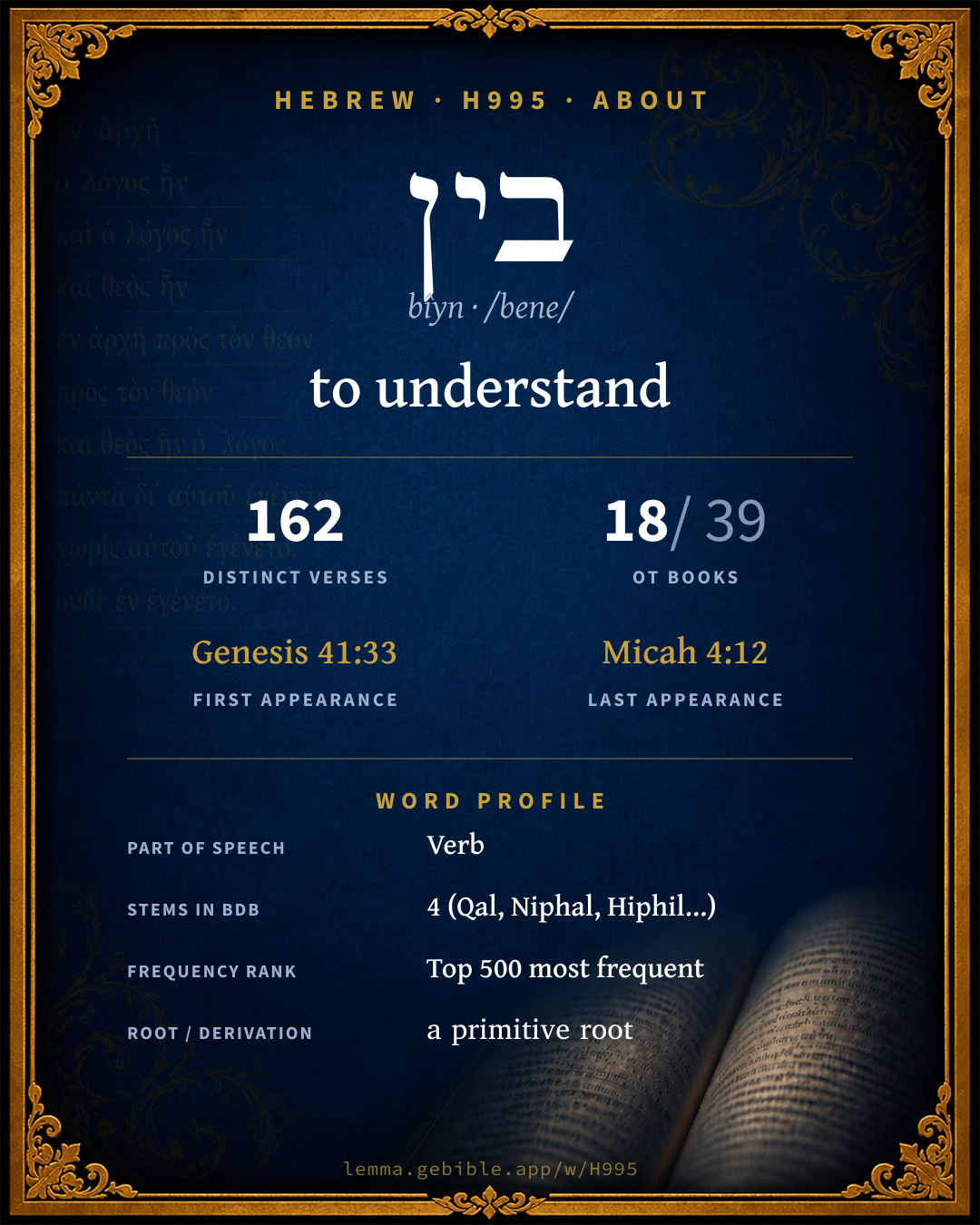
בִּין
to understand
‘to understand’ is one of 2 main senses fuller range ↓
Full lexicon entry — Brown-Driver-Briggs (BDB)
From Brown-Driver-Briggs (BDB)
Where this word appears
See every Hiphil verb in the Hebrew Bible →
Grammar key — what these labels mean
Part of speech
- Verb
- An action or state-of-being word.
Stem
- Qal
- The basic, simple active stem — the plain form of the verb (“he wrote”). Here: ‘perceive’
- Hiphil
- The causative active stem (“he caused / brought about”). Here: ‘understand’
- Niphal
- Usually the simple passive or reflexive of the Qal (“he was written”).
- Hithpolel
- The reflexive counterpart of the Polel. Here: ‘shew oneself attentive’
- Polel
- A stem of hollow/geminate roots functioning like the Piel — intensive active. Here: ‘shew oneself attentive’
- Hithpael
- The reflexive or reciprocal stem (the subject acts on itself).
Form
- Imperfect
- An incomplete, ongoing, or future action (“he will / would write”).
- Participle Active
- A verbal adjective expressing ongoing or characteristic action (“writing / one who writes”).
- Imperative
- A direct command (“write!”).
- Infinitive Construct
- A bound verbal noun, frequently with prepositions (“to write / in writing”).
- Jussive
- A third- or second-person volitional form expressing wish or command (“let him write”).
- Sequential Imperfect
- An imperfect with prefixed waw — the standard past-narrative form (waw-consecutive imperfect).
- Perfect
- A completed action or state — Hebrew marks aspect (completeness) more than strict tense (“he wrote”).
- Cohortative
- A first-person volitional form expressing wish or resolve (“let me / let us write”).
- Participle Passive
- A verbal adjective expressing action received (“written”).
- Infinitive Absolute
- An unbound verbal noun, often intensifying or standing in for a finite verb.
State
- Absolute
- The independent form of a noun, not bound to a following word.
- Construct
- A noun bound to a following noun in a possessive / “of” relationship (the construct chain).
Person
- 3rd Person
- The one spoken about (“he / she / it / they”).
- 2nd Person
- The one addressed (“you”).
- 1st Person
- The speaker (“I / we”).
Gender
- Masculine
- Grammatically masculine.
- Common
- Either gender — not distinguished for this form.
- Feminine
- Grammatically feminine.
Number
- Singular
- One.
- Plural
- More than one (in Hebrew, generally three or more).
Grammatical forms 54 distinct
- Verb, Hiphil, Participle Active, Masculine, Singular, Absolute 21 times (12%)
- Verb, Qal, Imperfect, 3rd Person, Masculine, Singular 19 times (11%)
- Verb, Niphal, Participle Active, Masculine, Singular, Absolute 14 times (8%)
- Verb, Qal, Imperfect, 3rd Person, Masculine, Plural 10 times (6%)
- Verb, Hiphil, Imperative, 2nd Person, Masculine, Singular 10 times (6%)
- Verb, Hiphil, Infinitive Construct 10 times (6%)
- Verb, Hithpolel, Imperfect, 1st Person, Common, Singular 6 times (4%)
- Verb, Hiphil, Participle Active, Masculine, Plural, Absolute 6 times (4%)
+46 more forms (75 occurrences)
Parsed forms decoded from the imported morphology (morphhb / Westminster Leningrad Codex — WLC text public domain, morphhb tagging CC BY 4.0), counted across 171 parsed occurrences — not distinct verses.
Every verse where H995 appears — 162 distinct verses across 18 books. Click any verse to open its interlinear word-by-word view. Verse text shown in the World English Bible for context — . Each verse’s Hebrew form is shown with its reference; the English is not keyword-highlighted, since the data carries no word-level English alignment. Use “Compare translations” on any verse to read it across multiple English versions. This concordance covers the Hebrew Bible; Septuagint (Greek Old Testament) occurrences are not indexed here.
Genesis 2 verses
Deuteronomy 5 verses
- Deuteronomy 1:13 וּ/נְבֹנִ֛ים conj + Niphal ptcp.act mp Take wise men of understanding and well known according to your tribes, and I will make them heads over you.
- Deuteronomy 4:6 וְ/נָב֔וֹן conj + Niphal ptcp.act ms Keep therefore and do them; for this is your wisdom and your understanding in the sight of the peoples, who shall hear all these statutes, and say, Surely this great nation is a wise and understanding people.
- Deuteronomy 32:7 בִּ֖ינוּ Qal impv 2mp Remember the days of old, Consider the years of many generations: Ask your father, and he will show you; Your elders, and they will tell you.
- Deuteronomy 32:10 יְב֣וֹנְנֵ֔/הוּ Polel impf 3ms + sfx pers 3ms He found him in a desert land, In the waste howling wilderness; He compassed him about, he cared for him, He kept him as the apple of his eye.
- Deuteronomy 32:29 יָבִ֖ינוּ Qal impf 3mp Oh that they were wise, that they understood this, That they would consider their latter end!
1 Samuel 2 verses
- 1 Samuel 3:8 וַ/יָּ֣בֶן conj + Qal wimpf 3ms Yahweh called Samuel again the third time. He arose and went to Eli, and said, Here am I; for you called me. Eli perceived that Yahweh had called the child.
- 1 Samuel 16:18 וּ/נְב֥וֹן conj + Niphal ptcp.act ms cs Then answered one of the young men, and said, Behold, I have seen a son of Jesse the Bethlehemite, who is skillful in playing, and a mighty man of valor, and a man of war, and prudent in speech, and a comely person; and Yahweh is with him.
2 Samuel 1 verse
1 Kings 4 verses
- 1 Kings 3:9 לְ/הָבִ֖ין prep + Hiphil inf.cs Give your servant therefore an understanding heart to judge your people, that I may discern between good and evil; for who is able to judge this your great people?
- 1 Kings 3:11 הָבִ֖ין Hiphil inf.cs God said to him, Because you have asked this thing, and have not asked for yourself long life, neither have asked riches for yourself, nor have asked the life of your enemies, but have asked for yourself understanding to discern justice;
- 1 Kings 3:12 וְ/נָב֔וֹן conj + Niphal ptcp.act ms behold, I have done according to your word: behold, I have given you a wise and an understanding heart; so that there has been none like you before you, neither after you shall any arise like you.
- 1 Kings 3:21 וָ/אֶתְבּוֹנֵ֤ן conj + Hithpolel wimpf 1cs When I rose in the morning to give my child suck, behold, it was dead; but when I had looked at it in the morning, behold, it was not my son, whom I bore.
1 Chronicles 5 verses
- 1 Chronicles 15:22 מֵבִ֖ין Hiphil ptcp.act ms Chenaniah, chief of the Levites, was over the song: he instructed about the song, because he was skillful.
- 1 Chronicles 25:7 הַ֨/מֵּבִ֔ין ptcl def.art + Hiphil ptcp.act ms The number of them, with their brothers who were instructed in singing to Yahweh, even all who were skillful, was two hundred eighty-eight.
- 1 Chronicles 25:8 מֵבִ֖ין Hiphil ptcp.act ms They cast lots for their offices, all alike, as well the small as the great, the teacher as the scholar.
- 1 Chronicles 27:32 מֵבִ֥ין Hiphil ptcp.act ms Also Jonathan, David's uncle, was a counselor, a man of understanding, and a scribe: and Jehiel the son of Hachmoni was with the king's sons:
- 1 Chronicles 28:9 מֵבִ֑ין Hiphil ptcp.act ms You, Solomon my son, know the God of your father, and serve him with a perfect heart and with a willing mind; for Yahweh searches all hearts, and understands all the imaginations of the thoughts: if you seek him, he will be found of you; but if you forsake him, he will cast you off forever.
2 Chronicles 4 verses
- 2 Chronicles 11:23 וַ/יָּבֶן֩ conj + Qal wimpf 3ms He dealt wisely, and dispersed of all his sons throughout all the lands of Judah and Benjamin, to every fortified city: and he gave them food in abundance. He sought [for them] many wives.
- 2 Chronicles 26:5 הַ/מֵּבִ֖ין ptcl def.art + Hiphil ptcp.act ms He set himself to seek God in the days of Zechariah, who had understanding in the vision of God: and as long as he sought Yahweh, God made him to prosper.
- 2 Chronicles 34:12 מֵבִ֖ין Hiphil ptcp.act ms The men did the work faithfully: and the overseers of them were Jahath and Obadiah, the Levites, of the sons of Merari; and Zechariah and Meshullam, of the sons of the Kohathites, to set it forward; and [others of] the Levites, all who were skillful with instruments of music.
- 2 Chronicles 35:3 ה/מבונים הַ/מְּבִינִ֨ים ptcl def.art + Hiphil ptcp.act mp ptcl def.art + Hiphil ptcp.act mp He said to the Levites who taught all Israel, who were holy to Yahweh, Put the holy ark in the house which Solomon the son of David king of Israel did build; there shall no more be a burden on your shoulders: now serve Yahweh your God, and his people Israel.
Ezra 2 verses
- Ezra 8:15 וָ/אָבִ֤ינָ/ה conj + Qal wimpf 1cs + sfx h I gathered them together to the river that runs to Ahava; and there we encamped three days: and I viewed the people, and the priests, and found there none of the sons of Levi.
- Ezra 8:16 מְבִינִֽים Hiphil ptcp.act mp Then sent I for Eliezer, for Ariel, for Shemaiah, and for Elnathan, and for Jarib, and for Elnathan, and for Nathan, and for Zechariah, and for Meshullam, chief men; also for Joiarib, and for Elnathan, who were teachers.
Nehemiah 8 verses
- Nehemiah 8:2 מֵבִ֣ין Hiphil ptcp.act ms Ezra the priest brought the law before the assembly, both men and women, and all who could hear with understanding, on the first day of the seventh month.
- Nehemiah 8:3 וְ/הַ/מְּבִינִ֑ים conj + ptcl def.art + Hiphil ptcp.act mp He read therein before the broad place that was before the water gate from early morning until midday, in the presence of the men and the women, and of those who could understand; and the ears of all the people were [attentive] to the book of the law.
- Nehemiah 8:7 מְבִינִ֥ים Hiphil ptcp.act mp Also Jeshua, and Bani, and Sherebiah, Jamin, Akkub, Shabbethai, Hodiah, Maaseiah, Kelita, Azariah, Jozabad, Hanan, Pelaiah, and the Levites, caused the people to understand the law: and the people [stood] in their place.
- Nehemiah 8:8 וַ/יָּבִ֖ינוּ conj + Qal wimpf 3mp They read in the book, in the law of God, distinctly; and they gave the sense, so that they understood the reading.
- Nehemiah 8:9 הַ/מְּבִינִ֨ים ptcl def.art + Hiphil ptcp.act mp Nehemiah, who was the governor, and Ezra the priest the scribe, and the Levites who taught the people, said to all the people, This day is holy to Yahweh your God; don't mourn, nor weep. For all the people wept, when they heard the words of the law.
- Nehemiah 8:12 הֵבִ֨ינוּ֙ Hiphil pf 3cp All the people went their way to eat, and to drink, and to send portions, and to make great mirth, because they had understood the words that were declared to them.
- Nehemiah 10:28 מֵבִֽין Hiphil ptcp.act ms The rest of the people, the priests, the Levites, the porters, the singers, the Nethinim, and all those who had separated themselves from the peoples of the lands to the law of God, their wives, their sons, and their daughters, everyone who had knowledge, and understanding;
- Nehemiah 13:7 וָ/אָבִ֣ינָ/ה conj + Qal wimpf 1cs + sfx h and I came to Jerusalem, and understood the evil that Eliashib had done for Tobiah, in preparing him a chamber in the courts of the house of God.
Job 23 verses
- Job 6:24 הָבִ֥ינוּ Hiphil impv 2mp "Teach me, and I will hold my peace; Cause me to understand wherein I have erred.
- Job 6:30 יָבִ֥ין Qal impf 3ms Is there injustice on my tongue? Can't my taste discern mischievous things?
- Job 9:11 אָבִ֥ין Qal impf 1cs Behold, he goes by me, and I don't see him. He passes on also, but I don't perceive him.
- Job 11:11 יִתְבּוֹנָֽן Hithpael impf 3ms For he knows false men. He sees iniquity also, even though he doesn't consider it.
- Job 13:1 וַ/תָּ֥בֶן conj + Qal wimpf 3fs "Behold, my eye has seen all this, My ear has heard and understood it.
- Job 14:21 יָבִ֥ין Qal impf 3ms His sons come to honor, and he doesn't know it; They are brought low, but he doesn't perceive it of them.
- Job 15:9 תָּ֝בִ֗ין Qal impf 2ms What do you know, that we don't know? What do you understand, which is not in us?
- Job 18:2 תָּ֝בִ֗ינוּ Qal impf 2mp "How long will you hunt for words? Consider, and afterwards we will speak.
- Job 23:5 וְ֝/אָבִ֗ינָה conj + Qal coh 1cs I would know the words which he would answer me, And understand what he would tell me.
- Job 23:8 אָבִ֥ין Qal impf 1cs "If I go east, he is not there; If west, I can't find him;
- Job 23:15 אֶ֝תְבּוֹנֵ֗ן Hithpolel impf 1cs Therefore I am terrified at his presence. When I consider, I am afraid of him.
- Job 26:14 יִתְבּוֹנָֽן Hithpolel impf 3ms Behold, these are but the outskirts of his ways. How small a whisper do we hear of him! But the thunder of his power who can understand?"
- Job 28:23 הֵבִ֣ין Hiphil pf 3ms "God understands its way, And he knows its place.
- Job 30:20 וַ/תִּתְבֹּ֥נֶן conj + Hithpolel wimpf 2ms I cry to you, and you do not answer me. I stand up, and you gaze at me.
- Job 31:1 אֶ֝תְבּוֹנֵ֗ן Hithpolel impf 1cs "I made a covenant with my eyes, How then should I look lustfully at a young woman?
- Job 32:8 תְּבִינֵֽ/ם Hiphil impf 3fs + sfx pers 3mp But there is a spirit in man, And the breath of the Almighty gives them understanding.
- Job 32:9 יָבִ֥ינוּ Qal impf 3mp It is not the great who are wise, Nor the aged who understand justice.
- Job 32:12 אֶתְבּ֫וֹנָ֥ן Hithpolel impf 1cs Yes, I gave you my full attention, But there was no one who convinced Job, Or who answered his words, among you.
- Job 36:29 יָ֭בִין Qal impf 3ms Yes, can any understand the spreading of the clouds, And the thunderings of his pavilion?
- Job 37:14 וְ/הִתְבּוֹנֵ֤ן conj + Hithpolel impv 2ms "Listen to this, Job: Stand still, and consider the wondrous works of God.
- Job 38:18 הִ֭תְבֹּנַנְתָּ Hithpolel pf 2ms Have you comprehended the earth in its breadth? Declare, if you know it all.
- Job 38:20 תָ֝בִ֗ין Qal impf 2ms That you should take it to the bound of it, That you should discern the paths to the house of it?
- Job 42:3 אָבִ֑ין Qal impf 1cs You asked, 'Who is this who hides counsel without knowledge?' Therefore I have uttered that which I did not understand, Things too wonderful for me, which I didn't know.
Psalms 26 verses
- Psalms 5:1 בִּ֣ינָ/ה Qal impv 2ms + sfx h Give ear to my words, Yahweh. Consider my meditation.
- Psalms 19:12 יָבִ֑ין Qal impf 3ms Who can discern his errors? Forgive me from hidden errors.
- Psalms 28:5 יָבִ֡ינוּ Qal impf 3mp Because they don't regard the works of Yahweh, Nor the operation of his hands, He will break them down and not build them up.
- Psalms 32:9 הָ֫בִ֥ין Hiphil inf.cs Don't be like the horse, or like the mule, which have no understanding, Who are controlled by bit and bridle, or else they will not come near to you.
- Psalms 33:15 הַ֝/מֵּבִ֗ין ptcl def.art + Hiphil ptcp.act ms He who fashions all of their hearts; And he considers all of their works.
- Psalms 37:10 וְ/הִתְבּוֹנַ֖נְתָּ conj + Hithpolel pf 2ms For yet a little while, and the wicked will be no more. Yes, though you look for his place, he isn't there.
- Psalms 49:20 יָבִ֑ין Qal impf 3ms A man who has riches without understanding, Is like the animals that perish.
- Psalms 50:22 בִּֽינוּ Qal impv 2mp "Now consider this, you who forget God, Lest I tear you into pieces, and there be none to deliver.
- Psalms 58:9 יָבִ֣ינוּ Qal impf 3mp Before your pots can feel the heat of the thorns, He will sweep away the green and the burning alike.
- Psalms 73:17 אָ֝בִ֗ינָה Qal coh 1cs Until I entered God's sanctuary, And considered their latter end.
- Psalms 82:5 יָבִ֗ינוּ Qal impf 3mp They don't know, neither do they understand. They walk back and forth in darkness. All the foundations of the earth are shaken.
- Psalms 92:6 יָבִ֥ין Qal impf 3ms A senseless man doesn't know, Neither does a fool understand this:
- Psalms 94:7 יָ֝בִ֗ין Qal impf 3ms They say, "Yah will not see, Neither will Jacob's God consider."
- Psalms 94:8 בִּ֭ינוּ Qal impv 2mp Consider, you senseless among the people; You fools, when will you be wise?
- Psalms 107:43 וְ֝/יִתְבּֽוֹנְנ֗וּ conj + Hithpolel juss 3mp Whoever is wise will pay attention to these things. They will consider the loving kindnesses of Yahweh.
- Psalms 119:27 הֲבִינֵ֑/נִי Hiphil impv 2ms + sfx pers 1cs Let me understand the teaching of your precepts! Then I will meditate on your wondrous works.
- Psalms 119:34 הֲ֭בִינֵ/נִי Hiphil impv 2ms + sfx pers 1cs Give me understanding, and I will keep your law. Yes, I will obey it with my whole heart.
- Psalms 119:73 הֲ֝בִינֵ֗/נִי Hiphil impv 2ms + sfx pers 1cs Your hands have made me and formed me. Give me understanding, that I may learn your commandments.
- Psalms 119:95 אֶתְבּוֹנָֽן Hithpolel impf 1cs The wicked have waited for me, to destroy me. I will consider your statutes.
- Psalms 119:100 אֶתְבּוֹנָ֑ן Hithpolel impf 1cs I understand more than the aged, Because I have kept your precepts.
- Psalms 119:104 אֶתְבּוֹנָ֑ן Hithpolel impf 1cs Through your precepts, I get understanding; Therefore I hate every false way.
- Psalms 119:125 הֲבִינֵ֑/נִי Hiphil impv 2ms + sfx pers 1cs I am your servant. Give me understanding, That I may know your testimonies.
- Psalms 119:130 מֵבִ֥ין Hiphil ptcp.act ms The entrance of your words gives light. It gives understanding to the simple.
- Psalms 119:144 הֲבִינֵ֥/נִי Hiphil impv 2ms + sfx pers 1cs Your testimonies are righteous forever. Give me understanding, that I may live.
- Psalms 119:169 הֲבִינֵֽ/נִי Hiphil impv 2ms + sfx pers 1cs Let my cry come before you, Yahweh. Give me understanding according to your word.
- Psalms 139:2 בַּ֥נְתָּה Qal pf 2ms You know my sitting down and my rising up. You perceive my thoughts from afar.
Proverbs 30 verses
- Proverbs 1:2 לְ֝/הָבִ֗ין prep + Hiphil inf.cs To know wisdom and instruction; To discern the words of understanding;
- Proverbs 1:5 וְ֝/נָב֗וֹן conj + Niphal ptcp.act ms That the wise man may hear, and increase in learning; That the man of understanding may attain to sound counsel:
- Proverbs 1:6 לְ/הָבִ֣ין prep + Hiphil inf.cs To understand a proverb, and parables, The words and riddles of the wise.
- Proverbs 2:5 תָּ֭בִין Qal impf 2ms Then you will understand the fear of Yahweh, And find the knowledge of God.
- Proverbs 2:9 תָּ֭בִין Qal impf 2ms Then you will understand righteousness and justice, Equity and every good path.
- Proverbs 7:7 אָ֘בִ֤ינָה Qal coh 1cs I saw among the simple ones. I discerned among the youths a young man void of understanding,
- Proverbs 8:5 הָבִ֣ינוּ הָבִ֥ינוּ Hiphil impv 2mp Hiphil impv 2mp You simple, understand prudence. You fools, be of an understanding heart.
- Proverbs 8:9 לַ/מֵּבִ֑ין prep det + Hiphil ptcp.act ms They are all plain to him who understands, Right to those who find knowledge.
- Proverbs 10:13 נָ֭בוֹן Niphal ptcp.act ms Wisdom is found on the lips of him who has discernment, But a rod is for the back of him who is void of understanding.
- Proverbs 14:6 לְ/נָב֣וֹן prep + Niphal ptcp.act ms A scoffer seeks wisdom, and doesn't find it, But knowledge comes easily to a discerning person.
- Proverbs 14:8 הָבִ֣ין Hiphil inf.cs The wisdom of the prudent is to think about his way, But the folly of fools is deceit.
- Proverbs 14:15 יָבִ֥ין Qal impf 3ms A simple man believes everything, But the prudent man carefully considers his ways.
- Proverbs 14:33 נָ֭בוֹן Niphal ptcp.act ms Wisdom rests in the heart of one who has understanding, And is even made known in the inward part of fools.
- Proverbs 15:14 נָ֭בוֹן Niphal ptcp.act ms The heart of one who has understanding seeks knowledge, But the mouths of fools feed on folly.
- Proverbs 16:21 נָב֑וֹן Niphal ptcp.act ms The wise in heart shall be called prudent. Pleasantness of the lips promotes instruction.
- Proverbs 17:10 בְ/מֵבִ֑ין prep + Hiphil ptcp.act ms A rebuke enters deeper into one who has understanding Than a hundred lashes into a fool.
- Proverbs 17:24 מֵבִ֣ין Hiphil ptcp.act ms Wisdom is before the face of one who has understanding, But the eyes of a fool wander to the ends of the earth.
- Proverbs 17:28 נָבֽוֹן Niphal ptcp.act ms Even a fool, when he keeps silent, is counted wise. When he shuts his lips, he is thought to be discerning.
- Proverbs 18:15 נָ֭בוֹן Niphal ptcp.act ms The heart of the discerning gets knowledge. The ear of the wise seeks knowledge.
- Proverbs 19:25 לְ֝/נָב֗וֹן יָבִ֥ין prep + Niphal ptcp.act ms Qal impf 3ms Flog a scoffer, and the simple will learn prudence; Rebuke one who has understanding, and he will gain knowledge.
- Proverbs 20:24 יָּבִ֥ין Qal impf 3ms A man's steps are from Yahweh; How then can man understand his way?
- Proverbs 21:29 יָבִ֬ין Qal impf 3ms A wicked man hardens his face; But as for the upright, he establishes his ways.
- Proverbs 23:1 בִּ֥ין תָּ֝בִ֗ין Qal inf.abs Qal juss 2ms When you sit to eat with a ruler, Consider diligently what is before you;
- Proverbs 24:12 יָבִ֗ין Qal impf 3ms If you say, "Behold, we didn't know this;" Doesn't he who weighs the hearts consider it? He who keeps your soul, doesn't he know it? Shall he not render to every man according to his work?
- Proverbs 28:2 מֵבִ֥ין Hiphil ptcp.act ms In rebellion, a land has many rulers, But order is maintained by a man of understanding and knowledge.
- Proverbs 28:5 יָבִ֣ינוּ יָבִ֥ינוּ Qal impf 3mp Qal impf 3mp Evil men don't understand justice; But those who seek Yahweh understand it fully.
- Proverbs 28:7 מֵבִ֑ין Hiphil ptcp.act ms Whoever keeps the law is a wise son; But he who is a companion of gluttons shames his father.
- Proverbs 28:11 מֵבִ֣ין Hiphil ptcp.act ms The rich man is wise in his own eyes; But the poor who has understanding sees through him.
- Proverbs 29:7 יָבִ֥ין Qal impf 3ms The righteous care about justice for the poor. The wicked aren't concerned about knowledge.
- Proverbs 29:19 יָ֝בִ֗ין Qal impf 3ms A servant can't be corrected by words. Though he understands, yet he will not respond.
Ecclesiastes 1 verse
Isaiah 20 verses
- Isaiah 1:3 הִתְבּוֹנָֽן Hithpolel pf 3ms The ox knows his owner, And the donkey his master's crib; But Israel doesn't know, My people don't consider.
- Isaiah 3:3 וּ/נְב֥וֹן conj + Niphal ptcp.act ms cs The captain of fifty, The honorable man, The counselor, The skilled craftsman, And the clever enchanter.
- Isaiah 5:21 נְבֹנִֽים Niphal ptcp.act mp Woe to those who are wise in their own eyes, And prudent in their own sight!
- Isaiah 6:9 תָּבִ֔ינוּ Qal juss 2mp He said, "Go, and tell this people, 'You hear indeed, But don't understand; And you see indeed, But don't perceive.'
- Isaiah 6:10 יָבִ֛ין Qal impf 3ms Make the heart of this people fat; Make their ears heavy, and shut their eyes; Lest they see with their eyes, And hear with their ears, And understand with their heart, And turn again, and be healed."
- Isaiah 10:13 נְבֻנ֑וֹתִי Niphal pf 1cs For he has said, By the strength of my hand I have done it, and by my wisdom; for I have understanding: and I have removed the bounds of the peoples, and have robbed their treasures, and like a valiant man I have brought down those who sit [on thrones]:
- Isaiah 14:16 יִתְבּוֹנָ֑נוּ Hithpolel impf 3mp Those who see you shall gaze at you, they shall consider you, [saying], "Is this the man who made the earth to tremble, who shook kingdoms;
- Isaiah 28:9 יָבִ֣ין Hiphil impf 3ms Whom will he teach knowledge? and whom will he make to understand the message? those who are weaned from the milk, and drawn from the breasts?
- Isaiah 28:19 הָבִ֥ין Hiphil inf.cs As often as it passes though, it shall take you; for morning by morning shall it pass through, by day and by night: and it shall be nothing but terror to understand the message.
- Isaiah 29:14 נְבֹנָ֖י/ו Niphal ptcp.act mp cs + sfx pers 3ms therefore, behold, I will proceed to do a marvelous work among this people, even a marvelous work and a wonder; and the wisdom of their wise men shall perish, and the understanding of their prudent men shall be hid.
- Isaiah 29:16 הֵבִֽין Hiphil pf 3ms You turn things upside down! Shall the potter be esteemed as clay; that the thing made should say of him who made it, He didn't make me; or the thing formed say of him who formed it, He has no understanding?
- Isaiah 32:4 יָבִ֣ין Qal impf 3ms The heart of the rash shall understand knowledge, and the tongue of the stammerers shall be ready to speak plainly.
- Isaiah 40:14 וַ/יְבִינֵ֔/הוּ conj + Hiphil wimpf 3ms + sfx pers 3ms With whom took he counsel, and who instructed him, and taught him in the path of justice, and taught him knowledge, and shown to him the way of understanding?
- Isaiah 40:21 הֲבִ֣ינֹתֶ֔ם Hiphil pf 2mp Have you not known? have yet not heard? has it not been told you from the beginning? have you not understood from the foundations of the earth?
- Isaiah 43:10 וְ/תָבִ֨ינוּ֙ conj + Qal impf 2mp You are my witnesses, says Yahweh, and my servant whom I have chosen; that you may know and believe me, and understand that I am he: before me there was no God formed, neither shall there be after me.
- Isaiah 43:18 תִּתְבֹּנָֽנוּ Hithpolel juss 2mp Don't remember the former things, neither consider the things of old.
- Isaiah 44:18 יָבִ֑ינוּ Qal impf 3mp They don't know, neither do they consider: for he has shut their eyes, that they can't see; and their hearts, that they can't understand.
- Isaiah 52:15 הִתְבּוֹנָֽנוּ Hithpolel pf 3cp so shall he sprinkle many nations; kings shall shut their mouths at him: for that which had not been told them shall they see; and that which they had not heard shall they understand.
- Isaiah 56:11 הָבִ֑ין Hiphil inf.cs Yes, the dogs are greedy, they can never have enough; and these are shepherds who can't understand: they have all turned to their own way, each one to his gain, from every quarter.
- Isaiah 57:1 מֵבִ֔ין Hiphil ptcp.act ms The righteous perishes, and no man lays it to heart; and merciful men are taken away, none considering that the righteous is taken away from the evil [to come].
Jeremiah 7 verses
- Jeremiah 2:10 וְ/הִֽתְבּוֹנְנ֖וּ conj + Hithpolel impv 2mp For pass over to the isles of Kittim, and see; and send to Kedar, and consider diligently; and see if there has been such a thing.
- Jeremiah 4:22 נְבוֹנִ֖ים Niphal ptcp.pass mp For my people are foolish, they don't know me; they are foolish children, and they have no understanding; they are wise to do evil, but to do good they have no knowledge.
- Jeremiah 9:12 וְ/יָבֵ֣ן conj + Qal juss 3ms Who is the wise man, that may understand this? and [who is] he to whom the mouth of Yahweh has spoken, that he may declare it? why is the land perished and burned up like a wilderness, so that none passes through?
- Jeremiah 9:17 הִתְבּֽוֹנְנ֛וּ Hithpolel impv 2mp Thus says Yahweh of Hosts, Consider you, and call for the mourning women, that they may come; and send for the skillful women, that they may come:
- Jeremiah 23:20 תִּתְבּ֥וֹנְנוּ Hithpolel impf 2mp The anger of Yahweh shall not return, until he has executed, and until he have performed the intents of his heart: in the latter days you shall understand it perfectly.
- Jeremiah 30:24 תִּתְבּ֥וֹנְנוּ Hithpolel impf 2mp The fierce anger of Yahweh shall not return, until he has executed, and until he have performed the intents of his heart: in the latter days you shall understand it.
- Jeremiah 49:7 מִ/בָּנִ֔ים prep + Qal ptcp.act mp Of Edom. Thus says Yahweh of Hosts: Is wisdom no more in Teman? is counsel perished from the prudent? is their wisdom vanished?
Daniel 19 verses
- Daniel 1:4 וּ/מְבִינֵ֣י conj + Hiphil ptcp.act mp cs youths in whom was no blemish, but well-favored, and skillful in all wisdom, and endowed with knowledge, and understanding science, and such as had ability to stand in the king's palace; and that he should teach them the learning and the language of the Chaldeans.
- Daniel 1:17 הֵבִ֔ין Hiphil pf 3ms Now as for these four youths, God gave them knowledge and skill in all learning and wisdom: and Daniel had understanding in all visions and dreams.
- Daniel 8:5 מֵבִ֗ין Hiphil ptcp.act ms As I was considering, behold, a male goat came from the west over the surface of the whole earth, and didn't touch the ground: and the goat had a notable horn between his eyes.
- Daniel 8:16 הָבֵ֥ן Hiphil impv 2ms I heard a man's voice between [the banks of] the Ulai, which called, and said, Gabriel, make this man to understand the vision.
- Daniel 8:17 הָבֵ֣ן Hiphil impv 2ms So he came near where I stood; and when he came, I was frightened, and fell on my face: but he said to me, Understand, son of man; for the vision belongs to the time of the end.
- Daniel 8:23 וּ/מֵבִ֥ין conj + Hiphil ptcp.act ms In the latter time of their kingdom, when the transgressors are come to the full, a king of fierce face, and understanding dark sentences, shall stand up.
- Daniel 8:27 מֵבִֽין Hiphil ptcp.act ms I, Daniel, fainted, and was sick certain days; then I rose up, and did the king's business: and I wondered at the vision, but none understood it.
- Daniel 9:2 בִּינֹ֖תִי Qal pf 1cs in the first year of his reign I, Daniel, understood by the books the number of the years about which the word of Yahweh came to Jeremiah the prophet, for the accomplishing of the desolations of Jerusalem, even seventy years.
- Daniel 9:22 וַ/יָּ֖בֶן conj + Hiphil wimpf 3ms He instructed me, and talked with me, and said, Daniel, I am now come forth to give you wisdom and understanding.
- Daniel 9:23 וּ/בִין֙ וְ/הָבֵ֖ן conj + Qal impv 2ms conj + Hiphil impv 2ms At the beginning of your petitions the commandment went forth, and I am come to tell you; for you are greatly beloved: therefore consider the matter, and understand the vision.
- Daniel 10:1 וּ/בִין֙ conj + Qal pf 3ms In the third year of Cyrus king of Persia a thing was revealed to Daniel, whose name was called Belteshazzar; and the thing was true, even a great warfare: and he understood the thing, and had understanding of the vision.
- Daniel 10:11 הָבֵ֨ן Hiphil impv 2ms He said to me, Daniel, you man greatly beloved, understand the words that I speak to you, and stand upright; for to you am I now sent. When he had spoken this word to me, I stood trembling.
- Daniel 10:12 לְ/הָבִ֧ין prep + Hiphil inf.cs Then said he to me, Don't be afraid, Daniel; for from the first day that you did set your heart to understand, and to humble yourself before your God, your words were heard: and I am come for your words' sake.
- Daniel 10:14 לַ/הֲבִ֣ינְ/ךָ֔ prep + Hiphil inf.cs + sfx pers 2ms Now I have come to make you understand what shall happen to your people in the latter days; for the vision is yet for [many] days:
- Daniel 11:30 וְ/יָבֵ֔ן conj + Qal juss 3ms For ships of Kittim shall come against him; therefore he shall be grieved, and shall return, and have indignation against the holy covenant, and shall do [his pleasure]: he shall even return, and have regard to those who forsake the holy covenant.
- Daniel 11:33 יָבִ֖ינוּ Hiphil impf 3mp Those who are wise among the people shall instruct many; yet they shall fall by the sword and by flame, by captivity and by spoil, [many] days.
- Daniel 11:37 יָבִ֔ין יָבִ֑ין Qal impf 3ms Qal impf 3ms Neither shall he regard the gods of his fathers, nor the desire of women, nor regard any god; for he shall magnify himself above all.
- Daniel 12:8 אָבִ֑ין Qal impf 1cs I heard, but I didn't understand: then said I, my lord, what shall be the issue of these things?
- Daniel 12:10 יָבִ֖ינוּ יָבִֽינוּ Qal impf 3mp Qal impf 3mp Many shall purify themselves, and make themselves white, and be refined; but the wicked shall do wickedly; and none of the wicked shall understand; but those who are wise shall understand.
Hosea 2 verses
- Hosea 4:14 יָבִ֖ין Qal impf 3ms I will not punish your daughters when they play the prostitute, Nor your brides when they commit adultery; Because the men consort with prostitutes, And they sacrifice with the shrine prostitutes; And the people that does not understand will come to ruin.
- Hosea 14:9 וְ/יָ֣בֵֽן נָב֖וֹן conj + Qal juss 3ms Niphal ptcp.act ms Who is wise, that he may understand these things? Who is prudent, that he may know them? For the ways of Yahweh are right, And the righteous walk in them; But the rebellious stumble in them.
Micah 1 verse
About this entry
At a glance — auto-summarized from this page’s data, not written by a person. Every figure links to its source below. This summary describes the numbers; it doesn’t interpret them.
The Hebrew verb בין centers on the idea of “to understand.” The King James Version usually renders it “understand,” while modern versions prefer “discerning” (Berean Standard Bible) — see the renderings breakdown. Spanning 162 verses in 18 books, it ranks among the common words of the Hebrew Bible. Debuting at Genesis 41:33, it then recurs through the corpus. Read the stem: it spans 4 stems, including Qal and Niphal. Dig into 162-verse concordance and the renderings breakdown below.
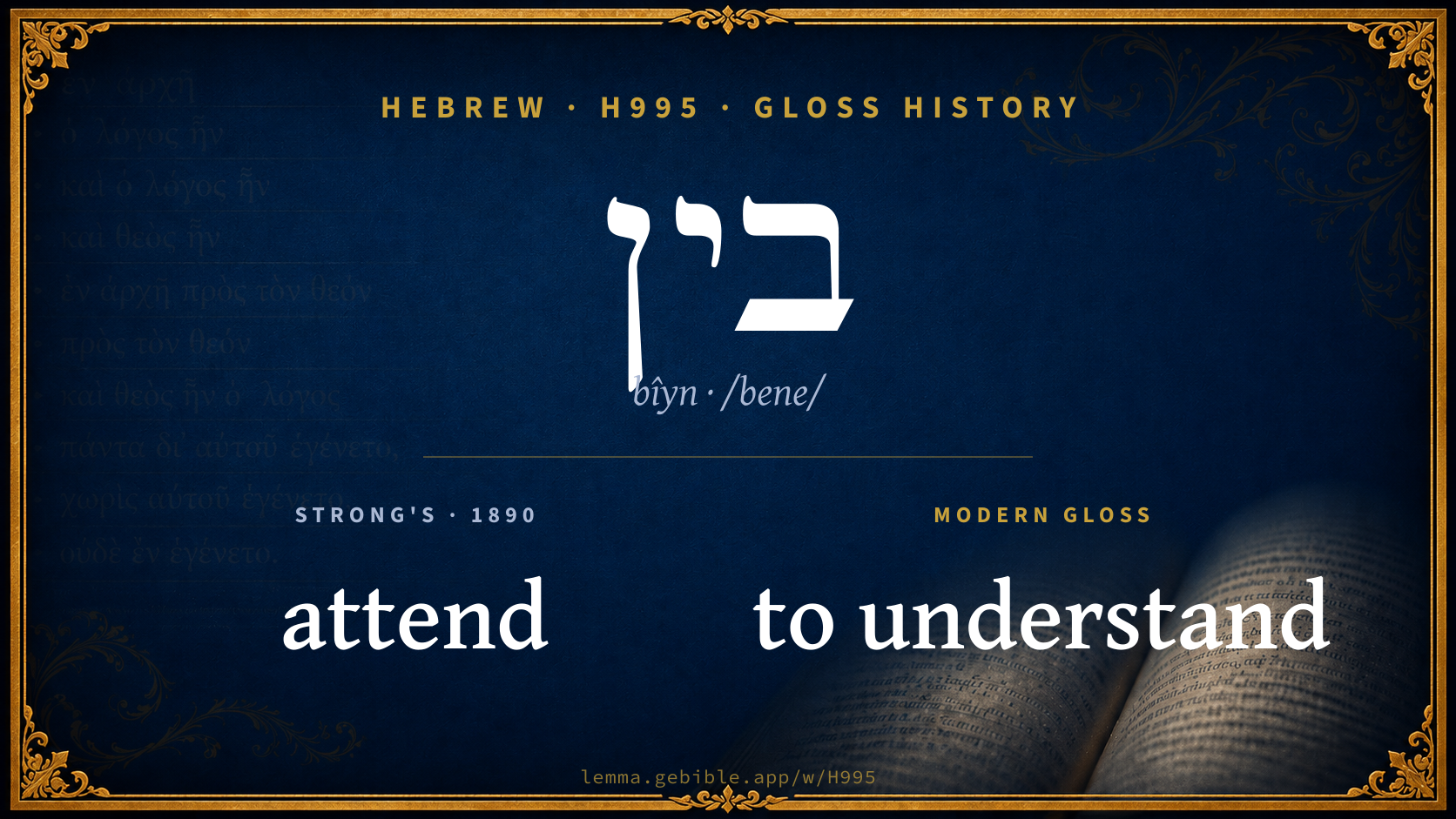
Gloss history
Strong's 1890 vs modern scholarship
About this word
Strong's H995 catalogs a Hebrew word from the Hebrew Old Testament.
These counts are not copied from any lexicon or concordance. They are computed here, from the morphology-tagged Hebrew Old Testament. What Lemma adds →
- 162
- distinct verses
- The word appears in 162 distinct verses.
- 18 / 39
- OT books
- The word appears in 18 of 39 Old Testament books.
- #270
- by frequency
- Top 500 most frequent Hebrew words (rank 270 of 8,640 Hebrew words by occurrence).
View all 162 occurrences in the concordance →
By section of the Old Testament
By traditional corpus
Conventional, traditional groupings — biblical authorship is debated, so this is a traditional corpus grouping, not an authorship claim. Each share is this word’s portion of its verses in that division of the Hebrew canon. Each figure is a share of the word’s 162 distinct verses.
- Writings (Ketuvim) 118 verses · 73%
- Prophets (Nevi'im) 37 verses · 23%
- Torah (Pentateuch) 7 verses · 4%
How translations render this word
Counts come from each version’s own published word-to-Strong’s tagging or interlinear alignment — an approximate guide to how each version renders this word, not a word-level alignment the data otherwise carries. Because each total is that version’s own tagged count, the per-version totals vary from one another and need not match the appearance or distinct-verse counts above. These counts may also differ from a printed concordance because Lemma counts each distinctly tagged rendering and does not collapse phrase taggings into a single head-word total. This is a fixed set of word-tagged versions (KJV, ASV, BSB, ULT) and does not change with the reading translation you choose elsewhere. Each version’s license is shown beside its name below (and on Sources).
- King James Version: Understand 17×, Consider 9×, Understanding 7×
- American Standard Version: Understand 13×, Consider 11×, Understanding 8×
- Berean Standard Bible: Discerning 15×, Understand 15×, Understanding 12×
- unfoldingWord Literal Text: Understand 35×, Understanding 10×, Understanding one 10×
King James Version Public Domain
Renders H995 across 169 tagged occurrences — most commonly:
Plus other, less common renderings. Plus 90 renderings that appear only once — usually multi-word phrases or single function words the recovered tagging swept in, not distinct renderings. Not rendered by a distinct English word in 1 further occurrence.
American Standard Version Public Domain
Renders H995 across 167 tagged occurrences — most commonly:
Plus other, less common renderings. Plus 91 renderings that appear only once — usually multi-word phrases or single function words the recovered tagging swept in, not distinct renderings.
Berean Standard Bible Public Domain
Renders H995 across 166 tagged occurrences — most commonly:
Plus other, less common renderings. Plus 80 renderings that appear only once — usually multi-word phrases or single function words the recovered tagging swept in, not distinct renderings. Not rendered by a distinct English word in 3 further occurrences.
unfoldingWord Literal Text CC BY-SA 4.0
Renders H995 across 203 tagged occurrences — most commonly:
Plus other, less common renderings. Plus 76 renderings that appear only once — usually multi-word phrases or single function words the recovered tagging swept in, not distinct renderings.
40 senses and sub-senses in the full BDB
Hebrew verbs can shift meaning by stem (binyan): Qal is the basic action, Niphal is often passive or reflexive, Piel often intensifies or makes it factitive, and Hiphil is typically causative. The senses below are grouped under the stem BDB assigns to each. This entry also uses one or more reduplicated stems (the Pōlēl/Pilpēl type), which for hollow or geminate roots behave much like Piel — often intensive or iterative.
What do BDB’s symbols mean?
BDB uses these scholarly abbreviations:
| Symbol | Meaning |
|---|---|
| 𝔊 | the Septuagint (the ancient Greek translation, LXX) |
| 𝔙 | the Vulgate (the Latin translation) |
| 𝔖 | the Syriac version (the Peshitta) |
| 𝔗 | the Targum (the Aramaic translation) |
| ψ | the Psalms |
| √ | root (the underlying root or stem) |
| ‖ | parallel passage (a synonymous or contrasted parallel) |
| † | the dagger: every passage where the word occurs is cited |
The 40 senses and sub-senses the full Brown-Driver-Briggs lexicon distinguishes for this word, in lexicon order (not ranked by frequency), with BDB’s own verbatim wording and sub-sense lettering. Shown in Hebrew script with BDB’s own scholarly abbreviations. The condensed entry is in the Lexicon Entry tab. See also the Forms in the corpus table below.
Qal
- Pf. בִּין Dn 10:1; בַּנְתָּה ψ 139:2; בִּינֹתִי Dn 9:2; Impf. יָבִין ψ 19:13 + 25 times; וְיָבֵן Je 9:11 + 2 times; וַיָּבֶן 1 S 3:8 + 2 times; אָבִינָה ψ 73:17 + 4 times; יָבִינוּ Pr 28:5 + 12 times; Imv. בִּין Dn 9:23; בִּינָה ψ 5:2; בִּינוּ Dt 32:7 + 2 times; Inf. abs. בִּין Pr 23:1; Pt. בָּנִים Je 49:7;— e.g. Daniel 10:1
- 1. perceive (with the senses):—
- a. eyes, acc. Pr 7:7, with לְ Jb 9:11; 14:21; 23:8 Pr 14:15. e.g. Proverbs 7:7
- b. ears, acc. Pr 29:19, with reflex. לְ Jb 13:1. e.g. Proverbs 29:19
- c. touch, acc. ψ 58:10. e.g. Psalms 58:10
- d. taste, acc. Jb 6:30. e.g. Job 6:30
- 2. understand, know (with mind):—
- a. abs. Jb 18:2; 38:20; 42:3 ψ 49:21; 82:5 Pr 24:12 Is 6:9, 10; 44:18 Dn 12:10 Ho 4:14; 14:10; שׁמעתי ולא אבין I heard but I could not understand Dn 12:8. e.g. Job 18:2
- b. acc. Jb 15:9; 23:5; 36:29 Pr 2:5, 9; 20:24; 28:5 ψ 19:13; 92:7 Je 9:11; יבין משׁפט Jb 32:9 Pr 28:5; יבין דעת Pr 29:7. e.g. Job 15:9
- c. with כִּי 1 S 3:8 2 S 12:19 Is 43:10. e.g. 1 Samuel 3:8
- d. with inf. & לְ, יבין לָדָ֑עַת Is 32:4. e.g. Isaiah 32:4
- 3. observe, mark, give heed to, distinguish, consider (with attention):—
- a. acc. Dt 32:7 ψ 5:2; 50:22; 94:7, 8 Pr 23:1; 21:29 (Qr) Dn 9:2; 10:1. e.g. Deuteronomy 32:7
- b. with לְ, ψ 73:17; 139:2 Dt 32:29. e.g. Psalms 73:17
- c. with בְּ, Ezr 8:15 Ne 13:7 Dn 9:23. e.g. Ezra 8:15
- d. with אל, ψ 28:5. e.g. Psalms 28:5
- e. with עַל, Dn 11:30, 37. e.g. Daniel 11:30
- 4. have discernment, insight, understanding Je 49:7. e.g. Jeremiah 49:7
Niphal
- נְבֻנוֹתִי Is 10:13; Pt. נָבוֹן Gn 41:33 + 15 times; pl. נְבוֹנִים Je 4:22, elsewhere נְבֹנִים Dt 1:13 Is 5:22 (Baer) Ec 9:11; נְבֹנָיו Is 29:14; be intelligent, discreet, discerning, have understanding 1 S 16:18 Pr 1:5; 10:13; 14:6; 16:21; 17:28; 19:25 Ec 9:11 Is 3:3; 5:21; 10:13; 29:14 Je 4:22 Ho 14:10; לֵב נָבוֹן intelligent mind Pr 14:33; 15:14; 18:15; נָבוֹן וְחָכָם Gn 41:33, 39; חכם ונבון Dt 4:6 1 K 3:12; חכמים ונבנים Dt 1:13. Poʿl. יְבוֹנֲנֵהוּ he attentively considereth him Dt 32:10. e.g. Isaiah 10:13
Hiphil
- Pf. הֵבִין Jb 28:23 + 5 times; Impf. יָבִין Is 28:9 + 4 times; וַיָּבֶן 2 Ch 11:23 Dn 9:22; Inf. הָבִין ψ 32:9 + 9 times; Imv. הָבֵן Dn 8:16 + 12 times; Pt. מֵבִין Pr 28:7 + 26 times;— e.g. Job 28:23
- 1. understand:—
- a. abs. Is 29:16; 40:21; 56:11 1 K 3:11 ψ 32:9 Dn 8:17; 10:12. e.g. Isaiah 29:16
- b. acc. 1 Ch 28:9 Jb 28:23 Pr 1:2, 6; 8:5; 14:8 Is 28:19 Dn 8:23 Mi 4:12; מֵבִין one with understanding Pr 8:9; 17:10, 24; 28:2, 7, 11; מְבִינֵי מַדָּע Dn 1:4; able to understand (i.e. old enough) Ne 8:3; 10:29, cf. 8:2 (sq. לִשׁמֹעַ). e.g. 1 Chronicles 28:9
- 2. give heed to, attend to, observe, discern, abs. Is 57:1 2 Ch 11:23 Dn 8:5; c. בְּ Ne 8:12 Dn 9:23; 10:11; מֵבִין בְּ skilled in 2 Ch 26:5; 34:12; c. אֶל ψ 33:15; בין טוב לרע 1 K 3:9. e.g. Isaiah 57:1
- 3. give understanding, make understand, teach:—
- a. abs. Dn 8:27; 9:22. e.g. Daniel 8:27
- b. with acc. pers. ψ 119:34, 73, 125, 130, 144, 169 Jb 32:8 Ne 8:7, 9 Is 40:14. e.g. Psalms 119:34
- c. with לְ pers. 2 Ch 35:3 Dn 11:33; with לְ pers. & acc. rei Jb 6:24 Dn 8:16. e.g. 2 Chronicles 35:3
- d. בְּ rei Ne 8:8, + acc. pers. Dn 1:17. e.g. Nehemiah 8:8
- e. double acc. Is 28:9 ψ 119:27 Dn 10:14; מֵבִין teacher 1 Ch 15:22; 25:7, 8; 27:32 Ezr 8:16. e.g. Isaiah 28:9
Hithpoʿl
- Pf. הִתְבּוֹנָ֑ן Is 1:3 + 6 times; Impf. אֶתְבּוֹנֵן Jb 23:15 + 3 times; אֶתְבּוֹנָ֑ן Jb 32:12 + 5 times; יִתְבּוֹנְנוּ ψ 107:43 + 2 times; יִתְבּוֹנָ֑נוּ Is 14:16; 43:18. e.g. Isaiah 1:3
- 1. shew oneself attentive, consider diligently:—
- a. abs. Jb 11:11; 23:15 Is 1:3 Je 2:10; 9:16. e.g. Job 11:11
- b. acc. Jb 37:14 ψ 107:43; 119:95 Is 43:18; 52:15. e.g. Job 37:14
- c. with אֶל 1 K 3:21 Is 14:16. e.g. 1 Kings 3:21
- d. with עַל Jb 31:1 ψ 37:10. e.g. Job 31:1
- e. with עד Jb 32:12; 38:18. e.g. Job 32:12
- f. with בְּ Jb 30:20 Je 30:24. e.g. Job 30:20
- 2. get understanding, understand Je 23:20 Jb 26:14 (sq. acc.) ψ 119:104. e.g. Jeremiah 23:20
- 3. shew oneself to have understanding ψ 119:100. e.g. Psalms 119:100
Senses from the full Brown-Driver-Briggs lexicon (Brown, Driver, Briggs; Oxford 1906 — public domain), digitized via Sefaria, supplemented by the OpenScriptures HebrewLexicon (CC BY 4.0). Full attribution on Sources.
Word origin
vb. discern (Nö ZMG 1883, 532 f.; Arabic بَانَ become separated, be distinct, iv. speak perspicuously; Ethiopic በየነ: i. 2 consider, perceive, Aramaic ܒܰܝܶܢ make to understand, cf. Sab. בין (the) wise, as epith., Mordt ZMG 1876, 37)—
— Brown-Driver-Briggs (Oxford 1906, public domain), digitized via Sefaria, supplemented by the OpenScriptures HebrewLexicon (CC BY 4.0). See Sources.
Origin: a primitive root
Jastrow Dictionary
A second Hebrew/Aramaic lexicon for comparison, covering Aramaic and post-biblical (Talmudic, Targumic, Midrashic) usage that the biblical-Hebrew BDB does not. Matched by lemma rather than by Strong’s number, so a lemma may carry more than one Jastrow headword (shown separately below), and the entries cover usage well beyond the Bible.
בִּין
- , v. בוא) to pierce, split, penetrate; whence, to discern, understand; v. Hif.
- (cmp. בֵּין) to cause to penetrate, to saturate. Sifra Vayikra, N’dab., Par. 12, ch. XIV (ref. to Lev. II, 13) יכול תְּבוֹנֵּהוּ from bammelaḥ I might judge, ‘thou must thoroughly saturate it, ת"ל תמלח therefore it says, ‘timlaḥ’ (thou shalt strew). Men. 21ᵃ (quoting Sifra l. c.) מאי תבונהו what does the word t’bonnehu mean? Said R. b. U. ה"ק יכול יִתְבֹּונֶנּוּ כתבן (taking ת as radical, as if imperat. of a verb תבן, denom. of תֶּבֶן) it means, I might suppose, he must mix it up like straw in clay (v. infra). Said A. to him א"ה יתבוננו מיבעי ליה if so, then it ought to read (in the Sifra) yithbonennu (third person). But said A. (taking it fr. בנה) יכול יעשנו כבניין I might suppose, he shall heap the salt upon it like a building (a pile). Said R. to him, א"ה יבננו מיבעי ליה then it ought to read yibnennu. But said R. (you must correct the Sifra so as to read) יכול תבוניהו (corr. תָּבִינֵיהוּ) thou shalt make it savory … יתן בו טעם כבינה he shall put a taste into it as does understanding into a man, v. טַעַם. [Yalk. Lev. 454: מאי יתבנהו … יכול יתבלנו כתבן וטיט … תבלנו מ"ל … יכול יעשנו כבנין … א"ה.יבנהו מ"ל … יכול תבינהו … יכול יתן בו טעם בבינה—Ar. ed. Koh.: יכול תבניהו … מאי תבניהו … יכול יתבלנו (הרבה במלח) כתבן בטיט … יכול יתן בו טעם, correct: יכול תבינהו יתן וכ׳.] e.g. Leviticus 2:13
- (cmp. הוֹבִיר, s. v. בּוּר) (denomin. of בֵּין) to mediate, to be interpreter. Ab. Zar. III, 5 (45ᵃ) אני אוֹבִין לפניך (v. Rabb. D. S. a. l. note 8) let me be thy interpreter (let me explain what you mean) כל מקום וכ׳ (the words על ההרים וכ׳, Deut. XII, 2, are explanatory) wherever thou findest a high mountain &c., know there must be an idol. [In the version אני אהיה אובין וכ׳, אוֹבֵין is used as a part. of a verb אָבֵין, denomin. of בֵּין, to act as a mediator or interpreter.] 2) הֵבִין (b. h.) to perceive, make intelligible, esp. to find analogies (between two cases). ה׳ דבר מתוך דבר prop. to bring out one thing from between another, i.e. to form a conclusion by analogy. Sabb. 31ᵃ הֵבַנְתָּה וכ׳ hast thou cultivated thy mind to conclude &c. (ref. to דעת Is. XXXIII, 6). Snh. 93ᵇ; a. fr. Ḥag. II, 1 (11ᵇ) חכם מֵבִין מדעתו (not ומבין, v. Rabb. D. S. a. l. note) a student able to speculate by himself, a thinker.—Ib. 13ᵃ bot. היה מֵבִין בהשמל speculated over the ḥashmal (Ezek. I, 27); a. fr. e.g. Deuteronomy 12:2
- to understand one’s self, to be careful, to reflect. B. Kam. 27ᵇ להתבונן בדרכים to look around on roads (to be prepared for something in their way against which they might strike). Gen. R. s. 34 ויבן כתי׳ נתבונן the word ויבן (he built, Gen. VIII, 20) may be read vayaben, i.e. he reflected, argued. e.g. Genesis 8:20
בִּין ²
- ; v. infra.—Pa. בַּיֵּין, בַּיֵּן to teach, make wise. Targ. Ps. CXIX, 27. Targ. Job XXXII, 8. Ib. v. 9 יְבַיְּנוּן דינא explain the law (ed. Vienn. יְבִינוּן, Pe., understand).
- to reflect upon, to understand. Targ. Job XXXII, 12. Ib. XXVIII, 23; a. fr.
- to be considerate, cautious. Lam. R. to I, 16, beg., v. בְּחִי.
בַּיִן
- , only in constr. בֵּין, בינת־ (b. h.; preced., cmp. ביין, באיין) something split, or placed between; prep. between, among.—אין בין … ל there is no difference betw. … and … Meg. I, 5; a. fr.—בין השמשות (abbr. בה"ש) at twilight, dusk; v. בֵּי. Ab. V, 6; a. fr.—… ב׳ … ב׳ both … as well as … B. Kam. IV, 3; a. fr.—Yeb. 23ᵃ ב׳ אומרים לו וכ׳ whether the law says to thy father …, or &c. Koh. R. to VII, 11 בין ווי לוה וכ׳ owing to the difference between vay (woe) and vah (ah), R. J. escaped.—דברים שֶׁבֵּינוֹ לְבֵינָהּ private affairs concerning him (the husband) and her (the wife). Ned. 79ᵇ; a. fr.—Du. בֵּינַיִים, בֵּנַיִים, בֵּינְתַּיִים, בֵּנְתַּיִם (for בֵּינוֹתַיִם) between two, among, amid. Gen. R. s. 4 ביניים ובינתיים in the very centre. Y. Ber. II, 5ᵇ top. Y. Maasr. I, beg. 48ᶜ טול מבנת׳ take from what is between the two, i.e. qualifications common to both; a. fr.—Constr. בֵּינֵי־. Nidd. 67ᵇ מפסקת בֵּינֵיהֶן intervening between; a. fr.
בֵּין
- usu. pl. בֵּינֵי ch. same. Targ. Gen. I, 6; a. fr.—Ḥull. 114ᵃ; Sabb. 132ᵇ אתיא מִבֵּינַיָּיא from between the two (from both cases combined) it may be concluded.—מאי בֵינַיְיהוּ (abbr. מ"ב) wherein do they differ? איכא בינייהו (abbr. א"ב) they differ as to … B. Mets. 15ᵇ; a. v. fr.—ביני וביני a) in the meantime. Yeb. 71ᵇ; a. fr.—b) the difference between (these and other goods). Bets. 7ᵃ; a. fr.—Ḥull. 47ᵃ ההוא ב׳ וב׳ a case (of an abnormal lobe) between the normal lungs. [Targ. Am. IX, 9 מִבֵּינָהּ, Var. מבינא, read מִבֵּינֵיה from between its meshes.]
A Dictionary of the Targumim, the Talmud Babli and Yerushalmi, and the Midrashic Literature (Marcus Jastrow; London, Luzac, 1903) — Public Domain. Digitized via Sefaria. Digitized via Sefaria. Full attribution on Sources.
Forms in the corpus
The 133 distinct written forms H995 takes in the Hebrew Bible, most frequent first — each parse links to that stem’s occurrences in the concordance. Hebrew forms include their vowel points and cantillation, so a single lemma takes many written forms.
The 60 most common forms are shown; 73 rarer forms follow in the full concordance.
Same root — word family
Other BDB entries built from the same root as H995, grouped by Strong’s listed origin. These share a root / origin per the lexicon — not necessarily a shared meaning. Each links to that word’s own entry.
Derived from this word
- בין bêyn H996 between
- בינה bîynâh H998 understanding
- מבון mâbôwn H4000 ones who taught, ones who gave
- תבון tâbûwn H8394 understanding
Proper names from this root
People and places named from this root — a name, not an additional meaning of the word.
Compare all same-root words → Showing 4 of 7 — not the complete family. 2 of the same-root words are proper names (people or places). They share a root, not necessarily a meaning.
Septuagint verse parallels
This word appears in 139 verses that also exist in the Greek Old Testament (Septuagint), out of the 162 Hebrew verses it occurs in. You can read those verses in Greek by switching the Old Testament edition to the Septuagint.
Read these verses in the Septuagint
- Genesis 41:33
- Deuteronomy 1:13
- 1 Samuel 3:8
- 2 Samuel 12:19
- 1 Kings 3:9
- 1 Chronicles 15:22
- 2 Chronicles 11:23
- Ezra 8:15
- Job 6:24
- Psalms 5:1
- Proverbs 1:2
- Ecclesiastes 9:11
This is a verse-level parallel only — the same verses exist in both the Hebrew and Greek Old Testaments. No word-level Hebrew↔Greek correspondence is claimed: the data carries no such alignment, so no Greek word is shown as this Hebrew word’s translation. Coverage is not total — the Septuagint omits the deuterocanon and renumbers the Psalms, so some Hebrew verses have no direct Greek parallel.