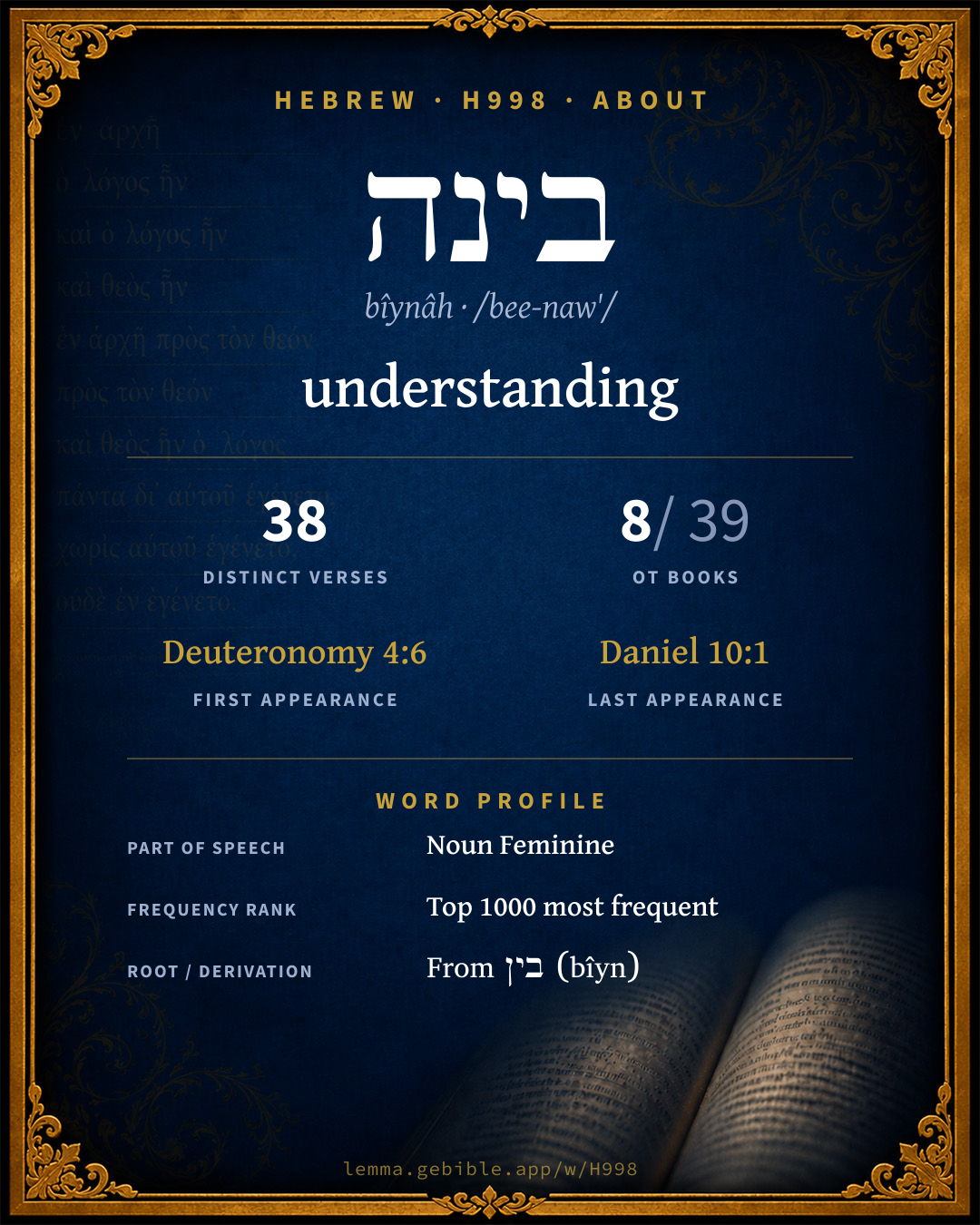
בִּינָה
understanding
‘understanding’ is one of 5 main senses fuller range ↓
Full lexicon entry — Brown-Driver-Briggs (BDB)
From Brown-Driver-Briggs (BDB)
Where this word appears
See every Absolute-state word in the Hebrew Bible →
Grammar key — what these labels mean
Part of speech
- Noun
- A naming word — a person, place, thing, or idea.
Noun type
- Common
- A common noun — a general class of person, place, or thing (“king,” “city,” “water”), not a specific name.
State
- Absolute
- The independent form of a noun, not bound to a following word.
- Construct
- A noun bound to a following noun in a possessive / “of” relationship (the construct chain).
Gender
- Feminine
- Grammatically feminine.
Number
- Singular
- One.
- Plural
- More than one (in Hebrew, generally three or more).
Grammatical forms
- Noun, Common, Feminine, Singular, Absolute 30 times (79%)
- Noun, Common, Feminine, Singular, Construct 7 times (18%)
- Noun, Common, Feminine, Plural, Absolute 1 time (3%)
Parsed forms decoded from the imported morphology (morphhb / Westminster Leningrad Codex — WLC text public domain, morphhb tagging CC BY 4.0), counted across 38 parsed occurrences — not distinct verses.
Every verse where H998 appears — 38 distinct verses across 8 books. Click any verse to open its interlinear word-by-word view. Verse text shown in the World English Bible for context — . Each verse’s Hebrew form is shown with its reference; the English is not keyword-highlighted, since the data carries no word-level English alignment. Use “Compare translations” on any verse to read it across multiple English versions. This concordance covers the Hebrew Bible; Septuagint (Greek Old Testament) occurrences are not indexed here.
Deuteronomy 1 verse
1 Chronicles 2 verses
- 1 Chronicles 12:32 בִינָה֙ n c fs Of the children of Issachar, men who had understanding of the times, to know what Israel ought to do, the heads of them were two hundred; and all their brothers were at their commandment.
- 1 Chronicles 22:12 וּ/בִינָ֔ה conj + n c fs May Yahweh give you discretion and understanding, and put you in charge of Israel; that so you may keep the law of Yahweh your God.
2 Chronicles 2 verses
- 2 Chronicles 2:12 וּ/בִינָ֔ה conj + n c fs Huram said moreover, Blessed be Yahweh, the God of Israel, that made heaven and earth, who has given to David the king a wise son, endowed with discretion and understanding, that should build a house for Yahweh, and a house for his kingdom.
- 2 Chronicles 2:13 בִּינָ֖ה n c fs Now I have sent a skillful man, endowed with understanding, of Huram my father's,
Job 9 verses
- Job 20:3 מִֽ/בִּינָתִ֥/י prep + n c fs cs + sfx pers 1cs I have heard the reproof which puts me to shame; The spirit of my understanding answers me.
- Job 28:12 בִּינָֽה n c fs "But where shall wisdom be found? Where is the place of understanding?
- Job 28:20 בִּינָֽה n c fs Whence then comes wisdom? Where is the place of understanding?
- Job 28:28 בִּינָֽה n c fs To man he said, 'Behold, the fear of the Lord, that is wisdom. To depart from evil is understanding.'"
- Job 34:16 בִּ֥ינָה n c fs "If now you have understanding, hear this. Listen to the voice of my words.
- Job 38:4 בִינָֽה n c fs "Where were you when I laid the foundations of the earth? Declare, if you have understanding.
- Job 38:36 בִינָֽה n c fs Who has put wisdom in the inward parts? Or who has given understanding to the mind?
- Job 39:17 בַּ/בִּינָֽה prep det + n c fs Because God has deprived her of wisdom, Neither has he imparted to her understanding.
- Job 39:26 הֲֽ֭/מִ/בִּינָ֣תְ/ךָ ptcl inter + prep + n c fs cs + sfx pers 2ms "Is it by your wisdom that the hawk soars, And stretches her wings toward the south?
Proverbs 14 verses
- Proverbs 1:2 בִינָֽה n c fs To know wisdom and instruction; To discern the words of understanding;
- Proverbs 2:3 לַ/בִּינָ֣ה prep det + n c fs Yes, if you call out for discernment, And lift up your voice for understanding;
- Proverbs 3:5 בִּֽ֝ינָתְ/ךָ֗ n c fs cs + sfx pers 2ms Trust in Yahweh with all your heart, And don't lean on your own understanding.
- Proverbs 4:1 בִּינָֽה n c fs Listen, sons, to a father's instruction. Pay attention and know understanding;
- Proverbs 4:5 בִינָ֑ה n c fs Get wisdom. Get understanding. Don't forget, neither swerve from the words of my mouth.
- Proverbs 4:7 בִינָֽה n c fs Wisdom is supreme. Get wisdom. Yes, though it costs all your possessions, get understanding.
- Proverbs 7:4 לַ/בִּינָ֥ה prep det + n c fs Tell wisdom, "You are my sister." Call understanding your relative,
- Proverbs 8:14 בִ֝ינָ֗ה n c fs Counsel and sound knowledge are mine. I have understanding and power.
- Proverbs 9:6 בִּינָֽה n c fs Leave your simple ways, and live. Walk in the way of understanding."
- Proverbs 9:10 בִּינָֽה n c fs The fear of Yahweh is the beginning of wisdom. The knowledge of the Holy One is understanding.
- Proverbs 16:16 בִּ֝ינָ֗ה n c fs How much better it is to get wisdom than gold! Yes, to get understanding is to be chosen rather than silver.
- Proverbs 23:4 מִֽ/בִּינָתְ/ךָ֥ prep + n c fs cs + sfx pers 2ms Don't weary yourself to be rich. In your wisdom, show restraint.
- Proverbs 23:23 וּ/בִינָֽה conj + n c fs Buy the truth, and don't sell it: Get wisdom, discipline, and understanding.
- Proverbs 30:2 בִינַ֖ת n c fs cs "Surely I am the most ignorant man, And don't have a man's understanding.
Isaiah 5 verses
- Isaiah 11:2 וּ/בִינָ֗ה conj + n c fs The Spirit of Yahweh shall rest on him, the spirit of wisdom and understanding, the spirit of counsel and might, the spirit of knowledge and of the fear of Yahweh.
- Isaiah 27:11 בִּינוֹת֙ n c fp When the boughs of it are withered, they shall be broken off; the women shall come, and set them on fire; for it is a people of no understanding: therefore he who made them will not have compassion on them, and he who formed them will show them no favor.
- Isaiah 29:14 וּ/בִינַ֥ת conj + n c fs cs therefore, behold, I will proceed to do a marvelous work among this people, even a marvelous work and a wonder; and the wisdom of their wise men shall perish, and the understanding of their prudent men shall be hid.
- Isaiah 29:24 בִּינָ֑ה n c fs They also who err in spirit shall come to understanding, and those who murmur shall receive instruction.
- Isaiah 33:19 בִּינָֽה n c fs You shall not see the fierce people, a people of a deep speech that you can not comprehend, of a strange language that you can not understand.
Jeremiah 1 verse
Daniel 4 verses
- Daniel 1:20 בִּינָ֔ה n c fs In every matter of wisdom and understanding, concerning which the king inquired of them, he found them ten times better than all the magicians and enchanters who were in all his realm.
- Daniel 8:15 בִינָ֔ה n c fs It happened, when I, even I Daniel, had seen the vision, that I sought to understand it; and, behold, there stood before me as the appearance of a man.
- Daniel 9:22 בִינָֽה n c fs He instructed me, and talked with me, and said, Daniel, I am now come forth to give you wisdom and understanding.
- Daniel 10:1 וּ/בִ֥ינָה conj + n c fs In the third year of Cyrus king of Persia a thing was revealed to Daniel, whose name was called Belteshazzar; and the thing was true, even a great warfare: and he understood the thing, and had understanding of the vision.
About this entry
At a glance — auto-summarized from this page’s data, not written by a person. Every figure links to its source below. This summary describes the numbers; it doesn’t interpret them.
At its core, בינה (bîynâh) means “understanding.” Carrying more than one sense, it rewards its full sense range. It turns up in 38 verses across 8 books, a moderately common footprint. The word gravitates to Proverbs (37%), then Job and Isaiah. Scripture first uses it in Deuteronomy 4:6. Each statement above links to its evidence; the full detail follows below.
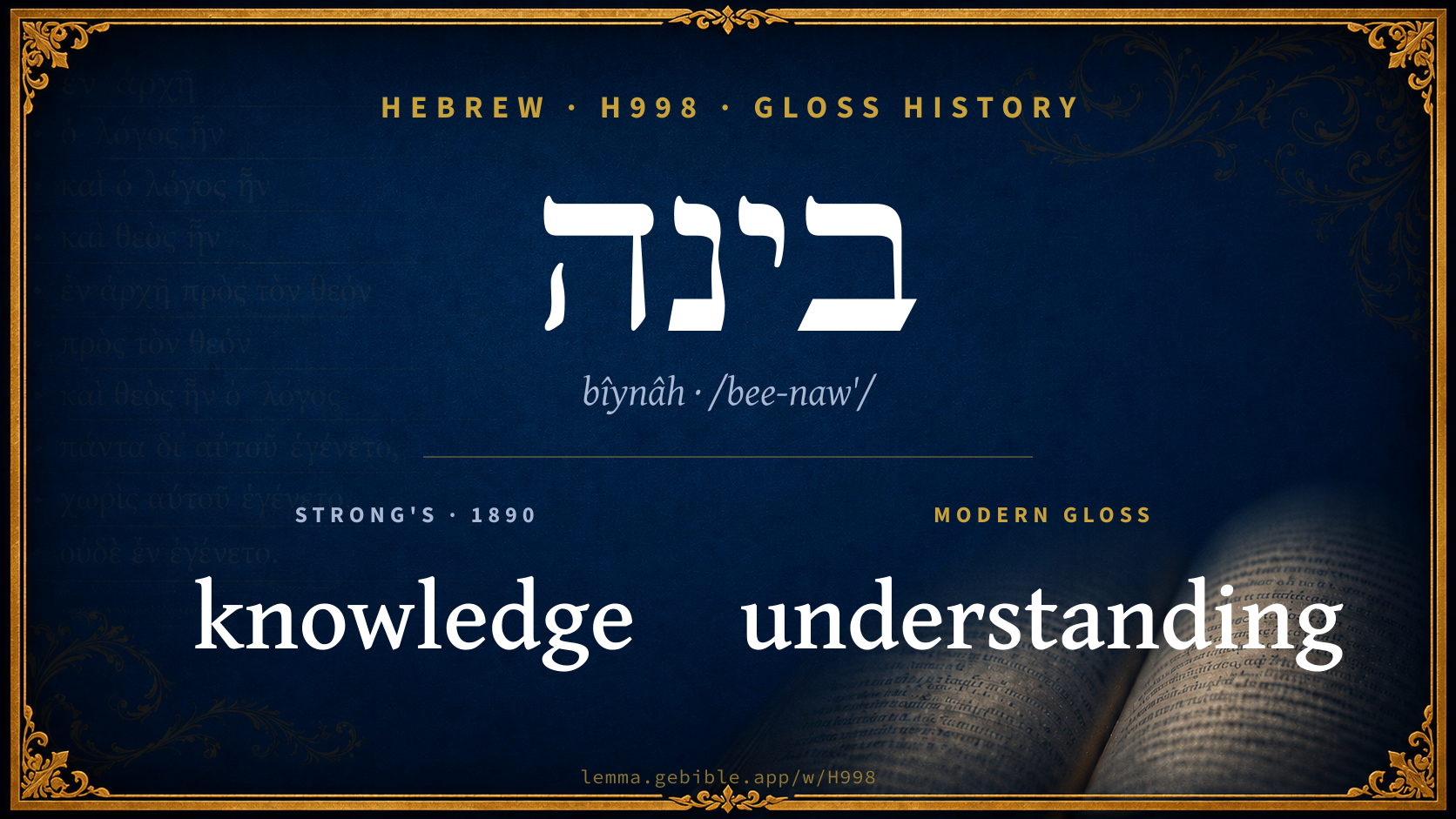
Gloss history
Strong's 1890 vs modern scholarship
About this word
Strong's H998 catalogs a Hebrew word from the Hebrew Old Testament.
These counts are not copied from any lexicon or concordance. They are computed here, from the morphology-tagged Hebrew Old Testament. What Lemma adds →
- 38
- distinct verses
- The word appears in 38 distinct verses.
- 8 / 39
- OT books
- The word appears in 8 of 39 Old Testament books.
- #947
- by frequency
- Top 1000 most frequent Hebrew words (rank 947 of 8,640 Hebrew words by occurrence).
View all 38 occurrences in the concordance →
By section of the Old Testament
By traditional corpus
Conventional, traditional groupings — biblical authorship is debated, so this is a traditional corpus grouping, not an authorship claim. Each share is this word’s portion of its verses in that division of the Hebrew canon. Each figure is a share of the word’s 38 distinct verses.
- Writings (Ketuvim) 31 verses · 82%
- Prophets (Nevi'im) 6 verses · 16%
- Torah (Pentateuch) 1 verse · 3%
How translations render this word
Counts come from each version’s own published word-to-Strong’s tagging or interlinear alignment — an approximate guide to how each version renders this word, not a word-level alignment the data otherwise carries. Because each total is that version’s own tagged count, the per-version totals vary from one another and need not match the appearance or distinct-verse counts above. These counts may also differ from a printed concordance because Lemma counts each distinctly tagged rendering and does not collapse phrase taggings into a single head-word total. This is a fixed set of word-tagged versions (KJV, ASV, BSB, ULT) and does not change with the reading translation you choose elsewhere. Each version’s license is shown beside its name below (and on Sources).
- King James Version: Understanding 23×, Is understanding 2×
- American Standard Version: Understanding 21×
- Berean Standard Bible: Understanding 22×, Does understanding 2×, Insight 2×
- unfoldingWord Literal Text: Understanding 30×, Is understanding 2×, Understanding of 2×
King James Version Public Domain
Renders H998 across 38 tagged occurrences — most commonly:
Plus 13 renderings that appear only once — usually multi-word phrases or single function words the recovered tagging swept in, not distinct renderings.
American Standard Version Public Domain
Renders H998 across 38 tagged occurrences — most commonly:
Plus 17 renderings that appear only once — usually multi-word phrases or single function words the recovered tagging swept in, not distinct renderings.
Berean Standard Bible Public Domain
Renders H998 across 36 tagged occurrences — most commonly:
Plus 10 renderings that appear only once — usually multi-word phrases or single function words the recovered tagging swept in, not distinct renderings. Not rendered by a distinct English word in 2 further occurrences.
unfoldingWord Literal Text CC BY-SA 4.0
Renders H998 across 39 tagged occurrences — most commonly:
Plus 5 renderings that appear only once — usually multi-word phrases or single function words the recovered tagging swept in, not distinct renderings.
Senses in the full BDB
What do BDB’s symbols mean?
BDB uses these scholarly abbreviations:
| Symbol | Meaning |
|---|---|
| 𝔊 | the Septuagint (the ancient Greek translation, LXX) |
| 𝔙 | the Vulgate (the Latin translation) |
| 𝔖 | the Syriac version (the Peshitta) |
| 𝔗 | the Targum (the Aramaic translation) |
| ψ | the Psalms |
| √ | root (the underlying root or stem) |
| ‖ | parallel passage (a synonymous or contrasted parallel) |
| † | the dagger: every passage where the word occurs is cited |
The 4 senses and sub-senses the full Brown-Driver-Briggs lexicon distinguishes for this word, in lexicon order (not ranked by frequency), with BDB’s own verbatim wording and sub-sense lettering. Shown in Hebrew script with BDB’s own scholarly abbreviations. The condensed entry is in the Lexicon Entry tab. See also the Forms in the corpus table below.
- 1. the act Is 33:19 Je 23:20 Dn 1:20; 8:15; 9:22; 10:1. e.g. Isaiah 33:19
- 2. the faculty Jb 20:3; 39:26 Pr 3:5; 23:4; 30:2 Is 27:11; קנה בינה get understanding Pr 4:5, 7; 16:16. e.g. Job 20:3
- 3. the object of knowledge Dt 4:6 1 Ch 22:12 Jb 28:12, 20, 28; 34:16; 38:36; 39:17 Pr 9:6, 10; 23:23 Is 11:2; 29:14; יָדַע בִינָה 1 Ch 12:32 2 Ch 2:11, 12 Jb 38:4 Pr 1:2; 4:1 Is 29:24. e.g. Deuteronomy 4:6
- 4. personified Pr 2:8; 7:4; 8:14. e.g. Proverbs 2:8
Senses from the full Brown-Driver-Briggs lexicon (Brown, Driver, Briggs; Oxford 1906 — public domain), digitized via Sefaria, supplemented by the OpenScriptures HebrewLexicon (CC BY 4.0). Full attribution on Sources.
Word origin
n.f. understanding 1 Ch 12:32 + 28 times; cstr. בִּינַת Pr 30:2 Is 29:14; sf. בִּינָתִי Jb 20:3 + 4 times; pl. בִּינוֹת Is 27:11;—
— Brown-Driver-Briggs (Oxford 1906, public domain), digitized via Sefaria, supplemented by the OpenScriptures HebrewLexicon (CC BY 4.0). See Sources.
Derived from בין (bîyn) (H995) — to understand.
Jastrow Dictionary
A second Hebrew/Aramaic lexicon for comparison, covering Aramaic and post-biblical (Talmudic, Targumic, Midrashic) usage that the biblical-Hebrew BDB does not. Matched by lemma rather than by Strong’s number, so a lemma may carry more than one Jastrow headword (shown separately below), and the entries cover usage well beyond the Bible.
בִּינָה
- intelligence, wisdom. Nidd. 45ᵇ (play on ויבן, v. בִּין Hithpa.) the Lord has given to woman ב׳ יתירה greater (earlier maturity of) judgment. Ber. 10ᵃ במקום ב׳ at the place of understanding (near the heart); a. fr.
בני
- [to combine,] to build. Sabb. XII, 1 הַבּוֹנֶה he who builds (on the Sabbath). Ib.] 102ᵇ משום בונה (isguilty) because it is one of the labors classified under ‘building’; a. fr.—Metaph. to educate, train. Ber. 64ᵃ (ref. to Is. LIV, 93) א"ת בָּנַיִךְ אלא בוֹנַיִּךְ read not banayikh (thy children), but bonayikh (thy builders, trainers); v. בַּנָּאִים.—Ex. R. s. 23 (play on b’noth, Cant. I, 5) בּוֹנוֹת וכ׳ the authorities directing the building of Jerusalem; v. Pi.—Ḥull. 78ᵇ זה בנה אב, v. אָב, a. בִּנְיָן. [Tosef. Par. VII (VI), 4 בְּנָאוֹ ed. Zuck., v. כָּנַן.] e.g. Isaiah 54:93
- 1. to be built up. Y. B. Bath. III, 14ᵇ, a. fr. לְהִיבָּנוֹת, לִיבָּנוֹת.
- 2. (denom. of בֵּן) to get children. Gen. R. s. 71.
- (denom. of בֵּן) to be adopted, naturalized. Pesik. R. s. 43 נִתְבַּנּוּ בישראל they became full Israelitish citizens.
- to lay out, plan a city, determine its limits. Ex. R. l. c. the Great Sanedrin held sessions ומְבַנָּים אותה (not אותם) and determined the limits of Jerusalem; v. Snh. I, 5.—Part. Pu. מְבוּנֶּה cultivated; built (of human stature), well-proportioned. Keth. 112ᵃ; Sot. 34ᵇ היתה מְבוּנָּה על וכ׳ it (Hebron, in spite of the rocky nature of its soil) was seven times better cultivated than Zoan (one measure of its land yielding as much as did seven measures of the soil of Zoan). Ib. 42ᵇ (play on benayim, I Sam. XVII, 4) מב׳ מכל מום his build was without blemish. e.g. 1 Samuel 17:4
A Dictionary of the Targumim, the Talmud Babli and Yerushalmi, and the Midrashic Literature (Marcus Jastrow; London, Luzac, 1903) — Public Domain. Digitized via Sefaria. Digitized via Sefaria. Full attribution on Sources.
Forms in the corpus
The 26 distinct written forms H998 takes in the Hebrew Bible, most frequent first — each parse links to that state’s occurrences in the concordance. Hebrew forms include their vowel points and cantillation, so a single lemma takes many written forms.
Same root — word family
Other BDB entries built from the same root as H998, grouped by Strong’s listed origin. These share a root / origin per the lexicon — not necessarily a shared meaning. Each links to that word’s own entry.
Derives from
Shares the same root
- בין bêyn H996 between
- מבון mâbôwn H4000 ones who taught, ones who gave
- תבון tâbûwn H8394 understanding
Derived from this word
Proper names from this root
People and places named from this root — a name, not an additional meaning of the word.
Compare all same-root words → Showing 4 of 8 — not the complete family. 2 of the same-root words are proper names (people or places). They share a root, not necessarily a meaning.
Septuagint verse parallels
This word appears in 36 verses that also exist in the Greek Old Testament (Septuagint), out of the 38 Hebrew verses it occurs in. You can read those verses in Greek by switching the Old Testament edition to the Septuagint.
Read these verses in the Septuagint
- Deuteronomy 4:6
- 1 Chronicles 12:32
- 2 Chronicles 2:12
- Job 20:3
- Proverbs 1:2
- Isaiah 11:2
- Jeremiah 23:20
- Daniel 1:20
This is a verse-level parallel only — the same verses exist in both the Hebrew and Greek Old Testaments. No word-level Hebrew↔Greek correspondence is claimed: the data carries no such alignment, so no Greek word is shown as this Hebrew word’s translation. Coverage is not total — the Septuagint omits the deuterocanon and renumbers the Psalms, so some Hebrew verses have no direct Greek parallel.