
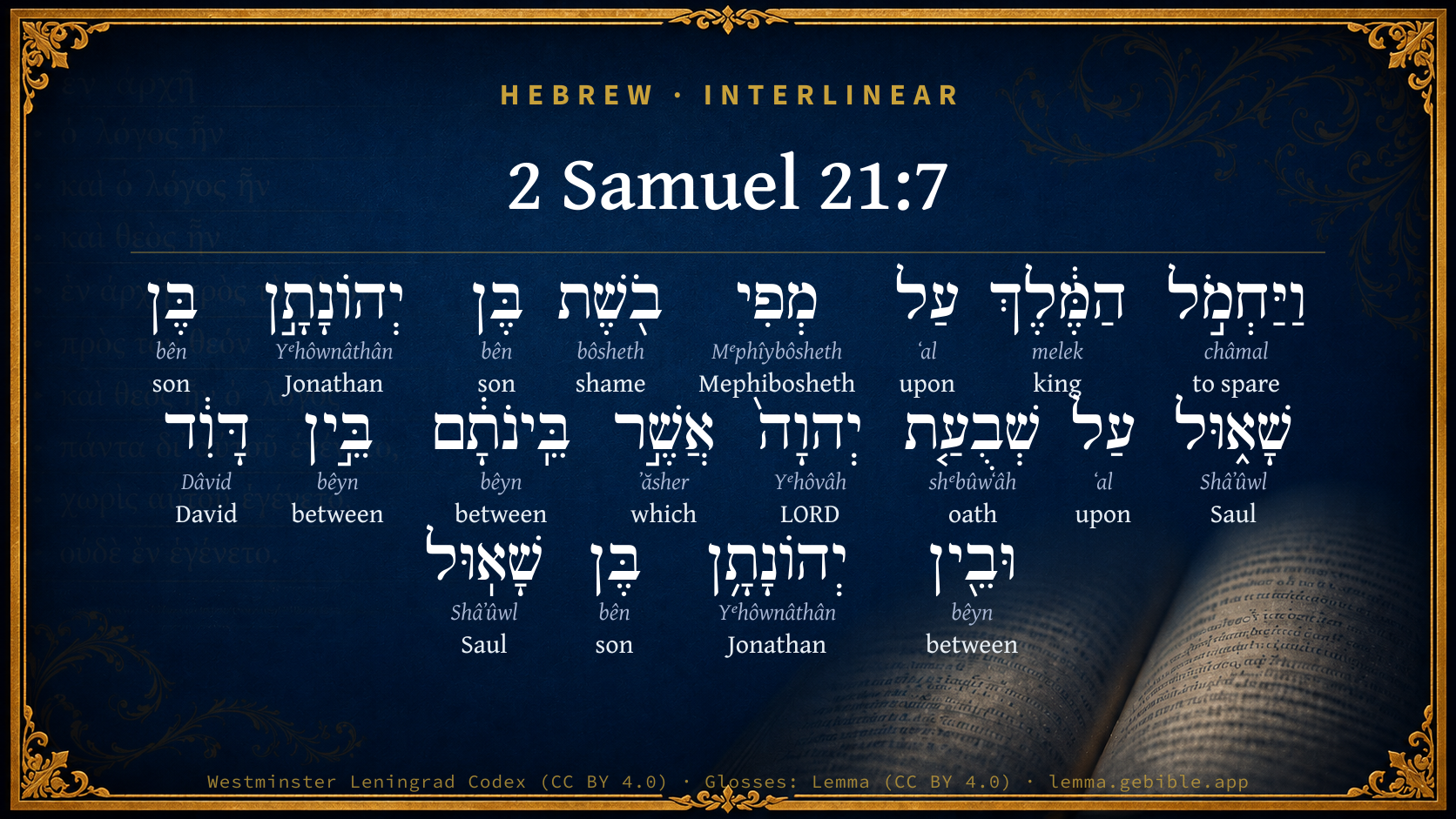
2 Samuel 21:7

Hebrew (Westminster Leningrad Codex) 2 Samuel 21:7 appears in the Hebrew Old Testament. The text above is from the Westminster Leningrad Codex. Each word links to its Strong’s number, a concise gloss, and parsing drawn from the Open Scriptures Hebrew Bible morphology. Click any word for its full Brown-Driver-Briggs (BDB) entry.
Download image
Cite this verse

2 Samuel 21:7 (World English Bible). Public Domain. Lemma interlinear Bible study tool, https://lemma.gebible.app/v/2-samuel/21/7.

Show BibTeX & RIS
BibTeX
RIS
English Translation
But the king spared Mephibosheth, the son of Jonathan the son of Saul, because of Yahweh's oath that was between them, between David and Jonathan the son of Saul.
World English Bible · Public Domain
Download a study sheet

One document with this verse’s original text, its word-by-word gloss line, the meaning frame, cross-references with their text, attributed commentary, and full source and license credits — printable, and it pastes into notes with its structure intact.

This verse Autodidact and up

Study sheet (.html) Plain text (.txt)

A passage Seminary Student

Up to 50 verses in one chapter. A passage sheet keeps up to 6 commentary sources and 12 cross-references per verse, in the order this page ranks them, and says so on the sheet whenever that leaves anything out. Ask for a single verse and you get the Autodidact verse sheet above.

Everything on this page stays free to read, with no account — the sheet is a download of what is already on screen, not access to it.

Want to remove ads? Support Godless Engineer
Compare translations 3

The same verse in 3 English versions, stacked beneath the original-language interlinear above. Click any original word for its lexicon entry.

Each is an independent rendering of the whole verse — the interlinear is not word-aligned to these translations.

Highlighted words mark where these versions differ — a whole-verse word diff, not a word-by-word alignment.

  • World English Bible Public Domain
    But the king spared Mephibosheth, the son of Jonathan the son of Saul, because of Yahweh's oath that was between them, between David and Jonathan the son of Saul.
  • King James Version Public Domain
    But the king spared Mephibosheth, the son of Jonathan the son of Saul, because of the LORD's oath that was between them, between David and Jonathan the son of Saul.
  • unfoldingWord Literal Text CC BY-SA 4.0
    Now the king had compassion on Mephibosheth, the son of Jonathan, the son of Saul, because of the oath of Yahweh that between them, between David and between Jonathan, the son of Saul.

unfoldingWord Literal Text — © unfoldingWord, licensed CC BY-SA 4.0. Word-aligned USFM3 via Door43 (git.door43.org/unfoldingWord/en_ult).

Versions to compare (up to 4)

3 of 4 selected

Show all 18 translations

Every available English version of this verse, each an independent rendering of the whole verse.

  • World English Bible Public Domain
    But the king spared Mephibosheth, the son of Jonathan the son of Saul, because of Yahweh's oath that was between them, between David and Jonathan the son of Saul.
  • Berean Standard Bible Public Domain
    Now the king spared Mephibosheth son of Jonathan, the son of Saul, because of the oath before the LORD between David and Jonathan son of Saul.
  • Majority Standard Bible Public Domain
    Now the king spared Mephibosheth son of Jonathan, the son of Saul, because of the oath before the LORD between David and Jonathan son of Saul.
  • King James Version Public Domain
    But the king spared Mephibosheth, the son of Jonathan the son of Saul, because of the LORD's oath that was between them, between David and Jonathan the son of Saul.
  • American Standard Version (1901) Public Domain
    But the king spared Mephibosheth, the son of Jonathan the son of Saul, because of Jehovah's oath that was between them, between David and Jonathan the son of Saul.
  • Revised Version (1885) Public Domain
    But the king spared Mephibosheth, the son of Jonathan the son of Saul, because of the LORD’S oath that was between them, between David and Jonathan the son of Saul.
  • Geneva Bible (1599) Public Domain
    But the King had compassion on Mephibosheth the sonne of Ionathan the sonne of Saul, because of the Lordes othe, that was betweene them, euen betweene Dauid and Ionathan the sonne of Saul.
  • Douay-Rheims (1899) Public Domain
    And the king spared Miphiboseth the son of Jonathan the son of Saul, because of the oath of the Lord, that had been between David and Jonathan the son of Saul.
  • Young's Literal Translation Public Domain
    and the king hath pity on Mephibosheth son of Jonathan, son of Saul, because of the oath of Jehovah that `is' between them, between David and Jonathan son of Saul;
  • Literal Standard Version CC BY-SA 4.0
    and the king has pity on Mephibosheth son of Jonathan, son of Saul, because of the oath of YHWH that [is] between them, between David and Jonathan son of Saul;
  • Unlocked Literal Bible CC BY-SA 4.0
    But the king spared Mephibosheth son of Jonathan son of Saul, because of Yahweh's oath between them, between David and Jonathan son of Saul.
  • unfoldingWord Literal Text CC BY-SA 4.0
    Now the king had compassion on Mephibosheth, the son of Jonathan, the son of Saul, because of the oath of Yahweh that between them, between David and between Jonathan, the son of Saul.
  • Darby Bible Public Domain
    But the king spared Mephibosheth, the son of Jonathan the son of Saul, because of Jehovah's oath that was between them, between David and Jonathan the son of Saul.
  • World Messianic Bible Public Domain
    But the king spared Mephibosheth the son of Jonathan the son of Saul, because of the LORD’s oath that was between them, between David and Jonathan the son of Saul.
  • Webster's Bible Public Domain
    But the king spared Mephibosheth, the son of Jonathan, the son of Saul, because of the LORD'S oath that was between them, between David and Jonathan the son of Saul.
  • Free Bible Version CC BY-SA 4.0
    However, the king spared Mephibosheth, son of Jonathan, son of Saul, because of the oath sworn before the Lord between David and Jonathan, son of Saul.
  • Bible in Basic English Public Domain
    But the king did not give up Mephibosheth, the son of Saul's son Jonathan, because of the Lord's oath made between David and Jonathan, the son of Saul.
  • JPS Tanakh (1917) Public Domain
    But the king spared Mephibosheth, the son of Jonathan the son of Saul, because of the LORD'S oath that was between them, between David and Jonathan the son of Saul.

Literal Standard Version (2020), Covenant Press — licensed CC BY-SA 4.0. Text via the HelloAO Bible API (eBible.org). Unlocked Literal Bible (unfoldingWord) — licensed CC BY-SA 4.0. Text via the HelloAO Bible API (eBible.org). unfoldingWord Literal Text — © unfoldingWord, licensed CC BY-SA 4.0. Word-aligned USFM3 via Door43 (git.door43.org/unfoldingWord/en_ult). Free Bible Version, Dr. Jonathan Gallagher — licensed CC BY-SA 4.0. Text via the HelloAO Bible API (eBible.org).

Word by word

More ways to search: Search by grammar → Find every occurrence → Compare this word →

Practice this passage: Drill this verse → Learn its vocabulary →

מְפִי
Mᵉphîybôsheth
H4648
“Mephibosheth”
Noun, Proper
Part of Speech
Noun
Type
Proper
Full BDB Definition

Origin: probably from H6284 and H1322

TWOT: None

Mephibosheth = "exterminating the idol" - grandson of Saul and son of Rizpah the daughter of Aiah, Saul's concubine; he and his brother Armoni were among the 7 victims surrendered by David to the Gibeonites to avert a famine - son of Jonathan and grandson of Saul - also 'Merib-baal'
  1. וַיַּחְמֹ֣ל châmal H2550 “and · to spare” Conjunction + Verb, Qal, Sequential Imperfect, 3rd Person, Masculine, Singular
  2. הַמֶּ֔לֶךְ melek H4428 “the · king” Particle, Definite Article + Noun, Common, Masculine, Singular, Absolute
  3. עַל ʻal H5921 “upon” Preposition
  4. בֹ֖שֶׁת bôsheth H1322 “shame” Noun, Proper
  5. בֶּן bên H1121 “son of” Noun, Common, Masculine, Singular, Construct
  6. יְהוֹנָתָ֣ן Yᵉhôwnâthân H3083 “Jonathan” Noun, Proper
  7. בֶּן bên H1121 “son of” Noun, Common, Masculine, Singular, Construct
  8. שָׁא֑וּל Shâʼûwl H7586 “Saul” Noun, Proper
  9. עַל ʻal H5921 “upon” Preposition
  10. שְׁבֻעַ֤ת shᵉbûwʻâh H7621 “oath of” Noun, Common, Feminine, Singular, Construct
  11. יְהוָה֙ Yᵉhôvâh H3068 “LORD” Noun, Proper
  12. אֲשֶׁ֣ר ʼăsher H834 “which” Particle, Relative
  13. בֵּֽינֹתָ֔ם bêyn H996 “between · them” Preposition + Suffix, Personal, 3rd Person, Masculine, Plural
  14. בֵּ֣ין bêyn H996 “between” Preposition
  15. דָּוִ֔ד Dâvid H1732 “David” Noun, Proper
  16. וּבֵ֖ין bêyn H996 “and · between” Conjunction + Preposition
  17. יְהוֹנָתָ֥ן Yᵉhôwnâthân H3083 “Jonathan” Noun, Proper
  18. בֶּן bên H1121 “son of” Noun, Common, Masculine, Singular, Construct
  19. שָׁאֽוּל Shâʼûwl H7586 “Saul” Noun, Proper

About this verse

These counts appear in no published source. They are computed here, from the morphology-tagged text and Lemma’s own curated glosses. What Lemma adds →

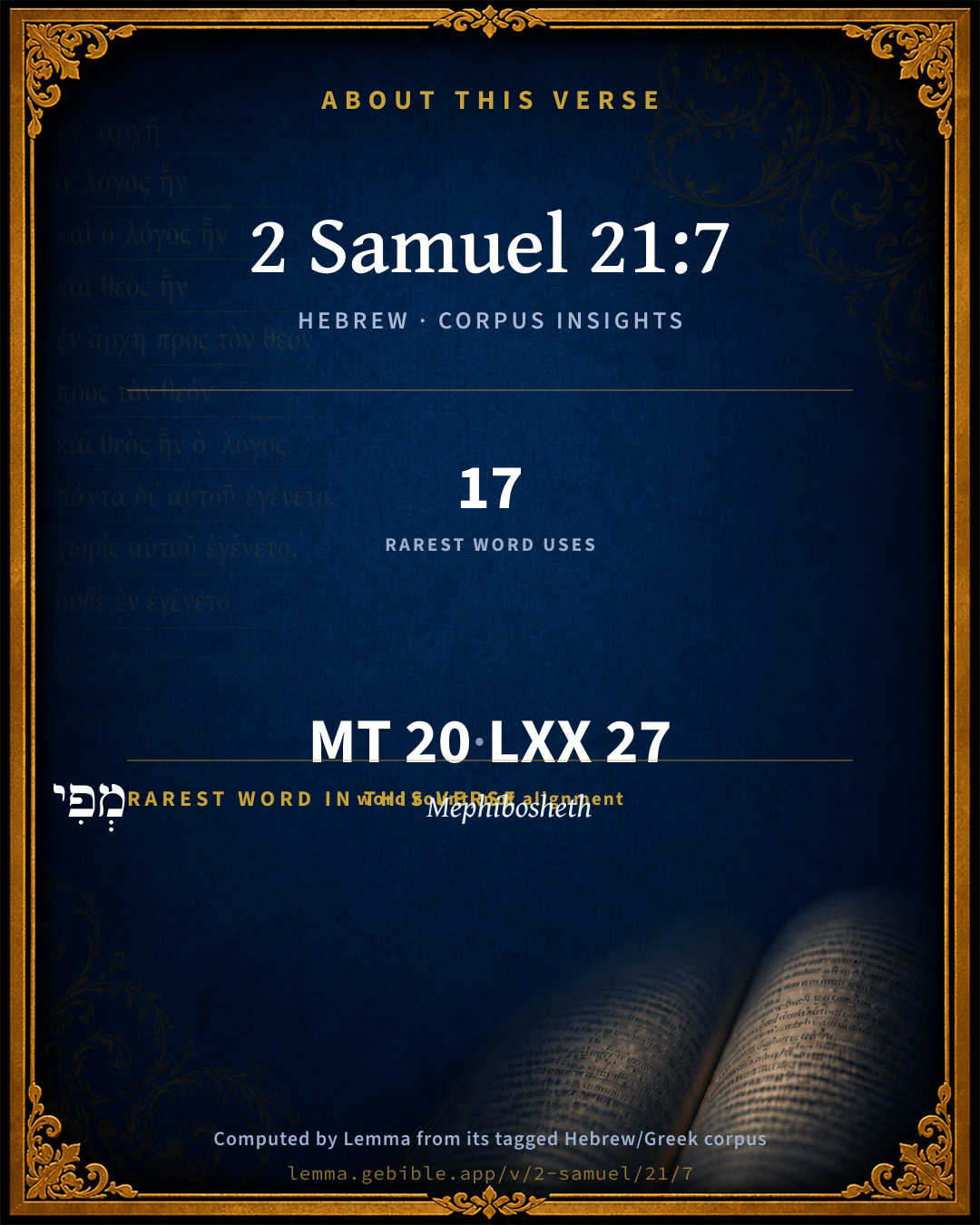
20
words
13
distinct lemmas
Historical
section

Notable vocabulary

The rarest word here is מְפִי Mephibosheth H4648 — appearing just 17 times in the whole Hebrew Bible.

Shared distinctive vocabulary

מְפִי Mephibosheth H4648 occurs in 13 verses of the Hebrew Bible. Also found in:

Grammatical profile

  • 1 verb
  • 13 nouns
  • 5 prepositions
  • 1 particle

Verb forms

  • וַיַּחְמֹ֣ל Qal · Sequential Imperfect

Repetition

Words recur within this verse — often emphatic in Hebrew:

  • בֶּן son H1121 ×3
  • בֵּֽינֹתָ֔ם between H996 ×3
  • עַל upon H5921 ×2
  • יְהוֹנָתָ֣ן Jonathan H3083 ×2
  • שָׁא֑וּל Saul H7586 ×2

Hebrew & Septuagint length

In English translation the verse runs 29 words from the Hebrew and 32 from the Septuagint (LXX English) — closely comparable.

A rough comparison of the two English renderings, which tokenize alike — not a word-level alignment.

Word counts can differ between the Hebrew and the Greek without any difference in meaning — e.g. the Hebrew direct-object marker אֵת has no separate Greek word, and Greek often adds the article ὁ.

In the original languages it is 20 Hebrew tokens and 27 Greek tokens — but the two are counted differently (Hebrew bundles its prefixes and suffixes into one token; the Greek is in lemma form), so that isn’t a like-for-like length.

Cross-references

11

Topical passages linked to 2 Samuel 21:7 in the Treasury of Scripture Knowledge — connected by theme and wording, ordered by reader-vote popularity; previews shown in the World English Bible.

  • 1 Samuel 18:3 Then Jonathan and David made a covenant, because he loved him as his own soul.
  • 1 Samuel 20:15 but also you shall not cut off your kindness from my house forever; no, not when Yahweh has cut off the enemies of David everyone from the surface of the earth.
  • 1 Samuel 23:18 They two made a covenant before Yahweh: and David abode in the wood, and Jonathan went to his house.
  • 2 Samuel 4:4 Now Jonathan, Saul's son, had a son who was lame of his feet. He was five years old when the news came of Saul and Jonathan out of Jezreel; and his nurse took him up, and fled: and it happened, as she made haste to flee, that he fell, and became lame. His name was Mephibosheth.
  • 1 Samuel 20:8 Therefore deal kindly with your servant; for you have brought your servant into a covenant of Yahweh with you: but if there be in me iniquity, kill me yourself; for why should you bring me to your father?
  • 2 Samuel 9:10 You shall till the land for him, you, and your sons, and your servants; and you shall bring in [the fruits], that your master's son may have bread to eat: but Mephibosheth your master's son shall eat bread always at my table." Now Ziba had fifteen sons and twenty servants.
  • 1 Samuel 20:17 Jonathan caused David to swear again, for the love that he had to him; for he loved him as he loved his own soul.
  • 1 Samuel 20:42 Jonathan said to David, Go in peace, because we have sworn both of us in the name of Yahweh, saying, Yahweh shall be between me and you, and between my seed and your seed, forever. He arose and departed: and Jonathan went into the city.
  • 2 Samuel 9:7 David said to him, "Don't be afraid of him; for I will surely show you kindness for Jonathan your father's sake, and will restore you all the land of Saul your father; and you shall eat bread at my table continually."
  • 2 Samuel 16:4 Then said the king to Ziba, Behold, all that pertains to Mephibosheth is yours. Ziba said, I do obeisance; let me find favor in your sight, my lord, O king.
  • 2 Samuel 19:25 It happened, when he was come to Jerusalem to meet the king, that the king said to him, Why didn't you go with me, Mephibosheth?

Cross-references courtesy of OpenBible.info (CC BY 4.0).

Hebrew and Greek witnesses Masoretic Hebrew ↔ Greek Septuagint

The same verse in the two great witnesses to the Old Testament, shown verse-for-verse.

These are two independent witnesses, not word-aligned to each other, and the Septuagint is shown in lemma (dictionary) form.

Hebrew 2 Samuel 21:7 Masoretic · Westminster Leningrad Codex

וַיַּחְמֹ֣ל הַמֶּ֔לֶךְ עַל מְפִי בֹ֖שֶׁת בֶּן יְהוֹנָתָ֣ן בֶּן שָׁא֑וּל עַל שְׁבֻעַ֤ת יְהוָה֙ אֲשֶׁ֣ר בֵּֽינֹתָ֔ם בֵּ֣ין דָּוִ֔ד וּבֵ֖ין יְהוֹנָתָ֥ן בֶּן שָׁאֽוּל

But the king spared Mephibosheth, the son of Jonathan the son of Saul, because of Yahweh's oath that was between them, between David and Jonathan the son of Saul.

World English Bible · Public Domain

Greek LXX 2 Samuel 21:7 Septuagint · lemma form

καί φείδομαι ὁ βασιλεύς ἐπί μεμφιβοσθε υἱός ιωναθαν υἱός σαούλ διά ὁ ὅρκος κύριος ὁ ἀνά μέσος αὐτός ἀνά μέσος δαυίδ καί ἀνά μέσος ιωναθαν υἱός σαούλ

But the king spared Memphibosthe son of Jonathan the son of Saul, because of the oath of the Lord that was between them, even between David and Jonathan the son of Saul.

LXX2012 (modern English Septuagint) · Public Domain

Hebrew: Westminster Leningrad Codex (CC BY 4.0). Greek: Septuagint (public domain); English from LXX2012 (modern English Septuagint) (Public Domain). How the Septuagint differs from the Hebrew →

Targum (Aramaic paraphrase)

1

The Targum is the ancient Jewish Aramaic paraphrase of the Hebrew Scriptures — an interpretive translation, not the Hebrew text itself. Onkelos (literal) and Pseudo-Jonathan (expansive) render the Torah, and Jonathan the Prophets. Coverage is partial: where no permissively-licensed English translation exists for a verse, only the Aramaic is shown. This is verse-level text, not a word-by-word alignment to the Hebrew.

  1. Targum Jonathan Prophets (Joshua–Malachi)
    וְחָס מַלְכָּא עַל מְפִיבֹשֶׁת בַּר יְהוֹנָתָן בַּר שָׁאוּל עַל שְׁבוּעֲתָא דַייָ דְבֵינֵיהוֹן בֵּין דָוִד וּבֵין יְהוֹנָתָן בַּר שָׁאוּל:

    (no public-domain English translation for this verse)

    Targum Jonathan — Aramaic: “Mikraot Gedolot” (public domain). English: “Sefaria Community Translation” (CC0 1.0 (public-domain dedication)); “London "Chaldee Paraphrase," 1871” (public domain). Text via Sefaria.

Commentary

Notes on 2 Samuel 21:7 from classic Christian and Jewish commentators (each source and its license shown beneath its notes). The classic Christian expositions comment on the surrounding passage and are grouped to its opening verse, so a note may address several verses; the Jewish commentaries on the Tanakh (Rashi and others) are per-verse, so they appear only where the commentator wrote on this verse.

Lemma curates 59 commentaries, every one of them public domain or Creative Commons licensed, each selected and text-cleaned for this edition rather than reprinted as found. About our sources →

Trapp's Complete Commentary

John Trapp

2Sa 21:7 But the king spared Mephibosheth, the son of Jonathan the son of Saul, because of the LORD’S oath that [was] between them, between David and Jonathan the son of Saul.

Ver. 7. Because of the Lord’s oath that was betwixt them.] That oath, if it had been rightly thought on, should have saved Mephibosheth’s land as well as his life. If it kept Mephibosheth: from the gallows, how much more shall the Father of all mercies do good to the children of the faithful, for the covenant made with their parents?

John Trapp, A Commentary or Exposition upon All the Books of the Old and New Testament (1647–1656) — public domain. Text from a community e-Sword module.

Joseph Benson's Commentary

2Sa 21:7-8. The king spared, &c. — For the Gibeonites desiring only such a number, it was at David’s choice whom to spare. The son of Jonathan — This is added to distinguish him from the other Mephibosheth, 2Sa 21:8. Because of the Lord’s oath, &c. — This was a just reason for not delivering him up. The five sons of Michal, whom she brought up for Adriel — In the original it is, whom she bare to Adriel. And as Michal was not the wife of Adriel, but her elder sister Merab, it is probable that Michal’s name has here crept into the text by the mistake of some transcriber for Merab’s. Or else it should stand as the margin of our Bible has it, Michal’s sister.

Joseph Benson's Commentary on the Old and New Testaments (1811–1818) — public domain. Text from a community e-Sword module.

Tyndale Open Study Notes

Tyndale Open Resources

21:7 the oath: See 1 Sam 20:14-15. In contrast to Saul, David was honoring his oath while dealing with the deadly fallout of Saul’s violation of an oath.

Tyndale Open Study Notes — © Tyndale Open Resources, licensed CC BY-SA 4.0. Text via the HelloAO Bible API.

The Cambridge Bible for Schools and Colleges

gen. ed. J. J. S. Perowne

7. the Lord’s oath] See 1Sa_18:3; 1Sa_20:12-17; 1Sa_20:42; 1Sa_23:18.

The Cambridge Bible for Schools and Colleges (gen. ed. J. J. S. Perowne; Cambridge University Press, 1878–1918) — public domain. Text from a community e-Sword module.

John Gill's Exposition

But the king spared Mephibosheth, the son of Jonathan, the son of Saul,.... As they did not name particular persons, only required seven sons, it was at the option of the king what sons to deliver to them, and therefore kept back Mephibosheth, who is thus described, to distinguish him from a son of Saul's of the same name, after mentioned:

because of the Lord's oath that was between them, between David and Jonathan the son of Saul; not merely or only out of affection to Mephibosheth, but because of the oath, that he might not be guilty of the same crime Saul was in slaying the Gibeonites.

John Gill's Exposition of the Whole Bible (1746–1763) — public domain (CC PDM 1.0). Text via the HelloAO Bible API.

Albert Barnes' Notes on the Bible

The Lord’s oath - The calamity brought upon Israel by Saul’s breach of the oath to the Gibeonites would make David doubly careful in the matter of his own oath to Jonathan.

Albert Barnes' Notes on the Bible (1834–1885) — public domain. Text from a community e-Sword/MySword module.

Matthew Poole's English Annotations

The king spared Mephibosheth; for the Gibeonites desiring only such a number, without designing the persons, it was at David’s choice whom to spare. Or, he prevailed with the Gibeonites that they did not demand him; and with the Lord, that he might not be one of those who were devoted to destruction.

The son of Jonathan: this is expressly added, to distinguish him from the other Mephibosheth, 2Sa 21:8.

Matthew Poole's English Annotations on the Holy Bible (1683–1685) — public domain. Text from a community e-Sword/MySword module.

John Wesley's Explanatory Notes

Spared - For the Gibeonites desiring only such a number, it was at David's choice whom to spare. Of Jonathan - This is added, to distinguish him from the other Mephibosheth, ver. 8.

John Wesley, Explanatory Notes Upon the Whole Bible (1754–1765) — public domain. Text via the GEBible commentary corpus.

unfoldingWord translationNotes

Door43 World Missions Community

Mephibosheth

Mephibosheth was the son of Jonathan. See how you translated his name in 2 Samuel 4:4.

Rizpah ... Aiah

Rizpah was a woman and her father was Aiah. See how you translated these names in 2 Samuel 3:7.

Armoni and Mephibosheth ... Adriel ... Barzillai

These are names of men. This is not the same Mephibosheth as the son of Jonathan. (See: How to Translate Names)

Merab

This is the name of a woman. See how you translated it in 2 Samuel 3:13.

Meholathite

This is the name of a people group. (See: How to Translate Names)

He handed them over into the hands of the Gibeonites

Here "the hands of the Gibeonites" represents the Gibeonite people's control. AT: "He gave them to the Gibeonites" (See: Metonymy)

They were put to death

This can be translated in active form. AT: "The Gibeonites put them to death" (See: Active or Passive)

translationWords

Jonathan

Yahweh

oath

name

harvest

barley

unfoldingWord translationNotes — © Distant Shores Media and the Door43 World Missions Community, licensed CC BY-SA 4.0. Source: git.door43.org/Door43/en_tn.

Rashi

Rabbi Shlomo Yitzchaki (Rashi)

The king had pity. He prayed for pity on Mephivoshes that the Ark should not detain him; because Dovid had them [Shaul's children] pass before the Ark, whomever the Ark detained, was put to death.

Rashi on the Tanakh — English translations: “The Judaica Press complete Tanach with Rashi, translated by A. J. Rosenberg” (CC BY 4.0); “Pentateuch with Rashi's commentary by M. Rosenbaum and A.M. Silbermann, 1929-1934” (public domain); “The Metsudah Tanach series, Lakewood, N.J” (CC BY 4.0); and “The Book of Joshua, Metsudah Publications, 1997” (CC BY 4.0). Text via Sefaria.

Lesson kit

Teaching starters — assembled from the data on this page, not authored interpretation. Every prompt links to the verse data it draws on. Edit before teaching.

2 Samuel, in the Historical, opens this verse with 20 words (13 distinct Hebrew lemmas). Its most distinctive word is Mᵉphîybôsheth (“Mephibosheth”). A historical commentator’s framing appears above. Read the whole chapter for the surrounding context.

Discussion questions

  1. What does “Mephibosheth” (Mᵉphîybôsheth) contribute to the verse as a whole?
  2. How does 2 Samuel 4:4, which shares the word «Mephibosheth», read alongside this verse?
  3. What does the repetition of “son” (3× in this one verse) do in this verse?
  4. The translations on this page render this verse differently — a whole-verse word diff, not a word-by-word alignment. What might account for the different wordings?
  5. «וַיַּחְמֹ֣ל» is a Qal Sequential Imperfect verb. How does that grammatical form shape the action described?
  6. Compare how Trapp's Complete Commentary and Joseph Benson's Commentary read this verse. Where do they agree or differ?

Things to notice

Reading settings

Reading text

Shown beneath each verse's original-language words.

Old Testament
Old Testament edition

Read the OT as the Masoretic Hebrew (MT) or the Greek Septuagint (LXX).

English shown for the Greek Septuagint (in the Hebrew ↔ Greek comparison).

Comparing translations? Open the Compare panel on any verse page to stack up to four side by side.