
Job 34:37

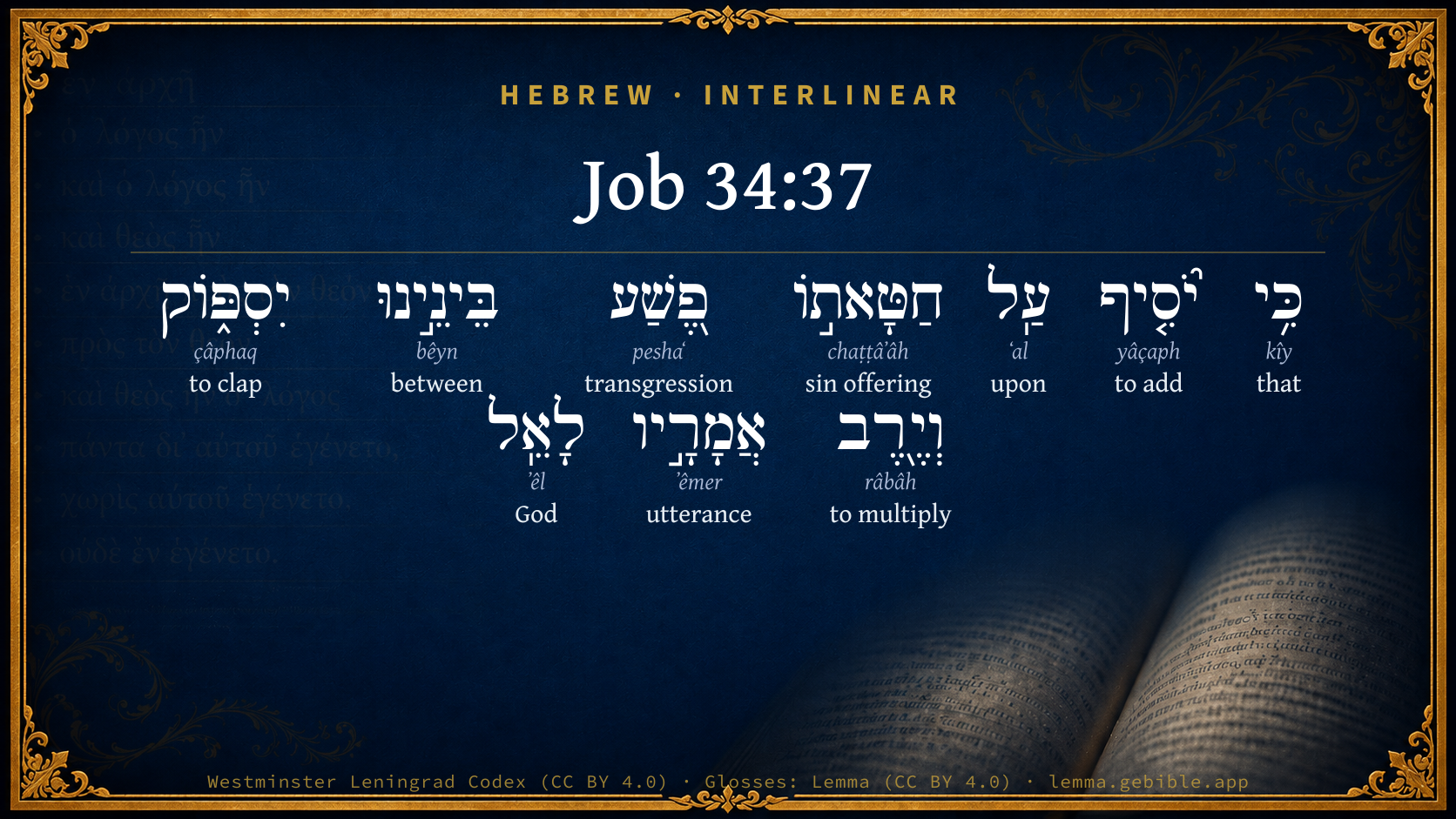
Hebrew (Westminster Leningrad Codex) Job 34:37 appears in the Hebrew Old Testament. The text above is from the Westminster Leningrad Codex. Each word links to its Strong’s number, a concise gloss, and parsing drawn from the Open Scriptures Hebrew Bible morphology. Click any word for its full Brown-Driver-Briggs (BDB) entry.
Download image
Cite this verse

Job 34:37 (World English Bible). Public Domain. Lemma interlinear Bible study tool, https://lemma.gebible.app/v/job/34/37.

Show BibTeX & RIS
BibTeX
RIS
English Translation
For he adds rebellion to his sin. He claps his hands among us, And multiplies his words against God."
World English Bible · Public Domain
Download a study sheet

One document with this verse’s original text, its word-by-word gloss line, the meaning frame, cross-references with their text, attributed commentary, and full source and license credits — printable, and it pastes into notes with its structure intact.

This verse Autodidact and up

Study sheet (.html) Plain text (.txt)

A passage Seminary Student

Up to 50 verses in one chapter. A passage sheet keeps up to 6 commentary sources and 12 cross-references per verse, in the order this page ranks them, and says so on the sheet whenever that leaves anything out. Ask for a single verse and you get the Autodidact verse sheet above.

Everything on this page stays free to read, with no account — the sheet is a download of what is already on screen, not access to it.

Want to remove ads? Support Godless Engineer
Compare translations 3

The same verse in 3 English versions, stacked beneath the original-language interlinear above. Click any original word for its lexicon entry.

Each is an independent rendering of the whole verse — the interlinear is not word-aligned to these translations.

Highlighted words mark where these versions differ — a whole-verse word diff, not a word-by-word alignment.

  • World English Bible Public Domain
    For he adds rebellion to his sin. He claps his hands among us, And multiplies his words against God."
  • King James Version Public Domain
    For he addeth rebellion unto his sin, he clappeth his hands among us, and multiplieth his words against God.
  • unfoldingWord Literal Text CC BY-SA 4.0
    For he adds transgression to his sin; he claps among us, and he multiplies his words against God.”

unfoldingWord Literal Text — © unfoldingWord, licensed CC BY-SA 4.0. Word-aligned USFM3 via Door43 (git.door43.org/unfoldingWord/en_ult).

Versions to compare (up to 4)

3 of 4 selected

Show all 18 translations

Every available English version of this verse, each an independent rendering of the whole verse.

  • World English Bible Public Domain
    For he adds rebellion to his sin. He claps his hands among us, And multiplies his words against God."
  • Berean Standard Bible Public Domain
    For he adds rebellion to his sin; he claps his hands among us and multiplies his words against God.”
  • Majority Standard Bible Public Domain
    For he adds rebellion to his sin; he claps his hands among us and multiplies his words against God.”
  • King James Version Public Domain
    For he addeth rebellion unto his sin, he clappeth his hands among us, and multiplieth his words against God.
  • American Standard Version (1901) Public Domain
    For he addeth rebellion unto his sin; He clappeth his hands among us, And multiplieth his words against God.
  • Revised Version (1885) Public Domain
    For he addeth rebellion unto his sin, he clappeth his hands among us, and multiplieth his words against God.
  • Geneva Bible (1599) Public Domain
    For he addeth rebellion vnto his sinne: he clappeth his handes among vs, and multiplieth his wordes against God.
  • Douay-Rheims (1899) Public Domain
    Because he addeth blasphemy upon his sins, let him be tied fast in the mean time amongst us: and then let him provoke God to judgment with his speeches.
  • Young's Literal Translation Public Domain
    For he doth add to his sin, Transgression among us he vomiteth, And multiplieth his sayings to God.
  • Literal Standard Version CC BY-SA 4.0
    For he adds to his sin, || He vomits transgression among us, || And multiplies his sayings to God.”
  • Unlocked Literal Bible CC BY-SA 4.0
    For he adds rebellion to his sin; he claps his hands in mockery in our midst; he piles up words against God.”
  • unfoldingWord Literal Text CC BY-SA 4.0
    For he adds transgression to his sin; he claps among us, and he multiplies his words against God.”
  • Darby Bible Public Domain
    For he addeth rebellion unto his sin, he clappeth [his hands] among us, and multiplieth his words against ùGod.
  • World Messianic Bible Public Domain
    For he adds rebellion to his sin. He claps his hands among us, and multiplies his words against God.”
  • Webster's Bible Public Domain
    For he addeth rebellion to his sin, he clappeth his hands among us, and multiplieth his words against God.
  • Free Bible Version CC BY-SA 4.0
    Now he has added rebellion to his sins; he claps his hands at us, making long speeches full of accusations against God.”
  • Bible in Basic English Public Domain
    For in addition to his sin, he is uncontrolled in heart; before our eyes he makes sport of God, increasing his words against him.
  • JPS Tanakh (1917) Public Domain
    For he addeth rebellion unto his sin, he clappeth his hands among us, and multiplieth his words against God.

Literal Standard Version (2020), Covenant Press — licensed CC BY-SA 4.0. Text via the HelloAO Bible API (eBible.org). Unlocked Literal Bible (unfoldingWord) — licensed CC BY-SA 4.0. Text via the HelloAO Bible API (eBible.org). unfoldingWord Literal Text — © unfoldingWord, licensed CC BY-SA 4.0. Word-aligned USFM3 via Door43 (git.door43.org/unfoldingWord/en_ult). Free Bible Version, Dr. Jonathan Gallagher — licensed CC BY-SA 4.0. Text via the HelloAO Bible API (eBible.org).

Word by word

More ways to search: Search by grammar → Find every occurrence → Compare this word →

Practice this passage: Drill this verse → Learn its vocabulary →

יִסְפּ֑וֹק
çâphaq
H5606
“to clap”
Verb, Qal, Imperfect, 3rd Person, Masculine, Singular
Part of Speech
Verb
Stem
Qal
Form
Imperfect
Person
3rd Person
Gender
Masculine
Number
Singular
Full BDB Definition

Origin: a primitive root

TWOT: 1539

( 1Ki 20:10 , Job 27:23 , Is Job 2:6 ) - to clap, slap - (Qal) - to slap, clap - to slap, chastise - to splash, throw up - (Hiphil) to cause to clap
  1. כִּ֥י kîy H3588 “that” Conjunction
  2. יֹ֘סִ֤יף yâçaph H3254 “to add” Verb, Hiphil, Imperfect, 3rd Person, Masculine, Singular
  3. עַֽל ʻal H5921 “upon” Preposition
  4. חַטָּאת֣וֹ chaṭṭâʼâh H2403 “sin offering · his” Noun, Common, Feminine, Singular, Construct + Suffix, Personal, 3rd Person, Masculine, Singular
  5. פֶ֭שַׁע peshaʻ H6588 “transgression” Noun, Common, Masculine, Singular, Absolute
  6. בֵּינֵ֣ינוּ bêyn H996 “between · us” Preposition + Suffix, Personal, 1st Person, Common, Plural
  7. וְיֶ֖רֶב râbâh H7235 “and · to multiply” Conjunction + Verb, Hiphil, Imperfect, 3rd Person, Masculine, Singular
  8. אֲמָרָ֣יו ʼêmer H561 “utterances · his” Noun, Common, Masculine, Plural, Construct + Suffix, Personal, 3rd Person, Masculine, Singular
  9. לָאֵֽל ʼêl H410 “to/for the · God” Preposition, Determined + Noun, Common, Masculine, Singular, Absolute

About this verse

These counts appear in no published source. They are computed here, from the morphology-tagged text and Lemma’s own curated glosses. What Lemma adds →

10
words
10
distinct lemmas
Wisdom
section

Notable vocabulary

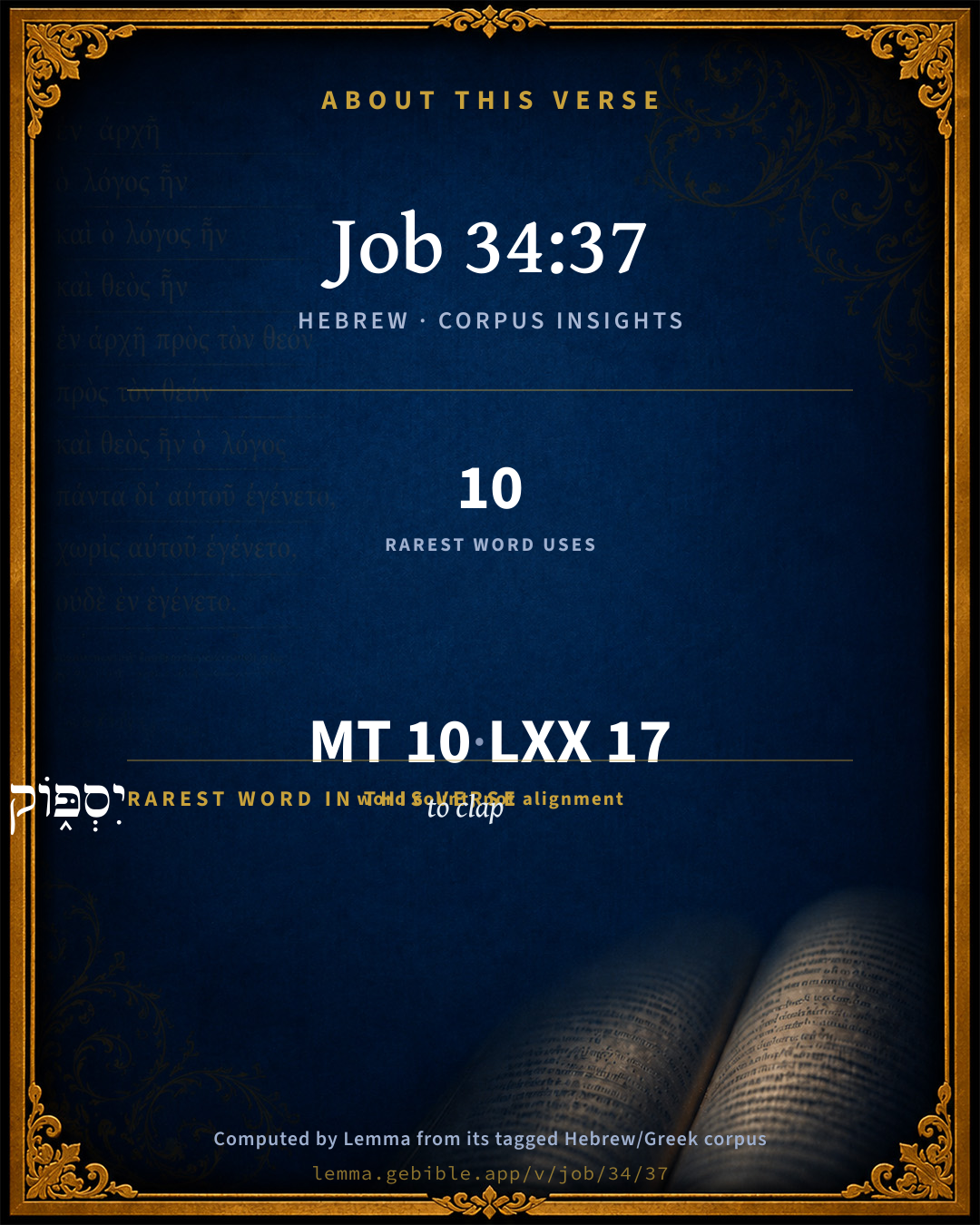
The rarest word here is יִסְפּ֑וֹק to clap H5606 — appearing just 10 times in the whole Hebrew Bible.

Shared distinctive vocabulary

יִסְפּ֑וֹק to clap H5606 occurs in 10 verses of the Hebrew Bible. Also found in:

Grammatical profile

  • 3 verbs
  • 4 nouns
  • 2 prepositions
  • 1 conjunction

Verb forms

  • יֹ֘סִ֤יף Hiphil · Imperfect
  • יִסְפּ֑וֹק Qal · Imperfect
  • וְיֶ֖רֶב Hiphil · Imperfect

Hebrew & Septuagint length

In English translation the verse runs 19 words from the Hebrew and 22 from the Septuagint (LXX English) — closely comparable.

A rough comparison of the two English renderings, which tokenize alike — not a word-level alignment.

Word counts can differ between the Hebrew and the Greek without any difference in meaning — e.g. the Hebrew direct-object marker אֵת has no separate Greek word, and Greek often adds the article ὁ.

In the original languages it is 10 Hebrew tokens and 17 Greek tokens — but the two are counted differently (Hebrew bundles its prefixes and suffixes into one token; the Greek is in lemma form), so that isn’t a like-for-like length.

Cross-references

9

Topical passages linked to Job 34:37 in the Treasury of Scripture Knowledge — connected by theme and wording, ordered by reader-vote popularity; previews shown in the World English Bible.

  • Job 27:23 Men shall clap their hands at him, And shall hiss him out of his place.
  • 1 Samuel 15:23 For rebellion is as the sin of witchcraft, and stubbornness is as idolatry and teraphim. Because you have rejected the word of Yahweh, he has also rejected you from being king.
  • Isaiah 1:19–20 If you are willing and obedient, You shall eat the good of the land;
  • Job 8:2–3 "How long will you speak these things? Shall the words of your mouth be a mighty wind?
  • Job 11:2–3 "Shouldn't the multitude of words be answered? Should a man full of talk be justified?
  • Job 23:2 "Even today is my complaint rebellious. His hand is heavy in spite of my groaning.
  • Job 35:2–3 "Do you think this to be your right, Or do you say, 'My righteousness is more than God's,'
  • Job 35:16 Therefore Job opens his mouth with empty talk, And he multiplies words without knowledge."
  • Job 42:7 It was so, that after Yahweh had spoken these words to Job, Yahweh said to Eliphaz the Temanite, "My wrath is kindled against you, and against your two friends; for you have not spoken of me the thing that is right, as my servant Job has.

Cross-references courtesy of OpenBible.info (CC BY 4.0).

Hebrew and Greek witnesses Masoretic Hebrew ↔ Greek Septuagint

The same verse in the two great witnesses to the Old Testament, shown verse-for-verse.

These are two independent witnesses, not word-aligned to each other, and the Septuagint is shown in lemma (dictionary) form.

Hebrew Job 34:37 Masoretic · Westminster Leningrad Codex

כִּ֥י יֹ֘סִ֤יף עַֽל חַטָּאת֣וֹ פֶ֭שַׁע בֵּינֵ֣ינוּ יִסְפּ֑וֹק וְיֶ֖רֶב אֲמָרָ֣יו לָאֵֽל

For he adds rebellion to his sin. He claps his hands among us, And multiplies his words against God."

World English Bible · Public Domain

Greek LXX Job 34:37 Septuagint · lemma form

ἵνα μή προςτίθημι ἐπί ἁμαρτία ἐγώ ἀνομία δέ ἐπί ἐγώ λογίζομαι πολύς λαλέω ῥῆμα ἐναντίον ὁ κύριος

that we add not to our sins: for iniquity will be reckoned against us, if we speak many words before the Lord.

LXX2012 (modern English Septuagint) · Public Domain

Hebrew: Westminster Leningrad Codex (CC BY 4.0). Greek: Septuagint (public domain); English from LXX2012 (modern English Septuagint) (Public Domain). How the Septuagint differs from the Hebrew →

Commentary

Notes on Job 34:37 from classic Christian and Jewish commentators (each source and its license shown beneath its notes). The classic Christian expositions comment on the surrounding passage and are grouped to its opening verse, so a note may address several verses; the Jewish commentaries on the Tanakh (Rashi and others) are per-verse, so they appear only where the commentator wrote on this verse.

Lemma curates 59 commentaries, every one of them public domain or Creative Commons licensed, each selected and text-cleaned for this edition rather than reprinted as found. About our sources →

Trapp's Complete Commentary

John Trapp

Job 34:37 For he addeth rebellion unto his sin, he clappeth [his hands] among us, and multiplieth his words against God.

Ver. 37. For he addeth rebellion unto his sin] Or, he will add, viz. unless he be exercised and subdued by more and longer load of afflictions; there will else be no hoe with him, no ground will hold him. The cross is of singular use to tame that rebel flesh; and is theretbre prayed for by Jeremiah for himself, Jer 10:24, and here by Elihu for Job, who had before advisedly chosen affliction rather than sin, and reckoned it as a mercy to be visited every morning, and tried every moment, Job 7:18.

He clappeth his hands among us] By way of derision, and as insulting over us. This it may seem Job had done in a disdainful way against all that had been spoken, which maketh Elihu thus fiercely to charge him.

And multiplieth his words against God] By a strange pertinace. He delivereth him therefore unto God to be further afflicted; as St Paul did Hymenaeus and Alexander unto Satan to be inwardly buffeted and bodily tormented, as Act 13:11; Act 19:16 ut castigati discerent, that they might learn not to blaspheme, 1Ti 1:20.

John Trapp, A Commentary or Exposition upon All the Books of the Old and New Testament (1647–1656) — public domain. Text from a community e-Sword module.

Joseph Benson's Commentary

Job 34:37. He addeth rebellion unto his sin — He sinned before by impatience under his afflictions, but now he is grown obstinate, and, instead of humbling himself for his sins, he justifies himself, and accuses the blessed God. He clappeth his hands among us — In token of victory, insulting and triumphing; and multiplieth his words against God — In effect, though not directly.

Joseph Benson's Commentary on the Old and New Testaments (1811–1818) — public domain. Text from a community e-Sword module.

Geneva Bible (1599)

Geneva Bible translators

He standeth stubbornly in the maintenance of his cause.

Geneva Bible (1599) marginal notes — public domain. Text via Bolls.life.

Jamieson, Fausset & Brown

Robert Jamieson, A. R. Fausset & David Brown

clappeth . . . hands--in scorn (Job 27:23; Eze 21:17).

multiplieth . . . words-- (Job 11:2; Job 35:16). To his original "sin" to correct which trials have been sent, "he adds rebellion," that is, words arraigning God's justice.

Next: Job Chapter 35

Jamieson, Fausset & Brown — Commentary Critical and Explanatory on the Whole Bible (1871) — public domain (CC PDM 1.0). Text via the HelloAO Bible API.

Adam Clarke's Commentary

Verse 37. He addeth rebellion unto his sin] An ill-natured, cruel, and unfounded assertion, borne out by nothing which Job had ever said or intended; and indeed, more severe than the most inveterate of his friends (so called) had ever spoken.

Mr. Good makes this virulent conclusion still more virulent and uncharitable, by translating thus: -

"For he would add to his transgressions apostasy;

He would clap his hands in the midst of us:

Yea, he would tempest his words up to God."

There was no need of adding a caustic here; the words in the tamest translation are tart enough. Though Elihu began well and tolerantly, he soon got into the spirit, and under the mistake, of those who had preceded him in this "tempest of words."

ON Job 34:30 I have referred to the case of Hegiage, governor of the Babylonian Irak, under the caliph Abdul Malec. When Hegiage was informed that the people were in a state of mutiny because of his oppressive government, before they broke out into open acts of hostility, he mounted on an eminence, and thus harangued them: -

"God has given me dominion over you; if I exercise it with severity, think not that by putting me to death your condition will be mended. From the manner in which you live you must be always ill-treated, for God has many executors of his justice; and when I am dead he will send you another, who will probably execute his orders against you with more rigour. Do you wish your prince to be moderate and merciful? Then exercise righteousness, and be obedient to the laws. Consider that your own conduct is the cause of the good or evil treatment which you receive from him. A prince may be compared to a mirror; all that you see in him is the reflection of the objects which you present before him."

The people immediately dropped their weapons, and quietly returned to their respective avocations. This man was one of the most valiant, eloquent, and cruel rulers of his time; he lived towards the close of the 7th century of the Christian era. He is said to have put to death 120,000 people; and to have had 50,000 in his prisons at the time of his decease.

Yet this man was capable of generous actions. The following anecdote is given by the celebrated Persian poet Jami, in his Baharistan: -

Hegiage, having been separated from his attendants one day in the chase, came to a place where he found an Arab feeding his camels. The camels starting at his sudden approach, the Arab lifted up his head, and seeing a man splendidly arrayed, became incensed, and said, Who is this who with his fine clothes comes into the desert to frighten my camels? The curse of Good light upon him! The governor, approaching the Arab, saluted him very civilly, with the salaam, Peace be unto thee! The Arab, far from returning the salutation, said, I wish thee neither peace, nor any other blessing of God. Hegiage, without seeming to heed what he had said, asked him very civilly "to give him a little water to drink." The Arab in a surly tone, answered, If thou desirest to drink, take the pains to alight, and draw for thyself; for I am neither thy companion nor thy slave. The governor accordingly alighted, and having drank, asked the Arab, "Whom dost thou think the greatest and most excellent of men?" The prophet sent by God, said the Arab, and thou mayest burst with spleen. "And what thinkest thou of Aaly?" returned Hegiage. No tongue can declare his excellence, said the Arab. "What," asked Hegiage, "is thy opinion of the caliph Abdul Malec?" I believe him to be a very bad prince, replied the Arab. "For what reason?" said Hegiage. Because, said the Arab, he hath sent us for governor the most execrable wretch under heaven. Hegiage, finding himself thus characterized, was silent; but his attendants coming up, he rejoined them, and ordered them to bring the Arab with them.

The next day Hegiage ordered him to be set at table with himself, and bade him "eat freely." The Arab, ere he tasted, said his usual grace, "God grant that the end of this repast may be no worse than the beginning!" While at meat the governor asked him, "Dost thou recollect the discourse we had together yesterday?" The Arab replied, God prosper thee in all things! but as to the secret of yesterday, take heed that thou disclose it not to-day. "I will not," said Hegiage; "but thou must choose one of these two things; either acknowledge me for thy master, and I will retain thee about my person; or else I will send thee to Abdul Malec, and tell him what thou hast said of him." There is a third course, replied the Arab, preferable to those two. "Well, what is that?" said the governor. Why, send me back to the desert, and pray God that we may never see each other's face again. Cruel and vindictive as Hegiage was, he could not help being pleased with the frankness and courage of the man; and not only forgave him the preceding insults but ordered him 10,000 pieces of silver, and sent him back to the desert, according to his wish.

Adam Clarke's Commentary on the Bible (1810–1826) — public domain. Text from a community e-Sword/MySword module.

Ellicott's Commentary for English Readers

(37) He clappeth his hands among us.—As though he were confident of victory in argument.

A Bible Commentary for English Readers, edited by Charles John Ellicott (1878–1897) — public domain. Text from a community e-Sword module.

The Cambridge Bible for Schools and Colleges

gen. ed. J. J. S. Perowne

37. Job’s sin is that of his former life, for which he has been cast into afflictions; his rebellion is his unsubmissive, defiant demeanour against God in his speeches. This “rebellion” is further described as clapping of the hands, a gesture of open mockery and contempt. The next clause, “multiplieth his words against God”, that is, his rebellious speeches, indicates that it is against God that Job “claps his hands,” not against his friends and counsellors—he shews his defiant scorn of God among them.

The passage is decisive as to the position taken by Elihu towards Job. His judgment of Job extends far beyond the mere bearing of the latter under his afflictions; it embraces Job’s former life. And the language exceeds in harshness almost anything that the three friends had said.

The Cambridge Bible for Schools and Colleges (gen. ed. J. J. S. Perowne; Cambridge University Press, 1878–1918) — public domain. Text from a community e-Sword module.

Albert Barnes' Notes on the Bible

For he addeth rebellion unto his sin - To the sin which he has formerly committed and which bas brought these trials upon him, he now adds the sin of complaining and rebellion against God. Of Job, this was certainly not true to the extent which Elihu intended, but it is a very common case in afflictions. A man is visited with calamity as a chastisement for his sins. Instead of searching out the cause why he is afflicted, or bowing with resignation to the superior wisdom of God when he cannot “see” any cause, he regards himself as unjustly dealt with; complains of the government of God as severe, and gives “occasion” for a severer calamity in some other form. The result is often that he is visited with severe affliction, and is made to see both his original offence and the accumulated guilt which has made a new form of punishment necessary.

He clappeth his hands amongst us - To clap the hands is either a signal of applause or triumph, or a mark of indignation, Num 24:10, or of derision, Job 27:23. It seems to be used in some such sense here, as expressing contempt or derision for the sentiments of his friends. The meaning is, that instead of treating the subject under discussion with a calm spirit and a disposition to learn the truth and profit by it, he had manifested in relation to the whole matter great disrespect, and had conductcd like one who attempts to silence others, or who shows his contempt for them by clapping his hands at them. It is scarcely necessary to say, that, notwithstanding all the professed candor and impartiality of Elihu, this is a most unfair representation of the general spirit of Job. That he had sometimes given vent to improper feelings there can be no doubt, but nothing had occurred to justify this statement.

And multiplieth his words against God - That is, his arguments are against the justice of his government and dealings. In the special phrase used here - “he multiplieth “words,”” Elihu means, probably, to say, that there was more of “words” than of argument in what Job had said, and that he was not content even with expressing his improper feelings once, but that he piled words on words, and epithet on epithet, that he might more fully give utterance to his reproachful feelings against his Maker.

Albert Barnes' Notes on the Bible (1834–1885) — public domain. Text from a community e-Sword/MySword module.

Haydock's Catholic Bible Commentary

Fast, and pressed by arguments. (Menochius) (Calmet) --- Hebrew, "since he adds crime (Calmet; Protestants, rebellion) to his sin, and clappeth his hands among us, and multiplieth his words against the Lord." Eliu concluding that Job was obstinate, (Haydock) invites his friends to join in prayer, that he might be still more severely chastised, to make him enter into himself. Such a strange petition might possibly proceed from charity. But Eliu had given too many proofs of passion, to allow this interpretation. Had he evinced that Job as a criminal? and were not his sorrows already too great, so that he might rather have prayed that God would alleviate them, or grant him more patience?

George Leo Haydock (1774–1849), Haydock's Catholic Family Bible and Commentary, 1859 edition — public domain. Excludes Psalms (Douay-Rheims chapter numbering differs from Protestant) and Deuterocanonical books (Catholic canon only).

Matthew Poole's English Annotations

He sinned before, as other ways, so by impatience under his afflictions, which may be ascribed to human infirmity; but now he is grown obstinate and incorrigible, and instead of repenting and humbling himself for his sins, he excuseth them, and justifieth himself, and accuseth the blessed God. Or thus,

For otherwise, unless he be thoroughly tried and rebuked, he will add rebellion unto his sin; he will break forth into open rebellion against God, and (as it follows) he will clap, &c. For the Hebrew words are of the future tense, although such are oft rendered by the past tense.

He clappeth his hands, in token of joy and victory, as this phrase is used, Psa 47:1; 98:8; insulting and triumphing, not only over us, as if none of us were able to answer him, but in a sort over God himself, inasmuch as he hath again and again desired leave of God to debate his cause with or before him, and in that case did not doubt to maintain it, but could not obtain the favour or justice of a fair hearing.

Multiplieth his words against God: whereas the reverence which he oweth to God, and his infinite distance from him, should teach him to be very modest and sparing in his speeches of God, Job on the contrary poureth forth whole floods of bold and presumptuous expostulations with God, and reflections upon God’s proceedings with him.

Matthew Poole's English Annotations on the Holy Bible (1683–1685) — public domain. Text from a community e-Sword/MySword module.

Whedon's Commentary on the Bible

Daniel D. Whedon

37. For he addeth rebellion — The root idea of פשׁע “rebellion,” is, “break from,” “sever.” The more Job murmurs, the more he becomes alienated from God. The danger is that he will completely apostatize from God. That Job may, if possible, be saved, it is desirable that he be tried to the utmost, or “till eternity,” (Furst,) if need be.

Clappeth — An expression of contempt, same as in Job_27:23.

Daniel D. Whedon (gen. ed.), Commentary on the Old and New Testaments (1874–1909) — public domain. Text from a community e-Sword module.

The Pulpit Commentary

-For he addeth rebellion unto his sin. Elihu holds that it is Job"s "sin" which has brought on him his chastisement, and regards his expostulations and complaints as flagrant "rebellion" against the Most High. He clappeth his hands among us; i.e. he applauds himself, approves of his own conduct, and, instead of repenting, makes a boast of it. And multiplieth his words against God. Job had continued to the last (Job 31) to justify himself and protest his integrity; which, in the view of Elihu, was to tax God with injustice.

The Pulpit Commentary (1880–1919), ed. H.D.M. Spence-Jones & Joseph S. Exell — public domain. Text from a community e-Sword module.

John Wesley's Explanatory Notes

Addeth - He sinned before, by impatience under his afflictions, now he is grown obstinate, and instead of humbling himself for his sins, justifies himself, and accuses the blessed God. Clapped - Insulting and triumphing. Against God - In effect, though not directly.

John Wesley, Explanatory Notes Upon the Whole Bible (1754–1765) — public domain. Text via the GEBible commentary corpus.

Rashi

Rabbi Shlomo Yitzchaki (Rashi)

he speaks loquaciously Heb. יספוק is an expression of many words and raising the voice.

among us he speaks loquaciously He asks, Why should we be concerned with his words? (above 19:4), ‘And even if I have indeed erred, let my error stay with me,’ and he does not know that we are punished, and he increases iniquities for us because we are listening. So it is explained in Leviticus Rabbah (4:6).

Rashi on the Tanakh — English translations: “The Judaica Press complete Tanach with Rashi, translated by A. J. Rosenberg” (CC BY 4.0); “Pentateuch with Rashi's commentary by M. Rosenbaum and A.M. Silbermann, 1929-1934” (public domain); “The Metsudah Tanach series, Lakewood, N.J” (CC BY 4.0); and “The Book of Joshua, Metsudah Publications, 1997” (CC BY 4.0). Text via Sefaria.

Lesson kit

Teaching starters — assembled from the data on this page, not authored interpretation. Every prompt links to the verse data it draws on. Edit before teaching.

Job, in the Wisdom, opens this verse with 10 words (10 distinct Hebrew lemmas). Its most distinctive word is çâphaq (“to clap”). A historical commentator’s framing appears above. Read the whole chapter for the surrounding context.

Discussion questions

  1. The word çâphaq carries the sense “to clap.” How does it shape the verse?
  2. Numbers 24:10 shares the word «to clap» with this verse. How do the two illuminate each other?
  3. The translations on this page render this verse differently — a whole-verse word diff, not a word-by-word alignment. What might account for the different wordings?
  4. The verb «יֹ֘סִ֤יף» is Hiphil Imperfect. How does its form color the action?
  5. Reading how Trapp's Complete Commentary and Joseph Benson's Commentary read this verse, where do the two commentators agree and where do they part?

Things to notice

Reading settings

Reading text

Shown beneath each verse's original-language words.

Old Testament
Old Testament edition

Read the OT as the Masoretic Hebrew (MT) or the Greek Septuagint (LXX).

English shown for the Greek Septuagint (in the Hebrew ↔ Greek comparison).

Comparing translations? Open the Compare panel on any verse page to stack up to four side by side.