Numbers 9:11

Hebrew (Westminster Leningrad Codex) Numbers 9:11 appears in the Hebrew Old Testament. The text above is from the Westminster Leningrad Codex. Each word links to its Strong’s number, a concise gloss, and parsing drawn from the Open Scriptures Hebrew Bible morphology. Click any word for its full Brown-Driver-Briggs (BDB) entry.
Download image
Cite this verse

Numbers 9:11 (World English Bible). Public Domain. Lemma interlinear Bible study tool, https://lemma.gebible.app/v/numbers/9/11.

Show BibTeX & RIS
BibTeX
RIS
English Translation
In the second month, on the fourteenth day at evening they shall keep it; they shall eat it with unleavened bread and bitter herbs.
World English Bible · Public Domain
Download a study sheet

One document with this verse’s original text, its word-by-word gloss line, the meaning frame, cross-references with their text, attributed commentary, and full source and license credits — printable, and it pastes into notes with its structure intact.

This verse Autodidact and up

Study sheet (.html) Plain text (.txt)

A passage Seminary Student

Up to 50 verses in one chapter. A passage sheet keeps up to 6 commentary sources and 12 cross-references per verse, in the order this page ranks them, and says so on the sheet whenever that leaves anything out. Ask for a single verse and you get the Autodidact verse sheet above.

Everything on this page stays free to read, with no account — the sheet is a download of what is already on screen, not access to it.

Want to remove ads? Support Godless Engineer
Compare translations 3

The same verse in 3 English versions, stacked beneath the original-language interlinear above. Click any original word for its lexicon entry.

Each is an independent rendering of the whole verse — the interlinear is not word-aligned to these translations.

Highlighted words mark where these versions differ — a whole-verse word diff, not a word-by-word alignment.

  • World English Bible Public Domain
    In the second month, on the fourteenth day at evening they shall keep it; they shall eat it with unleavened bread and bitter herbs.
  • King James Version Public Domain
    The fourteenth day of the second month at even they shall keep it, and eat it with unleavened bread and bitter herbs.
  • unfoldingWord Literal Text CC BY-SA 4.0
    In the second month on day 14, between the evenings, they shall do it. With unleavened bread and bitter herbs they shall eat it.

unfoldingWord Literal Text — © unfoldingWord, licensed CC BY-SA 4.0. Word-aligned USFM3 via Door43 (git.door43.org/unfoldingWord/en_ult).

Versions to compare (up to 4)

3 of 4 selected

Show all 18 translations

Every available English version of this verse, each an independent rendering of the whole verse.

  • World English Bible Public Domain
    In the second month, on the fourteenth day at evening they shall keep it; they shall eat it with unleavened bread and bitter herbs.
  • Berean Standard Bible Public Domain
    Such people are to observe it at twilight on the fourteenth day of the second month. They are to eat the lamb, together with unleavened bread and bitter herbs;
  • Majority Standard Bible Public Domain
    Such people are to observe it at twilight on the fourteenth day of the second month. They are to eat the lamb, together with unleavened bread and bitter herbs;
  • King James Version Public Domain
    The fourteenth day of the second month at even they shall keep it, and eat it with unleavened bread and bitter herbs.
  • American Standard Version (1901) Public Domain
    In the second month on the fourteenth day at even they shall keep it; they shall eat it with unleavened bread and bitter herbs:
  • Revised Version (1885) Public Domain
    in the second month on the fourteenth day at even they shall keep it; they shall eat it with unleavened bread and bitter herbs:
  • Geneva Bible (1599) Public Domain
    In the fourtenth day of the second moneth at euen they shall keepe it: with vnleauened bread and sowre herbes shall they eate it.
  • Douay-Rheims (1899) Public Domain
    In the second month, on the fourteenth day of the month in the evening, they shall eat it with unleavened bread and wild lettuce:
  • Young's Literal Translation Public Domain
    in the second month, on the fourteenth day, between the evenings they prepare it; with unleavened and bitter things they eat it;
  • Literal Standard Version CC BY-SA 4.0
    they prepare it in the second month, on the fourteenth day, between the evenings; they eat it with unleavened and bitter things;
  • Unlocked Literal Bible CC BY-SA 4.0
    In the second month on the fourteenth day at evening, they will eat the Passover meal. They must eat the Passover lamb with bread that is made without yeast and with bitter herbs.
  • unfoldingWord Literal Text CC BY-SA 4.0
    In the second month on day 14, between the evenings, they shall do it. With unleavened bread and bitter herbs they shall eat it.
  • Darby Bible Public Domain
    In the second month, on the fourteenth day, between the two evenings, shall they hold it; with unleavened bread and bitter herbs shall they eat it.
  • World Messianic Bible Public Domain
    In the second month, on the fourteenth day at evening they shall keep it; they shall eat it with unleavened bread and bitter herbs.
  • Webster's Bible Public Domain
    The fourteenth day of the second month at evening, they shall keep it, and eat it with unleavened bread and bitter herbs.
  • Free Bible Version CC BY-SA 4.0
    You are to observe it in the evening after sunset on the fourteenth day of the second month. You are to eat the lamb with the bread made without yeast, and the bitter herbs.
  • Bible in Basic English Public Domain
    In the second month, on the fourteenth day, in the evening, they are to keep it, taking it with unleavened bread and bitter-tasting plants;
  • JPS Tanakh (1917) Public Domain
    in the second month on the fourteenth day at dusk they shall keep it; they shall eat it with unleavened bread and bitter herbs;

Literal Standard Version (2020), Covenant Press — licensed CC BY-SA 4.0. Text via the HelloAO Bible API (eBible.org). Unlocked Literal Bible (unfoldingWord) — licensed CC BY-SA 4.0. Text via the HelloAO Bible API (eBible.org). unfoldingWord Literal Text — © unfoldingWord, licensed CC BY-SA 4.0. Word-aligned USFM3 via Door43 (git.door43.org/unfoldingWord/en_ult). Free Bible Version, Dr. Jonathan Gallagher — licensed CC BY-SA 4.0. Text via the HelloAO Bible API (eBible.org).

Word by word

More ways to search: Search by grammar → Find every occurrence → Compare this word →

Practice this passage: Drill this verse → Learn its vocabulary →

וּמְרֹרִ֖ים
mᵉrôr
H4844
“and · bitter herbs”
Conjunction + Noun, Common, Masculine, Plural, Absolute
Part of Speech
Conjunction + Noun
Type
Common
Gender
Masculine
Number
Plural
State
Absolute
Full BDB Definition

Origin: from H4843

TWOT: 1248e

bitter thing, bitter herb, bitterness
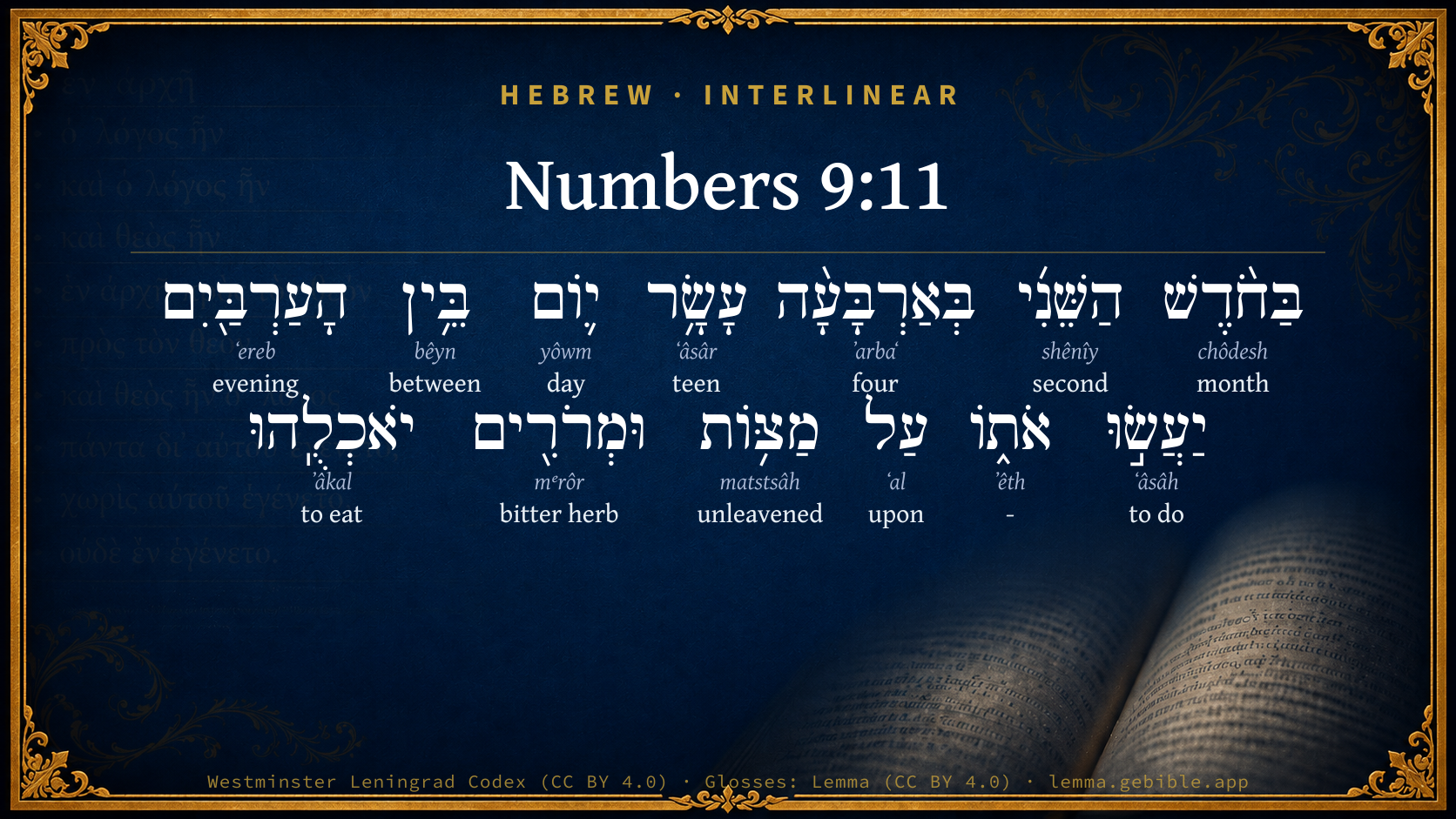
  1. בַּחֹ֨דֶשׁ chôdesh H2320 “in/at the · month” Preposition, Determined + Noun, Common, Masculine, Singular, Absolute
  2. הַשֵּׁנִ֜י shênîy H8145 “the · second” Particle, Definite Article + Adjective, Ordinal number, Masculine, Singular, Absolute
  3. בְּאַרְבָּעָ֨ה ʼarbaʻ H702 “in/at · four” Preposition + Adjective, Cardinal number, Masculine, Singular, Absolute
  4. עָשָׂ֥ר ʻâsâr H6240 “teen” Adjective, Cardinal number, Masculine, Singular, Absolute
  5. י֛וֹם yôwm H3117 “day” Noun, Common, Masculine, Singular, Absolute
  6. בֵּ֥ין bêyn H996 “between” Preposition
  7. הָעַרְבַּ֖יִם ʻereb H6153 “the · evenings” Particle, Definite Article + Noun, Common, Masculine, Dual, Absolute
  8. יַעֲשׂ֣וּ ʻâsâh H6213 “to do” Verb, Qal, Imperfect, 3rd Person, Masculine, Plural
  9. אֹת֑וֹ ʼêth H853 “- · him” Particle, Direct Object + Suffix, Personal, 3rd Person, Masculine, Singular
  10. עַל ʻal H5921 “upon” Preposition
  11. מַצּ֥וֹת matstsâh H4682 “unleavened bread” Noun, Common, Feminine, Plural, Absolute
  12. יֹאכְלֻֽהוּ ʼâkal H398 “to eat · him” Verb, Qal, Imperfect, 3rd Person, Masculine, Plural + Suffix, Personal, 3rd Person, Masculine, Singular

About this verse

These counts appear in no published source. They are computed here, from the morphology-tagged text and Lemma’s own curated glosses. What Lemma adds →

13
words
13
distinct lemmas
Pentateuch
section

Notable vocabulary

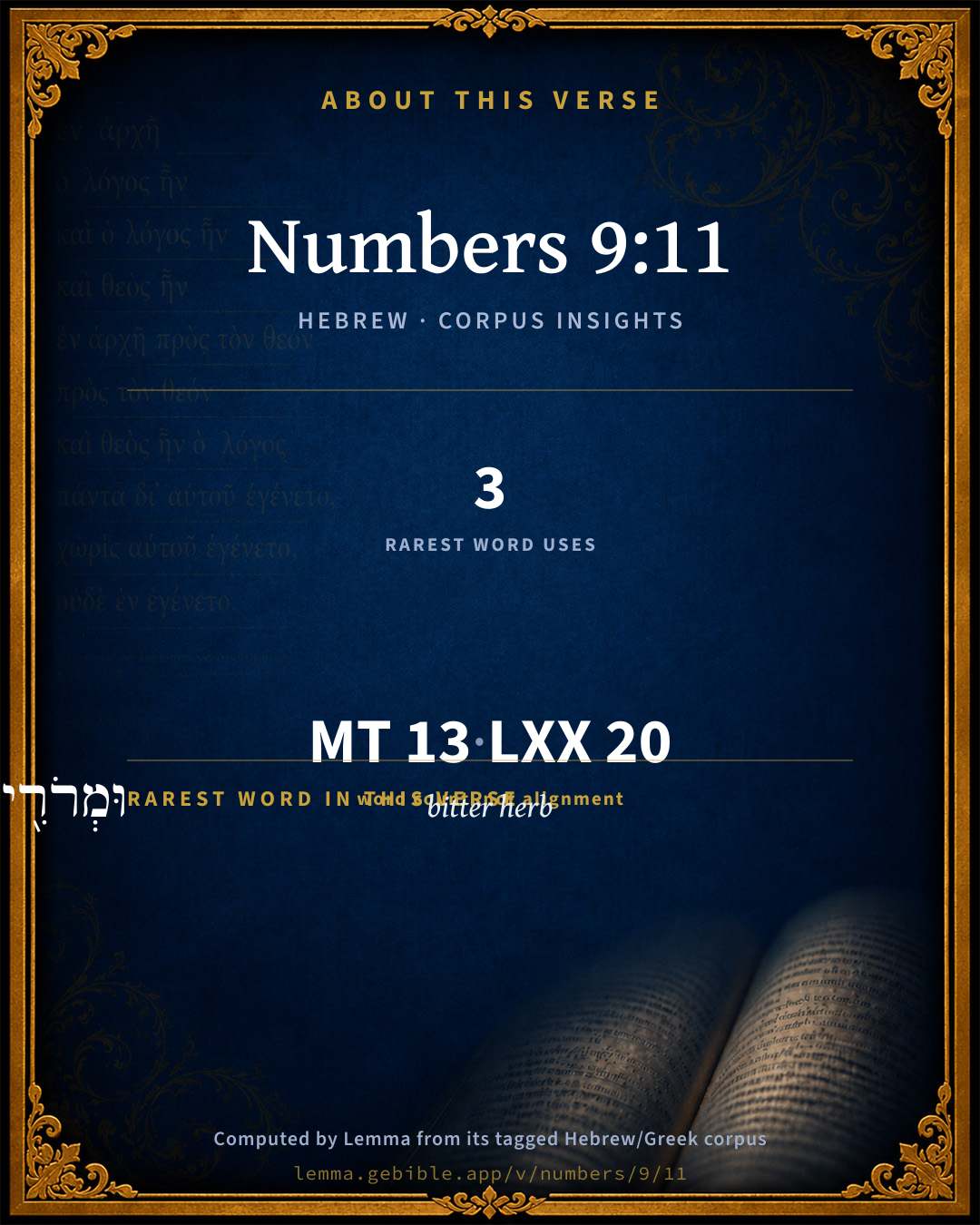
The rarest word here is וּמְרֹרִ֖ים bitter herb H4844 — appearing just 3 times in the whole Hebrew Bible.

Shared distinctive vocabulary

וּמְרֹרִ֖ים bitter herb H4844 occurs in 3 verses of the Hebrew Bible. Also found in:

Grammatical profile

  • 2 verbs
  • 5 nouns
  • 3 adjectives
  • 2 prepositions
  • 1 particle

Verb forms

  • יַעֲשׂ֣וּ Qal · Imperfect
  • יֹאכְלֻֽהוּ Qal · Imperfect

Hebrew & Septuagint length

In English translation the verse runs 24 words from the Hebrew and 25 from the Septuagint (LXX English) — closely comparable.

A rough comparison of the two English renderings, which tokenize alike — not a word-level alignment.

Word counts can differ between the Hebrew and the Greek without any difference in meaning — e.g. the Hebrew direct-object marker אֵת has no separate Greek word, and Greek often adds the article ὁ.

In the original languages it is 13 Hebrew tokens and 20 Greek tokens — but the two are counted differently (Hebrew bundles its prefixes and suffixes into one token; the Greek is in lemma form), so that isn’t a like-for-like length.

Cross-references

6

Topical passages linked to Numbers 9:11 in the Treasury of Scripture Knowledge — connected by theme and wording, ordered by reader-vote popularity; previews shown in the World English Bible.

  • 2 Chronicles 30:2–15 For the king had taken counsel, and his princes, and all the assembly in Jerusalem, to keep the Passover in the second month.
  • Exodus 12:2–14 "This month shall be to you the beginning of months. It shall be the first month of the year to you.
  • Exodus 12:43–49 Yahweh said to Moses and Aaron, "This is the ordinance of the Passover. There shall no foreigner eat of it,
  • Numbers 9:3 On the fourteenth day of this month, at evening, you shall keep it in its appointed season-- according to all its statutes, and according to all its ordinances, you shall keep it."
  • Deuteronomy 16:3 You shall eat no leavened bread with it; seven days shall you eat unleavened bread therewith, even the bread of affliction; for you came forth out of the land of Egypt in haste: that you may remember the day when you came forth out of the land of Egypt all the days of your life.
  • John 19:36 For these things happened, that the Scripture might be fulfilled, "A bone of him will not be broken."

Cross-references courtesy of OpenBible.info (CC BY 4.0).

Hebrew and Greek witnesses Masoretic Hebrew ↔ Greek Septuagint

The same verse in the two great witnesses to the Old Testament, shown verse-for-verse.

These are two independent witnesses, not word-aligned to each other, and the Septuagint is shown in lemma (dictionary) form.

Hebrew Numbers 9:11 Masoretic · Westminster Leningrad Codex

בַּחֹ֨דֶשׁ הַשֵּׁנִ֜י בְּאַרְבָּעָ֨ה עָשָׂ֥ר י֛וֹם בֵּ֥ין הָעַרְבַּ֖יִם יַעֲשׂ֣וּ אֹת֑וֹ עַל מַצּ֥וֹת וּמְרֹרִ֖ים יֹאכְלֻֽהוּ

In the second month, on the fourteenth day at evening they shall keep it; they shall eat it with unleavened bread and bitter herbs.

World English Bible · Public Domain

Greek LXX Numbers 9:11 Septuagint · lemma form

ἐν ὁ μήν ὁ δεύτερος ἐν ὁ οςτεσσαρεσκαιδέκατ ἡμέρα ὁ πρός ἑσπέρα ποιέω αὐτός ἐπί ἄζυμος καί πικρίς ἐσθίω αὐτός

in the second month, on the fourteenth day; in the evening they shall offer it, with unleavened bread and bitter herbs shall they eat it.

LXX2012 (modern English Septuagint) · Public Domain

Hebrew: Westminster Leningrad Codex (CC BY 4.0). Greek: Septuagint (public domain); English from LXX2012 (modern English Septuagint) (Public Domain). How the Septuagint differs from the Hebrew →

Targum (Aramaic paraphrase)

2

The Targum is the ancient Jewish Aramaic paraphrase of the Hebrew Scriptures — an interpretive translation, not the Hebrew text itself. Onkelos (literal) and Pseudo-Jonathan (expansive) render the Torah, and Jonathan the Prophets. Coverage is partial: where no permissively-licensed English translation exists for a verse, only the Aramaic is shown. This is verse-level text, not a word-by-word alignment to the Hebrew.

  1. Targum Onkelos Torah (Genesis–Deuteronomy)
    בְּיַרְחָא תִנְיָנָא בְּאַרְבְּעַת עַשְׂרָא יוֹמָא בֵּין שִׁמְשַׁיָא יַעְבְּדוּן יָתֵהּ עַל פַּטִּיר וּמְרָרִין יֵיכְלִנֵהּ

    (no public-domain English translation for this verse)

    Targum Onkelos — Aramaic: “Onkelos Genesis” (public domain); “Onkelos Exodus” (public domain); “Onkelos Leviticus” (public domain); “Onkelos Numbers” (public domain); “Onkelos Deuteronomy” (public domain). English: “Sefaria Community Translation” (CC0 1.0 (public-domain dedication)); “J.W. Etheridge. The Targums of Onkelos and Jonathan Ben Uzziel on the Pentateuch. London: Longmans, Green, 1862” (public domain). Text via Sefaria.

  2. Targum Pseudo-Jonathan Torah (Genesis–Deuteronomy)
    בְּיַרְחָא תִנְיָינָא הוּא יַרְחָא דְאִיָיר בְּאַרְבֵּיסַר יוֹמָא בֵּינֵי שִׁמְשָׁתָא יַעַבְדוּן יָתֵיהּ עַל פַּטִיר וּמְרָרִין יֵיכְלוּנֵיהּ

    But in the second month, which is the month of Ijar, on the fourteenth day of the month, between the suns they shall perform it; with unleavened bread and with bitters they shall eat it.

    Targum Pseudo-Jonathan — Aramaic: “Targum Jonathan on Genesis” (public domain); “Targum Jonathan on Exodus” (public domain); “Targum Jonathan on Leviticus” (public domain); “Targum Jonathan on Numbers” (public domain); “Targum Jonathan on Deuteronomy” (public domain). English: “The Targum of Jonathan ben Uzziel, trans. J. W. Etheridge, London, 1862” (public domain). Text via Sefaria.

Commentary

Notes on Numbers 9:11 from classic Christian and Jewish commentators (each source and its license shown beneath its notes). The classic Christian expositions comment on the surrounding passage and are grouped to its opening verse, so a note may address several verses; the Jewish commentaries on the Tanakh (Rashi and others) are per-verse, so they appear only where the commentator wrote on this verse.

Lemma curates 59 commentaries, every one of them public domain or Creative Commons licensed, each selected and text-cleaned for this edition rather than reprinted as found. About our sources →

Trapp's Complete Commentary

John Trapp

Num 9:11 The fourteenth day of the second month at even they shall keep it, [and] eat it with unleavened bread and bitter [herbs].

Ver. 11. With unleavened bread.] Teaching them to "purge out the old leaven," that fusty, swelling, souring, spreading, corruption of nature and practice.

And bitter herbs.] Directing them to true humiliation and bitterness for sin; without which there can be no sweetness in the blood of Christ.

John Trapp, A Commentary or Exposition upon All the Books of the Old and New Testament (1647–1656) — public domain. Text from a community e-Sword module.

Geneva Bible (1599)

Geneva Bible translators

So that the unclean, and they that are not at home, have a month longer granted unto them.

Geneva Bible (1599) marginal notes — public domain. Text via Bolls.life.

John Gill's Exposition

They shall leave none of it unto the morning,.... None of the flesh of the passover lamb, what was left was to be burnt with fire, Exo 12:10,

nor break any bone of it; the same was enjoined; see Gill on Exo 12:46,

according to all the ordinances of the passover they shall keep it: as when observed in its time, excepting the feast of unleavened bread, which followed the first passover, and those rites which were peculiar to the passover, as kept at their first coming out of Egypt; as the sprinkling the blood of the lamb on the doorposts, eating it in haste, &c.

John Gill's Exposition of the Whole Bible (1746–1763) — public domain (CC PDM 1.0). Text via the HelloAO Bible API.

Albert Barnes' Notes on the Bible

The later Jews speak of this as the “little Passover.” Coming, as it did, a month after the proper Passover, it afforded ample time for a man to purify himself from legal defilement, as also to return from any but a very distant journey. Compare Hezekiah’s act 2Ch 30:1-3.

Albert Barnes' Notes on the Bible (1834–1885) — public domain. Text from a community e-Sword/MySword module.

Whedon's Commentary on the Bible

Daniel D. Whedon

11. The fourteenth day of the second month — Thus a fundamental law is supplemented, and a standing ordinance is permanently established, in answer to prayer, first to Moses and then to the Lord. See chap. xxxvi for another instance. Bitter herbs of five kinds are eaten by the Jews as a salad with the paschal lamb; namely, lettuce, endive, chicory, and two others, the Hebrew names of which have not been identified with known plants. A very large number of bitter plants are eaten as salads in Syria, even the hearts of all the larger wild thistles. Says Tristram: “The leaves of the elecampane were gathered for salad by the Jehalin Arabs who accompanied us, as well as many cresses which grew in the southern desert, or at the south of the Dead Sea.”

Daniel D. Whedon (gen. ed.), Commentary on the Old and New Testaments (1874–1909) — public domain. Text from a community e-Sword module.

The Pulpit Commentary

The fourteenth day of the second month. The interval gave ample time to return from any ordinary journey, or to be purified from pollution of death. It was in the spirit of this command, though not in the letter of it, that Hezekiah acted. (2Ch_30:2) And possibly it was in the spirit of this command that our Lord acted when he ate the passover by anticipation with his disciples twenty-four hours before the proper time at which time he was himself to be the Lamb slain. With unleavened bread and bitter herbs. These and the following directions are expressly added for fear lest any should think that the little passover might be celebrated with less solemnity and with less carefulness than the great passover.

The Pulpit Commentary (1880–1919), ed. H.D.M. Spence-Jones & Joseph S. Exell — public domain. Text from a community e-Sword module.

Scofield Reference Notes

C. I. Scofield

second month

i.e. May.

The Scofield Reference Bible (1917 edition), notes by C. I. Scofield — public domain. Text from a community e-Sword module.

unfoldingWord translationNotes

Door43 World Missions Community

eat the Passover

Here the word "eat" means to observe. AT: "observe the Passover" or "celebrate the Passover" (See: Idiom)

the second month on the fourteenth day

"day 14 of month 2." This refers to time in the Jewish calendar. (See: Hebrew Months and Ordinal Numbers)

at evening

"at sunset"

with bread that is made without yeast

"with bread that contains no yeast"

bitter herbs

These are small plants that have a strong and usually bad taste.

or break any of its bones

"and they must not break any of its bones"

translationWords

day

bread

yeast

unfoldingWord translationNotes — © Distant Shores Media and the Door43 World Missions Community, licensed CC BY-SA 4.0. Source: git.door43.org/Door43/en_tn.

Lesson kit

Teaching starters — assembled from the data on this page, not authored interpretation. Every prompt links to the verse data it draws on. Edit before teaching.

Numbers, in the Pentateuch, opens this verse with 13 words (13 distinct Hebrew lemmas). Its most distinctive word is mᵉrôr (“bitter herb”). A historical commentator’s framing appears above. Read the whole chapter for the surrounding context.

Discussion questions

  1. The word mᵉrôr carries the sense “bitter herb.” How does it shape the verse?
  2. How does Exodus 12:8, which shares the word «bitter herb», read alongside this verse?
  3. The translations on this page render this verse differently — a whole-verse word diff, not a word-by-word alignment. What might account for the different wordings?
  4. «יַעֲשׂ֣וּ» is a Qal Imperfect verb. How does that grammatical form shape the action described?
  5. Compare how Trapp's Complete Commentary and Geneva Bible (1599) read this verse. Where do they agree or differ?

Things to notice

Reading settings

Reading text

Shown beneath each verse's original-language words.

Old Testament
Old Testament edition

Read the OT as the Masoretic Hebrew (MT) or the Greek Septuagint (LXX).

English shown for the Greek Septuagint (in the Hebrew ↔ Greek comparison).

Comparing translations? Open the Compare panel on any verse page to stack up to four side by side.