
Proverbs 26:13

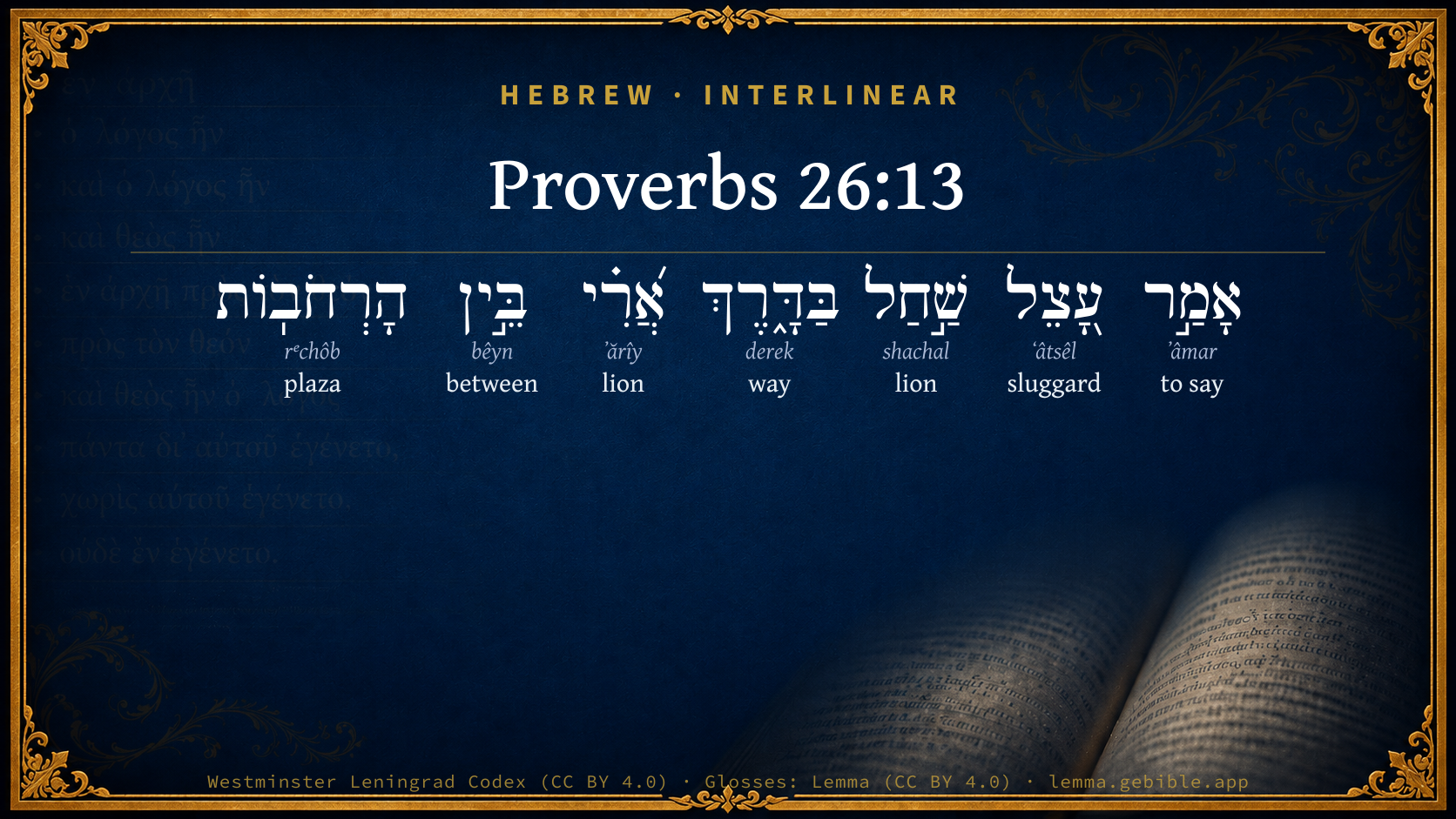
Hebrew (Westminster Leningrad Codex) Proverbs 26:13 appears in the Hebrew Old Testament. The text above is from the Westminster Leningrad Codex. Each word links to its Strong’s number, a concise gloss, and parsing drawn from the Open Scriptures Hebrew Bible morphology. Click any word for its full Brown-Driver-Briggs (BDB) entry.
Download image
Cite this verse

Proverbs 26:13 (World English Bible). Public Domain. Lemma interlinear Bible study tool, https://lemma.gebible.app/v/proverbs/26/13.

Show BibTeX & RIS
BibTeX
RIS
English Translation
The sluggard says, "There is a lion in the road! A fierce lion roams the streets!"
World English Bible · Public Domain
Download a study sheet

One document with this verse’s original text, its word-by-word gloss line, the meaning frame, cross-references with their text, attributed commentary, and full source and license credits — printable, and it pastes into notes with its structure intact.

This verse Autodidact and up

Study sheet (.html) Plain text (.txt)

A passage Seminary Student

Up to 50 verses in one chapter. A passage sheet keeps up to 6 commentary sources and 12 cross-references per verse, in the order this page ranks them, and says so on the sheet whenever that leaves anything out. Ask for a single verse and you get the Autodidact verse sheet above.

Everything on this page stays free to read, with no account — the sheet is a download of what is already on screen, not access to it.

Want to remove ads? Support Godless Engineer
Compare translations 3

The same verse in 3 English versions, stacked beneath the original-language interlinear above. Click any original word for its lexicon entry.

Each is an independent rendering of the whole verse — the interlinear is not word-aligned to these translations.

Highlighted words mark where these versions differ — a whole-verse word diff, not a word-by-word alignment.

  • World English Bible Public Domain
    The sluggard says, "There is a lion in the road! A fierce lion roams the streets!"
  • King James Version Public Domain
    The slothful man saith, There is a lion in the way; a lion is in the streets.
  • unfoldingWord Literal Text CC BY-SA 4.0
    A lazy says, “A young lion on the road! A lion between the open areas!”

unfoldingWord Literal Text — © unfoldingWord, licensed CC BY-SA 4.0. Word-aligned USFM3 via Door43 (git.door43.org/unfoldingWord/en_ult).

Versions to compare (up to 4)

3 of 4 selected

Show all 18 translations

Every available English version of this verse, each an independent rendering of the whole verse.

  • World English Bible Public Domain
    The sluggard says, "There is a lion in the road! A fierce lion roams the streets!"
  • Berean Standard Bible Public Domain
    The slacker says, “A lion is in the road! A fierce lion roams the public square!”
  • Majority Standard Bible Public Domain
    The slacker says, “A lion is in the road! A fierce lion roams the public square!”
  • King James Version Public Domain
    The slothful man saith, There is a lion in the way; a lion is in the streets.
  • American Standard Version (1901) Public Domain
    The sluggard saith, There is a lion in the way; A lion is in the streets.
  • Revised Version (1885) Public Domain
    The sluggard saith, There is a lion in the way; a lion is in the streets.
  • Geneva Bible (1599) Public Domain
    The slouthfull man sayth, A lyon is in the way: a lyon is in the streetes.
  • Douay-Rheims (1899) Public Domain
    The slothful man saith: There is a lion in the way, and a lioness in the roads.
  • Young's Literal Translation Public Domain
    The slothful hath said, `A lion `is' in the way, A lion `is' in the broad places.'
  • Literal Standard Version CC BY-SA 4.0
    The slothful has said, || “A lion [is] in the way, || A lion [is] in the broad places.”
  • Unlocked Literal Bible CC BY-SA 4.0
    The lazy person says, “There is a lion on the road! There is a lion between the open places!”
  • unfoldingWord Literal Text CC BY-SA 4.0
    A lazy says, “A young lion on the road! A lion between the open areas!”
  • Darby Bible Public Domain
    The sluggard saith, There is a fierce lion in the way; a lion is in the midst of the streets!
  • World Messianic Bible Public Domain
    The sluggard says, “There is a lion in the road! A fierce lion roams the streets!”
  • Webster's Bible Public Domain
    The slothful man saith, There is a lion in the way; a lion is in the streets.
  • Free Bible Version CC BY-SA 4.0
    Lazy people are the ones who say, “There's a lion on the road—a lion running around the streets!”
  • Bible in Basic English Public Domain
    The hater of work says, There is a lion in the way; a lion is in the streets.
  • JPS Tanakh (1917) Public Domain
    The sluggard saith: 'There is a lion in the way; yea, a lion is in the streets.'

Literal Standard Version (2020), Covenant Press — licensed CC BY-SA 4.0. Text via the HelloAO Bible API (eBible.org). Unlocked Literal Bible (unfoldingWord) — licensed CC BY-SA 4.0. Text via the HelloAO Bible API (eBible.org). unfoldingWord Literal Text — © unfoldingWord, licensed CC BY-SA 4.0. Word-aligned USFM3 via Door43 (git.door43.org/unfoldingWord/en_ult). Free Bible Version, Dr. Jonathan Gallagher — licensed CC BY-SA 4.0. Text via the HelloAO Bible API (eBible.org).

Word by word

More ways to search: Search by grammar → Find every occurrence → Compare this word →

Practice this passage: Drill this verse → Learn its vocabulary →

About this verse

These counts appear in no published source. They are computed here, from the morphology-tagged text and Lemma’s own curated glosses. What Lemma adds →

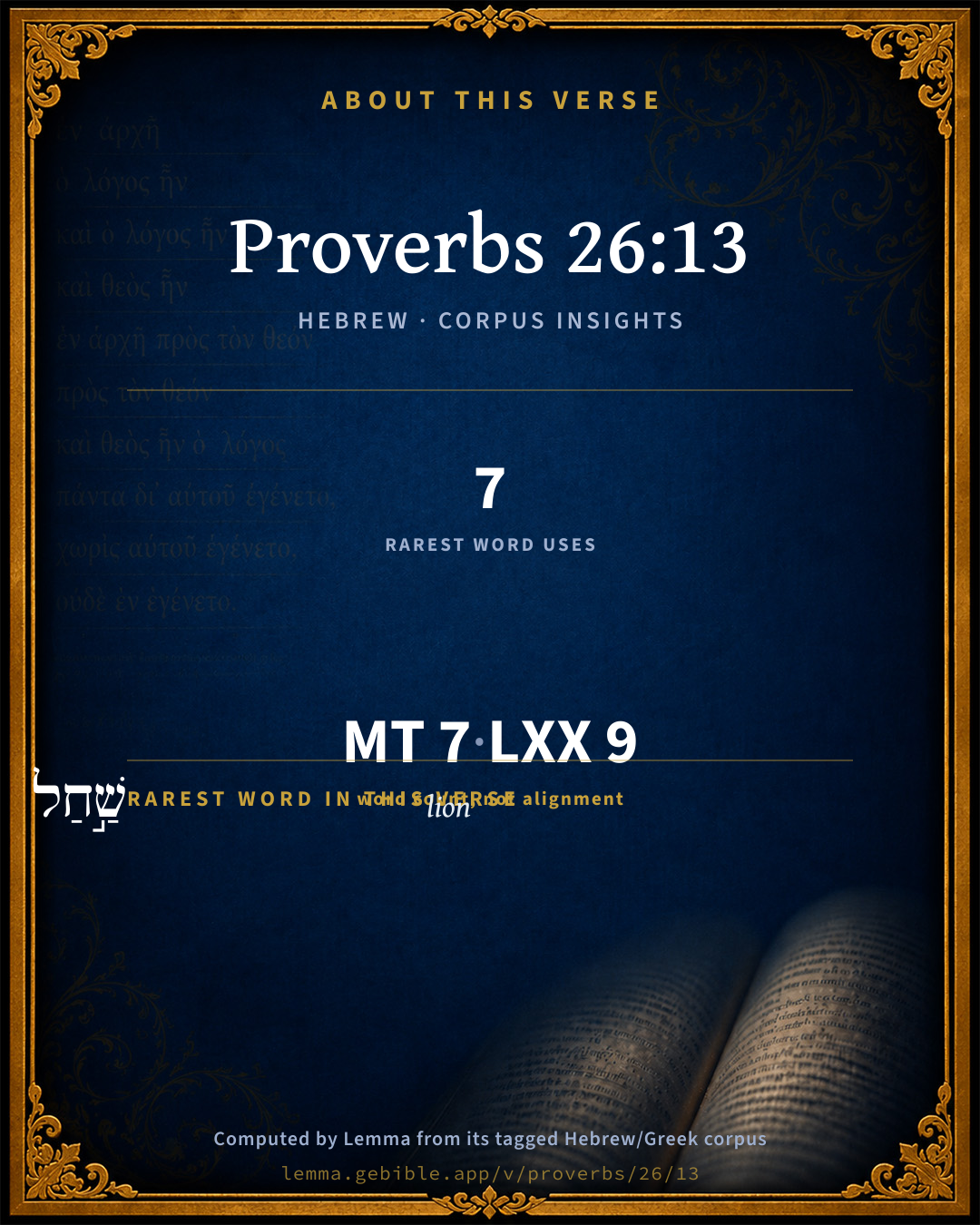
7
words
7
distinct lemmas
Wisdom
section

Notable vocabulary

The rarest word here is שַׁ֣חַל lion H7826 — appearing just 7 times in the whole Hebrew Bible.

Shared distinctive vocabulary

שַׁ֣חַל lion H7826 occurs in 7 verses of the Hebrew Bible. Also found in:

Grammatical profile

  • 1 verb
  • 4 nouns
  • 1 adjective
  • 1 preposition

Verb forms

  • אָמַ֣ר Qal · Perfect

Hebrew & Septuagint length

In English translation the verse runs 16 words from the Hebrew and 22 from the Septuagint (LXX English) — closely comparable.

A rough comparison of the two English renderings, which tokenize alike — not a word-level alignment.

Word counts can differ between the Hebrew and the Greek without any difference in meaning — e.g. the Hebrew direct-object marker אֵת has no separate Greek word, and Greek often adds the article ὁ.

In the original languages it is 7 Hebrew tokens and 9 Greek tokens — but the two are counted differently (Hebrew bundles its prefixes and suffixes into one token; the Greek is in lemma form), so that isn’t a like-for-like length.

Cross-references

3

Topical passages linked to Proverbs 26:13 in the Treasury of Scripture Knowledge — connected by theme and wording, ordered by reader-vote popularity; previews shown in the World English Bible.

  • Proverbs 22:13 The sluggard says, "There is a lion outside! I will be killed in the streets!"
  • Proverbs 19:15 Slothfulness casts into a deep sleep. The idle soul shall suffer hunger.
  • Proverbs 15:19 The way of the sluggard is like a thorn patch, But the path of the upright is a highway.

Cross-references courtesy of OpenBible.info (CC BY 4.0).

Hebrew and Greek witnesses Masoretic Hebrew ↔ Greek Septuagint

The same verse in the two great witnesses to the Old Testament, shown verse-for-verse.

These are two independent witnesses, not word-aligned to each other, and the Septuagint is shown in lemma (dictionary) form.

Hebrew Proverbs 26:13 Masoretic · Westminster Leningrad Codex

אָמַ֣ר עָ֭צֵל שַׁ֣חַל בַּדָּ֑רֶךְ אֲ֝רִ֗י בֵּ֣ין הָרְחֹבֽוֹת

The sluggard says, "There is a lion in the road! A fierce lion roams the streets!"

World English Bible · Public Domain

Greek LXX Proverbs 26:13 Septuagint · lemma form

λέγω ὀκνηρός ἀποστέλλω εἰς ὁδός λέων ἐν ὁ ὁδός

A sluggard when sent on a journey says, There is a lion in the ways, and there are murderers in the streets.

LXX2012 (modern English Septuagint) · Public Domain

On this verse, John Gill's Exposition discusses the Septuagint’s reading. Read the note in Commentary ↓

Hebrew: Westminster Leningrad Codex (CC BY 4.0). Greek: Septuagint (public domain); English from LXX2012 (modern English Septuagint) (Public Domain). How the Septuagint differs from the Hebrew →

Commentary

Notes on Proverbs 26:13 from classic Christian and Jewish commentators (each source and its license shown beneath its notes). The classic Christian expositions comment on the surrounding passage and are grouped to its opening verse, so a note may address several verses; the Jewish commentaries on the Tanakh (Rashi and others) are per-verse, so they appear only where the commentator wrote on this verse.

Lemma curates 59 commentaries, every one of them public domain or Creative Commons licensed, each selected and text-cleaned for this edition rather than reprinted as found. About our sources →

Trapp's Complete Commentary

John Trapp

Pro 26:13 The slothful [man] saith, [There is] a lion in the way; a lion [is] in the streets.

Ver. 13. The slothful man sayeth, There is a lion.] {See Trapp on "Pro 22:13"}

John Trapp, A Commentary or Exposition upon All the Books of the Old and New Testament (1647–1656) — public domain. Text from a community e-Sword module.

The Biblical Illustrator

Joseph S. Exell

Pro_26:13

The slothful man saith, There is a lion in the way; a lion is in the streets.

A lion in the way

The reprehensible sloth of the coward does not appear in what he says, but in what he leaves unsaid. He means, but is ashamed to say, Because there is a lion in the way, I will shirk my duty. The brave man says, Though a lion is in the way, I will slay it; anyway I will fight with it and wound it.

I. There is a lion in the way. In what way? In the way of life--of every life. Life, if it is to be a true life, is not an easy thing. There is, indeed, such a thing as a life which is no true life, only a living death. Sloth, self-indulgence, self-abandonment to a besetting sin, caring for nothing but self, and the keeping ones self miserably alive, to live at ease, to live selfishly, to live for pleasure, all this is to be dead while we live. If you live thus you may for a time live at home quite secure, fearless of the only lions you dread. If, on the other hand, you mean to live for nobler objects than those of shameless selfishness, you too, like Saul, will have to fight with wild beasts at Ephesus or elsewhere. There will be needed the girded loin and the burning lamp, the swift foot, and the sharp sword, and the stout heart, and the strong arm; faith and prayer, and the battle, and the Cross.

2. There are many lions, and not one only. True courage does not consist in the absence of any sense of fear--that may only be due to brute apathy--but it is to feel fear and to overcome it.

I. For the brave, true man there is the lion of the world. We live in days of wonderful, and for some men, pleasant compromises. Religion walks in silver slippers. Good and evil lie flat together, side by side, in amiable neutrality. You may take your choice. If what you are content with is compromise and conventionality, and the broad beaten road, and success and popularity, you may have it for the asking: it is quite easy to offend nobody. But if you would have any of the nobleness, any of the usefulness, of the prophet or the reformer, boldly rebuke vice, denounce a fashionable iniquity, fling away from you a theological falsehood, run counter to a general delusion, deal vigorously with the lion in the way. The lion of the worlds hatred and opposition may be avoided. It is avoided by thousands of sleek and prosperous men.

II. But there is another lion which each man must meet, the lion of his own fleshly nature, of his own physical and mental passions. Plato describes each man as consisting, so to speak, of three beings in one: a lion, a many-headed monster, and a man. Of these the man represents the controlling reason; the lion the fierce and irascible temper; the many-headed monster the low and animal passions. The man, the reason, must absolutely rule; the irascible impulses must not be crushed, indeed, but controlled; the monster of fleshly lusts must be utterly subdued. By every one of us that lion, that multitudinous and many-headed monster, must be fought.

III. Another lion is he who goeth about, seeking whom he may devour. Each of us knows by experience that there are some tendencies and temptations--to pride, to falsity, to blaspheming thoughts, to causeless hatred--which often come upon a man with fierce and unlooked-for suddenness, and we know not whence or where the tempting opportunity suddenly meets the susceptible disposition. Resist the devil, and he will flee from you. Remember that he can be fought face to face, but the Christian has no armour for the back.

IV. Consider the duty of facing these lions in our outward life. Everywhere individual license invades public rights. The slothful man (and the slothful man is the epitome of the slothful nation) is ingenious in excuses. Happily every now and then God-strengthened, God-inspired, good, brave, unsophisticated men, have torn their way through these thorny hedges of indolence, greed, and opposition; have faced the wild beast of demoralised public opinion, in spite of its erect mane and flaming eye.

V. The slothful man pleads that many have been slain by this lion in the way. Yes, it is quite true. But to them, as to their Lord, through death, and after death, if not in life, hath come the glory and the victory. Slain: yet no harm has come to them. Better a thousand times their death than the life of the selfish and the base. There is one way in which a man can die even better than this. It is when, homeless, landless, wifeless, childless, without even a hope of earthly things, he faces those fearful odds, not for his own wealth or his own comfort, but for his brother man; faces them for the sake of simple duty, faces them for the common love of humanity, faces them because, if God wills it, he, too, is ready to die for those for whom Christ died. Take courage, then, all ye who are fearless enough and noble enough to care for any righteous cause. (Dean Farrar.)

The slothful man

Man is made up of contradictions. A strong propensity to indolence, and a principle which prompts to action. There is a charm in the exercise of those physical and intellectual powers with which man is endowed. With many indolence diffuses its benumbing influence through all their faculties and powers. It becomes a disease, which strengthens itself by continuance. Habit is equally efficient in generating and confirming evil and good qualities. Extraordinary changes of moral character from bad to good have occurred in every age; but we have no right to calculate on them, so as to become indifferent to the ordinary growth of good or evil disposition. Indolence of character proceeds from a torpid state of the affections, or coldness of heart, in some partly natural, in most persons however, acquired by habit. In the state of indolence, the spellbound slumberer avails himself of every pretext for continuing to doze. The text gives one of his frivolous and groundless excuses. Consider some of the sluggards formidable discouragements and obstacles in the way of exertion--such as that labour is painful; that self-denial is against nature; and that there is no certain prospect of success, and that God, being all mercy, is ready to forgive at any time. You cannot question or dispute the evils, the misery and ruin to which indolence leads in this world; or the moral ruin to which the sin of lukewarmness, or indifference to your religious obligations, will lead you in the world to come. (James Flint, D. D.)

Seeing with our prejudices

We see not so much with our eyes as with our prejudices. The wish is father to the thought. Some men look at the religious life, and see in it nothing but what is narrow and bigoted, gloomy and morose. They do not want to see anything else. Some professing Christians look on the worlds amusements and discern no evil in them. It is to be feared they have no special desire to be convinced of any. There are members of Churches who look at Christian work in its varied departments and with its paramount claims, yet cannot be brought to discover their own qualifications to engage in it. The reason is, they have no wish to. The slothful man saith, There is a lion in the streets. And when anything in the shape of self-denying service is proposed to certain persons, this lion assumes most portentous dimensions, and rivals the thunder with his roar. (J. Halsey.)

The Biblical Illustrator, edited by Joseph S. Exell (c. 1880s–1900s) — public domain. Text from a community e-Sword module.

Joseph Benson's Commentary

Pro 26:13-16. The slothful man saith, &c. — “In this and the following verses, three degrees of sloth are represented; the first, when a man is loath to stir out of doors about his business in the field, Pro 26:13; the second, when he is loath so much as to leave his bed, Pro 26:14; and the third and highest, when he will scarcely put his hand to his mouth, Pro 26:15. By which hyperbolical expression the wise man admirably sets forth the incredible laziness of some, which increases upon them continually, if they will not shake it off; and yet, so presumptuous are they withal, that they laugh at those who take a great deal of pains to be wise, and fancy themselves much wiser; because, without any pains, they can find fault sometimes with other men’s works.” — Dodd. Thus, Pro 26:16, the sluggard is wiser in his own eyes — Because, by his idleness, he avoids those troubles and dangers to which other men, by their activity, expose themselves, forgetting, in the mean time, what reproach and loss are brought upon him by his slothfulness; than seven men that can render a reason — Namely, a satisfactory reason of all their actions, that is, who are truly wise men.

Joseph Benson's Commentary on the Old and New Testaments (1811–1818) — public domain. Text from a community e-Sword module.

Tyndale Open Study Notes

Tyndale Open Resources

26:13-16 The lazy person: See 6:6-11; 10:4-5; 15:19; 22:13.

Tyndale Open Study Notes — © Tyndale Open Resources, licensed CC BY-SA 4.0. Text via the HelloAO Bible API.

Geneva Bible (1599)

Geneva Bible translators

Read Prov. 22:13.

Geneva Bible (1599) marginal notes — public domain. Text via Bolls.life.

Matthew Henry's Commentary

When a man talks foolishly we say, He talks idly; for none betray their folly more than those who are idle and go about to excuse themselves in their idleness. As men's folly makes them slothful, so their slothfulness makes them foolish. Observe, 1. What the slothful man really dreads. He dreads the way, the streets, the place where work is to be done and a journey to be gone; he hates business, hates every thing that requires care and labour. 2. What he dreams of, and pretends to dread - a lion in the way. When he is pressed to be diligent, either in his worldly affairs or in the business of religion, this is his excuse (and a sorry excuse it is, as bad as none), There is a lion in the way, some insuperable difficulty or danger which he cannot pretend to grapple with. Lions frequent woods and deserts; and, in the day-time, when man has business to do, they are in their dens, Psa 104:22, Psa 104:23. But the sluggard fancies, or rather pretends to fancy, a lion in the streets, whereas the lion is only in his own fancy, nor is he so fierce as he is painted. Note, It is a foolish thing to frighten ourselves from real duties by fancied difficulties, Ecc 11:4.

Matthew Henry's Commentary on the Whole Bible (1708–1710) — public domain (CC PDM 1.0). Text via the HelloAO Bible API.

Jamieson, Fausset & Brown

Robert Jamieson, A. R. Fausset & David Brown

(Compare Pro 22:13).

Jamieson, Fausset & Brown — Commentary Critical and Explanatory on the Whole Bible (1871) — public domain (CC PDM 1.0). Text via the HelloAO Bible API.

Adam Clarke's Commentary

Verse 13. The slothful man saith] See Clarke on Pr 22:13.

Adam Clarke's Commentary on the Bible (1810–1826) — public domain. Text from a community e-Sword/MySword module.

Ellicott's Commentary for English Readers

(13) The slothful man saith, There is a lion in the way . . .—See above on Pro_22:13.

A Bible Commentary for English Readers, edited by Charles John Ellicott (1878–1897) — public domain. Text from a community e-Sword module.

The Cambridge Bible for Schools and Colleges

gen. ed. J. J. S. Perowne

13. Almost identical with Pro_22:13, where see note.

the slothful man] Rather, the sluggard. See Pro_26:16, note.

The Cambridge Bible for Schools and Colleges (gen. ed. J. J. S. Perowne; Cambridge University Press, 1878–1918) — public domain. Text from a community e-Sword module.

John Gill's Exposition

The slothful man saith,.... Within himself; or to such that excite him to diligence and industry, to go about the business of his calling, to till his field, and dress his vineyard. The Septuagint and Arabic versions add, "being sent into the way"; ordered by his master to go out to work, when he makes the following excuse:

there is a lion in the way; a lion is in the streets; in the way to his field or vineyard, and in the streets, where his business lies or leads unto it: a very idle excuse this; since lions are usually in woods, forests, and desert places, and not in public roads, and much less in streets of cities; see Pro 22:13. This may be applied to a man slothful in the duties of religion; the "way" and "streets" may denote public ordinances, which are the ways of God's appointing, prescribing, and directing to; and in which good men walk, and find pleasure and profit; and are the streets where Wisdom cries, or Christ is preached, and where he is sought for and found: but many are the excuses some men make not to attend them; see Luk 14:17; though they are vain, frivolous, and foolish, as this here; for in these ways and streets may true seen the feet of the messengers of peace; here the turtle's voice, the joyful sound of salvation by Christ, may be heard; here the Lamb of God is directed to, to be looked at, as taking away the sins of men, having been slain, and having shed his blood for the redemption of them: and though the terrible voice of the law may be sometimes heard, which is necessary to arouse and awaken sleepy sinners, and unhinge self-righteous persons from a dependence on the works of the law; yet, afterwards comes the still small voice of the Gospel, proclaiming freedom from the curse and condemnation of the law by Christ. Indeed, in some ages, there have been violent persecutors, comparable to lions; and informers have been in the way and in the streets, to terrify saints from their duty; but none of these could move them from it, nor separate fully gracious souls from their love to Christ: though carnal slothful professors are offended, when tribulation or persecution arise because of the word, these are lions to them; and, in times of peace and liberty, they can paint lions, very terrible to themselves, and raise such difficulties as are insuperable to them; a slight disorder of body, a small inclemency of the weather, little danger of catching cold, and the like, shall be a lion to them: not considering they have a devouring lion nearer them in their houses, chambers, and on their beds with them; even Satan, in whose clutches they are, who keeps their goods in peace, by whom they are led captive, and to whom they fall a prey: nor fearing the wrath of the King of kings, which is as the roaring of a lion: the wrath of God and of the Lamb, who is also the Lion of the tribe of Judah, and whose day of wrath will be such as none will be able to bear.

John Gill's Exposition of the Whole Bible (1746–1763) — public domain (CC PDM 1.0). Text via the HelloAO Bible API.

Albert Barnes' Notes on the Bible

Compare the marginal reference note. Here there is greater dramatic vividness in the two words used:

(1) A roaring one,

(2) a lion, more specifically.

Albert Barnes' Notes on the Bible (1834–1885) — public domain. Text from a community e-Sword/MySword module.

Matthew Poole's English Annotations

To excuse his idleness, and keeping himself at home. See Poole "Pro 22:13".

Matthew Poole's English Annotations on the Holy Bible (1683–1685) — public domain. Text from a community e-Sword/MySword module.

Whedon's Commentary on the Bible

Daniel D. Whedon

13. Lion in the way — Compare Pro_22:13, where we have the same proverb almost verbatim.

Daniel D. Whedon (gen. ed.), Commentary on the Old and New Testaments (1874–1909) — public domain. Text from a community e-Sword module.

The Pulpit Commentary

Vers. 13-16. Proverbs concerning the sluggard.

This is virtually the same as Pro_22:13. The words for "lion" are different in two parts of the verse, shakhal being the lion of advanced age, ari the full-grown animal; the latter may possibly be assumed to be the more dangerous of the two, and so a climax would be denoted. There is a proverb current in Bechuana, which says, "The month of seed time is the season of headaches.

"A lion in the way.

I INDOLENCE CREATES DIFFICULTIES. The hindrance is not real; it is purely imaginary. The lion is not in the way, but in the fancy of the slothful man. If a man is not in earnest in undertaking any work, he is certain to picture to himself insuperable obstacles. Thus missionary enterprises are discouraged by those who have no missionary zeal. The call of Christ to service and sacrifice is shirked by men whose inventive ingenuity has manufactured unsound excuses. The course of the Christian life is forsaken by some who see it beset with dangers that only spring out of their own reluctance to deny themselves, take up their cross and follow Christ. Often when the slothful man cries, "There is a lion in the way," it is a lie; there is no lion.

II INDOLENCE IS COWARDLY. It is possible that the indolent person really believes that the beast of the forest has actually invaded the city, is indeed prowling about its streets. He shrinks from a danger that he truly fears. Perhaps there is real danger. We do meet with difficulties and dangers in life. Threatening lions roar on the devoted servant of Christ. But then the true-hearted man will be brave to face difficulty, and only the coward will shrink and fail.

III DANGER IS NO EXCUSE FOR INDOLENCE. If there be a lion in the street it may be all the more incumbent on a true man to go out of his house. For the lion has no right to be in the city. He should be slain forthwith. To leave him there at large is to yield to him. Are the streets to be given up to the daring intruder because no one is bold enough to face him? Meanwhile he may work fearful havoc. There may be children in the street. While the idle coward bolts and bars his doors and sits shivering in his house, the helpless little ones are left unprotected, a sure prey for the fierce brute. To shrink from the task of expelling the lion is to be guilty of shameful negligence. Because of the hindrances and difficulties of Christ"s work cowardly and idle people permit the souls of their fellow men and the poor ignorant children of miserable degraded families to be destroyed.

IV DANGER IS OVERCOME BY BEING FACED. Perhaps the lion"s roar is worse than his bite. Who can tell but that he is a coward and will turn tail directly he is faced? Possibly, like Bunyan"s lions, he is chained. But we shall never know till we go boldly up to him. Many apparent dangers are but empty threats. There are difficulties that need only to be confronted to vanish. The valiant Christian soldier will find that his enemies will give way before the "sword of the Spirit.

V FOR THE INDOLENT MAN THERE IS A LION IN THE HOUSE. While he shrinks with terror from venturing forth there is greater danger at home. The hypochondriacal patient who dreads meeting the chili of fresh air for fear or" catching cold becomes a martyr to dyspepsia at home. The idle man is slain by his own indolence. Satan, who goes about as a roaring lion seeking whom he may devour, is kept out by no locks and finds his victims in their most private retreats.

Vers. 13-16. The vice of idleness.

I IT IS FULL OF EXCUSES. (Ver. 13) There is always some pretext for evading duty, however frivolous and absurd, with the idle man. Idleness is the parent of almost every sin; here of cowardice, he who excuses, accuses himself. Every manly act of exertion is imagined to be full of danger by the lazy mind. The sluggard does not see what danger of another and deadlier kind there is in stagnation. Danger is the brave man"s opportunity, difficulty the lion in the way, by victory over which he may earn the laurel of victory and gain the joy of new conscious power.

II IT LOVES REPOSE AND SELF-INDULGENCE. (Ver. 14) As the door swings perpetually upon its hinges, without moving a step from its fixed position, so with the sluggard. He "turns round and round, with dull stupidity, like the dyer"s horse in the ring". (Pro_19:24) How often the cannot of the slave of vice or evil habit only disguises the will not of the sloth-eaten heart! To make mere rest our life-object is to contend against the order of God.

III IT HATES EXERTION. (Ver. 15) Even the most necessary exertion may become by habit distasteful. To take his hand from his bosom, even merely to reach after the bread of life, is too much labour for him. And thus his life, instead of being a continual feast, sinks into spiritual indigence and starvation. "The idle soul shall suffer hunger.

IV IT BREEDS CONCEIT AND FOLLY. (Ver. 16) This is the strange irony of the vice, that the empty hand shall fancy itself full of wisdom. But such fancies are the very growth of the soil of indolence. It is impossible to make such a one understand his ignorance, for it requires knowledge to perceive it; and he who can perceive it has it not (Jeremy Taylor). The evil may creep into the Church. One may fall into an idle and passive piety, content with sitting still, hearing, praying, singing, from one end of the year to the other, without advancing one step in the practical Christian life. J. (1Th_5:6)

See homily on Pro_22:13. C.

The Pulpit Commentary (1880–1919), ed. H.D.M. Spence-Jones & Joseph S. Exell — public domain. Text from a community e-Sword module.

Keil & Delitzsch

C. F. Keil & F. Delitzsch

There follows now a group of proverbs regarding the slothful:

13 The slothful saith there is a lion without,

A lion in the midst of the streets;

cf. the original of this proverb, Pro 22:13. שׁוּעל, to say nothing of שׁחל, is not the jackal; שׁחל is the bibl. name for the lion. בּין is the more general expression for בּקרב, Isa 5:25; by the streets he thinks of the rows of houses that form them.

Keil & Delitzsch — Biblical Commentary on the Old Testament (1861–1891) — public domain (CC PDM 1.0). Text via the HelloAO Bible API. (Old Testament only.)

Bridges on Proverbs

Charles Bridges

13 The slothful man saith, There is a lion in the way; a lion is in the streets. (Pro 22:13 .) 14 As the door turneth upon his hinges, so doth the slothful upon his bed. 15 The slothful hideth his hand in his bosom; it grieveth him to bring it again to his mouth. (Pro 19:24 .) {it grieveth...: or, he is weary} 16 The sluggard is wiser in his own conceit than seven men that can render a reason.†a}

The counterpart to these illustrations may be seen in the man dozing away his life in guilty idleness; without an object, and therefore without a spring for exertion. But let us look at the pictures, as they meet our eye in the Church. The gradation shews the almost incredible increase of the evil — unresisted.

The slothful man is utterly reluctant to his work. When therefore his indolence is disturbed, he is ingenious in inventing excuses, and fancying dangers, which have no real existence. For ’he, who has no mind to labor, never wants pretenses for idleness.’†1 His insincerity lulls his conscience to sleep in his false excuses. Were it as easy to be spiritual as to wish to be so, who would not be a Christian? If it were only one great effort, soon to be accomplished, it would be worth the struggle. But to see no end of the toil, duty upon duty, trouble following trouble, no breathing-time of rest — is an appalling hindrance. And therefore a fierce lion in the way†2 — a lion in the streets (’bugbear rather than a lion’†3) excuses him from a decided profession.

We wonder not that he shrinks from his work. He loves his bed of ease. Here he turneth himself, as the door upon his hinges, moving indeed, but making no progress. He works from one excuse to another, but never removes from his place. Difficulties hinder him from going forward. Conscience keeps him from going backward. And therefore, as the door upon his hinges, where he was one day, one year, there he is found the next. He moves within a scanty round of duties, always beginning, never finishing, his work; determining nothing; not quite at ease; yet with no heart for exertion. Stretched upon his bed of sloth, he cries — ’O that this were working! O that I could raise my heart to heaven!’ But is heaven to be gained by complaining and wishing?

Nay — even the most needful exertion is grievous to him. Suppose him to have arisen from his bed, his case is not improved. Ease is still his cry. How to preserve it, his only care. He hides his hand in his bosom for the cold; and never makes an effort to bring it to his mouth for his necessary food. (Ecc 4:5 .) Thus for want of the most trifling exercise he starves his soul, though the bread of life is put before him. No marvel, if his life, instead of "a continual feast," is a constant vexation.

Yet — such is the strange union of self-complacency with folly — this worthless being — a mere "cumberer of the ground" — pronounces himself a genius, prides himself upon his sagacity, and looks down with contempt upon his more industrious companions — generally superior in attainment. This foolish dream of his own shrewdness fixes his standard. He has found the road to learning without any inconvenient exertion. Giving himself no trouble to think, he sees none of the difficulties obvious to a considerate mind, and speedily arrives at most unreasonable conclusions. He will not be beaten out of his sloth. Any wise man could render a reason for his conviction. But he is wiser in his own conceit than them all.†4

In how many striking lights is sloth presented in this book? Do I not think too slightly of it? Let me look closely — in what respect am I influenced by it — bodily, mentally, or spiritually? Does it never follow me throughout my work, to my knees, to my Bible-reading? Do I not excuse myself from work of painful effort? Or when conscience forces me to it, how is it done? May God enable me to resist this paralysis in every shape! If just about to resolve, let me propose my work to myself, as to be done with full purpose of heart; not opposing difficulties to necessity; not allowing heartless despondency. What if, after all, my faith be a fancy, my hope a delusion? Self-suspicion is the first awakening of the soul — "Search me, O my God." (Psa 139:23 .)

Well is it, if the slumber be only a little disturbed; far better, if the eyes are fully opened. Active, simple faith carries us onward, in the face of the lions in the way, seeming to stand open-mouthed to devour us. It is a special mercy to realize the holy violence of the conflict. Bunyan put his pilgrims under the conduct of Great-heart for their encouragement. Heaven never will be won by folded arms. "The violent take it by force." (Mat 11:12 .)

Footnotes:

†a ’Than seven men that sytt and teach.’ — Bp. Coverdale.

†1 Bp. Patrick.

†2 Scott.

†3 Bp. Sanderson’s Sermon on Heb 12:3 .

†4 Seven men — the number of perfection. Compare Amo 1:3, Amo 1:6, Amo 1:9, Amo 1:13 ; Amo 2:4, Amo 2:6 .

Charles Bridges, An Exposition of the Book of Proverbs (1846) — public domain. Text from a community e-Sword module.

unfoldingWord translationNotes

Door43 World Missions Community

The lazy person says, "There is a lion ... between the open places!"

The lazy person lies and says that he cannot go outside and work because there is a lion on the road or between the open places.

There is a lion on the road

See how you translated this in Proverbs 22:13.

the open places

This refers to the places in town where there is a lot of room for people to walk around or where people gather. AT: "the town plazas" or "the streets"

hinges

metal pieces that attach a door to something and allow it to open and close

As the door turns on its hinges, so is the lazy person upon his bed

Both the door and the lazy person move, but they do not go anywhere. (See: Simile)

translationWords

lions

turn

unfoldingWord translationNotes — © Distant Shores Media and the Door43 World Missions Community, licensed CC BY-SA 4.0. Source: git.door43.org/Door43/en_tn.

Lesson kit

Teaching starters — assembled from the data on this page, not authored interpretation. Every prompt links to the verse data it draws on. Edit before teaching.

Proverbs, in the Wisdom, opens this verse with 7 words (7 distinct Hebrew lemmas). Its most distinctive word is shachal (“lion”). A historical commentator’s framing appears above. Read the whole chapter for the surrounding context.

Discussion questions

  1. How does “lion” (shachal) shape what this verse is saying?
  2. How does Job 4:10, which shares the word «lion», read alongside this verse?
  3. The translations on this page render this verse differently — a whole-verse word diff, not a word-by-word alignment. What might account for the different wordings?
  4. «אָמַ֣ר» is a Qal Perfect verb. How does that grammatical form shape the action described?
  5. Compare how Trapp's Complete Commentary and The Biblical Illustrator read this verse. Where do they agree or differ?

Things to notice

Reading settings

Reading text

Shown beneath each verse's original-language words.

Old Testament
Old Testament edition

Read the OT as the Masoretic Hebrew (MT) or the Greek Septuagint (LXX).

English shown for the Greek Septuagint (in the Hebrew ↔ Greek comparison).

Comparing translations? Open the Compare panel on any verse page to stack up to four side by side.