Malachi 3:18

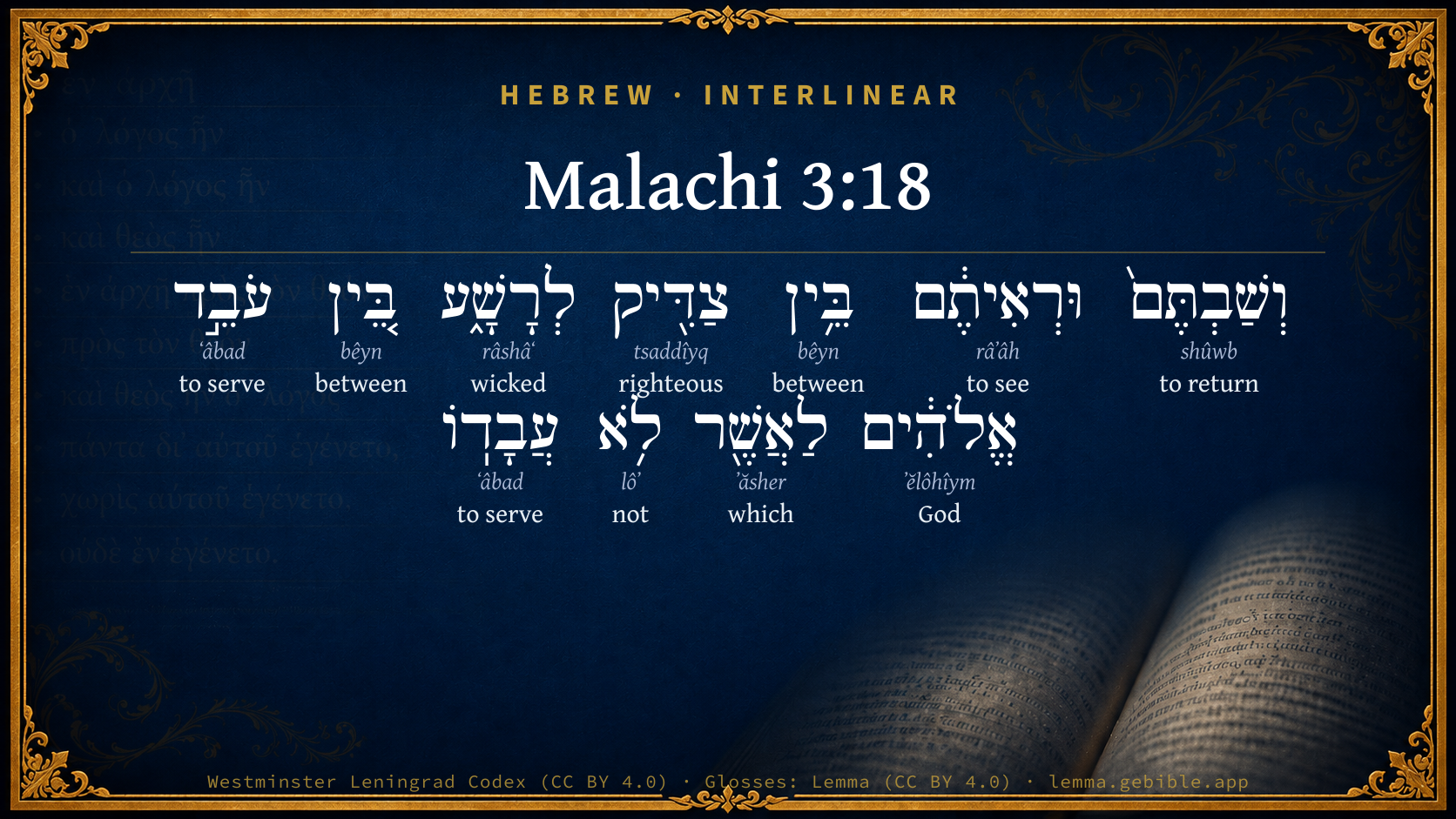
Hebrew (Westminster Leningrad Codex) Malachi 3:18 appears in the Hebrew Old Testament. The text above is from the Westminster Leningrad Codex. Each word links to its Strong’s number, a concise gloss, and parsing drawn from the Open Scriptures Hebrew Bible morphology. Click any word for its full Brown-Driver-Briggs (BDB) entry.
Download image
Cite this verse

Malachi 3:18 (World English Bible). Public Domain. Lemma interlinear Bible study tool, https://lemma.gebible.app/v/malachi/3/18.

Show BibTeX & RIS
BibTeX
RIS
English Translation
Then you shall return and discern between the righteous and the wicked, between him who serves God and him who doesn't serve him.
World English Bible · Public Domain
Download a study sheet

One document with this verse’s original text, its word-by-word gloss line, the meaning frame, cross-references with their text, attributed commentary, and full source and license credits — printable, and it pastes into notes with its structure intact.

This verse Autodidact and up

Study sheet (.html) Plain text (.txt)

A passage Seminary Student

Up to 50 verses in one chapter. A passage sheet keeps up to 6 commentary sources and 12 cross-references per verse, in the order this page ranks them, and says so on the sheet whenever that leaves anything out. Ask for a single verse and you get the Autodidact verse sheet above.

Everything on this page stays free to read, with no account — the sheet is a download of what is already on screen, not access to it.

Want to remove ads? Support Godless Engineer
Compare translations 3

The same verse in 3 English versions, stacked beneath the original-language interlinear above. Click any original word for its lexicon entry.

Each is an independent rendering of the whole verse — the interlinear is not word-aligned to these translations.

Highlighted words mark where these versions differ — a whole-verse word diff, not a word-by-word alignment.

  • World English Bible Public Domain
    Then you shall return and discern between the righteous and the wicked, between him who serves God and him who doesn't serve him.
  • King James Version Public Domain
    Then shall ye return, and discern between the righteous and the wicked, between him that serveth God and him that serveth him not.
  • unfoldingWord Literal Text CC BY-SA 4.0
    And you will return and see between the righteous and to the wicked, between the one serving God and to who does not serve him.

unfoldingWord Literal Text — © unfoldingWord, licensed CC BY-SA 4.0. Word-aligned USFM3 via Door43 (git.door43.org/unfoldingWord/en_ult).

Versions to compare (up to 4)

3 of 4 selected

Show all 18 translations

Every available English version of this verse, each an independent rendering of the whole verse.

  • World English Bible Public Domain
    Then you shall return and discern between the righteous and the wicked, between him who serves God and him who doesn't serve him.
  • Berean Standard Bible Public Domain
    So you will again distinguish between the righteous and the wicked, between those who serve God and those who do not.”
  • Majority Standard Bible Public Domain
    So you will again distinguish between the righteous and the wicked, between those who serve God and those who do not.”
  • King James Version Public Domain
    Then shall ye return, and discern between the righteous and the wicked, between him that serveth God and him that serveth him not.
  • American Standard Version (1901) Public Domain
    Then shall ye return and discern between the righteous and the wicked, between him that serveth God and him that serveth him not.
  • Revised Version (1885) Public Domain
    Then shall ye return and discern between the righteous and the wicked, between him that serveth God and him that serveth him not.
  • Geneva Bible (1599) Public Domain
    Then shall you returne, and discerne betweene the righteous and wicked, betweene him that serueth God, and him that serueth him not.
  • Douay-Rheims (1899) Public Domain
    And you shall return, and shall see the difference between the just and the wicked: and between him that serveth God, and him that serveth him not.
  • Young's Literal Translation Public Domain
    And ye have turned back and considered, Between the righteous and the wicked, Between the servant of God and him who is not His servant.
  • Literal Standard Version CC BY-SA 4.0
    And you have turned back and considered, || Between the righteous and the wicked, || Between the servant of God and him who is not His servant.”
  • Unlocked Literal Bible CC BY-SA 4.0
    Then once again you will distinguish between the righteous and the wicked, between one who worships God and one who does not worship him.
  • unfoldingWord Literal Text CC BY-SA 4.0
    And you will return and see between the righteous and to the wicked, between the one serving God and to who does not serve him.
  • Darby Bible Public Domain
    And ye shall return and discern between the righteous and the wicked, between him that serveth God and him that serveth him not.
  • World Messianic Bible Public Domain
    Then you shall return and discern between the righteous and the wicked, between him who serves God and him who doesn’t serve him.
  • Webster's Bible Public Domain
    Then shall ye return and discern between the righteous and the wicked, between him that serveth God and him that serveth him not.
  • Free Bible Version CC BY-SA 4.0
    Then you will once again be able to distinguish those who do right from those who do wrong, between those who serve him and those who don't.
  • Bible in Basic English Public Domain
    Then you will again see how the upright man is different from the sinner, and the servant of God from him who is not.
  • JPS Tanakh (1917) Public Domain
    Then shall ye again discern between the righteous and the wicked, between him that serveth God and him that serveth Him not.

Literal Standard Version (2020), Covenant Press — licensed CC BY-SA 4.0. Text via the HelloAO Bible API (eBible.org). Unlocked Literal Bible (unfoldingWord) — licensed CC BY-SA 4.0. Text via the HelloAO Bible API (eBible.org). unfoldingWord Literal Text — © unfoldingWord, licensed CC BY-SA 4.0. Word-aligned USFM3 via Door43 (git.door43.org/unfoldingWord/en_ult). Free Bible Version, Dr. Jonathan Gallagher — licensed CC BY-SA 4.0. Text via the HelloAO Bible API (eBible.org).

Word by word

More ways to search: Search by grammar → Find every occurrence → Compare this word →

Practice this passage: Drill this verse → Learn its vocabulary →

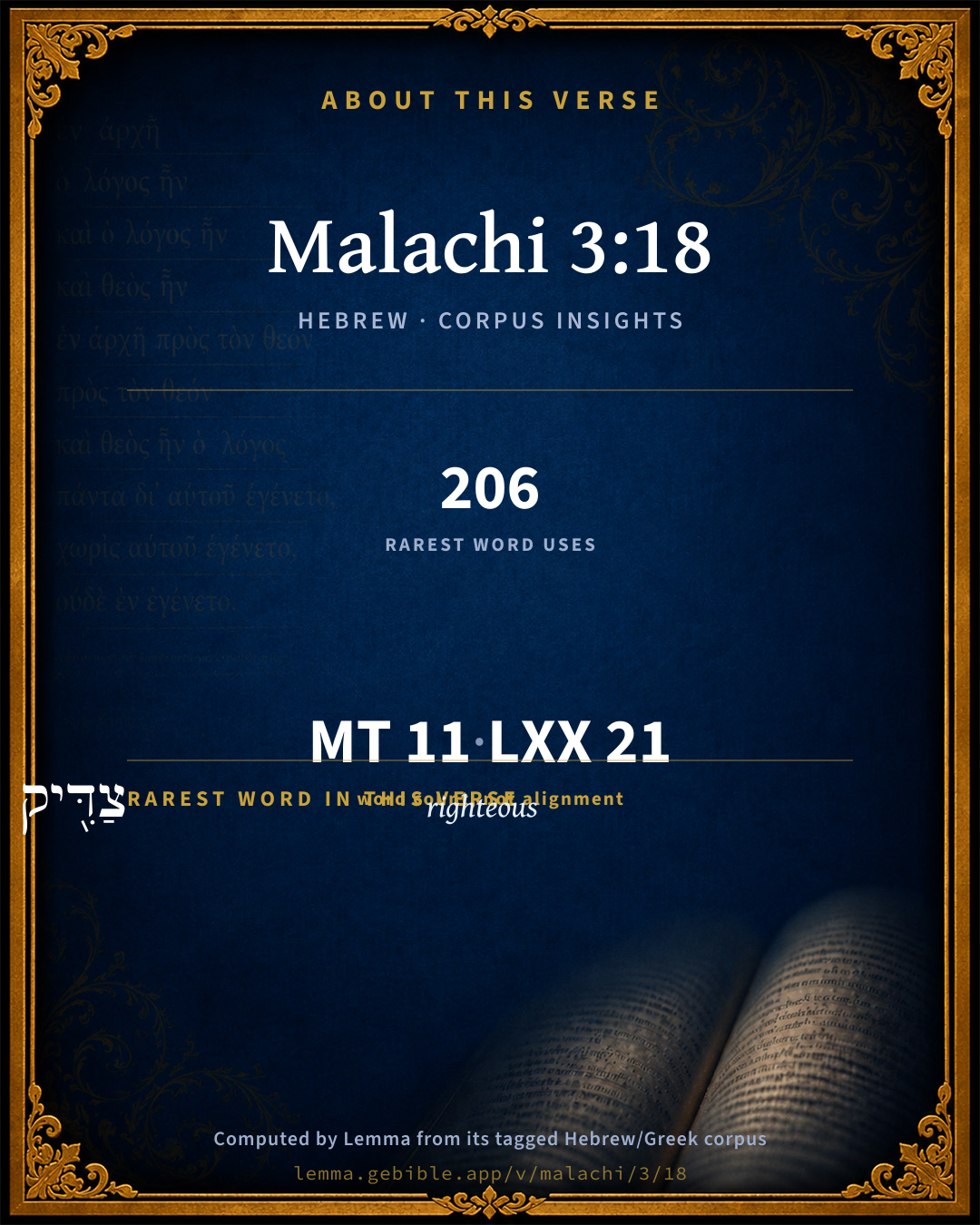
צַדִּ֖יק
tsaddîyq
H6662
“righteous”
Adjective, Adjective, Masculine, Singular, Absolute
Part of Speech
Adjective
Type
Adjective
Gender
Masculine
Number
Singular
State
Absolute
Full BDB Definition

Origin: from H6663

TWOT: 1879c

just, lawful, righteous - just, righteous (in government) - just, right (in one's cause) - just, righteous (in conduct and character) - righteous (as justified and vindicated by God) - right, correct, lawful
  1. וְשַׁבְתֶּם֙ shûwb H7725 “and · to return” Conjunction + Verb, Qal, Sequential Perfect, 2nd Person, Masculine, Plural
  2. וּרְאִיתֶ֔ם râʼâh H7200 “and · to see” Conjunction + Verb, Qal, Sequential Perfect, 2nd Person, Masculine, Plural
  3. בֵּ֥ין bêyn H996 “between” Preposition
  4. לְרָשָׁ֑ע râshâʻ H7563 “to/for · wicked” Preposition + Adjective, Adjective, Masculine, Singular, Absolute
  5. בֵּ֚ין bêyn H996 “between” Preposition
  6. עֹבֵ֣ד ʻâbad H5647 “serving” Verb, Qal, Participle Active, Masculine, Singular, Construct
  7. אֱלֹהִ֔ים ʼĕlôhîym H430 “God(s)” Noun, Common, Masculine, Plural, Absolute
  8. לַאֲשֶׁ֖ר ʼăsher H834 “to/for · which” Preposition + Particle, Relative
  9. לֹ֥א lôʼ H3808 “not” Particle, Negative
  10. עֲבָדֽוֹ ʻâbad H5647 “to serve · him” Verb, Qal, Perfect, 3rd Person, Masculine, Singular + Suffix, Personal, 3rd Person, Masculine, Singular

About this verse

These counts appear in no published source. They are computed here, from the morphology-tagged text and Lemma’s own curated glosses. What Lemma adds →

11
words
9
distinct lemmas
Prophets
section

Grammatical profile

  • 4 verbs
  • 1 noun
  • 2 adjectives
  • 2 prepositions
  • 2 particles

Verb forms

  • וְשַׁבְתֶּם֙ Qal · Sequential Perfect
  • וּרְאִיתֶ֔ם Qal · Sequential Perfect
  • עֹבֵ֣ד Qal · Participle Active
  • עֲבָדֽוֹ Qal · Perfect

Repetition

Words recur within this verse — often emphatic in Hebrew:

  • בֵּ֥ין between H996 ×2
  • עֹבֵ֣ד to serve H5647 ×2

Hebrew & Septuagint length

In English translation the verse runs 23 words from the Hebrew and 24 from the Septuagint (LXX English) — closely comparable.

A rough comparison of the two English renderings, which tokenize alike — not a word-level alignment.

Word counts can differ between the Hebrew and the Greek without any difference in meaning — e.g. the Hebrew direct-object marker אֵת has no separate Greek word, and Greek often adds the article ὁ.

In the original languages it is 11 Hebrew tokens and 21 Greek tokens — but the two are counted differently (Hebrew bundles its prefixes and suffixes into one token; the Greek is in lemma form), so that isn’t a like-for-like length.

Cross-references

21

Topical passages linked to Malachi 3:18 in the Treasury of Scripture Knowledge — connected by theme and wording, ordered by reader-vote popularity; previews shown in the World English Bible.

  • Matthew 25:46 These will go away into eternal punishment, but the righteous into eternal life."
  • Genesis 18:25 Be it far from you to do things like that, to kill the righteous with the wicked, that so the righteous should be as the wicked. May that be far from you. Shouldn't the Judge of all the earth do right?"
  • Psalms 58:10–11 The righteous shall rejoice when he sees the vengeance. He shall wash his feet in the blood of the wicked;
  • Joshua 24:15 If it seem evil to you to serve Yahweh, choose you this day whom you will serve; whether the gods which your fathers served that were beyond the River, or the gods of the Amorites, in whose land you dwell: but as for me and my house, we will serve Yahweh.
  • Malachi 3:14–15 You have said, 'It is vain to serve God;' and 'What profit is it that we have kept his charge, and that we have walked mournfully before Yahweh of Hosts?
  • Acts 27:23 For there stood by me this night an angel, belonging to the God whose I am and whom I serve,
  • Jeremiah 12:15 It shall happen, after that I have plucked them up, I will return and have compassion on them; and I will bring them again, every man to his heritage, and every man to his land.
  • John 12:26 If anyone serves me, let him follow me. Where I am, there will my servant also be. If anyone serves me, the Father will honor him.
  • 2 Thessalonians 1:5–10 This is an obvious sign of the righteous judgment of God, to the end that you may be counted worthy of the Kingdom of God, for which you also suffer.
  • Isaiah 3:10–11 Tell the righteous "Good!" For they shall eat the fruit of their deeds.
  • Malachi 1:4 Whereas Edom says, "We are beaten down, but we will return and build the waste places;" thus says Yahweh of Hosts, "They shall build, but I will throw down; and men will call them 'The Wicked Land,' even the people against whom Yahweh shows wrath forever."
  • Acts 16:17 Following Paul and us, she cried out, "These men are servants of the Most High God, who proclaim to us the way of salvation!"
  • Romans 2:5–6 But according to your hardness and unrepentant heart you are treasuring up for yourself wrath in the day of wrath, revelation, and of the righteous judgment of God;
  • 1 Thessalonians 1:9 For they themselves report concerning us what kind of a reception we had from you; and how you turned to God from idols, to serve a living and true God,
  • Job 6:29 Please return. Let there be no injustice; Yes, return again, my cause is righteous.
  • Job 17:10 But as for you all, come on now again; I shall not find a wise man among you.
  • Daniel 3:17–26 If it be [so], our God whom we serve is able to deliver us from the burning fiery furnace; and he will deliver us out of your hand, O king.
  • Daniel 12:1–3 "At that time shall Michael stand up, the great prince who stands for the children of your people; and there shall be a time of trouble, such as never was since there was a nation even to that same time: and at that time your people shall be delivered, everyone who shall be found written in the book.
  • Joel 2:14 Who knows? He may turn and relent, And leave a blessing behind him, Even a meal offering and a drink offering to Yahweh, your God.
  • Zechariah 1:6 But my words and my decrees, which I commanded my servants the prophets, didn't they overtake your fathers? "Then they repented and said, 'Just as Yahweh of Hosts determined to do to us, according to our ways, and according to our practices, so he has dealt with us.'"
  • Romans 1:9 For God is my witness, whom I serve in my spirit in the Gospel of his Son, how unceasingly I make mention of you always in my prayers,

Cross-references courtesy of OpenBible.info (CC BY 4.0).

Hebrew and Greek witnesses Masoretic Hebrew ↔ Greek Septuagint

The same verse in the two great witnesses to the Old Testament, shown verse-for-verse.

These are two independent witnesses, not word-aligned to each other, and the Septuagint is shown in lemma (dictionary) form.

Hebrew Malachi 3:18 Masoretic · Westminster Leningrad Codex

וְשַׁבְתֶּם֙ וּרְאִיתֶ֔ם בֵּ֥ין צַדִּ֖יק לְרָשָׁ֑ע בֵּ֚ין עֹבֵ֣ד אֱלֹהִ֔ים לַאֲשֶׁ֖ר לֹ֥א עֲבָדֽוֹ

Then you shall return and discern between the righteous and the wicked, between him who serves God and him who doesn't serve him.

World English Bible · Public Domain

Greek LXX Malachi 3:18 Septuagint · lemma form

καί ἐπιστρέφω καί ὁράω ἀνά μέσος δίκαιος καί ἀνά μέσος ἄνομος καί ἀνά μέσος ὁ δουλεύω θεός καί ὁ μή δουλεύω

Then shall you⌃ return, and discern between the righteous and the wicked, and between him that serves God, and him that serves him not.

LXX2012 (modern English Septuagint) · Public Domain

Hebrew: Westminster Leningrad Codex (CC BY 4.0). Greek: Septuagint (public domain); English from LXX2012 (modern English Septuagint) (Public Domain). How the Septuagint differs from the Hebrew →

Targum (Aramaic paraphrase)

1

The Targum is the ancient Jewish Aramaic paraphrase of the Hebrew Scriptures — an interpretive translation, not the Hebrew text itself. Onkelos (literal) and Pseudo-Jonathan (expansive) render the Torah, and Jonathan the Prophets. Coverage is partial: where no permissively-licensed English translation exists for a verse, only the Aramaic is shown. This is verse-level text, not a word-by-word alignment to the Hebrew.

  1. Targum Jonathan Prophets (Joshua–Malachi)
    וּתְתוּבוּן וְתֶחֱזוּן בֵּין צַדִיקַיָא לְרַשִׁיעַיָא בֵּין דִפְלַחוּ קֳדָם יְיָ לִדְלָא פְלַחוּ קֳדָמוֹהִי:

    (no public-domain English translation for this verse)

    Targum Jonathan — Aramaic: “Mikraot Gedolot” (public domain). English: “Sefaria Community Translation” (CC0 1.0 (public-domain dedication)); “London "Chaldee Paraphrase," 1871” (public domain). Text via Sefaria.

Commentary

Notes on Malachi 3:18 from classic Christian and Jewish commentators (each source and its license shown beneath its notes). The classic Christian expositions comment on the surrounding passage and are grouped to its opening verse, so a note may address several verses; the Jewish commentaries on the Tanakh (Rashi and others) are per-verse, so they appear only where the commentator wrote on this verse.

Lemma curates 59 commentaries, every one of them public domain or Creative Commons licensed, each selected and text-cleaned for this edition rather than reprinted as found. About our sources →

Trapp's Complete Commentary

John Trapp

Mal 3:18 Then shall ye return, and discern between the righteous and the wicked, between him that serveth God and him that serveth him not.

Ver. 18. Then shall ye return and discern] You wicked blasphemers, that have slandered God’s housekeeping, and brought up an evil report of his providence and justice; as if in managing the matters of the world he were less equal or less careful: you, I say, shall return, not to your right minds by a thorough conversion, by an entire change of the whole man, from evil to good (alas for your misery, it is past time of day with you for any such good works); but you shall alter your opinions when your eyes are once unsealed by the extremity of your sufferings (as the mole’s eyes are said to be, when pangs of death are upon her), to see and acknowledge a sensible difference between the righteous (ever more "excellent than his neighbour," let him dwell where he will, Pro 12:26, because "sealed up to the day of redemption" Eph 4:30), and the wicked, who is but a vile person, an ουτος (let him be great as Antiochus Epiphanes the great King of Syria); between him that serveth God, accounting it the highest honour to be his vassal, as Constantine, Theodosius, and Valentinian (the emperors) called themselves Dan 11:21, Vasallos Christi repersentives of Christ (Socrat.), and him that serveth him not, but casteth off the yoke of his obedience, being a son of Belial; and counteth it the only liberty to live as he wishes, and not to be ruled by God.

Then shall ye return] Then, when it is too late, when the day of grace is past, the gales of grace gone over, the gate shut, the drawbridge taken up. Then shall ye, wretched lingerers and loiterers, Epimetheuses, experts in hindsight, wise after the fact, that come in at length with your fool’s Had-I-know, return; not as the prodigal did, who seasonably and savingly came to himself, Luk 15:17, having been before utterly bestraught, and quite beside himself, by the deceitfulness of sin, called foolishness of madness, Ecc 7:25; nor as those true converts mentioned in Solomon’s prayer, that bethink themselves and repent, and make supplication to their judge, 1Ki 8:47; but as Judas, who, while he played alone, won all, but haunted with the furies of a guilty conscience, which would needs make one with him, he repented after a sort, with a poenitentia sera Iscariotica, as Pareus calleth it, had some after thoughts, but not to a transmentation; μεταμεληθεις, Mat 27:3; some inward wamblings, but they boiled not up to the full height of a godly sorrow, and therefore came to nothing. Or, is James Abbes, with his hideous All too late, all too late; so these wicked ones in the text, when they shall see Abraham, Isaac, and Jacob in the kingdom of heaven, and themselves thrust out; Lazarus in Abraham’s bosom, and themselves in the burning lake; Christ’s poor despised fellow sufferers shining "forth as the sun in the kingdom of their Father," and themselves cast out into outer darkness, Mat 13:43; then shall they change both their mind and their note; then shall their odious blasphemies be driven back again down their throats, and then made to say, with Pharaoh, Exo 9:27 "The Lord is righteous," and so are all his people, Isa 60:21, but I and mine associates are wicked, and therefore deservedly wretched. We once counted the proud happy, but now we see that of David verified which erst we believed not: "Thou hast rebuked the proud that are cursed," for that they "erred from thy commandments," Psa 119:21. We looked upon the righteous as calamitous, as worms and no men; as the nullificamen populi (Tertullian’s expression), fit to be set with the dogs of the flock, and as the offscouring of all things; but now we can vote with that man of God and say, "Happy art thou, O Israel: who is like unto thee, O people saved by the Lord, the shield of thy help, and the sword of thine excellency? and thine enemies are now found liars unto thee, for thou treadest upon their high places," when they are trodden underfoot as unsavoury salt, Deu 33:29. Woe unto us spoilers! for now we are spoiled. "Who among us shall dwell with the devouring fire? who can abide with everlasting burnings?" Isa 33:1; Isa 33:14 Jer 4:13. Behold, the day is come that burneth as an oven, Mal 4:1, and we are now "as stubble fully dried," that it may burn the better, Nah 1:10. We are put away (even all the wicked of the earth) like dross, Psa 119:119, thrust away as thorns, 2Sa 23:6, placed as vile things under Christ’s feet, Psa 110:1. When the righteous shine as bright as silver upon the celestial shelf (as that martyr, John Careless, said), and surpass us as far as the lily doth the thorns, Son 2:2, or as the gold doth the coals in the goldsmith’s shop; yea, they are the throne of Christ, Exo 17:16, his jewels, Mal 3:17, his ornament, the beauty of his ornament, and that set in majesty, Eze 7:20, a royal diadem on the head of Jehovah, Isa 62:3; and so they shall one day appear to be, though now they do not, 1Jn 3:2; it shall be no hard matter to discern them.

Between the righteous and the wicked] Here they are together in the Church militant, and ever have been. "Sinners in Zion," Isa 33:14 sacrificing Sodomites, Isa 1:10, a devil in Christ’s family, Joh 13:10. All men have not faith, 2Th 3:2, all the Lord’s people are not holy, Num 16:3, that any are it is a just wonder. "What is man, that he should be clean? and he which is born of a woman, that he should be righteous?" Job 15:14. None are so but such as are arrayed with that fine white linen and shining, the righteousnesses of the saints, Rev 19:8, that twofold righteousness, imputed and imparted, of justification and of sanctification. See both, 1Co 6:11, and seek after both by Christ’s merit and Spirit, by his value and virtue. He is Jehovah our righteousness, Jer 23:5, and of his fulness ye all receive, Joh 1:16. He it is that makes us to differ from the wicked of the world, that have hearts full of hell, and are ever either hatching cockatrice’s eggs, or, at best, weaving spider’s webs; vanity or villany is their whole practice. The best among them would serve God, and yet retain their lusts too; as Solomon thought he could follow sinful pleasures, and yet keep his wisdom. And with such we must converse while in this world. Tares will be with the wheat, goats among the sheep, righteous and wicked together. God permits it so to be for the glory of his free grace, and for the trial and exercise of his people. Our care must be the greater; for evil men endanger good men, as weeds do the corn, as bad humours the blood, or an infected house the neighbourhood. We must resolve, as Joshua, to serve the Lord, howsoever; because a difference shall be one day set between him that serveth God and him that serveth him not. Where we see, that not serving of God, not sacrificing, is a sin, Ecc 9:2. Not robbing only, but the not relieving of the poor was the rich man’s ruin. Not gluttony only, but overmuch abstinence may overthrow the body. Omission of diet breeds diseases; so doth omission of duties; and makes work for hell, or for the Physician of our souls. "Let us therefore have grace, whereby we may serve God with reverence and godly fear," Heb 12:28. Serve him as old Zechariah in his canticle saith we should do, Luk 1:74-75. First, out of sense of his dear love in our deliverance by Christ; whereinto the deeper we dive the sweeter. This will make us love to be his servants, Isa 56:7 "fervent in spirit, serving the Lord," Rom 12:12, Servati sumus ut serviamus. Secondly, serve him without fear, slavish fear; serve him with a holy security, in full assurance of his gracious assistance and acceptance; yea, though through infirmity we miss or mar his work, yet he will spare us, Mal 3:17. Thirdly, serve him in holiness and righteousness, in all parts and points of duty; show your integrity both for subject and object; not picking or choosing your work, nor sticking at anything, but willing in all things to please God. He doth not God’s, but his own will, that doth no more than himself will. Fourthly, serve him sincerely, in holiness and righteousness (before him, or, as in his presence). Set the Lord ever at your right hand; look him full in the face, approve your hearts and lives unto him, do him but eye service, and it sufficeth. Fifthly, serve him constantly, all the days of your lives, hire yourselves to him for term of life; why should you desire to shift or fleet? where can you mend yourselves, either for fairness of work or fulness of wages? "Can the son of Jesse give you vineyards," &c., said Saul to his servants; so may God say, Can the world do for you as I both can and will if you cleave to me with full purpose of heart? Sure it cannot, &c.

John Trapp, A Commentary or Exposition upon All the Books of the Old and New Testament (1647–1656) — public domain. Text from a community e-Sword module.

The Biblical Illustrator

Joseph S. Exell

Mal_3:18

And discern between the righteous and the wicked.

The characters of the righteous and the wicked contrasted

The time alluded to by the prophet appears to be the awful day of judgment. Then shall ye return, says he, or be converted to a full sense of your neglected duty and your past transgressions. The delusions of folly and self-love shall be removed; conscience shall then no longer be blinded by the corruption of reason, or overpowered by the violence of the passions; but vice shall appear in all its depravity; guilt shall be attended with all its terrors and remorse; and you shall discern the striking contrast between the state of him that serveth God, and him that serveth Him not. Without presuming to enter upon any imaginary description of the difference between the righteous and the wicked, in that future and invisible world to which we are all hastening, permit me to state some of the principal distinctions between him that serveth God, and him that serveth Him not, here, in this present life. Consider the superiority of the pious, in their intellectual powers, as well as in the good qualities and virtuous endowments of the mind. By the pious understand only those who admit, with grateful adoration, the glorious truths of revealed religion, and who endeavour to fulfil the duties of the Gospel of Christ from a steadfast belief in its holy sanctions.

1. The man who serves God may be said to possess a steady, elevated, and comprehensive mind. His belief is a strong and lively faith, implanted in early youth, founded on the first elements of reason, cherished from inclination, and deriving, force from the influence of sentiment and the energy of the passions. He receives also that Divine revelation which graciously instructs him in the ways of His providence; enjoins his duty under various forms, and prescribes the reward of his due obedience.

2. The pious man, by frequent meditations on the Almighty Father, shows a natural relish for grandeur and sublimity. The mere worldling finds his little passions, his low thoughts and grovelling desires completely occupied with the pleasures and enjoyments which thins present world affords. If he claim any pretensions to what is called a taste for the sublime and beautiful, it is confined chiefly to the productions of art. At most, he admires only parts, not a whole; and looks with wonder at the mere creature, without raising his thoughts to the great Creator. The truly religious man is the very reverse of this. He can retire, as it were, within his own bosom, as into a sanctuary, and converse with God. Every species of excellence is admired in proportion as it approaches His wisdom, His goodness, or His power.

3. By lifting up our hearts unto the Lord in the fervour of prayer and thanksgiving it is impossible not to enjoy the highest sensibility of which the human soul is capable;--a sensibility very unlike the sickly offspring of a worldly sorrow. The sensibility cherished by an habitual intercourse with God, purifies and ennobles the mind.

4. Akin to this intellectual enjoyment, is lively and impressive gratitude. It concerns both Divine and human obligations.

5. A constant sense of the benefits which he receives from God, prompts the pious man to imitate the Divine love, within the small circle of his power and abilities. Equally active is this Divine principle in promoting peace, in teaching forbearance, and in the forgiveness of injuries.

6. None but the pious man can have a proper sense of the dignity of his nature. Whatever the condition allotted to us here, however humble and dependent, we know that not all the world can estrange us from our Maker, or banish us from the presence of God. And nothing but sin can render the sense of this Divine presence afflicting, or leave us, in our sufferings, comfortless or degraded.

7. He who serves God with truth and fidelity will be endowed with a larger portion of fortitude than he who serveth Him not. It was proper that a life of discipline should abound with difficulties and dangers, temptations and calamities. They are the appointed measures of our virtue and obedience, and they form our spiritual warfare with the world. The pious man ever regards them as the means of improvement in righteousness and true holiness; as such, he submits to them with patience and resignation. Full of trust and confidence in the Divine wisdom and goodness, he learns to suffer as a good soldier of Christ. If we take, therefore, from human life this grand principle of action--a principle that equally influences our hopes and fears--that gives steadiness of conduct, and fortitude of resolution in every situation, and that combines itself with all our nobler passions; is it not easy to perceive that we destroy the strongest support of moral duty, that we diminish the worth of every virtue, and poison the purest source of happiness in the human heart! Contrast, in conclusion, these two characters in the text, on the bed of sickness, and in the hour of death. (J. Hewlett, B. A.)

Two classes

I. There are two great classes into which the whole human race may be divided.

1. They are distinguished by their state.

2. They are distinguished by their character.

II. These two classes are now so intermixed as to obscure the distinction between them.

1. They are intermingled in the family circle.

2. They are intermingled in the arrangements of civil society.

3. They are intermingled in the house of God.

4. They are intermingled in the membership of the Church.

III. There is a period when the distinction between these two classes shall be rendered visible.

1. The season of temporal calamity.

2. The day of judgment.

3. Eternity. (G. Brooks.)

The obliteration of moral distinctions

It is a sad state of society when the faculty of moral discrimination is blunted. The minor prophets were appointed to rebuke just such religious degeneracy.

1. One sign of the practical obliteration of these vital distinctions may be seen in the prevailing depreciation of sound doctrine. Men try to mix truth with error, as though they were not inherently different. To depreciate the importance of discovering and embracing the truth undermines, also, the true basis of morals. Sincere convictions may thus be urged to justify crime, as the Spartans upheld secret theft, and David Hume secret adultery.

2. Another sign is found in the practical association of those that serve God and those that serve Him not. God decrees separation as the means of expressing and impressing these vital distinctions.

(1) Many believers are only secret disciples. Their very success in practising Christian virtues is disastrous, fostering self-righteous hopes in worldly hearts, and leading men to confuse worldly morality with genuine piety.

(2) Another thing which contributes to the confusion of godly and ungodly, is the fact, that many worldly men are professed disciples. Secret believers make the world seem more godly; unregenerate professors make the Church seem more worldly, and so there is double confusion.

(3) Whatever relaxes the demand for godliness of character, lowers the standard of piety, and so lessens the contrast between righteous and wicked. Besides secular influences, there are many ecclesiastic tendencies hostile to holy living. Ritualism furnishes one example. But the lack of holiness of heart is the main cause of the slight contrast between the servants of God and of mammon. Most earnestly, therefore, do we plead in Gods name, for practical separation between the godly and the ungodly. (Arthur T. Pierson, D. D.)

Balaam and Saul, or consistent wickedness and inconsistent profession:

It is wonderful to remark the numberless shades of character among wicked men: the various modes and ways which they have of acting against God. The character of Balaam was that of a very sinful man, in his mode of offending God. Strikingly different to him, yet equally offending God, is the character of Saul, King of Israel. The fact of a mans being raised up to bring about a certain end, does not excuse him in acting wrongly, if, to gain that end, he does act wickedly. We do not know now what God intends about us; yet we do know we can act rightly if we like, with Gods grace. For instance, Pharaohs con duct was doubtless overruled for good--to show forth His power. Still, Pharaoh acted calmly and coolly; he might have acted rightly if he liked. He was hardened because he neglected opportunities. In finding fault with Saul persons might say he could not help it. He was appointed for a punishment.

1. The announcement of Sauls being elevated to the throne of Israel came upon him suddenly; but seemingly without unsettling him.

2. Saul was not wanting in generosity and a feeling of gratitude. He was calm, high-minded, generous, and candid. A brave man he was without doubt. But take a deeper insight into Sauls character, and we shall find those deficiencies which he certainly had. The first duty of every man is the fear of God, a reverence for His Word, a love towards Him, a desire to obey Him, and all this would be most peculiarly the duty of the King of Israel. Saul lacked this one thing. He was never under an abiding sense of religion, or what Scripture calls the fear of God, however much he was sometimes softened and touched. His unbelief and fearlessness of God seem to have been shown by a contempt alike for prophet and priest. The immediate cause of his rejection was his impatience at the arrival of Samuel, and his own offering up of the sacrifice. He rejected Samuel, and had recourse to others instead. There was no profaneness, nor intentional irreverence in Sauls conduct. He finished his sad history by an open act of apostasy from God: in consulting the witch of Eudor. Unbelief and wilful ness are ever deaf to the plainest commands, and produce a heart hardened against the most gracious influences. Balaam offers a singular contrast with Saul. The leading difference was: the one was under a strong, abiding sense and influence of religion and the fear of God; the other not. The one trembled before a God he was forced to confess; the other appeared to respect a Deity whom in heart he despised. Balaam knew what religion was; felt it, valued it, was convinced of it. Saul knew, but calmly scoffed at and despised all he knew. The one was the religious man grossly inconsistent; the other, the man with no religion, yet wearing it as a garb. Learn from this contrast-

1. A character may be admirable, nay beautiful, without one spark of Gods grace, and therefore all its moral excellence be nothing worth; it may shine in every virtue, amiability, disinterestedness, kindness, generosity, and benevolence.

2. Inconsistency in a professing religious man is nearly equally bad with the conduct of the unprofessing and open believer. (E. Monro.)

Consecration to God

I. What consecration to God is.

1. It is not necessarily a seclusion from the fullest, largest life. Long before the Christian era, men saw obscurely the need of their turning life over from self, from itself, to the great Author of Life. This impulse wrought itself into the excesses of pagan monachism, which has left unmistakable traces in oldest historic records and in rock-hewn caves,--mute witnesses of vigil and macerations for centuries, and even millenniums before the coming of Christ. Separateness from the world, such as Christ taught, was not of the body, but of the spirit. He emphasised, with the utmost distinctness, the duty of closest contact. The purifying salt, the guiding light, and the useful talent could do their work for the world only at the shortest range. Sympathy and free mingling with men and women are a far closer copy of Jesus than is the solitariness of cloister, cave, or desert.

2. Consecration to God is full self-surrender to Him, not self-abandonment. Here is room for great mistakes. Never is a man more truly master of himself, more vigorously alive, more earnestly at work, than when he has given himself to God, and is, henceforth, in the Christian sense, not his own. There is no diminution of being, no stinting of faculties, no abridgment of opportunities.

II. Reasons for consecration to God.

1. Refusing, or failing in this, we rob God. Mens faculties find their rest, and possibilities of profitable exercise, only when intentionally and gladly used for their Creator. Time, talents, all that there is in and of life, belong to God by virtue of creation and preservation.

2. Disobedience is followed by penalty. For this sin Malachi pronounced a curse upon Israel. Israel is not alone in this.

3. The rewards of obedience. A general enfranchisement and empowering of faculties come to the soul when consecrated to God. Among the rewards of obedience, a prominent place should be given to the peace of mind which comes from harmony with God. Christian fellowship has glad rewards for those consecrated to the same Master.

III. How is this consecration made?

1. Deliberately.

2. Personally.

3. Affectionately.

However full and irrevocable the surrender which the soul makes of itself, it is made gladly and lovingly. Meanwhile, till the day of reward comes, every burden is lightened, because borne for God; every sorrow is assuaged, because faith loves the hand that chastens; every dark cloud has a bright lining, every weariness sings of coming rest, disappointments point to the time, not far away, when every soul shall be satisfied, awaking in the Divine likeness. Consecration on earth transfigured and fulfilled in the glories of heaven. (Sermons Monday Club.)

The Biblical Illustrator, edited by Joseph S. Exell (c. 1880s–1900s) — public domain. Text from a community e-Sword module.

Joseph Benson's Commentary

Mal 3:18. Then shall ye — Ye contemners of God and religion; return and discern — See clearly, and distinguish perfectly; between the righteous and the wicked — Between the characters and the portion of the truly righteous, and of those who are not so. How different the lot is, and to all eternity will be, between the former and the latter; between him that serveth God — And makes conscience of his duty to him, and him that serveth him not — But puts contempt upon his service. You that now speak against God, as making no difference between the good and bad, and therefore say, It is vain to serve him, Mal 3:14, you shall be made to see your error: and you that speak for God, but know not what to say to this, that there seems to be one event to the righteous and the wicked, and that all things come alike to all, will then have the matter set in a true light, and will see to your everlasting satisfaction the difference between the holy and the profane, the godly and the ungodly. Then shall ye return — That is, change your minds, and come to a right understanding of this most important matter. For then every man’s character will be both perfected and perfectly discovered; and every man appear in his true colours; and every man’s condition, likewise, will be both perfectly happy or miserable, without mixture or alloy, and everlastingly determined.

Joseph Benson's Commentary on the Old and New Testaments (1811–1818) — public domain. Text from a community e-Sword module.

Jamieson, Fausset & Brown

Robert Jamieson, A. R. Fausset & David Brown

Then shall ye . . . discern--Then shall ye see the falseness of your calumny against God's government (Mal 3:15), that the "proud" and wicked prosper. Do not judge before the time till My work is complete. It is in part to test your disposition to trust in God in spite of perplexing appearances, and in order to make your service less mercenary, that the present blended state is allowed; but at last all ("ye," both godly and ungodly) shall see the eternal difference there really is "between him that serveth God and him that serveth Him not" (Psa 58:11).

return--Ye shall turn to a better state of mind on this point.

Next: Malachi Chapter 4

Jamieson, Fausset & Brown — Commentary Critical and Explanatory on the Whole Bible (1871) — public domain (CC PDM 1.0). Text via the HelloAO Bible API.

Adam Clarke's Commentary

Verse 18. Then shall ye return] To your senses, when perhaps too late; and discern-see the difference which God makes, between the righteous and the wicked, which will be most marked and awful.

Between him that serveth God] Your obedience to whom, ye said, would be unprofitable to you.

And him that serveth him not.] Of whom ye said, his disobedience would be no prejudice to him. You will find the former received into the kingdom of glory; and the latter, with yourselves, thrust down into the bitter pains of an eternal death. Reader, ponder these things.

In the great day of the Lord, at least, if not long before, it will be fully discovered who have been the truly wise people; those who took up their cross and followed Christ; or those who satisfied the flesh, with its affections and desires, following a multitude to do evil.

Adam Clarke's Commentary on the Bible (1810–1826) — public domain. Text from a community e-Sword/MySword module.

John Calvin's Commentaries

This verse at the first view seems to be addressed to the faithful; for there never has been a turning as to the reprobate: but as the word has a wide meaning, the passage may be suitably applied to the whole people, according to what we find in Zechariah, “They shall see him whom they have pierced;” for we have said that this might be understood both of the good and of the bad. So also the whole people might be viewed as addressed in these words. But when we more minutely examine all circumstances, it seems that Malachi more particularly addressed the ungodly, and checked again their furious blasphemies; for we find almost the same sentiment expressed here, as when he said, “The Lord whom ye expect shall come to his temple, and the angel of the covenant whom ye seek;” and at the same time he showed that the coming of Christ, which they said was advancing too slowly, would not be such as they desired or looked for. “Let not this delay,” he says, “be grievous to you; for everything terrible which his majesty possesses will be turned on your heads; for he will come as an angry judge and an avenger: ye therefore in vain hope for any comfort or alleviation from his presence.”

So also he says in this place, Ye shall see this difference between the just and the unjust; that is, “Ye shall find that God does not sleep in heaven, when the ungodly grow wanton on the earth and abandon themselves to every kind of wickedness: experience then will at length teach you, that men shall not thus with impunity become insolent against God, but that all your wickedness must come to a reckoning.” When therefore he says, that they would find the difference between the godly and the ungodly, he means that they would find by the punishments which God would inflict, that men are not permitted to indulge their own depraved desires, as though God slept in heaven, forgetful of his office. Their blasphemy was, “In vain is God worshipped; what is the benefit? for we have kept his charge, and yet the proud are more happy than we are.” As then they accused God of such a connivance, as though he disregarded and cast away his own servants, and showed favor to the wicked, Malachi returns them an answer and says, “Ye shall see how much the good differ from the evil; God indeed spares the wicked, but he will at length rise to judgement, and come armed suddenly upon them, and then ye shall know that all the deeds of men are noticed by him, and that wickedness shall not go unpunished, though God for a time delays his vengeance.”

We now then perceive the Prophet’s meaning — that the ungodly who clamor against God, as though he made no account either of the just or of the unjust, shall find, even to their own loss, that he is one who punishes wickedness.

As to the verb turn, I have already said that it has a wide meaning, and does not always mean repentance or the renovation of man: it may therefore be taken as signifying only a different state of things; as though he had said, “The dice shall be turned, and such will be your condition when God shall begin to execute his judgement, that he will then manifestly show that he has not forgotten his office, though he does not immediately hasten to execute his judgements.” Ye shall return then and see. Yet if any one prefers to regard returning as the feeling of God’s judgements, by which even the ungodly shall be touched, though without repentance, the view will not be unsuitable, and I am disposed to embrace it, that is, that the Lord will shake off the stupidity in which they were sunk, and will correct their madness, so that they will not dare to vomit forth so insolently their blasphemies, as they had been wont to do: Ye then shall return; that is, “I will make my judgement known to you, and ye shall not rush on headlong as wild beasts, for being taught by facts, ye shall learn the difference between the good and the bad.”

The just, and he who serves God, mean the same person. We hence learn that there is no justice where there is no obedience rendered to God. The first thing then in a good and an upright life, is to serve God; for it would be but of little benefit to be harmless towards men, when his right is denied: and we know that God is not rightly served but according to what his law prescribes. We must then always come to this, — that men must obey God, if they desire to form their life aright. Now follows —

John Calvin's Commentaries (1540-1563) — public domain. Text from the Calvin Translation Society English edition (1840s-50s) via the Christian Classics Ethereal Library (ccel.org). Calvin's coverage is partial (roughly two-thirds of the Bible); uncommented books and verses are honest gaps, never fabricated. The 19th-century editor's footnotes and remarks are omitted so the notes are faithfully Calvin's own voice.

The Cambridge Bible for Schools and Colleges

gen. ed. J. J. S. Perowne

18. return, and discern] When “judgment shall return unto righteousness” (Psa_94:15), when, that is, the judgement of God shall not only be, as it ever is, but be seen to be righteous, then not only shall “all the upright in heart follow it” with glad approval, but those who have impiously called it in question (Mal_3:14-15) shall witness and confess the justice of the discriminating sentence.

The Cambridge Bible for Schools and Colleges (gen. ed. J. J. S. Perowne; Cambridge University Press, 1878–1918) — public domain. Text from a community e-Sword module.

John Gill's Exposition

Then shall ye return,.... Either the wicked, who will be "converted" (z), as some render the word, and will have a different view of things, and change their minds and language; or they that feared the Lord, who at the time before spoken of will have a new turn of thought, and another and clear discerning of persons and things, and better judge of the dispensations of Providence: some that refer this to the resurrection of the dead, and the last judgment, understand it, as Abarbinel does, of the returning of souls to their bodies, when indeed the difference between persons after described will be very discernible; but it seems to refer to the time of Christ's first coming, and Jerusalem's destruction:

and discern between the righteous and the wicked; the difference between such who are really and truly righteous, who are here meant, even such who believe in Christ, and are justified by his righteousness; and those that are wicked, as all by nature are: though sometimes this character designs the more profane and abandoned, and even professors of religion; the difference between these is not always easily discerned; as for the righteous, they are not known and discerned by the world; and by reason of afflictions, temptations, and sins, they are apt to judge wrong of themselves; and sometimes are so left to fall into sin, that they look like others: and there are wicked men under the appearance of righteous men, as were the Scribes and Pharisees in Christ's time; but by the destruction that came upon them, and the preservation of such as believed in Christ, it was discernible who were wicked, and who were righteous; indeed, at the last day, this difference will be more visible; in the bodies of the righteous, which will be raised glorious, when those of the wicked will not; in their souls, having on the wedding garment, the robe of Christ's righteousness, and perfectly holy; and in their situation, being set at Christ's right hand, and the wicked at his left; and by the characters that will be given of them by the Judge, and the different sentences passed and executed on them:

between him that serveth God and him that serveth him not; that is, between such persons that serve the Lord, and him only, privately and publicly, in righteousness and true holiness, in spirit and in truth, with faith and fervency, with reverence and fear, heartily and willingly, seeking his glory, without any dependence on their services; and those that are ungodly, or only outwardly serve the Lord, for sinister ends, and with selfish views, and according to their own inventions, and the traditions of men, and not the will of God, as the Scribes and Pharisees; between whom, and Christ's sincere disciples and followers, the awful day, described in the next chapter Mal 4:1, will make a manifest difference.

(z) "et convertemini", Cocceius, Gussetius, so Pagninus, Montanus; "conversi", Drusius, Junius & Tremellius.

Next: Malachi Chapter 4

John Gill's Exposition of the Whole Bible (1746–1763) — public domain (CC PDM 1.0). Text via the HelloAO Bible API.

Albert Barnes' Notes on the Bible

Then shall ye return, or turn - , not, “return” in the sense of returning to God, for in that day will be the time of judgment, not of repentance; nor yet, “then shall ye again see;” for this is what they denied; and, if they had ceased to deny it, they would have been converted, not in that day, but before, when God gave them grace to see it. They shall turn, so as to have other convictions than before; but, as Judas. The Day of Judgment will make a great change in earthly judgment. Last shall be first and first last; this world’s sorrow shall end in joy, and worldly joy in sorrow; afflictions shall be seen to be God’s love: Psa 119:75, “Thou in very faithfulness hast afflicted me;” and the unclouded prosperity of the ungodly to be God’s abandonment of them. The picture of the surprise of the wicked in the Day of Judgment, in the Wisdom of Solomon, is a comment on the prophet (Wisdom 5:1-5), “Then shall the righteous man stand in great boldness before the face of such as have afflicted him, and made no account of his labors; when they see it, they shall be troubled with terrible fear, and shall be amazed with the strangeness of his salvation, so far beyond all they looked for: and they, repenting and groaning for anguish of spirit, shall say within themselves, This was he whom we had sometimes in derision and a proverb of reproach: we fools counted his life madness and his end to be without honor: how is he numbered among the children of God, and his lot is among the saints!”

Albert Barnes' Notes on the Bible (1834–1885) — public domain. Text from a community e-Sword/MySword module.

Matthew Poole's English Annotations

Then, when that day of the Lord punishing the Jews by the Romans shall come, and he shall do thus for his jewels, shall ye, the blasphemous scoffers, proud contemnors of God and. religion, return; return to your reason, enforced by the convincing power of God’s judgments to come to yourselves, or to change your opinion of God and his government.

Discern between the righteous and the wicked; clearly see, with envy towards them, with horror and grief in yourselves, the unexpected escape and happiness of the righteous who served God and your misery that served him not, but were wicked, and perish now in your wickedness.

Matthew Poole's English Annotations on the Holy Bible (1683–1685) — public domain. Text from a community e-Sword/MySword module.

Whedon's Commentary on the Bible

Daniel D. Whedon

18. In that day the skeptics will see that Jehovah does distinguish between the righteous and the wicked, and that he does reward all according to their deeds, whether they be good or evil (2Co_5:10).

Then — In the day mentioned in Mal_3:17.

Ye — The skeptics addressed in Mal_3:13 ff.

Return, and discern — Better, ye shall discern again. Accounts had been handed down from ancient times telling how Jehovah rewarded the good and punished the wicked; in their own days these divine manifestations seemed to have ceased, hence the skepticism; but in the day of Jehovah’s coming his fairness and justice will be recognized once more.

Daniel D. Whedon (gen. ed.), Commentary on the Old and New Testaments (1874–1909) — public domain. Text from a community e-Sword module.

The Pulpit Commentary

Then shall ye return, and discern; or, ye shall again discern. They had already had many opportunities, both in the history of the nation and the life of individuals, of observing the different treatment of the godly and of sinners; but in the day of the Lord they should have a more plain and convincing proof of God"s moral government; (comp. Exo_11:7 RAPC Wis 5:1-5) "So that men shall say, Verily there is a reward for the righteous; verily there is a God that judgeth in the earth". (Psa_58:11)

The Pulpit Commentary (1880–1919), ed. H.D.M. Spence-Jones & Joseph S. Exell — public domain. Text from a community e-Sword module.

John Wesley's Explanatory Notes

Ye - Ye contemners of God and religion, return to your reason, forced by the convincing power of God's judgments. Discern - Clearly see the happiness of the righteous, and your own misery, who perish in your wickedness.

John Wesley, Explanatory Notes Upon the Whole Bible (1754–1765) — public domain. Text via the GEBible commentary corpus.

Scofield Reference Notes

C. I. Scofield

God

Summary of the O.T. revelation of Deity: God is revealed in the O.T. (1) through His names, as follows: ClassEnglish FormHebrew EquivalentPrimaryGodEl, Elah, or Elohim (Gen 1:1)LORDJehovah (Gen 2:4)LordAdon or Adonai (Gen 15:2)Compound (with El = God)Almighty GodEl Shaddai (Gen 17:1)Most High, or most high GodEl Elyon (Gen 14:18)everlasting GodEl Olam (Gen 21:33)Compound (with Jehovah = Lord)LORD GodJehovah Elohim (Gen 2:4)Lord GODAdonai Jehovah (Gen 15:2)LORD of hostsJehovah Sabaoth (1Sa 1:3)

The trinity is suggested by the three times repeated groups of threes. This is not an arbitrary arrangement, but inheres in the O.T. itself.

This revelation of God by His name is invariably made in connection with some particular need of His people, and there can be no need of man to which these names do not answer as showing that man’s true resource is in God. Even human failure and sin but evoke new and fuller revelations of the divine fulness.

(2) The O.T. Scriptures reveal the existence of a Supreme Being, the Creator of the universe and of man, the Source of all life and of all intelligence, who is to be worshipped and served by men and angels. This Supreme Being is One, but, in some sense not fully revealed in the O.T., is a unity in plurality. This is shown by the plural name, Elohim, by the use of the plural pronoun in the interrelation of deity as evidenced in Gen 1:26; Gen 3:22; Psa 110:1; Isa 6:8. That this plurality is really a Trinity is intimated in the three primary names of Deity, and in the threefold ascription of the Seraphim in Isa 6:3 That the interrelation of Deity is that of Father and Son is directly asserted; Psa 2:7; Heb 1:5 and the Spirit is distinctly recognized in His personality, and to Him are ascribed all the divine attributes (e.g.; Gen 1:2; Num 11:25; Num 24:2; Jdg 3:10; Jdg 6:34; Jdg 11:29; Jdg 13:25; Jdg 14:6; Jdg 14:19; Jdg 15:14; 2Sa 23:2; Job 26:13; Job 33:4; Psa 106:33; Psa 139:7; Isa 40:7; Isa 59:19; Isa 63:10. (See Scofield "Mal 2:15").

(3) The future incarnation is intimated in the theophanies, or appearances of God in human form (e.g. Gen 18:1; Gen 18:13; Gen 18:17-22; Gen 32:24-30 and distinctly predicted in the promises connected with redemption (e.g. Gen 3:15 and with the Davidic Covenant Isa 7:13-14; Isa 9:6-7; Jer 23:5; Jer 23:6.

The revelation of Deity in the N.T. so illuminates that of the O.T. that the latter is seen to be, from Genesis to Malachi, the foreshadowing of the coming incarnation of God in Jesus the Christ. In promise, covenant, type, and prophecy the O.T. points forward to Him.

(4) The revelation of God to man is one of authority and redemption. He requires righteousness from man, but saves the unrighteous through sacrifice; and in His redemptive dealings with man all the divine persons and attributes are brought into manifestation. The O.T. reveals the justice of God equally with His mercy, but never in opposition to His mercy. The flood, e.g., was an unspeakable mercy to unborn generations. From Genesis to Malachi He is revealed as the seeking God who has no pleasure in the death of the wicked, and who heaps up before the sinner every possible motive to persuade to faith and obedience.

(5) In the experience of the O.T. men of faith their God inspires reverence but never slavish fear; and they exhaust the resources of language to express their love and adoration in view of His loving-kindness and tender mercy. This adoring love of His saints is the triumphant answer to those who pretend to find the O.T. revelation of God cruel and repellent. It is in harmony, not contrast, with the N.T. revelation of God in Christ.

(6) Those passages which attribute to God bodily parts and human emotions (e.g. Exo 33:11; Exo 33:20; Deu 29:20; 2Ch 16:9; Gen 6:6; Gen 6:7; Jer 15:6) are metaphorical and mean that in the infinite being of God exists that which answers to these things--eyes, a hand, feet, etc.; and the jealousy and anger attributed to Him are the emotions of perfect Love in view of the havoc of sin.

(7) In the O.T. revelation there is a true sense in which, wholly apart from sin or infirmity, God is like His creature man Gen 1:27 and the supreme and perfect revelation of God, toward which the O.T. points, is a revelation in and through a perfect Man.

The Scofield Reference Bible (1917 edition), notes by C. I. Scofield — public domain. Text from a community e-Sword module.

Lesson kit

Teaching starters — assembled from the data on this page, not authored interpretation. Every prompt links to the verse data it draws on. Edit before teaching.

Malachi, in the Prophets, opens this verse with 11 words (9 distinct Hebrew lemmas). Its most distinctive word is tsaddîyq (“righteous”). A historical commentator’s framing appears above. Read the whole chapter for the surrounding context.

Discussion questions

  1. The word tsaddîyq carries the sense “righteous.” How does it shape the verse?
  2. How does Matthew 25:46, which shares this passage’s theme, read alongside this verse?
  3. What does the repetition of “between” (2× in this one verse) do in this verse?
  4. The translations on this page render this verse differently — a whole-verse word diff, not a word-by-word alignment. What might account for the different wordings?
  5. «וְשַׁבְתֶּם֙» is a Qal Sequential Perfect verb. How does that grammatical form shape the action described?
  6. Compare how Trapp's Complete Commentary and The Biblical Illustrator read this verse. Where do they agree or differ?

Things to notice

Reading settings

Reading text

Shown beneath each verse's original-language words.

Old Testament
Old Testament edition

Read the OT as the Masoretic Hebrew (MT) or the Greek Septuagint (LXX).

English shown for the Greek Septuagint (in the Hebrew ↔ Greek comparison).

Comparing translations? Open the Compare panel on any verse page to stack up to four side by side.