
Lamentations 1:3

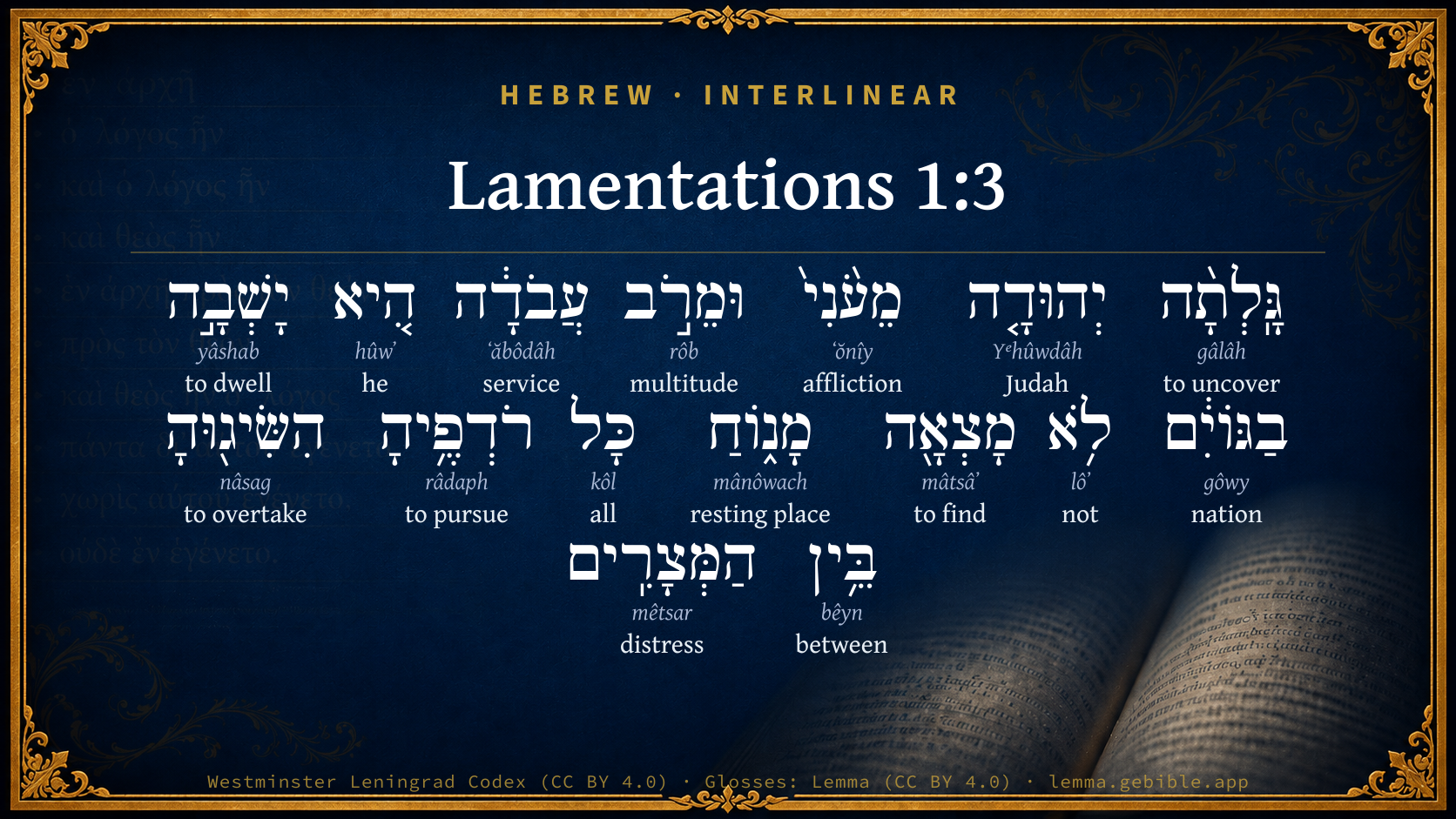
Hebrew (Westminster Leningrad Codex) Lamentations 1:3 appears in the Hebrew Old Testament. The text above is from the Westminster Leningrad Codex. Each word links to its Strong’s number, a concise gloss, and parsing drawn from the Open Scriptures Hebrew Bible morphology. Click any word for its full Brown-Driver-Briggs (BDB) entry.
Download image
Cite this verse

Lamentations 1:3 (World English Bible). Public Domain. Lemma interlinear Bible study tool, https://lemma.gebible.app/v/lamentations/1/3.

Show BibTeX & RIS
BibTeX
RIS
English Translation
Judah is gone into captivity because of affliction, and because of great servitude; She dwells among the nations, she finds no rest: All her persecutors overtook her within the straits.
World English Bible · Public Domain
Download a study sheet

One document with this verse’s original text, its word-by-word gloss line, the meaning frame, cross-references with their text, attributed commentary, and full source and license credits — printable, and it pastes into notes with its structure intact.

This verse Autodidact and up

Study sheet (.html) Plain text (.txt)

A passage Seminary Student

Up to 50 verses in one chapter. A passage sheet keeps up to 6 commentary sources and 12 cross-references per verse, in the order this page ranks them, and says so on the sheet whenever that leaves anything out. Ask for a single verse and you get the Autodidact verse sheet above.

Everything on this page stays free to read, with no account — the sheet is a download of what is already on screen, not access to it.

Want to remove ads? Support Godless Engineer
Compare translations 3

The same verse in 3 English versions, stacked beneath the original-language interlinear above. Click any original word for its lexicon entry.

Each is an independent rendering of the whole verse — the interlinear is not word-aligned to these translations.

Highlighted words mark where these versions differ — a whole-verse word diff, not a word-by-word alignment.

  • World English Bible Public Domain
    Judah is gone into captivity because of affliction, and because of great servitude; She dwells among the nations, she finds no rest: All her persecutors overtook her within the straits.
  • King James Version Public Domain
    Judah is gone into captivity because of affliction, and because of great servitude: she dwelleth among the heathen, she findeth no rest: all her persecutors overtook her between the straits.
  • unfoldingWord Literal Text CC BY-SA 4.0
    Judah has gone into exile from affliction and from the greatness of forced labor. She herself has settled among the nations; she has not found a resting place. All her pursuers have overtaken her between the narrow passes. DALETH

unfoldingWord Literal Text — © unfoldingWord, licensed CC BY-SA 4.0. Word-aligned USFM3 via Door43 (git.door43.org/unfoldingWord/en_ult).

Versions to compare (up to 4)

3 of 4 selected

Show all 18 translations

Every available English version of this verse, each an independent rendering of the whole verse.

  • World English Bible Public Domain
    Judah is gone into captivity because of affliction, and because of great servitude; She dwells among the nations, she finds no rest: All her persecutors overtook her within the straits.
  • Berean Standard Bible Public Domain
    Judah has gone into exile under affliction and harsh slavery; she dwells among the nations but finds no place to rest. All her pursuers have overtaken her in the midst of her distress.
  • Majority Standard Bible Public Domain
    Judah has gone into exile under affliction and harsh slavery; she dwells among the nations but finds no place to rest. All her pursuers have overtaken her in the midst of her distress.
  • King James Version Public Domain
    Judah is gone into captivity because of affliction, and because of great servitude: she dwelleth among the heathen, she findeth no rest: all her persecutors overtook her between the straits.
  • American Standard Version (1901) Public Domain
    Judah is gone into captivity because of affliction, and because of great servitude; She dwelleth among the nations, she findeth no rest: All her persecutors overtook her within the straits.
  • Revised Version (1885) Public Domain
    Judah is gone into captivity because of affliction, and because of great servitude; she dwelleth among the heathen, she findeth no rest: all her persecutors overtook her within the straits.
  • Geneva Bible (1599) Public Domain
    Iudah is caried away captiue because of affliction, and because of great seruitude: shee dwelleth among the heathen, and findeth no rest: all her persecuters tooke her in the straites.
  • Douay-Rheims (1899) Public Domain
    Ghimel. Juda hath removed her dwelling place because of her affliction, and the greatness of her bondage: she hath dwelt among the nations, and she hath found no rest: all her persecutors have taken her in the midst of straits.
  • Young's Literal Translation Public Domain
    Removed hath Judah because of affliction, And because of the abundance of her service; She hath dwelt among nations, She hath not found rest, All her pursuers have overtaken her between the straits.
  • Literal Standard Version CC BY-SA 4.0
    Removed has Judah because of affliction, || And because of the abundance of her service; She has dwelt among nations, || She has not found rest, || All her pursuers have overtaken her between the straits.
  • Unlocked Literal Bible CC BY-SA 4.0
    After poverty and affliction, Judah has gone into exile. She lives among the nations and finds no rest. All her pursuers overtook her in her desperation.
  • unfoldingWord Literal Text CC BY-SA 4.0
    Judah has gone into exile from affliction and from the greatness of forced labor. She herself has settled among the nations; she has not found a resting place. All her pursuers have overtaken her between the narrow passes. DALETH
  • Darby Bible Public Domain
    Judah is gone into captivity because of affliction, and because of great servitude; she dwelleth among the nations, she findeth no rest: all her pursuers have overtaken her within the straits.
  • World Messianic Bible Public Domain
    Judah has gone into captivity because of affliction and because of great servitude. She dwells among the nations. She finds no rest. All her persecutors overtook her in her distress.
  • Webster's Bible Public Domain
    Judah is gone into captivity because of affliction, and because of great servitude: she dwelleth among the heathen, she findeth no rest: all her persecutors overtook her between the straits.
  • Free Bible Version CC BY-SA 4.0
    Judah has been dragged off into captivity, suffering miserably under brutal slavery; she lives among the nations but has no place of her own where she can rest. Those chasing her have brought her down and she cannot escape.
  • Bible in Basic English Public Domain
    Judah has been taken away as a prisoner because of trouble and hard work; her living-place is among the nations, there is no rest for her: all her attackers have overtaken her in a narrow place.
  • JPS Tanakh (1917) Public Domain
    Judah is gone into exile because of affliction, and because of great servitude; she dwelleth among the nations, she findeth no rest; all her pursuers overtook her within the straits.

Literal Standard Version (2020), Covenant Press — licensed CC BY-SA 4.0. Text via the HelloAO Bible API (eBible.org). Unlocked Literal Bible (unfoldingWord) — licensed CC BY-SA 4.0. Text via the HelloAO Bible API (eBible.org). unfoldingWord Literal Text — © unfoldingWord, licensed CC BY-SA 4.0. Word-aligned USFM3 via Door43 (git.door43.org/unfoldingWord/en_ult). Free Bible Version, Dr. Jonathan Gallagher — licensed CC BY-SA 4.0. Text via the HelloAO Bible API (eBible.org).

Word by word

More ways to search: Search by grammar → Find every occurrence → Compare this word →

Practice this passage: Drill this verse → Learn its vocabulary →

הַמְּצָרִֽים
mêtsar
H4712
“the · distresses”
Particle, Definite Article + Noun, Common, Masculine, Plural, Absolute
Part of Speech
Particle + Noun
Type
Common
Gender
Masculine
Number
Plural
State
Absolute
Full BDB Definition

Origin: from H6896

TWOT: 1973f

straits, distress
  1. גָּֽלְתָ֨ה gâlâh H1540 “to uncover” Verb, Qal, Perfect, 3rd Person, Feminine, Singular
  2. יְהוּדָ֤ה Yᵉhûwdâh H3063 “Judah” Noun, Proper
  3. מֵעֹ֨נִי֙ ʻŏnîy H6040 “from · affliction” Preposition + Noun, Common, Masculine, Singular, Absolute
  4. וּמֵרֹ֣ב rôb H7230 “and · from · multitude of” Conjunction + Preposition + Noun, Common, Both, Singular, Construct
  5. עֲבֹדָ֔ה ʻăbôdâh H5656 “service” Noun, Common, Feminine, Singular, Absolute
  6. הִ֚יא hûwʼ H1931 “he” Pronoun, Personal, 3rd Person, Feminine, Singular
  7. יָשְׁבָ֣ה yâshab H3427 “to dwell” Verb, Qal, Perfect, 3rd Person, Feminine, Singular
  8. בַגּוֹיִ֔ם gôwy H1471 “in/at the · nations” Preposition, Determined + Noun, Common, Masculine, Plural, Absolute
  9. לֹ֥א lôʼ H3808 “not” Particle, Negative
  10. מָצְאָ֖ה mâtsâʼ H4672 “to find” Verb, Qal, Perfect, 3rd Person, Feminine, Singular
  11. מָנ֑וֹחַ mânôwach H4494 “resting place” Noun, Common, Both, Singular, Absolute
  12. כָּל kôl H3605 “all of” Noun, Common, Masculine, Singular, Construct
  13. רֹדְפֶ֥יהָ râdaph H7291 “pursuing · her” Verb, Qal, Participle Active, Masculine, Plural, Construct + Suffix, Personal, 3rd Person, Feminine, Singular
  14. הִשִּׂיג֖וּהָ nâsag H5381 “to overtake · her” Verb, Hiphil, Perfect, 3rd Person, Common, Plural + Suffix, Personal, 3rd Person, Feminine, Singular
  15. בֵּ֥ין bêyn H996 “between” Preposition

About this verse

These counts appear in no published source. They are computed here, from the morphology-tagged text and Lemma’s own curated glosses. What Lemma adds →

16
words
16
distinct lemmas
Prophets
section

Notable vocabulary

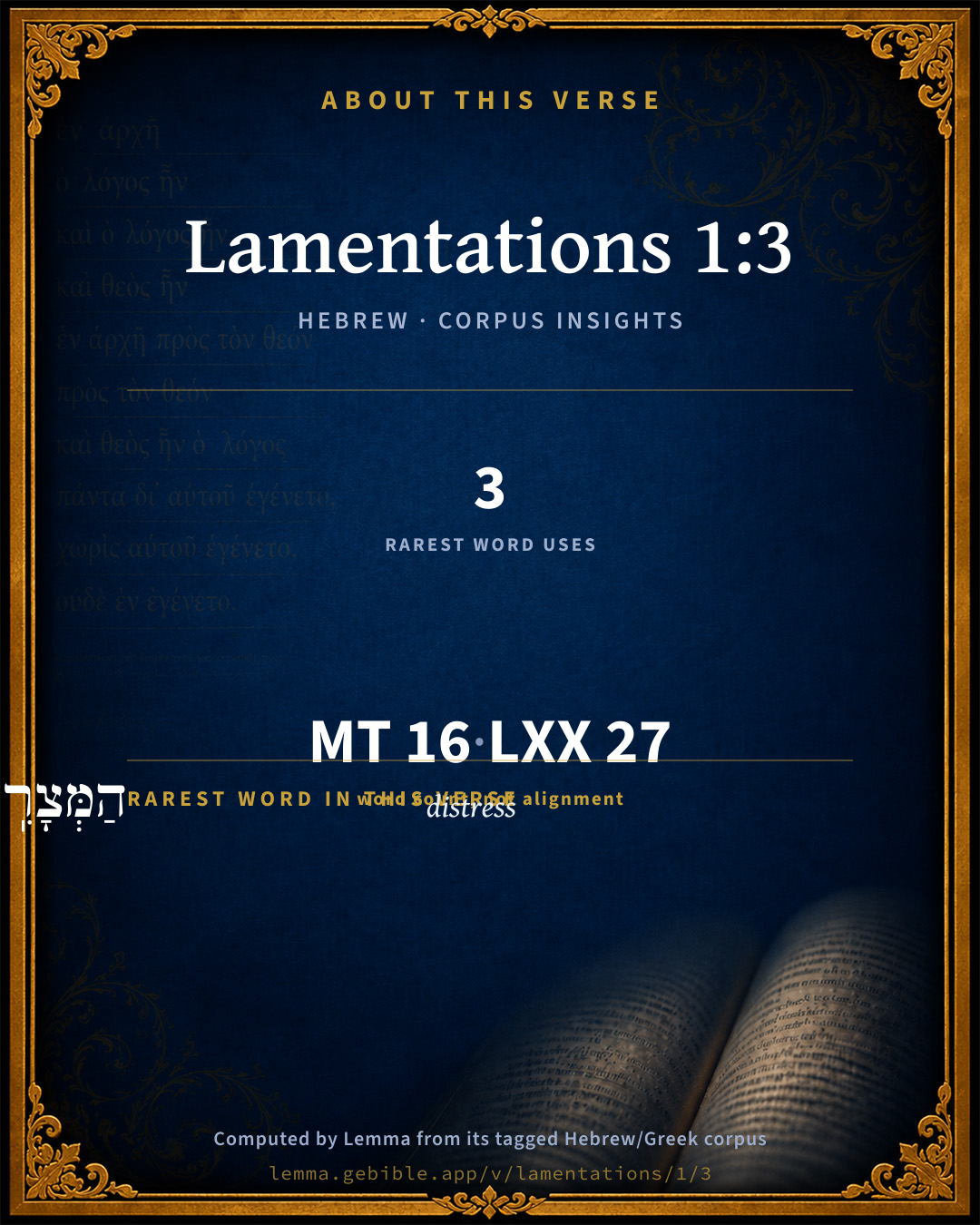
The rarest word here is הַמְּצָרִֽים distress H4712 — appearing just 3 times in the whole Hebrew Bible.

Shared distinctive vocabulary

הַמְּצָרִֽים distress H4712 occurs in 3 verses of the Hebrew Bible. Also found in:

Grammatical profile

  • 5 verbs
  • 8 nouns
  • 1 pronoun
  • 1 preposition
  • 1 particle

Verb forms

  • גָּֽלְתָ֨ה Qal · Perfect
  • יָשְׁבָ֣ה Qal · Perfect
  • מָצְאָ֖ה Qal · Perfect
  • רֹדְפֶ֥יהָ Qal · Participle Active
  • הִשִּׂיג֖וּהָ Hiphil · Perfect

Hebrew & Septuagint length

In English translation the verse runs 30 words from the Hebrew and 39 from the Septuagint (LXX English) — closely comparable.

A rough comparison of the two English renderings, which tokenize alike — not a word-level alignment.

Word counts can differ between the Hebrew and the Greek without any difference in meaning — e.g. the Hebrew direct-object marker אֵת has no separate Greek word, and Greek often adds the article ὁ.

In the original languages it is 16 Hebrew tokens and 27 Greek tokens — but the two are counted differently (Hebrew bundles its prefixes and suffixes into one token; the Greek is in lemma form), so that isn’t a like-for-like length.

Cross-references

17

Topical passages linked to Lamentations 1:3 in the Treasury of Scripture Knowledge — connected by theme and wording, ordered by reader-vote popularity; previews shown in the World English Bible.

  • Deuteronomy 28:64–67 Yahweh will scatter you among all peoples, from the one end of the earth even to the other end of the earth; and there you shall serve other gods, which you have not known, you nor your fathers, even wood and stone.
  • Lamentations 2:9 Her gates are sunk into the ground; he has destroyed and broken her bars: Her king and her princes are among the nations where the law is not; Yes, her prophets find no vision from Yahweh.
  • Leviticus 26:36–39 "'As for those of you who are left, I will send a faintness into their hearts in the lands of their enemies: and the sound of a driven leaf will put them to flight; and they shall flee, as one flees from the sword; and they will fall when no one pursues.
  • 2 Kings 24:14–15 He carried away all Jerusalem, and all the princes, and all the mighty men of valor, even ten thousand captives, and all the craftsmen and the smiths; none remained, save the poorest sort of the people of the land.
  • 2 Kings 25:11 The residue of the people who were left in the city, and those who fell away, who fell to the king of Babylon, and the residue of the multitude, did Nebuzaradan the captain of the guard carry away captive.
  • 2 Kings 25:21 The king of Babylon struck them, and put them to death at Riblah in the land of Hamath. So Judah was carried away captive out of his land.
  • 2 Chronicles 36:20–21 Those who had escaped from the sword carried he away to Babylon; and they were servants to him and his sons until the reign of the kingdom of Persia:
  • Jeremiah 13:19 The cities of the South are shut up, and there is none to open them: Judah is carried away captive, all of it; it is wholly carried away captive.
  • Jeremiah 16:16 Behold, I will send for many fishermen, says Yahweh, and they shall fish them up; and afterward I will send for many hunters, and they shall hunt them from every mountain, and from every hill, and out of the clefts of the rocks.
  • Jeremiah 24:9 I will even give them up to be tossed back and forth among all the kingdoms of the earth for evil; to be a reproach and a proverb, a taunt and a curse, in all places where I shall drive them.
  • Jeremiah 39:9 Then Nebuzaradan the captain of the guard carried away captive into Babylon the residue of the people who remained in the city, the deserters also who fell away to him, and the residue of the people who remained.
  • Jeremiah 52:8 But the army of the Chaldeans pursued after the king, and overtook Zedekiah in the plains of Jericho; and all his army was scattered from him.
  • Jeremiah 52:15 Then Nebuzaradan the captain of the guard carried away captive of the poorest of the people, and the residue of the people who were left in the city, and those who fell away, who fell to the king of Babylon, and the residue of the multitude.
  • Jeremiah 52:27–30 The king of Babylon struck them, and put them to death at Riblah in the land of Hamath. So Judah was carried away captive out of his land.
  • Lamentations 4:18–19 They hunt our steps, so that we can't go in our streets: Our end is near, our days are fulfilled; for our end is come.
  • Ezekiel 5:12 A third part of you shall die with the pestilence, and with famine shall they be consumed in the midst of you; and a third part shall fall by the sword round about you; and a third part I will scatter to all the winds, and will draw out a sword after them.
  • Amos 9:1–4 I saw the Lord standing beside the altar, and he said, "Strike the tops of the pillars, that the thresholds may shake; and break them in pieces on the head of all of them; and I will kill the last of them with the sword: there shall not one of them flee away, and there shall not one of them escape.

Cross-references courtesy of OpenBible.info (CC BY 4.0).

Hebrew and Greek witnesses Masoretic Hebrew ↔ Greek Septuagint

The same verse in the two great witnesses to the Old Testament, shown verse-for-verse.

These are two independent witnesses, not word-aligned to each other, and the Septuagint is shown in lemma (dictionary) form.

Hebrew Lamentations 1:3 Masoretic · Westminster Leningrad Codex

גָּֽלְתָ֨ה יְהוּדָ֤ה מֵעֹ֨נִי֙ וּמֵרֹ֣ב עֲבֹדָ֔ה הִ֚יא יָשְׁבָ֣ה בַגּוֹיִ֔ם לֹ֥א מָצְאָ֖ה מָנ֑וֹחַ כָּל רֹדְפֶ֥יהָ הִשִּׂיג֖וּהָ בֵּ֥ין הַמְּצָרִֽים

Judah is gone into captivity because of affliction, and because of great servitude; She dwells among the nations, she finds no rest: All her persecutors overtook her within the straits.

World English Bible · Public Domain

Greek LXX Lamentations 1:3 Septuagint · lemma form

μεταοἰκίζω ὁ ἰουδαία ἀπό ταπείνωσις αὐτός καί ἀπό πλῆθος δουλεία αὐτός καταἵζω ἐν ἔθνος οὐ εὑρίσκω ἀνάπαυσις πᾶς ὁ καταδιώκω αὐτός καταλαμβάνω αὐτός ἀνά μέσος ὁ θλίβω

GIMEL. Judea is gone into captivity by reason of her affliction, and by reason of the abundance of her servitude: she dwells among the nations, she has not found rest: all her pursuers have overtaken her between her oppressors.

LXX2012 (modern English Septuagint) · Public Domain

Hebrew: Westminster Leningrad Codex (CC BY 4.0). Greek: Septuagint (public domain); English from LXX2012 (modern English Septuagint) (Public Domain). How the Septuagint differs from the Hebrew →

Commentary

Notes on Lamentations 1:3 from classic Christian and Jewish commentators (each source and its license shown beneath its notes). The classic Christian expositions comment on the surrounding passage and are grouped to its opening verse, so a note may address several verses; the Jewish commentaries on the Tanakh (Rashi and others) are per-verse, so they appear only where the commentator wrote on this verse.

Lemma curates 59 commentaries, every one of them public domain or Creative Commons licensed, each selected and text-cleaned for this edition rather than reprinted as found. About our sources →

Trapp's Complete Commentary

John Trapp

Lam 1:3 Judah is gone into captivity because of affliction, and because of great servitude: she dwelleth among the heathen, she findeth no rest: all her persecutors overtook her between the straits.

Ver. 3. Judah is gone into captivity.] But with no goodwill. God hath driven them out for their cruel oppressions and hard usage of their poor brethren that served them; thus the Chaldee paraphrast, and not amiss. Others {a} thus: Judah, i.e., the inhabitants of the kingdom, goeth away, i.e., willingly leave their country, goods, and dwelling, sc., before the desolation of Jerusalem, because of affliction, i.e., extremity of trouble, and great slavery, &c.

She dwelleth among the heathen.] Where she can get nothing better than guilt or grief.

She findeth no rest.] No more than did the dove in the deluge. {Gen 8:9}

All her persecutors took her in the straits,] i.e., At the most advantage to mischief her - a term taken from hunters or highwaymen. The Chaldees took the city when it had been first distressed with famine; and then the Jews that went down to Egypt for succour and shelter after Gedaliah’s death, they caught there, as mice in a trap, as this prophet had foretold them (Jer 42:1-22; Jer 43:1-13; Jer 44:1-30), but they would not be warned. Mitsraim proved to be their Metsarim - i.e., Egypt their pound, or prison.

{a} Jun., Udal.

John Trapp, A Commentary or Exposition upon All the Books of the Old and New Testament (1647–1656) — public domain. Text from a community e-Sword module.

The Biblical Illustrator

Joseph S. Exell

Lam_1:3

Judah is gone into captivity because of affliction.

Afflictive dispensations

1. The outward things of this life are the soonest lost; and being enjoyed, the most uncertain.

(1) They are most subject to all kinds of enemies.

(2) God knoweth that we may best want them.

Learn to make least account of them, as things without which we may be perfectly happy. Endeavour most of all to obtain the true knowledge and fear of God, which is the treasure laid up in heaven (Mat_6:19-20).

2. It is natural for a man to seek to better his outward estate, and his duty to seek far and near for the freedom and rest of conscience (2Ch_11:13-17).

3. It is better to live anywhere than in our own country where our governors seek to oppress us, for their hatred being assisted with their might will never let us live in any tolerable peace.

4. Of two evils, we may and ought to choose the less, to avoid the greater.

5. It is grievous and dangerous to dwell among the ungodly.

(1) They can administer no true comfort unto us.

(2) They are strong to draw us to evil.

6. When God means to punish, He stirs up means; but when He means it not, the means shall not prosper.

7. There is no place or means to escape Gods hand, when He means to punish.

8. There is no kind of people so generally and so evil entreated in their adversity as the godly.

9. This people seemeth to be utterly overthrown for ever, and yet they returned unto their land and became a commonwealth again. So is it often with the Church of God (Psa_139:1, etc.). This teaches us--

(1) Never to despair, though our calamities be never so many and grievous.

(2) That there is no assured safety, but in the true fear of God. (J. Udall.)

The Biblical Illustrator, edited by Joseph S. Exell (c. 1880s–1900s) — public domain. Text from a community e-Sword module.

Joseph Benson's Commentary

Lam 1:3. Judah is gone into captivity because of affliction, &c. — Her miseries have received their finishing stroke in a total captivity among, and bondage to, heathen and infidels, because of the oppression exercised by her rulers and others, and the servitude to which they obliged their subjects and inferiors. This is the interpretation adopted by the Chaldee paraphrast, who represents the Jews as having been carried into captivity, in retaliation of their having oppressed the widows and the fatherless among them, and prolonged illegally the bondage of their brethren who had been sold for slaves. But, as the word גלה, here used, does not necessarily signify to go into captivity, but often to remove, or go into exile, whether voluntarily or by compulsion; Blaney thinks that “a voluntary migration of the Jews is here intended, many of whom, previous to the captivity, had left their country, and retired into Egypt and other parts, to avoid the oppressions and servitude that they had reason to apprehend from the Chaldeans, who had invaded, or were about to invade, their land. Either of these senses,” however, he observes, “is competent; and the interpretation according to them will be found to suit perfectly with the subsequent members of the period.” She findeth no rest — No satisfaction of mind, no settled place of abode, no remission of labour, terror, and suffering; but, deprived of all peace and comfort, is continually exposed to every insult and outrage, and to all manner of oppressions and vexations. All her persecutors — Or pursuers, rather; overtook her between the straits — That is, all her enemies have taken the opportunity of her being in a difficult and distressed condition, to oppress and injure her. The expression is metaphorical, taken from those who hunt their prey, which they are wont to drive into some strait and difficult passage, from whence it cannot escape.

Joseph Benson's Commentary on the Old and New Testaments (1811–1818) — public domain. Text from a community e-Sword module.

The Preacher's Complete Homiletical Commentary

Joseph S. Exell (gen. ed.)

EXEGETICAL NOTES.—

(ג) Lam_1:3. Judah, the population of the whole territory, with that of Jerusalem, is taken into exile, a subjugated, impoverished remnant being left. From affliction, the same expression occurs in Exo_3:17 and Psa_108:4, and from much servitude, not, as might seem intimated by the Authorised Version and Revised Version, that the Jews were led into captivity because of the manumitted Hebrew servants being again subjected to bondage by their richer brethren (Jer_34:8-12); not that the Jews fled as voluntary emigrants to escape the oppression of conquerors; but that, from the low depth of misery into which they had been brought by the invasions and exactions of foreign powers, from months of faction and coercion and famine, they were taken into the lower depth of being made captives. In Babylon, in the centre of old world civilisation, with its traffic and magnificence, she has not found rest. Nebuchadnezzar employed “them upon those large works of irrigation and the building of cities, for which his ambition required labourers, just where they were forced to share and contribute to Babylonian life.” Thou didst show them no mercy; upon the aged hast thou very heavily laid thy yoke (Isa_48:6). All her pursuers have overtaken her between the straits; they laid affliction upon her when she was already pressed in by trouble; hit her when she was down.

HOMILETICS

THE JUDGMENT OF OPPRESSION

(Lam_1:3)

I. The oppressor is in turn oppressed. “Judah is gone into captivity because of affliction and because of great servitude.” The prophet would probably have in view the circumstances narrated in Jeremiah 34, where the Jewish princes and people were threatened with captivity, because, in violation of the law, they withdrew the grant of liberty made to their servants, and reduced them to their former servitude, aggravated with increased exactions. It is an oft-repeated charge against the Jews that they robbed and oppressed their own countrymen; and the day came when they were robbed and oppressed by their powerful conquerors. It is a cruel abuse of power when it is used to injure the helpless. Every act of wrong-doing carries within it the germ of future recompense. The boomerang rebounds towards the man who threw it.

II. The judgment is constant. “She dwelleth among the heathen; she findeth no rest.” The endless and impossible tasks imposed on others are now allotted to the oppressors. There is no prospect of release—they dwell among the heathen; no prospect of abatement—they find no rest. Judgment knows nothing of pity: while the sinner remains obdurate, its mission is to punish. There is no change in the punishment until there is a moral change in the offender. Divine mercy alone can break the entail of suffering, and that can be effected only by satisfying the claims of justice.

III. The judgment cannot be evaded by flight. “All her persecutors over took her between the straits.” Zedekiah and the princes of Judah strove to escape from besieged Jerusalem, but the wary Chaldeans pursued and captured them (Jer_52:7-8). The people fled to the mountain passes, but they were there confronted by the enemy, and flight was impossible. Like hunted deer, whichever way they turned, they found themselves within the toils of the invaders. The conquerors held them as in a grip of steel. The day came when the Chaldeans were similarly helpless in the hands of a superior force. Judgment perpetually dogs the heel of the oppressor, and every possible avenue of escape is carefully guarded. Oppression is the attempt of an imperious will to have its own way, and it does not answer. “Not thy will but mine be done,” changed Paradise into a desert. “Not My will but Thine be done,” changed the desert into Paradise, and made Gethsemane the gate of glory.

LESSONS.—

1. Oppression is a short-sighted policy.

2. The spoils gained by oppression are worthless.

3. The law of retribution is always at work.

GERM NOTES ON THE VERSES

Lam_1:3. “Judah is gone into captivity because of affliction and great servitude.” A time of trouble.

1. Should induce careful self-examination.

2. Should lead us to reflect whether we have caused trouble to others.

3. Is a call to repentance and moral reform.

—“She dwelleth among the heathen, she findeth no rest.” The changes of life.

1. Often bring us into the midst of strange, unfriendly associations.

2. Interfere with growth in personal piety.

3. Disturb the soul’s peace.

—“All her persecutors overtook her between the straits.” The spirit of persecution.

1. Instigated by hatred to the good.

2. Is vigilant and active in its cruel pursuits.

3. Takes advantage of the helplessness of its victims.

ILLUSTRATIONS.—The oppressor punished. There is an Eastern fable that a wicked and oppressive king was once kissed on either shoulder by the Evil One. Immediately there sprang therefrom two serpents, who, furious with hunger, attacked the man and strove to eat into his brain. The terrified king tried to tear them away and cast them from him, when, to his horror, he found they had become part of himself. So is it with those who yield to anger or any other evil passion. The man who tyrannises over others becomes by and by the victim of his own tyrannical temper, and all efforts to deliver himself are in vain; it has become a part of himself. Wrong-doing carries with it its own punishment. In its earlier stages we fancy it will be easy at any time to do right; but when we try, we are helpless.

The oppressor a selfish man.

“He pours no cordial in the wounds of pain;

Unlocks no prison, and unclasps no chain.

His heart is like the rock, where sun nor dew

Can rear one plant, or flower of heavenly hue.

No thought of mercy there may have its birth,

For helpless misery or suffering worth.

The end of all his life is paltry pelf,

And all his thoughts are centred on himself.

The wretch of both worlds; for so mean a sum,

First starved in this, then damned in that to come!”

A time of trouble. If God brings us into difficulties, we may be sure He will bring us out again; but no such confidence should be ours if we bring ourselves into them.

Trouble and the way out. An expedition started from Buenos Ayres to explore the Pilcomayo River, South America, with the view of establishing a water communication between the Argentine Republic and Bolivia. For the first fortnight the explorers made fair progress, but after that the navigation was difficult and slow, it being necessary to construct dams across the river below their vessel and wait till the water accumulated sufficiently to float it. At length they could proceed no farther, and remained in the same position for months. Having exhausted all their provisions, and their efforts at foraging proving unsuccessful, they daily expected the arrival of a relief party, and were daily disappointed. When they were wasting with famine and had given up all hope, they were surprised one morning by hearing a bugle blast, and knew they were saved. Only those who have been in extremity can realise how exquisite is the joy of sudden and unexpected rescue.—The Scottish Pulpit.

The changes of life. A mill-owner was obliged to dismiss several of his hands. Among them was a man whose faith and trust in God always led him to say, “The Lord will provide.” One day when he had eaten his last morsel of food, and his faith was tried to the utmost, some street-boys, opening his door, flung in a dead raven, shouting mockingly, “The Lord will provide.” He quietly took up the dead bird and tenderly stroked its plumage. Suddenly he felt something hard in the crop of the bird, and wondering what it was, he took a knife and opened it. To his amazement he found there a gold chain. He felt here was God providing for him and his family. He went straight to a jeweller, telling his story, and asked if he would buy it. The jeweller saw it to be a chain of great value, with initials on it, and said, “If you could learn the name of the owner, would you return it?” “Certainly,” replied the workman. “Well then,” said the jeweller, “it belongs to your late master.” Hearing that, the man set off without delay and put the chain into his master’s hands, who received it with great joy, as he had on missing it accused one of his servants of theft. Greatly struck with his workman’s honesty, he told him he wished him to return to his employment, as he could not part with so honest a man. In the most trying changes of life it is best to do what is right.

Persecution. A sensation was caused in Hungary by a certain Count, a large landed proprietor, giving orders that thenceforth no Protestant was to be engaged in the service of his estate, and that Protestants already employed were disqualified from any further promotion. Any officials who married Protestants were to be at once dismissed. This high-handed procedure was the more remarkable as religious toleration was recognised as a supreme political and social principle, there being already eight different Christian denominations. Persecution and bigotry are weeds difficult to eradicate, and there is no knowing into what eccentric and tyrannical forms they may develop.—The Scottish Pulpit.

God the Helper of the persecuted. Have faith, O you who suffer for the noble cause, the apostles of a truth which the world of to-day comprehends not, warriors in the sacred fight whom it yet stigmatises with the name of rebels. To-morrow victory will bless the banner of your crusade. Walk in faith and fear not. That which Christ has done, humanity may do. Believe, and you will conquer. Action is the word of God; thought alone is but His shadow. They who disjoin thought and action seek to divide Deity, and deny the Eternal unity. They who are not ready to bear witness to their faith with their blood are no true believers. From your cross of sorrow and persecution proclaim the religion of the epoch. Soon shall it receive the consecration of faith. From our cross of misery and persecution we men of exile, the representatives of heart and faith of the enslaved races, of millions of men constrained to silence, will respond to your appeal, and say to our brothers, The alliance is founded. Answer your persecutors with the formula, God and the people. They may rebel and blaspheme against it for a while, but it will be accepted and worshipped by the peoples.—Mazzini.

The spirit of persecution inexorable. A poor Anabaptist, guilty of no crime but his fellowship with a persecuted sect, had been condemned to death. He had made his escape, closely pursued by an officer of justice, across a frozen lake. It was late in the winter, and the ice had become unsound. It trembled and cracked beneath his footsteps, but he reached the shore in safety. The officer was not so fortunate. The ice gave way beneath him, and he sank into the lake uttering a cry for succour. There were none to hear him except the fugitive whom he had been hunting. Dirk Willemzoon, for so was the Anabaptist called, instinctively obeyed the dictates of a generous nature, returned, crossed the quaking and dangerous ice at the peril of his life, extended his hand to the enemy, and saved him from certain death. Unfortunately for human nature, it cannot be added that the generosity of the action was met by a corresponding heroism. The officer was desirous, it is true, of avoiding the responsibility of sacrificing the preserver of his life, but the burgomaster of Asperen sternly reminded him to remember his oath. He accordingly arrested the fugitive, who, in the month of May following, was burned to death under the most lingering tortures.—Motley’s “Dutch Republic.”

The Preacher's Complete Homiletical Commentary (gen. ed. Joseph S. Exell; Funk & Wagnalls, c. 1892) — public domain (pre-1929). A full-Bible homiletical/sermon-outline anthology covering 65 of 66 books (2 John is absent from the source module). Text from a community e-Sword module.

Keil & Delitzsch

C. F. Keil & F. Delitzsch

With Lam 1:3 begins the specific account of the misery over which Jerusalem sorrows so deeply. Judah has gone into exile, but she does not find any rest there among the nations. "Judah" is the population not merely of Jerusalem, but of the whole kingdom, whose deportation is bewailed by Jerusalem as the mother of the whole country. Although יהוּדה designates the people, and not the country, it is construed as a feminine, because the inhabitants are regarded as the daughter of the land; cf. Ewald, 174, b [and Gesenius, 107, 4, a]. 'מעני וגו has been explained, since J. D. Michaelis, by most modern expositors (Rosenmller, Maurer, Ewald, Thenius, Ngelsbach), and previously by Calvin, as referring to the cause of the emigration, "from (because of) misery and much servitude;" and in harmony with this view, גּלתה יהוּדה has been understood, not of the deportation of Judah into exile, but of the voluntary emigration of the fugitives who sought to escape from the power of the Chaldeans by fleeing into foreign countries, partly before and partly after the destruction of Jerusalem. But this interpretation neither agrees with the meaning of the words nor the context. Those fugitives cannot be designated "Judah," because, however numerous one may think they were, they formed but a fraction of the inhabitants of Judah: the flower of the nation had been carried off to Babylon into exile, for which the usual word is גּלה. The context also requires us to refer the words to involuntary emigration into exile. For, in comparison with this, the emigration of fugitives to different countries was so unimportant a matter that the writer could not possibly have been silent regarding the deportation of the people, and placed this secondary consideration in the foreground as the cause of the sorrow. מעני is not to be taken in a causal sense, for מן simply denotes the coming out of a certain condition, "out of misery," into which Judah had fallen through the occupation of the country, first by Pharaoh-Necho, then by the Chaldeans; and רב עבדה does not mean "much service," but "much labour." For עבדה does not mean "service" (=עבדוּת), but "labour, work, business," e.g., עבדת המּלך, "the service of the king," i.e., the service to be rendered to the king in the shape of work (Ch1 26:30), and the labour connected with public worship (Ch1 9:13; Ch1 28:14, etc.); here, in connection with עני, it means severe labour and toil which the people had to render, partly for the king, that he might get ready the tribute imposed on the country, and partly to defend the country and the capital against those who sought to conquer them. Although Judah had wandered out from a condition of misery and toil into exile, yet even there she found no rest among the nations, just as Moses had already predicted to the faithless nation, Deu 28:65. All her pursuers find her בּין המּצרים, inter angustias (Vulgate). This word denotes "straits," narrow places where escape is impossible (Psa 116:3; Psa 118:5), or circumstances in life from which no escape can be found.

Keil & Delitzsch — Biblical Commentary on the Old Testament (1861–1891) — public domain (CC PDM 1.0). Text via the HelloAO Bible API. (Old Testament only.)

Tyndale Open Study Notes

Tyndale Open Resources

1:3 The woman of 1:1 is the nation of Judah. • led away into captivity: This happened four times: 605 BC (Dan 1:3-4); 597 BC (2 Kgs 24:12-16; Jer 52:28; Ezek 1:2-3); 586 BC (2 Kgs 25:5-7, 18-21; Jer 39:5-10; 52:29); and 581 BC (Jer 52:30).

Tyndale Open Study Notes — © Tyndale Open Resources, licensed CC BY-SA 4.0. Text via the HelloAO Bible API.

Geneva Bible (1599)

Geneva Bible translators

For her cruelty toward the poor and oppression of servants, Jer. 34:11.

Geneva Bible (1599) marginal notes — public domain. Text via Bolls.life.

Jamieson, Fausset & Brown

Robert Jamieson, A. R. Fausset & David Brown

(Jer 52:27).

because of great servitude--that is, in a state "of great servitude," endured from the Chaldeans. "Because" is made by VATABLUS indicative of the cause of her captivity; namely, her having "afflicted" and unjustly brought into "servitude" the manumitted bond-servants (Jer 34:8-22). MAURER explains it, "Judah has left her land (not literally 'gone into captivity') because of the yoke imposed on it by Nebuchadnezzar."

no rest-- (Deu 28:64-65).

overtook her between . . . straits--image from robbers, who in the East intercept travellers at the narrow passes in hilly regions.

Jamieson, Fausset & Brown — Commentary Critical and Explanatory on the Whole Bible (1871) — public domain (CC PDM 1.0). Text via the HelloAO Bible API.

Adam Clarke's Commentary

Verse 3. Between the straits.] She has been brought into such difficulties, that it was impossible for her to escape. Has this any reference to the circumstances in which Zedekiah and the princes of Judah endeavoured to escape from Jerusalem, by the way of the gates between the two walls? Jer 52:7.

Adam Clarke's Commentary on the Bible (1810–1826) — public domain. Text from a community e-Sword/MySword module.

John Calvin's Commentaries

Interpreters apply this, but in my view improperly, to the captivity of the people; on the contrary, the Prophet means that the Jews had been scattered and sought refuges when oppressed, as they were often, by the tyranny of their enemies, and then by degrees he advances to their exile; for he could not have said all things at the same time. Let, then, the order in which he speaks be observed: before he bewails their exile, he says that Judah had been scattered; for many, fleeing the cruelty of enemies, went into voluntary exile. We have before seen that many concealed themselves with the Moabites; nor is there a doubt but that many went into Egypt: in short, there was no country in which some of the Jews were not fugitives.

The real meaning, then, of the Prophet here is, that the Jews had migrated, that is, had left their own country and fled to other countries, because they were subjected to miseries and cruel servitude.

Some take the words in a passive sense, even that Judah migrated, because they had inhumanly oppressed their servants. But I suspect what has led them astray, they thought that exile is meant here; and then one mistake produces another; for it would have been absurd to say, that the Jews had migrated into exile on account of affliction, and had migrated willingly; for we know that they were violently driven by the Chaldeans. They did not, then, willingly migrate. When these two things could not be connected, they thought that the cruelty of the Jews is what is referred to, which they had exercised towards their own brethren. But the migration of which the Prophet speaks is improperly applied, as I have said, to the captivity; but on the contrary, he means those who had removed into different parts of the world, because this was more tolerable than their condition in their own country. And we hence learn how severely they had been harassed by the Chaldeans, for they had willingly fled away, though, as we know, exile is hard. We then conclude that it was a barbarous and a violent oppression, since the Prophet says, that the Jews thus went into exile of their own accord, and sought hiding-places either in Egypt or in the land of Moab, or among other neighboring nations.

He afterwards adds another evil, that they never found rest; and lastly, that they had been taken by their enemies between straits, so that no escape was possible. It must have been a sad condition for the people to live in a foreign land; for we know that such a precarious life differs but little from death; and there were no contiguous nations by whom the Jews were not hated. When they then fled to such people, it was no small evil. But when they had nowhere a quiet abode, the indignity was still greater, and this is what the Prophet now refers to. But when we flee and tremblingly turn here and there, it is one of the greatest of evils to fall into the hands of enemies, and to be taken by them when we are enclosed as it were between two walls, or in a narrow passage, as some explain the word. It follows, —

John Calvin's Commentaries (1540-1563) — public domain. Text from the Calvin Translation Society English edition (1840s-50s) via the Christian Classics Ethereal Library (ccel.org). Calvin's coverage is partial (roughly two-thirds of the Bible); uncommented books and verses are honest gaps, never fabricated. The 19th-century editor's footnotes and remarks are omitted so the notes are faithfully Calvin's own voice.

Ellicott's Commentary for English Readers

(3) Because of affliction.—The Authorised version suggests the thought that the words refer to the voluntary emigration of those who went to Egypt and other countries (Jer_42:14), to avoid the oppression to which they were subject in their own land. The Hebrew admits, however, of the rendering “from affliction,” and so the words speak of the forcible deportation of the people from misery at home to a yet worse misery in Babylon as the land of their exile. Even there they found no “rest” (Deu_28:65) Their persecutors hunted them down to the “straits” from which no escape was possible.

A Bible Commentary for English Readers, edited by Charles John Ellicott (1878–1897) — public domain. Text from a community e-Sword module.

The Cambridge Bible for Schools and Colleges

gen. ed. J. J. S. Perowne

3. is gone into captivity because of affliction] The better rendering is, is gone into exile (so mg.) because of affliction, i.e. the long sufferings of the Jews at the hands of Egypt and Chaldaea had induced many of them to go voluntarily to dwell in other lands. That this frequently took place we gather from Jer_40:11. This is better than the alternative rendering (taken) out of affliction (into Babylon), as this would be a lightening of the picture hardly in consonance with the purpose of the writer. If, however, this latter be the sense, the word “servitude” will be illustrated by the “hard service” inflicted on exiles in Babylon according to Isa_14:3.

within the straits] distresses, oppression. The Jews have been hemmed in and harassed by their foes.

The Cambridge Bible for Schools and Colleges (gen. ed. J. J. S. Perowne; Cambridge University Press, 1878–1918) — public domain. Text from a community e-Sword module.

John Gill's Exposition

Judah is gone into captivity,.... Not only Jerusalem the metropolis of Judea was destroyed, but the whole country was ravaged, and the inhabitants of it carried captive into Babylon:

because of affliction, and because of great servitude; because of their sins in oppressing and afflicting their poor brethren, and retaining them in a state of bondage after their seven years' servitude, contrary to the law of God; for which they were threatened with captivity, Jer 34:13; so the Targum,

"the house of Judah went into captivity, because they afflicted the fatherless and the widows; and because of the multitude of service which they caused their brethren the children of Israel to serve, who were sold unto them; and they did not proclaim liberty to their servants and maidens, who were of the seed of Israel:''

or, "through affliction, and through great servitude" (l); that is, through the affliction and servitude they suffered by the Chaldeans, into whose hands they fell; though some understand it of the Jews, who, to escape the affliction and servitude of the Chaldeans, went into a kind of voluntary captivity, fleeing to the countries of Moab, Ammon, and Edom, during the siege of Jerusalem by the Chaldeans; see Jer 40:11;

she dwelleth among the Heathen; the uncircumcised and the unclean; and so was deprived of both her civil and religious liberties; having no opportunity of worshipping God, and enjoying him in his courts, as formerly; and which must be very uncomfortable living, especially to those who were truly gracious:

she findeth no rest. The Targum adds,

"because of the hard service to which they subjected her;''

she found no natural rest, being carried from place to place; nor civil rest, being kept in hard bondage; nor spiritual rest, being deprived of the worship and ordinances of God; and being conscious of her sins, which had brought all this misery on her:

all her persecutors overtook her between the straits; having hunted her as men hunt wild beasts, and get them into some strait and difficult place, and then seize on them. The Targum interprets it, between the borders; or between the hedges, as Ben Melech; and so Jarchi, of the borders of a field and vineyard; and of a ditch on the one side and the other, that there is no room to escape; and who makes mention of a Midrash, that explains it not of place, but time, between the seventeenth day of Tammuz, and the ninth of Ab; see Jer 52:7.

(l) "per afflictionem"; "hic, non prae, sed per significat", Grotius; "vel prae afflictione, sub. a Chaldaeis perpessa"; so some in Vatablus.

John Gill's Exposition of the Whole Bible (1746–1763) — public domain (CC PDM 1.0). Text via the HelloAO Bible API.

Albert Barnes' Notes on the Bible

Because of ... - i. e. the people, not of Jerusalem only, but of the whole land, “is gone into exile to escape from the affliction and laborious servitude,” to which they are subject in their own land.

Persecutors ... between the straits - Rather, “pursuers ... in the midst of her straits.” The Jews flee like deer to escape from the invading Chaldaeans, but are driven by them into places from where there is no escape.

Albert Barnes' Notes on the Bible (1834–1885) — public domain. Text from a community e-Sword/MySword module.

Haydock's Catholic Bible Commentary

Rest. Many returning to join Godolias, chap. xl. 7. (Calmet) --- The Jews who beheld their brethren led away to Babylon, retired into Egypt, but were in misery. (Worthington)

George Leo Haydock (1774–1849), Haydock's Catholic Family Bible and Commentary, 1859 edition — public domain. Excludes Psalms (Douay-Rheims chapter numbering differs from Protestant) and Deuterocanonical books (Catholic canon only).

Matthew Poole's English Annotations

This is expounded as the cause why the Jews were carried into captivity, because of the servitude and oppression exercised amongst them, oppression by their rulers, and servitude more generally, keeping their servants beyond the year of jubilee, when they ought to have set them at liberty; and that this was one cause appeareth from Jer 34:17; or if

because of affliction, & c. be joined to the next words, the sense is plain,

she dwelleth amongst the heathen, by reason of her low condition, and the state of servitude she is in; where she, that is, the Jews, have neither any satisfaction nor quiet in their own minds, nor are they by their enemies suffered to be at quiet any where. Those that pursued them with all violence to destroy them overtook them in places where they could not escape them, as huntsmen and others take their game by driving them into strait and narrow places.

Matthew Poole's English Annotations on the Holy Bible (1683–1685) — public domain. Text from a community e-Sword/MySword module.

Whedon's Commentary on the Bible

Daniel D. Whedon

3. Because of affliction — The unendurable pressure of evil upon them in their own land has driven them into exile.

Between the straits — The word here rendered “straits” is elsewhere translated “pain,” “distress.” See Psa_116:3; Psa_118:5. The idea is, that her persecutors came upon her when unable either to resist or flee.

Daniel D. Whedon (gen. ed.), Commentary on the Old and New Testaments (1874–1909) — public domain. Text from a community e-Sword module.

The Pulpit Commentary

Is gone into captivity because of affliction; rather, is gone into exile, etc. The poet is not thinking of the deportation of the captives, but of those Jews who sought refuge for themselves in foreign lands. (Jer_40:11) An objection has been raised to this view that the number of fugitive Jews would not be large enough to warrant their being called "Judah." But we might almost as well object on a similar ground to the application of the term "Judah" to the Jews who were carried to Babylon. The truth may, perhaps, be that, after the fall of Jerusalem, the Jewish nation became split up into three parts:

(1) the Jews who succeeded in escaping into Egypt or elsewhere;

(2) those who were carried captive;

(3) the mass of the common people, who remained on their native soil, Keil, however, retains the view of the Authorized Version, only substituting "out of" for "because of." "Out of" the misery into which the Jews had been brought by the invasions of Necho and Nebuchadnezzar they passed into the new misery of captivity. Among the heathen; rather, among the nations. Between the straits. The phrase is peculiar, and reminds us of Psa_118:5, "Out of the strait I called unto thee." "A strait," or narrow place, clearly means adversity, just as "a large place" (Psa_118:5) means prosperity.

The Pulpit Commentary (1880–1919), ed. H.D.M. Spence-Jones & Joseph S. Exell — public domain. Text from a community e-Sword module.

John Wesley's Explanatory Notes

Because - Because of the servitude and oppression exercised among them: oppression by their rulers, and servitude more generally; keeping their servants beyond the year of jubilee, when they ought to be set at liberty. The straits - Those that pursued them overtook them in places where they could not escape.

John Wesley, Explanatory Notes Upon the Whole Bible (1754–1765) — public domain. Text via the GEBible commentary corpus.

unfoldingWord translationNotes

Door43 World Missions Community

General Information:

In these verses, Jerusalem and Judah are spoken of as if they were women. (See: Personification)

After poverty and affliction

"After suffering poverty and affliction"

Judah has gone into exile

Here Judah refers to its inhabitants. AT: "the people of Judah have gone into exile" or "the people of Judah have been taken into a foreign land" (See: Metonymy)

She lives ... finds

Here the kingdom of Judah is described as a woman. "She" also stands for the citizens of Judah. AT: "Her people live ... they find" (See: Personification and Metonymy)

finds no rest

"does not find rest" or "is always afraid"

All her pursuers overtook her in her desperation

This speaks of the people of Judah being captured by their enemies as if they were a woman who was captured by those pursuing her. (See: Personification)

All her pursuers overtook her

"Everyone who was chasing her managed to capture her" or "Everyone who was hunting for her found her"

in her desperation

The word "desperation" can be expressed as an adjective. AT: "when she was desperate" or "when she was distressed" (See: Abstract Nouns)

translationWords

afflicted

Judah

rest

unfoldingWord translationNotes — © Distant Shores Media and the Door43 World Missions Community, licensed CC BY-SA 4.0. Source: git.door43.org/Door43/en_tn.

Rashi

Rabbi Shlomo Yitzchaki (Rashi)

Judah went into exile from her land.

and great servitude with which the Chaldeans burdened her.

she settled among the nations and in the place where she was exiled and settled she found no rest.

between the boundaries where there is a high place on either side, and there is no place to flee.

the boundaries Heb. הַמְצָרִים, the boundaries of fields and vineyards. The Midrash Aggadah (Lam. Rabbah 1:29) explains: between the seventeenth of Tammuz and the ninth of Av.

Rashi on the Tanakh — English translations: “The Judaica Press complete Tanach with Rashi, translated by A. J. Rosenberg” (CC BY 4.0); “Pentateuch with Rashi's commentary by M. Rosenbaum and A.M. Silbermann, 1929-1934” (public domain); “The Metsudah Tanach series, Lakewood, N.J” (CC BY 4.0); and “The Book of Joshua, Metsudah Publications, 1997” (CC BY 4.0). Text via Sefaria.

Ibn Ezra

Rabbi Abraham ibn Ezra

Yehuda (יהודה) - is both a masculine and feminine noun, similar to Israel (ישראל) and Egypt (מצרים). In the phrase "Vatechazeik Mitzrayim" (ותחזק מצרים), Mitzrayim is used in the masculine form. There are interpretations from the ancient religious sages (ז"ל) that explain "Dina DeMitzra" (דינא דבר מצרא) - the law of Egypt. However, the straightforward interpretation in my opinion is "Min HaMitzra" (מן המצר), and if it differs slightly, the letter "Hey" should be emphasized. We find a similar pattern of masculine and feminine in "Bayit" (בית) and "Makom" (מקום).

Ibn Ezra on the Tanakh — English translations: “Sefaria Community Translation” (CC0 1.0 (public-domain dedication)); “Yalkut, Sifsei Chachomim Chumash, Metsudah Publications, 2009” (CC BY 4.0); and “Commentary of Ibn Ezra on Isaiah - trans. by M. Friedlander, 1873” (public domain). Text via Sefaria.

Lesson kit

Teaching starters — assembled from the data on this page, not authored interpretation. Every prompt links to the verse data it draws on. Edit before teaching.

Lamentations, in the Prophets, opens this verse with 16 words (16 distinct Hebrew lemmas). Its most distinctive word is mêtsar (“distress”). A historical commentator’s framing appears above. Read the whole chapter for the surrounding context.

Discussion questions

  1. What does “distress” (mêtsar) contribute to the verse as a whole?
  2. How does Psalms 116:3, which shares the word «distress», read alongside this verse?
  3. These translations render this verse differently; the difference is in the English rendering, not the original. What questions does that raise?
  4. «גָּֽלְתָ֨ה» is a Qal Perfect verb. How does that grammatical form shape the action described?
  5. Compare how Trapp's Complete Commentary and The Biblical Illustrator read this verse. Where do they agree or differ?

Things to notice

Reading settings

Reading text

Shown beneath each verse's original-language words.

Old Testament
Old Testament edition

Read the OT as the Masoretic Hebrew (MT) or the Greek Septuagint (LXX).

English shown for the Greek Septuagint (in the Hebrew ↔ Greek comparison).

Comparing translations? Open the Compare panel on any verse page to stack up to four side by side.