
1 Kings 3:9

Hebrew (Westminster Leningrad Codex) 1 Kings 3:9 appears in the Hebrew Old Testament. The text above is from the Westminster Leningrad Codex. Each word links to its Strong’s number, a concise gloss, and parsing drawn from the Open Scriptures Hebrew Bible morphology. Click any word for its full Brown-Driver-Briggs (BDB) entry.
Download image
Cite this verse

1 Kings 3:9 (World English Bible). Public Domain. Lemma interlinear Bible study tool, https://lemma.gebible.app/v/1-kings/3/9.

Show BibTeX & RIS
BibTeX
RIS
English Translation
Give your servant therefore an understanding heart to judge your people, that I may discern between good and evil; for who is able to judge this your great people?
World English Bible · Public Domain
Download a study sheet

One document with this verse’s original text, its word-by-word gloss line, the meaning frame, cross-references with their text, attributed commentary, and full source and license credits — printable, and it pastes into notes with its structure intact.

This verse Autodidact and up

Study sheet (.html) Plain text (.txt)

A passage Seminary Student

Up to 50 verses in one chapter. A passage sheet keeps up to 6 commentary sources and 12 cross-references per verse, in the order this page ranks them, and says so on the sheet whenever that leaves anything out. Ask for a single verse and you get the Autodidact verse sheet above.

Everything on this page stays free to read, with no account — the sheet is a download of what is already on screen, not access to it.

Want to remove ads? Support Godless Engineer
Compare translations 3

The same verse in 3 English versions, stacked beneath the original-language interlinear above. Click any original word for its lexicon entry.

Each is an independent rendering of the whole verse — the interlinear is not word-aligned to these translations.

Highlighted words mark where these versions differ — a whole-verse word diff, not a word-by-word alignment.

  • World English Bible Public Domain
    Give your servant therefore an understanding heart to judge your people, that I may discern between good and evil; for who is able to judge this your great people?
  • King James Version Public Domain
    Give therefore thy servant an understanding heart to judge thy people, that I may discern between good and bad: for who is able to judge this thy so great a people?
  • unfoldingWord Literal Text CC BY-SA 4.0
    So may you give to your servant a hearing heart to judge your people, to discern between good to evil. For who is able to judge this your heavy people?”

unfoldingWord Literal Text — © unfoldingWord, licensed CC BY-SA 4.0. Word-aligned USFM3 via Door43 (git.door43.org/unfoldingWord/en_ult).

Versions to compare (up to 4)

3 of 4 selected

Show all 18 translations

Every available English version of this verse, each an independent rendering of the whole verse.

  • World English Bible Public Domain
    Give your servant therefore an understanding heart to judge your people, that I may discern between good and evil; for who is able to judge this your great people?
  • Berean Standard Bible Public Domain
    Therefore give Your servant an understanding heart to judge Your people and to discern between good and evil. For who is able to govern this great people of Yours?”
  • Majority Standard Bible Public Domain
    Therefore give Your servant an understanding heart to judge Your people and to discern between good and evil. For who is able to govern this great people of Yours?”
  • King James Version Public Domain
    Give therefore thy servant an understanding heart to judge thy people, that I may discern between good and bad: for who is able to judge this thy so great a people?
  • American Standard Version (1901) Public Domain
    Give thy servant therefore an understanding heart to judge thy people, that I may discern between good and evil; for who is able to judge this thy great people?
  • Revised Version (1885) Public Domain
    Give thy servant therefore an understanding heart to judge thy people, that I may discern between good and evil; for who is able to judge this thy great people?
  • Geneva Bible (1599) Public Domain
    Giue therefore vnto thy seruant an vnderstanding heart, to iudge thy people, that I may discerne betweene good and bad: for who is able to iudge this thy mightie people?
  • Douay-Rheims (1899) Public Domain
    Give therefore to thy servant an understanding heart, to judge thy people, and discern between good and evil. For who shall be able to judge this people, thy people which is so numerous?
  • Young's Literal Translation Public Domain
    and Thou hast given to Thy servant an understanding heart, to judge Thy people, to discern between good and evil; for who is able to judge this Thy great people?'
  • Literal Standard Version CC BY-SA 4.0
    and You have given an understanding heart to Your servant, to judge Your people, to discern between good and evil; for who is able to judge this great people of Yours?”
  • Unlocked Literal Bible CC BY-SA 4.0
    So give your servant an understanding heart to judge your people, so that I may discern between good and evil. For who is able to judge this great people of yours?”
  • unfoldingWord Literal Text CC BY-SA 4.0
    So may you give to your servant a hearing heart to judge your people, to discern between good to evil. For who is able to judge this your heavy people?”
  • Darby Bible Public Domain
    Give therefore to thy servant an understanding heart, to judge thy people, to discern between good and bad; for who is able to judge this thy numerous people?
  • World Messianic Bible Public Domain
    Give your servant therefore an understanding heart to judge your people, that I may discern between good and evil; for who is able to judge this great people of yours?”
  • Webster's Bible Public Domain
    Give therefore to thy servant an understanding heart to judge thy people, that I may discern between good and bad: for who is able to judge this thy so great a people?
  • Free Bible Version CC BY-SA 4.0
    So please give me a mind that's receptive so I can rule your people well, understanding the difference between right and wrong, for who can rule this difficult people of yours?”
  • Bible in Basic English Public Domain
    Give your servant, then, a wise heart for judging your people, able to see what is good and what evil; for who is able to be the judge of this great people?
  • JPS Tanakh (1917) Public Domain
    Give Thy servant therefore an understanding heart to judge Thy people, that I may discern between good and evil; for who is able to judge this Thy great people?'

Literal Standard Version (2020), Covenant Press — licensed CC BY-SA 4.0. Text via the HelloAO Bible API (eBible.org). Unlocked Literal Bible (unfoldingWord) — licensed CC BY-SA 4.0. Text via the HelloAO Bible API (eBible.org). unfoldingWord Literal Text — © unfoldingWord, licensed CC BY-SA 4.0. Word-aligned USFM3 via Door43 (git.door43.org/unfoldingWord/en_ult). Free Bible Version, Dr. Jonathan Gallagher — licensed CC BY-SA 4.0. Text via the HelloAO Bible API (eBible.org).

Word by word

More ways to search: Search by grammar → Find every occurrence → Compare this word →

Practice this passage: Drill this verse → Learn its vocabulary →

הַכָּבֵ֖ד
kâbêd
H3515
“the · heavy”
Particle, Definite Article + Adjective, Adjective, Masculine, Singular, Absolute
Part of Speech
Particle + Adjective
Type
Adjective
Gender
Masculine
Number
Singular
State
Absolute
Full BDB Definition

Origin: from H3513

TWOT: 943a

heavy, great - heavy - massive, abundant, numerous - heavy, dull - hard, difficult, burdensome - very oppressive, numerous, rich
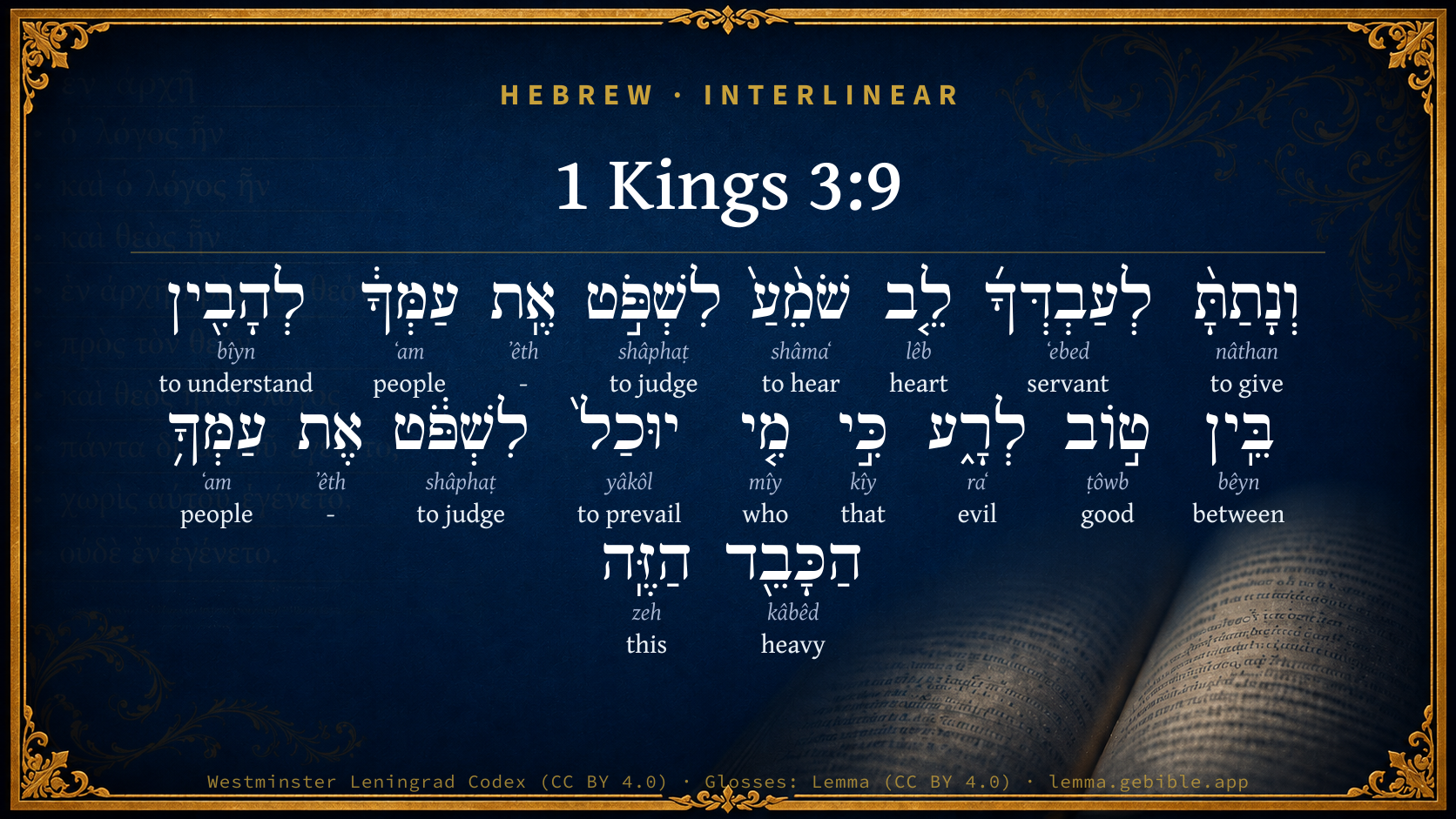
  1. וְנָתַתָּ֨ nâthan H5414 “and · to give” Conjunction + Verb, Qal, Sequential Perfect, 2nd Person, Masculine, Singular
  2. לְעַבְדְּךָ֜ ʻebed H5650 “to/for · servant · your” Preposition + Noun, Common, Masculine, Singular, Construct + Suffix, Personal, 2nd Person, Masculine, Singular
  3. לֵ֤ב lêb H3820 “heart” Noun, Common, Masculine, Singular, Absolute
  4. שֹׁמֵ֨עַ֙ shâmaʻ H8085 “hearing” Verb, Qal, Participle Active, Masculine, Singular, Absolute
  5. לִשְׁפֹּ֣ט shâphaṭ H8199 “to judge” Preposition + Verb, Qal, Infinitive Construct
  6. אֶֽת ʼêth H853 “-” Particle, Direct Object
  7. עַמְּךָ֔ ʻam H5971 “people · your” Noun, Common, Masculine, Singular, Construct + Suffix, Personal, 2nd Person, Masculine, Singular
  8. לְהָבִ֖ין bîyn H995 “to understand” Preposition + Verb, Hiphil, Infinitive Construct
  9. בֵּֽין bêyn H996 “between” Preposition
  10. ט֣וֹב ṭôwb H2896 “good” Adjective, Adjective, Masculine, Singular, Absolute
  11. לְרָ֑ע raʻ H7451 “to/for · evil” Preposition + Adjective, Adjective, Masculine, Singular, Absolute
  12. כִּ֣י kîy H3588 “that” Conjunction
  13. מִ֤י mîy H4310 “who” Particle, Interrogative
  14. יוּכַל֙ yâkôl H3201 “to prevail” Verb, Qal, Imperfect, 3rd Person, Masculine, Singular
  15. לִשְׁפֹּ֔ט shâphaṭ H8199 “to judge” Preposition + Verb, Qal, Infinitive Construct
  16. אֶת ʼêth H853 “-” Particle, Direct Object
  17. עַמְּךָ֥ ʻam H5971 “people · your” Noun, Common, Masculine, Singular, Construct + Suffix, Personal, 2nd Person, Masculine, Singular
  18. הַזֶּֽה zeh H2088 “the · this” Particle, Definite Article + Pronoun, Demonstrative, Masculine, Singular

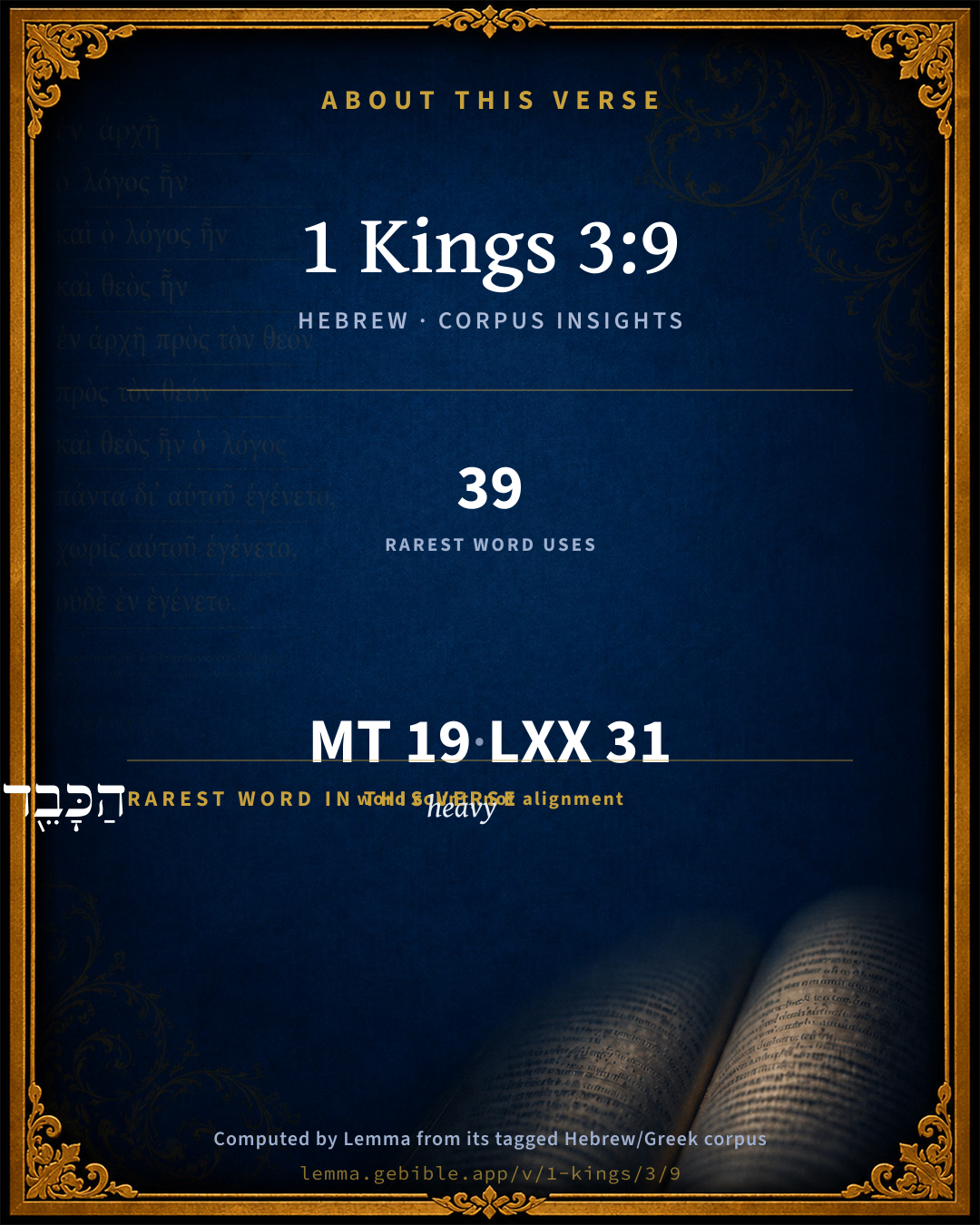
About this verse

These counts appear in no published source. They are computed here, from the morphology-tagged text and Lemma’s own curated glosses. What Lemma adds →

19
words
16
distinct lemmas
Historical
section

Shared distinctive vocabulary

הַכָּבֵ֖ד heavy H3515 occurs in 38 verses of the Hebrew Bible. Also found in:

Grammatical profile

  • 6 verbs
  • 4 nouns
  • 3 adjectives
  • 1 pronoun
  • 1 preposition
  • 1 conjunction
  • 3 particles

Verb forms

  • וְנָתַתָּ֨ Qal · Sequential Perfect
  • שֹׁמֵ֨עַ֙ Qal · Participle Active
  • לִשְׁפֹּ֣ט Qal · Infinitive Construct
  • לְהָבִ֖ין Hiphil · Infinitive Construct
  • יוּכַל֙ Qal · Imperfect
  • לִשְׁפֹּ֔ט Qal · Infinitive Construct

Repetition

Words recur within this verse — often emphatic in Hebrew:

  • לִשְׁפֹּ֣ט to judge H8199 ×2
  • עַמְּךָ֔ people H5971 ×2

Hebrew & Septuagint length

In English translation the verse runs 29 words from the Hebrew and 35 from the Septuagint (LXX English) — closely comparable.

A rough comparison of the two English renderings, which tokenize alike — not a word-level alignment.

Word counts can differ between the Hebrew and the Greek without any difference in meaning — e.g. the Hebrew direct-object marker אֵת has no separate Greek word, and Greek often adds the article ὁ.

In the original languages it is 19 Hebrew tokens and 31 Greek tokens — but the two are counted differently (Hebrew bundles its prefixes and suffixes into one token; the Greek is in lemma form), so that isn’t a like-for-like length.

Cross-references

32

Topical passages linked to 1 Kings 3:9 in the Treasury of Scripture Knowledge — connected by theme and wording, ordered by reader-vote popularity; previews shown in the World English Bible.

  • James 1:5 But if any of you lacks wisdom, let him ask of God, who gives to all liberally and without reproach; and it will be given to him.
  • Proverbs 16:16 How much better it is to get wisdom than gold! Yes, to get understanding is to be chosen rather than silver.
  • Hebrews 5:14 But solid food is for those who are full grown, who by reason of use have their senses exercised to discern good and evil.
  • John 5:30 I can of myself do nothing. As I hear, I judge, and my judgment is righteous; because I don't seek my own will, but the will of my Father who sent me.
  • Proverbs 2:3–9 Yes, if you call out for discernment, And lift up your voice for understanding;
  • 2 Samuel 14:17 Then your handmaid said, Please let the word of my lord the king be comfortable; for as an angel of God, so is my lord the king to discern good and bad: and Yahweh your God be with you.
  • Proverbs 3:13–18 Happy is the man who finds wisdom, The man who gets understanding.
  • 1 Chronicles 22:12 May Yahweh give you discretion and understanding, and put you in charge of Israel; that so you may keep the law of Yahweh your God.
  • Isaiah 11:2–4 The Spirit of Yahweh shall rest on him, the spirit of wisdom and understanding, the spirit of counsel and might, the spirit of knowledge and of the fear of Yahweh.
  • Psalms 72:1–2 God, give the king your justice; Your righteousness to the royal son.
  • Psalms 119:34 Give me understanding, and I will keep your law. Yes, I will obey it with my whole heart.
  • Psalms 119:144 Your testimonies are righteous forever. Give me understanding, that I may live.
  • Ecclesiastes 9:15–18 Now a poor wise man was found in it, and he by his wisdom delivered the city; yet no man remembered that same poor man.
  • 1 Corinthians 2:14–15 Now the natural man doesn't receive the things of God's Spirit, for they are foolishness to him, and he can't know them, because they are spiritually discerned.
  • Ephesians 5:17 Therefore don't be foolish, but understand what the will of the Lord is.
  • James 3:17 But the wisdom that is from above is first pure, then peaceful, gentle, reasonable, full of mercy and good fruits, without partiality, and without hypocrisy.
  • Exodus 4:10–13 Moses said to Yahweh, "Oh, Lord, I am not eloquent, neither before now, nor since you have spoken to your servant; for I am slow of speech, and of a slow tongue."
  • 1 Chronicles 29:19 and give to Solomon my son a perfect heart, to keep your commandments, your testimonies, and your statutes, and to do all these things, and to build the palace, for which I have made provision.
  • 2 Chronicles 1:10 Give me now wisdom and knowledge, that I may go out and come in before this people; for who can judge this your people, that is so great?
  • Proverbs 20:12 The hearing ear, and the seeing eye, Yahweh has made even both of them.
  • Ecclesiastes 7:11 Wisdom is as good as an inheritance. Yes, it is more excellent for those who see the sun.
  • Matthew 3:14 But John would have hindered him, saying, "I need to be baptized by you, and you come to me?"
  • 2 Corinthians 3:5 not that we are sufficient of ourselves, to account anything as from ourselves; but our sufficiency is from God;
  • Exodus 3:11–12 Moses said to God, "Who am I, that I should go to Pharaoh, and that I should bring forth the children of Israel out of Egypt?"
  • Ecclesiastes 7:19 Wisdom is a strength to the wise man more than ten rulers who are in a city.
  • Matthew 3:11 I indeed baptize you in water for repentance, but he who comes after me is mightier than I, whose shoes I am not worthy to carry. He will baptize you in the Holy Spirit.
  • 2 Corinthians 2:16 to the one a stench from death to death; to the other a sweet aroma from life to life. Who is sufficient for these things?
  • Philippians 1:10 so that you may approve the things that are excellent; that you may be sincere and without offense to the day of Christ;
  • 1 Kings 3:28 All Israel heard of the judgment which the king had judged; and they feared the king: for they saw that the wisdom of God was in him, to do justice.
  • Psalms 119:73 Your hands have made me and formed me. Give me understanding, that I may learn your commandments.
  • Proverbs 14:8 The wisdom of the prudent is to think about his way, But the folly of fools is deceit.
  • Jeremiah 1:6 Then said I, Ah, Lord Yahweh! behold, I don't know how to speak; for I am a child.

Cross-references courtesy of OpenBible.info (CC BY 4.0).

Hebrew and Greek witnesses Masoretic Hebrew ↔ Greek Septuagint

The same verse in the two great witnesses to the Old Testament, shown verse-for-verse.

These are two independent witnesses, not word-aligned to each other, and the Septuagint is shown in lemma (dictionary) form.

Hebrew 1 Kings 3:9 Masoretic · Westminster Leningrad Codex

וְנָתַתָּ֨ לְעַבְדְּךָ֜ לֵ֤ב שֹׁמֵ֨עַ֙ לִשְׁפֹּ֣ט אֶֽת עַמְּךָ֔ לְהָבִ֖ין בֵּֽין ט֣וֹב לְרָ֑ע כִּ֣י מִ֤י יוּכַל֙ לִשְׁפֹּ֔ט אֶת עַמְּךָ֥ הַכָּבֵ֖ד הַזֶּֽה

Give your servant therefore an understanding heart to judge your people, that I may discern between good and evil; for who is able to judge this your great people?

World English Bible · Public Domain

Greek LXX 1 Kings 3:9 Septuagint · lemma form

καί δίδωμι ὁ δοῦλος σύ καρδία ἀκούω καί διακρίνω ὁ λαός σύ ἐν δικαιοσύνη ὁ συνἵημι ἀνά μέσος ἀγαθός καί κακός ὅτι τίς δύναμαι κρίνω ὁ λαός σύ ὁ βαρύς οὗτος

You shall give therefore to your servant a heart to hear and to judge your people justly, and to discern between good and evil: for who will be able to judge this your great people?

LXX2012 (modern English Septuagint) · Public Domain

On this verse, The Cambridge Bible for Schools and Colleges discusses the Septuagint’s reading. Read the note in Commentary ↓

Hebrew: Westminster Leningrad Codex (CC BY 4.0). Greek: Septuagint (public domain); English from LXX2012 (modern English Septuagint) (Public Domain). How the Septuagint differs from the Hebrew →

Targum (Aramaic paraphrase)

1

The Targum is the ancient Jewish Aramaic paraphrase of the Hebrew Scriptures — an interpretive translation, not the Hebrew text itself. Onkelos (literal) and Pseudo-Jonathan (expansive) render the Torah, and Jonathan the Prophets. Coverage is partial: where no permissively-licensed English translation exists for a verse, only the Aramaic is shown. This is verse-level text, not a word-by-word alignment to the Hebrew.

  1. Targum Jonathan Prophets (Joshua–Malachi)
    וְתִתֵּן לְעַבְדָךְ לֵב סַבַּר לְמֵידַן יַת עַמָךְ לְמִסְבַּר בֵּין טַב לְבִישׁ אֲרֵי מַן יִכּוֹל לְמֵידַן יַת עַמָךְ סַגִיאָה הָדֵין:

    (no public-domain English translation for this verse)

    Targum Jonathan — Aramaic: “Mikraot Gedolot” (public domain). English: “Sefaria Community Translation” (CC0 1.0 (public-domain dedication)); “London "Chaldee Paraphrase," 1871” (public domain). Text via Sefaria.

Commentary

Notes on 1 Kings 3:9 from classic Christian and Jewish commentators (each source and its license shown beneath its notes). The classic Christian expositions comment on the surrounding passage and are grouped to its opening verse, so a note may address several verses; the Jewish commentaries on the Tanakh (Rashi and others) are per-verse, so they appear only where the commentator wrote on this verse.

Lemma curates 59 commentaries, every one of them public domain or Creative Commons licensed, each selected and text-cleaned for this edition rather than reprinted as found. About our sources →

Trapp's Complete Commentary

John Trapp

1Ki 3:9 Give therefore thy servant an understanding heart to judge thy people, that I may discern between good and bad: for who is able to judge this thy so great a people?

Ver. 9. Give therefore thy servant an understanding heart.] Heb., A hearing heart; for wisdom is gotten by prayer and hearing the word, by begging and digging, as Pro 2:3-4; we also must run the like method, {Jas 1:5} ran through all the exercises of Christ’s school, if we would be wise to salvation.

That I may discern between good and bad.] Rupertus blameth Solomon for this, that he asked of God wisdom, and not holiness rather, bonum illud quod verum et summum est, which is the principal good thing. But it was doubtless a saving and sanctifying knowledge that Solomon prayed for, and obtained; not an apprehensive knowledge only, and notional, but effective and practical also, and directive of the life. Socrates, the wisest of all the Greeks, made no distinction between σοφια, wisdom, and σωπροσυνη, good conversation. Ignorat sane improbus omnis, saith Aristotle, He is not wise that is ill-conditioned.

John Trapp, A Commentary or Exposition upon All the Books of the Old and New Testament (1647–1656) — public domain. Text from a community e-Sword module.

Joseph Benson's Commentary

1Ki 3:9. Give to thy servant an understanding heart — Whereby I may both clearly discern, and faithfully perform all the parts of my duty: for both these are spoken of in Scripture as the effects of a good understanding; and he that lives in the neglect of his duties, or the practice of wickedness, is called a fool, and one void of understanding. To judge thy people — Or govern, as that word is often used. That I may discern between good and bad — Namely, in causes and controversies among thy people; that I may not, through mistake, or prejudice, or passion, give wrong sentences, and call evil good, or good evil. Absalom, that was a fool, wished himself a judge: Solomon, that was a wise man, trembles at the undertaking. The more knowing and considerate men are, the more jealous they are of themselves.

Joseph Benson's Commentary on the Old and New Testaments (1811–1818) — public domain. Text from a community e-Sword module.

Geneva Bible (1599)

Geneva Bible translators

Which are so many in number.

Or, obedient.

Geneva Bible (1599) marginal notes — public domain. Text via Bolls.life.

Adam Clarke's Commentary

Verse 9. Give - an understanding heart to judge thy people] He did not ask wisdom in general, but the true science of government. This wisdom he sought, and this wisdom he obtained.

Adam Clarke's Commentary on the Bible (1810–1826) — public domain. Text from a community e-Sword/MySword module.

The Cambridge Bible for Schools and Colleges

gen. ed. J. J. S. Perowne

9. an understanding heart] This is explained (2Ch_1:10) by ‘wisdom and knowledge.’ The participle rendered ‘understanding’ is literally ‘hearing,’ and the LXX. has paraphrased the clause thus: ‘a heart to hear and judge thy people in righteousness.’ But the hearing of the heart must refer to the following of the Divine guidance and promptings from within. That this was Solomon’s meaning seems certain, from the end of this verse ‘Who is able to judge this thy so great people?’ unless (that is) he have thy constant leading, and attend thereto?

The word rendered ‘great’ in this verse is different from that so translated in 1Ki_3:8. Here the literal sense is ‘heavy,’ and the reference is to the great burden of care which the king must take upon himself.

The Cambridge Bible for Schools and Colleges (gen. ed. J. J. S. Perowne; Cambridge University Press, 1878–1918) — public domain. Text from a community e-Sword module.

John Gill's Exposition

Give therefore thy servant an understanding heart, to judge thy people,.... Not an understanding of things spiritual, nor of things natural, though both were given him, but of things political, what related to the civil government, that he might be able to judge or rule the people of Israel in the best manner:

that I may discern between good and bad; not merely between moral good and evil, of which he had a discernment; but between right and wrong in any case or controversy that came before him between man and man, that so he might be able to pass a right sentence, and do justice to every one:

for who is able to judge this thy so great a people? who are so very numerous, and have so many causes to be heard and and those many of them very intricate and difficult; so that no man is equal to such arduous work, unless he has more than an ordinary capacity given him by the Lord.

John Gill's Exposition of the Whole Bible (1746–1763) — public domain (CC PDM 1.0). Text via the HelloAO Bible API.

Albert Barnes' Notes on the Bible

One of the chief functions of the Oriental monarch is always to hear and decide causes. Hence, supreme magistrates were naturally called “judges.” (See the introduction to the Book of Judges.) In the minds of the Jews the “judge” and the “prince” were always closely associated, the direct cognisance of causes being constantly taken by their chief civil governors. (See Exo 2:14; Exo 18:16, Exo 18:22; 1Sa 8:20; 2Sa 15:2-6.)

Good and bad - i. e. “right and wrong,” “justice and injustice.”

Albert Barnes' Notes on the Bible (1834–1885) — public domain. Text from a community e-Sword/MySword module.

Haydock's Catholic Bible Commentary

Understanding. Literally, "docile." (Haydock) --- Hebrew, "willing to hear," and to obey God. (Menochius)

George Leo Haydock (1774–1849), Haydock's Catholic Family Bible and Commentary, 1859 edition — public domain. Excludes Psalms (Douay-Rheims chapter numbering differs from Protestant) and Deuterocanonical books (Catholic canon only).

Matthew Poole's English Annotations

An understanding heart; whereby I may both clearly discern, and faithfully perform, all the parts of my duty; for both these are spoken of in Scripture as the effects of a good understanding; and he that lives in the neglect of his duties, or the practice of wickedness, is called a fool, and one void of understanding.

Judge, or, govern, as that word is used, Jdg 3:10; 4:4; Psa 7:8; 67:4; Isa 2:4; 16:5.

That I may discern between good and bad, to wit, in causes and controversies among my people; that I may not through mistakes, or prejudices, or passions, give wrong sentences, and call evil good, or good evil.

Who is able of himself, or without thy gracious assistance.

Matthew Poole's English Annotations on the Holy Bible (1683–1685) — public domain. Text from a community e-Sword/MySword module.

Whedon's Commentary on the Bible

Daniel D. Whedon

9. An understanding heart — Noble choice! “It was the choice offered to the youthful king on the threshold of life, the choice so often imagined in fiction, and here actually presented in real life. The answer is the ideal answer of such a prince, burdened with the responsibility of his position.

He made the demand for the gift which he, of all the heroes of the ancient Church, was the first to claim. He showed his wisdom by asking for wisdom. He became wise because he had set his heart upon it. This was to him the special aspect through which the Divine Spirit was to be approached, and grasped, and made to bear on the wants of men; not the highest, not the choice of David, not the choice of Isaiah; but still the choice of Solomon.” — Stanley.

To judge thy people — The Oriental mind always associates the functions of the judge with the monarch, as he is expected to hear and decide important cases. See note on 1Ki_3:16.

Daniel D. Whedon (gen. ed.), Commentary on the Old and New Testaments (1874–1909) — public domain. Text from a community e-Sword module.

The Pulpit Commentary

Give therefore thy servant an understanding (Heb. hearing. Cf. ver. 11 (Heb. "to hear judgment.") The idea is not docility, as the Vulg. (cor docile), but discrimination, penetration. Cf. 2Sa_14:17 (Heb.); Php_1:9, 10 (marg.)) heart (i.e. , a judicial mind. The "hearing heart" was desired, not that it might "give heed to the law" (Keil), but to qualify him) to Judge thy people The Hebrew king, like most ancient monarchs, was supreme judge as well as governor ("prince and judge, Exo_5:14; and cf. Exo_18:16) The Jews desired a king that he might judge them. (1Sa_8:5) Their rulers so far had been purely "Judges" ( compare the Carthaginian name, suffetes.)

When they desired one who should, lead their armies, they still put his judicial functions in the first place (loc. cit. ver. 20). And what were the duties of a king in this respect, Absalom"s words (2Sa_15:4) show. In vers. 16-28 we see Solomon sitting as Chief Justice), that I may discern between good and bad: (i.e., right and wrong, true and false; cf. Heb_5:14) for who is able to judge this thy so great (Heb. heavy, i.e. , numerous; compare graves greges) a people. The number of the Israelites at this period is referred to in 1Ki_4:20.

Vers. 9-13. The wisdom of Solomon"s choice.

Solomon was never more kingly than when he made this choice. Subsequently he became enervated by prosperity, corrupted by heathen associations, etc., but now he ruled as a king over himself. The bright promise of life is often gradually overcast, till it ends in the gloom of a hopeless night. Examples from Scripture, e.g. , Saul the King, Esau. It is well to know the kind of choice that "pleased the Lord." In Solomon"s there was true wisdom, for it had these elements

I THE CHOICE WAS FOR THE GOOD OF OTHERS RATHER THAN FOR THE ADVANTAGE OF HIMSELF. It was not like asking for knowledge and wisdom that he might himself be admired as a sage. This followed, but this he did not seek. He wished to rule God"s people well for their good, and asked that he might do what was just in judgment, what was equitable in law. Such equity establishes any rule on a sure foundation. Our hold on India is chiefly due to the righteousness of our magistrates, and the trustworthiness of men like the Lawrences, Lord Mayo, etc. Natives would not hesitate to bring an action in one of our English law courts against an Englishman, so certain are they of even-handed justice. This Solomon sought, and the peace and prosperity of his kingdom (1Ki_4:25) arose from the fact that God gave it him. To ask God to make us wise and capable for the sake of others, is a prayer consonant with His will. Unselfishness is commended and exalted under the new dispensation as it never was under the old. Christ Himself came not to be ministered unto, but to minister, and to give His life "a ransom for many." The prayer of selfishness, greed, avarice, can never be put up in Christ"s name.

II THE CHOICE WAS MADE OF INWARD WORTH AND NOT OF OUTWARD SHOW. He did not ask for himself riches and honour. What will make us noble is always more readily given by God than what will make us wealthy. A wise father would rather that his son should be truthful than that he should win popularity among his schoolfellows by anything surreptitious and deceitful. So our heavenly Father cares little that we should make money, or win applause; but He cares much that we should be wise, and true, and loving; and these graces He will in no wise withhold from those who seek. Sometimes He answers our prayers for these inward blessings in modes we resent. The illness that throws us back upon Him, the failure that proves a man"s life does not consist in the abundance of things that he possesseth, etc., may work in us the peaceable fruits of righteousness. The Lord Jesus, who was at once the King of Glory and the village carpenter, showed us this; and in the inward gladness His disciples experienced amid their outward woes, we have confirmation of it. Show how, in New Testament history, and in the lives of the saints, the words which begin the Sermon on the Mount have been fulfilled. Blessedness of the highest kind comes to the poor in spirit, to them that mourn, to the meek, to them which do hunger and thirst after righteousness, to the merciful, to the pure in heart, to the peacemakers, and even to those who are persecuted for righteousness" sake.

III THE CHOICE MADE OF THE HIGHER BROUGHT WITH IT THE LOWER BLESSINGS, (Vers. 11-13) Because Solomon asked wisdom God gave him that, but added to it wealth and honour. If we ask grace to fulfil our mission, and rightly do our life work, our heavenly Father will see that we do not want for life"s necessities. "Seek ye first the kingdom of God, and his righteousness, and all these things shall be added unto you." The teaching of Christ (Mat_6:24-34) goes to show that a man who is chiefly concerned to please God need have no anxiety or care about lower things. If God feeds the birds, He will feed you; if He clothes the lilies, He will clothe you; if He gives the life, He will give the "meat" that is less than life. Ask God for the higher blessings: pardon, righteousness, reverence, wisdom, etc., and He will give you not only these, but all things necessary for us, and all the riches and honours that are good for us.

Solomon"s wisdom was great, but there has come into the world one greater than Solomon, more worthy far of our adoration and love. As the child in Nazareth, Jesus grew in wisdom, and in stature, and in favour with God and man. His wisdom was purer, deeper, truer than Solomon"s, because it was united with purity of life, with victory over sin, and with sacrifice of self. He is the true Shelomoh, "the Prince of Peace;" the true Jedidiah, "the well beloved of the Father;" and to Him now let us humbly bow the knee, as to One worthy to be exalted both as Prince and Saviour. A.R.

The Pulpit Commentary (1880–1919), ed. H.D.M. Spence-Jones & Joseph S. Exell — public domain. Text from a community e-Sword module.

John Wesley's Explanatory Notes

An understanding heart - Whereby I may both clearly discern, and faithfully perform all the parts of my duty: for both these are spoken of in scripture, as the effects of a good understanding; and he that lives in the neglect of his duties, or the practice of wickedness, is called a fool, and one void of understanding. Discern - Namely in causes and controversies among my people; that I may not through mistake, or prejudice, or passion, give wrong sentences, and call evil good, or good evil. Absalom, that was a fool, wished himself a judge: Solomon, that was a wise man, trembles at the undertaking. The more knowing and considerate men are, the more jealous they are of themselves.

John Wesley, Explanatory Notes Upon the Whole Bible (1754–1765) — public domain. Text via the GEBible commentary corpus.

Rashi

Rabbi Shlomo Yitzchaki (Rashi)

This great people of Yours. Since they are many, they have many dealings, and they come to litigate and I have no time to deliberate over their arguments. Another interpretation of, “for who is able to judge this great people of Yours,” their legal decisions are very difficult [for me to make]. If a lawsuit comes before me between two non-Jews, and I take from one and give to the other unjustly, I will not be punished. But [if a lawsuit comes before me] between Jews [and I take from one and give to the other unjustly], I will be punished for it with capital punishment, as it is stated, “And He takes the lives of those that steal from them.”

Rashi on the Tanakh — English translations: “The Judaica Press complete Tanach with Rashi, translated by A. J. Rosenberg” (CC BY 4.0); “Pentateuch with Rashi's commentary by M. Rosenbaum and A.M. Silbermann, 1929-1934” (public domain); “The Metsudah Tanach series, Lakewood, N.J” (CC BY 4.0); and “The Book of Joshua, Metsudah Publications, 1997” (CC BY 4.0). Text via Sefaria.

Lesson kit

Teaching starters — assembled from the data on this page, not authored interpretation. Every prompt links to the verse data it draws on. Edit before teaching.

1 Kings, in the Historical, opens this verse with 19 words (16 distinct Hebrew lemmas). Its most distinctive word is kâbêd (“heavy”). A historical commentator’s framing appears above. Read the whole chapter for the surrounding context.

Discussion questions

  1. The word kâbêd carries the sense “heavy.” How does it shape the verse?
  2. How does Genesis 12:10, which shares the word «heavy», read alongside this verse?
  3. What does the repetition of “to judge” (2× in this one verse) do in this verse?
  4. These translations render this verse differently; the difference is in the English rendering, not the original. What questions does that raise?
  5. «וְנָתַתָּ֨» is a Qal Sequential Perfect verb. How does that grammatical form shape the action described?
  6. Compare how Trapp's Complete Commentary and Joseph Benson's Commentary read this verse. Where do they agree or differ?

Things to notice

Reading settings

Reading text

Shown beneath each verse's original-language words.

Old Testament
Old Testament edition

Read the OT as the Masoretic Hebrew (MT) or the Greek Septuagint (LXX).

English shown for the Greek Septuagint (in the Hebrew ↔ Greek comparison).

Comparing translations? Open the Compare panel on any verse page to stack up to four side by side.