Exodus 13:16

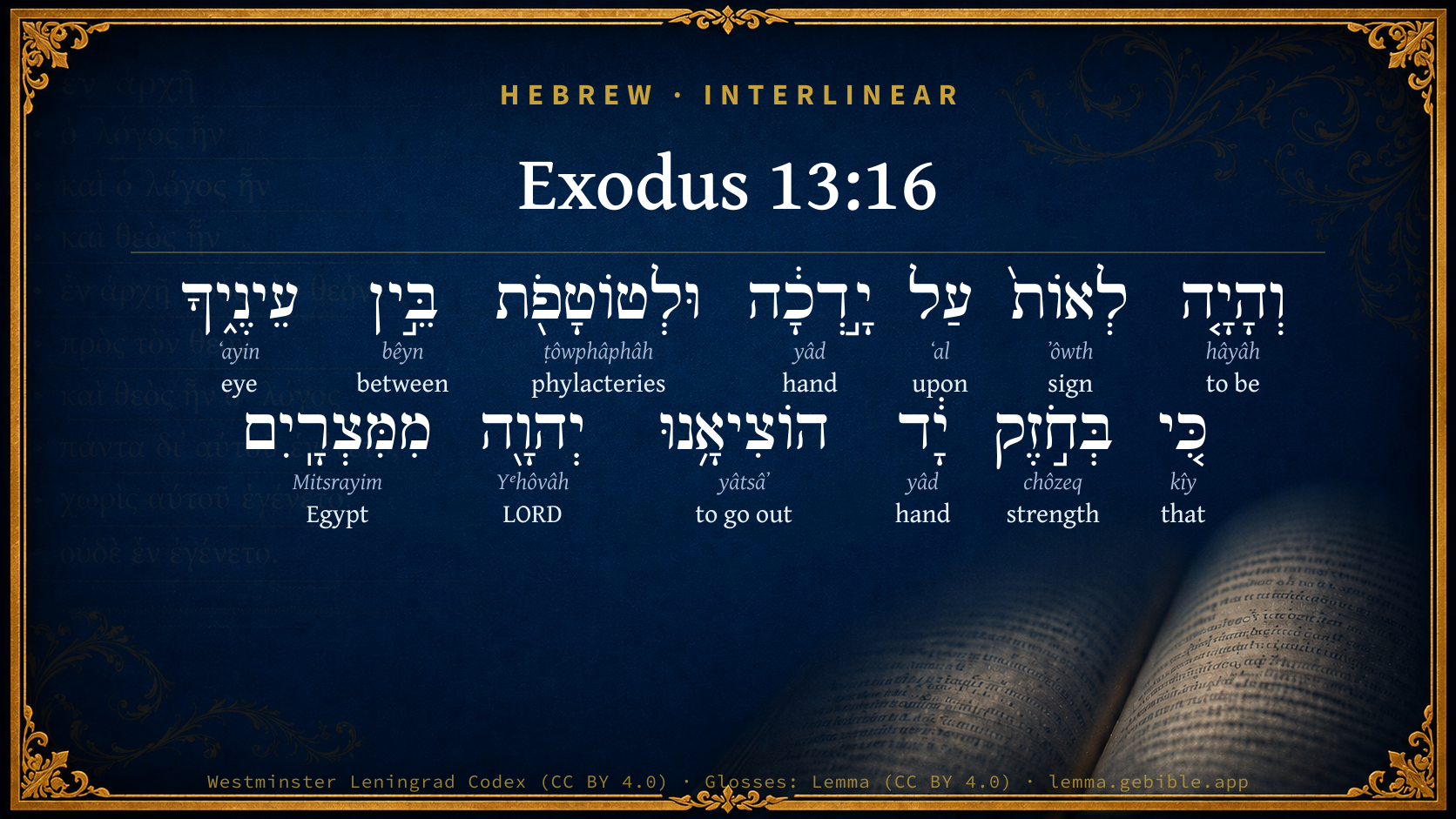
Hebrew (Westminster Leningrad Codex) Exodus 13:16 appears in the Hebrew Old Testament. The text above is from the Westminster Leningrad Codex. Each word links to its Strong’s number, a concise gloss, and parsing drawn from the Open Scriptures Hebrew Bible morphology. Click any word for its full Brown-Driver-Briggs (BDB) entry.
Download image
Cite this verse

Exodus 13:16 (World English Bible). Public Domain. Lemma interlinear Bible study tool, https://lemma.gebible.app/v/exodus/13/16.

Show BibTeX & RIS
BibTeX
RIS
English Translation
It shall be for a sign on your hand, and for symbols between your eyes: for by strength of hand Yahweh brought us forth out of Egypt."
World English Bible · Public Domain
Highlights
  • 1 first appearance in the Hebrew Bible
Full analysis ↓
Download a study sheet

One document with this verse’s original text, its word-by-word gloss line, the meaning frame, cross-references with their text, attributed commentary, and full source and license credits — printable, and it pastes into notes with its structure intact.

This verse Autodidact and up

Study sheet (.html) Plain text (.txt)

A passage Seminary Student

Up to 50 verses in one chapter. A passage sheet keeps up to 6 commentary sources and 12 cross-references per verse, in the order this page ranks them, and says so on the sheet whenever that leaves anything out. Ask for a single verse and you get the Autodidact verse sheet above.

Everything on this page stays free to read, with no account — the sheet is a download of what is already on screen, not access to it.

Want to remove ads? Support Godless Engineer
Compare translations 3

The same verse in 3 English versions, stacked beneath the original-language interlinear above. Click any original word for its lexicon entry.

Each is an independent rendering of the whole verse — the interlinear is not word-aligned to these translations.

Highlighted words mark where these versions differ — a whole-verse word diff, not a word-by-word alignment.

  • World English Bible Public Domain
    It shall be for a sign on your hand, and for symbols between your eyes: for by strength of hand Yahweh brought us forth out of Egypt."
  • King James Version Public Domain
    And it shall be for a token upon thine hand, and for frontlets between thine eyes: for by strength of hand the LORD brought us forth out of Egypt.
  • unfoldingWord Literal Text CC BY-SA 4.0
    And it shall be a sign on your hand and a headband between your eyes, for with a strong hand Yahweh brought us out from Egypt.”

unfoldingWord Literal Text — © unfoldingWord, licensed CC BY-SA 4.0. Word-aligned USFM3 via Door43 (git.door43.org/unfoldingWord/en_ult).

Versions to compare (up to 4)

3 of 4 selected

Show all 18 translations

Every available English version of this verse, each an independent rendering of the whole verse.

  • World English Bible Public Domain
    It shall be for a sign on your hand, and for symbols between your eyes: for by strength of hand Yahweh brought us forth out of Egypt."
  • Berean Standard Bible Public Domain
    So it shall serve as a sign on your hand and a symbol on your forehead, for with a mighty hand the LORD brought us out of Egypt.”
  • Majority Standard Bible Public Domain
    So it shall serve as a sign on your hand and a symbol on your forehead, for with a mighty hand the LORD brought us out of Egypt.”
  • King James Version Public Domain
    And it shall be for a token upon thine hand, and for frontlets between thine eyes: for by strength of hand the LORD brought us forth out of Egypt.
  • American Standard Version (1901) Public Domain
    And it shall be for a sign upon thy hand, and for frontlets between thine eyes: for by strength of hand Jehovah brought us forth out of Egypt.
  • Revised Version (1885) Public Domain
    And it shall be for a sign upon thine hand, and for frontlets between thine eyes: for by strength of hand the LORD brought us forth out of Egypt.
  • Geneva Bible (1599) Public Domain
    And it shalbe as a token vpon thine hand, and as frontlets betweene thine eyes, that the Lord brought vs out of Egypt by a mightie hande.
  • Douay-Rheims (1899) Public Domain
    And it shall be as a sign in thy hand, and as a thing hung between thy eyes, for a remembrance: because the Lord hath brought us forth out of Egypt by a strong hand.
  • Young's Literal Translation Public Domain
    and it hath been for a token on thy hand, and for frontlets between thine eyes, for by strength of hand hath Jehovah brought us out of Egypt.'
  • Literal Standard Version CC BY-SA 4.0
    and it has been for a token on your hand, and for frontlets between your eyes, for by strength of hand YHWH has brought us out of Egypt.”
  • Unlocked Literal Bible CC BY-SA 4.0
    This will become a reminder on your hands, and a reminder on your forehead, for it was by a strong hand Yahweh brought us out of Egypt.”
  • unfoldingWord Literal Text CC BY-SA 4.0
    And it shall be a sign on your hand and a headband between your eyes, for with a strong hand Yahweh brought us out from Egypt.”
  • Darby Bible Public Domain
    And it shall be for a sign on thy hand, and for frontlets between thine eyes, for with a powerful hand Jehovah brought us forth out of Egypt.
  • World Messianic Bible Public Domain
    It shall be for a sign on your hand, and for symbols between your eyes; for by strength of hand the LORD brought us out of Egypt.”
  • Webster's Bible Public Domain
    And it shall be for a token upon thy hand, and for frontlets between thy eyes: for by strength of hand the LORD brought us forth out of Egypt.
  • Free Bible Version CC BY-SA 4.0
    In this way it will be like a sign on your hand and a reminder between your eyes, for the Lord led us out of Egypt by his amazing power.”
  • Bible in Basic English Public Domain
    And this will be for a sign on your hand and for a mark on your brow: for by the strength of his hand the Lord took us out of Egypt.
  • JPS Tanakh (1917) Public Domain
    And it shall be for a sign upon thy hand, and for frontlets between thine eyes; for by strength of hand the LORD brought us forth out of Egypt.'

Literal Standard Version (2020), Covenant Press — licensed CC BY-SA 4.0. Text via the HelloAO Bible API (eBible.org). Unlocked Literal Bible (unfoldingWord) — licensed CC BY-SA 4.0. Text via the HelloAO Bible API (eBible.org). unfoldingWord Literal Text — © unfoldingWord, licensed CC BY-SA 4.0. Word-aligned USFM3 via Door43 (git.door43.org/unfoldingWord/en_ult). Free Bible Version, Dr. Jonathan Gallagher — licensed CC BY-SA 4.0. Text via the HelloAO Bible API (eBible.org).

Word by word

More ways to search: Search by grammar → Find every occurrence → Compare this word →

Practice this passage: Drill this verse → Learn its vocabulary →

וּלְטוֹטָפֹ֖ת
ṭôwphâphâh
H2903
“and · to/for · phylacteries”
Conjunction + Preposition + Noun, Common, Feminine, Plural, Absolute
Part of Speech
Conjunction + Preposition + Noun
Type
Common
Gender
Feminine
Number
Plural
State
Absolute
Full BDB Definition

Origin: from an unused root meaning to go around or bind

TWOT: 804a

bands, phylacteries, frontlets, marks
  1. וְהָיָ֤ה hâyâh H1961 “and · to be” Conjunction + Verb, Qal, Sequential Perfect, 3rd Person, Masculine, Singular
  2. לְאוֹת֙ ʼôwth H226 “to/for · sign” Preposition + Noun, Common, Both, Singular, Absolute
  3. עַל ʻal H5921 “upon” Preposition
  4. יָ֣דְכָ֔ה yâd H3027 “hand · your” Noun, Common, Both, Singular, Construct + Suffix, Personal, 2nd Person, Masculine, Singular
  5. בֵּ֣ין bêyn H996 “between” Preposition
  6. עֵינֶ֑יךָ ʻayin H5869 “eyes · your” Noun, Common, Both, Dual, Construct + Suffix, Personal, 2nd Person, Masculine, Singular
  7. כִּ֚י kîy H3588 “that” Conjunction
  8. בְּחֹ֣זֶק chôzeq H2392 “in/at · strength of” Preposition + Noun, Common, Masculine, Singular, Construct
  9. יָ֔ד yâd H3027 “hand” Noun, Common, Both, Singular, Absolute
  10. הוֹצִיאָ֥נוּ yâtsâʼ H3318 “to go out · us” Verb, Hiphil, Perfect, 3rd Person, Masculine, Singular + Suffix, Personal, 1st Person, Common, Plural
  11. יְהוָ֖ה Yᵉhôvâh H3068 “LORD” Noun, Proper
  12. מִמִּצְרָֽיִם Mitsrayim H4714 “from · Egypt” Preposition + Noun, Proper

About this verse

These counts appear in no published source. They are computed here, from the morphology-tagged text and Lemma’s own curated glosses. What Lemma adds →

13
words
12
distinct lemmas
Pentateuch
section

Notable vocabulary

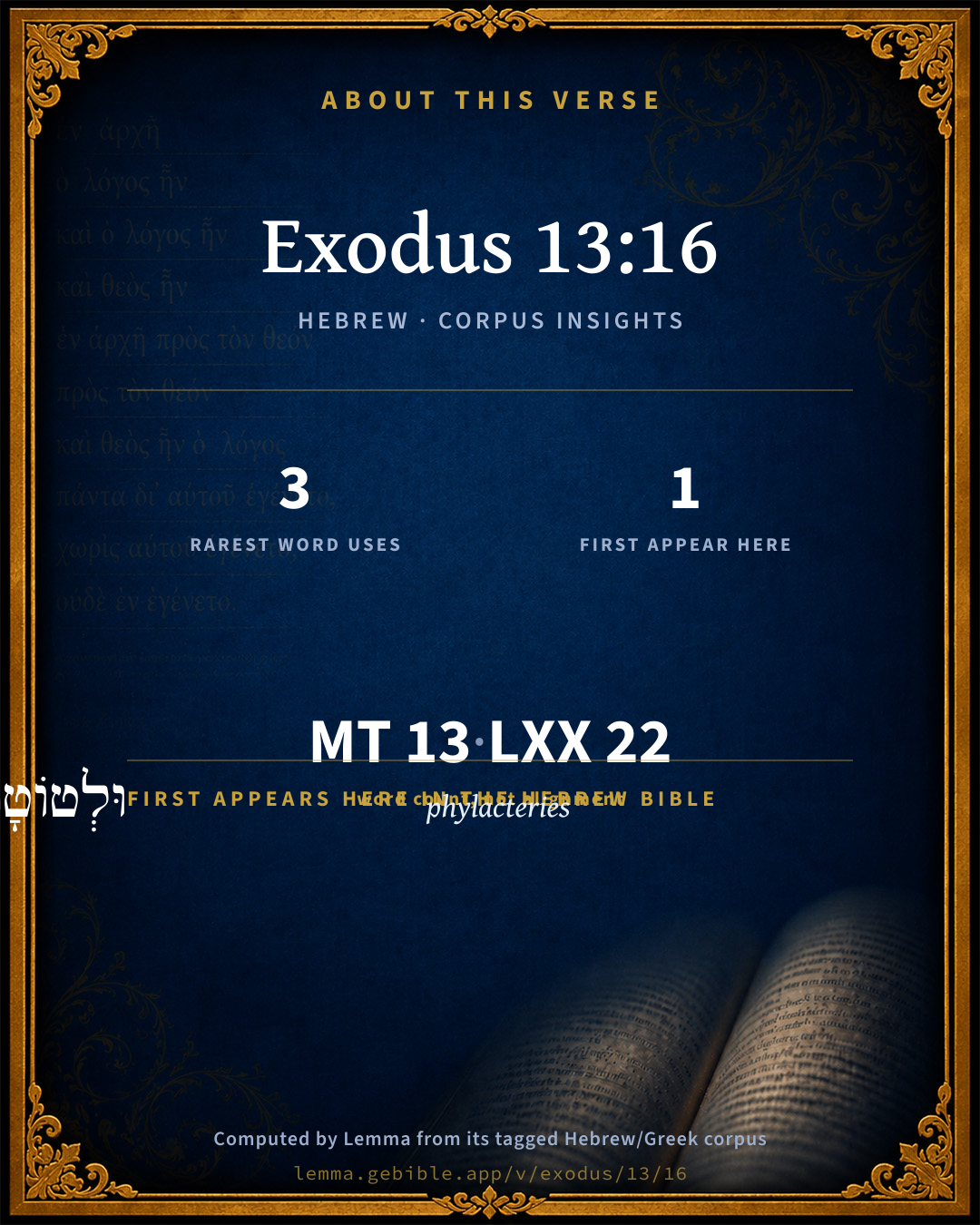
The rarest word here is וּלְטוֹטָפֹ֖ת phylacteries H2903 — appearing just 3 times in the whole Hebrew Bible.

First appearance in Scripture

This word makes its first canonical appearance in the Hebrew Bible here:

  • וּלְטוֹטָפֹ֖ת phylacteries H2903

Shared distinctive vocabulary

וּלְטוֹטָפֹ֖ת phylacteries H2903 occurs in 3 verses of the Hebrew Bible. Also found in:

Grammatical profile

  • 2 verbs
  • 8 nouns
  • 2 prepositions
  • 1 conjunction

Verb forms

  • וְהָיָ֤ה Qal · Sequential Perfect
  • הוֹצִיאָ֥נוּ Hiphil · Perfect

Repetition

A word recurs within this verse — often emphatic in Hebrew:

  • יָ֣דְכָ֔ה hand H3027 ×2

Hebrew & Septuagint length

In English translation the verse runs 27 words from the Hebrew and 27 from the Septuagint (LXX English) — the same length.

A rough comparison of the two English renderings, which tokenize alike — not a word-level alignment.

Word counts can differ between the Hebrew and the Greek without any difference in meaning — e.g. the Hebrew direct-object marker אֵת has no separate Greek word, and Greek often adds the article ὁ.

In the original languages it is 13 Hebrew tokens and 22 Greek tokens — but the two are counted differently (Hebrew bundles its prefixes and suffixes into one token; the Greek is in lemma form), so that isn’t a like-for-like length.

Cross-references

7

Topical passages linked to Exodus 13:16 in the Treasury of Scripture Knowledge — connected by theme and wording, ordered by reader-vote popularity; previews shown in the World English Bible.

  • Exodus 13:9 It shall be for a sign to you on your hand, and for a memorial between your eyes, that the law of Yahweh may be in your mouth; for with a strong hand Yahweh has brought you out of Egypt.
  • Deuteronomy 11:18 Therefore shall you lay up these my words in your heart and in your soul; and you shall bind them for a sign on your hand, and they shall be for symbols between your eyes.
  • Exodus 13:14 It shall be, when your son asks you in time to come, saying, 'What is this?' that you shall tell him, 'By strength of hand Yahweh brought us out from Egypt, from the house of bondage;
  • Deuteronomy 6:7–9 and you shall teach them diligently to your children, and shall talk of them when you sit in your house, and when you walk by the way, and when you lie down, and when you rise up.
  • Exodus 12:13 The blood shall be to you for a token on the houses where you are: and when I see the blood, I will pass over you, and there shall no plague be on you to destroy you, when I strike the land of Egypt.
  • Deuteronomy 26:8 and Yahweh brought us forth out of Egypt with a mighty hand, and with an outstretched arm, and with great terror, and with signs, and with wonders;
  • Matthew 23:5 But all their works they do to be seen by men. They make their phylacteries broad, enlarge the fringes of their garments,

Cross-references courtesy of OpenBible.info (CC BY 4.0).

Hebrew and Greek witnesses Masoretic Hebrew ↔ Greek Septuagint

The same verse in the two great witnesses to the Old Testament, shown verse-for-verse.

These are two independent witnesses, not word-aligned to each other, and the Septuagint is shown in lemma (dictionary) form.

Hebrew Exodus 13:16 Masoretic · Westminster Leningrad Codex

וְהָיָ֤ה לְאוֹת֙ עַל יָ֣דְכָ֔ה וּלְטוֹטָפֹ֖ת בֵּ֣ין עֵינֶ֑יךָ כִּ֚י בְּחֹ֣זֶק יָ֔ד הוֹצִיאָ֥נוּ יְהוָ֖ה מִמִּצְרָֽיִם

It shall be for a sign on your hand, and for symbols between your eyes: for by strength of hand Yahweh brought us forth out of Egypt."

World English Bible · Public Domain

Greek LXX Exodus 13:16 Septuagint · lemma form

καί εἰμί εἰς σημεῖον ἐπί ὁ χείρ σύ καί ἀσάλευτος πρό ὀφθαλμός σύ ἐν γάρ χείρ κραταιός ἐκἄγω σύ κύριος ἐκ αἴγυπτος

And it shall be for a sign upon your hand, and immovable before your eyes, for with a strong hand the Lord brought you out of Egypt.

LXX2012 (modern English Septuagint) · Public Domain

On this verse, The Cambridge Bible for Schools and Colleges discusses the Septuagint’s reading. Read the note in Commentary ↓

Hebrew: Westminster Leningrad Codex (CC BY 4.0). Greek: Septuagint (public domain); English from LXX2012 (modern English Septuagint) (Public Domain). How the Septuagint differs from the Hebrew →

Targum (Aramaic paraphrase)

2

The Targum is the ancient Jewish Aramaic paraphrase of the Hebrew Scriptures — an interpretive translation, not the Hebrew text itself. Onkelos (literal) and Pseudo-Jonathan (expansive) render the Torah, and Jonathan the Prophets. Coverage is partial: where no permissively-licensed English translation exists for a verse, only the Aramaic is shown. This is verse-level text, not a word-by-word alignment to the Hebrew.

  1. Targum Onkelos Torah (Genesis–Deuteronomy)
    וִיהֵי לְאָת עַל יְדָךְ וְלִתְפִלִין בֵּין עֵינָיךְ אֲרֵי בִּתְקוֹף יְדָא אַפְּקָנָא יְיָ מִמִצְרָיִם: ססס:

    (no public-domain English translation for this verse)

    Targum Onkelos — Aramaic: “Onkelos Genesis” (public domain); “Onkelos Exodus” (public domain); “Onkelos Leviticus” (public domain); “Onkelos Numbers” (public domain); “Onkelos Deuteronomy” (public domain). English: “Sefaria Community Translation” (CC0 1.0 (public-domain dedication)); “J.W. Etheridge. The Targums of Onkelos and Jonathan Ben Uzziel on the Pentateuch. London: Longmans, Green, 1862” (public domain). Text via Sefaria.

  2. Targum Pseudo-Jonathan Torah (Genesis–Deuteronomy)
    וִיהֵי לְאַת חֲקִיק וּמְפָרֵשׁ עַל יַד שְמָאלָךְ וְלִתְפִילִין בֵּין רִיסֵי עֵינָךְ אֲרוּם בִּתְקוֹף גְּבוּרַת יְדָא הַנְפָקָנָא יְיָ מִמִּצְרָיִם

    And it shall be inscribed and set forth upon thy left land, and on the tephilla between thine eyebrows; because by mighty strength of hand the Lord brought us out of Mizraim.

    Targum Pseudo-Jonathan — Aramaic: “Targum Jonathan on Genesis” (public domain); “Targum Jonathan on Exodus” (public domain); “Targum Jonathan on Leviticus” (public domain); “Targum Jonathan on Numbers” (public domain); “Targum Jonathan on Deuteronomy” (public domain). English: “The Targum of Jonathan ben Uzziel, trans. J. W. Etheridge, London, 1862” (public domain). Text via Sefaria.

Commentary

Notes on Exodus 13:16 from classic Christian and Jewish commentators (each source and its license shown beneath its notes). The classic Christian expositions comment on the surrounding passage and are grouped to its opening verse, so a note may address several verses; the Jewish commentaries on the Tanakh (Rashi and others) are per-verse, so they appear only where the commentator wrote on this verse.

Lemma curates 59 commentaries, every one of them public domain or Creative Commons licensed, each selected and text-cleaned for this edition rather than reprinted as found. About our sources →

Trapp's Complete Commentary

John Trapp

Exo 13:16 And it shall be for a token upon thine hand, and for frontlets between thine eyes: for by strength of hand the LORD brought us forth out of Egypt.

Ver. 16. Frontlets.] Phylacteries. See on Mat 23:5-6. The right use of them was memorative: the superstitious use, preservative against the power of sin.

John Trapp, A Commentary or Exposition upon All the Books of the Old and New Testament (1647–1656) — public domain. Text from a community e-Sword module.

Joseph Benson's Commentary

Exo 13:16. For frontlets between thine eyes — As conspicuous as any thing fixed to thy forehead, or between thine eyes. That is, they were constantly to retain such a sense of their deliverance as if they had it before their eyes.

Joseph Benson's Commentary on the Old and New Testaments (1811–1818) — public domain. Text from a community e-Sword module.

Tyndale Open Study Notes

Tyndale Open Resources

13:16 Like the annual Passover celebration (13:9), dedicating the firstborn to the Lord was like a mark, a visible way to identify oneself as the Lord’s possession.

Tyndale Open Study Notes — © Tyndale Open Resources, licensed CC BY-SA 4.0. Text via the HelloAO Bible API.

Geneva Bible (1599)

Geneva Bible translators

Or, signs of remembrance.

Geneva Bible (1599) marginal notes — public domain. Text via Bolls.life.

Adam Clarke's Commentary

Verse 16. It shall be for a token, &c.] See Clarke on Ex 13:9.

Adam Clarke's Commentary on the Bible (1810–1826) — public domain. Text from a community e-Sword/MySword module.

Ellicott's Commentary for English Readers

(16) It shall be for a token.—See the comment on Exo_13:9. The “frontlets” (totaphôth) of this passage, and of Deu_6:8, were called tephillin in Chaldee, both words signifying properly “bands” or “circlets.” The injunctions on the subject which are here given might undoubtedly be explained as metaphorical; but those in Deu_6:6-9 seem to have been intended, and were certainly understood, literally.

A Bible Commentary for English Readers, edited by Charles John Ellicott (1878–1897) — public domain. Text from a community e-Sword module.

The Cambridge Bible for Schools and Colleges

gen. ed. J. J. S. Perowne

16. Like Maẓẓoth (v. 9), the redemption of the firstborn is to serve the same purpose as a ritual mark, or badge, in reminding Israel constantly of what Jehovah had done for them.

frontlets] Heb. ṭôṭâphôth (properly, perhaps,—from the Arabic ṭâfa, to make a circuit,—circlets or headbands1[137]): Deu_6:8; Deu_11:18 †. The word takes the place of the ‘memorial’ in v. 9. Originally, as the comparative study of religions makes probable, the ‘frontlet’ was some kind of badge worn upon the forehead as a mark of belonging to the national Deity, by which he might know who were his, and (like an amulet) guaranteeing them his protection, and also reminding those who bore it of their ceremonial duties towards him. Here it is merely said that the redemption of the firstborn is to be for (i.e. to serve the same purpose as) a ‘sign,’ or ritual mark (see on v. 9) upon the head, and ‘frontlets’ on the forehead, in reminding Israel of its duties towards Jehovah. In Deu_6:8; Deu_11:18, where the same two expressions are used, but the reference is to words, it has been generally supposed that material objects are meant (see, however, against this view the strong arguments of A. R. S. Kennedy, art. Phylacteries in DB. p. 871 f.: it is not clear that ‘these words’ in Deu_6:6 refer to vv. 4, 5 alone; cf. Deu_11:18[138]); and the later Jews gave effect to this interpretation of the passage by inscribing Deu_13:1-16, Deu_6:4-9; Deu_11:13-21 on small scrolls of parchment, which were enclosed in cases, and bound with leathern thongs to the forehead and left arm. These are the tephillin, ‘prayers,’ of the later Jews, the φυλακτήρια (i.e. preservatives against demons, amulets: cf. Targ. on Son_8:3, where protection against demons is expressly said to be the object of binding on the tephillin), mentioned in Mat_23:5 (see further DB. l.c.).

[137] This meaning is not certain; but the sense drop, jewel (worn as an amulet) does not seem established by Shabb. vi. 1, 5, quoted for it by Kennedy (DB. iii. 872) Ṭôṭépheth certainly denotes there something worn by women; but the Gemara ibid. interprets of a band ‘going round from ear to ear.’ The word is extremely rare: Levy (NHWB. s.v.) states that he knows no other occurrence in post-Bibl. Heb. literature. In 2Sa_1:10 Targ. it is used of the armlet worn by Saul.

[138] LXX. also (in Dt. as well as in Ex.) interpret figuratively, ἀσάλευτον πρὸὀφθαλμῶν σου, i.e. ‘something immoveably fixed before [not ‘between’] thine eyes,’ ever present to thy thoughts.

The Cambridge Bible for Schools and Colleges (gen. ed. J. J. S. Perowne; Cambridge University Press, 1878–1918) — public domain. Text from a community e-Sword module.

John Gill's Exposition

And it shall be for a token upon thine head, and for frontlets between thine eyes,.... These laws observed concerning the setting apart the firstlings of their beasts, the redemption of the firstborn of unclean ones, and of the firstborn of men, will bring the reason of it, the destruction of the firstborn of Egypt, and the preservation of the firstborn of Israel, as fresh to remembrance as any token upon the hand, put there to bring things to mind; and it will be as easily and as clearly discerned as anything upon a man's forehead may be seen by another:

for by strength of hand the Lord brought us forth out of Egypt: which is often mentioned, that it might be observed; it being the signs and wonders which the omnipotent hand of God wrought, especially the last, which worked upon Pharaoh, to let the people of Israel go; and their posterity, in all succeeding ages, would speak of this affair as if personally concerned in it, they being then in the loins of their ancestors, and represented by them, as well as they reaped and enjoyed all the benefits of that wonderful deliverance, the possession of the land of Canaan, and the blessings of it, as well as many other privileges both of a civil and religious kind. And so Maimonides (k) says,"in every age a man is obliged to consider himself as if he in himself now went out of the bondage of Egypt, as it is said, "and he brought us forth from thence", &c.''

(k) Hilchot Chametz Umetzah, c. 7. sect. 6.

John Gill's Exposition of the Whole Bible (1746–1763) — public domain (CC PDM 1.0). Text via the HelloAO Bible API.

Haydock's Catholic Bible Commentary

It. This ordinance shall cause thee never to forget the goodness of God. (Haydock)

George Leo Haydock (1774–1849), Haydock's Catholic Family Bible and Commentary, 1859 edition — public domain. Excludes Psalms (Douay-Rheims chapter numbering differs from Protestant) and Deuterocanonical books (Catholic canon only).

Matthew Poole's English Annotations

For frontlets; instead of frontlets. The sense is, This practice shall make your deliverance from Egypt as fresh and evident to you, and to your children, as any thing which you see hanged or written upon one another’s foreheads. See Eze 9:4. It seems strange to me, that they that understand the sign on the hand, and the memorial between the eyes, Exo 13:9, metaphorically, should understand the

frontlets between the eyes in this place properly, seeing the phrase is perfectly the same; only here is a more particular allusion to the custom of the Egyptians, which used to wear some devices upon their foreheads, which probably they called totaphoth, which were memorials of their idols, or of something relating to them. And therefore it seems unlikely that he should here prescribe the use of the same things to the Jews; and the more probable meaning of the phrase is only this, that this practice would be as effectual and useful a remembrancer of this mighty and glorious work of God in bringing them out of Egypt, as those contrivances were to the Egyptians of their idols.

Matthew Poole's English Annotations on the Holy Bible (1683–1685) — public domain. Text from a community e-Sword/MySword module.

The Pulpit Commentary

A sign frontlets. See the comment on verse 9. It is the custom among the Jews to write this entire passage Exo_13:1-16 on two of the four strips of parchment contained in the tephillin. The others have inscribed on them Deu_6:4-9, and Deu_11:13-21.

The Pulpit Commentary (1880–1919), ed. H.D.M. Spence-Jones & Joseph S. Exell — public domain. Text from a community e-Sword module.

John Wesley's Explanatory Notes

For frontlets between thine eyes - As conspicuous as any thing fixt to thy forehead, or between thine eyes.

John Wesley, Explanatory Notes Upon the Whole Bible (1754–1765) — public domain. Text via the GEBible commentary corpus.

Rashi

Rabbi Shlomo Yitzchaki (Rashi)

ולטטפת this denotes the Tephillin; and because they consist of four houses (compartments) they are called טטפת, for טט denotes “two” in Katpi and פת in Afriki denotes “two״ (Sanhedrin 4b). Menachem ben Seruk, however, placed it in the same section (gave it the same meaning) as, (Ezekiel 21:2) “And speak (הטף) to the south״; and as, (Micah 2:6) “speak ye (תטיפו) not”; so that טטפת would be an expression denoting “speaking”, and corresponds to ולזכרון (in v. 9 where it really replaces טוטפת), because whoever sees them (the Tephillin) bound between the eyes will remember the miracle (so that they become a זכרון, a reminder) and will speak about it (so that they become a טטפת. something that causes one to speak about the miracle).

Rashi on the Tanakh — English translations: “The Judaica Press complete Tanach with Rashi, translated by A. J. Rosenberg” (CC BY 4.0); “Pentateuch with Rashi's commentary by M. Rosenbaum and A.M. Silbermann, 1929-1934” (public domain); “The Metsudah Tanach series, Lakewood, N.J” (CC BY 4.0); and “The Book of Joshua, Metsudah Publications, 1997” (CC BY 4.0). Text via Sefaria.

Ramban (Nachmanides)

Rabbi Moshe ben Nachman (Ramban / Nachmanides)

ULTOTAPHOTH’ BETWEEN THINE EYES. No affinity is known to this word. Linguists, however, associated it with the expressions: ‘v’hateiph’ (And speak) to the south; And my word ‘titoph’ (dropped) upon them. The figurative usage thereof is based on the verse: And the mountains shall drop (‘v’hitiphu’) sweet wine. Thus the verse is saying that you should make the exodus from Egypt a sign upon your hand, and between your eyes a source for discourse distilling as the dew upon those that hear it. Our Rabbis, however, have called an object which lies upon the head totaphoth, just as they have said: “[A woman] may not go out [on the Sabbath] with a totepheth or head-bangles.” Rabbi Abahu said: “What is totepheth? It is a forehead-band extending from ear to ear.”, 57b. Now it is the Rabbis [of the Talmud] who are the [true Hebrew] linguists, as they spoke the language and knew it and it is from them that we should accept [the explanation of the word ultotaphoth].Now Scripture says totaphoth [in the plural] and not totepheth [in the singular] because there are many compartments in the phylacteries, just as we have received their form from the holy fathers who saw the prophets and the ancient ones up to Moses our teacher doing so.Now the fundamental reason of this commandment is that we lay the script of the exodus from Egypt upon the hand and upon the head opposite the heart and the brain, which are the pivots of thought. Thus we are to inscribe [on parchment] the Scriptural sections of Kadesh (Sanctify unto Me) [Verses 1-10], and V’haya ki y’viacha (And it shall be when the Eternal shall bring thee) [Verses 11-16], and enclose them in the phylacteries because of this commandment wherein we were charged to make the exodus from Egypt for frontlets between our eyes. [We are also to inscribe and enclose in the phylacteries the sections of] Sh’ma (Hear O Israel) [Deuteronomy 6:4-9] and V’haya im shamo’a (And it shall come to pass, if ye shall hearken) [ibid., 11:13-21] because we are charged to have the commandments [of the Torah] also for frontlets between our eyes, as it is written: And these words, which I command thee this day, shall be upon thy heart; and they shall be for frontlets between thine eyes., Verse 8. This is why we also inscribe [on parchment] these two sections — [Sh’ma and V’haya im shamo’a] — for frontlets [even though the exodus is not mentioned in them], for they contain the commandments of the Unity of G-d, the memorial of all commandments, the doctrine of retribution, which states that the consequence of disobeying the commandments is punishment and that blessings come in the wake of obedience — and the whole foundation of the faith., p. 153) as well as at the end of this Seder, he states clearly that “a person has no part in the Torah of Moses our teacher” unless he believes in this principle. It is thus logical to assume that “the whole foundation of the faith” mentioned here is a reference to the above principle. Now of the phylactery of the arm, Scripture says, And it shall be for a sign unto thee upon thy hand, which the Rabbis explained as referring to the left arm, which is opposite the heart.By way of the Truth, [the mystic lore of the Cabala], the verse, It is because of ‘zeh’ (this) which the Eternal did for me, is similar to ‘zeh’ (this) is my G-d, and I will glorify Him. The verse here thus states that it was because of His name and His glory that He did for us and brought us forth out of Egypt. And “this” shall be for a sign unto thee on the arm of your strength, just as it is written, For Thou art the glory of their strength., Verse 18. Thus the sign [of the phylactery] is similar to the sign of circumcision and the Sabbath. And since all [emanations] are one perfect unity, which is alluded to in “the sign” on the arm, our ancestors have received the tradition from Moses, who received it from the mouth of the Almighty, that [all four sections of Scripture inscribed in the phylacteries, as described above], are encased in one compartment. This is something like Scripture says, achothi kalah, my sister — echad, one) and “totality” (kalah, bride — kol, all), as explained in the text. See also Vol. I, p. 292, where Ramban refers to this theme. because it is united and comprised of the thirty-two paths of wisdom [with which the world was created], and it is further written, His left hand is under my head. Then Scripture says, And it shall be for a memorial between thine eyes, meaning that we are to lay them at the place of remembrance, which is between the eyes, at the beginning of the brain. It is there that remembrance begins by recalling the appearances [of persons and events] after they have passed away from us. These frontlets circle around the whole head with their straps, while the loop rests directly over the base of the brain which guards the memory. And the expression, between your eyes, means that they are to be placed upon the middle of the head, not towards one side. It may be that in the middle of the head, there are the roots of the eyes and from these stems the power of sight. Similarly, the verse, Nor make ye any baldness between your eyes for the dead, that the expression between the eyes means on the head adjoining the forehead. See also Rashi to Leviticus 21:5. [means baldness adjoining the forehead. Thus the expression between your eyes mentioned here in the case of the frontlets also refers to the identical place]. It is to explain this point, [i.e., that the phylactery of the head is not to be placed between the eyes, as the literal meaning of the words might indicate, but that it is to be placed upon the middle of the head adjoining the forehead], that He reverts here [in Verse 16 and instead of using the expression, and for ‘a memorial’ between your eyes, as stated in Verse 9], and says ‘ultotaphoth’ between your eyes. This is in order to explain that the commandment is not fulfilled by placing the phylactery between the eyes bottomward, but rather it is to be placed high on the head where it is to be there like totaphoth, [and we have seen above that the word totepheth was used by the Rabbis for an object which lies upon the head]. He uses the plural form [totaphoth, and not the singular totepheth], because the compartments in the phylactery of the head are many, as we have received the form by Tradition.And now I shall declare to you a general principle in the reason of many commandments. Beginning with the days of Enosh when idol-worship came into existence, opinions in the matter of faith fell into error. Some people denied the root of faith by saying that the world is eternal; they denied the Eternal, and said: It is not He [Who called forth the world into existence]. Others denied His knowledge of individual matters, and they say, How doth G-d know? and is there knowledge in the Most High? Some admit His knowledge but deny the principle of providence and make men as the fishes of the sea, [believing] that G-d does not watch over them and that there is no punishment or reward for their deeds, for they say the Eternal hath forsaken the land. Now when G-d is pleased to bring about a change in the customary and natural order of the world for the sake of a people or an individual, then the voidance of all these [false beliefs] becomes clear to all people, since a wondrous miracle shows that the world has a G-d Who created it, and Who knows and supervises it, and Who has the power to change it. And when that wonder is previously prophesied by a prophet, another principle is further established, namely, that of the truth of prophecy, that G-d doth speak with man, and that He revealeth His counsel unto His servants the prophets, and thereby the whole Torah is confirmed. This is why Scripture says in connection with the wonders [in Egypt]: That thou [Pharaoh] mayest know that I am the Eternal in the midst of the earth, which teaches us the principle of providence, i.e., that G-d has not abandoned the world to chance, as they [the heretics] would have it; That thou mayest know that the earth is the Eternal’s, 9:29. which informs us of the principle of creation, for everything is His since He created all out of nothing; That thou mayest know that there is none like Me in all the earth, Verse 14. which indicates His might, i.e., that He rules over everything and that there is nothing to withhold Him. The Egyptians either denied or doubted all of these [three] principles, [and the miracles confirmed their truth].Accordingly, it follows that the great signs and wonders constitute faithful witnesses to the truth of the belief in the existence of the Creator and the truth of the whole Torah. And because the Holy One, blessed be He, will not make signs and wonders in every generation for the eyes of some wicked man or heretic, He therefore commanded us that we should always make a memorial or sign of that which we have seen with our eyes, and that we should transmit the matter to our children, and their children to their children, to the generations to come, and He placed great emphasis on it, as is indicated by the fact that one is liable to extinction for eating leavened bread on the Passover, and for abandoning the Passover-offering, [i.e., for not taking part in the slaughtering thereof]. He has further required of us that we inscribe upon our arms and between our eyes all that we have seen in the way of signs and wonders, and to inscribe it yet upon the doorposts of the houses, and that we remember it by recital in the morning and evening — just as the Rabbis have said: “The recital of the benediction True and firm, [which follows the Sh’ma in the morning and which terminates with a blessing to G-d for the redemption from Egypt], is obligatory as a matter of Scriptural law because it is written, That thou mayest remember the day when thou camest forth out of the land of Egypt all the days of thy life. [He further required] that we make a booth every year and many other commandments like them which are a memorial to the exodus from Egypt. All these commandments are designed for the purpose that in all generations we should have testimonies to the wonders so that they should not be forgotten and so that the heretic should not be able to open his lips to deny the belief in [the existence of] G-d. He who buys a Mezuzah for one zuz [a silver coin] and affixes it to his doorpost and has the proper intent of heart on its content, has already admitted the creation of the world, the Creator’s knowledge and His providence, and also his belief in prophecy as well as in all fundamental principles of the Torah, besides admitting that the mercy of the Creator is very great upon them that do His will, since He brought us forth from that bondage to freedom and to great honor on account of the merit of our fathers who delighted in the fear of His Name. It is for this reason that the Rabbis have said: “Be as heedful of a light commandment that can be bought for one zuz and affixed to the door-post. as of a weighty one,” for they are all exceedingly precious and beloved, for through them a person always expresses thankfulness to his G-d.And the purpose of all the commandments is that we believe in our G-d and be thankful to Him for having created us, for we know of no other reason for the first creation, and G-d the Most High has no demand on the lower creatures, excepting that man should know and be thankful to G-d for having created him. The purposes of raising our voices in prayer and of the service in synagogues, as well as the merit of public prayer, is precisely this: that people should have a place wherein they assemble and express their thankfulness to G-d for having created them and supported them, and thus proclaim and say before Him, “We are your creatures.”This is the intent of what the Rabbis of blessed memory have said: “And they cried mightily unto G-d. From here you learn that prayer must be accompanied by sound. The undaunted one wins over the abashed one.”Through the great open miracles, one comes to admit the hidden miracles which constitute the foundation of the whole Torah, for no one can have a part in the Torah of Moses our teacher unless he believes that all our words and our events, [as dictated in the Torah], are miraculous in scope, there being no natural or customary way of the world in them, whether affecting the public or the individual. Instead, if a person observes the commandments, His reward will bring him success, and if he violates them, His punishment will cause his extinction. It is all by decree of the Most High, as I have already mentioned. The hidden miracles done to the public come to be known as is mentioned in the assurances of the Torah on the subject of the blessings and imprecations, as the verse says: And all the nations shall say: Wherefore hath the Eternal done thus unto this land? … Then men shall say: Because they forsook the covenant of the Eternal, the G-d of their fathers. Thus it will become known to all nations that their punishment came from G-d. And of the fulfillment of the commandments it says, And all the peoples of the earth shall see that the name of the Eternal is called upon thee., 28:10. I will yet explain this, with the help of G-d. Beshalach

Ramban (Nachmanides) on the Tanakh — English translation: “Commentary on the Torah by Ramban (Nachmanides). Translated and annotated by Charles B. Chavel. New York, Shilo Pub. House, 1971-1976” (CC BY 4.0). Text via Sefaria.

Lesson kit

Teaching starters — assembled from the data on this page, not authored interpretation. Every prompt links to the verse data it draws on. Edit before teaching.

Exodus, in the Pentateuch, opens this verse with 13 words (12 distinct Hebrew lemmas). Its most distinctive word is ṭôwphâphâh (“phylacteries”). A historical commentator’s framing appears above. Read the whole chapter for the surrounding context.

Discussion questions

  1. How does “phylacteries” (ṭôwphâphâh) shape what this verse is saying?
  2. This is the first place “phylacteries” appears in Scripture (first appears here). What does its debut here establish?
  3. How does Deuteronomy 6:8, which shares the word «phylacteries», read alongside this verse?
  4. What does the repetition of “hand” (2× in this one verse) do in this verse?
  5. These translations render this verse differently. What is at stake in choosing one wording over another?
  6. «וְהָיָ֤ה» is a Qal Sequential Perfect verb. How does that grammatical form shape the action described?
  7. Compare how Trapp's Complete Commentary and Joseph Benson's Commentary read this verse. Where do they agree or differ?

Things to notice

Reading settings

Reading text

Shown beneath each verse's original-language words.

Old Testament
Old Testament edition

Read the OT as the Masoretic Hebrew (MT) or the Greek Septuagint (LXX).

English shown for the Greek Septuagint (in the Hebrew ↔ Greek comparison).

Comparing translations? Open the Compare panel on any verse page to stack up to four side by side.