
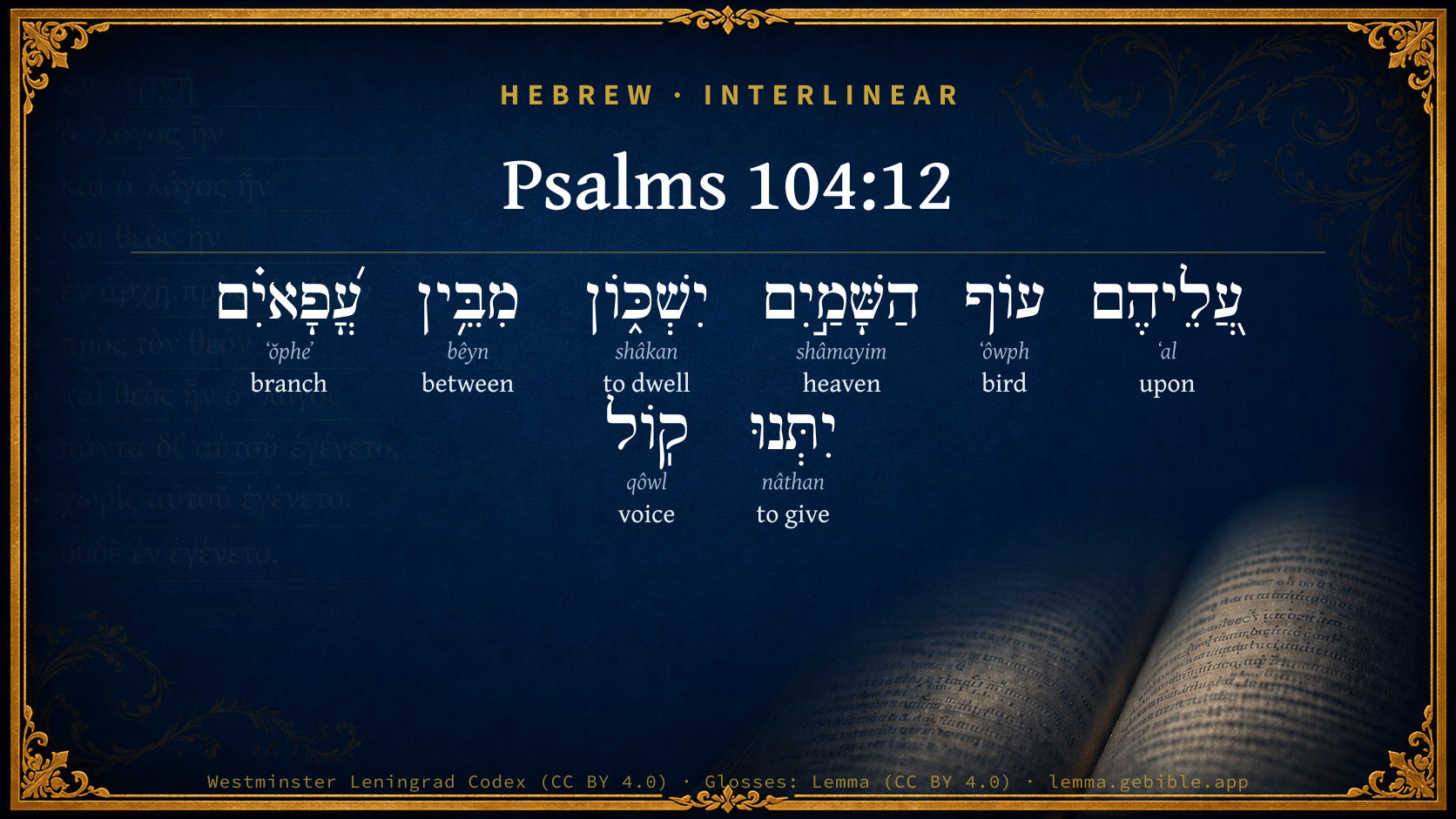
Psalms 104:12

Hebrew (Westminster Leningrad Codex) Psalms 104:12 appears in the Hebrew Old Testament. The text above is from the Westminster Leningrad Codex. Each word links to its Strong’s number, a concise gloss, and parsing drawn from the Open Scriptures Hebrew Bible morphology. Click any word for its full Brown-Driver-Briggs (BDB) entry.
Download image
Cite this verse

Psalms 104:12 (World English Bible). Public Domain. Lemma interlinear Bible study tool, https://lemma.gebible.app/v/psalms/104/12.

Show BibTeX & RIS
BibTeX
RIS
English Translation
The birds of the sky nest by them. They sing among the branches.
World English Bible · Public Domain
Highlights
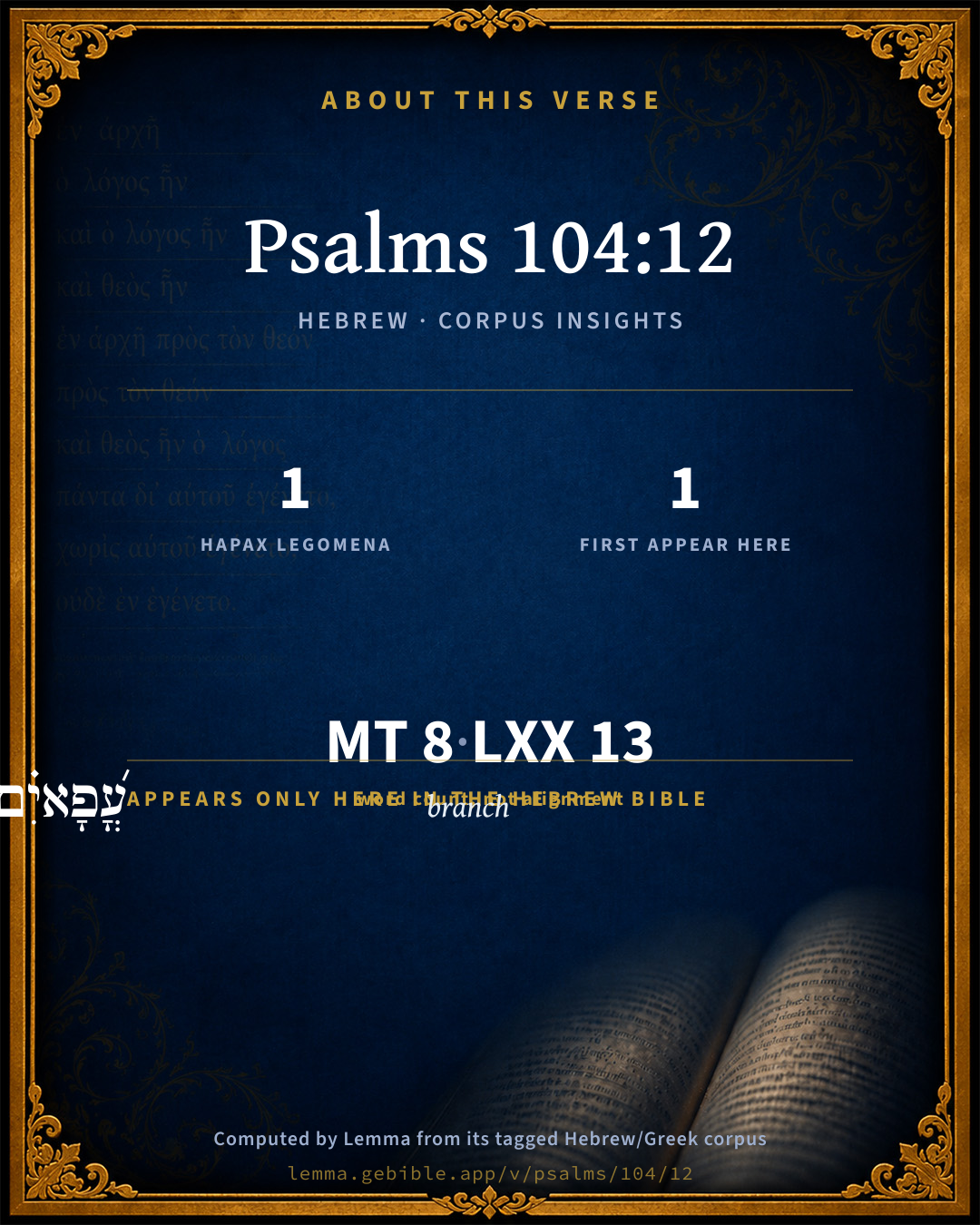
  • 1 hapax legomenon — only here in the Hebrew Bible
  • 1 first appearance in the Hebrew Bible
Full analysis ↓
Download a study sheet

One document with this verse’s original text, its word-by-word gloss line, the meaning frame, cross-references with their text, attributed commentary, and full source and license credits — printable, and it pastes into notes with its structure intact.

This verse Autodidact and up

Study sheet (.html) Plain text (.txt)

A passage Seminary Student

Up to 50 verses in one chapter. A passage sheet keeps up to 6 commentary sources and 12 cross-references per verse, in the order this page ranks them, and says so on the sheet whenever that leaves anything out. Ask for a single verse and you get the Autodidact verse sheet above.

Everything on this page stays free to read, with no account — the sheet is a download of what is already on screen, not access to it.

Want to remove ads? Support Godless Engineer
Compare translations 3

The same verse in 3 English versions, stacked beneath the original-language interlinear above. Click any original word for its lexicon entry.

Each is an independent rendering of the whole verse — the interlinear is not word-aligned to these translations.

Highlighted words mark where these versions differ — a whole-verse word diff, not a word-by-word alignment.

  • World English Bible Public Domain
    The birds of the sky nest by them. They sing among the branches.
  • King James Version Public Domain
    By them shall the fowls of the heaven have their habitation, which sing among the branches.
  • unfoldingWord Literal Text CC BY-SA 4.0
    Alongside them the birds of the heavens dwell; from between the branches they give voice.

unfoldingWord Literal Text — © unfoldingWord, licensed CC BY-SA 4.0. Word-aligned USFM3 via Door43 (git.door43.org/unfoldingWord/en_ult).

Versions to compare (up to 4)

3 of 4 selected

Show all 18 translations

Every available English version of this verse, each an independent rendering of the whole verse.

  • World English Bible Public Domain
    The birds of the sky nest by them. They sing among the branches.
  • Berean Standard Bible Public Domain
    The birds of the air nest beside the springs; they sing among the branches.
  • Majority Standard Bible Public Domain
    The birds of the air nest beside the springs; they sing among the branches.
  • King James Version Public Domain
    By them shall the fowls of the heaven have their habitation, which sing among the branches.
  • American Standard Version (1901) Public Domain
    By them the birds of the heavens have their habitation; They sing among the branches.
  • Revised Version (1885) Public Domain
    By them the fowl of the heaven have their habitation, they sing among the branches.
  • Geneva Bible (1599) Public Domain
    By these springs shall the foules of the heauen dwell, and sing among the branches.
  • Douay-Rheims (1899) Public Domain
    Over them the birds of the air shall dwell: from the midst of the rocks they shall give forth their voices.
  • Young's Literal Translation Public Domain
    By them the fowl of the heavens doth dwell, From between the branches They give forth the voice.
  • Literal Standard Version CC BY-SA 4.0
    The bird of the heavens dwells by them, || From between the branches || They give forth the voice.
  • Unlocked Literal Bible CC BY-SA 4.0
    By the riverbanks the birds build their nests; they sing among the branches.
  • unfoldingWord Literal Text CC BY-SA 4.0
    Alongside them the birds of the heavens dwell; from between the branches they give voice.
  • Darby Bible Public Domain
    The birds of heaven dwell by them; they give forth their voice from among the branches.
  • World Messianic Bible Public Domain
    The birds of the sky nest by them. They sing among the branches.
  • Webster's Bible Public Domain
    By them shall the fowls of the heaven have their habitation, which sing among the branches.
  • Free Bible Version CC BY-SA 4.0
    Birds build their nests in trees along the streams, singing from among the leaves.
  • Bible in Basic English Public Domain
    The birds of the air have their resting-places by them, and make their song among the branches.
  • JPS Tanakh (1917) Public Domain
    Beside them dwell the fowl of the heaven, from among the branches they sing.

Literal Standard Version (2020), Covenant Press — licensed CC BY-SA 4.0. Text via the HelloAO Bible API (eBible.org). Unlocked Literal Bible (unfoldingWord) — licensed CC BY-SA 4.0. Text via the HelloAO Bible API (eBible.org). unfoldingWord Literal Text — © unfoldingWord, licensed CC BY-SA 4.0. Word-aligned USFM3 via Door43 (git.door43.org/unfoldingWord/en_ult). Free Bible Version, Dr. Jonathan Gallagher — licensed CC BY-SA 4.0. Text via the HelloAO Bible API (eBible.org).

Word by word

More ways to search: Search by grammar → Find every occurrence → Compare this word →

Practice this passage: Drill this verse → Learn its vocabulary →

About this verse

These counts appear in no published source. They are computed here, from the morphology-tagged text and Lemma’s own curated glosses. What Lemma adds →

8
words
8
distinct lemmas
Wisdom
section

Notable vocabulary

1 hapax legomenon — a word that appears only here in the entire Hebrew Bible:

  • עֳ֝פָאיִ֗ם branch H6073

First appearance in Scripture

This word makes its first canonical appearance in the Hebrew Bible here:

  • עֳ֝פָאיִ֗ם branch H6073

Grammatical profile

  • 2 verbs
  • 4 nouns
  • 2 prepositions

Verb forms

  • יִשְׁכּ֑וֹן Qal · Imperfect
  • יִתְּנוּ Qal · Imperfect

Hebrew & Septuagint length

In English translation the verse runs 13 words from the Hebrew and 21 from the Septuagint (LXX English) — closely comparable.

A rough comparison of the two English renderings, which tokenize alike — not a word-level alignment.

Word counts can differ between the Hebrew and the Greek without any difference in meaning — e.g. the Hebrew direct-object marker אֵת has no separate Greek word, and Greek often adds the article ὁ.

In the original languages it is 8 Hebrew tokens and 13 Greek tokens — but the two are counted differently (Hebrew bundles its prefixes and suffixes into one token; the Greek is in lemma form), so that isn’t a like-for-like length.

Cross-references

7

Topical passages linked to Psalms 104:12 in the Treasury of Scripture Knowledge — connected by theme and wording, ordered by reader-vote popularity; previews shown in the World English Bible.

  • Psalms 50:11 I know all the birds of the mountains. The wild animals of the field are mine.
  • Psalms 148:10 Wild animals and all cattle; Small creatures and flying birds;
  • Psalms 84:3 Yes, the sparrow has found a home, And the swallow a nest for herself, where she may have her young, Near your altars, Yahweh of Hosts, my King, and my God.
  • Psalms 104:16–17 Yahweh's trees are well watered, The cedars of Lebanon, which he has planted;
  • Psalms 147:9 He provides food for the cattle, And for the young ravens when they call.
  • Matthew 6:26 See the birds of the sky, that they don't sow, neither do they reap, nor gather into barns. Your heavenly Father feeds them. Aren't you of much more value than they?
  • Matthew 8:20 Jesus said to him, "The foxes have holes, and the birds of the sky have nests, but the Son of Man has nowhere to lay his head."

Cross-references courtesy of OpenBible.info (CC BY 4.0).

Hebrew and Greek witnesses Masoretic Hebrew ↔ Greek Septuagint

The same verse in the two great witnesses to the Old Testament, shown verse-for-verse.

You’re reading Greek Psalm 103 (Hebrew Psalm 104). The Septuagint counts the superscription, so verse numbers can differ from the Hebrew — chapter-level alignment, not verse-by-verse. Numbering follows Rahlfs.

These are two independent witnesses, not word-aligned to each other, and the Septuagint is shown in lemma (dictionary) form.

Hebrew Psalms 104:12 Masoretic · Westminster Leningrad Codex

עֲ֭לֵיהֶם עוֹף הַשָּׁמַ֣יִם יִשְׁכּ֑וֹן מִבֵּ֥ין עֳ֝פָאיִ֗ם יִתְּנוּ קֽוֹל

The birds of the sky nest by them. They sing among the branches.

World English Bible · Public Domain

Greek LXX Greek Psalm 103:12 Septuagint · lemma form

ἐπί αὐτός ὁ πετεινόν ὁ οὐρανός κατασκηνόω ἐκ μέσος ὁ πέτρος δίδωμι φωνή

By them shall the birds of the sky lodge: they shall utter a voice out of the midst of the rocks.

LXX2012 (modern English Septuagint) · Public Domain

Hebrew: Westminster Leningrad Codex (CC BY 4.0). Greek: Septuagint (public domain); English from LXX2012 (modern English Septuagint) (Public Domain). How the Septuagint differs from the Hebrew →

Commentary

Notes on Psalms 104:12 from classic Christian and Jewish commentators (each source and its license shown beneath its notes). The classic Christian expositions comment on the surrounding passage and are grouped to its opening verse, so a note may address several verses; the Jewish commentaries on the Tanakh (Rashi and others) are per-verse, so they appear only where the commentator wrote on this verse.

Lemma curates 59 commentaries, every one of them public domain or Creative Commons licensed, each selected and text-cleaned for this edition rather than reprinted as found. About our sources →

Trapp's Complete Commentary

John Trapp

Psa 104:12 By them shall the fowls of the heaven have their habitation, [which] sing among the branches.

Ver. 12. By them shall the fowls of the heaven]

Assuetae ripis volucres, et fluminis alveo (Virg.).

Which sing among the branches] Most melodiously, many of them; therefore it is reckoned as a judgment to lose them, Jer 4:25; Jer 9:10.

John Trapp, A Commentary or Exposition upon All the Books of the Old and New Testament (1647–1656) — public domain. Text from a community e-Sword module.

Joseph Benson's Commentary

Psa 104:12. By them — By the springs of water in the valleys; the fowls of the heaven have their habitation — Delighting to build their nests, and sing among the verdant branches which conceal them from our sight. “The music of birds,” says Mr. Wesley, “was the first song of thanksgiving which was offered on earth before man was formed. All their sounds are different, but all harmonious, and all together compose a choir which we cannot imitate.” (Survey of the Wisdom of God, vol. 1. p. 314, third edition.) “If these little choristers of the air,” adds Dr. H., “when refreshed by the streams near which they dwell, express their gratitude by chanting, in their way, the praises of their Maker and Preserver, how ought Christians to blush, who, besides the comforts and conveniences of this world, are indulged with copious draughts of the water of eternal life, if for so great a blessing they pay not their tribute of thanksgiving, and sing not unto the Lord the songs of Zion!”

Joseph Benson's Commentary on the Old and New Testaments (1811–1818) — public domain. Text from a community e-Sword module.

J. A. Alexander on Psalms

Joseph Addison Alexander

12. (Psa 104:12) Above them the birds of heaven dwell, from between the branches they give voice. The poetical character of the composition is in nothing more obvious than in these minute strokes of exquisite painting, superadded to the more essential parts of the description. At the same time these are not to be regarded as mere lavish or gratuitous embellishments, since the Psalmist's purpose is to celebrate God's wonderful and bountiful provision for his living creatures, and the running brooks would fail to answer one of their most valuable ends, if there were no birds to give voice or sing among the branches of the overhanging trees. The word translated birds is a collective answering to the old English fowl, not as used in the version of this psalm, where it is plural, but in that of Gen 1:20; Gen 1:22; Gen 1:26; Gen 1:28. That passage furnishes an explanation of the phrase fowl (or birds) of heaven, in the fuller description (Gen 1:20), fowl that may fly above the earth in the open firmament of heaven, i.e. through the air, across the face of the expanse or visible heaven.

Joseph Addison Alexander, The Psalms Translated and Explained (1850) — public domain. Text from a community e-Sword module.

Geneva Bible (1599)

Geneva Bible translators

There is no part of the world so barren, where most evident signs of God’s blessings appear not.

Geneva Bible (1599) marginal notes — public domain. Text via Bolls.life.

Adam Clarke's Commentary

Verse 12. By them shall the fowls of the heaven have their habitation] All fowls love verdure, and have their residence where they can find wood and water.

Adam Clarke's Commentary on the Bible (1810–1826) — public domain. Text from a community e-Sword/MySword module.

Ellicott's Commentary for English Readers

(12) By them.—Better, above them, i.e., in the trees and bushes growing on the bank of the stream. Translate by the present, have their homes.

A Bible Commentary for English Readers, edited by Charles John Ellicott (1878–1897) — public domain. Text from a community e-Sword module.

The Cambridge Bible for Schools and Colleges

gen. ed. J. J. S. Perowne

12. Beside them dwell the birds of the heaven;

From among the leafage they utter their song.

Beside the springs and streams grow the trees which are the home of the birds, whose song of praise to their Maker ever rises from their branches.

The Cambridge Bible for Schools and Colleges (gen. ed. J. J. S. Perowne; Cambridge University Press, 1878–1918) — public domain. Text from a community e-Sword module.

John Gill's Exposition

By them shall the fowls of the heaven have their habitation,.... Another use of the springs, fountains, and rivers of water; by the sides and on the shores of these, some birds delight to be, and on trees that grow here do they build their nests; and here, having wetted their throats, they sit, and chirp, and sing: to doves, by rivers of water, is the allusion in Sol 5:12.

Which sing among the branches; of trees that grow by the sides of fountains and rivers; see Eze 17:23. To such birds may saints be compared; being, like them, weak, defenceless, and timorous; liable to be taken in snares, and sometimes wonderfully delivered; as well as given to wanderings and strayings: and to fowls of the heaven, being heaven born souls, and partakers of the heavenly calling. These have their habitation by the fountain of Jacob, by the river of divine love, beside the still waters of the sanctuary; where they sing the songs of Zion, the songs of electing, redeeming, and calling grace.

John Gill's Exposition of the Whole Bible (1746–1763) — public domain (CC PDM 1.0). Text via the HelloAO Bible API.

Albert Barnes' Notes on the Bible

By them shall the fowls of the heaven have their habitation - Among them the fowls of the air dwell. That is, among the trees which spring up by the fountains and water-courses. The whole picture is full of animation and beauty.

Which sing among the branches - Margin, as in Hebrew, “give a voice.” Their voice is heard - their sweet music - in the foliage of the trees which grow on the margin of the streams and by the fountains. There is scarcely to be found a more beautiful poetic image than this.

Albert Barnes' Notes on the Bible (1834–1885) — public domain. Text from a community e-Sword/MySword module.

Matthew Poole's English Annotations

By them; either upon the waters, where many fowls have their common abode; or in the ground nigh unto them; or in the trees, which commonly grow by the banks of rivers.

Which sing among the branches; which, being delighted and refreshed by the waters, send forth their pleasant notes.

Matthew Poole's English Annotations on the Holy Bible (1683–1685) — public domain. Text from a community e-Sword/MySword module.

The Treasury of David

Charles H. Spurgeon

Ver. 12. By them shall the fowls of the heaven have their habitation, which sing among the branches. How refreshing are these words! What happy memories they arouse of splashing waterfalls and entangled boughs, where the merry din of the falling and rushing water forms a sort of solid background of music, and the sweet tuneful notes of the birds are the brighter and more flashing lights in the harmony. Pretty birdies, sing on! What better can ye do, and who can do it better? When we too drink of the river of God, and eat of the fruit of the tree of fife, it well becomes us to "sing among the branches." Where ye dwell ye sing; and shall not we rejoice in the Lord, who has been our dwelling place in all generations. As ye fly from bough to bough, ye warble forth your notes, and so will we as we flit through time into eternity. It is not meet that birds of Paradise should be outdone by birds of earth.

Ver. 12. By them shall the fowls of the heaven have their habitation. Never shall I forget my first ride from Riha to Ain Sultan; our way lay right across the oasis evoked by the waters. It may be that the contrast with the arid desert of the previous day heightened the feelings of present enjoyment, but certainly they echoed the words of Josephus, a "Divine region". At one time I was reminded of Epping Forest, and then of a neglected orchard with an undergrowth of luxuriant vegetation. Large thorn bushes and forest shrubs dotted the plain on every side. In some places the ground was carpeted with flowers, and every bush seemed vocal with the cheerful twittering of birds. I use the word "twittering", because I do not think that I ever heard a decided warble during the whole time I was in Syria. Coleridge speaks of the "merry nightingale",

"That crowds, and hurries, and precipitates

With fast, quick warble, his delicious notes."

The song of my little Syrian friends seemed to consist of a series of, cheerful chirps. Other travellers have been more fortunate. Bonar speaks of the note of the cuckoo; Dr. Robinson of the nightingale. Lord Lindsay tells us of the delight of an evening spent by the Jordan, "the river murmuring along, and the nightingale singing from the trees." Canon Tristram, describing the scenery near Tell-el-Kady, says that "the bulbul and nightingale vied in rival scrag in the branches above, audible over the noise of the torrent below." In the face of these statements it seems to me remarkable, considering the innumerable references to nature in the Bible, that the singing of birds is only mentioned three times. In the well known passage which so exquisitely depicts a Syrian spring, we read "the time of the singing of birds is come" (So 2:12). The Psalmist in speaking of the mighty power and wondrous Providence of God, mentions the springs in "the valleys, which run among the hills. They give drink to every beast of the field; the wild asses quench their thirst. By them shall the fowls of the heaven have their habitation which sing among the branches." Canon Tristram commenting on this passage, says, that it may refer especially to the "bulbul and the nightingale, both of which throng the trees that fringe the Jordan and abound in all the wooded valleys, filling the air in early spring with the rich cadence of their notes." James Wareing Bardsley, in "Illustrative Texts", 1876.

Ver. 12. By them shall the fowls of the heaven have their habitation, etc. To such birds may saints be compared; being, like them, weak, defenceless, and timorous; liable to be taken in snares, and sometimes wonderfully delivered; as well as given to wanderings and straying; and to fowls of the heaven, being heaven born souls, and partakers of the heavenly calling. These have their habitation by the fountain of Jacob, by the river of divine love, beside the still waters of the sanctuary, where they sing the songs of Zion, the songs of electing, redeeming, and calling grace. John Gill.

Ver. 12. The fowls...which sing among the branches. The music of birds was the first song of thanksgiving which was offered from the earth, before man was formed. John Wesley.

Ver. 12. The fowls of the heaven which sing among the branches. How do the blackbird and thrassel thrush, with their melodious voices, bid welcome to the cheerful spring, and in their fixed months warble forth such ditties as no art or instrument can reach to? ... But the nightingale, another of my airy creatures, breathes such sweet loud music out of her little instrumental throat, that it makes mankind to think miracles are not ceased. He that at midnight, when the very labourer sleeps securely, should hear, as I have very often, the clear airs, the sweet descants, the natural rising and falling, the doubling and redoubling of her voice, might well be lifted above earth, and say, "Lord, what music hast thou provided for the saints in heaven, when you afford bad men such music on earth?" Izaak Walton.

Ver. 12.

While over their heads the hazels hing,

The little birdies blithely sing,

Or lightly flit on wanton wing

In the birks of Aberfeldy.

The braes ascend like lofty wa's,

The foaming stream deep roaring fa's,

Overhung with fragrant spreading shaws,

The birks of Aberfeldy. Robert Burns, 1759-1796.

Psalms 104:13*

Charles H. Spurgeon's The Treasury of David (1869–1885) — public domain. Psalms only. Text from a community e-Sword/MySword module.

Whedon's Commentary on the Bible

Daniel D. Whedon

12. By them—Literally, Above, or over, “them;” that is, over the banks of these streams, by which trees are nourished, the birds have their habitation, and give forth their voices.

Fowls of the heaven—The phrase is opposed to “beasts of the earth.” Gen_1:24; Gen_1:26

Daniel D. Whedon (gen. ed.), Commentary on the Old and New Testaments (1874–1909) — public domain. Text from a community e-Sword module.

The Pulpit Commentary

By them; i.e. "by the springs" (see ver. 10). Shall the fowls of the heaven have their habitation. Birds need water as much as any other animals, and in dry tracts frequently congregate at the springs. Which sing (or, utter a voice) among the branches of the trees which in the East spring up wherever there is moisture.

The Pulpit Commentary (1880–1919), ed. H.D.M. Spence-Jones & Joseph S. Exell — public domain. Text from a community e-Sword module.

Rashi

Rabbi Shlomo Yitzchaki (Rashi)

Beside them the fowl of the heavens dwell Beside the springs.

from between the branches Heb. עפאים, the branches of the trees, and so (Dan. 4:11): “its branches were (עפיה) beautiful.”

Rashi on the Tanakh — English translations: “The Judaica Press complete Tanach with Rashi, translated by A. J. Rosenberg” (CC BY 4.0); “Pentateuch with Rashi's commentary by M. Rosenbaum and A.M. Silbermann, 1929-1934” (public domain); “The Metsudah Tanach series, Lakewood, N.J” (CC BY 4.0); and “The Book of Joshua, Metsudah Publications, 1997” (CC BY 4.0). Text via Sefaria.

Lesson kit

Teaching starters — assembled from the data on this page, not authored interpretation. Every prompt links to the verse data it draws on. Edit before teaching.

Psalms, in the Wisdom, opens this verse with 8 words (8 distinct Hebrew lemmas). Its most distinctive word is ʻŏpheʼ (“branch”). A historical commentator’s framing appears above. Read the whole chapter for the surrounding context.

Discussion questions

  1. What does “branch” (ʻŏpheʼ) contribute to the verse as a whole?
  2. This verse holds 1 word here found nowhere else in the Hebrew Bible. What might the rare word draw attention to?
  3. The word “branch” first appears here in Scripture. What is being introduced at this debut?
  4. Psalms 50:11 shares this passage’s theme. How do the two illuminate each other?
  5. These translations render this verse differently. What is at stake in choosing one wording over another?
  6. The verb «יִשְׁכּ֑וֹן» is Qal Imperfect. How does its form color the action?
  7. Reading how Trapp's Complete Commentary and Joseph Benson's Commentary read this verse, where do the two commentators agree and where do they part?

Things to notice

Reading settings

Reading text

Shown beneath each verse's original-language words.

Old Testament
Old Testament edition

Read the OT as the Masoretic Hebrew (MT) or the Greek Septuagint (LXX).

English shown for the Greek Septuagint (in the Hebrew ↔ Greek comparison).

Comparing translations? Open the Compare panel on any verse page to stack up to four side by side.