
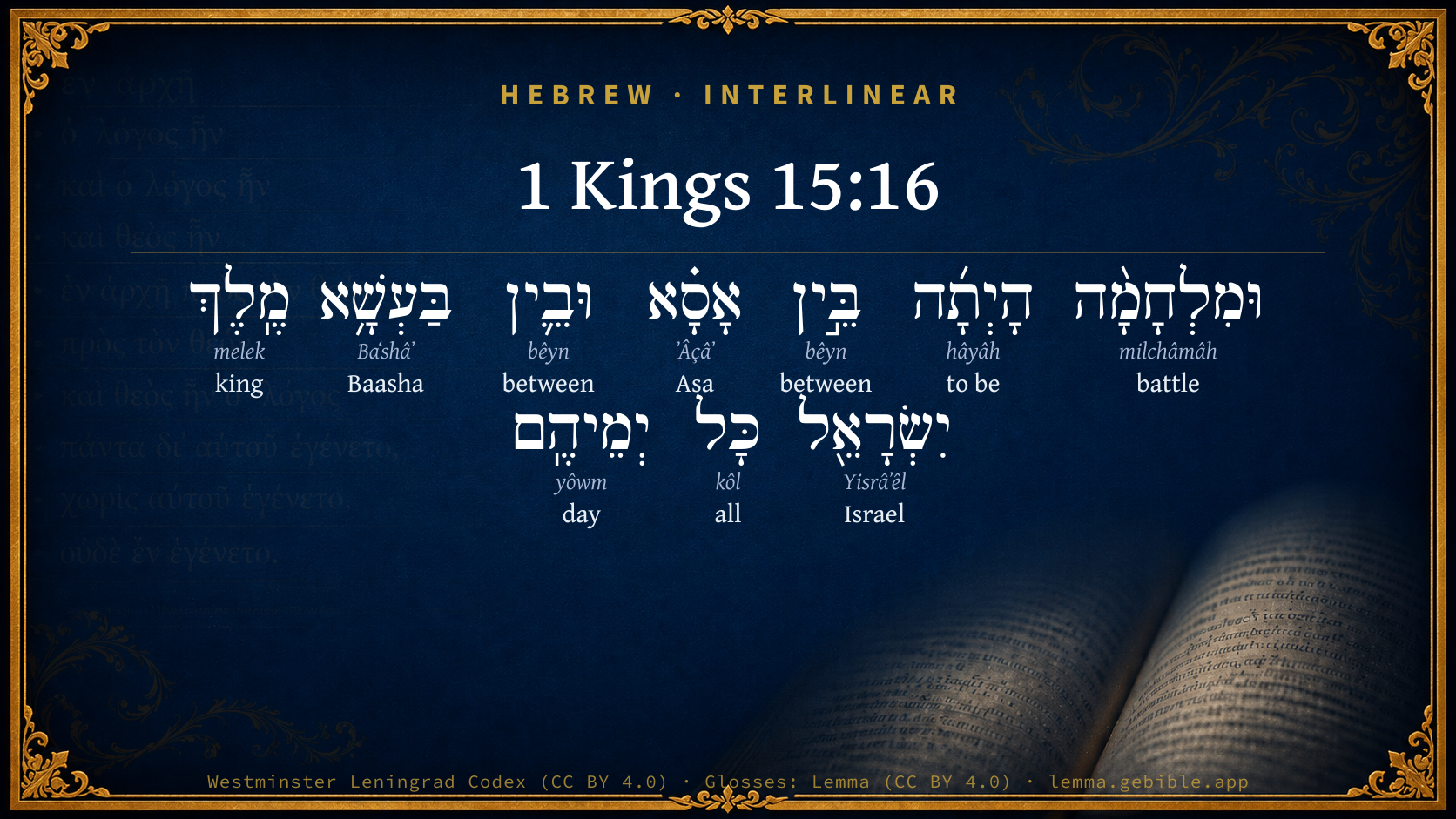
1 Kings 15:16

Hebrew (Westminster Leningrad Codex) 1 Kings 15:16 appears in the Hebrew Old Testament. The text above is from the Westminster Leningrad Codex. Each word links to its Strong’s number, a concise gloss, and parsing drawn from the Open Scriptures Hebrew Bible morphology. Click any word for its full Brown-Driver-Briggs (BDB) entry.
Download image
Cite this verse

1 Kings 15:16 (World English Bible). Public Domain. Lemma interlinear Bible study tool, https://lemma.gebible.app/v/1-kings/15/16.

Show BibTeX & RIS
BibTeX
RIS
English Translation
There was war between Asa and Baasha king of Israel all their days.
World English Bible · Public Domain
Highlights
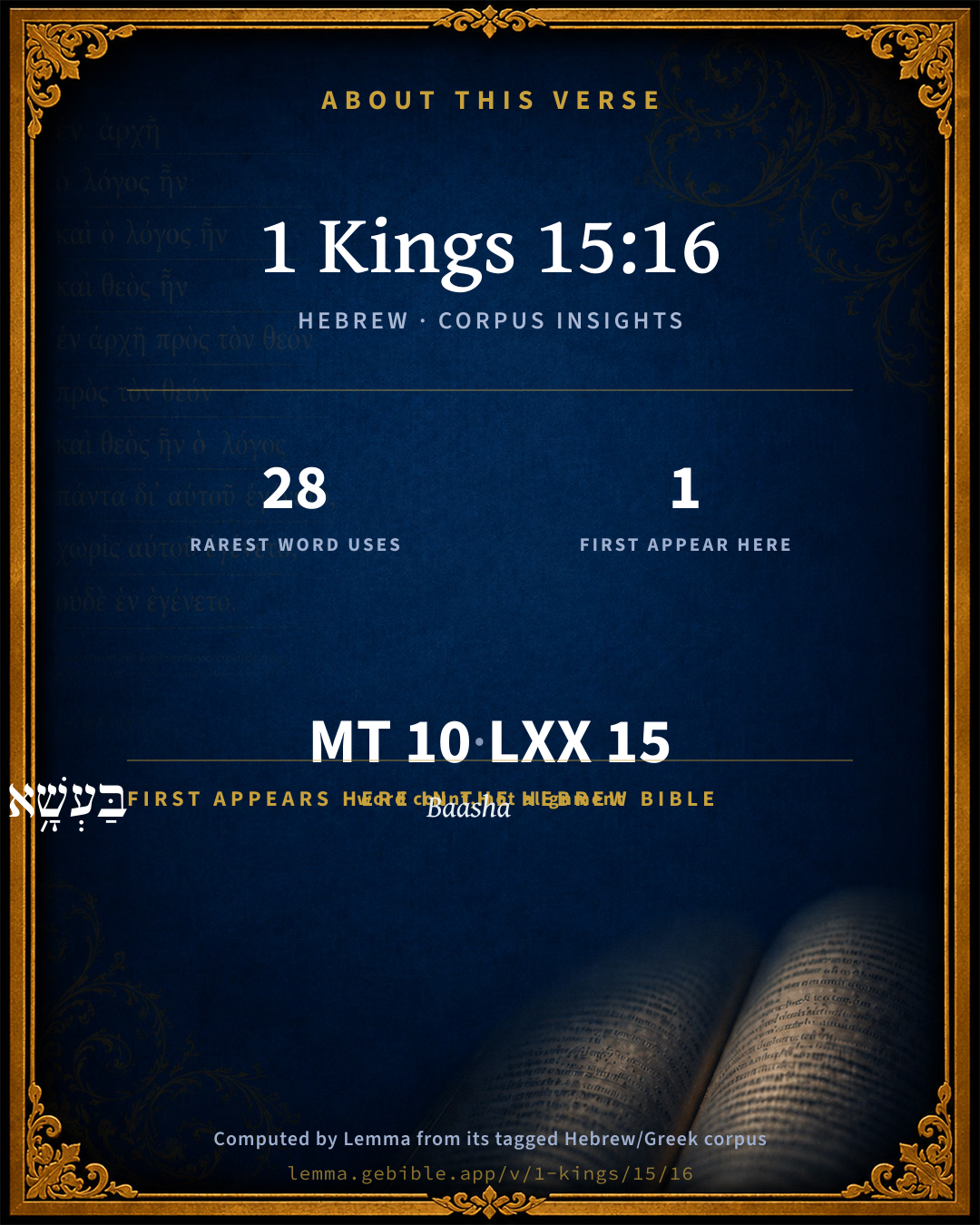
  • 1 first appearance in the Hebrew Bible
Full analysis ↓
Download a study sheet

One document with this verse’s original text, its word-by-word gloss line, the meaning frame, cross-references with their text, attributed commentary, and full source and license credits — printable, and it pastes into notes with its structure intact.

This verse Autodidact and up

Study sheet (.html) Plain text (.txt)

A passage Seminary Student

Up to 50 verses in one chapter. A passage sheet keeps up to 6 commentary sources and 12 cross-references per verse, in the order this page ranks them, and says so on the sheet whenever that leaves anything out. Ask for a single verse and you get the Autodidact verse sheet above.

Everything on this page stays free to read, with no account — the sheet is a download of what is already on screen, not access to it.

Want to remove ads? Support Godless Engineer
Compare translations 3

The same verse in 3 English versions, stacked beneath the original-language interlinear above. Click any original word for its lexicon entry.

Each is an independent rendering of the whole verse — the interlinear is not word-aligned to these translations.

Highlighted words mark where these versions differ — a whole-verse word diff, not a word-by-word alignment.

  • World English Bible Public Domain
    There was war between Asa and Baasha king of Israel all their days.
  • King James Version Public Domain
    And there was war between Asa and Baasha king of Israel all their days.
  • unfoldingWord Literal Text CC BY-SA 4.0
    And war was between Asa and between Baasha, the king of Israel, all of their days.

unfoldingWord Literal Text — © unfoldingWord, licensed CC BY-SA 4.0. Word-aligned USFM3 via Door43 (git.door43.org/unfoldingWord/en_ult).

Versions to compare (up to 4)

3 of 4 selected

Show all 18 translations

Every available English version of this verse, each an independent rendering of the whole verse.

  • World English Bible Public Domain
    There was war between Asa and Baasha king of Israel all their days.
  • Berean Standard Bible Public Domain
    Now there was war between Asa and Baasha king of Israel throughout their days.
  • Majority Standard Bible Public Domain
    Now there was war between Asa and Baasha king of Israel throughout their days.
  • King James Version Public Domain
    And there was war between Asa and Baasha king of Israel all their days.
  • American Standard Version (1901) Public Domain
    And there was war between Asa and Baasha king of Israel all their days.
  • Revised Version (1885) Public Domain
    And there was war between Asa and Baasha king of Israel all their days.
  • Geneva Bible (1599) Public Domain
    And there was warre betweene Asa and Baasha King of Israel all their dayes.
  • Douay-Rheims (1899) Public Domain
    And there was war between Asa, and Baasa king of Israel all their days.
  • Young's Literal Translation Public Domain
    And war hath been between Asa and Baasha king of Israel all their days,
  • Literal Standard Version CC BY-SA 4.0
    And there has been war between Asa and Baasha king of Israel [for] all their days,
  • Unlocked Literal Bible CC BY-SA 4.0
    There was war between Asa and Baasha king of Israel, all their days.
  • unfoldingWord Literal Text CC BY-SA 4.0
    And war was between Asa and between Baasha, the king of Israel, all of their days.
  • Darby Bible Public Domain
    And there was war between Asa and Baasha king of Israel all their days.
  • World Messianic Bible Public Domain
    There was war between Asa and Baasha king of Israel all their days.
  • Webster's Bible Public Domain
    And there was war between Asa and Baasha king of Israel all their days.
  • Free Bible Version CC BY-SA 4.0
    Asa and Baasha, king of Israel, were always at war with each other.
  • Bible in Basic English Public Domain
    Now there was war between Asa and Baasha, king of Israel, all their days.
  • JPS Tanakh (1917) Public Domain
    And there was war between Asa and Baasa king of Israel all their days.

Literal Standard Version (2020), Covenant Press — licensed CC BY-SA 4.0. Text via the HelloAO Bible API (eBible.org). Unlocked Literal Bible (unfoldingWord) — licensed CC BY-SA 4.0. Text via the HelloAO Bible API (eBible.org). unfoldingWord Literal Text — © unfoldingWord, licensed CC BY-SA 4.0. Word-aligned USFM3 via Door43 (git.door43.org/unfoldingWord/en_ult). Free Bible Version, Dr. Jonathan Gallagher — licensed CC BY-SA 4.0. Text via the HelloAO Bible API (eBible.org).

Word by word

More ways to search: Search by grammar → Find every occurrence → Compare this word →

Practice this passage: Drill this verse → Learn its vocabulary →

About this verse

These counts appear in no published source. They are computed here, from the morphology-tagged text and Lemma’s own curated glosses. What Lemma adds →

10
words
9
distinct lemmas
Historical
section

First appearance in Scripture

This word makes its first canonical appearance in the Hebrew Bible here:

  • בַּעְשָׁ֥א Baasha H1201

Shared distinctive vocabulary

בַּעְשָׁ֥א Baasha H1201 occurs in 26 verses of the Hebrew Bible. Also found in:

Grammatical profile

  • 1 verb
  • 7 nouns
  • 2 prepositions

Verb forms

  • הָיְתָ֜ה Qal · Perfect

Repetition

A word recurs within this verse — often emphatic in Hebrew:

  • בֵּ֣ין between H996 ×2

Hebrew & Septuagint length

In English translation the verse runs 13 words from the Hebrew and 14 from the Septuagint (LXX English) — closely comparable.

A rough comparison of the two English renderings, which tokenize alike — not a word-level alignment.

Word counts can differ between the Hebrew and the Greek without any difference in meaning — e.g. the Hebrew direct-object marker אֵת has no separate Greek word, and Greek often adds the article ὁ.

In the original languages it is 10 Hebrew tokens and 15 Greek tokens — but the two are counted differently (Hebrew bundles its prefixes and suffixes into one token; the Greek is in lemma form), so that isn’t a like-for-like length.

Cross-references

4

Topical passages linked to 1 Kings 15:16 in the Treasury of Scripture Knowledge — connected by theme and wording, ordered by reader-vote popularity; previews shown in the World English Bible.

  • 1 Kings 15:32 There was war between Asa and Baasha king of Israel all their days.
  • 1 Kings 14:30 There was war between Rehoboam and Jeroboam continually.
  • 1 Kings 15:6–7 Now there was war between Rehoboam and Jeroboam all the days of his life.
  • 2 Chronicles 16:1–6 In the six and thirtieth year of the reign of Asa, Baasha king of Israel went up against Judah, and built Ramah, that he might not allow anyone to go out or come in to Asa king of Judah.

Cross-references courtesy of OpenBible.info (CC BY 4.0).

Hebrew and Greek witnesses Masoretic Hebrew ↔ Greek Septuagint

The same verse in the two great witnesses to the Old Testament, shown verse-for-verse.

These are two independent witnesses, not word-aligned to each other, and the Septuagint is shown in lemma (dictionary) form.

Hebrew 1 Kings 15:16 Masoretic · Westminster Leningrad Codex

וּמִלְחָמָ֨ה הָיְתָ֜ה בֵּ֣ין אָסָ֗א וּבֵ֛ין בַּעְשָׁ֥א מֶֽלֶךְ יִשְׂרָאֵ֖ל כָּל יְמֵיהֶֽם

There was war between Asa and Baasha king of Israel all their days.

World English Bible · Public Domain

Greek LXX 1 Kings 15:16 Septuagint · lemma form

καί πόλεμος εἰμί ἀνά μέσος ασα καί ἀνά μέσος βαασα βασιλεύς ἰσραήλ πᾶς ὁ ἡμέρα

And there was war between Asa and Baasa king of Israel all their days.

LXX2012 (modern English Septuagint) · Public Domain

On this verse, The Preacher's Complete Homiletical Commentary discusses the Septuagint’s reading. Read the note in Commentary ↓

Hebrew: Westminster Leningrad Codex (CC BY 4.0). Greek: Septuagint (public domain); English from LXX2012 (modern English Septuagint) (Public Domain). How the Septuagint differs from the Hebrew →

Targum (Aramaic paraphrase)

1

The Targum is the ancient Jewish Aramaic paraphrase of the Hebrew Scriptures — an interpretive translation, not the Hebrew text itself. Onkelos (literal) and Pseudo-Jonathan (expansive) render the Torah, and Jonathan the Prophets. Coverage is partial: where no permissively-licensed English translation exists for a verse, only the Aramaic is shown. This is verse-level text, not a word-by-word alignment to the Hebrew.

  1. Targum Jonathan Prophets (Joshua–Malachi)
    וּקְרָבָא הֲוַת בֵּין אָסָא וּבֵין בַּעְשָׁא מַלְכָּא דְיִשְׂרָאֵל כָּל יוֹמֵיהוֹן:

    (no public-domain English translation for this verse)

    Targum Jonathan — Aramaic: “Mikraot Gedolot” (public domain). English: “Sefaria Community Translation” (CC0 1.0 (public-domain dedication)); “London "Chaldee Paraphrase," 1871” (public domain). Text via Sefaria.

Commentary

Notes on 1 Kings 15:16 from classic Christian and Jewish commentators (each source and its license shown beneath its notes). The classic Christian expositions comment on the surrounding passage and are grouped to its opening verse, so a note may address several verses; the Jewish commentaries on the Tanakh (Rashi and others) are per-verse, so they appear only where the commentator wrote on this verse.

Lemma curates 59 commentaries, every one of them public domain or Creative Commons licensed, each selected and text-cleaned for this edition rather than reprinted as found. About our sources →

Trapp's Complete Commentary

John Trapp

1Ki 15:16 And there was war between Asa and Baasha king of Israel all their days.

Ver. 16. And there was war.] See on 1Ki 14:30.

John Trapp, A Commentary or Exposition upon All the Books of the Old and New Testament (1647–1656) — public domain. Text from a community e-Sword module.

The Preacher's Complete Homiletical Commentary

Joseph S. Exell (gen. ed.)

CRITICAL AND EXPLANATORY NOTES.—

1Ki_15:17. Baasha, king of Israel—Third sovereign of the kingdom of Israel, son of Ahijab, probably of lowly origin (chap. 1Ki_16:2). Built Ramah—In the tribal territory of Benjamin, about six miles (Roman) from and on the highway to Jerusalem, thereby cutting off king Asa’s communication with the north.

1Ki_15:18. All the silver, &c., left in the treasures—Shishak had “left” but little (chap. 1Ki_14:26); indeed, he “took away all.” So that the הַנּוֹתָרִים, the remainder, means what Asa had placed therein; τὸ εὑρεθὲν, as the Sept. gives it, what he found.

1Ki_15:20. With all Naphtali—Or, unto the land of Naphtali.

1Ki_15:22. Made a proclamation throughout—or, called together. None excepted—The Septuagint has misapprehended the adverbial sense of אֵין נָקִי, “none excepted,” and given it as a proper name—εὶς Ἑνακίμ.

HOMILETICS OF 1Ki_15:16-24

SYMPTOMS OF RELIGIOUS REACTION

I. Seen in a growing distrust of the protecting power of God. The building of a fortress by his rival Baasha, which would have the effect of interrupting a free and open intercourse with his capital, filled Asa with fear; and instead of putting his trust in that God whom he had so zealously served, he relied on his own crooked and short-sighted policy. He bribed the king of Syria to break the league existing between his own kingdom and the two rival Jewish kingdoms, so that Baasha was compelled to abandon the building of Ramah, and Asa used the stones for the fortifying of his own cities (1Ki_15:17-22). “O, what great and many infirmities may consist with uprightness! what alloys of imperfection will there be found in the most refined soul! Asa doth not only employ the Syrian, but relies on him, relies not on God: a confidence less sinful cost his grandfather David dear.” Religion is losing its influence over the soul when man is trusted more than God. A dishonest and wicked project may succeed, but the success is always embittered sooner or later. It is a dangerous thing to be too clever.

II. Seen in the misappropriation of consecrated treasure (1Ki_15:18). It is sad to notice that he who so recently dedicated these spoils to the Lord should make such use of them as is here described. Only on extraordinary occasions was the king justified in employing the temple treasures; but it was downright sacrilege for Asa to use them in bribing a foreign and heathen king, for whose help there was no urgent necessity. “What is bestowed in faith must be regarded as sacred, and under no pretext must it be diverted to worldly purposes. Nothing but a rude power, knowing neither fear nor awe of God, could commit such a robbery, and no blessing can ever rest upon it. He who gives with one hand, and takes back with the other, has his just recompense therein.” The money power of the world is largely in the hands of the Christian church, and there is an immense responsibility resting upon the wealthy members of that church as to the righteous use of their riches. They are but stewards, and that only for a brief space, when they will be called to render an account of their stewardship to God. Indifference to financial responsibilities is a sure token of religious decay.

III. Seen in the disrespect and cruelty shown towards God’s faithful messengers (2Ch_16:7-10). An important incident in the life of Asa, omitted by the writer of Kings, is supplied by the author of Chronicles. Hanani, the seer, was sent to rebuke and threaten the king for his sin in forsaking the Lord and in relying upon the Syrian for aid. To be thus chided and exposed when his diplomatic policy had seemed to prosper so well, was more than one so little used to contradiction could bear, and in his rage he thrust the too faithful prophet into prison, adding to his original fault the grievous sin of persecuting an inspired messenger of Jehovah. “Here we have the melancholy spectacle of a prophet of God imprisoned, not by an idolatrous or notoriously wicked king, but by one who has hitherto borne a noble character, and whose heart was substantially right with God. Not so did David receive Nathan’s more stern rebuke. This descendant of his does that for only attempting to do which Jeroboam had his arm palsied.” There is little power of religion left when the servants of God are treated with contempt and hardship.

IV. Seen in the way in which God is ignored even in affliction (1Ki_15:23, comp. with 2Ch_16:12). From the whole narrative of Chronicles we gather that the character of Asa deteriorated as he grew old, and that while he maintained the worship of Jehovah consistently from first to last, he failed to maintain the personal faith and piety which had been so conspicuous in his early youth. In his great and fatal affliction “he sought not to the Lord, but to the physicians.” Not that he was blamed for adopting the best means within his reach for his recovery, but he was blamed for relying more upon the skill of the physicians instead of upon the Lord’s blessing upon the means they employed. It is in affliction that man realises his helplessness and need, and when, more than at any other time, he is called upon to depend upon the gracious interference and help of God. It is a lamentable proof of how sadly and deeply the religious spirit has declined when God is forgotten at a period of great extremity, and in the near prospect of death!

LESSONS:—

1. A time of high religious tension is usually followed by a time of reaction.

2. Religious reaction is fraught with great danger, and calls for patient and skilful treatment on the part of the church. 3. In a time of religious reaction there is always much to disappoint and grieve the hearts of God’s people.

GERM NOTES ON THE VERSES

1Ki_15:16. The enemies who rise up against us and bring us into straits must often serve, in the hand of God, to try and prove whether our faith is rooted in the deepest soil of the heart, and our zeal in religious things no fleshy one, but a high and holy one.

1Ki_15:17. The devices of the wicked. I. Are maliciously planned to place hindrances in the way of the good. II. Are prodigal of labour and expense in accomplishing the desired end. III. Will be ignominiously defeated.

1Ki_15:18-21. The eloquence of gold.

1. Is often more potent than words.

2. Is an irresistible argument to the avaricious.

3. Has made many a one a traitor to the most solemn engagements.

4. Will set an army in motion for any purpose.

5. Rarely fails in winning a victory.

1Ki_15:18. To confront his rival of Israel, Baasha, this religious king of Judah fetches in Benhadad, the king of Syria, into God’s inheritance, upon too dear a rate, the breach of his league, the expilation of the temple. All the wealth wherewith Asa had endowed the house of the Lord was little enough to hire an Edomite to betray his fidelity and to invade Israel. Leagues may be made with infidels: not at such a price, upon such terms. There can be no warrant for a wilful subornation of perfidiousness. In these cases of outward things, the mercy of God dispenseth with our true necessities, not with the affected. O Asa! where was thy piety while thou robbest God, to corrupt an infidel, for the slaughter of Israelites? O princes! where is your piety while ye hire Turks to the slaughter of Christians, to the spoil of God’s church?—Bp. Hall.

1Ki_15:19. This is the curse resting upon the strife of brethren: each forms a league with the common enemy rather than resolve upon peace with each other. The least reliable friend and companion in need is he who can be bought with gold, and is always at the disposal of the highest bidder. He who persuades another to break faith must be prepared to find that he will not maintain the word given to him. In every strait, seek first the support and aid of thy God, without whom no man can help thee.

1Ki_15:20. Whoso diggeth a pit shall fall therein, and he that rolleth a stone, it will return upon him (Pro_26:27). Baasha wished to become possessed of an additional city, and thus lost a series of his own cities; with the same stones with which he purposed to strengthen Ramah, Asa built two strong cities.—Lange.

1Ki_15:22. Factious opposition.

1. Is ever short-sighted and short-lived.

2. Is liable to a sudden collapse.

3. May have the materials it gathered used against itself.

1Ki_15:23. As the life, so the deathbed of Asa wanted not infirmities, long and prosperous had his reign been: now, after forty years’ health and happiness, he that imprisoned the prophet is imprisoned in his bed. There is more pain in these fetters which God put upon Asa, than those which Asa put upon Hanani. And now, behold, he that in his war seeks to Benhadad, not to God, in his sickness seeks not to God, but to physicians. We cannot easily put upon God a greater wrong than the alienation of our trust. Earthly means are for use, not for confidence; we may, we must, employ them; we may not rely on them. Well may God challenge our trust as his peculiarly, which, if we cast upon any creature, we deify it. Whence have herbs and drugs and physicians their being and efficacy, but from that Divine hand? No marvel, then, if Asa’s gout struck to his heart, and his feet carried him to his grave, since his heart was miscarried, for the cure of his feet, to an injurious misconfidence in the means, with neglect of his Maker.—Bp. Hall.

—The teachings of affliction.

1. Affliction is often sent in mercy.

2. Suggests topics for serious reflection.

3. Is the more admonitory when associated with age.

4. Often leads the wanderer back to God.

5. Can only increase the distress of the obstinately impenitent.

1Ki_15:24. Sickness in old age, previous to death, is a Divine chastisement and trial, to wean men from the world and ripen them for eternity. How many men would die unconverted if God did not visit them before death with sickness!

The Preacher's Complete Homiletical Commentary (gen. ed. Joseph S. Exell; Funk & Wagnalls, c. 1892) — public domain (pre-1929). A full-Bible homiletical/sermon-outline anthology covering 65 of 66 books (2 John is absent from the source module). Text from a community e-Sword module.

Tyndale Open Study Notes

Tyndale Open Resources

15:16 Baasha began to reign in Asa’s third year (15:33); when Baasha was established, Judah faced renewed hostilities with Israel. Asa also withstood an attack by Zerah the Ethiopian (2 Chr 14:9-12), who was apparently a commander in the service of Pharaoh Osorkon I (924–889 BC). Asa and his troops won a great victory and took vast plunder from Zerah’s forces and from towns in the Negev that probably launched the Egyptian invasion.

Tyndale Open Study Notes — © Tyndale Open Resources, licensed CC BY-SA 4.0. Text via the HelloAO Bible API.

Jamieson, Fausset & Brown

Robert Jamieson, A. R. Fausset & David Brown

there was war between Asa and Baasha king of Israel all their days--Asa enjoyed a ten years' peace after Jeroboam's defeat by Abijam, and this interval was wisely and energetically spent in making internal reforms, as well as increasing the means of national defense (Ch2 14:1-7). In the fifteenth year of his reign, however, the king of Israel commenced hostilities against him, and, invading his kingdom, erected a strong fortress at Ramah, which was near Gibeah, and only six Roman miles from Jerusalem. Afraid lest his subjects might quit his kingdom and return to the worship of their fathers, he wished to cut off all intercourse between the two nations. Ramah stood on an eminence overhanging a narrow ravine which separated Israel from Judah, and therefore he took up a hostile position in that place.

Jamieson, Fausset & Brown — Commentary Critical and Explanatory on the Whole Bible (1871) — public domain (CC PDM 1.0). Text via the HelloAO Bible API.

Adam Clarke's Commentary

Verse 16. There was war] That is, there was continual enmity; see on 1Kg 15:6. But there was no open war till the thirty-sixth year of Asa, when Baasha, king of Israel, began to build Ramah, that he might prevent all communication between Israel and Judah; see 2Ch 15:19; 2Ch 16:1. But this does not agree with what is said here, 1Kg 16:8-9, that Elah, the son and successor of Baasha, was killed by Zimri, in the twenty-sixth year of the reign of Asa. Chronologers endeavour to reconcile this by saying that the years should be reckoned, not from the beginning of the reign of Asa, but from the separation of the kingdoms of Israel and Judah. It is most certain that Baasha could not make war upon Asa in the thirty-sixth year of his reign, when it is evident from this chapter that he was dead in the twenty-sixth year of that king. We must either adopt the mode of solution given by chronologists, or grant that there is a mistake in some of the numbers; most likely in the parallel places in Chronicles, but which we have no direct means of correcting. But the reader may compare 2Ch 14:1, with 2Ch 15:10; 2Ch 15:19; 2Ch 16:1.

Adam Clarke's Commentary on the Bible (1810–1826) — public domain. Text from a community e-Sword/MySword module.

Ellicott's Commentary for English Readers

(16) There was war . . .—According to 1Ki_15:33, Baasha reigned from the third to the twenty-seventh year of Asa. The phrase, here repeated from 1Ki_14:30, 1Ki_15:7, appears simply to mean that the old hostile relations remained, combined with, perhaps, some border war; for it is expressly said in 2Ch_14:1, that Asa’s first ten years were peaceful, and the open war with Israel did not break out till after the victory over Zerah, in his fifteenth year.

A Bible Commentary for English Readers, edited by Charles John Ellicott (1878–1897) — public domain. Text from a community e-Sword module.

The Cambridge Bible for Schools and Colleges

gen. ed. J. J. S. Perowne

16–24. Asa’s war with Baasha. His death (2Ch_16:1-6; 2Ch_16:11-14)

16. between Asa and Baasha] Baasha obtained the throne of Israel in the third year of Asa’s reign (1Ki_15:33) and reigned twenty-four years. So Asa was king all through Baasha’s reign. Hence ‘all their days’ implies the whole of Baasha’s reign.

The Cambridge Bible for Schools and Colleges (gen. ed. J. J. S. Perowne; Cambridge University Press, 1878–1918) — public domain. Text from a community e-Sword module.

John Gill's Exposition

And it came to pass, when Baasha heard thereof,.... What was doing in the northern part of his kingdom:

that he left off building of Ramah; which was the thing designed to be answered by this diversion:

and dwelt in Tirzah; in the tribe of Manasseh, nearer at hand, to observe and stop the motions of the Syrian king.

John Gill's Exposition of the Whole Bible (1746–1763) — public domain (CC PDM 1.0). Text via the HelloAO Bible API.

Albert Barnes' Notes on the Bible

Baasha became king of Israel in the third year of Asa 1Ki 15:33. The petty warfare which ordinarily prevailed on the borders of the two kingdoms continued “all the days” of Asa and Baasha. During the first ten years of Asa’s reign he was little molested 2Ch 14:1, 2Ch 14:6.

Albert Barnes' Notes on the Bible (1834–1885) — public domain. Text from a community e-Sword/MySword module.

Haydock's Catholic Bible Commentary

Their days: not that they were always fighting. (Haydock) --- Open war was declared only in the 35th year of Asa, (2 Paralipomenon xv. 19.) which must be dated from the schism, and not from the commencement of his reign; since his rival, Baasa, enjoyed the sovereignty only 24 years, and died in the 26th of Asa, which was the 36th from the division of the two kingdoms. Thus Hardouin observes that the years of Commodus, in some ancient Egyptians medals, are dated from the reign of M. Aurelius, chief of that family; so that the first of Commodus is inscribed the twenty-first of Aurelius. Asa defeated Zara in the fifteenth, and attacked Israel in the sixteen year of his reign. (Usher) (Tirinus) (Calmet) --- Others would substitute 25 for 35, (Grotius; Capel.) though contrary to the text, and to all the versions. (Calmet)

George Leo Haydock (1774–1849), Haydock's Catholic Family Bible and Commentary, 1859 edition — public domain. Excludes Psalms (Douay-Rheims chapter numbering differs from Protestant) and Deuterocanonical books (Catholic canon only).

Matthew Poole's English Annotations

So long as they two lived and reigned together; which is not so to be understood, as if there were a solemn and declared war continuing all that time, (for Asa was quiet in a great measure for his first ten years, 2Ch 14:1, till the Israelites had recovered themselves from that dreadfull blow given them by Abijah, 2Ch 13, and Baasha began to reign in Asa’s third year,) but so that there were many private and particular hostilities practised among them; in which sense the same phrase is used 1Ki 14:30.

Matthew Poole's English Annotations on the Holy Bible (1683–1685) — public domain. Text from a community e-Sword/MySword module.

Whedon's Commentary on the Bible

Daniel D. Whedon

16. War between Asa and Baasha… all their days — Though there were intervals of rest and comparative peace, like those mentioned 2Ch_14:1; 2Ch_15:19, the feeling of hostility was such that, together with the open conflicts that occasionally took place, it might well be spoken of as continual war. How Baasha came to be king of Israel is related in 1Ki_15:27-28.

Daniel D. Whedon (gen. ed.), Commentary on the Old and New Testaments (1874–1909) — public domain. Text from a community e-Sword module.

The Pulpit Commentary

And there was war between Asa and Baasha king of Israel all their days This statement must be compared with 2Ch_14:1, 2Ch_14:6, from which we gather that during the first ten years of Asa"s reign there cannot have been war, properly so called, between them. Indeed, it would seem from, 2Ch_15:19, 2Ch_16:1, that it was not until the 36th year of Asa"s reign that it first broke out. But these numbers have clearly not escaped corruption (see note there) as at the date last mentioned Baasha must have been dead (cf. ver. 33 below). It is probable that war is to be taken here, as elsewhere, (1Ki_14:30) in the sense of hostility, and in any case we have here another instance of the hyperbolical habit of the Eastern mind.

Vers. 16-24.

The War Policy of Asa.

and one years reigned he in Jerusalem" (ver. 10). The evil kings of Judah were about as numerous as the good, but their reigns were shorter. "The wicked do not live out half their days." But though the reign of Asa was long and glorious, his war policy with Baasha was not creditable.

I THE OBJECT WAS RIGHT.

1. The war was provoked by the enemy.

(1) Baasha was the aggressor (ver. 17). War is such a fearful evil that whoever provokes it is greatly culpable.

(2) Therefore on Asa"s part it was defensive. If human war is ever defensible it is when defensive.

2. It was provoked by impious intention.

(1) Asa had set his heart upon the reformation of true religion, in which he was blessed by God with peace and prosperity. (2Ch_14:1-7)

(2) The more pious Ephrathites were attracted in great numbers to Jerusalem to join in the pure worship of the temple; and the reformation was influencing the northern kingdom. (2Ch_15:9)

(3) Baasha now feared, as Jeroboam did when he set up his calves, (1Ki_12:26-28) that his people would return to the house of David. To prevent this he proceeded to fortify the frontier town of Ramah. (2Ch_16:1)

(4) This was to coerce the Ephrathites to transgress the law of God. (see Deu_12:11 Deu 14:28-26 Deu_16:2) To resist this persecution was as pious in Asa as the persecution was impious in Baasha.

II THE MEANS WERE WRONG.

1. They were human.

(1) Asa did not rely upon the Lord. This was the less excusable since God had wrought such signal deliverance for him from the vast multitude of the Ethiopians. (see 2Ch_14:9-15) What was the host of Baasha compared with that army?

(2) He did not even inquire of the Lord. Had God sanctioned his recourse to Ben-hadad then had he been blameless.

(3) Though in other particulars he had listened to the advice of Azariah, the son of Oded, with blessed advantage, yet in this he had disregarded that advice. (see 2Ch_15:1, 2Ch_15:2)

2. They were unworthy.

(1) What right had he to engage a heathen to fight with his brethren?

(2) What right had he to bribe a heathen to break his covenant (tyrb purification) with Baasha, in which the blood of sacrifice had been sprinkled to express his purity of intention, as we now take the sacrament?

What opinion could the heathen form of the religion of one who could offer a bribe for such a purpose?

(3) What right had he to take the treasure of the temple for such a purpose?

III THE SUCCESS WAS PARTIAL.

1. The end was answered.

(1) The Syrians attacked Israel in the north. The news of this drew Baasha away from Ramah (vers. 20, 21).

(2) This gave Asa the opportunity to demolish the fortifications in progress so as to open the road Baasha sought to close. He also removed the material so that the road might be kept open.

(3) The material was useful to him in building Geba of Benjamin and Mizpah.

2. But the price was too great.

(1) He missed an opportunity of spoiling the Syrians as he had spoiled the Ethiopians. This fact is revealed, though by what means Providence purposed to have brought it about is not disclosed. (2Ch_16:7)

(2) The treasures of the temple and of the palace were therefore needlessly alienated.

(3) His brethren in "Ijon, and Dan, and Abel-beth-Maachah, and all Cinneroth," or Gennesaret, "with all the land of Naphtali," were exposed to the horrors of the Syrian invasion. The heart of Israel would be alienated from Asa in consequence, and the reformation hindered.

(4) Asa"s own heart became hardened, else he would not have imprisoned Hanani, and oppressed some of his people (who probably sympathized with the prophet).

(5) And he inherited the judgment of wars to the end of his days. Also a disease in the feet, respecting which he sought to "physicians rather than the Lord". (2Ch_16:10, 2Ch_16:12)

Note: Asa"s blunders followed upon his prosperity. Few abide this test. Loss of spirituality and religious zeal accompanies the growing worldly prosperity of churches! J.A.M.

The Pulpit Commentary (1880–1919), ed. H.D.M. Spence-Jones & Joseph S. Exell — public domain. Text from a community e-Sword module.

unfoldingWord translationNotes

Door43 World Missions Community

all their days

This refers to the entire time they reigned as kings. AT: "the whole time that they reigned over Judah and Israel" (See: Assumed Knowledge and Implicit Information)

acted aggressively against Judah

"attacked Judah"

built up Ramah

It is implied that the army of Baasha first captured Ramah. The full meaning of this statement can be made clear. AT: "captured and fortified Ramah" (See: Assumed Knowledge and Implicit Information)

translationWords

Asa

Baasha

king

kingdom of Israel

kingdom of Judah

Ramah

unfoldingWord translationNotes — © Distant Shores Media and the Door43 World Missions Community, licensed CC BY-SA 4.0. Source: git.door43.org/Door43/en_tn.

Lesson kit

Teaching starters — assembled from the data on this page, not authored interpretation. Every prompt links to the verse data it draws on. Edit before teaching.

1 Kings, in the Historical, opens this verse with 10 words (9 distinct Hebrew lemmas). Its most distinctive word is Baʻshâʼ (“Baasha”). A historical commentator’s framing appears above. Read the whole chapter for the surrounding context.

Discussion questions

  1. How does “Baasha” (Baʻshâʼ) shape what this verse is saying?
  2. The word “Baasha” first appears here in Scripture. What is being introduced at this debut?
  3. 1 Kings 15:17 shares the word «Baasha» with this verse. How do the two illuminate each other?
  4. “between” occurs 2× in this one verse. What is the effect of the repetition?
  5. These translations render this verse differently. What is at stake in choosing one wording over another?
  6. The verb «הָיְתָ֜ה» is Qal Perfect. How does its form color the action?
  7. Reading how Trapp's Complete Commentary and The Preacher's Complete Homiletical Commentary read this verse, where do the two commentators agree and where do they part?

Things to notice

Reading settings

Reading text

Shown beneath each verse's original-language words.

Old Testament
Old Testament edition

Read the OT as the Masoretic Hebrew (MT) or the Greek Septuagint (LXX).

English shown for the Greek Septuagint (in the Hebrew ↔ Greek comparison).

Comparing translations? Open the Compare panel on any verse page to stack up to four side by side.