Exodus 29:39

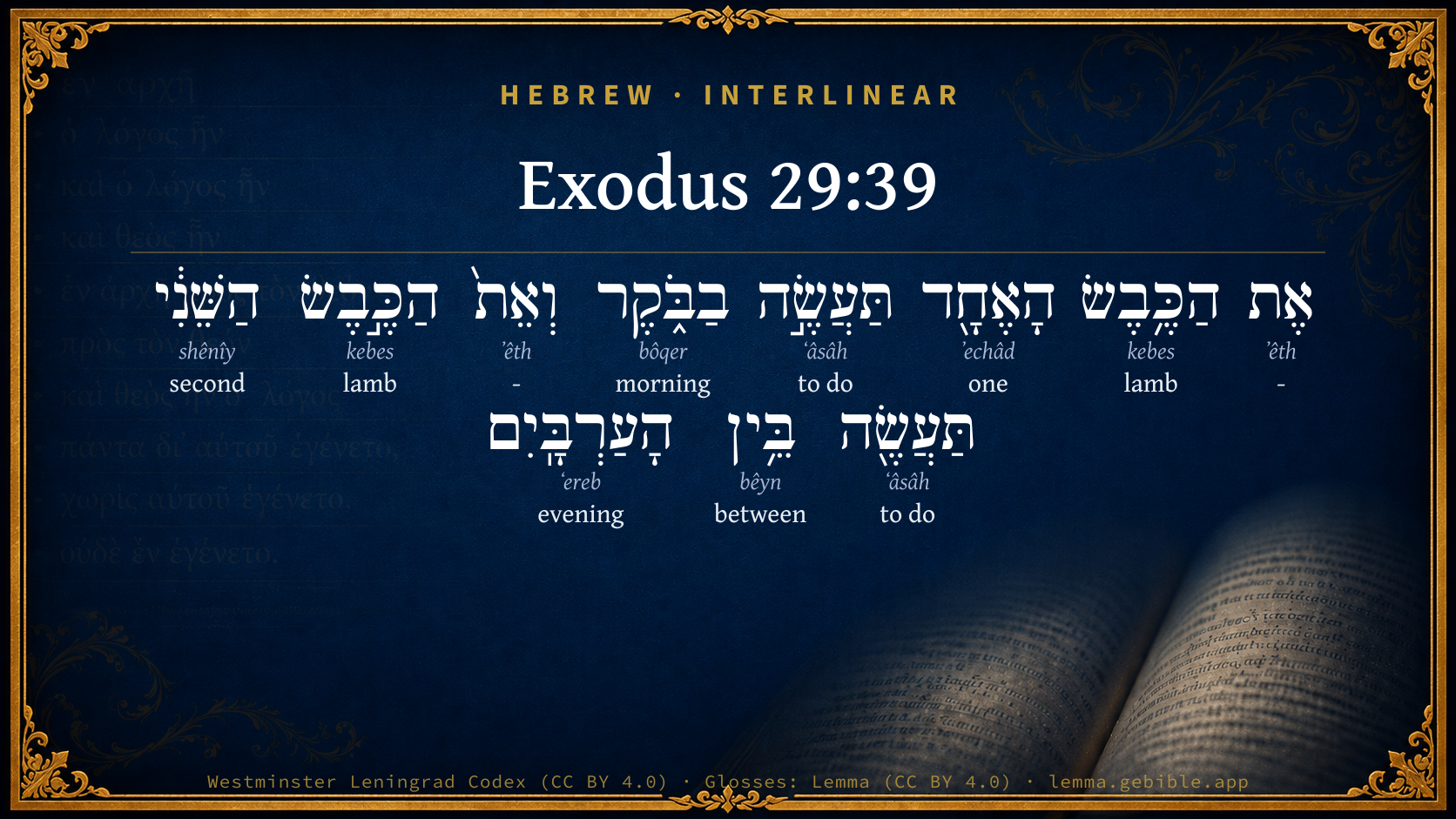
Hebrew (Westminster Leningrad Codex) Exodus 29:39 appears in the Hebrew Old Testament. The text above is from the Westminster Leningrad Codex. Each word links to its Strong’s number, a concise gloss, and parsing drawn from the Open Scriptures Hebrew Bible morphology. Click any word for its full Brown-Driver-Briggs (BDB) entry.
Download image
Cite this verse

Exodus 29:39 (World English Bible). Public Domain. Lemma interlinear Bible study tool, https://lemma.gebible.app/v/exodus/29/39.

Show BibTeX & RIS
BibTeX
RIS
English Translation
The one lamb you shall offer in the morning; and the other lamb you shall offer at evening:
World English Bible · Public Domain
Download a study sheet

One document with this verse’s original text, its word-by-word gloss line, the meaning frame, cross-references with their text, attributed commentary, and full source and license credits — printable, and it pastes into notes with its structure intact.

This verse Autodidact and up

Study sheet (.html) Plain text (.txt)

A passage Seminary Student

Up to 50 verses in one chapter. A passage sheet keeps up to 6 commentary sources and 12 cross-references per verse, in the order this page ranks them, and says so on the sheet whenever that leaves anything out. Ask for a single verse and you get the Autodidact verse sheet above.

Everything on this page stays free to read, with no account — the sheet is a download of what is already on screen, not access to it.

Want to remove ads? Support Godless Engineer
Compare translations 3

The same verse in 3 English versions, stacked beneath the original-language interlinear above. Click any original word for its lexicon entry.

Each is an independent rendering of the whole verse — the interlinear is not word-aligned to these translations.

Highlighted words mark where these versions differ — a whole-verse word diff, not a word-by-word alignment.

  • World English Bible Public Domain
    The one lamb you shall offer in the morning; and the other lamb you shall offer at evening:
  • King James Version Public Domain
    The one lamb thou shalt offer in the morning; and the other lamb thou shalt offer at even:
  • unfoldingWord Literal Text CC BY-SA 4.0
    The one lamb you shall offer in the morning, and the second lamb you shall offer between the evenings.

unfoldingWord Literal Text — © unfoldingWord, licensed CC BY-SA 4.0. Word-aligned USFM3 via Door43 (git.door43.org/unfoldingWord/en_ult).

Versions to compare (up to 4)

3 of 4 selected

Show all 18 translations

Every available English version of this verse, each an independent rendering of the whole verse.

  • World English Bible Public Domain
    The one lamb you shall offer in the morning; and the other lamb you shall offer at evening:
  • Berean Standard Bible Public Domain
    Offer one lamb in the morning and the other at twilight.
  • Majority Standard Bible Public Domain
    Offer one lamb in the morning and the other at twilight.
  • King James Version Public Domain
    The one lamb thou shalt offer in the morning; and the other lamb thou shalt offer at even:
  • American Standard Version (1901) Public Domain
    The one lamb thou shalt offer in the morning; and the other lamb thou shalt offer at even:
  • Revised Version (1885) Public Domain
    The one lamb thou shalt offer in the morning; and the other lamb thou shalt offer at even:
  • Geneva Bible (1599) Public Domain
    The one lambe thou shalt present in the morning, and the other lambe thou shalt present at euen.
  • Douay-Rheims (1899) Public Domain
    One lamb in the morning and another in the evening.
  • Young's Literal Translation Public Domain
    the one lamb thou dost prepare in the morning, and the second lamb thou dost prepare between the evenings;
  • Literal Standard Version CC BY-SA 4.0
    you prepare the first lamb in the morning, and you prepare the second lamb between the evenings;
  • Unlocked Literal Bible CC BY-SA 4.0
    One lamb you must offer in the morning, and the other lamb you must offer about sundown.
  • unfoldingWord Literal Text CC BY-SA 4.0
    The one lamb you shall offer in the morning, and the second lamb you shall offer between the evenings.
  • Darby Bible Public Domain
    The one lamb thou shalt offer in the morning; and the other lamb thou shalt offer between the two evenings.
  • World Messianic Bible Public Domain
    The one lamb you shall offer in the morning; and the other lamb you shall offer at evening;
  • Webster's Bible Public Domain
    The one lamb thou shalt offer in the morning; and the other lamb thou shalt offer at evening.
  • Free Bible Version CC BY-SA 4.0
    In the morning offer one lamb, and offer the other one in the evening before it gets dark.
  • Bible in Basic English Public Domain
    One lamb is to be offered in the morning and the other in the evening:
  • JPS Tanakh (1917) Public Domain
    The one lamb thou shalt offer in the morning; and the other lamb thou shalt offer at dusk.

Literal Standard Version (2020), Covenant Press — licensed CC BY-SA 4.0. Text via the HelloAO Bible API (eBible.org). Unlocked Literal Bible (unfoldingWord) — licensed CC BY-SA 4.0. Text via the HelloAO Bible API (eBible.org). unfoldingWord Literal Text — © unfoldingWord, licensed CC BY-SA 4.0. Word-aligned USFM3 via Door43 (git.door43.org/unfoldingWord/en_ult). Free Bible Version, Dr. Jonathan Gallagher — licensed CC BY-SA 4.0. Text via the HelloAO Bible API (eBible.org).

Word by word

More ways to search: Search by grammar → Find every occurrence → Compare this word →

Practice this passage: Drill this verse → Learn its vocabulary →

הַכֶּ֥בֶשׂ
kebes
H3532
“the · lamb”
Particle, Definite Article + Noun, Common, Masculine, Singular, Absolute
Part of Speech
Particle + Noun
Type
Common
Gender
Masculine
Number
Singular
State
Absolute
Full BDB Definition

Origin: from an unused root meaning to dominate

TWOT: 949

lamb, sheep, young ram
  1. אֶת ʼêth H853 “-” Particle, Direct Object
  2. הָאֶחָ֖ד ʼechâd H259 “the · one” Particle, Definite Article + Adjective, Cardinal number, Masculine, Singular, Absolute
  3. תַּעֲשֶׂ֣ה ʻâsâh H6213 “to do” Verb, Qal, Imperfect, 2nd Person, Masculine, Singular
  4. בַבֹּ֑קֶר bôqer H1242 “in/at the · morning” Preposition, Determined + Noun, Common, Masculine, Singular, Absolute
  5. וְאֵת֙ ʼêth H853 “and · -” Conjunction + Particle, Direct Object
  6. הַכֶּ֣בֶשׂ kebes H3532 “the · lamb” Particle, Definite Article + Noun, Common, Masculine, Singular, Absolute
  7. הַשֵּׁנִ֔י shênîy H8145 “the · second” Particle, Definite Article + Adjective, Ordinal number, Masculine, Singular, Absolute
  8. תַּעֲשֶׂ֖ה ʻâsâh H6213 “to do” Verb, Qal, Imperfect, 2nd Person, Masculine, Singular
  9. בֵּ֥ין bêyn H996 “between” Preposition
  10. הָעַרְבָּֽיִם ʻereb H6153 “the · evenings” Particle, Definite Article + Noun, Common, Masculine, Dual, Absolute

About this verse

These counts appear in no published source. They are computed here, from the morphology-tagged text and Lemma’s own curated glosses. What Lemma adds →

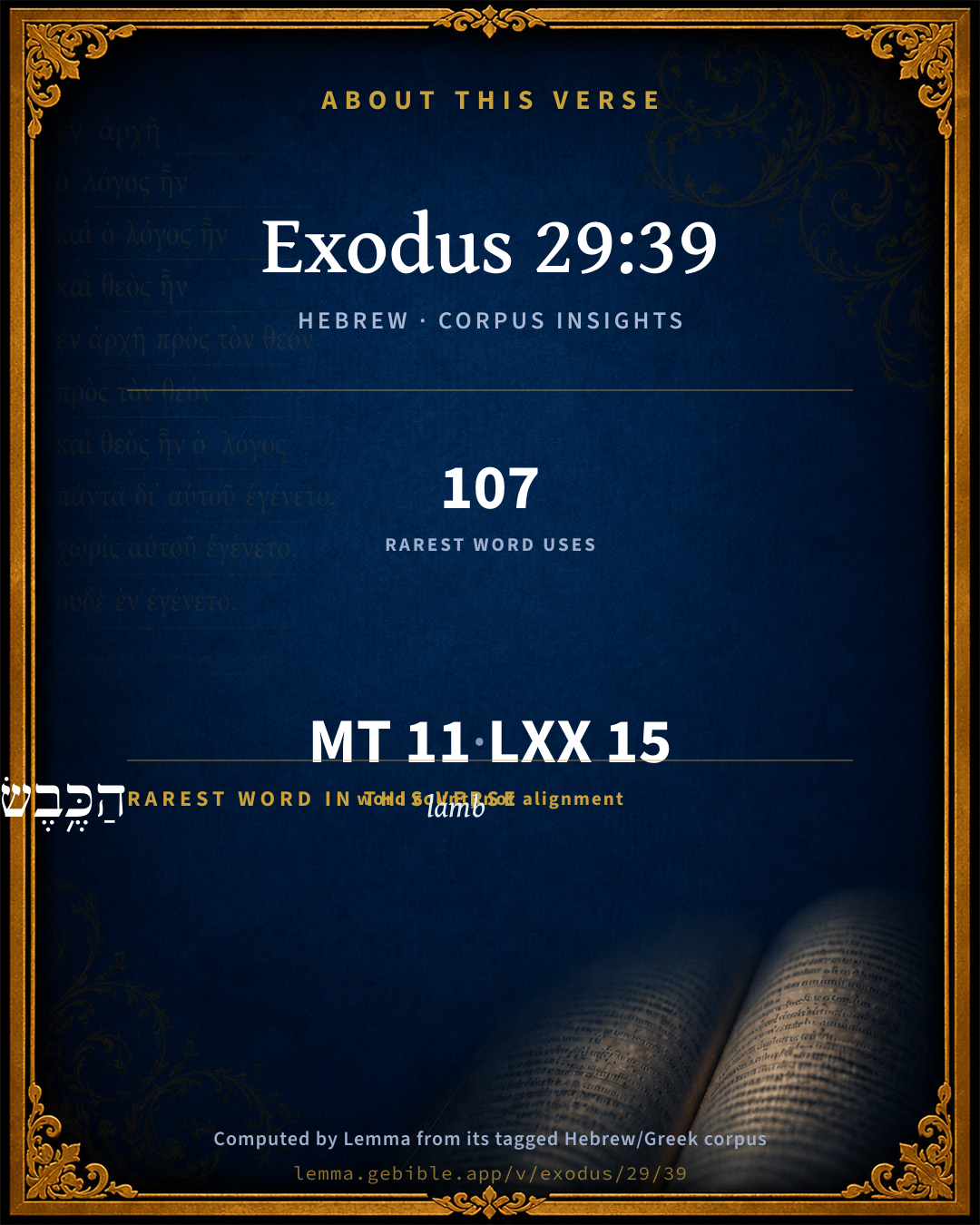
11
words
8
distinct lemmas
Pentateuch
section

Grammatical profile

  • 2 verbs
  • 4 nouns
  • 2 adjectives
  • 1 preposition
  • 2 particles

Verb forms

  • תַּעֲשֶׂ֣ה Qal · Imperfect
  • תַּעֲשֶׂ֖ה Qal · Imperfect

Repetition

Words recur within this verse — often emphatic in Hebrew:

  • הַכֶּ֥בֶשׂ lamb H3532 ×2
  • תַּעֲשֶׂ֣ה to do H6213 ×2

Hebrew & Septuagint length

In English translation the verse runs 18 words from the Hebrew and 18 from the Septuagint (LXX English) — the same length.

A rough comparison of the two English renderings, which tokenize alike — not a word-level alignment.

Word counts can differ between the Hebrew and the Greek without any difference in meaning — e.g. the Hebrew direct-object marker אֵת has no separate Greek word, and Greek often adds the article ὁ.

In the original languages it is 11 Hebrew tokens and 15 Greek tokens — but the two are counted differently (Hebrew bundles its prefixes and suffixes into one token; the Greek is in lemma form), so that isn’t a like-for-like length.

Cross-references

7

Topical passages linked to Exodus 29:39 in the Treasury of Scripture Knowledge — connected by theme and wording, ordered by reader-vote popularity; previews shown in the World English Bible.

  • Ezekiel 46:13–15 You shall prepare a lamb a year old without blemish for a burnt offering to Yahweh daily: morning by morning shall you prepare it.
  • 2 Kings 16:15 King Ahaz commanded Urijah the priest, saying, On the great altar burn the morning burnt offering, and the evening meal-offering, and the king's burnt offering, and his meal-offering, with the burnt offering of all the people of the land, and their meal-offering, and their drink-offerings; and sprinkle on it all the blood of the burnt offering, and all the blood of the sacrifice: but the brazen altar shall be for me to inquire by.
  • 2 Chronicles 13:11 and they burn to Yahweh every morning and every evening burnt offerings and sweet incense: the show bread also [set they] in order on the pure table; and the lampstand of gold with the lamps of it, to burn every evening: for we keep the charge of Yahweh our God; but you have forsaken him.
  • Psalms 5:3 Yahweh, in the morning you shall hear my voice. In the morning I will lay my requests before you, and will watch expectantly.
  • Psalms 55:16–17 As for me, I will call on God. Yahweh will save me.
  • Luke 1:10 The whole multitude of the people were praying outside at the hour of incense.
  • Acts 26:7 which our twelve tribes, earnestly serving night and day, hope to attain. Concerning this hope I am accused by the Jews, King Agrippa!

Cross-references courtesy of OpenBible.info (CC BY 4.0).

Hebrew and Greek witnesses Masoretic Hebrew ↔ Greek Septuagint

The same verse in the two great witnesses to the Old Testament, shown verse-for-verse.

These are two independent witnesses, not word-aligned to each other, and the Septuagint is shown in lemma (dictionary) form.

Hebrew Exodus 29:39 Masoretic · Westminster Leningrad Codex

אֶת הַכֶּ֥בֶשׂ הָאֶחָ֖ד תַּעֲשֶׂ֣ה בַבֹּ֑קֶר וְאֵת֙ הַכֶּ֣בֶשׂ הַשֵּׁנִ֔י תַּעֲשֶׂ֖ה בֵּ֥ין הָעַרְבָּֽיִם

The one lamb you shall offer in the morning; and the other lamb you shall offer at evening:

World English Bible · Public Domain

Greek LXX Exodus 29:39 Septuagint · lemma form

ὁ ἀμνός ὁ εἷς ποιέω ὁ πρωΐ καί ὁ ἀμνός ὁ δεύτερος ποιέω ὁ δειλινός

One lamb you shall offer in the morning, and the second lamb you shall offer in the evening.

LXX2012 (modern English Septuagint) · Public Domain

Hebrew: Westminster Leningrad Codex (CC BY 4.0). Greek: Septuagint (public domain); English from LXX2012 (modern English Septuagint) (Public Domain). How the Septuagint differs from the Hebrew →

Targum (Aramaic paraphrase)

2

The Targum is the ancient Jewish Aramaic paraphrase of the Hebrew Scriptures — an interpretive translation, not the Hebrew text itself. Onkelos (literal) and Pseudo-Jonathan (expansive) render the Torah, and Jonathan the Prophets. Coverage is partial: where no permissively-licensed English translation exists for a verse, only the Aramaic is shown. This is verse-level text, not a word-by-word alignment to the Hebrew.

  1. Targum Onkelos Torah (Genesis–Deuteronomy)
    יָת אִמְרָא חַד תַּעְבֵּד בְּצַפְרָא וְיָת אִמְרָא תִנְיָנָא תַּעְבֵּד בֵּין שִׁמְשַׁיָא:

    (no public-domain English translation for this verse)

    Targum Onkelos — Aramaic: “Onkelos Genesis” (public domain); “Onkelos Exodus” (public domain); “Onkelos Leviticus” (public domain); “Onkelos Numbers” (public domain); “Onkelos Deuteronomy” (public domain). English: “Sefaria Community Translation” (CC0 1.0 (public-domain dedication)); “J.W. Etheridge. The Targums of Onkelos and Jonathan Ben Uzziel on the Pentateuch. London: Longmans, Green, 1862” (public domain). Text via Sefaria.

  2. Targum Pseudo-Jonathan Torah (Genesis–Deuteronomy)
    יַת אִימְרָא חַד תַּעֲבֵיד בְּצַפְרָא וְיַת אִימְרָא תִנְיָנָא תַעֲבֵיד בֵּינֵי שִׁימְשָׁתָא

    The one lamb thou shalt perform in the morning; and the second lamb thou shalt perform between the evenings.

    Targum Pseudo-Jonathan — Aramaic: “Targum Jonathan on Genesis” (public domain); “Targum Jonathan on Exodus” (public domain); “Targum Jonathan on Leviticus” (public domain); “Targum Jonathan on Numbers” (public domain); “Targum Jonathan on Deuteronomy” (public domain). English: “The Targum of Jonathan ben Uzziel, trans. J. W. Etheridge, London, 1862” (public domain). Text via Sefaria.

Commentary

Notes on Exodus 29:39 from classic Christian and Jewish commentators (each source and its license shown beneath its notes). The classic Christian expositions comment on the surrounding passage and are grouped to its opening verse, so a note may address several verses; the Jewish commentaries on the Tanakh (Rashi and others) are per-verse, so they appear only where the commentator wrote on this verse.

Lemma curates 59 commentaries, every one of them public domain or Creative Commons licensed, each selected and text-cleaned for this edition rather than reprinted as found. About our sources →

Trapp's Complete Commentary

John Trapp

Exo 29:39 The one lamb thou shalt offer in the morning; and the other lamb thou shalt offer at even:

Ver. 39. Thou shalt offer in the morning.] These two lambs were types of the Lamb of God, taking away the sins of the world, with a commemoration of whose benefits the day was begun and ended. Wherefore, also, from David’s days and forwards, they sang the 22nd Psalm at the morning sacrifice, and the 136th Psalm at the evening.

John Trapp, A Commentary or Exposition upon All the Books of the Old and New Testament (1647–1656) — public domain. Text from a community e-Sword module.

Adam Clarke's Commentary

Verse 39. One lamb thou shalt offer in the morning] These two lambs, one in the morning, and the other in the evening, were generally termed the morning and evening daily sacrifices, and were offered from the time of their settlement in the promised land to the destruction of Jerusalem by the Romans. The use of these sacrifices according to the Jews was this: "The morning sacrifice made atonement for the sins committed in the night, and the evening sacrifice expiated the sins committed during the day."

Adam Clarke's Commentary on the Bible (1810–1826) — public domain. Text from a community e-Sword/MySword module.

The Cambridge Bible for Schools and Colleges

gen. ed. J. J. S. Perowne

39. between the two evenings] see on Exo_12:6.

The Cambridge Bible for Schools and Colleges (gen. ed. J. J. S. Perowne; Cambridge University Press, 1878–1918) — public domain. Text from a community e-Sword module.

John Gill's Exposition

The one lamb thou shalt offer in the morning,.... And before this no other sacrifice was to be offered, and therefore it was slain and offered very early; and yet it was not lawful to slay it before break of day, wherefore great care was taken that it should not;"he that was appointed over the service used to say to the priests, go out, and see if the time of slaying is come; if it is come, he that went out to see, said, coruscations or brightnesses; Matthias the son of Samuel said, does it enlighten the face of the whole east as far as Hebron? he said, yes; why was this necessary? because one time the light of the moon ascended, and they thought the east was enlightened (or it was break of day), and they slew the sacrifice (h):"

and the other lamb thou shalt offer at even, or

between the two evenings; of which phrase See Gill on Exo 12:6 Josephus (i) says, it was about the ninth hour, or three o'clock in the afternoon, that the daily sacrifice was offered: the Misnic doctors say (k), it was slain at eight and a half, or half an hour after two o'clock, and was offered up at nine and a half, or half an hour after three o'clock: they stayed as long as they could before they offered it, because no sacrifice was offered after it but the passover. We are told that the lamb of the morning was slain in the northwest corner of the altar, and that of the evening in the northeast corner (l): the reason of this was, because in the morning the sun was in the east, and shone over against the west; but the evening daily sacrifice was when the sun was in the west, and shone opposite the east (m): this was in a good measure literally fulfilled in Christ, namely, as to the time of slaying and offering the daily sacrifice; for he was crucified at the third hour, that is, at nine o'clock in the morning, at the sixth hour, or at twelve o'clock at noon, darkness was upon the earth, which continued till the ninth, and then he gave up the ghost, which was three o'clock in the afternoon, the usual time of slaying and offering the daily evening sacrifice, Mar 15:25 and this may signify the extensiveness of Christ's sacrifice, reaching from the morning of the world to the evening of it. He was slain and offered up in the morning of the world, in the purpose and promise of God, in the typical sacrifices of men, and in the faith of his people, who looked to him as the atoning Saviour, and in the efficacy of his blood, which reached to all the saints from the beginning, for the pardon and atonement of their sins; and it was at the end or evening of the Jewish world and state that Christ was offered up a sacrifice for sin, and the virtue of it will continue to the end of the world. Christ is the Lamb of God that continues to take away the sin of the world, and his blood continues to cleanse from all sin, and he ever lives to make intercession for transgressors. Good men are continually sinning, and they ever stand in need of the application of pardoning grace and mercy; there are sins of the night, and the sins of the day they fall into, and nothing can expiate them but the blood and sacrifice of Christ. The repetition of these sacrifices every day, morning and night, shows that they could not really and perfectly take away sin; the cessation of them was a token of perfect atonement by Christ, which made them needless and useless: and this may teach us, that the sacrifices of prayer and praise should be morning and evening; in the morning we should express our thankfulness for the mercies of the night, and pray for the continuance of them the day following; and at the evening we should offer up the sacrifices of praise for the mercies of the day, and pray for the mercies of the night; and at both seasons should be concerned to have a fresh application of the atoning blood and sacrifice of Christ, for the taking away from us the sins of the night and day.

(h) Misn. Yoma, c. 3. sect. 1, 2. Tamid, c. 3. sect. 2. (i) Joseph. Antiqu. l. 14. c. 4. sect. 3. (k) Misn. Pesachim, c. 5. sect. 1. (l) Misn. Tamid, c. 4. sect. 1. (m) Bartenora in Misn. Tamid, c. 4. sect. 1.

John Gill's Exposition of the Whole Bible (1746–1763) — public domain (CC PDM 1.0). Text via the HelloAO Bible API.

Haydock's Catholic Bible Commentary

Morning. About sun-rise. --- Evening, or between the two vespers, Exodus xii. 6. The lambs were provided by the people; flour, wine, and oil, by the priests. (Philo) --- The wine was poured at the foot of the altar, the flour and oil were burnt upon it, and not placed on the head of the victim, as was customary among the pagans, frontique invergit vina sacerdos. (Virgil, vi.; Maimonides) By these sacrifices, God was to be adored as the author both of day and night; (Menochius) and we are admonished of our duty of praying to him, particularly at those times. (Haydock) --- All the sacrifices prefigured that of Christ, (St. Augustine, contra advers. i. 18,) but none more than these of lambs. (Origen in Jo.) (Worthington)

George Leo Haydock (1774–1849), Haydock's Catholic Family Bible and Commentary, 1859 edition — public domain. Excludes Psalms (Douay-Rheims chapter numbering differs from Protestant) and Deuterocanonical books (Catholic canon only).

Matthew Poole's English Annotations

Which two seasons were selected as most commodious, that men might both begin and end their worldly actions said businesses with God, and might see their need of God’s assistance and blessing in all their concerns, and the justness of giving him the praise and glory of all.

Matthew Poole's English Annotations on the Holy Bible (1683–1685) — public domain. Text from a community e-Sword/MySword module.

Whedon's Commentary on the Bible

Daniel D. Whedon

39. Morning… even — As regularly as the sun was wont to rise and set, so regularly were these sacrifices to be offered unto the Lord. Even is the same expression in Hebrew as between the two evenings in the margin of Exo_12:6, where see note.

Daniel D. Whedon (gen. ed.), Commentary on the Old and New Testaments (1874–1909) — public domain. Text from a community e-Sword module.

The Pulpit Commentary

At even. Literally, "between the two evenings." (See the comment on Exo_12:6) Josephus says (Ant. Jud: 14:4, that the hour in ordinary use was three.

The Pulpit Commentary (1880–1919), ed. H.D.M. Spence-Jones & Joseph S. Exell — public domain. Text from a community e-Sword module.

Lesson kit

Teaching starters — assembled from the data on this page, not authored interpretation. Every prompt links to the verse data it draws on. Edit before teaching.

Exodus, in the Pentateuch, opens this verse with 11 words (8 distinct Hebrew lemmas). Its most distinctive word is kebes (“lamb”). A historical commentator’s framing appears above. Read the whole chapter for the surrounding context.

Discussion questions

  1. What does “lamb” (kebes) contribute to the verse as a whole?
  2. How does Ezekiel 46:13–15, which shares this passage’s theme, read alongside this verse?
  3. What does the repetition of “lamb” (2× in this one verse) do in this verse?
  4. These translations render this verse differently; the difference is in the English rendering, not the original. What questions does that raise?
  5. «תַּעֲשֶׂ֣ה» is a Qal Imperfect verb. How does that grammatical form shape the action described?
  6. Compare how Trapp's Complete Commentary and Adam Clarke's Commentary read this verse. Where do they agree or differ?

Things to notice

Reading settings

Reading text

Shown beneath each verse's original-language words.

Old Testament
Old Testament edition

Read the OT as the Masoretic Hebrew (MT) or the Greek Septuagint (LXX).

English shown for the Greek Septuagint (in the Hebrew ↔ Greek comparison).

Comparing translations? Open the Compare panel on any verse page to stack up to four side by side.