
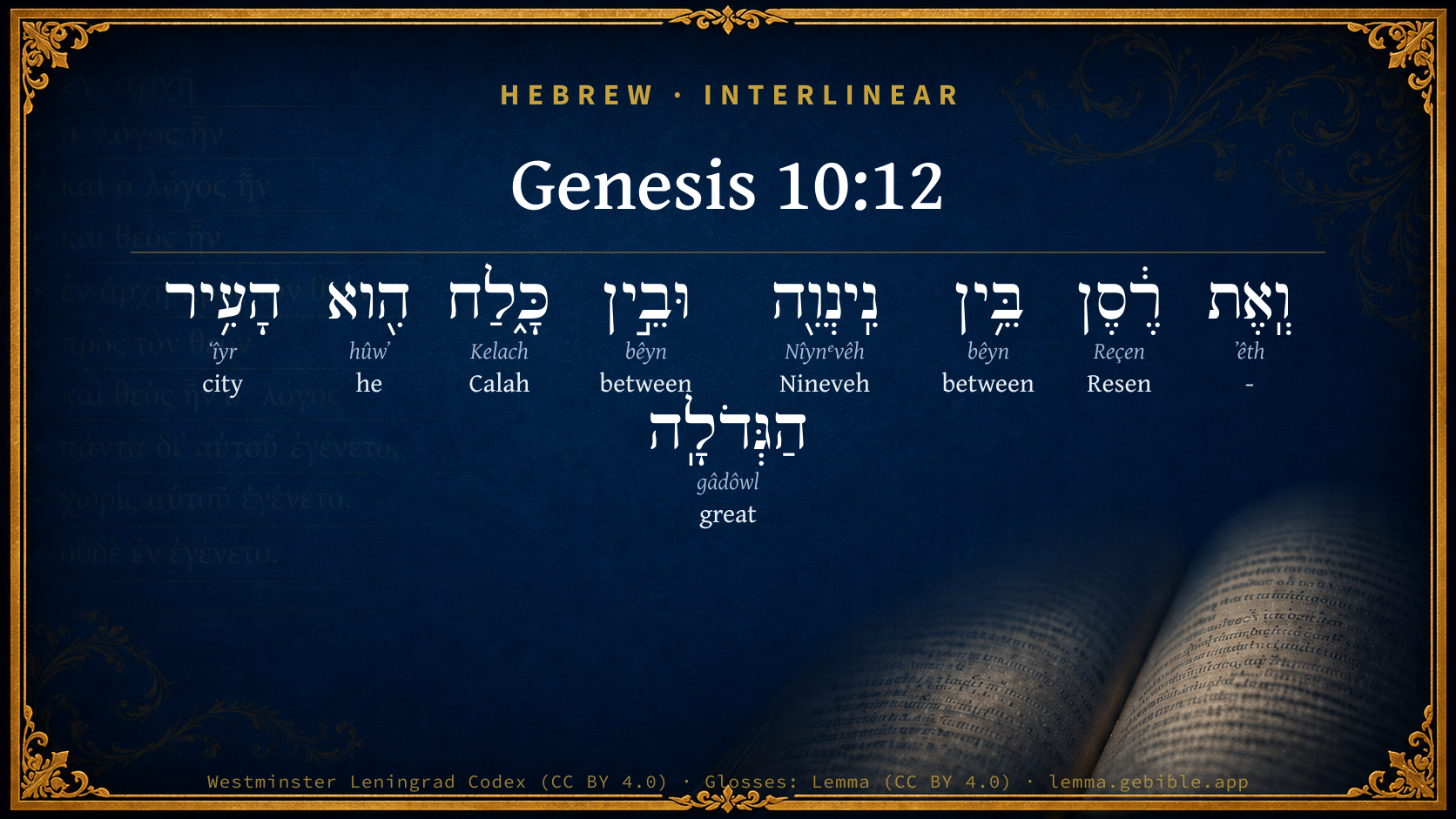
Genesis 10:12

Hebrew (Westminster Leningrad Codex) Genesis 10:12 appears in the Hebrew Old Testament. The text above is from the Westminster Leningrad Codex. Each word links to its Strong’s number, a concise gloss, and parsing drawn from the Open Scriptures Hebrew Bible morphology. Click any word for its full Brown-Driver-Briggs (BDB) entry.
Download image
Cite this verse

Genesis 10:12 (World English Bible). Public Domain. Lemma interlinear Bible study tool, https://lemma.gebible.app/v/genesis/10/12.

Show BibTeX & RIS
BibTeX
RIS
English Translation
and Resen between Nineveh and Calah (the same is the great city).
World English Bible · Public Domain
Highlights
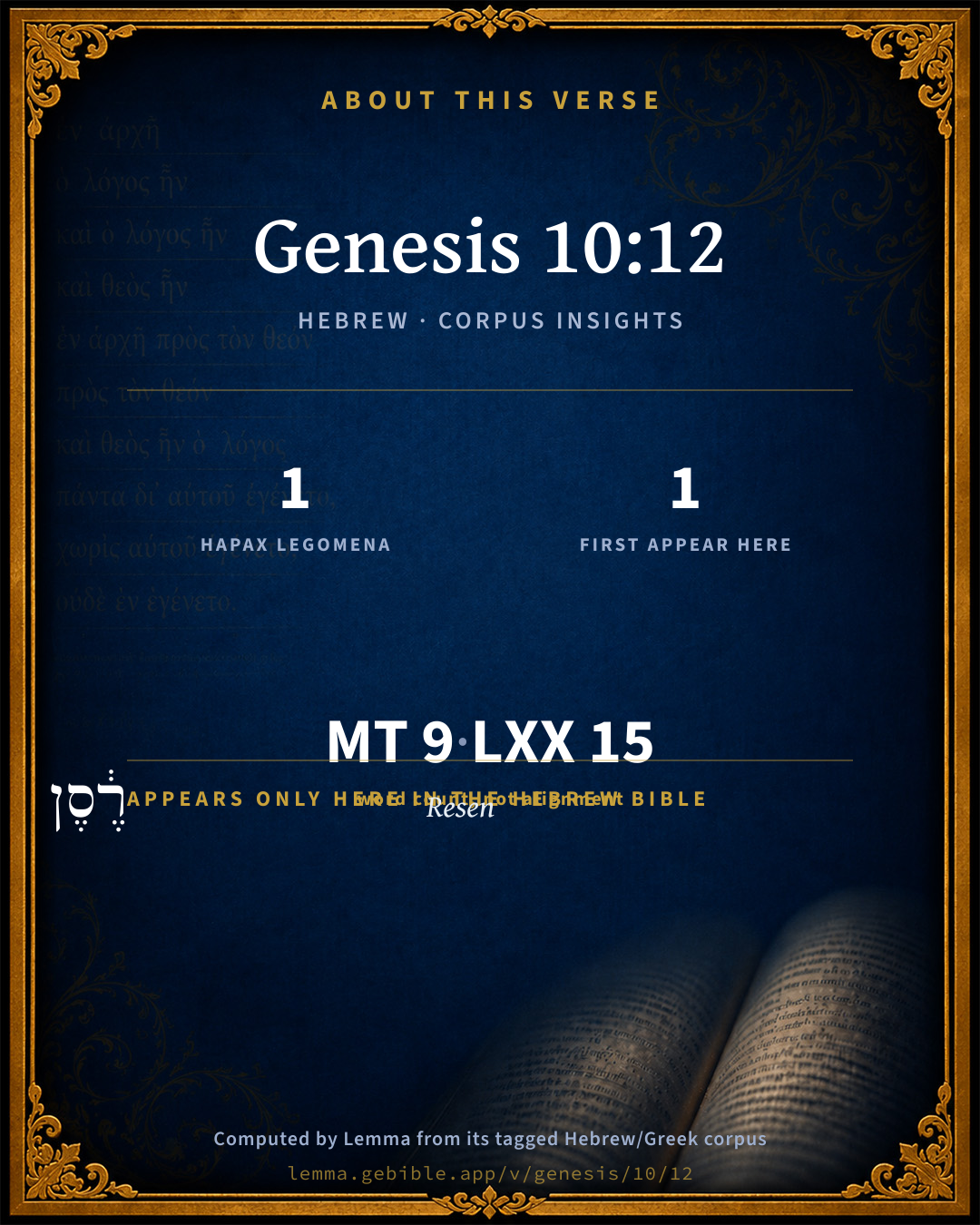
  • 1 hapax legomenon — only here in the Hebrew Bible
  • 1 first appearance in the Hebrew Bible
Full analysis ↓
Download a study sheet

One document with this verse’s original text, its word-by-word gloss line, the meaning frame, cross-references with their text, attributed commentary, and full source and license credits — printable, and it pastes into notes with its structure intact.

This verse Autodidact and up

Study sheet (.html) Plain text (.txt)

A passage Seminary Student

Up to 50 verses in one chapter. A passage sheet keeps up to 6 commentary sources and 12 cross-references per verse, in the order this page ranks them, and says so on the sheet whenever that leaves anything out. Ask for a single verse and you get the Autodidact verse sheet above.

Everything on this page stays free to read, with no account — the sheet is a download of what is already on screen, not access to it.

Want to remove ads? Support Godless Engineer
Compare translations 3

The same verse in 3 English versions, stacked beneath the original-language interlinear above. Click any original word for its lexicon entry.

Each is an independent rendering of the whole verse — the interlinear is not word-aligned to these translations.

Highlighted words mark where these versions differ — a whole-verse word diff, not a word-by-word alignment.

  • World English Bible Public Domain
    and Resen between Nineveh and Calah (the same is the great city).
  • King James Version Public Domain
    And Resen between Nineveh and Calah: the same is a great city.
  • unfoldingWord Literal Text CC BY-SA 4.0
    and Resen, between Nineveh and Calah, which the great city.

unfoldingWord Literal Text — © unfoldingWord, licensed CC BY-SA 4.0. Word-aligned USFM3 via Door43 (git.door43.org/unfoldingWord/en_ult).

Versions to compare (up to 4)

3 of 4 selected

Show all 18 translations

Every available English version of this verse, each an independent rendering of the whole verse.

  • World English Bible Public Domain
    and Resen between Nineveh and Calah (the same is the great city).
  • Berean Standard Bible Public Domain
    and Resen, which is between Nineveh and the great city of Calah.
  • Majority Standard Bible Public Domain
    and Resen, which is between Nineveh and the great city of Calah.
  • King James Version Public Domain
    And Resen between Nineveh and Calah: the same is a great city.
  • American Standard Version (1901) Public Domain
    and Resen between Nineveh and Calah (the same is the great city).
  • Revised Version (1885) Public Domain
    and Resen between Nineveh and Calah (the same is the great city).
  • Geneva Bible (1599) Public Domain
    Resen also betweene Niniueh and Calah: this is a great citie.
  • Douay-Rheims (1899) Public Domain
    Resen also between Ninive and Chale: this is the great city.
  • Young's Literal Translation Public Domain
    and Resen, between Nineveh and Calah; it `is' the great city.
  • Literal Standard Version CC BY-SA 4.0
    and Resen, between Nineveh and Calah; it [is] the great city.
  • Unlocked Literal Bible CC BY-SA 4.0
    and Resen, which was between Nineveh and Calah. It was a large city.
  • unfoldingWord Literal Text CC BY-SA 4.0
    and Resen, between Nineveh and Calah, which the great city.
  • Darby Bible Public Domain
    and Resen, between Nineveh and Calah: this is the great city.
  • World Messianic Bible Public Domain
    and Resen between Nineveh and the great city Calah.
  • Webster's Bible Public Domain
    And Resen between Nineveh and Calah: the same is a great city.
  • Free Bible Version CC BY-SA 4.0
    and Resen, which lies between Nineveh and the great city of Calah.
  • Bible in Basic English Public Domain
    And Resen between Nineveh and Calah, which is a very great town.
  • JPS Tanakh (1917) Public Domain
    and Resen between Nineveh and Calah — the same is the great city.

Literal Standard Version (2020), Covenant Press — licensed CC BY-SA 4.0. Text via the HelloAO Bible API (eBible.org). Unlocked Literal Bible (unfoldingWord) — licensed CC BY-SA 4.0. Text via the HelloAO Bible API (eBible.org). unfoldingWord Literal Text — © unfoldingWord, licensed CC BY-SA 4.0. Word-aligned USFM3 via Door43 (git.door43.org/unfoldingWord/en_ult). Free Bible Version, Dr. Jonathan Gallagher — licensed CC BY-SA 4.0. Text via the HelloAO Bible API (eBible.org).

Word by word

More ways to search: Search by grammar → Find every occurrence → Compare this word →

Practice this passage: Drill this verse → Learn its vocabulary →

About this verse

These counts appear in no published source. They are computed here, from the morphology-tagged text and Lemma’s own curated glosses. What Lemma adds →

9
words
8
distinct lemmas
Pentateuch
section

Notable vocabulary

1 hapax legomenon — a word that appears only here in the entire Hebrew Bible:

  • רֶ֔סֶן Resen H7449

First appearance in Scripture

This word makes its first canonical appearance in the Hebrew Bible here:

  • רֶ֔סֶן Resen H7449

Shared distinctive vocabulary

כָּ֑לַח Calah H3625 occurs in 2 verses of the Hebrew Bible. Also found in:

Grammatical profile

  • 4 nouns
  • 1 adjective
  • 1 pronoun
  • 2 prepositions
  • 1 particle

Repetition

A word recurs within this verse — often emphatic in Hebrew:

  • בֵּ֥ין between H996 ×2

Hebrew & Septuagint length

In English translation the verse runs 12 words from the Hebrew and 11 from the Septuagint (LXX English) — closely comparable.

A rough comparison of the two English renderings, which tokenize alike — not a word-level alignment.

Word counts can differ between the Hebrew and the Greek without any difference in meaning — e.g. the Hebrew direct-object marker אֵת has no separate Greek word, and Greek often adds the article ὁ.

In the original languages it is 9 Hebrew tokens and 15 Greek tokens — but the two are counted differently (Hebrew bundles its prefixes and suffixes into one token; the Greek is in lemma form), so that isn’t a like-for-like length.

Hebrew and Greek witnesses Masoretic Hebrew ↔ Greek Septuagint

The same verse in the two great witnesses to the Old Testament, shown verse-for-verse.

These are two independent witnesses, not word-aligned to each other, and the Septuagint is shown in lemma (dictionary) form.

Hebrew Genesis 10:12 Masoretic · Westminster Leningrad Codex

וְֽאֶת רֶ֔סֶן בֵּ֥ין נִֽינְוֵ֖ה וּבֵ֣ין כָּ֑לַח הִ֖וא הָעִ֥יר הַגְּדֹלָֽה

and Resen between Nineveh and Calah (the same is the great city).

World English Bible · Public Domain

Greek LXX Genesis 10:12 Septuagint · lemma form

καί ὁ δασεμ ἀνά μέσος νινευη καί ἀνά μέσος χαλαχ οὗτος ὁ πόλις ὁ μέγας

and Dase between Ninevi and Chalach: this is the great city.

LXX2012 (modern English Septuagint) · Public Domain

Hebrew: Westminster Leningrad Codex (CC BY 4.0). Greek: Septuagint (public domain); English from LXX2012 (modern English Septuagint) (Public Domain). How the Septuagint differs from the Hebrew →

Targum (Aramaic paraphrase)

2

The Targum is the ancient Jewish Aramaic paraphrase of the Hebrew Scriptures — an interpretive translation, not the Hebrew text itself. Onkelos (literal) and Pseudo-Jonathan (expansive) render the Torah, and Jonathan the Prophets. Coverage is partial: where no permissively-licensed English translation exists for a verse, only the Aramaic is shown. This is verse-level text, not a word-by-word alignment to the Hebrew.

  1. Targum Onkelos Torah (Genesis–Deuteronomy)
    וְיָת רֶסֶן בֵּין נִינְוֵה וּבֵין כָּלַח הִיא קַרְתָּא רַבְּתָא

    and Resen, between Nineveh and Kalach, which was a great city.

    Targum Onkelos — Aramaic: “Onkelos Genesis” (public domain); “Onkelos Exodus” (public domain); “Onkelos Leviticus” (public domain); “Onkelos Numbers” (public domain); “Onkelos Deuteronomy” (public domain). English: “Sefaria Community Translation” (CC0 1.0 (public-domain dedication)); “J.W. Etheridge. The Targums of Onkelos and Jonathan Ben Uzziel on the Pentateuch. London: Longmans, Green, 1862” (public domain). Text via Sefaria.

  2. Targum Pseudo-Jonathan Torah (Genesis–Deuteronomy)
    וְיַת תַּלְסַר דְמִתְבַּנְיָא בֵּינֵי נִינְוֵה וּבֵינֵי חַרְיַית אִיהִי קַרְתָּא רַבְּתָא

    And Talesar, which was builded between Nineveh and Hadiath; that is a great city.

    Targum Pseudo-Jonathan — Aramaic: “Targum Jonathan on Genesis” (public domain); “Targum Jonathan on Exodus” (public domain); “Targum Jonathan on Leviticus” (public domain); “Targum Jonathan on Numbers” (public domain); “Targum Jonathan on Deuteronomy” (public domain). English: “The Targum of Jonathan ben Uzziel, trans. J. W. Etheridge, London, 1862” (public domain). Text via Sefaria.

Commentary

Notes on Genesis 10:12 from classic Christian and Jewish commentators (each source and its license shown beneath its notes). The classic Christian expositions comment on the surrounding passage and are grouped to its opening verse, so a note may address several verses; the Jewish commentaries on the Tanakh (Rashi and others) are per-verse, so they appear only where the commentator wrote on this verse.

Lemma curates 59 commentaries, every one of them public domain or Creative Commons licensed, each selected and text-cleaned for this edition rather than reprinted as found. About our sources →

Trapp's Complete Commentary

John Trapp

Gen 10:12 And Resen between Nineveh and Calah: the same [is] a great city.

Ver. 12. The same is a great city.] As consisting of three cities, and having more people within the walls than are now in some one kingdom. See the greatness of this city set forth in the Preacher’s Travels, p. 89. The greatest city in the world at this day is said to be Quinsai, in Tartary, which is a hundred miles about, as M. Paulus Venetus writeth, who himself dwelt therein, about the year 1260. Cambula, the imperial city, and seat of the great Cham of Tartary, is in circuit twenty-eight miles about. {a} Nineveh was three days’ journey in Jonah’s days: now it is destroyed (as was long since prophesied by Nahum), being nothing else than a sepulchre of herself, a little town of small trade, where the Patriarch of the Nestorians keeps his seat at the devotion of the Turk. As Susa, in Persia, once a lily (as the name signifies), for the sweet sight, and so rich, as afterwards is reported, {Gen 11:3} is now called Valdac, of the poverty of the place. {b}

{a} Turk. Hist., fol. 75.

{b} Preacher’s Travels, 88.

John Trapp, A Commentary or Exposition upon All the Books of the Old and New Testament (1647–1656) — public domain. Text from a community e-Sword module.

The Cambridge Bible for Schools and Colleges

gen. ed. J. J. S. Perowne

12. Resen] Not yet identified; but conjectured to lie among the mounds which conceal ruins between Nineveh and Nimrud.

(the same is the great city)] This is a note added by the compiler; or, possibly, as Skinner suggests, a gloss, referring to Nineveh, which is misplaced.

13–19 (J). The descendants of Mizraim (Egypt), Gen_10:13-14; and of Canaan (Phoenicia), Gen_10:15-19. The names of tribes (the plural termination -im) in Gen_10:13-14, and of peoples (Gen_10:16-19), seem to imply a different source of tradition from that in Gen_10:2-7.

The Cambridge Bible for Schools and Colleges (gen. ed. J. J. S. Perowne; Cambridge University Press, 1878–1918) — public domain. Text from a community e-Sword module.

John Gill's Exposition

And Resen, between Nineveh and Calah,.... This was another city built by Ashur, situated between those two cities mentioned: the Targums of Jonathan and Jerusalem call it Talsar, or Thalassar, see Isa 37:12 The conjecture of Bochart (b) is more probable, that it is the Larissa of Xenophon, situated on the Tigris; though Junius thinks it is either Bassora, or Belcina, which Ptolemy (c) places on the Tigris, near Nineveh:

the same is a great city: which Jarchi interprets of Nineveh, called a great city, and was indeed one, being sixty miles in circumference, Jon 1:2 but the construction of the words carries it to Resen, which might be the greatest city when first built; and, if understood of Larissa, was a great city, the walls of it being one hundred feet high, and the breadth twenty five, and the compass of it eight miles. Benjamin of Tudela says (d), that in his time Resen was called Gehidagan, and was a great city, in which were 5000 Israelites; but according to Schmidt, this refers to all the cities in a coalition, Nineveh, Rehoboth, Calah, and Resen, which all made that great city Nineveh; or were a Tetrapolis, as Tripoli was anciently three cities, built by the joint interest of the Aradians, Sidonians, and Tyrians, as Diodorus Siculus (e) relates.

(b) Phaleg. l. 4. c. 23. (c) Ut supra. (Geograph. l. 5. c. 19.) (d) Itinerarium, p. 75. (e) Bibliothec. l. 16. p. 439.

John Gill's Exposition of the Whole Bible (1746–1763) — public domain (CC PDM 1.0). Text via the HelloAO Bible API.

Haydock's Catholic Bible Commentary

Resen, perhaps Larissa, here written without the La; as 1 Paralipomenon v. 26. Hala has the preposition, and is written Lahela. (Bochart.) --- This, &c. It is doubtful which of these three cities is meant: but as we know that Ninive was remarkable for size and magnificence, we may suppose this is designated. (Calmet) (Menochius)

George Leo Haydock (1774–1849), Haydock's Catholic Family Bible and Commentary, 1859 edition — public domain. Excludes Psalms (Douay-Rheims chapter numbering differs from Protestant) and Deuterocanonical books (Catholic canon only).

Matthew Poole's English Annotations

Either,

1. Nineveh, which is called a

great city, Jon 3:3; 4:11; and indeed was so, being sixty miles in compass. Thus it is a trajection, and the relative is referred to the remoter noun, as sometimes is done, though this seems to be a little forced. Or,

2. Resen; so the meaning is, though this city be much inferior to Nineveh, yet this also, if compared with most others, is a great city.

Matthew Poole's English Annotations on the Holy Bible (1683–1685) — public domain. Text from a community e-Sword/MySword module.

The Pulpit Commentary

And Resen, i.e. Nimrod, between Kalah Shergat and Kouyunjik (Kalisch); but if Calah be Nimroud, then Rosen may be Selamiyeh, a village about half way, between Nineveh and Calah, i.e. Kouyunjik and Nimroud, ut supra (Layard). The same. Rosen (Kalisch), which will suit if it was Nimroud, whose remains cover a parallelogram about 1800 feet in length and 900 feet in breadth; but others apply it to Nineveh with the other towns as forming one large composite city (Knobel, Keil, Lange, Wordsworth). Is a great city. With this the record of Nimrod s achievements closes. It is generally supposed that Nimrod flourished either before or about the time of the building of the tower of Babel; but Prof. Chwolsen of St. Petersburg, in his "Ueber die Ueberreste der Altbabylon-ischen Literatur,"brings the dynasty of Nimrod down as late as 1500 B.C., relying principally on the evidence of an original work composed by Qut ami, a native Babylonian, and translated by Ibnwa hachijah, a descendant of the Chaldaeans, and assigned by Chwolsen to one of the earlier periods of Babylonian history, in which is mentioned the name of Nemrod, or Nemroda, as the founder of a Canaanite dynasty which ruled at Babylon (vide an excellent paper on this subject in Turner"s "Biblical and Oriental Studies," Edin., A. and C. Black, 1876). Perhaps the hardest difficulty to explain in connection with the ordinary date assigned to Nimrod is the fact that in Genesis 14., which speaks of the reigning monarchs in the Euphrates valley, there is no account taken of Nineveh and its king a circumstance which has been supposed to import that the founding of the capital of Assyria could not have been anterior to the days of Abraham. But early Babylonian texts confirm what Genesis 14. seems to imply the fact of an Elamite conquest of Babylonia, B.C. 2280, by Kudur-nanhundi (Kudurlagamar, the Chederlaomer of Genesis), who carried off an image of the goddess Nana from the city Erech (vide "Assyrian Discoveries," Genesis 12.; "Records of the Past," vol. 3.), so that this difficulty may be held to have disappeared before the light of archaeological discovery. But at whatever period Nimrod flourished, the Biblical narrative would lead us to anticipate a commingling of Hamitic and Shemitic tongues in the Euphrates valley, which existing monuments confirm (cf. "Records of the Past," vol. 3. p. 3).

The Pulpit Commentary (1880–1919), ed. H.D.M. Spence-Jones & Joseph S. Exell — public domain. Text from a community e-Sword module.

Scofield Reference Notes

C. I. Scofield

Nineveh

(See Scofield "Isa 13:1").

The Scofield Reference Bible (1917 edition), notes by C. I. Scofield — public domain. Text from a community e-Sword module.

Rashi

Rabbi Shlomo Yitzchaki (Rashi)

העיר הגדלה THE GREAT CITY — This refers to Nineveh (not to Calah the last mentioned city nor to Resen), as it is said (Jonah 3:3) “Now Nineveh was an exceeding great city” (Yoma 10a).

Rashi on the Tanakh — English translations: “The Judaica Press complete Tanach with Rashi, translated by A. J. Rosenberg” (CC BY 4.0); “Pentateuch with Rashi's commentary by M. Rosenbaum and A.M. Silbermann, 1929-1934” (public domain); “The Metsudah Tanach series, Lakewood, N.J” (CC BY 4.0); and “The Book of Joshua, Metsudah Publications, 1997” (CC BY 4.0). Text via Sefaria.

Radak

Rabbi David Kimhi (Radak)

ויבן את נינוה היא העיר הגדולה, most commentators believe that the words העיר הגדולה refer to the city Nineveh, seeing that this city has been described in similar terms in Jonah 3,3. I believe that actually, these words refer to רסן, seeing that our verse speaks about this city in the first place. The entire story, as we mentioned previously, has as its objective to demonstrate how ownership of even a sizable land or city is subject to rapid change. Even though Ashur established a great empire, this empire was crushed by the Babylonians who replaced them, and who, in turn were replaced in short order by the Persians and the Medes.

Radak on the Tanakh — English translations: “Sefaria Community Translation” (CC0 1.0 (public-domain dedication)); “Eliyahu Munk, HaChut Hameshulash” (CC BY 4.0); “Rabbi Mike Feuer, Jerusalem Anthology” (CC BY 4.0); and “R. David Kimhi on the first book of Psalms, Translated by R.G. Finch, London, 1919” (public domain). Text via Sefaria.

Lesson kit

Teaching starters — assembled from the data on this page, not authored interpretation. Every prompt links to the verse data it draws on. Edit before teaching.

Genesis, in the Pentateuch, opens this verse with 9 words (8 distinct Hebrew lemmas). Its most distinctive word is Reçen (“Resen”). A historical commentator’s framing appears above. Read the whole chapter for the surrounding context.

Discussion questions

  1. What does “Resen” (Reçen) contribute to the verse as a whole?
  2. This verse holds 1 word here found nowhere else in the Hebrew Bible. What might the rare word draw attention to?
  3. The word “Resen” first appears here in Scripture. What is being introduced at this debut?
  4. Genesis 10:11 shares the word «Calah» with this verse. How do the two illuminate each other?
  5. “between” occurs 2× in this one verse. What is the effect of the repetition?
  6. These translations render this verse differently. What is at stake in choosing one wording over another?
  7. Reading how Trapp's Complete Commentary and The Cambridge Bible for Schools and Colleges read this verse, where do the two commentators agree and where do they part?

Things to notice

  • 1 word in this verse appears nowhere else in the Hebrew Bible.
  • 1 word makes its first canonical appearance in Scripture here.
  • This verse counts 9 Hebrew ↔ 15 Greek words.
  • These translations choose different wording for 2 words in this verse.
  • “between” occurs 2× in this single verse.

Reading settings

Reading text

Shown beneath each verse's original-language words.

Old Testament
Old Testament edition

Read the OT as the Masoretic Hebrew (MT) or the Greek Septuagint (LXX).

English shown for the Greek Septuagint (in the Hebrew ↔ Greek comparison).

Comparing translations? Open the Compare panel on any verse page to stack up to four side by side.