
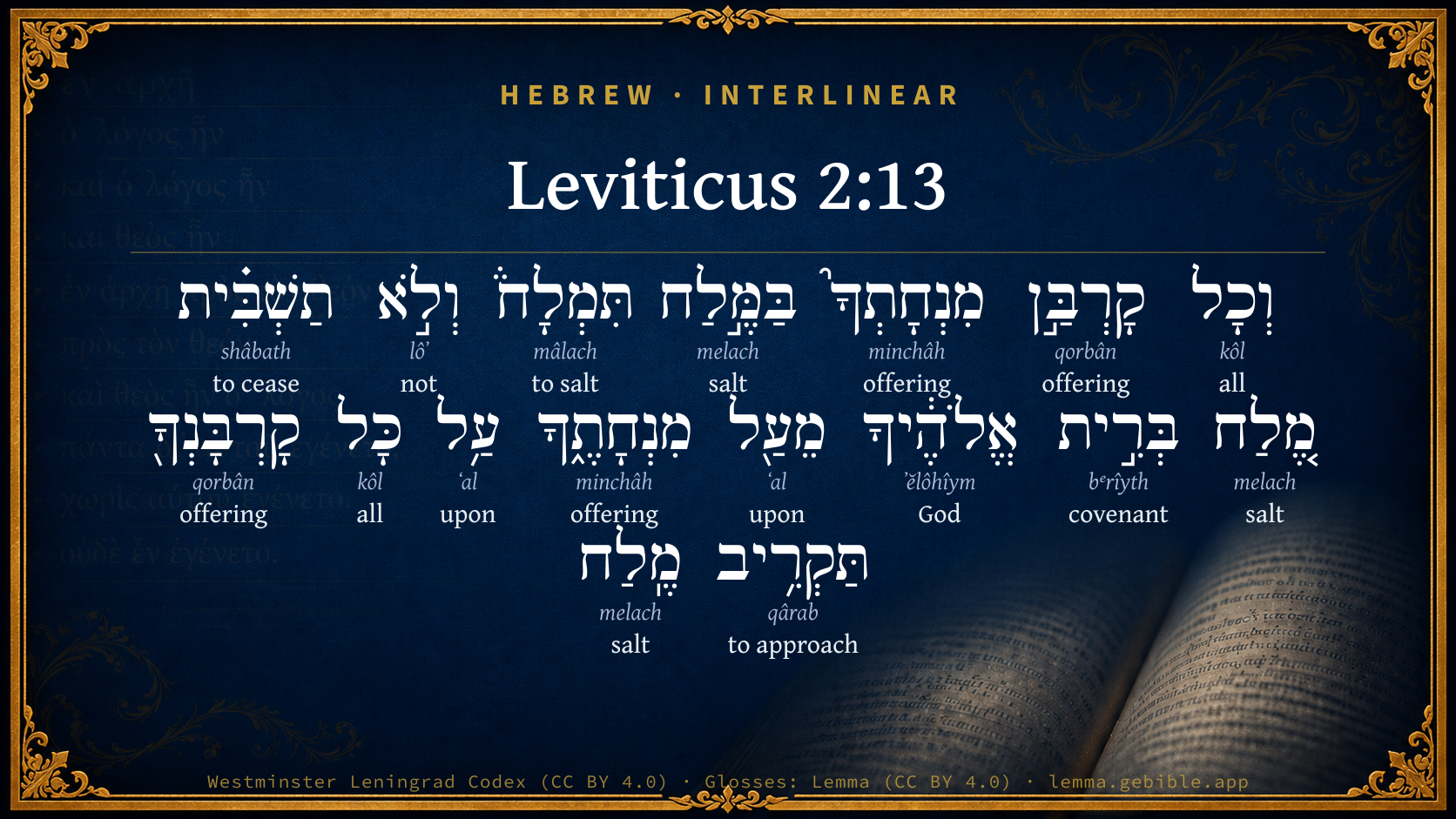
Leviticus 2:13

Hebrew (Westminster Leningrad Codex) Leviticus 2:13 appears in the Hebrew Old Testament. The text above is from the Westminster Leningrad Codex. Each word links to its Strong’s number, a concise gloss, and parsing drawn from the Open Scriptures Hebrew Bible morphology. Click any word for its full Brown-Driver-Briggs (BDB) entry.
Download image
Cite this verse

Leviticus 2:13 (World English Bible). Public Domain. Lemma interlinear Bible study tool, https://lemma.gebible.app/v/leviticus/2/13.

Show BibTeX & RIS
BibTeX
RIS
English Translation
Every offering of your meal offering you shall season with salt; neither shall you allow the salt of the covenant of your God to be lacking from your meal offering. With all your offerings you shall offer salt.
World English Bible · Public Domain
Download a study sheet

One document with this verse’s original text, its word-by-word gloss line, the meaning frame, cross-references with their text, attributed commentary, and full source and license credits — printable, and it pastes into notes with its structure intact.

This verse Autodidact and up

Study sheet (.html) Plain text (.txt)

A passage Seminary Student

Up to 50 verses in one chapter. A passage sheet keeps up to 6 commentary sources and 12 cross-references per verse, in the order this page ranks them, and says so on the sheet whenever that leaves anything out. Ask for a single verse and you get the Autodidact verse sheet above.

Everything on this page stays free to read, with no account — the sheet is a download of what is already on screen, not access to it.

Want to remove ads? Support Godless Engineer
Compare translations 3

The same verse in 3 English versions, stacked beneath the original-language interlinear above. Click any original word for its lexicon entry.

Each is an independent rendering of the whole verse — the interlinear is not word-aligned to these translations.

Highlighted words mark where these versions differ — a whole-verse word diff, not a word-by-word alignment.

  • World English Bible Public Domain
    Every offering of your meal offering you shall season with salt; neither shall you allow the salt of the covenant of your God to be lacking from your meal offering. With all your offerings you shall offer salt.
  • King James Version Public Domain
    And every oblation of thy meat offering shalt thou season with salt; neither shalt thou suffer the salt of the covenant of thy God to be lacking from thy meat offering: with all thine offerings thou shalt offer salt.
  • unfoldingWord Literal Text CC BY-SA 4.0
    And every offering of your grain offerings you shall salt with salt. And you shall not omit the salt of the covenant of your God from on your grain offering. On all your offerings you shall present salt.

unfoldingWord Literal Text — © unfoldingWord, licensed CC BY-SA 4.0. Word-aligned USFM3 via Door43 (git.door43.org/unfoldingWord/en_ult).

Versions to compare (up to 4)

3 of 4 selected

Show all 18 translations

Every available English version of this verse, each an independent rendering of the whole verse.

  • World English Bible Public Domain
    Every offering of your meal offering you shall season with salt; neither shall you allow the salt of the covenant of your God to be lacking from your meal offering. With all your offerings you shall offer salt.
  • Berean Standard Bible Public Domain
    And you shall season each of your grain offerings with salt. You must not leave the salt of the covenant of your God out of your grain offering; you are to add salt to each of your offerings.
  • Majority Standard Bible Public Domain
    And you shall season each of your grain offerings with salt. You must not leave the salt of the covenant of your God out of your grain offering; you are to add salt to each of your offerings.
  • King James Version Public Domain
    And every oblation of thy meat offering shalt thou season with salt; neither shalt thou suffer the salt of the covenant of thy God to be lacking from thy meat offering: with all thine offerings thou shalt offer salt.
  • American Standard Version (1901) Public Domain
    And every oblation of thy meal-offering shalt thou season with salt; neither shalt thou suffer the salt of the covenant of thy God to be lacking from thy meal-offering: with all thine oblations thou shalt offer salt.
  • Revised Version (1885) Public Domain
    And every oblation of thy meal offering shalt thou season with salt; neither shalt thou suffer the salt of the covenant of thy God to be lacking from thy meal offering: with all thine oblations thou shalt offer salt.
  • Geneva Bible (1599) Public Domain
    (All the meate offrings also shalt thou season with salt, neither shalt thou suffer the salt of the couenant of thy God to be lacking from thy meate offring, but vpon all thine oblations thou shalt offer salt)
  • Douay-Rheims (1899) Public Domain
    Whatsoever sacrifice thou offerest, thou shalt season it with salt, neither shalt thou take away the salt of the covenant of thy God from thy sacrifice. In all thy oblations thou shalt offer salt.
  • Young's Literal Translation Public Domain
    And every offering -- thy present -- with salt thou dost season, and thou dost not let the salt of the covenant of thy God cease from thy present; with all thine offerings thou dost bring near salt.
  • Literal Standard Version CC BY-SA 4.0
    And every offering—your present—you season with salt, and you do not let the salt of the covenant of your God cease from your present; you bring salt near with all your offerings.
  • Unlocked Literal Bible CC BY-SA 4.0
    You must season each of your grain offerings with salt. You must never allow the salt of the covenant of your God to be missing from your grain offering. With all your offerings you must offer salt.
  • unfoldingWord Literal Text CC BY-SA 4.0
    And every offering of your grain offerings you shall salt with salt. And you shall not omit the salt of the covenant of your God from on your grain offering. On all your offerings you shall present salt.
  • Darby Bible Public Domain
    And every offering of thine oblation shalt thou season with salt; neither shalt thou suffer the salt of the covenant of thy God to be lacking from thine oblation: with all thine offerings thou shalt offer salt.
  • World Messianic Bible Public Domain
    Every offering of your meal offering you shall season with salt. You shall not allow the salt of the covenant of your God to be lacking from your meal offering. With all your offerings you shall offer salt.
  • Webster's Bible Public Domain
    And every oblation of thy meat-offering shalt thou season with salt: neither shalt thou suffer the salt of the covenant of thy God to be lacking from thy meat-offering: with all thy offerings thou shalt offer salt.
  • Free Bible Version CC BY-SA 4.0
    All of your grain offerings are to be seasoned with salt. Don't leave the salt of God's agreement out of your grain offering. Add salt to all of your offerings.
  • Bible in Basic English Public Domain
    And every meal offering is to be salted with salt; your meal offering is not to be without the salt of the agreement of your God: with all your offerings give salt.
  • JPS Tanakh (1917) Public Domain
    And every meal-offering of thine shalt thou season with salt; neither shalt thou suffer the salt of the covenant of thy God to be lacking from thy meal-offering; with all thy offerings thou shalt offer salt.

Literal Standard Version (2020), Covenant Press — licensed CC BY-SA 4.0. Text via the HelloAO Bible API (eBible.org). Unlocked Literal Bible (unfoldingWord) — licensed CC BY-SA 4.0. Text via the HelloAO Bible API (eBible.org). unfoldingWord Literal Text — © unfoldingWord, licensed CC BY-SA 4.0. Word-aligned USFM3 via Door43 (git.door43.org/unfoldingWord/en_ult). Free Bible Version, Dr. Jonathan Gallagher — licensed CC BY-SA 4.0. Text via the HelloAO Bible API (eBible.org).

Word by word

More ways to search: Search by grammar → Find every occurrence → Compare this word →

Practice this passage: Drill this verse → Learn its vocabulary →

תִּמְלָח֒
mâlach
H4414
“to salt”
Verb, Qal, Imperfect, 2nd Person, Masculine, Singular
Part of Speech
Verb
Stem
Qal
Form
Imperfect
Person
2nd Person
Gender
Masculine
Number
Singular
Full BDB Definition

Origin: a primitive root

TWOT: 1196 , 1197

to tear away, dissipate - (Niphal) to be dispersed, be dissipated - to salt, season - (Qal) to salt, season - (Pual) to be salted - (Hophal) to be rubbed or washed with salt
  1. וְכָל kôl H3605 “and · all of” Conjunction + Noun, Common, Masculine, Singular, Construct
  2. קָרְבַּ֣ן qorbân H7133 “offering of” Noun, Common, Masculine, Singular, Construct
  3. מִנְחָתְךָ֮ minchâh H4503 “offering · your” Noun, Common, Feminine, Singular, Construct + Suffix, Personal, 2nd Person, Masculine, Singular
  4. בַּמֶּ֣לַח melach H4417 “in/at the · salt” Preposition, Determined + Noun, Common, Masculine, Singular, Absolute
  5. וְלֹ֣א lôʼ H3808 “and · not” Conjunction + Particle, Negative
  6. תַשְׁבִּ֗ית shâbath H7673 “to cease” Verb, Hiphil, Imperfect, 2nd Person, Masculine, Singular
  7. מֶ֚לַח melach H4417 “salt of” Noun, Common, Masculine, Singular, Construct
  8. בְּרִ֣ית bᵉrîyth H1285 “covenant of” Noun, Common, Feminine, Singular, Construct
  9. אֱלֹהֶ֔יךָ ʼĕlôhîym H430 “God(s) · your” Noun, Common, Masculine, Plural, Construct + Suffix, Personal, 2nd Person, Masculine, Singular
  10. מֵעַ֖ל ʻal H5921 “from · upon” Preposition + Preposition
  11. מִנְחָתֶ֑ךָ minchâh H4503 “offering · your” Noun, Common, Feminine, Singular, Construct + Suffix, Personal, 2nd Person, Masculine, Singular
  12. עַ֥ל ʻal H5921 “upon” Preposition
  13. כָּל kôl H3605 “all of” Noun, Common, Masculine, Singular, Construct
  14. קָרְבָּנְךָ֖ qorbân H7133 “offering · your” Noun, Common, Masculine, Singular, Construct + Suffix, Personal, 2nd Person, Masculine, Singular
  15. תַּקְרִ֥יב qârab H7126 “to approach” Verb, Hiphil, Imperfect, 2nd Person, Masculine, Singular
  16. מֶֽלַח melach H4417 “salt” Noun, Common, Masculine, Singular, Absolute

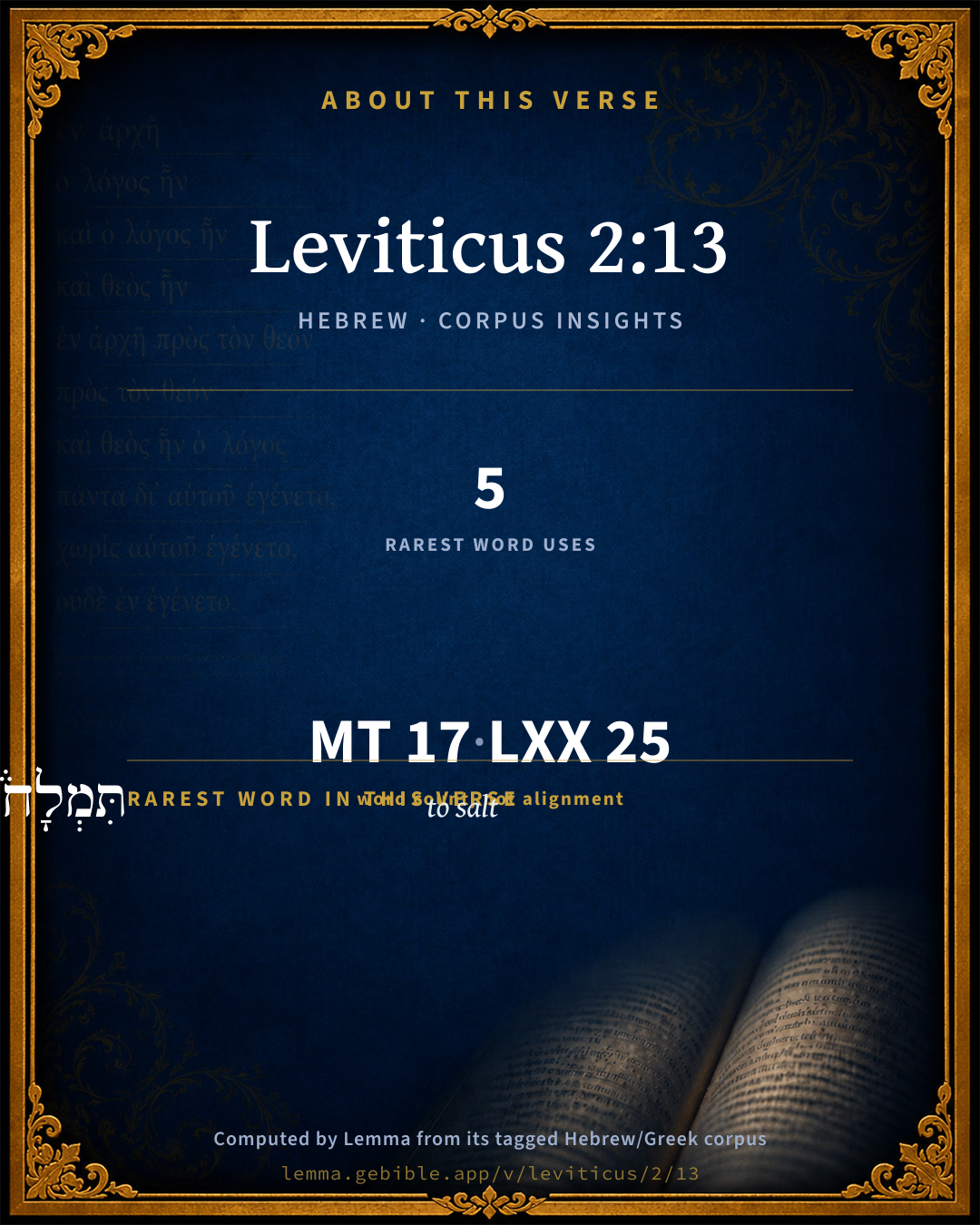
About this verse

These counts appear in no published source. They are computed here, from the morphology-tagged text and Lemma’s own curated glosses. What Lemma adds →

17
words
11
distinct lemmas
Pentateuch
section

Notable vocabulary

The rarest word here is תִּמְלָח֒ to salt H4414 — appearing just 5 times in the whole Hebrew Bible.

Shared distinctive vocabulary

תִּמְלָח֒ to salt H4414 occurs in 4 verses of the Hebrew Bible. Also found in:

Grammatical profile

  • 3 verbs
  • 11 nouns
  • 2 prepositions
  • 1 particle

Verb forms

  • תִּמְלָח֒ Qal · Imperfect
  • תַשְׁבִּ֗ית Hiphil · Imperfect
  • תַּקְרִ֥יב Hiphil · Imperfect

Repetition

Words recur within this verse — often emphatic in Hebrew:

  • בַּמֶּ֣לַח salt H4417 ×3
  • וְכָל all H3605 ×2
  • קָרְבַּ֣ן offering H7133 ×2
  • מִנְחָתְךָ֮ offering H4503 ×2
  • מֵעַ֖ל upon H5921 ×2

Hebrew & Septuagint length

In English translation the verse runs 38 words from the Hebrew and 38 from the Septuagint (LXX English) — the same length.

A rough comparison of the two English renderings, which tokenize alike — not a word-level alignment.

Word counts can differ between the Hebrew and the Greek without any difference in meaning — e.g. the Hebrew direct-object marker אֵת has no separate Greek word, and Greek often adds the article ὁ.

In the original languages it is 17 Hebrew tokens and 25 Greek tokens — but the two are counted differently (Hebrew bundles its prefixes and suffixes into one token; the Greek is in lemma form), so that isn’t a like-for-like length.

Cross-references

7

Topical passages linked to Leviticus 2:13 in the Treasury of Scripture Knowledge — connected by theme and wording, ordered by reader-vote popularity; previews shown in the World English Bible.

  • Ezekiel 43:24 You shall bring them near before Yahweh, and the priests shall cast salt on them, and they shall offer them up for a burnt offering to Yahweh.
  • Matthew 5:13 "You are the salt of the earth, but if the salt has lost its flavor, with what will it be salted? It is then good for nothing, but to be cast out and trodden under the feet of men.
  • Colossians 4:6 Let your speech always be with grace, seasoned with salt, that you may know how you ought to answer each one.
  • Mark 9:49–50 For everyone will be salted with fire, and every sacrifice will be seasoned with salt.
  • Numbers 18:19 All the heave-offerings of the holy things, which the children of Israel offer to Yahweh, have I given you, and your sons and your daughters with you, as a portion forever: it is a covenant of salt forever before Yahweh to you and to your seed with you.
  • 2 Chronicles 13:5 Ought you not to know that Yahweh, the God of Israel, gave the kingdom over Israel to David forever, even to him and to his sons by a covenant of salt?
  • Ezra 7:22 to one hundred talents of silver, and to one hundred measures of wheat, and to one hundred baths of wine, and to one hundred baths of oil, and salt without prescribing how much.

Cross-references courtesy of OpenBible.info (CC BY 4.0).

Hebrew and Greek witnesses Masoretic Hebrew ↔ Greek Septuagint

The same verse in the two great witnesses to the Old Testament, shown verse-for-verse.

These are two independent witnesses, not word-aligned to each other, and the Septuagint is shown in lemma (dictionary) form.

Hebrew Leviticus 2:13 Masoretic · Westminster Leningrad Codex

וְכָל קָרְבַּ֣ן מִנְחָתְךָ֮ בַּמֶּ֣לַח תִּמְלָח֒ וְלֹ֣א תַשְׁבִּ֗ית מֶ֚לַח בְּרִ֣ית אֱלֹהֶ֔יךָ מֵעַ֖ל מִנְחָתֶ֑ךָ עַ֥ל כָּל קָרְבָּנְךָ֖ תַּקְרִ֥יב מֶֽלַח

Every offering of your meal offering you shall season with salt; neither shall you allow the salt of the covenant of your God to be lacking from your meal offering. With all your offerings you shall offer salt.

World English Bible · Public Domain

Greek LXX Leviticus 2:13 Septuagint · lemma form

καί πᾶς δῶρον θυσία σύ ἅλς ἁλίζω οὐ διαπαύω ἅλς διαθήκη κύριος ἀπό θυσίασμα σύ ἐπί πᾶς δῶρον σύ προςφέρω κύριος ὁ θεός σύ ἅλς

And every gift of your sacrifice shall be seasoned with salt; omit not the salt of the covenant of the Lord from your sacrifices: on every gift of yours you⌃ shall offer salt to the Lord your God.

LXX2012 (modern English Septuagint) · Public Domain

Hebrew: Westminster Leningrad Codex (CC BY 4.0). Greek: Septuagint (public domain); English from LXX2012 (modern English Septuagint) (Public Domain). How the Septuagint differs from the Hebrew →

Targum (Aramaic paraphrase)

2

The Targum is the ancient Jewish Aramaic paraphrase of the Hebrew Scriptures — an interpretive translation, not the Hebrew text itself. Onkelos (literal) and Pseudo-Jonathan (expansive) render the Torah, and Jonathan the Prophets. Coverage is partial: where no permissively-licensed English translation exists for a verse, only the Aramaic is shown. This is verse-level text, not a word-by-word alignment to the Hebrew. Some Onkelos verses here show an unreviewed machine translation (clearly flagged), not a published edition.

  1. Targum Onkelos Torah (Genesis–Deuteronomy)
    וְכָל קוּרְבַּן מִנְחָתָךְ בְּמִלְחָא תִּמְלַח וְלָא תְבַטֵל מְלַח קְיַם אֱלָהָךְ מֵעַל מִנְחָתָךְ עַל כָּל קוּרְבָּנָךְ תְּקָרֵב מִלְחָא

    Unreviewed machine translation (Claude Sonnet 5) — not public domain confidence: high

    And every offering of your meal-offering you shall salt with salt, and you shall not omit the salt of the covenant of your God from upon your meal-offering; upon every offering of yours you shall offer salt.

    Generated by an AI translate-then-audit pipeline and checked against an independent public-domain English translation of the underlying Hebrew for drift only. Not a published edition; pending human review.

    Aramaic base: public-domain Targum Onkelos (via Sefaria). The English above is the unreviewed machine translation, not public domain.

  2. Targum Pseudo-Jonathan Torah (Genesis–Deuteronomy)
    וְכָל קוּרְבַּן מִנְחָתָךְ בְּמִלְחָא תִמְלָח וְלָא תִבַטֵל מְלַח קְיַים אֳלָהָךְ מֵעִילַוֵי מִנְחָתָךְ מְטוֹל דְעֶשְרִין וְאַרְבְּעָא מוֹהֲבָתָא דְכַהֲנַיָא אִתְגְזָרוּ בִּקְיַים מִלְחָא בְּגִין כֵּן עַל כָּל קָרְבָּנָךְ תַּקְרִיב מִלְחָא

    And every oblation of thy mincha thou shalt salt with salt; thou shalt not withhold the salt of the covenant of thy God from thy mincha, because the twenty and four gifts of the priests are appointed with a covenant of salt; therefore salt shalt thou offer with all thy oblations.

    Targum Pseudo-Jonathan — Aramaic: “Targum Jonathan on Genesis” (public domain); “Targum Jonathan on Exodus” (public domain); “Targum Jonathan on Leviticus” (public domain); “Targum Jonathan on Numbers” (public domain); “Targum Jonathan on Deuteronomy” (public domain). English: “The Targum of Jonathan ben Uzziel, trans. J. W. Etheridge, London, 1862” (public domain). Text via Sefaria.

Commentary

Notes on Leviticus 2:13 from classic Christian and Jewish commentators (each source and its license shown beneath its notes). The classic Christian expositions comment on the surrounding passage and are grouped to its opening verse, so a note may address several verses; the Jewish commentaries on the Tanakh (Rashi and others) are per-verse, so they appear only where the commentator wrote on this verse.

Lemma curates 59 commentaries, every one of them public domain or Creative Commons licensed, each selected and text-cleaned for this edition rather than reprinted as found. About our sources →

Trapp's Complete Commentary

John Trapp

Lev 2:13 And every oblation of thy meat offering shalt thou season with salt; neither shalt thou suffer the salt of the covenant of thy God to be lacking from thy meat offering: with all thine offerings thou shalt offer salt.

Ver. 13. Shalt thou season with salt.] Called here the salt of God’s covenant; as signifying the covenant of God made with us in Christ, who seasoneth us, and makes all our services savoury. See the note on Mar 9:49-50.

John Trapp, A Commentary or Exposition upon All the Books of the Old and New Testament (1647–1656) — public domain. Text from a community e-Sword module.

The Biblical Illustrator

Joseph S. Exell

Lev_2:13

Season with salt.

Salt for sacrifice

If you will read the chapter through you will note that other things were needed in connection with the sacrifices of the Israelites. Their sacrifices were of course imperfect. Even on the low ground which they occupied as emblems they were not complete; for you read, in the first place, that they needed frankincense; God did not smell sweet savour in the bullock, or the ram, or the lamb, unless sweet spices were added. What does that teach us but that the best performances of our hands must not appear before His throne without the merit of Christ mingled therewith? Another thing that was enjoined constantly was that they should bring oil; and oil is ever the type of the blessed Spirit of God. What is the use of a sermon if there is no unction in it? What is prayer without the anointing that cometh of the Holy Spirit? What is praise unless the Spirit of God be in it to give it life, that it may rise to heaven? That which goes to God must first come from God. Then came a third requisite, namely, salt. If you read the preceding verses you will see that the Lord forbids them to present any honey. No meat-offering, which ye shall bring unto the Lord, shall be made with leaven: for ye shall burn no leaven, nor any honey, in any offering of the Lord made by fire. As for the oblation of the firstfruits, ye shall offer them unto the Lord: but they shall not be burnt on the altar for a sweet savour. Ripe fruits were full of honey, full of sweetness; and God does not ask for sweetness, He asks for salt.

I. It appears, then, that salt was the symbol of the covenant. When God made a covenant with David, it is written, The Lord gave the kingdom to David for ever by a covenant of salt--by which was meant that it was an unchangeable, incorruptible covenant, which would endure as salt makes a thing to endure, so that it is not liable to putrefy or corrupt. The salt of the covenant signifies that, whenever you and I are bringing any offering to the Lord, we must take care that we remember the covenant.

1. We want this salt of the covenant in all that we do, in the first place, to preserve us from falling into legality. He that serves God for wages forgets the word--The gift of God is eternal life. If you forget that you are under a covenant of pure grace, in which God gives to the unworthy, and saves those who have no claim to covenant blessing, you will get on legal ground; and, once on leg d ground, God cannot accept your sacrifice.

2. The covenant is to be remembered also that it may excite gratitude. Whenever I think of God entering into covenant that He will not depart from me, and that I shall never depart from Him, my love to Him overflows. Nothing constrains me to such activity and such zeal in the cause of God as a sense of covenant love. Standing on covenant ground we feel consecrated to the noblest ends.

3. This tends to arouse our devotion to God. When we remember that God has entered into covenant with us, then we do not do our work for Him in a cold, dead way; neither do we perform it after a nominal sort; for we say, I am one of Gods covenanted ones.

II. But, secondly, salt is the token of communion. In the East, especially, it is the token of fellowship. When an Oriental has once eaten a mans salt, he will do him no harm. Whenever you are attempting to serve God, take care that you do it in the spirit of fellowship with God.

III. But salt is the emblem of sincerity. With all thine offerings thou shalt offer salt. There must be an intense sincerity about all we do towards God.

IV. Lastly, salt is the type of purifying power; and with all our sacrifices we have need to bring a great deal of this salt. The salt eats into the meat; it drives away corruption; it preserves it. If we come before God with holy things while we are living in sin we need not deceive ourselves, we shall not be accepted. If there be any man, of whom it can be said that he is a saint abroad and a devil at home, God will estimate him at what he is at home, and not at what he is abroad. He may lay the sacrifice upon the altar, but if it is brought there with foul hands and an unholy heart, God will bare nothing to do with it. Without holiness no man can see the Lord, and, certainly, without holiness can no man serve the Lord. We have our imperfections; but known and wilful sin Gods people will not indulge. (C. H. Spurgeon.)

Salt of the covenant

Eating salt together is in the East a pledge of amity and friendship. Hence the covenant of salt was an indissoluble pact; and salted with the salt of the palace (Ezr_4:14) meant not maintenance, but the sign of faithfulness to the king. Salt was used in the sacrifices and offerings of the Israelites, probably with the same idea of honour and fidelity. (G. Deane.)

Salt to be included in all offerings

This salt indicates corruption removed and prevented; and in the case of the meat-offering, it is as if to say, Thy body and thy substance are become healthy now; they shall not rot. They are not like those of the ungodly in Jam_5:2, Your riches are corrupted. There is a blessing on thy body and thy estate. And next it intimates the friendship (of which salt was a well-known emblem) now existing between God and the man. God can sup with man, and man with God (Rev_3:18). There is a covenant between him and God, even in regard to the beasts of the field (Job_5:23), and fowls of heaven (Hos_2:18). The friendship of God extends to His peoples property; and to assure us of this He appoints the salt in the meat-offering, the offering that especially typified their substance. How comforting to labouring men! how cheering to careworn merchants if they dedicate themselves to God; He is interested in their property as much as they themselves are! Who is a God like unto Thee! But more; with all thine offerings thou shalt offer salt, declared that the sweet savour of these sacrifices was not momentary and passing, but enduring and eternal. By this declaration He sprinkles every sacrifice with the salt of His unchanging satisfaction. And the covenant by sacrifice (Psa_50:5) is thus confirmed on the part of God; He declares that He on His part will be faithful. (A. A. Bonar.)

.

The Biblical Illustrator, edited by Joseph S. Exell (c. 1880s–1900s) — public domain. Text from a community e-Sword module.

Joseph Benson's Commentary

Lev 2:13. Salt — To signify that incorruption of mind, and sincerity of grace, which in Scripture is signified by salt, (Mar 9:49;

Col 4:6,) and which is necessary in all them that would offer an acceptable offering to God. Or in testimony of that communion which they had with God in these exercises of worship; salt being the great symbol of friendship in all nations and ages. The salt of the covenant of thy God — It is so called, either, 1st, Because it represented the perpetuity of God’s covenant with them, which is designed by salt, Num 8:19; Numbers 2

Chronicles Lev 13:5. Or, 2d, Because it was so particularly required as a condition of their covenant with God; this being made absolutely necessary in all their offerings; and as the neglect of sacrifices was a breach of covenant on their part, so also was the neglect of salt in their sacrifices.

Joseph Benson's Commentary on the Old and New Testaments (1811–1818) — public domain. Text from a community e-Sword module.

Tyndale Open Study Notes

Tyndale Open Resources

2:13 In ancient times, salt represented permanence because it preserved food. A covenant of salt (see study notes on Num 18:19; 2 Chr 13:5) denoted an enduring covenant that was renewed with successive generations.

Tyndale Open Study Notes — © Tyndale Open Resources, licensed CC BY-SA 4.0. Text via the HelloAO Bible API.

Geneva Bible (1599)

Geneva Bible translators

Which they were bound (as by covenant) to use all sacrifices, Num. 18:19; 2 Chron. 13:5; Ezek. 43:24, or it meaneth a sure and pure covenant.

Geneva Bible (1599) marginal notes — public domain. Text via Bolls.life.

Jamieson, Fausset & Brown

Robert Jamieson, A. R. Fausset & David Brown

every . . . meat offering shalt thou season with salt--The same reasons which led to the prohibition of leaven, recommended the use of salt--if the one soon putrefies, the other possesses a strongly preservative property, and hence it became an emblem of incorruption and purity, as well as of a perpetual covenant--a perfect reconciliation and lasting friendship. No injunction in the whole law was more sacredly observed than this application of salt; for besides other uses of it that will be noticed elsewhere, it had a typical meaning referred to by our Lord concerning the effect of the Gospel on those who embrace it (Mar 9:49-50); as when plentifully applied it preserves meat from spoiling, so will the Gospel keep men from being corrupted by sin. And as salt was indispensable to render sacrifices acceptable to God, so the Gospel, brought home to the hearts of men by the Holy Ghost, is indispensably requisite to their offering up of themselves as living sacrifices [BROWN].

Jamieson, Fausset & Brown — Commentary Critical and Explanatory on the Whole Bible (1871) — public domain (CC PDM 1.0). Text via the HelloAO Bible API.

Adam Clarke's Commentary

Verse 13. With all thine offerings thou shalt offer salt.] SALT was the opposite to leaven, for it preserved from putrefaction and corruption, and signified the purity and persevering fidelity that were necessary in the worship of God. Every thing was seasoned with it, to signify the purity and perfection that should be extended through every part of the Divine service, and through the hearts and lives of God's worshippers. It was called the salt of the covenant of God, because as salt is incorruptible, so was the covenant made with Abram, Isaac, Jacob, and the patriarchs, relative to the redemption of the world by the incarnation and death of Jesus Christ. Among the heathens salt was a common ingredient in all their sacrificial offerings; and as it was considered essential to the comfort and preservation of life, and an emblem of the most perfect corporeal and mental endowments, so it was supposed to be one of the most acceptable presents they could make unto their gods, from whose sacrifices it was never absent. That inimitable and invaluable writer, Pliny, has left a long chapter on this subject, the seventh of the thirty-first book of his Natural History, a few extracts from which will not displease the intelligent reader. Ergo, hercule, vita humanior sine Sale nequit degere: adeoque necessarium elementum est, ut transierit intellectus ad voluptates animi quoque. Nam ita SALES appellantur omnisque vitae lepos et summa hilaritas, laborumque requies non alio magis vocabulo constat. Honoribus etiam militiaeque inter ponitur, SALARIIS inde dictis--Maxime tamen in sacris intelligitur auctoritas, quando nulla conficiuntur sine mola salsa. "So essentially necessary is salt that without it human life cannot be preserved: and even the pleasures and endowments of the mind are expressed by it; the delights of life, repose, and the highest mental serenity, are expressed by no other term than sales among the Latins. It has also been applied to designate the honourable rewards given to soldiers, which are called salarii or salaries. But its importance may be farther understood by its use in sacred things, as no sacrifice was offered to the gods without the salt cake." So Virgil, Eclog. viii., ver. 82: Sparge molam.

"Crumble the sacred mole of salt and corn."

And again, AEneid., lib. iv., ver. 517: -

Ipsa mola, manibitsque piis, altaria juxta.

"Now with the sacred cake, and lifted hands,,

All bent on death, before her altar stands."

PITT.

In like manner Homer: -

Πασσε δ' ἁλος θειοιο, κρατευταων επαειπας.

Iliad, lib. ix., ver. 214.

"And taking sacred salt from the hearth side,

Where it was treasured, pour'd it o'er the feast."

COWPER.

Quotations of this kind might be easily multiplied, but the above may be deemed sufficient.

Adam Clarke's Commentary on the Bible (1810–1826) — public domain. Text from a community e-Sword/MySword module.

Ellicott's Commentary for English Readers

(13) And every oblation.—But salt, which is the contrary to leaven, and which preserves from putrefaction and corruption, was to be an ingredient, not only of bloodless, but of all animal sacrifices (Eze_43:24).

The salt of the covenant of thy God.—From its antiseptic and savoury qualities, salt became the symbol of hospitality, friendship, durability, fidelity. “To eat bread and salt together” is, in the East, an expression for a league of mutual amity (Russell, Aleppo, i. 232). When the Arabs make a covenant together, they put salt on the blade of a sword, from whence every one puts a little into his mouth. This constitutes them blood relations, and they remain faithful to each other even when in danger of life (Ritter, Erd. 14:960). Hence the expression “a covenant of salt,” which also occurs in Num_18:19, and 2Ch_13:5, denotes an indissoluble alliance, an everlasting covenant. Hence, too, the phrase “salted with the salt of the palace” (Ezr_4:14) means bound by sacred obligations of fidelity to the king.

A Bible Commentary for English Readers, edited by Charles John Ellicott (1878–1897) — public domain. Text from a community e-Sword module.

The Cambridge Bible for Schools and Colleges

gen. ed. J. J. S. Perowne

13. shalt thou season with salt] Salt, which is necessary for those who eat farinaceous food and a pleasant condiment with flesh meat, was freely used by the Hebrews, Greeks, Romans, and other nations of antiquity. They brought it as an accompaniment of sacrifice, in accordance with the primitive view of sacrifice as the food of the gods (cp. ch. Lev_21:22). It may have been an element in the Jewish ritual from the earliest times. The phrase ‘salt of the covenant of thy God’ indicates that a symbolical meaning was also attached to it. A covenant among ancient peoples was ratified by eating food together (Gen_31:54) with which salt was generally taken. ‘There is salt between us’ is in the mouth of the Arab a declaration of friendship and obligation; God’s covenants with Levi and David are ‘covenants of salt’ (Num_18:19; 2Ch_13:5); so here ‘the salt of the covenant’ implies that the Israelite, by reason of his covenant relation with God, was bound to bring with his sacrifice the offering of a willing heart (Psa_54:6; Psa_119:108). Salt with sacrifice is enjoined in Eze_43:24, and referred to Mar_9:49. For the remission of the tax on salt, cp. 1Ma_10:29; 1Ma_11:35, and Jos. Ant. xii. 3. 3. For the mola salsa of the Romans (Hor. Sat. ii. 3. 200) and other classical references to salt with sacrifice, see the Articles on Salt in HDB. and Enc. Bib.

The Cambridge Bible for Schools and Colleges (gen. ed. J. J. S. Perowne; Cambridge University Press, 1878–1918) — public domain. Text from a community e-Sword module.

John Gill's Exposition

And every oblation of thy meat offering shalt thou season with salt,.... Which makes food savoury, and preserves from putrefaction; denoting the savouriness and acceptableness of Christ as a meat offering to his people, he being savoury food, such as their souls love, as well as to God the Father, who is well pleased with his sacrifice; and also the perpetuity of his sacrifice, which always has the same virtue in it, and of him as a meat offering, who is that meat which endures to everlasting life, Joh 6:27 and also the grave and gracious conversation of those that by faith feed upon him, Mar 9:50.

neither shall thou suffer the salt of the covenant of thy God to be lacking from thy meat offering; this seems to suggest the reason why salt was used in meat offerings, and in all others, because it was a symbol of the perpetuity of the covenant, which from thence is called a covenant of salt, Num 18:19 namely, the covenant of the priesthood, to which these sacrifices belonged, Num 25:13 hence the Targum of Jonathan,"because the twenty four gifts of the priests are decreed by the covenant of salt, therefore upon all thine offerings thou shalt offer salt:"

with all thine offerings thou shall offer salt, even those that were not to be eaten, as well as those that were; as the burnt offering of the herd, of the flock, and of fowls, and their several parts; all were obliged to be salted that were offered, excepting wine, blood, wood, and incense (x); hence there was a room in the temple where salt was laid up for this purpose, called , "the salt room" (y); and which was provided by the congregation, and not by a private person (z); our Lord has reference to this law in Mar 9:49 the Heathens always made use of salt in their sacrifices (a).

(x) Maimon. Issure Mizbeach, c. 5. sect. 11. (y) Misn. Middot, c. 5. sect. 2. (z) Maimon. Issure Mizbeach, c. 5. sect. 13. (a) Ante Deos Homini, &c. Ovid. Fastor. l. 1. Vid. Horat. Carmin. l. 3. Ode 23.

John Gill's Exposition of the Whole Bible (1746–1763) — public domain (CC PDM 1.0). Text via the HelloAO Bible API.

Albert Barnes' Notes on the Bible

With all thine offerings thou shalt offer salt - Not only every מנחה mı̂nchāh, but every animal offering was to be accompanied by salt. It was the one symbol which was never absent from the altar of burnt-offering, showing the imperishablness of the love of Yahweh for His people. In its unalterable nature, it is the contrary of leaven (yeast). The Arabs are said to retain in common use the expression, “a covenant of salt;” and the respect they pay to bread and salt in their rites of hospitality is well known.

Albert Barnes' Notes on the Bible (1834–1885) — public domain. Text from a community e-Sword/MySword module.

Haydock's Catholic Bible Commentary

Salt. In every sacrifice salt was to be used, which is an emblem of wisdom and discretion, without which none of our performances are agreeable to God. (Challoner) --- Salt is not prescribed in the sacrifices of animals. But it was to be used in them, as we learn from the Jews, and from St. Mark ix. 48, Every victim shall be salted. The ancient poets never specify salt in their descriptions of sacrifices. But Pliny assures us, that in his time it was of the greatest authority, and always used in sacrifice, with cakes. Maxime in sacris intelligebatur salis auctoritas, quando nulla conficiuntur sine mola salsa. (B. xxxi. 7.) --- Covenant. It is so called, because it was a symbol of the durable condition of the alliance with God, which was renewed in every sacrifice; (Calmet) or it may signify "the salt prescribed" by God: for the law and covenant are often used synonymously. (Menochius) --- Let your speech be always in grace, seasoned with salt, Colossians iv. 6. See Numbers xviii. 19.

George Leo Haydock (1774–1849), Haydock's Catholic Family Bible and Commentary, 1859 edition — public domain. Excludes Psalms (Douay-Rheims chapter numbering differs from Protestant) and Deuterocanonical books (Catholic canon only).

Matthew Poole's English Annotations

Every oblation of thy meat-offering shalt thou season with salt; either,

1. For the decency and conveniency of the feast, which God would have here represented. Or,

2. For the signification of that incorruption of mind, and sincerity of grace, which in Scripture is signified by salt, Mar 9:49; Col 4:6, and which is necessary in all them that would offer an acceptable offering to God. Or,

3. In testimony of that communion which they had with God in these exercises of his worship; salt being the great symbol of friendship in all nations and ages. The salt of the covenant of thy God: so salt is called, either,

1. Because it fitly represented the durableness and perpetuity of God’s covenant with them, which is designed by salt, Num 18:19; 2Ch 13:5. Or,

2. Because it was so particularly and rigorously required as a condition of their covenant with God; this being made absolutely necessary in all their offerings, as it follows; and as the neglect of sacrifices was a breach of covenant on their part, so also was the neglect of salt in their sacrifices. With all thine offerings; not these only, but all other, as appears from Eze 43:24; Mar 9:49.

Matthew Poole's English Annotations on the Holy Bible (1683–1685) — public domain. Text from a community e-Sword/MySword module.

Whedon's Commentary on the Bible

Daniel D. Whedon

13. Season with salt — Salt, from its antiseptic quality, is suggestive of that moral purity and fidelity required of all true worshippers. It was applied to the bread offering for another reason — because it symbolized the existence of an inviolable friendship between the host and the guest. It was to the Hebrew a perpetual memorial of the bond of union between Jehovah and Israel. Num_18:19. Hence the injunction, “Thou shalt not suffer the salt of the covenant of thy God to be lacking.”

With all… offerings… offer salt — The typology of this requirement is explained by our Lord Jesus: “For every one shall be salted (purified or punished) with fire, (God’s holiness,) as every sacrifice shall be salted with salt.” See Mar_9:49, note.

Daniel D. Whedon (gen. ed.), Commentary on the Old and New Testaments (1874–1909) — public domain. Text from a community e-Sword module.

The Pulpit Commentary

Every oblation of thy meat offering shalt thou season with salt. Salt is commanded as symbolizing in things spiritual, because preserving in things physical, incorruption. (cf. Mat_5:13 Mar_9:49 Luk_14:34 Col_4:6) It is an emblem of an established and enduring covenant, such as God"s covenant with his people, which is never to wax old and be destroyed, and it is therefore termed the salt of the covenant of thy God. Hence "a covenant of salt" came to mean a covenant that should not be broken. (Num_18:19 2Ch_13:5) The use of salt is not confined to the meat offering. With all thine offerings thou shalt offer salt. Accordingly we find in Eze_43:24, "The priest shall cast salt upon them, and they shall offer them up for a burnt offering.

Salt was to be used with all the sacrifices. Cf. Eze_43:24 Mar_9:49.

I WHAT IT RECALLED TO THE MIND OF THE OFFERER. The eating of bread and salt together being the ceremony which finally ratified an agreement or covenant (as it still is in Arabia), salt was associated in the mind of the Israelite with the thought of a firmly established covenant. Each time, therefore, that the priest strewed the salt on the offering there would have been a reminder to all concerned of the peculiar blessing enjoyed by the nation and all members of it, of being in covenant with God, without which they would not have been in a state to offer acceptable sacrifices at all.

II WHAT IT SYMBOLIZED. The effect of salt being to preserve from corruption, its being sprinkled on the sacrifice taught the offerer the necessity of purity and constancy in his devotion of himself to God.

III THE SYMBOL TAKEN UP AND APPLIED IN THE NEW TESTAMENT.

1. The Christian"s speech is not to be corrupting, but edifying. "Let yourspeech be always seasoned with salt, that ye may know how ye ought to answer every man". (Col_4:6) "Let no corrupt communication proceed out of your mouth, hut that which is good for the use of edifying, that it may minister grace unto the hearers". (Eph_4:29)

2. Christian men are to be salted with fire, as the sacrifices are salted withsalt, (Mar_9:49) and the life of the collective body of Christians, the Church, is to be, in its effects upon the world, as salt. "Ye are the salt of the earth". (Mat_5:13) "Have salt in yourselves". (Mar_9:50) Men influenced by the Spirit of Christ, having been themselves salted with fire, have now become the salt which saves the world from perishing in its own corruption.

IV THE SALT MAY LOSE ITS SAVOUR. (Mat_5:13 Mar_9:50 Luk_14:34) This is the case when "doctrine" being no longer characterized by "uncorruptness, gravity, sincerity", (Tit_2:7) religion becomes changed into superstition, thenceforward debasing instead of elevating mankind; or when it stirs men to acts of fanaticism, or rebellion, or cruelty; or when the spiritual life becomes so dead within it that it abets instead of counteracting the wickedness of the world.

V SALT SYMBOLIZES PERMANENCY AS WELL AS PURITY. Our love for Christ must be, St. Paul teaches us, (Eph_6:24) a love "in sincerity," or rather, as the word should be translated, "in incorruption," that is, an abiding love, without human caprice or changeableness; and our obedience to God must be constant, without breaks in its even course, and lasting to the end of life. "Because iniquity shall abound, the love of many shall wax cold. But he that shall endure unto the end, the same shall be saved". (Mat_24:12, Mat_24:13) "Be thou faithful unto death, and I will give thee a crown of life". (Rev_2:10)

The salt of the covenant.

It has been thought by some unworthy of the notion of an Infinite Being to consider him as concerned about such petty details as those here laid down for observance. But since the Deity had to deal with uninstructed creatures, with men whose ideas of his greatness and holiness were obscure and imperfect, it was surely wise to act according to the analogy furnished by the customs of earthly monarchs, whose courts require attention to be paid to numberless points of behaviour. Only thus could the august nature of Jehovah, the majesty of his attributes, and the solemnity of religious worship be duly impressed upon the minds of the Israelites. Every rite had a meaning, and to add salt to every offering was a command we shall find it interesting to study.

I OBEDIENCE TO THIS COMMAND CONSTITUTES EVERY OFFERING A PART OF THE COVENANT BETWEEN GOD AND HIS PEOPLE. It was by virtue of a special covenant that the nation had been selected as the vehicle of Divine revelation and the repository of Divine favours. The relation of superiority in which God stands to man, places in a strong light his condescension in making an agreement by which he binds himself as well as the people. Every covenant implies mutual obligations. God promised to guide and bless the Israelites if they, in their turn, kept his commandments and held him in proper esteem. To put salt, therefore, in compliance with his behest, was to acknowledge that the covenant remained in force, and the act became a present instance of the existence of the covenant. It was as much as to say, "I present this gift because of the covenanted relationship in which I stand to Jehovah." The covenant of the gospel is ratified in Christ for all his faithful seed, who are made partakers of the blessing promised to Abraham. (Gal_3:16) Hence whatever we do is in the name of Christ, recognizing our sonship, heirship, and co-heirship. The covenant influences, embraces all thoughts and deeds.

II SALT, AS THE EMBLEM OF HOSPITALITY, SHOWS THAT SERVICE TO GOD IS A FEAST OF FRIENDSHIP. The offering of flour on which oil was poured was itself indicative of a friendly meal, and this view was strengthened by adding salt to the sacrifice. So surprising is the intimacy to which the Most High admits his people, that they may be said to feed daily at his table; all the fruits of the earth are the product of his bounty, which honours men as his guests. We do but render to God what he first bestowed; and in thus approaching we enjoy his presence and favour. It is permitted us to make ready for the Passover, whereat the Lord shall sit down with his disciples.

III SALT, AS A PRESERVATIVE, REMINDS US OF THE PURITY WHICH SHOULD CHARACTERIZE OUR LIVES. Nothing that partakes of corruption is fit to be brought unto the ever-living God. "Let us cleanse ourselves from all filthiness of the flesh and spirit." "Flesh and blood" tend to impurity and death, and "cannot inherit the kingdom of God." Our speech must he with grace, seasoned with salt, lest anything destructive of peace or edification should issue from our lips. Apart from the life that is instilled through faith in Christ, man is dead, and decay is loathsome. Without faith our walk and conversation cannot please God, nor are we "the salt of the earth." Christians are salted with the purifying fire of trial. (Mar_9:49)

IV SALT TEACHES US THE PERPETUITY OF OUR FRIENDSHIP WITH GOD. A covenant of salt is for ever. (See Num_18:19 and 2Ch_13:5) It lasts as long as the conditions are observed by us, for God will never change, nor desire on his part to revoke his blessing. Let us rejoice in the truth that he abideth faithful, and in the thought of the indissoluble alliance thereby created. He does not wish to treat us as playthings, invented to amuse him temporarily, and then to be tossed aside. We are put in possession by the great Healer and Life-restorer of imperishable principles, seeds of righteousness, that avert corruption and defy decay. Our devotion is not a hireling service that may soon terminate, but a consecration for the everlasting ages. S.R.A.

The Pulpit Commentary (1880–1919), ed. H.D.M. Spence-Jones & Joseph S. Exell — public domain. Text from a community e-Sword module.

John Wesley's Explanatory Notes

Salt - To signify that incorruption of mind, and sincerity of grace, which in scripture is signified by salt, Mark ix, 49, Colossians iv, 6, and which is necessary in all them that would offer an acceptable offering to God. Or in testimony of that communion which they had with God in these exercises of worship; salt being the great symbol of friendship in all nations is called, either,

1. because it represented the perpetuity of God's covenant with them, which is designed by salt, Num. xviii, 19, 2 Chron. xiii, 5. Or,

2. because it was so particularly required as a condition of their covenant with God; this being made absolutely necessary in all their offerings; and as the neglect of sacrifices was a breach of covenant on their part, so also was the neglect of salt in their sacrifices.

John Wesley, Explanatory Notes Upon the Whole Bible (1754–1765) — public domain. Text via the GEBible commentary corpus.

Scofield Reference Notes

C. I. Scofield

salt

Cf. Num 18:19; Mar 9:49; Mar 9:50; Col 4:6

The Scofield Reference Bible (1917 edition), notes by C. I. Scofield — public domain. Text from a community e-Sword module.

Rashi

Rabbi Shlomo Yitzchaki (Rashi)

מלח ברית [NEITHER SHALT THOU SUFFER] THE SALT OF THE COVENANT [… TO BE LACKING FROM MY MEAL OFFERING], because a covenant was established with the salt as far back as the six days of Creation when the lower waters (those of the oceans) received an assurance that they would be offered on the altar in the form of salt and also as water in the ceremony of “the libation of water” on the Feast of Tabernacles).‎

על כל קרבנך‎ UPON ALL THY OFFERINGS [THOU SHALT OFFER SALT] — upon burnt-offerings of cattle and fowls and upon the fat-portions of all sacrifices in general (Menachot 20a).

Rashi on the Tanakh — English translations: “The Judaica Press complete Tanach with Rashi, translated by A. J. Rosenberg” (CC BY 4.0); “Pentateuch with Rashi's commentary by M. Rosenbaum and A.M. Silbermann, 1929-1934” (public domain); “The Metsudah Tanach series, Lakewood, N.J” (CC BY 4.0); and “The Book of Joshua, Metsudah Publications, 1997” (CC BY 4.0). Text via Sefaria.

Ramban (Nachmanides)

Rabbi Moshe ben Nachman (Ramban / Nachmanides)

NEITHER SHALT THOU SUFFER THE SALT OF THE COVENANT OF THY G-D TO BE LACKING FROM THY MEAL-OFFERING. “For a covenant was established with salt as far back as the six days of Creation, for the lower waters [i.e., those of the oceans] were promised that they would be offered upon the altar in the form of salt, and [also as water] at the libation of water, on the Festival of Tabernacles.” (Rejoicing of the Drawing of the Water). This is Rashi’s language, and it is a homiletic exposition of the Sages. Rabbi Abraham ibn Ezra interpreted it in line with the plain meaning of Scripture as follows: “I have brought you into a covenant and made you swear that you would not offer a saltless offering, nor shall it [i.e., a saltless offering] be eaten, because it is a mark of contempt.” Now since salt is the covenant of the offerings, Scripture made this accord the pattern for all such agreements, saying of the gifts given to priests and the dynasty of David that they are [an everlasting] covenant of salt, meaning that they are as everlasting as the covenant of salt of the offerings. There, however, Rabbi Abraham ibn Ezra explained: “A covenant of salt — a covenant decreed, it being of the root, a fruitful land into a salt waste, since a salt waste is as if it has been decreed [upon it that nothing should grow therein].” But there is no sense to his words.Now it seems to me that since Scripture here states, the covenant of thy G-d, and does not say “the covenant of the Eternal,” which would have been in consonance with the language of the section and the way all the offerings are mentioned [throughout Scripture], or did not say, “the covenant of the Eternal thy G-d” — that the reason for this is because salt is derived from water, and it is through the power of the sun which shines upon it that it becomes salt. Now the nature of water is that it soaks into the earth and makes it bring forth and bud; but after it becomes salt it destroys every place and burns it, that it is not sown, nor beareth. Since a covenant is inclusive of all attributes, water and fire come into it, and unto her shall come the former dominion — the Kingdom of G-d, just like salt which seasons all foods and helps to preserve them, but destroys them when they are over-saturated with it. Thus salt is like the covenant. It is for this reason that Scripture states, Ought ye not to know that the Eternal, the G-d of Israel, gave the kingdom over Israel to David forever, even to him and to his sons by a covenant of salt forever? For this too is the attribute of David. Therefore He says in connection with the offerings, it is an everlasting covenant of salt, for the covenant is “the salt of the world,” and by virtue of it [the world] exists or may be destroyed. I have already taught you to understand from our words in other places the meaning of these three words, brith olam hi (it is a perpetual covenant).

Ramban (Nachmanides) on the Tanakh — English translation: “Commentary on the Torah by Ramban (Nachmanides). Translated and annotated by Charles B. Chavel. New York, Shilo Pub. House, 1971-1976” (CC BY 4.0). Text via Sefaria.

Lesson kit

Teaching starters — assembled from the data on this page, not authored interpretation. Every prompt links to the verse data it draws on. Edit before teaching.

Leviticus, in the Pentateuch, opens this verse with 17 words (11 distinct Hebrew lemmas). Its most distinctive word is mâlach (“to salt”). A historical commentator’s framing appears above. Read the whole chapter for the surrounding context.

Discussion questions

  1. How does “to salt” (mâlach) shape what this verse is saying?
  2. Exodus 30:35 shares the word «to salt» with this verse. How do the two illuminate each other?
  3. “salt” occurs 3× in this one verse. What is the effect of the repetition?
  4. The translations on this page render this verse differently — a whole-verse word diff, not a word-by-word alignment. What might account for the different wordings?
  5. The verb «תִּמְלָח֒» is Qal Imperfect. How does its form color the action?
  6. Reading how Trapp's Complete Commentary and The Biblical Illustrator read this verse, where do the two commentators agree and where do they part?

Things to notice

Reading settings

Reading text

Shown beneath each verse's original-language words.

Old Testament
Old Testament edition

Read the OT as the Masoretic Hebrew (MT) or the Greek Septuagint (LXX).

English shown for the Greek Septuagint (in the Hebrew ↔ Greek comparison).

Comparing translations? Open the Compare panel on any verse page to stack up to four side by side.