
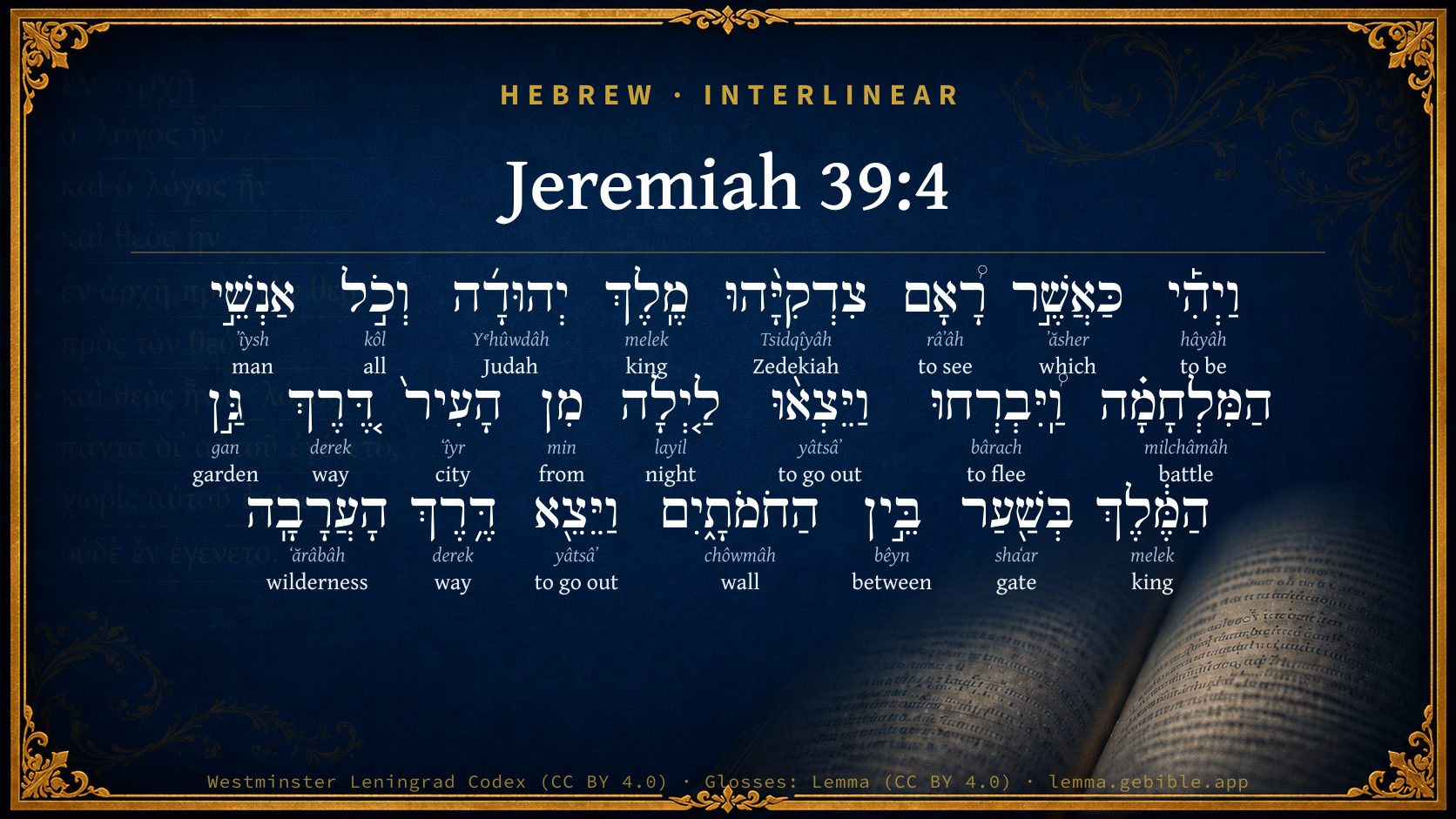
Jeremiah 39:4

Hebrew (Westminster Leningrad Codex) Jeremiah 39:4 appears in the Hebrew Old Testament. The text above is from the Westminster Leningrad Codex. Each word links to its Strong’s number, a concise gloss, and parsing drawn from the Open Scriptures Hebrew Bible morphology. Click any word for its full Brown-Driver-Briggs (BDB) entry.
Download image
Cite this verse

Jeremiah 39:4 (World English Bible). Public Domain. Lemma interlinear Bible study tool, https://lemma.gebible.app/v/jeremiah/39/4.

Show BibTeX & RIS
BibTeX
RIS
English Translation
It happened that, when Zedekiah the king of Judah and all the men of war saw them, then they fled, and went forth out of the city by night, by the way of the king's garden, through the gate between the two walls; and he went out toward the Arabah.
World English Bible · Public Domain
Download a study sheet

One document with this verse’s original text, its word-by-word gloss line, the meaning frame, cross-references with their text, attributed commentary, and full source and license credits — printable, and it pastes into notes with its structure intact.

This verse Autodidact and up

Study sheet (.html) Plain text (.txt)

A passage Seminary Student

Up to 50 verses in one chapter. A passage sheet keeps up to 6 commentary sources and 12 cross-references per verse, in the order this page ranks them, and says so on the sheet whenever that leaves anything out. Ask for a single verse and you get the Autodidact verse sheet above.

Everything on this page stays free to read, with no account — the sheet is a download of what is already on screen, not access to it.

Want to remove ads? Support Godless Engineer
Compare translations 3

The same verse in 3 English versions, stacked beneath the original-language interlinear above. Click any original word for its lexicon entry.

Each is an independent rendering of the whole verse — the interlinear is not word-aligned to these translations.

Highlighted words mark where these versions differ — a whole-verse word diff, not a word-by-word alignment.

  • World English Bible Public Domain
    It happened that, when Zedekiah the king of Judah and all the men of war saw them, then they fled, and went forth out of the city by night, by the way of the king's garden, through the gate between the two walls; and he went out toward the Arabah.
  • King James Version Public Domain
    And it came to pass, that when Zedekiah the king of Judah saw them, and all the men of war, then they fled, and went forth out of the city by night, by the way of the king's garden, by the gate betwixt the two walls: and he went out the way of the plain.
  • unfoldingWord Literal Text CC BY-SA 4.0
    It happened that when Zedekiah, king of Judah, and all his fighting men saw them, they fled. They went out at night from the city by the king’s garden path, through the gate between the two walls. The king went out in the direction of the Arabah.

unfoldingWord Literal Text — © unfoldingWord, licensed CC BY-SA 4.0. Word-aligned USFM3 via Door43 (git.door43.org/unfoldingWord/en_ult).

Versions to compare (up to 4)

3 of 4 selected

Show all 18 translations

Every available English version of this verse, each an independent rendering of the whole verse.

  • World English Bible Public Domain
    It happened that, when Zedekiah the king of Judah and all the men of war saw them, then they fled, and went forth out of the city by night, by the way of the king's garden, through the gate between the two walls; and he went out toward the Arabah.
  • Berean Standard Bible Public Domain
    When Zedekiah king of Judah and all the soldiers saw them, they fled. They left the city at night by way of the king’s garden, through the gate between the two walls, and they went out along the route to the Arabah.
  • Majority Standard Bible Public Domain
    When Zedekiah king of Judah and all the soldiers saw them, they fled. They left the city at night by way of the king’s garden, through the gate between the two walls, and they went out along the route to the Arabah.
  • King James Version Public Domain
    And it came to pass, that when Zedekiah the king of Judah saw them, and all the men of war, then they fled, and went forth out of the city by night, by the way of the king's garden, by the gate betwixt the two walls: and he went out the way of the plain.
  • American Standard Version (1901) Public Domain
    And it came to pass that, when Zedekiah the king of Judah and all the men of war saw them, then they fled, and went forth out of the city by night, by the way of the king's garden, through the gate betwixt the two walls; and he went out toward the Arabah.
  • Revised Version (1885) Public Domain
    And it came to pass that when Zedekiah the king of Judah and all the men of war saw them, then they fled, and went forth out of the city by night, by the way of the king’s garden, by the gate betwixt the two walls: and he went out the way of the Arabah.
  • Geneva Bible (1599) Public Domain
    And when Zedekiah the King of Iudah saw them, and all the men of warre, then they fled, and went out of the citie by night, through the Kings garden, and by the gate betweene the two walles, and he went toward the wildernes.
  • Douay-Rheims (1899) Public Domain
    And when Sedecias the king of Juda and all the men of war saw them, they fled: and they went forth in the night out of the city by the way of the king's garden, and by the gate that was between the two walls, and they went; out to the way of the desert.
  • Young's Literal Translation Public Domain
    And it cometh to pass, when Zedekiah king of Judah, and all the men of war, have seen them, that they flee and go forth by night from the city, the way of the king's garden, through the gate between the two walls, and he goeth forth the way of the plain.
  • Literal Standard Version CC BY-SA 4.0
    And it comes to pass, when Zedekiah king of Judah and all the men of war have seen them, that they flee and go forth by night from the city, the way of the king’s garden, through the gate between the two walls, and he goes forth the way of the plain.
  • Unlocked Literal Bible CC BY-SA 4.0
    It happened that when Zedekiah, king of Judah, and all his fighting men saw them, they fled. They went out at night from the city by the king's garden path, through the gate between the two walls. The king went out in the direction of the Arabah.
  • unfoldingWord Literal Text CC BY-SA 4.0
    It happened that when Zedekiah, king of Judah, and all his fighting men saw them, they fled. They went out at night from the city by the king’s garden path, through the gate between the two walls. The king went out in the direction of the Arabah.
  • Darby Bible Public Domain
    And it came to pass when Zedekiah the king of Judah and all the men of war saw them, that they fled, and went forth out of the city by night, by the way of the king's garden, by the gate between the two walls; and he went out the way of the plain.
  • World Messianic Bible Public Domain
    When Zedekiah the king of Judah and all the men of war saw them, then they fled and went out of the city by night, by the way of the king’s garden, through the gate between the two walls; and he went out toward the Arabah.
  • Webster's Bible Public Domain
    And it came to pass, when Zedekiah the king of Judah saw them, and all the men of war, then they fled, and went out of the city by night, by the way of the king's garden, by the gate betwixt the two walls: and he went out the way of the plain.
  • Free Bible Version CC BY-SA 4.0
    When Zedekiah king of Judah and all the defenders saw them there, they ran away. They escaped from the city during the night through the king's garden, passing through the gate between the two walls, and took the road to the Arabah.
  • Bible in Basic English Public Domain
    And when Zedekiah, king of Judah, and all the men of war saw it, they went in flight from the town by night, by the way of the king's garden, through the doorway between the two walls: and they went out by the Arabah.
  • JPS Tanakh (1917) Public Domain
    And it came to pass, that when Zedekiah the king of Judah and all the men of war saw them, then they fled, and went forth out of the city by night, by the way of the king's garden, by the gate betwixt the two walls; and he went out the way of the Arabah.

Literal Standard Version (2020), Covenant Press — licensed CC BY-SA 4.0. Text via the HelloAO Bible API (eBible.org). Unlocked Literal Bible (unfoldingWord) — licensed CC BY-SA 4.0. Text via the HelloAO Bible API (eBible.org). unfoldingWord Literal Text — © unfoldingWord, licensed CC BY-SA 4.0. Word-aligned USFM3 via Door43 (git.door43.org/unfoldingWord/en_ult). Free Bible Version, Dr. Jonathan Gallagher — licensed CC BY-SA 4.0. Text via the HelloAO Bible API (eBible.org).

Word by word

More ways to search: Search by grammar → Find every occurrence → Compare this word →

Practice this passage: Drill this verse → Learn its vocabulary →

גַּ֣ן
gan
H1588
“garden of”
Noun, Common, Both, Singular, Construct
Part of Speech
Noun
Type
Common
Gender
Both
Number
Singular
State
Construct
Full BDB Definition

Origin: from H1598

TWOT: 367a

garden, enclosure (noun masculine or feminine) - enclosed garden - (figuratively of a bride) - garden (of plants) - Garden of Eden (noun proper locative)
  1. וַיְהִ֡י hâyâh H1961 “and · to be” Conjunction + Verb, Qal, Sequential Imperfect, 3rd Person, Masculine, Singular
  2. כַּאֲשֶׁ֣ר ʼăsher H834 “like/as · which” Preposition + Particle, Relative
  3. רָ֠אָם râʼâh H7200 “to see · them” Verb, Qal, Perfect, 3rd Person, Masculine, Singular + Suffix, Personal, 3rd Person, Masculine, Plural
  4. צִדְקִיָּ֨הוּ Tsidqîyâh H6667 “Zedekiah” Noun, Proper
  5. מֶֽלֶךְ melek H4428 “king of” Noun, Common, Masculine, Singular, Construct
  6. יְהוּדָ֜ה Yᵉhûwdâh H3063 “Judah” Noun, Proper
  7. וְכֹ֣ל kôl H3605 “and · all of” Conjunction + Noun, Common, Masculine, Singular, Construct
  8. אַנְשֵׁ֣י ʼîysh H376 “men of” Noun, Common, Masculine, Plural, Construct
  9. הַמִּלְחָמָ֗ה milchâmâh H4421 “the · battle” Particle, Definite Article + Noun, Common, Feminine, Singular, Absolute
  10. וַֽ֠יִּבְרְחוּ bârach H1272 “and · to flee” Conjunction + Verb, Qal, Sequential Imperfect, 3rd Person, Masculine, Plural
  11. וַיֵּצְא֨וּ yâtsâʼ H3318 “and · to go out” Conjunction + Verb, Qal, Sequential Imperfect, 3rd Person, Masculine, Plural
  12. לַ֤יְלָה layil H3915 “night” Noun, Common, Masculine, Singular, Absolute
  13. מִן min H4480 “from” Preposition
  14. הָעִיר֙ ʻîyr H5892 “the · city” Particle, Definite Article + Noun, Common, Feminine, Singular, Absolute
  15. דֶּ֚רֶךְ derek H1870 “way of” Noun, Common, Both, Singular, Construct
  16. הַמֶּ֔לֶךְ melek H4428 “the · king” Particle, Definite Article + Noun, Common, Masculine, Singular, Absolute
  17. בְּשַׁ֖עַר shaʻar H8179 “in/at · gate” Preposition + Noun, Common, Masculine, Singular, Absolute
  18. בֵּ֣ין bêyn H996 “between” Preposition
  19. הַחֹמֹתָ֑יִם chôwmâh H2346 “the · walls” Particle, Definite Article + Noun, Common, Feminine, Dual, Absolute
  20. וַיֵּצֵ֖א yâtsâʼ H3318 “and · to go out” Conjunction + Verb, Qal, Sequential Imperfect, 3rd Person, Masculine, Singular
  21. דֶּ֥רֶךְ derek H1870 “way of” Noun, Common, Both, Singular, Construct
  22. הָעֲרָבָֽה ʻărâbâh H6160 “the · wilderness” Particle, Definite Article + Noun, Common, Feminine, Singular, Absolute

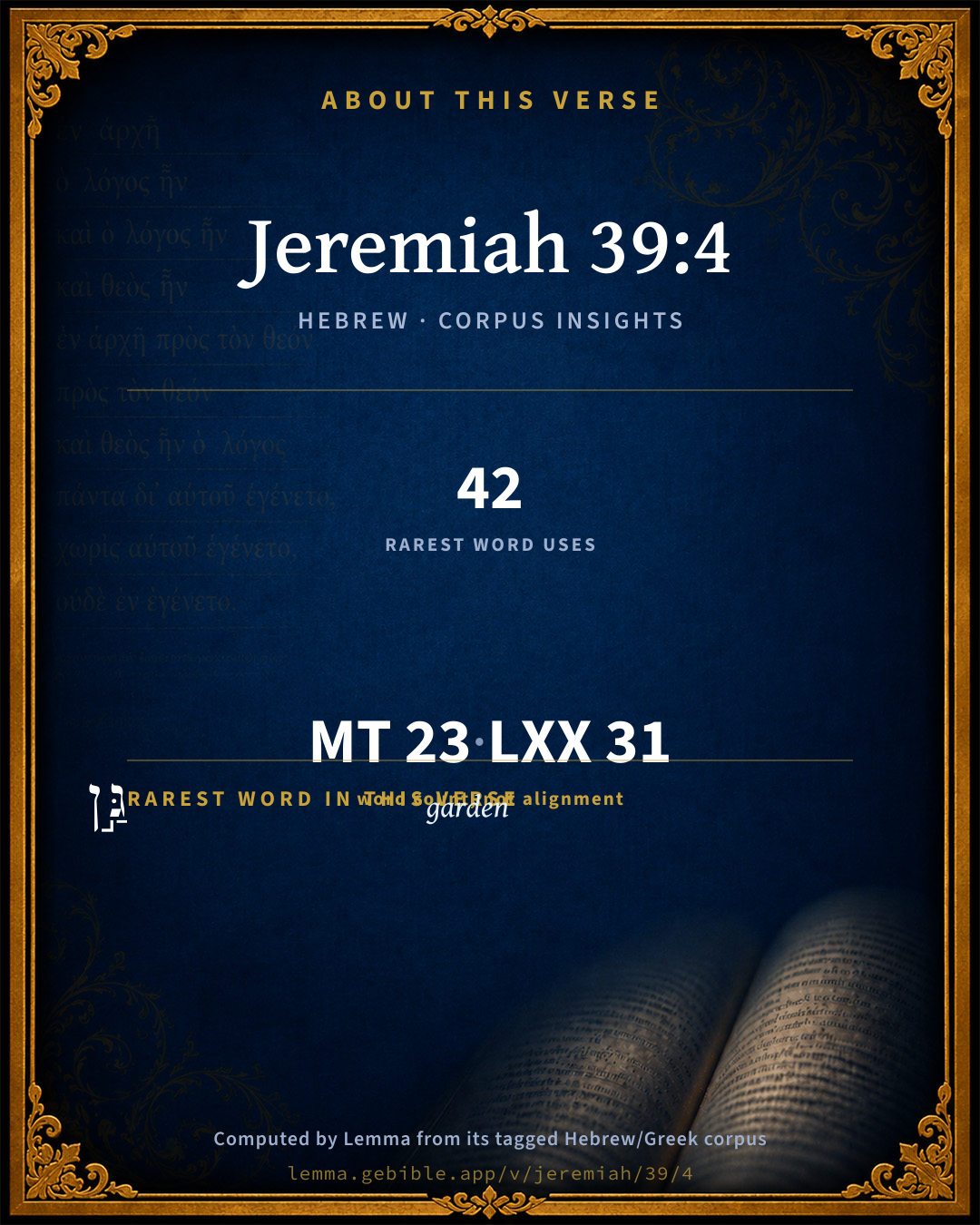
About this verse

These counts appear in no published source. They are computed here, from the morphology-tagged text and Lemma’s own curated glosses. What Lemma adds →

23
words
20
distinct lemmas
Prophets
section

Shared distinctive vocabulary

גַּ֣ן garden H1588 occurs in 37 verses of the Hebrew Bible. Also found in:

Grammatical profile

  • 5 verbs
  • 15 nouns
  • 2 prepositions
  • 1 particle

Verb forms

  • וַיְהִ֡י Qal · Sequential Imperfect
  • רָ֠אָם Qal · Perfect
  • וַֽ֠יִּבְרְחוּ Qal · Sequential Imperfect
  • וַיֵּצְא֨וּ Qal · Sequential Imperfect
  • וַיֵּצֵ֖א Qal · Sequential Imperfect

Repetition

Words recur within this verse — often emphatic in Hebrew:

  • מֶֽלֶךְ king H4428 ×2
  • וַיֵּצְא֨וּ to go out H3318 ×2
  • דֶּ֚רֶךְ way H1870 ×2

Hebrew & Septuagint length

In the original languages it is 23 Hebrew tokens and 31 Greek tokens — but the two are counted differently (Hebrew bundles its prefixes and suffixes into one token; the Greek is in lemma form), so that isn’t a like-for-like length.

Cross-references

11

Topical passages linked to Jeremiah 39:4 in the Treasury of Scripture Knowledge — connected by theme and wording, ordered by reader-vote popularity; previews shown in the World English Bible.

  • 2 Chronicles 32:5 He took courage, and built up all the wall that was broken down, and raised [it] up to the towers, and the other wall outside, and strengthened Millo [in] the city of David, and made weapons and shields in abundance.
  • Amos 2:14 Flight will perish from the swift; And the strong won't strengthen his force; Neither shall the mighty deliver himself;
  • Leviticus 26:17 I will set my face against you, and you will be struck before your enemies. Those who hate you will rule over you; and you will flee when no one pursues you.
  • Leviticus 26:36 "'As for those of you who are left, I will send a faintness into their hearts in the lands of their enemies: and the sound of a driven leaf will put them to flight; and they shall flee, as one flees from the sword; and they will fall when no one pursues.
  • Deuteronomy 28:25 Yahweh will cause you to be struck before your enemies; you shall go out one way against them, and shall flee seven ways before them: and you shall be tossed back and forth among all the kingdoms of the earth.
  • Deuteronomy 32:24–30 [They shall be] wasted with hunger, and devoured with burning heat Bitter destruction; The teeth of animals will I send on them, With the poison of crawling things of the dust.
  • 2 Kings 25:4–7 Then a breach was made in the city, and all the men of war [fled] by night by the way of the gate between the two walls, which was by the king's garden (now the Chaldeans were against the city round about); and [the king] went by the way of the Arabah.
  • Isaiah 30:15–16 For thus said the Lord Yahweh, the Holy One of Israel, In returning and rest shall you be saved; in quietness and in confidence shall be your strength. You would not:
  • Jeremiah 38:18–20 But if you will not go forth to the king of Babylon's princes, then shall this city be given into the hand of the Chaldeans, and they shall burn it with fire, and you shall not escape out of their hand.
  • Jeremiah 52:7–11 Then a breach was made in the city, and all the men of war fled, and went forth out of the city by night by the way of the gate between the two walls, which was by the king's garden; (now the Chaldeans were against the city round about;) and they went toward the Arabah.
  • Ezekiel 12:12 The prince who is among them shall bear on his shoulder in the dark, and shall go forth: they shall dig through the wall to carry out thereby: he shall cover his face, because he shall not see the land with his eyes.

Cross-references courtesy of OpenBible.info (CC BY 4.0).

Hebrew and Greek witnesses Masoretic Hebrew ↔ Greek Septuagint

The same verse in the two great witnesses to the Old Testament, shown verse-for-verse.

These are two independent witnesses, not word-aligned to each other, and the Septuagint is shown in lemma (dictionary) form.

Hebrew Jeremiah 39:4 Masoretic · Westminster Leningrad Codex

וַיְהִ֡י כַּאֲשֶׁ֣ר רָ֠אָם צִדְקִיָּ֨הוּ מֶֽלֶךְ יְהוּדָ֜ה וְכֹ֣ל אַנְשֵׁ֣י הַמִּלְחָמָ֗ה וַֽ֠יִּבְרְחוּ וַיֵּצְא֨וּ לַ֤יְלָה מִן הָעִיר֙ דֶּ֚רֶךְ גַּ֣ן הַמֶּ֔לֶךְ בְּשַׁ֖עַר בֵּ֣ין הַחֹמֹתָ֑יִם וַיֵּצֵ֖א דֶּ֥רֶךְ הָעֲרָבָֽה

It happened that, when Zedekiah the king of Judah and all the men of war saw them, then they fled, and went forth out of the city by night, by the way of the king's garden, through the gate between the two walls; and he went out toward the Arabah.

World English Bible · Public Domain

Greek LXX Structure differs

In the Septuagint, Jeremiah is about an eighth shorter than the Hebrew and arranges its material differently — the Oracles Against the Nations (Hebrew chapters 46–51) appear in the middle of the Greek book, after 25:13. Because the chapter and verse boundaries do not line up, a verse-for-verse comparison with the Hebrew is not shown.

A verse-for-verse comparison isn’t shown here because the chapters and verses don’t line up. Switch to the LXX edition with the MT / LXX toggle above to read the Greek directly.

On this verse, Haydock's Catholic Bible Commentary discusses the Septuagint’s reading. Read the note in Commentary ↓

Hebrew: Westminster Leningrad Codex (CC BY 4.0). Greek: Septuagint (public domain); English from a public-domain English Septuagint. How the Septuagint differs from the Hebrew →

Targum (Aramaic paraphrase)

1

The Targum is the ancient Jewish Aramaic paraphrase of the Hebrew Scriptures — an interpretive translation, not the Hebrew text itself. Onkelos (literal) and Pseudo-Jonathan (expansive) render the Torah, and Jonathan the Prophets. Coverage is partial: where no permissively-licensed English translation exists for a verse, only the Aramaic is shown. This is verse-level text, not a word-by-word alignment to the Hebrew.

  1. Targum Jonathan Prophets (Joshua–Malachi)
    וַהֲוָה כַּד חֲזָנוּן צִדְקִיָה מְלַךְ שִׁבְטָא דְבֵית יְהוּדָה וְכָל גִבָּרֵי עַבְדֵי קְרָבָא וַעֲרָקוּ וּנְפָקוּ בְּלֵילְיָא מִן קַרְתָּא בְּאוֹרַח גִינְתָא דְמַלְכָּא בְּתַרְעָא בֵּין שׁוּרַיָא וּנְפַק בְּאוֹרַח מֵישְׁרָא:

    (no public-domain English translation for this verse)

    Targum Jonathan — Aramaic: “Mikraot Gedolot” (public domain). English: “Sefaria Community Translation” (CC0 1.0 (public-domain dedication)); “London "Chaldee Paraphrase," 1871” (public domain). Text via Sefaria.

Commentary

Notes on Jeremiah 39:4 from classic Christian and Jewish commentators (each source and its license shown beneath its notes). The classic Christian expositions comment on the surrounding passage and are grouped to its opening verse, so a note may address several verses; the Jewish commentaries on the Tanakh (Rashi and others) are per-verse, so they appear only where the commentator wrote on this verse.

Lemma curates 59 commentaries, every one of them public domain or Creative Commons licensed, each selected and text-cleaned for this edition rather than reprinted as found. About our sources →

Trapp's Complete Commentary

John Trapp

Jer 39:4 And it came to pass, [that] when Zedekiah the king of Judah saw them, and all the men of war, then they fled, and went forth out of the city by night, by the way of the king’s garden, by the gate betwixt the two walls: and he went out the way of the plain.

Ver. 4. When Zedekiah the king saw them.] Not entered, but ready to enter. See 2Ki 25:4.

He went out the way of the plain.] Intending likely for Egypt; but his journey was shortened. So was Muliasses, king of Tunis, when fleeing from his son Amidas, he was discovered by the sweet perfumes he had about him; and being brought back, had, like Zedekiah, his eyes put out with a burning hot iron.

John Trapp, A Commentary or Exposition upon All the Books of the Old and New Testament (1647–1656) — public domain. Text from a community e-Sword module.

Joseph Benson's Commentary

Jer 39:4-10. They fled by the gate betwixt the two walls — Betwixt the wall and the outworks, or betwixt the old wall of the city and the new one which Hezekiah built, of which mention is made 2Ch 32:5. See note on 2Ki 25:4. Blaney thinks it probable that between these two walls there might be a private postern through which the king and his followers might slip out unperceived by the besiegers, who surrounded the city, and undoubtedly kept a strict watch on the principal gates. The Chaldean army pursued, &c. — For an illustration of this and the five following verses, see notes on 2Ki 25:5-12.

Joseph Benson's Commentary on the Old and New Testaments (1811–1818) — public domain. Text from a community e-Sword module.

Tyndale Open Study Notes

Tyndale Open Resources

39:4 The steep slopes of the Kidron Valley on the east side and the Ben-Hinnom Valley on the west and south sides of Jerusalem forced the Babylonian army to concentrate their men to the north. This made it possible for Zedekiah, his family, and his officials to slip out of the south end of the city, cross the Kidron Valley, and travel up and over the Mount of Olives. Although they made this move after nightfall, the noise of their departure alerted Babylonian sentries, and soldiers were soon chasing them.

Tyndale Open Study Notes — © Tyndale Open Resources, licensed CC BY-SA 4.0. Text via the HelloAO Bible API.

Geneva Bible (1599)

Geneva Bible translators

Which was a postern door, read 2 Kings 25:4.

Geneva Bible (1599) marginal notes — public domain. Text via Bolls.life.

Jamieson, Fausset & Brown

Robert Jamieson, A. R. Fausset & David Brown

the king's garden--The "gate" to it from the upper, city above was appropriated to the kings alone; stairs" led down from Mount Zion and the palace to the king's garden below (Neh 3:15).

two walls--Zedekiah might have held the upper city longer, but want of provisions drove him to flee by the double wall south of Zion, towards the plains of Jericho (Jer 39:5), in order to escape beyond Jordan to Arabia-Deserta. He broke an opening in the wall to get out (Eze 12:12).

Jamieson, Fausset & Brown — Commentary Critical and Explanatory on the Whole Bible (1871) — public domain (CC PDM 1.0). Text via the HelloAO Bible API.

Adam Clarke's Commentary

Verse 4. Went forth out of the city by night] Probably there was a private passage under ground, leading without the walls, by which Zedekiah and his followers might escape unperceived, till they had got some way from the city.

The way of the plain.] There were two roads from Jerusalem to Jericho. One passed over the mount of Olives; but, as this might have retarded his flight, he chose the way of the plain, and was overtaken near Jericho, perhaps about sixteen or eighteen miles from Jerusalem. He had probably intended to have passed the Jordan, in order to escape to Egypt, as the Egyptians were then his professed allies.

Adam Clarke's Commentary on the Bible (1810–1826) — public domain. Text from a community e-Sword/MySword module.

John Calvin's Commentaries

he then adds, After Zedekiah saw them, etc.; not that he came to that part, but after he understood that that part of the city was occupied by the enemies; for matters then had come to an extremity. Then he fled with his men of war. And here is set before us a sad spectacle: men in no way trained up for war were left in the city, women also and children were left there, while the men of war fled, inasmuch as their condition was worse, because they had delayed the taking of the city. It was then according to what is commonly done, that they fled. We yet see that ungodly men, after having long despised heavenly truth, flee in time of danger, and are so filled with terror, that they cast themselves headlong into many perils. This is a just reward to those who are not terrified by the threatenings of God, but become so hardened, that they too late acknowledge that they ought to have feared; and being, as it were, stunned, they see not what is expedient, and cannot follow any fixed course.

The Prophet adds, that they fled in the night, and that they went out by the way of the king’s garden, and lastly, that they came to the gate which was between the two walls There is in this passage nothing superfluous; for he meant to shew us, that though the king thought that he could escape from the hands of his enemies, he was yet taken, as God had predicted. For, if after the city was taken, he had come as a suppliant, of his own accord, he might probably have obtained mercy; and this counsel, we know, was given while the state of things was not yet desperate; but he put no faith in God’s word. In the meantime he thought that he could disappoint his enemies, if he quickly fled through some secret way. Some think that there was a subterranean passage, which had a door in the middle of the garden, and had also an egress at the other end in the plain of Jericho, as we shall hereafter see. And that region was barren, and therefore solitary. Hence the king entertained confidence; but he found, at length, how certain was prophetic truth; for it is said afterwards, that the Chaldeans followed and took him. But this circumstance, as I have said, ought to be carefully observed, that the king, as the Prophet tells us, fled. through a secret way, during the darkness of the night, and escaped. It now follows —

John Calvin's Commentaries (1540-1563) — public domain. Text from the Calvin Translation Society English edition (1840s-50s) via the Christian Classics Ethereal Library (ccel.org). Calvin's coverage is partial (roughly two-thirds of the Bible); uncommented books and verses are honest gaps, never fabricated. The 19th-century editor's footnotes and remarks are omitted so the notes are faithfully Calvin's own voice.

Ellicott's Commentary for English Readers

(4) When Zedekiah the king of Judah saw them . . .—The hasty flight is narrated again in Jer_52:7. The gate between the two walls was one apparently that opened from the park-like garden of the palace, near the pool of Siloah (Neh_3:15); probably identical with the garden of Uzza, which was used as a burial-place for Manasseh and Amon (2Ki_21:18-26); and led to the Arabah, the plain (always known by this distinctive name) of the valley of the Jordan (Deu_1:1; Deu_3:17; Deu_4:49; Jos_12:1, and elsewhere). The “two walls” appear as part of the defence of the city in Isa_22:11, and connected Zion with the fortress known as Ophel (2Ch_27:3; 2Ch_33:14).

A Bible Commentary for English Readers, edited by Charles John Ellicott (1878–1897) — public domain. Text from a community e-Sword module.

The Cambridge Bible for Schools and Colleges

gen. ed. J. J. S. Perowne

4. by the gate betwixt, etc.] “on the S. of the city (the ‘king’s garden’ was near the pool of Siloam, Neh_3:15), probably the fountain gate of Neh_2:14; Neh_3:15; Neh_12:37, the ‘two walls’ (cf. Isa_22:11) being those below this gate along the W. side of the E. hill of Jerusalem, and the E. side of the W. hill.” Dr. See further in C.B. (Barnes) 2Ki_25:4.

Arabah] the deep valley of the Jordan. See Deu_1:1 R.V. mg.

4–10. See introd. note and summary to ch.

The Cambridge Bible for Schools and Colleges (gen. ed. J. J. S. Perowne; Cambridge University Press, 1878–1918) — public domain. Text from a community e-Sword module.

John Gill's Exposition

And it came to pass, that when Zedekiah the king of Judah saw them, and all the men of war,.... That is, when Zedekiah and his soldiers saw the princes and generals of the Chaldean army enter the city through a breach made in the wall, and take possession of the middle gate; which they might see from some high tower where they were for safety, and to make their observation of the enemy:

then they fled; finding they were not able to keep their posts and resist the enemy:

and went forth out of the city by night; it being the middle of the night, as before observed out of Josephus, that the city was taken; and they took the advantage of the darkness of the night to make their escape: this they chose rather to do than to surrender to the Chaldeans, and lie at their mercy: and they went

by the way of the king's garden, by the gate betwixt the two walls; which lay either between the wall of the city and the outworks, as some; or between the old wall and the new one Hezekiah built, Ch2 32:5; as others; or rather between the wall of the city and the wall of the king's garden; this being a private way, they took it. The Jews have a fable, and which is related both by Jarchi and Kimchi, that there was a cave or vault underground, from the king's house to the plains of Jericho; and by this way the king went that he might not be seen; but God prepared a hind, which the Chaldean army saw, and pursued, and which went into the cave, add they after it; and when they were at the mouth of the cave they saw Zedekiah coming out of it, and took him:

and he went out the way of the plain; on the south side of the which led to Jericho; and on which side the kings garden was; not that he went alone, but his wives, and children, and princes, and men of war with him; see Jer 52:7.

John Gill's Exposition of the Whole Bible (1746–1763) — public domain (CC PDM 1.0). Text via the HelloAO Bible API.

Albert Barnes' Notes on the Bible

Compare the marginal reference. The differences between the two accounts are slight.

Albert Barnes' Notes on the Bible (1834–1885) — public domain. Text from a community e-Sword/MySword module.

Haydock's Catholic Bible Commentary

Walls. This gate had not yet been seized, (Calmet) leading to Jericho, ver. 5. (Haydock) (Ezechiel xii. 4.) --- Roman Septuagint passes over the next 12 verses, which seem to be taken from 4 Kings xxv. 4. (Calmet) --- Grabe supplies ver. 4. to 13., inclusively. "And they sent," &c., which is well connected with ver. 3. --- The possession of one gate would let all the army enter: whereupon Sedecias fled by a postern gate. (Worthington)

George Leo Haydock (1774–1849), Haydock's Catholic Family Bible and Commentary, 1859 edition — public domain. Excludes Psalms (Douay-Rheims chapter numbering differs from Protestant) and Deuterocanonical books (Catholic canon only).

Matthew Poole's English Annotations

It should seem that the city was taken by a surprise; the Chaldeans battering the walls incessantly with their rams and engines of war, on a sudden made such a breach as gave them a liberty to enter in. The king either heard of it, or possibly might be in some place where he might see it; then he begins to think of escaping, but for greater privacy stayeth till he had the covert of the night, and then goeth out towards the plains of Jericho, for there the Chaldeans overtook him, as we read in the next verse. He is said here to have gone by

the way of the king’s garden, by the gate betwixt the two walls. It is very hard for us at this distance of time to pretend to any certainty in determining the way by which he made his escape. They seem to judge most probably that think that the king had prepared for himself a private passage out of his garden betwixt two walls, leading to the wall of the city, which they had before so weakened, as on a sudden they might dig it through. Possibly these particulars are the rather set down, to show us how God verified what he had revealed in this matter to the prophet Eze 12; where God set the prophet, Eze 12:3, to prepare stuff for removing, and to remove by day in the sight of the people from his own place to another place; and, Eze 12:4, to go out at even in their sight, as they that go out into captivity: Eze 12:5, to dig through the wall in their sight, and carry out thereby: Eze 12:6, in their sight to bear it on his shoulders, and carry it forth in the twilight; to cover his face, so as not to see the ground: and he told him, that in all this he was to be a sign; and, Eze 12:10, tells him, this burden concerneth the prince in Jerusalem (who was that Zedekiah). Eze 12:12, And the prince that is among them shall bear upon his shoulder in the twilight, and shall go forth: they shall dig through the wall to go out thereby: he shall cover his face, that he see not the ground with his eyes.

Matthew Poole's English Annotations on the Holy Bible (1683–1685) — public domain. Text from a community e-Sword/MySword module.

Whedon's Commentary on the Bible

Daniel D. Whedon

4. Saw — Perhaps literally, notwithstanding it was night, but the sense may be perceived — knew by the confusion.

Way of the king’s garden… the way of the plain — In Neh_3:15, occurs this expression: “The wall of the pool of Siloah by the king’s garden.” The two walls were that of Ophel on the east, and that of Zion on the west. The gate was probably in the short wall uniting these and stretching across the valley of the Tyropoeon. It was not, as some have suggested, “the gate of the fountain,” but the same that is called the “horse gate” in Neh_3:28. The “way of the plain” is more distinctly indicated in the following verse — the plain of Jericho.

Daniel D. Whedon (gen. ed.), Commentary on the Old and New Testaments (1874–1909) — public domain. Text from a community e-Sword module.

The Pulpit Commentary

Here begins the second parenthesis, to be read apart from the principal, though shorter, narrative (see introduction to chapter). Observe elsewhere in the Book of Jeremiah events known from other sources are only briefly referred to; (comp. Jer_29:2 Jer_32:1-5 Jer_34:1, 7 35:11 37:5) see 2Ki_25:4-12.

Vers. 4-7. See homily on Jer_52:8-11

Vers. 4-7. Too late.

These verses tell of the flight of Zedekiah and his miserable capture by the Chaldean army. Picture the scene. The breach made in the wall. The dead hour of night. The rush upon the temple. The slaughter there. The alarm spreading to the palace. The attempted escape, before dawn, of the king, his wives, and his children. See them muffled, disguised, laden with such precious things as they could snatch up in the hurry of that awful moment, stealthily making their way along the narrow alley between the walls, speeding down the ravine, up over the slopes of Olivet, then down again to the plains of Jericho, where they were overtaken and made prisoners. Many an opportunity of escape had been given to Zedekiah during these last months and previously, but he had neglected them all. For a while his present attempt seemed successful, but he was soon in the cruel grasp of the Chaldeans, and then worse than all he had feared came upon him. He tried to escape, but too late. This history, unutterably sad as it is, has many parallels and much instruction. Consider

I INSTANCES IN WHICH THIS VERDICT OF "TOO LATE" IS APPLICABLE. There are many.

1. Scriptural. No doubt that not a few, when the Lord had shut Noah in the ark, and they saw the lowering clouds, the overwhelming rain, and the rising waters repented and sought safety in the ark. But then, because they had been "sometime disobedient", (cf. 1Pe_3:19) they were now too late. "Remember Lot"s wife." The Israelites after their repulse at Ai; after their disbelief of the faithful spies. (Num_14:44) Our Lord"s words to Jerusalem, "But now they are hid from thine eyes." The foolish virgins (Matthew 25). Cf. also "When once the master of the house has risen up and shut to the door," etc.

2. Historic. Archias, magistrate of Greece, revelling and feasting. Plot formed to assassinate. A friend sends intelligence. Arrives as feast is going on. "Serious things tomorrow," said the senseless man. That night he was slain. The massacre of Glencoe would never have occurred but for the tardiness of the chief of the clan in giving in his submission to the government. A snowstorm hindered him when at last he did set out for this purpose, and the last day of grace came and ended, and the chief"s submission had not been made. The massacre followed (cf. Macaulay).

3. And in less notable events in common everyday life, how perpetually are we seeing like instances! School life wasted, no making it up again. Opportunities in business, in the home, in the Church, missed; above all, in regard to the life eternal, and not recoverable. The tide in the affairs of men not taken at the flood; instead of fortune, the few ships which men have launched lie wrecked or stranded on the shore. "Too late!" With what disappointment and despair is this often said, and will it be said hereafter, and with what truth as well! Therefore note

II THE MISERY OF HIM WHO IS TOO LATE. This arises from:

1. Shame before men. They will not pity, but despise and blame.

2. Sting of conscience. We know it might have been otherwise; we might have secured what we have let go.

3. Sight of the consequences brought on ourselves and others through our neglect.

4. The irrecoverability of what is lost. It can never be all the same to any soul, no matter what theory of the future we may hold, if he has thrown away opportunities of grace and squandered the days of salvation with which he was blessed. This thought, that he was "too late," was the "torment" of the rich man in the hell into which God sent his soul after death.

III HOW COME MEN TO BE TOO LATE? Sometimes it is:

1. The opportunity passes away. The tide which should have been taken at the flood has begun to ebb.

2. Yet more often, the power of the law of habit. Opportunities may be plentiful, but the habit of resisting the call to use them has become fixed, and therefore it it really "too late" for the man, even when he might if he would seize upon them for his good. We sing"And while the lamp holds out to burn, The vilest sinner may return.

Yes, no doubt; but will he? If he has got so into the habit of saying "No" to God will he is it likely? at the last turn and say, "Yes"? Death bed repentances! are there any such things? That which determines a soul"s destiny is not death, but this law of habit. Long before death it may have been settled whether that soul shall be saved or lost. And death may come, as it does to the young, and the matter be not settled, the law of habit not having had time to declare itself whilst life in the body lasted. The law of habit, not the hour of death, is that from which we have most to hope and most to fear.

3. The gambling spirit that is in all men. The trusting to chance, the hope in good luck, in regard to things secular; the hope for a more convenient season in regard to the things of the soul. There is this spirit in us all. It has its uses, for there are "ventures of faith" as well as all too many ventures of a very different kind. Read this history of King Zedekiah, and see how he gambled away his crown, his kingdom, his life, his all.

IV SAFEGUARDS AGAINST THIS EVIL. Under God, this same law of habit of which we have spoken. Resolve, and strengthen your resolve by prayer, that you will not put off till tomorrow what you should do today. Act on it, and tomorrow you shall act on it again, and the next day, and so the blessed habit shall be formed of practically remembering that "now is the accepted time," and for you or by you the miserable verdict of "too late" shall never have to be pronounced. C.

The Pulpit Commentary (1880–1919), ed. H.D.M. Spence-Jones & Joseph S. Exell — public domain. Text from a community e-Sword module.

unfoldingWord translationNotes

Door43 World Missions Community

They went out at night from the city by the king's garden path

"They left the city at night going out on a path in the king's garden"

the plains of the Jordan River valley

This is the flat land at the southern end of the valley.

at Riblah in the land of Hamath

Riblah was a town in the territory of Hamath, which is in Syria. (See: How to Translate Names)

pursued them and overtook

"followed them and caught"

passed sentence on him

"decided how to punish him"

translationWords

Arabah

Chaldea

Jordan River

Jericho

unfoldingWord translationNotes — © Distant Shores Media and the Door43 World Missions Community, licensed CC BY-SA 4.0. Source: git.door43.org/Door43/en_tn.

Rashi

Rabbi Shlomo Yitzchaki (Rashi)

by way of the king’s garden He had a cave from his house to the plains of Jericho, and he went out at night by way of the cave. What did the Holy One, blessed be He, do to fulfill “And I will spread My net over him” (Ezek. 12:13)? He prepared a deer before the Chaldeans walking on the roof the cave outside the city, and they ran after it to seize it, and it ran up to the entrance of the cave, and they saw Zedekiah going out of the cave.

Rashi on the Tanakh — English translations: “The Judaica Press complete Tanach with Rashi, translated by A. J. Rosenberg” (CC BY 4.0); “Pentateuch with Rashi's commentary by M. Rosenbaum and A.M. Silbermann, 1929-1934” (public domain); “The Metsudah Tanach series, Lakewood, N.J” (CC BY 4.0); and “The Book of Joshua, Metsudah Publications, 1997” (CC BY 4.0). Text via Sefaria.

Lesson kit

Teaching starters — assembled from the data on this page, not authored interpretation. Every prompt links to the verse data it draws on. Edit before teaching.

Jeremiah, in the Prophets, opens this verse with 23 words (20 distinct Hebrew lemmas). Its most distinctive word is gan (“garden”). A historical commentator’s framing appears above. Read the whole chapter for the surrounding context.

Discussion questions

  1. How does “garden” (gan) shape what this verse is saying?
  2. How does Genesis 2:8, which shares the word «garden», read alongside this verse?
  3. What does the repetition of “king” (2× in this one verse) do in this verse?
  4. The translations on this page render this verse differently — a whole-verse word diff, not a word-by-word alignment. What might account for the different wordings?
  5. «וַיְהִ֡י» is a Qal Sequential Imperfect verb. How does that grammatical form shape the action described?
  6. Compare how Trapp's Complete Commentary and Joseph Benson's Commentary read this verse. Where do they agree or differ?

Things to notice

Reading settings

Reading text

Shown beneath each verse's original-language words.

Old Testament
Old Testament edition

Read the OT as the Masoretic Hebrew (MT) or the Greek Septuagint (LXX).

English shown for the Greek Septuagint (in the Hebrew ↔ Greek comparison).

Comparing translations? Open the Compare panel on any verse page to stack up to four side by side.