Ruth 2:15

Hebrew (Westminster Leningrad Codex) Ruth 2:15 appears in the Hebrew Old Testament. The text above is from the Westminster Leningrad Codex. Each word links to its Strong’s number, a concise gloss, and parsing drawn from the Open Scriptures Hebrew Bible morphology. Click any word for its full Brown-Driver-Briggs (BDB) entry.
Download image
Cite this verse

Ruth 2:15 (World English Bible). Public Domain. Lemma interlinear Bible study tool, https://lemma.gebible.app/v/ruth/2/15.

Show BibTeX & RIS
BibTeX
RIS
English Translation
When she was risen up to glean, Boaz commanded his young men, saying, Let her glean even among the sheaves, and don't reproach her.
World English Bible · Public Domain
Download a study sheet

One document with this verse’s original text, its word-by-word gloss line, the meaning frame, cross-references with their text, attributed commentary, and full source and license credits — printable, and it pastes into notes with its structure intact.

This verse Autodidact and up

Study sheet (.html) Plain text (.txt)

A passage Seminary Student

Up to 50 verses in one chapter. A passage sheet keeps up to 6 commentary sources and 12 cross-references per verse, in the order this page ranks them, and says so on the sheet whenever that leaves anything out. Ask for a single verse and you get the Autodidact verse sheet above.

Everything on this page stays free to read, with no account — the sheet is a download of what is already on screen, not access to it.

Want to remove ads? Support Godless Engineer
Compare translations 3

The same verse in 3 English versions, stacked beneath the original-language interlinear above. Click any original word for its lexicon entry.

Each is an independent rendering of the whole verse — the interlinear is not word-aligned to these translations.

Highlighted words mark where these versions differ — a whole-verse word diff, not a word-by-word alignment.

  • World English Bible Public Domain
    When she was risen up to glean, Boaz commanded his young men, saying, Let her glean even among the sheaves, and don't reproach her.
  • King James Version Public Domain
    And when she was risen up to glean, Boaz commanded his young men, saying, Let her glean even among the sheaves, and reproach her not:
  • unfoldingWord Literal Text CC BY-SA 4.0
    Then she got up to glean. Then Boaz commanded his young men, saying, “Let her glean even among the bundles, and do not shame her.

unfoldingWord Literal Text — © unfoldingWord, licensed CC BY-SA 4.0. Word-aligned USFM3 via Door43 (git.door43.org/unfoldingWord/en_ult).

Versions to compare (up to 4)

3 of 4 selected

Show all 18 translations

Every available English version of this verse, each an independent rendering of the whole verse.

  • World English Bible Public Domain
    When she was risen up to glean, Boaz commanded his young men, saying, Let her glean even among the sheaves, and don't reproach her.
  • Berean Standard Bible Public Domain
    When Ruth got up to glean, Boaz ordered his young men, “Even if she gathers among the sheaves, do not insult her.
  • Majority Standard Bible Public Domain
    When Ruth got up to glean, Boaz ordered his young men, “Even if she gathers among the sheaves, do not insult her.
  • King James Version Public Domain
    And when she was risen up to glean, Boaz commanded his young men, saying, Let her glean even among the sheaves, and reproach her not:
  • American Standard Version (1901) Public Domain
    And when she was risen up to glean, Boaz commanded his young men, saying, Let her glean even among the sheaves, and reproach her not.
  • Revised Version (1885) Public Domain
    And when she was risen up to glean, Boaz commanded his young men, saying, Let her glean even among the sheaves, and reproach her not.
  • Geneva Bible (1599) Public Domain
    And when she arose to gleane, Boaz commanded his seruants, saying, Let her gather among the sheaues, and doe not rebuke her.
  • Douay-Rheims (1899) Public Domain
    And she arose from thence, to glean the ears of corn as before. And Booz commanded his servants, saying: If she would even reap with you, hinder her not:
  • Young's Literal Translation Public Domain
    And she riseth to glean, and Boaz chargeth his young men, saying, `Even between the sheaves she doth glean, and ye do not cause her to blush;
  • Literal Standard Version CC BY-SA 4.0
    And she rises to glean, and Boaz charges his young men, saying, “Even between the sheaves she gleans, and you do not cause her to blush;
  • Unlocked Literal Bible CC BY-SA 4.0
    As she got up to gather up grain, Boaz commanded his young men, saying, “Let her gather up the grain even among the bundles, and do not tell her not to.
  • unfoldingWord Literal Text CC BY-SA 4.0
    Then she got up to glean. Then Boaz commanded his young men, saying, “Let her glean even among the bundles, and do not shame her.
  • Darby Bible Public Domain
    And when she rose up to glean, Boaz commanded his young men, saying, Let her glean even among the sheaves, and ye shall not reproach her.
  • World Messianic Bible Public Domain
    When she had risen up to glean, Boaz commanded his young men, saying, “Let her glean even among the sheaves, and don’t reproach her.
  • Webster's Bible Public Domain
    And when she had risen to glean, Boaz commanded his young men, saying, Let her glean even among the sheaves, and reproach her not:
  • Free Bible Version CC BY-SA 4.0
    After Ruth went back to work Boaz told his men, “Let her pick up grain even among the sheaves. Don't say anything to embarrass her.
  • Bible in Basic English Public Domain
    And when she got ready to take up the grain, Boaz gave his young men orders, saying, Let her take it even from among the cut grain, and say nothing to her.
  • JPS Tanakh (1917) Public Domain
    And when she was risen up to glean, Boaz commanded his young men, saying: 'Let her glean even among the sheaves, and put her not to shame.

Literal Standard Version (2020), Covenant Press — licensed CC BY-SA 4.0. Text via the HelloAO Bible API (eBible.org). Unlocked Literal Bible (unfoldingWord) — licensed CC BY-SA 4.0. Text via the HelloAO Bible API (eBible.org). unfoldingWord Literal Text — © unfoldingWord, licensed CC BY-SA 4.0. Word-aligned USFM3 via Door43 (git.door43.org/unfoldingWord/en_ult). Free Bible Version, Dr. Jonathan Gallagher — licensed CC BY-SA 4.0. Text via the HelloAO Bible API (eBible.org).

Word by word

More ways to search: Search by grammar → Find every occurrence → Compare this word →

Practice this passage: Drill this verse → Learn its vocabulary →

הָֽעֳמָרִ֛ים
ʻômer
H6016
“the · sheaves”
Particle, Definite Article + Noun, Common, Masculine, Plural, Absolute
Part of Speech
Particle + Noun
Type
Common
Gender
Masculine
Number
Plural
State
Absolute
Full BDB Definition

Origin: from H6014

TWOT: 1645b , 1645a

omer - a dry measure of 1/10 ephah (about 2 litres) - sheaf
  1. וַתָּ֖קָם qûwm H6965 “and · to rise” Conjunction + Verb, Qal, Sequential Imperfect, 3rd Person, Feminine, Singular
  2. לְלַקֵּ֑ט lâqaṭ H3950 “to gather” Preposition + Verb, Piel, Infinitive Construct
  3. וַיְצַו֩ tsâvâh H6680 “and · to command” Conjunction + Verb, Piel, Sequential Imperfect, 3rd Person, Masculine, Singular
  4. בֹּ֨עַז Bôʻaz H1162 “Boaz” Noun, Proper
  5. אֶת ʼêth H853 “-” Particle, Direct Object
  6. נְעָרָ֜יו naʻar H5288 “boys · his” Noun, Common, Masculine, Plural, Construct + Suffix, Personal, 3rd Person, Masculine, Singular
  7. לֵאמֹ֗ר ʼâmar H559 “to say” Preposition + Verb, Qal, Infinitive Construct
  8. גַּ֣ם gam H1571 “also” Particle, Accusative
  9. בֵּ֧ין bêyn H996 “between” Preposition
  10. תְּלַקֵּ֖ט lâqaṭ H3950 “to gather” Verb, Piel, Imperfect, 3rd Person, Feminine, Singular
  11. וְלֹ֥א lôʼ H3808 “and · not” Conjunction + Particle, Negative
  12. תַכְלִימֽוּהָ kâlam H3637 “to shame · her” Verb, Hiphil, Imperfect, 2nd Person, Masculine, Plural + Suffix, Personal, 3rd Person, Feminine, Singular

About this verse

These counts appear in no published source. They are computed here, from the morphology-tagged text and Lemma’s own curated glosses. What Lemma adds →

13
words
12
distinct lemmas
Historical
section

Notable vocabulary

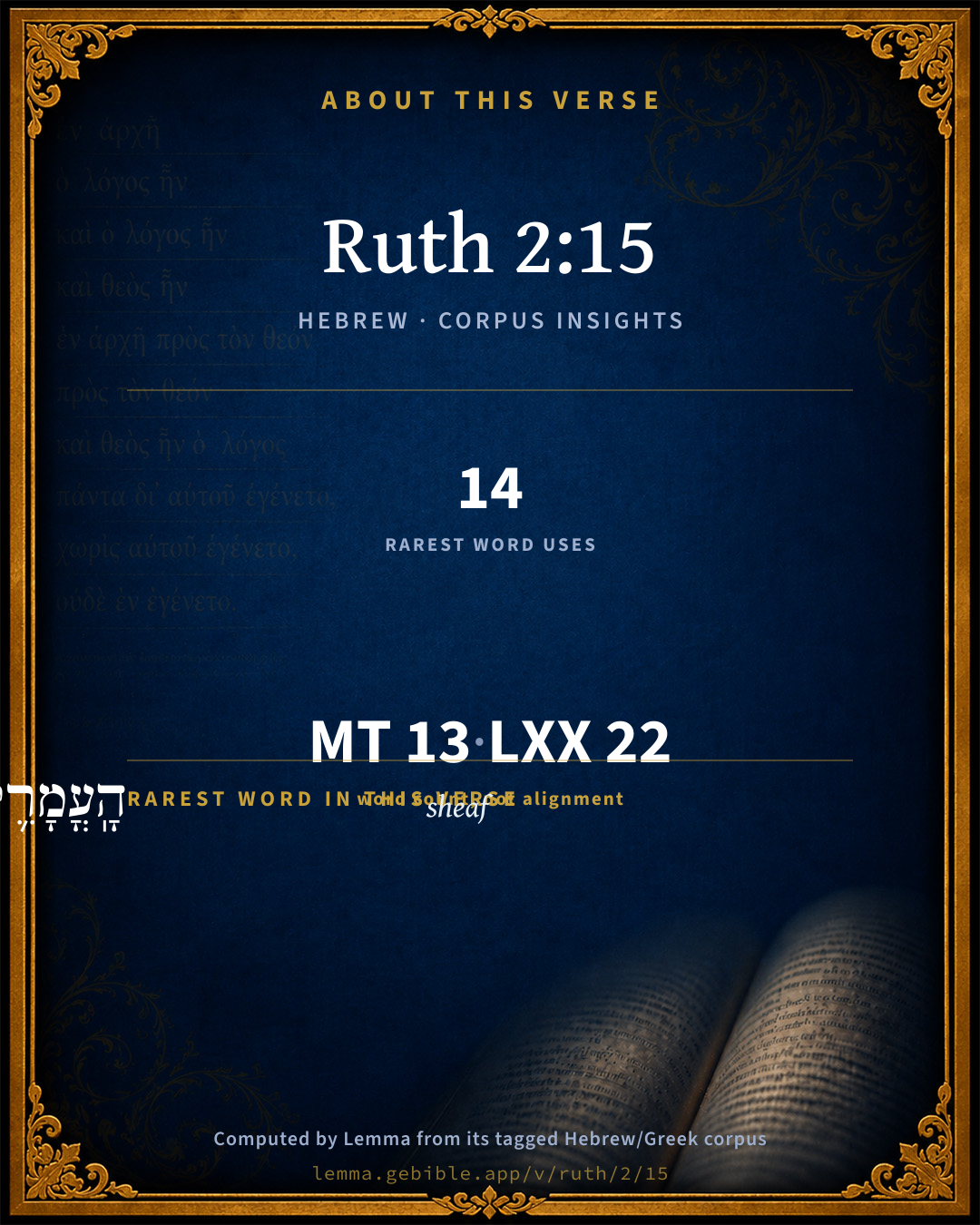
The rarest word here is הָֽעֳמָרִ֛ים sheaf H6016 — appearing just 14 times in the whole Hebrew Bible.

Shared distinctive vocabulary

הָֽעֳמָרִ֛ים sheaf H6016 occurs in 14 verses of the Hebrew Bible. Also found in:

Grammatical profile

  • 6 verbs
  • 3 nouns
  • 1 preposition
  • 3 particles

Verb forms

  • וַתָּ֖קָם Qal · Sequential Imperfect
  • לְלַקֵּ֑ט Piel · Infinitive Construct
  • וַיְצַו֩ Piel · Sequential Imperfect
  • לֵאמֹ֗ר Qal · Infinitive Construct
  • תְּלַקֵּ֖ט Piel · Imperfect
  • תַכְלִימֽוּהָ Hiphil · Imperfect

Repetition

A word recurs within this verse — often emphatic in Hebrew:

  • לְלַקֵּ֑ט to gather H3950 ×2

Hebrew & Septuagint length

In English translation the verse runs 24 words from the Hebrew and 24 from the Septuagint (LXX English) — the same length.

A rough comparison of the two English renderings, which tokenize alike — not a word-level alignment.

Word counts can differ between the Hebrew and the Greek without any difference in meaning — e.g. the Hebrew direct-object marker אֵת has no separate Greek word, and Greek often adds the article ὁ.

In the original languages it is 13 Hebrew tokens and 22 Greek tokens — but the two are counted differently (Hebrew bundles its prefixes and suffixes into one token; the Greek is in lemma form), so that isn’t a like-for-like length.

Cross-references

1

Topical passages linked to Ruth 2:15 in the Treasury of Scripture Knowledge — connected by theme and wording, ordered by reader-vote popularity; previews shown in the World English Bible.

  • James 1:5 But if any of you lacks wisdom, let him ask of God, who gives to all liberally and without reproach; and it will be given to him.

Cross-references courtesy of OpenBible.info (CC BY 4.0).

Hebrew and Greek witnesses Masoretic Hebrew ↔ Greek Septuagint

The same verse in the two great witnesses to the Old Testament, shown verse-for-verse.

These are two independent witnesses, not word-aligned to each other, and the Septuagint is shown in lemma (dictionary) form.

Hebrew Ruth 2:15 Masoretic · Westminster Leningrad Codex

וַתָּ֖קָם לְלַקֵּ֑ט וַיְצַו֩ בֹּ֨עַז אֶת נְעָרָ֜יו לֵאמֹ֗ר גַּ֣ם בֵּ֧ין הָֽעֳמָרִ֛ים תְּלַקֵּ֖ט וְלֹ֥א תַכְלִימֽוּהָ

When she was risen up to glean, Boaz commanded his young men, saying, Let her glean even among the sheaves, and don't reproach her.

World English Bible · Public Domain

Greek LXX Ruth 2:15 Septuagint · lemma form

καί ἀναἵστημι ὁ συνλέγω καί ἐντέλλω βοος ὁ παιδάριον αὐτός λέγω καί γέ ἀνά μέσος ὁ δράγμα συνλέγω καί μή κατααἰσχύνω αὐτός

And she rose up to glean; and Booz charged his young men, saying, Let her even glean among the sheaves, and reproach her not.

LXX2012 (modern English Septuagint) · Public Domain

On this verse, The Preacher's Complete Homiletical Commentary discusses the Septuagint’s reading. Read the note in Commentary ↓

Hebrew: Westminster Leningrad Codex (CC BY 4.0). Greek: Septuagint (public domain); English from LXX2012 (modern English Septuagint) (Public Domain). How the Septuagint differs from the Hebrew →

Commentary

Notes on Ruth 2:15 from classic Christian and Jewish commentators (each source and its license shown beneath its notes). The classic Christian expositions comment on the surrounding passage and are grouped to its opening verse, so a note may address several verses; the Jewish commentaries on the Tanakh (Rashi and others) are per-verse, so they appear only where the commentator wrote on this verse.

Lemma curates 59 commentaries, every one of them public domain or Creative Commons licensed, each selected and text-cleaned for this edition rather than reprinted as found. About our sources →

Trapp's Complete Commentary

John Trapp

Rth 2:15 And when she was risen up to glean, Boaz commanded his young men, saying, Let her glean even among the sheaves, and reproach her not:

Ver. 15. And when she was risen up to glean.] After thanks returned, first to God, and then to Boaz, she returneth to her labour. Eat she did to live, not live to eat.

Boaz commanded his young men.] These he bound to the good behaviour, as being apt enough to be unruly.

Reproach her not,] sc., By rebuking her {Rth 2:16} as too forwardly.

John Trapp, A Commentary or Exposition upon All the Books of the Old and New Testament (1647–1656) — public domain. Text from a community e-Sword module.

The Biblical Illustrator

Joseph S. Exell

Rth_2:15-16

Let her glean even among the sheaves.

Spiritual gleaning

I. The God of the whole earth is a great husbandman. This is true in natural things. As a matter of fact all farm operations are carried on by His power and prudence. In spiritual matters God is a great Husbandman; and there, too, all His works are done for His children, that they may be fed upon the finest of the wheat. Permit me to speak of the wide gospel-fields which our heavenly Father farms for the good of His children. Every field which our heavenly Father tills yields a plentiful harvest, for there are no failures or famines with Him.

1. One part of His farm is called doctrine field. What full sheaves of finest wheat are to be found there! Gospel doctrine is always safe doctrine. You may feast upon it till you are full, and no harm will come of it. Be afraid of no revealed truth.

2. The great Husbandman has another field called promise field; of that I shall not need to speak, for I hope you often enter and glean from it. The whole field is your own, every ear of it; you may draw out from the sheaves themselves, and the more you take the more you may.

3. Then there is ordinance field; a great deal of good wheat grows in this field. In all the estate no field is to be found to rival this centre and crown of all the domain: this is the Kings acre. Gospel gleaner, abide in that field; glean in it on the first day of every week, and expect to see your Lord there; for it is written, He was known of them in the breaking of bread.

4. Fellowship and communion with Christ. This is the field for the Lords choicest ones to glean in.

II. a humble gleaner.

1. The believer is a favoured gleaner, for he may take home a whole sheaf, if he likes: he may bear away all that he can possibly carry, for all things are freely given him of the Lord. Alas, our faith is so little that we rather glean than reap; we are straitened in ourselves, not in our God. May you all outgrow the metaphor, and come home, bringing your sheaves with you.

2. Again, we may remark that the gleaner, in her business has to endure much toil and fatigue. I know a friend who walks five miles every Sunday to hear the gospel, and has the same distance to return. Another thinks little of a ten miles journey; and these are wise, for to hear the pure Word of God no labour is extravagant.

3. We remark, next, that every ear the gleaner gets she has to stoop for. We will go down on our knees in prayer, and stoop by self-humiliation and confession of ignorance, and so gather with the hand of faith the daily bread of our hungering souls.

4. Note, in the next place, that what a gleaner gets she wins ear by ear; occasionally she picks up a handful at once, but as a rule it is straw by straw. Now, where there are handfuls to be got at once, there is the place to go and glean; but if you cannot meet with such abundance, be glad to gather ear by ear, That is a sorry ministry which yields nothing. Go and glean where the Lord has opened the gate for you. Why the text alone is worth the journey; do not miss it.

5. Note, next, that what the gleaner picks up she keeps in her hand; she does not drop the corn as fast as she gathers it. Be attentive, but be retentive too. Gather the grain and tie it up in bundles for carrying away with you, and mind you do not lose it on the road home. Do not lose by trifling talk that which may make you rich to all eternity.

6. Then, again, the gleaner takes the wheat home and threshes it. It is a wise thing to thresh a sermon whoever may have been the preacher, for it is certain that there is a portion of straw and chaff about it. Many thresh the preacher by finding needless fault; but that is not half so good as threshing the sermon to get out of it the pure truth.

7. And then, in the last place, the good woman, after threshing the corn, no doubt winnowed it. Ruth did all this in the field; but you can scarcely do so. You must do some of the work at home. Separate between the precious and the vile, and let the worthless material go where it may; you have no use for it, and the sooner you are rid of it the better. Judge with care; reject false teaching with decision, and retain true doctrine with earnestness, so shall you practise the enriching art of heavenly gleaning.

III. a gracious permission given: Let her glean among the sheaves, and reproach her not. We have no right to any heavenly blessings of ourselves; our portion is due to free and sovereign grace. I tell you the reasons that moved Boazs heart to let Ruth go among the sheaves. The master motive was because he loved her. He would have her go there because he had conceived an affection for her, which he afterwards displayed in grander ways. So the Lord lets His people come and glean among the sheaves, because He loves them. There was another reason why Boaz allows Ruth to glean among the sheaves; it was because he was her relative. This is why our Lord gives us choice favours at times, and takes us into His banqueting house in so gracious a manner. He is our next of kin, bone of our bone, and flesh of our flesh. Oh, child of God, never be afraid to glean! Have faith in God, and take the promises home to yourself. Jesus will rejoice to see you making free with His good things. (C. H. Spurgeon.)

The benevolence of Boaz

This benevolence of Boaz seems to me to have two lessons in it: one practical how we should do our benevolence; and one theological--how God does His benevolence. You will see, in the first place, that Boaz does not give her the wheat. Generous as he is, she earns what she gets. He does not send her back home and send the young men with sheaves after her; he lets her work for what she receives. To give something for nothing is always a dangerous piece of business. Sometimes we must do it, it is true, but it is not the ideal kind of benevolence. If you desire to do something for the poor that will endure, let them do something to earn that which they receive from you. And yet while Boaz thus allows her to earn what she receives, so that she is no pauper, no beggar, has no self-respect taken away from her, he does it largely and with a great, generous mood, not in a niggardly way. But, most of all, he gives her secretly. Boaz anticipated Christ. A great many years before Christ had said, Let not your right hand know what your left hand does, Boaz practised that maxim. He hid his benevolence from this woman, and Boaz enjoyed the benevolence all the more because she did not understand it. In our benevolence let us maintain the self-respect of those we aid; let us not make paupers of them; and strive how we can do the most good with the least possible display. That is not the ordinary rule, but it is a good one. But this story of the benevolence of Boaz is also a parable. It indicates the way in which God does His good works among men. Did you ever think how true it is that God also maintains our self-respect when He gives to us--how very little He gives unless we do something to get the gift? When we pray for bread for our need, He does not give us the bread; He gives us a piece of land, and a plough, and a hoe, and we must sweat for the bread. When we pray for clothing, He does not send the clothing; He gives us that out of which we can by our own industry make the clothing. It is certainly true in the material realm. It is true in the intellectual realm. The world is full of wisdom, full of the resources out of which wisdom is gathered; but we must gather it; we cannot get our wisdom ready-made. It is not handed to us. And this is equally true in the spiritual realm. God no more hands the bread of life ready-made than He hands the material bread ready-made. But how generously He gives to those who are willing to work for Him, and take that given in that spirit which preserves the self-respect while receiving the benevolence! We cut down the forests and find the coal-mine; we exhaust the ocean of its whales and find gas and electricity to take their place; and now the scientific men are discussing the problem whether they cannot find a way to utilise the seemingly wasted sunlight. Nature has reservoired them in the coal-fields--that is, God has reservoired them--and out of its reservoir we gather the light. But now men are beginning to say, Can we not reservoir this sunlight, this heat that goes to Waste, and make it do the worlds work for us? The world is full of Gods gifts. He only waits for us with pick and axe and hoe, with sweat of brain and sweat of body, to find a way to realise them. And as God sets us to work to get His gifts, and as God fills the world full with them, so God conceals Himself in the giving. I turn to my books of literature, and I find praises of Nature. Nature! What is Nature but a word for God? What is Nature but the minister and servant? What is Nature but the elements that are dropping the great sheaves of wheat in our path, and we do not know that Boaz is hiding behind the hedge smiling at our joy in our discovery. God conceals Himself. He ministers through others, and takes as to Himself the thanks we give to them. (Lyman Abbott, D. D.)

Combination of strength and gentleness in Boaz

There are persons to be met with in social life who, while possessing the more solid qualities of moral excellence, are singularly deficient in the more graceful. They have honesty, but they have no sensibility; they have truth, but they are strangely wanting in tenderness. You have the marble column, but you have not the polish or the delicate tracery on its surface; you have the rugged oak, but you miss the jasmine or the honeysuckle creeping gracefully around it from its roots. But the conduct of Boaz, as we stand and hear him giving those directions to his reapers, proves the compatibility of those two forms of excellence, and how the strong and the amiable may meet and harmonise in the same character. They do always meet in the highest forms of moral greatness. (A. Thomson. D. D.)

The refining art of doing good

I speak of the art of doing good because it deserves a place among the beautiful arts of earth and heaven. We speak of the refinement of the arts. Men may cultivate the beautiful and be no better at heart for it all. The beautiful has no ministry to those who reject the great Artist of the universe. He would have saved the world long ago by the ministry of the beautiful had it been possible. What pictures are like those He hangs before us every day? What sunsets represented on the canvas are like the real sunsets? When we love the great Artist out of whose mind has poured all the beauty there is in the world, then every leaf and every flower, every sunrise and every sunset, every vision of beauty in earth or sky or sea, has its tender, gentle, refining influence upon the adoring heart. This art of doing good refines the heart and life even more than the study of the beautiful (C. C. McCabe, D. D.)

The Biblical Illustrator, edited by Joseph S. Exell (c. 1880s–1900s) — public domain. Text from a community e-Sword module.

The Preacher's Complete Homiletical Commentary

Joseph S. Exell (gen. ed.)

CRITICAL AND EXEGETICAL NOTES.—Rth_2:15. And when she was risen up. Evident from this and the previous phrase that Boaz said, “Come thou hither,” as he himself sat among his reapers at the mid-day meal. So that a pause may be understood between the first conversation, ending with Rth_2:13, and the invitation itself, during which Ruth goes on with her gleaning. Then there is the rest lasting throughout the hour of meals, in the tent or house for the reapers, followed by fresh toil until the evening. Commanded his young men. He had charged them already not to touch her (Rth_2:9). Let her glean even among the sheaves. She may also glean between the sheaves (Keil). A rare privilege, not allowed to ordinary gleaners (Steele and Terry); and a still greater concession than that in Rth_2:9—“after the reapers.” And reproach her not. (Heb. shame her not); μὴ καταισχύνητε (LXX.). Ye shall not shame her [do her any injury (Jdg_18:7)] (Keil). In other words, they were not to say things to her which would make her blush (Lange), not to remind her of her poverty, etc.

Rth_2:16. And let fall also of the handfuls. Let fall also out of your armfuls that you have reaped (Vulg.). Pull out from the bundles (Lange). Ye shall also draw out of the bundles for her (Keil). It is necessary to distinguish carefully between “the sheaves” (Rth_2:15) and the “handfuls.” The former is the sheaf already bound by the maidservants, and lying on the ground; the latter is the bundle as taken up and still held in the arm, manipulus (Lange). And leave them. Let them lie (Keil). And rebuke her not. Scold her not (Lange, Keil). These directions of Boaz went far beyond the bounds of generosity and compassion for the poor, and show that he felt a peculiar interest in Ruth, with whose circumstances he was well acquainted, and who had won his heart by her humility, etc.,—a fact important to notice in connection with the further course of the history (Keil).

Rth_2:17. And beat out, ἐῤῥάβδισεν (LXX.). With a stick (Wordsworth). A process often witnessed by modern travellers in the East (Steele and Terry). About an ephah of barley. About a bushel and a half (ibid). About twenty to twenty-five lbs. (Keil). Impossible to ascertain the quantity, still less its weight, exactly, but it was considerable, say fifty-five pounds (Lange). About eight gallons; see Exo_16:36 (Wordsworth). She had gleaned so much, she could not carry it home in the ear (ibid.). An ephah exactly equal to an English cubic foot (Conder). The quantity of manna contained by the ephah was sufficient for ten men (cf. Exo_16:16, with Exo_16:36).

Rth_2:15-16

Theme.—LIBERAL GIVING, LIKE GOD’S

“And the more thou spendest

From thy little store;

With a double bounty,

God shall give thee more.”

“Thrice happy man! enabled to pursue

What all so wish, but want the power to do!”—Pope.

And when she was risen up to glean, Boaz commanded his young men, saying, Let her glean among, etc., and reproach her [shame her] not. And let fall, etc., and rebuke [scold] her not.

Rested, refreshed, invigorated with food, as well as comforted by the kind words of the master of the harvest-field, Ruth evidently rises up to her labour with new pleasure and fresh earnestness. Note. (a) The poor can appreciate and respond to all this, without presuming upon it, or without being encouraged to idleness. Kindness to the deserving is a stimulus, an incentive to fresh enterprise and diligence. (b) The true use of rest and food is to strengthen us for resuming our toil.

Again, mark how the diligent hand obtains new and ever-increasing favours. God’s law is, to him that hath shall be given, and labour is the appointed way of increase, from which even Paradise itself was not exempted (Gen_2:15). He who would have must get, and he who would have much, must get diligently. We are all gleaners, and the world is our harvest-field; and productive gleaning is, and always has been, to the earnest and the industrious. God helps us, both in spiritual and temporal things; but He in no way does so with a desire to do away with human responsibility. He scatters His blessings around us, but we ourselves must gather and make them our own. His giving is never intended to abate our diligence. Boaz here gives from pure goodness and nobleness of heart, and therefore his benevolence is a type of the divine and perfect giving of God.

I. He gives unexpectedly. This is seen in two ways:

(1) He allows her to “glean among the sheaves,” in a place where her labour will be more productive. So the Divine hand, in reward for past diligence, and as a proof of present favour, leads men to new spheres and employments, more fertile, as well as more dignified and productive. Joseph is exalted in Egypt, and David in Israel, and Paul among the apostles. Note. It is lawful to extend favours more to one than another (Fuller), in those things which are free favours (ibid.), in those things which are our own (Mat_20:15), as with Boaz here. So with the Divine grace, and those privileges and opportunities He bestows in a seemingly unequal way among men. He gives and rewards not without a meaning, and not without a reason—this were impossible with God; but He will be accountable to no man for His dealings with the most highly favoured among men. The answer of sovereign grace to the caviller is, and always must be, “Is it not lawful for me to do what I will with mine own?” “Is thine eye evil?” etc.

(2) He charges his reapers to scatter handfuls for her. He increases her gleanings, and yet makes it appear the fruit of her own industry (Thomson). [See on Rth_2:8-9, div. I., p. 108.] And in our own lives how often God has given (a) beyond our fondest anticipations, and (b) in ways which seem the result of our own thrift and endeavours. [Examples: Jacob in Laban’s household; Daniel in Babylon.] We say, in our short-sightedness, possibly, that our own hand and our own wisdom has gained us all this increase; but is it so?

II. He gives liberally. Nowhere have the poor been cared for so liberally as among the Jews (Baldwin Brown). The law made it a sacred duty not to reap “wholly the corners of the field,” etc. (Lev_19:9-10), but to leave something behind for the destitute and the stranger. Boaz, however, goes beyond his creed; and so Ruth, who expected to gather a little, gathers abundantly. This is the Divine idea, “good measure, pressed down, running over;” not the giving with a niggardly spirit and a grudging hand, but largely, overflowingly, beyond that which is due, beyond that which is expected or even deserved.

(1) So good men give. They live to bestow happiness. Riches are lent, not given, and bring the purest pleasure when scattered around upon the worthy and the necessitous. Wealth—

“By disburdening grows

More fruitful, which instructs us not to spare.”—Milton.

So God gives (a) largely, (b) liberally, (c) lavishly, (d) constantly. Note. He can make the world, to every one of us, a harvest-field, full of temporal and spiritual blessings.

III. He gives without reproach and without rebuke. His reapers are only his agents in this matter; the master’s will is to control all. An alien, and a daughter of the sinful race of Moab, shall glean in the choicest portions of his harvest-field, shielded from prejudice, and without a single word to remind her of her poverty, or her unworthiness (as some would think it), or of the unexpected favour bestowed upon her. A word to a delicate, sensitive spirit like that she has displayed would spoil all; therefore rebuke her not. Note. Kindness shows itself not only in doing good, but also in preventing evil and reproach. How exactly all this corresponds to the Divine dealings with sinful men! When they come in humble, suppliant attitude, it is said, “None of their sins shall be mentioned unto them.” God shields from shame, as well as bestows pardon, and sovereign grace is always willing to blot out the past. The inspired conception of the Divine benevolence is that He “giveth to all men liberally and upbraideth not” (Jas_1:5).

Again, God charges others, lest they should reproach the sensitive and the tender-hearted among His children (Isa_40:1-2; Isa_65:25), as well as the wanderer and the stranger who cast themselves on His protecting care. The Saviour’s disciples were reapers in a field “white unto the harvest,” and yet, when they would have rebuked others who were not “of them,” He said, “Forbid them not” (Mat_19:14).

IV. He gives in encouragement of her own labours. The kindness of Boaz suited

(1) to her situation,

(2) to her employment as a gleaner in the harvest field. So God gives in kind as well as in degree, according to our present capacity. He gives along the lines we ourselves are laying down—a solemn yet certain truth—and according to the spirit and diligence we ourselves are displaying. He gives “wood and hay and stubble” to such as are seeking such; the pure and precious grain of the kingdom only to those whom He is certain have sought, and sought diligently, for the same.

IMPROVEMENT.

(1) Charity, wisely directed, will not tempt the poor to idleness (Lawson).

(2) If we come into fellowship with God, He will protect our characters from shame (E. Price), as well as our lives from want. We are to do our duty, and leave the rest with Him. When led into danger, we are to go quietly on, trusting to His guidance, as well as to our own integrity.

“The end of feeding is to fall to our calling. Let us not therefore, with Israel, sit down to eat and to drink, and so rise up to play; but let us eat to live, not live to eat. We need not make the clay cottage of our body much larger than it is by immoderate feeding: it is enough if we maintain it so with competent food, that God, our Landlord, may not have just cause to sue us for want of reparations.”—Fuller.

“That bird was once a woman, and it is a good lesson she reads us. One day she was kneading bread in her trough, under the eaves of her house, when our Lord passed by, leaning on St Peter. She did not know it was the Saviour and His apostle, for they looked like two poor men travelling past her door. ‘Give us of your dough, for the love of God,’ said the Lord Christ: ‘we have come far across the field, and have fasted long.’ Gertrude pinched off a small piece for them; but on rolling it in her trough, to get it into shape, it grew and grew, and filled up the trough completely. She looked at it in wonder. ‘No,’ said she, ‘that is more than you want;’ so she pinched off a smaller piece, and rolled it out as before; but the smaller piece filled up the trough, just as the other had done; so she put that aside too, and pinched a smaller bit still. But the miracle was just as apparent, the smaller bit filling up the trough the same as ever. Gertrude’s heart was hardened still more; she put that aside also. ‘I cannot give you any to-day,’ said she; for the greed of her heart was to divide all her dough into little bits and roll it into loaves. ‘Go on your journey, and the Lord prosper you.’ Then the Lord Christ was angry, and her eyes were opened, and she fell down on her knees to hear Him say, ‘I gave you plenty, but that hardened your heart, so that plenty was not a blessing to you; I will try you now with the blessing of poverty; you shall henceforth seek your food day by day, and always between the wood and the bark.’ ”—Norwegian Legend of the Gertrude Bird.

“We learn, that is the best charity which so relieves people’s wants as that they are still continued in their calling. For, as he who teacheth one to swim, though haply he will take him by the chin, yet he expecteth that the learner shall nimbly ply the oars of his hands and feet, and strive and struggle with all his strength to keep himself above water; so those who are beneficial to poor people may justly require of them that they use both their hands to work and feet to go in their calling, and themselves take all due labour that they may not sink in the gulf of penury. Relieve a husbandman, yet so as he may still continue in his husbandry; a tradesman, yet so he may still go on in his trade; a poor scholar, yet so he may still proceed in his studies. Thereby the commonwealth shall be a gainer. Drones bring no honey to the hive; but the painful hand of each private man contributes some profit to the public good. Hereby the able poor, the more diligent they be, the more bountiful men will be to them; while their bodies are freed from many diseases, their souls from many sins, wherof idleness is the mother. Laziness makes a breach in our soul, where the devil doth assault us with greatest advantage; and when we are most idle in our vocations, then he is most busy in his temptations.”—Fuller.

“There can be no wrong in those things which are free favours. I am not less just to him to whom I give less, but I am more merciful to him to whom I give more.… Shall it not therefore be lawful for the Lord of heaven to bestow wealth, honour, wisdom, effectual grace, blessings outward and inward, on one, and deny them to another? You, therefore, whom God hath suffered to glean among the sheaves, and hath scattered whole handfuls for you to gather; you that abound and flow with His favours, be heartily thankful unto Him. He hath not dealt so with everyone, neither have all such a large measure of His blessings.”—Fuller.

“I know some preachers who never went to Martin Luther’s school; they may have prayer and meditation, but they have never been schooled by temptation; and if we are not much tempted ourselves, if we are not emptied from vessel to vessel ourselves, we are in very great danger, when we are dealing with these Ruths, lest we be hard with them, and rebuke and reproach them, when instead thereof we should hear the Master say, ‘Comfort ye, comfort ye my people; speak ye comfortably unto Jerusalem.’ Now I take it that we do very much reproach these tender ones when we set up standards in our ministry to which we tell them they must come or else perish.”—Spurgeon.

“But then, brethren, you will notice that these reapers were to let handfuls fall on purpose for her. Well, then, ye reapers in God’s field, let your preaching be very personal. Oh! I love, when I draw the bow, not to do it at a venture, but to single out some troubled heart, and speak to you all as though there were but one here; not pouring the oil over the wound, but coming up to the edge of the gaping sore to pour in oil and wine. These poor Ruths will not dare to take the corn unless we put it right in their way. They are so faithful, so timorous, that though it seems to be scattered for everybody, they think it cannot be for them: but if it be there, put there so that they cannot mistake it, then they say, ‘Well, that is for me; ay, that is what I have felt; that is what I want;’ and they cannot, unbelieving though they be, they cannot help stooping down and picking up the handful that is let fall on purpose for them. Then, if it be so, our preaching must always be very affectionate.”—Ibid.

“Dr Manton once preached in St. Paul’s Cathedral, and a great crowd went to listen to him. A poor man, who had walked fifty miles to bear the good doctor, afterwards plucked him by the sleeve, and said, ‘There was nothing for me this morning.’ The doctor had preached a very learned sermon, full of Greek and Latin quotations which the poor countryman could not understand; but the doctor had not expected him, and there was nothing for him. I think there should always be in our ministry some things for poor Ruth, so plain and so simple, that the wiseacres will turn up their noses, and say, ‘What platitudes!’ Never mind, if Ruth gets a handful of corn, our Master at the last shall know who did His errand best, and served Him with a perfect heart.”—Ibid.

“While such a practice as is here enjoined would have been dishonest and unfaithful without the express authority of the master, not to have done it after it was enjoined would have been undutiful in its turn,”—Thomson.

“Doubtless Boaz, having taken notice of the good nature, dutiful carriage, and the near affinity of Ruth, could not but purpose some greater beneficence and higher respects to her; yet how he fits his kindness to her condition, and gives her that which to her seemed much, though he thought it little. Thus doth the bounty of our God deal with us. It is not for want of love that He gives us no greater measure of grace, but for want of our fitness and capacity. He hath reserved greater preferments for us, when it shall be seasonable for us to receive them.”—Bishop Hall.

Rth_2:17

Theme.—LABOUR UNTIL THE EVENING

“When the corn’s rustle on the ear doth come,

When the eve’s beetle sounds its drowsy hum,

When the stars, dewdrops of the summer sky,

Watch over all with soft and loving eye.”—Nicoll.

“Night is the time for rest;

How sweet, when labours close,

To gather round an aching breast

The curtain of repose,

Stretch the tired limbs, and lay the head

Upon our own delightful bed.”—J. Montgomery.

So she gleaned in the fields until even, and beat out, etc.

The longest and most eventful day must come to a close at last. So with this of Ruth’s toil, and the beginning of her recompense.

(1) She was not weary in well doing.

(2) She did not presume upon the fact that Boaz had so greatly and so generously increased her gleanings. No! She perseveres in her labour of love until the due and proper hour for retiring; then, pleased with what she had gained by her own industry, and careful to secure it, she lingers to beat out the corn, instead of taking it where it might trouble Naomi—a thoughtfulness surpassing even that of most natural children to their parents.

Learn, as suggested here—

I. That it is good to abide where we do well. Boaz had charged her not to glean in another field, but to stand fast by his maidens (Rth_2:8), and here is the result. She reaped the fruit of her constancy;

(1) a lesson to the unstable in temporal things. Prosperity only follows persevering labour. It is the diligent hand that maketh rich; “the rolling stone gathers no moss” (Braden).

(2) To the unstable in the kingdom of God—men who wander from one church to another, from one preacher to another, from one sphere of duty to another. Note. Every man has his appropriate place: the aim of life should be first to find it and then to keep it.

II. That it is good to labour where God sends success. Can Ruth return to the city with a dejected countenance? Never, while Jehovah lives (E. Price). And why? Evident that she was in the place God had appointed for her. We misread the whole narrative, too, if we fail to see that Boaz is only an instrument in the Divine hands. In all labour, even that of gleaning, there is profit; but see what gleaning is when God guides to the harvest field! The humblest toil then becomes not only productive, but beautiful, and pregnant with after consequences.

III. That it is good to toil on until God’s appointed time of rest. “Man goeth forth to his labour until the evening.” There is a time, then, for going forth, and there is also a time for returning. The day for toil, the night for repose, this is God’s great appointed law. Labour is man’s heritage (Gen_2:15), and we are happy only as we bow to this. Life, health, man’s physical and moral well-being depend upon obedience. But mark! Labour, too, has its boundaries, the time when it must end; and from this thought comes a stimulus to which even the great Master Himself responded, “I must work the works of Him that sent me, while it is day,” as well as a hope which looks forward to rest and reward when toil is over. Note. Rest time is not waste time (Spurgeon). The pause prepares mind and body alike for further service.

“King Alphonsus doing something with his hands, and labouring so, as some which beheld him found fault, smiled and said, ‘Hath God given hands to kings in vain?’ ”—Bernard.

“I do not like to see a Christian man too eager for holidays, nor doling out his services in exact and precise proportion to his wages, bitterly complaining if he is requested to do a little more than is in ‘the bond,’ ready to fling down his tools before the first stroke of the clock has fairly struck which tells that the day’s work may cease. A man should be in love with his work, and should take as the mottoes for his inspiration the words, ‘Whatsoever thy hand findeth to do,’ etc., ‘Not slothful in business, fervent in spirit,’ etc.”—Braden.

“Sarah kneaded cakes; Rachel fed sheep; Rebekah drew water; Tamar baked cakes. Suetonius reporteth of Augustus Cæsar, that he made his daughters to learn to spin; and Pantaelon relates the same of Charles the Great. Yet now-a-days (such is the pride of the world) people of far meaner quality scorn so base employments.”—Fuller.

“Such diligence is supremely praiseworthy. and deserves, nay, ensures an abundant reward. It is a great thing in life to be wholly devoted to the work we have in hand, and to be able to say, ‘This one thing I do.’ For there is an incalculable multitude of people who are ‘everything by turns and nothing long.’ Shifty, changeful, dissatisfied, untrustworthy, they pass from one occupation to another with the ease and rapidity with which the wind veers round all the points of the compass; busy, fussy folk who are excited, enthusiastic about one thing to-day, and equally excited and enthusiastic about another and totally opposite thing to-morrow. All they undertake is regarded of the same importance, to be entered upon with unrestrained vigour; but nothing prospers that they touch, because they only touch it, and soon it droops and fades.”—Braden.

“Seek a retentive memory, to keep in thy hand what thou hast gathered, or else thou wilt be like a silly gleaner who stoops to glean one ear, and drops another at the same time. Carry home what of truth thou canst. Take notes in thy heart. And when thou hast gathered and hast thy hands full, take care to discriminate. Ruth, we are told, threshed her corn, and left the straw behind, and took home the good wheat. Do thou the same.”—Spurgeon.

“Corn, even the finest kidney of the wheat, grows encompassed with chaff, and therefore must be beaten out and winnowed before it is fit for use.… Paul, that incomparable preacher, freely confessed that he saw and prophesied but in part: if he in part, surely we in a very little part; consequently much of our own chaff is mixed with our Redeemer’s wheat: and that you our hearers are called to beat out what you glean, by a diligent search of the Scriptures, by meditation and prayer.”—Macgowan.

“The materials of the temple were so hewed and carved, both stone and wood, before that they were brought unto Jerusalem, that there was not so much as the noise of a hammer heard in the temple. So Ruth fits all things in a readiness before she goes home, that so no noise might be made at home, to disturb her aged mother.”—Fuller.

The Preacher's Complete Homiletical Commentary (gen. ed. Joseph S. Exell; Funk & Wagnalls, c. 1892) — public domain (pre-1929). A full-Bible homiletical/sermon-outline anthology covering 65 of 66 books (2 John is absent from the source module). Text from a community e-Sword module.

Tyndale Open Study Notes

Tyndale Open Resources

2:15-16 Boaz’s instructions to his reapers as they returned to work after lunch made Ruth’s gleaning a great deal more productive. Boaz provided for Ruth much more than the law of gleaning required of him.

Tyndale Open Study Notes — © Tyndale Open Resources, licensed CC BY-SA 4.0. Text via the HelloAO Bible API.

Adam Clarke's Commentary

Verse 15. Let her glean even among the sheaves] This was a privilege; for no person should glean till the sheaves were all bound, and the shocks set up.

Adam Clarke's Commentary on the Bible (1810–1826) — public domain. Text from a community e-Sword/MySword module.

John Gill's Exposition

And when she was risen up to glean,.... After she had ate sufficiently, and refreshed herself, she rose up from her seat to go into the field and glean again; which shows her industry:

Boaz commanded his young men; the reapers, or who gathered the handfuls, and bound them up in sheaves:

saying, let her glean even among the sheaves; this she had requested of the reapers when she first came into the field, and it was granted her, Rut 2:7 but this, as it was granted by Boaz himself, so was still a greater favour; and there is some difference in the expression, for it may be rendered here, "among those sheaves" (h), pointing to a particular spot where might be the best ears of corn, and where more of them had fallen:

and reproach her not; as not with her being a poor woman, a widow, a Moabitish woman, so neither with being a thief, or taking such corn she should not, or gleaning where she ought not.

(h) "inter ipsos manipulos", Tigurine version, Rambachius.

John Gill's Exposition of the Whole Bible (1746–1763) — public domain (CC PDM 1.0). Text via the HelloAO Bible API.

Haydock's Catholic Bible Commentary

Reap. Hebrew, "if she will glean, even among the sheaves, do not cover her with confusion," (Haydock) or hinder her, Psalm xliii. 10. (Calmet)

George Leo Haydock (1774–1849), Haydock's Catholic Family Bible and Commentary, 1859 edition — public domain. Excludes Psalms (Douay-Rheims chapter numbering differs from Protestant) and Deuterocanonical books (Catholic canon only).

Matthew Poole's English Annotations

As if she were rude or impudent in so doing, as otherwise they should have thought.

Quest. Why did he not rather give her as much corn as she could carry, and send her away?

Answ. Because he would not have her to eat the bread of idleness, but honestly to get it with the sweat of her brow, according to her duty and present condition.

Matthew Poole's English Annotations on the Holy Bible (1683–1685) — public domain. Text from a community e-Sword/MySword module.

Whedon's Commentary on the Bible

Daniel D. Whedon

15. Let her glean even among the sheaves — This was evidently a rare privilege, not at all allowed to ordinary gleaners.

Reproach her not — Or, as in the margin, Shame her not. Offer her no injury or annoyance either by word or deed. See note on Rth_2:9.

Daniel D. Whedon (gen. ed.), Commentary on the Old and New Testaments (1874–1909) — public domain. Text from a community e-Sword module.

The Pulpit Commentary

And she rose to glean: and Boaz charged his young men, saying, Even between the sheaves let her glean, and do not affront her. Boaz would probably thus speak in the hearing of Ruth herself, so that, without any fear of reproach, she might feel free to take full advantage of the privilege accorded her. Boaz wished her to gather a large gleaning, no doubt rightly conjecturing that there must have been for some time past but little superfluity in the larder of Naomi. The space "between the sheaves," as distinguished from the spaces outside their line, would probably be the part whither the maidens conveyed their collected armfuls, and where they bound them into sheaves. It would thus be the place where there would be the greatest number of "waifs." It would also be the place in which unprincipled gleaners might have the best opportunity for stealing from the sheaves. Boaz felt unbounded confidence in Ruth, and said to the reapers, "Affront her not," namely, by saying or insinuating anything to the effect that she was either pilfering, on the one hand, or making herself too forward, on the other. The Vulgate version completely merges out of sight the poetic beauty and tenderness of the injunction by rendering it thus: "Do not hinder her.

HOMILIES BY J.R. THOMSON Vers. 15-17. Liberality to the poor.

The customs recorded in these chapters remain many of them to the present day. As to gleaning, Robinson says, "The way led us through open fields, where the people were in the midst of the wheat-harvest. The beautiful tracts of grain were full of reapers of the Henady Arabs, and also of gleaners almost as numerous. These were mostly women; and this department seemed almost as important as the reaping itself, since the latter is done in so slovenly a manner, that not only much falls to the ground, but also many stalks remain uncut. In one field nearly 200 reapers and gleaners were at work, the latter being nearly as numerous as the former." As to threshing, Robinson mentions that "several women were beating out with a stick handfuls of the grain which they seemed to have gleaned." As to the parching of corn, the same writer says, "The grains of wheat, not yet fully dry and hard, are roasted in a pan or on an iron plate, and eaten along with bread, or instead of it." Boaz showed his practical sympathy with the widows of the narrative by giving parched corn to Ruth to eat, and by securing that her gleaning should be even more successful and abundant than was usual with the maidens.

I Liberality to the poor should ACCORD WITH THE CIRCUMSTANCES OF THE GIVER.

II It should TAKE A FORM ADAPTED TO THE WANTS OF THE RECIPIENT.

III It should BE UNGRUDGING AND GRACEFUL IN ITS BESTOWAL.

IV It should RE INSPIRED BY THE MEMORY OF THE UNDESERVED BOUNTY OF THE GREAT GIVER, GOD.

V It should NOT COUNT UPON, though it may have occasion to rejoice in, THE GRATITUDE OF THE BENEFICIARY. T.

The Pulpit Commentary (1880–1919), ed. H.D.M. Spence-Jones & Joseph S. Exell — public domain. Text from a community e-Sword module.

Keil & Delitzsch

C. F. Keil & F. Delitzsch

When she rose up to glean again after eating, Boaz commanded his people, saying, "She may also glean between the shaves (which was not generally allowed), and ye shall not shame her (do her any injury, Jdg 18:7); and ye shall also draw out of the bundles for her, and let them lie (the ears drawn out), that she may glean them, and shall not scold her," sc., for picking up the ears that have been drawn out. These directions of Boaz went far beyond the bounds of generosity and compassion for the poor; and show that he felt a peculiar interest in Ruth, with whose circumstances he was well acquainted, and who had won his heart by her humility, her faithful attachment to her mother-in-law, and her love to the God of Israel, - a face important to notice in connection with the further course of the history.

Keil & Delitzsch — Biblical Commentary on the Old Testament (1861–1891) — public domain (CC PDM 1.0). Text via the HelloAO Bible API. (Old Testament only.)

unfoldingWord translationNotes

Door43 World Missions Community

As she got up to gather up grain, Boaz commanded his young men

In the context of the commands, it is likely that Ruth was far enough away not to hear Boaz's instructions. AT: "And when Ruth got up to gather up grain, Boaz privately told his young men"

As she got up

"As she stood up"

even among the bundles

Here "even" denotes "above and beyond what one normally does." Boaz instructs his workers to let Ruth glean around the bundles of grain. People who were gleaning were normally forbidden from working that close to the harvested grain.

pull out for her some ears of grain from the bundles

"take some stalks of grain out of the bundles and leave them for her" or "leave behind stalks of grain for her to collect"

do not rebuke her

"do not cause her shame" or "do not dishonor her"

translationWords

Boaz

glean

unfoldingWord translationNotes — © Distant Shores Media and the Door43 World Missions Community, licensed CC BY-SA 4.0. Source: git.door43.org/Door43/en_tn.

Ibn Ezra

Rabbi Abraham ibn Ezra

Do not reproach her. Derived from the root שלל (to plunder). Some say it is like an error from [the word] של.

Ibn Ezra on the Tanakh — English translations: “Sefaria Community Translation” (CC0 1.0 (public-domain dedication)); “Yalkut, Sifsei Chachomim Chumash, Metsudah Publications, 2009” (CC BY 4.0); and “Commentary of Ibn Ezra on Isaiah - trans. by M. Friedlander, 1873” (public domain). Text via Sefaria.

Lesson kit

Teaching starters — assembled from the data on this page, not authored interpretation. Every prompt links to the verse data it draws on. Edit before teaching.

Ruth, in the Historical, opens this verse with 13 words (12 distinct Hebrew lemmas). Its most distinctive word is ʻômer (“sheaf”). A historical commentator’s framing appears above. Read the whole chapter for the surrounding context.

Discussion questions

  1. How does “sheaf” (ʻômer) shape what this verse is saying?
  2. How does Exodus 16:16, which shares the word «sheaf», read alongside this verse?
  3. What does the repetition of “to gather” (2× in this one verse) do in this verse?
  4. These translations render this verse differently. What is at stake in choosing one wording over another?
  5. «וַתָּ֖קָם» is a Qal Sequential Imperfect verb. How does that grammatical form shape the action described?
  6. Compare how Trapp's Complete Commentary and The Biblical Illustrator read this verse. Where do they agree or differ?

Things to notice

Reading settings

Reading text

Shown beneath each verse's original-language words.

Old Testament
Old Testament edition

Read the OT as the Masoretic Hebrew (MT) or the Greek Septuagint (LXX).

English shown for the Greek Septuagint (in the Hebrew ↔ Greek comparison).

Comparing translations? Open the Compare panel on any verse page to stack up to four side by side.