
Judges 4:17

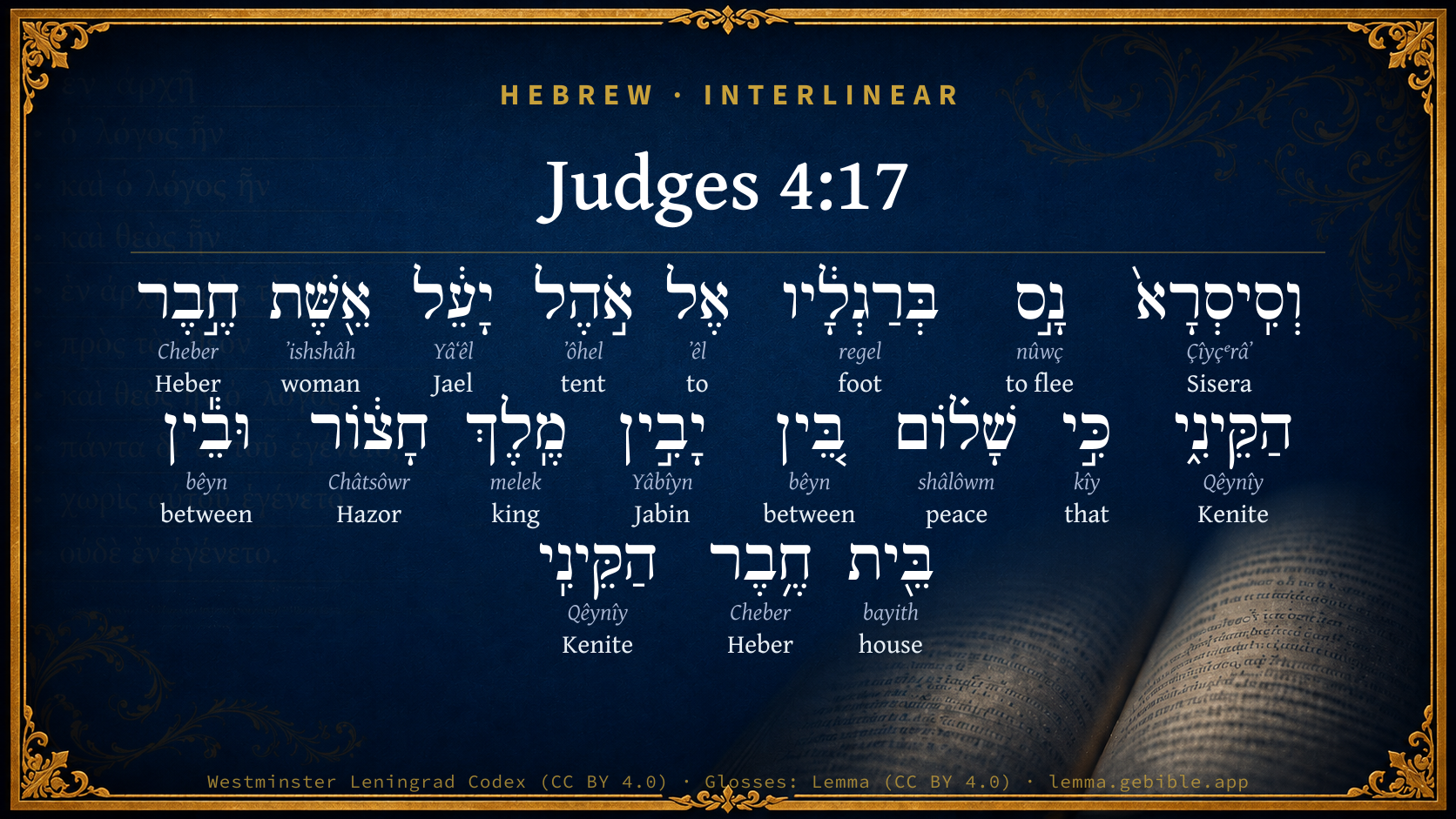
Hebrew (Westminster Leningrad Codex) Judges 4:17 appears in the Hebrew Old Testament. The text above is from the Westminster Leningrad Codex. Each word links to its Strong’s number, a concise gloss, and parsing drawn from the Open Scriptures Hebrew Bible morphology. Click any word for its full Brown-Driver-Briggs (BDB) entry.
Download image
Cite this verse

Judges 4:17 (World English Bible). Public Domain. Lemma interlinear Bible study tool, https://lemma.gebible.app/v/judges/4/17.

Show BibTeX & RIS
BibTeX
RIS
English Translation
However Sisera fled away on his feet to the tent of Jael the wife of Heber the Kenite; for there was peace between Jabin the king of Hazor and the house of Heber the Kenite.
World English Bible · Public Domain
Highlights
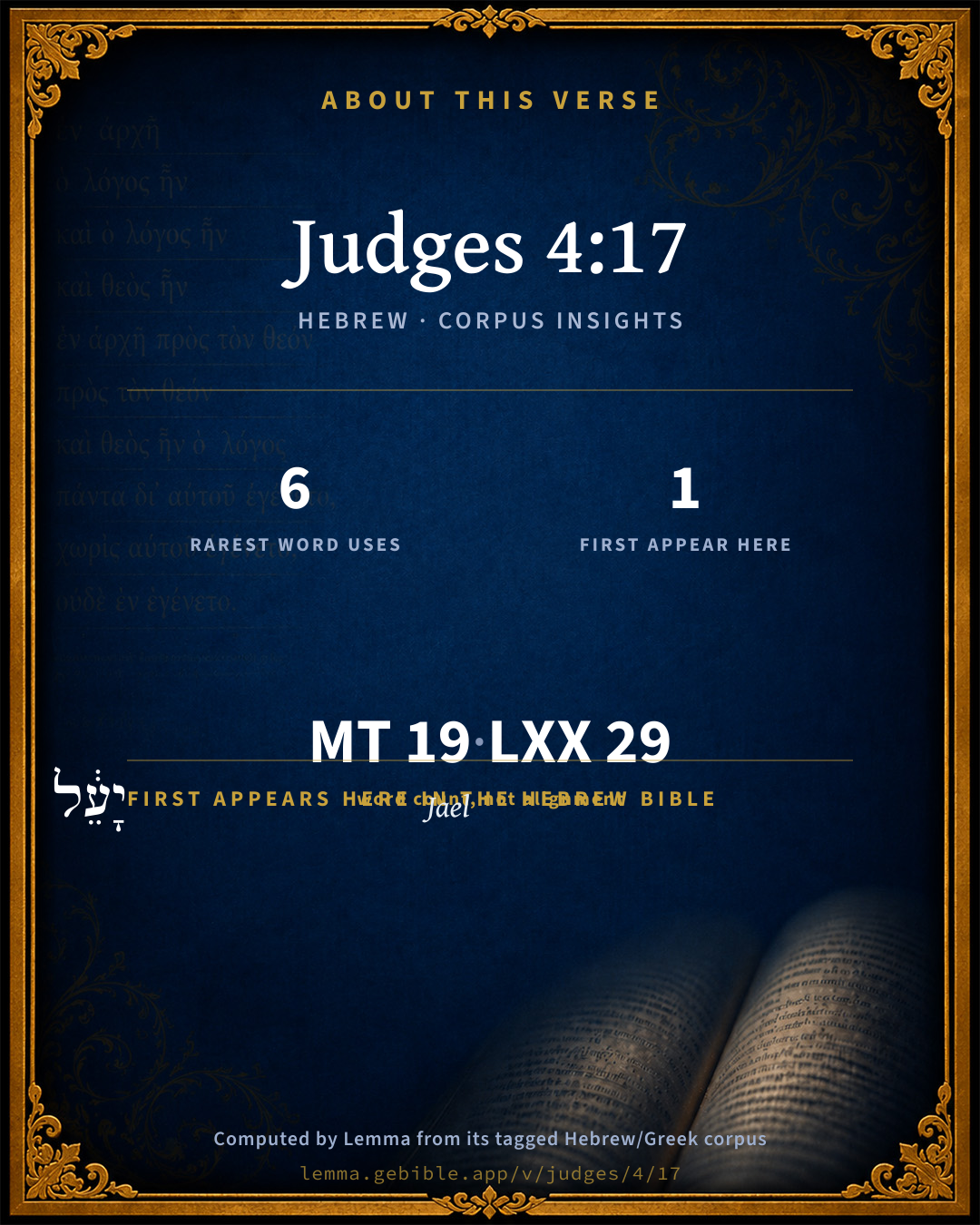
  • 1 first appearance in the Hebrew Bible
Full analysis ↓
Download a study sheet

One document with this verse’s original text, its word-by-word gloss line, the meaning frame, cross-references with their text, attributed commentary, and full source and license credits — printable, and it pastes into notes with its structure intact.

This verse Autodidact and up

Study sheet (.html) Plain text (.txt)

A passage Seminary Student

Up to 50 verses in one chapter. A passage sheet keeps up to 6 commentary sources and 12 cross-references per verse, in the order this page ranks them, and says so on the sheet whenever that leaves anything out. Ask for a single verse and you get the Autodidact verse sheet above.

Everything on this page stays free to read, with no account — the sheet is a download of what is already on screen, not access to it.

Want to remove ads? Support Godless Engineer
Compare translations 3

The same verse in 3 English versions, stacked beneath the original-language interlinear above. Click any original word for its lexicon entry.

Each is an independent rendering of the whole verse — the interlinear is not word-aligned to these translations.

Highlighted words mark where these versions differ — a whole-verse word diff, not a word-by-word alignment.

  • World English Bible Public Domain
    However Sisera fled away on his feet to the tent of Jael the wife of Heber the Kenite; for there was peace between Jabin the king of Hazor and the house of Heber the Kenite.
  • King James Version Public Domain
    Howbeit Sisera fled away on his feet to the tent of Jael the wife of Heber the Kenite: for there was peace between Jabin the king of Hazor and the house of Heber the Kenite.
  • unfoldingWord Literal Text CC BY-SA 4.0
    But Sisera fled on his feet to the tent of Jael, the wife of Heber the Kenite, for peace between Jabin, king of Hazor, and the house of Heber the Kenite.

unfoldingWord Literal Text — © unfoldingWord, licensed CC BY-SA 4.0. Word-aligned USFM3 via Door43 (git.door43.org/unfoldingWord/en_ult).

Versions to compare (up to 4)

3 of 4 selected

Show all 18 translations

Every available English version of this verse, each an independent rendering of the whole verse.

  • World English Bible Public Domain
    However Sisera fled away on his feet to the tent of Jael the wife of Heber the Kenite; for there was peace between Jabin the king of Hazor and the house of Heber the Kenite.
  • Berean Standard Bible Public Domain
    Meanwhile, Sisera had fled on foot to the tent of Jael, the wife of Heber the Kenite, because there was peace between Jabin king of Hazor and the house of Heber the Kenite.
  • Majority Standard Bible Public Domain
    Meanwhile, Sisera had fled on foot to the tent of Jael, the wife of Heber the Kenite, because there was peace between Jabin king of Hazor and the house of Heber the Kenite.
  • King James Version Public Domain
    Howbeit Sisera fled away on his feet to the tent of Jael the wife of Heber the Kenite: for there was peace between Jabin the king of Hazor and the house of Heber the Kenite.
  • American Standard Version (1901) Public Domain
    Howbeit Sisera fled away on his feet to the tent of Jael the wife of Heber the Kenite; for there was peace between Jabin the king of Hazor and the house of Heber the Kenite.
  • Revised Version (1885) Public Domain
    Howbeit Sisera fled away on his feet to the tent of Jael the wife of Heber the Kenite: for there was peace between Jabin the king of Hazor and the house of Heber the Kenite.
  • Geneva Bible (1599) Public Domain
    Howbeit Sisera fled away on his feete to the tent of Iael the wife of Heber the Kenite: (for peace was betweene Iabin the king of Hazor, and betweene the house of Heber the Kenite)
  • Douay-Rheims (1899) Public Domain
    But Sisara fleeing came to the tent of Jahel the wife of Haber the Cinite, for there was peace between Jabin the king of Asor, and the house of Haber the Cinite.
  • Young's Literal Translation Public Domain
    And Sisera hath fled on his feet unto the tent of Jael wife of Heber the Kenite, for peace `is' between Jabin king of Hazor and the house of Heber the Kenite;
  • Literal Standard Version CC BY-SA 4.0
    And Sisera has fled on his feet to the tent of Jael wife of Heber the Kenite, for [there is] peace between Jabin king of Hazor and the house of Heber the Kenite;
  • Unlocked Literal Bible CC BY-SA 4.0
    But Sisera ran away on foot to the tent of Jael, the wife of Heber the Kenite, for there was peace between Jabin the king of Hazor and the family of Heber the Kenite.
  • unfoldingWord Literal Text CC BY-SA 4.0
    But Sisera fled on his feet to the tent of Jael, the wife of Heber the Kenite, for peace between Jabin, king of Hazor, and the house of Heber the Kenite.
  • Darby Bible Public Domain
    But Sis'era fled away on foot to the tent of Ja'el, the wife of Heber the Ken'ite; for there was peace between Jabin the king of Hazor and the house of Heber the Ken'ite.
  • World Messianic Bible Public Domain
    However Sisera fled away on his feet to the tent of Jael the wife of Heber the Kenite; for there was peace between Jabin the king of Hazor and the house of Heber the Kenite.
  • Webster's Bible Public Domain
    Howbeit, Sisera fled away on his feet to the tent of Jael the wife of Heber the Kenite: for there was peace between Jabin the king of Hazor and the house of Heber the Kenite.
  • Free Bible Version CC BY-SA 4.0
    In the meantime Sisera had run away to the tent of Jael, the wife of Heber the Kenite, because there was a peace treaty between Jabin, king of Hazor, and the family of Heber the Kenite.
  • Bible in Basic English Public Domain
    But Sisera went in flight on foot to the tent of Jael, the wife of Heber the Kenite; for there was peace between Jabin, king of Hazor, and the family of Heber the Kenite.
  • JPS Tanakh (1917) Public Domain
    Howbeit Sisera fled away on his feet to the tent of Jael the wife of Heber the Kenite; for there was peace between Jabin the king of Hazor and the house of Heber the Kenite.

Literal Standard Version (2020), Covenant Press — licensed CC BY-SA 4.0. Text via the HelloAO Bible API (eBible.org). Unlocked Literal Bible (unfoldingWord) — licensed CC BY-SA 4.0. Text via the HelloAO Bible API (eBible.org). unfoldingWord Literal Text — © unfoldingWord, licensed CC BY-SA 4.0. Word-aligned USFM3 via Door43 (git.door43.org/unfoldingWord/en_ult). Free Bible Version, Dr. Jonathan Gallagher — licensed CC BY-SA 4.0. Text via the HelloAO Bible API (eBible.org).

Word by word

More ways to search: Search by grammar → Find every occurrence → Compare this word →

Practice this passage: Drill this verse → Learn its vocabulary →

יָעֵ֔ל
Yâʻêl
H3278
“Jael”
Noun, Proper
Part of Speech
Noun
Type
Proper
Full BDB Definition

Origin: the same as H3277

TWOT: None

Jael = "mountain goat" - the wife of Heber the Kenite who killed the general Sisera as he slept by driving a peg through his temples into the ground
  1. וְסִֽיסְרָא֙ Çîyçᵉrâʼ H5516 “and · Sisera” Conjunction + Noun, Proper
  2. נָ֣ס nûwç H5127 “to flee” Verb, Qal, Perfect, 3rd Person, Masculine, Singular
  3. בְּרַגְלָ֔יו regel H7272 “in/at · feet · his” Preposition + Noun, Common, Feminine, Dual, Construct + Suffix, Personal, 3rd Person, Masculine, Singular
  4. אֶל ʼêl H413 “to” Preposition
  5. אֹ֣הֶל ʼôhel H168 “tent of” Noun, Common, Masculine, Singular, Construct
  6. אֵ֖שֶּׁת ʼishshâh H802 “woman of” Noun, Common, Feminine, Singular, Construct
  7. חֶ֣בֶר Cheber H2268 “Heber” Noun, Proper
  8. הַקֵּינִ֑י Qêynîy H7017 “the · Kenite” Particle, Definite Article + Noun, Gentilic, Masculine, Singular, Absolute
  9. כִּ֣י kîy H3588 “that” Conjunction
  10. שָׁל֗וֹם shâlôwm H7965 “peace” Noun, Common, Masculine, Singular, Absolute
  11. בֵּ֚ין bêyn H996 “between” Preposition
  12. יָבִ֣ין Yâbîyn H2985 “Jabin” Noun, Proper
  13. מֶֽלֶךְ melek H4428 “king of” Noun, Common, Masculine, Singular, Construct
  14. חָצ֔וֹר Châtsôwr H2674 “Hazor” Noun, Proper
  15. וּבֵ֕ין bêyn H996 “and · between” Conjunction + Preposition
  16. בֵּ֖ית bayith H1004 “house of” Noun, Common, Masculine, Singular, Construct
  17. חֶ֥בֶר Cheber H2268 “Heber” Noun, Proper
  18. הַקֵּינִֽי Qêynîy H7017 “the · Kenite” Particle, Definite Article + Noun, Gentilic, Masculine, Singular, Absolute

About this verse

These counts appear in no published source. They are computed here, from the morphology-tagged text and Lemma’s own curated glosses. What Lemma adds →

19
words
16
distinct lemmas
Historical
section

Notable vocabulary

The rarest word here is יָעֵ֔ל Jael H3278 — appearing just 6 times in the whole Hebrew Bible.

First appearance in Scripture

This word makes its first canonical appearance in the Hebrew Bible here:

  • יָעֵ֔ל Jael H3278

Shared distinctive vocabulary

יָעֵ֔ל Jael H3278 occurs in 6 verses of the Hebrew Bible. Also found in:

Grammatical profile

  • 1 verb
  • 14 nouns
  • 3 prepositions
  • 1 conjunction

Verb forms

  • נָ֣ס Qal · Perfect

Repetition

Words recur within this verse — often emphatic in Hebrew:

  • חֶ֣בֶר Heber H2268 ×2
  • הַקֵּינִ֑י Kenite H7017 ×2
  • בֵּ֚ין between H996 ×2

Hebrew & Septuagint length

In English translation the verse runs 35 words from the Hebrew and 35 from the Septuagint (LXX English) — the same length.

A rough comparison of the two English renderings, which tokenize alike — not a word-level alignment.

Word counts can differ between the Hebrew and the Greek without any difference in meaning — e.g. the Hebrew direct-object marker אֵת has no separate Greek word, and Greek often adds the article ὁ.

In the original languages it is 19 Hebrew tokens and 29 Greek tokens — but the two are counted differently (Hebrew bundles its prefixes and suffixes into one token; the Greek is in lemma form), so that isn’t a like-for-like length.

Cross-references

11

Topical passages linked to Judges 4:17 in the Treasury of Scripture Knowledge — connected by theme and wording, ordered by reader-vote popularity; previews shown in the World English Bible.

  • Isaiah 57:21 There is no peace, says my God, to the wicked.
  • Psalms 37:35–36 I have seen the wicked in great power, Spreading himself like a green tree in its native soil.
  • Psalms 69:22 Let their table before them become a snare. May it become a retribution and a trap.
  • Judges 5:6 In the days of Shamgar the son of Anath, In the days of Jael, the highways were unoccupied, The travelers walked through byways.
  • Judges 5:24 Blessed above women shall Jael be, The wife of Heber the Kenite; Blessed shall she be above women in the tent.
  • Job 12:19–21 He leads priests away stripped, And overthrows the mighty.
  • Job 18:7–12 The steps of his strength shall be shortened, His own counsel shall cast him down.
  • Job 40:11–12 Pour forth the fury of your anger. Look on everyone who is proud, and bring him low.
  • Psalms 107:40 He pours contempt on princes, And causes them to wander in a trackless waste.
  • Proverbs 29:23 A man's pride brings him low, But one of lowly spirit gains honor.
  • Amos 5:19–20 As if a man fled from a lion, And a bear met him; Or he went into the house and leaned his hand on the wall, And a snake bit him.

Cross-references courtesy of OpenBible.info (CC BY 4.0).

Hebrew and Greek witnesses Masoretic Hebrew ↔ Greek Septuagint

The same verse in the two great witnesses to the Old Testament, shown verse-for-verse.

These are two independent witnesses, not word-aligned to each other, and the Septuagint is shown in lemma (dictionary) form.

Hebrew Judges 4:17 Masoretic · Westminster Leningrad Codex

וְסִֽיסְרָא֙ נָ֣ס בְּרַגְלָ֔יו אֶל אֹ֣הֶל יָעֵ֔ל אֵ֖שֶּׁת חֶ֣בֶר הַקֵּינִ֑י כִּ֣י שָׁל֗וֹם בֵּ֚ין יָבִ֣ין מֶֽלֶךְ חָצ֔וֹר וּבֵ֕ין בֵּ֖ית חֶ֥בֶר הַקֵּינִֽי

However Sisera fled away on his feet to the tent of Jael the wife of Heber the Kenite; for there was peace between Jabin the king of Hazor and the house of Heber the Kenite.

World English Bible · Public Domain

Greek LXX Judges 4:17 Septuagint · lemma form

καί σισαρα φεύγω ὁ πούς αὐτός εἰς σκηνή ιαηλ γυνή χαβερ ἑταῖρος ὁ κιναῖος ὅτι εἰρήνη εἰμί ἀνά μέσος ιαβιν βασιλεύς ασωρ καί ἀνά μέσος οἶκος χαβερ ὁ κιναῖος

And Sisara fled on his feet to the tent of Jael the wife of Chaber the Kenite his friend: for there was peace between Jabin king of Asor and the house of Chaber the Kenite.

LXX2012 (modern English Septuagint) · Public Domain

On this verse, Matthew Henry's Commentary discusses the Septuagint’s reading. Read the note in Commentary ↓

Hebrew: Westminster Leningrad Codex (CC BY 4.0). Greek: Septuagint (public domain); English from LXX2012 (modern English Septuagint) (Public Domain). How the Septuagint differs from the Hebrew →

Targum (Aramaic paraphrase)

1

The Targum is the ancient Jewish Aramaic paraphrase of the Hebrew Scriptures — an interpretive translation, not the Hebrew text itself. Onkelos (literal) and Pseudo-Jonathan (expansive) render the Torah, and Jonathan the Prophets. Coverage is partial: where no permissively-licensed English translation exists for a verse, only the Aramaic is shown. This is verse-level text, not a word-by-word alignment to the Hebrew.

  1. Targum Jonathan Prophets (Joshua–Malachi)
    וְסִיסְרָא אַפֵּךְ בְּרַגְלוֹהִי לְמַשְׁכְּנָא דְיָעֵל אִתַּת חֶבֶר שַׁלְמָאָה אֲרֵי שְׁלָמָא בֵּין יָבִין מַלְכָּא דְחָצוֹר וּבֵין בֵּית חֶבֶר שַׁלְמָאָה:

    (no public-domain English translation for this verse)

    Targum Jonathan — Aramaic: “Mikraot Gedolot” (public domain). English: “Sefaria Community Translation” (CC0 1.0 (public-domain dedication)); “London "Chaldee Paraphrase," 1871” (public domain). Text via Sefaria.

Commentary

Notes on Judges 4:17 from classic Christian and Jewish commentators (each source and its license shown beneath its notes). The classic Christian expositions comment on the surrounding passage and are grouped to its opening verse, so a note may address several verses; the Jewish commentaries on the Tanakh (Rashi and others) are per-verse, so they appear only where the commentator wrote on this verse.

Lemma curates 59 commentaries, every one of them public domain or Creative Commons licensed, each selected and text-cleaned for this edition rather than reprinted as found. About our sources →

Matthew Henry's Commentary

We have seen the army of the Canaanites totally routed. It is said (Psa 83:9, Psa 83:10, where the defeat of this army is pleaded as a precedent for God's doing the like in after times) that they became as dung for the earth. Now here we have,

I. The fall of their general, Sisera, captain of the host, in whom, it is likely, Jabin their king put an entire confidence, and therefore was not himself present in the action. Let us trace the steps of this mighty man's fall.

1. He quitted his chariot, and took to his feet, Jdg 4:15, Jdg 4:17. His chariots had been his pride and his confidence; and we may suppose he had therefore despised and defied the armies of the living God, because they were all on foot, and had neither chariot nor horse, as he had. Justly therefore is he thus made ashamed of his confidence, and forced to quit it, and thinks himself then most safe and easy when he has got clear of his chariot, though we may well suppose it the best made, and best drawn, of any of them. Thus are those disappointed who rest on the creature; like a broken reed, it not only breaks under them, but runs into their hand, and pierceth them with many sorrows. The idol may quickly become a burden (Isa 46:1), and what we were sick for God can make us sick of. How miserable doth Sisera look now he is dismounted! It is hard to say whether he blusheth or trembleth more. Put not your trust in princes, if they may so soon be brought to this, if he who but lately trusted to his arms with so much assurance must now trust to his heels only with so little.

2. He fled for shelter to the tents of the Kenites, having no strong-hold, nor any place of is own in reach to retire to. The mean and solitary way of the Kenites' living, perhaps, he had formerly despised and ridiculed, and the more because religion was kept up among them; yet now he is glad to put himself under the protection of one of these tents: and he chooses the wife's tent or apartment, either because less suspected, or because it happened to be next to him, and the first he came to, Jdg 4:17. And that which encouraged him to go thither was that at this time there was peace between his master and the house of Heber: not that there was any league offensive and defensive between them, only at present there were no indications of hostility. Jabin did them no harm, did not oppress them as he did the Israelites, their plain, quiet, harmless way of living making them not suspected nor feared, and perhaps God so ordering it as a recompence for their constant adherence to the true religion. Sisera thought he might therefore be safe among them; not considering that, though they themselves suffered not by Jabin's power, they heartily sympathized with the Israel of God that did.

3. Jael invited him in, and bade him very welcome. Probably she stood at the tent door, to enquire what news from the army, and what the success of the battle which was fought not far off. (1.) She invited him in. Perhaps she stood waiting for an opportunity to show kindness to any distressed Israelite, if there should be occasion for it; but seeing Sisera come in great haste, panting and out of breath, she invited him to come and repose himself in her tent, in which, while she seemed to design the relieving of his fatigue, perhaps she really intended the retarding of his flight, that he might fall into the hands of Barak, who was not in a hot chase after him (Jdg 4:18), and it may well questioned whether she had at first any thought of taking away his life, but rather God afterwards put it into her heart. (2.) She made very much of him, and seemed mighty careful to have him easy, as her invited guest. Was he weary? she finds him a very convenient place to repose himself in, and recruit his strength. Was he thirsty? well he might. Did he want a little water to cool his tongue? the best liquor her tent afforded was at his service, and that was milk (Jdg 4:19), which, we may suppose, he drank heartily of, and, being refreshed with it, was the better disposed to sleep. Was he cold, or afraid of catching cold? or did he desire to be hid from the pursuers, if they should search that tent? she covered him with a mantle, Jdg 4:18. All expressions of care for his safety. Only when he desired her to tell a lie for him, and to say he was not there, she declined making any such promise, Jdg 4:20. We must not sin against God, no, not to oblige those we would show ourselves most observant of. Lastly, We must suppose she kept her tent as quiet as she could, and free from noise, that he might sleep the sooner and the faster. And now was Sisera least safe when he was most secure. How uncertain and precarious is human life! and what assurance can we have of it, when it may so easily be betrayed by those with whom it is trusted, and those may prove its destroyers who we hoped would be its protectors! It is best making God our friend, for he will not deceive us.

4. When he lay fast asleep she drove a long nail through his temples, so fastened his head to the ground, and killed him, Jdg 4:21. And, though this was enough to do the business, yet, to make sure work (if we translate it rightly, Jdg 5:26), she cut off his head, and left it nailed there. Whether she designed this or no when she invited him into her tent does not appear; probably the thought was darted into her mind when she saw him lie so conveniently to receive such a fatal blow; and, doubtless, the thought brought with it evidence sufficient that it came not from Satan as a murderer and destroyer, but from God as a righteous judge and avenger, so much of brightness and heavenly light did she perceive in the inducements to it that offered themselves, the honour of God and the deliverance of Israel, and nothing of the blackness of malice, hatred, or personal revenge. (1.) It was a divine power that enabled her to do it, and inspired her with a more than manly courage. What if her hand should shake, and she should miss her blow? What if he should awake when she was attempting it? Or suppose some of his own attendants should follow him, and surprise her in the face, how dearly would she and all hers be made to pay for it? Yet, obtaining help of God, she did it effectually. (2.) It was a divine warrant that justified her in the doing of it; and therefore, since no such extraordinary commissions can now be pretended, it ought not in any case to be imitated. The laws of friendship and hospitality must be religiously observed, and we must abhor the thought of betraying any whom we have invited and encouraged to put a confidence in us. And, as to this act of Jael (like that of Ehud in the chapter before), we have reason to think she was conscious of such a divine impulse upon her spirit to do it as did abundantly satisfy herself (and it ought therefore to satisfy us) that it was well done. God's judgments are a great deep. The instrument of this execution was a nail of the tent, that is, one of the great pins with which the tent, or the stakes of it, were fastened. They often removing their tents, she had been used to drive these nails, and therefore knew how to do it the more dexterously on this great occasion. he that thought to destroy Israel with his many iron chariots is himself destroyed with one iron nail. Thus do the weak things of the world confound the mighty. See here Jael's glory and Sisera's shame. The great commander dies, [1.] In his sleep, fast asleep, and weary. It comes in as a reason why he stirred not, to make resistance. So fettered was he in the chains of sleep that he could not find his hands. Thus the stout-hearted are spoiled at thy rebuke, O God of Jacob! they are cast into a dead sleep, and so are made to sleep their last, Psa 76:5, Psa 76:6. Let not the strong man then glory in his strength; for when he sleeps where is it? It is weak, and he can do nothing; a child may insult him then, and steal his life from him; and yet if he sleep not he is soon spent and weary, and can do nothing either. Those words which we here put in a parenthesis (for he was weary) all the ancient versions read otherwise: he struggled (or started, as we say) and died, so the Syriac and Arabic, Exagitans ses mortuus est. He fainted and died, so the lxx. Consocians morte soporem, so the vulgar Latin, joining sleep and death together, seeing they are so near akin. He fainted and died. He dies, [2.] With his head nailed to the ground, an emblem of his earthly-mindedness. O curve in terram animoe! His ear (says bishop Hall) was fastened close to the earth, as if his body had been listening what had become of his soul. He dies, [3.] By the hand of a woman. This added to the shame of his death before men; and had he but known it, as Abimelech (Jdg 9:54), we may well imagine how much it would have added to the vexation of his own heart.

II. The glory and joy of Israel hereupon. 1. Barak their leader finds his enemy dead, (Jdg 4:22), and no doubt, he was very well pleased to find his work done so well to his hand, and so much to the glory of God and the confusion of his enemies. had he stood too nicely upon a point of honour, he would have resented it as an affront to have the general slain by any hand but his; but now he remembered that this diminution of his honour he was sentenced to undergo, for insisting upon Deborah's going with him (the Lord shall sell Sisera into the hand of a woman), though then it was little thought that the prediction would be fulfilled in such a way as this. 2. Israel is completely delivered out of the hands of Jabin king of Canaan, Jdg 4:23, Jdg 4:24. They not only shook off his yoke by this day's victory, but they afterwards prosecuted the war against him, till they had destroyed him, he and his nation being by the divine appointment devoted to ruin and not to be spared. The Israelites, having soundly smarted for their foolish pity in not doing it before, resolved now it is in their power to indulge them no longer, but to make a thorough riddance of them, as a people to whom to show mercy was as contrary to their own interest as it was to God's command; and probably it is with an eye to the sentence they were under that this enemy is named three times here in these last two verses, and called king of Canaan; for as such he was to be destroyed; and so thoroughly was he destroyed that I do not remember to read of the kings of Canaan any more after this. The children of Israel would have prevented a great deal of mischief if they had sooner destroyed these Canaanites, as God had both commanded and enabled them; but better be wise late, and buy wisdom by experience, than never wise.

Matthew Henry's Commentary on the Whole Bible (1708–1710) — public domain (CC PDM 1.0). Text via the HelloAO Bible API.

The Cambridge Bible for Schools and Colleges

gen. ed. J. J. S. Perowne

17. Clause a taken with Jdg_4:22 implies that Sisera, as he fled from the battle, found a place of refuge close by; but according to clause b taken with Jdg_4:11 Jael’s tent was in the north, near Kedesh-naphtali, 40 or 50 miles from the Kishon valley. The inconsistencies of the narrative can only be explained by supposing that the two stories of Jabin and Sisera have been combined by a sentence designed to harmonize them, 17b. Jael certainly belongs to the story of Sisera; it has been suggested that Heber belongs to that of Jabin. But we cannot separate Jael from Heber; it would be irregular to name a prominent Bedouin woman, living in an encampment with her family, without mentioning her husband. Probably we must separate Heber from Jabin, and suppose that the connexion between them is merely editorial; see above on Jdg_4:11. The composite character of Jdg_4:17 is responsible for another difficulty. In Jdg_4:17 Sisera aims for Jael’s tent because of the friendly relations between Heber and Jabin; but in Jdg_4:18 he comes upon it while he is flying, and is persuaded by Jael to turn aside. By inserting after fled away on his feet a verb and came we gain some relief, but it is better to regard clause b as not belonging to the original form of the narrative. ‘Jael’s tent’ is mentioned because as the wife of a Bedouin chief she would have a tent of her own.

The Cambridge Bible for Schools and Colleges (gen. ed. J. J. S. Perowne; Cambridge University Press, 1878–1918) — public domain. Text from a community e-Sword module.

Trapp's Complete Commentary

John Trapp

Jdg 4:17 Howbeit Sisera fled away on his feet to the tent of Jael the wife of Heber the Kenite: for [there was] peace between Jabin the king of Hazor and the house of Heber the Kenite.

Ver. 17. For there was peace,] i.e., Non erant simultates aut bella inter illos, {a} there was no open hostility: or if there were a league, the Emperor of the world, saith Ferus, had now disannulled it, as having proscribed Sisera, and declared that he should be destroyed, and that by a woman.

{a} Jun.

John Trapp, A Commentary or Exposition upon All the Books of the Old and New Testament (1647–1656) — public domain. Text from a community e-Sword module.

Geneva Bible (1599)

Geneva Bible translators

Whose ancestors were strangers, but worshipped the true God, and therefore were joined with Israel.

Geneva Bible (1599) marginal notes — public domain. Text via Bolls.life.

Jamieson, Fausset & Brown

Robert Jamieson, A. R. Fausset & David Brown

Sisera fled . . . to the tent of Jael--According to the usages of nomadic people, the duty of receiving the stranger in the sheik's absence devolves on his wife, and the moment the stranger is admitted into his tent, his claim to be defended or concealed from his pursuers is established.

Jamieson, Fausset & Brown — Commentary Critical and Explanatory on the Whole Bible (1871) — public domain (CC PDM 1.0). Text via the HelloAO Bible API.

Ellicott's Commentary for English Readers

(17) Fled away on his feet to the tent of Jael.—In a different direction from that taken by his army, which fled towards Harosheth (Kimchi). The expression is probably used by anticipation. He could hardly have meant to fly to Jael rather than to Heber, until Jael came to meet him, unless there are circumstances unknown to us. Women had separate tents (Gen_18:6), and these were regarded as inviolably secure. He thought that there he would lie unsuspected till the pursuers passed (comp. Gen_24:67). The name Jael means “gazelle” (like Tabitha, Dorcas), “a fit name for a Bedouin’s wife—especially for one whose family had come from the rocks of Engedi, the spring of the wild goat or chamois” (Stanley).

For there was peace.—This enabled Sisera boldly to appeal to these nomads for dakheel—the sacred duty of protection. A poor strolling Bedouin tribe might well be left by Jabin to its natural independence; tribute can only be secured from Fellahîn—i.e., from settled tribes. Three days must have elapsed since the battle before it would be possible for Sisera to fly on foot from the Kishon to “the nomad’s terebinth.” It may well be conceived that the unfortunate general arrived there in miserable plight—a starving and ruined fugitive.

A Bible Commentary for English Readers, edited by Charles John Ellicott (1878–1897) — public domain. Text from a community e-Sword module.

John Gill's Exposition

Howbeit, Sisera fled away on his feet,.... Got off, and made his escape

to the tent of Jael, the wife of Heber the Kenite; before spoken of, Jdg 4:11; and he made to that, because he might think himself safer in a tent than in a town; and especially in the tent of a woman, where he might imagine no search would be made; for women of note, in those times, had separate tents, see Gen 24:67; and the rather he made his escape hither for a reason that follows:

for there was peace between Jabin the king of Hazor and the house of Heber the Kenite; which Jabin might the more readily come into, because these were not Israelites, nor did they make any claim to the country, and lived only in tents, and attended their flocks, and were a quiet people, and not at all disposed to war; and it might be so ordered by the providence of God, as a rebuke to the Israelites for their sins, when those who were only proselytes kept close to the worship of God, and so enjoyed liberty, peace, and prosperity.

John Gill's Exposition of the Whole Bible (1746–1763) — public domain (CC PDM 1.0). Text via the HelloAO Bible API.

Albert Barnes' Notes on the Bible

Sisera went, not to Heber’s tent, but to Joel’s, as more secure from pursuit. Women occupied a separate tent. Gen 18:6, Gen 18:10; Gen 24:67.

Albert Barnes' Notes on the Bible (1834–1885) — public domain. Text from a community e-Sword/MySword module.

Haydock's Catholic Bible Commentary

Tent. The women had separate tents from their husbands. Haber, it seems, was from home, and was not molested by the Chanaanites. He continued neuter during this war. What then must we think of the conduct of his wife? Commentators generally justify her, as the Scripture gives her great commendations, and as the family of the Cinites enjoyed the religion and privileges of the Israelites. Hence this portion of it could not make a league with the enemy of God’s people, to the detriment of the latter; and if they did, they were bound to break it as soon, at least, as God manifested his will, that the enemy should be destroyed. Jahel might however deserve the praise of fortitude, which the Scripture gives her, and yet mingle some human imperfection in her manner of acting. She seems to speak with fraud, and to betray the sacred rights of hospitality; and it is doubtful whether Haber himself could renounce the alliance with Jabin, (particularly if they had taken mutual oaths to observe it, as was then customary) without informing him of his resolution. Fides, quando promititur, etiam hosti servanda est. (St. Augustine, ep. i. ad Bonif.) See Grotius, Jur. iii. 19. (Calmet) --- Yet, if she told a lie, it was only an officious one, (Menochius) such as Sisara desired should be told for his safety, ver. 20. (Haydock) --- It is lawful to use stratagems against an enemy. (Salien, in the year of the world 2741. See Josue ii., and viii. 4. Debbora pronounces the name of Jahel to be most blessed, (chap. v. 24,) which shews that she was inspired by God to kill Sisara. If we consider her action in any other light, it will certainly appear very shocking, as Rahab could not escape the accusation of treason towards her country by any other means. Aod, Judith, &c., who washed their hands in the blood of sinners, (Psalm lvii. 11,) would undoubtedly have been condemned at any merely human tribunal, which would not admit the plea of inspiration. (Haydock) --- Besides this secret impulse, Jahel might be acquainted with the prediction of Debbora, (ver. 9,) and with the miraculous victory which encouraged her to destroy the common enemy, (Abulensis, Josephus, &c.; Tirinus) the only remnant of an immense army. (Haydock) --- The peace which subsisted between her family and the Chanaanites, was a forced one, (Tirinus) and perhaps consisted only in the former being allowed to live quietly (Du Hamel) in the midst of these idolaters, whose manners they abhorred; (Haydock) while the Israelites, though at a greater distance, were so severely treated even when they were so weak as to adore the idols (Tirinus) of their oppressors. Thus the divine Providence was pleased to reward virtue, and to punish infidelity. (Haydock) --- The Fathers consider Debbora as a figure of the Synagogue, which begins the attack against the empire of the devil, while the victory is reserved for the Christian Church, represented by Jahel, a woman living among the Israelites, though of a different nation, and engrafted, as it were, like the wild olive on the good olive tree. She gains strength in the midst of persecutions, and, armed with the cross of Christ, destroys the captain of the worldly empire. (Origen, hom v.; St. Augustine, contra Faust. xii. 31, &c.) (Calmet) --- Jahel was also a figure of the blessed Virgin, who crushed the serpent’s head. (Worthington)

George Leo Haydock (1774–1849), Haydock's Catholic Family Bible and Commentary, 1859 edition — public domain. Excludes Psalms (Douay-Rheims chapter numbering differs from Protestant) and Deuterocanonical books (Catholic canon only).

Matthew Poole's English Annotations

To the tent of Jael; for women had their tents apart from their husbands, Gen 24:67; 31:33. And here he thought to lurk more securely than in her husband’s tent.

There was peace; not a league or covenant of friendship, which they were forbidden to make with that cursed people, but only a cessation of hostilities, which he afforded them because they were a peaceable people, abhorring war, and wholly minding pasturage, and were not Israelites, with whom his principal quarrel was; and especially by God’s overruling disposal of his heart to favour them who were careful to keep themselves uncorrupted with Israel’s sins, and therefore are preserved from their plagues.

Matthew Poole's English Annotations on the Holy Bible (1683–1685) — public domain. Text from a community e-Sword/MySword module.

Whedon's Commentary on the Bible

Daniel D. Whedon

17. Tent of Jael — According to Dr. Thomson, Heber had removed for the time from his home near Kedesh, and pitched his tent for winter quarters at the border of the Plain of Esdraelon. Hence the tent of Jael was not so far from the battle field as Kedesh, which was nearly two days’ journey distant. “I once,” says Thomson, “crossed the lower part of Esdraelon in the winter. It was then full of Arab tents, and at first I felt a little nervous; but my guide assured me there was no danger, for he was well acquainted with these Arabs. Their home was in the mountains north of Nazareth, and they only came down here to pass the cold months of winter. This was the very thing that Heber did, and who knows but these Arabs are lineal descendants of that heroic Jaal.”

Peace between Jabin… and… Heber — This shows why Sisera so readily entered Jael’s tent, and seemed to have such confidence in her. He was probably acquainted with Jael, and knew of Heber’s alliance with Jabin, and fled to her tent with the purpose and expectation of being sheltered there.

Daniel D. Whedon (gen. ed.), Commentary on the Old and New Testaments (1874–1909) — public domain. Text from a community e-Sword module.

The Pulpit Commentary

Vers. 17-22. Vide Jud 5:24-27. M.

The Pulpit Commentary (1880–1919), ed. H.D.M. Spence-Jones & Joseph S. Exell — public domain. Text from a community e-Sword module.

John Wesley's Explanatory Notes

The tent of Jael - For women had their tents apart from their husbands. And here he thought to lurk more securely than in her husband's tent. Peace - Not a covenant of friendship, which they were forbidden to make with that cursed people, but only a cessation of hostilities, which he afforded them because they were peaceable people, abhorring war, and wholly minding pasturage, and were not Israelites, with whom his principal quarrel was; and especially by God's over-ruling disposal of his heart to favour them who were careful to keep themselves uncorrupted with Israel's sins, and therefore preserved from their plagues.

John Wesley, Explanatory Notes Upon the Whole Bible (1754–1765) — public domain. Text via the GEBible commentary corpus.

Keil & Delitzsch

C. F. Keil & F. Delitzsch

Sisera took refuge in the tent of Jael, the wife of Heber the Kenite, to escape the sword of the Israelites, as king Jabin lived at peace with the house of Heber, i.e., with this branch of the Kenites.

Jdg 4:18

Jael received the fugitive into her tent in the usual form of oriental hospitality (סוּר, as in Gen 19:2-3, to turn aside from the road and approach a person), and covered him with a covering (שׂמיכה, ἁπ. λεγ., covering, or rug), that he might be able to sleep, as he was thoroughly exhausted with his flight.

Jdg 4:19

On his asking for water to drink, as he was thirsty (צמתּי, defective form for צמאתּי), she handed him milk from her bottle, and covered him up again. She gave him milk instead of water, as Deborah emphatically mentions in her song in Jdg 5:25, no doubt merely for the purpose of giving to her guest a friendly and hospitable reception. When Josephus affirms, in his account of this event (Ant. v. 5, 4), that she gave him milk that was already spoiled (διεφθορὸς ἤδη), i.e., had turned sour, and R. Tanchum supposes that such milk intoxicated the weary man, these are merely later decorations of the simple fact, that have no historical worth whatever.

Jdg 4:20-21

In order to be quite sure, Sisera entreated his hostess to stand before the door and turn any one away who might come to her to seek for one of the fugitives. עמד is the imperative for עמדי rof , as the syntax proves that the word cannot be an infinitive. The anomaly apparent in the use of the gender may be accounted for on the ground that the masculine was the more general form, and might therefore be used for the more definite feminine. There are not sufficient grounds for altering it into עמוד, the inf. abs. Whether Jael complied with this wish is not stated; but in the place of anything further, the chief fact alone is given in Jdg 4:21, namely, that Jael took a tent-plug, and went with a hammer in her hand to Sisera, who had fallen through exhaustion into a deep sleep, and drove the plug into his temples, so that it penetrated into the earth, or the floor. The words ויּעף והוּא־נרדּם are introduced as explanatory of the course of the events: "but he was fallen into a deep sleep, and exhausted," i.e., had fallen fast asleep through exhaustion. "And so he died." ויּמת is attached as a consequence to וגו התּצנח ... ותּתקע, whereas ויּעף belongs to the parenthetical clause נרדּם והוּא. This is the explanation adopted by Rosenmller, and also in the remark of Kimchi: "the words ויּעף נרדּם indicate the reason why Sisera neither heard Jael approach him, nor was conscious of the blow inflicted upon him." For the combination of ויּעף with ויּמת, "then he became exhausted and died," which Stud. and Bertheau support, does not give any intelligible thought at all. A man who has a tent-peg driven with a hammer into his temples, so that the peg passes through his head into the ground, does not become exhausted before he dies, but dies instantaneously. And ויּעף, from עוּף, equivalent to עיף (Jer 4:31), or יעף, and written with Patach in the last syllable, to distinguish it from עוּף, volare, has no other meaning than to be exhausted, in any of the passages in which it occurs (see Sa1 14:28, Sa1 14:31; Sa2 21:15). The rendering adopted by the lxx, ἐσκοτώθη, cannot be grammatically sustained.

Jdg 4:22

When Barak, who was in pursuit of Sisera, arrived at Jael's tent, she went to meet him, to show him the deed which he had performed. Thus was Deborah's prediction to Barak (Jdg 4:9) fulfilled. The Lord had sold Sisera into the hand of a woman, and deprived Barak of the glory of the victory. Nevertheless the act itself was not morally justified, either by this prophetic announcement, or by the fact that it is commemorated in the song of Deborah in Jdg 5:24. Even though there can be no doubt that Jael acted under the influence of religious enthusiasm for the cause of Israel and its God, and that she was prompted by religious motives to regard the connection of her tribe with Israel, the people of the Lord, as higher and more sacred, not only than the bond of peace, in which her tribe was living with Jabin the Canaanitish king, but even than the duties of hospitality, which are so universally sacred to an oriental mind, her heroic deed cannot be acquitted of the sins of lying, treachery, and assassination, which were associated with it, by assuming as Calovius, Buddeus, and others have done, that when Jael invited Sisera into her tent, and promised him safety, and quenched this thirst with milk, she was acting with perfect sincerity, and without any thought of killing him, and that it was not till after he was fast asleep that she was instigated and impelled instinctu Dei arcano to perform the deed. For Jehovah, the God of Israel, not only abhors lying lips (Pro 12:22), but hates wickedness and deception of every kind. It is true, He punishes the ungodly at the hand of sinners; but the sinners whom He employs as the instruments of His penal justice in carrying out the plans of His kingdom, are not instigated to the performance of wicked deeds by an inward and secret impulse from Him. God had no doubt so ordered it, that Sisera should meet with his death in Jael's tent, where he had taken refuge; but this divine purpose did not justify Jael in giving to the enemy of Israel a hospitable reception into her tent, making him feel secure both by word and deed, and then murdering him secretly while he was asleep. Such conduct as that was not the operation of the Spirit of God, but the fruit of a heroism inspired by flesh and blood; and even in Deborah's song (Jdg 5:24.) it is not lauded as a divine act.

Keil & Delitzsch — Biblical Commentary on the Old Testament (1861–1891) — public domain (CC PDM 1.0). Text via the HelloAO Bible API. (Old Testament only.)

unfoldingWord translationNotes

Door43 World Missions Community

Sisera ... Jabin ... Hazor

See how you translated these names in Judges 4:2.

ran away on foot

This is an idiom that means he was walking rather than riding a horse or in a chariot. (See: Idiom)

Jael

This is the name of a woman. (See: How to Translate Names)

Heber

See how you translated this man's name in Judges 4:11.

Kenite

See how you translated this in Judges 1:16.

Turn aside

This means to change course during a journey in order to rest. AT: "Come here" (See: Assumed Knowledge and Implicit Information)

blanket

a large covering for the body to sleep under for warmth, made of wool or animal skins

translationWords

tent

peace

king

house

turn

lord

fear

unfoldingWord translationNotes — © Distant Shores Media and the Door43 World Missions Community, licensed CC BY-SA 4.0. Source: git.door43.org/Door43/en_tn.

Radak

Rabbi David Kimhi (Radak)

And Sisera had fled: He did not flee to the place that his camp fled, as they fled towards their land, which was Haroshet-hagoyim; and Barak and his people chased after them and smote them with the edge of the sword. But Sisera knew that he could not escape by [just] fleeing, for they would catch up to him. So he fled to another place, in which they would not notice him and chase after him. So he fled to a different place close to the war's location, to escape to Yael's tent. For there was peace between them, so he thought that he could escape there and she would hide him until the war had passed.

Radak on the Tanakh — English translations: “Sefaria Community Translation” (CC0 1.0 (public-domain dedication)); “Eliyahu Munk, HaChut Hameshulash” (CC BY 4.0); “Rabbi Mike Feuer, Jerusalem Anthology” (CC BY 4.0); and “R. David Kimhi on the first book of Psalms, Translated by R.G. Finch, London, 1919” (public domain). Text via Sefaria.

Lesson kit

Teaching starters — assembled from the data on this page, not authored interpretation. Every prompt links to the verse data it draws on. Edit before teaching.

Judges, in the Historical, opens this verse with 19 words (16 distinct Hebrew lemmas). Its most distinctive word is Yâʻêl (“Jael”). A historical commentator’s framing appears above. Read the whole chapter for the surrounding context.

Discussion questions

  1. How does “Jael” (Yâʻêl) shape what this verse is saying?
  2. The word “Jael” first appears here in Scripture. What is being introduced at this debut?
  3. Judges 4:18 shares the word «Jael» with this verse. How do the two illuminate each other?
  4. “Heber” occurs 2× in this one verse. What is the effect of the repetition?
  5. The translations on this page render this verse differently — a whole-verse word diff, not a word-by-word alignment. What might account for the different wordings?
  6. The verb «נָ֣ס» is Qal Perfect. How does its form color the action?
  7. Reading how Matthew Henry's Commentary and The Cambridge Bible for Schools and Colleges read this verse, where do the two commentators agree and where do they part?

Things to notice

Reading settings

Reading text

Shown beneath each verse's original-language words.

Old Testament
Old Testament edition

Read the OT as the Masoretic Hebrew (MT) or the Greek Septuagint (LXX).

English shown for the Greek Septuagint (in the Hebrew ↔ Greek comparison).

Comparing translations? Open the Compare panel on any verse page to stack up to four side by side.