
Numbers 21:13

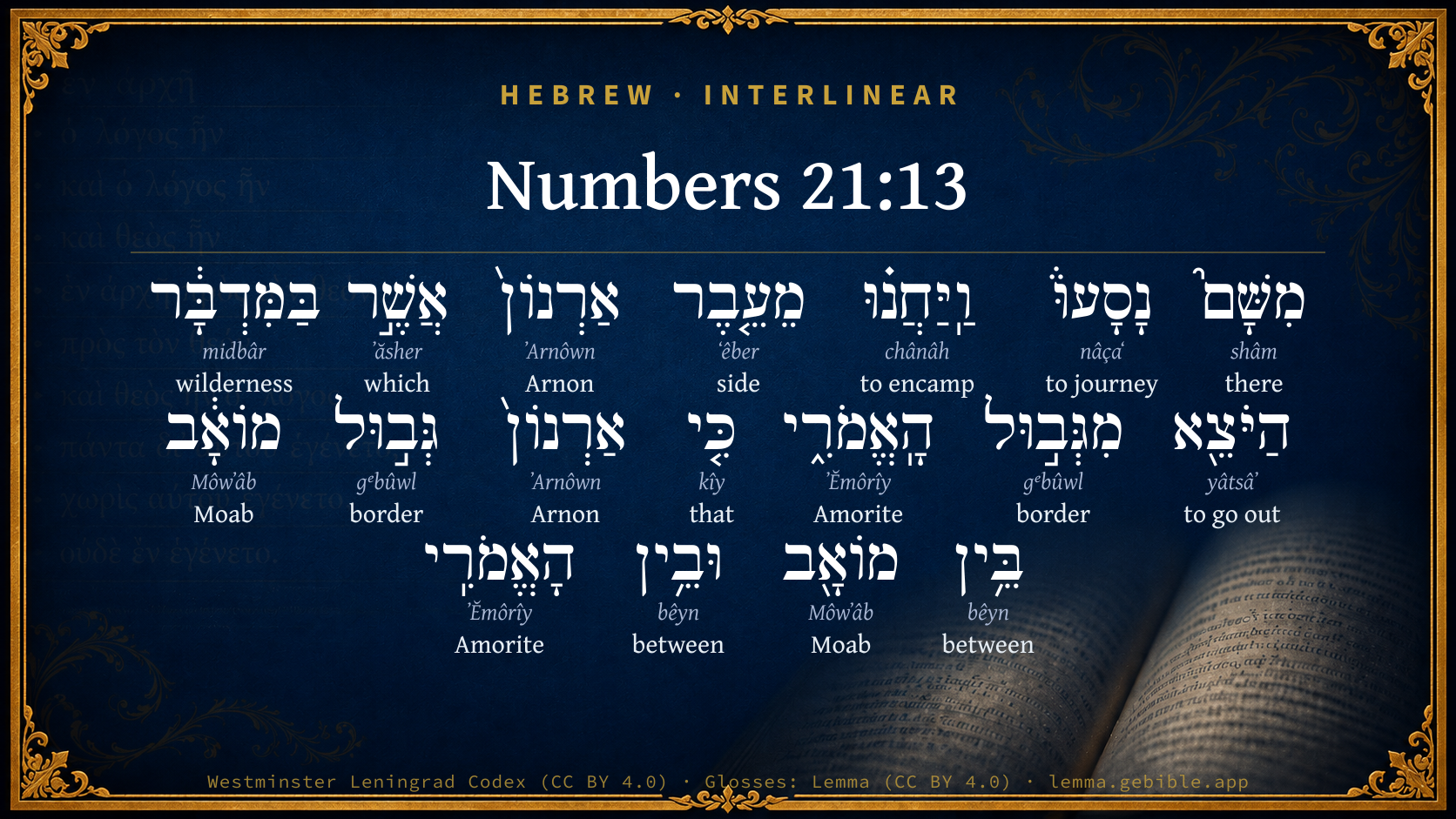
Hebrew (Westminster Leningrad Codex) Numbers 21:13 appears in the Hebrew Old Testament. The text above is from the Westminster Leningrad Codex. Each word links to its Strong’s number, a concise gloss, and parsing drawn from the Open Scriptures Hebrew Bible morphology. Click any word for its full Brown-Driver-Briggs (BDB) entry.
Download image
Cite this verse

Numbers 21:13 (World English Bible). Public Domain. Lemma interlinear Bible study tool, https://lemma.gebible.app/v/numbers/21/13.

Show BibTeX & RIS
BibTeX
RIS
English Translation
From there they traveled, and encamped on the other side of the Arnon, which is in the wilderness, that comes out of the border of the Amorites: for the Arnon is the border of Moab, between Moab and the Amorites.
World English Bible · Public Domain
Highlights
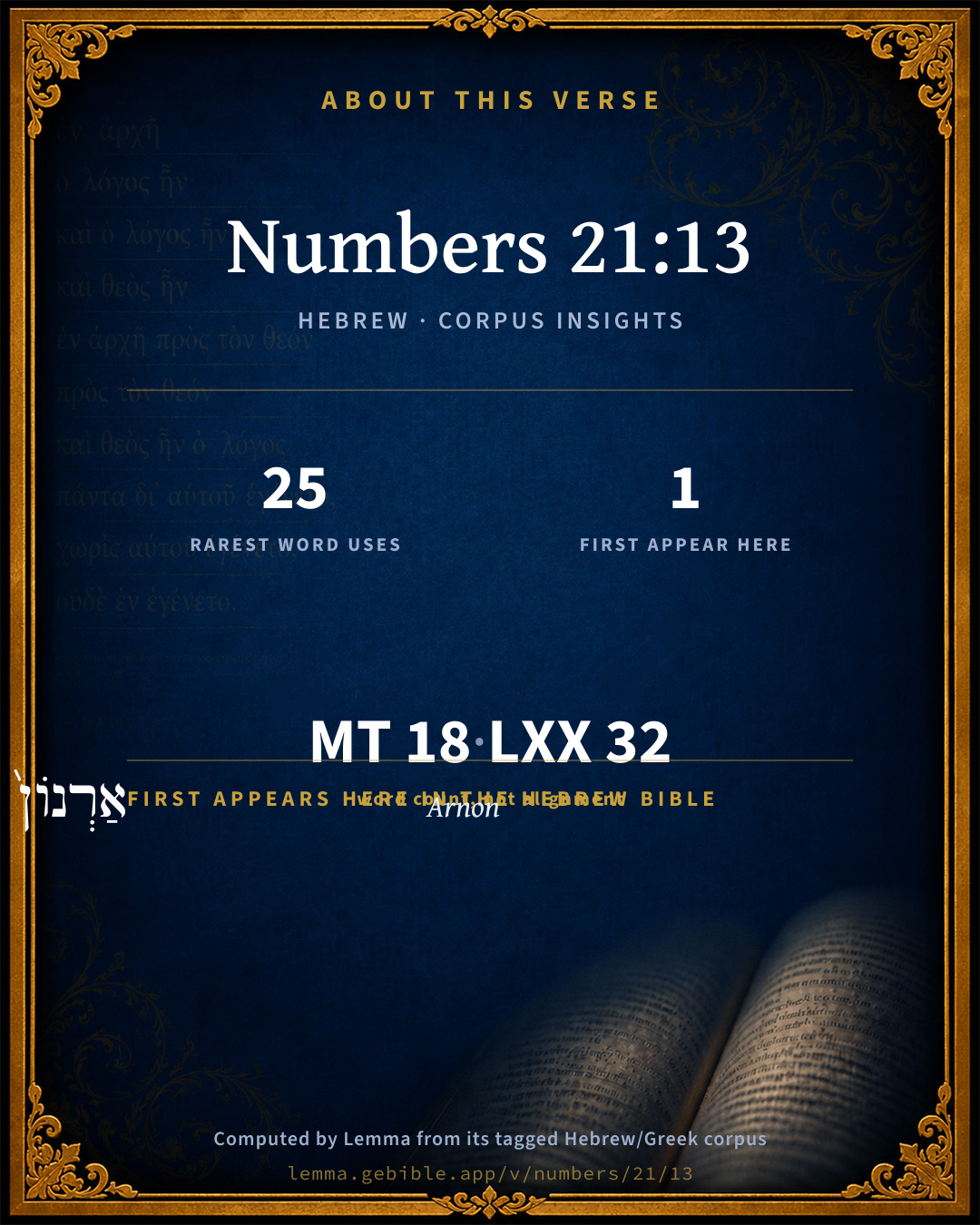
  • 1 first appearance in the Hebrew Bible
Full analysis ↓
Download a study sheet

One document with this verse’s original text, its word-by-word gloss line, the meaning frame, cross-references with their text, attributed commentary, and full source and license credits — printable, and it pastes into notes with its structure intact.

This verse Autodidact and up

Study sheet (.html) Plain text (.txt)

A passage Seminary Student

Up to 50 verses in one chapter. A passage sheet keeps up to 6 commentary sources and 12 cross-references per verse, in the order this page ranks them, and says so on the sheet whenever that leaves anything out. Ask for a single verse and you get the Autodidact verse sheet above.

Everything on this page stays free to read, with no account — the sheet is a download of what is already on screen, not access to it.

Want to remove ads? Support Godless Engineer
Compare translations 3

The same verse in 3 English versions, stacked beneath the original-language interlinear above. Click any original word for its lexicon entry.

Each is an independent rendering of the whole verse — the interlinear is not word-aligned to these translations.

Highlighted words mark where these versions differ — a whole-verse word diff, not a word-by-word alignment.

  • World English Bible Public Domain
    From there they traveled, and encamped on the other side of the Arnon, which is in the wilderness, that comes out of the border of the Amorites: for the Arnon is the border of Moab, between Moab and the Amorites.
  • King James Version Public Domain
    From thence they removed, and pitched on the other side of Arnon, which is in the wilderness that cometh out of the coasts of the Amorites: for Arnon is the border of Moab, between Moab and the Amorites.
  • unfoldingWord Literal Text CC BY-SA 4.0
    From there they set out and camped on the other side of the Arnon, which in the wilderness going out from the border of the Amorite. For the Arnon the border of Moab, between Moab and the Amorite.

unfoldingWord Literal Text — © unfoldingWord, licensed CC BY-SA 4.0. Word-aligned USFM3 via Door43 (git.door43.org/unfoldingWord/en_ult).

Versions to compare (up to 4)

3 of 4 selected

Show all 18 translations

Every available English version of this verse, each an independent rendering of the whole verse.

  • World English Bible Public Domain
    From there they traveled, and encamped on the other side of the Arnon, which is in the wilderness, that comes out of the border of the Amorites: for the Arnon is the border of Moab, between Moab and the Amorites.
  • Berean Standard Bible Public Domain
    From there they moved on and camped on the other side of the Arnon, in the wilderness that extends into the Amorite territory. Now the Arnon is the border between the Moabites and the Amorites.
  • Majority Standard Bible Public Domain
    From there they moved on and camped on the other side of the Arnon, in the wilderness that extends into the Amorite territory. Now the Arnon is the border between the Moabites and the Amorites.
  • King James Version Public Domain
    From thence they removed, and pitched on the other side of Arnon, which is in the wilderness that cometh out of the coasts of the Amorites: for Arnon is the border of Moab, between Moab and the Amorites.
  • American Standard Version (1901) Public Domain
    From thence they journeyed, and encamped on the other side of the Arnon, which is in the wilderness, that cometh out of the border of the Amorites: for the Arnon is the border of Moab, between Moab and the Amorites.
  • Revised Version (1885) Public Domain
    From thence they journeyed, and pitched on the other side of Arnon, which is in the wilderness, that cometh out of the border of the Amorites: for Arnon is the border of Moab, between Moab and the Amorites.
  • Geneva Bible (1599) Public Domain
    Thence they departed, and pitched on the other side of Arnon, which is in the wildernesse, and commeth out of the coasts of the Amorites: (for Arnon is the border of Moab, betweene the Moabites and the Amorites)
  • Douay-Rheims (1899) Public Domain
    Which they left and encamped over against Arnon, which is in the desert and standeth out on the borders of the Amorrhite. For Arnon is the border of Moab, dividing the Moabites and the Amorrhites.
  • Young's Literal Translation Public Domain
    From thence they have journeyed, and encamp beyond Arnon, which `is' in the wilderness which is coming out of the border of the Amorite, for Arnon `is' the border of Moab, between Moab and the Amorite;
  • Literal Standard Version CC BY-SA 4.0
    From there they have journeyed and encamp beyond Arnon, which [is] in the wilderness which is coming out of the border of the Amorite, for Arnon [is] the border of Moab, between Moab and the Amorite;
  • Unlocked Literal Bible CC BY-SA 4.0
    From there they traveled on and camped on the other side of the Arnon River, which is in the wilderness that extends from the border of the Amorites. The Arnon River forms the border of Moab, between Moab and the Amorites.
  • unfoldingWord Literal Text CC BY-SA 4.0
    From there they set out and camped on the other side of the Arnon, which in the wilderness going out from the border of the Amorite. For the Arnon the border of Moab, between Moab and the Amorite.
  • Darby Bible Public Domain
    From thence they removed, and encamped on the other side of the Arnon, which is in the wilderness that comes out of the border of the Amorites. For the Arnon is the border of Moab, between Moab and the Amorites.
  • World Messianic Bible Public Domain
    From there they traveled, and encamped on the other side of the Arnon, which is in the wilderness that comes out of the border of the Amorites; for the Arnon is the border of Moab, between Moab and the Amorites.
  • Webster's Bible Public Domain
    From thence they removed, and pitched on the other side of Arnon, which is in the wilderness that cometh out of the coasts of the Amorites: for Arnon is the border of Moab, between Moab and the Amorites.
  • Free Bible Version CC BY-SA 4.0
    Then they moved on from there and camped on the far side of the Arnon River, in the desert near Amorite territory. The Arnon River is the border between the Moab and the Amorites.
  • Bible in Basic English Public Domain
    From there they went on and put up their tents on the other side of the Arnon, which is on the waste land at the edge of the land of the Amorites; for the Arnon is the line of division between Moab and the Amorites:
  • JPS Tanakh (1917) Public Domain
    From thence they journeyed, and pitched on the other side of the Arnon, which is in the wilderness, that cometh out of the border of the Amorites. — For Arnon is the border of Moab, between Moab and the Amorites;

Literal Standard Version (2020), Covenant Press — licensed CC BY-SA 4.0. Text via the HelloAO Bible API (eBible.org). Unlocked Literal Bible (unfoldingWord) — licensed CC BY-SA 4.0. Text via the HelloAO Bible API (eBible.org). unfoldingWord Literal Text — © unfoldingWord, licensed CC BY-SA 4.0. Word-aligned USFM3 via Door43 (git.door43.org/unfoldingWord/en_ult). Free Bible Version, Dr. Jonathan Gallagher — licensed CC BY-SA 4.0. Text via the HelloAO Bible API (eBible.org).

Word by word

More ways to search: Search by grammar → Find every occurrence → Compare this word →

Practice this passage: Drill this verse → Learn its vocabulary →

אַרְנוֹן֙
ʼArnôwn
H769
“Arnon”
Noun, Proper
Part of Speech
Noun
Type
Proper
Full BDB Definition

Origin: from H7442

TWOT: None

Arnon = "rushing stream" - a river and surrounding valley in south Palestine, forms the border between Moab and the Amorites
  1. מִשָּׁם֮ shâm H8033 “from · there” Preposition + Adverb
  2. נָסָעוּ֒ nâçaʻ H5265 “to journey” Verb, Qal, Perfect, 3rd Person, Common, Plural
  3. וַֽיַּחֲנ֗וּ chânâh H2583 “and · to encamp” Conjunction + Verb, Qal, Sequential Imperfect, 3rd Person, Masculine, Plural
  4. מֵעֵ֤בֶר ʻêber H5676 “from · side of” Preposition + Noun, Common, Masculine, Singular, Construct
  5. אֲשֶׁ֣ר ʼăsher H834 “which” Particle, Relative
  6. בַּמִּדְבָּ֔ר midbâr H4057 “in/at the · wilderness” Preposition, Determined + Noun, Common, Masculine, Singular, Absolute
  7. הַיֹּצֵ֖א yâtsâʼ H3318 “the · going out” Particle, Definite Article + Verb, Qal, Participle Active, Masculine, Singular, Absolute
  8. מִגְּב֣וּל gᵉbûwl H1366 “from · border of” Preposition + Noun, Common, Masculine, Singular, Construct
  9. הָֽאֱמֹרִ֑י ʼĔmôrîy H567 “the · Amorite” Particle, Definite Article + Noun, Gentilic, Masculine, Singular, Absolute
  10. כִּ֤י kîy H3588 “that” Conjunction
  11. אַרְנוֹן֙ ʼArnôwn H769 “Arnon” Noun, Proper
  12. גְּב֣וּל gᵉbûwl H1366 “border of” Noun, Common, Masculine, Singular, Construct
  13. מוֹאָ֔ב Môwʼâb H4124 “Moab” Noun, Proper
  14. בֵּ֥ין bêyn H996 “between” Preposition
  15. מוֹאָ֖ב Môwʼâb H4124 “Moab” Noun, Proper
  16. וּבֵ֥ין bêyn H996 “and · between” Conjunction + Preposition
  17. הָאֱמֹרִֽי ʼĔmôrîy H567 “the · Amorite” Particle, Definite Article + Noun, Gentilic, Masculine, Singular, Absolute

About this verse

These counts appear in no published source. They are computed here, from the morphology-tagged text and Lemma’s own curated glosses. What Lemma adds →

18
words
13
distinct lemmas
Pentateuch
section

Notable vocabulary

The rarest word here is אַרְנוֹן֙ Arnon H769 — appearing just 25 times in the whole Hebrew Bible.

First appearance in Scripture

This word makes its first canonical appearance in the Hebrew Bible here:

  • אַרְנוֹן֙ Arnon H769

Shared distinctive vocabulary

אַרְנוֹן֙ Arnon H769 occurs in 23 verses of the Hebrew Bible. Also found in:

Grammatical profile

  • 3 verbs
  • 10 nouns
  • 2 prepositions
  • 1 conjunction
  • 1 adverb
  • 1 particle

Verb forms

  • נָסָעוּ֒ Qal · Perfect
  • וַֽיַּחֲנ֗וּ Qal · Sequential Imperfect
  • הַיֹּצֵ֖א Qal · Participle Active

Repetition

Words recur within this verse — often emphatic in Hebrew:

  • אַרְנוֹן֙ Arnon H769 ×2
  • מִגְּב֣וּל border H1366 ×2
  • הָֽאֱמֹרִ֑י Amorite H567 ×2
  • מוֹאָ֔ב Moab H4124 ×2
  • בֵּ֥ין between H996 ×2

Hebrew & Septuagint length

In English translation the verse runs 40 words from the Hebrew and 37 from the Septuagint (LXX English) — closely comparable.

A rough comparison of the two English renderings, which tokenize alike — not a word-level alignment.

Word counts can differ between the Hebrew and the Greek without any difference in meaning — e.g. the Hebrew direct-object marker אֵת has no separate Greek word, and Greek often adds the article ὁ.

In the original languages it is 18 Hebrew tokens and 32 Greek tokens — but the two are counted differently (Hebrew bundles its prefixes and suffixes into one token; the Greek is in lemma form), so that isn’t a like-for-like length.

Cross-references

6

Topical passages linked to Numbers 21:13 in the Treasury of Scripture Knowledge — connected by theme and wording, ordered by reader-vote popularity; previews shown in the World English Bible.

  • Judges 11:18 Then they went through the wilderness, and went around the land of Edom, and the land of Moab, and came by the east side of the land of Moab, and they encamped on the other side of the Arnon; but they didn't come within the border of Moab, for the Arnon was the border of Moab.
  • Numbers 22:36 When Balak heard that Balaam was come, he went out to meet him to the City of Moab, which is on the border of the Arnon, which is in the utmost part of the border.
  • Numbers 21:14 Therefore it is said in the book of the Wars of Yahweh, Vaheb in Suphah, The valleys of the Arnon,
  • Deuteronomy 2:24 Rise up, take your journey, and pass over the valley of the Arnon: behold, I have given into your hand Sihon the Amorite, king of Heshbon, and his land; begin to possess it, and contend with him in battle.
  • Isaiah 16:2 For it shall be that, as wandering birds, as a scattered nest, so shall the daughters of Moab be at the fords of the Arnon.
  • Jeremiah 48:20 Moab is disappointed; for it is broken down: wail and cry; tell you it by the Arnon, that Moab is laid waste.

Cross-references courtesy of OpenBible.info (CC BY 4.0).

Hebrew and Greek witnesses Masoretic Hebrew ↔ Greek Septuagint

The same verse in the two great witnesses to the Old Testament, shown verse-for-verse.

These are two independent witnesses, not word-aligned to each other, and the Septuagint is shown in lemma (dictionary) form.

Hebrew Numbers 21:13 Masoretic · Westminster Leningrad Codex

מִשָּׁם֮ נָסָעוּ֒ וַֽיַּחֲנ֗וּ מֵעֵ֤בֶר אַרְנוֹן֙ אֲשֶׁ֣ר בַּמִּדְבָּ֔ר הַיֹּצֵ֖א מִגְּב֣וּל הָֽאֱמֹרִ֑י כִּ֤י אַרְנוֹן֙ גְּב֣וּל מוֹאָ֔ב בֵּ֥ין מוֹאָ֖ב וּבֵ֥ין הָאֱמֹרִֽי

From there they traveled, and encamped on the other side of the Arnon, which is in the wilderness, that comes out of the border of the Amorites: for the Arnon is the border of Moab, between Moab and the Amorites.

World English Bible · Public Domain

Greek LXX Numbers 21:13 Septuagint · lemma form

καί ἐκεῖθεν ἀποαἴρω παρα ἐνβάλλω εἰς ὁ πέραν αρνων ἐν ὁ ἔρημος ὁ ἐκἔχω ἀπό ὁ ὅριον ὁ ἀμορραῖος εἰμί γάρ αρνων ὅριον μωαβ ἀνά μέσος μωαβ καί ἀνά μέσος ὁ ἀμορραῖος

And they departed thence and encamped on the other side of Arnon in the wilderness, the country which extends from the coasts of the Amorites; for Arnon is the borders of Moab, between Moab and the Amorites.

LXX2012 (modern English Septuagint) · Public Domain

Hebrew: Westminster Leningrad Codex (CC BY 4.0). Greek: Septuagint (public domain); English from LXX2012 (modern English Septuagint) (Public Domain). How the Septuagint differs from the Hebrew →

Targum (Aramaic paraphrase)

2

The Targum is the ancient Jewish Aramaic paraphrase of the Hebrew Scriptures — an interpretive translation, not the Hebrew text itself. Onkelos (literal) and Pseudo-Jonathan (expansive) render the Torah, and Jonathan the Prophets. Coverage is partial: where no permissively-licensed English translation exists for a verse, only the Aramaic is shown. This is verse-level text, not a word-by-word alignment to the Hebrew.

  1. Targum Onkelos Torah (Genesis–Deuteronomy)
    מִתַּמָן נְטָלוּ וּשְׁרוֹ מֵעִבְרָא דְאַרְנוֹן דִי בְּמַדְבְּרָא דְנָפֵיק מִתְּחוּם אֱמוֹרָאָה אֲרֵי אַרְנוֹן תְּחוּם מוֹאָב בֵּין מוֹאָב וּבֵין אֱמוֹרָאָה

    (no public-domain English translation for this verse)

    Targum Onkelos — Aramaic: “Onkelos Genesis” (public domain); “Onkelos Exodus” (public domain); “Onkelos Leviticus” (public domain); “Onkelos Numbers” (public domain); “Onkelos Deuteronomy” (public domain). English: “Sefaria Community Translation” (CC0 1.0 (public-domain dedication)); “J.W. Etheridge. The Targums of Onkelos and Jonathan Ben Uzziel on the Pentateuch. London: Longmans, Green, 1862” (public domain). Text via Sefaria.

  2. Targum Pseudo-Jonathan Torah (Genesis–Deuteronomy)
    וּמִתַּמָן נְטָלוּ וּשְׁרוֹ מִן לְהָאֵל לְאַרְנוֹן בְּמַעְבְּרָא דִבְמַדְבְּרָא דְנָפִיק מִתְּחוּם אֱמוֹרָאָה אֲרוּם אַרְנוֹן תְּחוּם מוֹאָב מְמֻצָע בֵּין מוֹאָב וּבֵין אֱמוֹרָאָה וְיַתְבִין בֵּיהּ כּוּמְרָנַיָא פַּלְחֵי טַעֲוַותְהוֹן

    And they journeyed from thence, and encamped beyond the Arnon, in a passage of the desert that stretcheth from the coast of the Amoraah; for Arnon is the border of Moab, situate between Moab and the Amoraah; and therein dwelt a priesthood of the worshippers of idols.

    Targum Pseudo-Jonathan — Aramaic: “Targum Jonathan on Genesis” (public domain); “Targum Jonathan on Exodus” (public domain); “Targum Jonathan on Leviticus” (public domain); “Targum Jonathan on Numbers” (public domain); “Targum Jonathan on Deuteronomy” (public domain). English: “The Targum of Jonathan ben Uzziel, trans. J. W. Etheridge, London, 1862” (public domain). Text via Sefaria.

Commentary

Notes on Numbers 21:13 from classic Christian and Jewish commentators (each source and its license shown beneath its notes). The classic Christian expositions comment on the surrounding passage and are grouped to its opening verse, so a note may address several verses; the Jewish commentaries on the Tanakh (Rashi and others) are per-verse, so they appear only where the commentator wrote on this verse.

Lemma curates 59 commentaries, every one of them public domain or Creative Commons licensed, each selected and text-cleaned for this edition rather than reprinted as found. About our sources →

Tyndale Open Study Notes

Tyndale Open Resources

21:13 The Israelites traveled to the east of the Moabite territory that lay between the Zered Brook on the south and the Arnon River on the north. The far side of the Arnon River was probably north and east of the main east–west canyon of the Arnon; this “Grand Canyon” was an effective natural boundary line between Moab and the territory of the Amorites north of the Arnon (see 21:26). • The Amorites were a group of nomadic peoples who had conquered areas from Mesopotamia to Canaan in the Middle Bronze Age (about 2000–1500 BC), including Babylon (around 1830 BC) and Assur (around 1750 BC). Amorites living in the hill country of Canaan had terrified Israel’s spies (Deut 1:26-28) and had then repelled Israel’s misguided attempt to enter Canaan (Num 14:44-45; see Deut 1:42-44). At the time of Israel’s arrival, Amorites had gained control of much of Transjordan (the area east of the Jordan); see study note on Num 21:26.

Tyndale Open Study Notes — © Tyndale Open Resources, licensed CC BY-SA 4.0. Text via the HelloAO Bible API.

Jamieson, Fausset & Brown

Robert Jamieson, A. R. Fausset & David Brown

pitched on the other side of Arnon--now El-Mojib, a deep, broad, and rapid stream, dividing the dominions of the Moabites and Amorites.

Jamieson, Fausset & Brown — Commentary Critical and Explanatory on the Whole Bible (1871) — public domain (CC PDM 1.0). Text via the HelloAO Bible API.

Adam Clarke's Commentary

Verse 13. Arnon] Another river which takes its rise in the mountains of Moab, and, after having separated the ancient territories of the Moabites and Ammonites, falls into the Dead Sea, near the mouth of Jordan.

Adam Clarke's Commentary on the Bible (1810–1826) — public domain. Text from a community e-Sword/MySword module.

Ellicott's Commentary for English Readers

(13) On the other side of Arnon.—Better, by the side of the Arnon. (Comp. Deu_2:24; Deu_2:26.) The Hebrew word which is here used does not determine on which side of the Arnon the encampment was. (Comp. Num_22:1, and Note.)

A Bible Commentary for English Readers, edited by Charles John Ellicott (1878–1897) — public domain. Text from a community e-Sword module.

The Cambridge Bible for Schools and Colleges

gen. ed. J. J. S. Perowne

13. on the other side of Arnon] This probably means north of it, the direction being considered from the point of view of the march; cf. Jdg_11:18.

The Arnon, now known as the Wady-el-Mojib, was a large stream which flowed westward into the Dead Sea at about the middle point of its eastern side. For a fuller description see on Num_21:14.

which is in the wilderness] i.e. that part of it which is in the wilderness. The clause defines more exactly one of the many streams which compose the river, perhaps the Wady Wâleh which flows into it from the north about 4½ miles from its mouth (see Enc. Bibl. [Note: nc. Bibl. Encyclopaedia Biblica.] 3170 note 1). It shews that the Israelites were still eastward of Moab in the district of the upper reaches of the river and its tributaries, all of which might loosely be called the Arnon (G. A. Smith, H. G. [Note: . G. Historical Geography of the Holy Land.] 558). This district, here and in Num_21:23 called ‘the wilderness,’ is named ‘the wilderness of Kedemoth’ in Deu_2:26.

that cometh out from the territory of the Amorites] This describes the wilderness, not the Arnon. The uncultivated region of the upper Arnon stretched away eastward from the Amorite country.

Arnon is the border of Moab] i.e. the northern border. At an earlier time the Moabites had possessed some land north of the river, and the Ammonites had lived north of them as far as the Jabbok. But shortly before the arrival of the Israelites, the Amorites had driven the Ammonites eastward into the desert, and the Moabites to the south of the Arnon (Num_21:26, Jdg_11:22). Thus directly the Israelites crossed the Arnon they were on the eastern border of the Amorites’ country, and, with a view to striking westward to the Jordan, they asked Sihon’s permission to pass through his country. In Deu_2:26-37 this and the subsequent fight with the Amorites are related correctly at this point. But in Num. the journey through the Amorite land is related (Num_21:16-20) before the hostility of Sihon is described.

The Cambridge Bible for Schools and Colleges (gen. ed. J. J. S. Perowne; Cambridge University Press, 1878–1918) — public domain. Text from a community e-Sword module.

John Gill's Exposition

Wherefore it is said in the book of the wars of the Lord,.... A history of wars in former times, which the Lord had suffered to be in the world; and which, as Aben Ezra thinks, reached from the times of Abraham and so might begin with the battle of the kings in his time, and take in others in later times, and particularly those of Sihon, king of the Amorites, and his conquests of some parts of Moab; and to this book, which might be written by some one of those nations, Moses refers in proof of what he here says:

what he did in the Red sea; that is, what Sihon king of the Amorites did, or the Lord by him, "at Vaheb in Suphah", as the words may be rendered; either against a king, or rather city, of Moab, whose name was Vaheb, in the borders of the land of Moab, or how he destroyed that city Vaheb with a storm or terrible assault (l):

and in the brooks of Arnon: some places situated on the streams of that river, which were taken by the Amorites from the Moabites, as the book quoted plainly testified.

(l) Vid. L'Empereur. Not. in Mosis Kimchi p. 195.

John Gill's Exposition of the Whole Bible (1746–1763) — public domain (CC PDM 1.0). Text via the HelloAO Bible API.

Albert Barnes' Notes on the Bible

The Arnon, now the Wady Mojeb, an impetuous torrent, divided the territory which remained to the Moabites from that which the Amorites had wrested from them, Num 21:26.

Albert Barnes' Notes on the Bible (1834–1885) — public domain. Text from a community e-Sword/MySword module.

Haydock's Catholic Bible Commentary

Against. Hebrew, "on the other, or on this side of (the river, ver. 14) Arnon," which runs from the east, almost in the same direction as the torrent of Zared, but empties itself into the Dead Sea higher up, near the mouth of the Jordan. (Calmet) --- It divides the Moabites from their brethren, the children of Ammon, who lay to the north-east. The Hebrews encamped on the south side of this river, in the desert of Cademoth, (Deuteronomy ii. 26,) whence they sent to ask leave of Sehon to pass through his dominions; but, on his refusal, God ordered them to cross the Arnon by force. (Calmet)

George Leo Haydock (1774–1849), Haydock's Catholic Family Bible and Commentary, 1859 edition — public domain. Excludes Psalms (Douay-Rheims chapter numbering differs from Protestant) and Deuterocanonical books (Catholic canon only).

Matthew Poole's English Annotations

On the other side of Arnon, or rather, on this side of Arnon, for so it now was to the Israelites, who had not yet passed over it, as appears from Deu 2:24. But the same words, Jdg 11:18, are to be rendered on the other side of Arnon, for so it was to Jephthah; and the same preposition signifieth on this side, or beyond, according to the circumstances of the place.

Between Moab and the Amorite, i.e. though formerly it and the land beyond it belonged to Moab, yet afterwards it had been taken from them by Sihon, Num 21:26,28. This is added to reconcile two seemingly contrary commands of God, the one that of not meddling with the land of the. Moabites, Deu 2:9, the other that of going over Arnon and taking possession of the land beyond it, Deu 2:24, because, saith he, it is not now the land of the Moabites, but of the Amorites.

Matthew Poole's English Annotations on the Holy Bible (1683–1685) — public domain. Text from a community e-Sword/MySword module.

Whedon's Commentary on the Bible

Daniel D. Whedon

13. Arnon — “The rushing river,” dashing through a tremendous chasm, was the first river they had seen since leaving the Nile. “Looking across its width of about three miles from crest to crest, and into its depths over two thousand feet below, its sides rich with permanent verdure, and floods of bright water sparkling far underneath, the joy after a long life in the thirsty and barren wilderness must have been indescribable.” — Geikie. The Arnon rises in the mountains of Arabia, flows westward about eighty miles through the desert, and falls into the Dead Sea. Jos_12:1, note. The Arnon is the modern Wady Mojib. Israel encamped on its south side waiting the return of the embassy to Sihon sent to ask for a passage through his territory. Tristram has given a most vivid description of the gorge through which the Arnon flows. From crest to crest is three miles, the height of the southern bank is 2,150 feet, and that of the northern is 1,950. “Of course, the army of Israel could not have passed the river here, but higher up, to the east, ‘in the wilderness.’” The Revised Version translates Num_21:14-15; Num_21:18 in poetical form, also Num_21:27-30.

Daniel D. Whedon (gen. ed.), Commentary on the Old and New Testaments (1874–1909) — public domain. Text from a community e-Sword module.

The Pulpit Commentary

Pitched on the other side of Arnon. The Arnon was without doubt the stream or torrent now known as the Wady Mojeb, which breaks its way down to the Salt Sea through a precipitous ravine. It must have been in the upper part of its course, in the desert uplands, that the Israelites crossed it; and this both because the passage lower down is extremely difficult, and also because they were keeping well to the eastward of Moabitish territory up to this point. It is not certain which side of the stream is intended by "the other side," because the force of these expressions depends as often upon the point of view of the writer as of the reader. It would appear from Deu_2:26 that Israel remained at this spot until the embassage to Sihon had returned. That cometh out of the coasts of the Amorites, i.e., the Aruon, or perhaps one of its confluents which comes down from the northeast. For Arnon is the border of Moab. It was at that time the boundary (see on verse 26).

The Pulpit Commentary (1880–1919), ed. H.D.M. Spence-Jones & Joseph S. Exell — public domain. Text from a community e-Sword module.

John Wesley's Explanatory Notes

On the other side - Or rather, on this side of Arnon, for so it now was to the Israelites, who had not yet passed over it. Between Moab and the Amorites - Though formerly it and the land beyond it belonged to Moab, yet afterwards it had been taken from them by Sihon. This is added to reconcile two seemingly contrary commands of God, the one that of not meddling with the land of the Moabites, Deut. ii, 9, the other that of going over Arnon and taking possession of the land beyond it, Deut. ii, 24, because, saith he, it is not now the land of the Moabites, but of the Amorites.

John Wesley, Explanatory Notes Upon the Whole Bible (1754–1765) — public domain. Text via the GEBible commentary corpus.

Rashi

Rabbi Shlomo Yitzchaki (Rashi)

מגבל האמרי The word גבול denotes boundary-line of (marking) the end of their frontier. Similar is the term the גבול of Moab (in this verse): it is an expression for extremity and end.

מעבר ארנון ON THE OTHER SIDE OF ARNON — they travelled round the land of Moab along the whole of its southern and eastern sides until they came to the other side of the Arnon into the land of the Amorites on the north of the land of Moab.

היצא מגבל האמרי [ARNON WHICH IS IN THE WILDERNESS] THAT COMETH OUT OF THE BOUNDARY OF THE AMORITES — a strip of land jutted out from the territory of the Amorites — it belonged to the Amorites — and entered into the territory of Moab extending unto the Arnon which is the boundary of Moab. It was there that the Israelites encamped and thus they did not pass into the territory of Moab, כי ארנון גבול מואב, FOR ARNON IS THE BOUNDARY OF MOAB, and they did not grant them permission to pass through their land. And although Moses did not state this plainly, Jephtha plainly stated it], as Jephtha said, (Judges 11:17) "And in like manner he sent unto the king of Moab, out he would not permit him to pass through his territory”. Moses, however, made an allusion to it when he stated, (Deuteronomy 2:29) “As the children of Esau that dwell in Seir, and the Moabites that dwell in Ar, did unto me”. What was the case with these (the children of Esau)? They did not permit them to pass through their land, but they made them travel right round it! Similarly, too, Moab did!

Rashi on the Tanakh — English translations: “The Judaica Press complete Tanach with Rashi, translated by A. J. Rosenberg” (CC BY 4.0); “Pentateuch with Rashi's commentary by M. Rosenbaum and A.M. Silbermann, 1929-1934” (public domain); “The Metsudah Tanach series, Lakewood, N.J” (CC BY 4.0); and “The Book of Joshua, Metsudah Publications, 1997” (CC BY 4.0). Text via Sefaria.

Ramban (Nachmanides)

Rabbi Moshe ben Nachman (Ramban / Nachmanides)

FOR ARNON IS THE BORDER OF MOAB, BETWEEN MOAB AND THE AMORITES. Arnon was a city which belonged to Moab, [located] near the end of the Amorite border and the beginning of the border of Moab, and it was situated on brooks that flowed through it..

Ramban (Nachmanides) on the Tanakh — English translation: “Commentary on the Torah by Ramban (Nachmanides). Translated and annotated by Charles B. Chavel. New York, Shilo Pub. House, 1971-1976” (CC BY 4.0). Text via Sefaria.

Lesson kit

Teaching starters — assembled from the data on this page, not authored interpretation. Every prompt links to the verse data it draws on. Edit before teaching.

Numbers, in the Pentateuch, opens this verse with 18 words (13 distinct Hebrew lemmas). Its most distinctive word is ʼArnôwn (“Arnon”). A historical commentator’s framing appears above. Read the whole chapter for the surrounding context.

Discussion questions

  1. The word ʼArnôwn carries the sense “Arnon.” How does it shape the verse?
  2. This is the first place “Arnon” appears in Scripture (first appears here). What does its debut here establish?
  3. How does Numbers 21:14, which shares the word «Arnon», read alongside this verse?
  4. What does the repetition of “Arnon” (2× in this one verse) do in this verse?
  5. These translations render this verse differently; the difference is in the English rendering, not the original. What questions does that raise?
  6. «נָסָעוּ֒» is a Qal Perfect verb. How does that grammatical form shape the action described?
  7. Compare how Tyndale Open Study Notes and Jamieson, Fausset & Brown read this verse. Where do they agree or differ?

Things to notice

Reading settings

Reading text

Shown beneath each verse's original-language words.

Old Testament
Old Testament edition

Read the OT as the Masoretic Hebrew (MT) or the Greek Septuagint (LXX).

English shown for the Greek Septuagint (in the Hebrew ↔ Greek comparison).

Comparing translations? Open the Compare panel on any verse page to stack up to four side by side.