Genesis 31:48

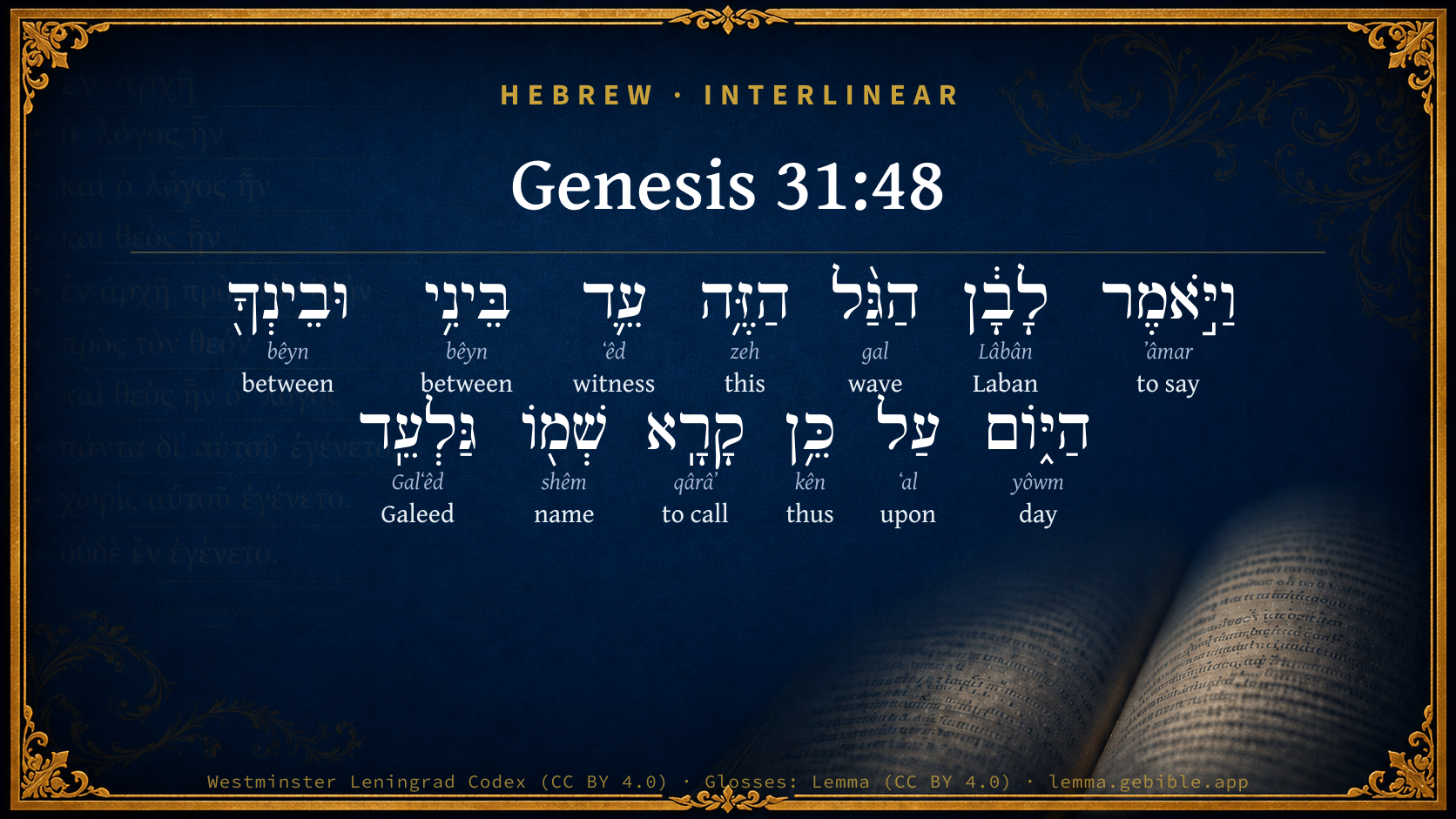
Hebrew (Westminster Leningrad Codex) Genesis 31:48 appears in the Hebrew Old Testament. The text above is from the Westminster Leningrad Codex. Each word links to its Strong’s number, a concise gloss, and parsing drawn from the Open Scriptures Hebrew Bible morphology. Click any word for its full Brown-Driver-Briggs (BDB) entry.
Download image
Cite this verse

Genesis 31:48 (World English Bible). Public Domain. Lemma interlinear Bible study tool, https://lemma.gebible.app/v/genesis/31/48.

Show BibTeX & RIS
BibTeX
RIS
English Translation
Laban said, "This heap is witness between me and you this day." Therefore it was named Galeed
World English Bible · Public Domain
Download a study sheet

One document with this verse’s original text, its word-by-word gloss line, the meaning frame, cross-references with their text, attributed commentary, and full source and license credits — printable, and it pastes into notes with its structure intact.

This verse Autodidact and up

Study sheet (.html) Plain text (.txt)

A passage Seminary Student

Up to 50 verses in one chapter. A passage sheet keeps up to 6 commentary sources and 12 cross-references per verse, in the order this page ranks them, and says so on the sheet whenever that leaves anything out. Ask for a single verse and you get the Autodidact verse sheet above.

Everything on this page stays free to read, with no account — the sheet is a download of what is already on screen, not access to it.

Want to remove ads? Support Godless Engineer
Compare translations 3

The same verse in 3 English versions, stacked beneath the original-language interlinear above. Click any original word for its lexicon entry.

Each is an independent rendering of the whole verse — the interlinear is not word-aligned to these translations.

Highlighted words mark where these versions differ — a whole-verse word diff, not a word-by-word alignment.

  • World English Bible Public Domain
    Laban said, "This heap is witness between me and you this day." Therefore it was named Galeed
  • King James Version Public Domain
    And Laban said, This heap is a witness between me and thee this day. Therefore was the name of it called Galeed;
  • unfoldingWord Literal Text CC BY-SA 4.0
    And Laban said, “This heap a witness between me and you today.” For that he called its name Galeed.

unfoldingWord Literal Text — © unfoldingWord, licensed CC BY-SA 4.0. Word-aligned USFM3 via Door43 (git.door43.org/unfoldingWord/en_ult).

Versions to compare (up to 4)

3 of 4 selected

Show all 18 translations

Every available English version of this verse, each an independent rendering of the whole verse.

  • World English Bible Public Domain
    Laban said, "This heap is witness between me and you this day." Therefore it was named Galeed
  • Berean Standard Bible Public Domain
    Then Laban declared, “This mound is a witness between you and me this day.” Therefore the place was called Galeed.
  • Majority Standard Bible Public Domain
    Then Laban declared, “This mound is a witness between you and me this day.” Therefore the place was called Galeed.
  • King James Version Public Domain
    And Laban said, This heap is a witness between me and thee this day. Therefore was the name of it called Galeed;
  • American Standard Version (1901) Public Domain
    And Laban said, This heap is witness between me and thee this day. Therefore was the name of it called Galeed:
  • Revised Version (1885) Public Domain
    And Laban said, This heap is witness between me and thee this day. Therefore was the name of it called Galeed:
  • Geneva Bible (1599) Public Domain
    For Laban sayd, This heape is witnesse betweene me and thee this day: therefore he called the name of it Galeed.
  • Douay-Rheims (1899) Public Domain
    And Laban said: This heap shall be a witness between me and thee this day, and therefore the name thereof was called Galaad, that is, The witness heap.
  • Young's Literal Translation Public Domain
    And Laban saith, `This heap `is' witness between me and thee to-day;' therefore hath he called its name Galeed;
  • Literal Standard Version CC BY-SA 4.0
    And Laban says, “This heap [is] witness between me and you today”; therefore has he called its name Galeed;
  • Unlocked Literal Bible CC BY-SA 4.0
    Laban said, “This pile is a witness between me and you today.” Therefore its name was called Galeed.
  • unfoldingWord Literal Text CC BY-SA 4.0
    And Laban said, “This heap a witness between me and you today.” For that he called its name Galeed.
  • Darby Bible Public Domain
    And Laban said, This heap is a witness between me and thee this day. Therefore was the name of it called Galeed,
  • World Messianic Bible Public Domain
    Laban said, “This heap is witness between me and you today.” Therefore it was named Galeed
  • Webster's Bible Public Domain
    And Laban said, This heap is a witness between me and thee this day. Therefore was the name of it called Galeed:
  • Free Bible Version CC BY-SA 4.0
    Laban announced, “This pile of stone serves as a witness between me and you.” This is why it was called Galeed.
  • Bible in Basic English Public Domain
    And Laban said, These stones are a witness between you and me today. For this reason its name was Galeed,
  • JPS Tanakh (1917) Public Domain
    And Laban said: 'This heap is witness between me and thee this day.' Therefore was the name of it called Galeed;

Literal Standard Version (2020), Covenant Press — licensed CC BY-SA 4.0. Text via the HelloAO Bible API (eBible.org). Unlocked Literal Bible (unfoldingWord) — licensed CC BY-SA 4.0. Text via the HelloAO Bible API (eBible.org). unfoldingWord Literal Text — © unfoldingWord, licensed CC BY-SA 4.0. Word-aligned USFM3 via Door43 (git.door43.org/unfoldingWord/en_ult). Free Bible Version, Dr. Jonathan Gallagher — licensed CC BY-SA 4.0. Text via the HelloAO Bible API (eBible.org).

Word by word

More ways to search: Search by grammar → Find every occurrence → Compare this word →

Practice this passage: Drill this verse → Learn its vocabulary →

גַּלְעֵֽד
Galʻêd
H1567
“Galeed”
Noun, Proper
Part of Speech
Noun
Type
Proper
Full BDB Definition

Origin: from H1530 and H5707

TWOT: None

Galeed = "witness heap" - the pile of stones heaped up between Jacob and Laban to certify their covenant; located on Mt Gilead
  1. וַיֹּ֣אמֶר ʼâmar H559 “and · to say” Conjunction + Verb, Qal, Sequential Imperfect, 3rd Person, Masculine, Singular
  2. לָבָ֔ן Lâbân H3837 “Laban” Noun, Proper
  3. הַגַּ֨ל gal H1530 “the · wave” Particle, Definite Article + Noun, Common, Masculine, Singular, Absolute
  4. הַזֶּ֥ה zeh H2088 “the · this” Particle, Definite Article + Pronoun, Demonstrative, Masculine, Singular
  5. עֵ֛ד ʻêd H5707 “witness” Noun, Common, Masculine, Singular, Absolute
  6. בֵּינִ֥י bêyn H996 “between · me” Preposition + Suffix, Personal, 1st Person, Common, Singular
  7. וּבֵינְךָ֖ bêyn H996 “and · between · you” Conjunction + Preposition + Suffix, Personal, 2nd Person, Masculine, Singular
  8. הַיּ֑וֹם yôwm H3117 “the · day” Particle, Definite Article + Noun, Common, Masculine, Singular, Absolute
  9. עַל ʻal H5921 “upon” Preposition
  10. כֵּ֥ן kên H3651 “thus” Particle, Demonstrative
  11. קָרָֽא qârâʼ H7121 “to call” Verb, Qal, Perfect, 3rd Person, Masculine, Singular
  12. שְׁמ֖וֹ shêm H8034 “name · his” Noun, Common, Masculine, Singular, Construct + Suffix, Personal, 3rd Person, Masculine, Singular

About this verse

These counts appear in no published source. They are computed here, from the morphology-tagged text and Lemma’s own curated glosses. What Lemma adds →

13
words
12
distinct lemmas
Pentateuch
section

Notable vocabulary

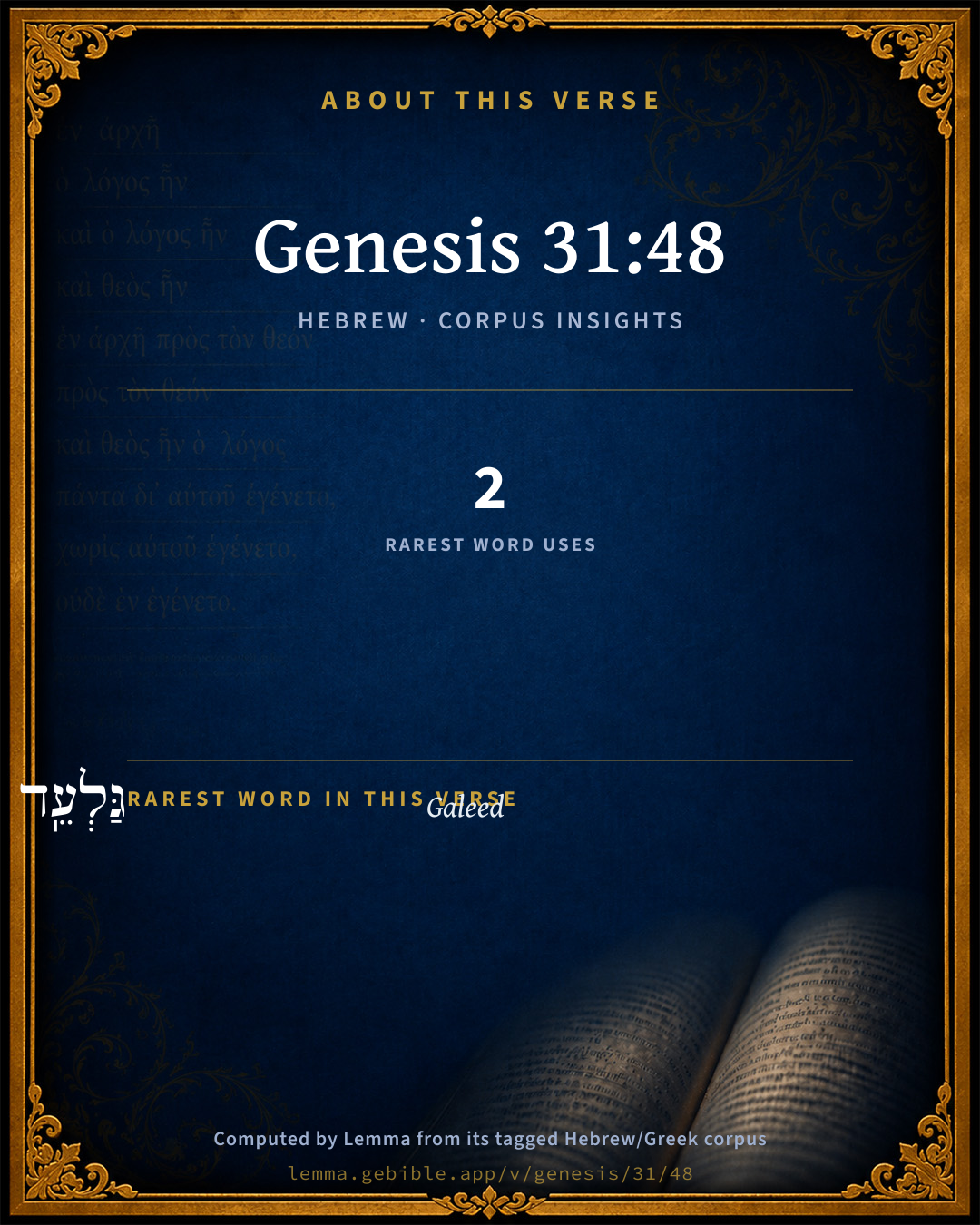
The rarest word here is גַּלְעֵֽד Galeed H1567 — appearing just 2 times in the whole Hebrew Bible.

Shared distinctive vocabulary

גַּלְעֵֽד Galeed H1567 occurs in 2 verses of the Hebrew Bible. Also found in:

Grammatical profile

  • 2 verbs
  • 6 nouns
  • 1 pronoun
  • 3 prepositions
  • 1 particle

Verb forms

  • וַיֹּ֣אמֶר Qal · Sequential Imperfect
  • קָרָֽא Qal · Perfect

Repetition

A word recurs within this verse — often emphatic in Hebrew:

  • בֵּינִ֥י between H996 ×2

Hebrew & Septuagint length

In English translation the verse runs 17 words from the Hebrew and 34 from the Septuagint (LXX English) — the Septuagint runs noticeably longer here. See the side-by-side →

A rough comparison of the two English renderings, which tokenize alike — not a word-level alignment.

Word counts can differ between the Hebrew and the Greek without any difference in meaning — e.g. the Hebrew direct-object marker אֵת has no separate Greek word, and Greek often adds the article ὁ.

Cross-references

5

Topical passages linked to Genesis 31:48 in the Treasury of Scripture Knowledge — connected by theme and wording, ordered by reader-vote popularity; previews shown in the World English Bible.

  • Joshua 24:27 Joshua said to all the people, Behold, this stone shall be a witness against us; for it has heard all the words of Yahweh which he spoke to us: it shall be therefore a witness against you, lest you deny your God.
  • Genesis 31:23 He took his relatives with him, and pursued after him seven days' journey. He overtook him in the mountain of Gilead.
  • Deuteronomy 2:36 From Aroer, which is on the edge of the valley of the Arnon, and [from] the city that is in the valley, even to Gilead, there was not a city too high for us; Yahweh our God delivered up all before us:
  • Deuteronomy 3:16 To the Reubenites and to the Gadites I gave from Gilead even to the valley of the Arnon, the middle of the valley, and the border [of it], even to the river Jabbok, which is the border of the children of Ammon;
  • Joshua 13:8–9 With him the Reubenites and the Gadites received their inheritance, which Moses gave them, beyond the Jordan eastward, even as Moses the servant of Yahweh gave them:

Cross-references courtesy of OpenBible.info (CC BY 4.0).

Hebrew and Greek witnesses Masoretic Hebrew ↔ Greek Septuagint

The same verse in the two great witnesses to the Old Testament, shown verse-for-verse.

Here the Septuagint runs noticeably longer than the Hebrew — LXX2012 (modern English Septuagint) 34 words vs World English Bible 17. A rough length comparison of the two English translations, not a word-level alignment — read both below.

These are two independent witnesses, not word-aligned to each other, and the Septuagint is shown in lemma (dictionary) form.

Hebrew Genesis 31:48 Masoretic · Westminster Leningrad Codex

וַיֹּ֣אמֶר לָבָ֔ן הַגַּ֨ל הַזֶּ֥ה עֵ֛ד בֵּינִ֥י וּבֵינְךָ֖ הַיּ֑וֹם עַל כֵּ֥ן קָרָֽא שְׁמ֖וֹ גַּלְעֵֽד

Laban said, "This heap is witness between me and you this day." Therefore it was named Galeed

World English Bible · Public Domain

Greek LXX Genesis 31:48 Septuagint · lemma form

εἶπον δέ λαβαν ὁ ἰακώβ ἰδού ὁ βουνός οὗτος καί ὁ στήλη οὗτος ὅς ἵστημι ἀνά μέσος ἐγώ καί σύ μαρτυρέω ὁ βουνός οὗτος καί μαρτυρέω ὁ στήλη οὗτος διά οὗτος καλέω ὁ ὄνομα αὐτός βουνός μαρτυρέω

And Laban said to Jacob, Behold this heap, and the pillar, which I have set between me and you; this heap witnesses, and this pillar witnesses; therefore its name was called, the Heap witnesses.

LXX2012 (modern English Septuagint) · Public Domain

Hebrew: Westminster Leningrad Codex (CC BY 4.0). Greek: Septuagint (public domain); English from LXX2012 (modern English Septuagint) (Public Domain). How the Septuagint differs from the Hebrew →

Targum (Aramaic paraphrase)

2

The Targum is the ancient Jewish Aramaic paraphrase of the Hebrew Scriptures — an interpretive translation, not the Hebrew text itself. Onkelos (literal) and Pseudo-Jonathan (expansive) render the Torah, and Jonathan the Prophets. Coverage is partial: where no permissively-licensed English translation exists for a verse, only the Aramaic is shown. This is verse-level text, not a word-by-word alignment to the Hebrew.

  1. Targum Onkelos Torah (Genesis–Deuteronomy)
    וַאֲמַר לָבָן דְּגוֹרָא הָדֵין סָהִיד בֵּינִי וּבֵינָךְ יוֹמָא דֵּין עַל כֵּן קְרָא שְׁמֵהּ גַּלְעֵד

    (no public-domain English translation for this verse)

    Targum Onkelos — Aramaic: “Onkelos Genesis” (public domain); “Onkelos Exodus” (public domain); “Onkelos Leviticus” (public domain); “Onkelos Numbers” (public domain); “Onkelos Deuteronomy” (public domain). English: “Sefaria Community Translation” (CC0 1.0 (public-domain dedication)); “J.W. Etheridge. The Targums of Onkelos and Jonathan Ben Uzziel on the Pentateuch. London: Longmans, Green, 1862” (public domain). Text via Sefaria.

  2. Targum Pseudo-Jonathan Torah (Genesis–Deuteronomy)
    וַאֲמַר לָבָן דָגוֹרָא הָדֵין סָהִיד בֵּינָא וּבֵנָךְ יוֹמָא דֵין עַל כֵּן קְרָא שְׁמֵיהּ גַלְעֵד

    And Laban said, This mound is a witness between me and you today; therefore it was called, Gal-ed;

    Targum Pseudo-Jonathan — Aramaic: “Targum Jonathan on Genesis” (public domain); “Targum Jonathan on Exodus” (public domain); “Targum Jonathan on Leviticus” (public domain); “Targum Jonathan on Numbers” (public domain); “Targum Jonathan on Deuteronomy” (public domain). English: “The Targum of Jonathan ben Uzziel, trans. J. W. Etheridge, London, 1862” (public domain). Text via Sefaria.

Commentary

Notes on Genesis 31:48 from classic Christian and Jewish commentators (each source and its license shown beneath its notes). The classic Christian expositions comment on the surrounding passage and are grouped to its opening verse, so a note may address several verses; the Jewish commentaries on the Tanakh (Rashi and others) are per-verse, so they appear only where the commentator wrote on this verse.

Lemma curates 59 commentaries, every one of them public domain or Creative Commons licensed, each selected and text-cleaned for this edition rather than reprinted as found. About our sources →

Trapp's Complete Commentary

John Trapp

Gen 31:48 And Laban said, This heap [is] a witness between me and thee this day. Therefore was the name of it called Galeed;

Ver. 48. {See Trapp on "Gen 31:44"}

John Trapp, A Commentary or Exposition upon All the Books of the Old and New Testament (1647–1656) — public domain. Text from a community e-Sword module.

Adam Clarke's Commentary

Verse 48. See Clarke on Ge 31:49.

Adam Clarke's Commentary on the Bible (1810–1826) — public domain. Text from a community e-Sword/MySword module.

The Cambridge Bible for Schools and Colleges

gen. ed. J. J. S. Perowne

48. Therefore was the name, &c.] A popular etymology thus accounted for the name “Gilead” by derivation from “Galeed.” Probably, some well-known “cairn” on the hill-frontier of Gilead was the reputed scene of the compact between Laban and Jacob. That border feuds were waged between Aramaeans and Israelites, and that the boundaries between the two nations were marked by cairns, is indicated in this story.

The Cambridge Bible for Schools and Colleges (gen. ed. J. J. S. Perowne; Cambridge University Press, 1878–1918) — public domain. Text from a community e-Sword module.

John Gill's Exposition

And Laban said to Jacob,.... Continued speaking to him, as follows:

behold this heap, and behold this pillar which I have cast betwixt me and thee; the heap of stones seems to be gathered and laid together by the brethren, and the pillar to be erected by Jacob; and yet Laban says of them both, that he cast them, or erected them, they being done by his order, or with his consent, as well as Jacob's; unless the pillar can be thought to design another beside that which Jacob set up, and was like that, a single stone at some little distance from the heap: but the Samaritan and Arabic versions read, "which thou hast seen or set", &c. agreeably to Gen 31:45.

John Gill's Exposition of the Whole Bible (1746–1763) — public domain (CC PDM 1.0). Text via the HelloAO Bible API.

Whedon's Commentary on the Bible

Daniel D. Whedon

48. Laban said — The following verses appear more like an antique song than formal narrative, and may be regarded as an ode composed upon this occasion, or soon after. We may regard the whole passage as the words of Laban, and translate, literally, thus:

And Laban said, This heap, a witness, Between me and thee to-day.

Therefore he called its name Galeed, And the Watch-Tower, as he said:

Let Jehovah watch between me and thee. For we are hidden, a man from his fellow, If thou afflict my daughters, And if thou take wives upon my daughters, No man with us!

Behold, God, a witness between me and thee! And Laban said to Jacob, Behold this heap, And behold the pillar.

Which I have cast between me and thee! A witness this heap, And a witness the pillar, If I pass not to thee over this heap, And if thou pass not to me over this heap, And over this pillar for evil.

The God of Abraham, And the God of Nahor, Shall judge between us, — The God of their father. And let Jacob swear In the Fear of his father Isaac.

Daniel D. Whedon (gen. ed.), Commentary on the Old and New Testaments (1874–1909) — public domain. Text from a community e-Sword module.

The Pulpit Commentary

Vers. 48-50. And Laban said, This heap is a witness between me and thee this day. The historian addingTherefore was the name of it called (originally by Jacob, and afterwards by the Israelites from this transaction) Galeed (vide on ver. 21). The stony character of the regon may have suggested the designation. And Mizpah; watchtower from Tsaphah, to watch. Mizpah afterwards became the site of a town in the district of Gilead; (Jud_1:10:17 11:11, 19, 34) which received its name, as the historian intimates, from the pile of witness erected by Laban and his kinsmen, and was later celebrated as the residence of Jephthah (Jud_1:11:34) and the seat of the sanctuary. (Jud_1:11:11) Ewald supposes that the mound (Galeed) and the watch tower (Mispah) were different objects, and that the meaning of the (so-called) legend is that, while the former (the mountain) was riled up by Jacob and his people, the latter (now the city and fortress of Mizpah on one of the heights of Gilead) was constructed by Laban and his followers (vide "History of Israel," vol. 1. p. 347); but the grotesqusnesa " of this interpretation of the Hebrew story is its best refutationfor he (i.e. Laban) said, The Lord Jehovah; a proof that vers. 49, 50 are a Jehovistic interpolation (Tuch, Bleek, Colenso, Kalisch); an indication of their being a subsequent insertion, though not warranting the inference that the entire history is a complication (Keil); a sign that henceforth Laban regarded Jehovah as the representative of his rights (Lange); but probably only a token that Laban, recognizing Jehovah as the only name that would bind the conscience of Jacob (Hengstenberg, Quarry), had for the moment adopted Jacob"s theology ("Speaker"s Commentary"), but only in self-defense (Wordsworth)watch between me and thee, when we are absent one from another literally, a man from his companion. If thou shalt afflict my daughters, or if thou shalt take other wives beside my daughters (Laban"s concern for his daughters, though hitherto not conspicuous, may, in the hour of parting from them, have been real: his language shows that he was not quite at ease as to Jacob"s integrity. Perhaps the remembrance that he had been the cause of Jacob"s taking two wives made him anxious to secure that Jacob should not improve upon his evil instructions), no man is with us; either then they stood apart from Laban"s clan followers (Inglis); or his meaning was that when widely separated there would be no one to judge betwixt them, or perhaps even to observe them (Rosenm but see, God (Elohim in contrast to man) is witness betwixt me and thee.

The Pulpit Commentary (1880–1919), ed. H.D.M. Spence-Jones & Joseph S. Exell — public domain. Text from a community e-Sword module.

unfoldingWord translationNotes

Door43 World Missions Community

This pile is a witness between me and you

The stones do not actually bear witness as a person. AT: "This pile will be a reminder between me and you" (See: Personification)

Galeed

Translators may add a footnote that says: "The name Galeed means 'heap of witness' in Jacob's language. See how you translated this in Genesis 31:47. (See: How to Translate Names)

Mizpah

Translators may add a footnote that says: "The name Mizpah means 'watchtower.'" (See: How to Translate Names)

when we are out of sight one from another

Here "out of sight" stands for no longer being in each other's presence. AT: "when we are no longer with each other" (See: Metonymy)

although no one else is with us

Here "us" refers to Laban and Jacob. AT: "even if no one else is there to see us"

see

"look" or "remember" or "pay attention to what i am about to tell you"

translationWords

Laban

testimony

Yahweh

God

unfoldingWord translationNotes — © Distant Shores Media and the Door43 World Missions Community, licensed CC BY-SA 4.0. Source: git.door43.org/Door43/en_tn.

Ramban (Nachmanides)

Rabbi Moshe ben Nachman (Ramban / Nachmanides)

AND LABAN SAID, THIS STONE-HEAP IS A WITNESS. After Jacob had called it Galed, Laban spoke in Jacob’s language, This stone-heap is a witness, and therefore its name was called Galed, for they mutually agreed upon this name. It may be that Laban’s words are translated into the Sacred Language, [but he himself did not use the term Galed].

Ramban (Nachmanides) on the Tanakh — English translation: “Commentary on the Torah by Ramban (Nachmanides). Translated and annotated by Charles B. Chavel. New York, Shilo Pub. House, 1971-1976” (CC BY 4.0). Text via Sefaria.

Radak

Rabbi David Kimhi (Radak)

ויאמר, he made the statement following in his own language. Alternatively, he said all this in Hebrew as it is quite possible that Lavan knew Hebrew and when speaking with Yaakov used to speak to him in Hebrew.

על כן קרא שמו, Yaakov named the monument Galed, meaning that the heap of stones should be a witness between himself [and the Torah mentions that this had been his intention already before the thought was articulated. Paraphrased by me. Ed.]

Radak on the Tanakh — English translations: “Sefaria Community Translation” (CC0 1.0 (public-domain dedication)); “Eliyahu Munk, HaChut Hameshulash” (CC BY 4.0); “Rabbi Mike Feuer, Jerusalem Anthology” (CC BY 4.0); and “R. David Kimhi on the first book of Psalms, Translated by R.G. Finch, London, 1919” (public domain). Text via Sefaria.

Lesson kit

Teaching starters — assembled from the data on this page, not authored interpretation. Every prompt links to the verse data it draws on. Edit before teaching.

Genesis, in the Pentateuch, opens this verse with 13 words (12 distinct Hebrew lemmas). Its most distinctive word is Galʻêd (“Galeed”). The Greek Septuagint runs longer here. A historical commentator’s framing appears above. Read the whole chapter for the surrounding context.

Discussion questions

  1. The word Galʻêd carries the sense “Galeed.” How does it shape the verse?
  2. Genesis 31:47 shares the word «Galeed» with this verse. How do the two illuminate each other?
  3. “between” occurs 2× in this one verse. What is the effect of the repetition?
  4. Compared with the Hebrew, the Septuagint runs longer here. What questions does that raise?
  5. The translations on this page render this verse differently — a whole-verse word diff, not a word-by-word alignment. What might account for the different wordings?
  6. The verb «וַיֹּ֣אמֶר» is Qal Sequential Imperfect. How does its form color the action?
  7. Reading how Trapp's Complete Commentary and Adam Clarke's Commentary read this verse, where do the two commentators agree and where do they part?

Things to notice

Reading settings

Reading text

Shown beneath each verse's original-language words.

Old Testament
Old Testament edition

Read the OT as the Masoretic Hebrew (MT) or the Greek Septuagint (LXX).

English shown for the Greek Septuagint (in the Hebrew ↔ Greek comparison).

Comparing translations? Open the Compare panel on any verse page to stack up to four side by side.