2 Kings 9:24

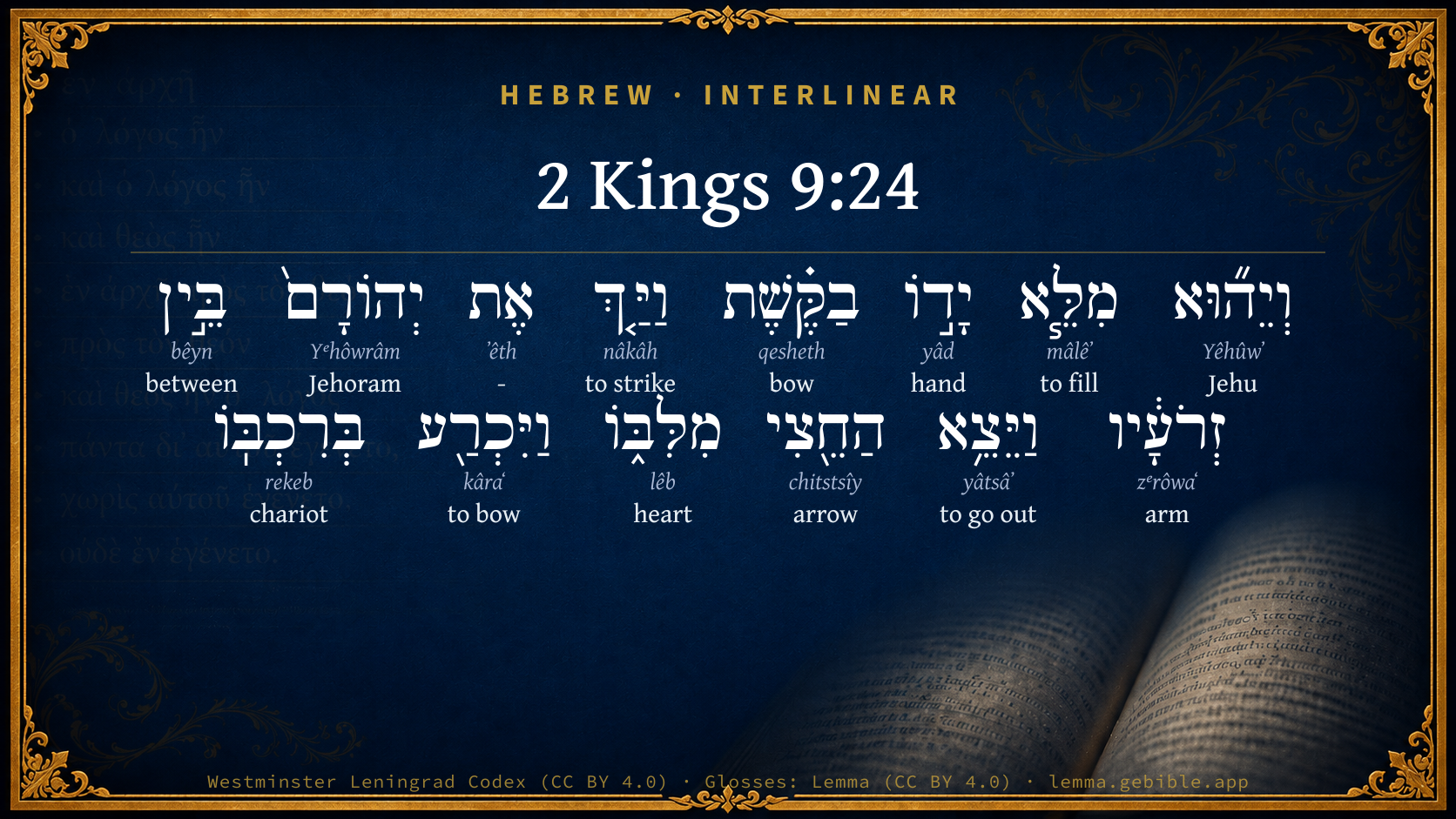
Hebrew (Westminster Leningrad Codex) 2 Kings 9:24 appears in the Hebrew Old Testament. The text above is from the Westminster Leningrad Codex. Each word links to its Strong’s number, a concise gloss, and parsing drawn from the Open Scriptures Hebrew Bible morphology. Click any word for its full Brown-Driver-Briggs (BDB) entry.
Download image
Cite this verse

2 Kings 9:24 (World English Bible). Public Domain. Lemma interlinear Bible study tool, https://lemma.gebible.app/v/2-kings/9/24.

Show BibTeX & RIS
BibTeX
RIS
English Translation
Jehu drew his bow with his full strength, and struck Joram between his arms; and the arrow went out at his heart, and he sunk down in his chariot.
World English Bible · Public Domain
Download a study sheet

One document with this verse’s original text, its word-by-word gloss line, the meaning frame, cross-references with their text, attributed commentary, and full source and license credits — printable, and it pastes into notes with its structure intact.

This verse Autodidact and up

Study sheet (.html) Plain text (.txt)

A passage Seminary Student

Up to 50 verses in one chapter. A passage sheet keeps up to 6 commentary sources and 12 cross-references per verse, in the order this page ranks them, and says so on the sheet whenever that leaves anything out. Ask for a single verse and you get the Autodidact verse sheet above.

Everything on this page stays free to read, with no account — the sheet is a download of what is already on screen, not access to it.

Want to remove ads? Support Godless Engineer
Compare translations 3

The same verse in 3 English versions, stacked beneath the original-language interlinear above. Click any original word for its lexicon entry.

Each is an independent rendering of the whole verse — the interlinear is not word-aligned to these translations.

Highlighted words mark where these versions differ — a whole-verse word diff, not a word-by-word alignment.

  • World English Bible Public Domain
    Jehu drew his bow with his full strength, and struck Joram between his arms; and the arrow went out at his heart, and he sunk down in his chariot.
  • King James Version Public Domain
    And Jehu drew a bow with his full strength, and smote Jehoram between his arms, and the arrow went out at his heart, and he sunk down in his chariot.
  • unfoldingWord Literal Text CC BY-SA 4.0
    And Jehu filled his hand with the bow, and he struck Jehoram between his arms, and the arrow went out from his heart. And he sank down in his chariot.

unfoldingWord Literal Text — © unfoldingWord, licensed CC BY-SA 4.0. Word-aligned USFM3 via Door43 (git.door43.org/unfoldingWord/en_ult).

Versions to compare (up to 4)

3 of 4 selected

Show all 18 translations

Every available English version of this verse, each an independent rendering of the whole verse.

  • World English Bible Public Domain
    Jehu drew his bow with his full strength, and struck Joram between his arms; and the arrow went out at his heart, and he sunk down in his chariot.
  • Berean Standard Bible Public Domain
    Then Jehu drew his bow and shot Joram between the shoulders. The arrow pierced his heart, and he slumped down in his chariot.
  • Majority Standard Bible Public Domain
    Then Jehu drew his bow and shot Joram between the shoulders. The arrow pierced his heart, and he slumped down in his chariot.
  • King James Version Public Domain
    And Jehu drew a bow with his full strength, and smote Jehoram between his arms, and the arrow went out at his heart, and he sunk down in his chariot.
  • American Standard Version (1901) Public Domain
    And Jehu drew his bow with his full strength, and smote Joram between his arms; and the arrow went out at his heart, and he sunk down in his chariot.
  • Revised Version (1885) Public Domain
    And Jehu drew his bow with his full strength, and smote Joram between his arms, and the arrow went out at his heart, and he sunk down in his chariot.
  • Geneva Bible (1599) Public Domain
    But Iehu tooke a bowe in his hande, and smote Iehoram betweene the shoulders, that the arowe went through his heart: and he fell downe in his charet.
  • Douay-Rheims (1899) Public Domain
    But Jehu bent Iris bow with his hand, and shot Joram between the shoulders: and the arrow went out through his heart, and immediately he fell in his chariot.
  • Young's Literal Translation Public Domain
    And Jehu hath filled his hand with a bow, and smiteth Jehoram between his arms, and the arrow goeth out from his heart, and he boweth down in his chariot.
  • Literal Standard Version CC BY-SA 4.0
    And Jehu has filled his hand with a bow, and strikes Jehoram between his arms, and the arrow goes out from his heart, and he bows down in his chariot.
  • Unlocked Literal Bible CC BY-SA 4.0
    Then Jehu drew his bow with his full strength and shot Joram between his shoulders; the arrow went through his heart, and he sank down in his chariot.
  • unfoldingWord Literal Text CC BY-SA 4.0
    And Jehu filled his hand with the bow, and he struck Jehoram between his arms, and the arrow went out from his heart. And he sank down in his chariot.
  • Darby Bible Public Domain
    And Jehu took his bow in his hand, and smote Jehoram between his arms, and the arrow went out through his heart; and he sank down in his chariot.
  • World Messianic Bible Public Domain
    Jehu drew his bow with his full strength, and struck Joram between his arms; and the arrow went out at his heart, and he sunk down in his chariot.
  • Webster's Bible Public Domain
    And Jehu drew a bow with his full strength, and smote Jehoram between his arms, and the arrow went out at his heart, and he sunk down in his chariot.
  • Free Bible Version CC BY-SA 4.0
    Jehu picked up his bow and shot Joram between the shoulders. The arrow went through his heart and he collapsed dead in his chariot.
  • Bible in Basic English Public Domain
    Then Jehu took his bow in his hand, and with all his strength sent an arrow, wounding Joram between the arms; and the arrow came out at his heart, and he went down on his face in his carriage.
  • JPS Tanakh (1917) Public Domain
    And Jehu drew his bow with his full strength, and smote Joram between his arms, and the arrow went out at his heart, and he sunk down in his chariot.

Literal Standard Version (2020), Covenant Press — licensed CC BY-SA 4.0. Text via the HelloAO Bible API (eBible.org). Unlocked Literal Bible (unfoldingWord) — licensed CC BY-SA 4.0. Text via the HelloAO Bible API (eBible.org). unfoldingWord Literal Text — © unfoldingWord, licensed CC BY-SA 4.0. Word-aligned USFM3 via Door43 (git.door43.org/unfoldingWord/en_ult). Free Bible Version, Dr. Jonathan Gallagher — licensed CC BY-SA 4.0. Text via the HelloAO Bible API (eBible.org).

Word by word

More ways to search: Search by grammar → Find every occurrence → Compare this word →

Practice this passage: Drill this verse → Learn its vocabulary →

הַחֵ֖צִי
chitstsîy
H2678
“the · arrow”
Particle, Definite Article + Noun, Common, Masculine, Singular, Absolute
Part of Speech
Particle + Noun
Type
Common
Gender
Masculine
Number
Singular
State
Absolute
Full BDB Definition

Origin: prolongation from H2671

TWOT: 719c , 721b

arrow
  1. וְיֵה֞וּא Yêhûwʼ H3058 “and · Jehu” Conjunction + Noun, Proper
  2. מִלֵּ֧א mâlêʼ H4390 “to fill” Verb, Piel, Perfect, 3rd Person, Masculine, Singular
  3. יָד֣וֹ yâd H3027 “hand · his” Noun, Common, Both, Singular, Construct + Suffix, Personal, 3rd Person, Masculine, Singular
  4. בַקֶּ֗שֶׁת qesheth H7198 “in/at the · bow” Preposition, Determined + Noun, Common, Feminine, Singular, Absolute
  5. וַיַּ֤ךְ nâkâh H5221 “and · to strike” Conjunction + Verb, Hiphil, Sequential Imperfect, 3rd Person, Masculine, Singular
  6. אֶת ʼêth H853 “-” Particle, Direct Object
  7. יְהוֹרָם֙ Yᵉhôwrâm H3088 “Jehoram” Noun, Proper
  8. בֵּ֣ין bêyn H996 “between” Preposition
  9. זְרֹעָ֔יו zᵉrôwaʻ H2220 “arms · his” Noun, Common, Both, Plural, Construct + Suffix, Personal, 3rd Person, Masculine, Singular
  10. וַיֵּצֵ֥א yâtsâʼ H3318 “and · to go out” Conjunction + Verb, Qal, Sequential Imperfect, 3rd Person, Masculine, Singular
  11. מִלִּבּ֑וֹ lêb H3820 “from · heart · his” Preposition + Noun, Common, Masculine, Singular, Construct + Suffix, Personal, 3rd Person, Masculine, Singular
  12. וַיִּכְרַ֖ע kâraʻ H3766 “and · to bow” Conjunction + Verb, Qal, Sequential Imperfect, 3rd Person, Masculine, Singular
  13. בְּרִכְבּֽוֹ rekeb H7393 “in/at · chariot · his” Preposition + Noun, Common, Masculine, Singular, Construct + Suffix, Personal, 3rd Person, Masculine, Singular

About this verse

These counts appear in no published source. They are computed here, from the morphology-tagged text and Lemma’s own curated glosses. What Lemma adds →

14
words
14
distinct lemmas
Historical
section

Notable vocabulary

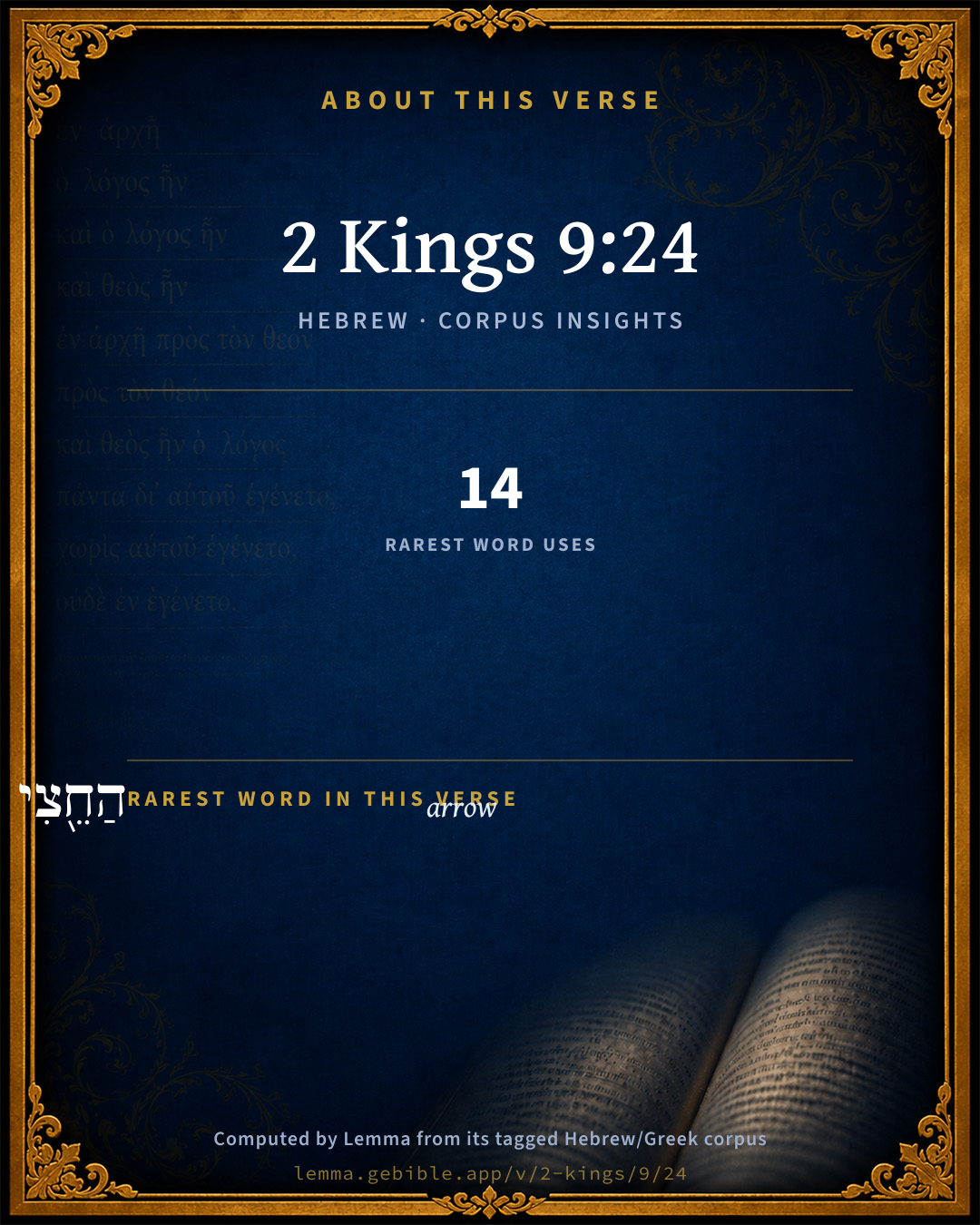
The rarest word here is הַחֵ֖צִי arrow H2678 — appearing just 14 times in the whole Hebrew Bible.

Shared distinctive vocabulary

הַחֵ֖צִי arrow H2678 occurs in 10 verses of the Hebrew Bible. Also found in:

Grammatical profile

  • 4 verbs
  • 8 nouns
  • 1 preposition
  • 1 particle

Verb forms

  • מִלֵּ֧א Piel · Perfect
  • וַיַּ֤ךְ Hiphil · Sequential Imperfect
  • וַיֵּצֵ֥א Qal · Sequential Imperfect
  • וַיִּכְרַ֖ע Qal · Sequential Imperfect

Hebrew & Septuagint length

In English translation the verse runs 29 words from the Hebrew and 29 from the Septuagint (LXX English) — the same length.

A rough comparison of the two English renderings, which tokenize alike — not a word-level alignment.

Word counts can differ between the Hebrew and the Greek without any difference in meaning — e.g. the Hebrew direct-object marker אֵת has no separate Greek word, and Greek often adds the article ὁ.

Cross-references

6

Topical passages linked to 2 Kings 9:24 in the Treasury of Scripture Knowledge — connected by theme and wording, ordered by reader-vote popularity; previews shown in the World English Bible.

  • 1 Kings 22:34 A certain man drew his bow at a venture, and struck the king of Israel between the joints of the armor: therefore he said to the driver of his chariot, Turn your hand, and carry me out of the host; for I am severely wounded.
  • Job 20:23–25 When he is about to fill his belly, God will cast the fierceness of his wrath on him. It will rain on him while he is eating.
  • Psalms 50:22 "Now consider this, you who forget God, Lest I tear you into pieces, and there be none to deliver.
  • Proverbs 21:30 There is no wisdom nor understanding Nor counsel against Yahweh.
  • Ecclesiastes 8:12–13 Though a sinner commits crimes a hundred times, and lives long, yet surely I know that it will be better with those who fear God, who are reverent before him.
  • 1 Thessalonians 5:3 For when they are saying, "Peace and safety," then sudden destruction will come on them, like birth pains on a pregnant woman; and they will in no way escape.

Cross-references courtesy of OpenBible.info (CC BY 4.0).

Hebrew and Greek witnesses Masoretic Hebrew ↔ Greek Septuagint

The same verse in the two great witnesses to the Old Testament, shown verse-for-verse.

These are two independent witnesses, not word-aligned to each other, and the Septuagint is shown in lemma (dictionary) form.

Hebrew 2 Kings 9:24 Masoretic · Westminster Leningrad Codex

וְיֵה֞וּא מִלֵּ֧א יָד֣וֹ בַקֶּ֗שֶׁת וַיַּ֤ךְ אֶת יְהוֹרָם֙ בֵּ֣ין זְרֹעָ֔יו וַיֵּצֵ֥א הַחֵ֖צִי מִלִּבּ֑וֹ וַיִּכְרַ֖ע בְּרִכְבּֽוֹ

Jehu drew his bow with his full strength, and struck Joram between his arms; and the arrow went out at his heart, and he sunk down in his chariot.

World English Bible · Public Domain

Greek LXX 2 Kings 9:24 Septuagint · lemma form

καί πίμπλημι ιου ὁ χείρ αὐτός ἐν ὁ τόξον καί πατάσσω ὁ ιωραμ ἀνά μέσος ὁ βραχίων αὐτός καί ἐκἔρχομαι ὁ βέλος διά ὁ καρδία αὐτός καί κάμπτω ἐπί ὁ γόνυ αὐτός

And Ju bent his bow with his full strength, and struck Joram between his arms, and his arrow went out at his heart, and he bowed upon his knees.

LXX2012 (modern English Septuagint) · Public Domain

On this verse, Ellicott's Commentary for English Readers discusses the Septuagint’s reading. Read the note in Commentary ↓

Hebrew: Westminster Leningrad Codex (CC BY 4.0). Greek: Septuagint (public domain); English from LXX2012 (modern English Septuagint) (Public Domain). How the Septuagint differs from the Hebrew →

Targum (Aramaic paraphrase)

1

The Targum is the ancient Jewish Aramaic paraphrase of the Hebrew Scriptures — an interpretive translation, not the Hebrew text itself. Onkelos (literal) and Pseudo-Jonathan (expansive) render the Torah, and Jonathan the Prophets. Coverage is partial: where no permissively-licensed English translation exists for a verse, only the Aramaic is shown. This is verse-level text, not a word-by-word alignment to the Hebrew.

  1. Targum Jonathan Prophets (Joshua–Malachi)
    וְיֵהוּא מִלֵא יְדֵיהּ בְּקַשְׁתָּא וּמְחָא יַת יְהוֹרָם בֵּין דְרָעוֹהִי וּנְפַק גִירָא מִלִבֵּיהּ וּכְרַע בִּרְתִיכֵיהּ:

    (no public-domain English translation for this verse)

    Targum Jonathan — Aramaic: “Mikraot Gedolot” (public domain). English: “Sefaria Community Translation” (CC0 1.0 (public-domain dedication)); “London "Chaldee Paraphrase," 1871” (public domain). Text via Sefaria.

Commentary

Notes on 2 Kings 9:24 from classic Christian and Jewish commentators (each source and its license shown beneath its notes). The classic Christian expositions comment on the surrounding passage and are grouped to its opening verse, so a note may address several verses; the Jewish commentaries on the Tanakh (Rashi and others) are per-verse, so they appear only where the commentator wrote on this verse.

Lemma curates 59 commentaries, every one of them public domain or Creative Commons licensed, each selected and text-cleaned for this edition rather than reprinted as found. About our sources →

Trapp's Complete Commentary

John Trapp

2Ki 9:24 And Jehu drew a bow with his full strength, and smote Jehoram between his arms, and the arrow went out at his heart, and he sunk down in his chariot.

Ver. 24. And the arrow went out at his heart.] Jehu was an excellent marksman; but it was God that guided his hand, strengthened his arm, {Eze 30:24} and ordered his arrow. {Jer 50:9}

John Trapp, A Commentary or Exposition upon All the Books of the Old and New Testament (1647–1656) — public domain. Text from a community e-Sword module.

The Biblical Illustrator

Joseph S. Exell

2Ki_9:24

And Jehu drew a bow with his full strength.

Aimlessness

The frivolous, purposeless lives of this world are like ships at the mercy of the wind and tide. Hail one of them, and ask, Whither are you bound? and the answer will be, I dont know. What cargo do you carry? Nothing. Well, what are you doing out here on the ocean of life? Only drifting. Ah! but you dont know what a sorry spectacle you make only drifting when there is so much to be done. It is said that Carlyle, on one of his daily walks, met a young man, and, falling into conversation with him, inquired about his purpose in life. I havent any particular purpose, came the reply. Then get one, exclaimed the stern old man, striking his cane on the pavement--get one quick. (Homiletic Review.)

The Biblical Illustrator, edited by Joseph S. Exell (c. 1880s–1900s) — public domain. Text from a community e-Sword module.

Adam Clarke's Commentary

Verse 24. Drew a bow with his full strength] The marginal reading is correct: He filled his hand with a bow. That is, "He immediately took up his bow, set his arrow, and let fly." This is the only meaning of the passage.

Between his arms] That is, between his shoulders; for he was now turned, and was flying from Jehu.

Adam Clarke's Commentary on the Bible (1810–1826) — public domain. Text from a community e-Sword/MySword module.

Ellicott's Commentary for English Readers

(24) And Jehu drew . . . strength.—See margin, which, however, is not quite accurate. Rather it should be, And Jehu had filled his hand (with an arrow) on the bow—i.e., had meanwhile put an arrow on his bow ready to shoot. Keil explains, “filled his hand with the bow,” i.e., seized the bow. The phrase “to fill a bow” means to stretch it, both in Hebrew (Zec_9:13) and in Syriac (Psa_11:2). In Psa_64:4. Symmachus renders the Hebrew, “they have aimed their arrow,” by the Greek, ἐπλήρωσαν τὸ τόξον, “they have filled the bow.”

Between his arms—i.e., between the shoulders, as he was flying; Vulg., “inter scapulas.”

The arrow went out at his heart.—Or, came out from his heart. It struck him obliquely between the shoulders, and went right through the heart. (The word for “arrow” is hĕçî, an ancient form, occurring thrice in 1Sa_20:36-38.) Ewald, on this account, refers both passages to the oldest narrator of the history of the kings.

Sunk down.—See margin (Isa_46:1).

In his chariot.—LXX., “on his knees,” owing to a partial obliteration of one letter in their Hebrew text.

A Bible Commentary for English Readers, edited by Charles John Ellicott (1878–1897) — public domain. Text from a community e-Sword module.

The Cambridge Bible for Schools and Colleges

gen. ed. J. J. S. Perowne

24. drew a [R.V. his] bow with his full strength] Literally as on margin of R.V. ‘filled his hand with the bow’, which expresses the attitude of a bowman as he shoots.

between his arms] As he was in flight, the arrow passed between his shoulders and so went through the breast. He was mortally wounded and could not be stayed up in his chariot, but died at once. Instead of ‘in his chariot’ the LXX. renders ‘upon his knees, reading the preposition in ברככו as a part of the root and treating the word as if it had been ברכיו.

The Cambridge Bible for Schools and Colleges (gen. ed. J. J. S. Perowne; Cambridge University Press, 1878–1918) — public domain. Text from a community e-Sword module.

John Gill's Exposition

But when Ahaziah the king of Judah saw this,.... That Joram was slain:

he fled by the way of the garden house, which perhaps stood upon the spot where Naboth's vineyard was, turned into a garden by Ahab:

and Jehu followed after him; as far as Samaria, where he was hid, Ch2 22:9,

and said, smite him also in the chariot; this order he gave to his soldiers, to do to him as he had done to Joram: and they did so:

at the going up to Gur, which is by Ibleam; a city in the tribe of Manasseh, Jos 17:11,

and he fled to Megiddo; after he was wounded; another city in the same tribe, Jos 17:11,

and died there; at Megiddo; though some think that from thence he was had by his servants to Samaria, and there hid, and, being found, was brought from thence to Jezreel, where he was slain, and died. Jehu was ordered to destroy the whole house of Ahab, and Ahaziah was of that house by his mother's side, and walked in the way of it, and was in conjunction with it, and perished therewith; this, though here recorded, was after the death of Jezebel, and of the seventy sons of Ahab, and of the brethren of Ahaziah.

John Gill's Exposition of the Whole Bible (1746–1763) — public domain (CC PDM 1.0). Text via the HelloAO Bible API.

Albert Barnes' Notes on the Bible

Jehu drew a bow ... - literally, as in the margin, i. e., “Jehu took a bow in his hand.” The arrow struck Jehoram’s back, between his two shoulders, as he fled.

Albert Barnes' Notes on the Bible (1834–1885) — public domain. Text from a community e-Sword/MySword module.

Matthew Poole's English Annotations

Between his arms; between his shoulders, when he was turned or turning back, the chariot being probably open behind, as many times they were.

Matthew Poole's English Annotations on the Holy Bible (1683–1685) — public domain. Text from a community e-Sword/MySword module.

The Pulpit Commentary

And Jehu drew a bow with his full strength. This meaning is scarcely contained in the Hebrew, which merely says that Jehu "filled his hand with his bow," that is to say, took his bow into his hands for the purpose of using it. And smote Jehoram between his arms; i.e. directed an arrow against Jehoram with so true an aim, that it struck him in the middle of the back between his shoulders. And the arrow went out at his heart. This was quite possible, for the heart lies towards the center of the chest, not wholly on the left side. It is not necessary to suppose an oblique wound. And he sank down in his chariot. Jehoram fell into the "well," or body, of the chariot, and there lay, the chariot being brought to a stand.

The Pulpit Commentary (1880–1919), ed. H.D.M. Spence-Jones & Joseph S. Exell — public domain. Text from a community e-Sword module.

John Wesley's Explanatory Notes

The arrow - It was one of God's arrows, which he ordained against the persecutor.

John Wesley, Explanatory Notes Upon the Whole Bible (1754–1765) — public domain. Text via the GEBible commentary corpus.

Lesson kit

Teaching starters — assembled from the data on this page, not authored interpretation. Every prompt links to the verse data it draws on. Edit before teaching.

2 Kings, in the Historical, opens this verse with 14 words (14 distinct Hebrew lemmas). Its most distinctive word is chitstsîy (“arrow”). A historical commentator’s framing appears above. Read the whole chapter for the surrounding context.

Discussion questions

  1. How does “arrow” (chitstsîy) shape what this verse is saying?
  2. How does 1 Samuel 20:20, which shares the word «arrow», read alongside this verse?
  3. These translations render this verse differently. What is at stake in choosing one wording over another?
  4. «מִלֵּ֧א» is a Piel Perfect verb. How does that grammatical form shape the action described?
  5. Compare how Trapp's Complete Commentary and The Biblical Illustrator read this verse. Where do they agree or differ?

Things to notice

Reading settings

Reading text

Shown beneath each verse's original-language words.

Old Testament
Old Testament edition

Read the OT as the Masoretic Hebrew (MT) or the Greek Septuagint (LXX).

English shown for the Greek Septuagint (in the Hebrew ↔ Greek comparison).

Comparing translations? Open the Compare panel on any verse page to stack up to four side by side.