
Leviticus 20:25

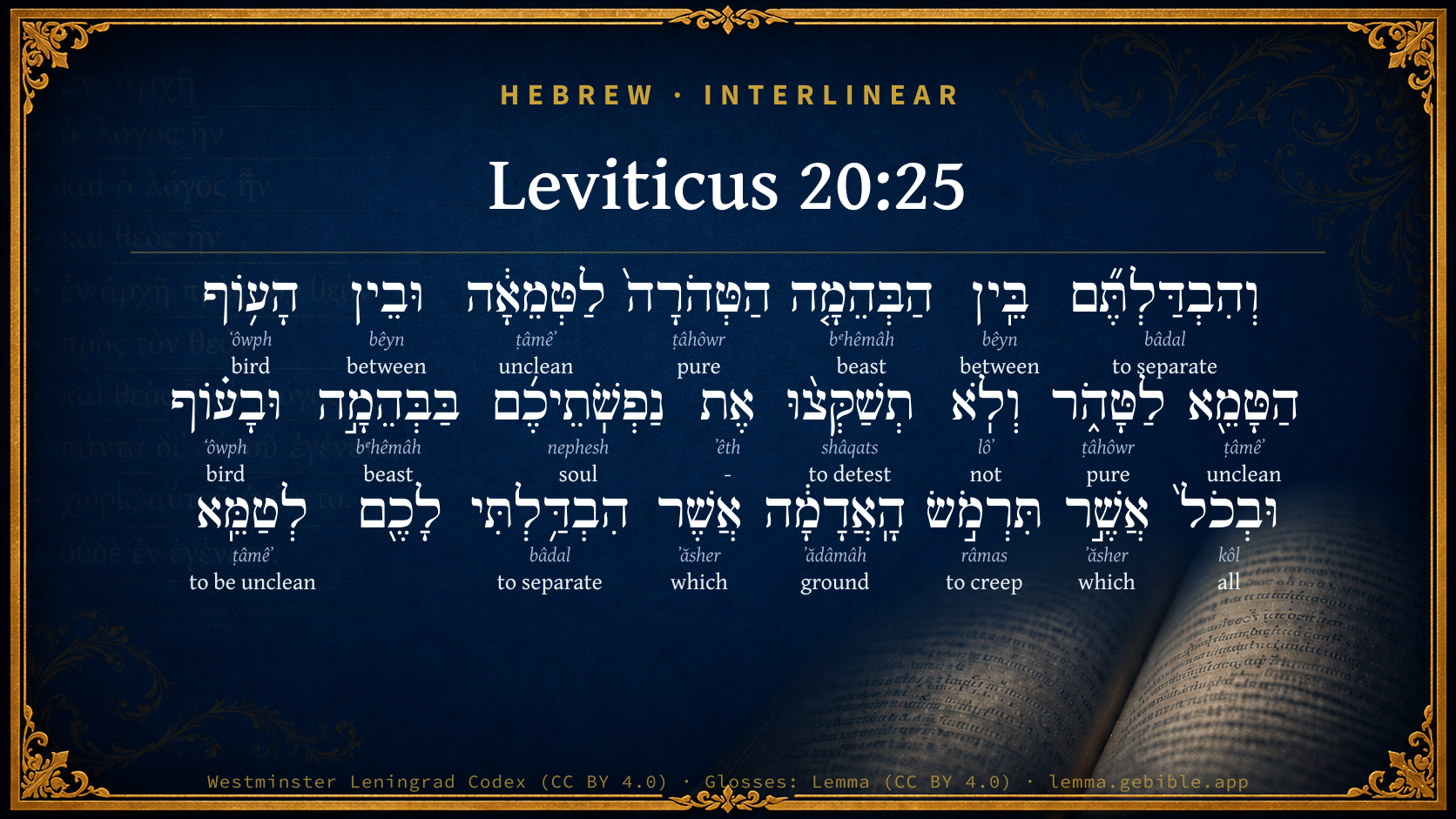
Hebrew (Westminster Leningrad Codex) Leviticus 20:25 appears in the Hebrew Old Testament. The text above is from the Westminster Leningrad Codex. Each word links to its Strong’s number, a concise gloss, and parsing drawn from the Open Scriptures Hebrew Bible morphology. Click any word for its full Brown-Driver-Briggs (BDB) entry.
Download image
Cite this verse

Leviticus 20:25 (World English Bible). Public Domain. Lemma interlinear Bible study tool, https://lemma.gebible.app/v/leviticus/20/25.

Show BibTeX & RIS
BibTeX
RIS
English Translation
"'You shall therefore make a distinction between the clean animal and the unclean, and between the unclean fowl and the clean: and you shall not make yourselves abominable by animal, or by bird, or by anything with which the ground teems, which I have separated from you as unclean for you.
World English Bible · Public Domain
Download a study sheet

One document with this verse’s original text, its word-by-word gloss line, the meaning frame, cross-references with their text, attributed commentary, and full source and license credits — printable, and it pastes into notes with its structure intact.

This verse Autodidact and up

Study sheet (.html) Plain text (.txt)

A passage Seminary Student

Up to 50 verses in one chapter. A passage sheet keeps up to 6 commentary sources and 12 cross-references per verse, in the order this page ranks them, and says so on the sheet whenever that leaves anything out. Ask for a single verse and you get the Autodidact verse sheet above.

Everything on this page stays free to read, with no account — the sheet is a download of what is already on screen, not access to it.

Want to remove ads? Support Godless Engineer
Compare translations 3

The same verse in 3 English versions, stacked beneath the original-language interlinear above. Click any original word for its lexicon entry.

Each is an independent rendering of the whole verse — the interlinear is not word-aligned to these translations.

Highlighted words mark where these versions differ — a whole-verse word diff, not a word-by-word alignment.

  • World English Bible Public Domain
    "'You shall therefore make a distinction between the clean animal and the unclean, and between the unclean fowl and the clean: and you shall not make yourselves abominable by animal, or by bird, or by anything with which the ground teems, which I have separated from you as unclean for you.
  • King James Version Public Domain
    Ye shall therefore put difference between clean beasts and unclean, and between unclean fowls and clean: and ye shall not make your souls abominable by beast, or by fowl, or by any manner of living thing that creepeth on the ground, which I have separated from you as unclean.
  • unfoldingWord Literal Text CC BY-SA 4.0
    And you shall separate between the clean animal and the unclean, and between the unclean bird and the clean. And you shall not make your lives detestable with an animal or with a bird or with anything that crawls on the ground, which I separated from you to unclean.

unfoldingWord Literal Text — © unfoldingWord, licensed CC BY-SA 4.0. Word-aligned USFM3 via Door43 (git.door43.org/unfoldingWord/en_ult).

Versions to compare (up to 4)

3 of 4 selected

Show all 18 translations

Every available English version of this verse, each an independent rendering of the whole verse.

  • World English Bible Public Domain
    "'You shall therefore make a distinction between the clean animal and the unclean, and between the unclean fowl and the clean: and you shall not make yourselves abominable by animal, or by bird, or by anything with which the ground teems, which I have separated from you as unclean for you.
  • Berean Standard Bible Public Domain
    You are therefore to distinguish between clean and unclean animals and birds. Do not become contaminated by any animal or bird, or by anything that crawls on the ground; I have set these apart as unclean for you.
  • Majority Standard Bible Public Domain
    You are therefore to distinguish between clean and unclean animals and birds. Do not become contaminated by any animal or bird, or by anything that crawls on the ground; I have set these apart as unclean for you.
  • King James Version Public Domain
    Ye shall therefore put difference between clean beasts and unclean, and between unclean fowls and clean: and ye shall not make your souls abominable by beast, or by fowl, or by any manner of living thing that creepeth on the ground, which I have separated from you as unclean.
  • American Standard Version (1901) Public Domain
    Ye shall therefore make a distinction between the clean beast and the unclean, and between the unclean fowl and the clean: and ye shall not make your souls abominable by beast, or by bird, or by anything wherewith the ground teemeth, which I have separated from you as unclean.
  • Revised Version (1885) Public Domain
    Ye shall therefore separate between the clean beast and the unclean, and between the unclean fowl and the clean: and ye shall not make your souls abominable by beast, or by fowl, or by any thing wherewith the ground teemeth, which I have separated from you as unclean.
  • Geneva Bible (1599) Public Domain
    Therefore shall ye put difference betweene cleane beastes and vncleane, and betweene vncleane foules and cleane: neither shall ye defile your selues with beastes and foules, nor with any creeping thing, that ye ground bringeth forth, which I haue separated from you as vncleane.
  • Douay-Rheims (1899) Public Domain
    Therefore do you also separate the clean beast from the unclean, and the clean fowl from the unclean: defile not your souls with beasts, or birds, or any things that move on the earth, and which I have shewn you to be unclean.
  • Young's Literal Translation Public Domain
    `And ye have made separation between the pure beasts and the unclean, and between the unclean fowl and the pure, and ye do not make yourselves abominable by beast or by fowl, or by anything which creepeth `on' the ground which I have separated to you for unclean;
  • Literal Standard Version CC BY-SA 4.0
    And you have made separation between the pure beasts and the unclean, and between the unclean bird and the pure, and you do not make yourselves abominable by beast or by bird, or by anything which creeps [on] the ground which I have separated to you for unclean.
  • Unlocked Literal Bible CC BY-SA 4.0
    You must therefore distinguish between the clean animals and the unclean, and between the unclean birds and the clean. You must not defile yourselves with unclean animals or birds or with any creature that crawls along the ground, which I have separated as unclean from you.
  • unfoldingWord Literal Text CC BY-SA 4.0
    And you shall separate between the clean animal and the unclean, and between the unclean bird and the clean. And you shall not make your lives detestable with an animal or with a bird or with anything that crawls on the ground, which I separated from you to unclean.
  • Darby Bible Public Domain
    And ye shall make a separation between the clean beast and the unclean, and between the unclean fowl and the clean, and ye shall not make yourselves an abomination by beast, or by fowl, or by anything that creepeth on the ground which I have separated for you, declaring [it] as unclean.
  • World Messianic Bible Public Domain
    “‘You shall therefore make a distinction between the clean animal and the unclean, and between the unclean fowl and the clean. You shall not make yourselves abominable by animal, or by bird, or by anything with which the ground teems, which I have separated from you as unclean for you.
  • Webster's Bible Public Domain
    Ye shall therefore distinguish between clean beasts and unclean, and between unclean fowls and clean: and ye shall not make your souls abominable by beast or by fowl, or by any manner of living animal that creepeth on the ground, which I have separated from you as unclean.
  • Free Bible Version CC BY-SA 4.0
    So make sure you observe the difference between clean and unclean animals and birds. Don't make yourselves unclean because of any animal or bird, or by anything that runs along the ground. I have made the difference clear: they are unclean for you.
  • Bible in Basic English Public Domain
    So then, make division between the clean beast and the unclean, and between the clean bird and the unclean: do not make yourselves disgusting by any beast or bird or anything which goes flat on the earth, which has been marked by me as unclean for you.
  • JPS Tanakh (1917) Public Domain
    Ye shall therefore separate between the clean beast and the unclean, and between the unclean fowl and the clean; and ye shall not make your souls detestable by beast, or by fowl, or by any thing wherewith the ground teemeth, which I have set apart for you to hold unclean.

Literal Standard Version (2020), Covenant Press — licensed CC BY-SA 4.0. Text via the HelloAO Bible API (eBible.org). Unlocked Literal Bible (unfoldingWord) — licensed CC BY-SA 4.0. Text via the HelloAO Bible API (eBible.org). unfoldingWord Literal Text — © unfoldingWord, licensed CC BY-SA 4.0. Word-aligned USFM3 via Door43 (git.door43.org/unfoldingWord/en_ult). Free Bible Version, Dr. Jonathan Gallagher — licensed CC BY-SA 4.0. Text via the HelloAO Bible API (eBible.org).

Word by word

More ways to search: Search by grammar → Find every occurrence → Compare this word →

Practice this passage: Drill this verse → Learn its vocabulary →

תְשַׁקְּצ֨וּ
shâqats
H8262
“to detest”
Verb, Piel, Imperfect, 2nd Person, Masculine, Plural
Part of Speech
Verb
Stem
Piel
Form
Imperfect
Person
2nd Person
Gender
Masculine
Number
Plural
Full BDB Definition

Origin: a primitive root

TWOT: 2459

(Piel) to detest, make abominable, count filthy, make detestable - to detest - to make detestable
  1. וְהִבְדַּלְתֶּ֞ם bâdal H914 “and · to separate” Conjunction + Verb, Hiphil, Sequential Perfect, 2nd Person, Masculine, Plural
  2. בֵּֽין bêyn H996 “between” Preposition
  3. הַבְּהֵמָ֤ה bᵉhêmâh H929 “the · beast” Particle, Definite Article + Noun, Common, Feminine, Singular, Absolute
  4. הַטְּהֹרָה֙ ṭâhôwr H2889 “the · pure” Particle, Definite Article + Adjective, Adjective, Feminine, Singular, Absolute
  5. לַטְּמֵאָ֔ה ṭâmêʼ H2931 “to/for the · unclean” Preposition, Determined + Adjective, Adjective, Feminine, Singular, Absolute
  6. וּבֵין bêyn H996 “and · between” Conjunction + Preposition
  7. הָע֥וֹף ʻôwph H5775 “the · bird” Particle, Definite Article + Noun, Common, Masculine, Singular, Absolute
  8. הַטָּמֵ֖א ṭâmêʼ H2931 “the · unclean” Particle, Definite Article + Adjective, Adjective, Masculine, Singular, Absolute
  9. לַטָּהֹ֑ר ṭâhôwr H2889 “to/for the · pure” Preposition, Determined + Adjective, Adjective, Masculine, Singular, Absolute
  10. וְלֹֽא lôʼ H3808 “and · not” Conjunction + Particle, Negative
  11. אֶת ʼêth H853 “-” Particle, Direct Object
  12. נַפְשֹֽׁתֵיכֶ֜ם nephesh H5315 “souls · your” Noun, Common, Both, Plural, Construct + Suffix, Personal, 2nd Person, Masculine, Plural
  13. בַּבְּהֵמָ֣ה bᵉhêmâh H929 “in/at the · beast” Preposition, Determined + Noun, Common, Feminine, Singular, Absolute
  14. וּבָע֗וֹף ʻôwph H5775 “and · in/at the · bird” Conjunction + Preposition, Determined + Noun, Common, Masculine, Singular, Absolute
  15. וּבְכֹל֙ kôl H3605 “and · in/at · all” Conjunction + Preposition + Noun, Common, Masculine, Singular, Absolute
  16. אֲשֶׁ֣ר ʼăsher H834 “which” Particle, Relative
  17. תִּרְמֹ֣שׂ râmas H7430 “to creep” Verb, Qal, Imperfect, 3rd Person, Feminine, Singular
  18. הָֽאֲדָמָ֔ה ʼădâmâh H127 “the · ground” Particle, Definite Article + Noun, Common, Feminine, Singular, Absolute
  19. אֲשֶׁר ʼăsher H834 “which” Particle, Relative
  20. הִבְדַּ֥לְתִּי bâdal H914 “to separate” Verb, Hiphil, Perfect, 1st Person, Common, Singular
  21. לְטַמֵּֽא ṭâmêʼ H2930 “to be unclean” Preposition + Verb, Piel, Infinitive Construct

About this verse

These counts appear in no published source. They are computed here, from the morphology-tagged text and Lemma’s own curated glosses. What Lemma adds →

23
words
15
distinct lemmas
Pentateuch
section

Notable vocabulary

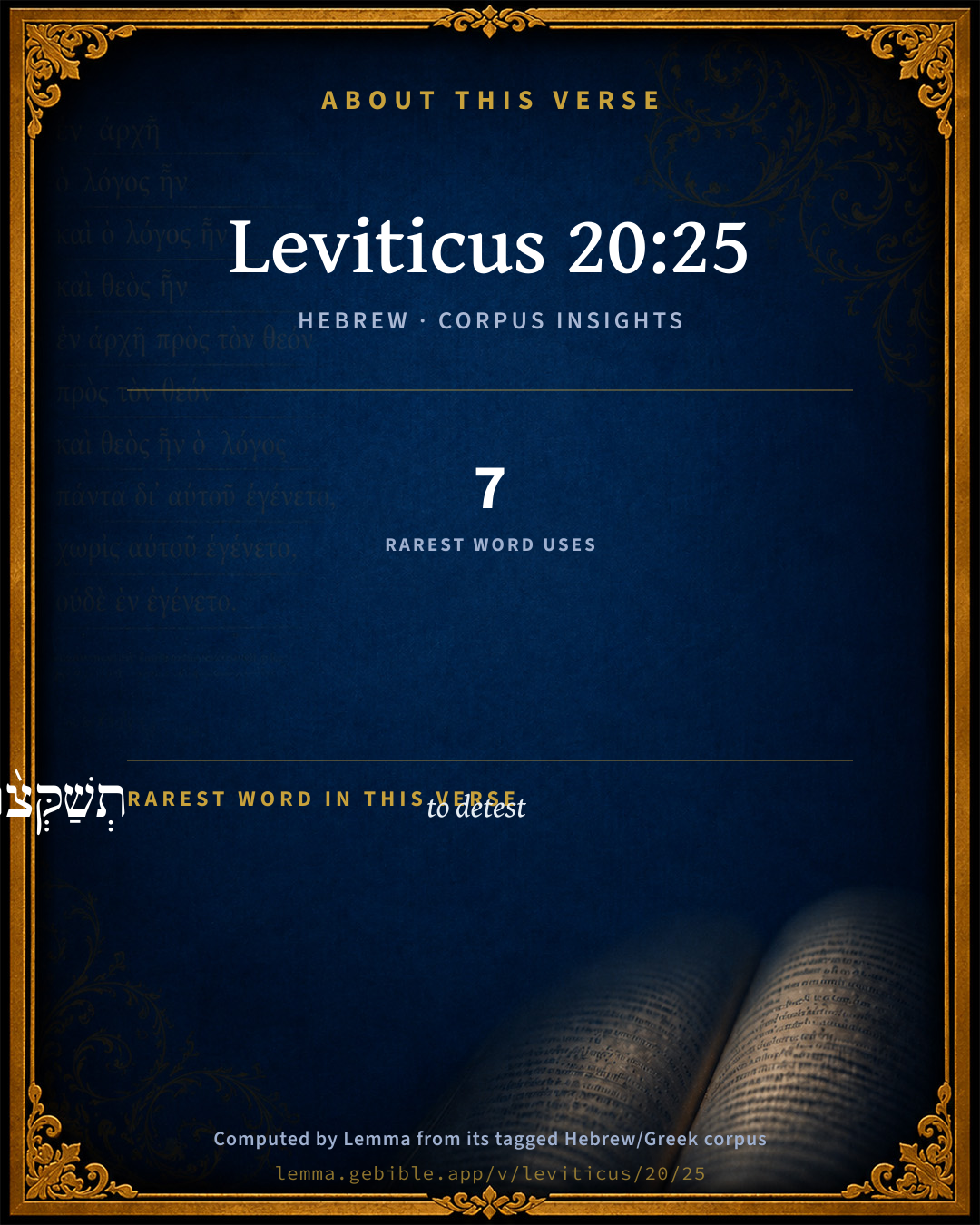
The rarest word here is תְשַׁקְּצ֨וּ to detest H8262 — appearing just 7 times in the whole Hebrew Bible.

Shared distinctive vocabulary

תְשַׁקְּצ֨וּ to detest H8262 occurs in 6 verses of the Hebrew Bible. Also found in:

Grammatical profile

  • 5 verbs
  • 7 nouns
  • 4 adjectives
  • 3 prepositions
  • 4 particles

Verb forms

  • וְהִבְדַּלְתֶּ֞ם Hiphil · Sequential Perfect
  • תְשַׁקְּצ֨וּ Piel · Imperfect
  • תִּרְמֹ֣שׂ Qal · Imperfect
  • הִבְדַּ֥לְתִּי Hiphil · Perfect
  • לְטַמֵּֽא Piel · Infinitive Construct

Repetition

Words recur within this verse — often emphatic in Hebrew:

  • וְהִבְדַּלְתֶּ֞ם to separate H914 ×2
  • בֵּֽין between H996 ×2
  • הַבְּהֵמָ֤ה beast H929 ×2
  • הַטְּהֹרָה֙ pure H2889 ×2
  • לַטְּמֵאָ֔ה unclean H2931 ×2
  • הָע֥וֹף bird H5775 ×2
  • אֲשֶׁ֣ר which H834 ×2

Hebrew & Septuagint length

In English translation the verse runs 51 words from the Hebrew and 49 from the Septuagint (LXX English) — closely comparable.

A rough comparison of the two English renderings, which tokenize alike — not a word-level alignment.

Word counts can differ between the Hebrew and the Greek without any difference in meaning — e.g. the Hebrew direct-object marker אֵת has no separate Greek word, and Greek often adds the article ὁ.

Cross-references

5

Topical passages linked to Leviticus 20:25 in the Treasury of Scripture Knowledge — connected by theme and wording, ordered by reader-vote popularity; previews shown in the World English Bible.

  • Leviticus 11:1–47 Yahweh spoke to Moses and to Aaron, saying to them,
  • Deuteronomy 14:3–21 You shall not eat any abominable thing.
  • Acts 10:11–15 He saw heaven opened and a certain container descending to him, like a great sheet let down by four corners on the earth,
  • Acts 10:28 He said to them, "You yourselves know how it is an unlawful thing for a man who is a Jew to join himself or come to one of another nation, but God has shown me that I shouldn't call any man unholy or unclean.
  • Ephesians 5:7–11 Therefore don't be partakers with them.

Cross-references courtesy of OpenBible.info (CC BY 4.0).

Hebrew and Greek witnesses Masoretic Hebrew ↔ Greek Septuagint

The same verse in the two great witnesses to the Old Testament, shown verse-for-verse.

These are two independent witnesses, not word-aligned to each other, and the Septuagint is shown in lemma (dictionary) form.

Hebrew Leviticus 20:25 Masoretic · Westminster Leningrad Codex

וְהִבְדַּלְתֶּ֞ם בֵּֽין הַבְּהֵמָ֤ה הַטְּהֹרָה֙ לַטְּמֵאָ֔ה וּבֵין הָע֥וֹף הַטָּמֵ֖א לַטָּהֹ֑ר וְלֹֽא תְשַׁקְּצ֨וּ אֶת נַפְשֹֽׁתֵיכֶ֜ם בַּבְּהֵמָ֣ה וּבָע֗וֹף וּבְכֹל֙ אֲשֶׁ֣ר תִּרְמֹ֣שׂ הָֽאֲדָמָ֔ה אֲשֶׁר הִבְדַּ֥לְתִּי לָכֶ֖ם לְטַמֵּֽא

"'You shall therefore make a distinction between the clean animal and the unclean, and between the unclean fowl and the clean: and you shall not make yourselves abominable by animal, or by bird, or by anything with which the ground teems, which I have separated from you as unclean for you.

World English Bible · Public Domain

Greek LXX Leviticus 20:25 Septuagint · lemma form

καί ἀποὁρίζω αὐτός ἀνά μέσος ὁ κτῆνος ὁ καθαρός καί ἀνά μέσος ὁ κτῆνος ὁ ἀκάθαρτος καί ἀνά μέσος ὁ πετεινόν ὁ καθαρός καί ὁ ἀκάθαρτος καί οὐ βδελύσσω ὁ ψυχή σύ ἐν ὁ κτῆνος καί ἐν ὁ πετεινόν καί ἐν πᾶς ὁ ἑρπετόν ὁ γῆ ὅς ἐγώ ἀποὁρίζω σύ ἐν ἀκαθαρσία

And you⌃ shall make a distinction between the clean and the unclean cattle, and between clean and unclean birds; and you⌃ shall not defile your souls with cattle, or with birds, or with any creeping things of the earth, which I have separated for you by reason of uncleanness.

LXX2012 (modern English Septuagint) · Public Domain

Hebrew: Westminster Leningrad Codex (CC BY 4.0). Greek: Septuagint (public domain); English from LXX2012 (modern English Septuagint) (Public Domain). How the Septuagint differs from the Hebrew →

Targum (Aramaic paraphrase)

2

The Targum is the ancient Jewish Aramaic paraphrase of the Hebrew Scriptures — an interpretive translation, not the Hebrew text itself. Onkelos (literal) and Pseudo-Jonathan (expansive) render the Torah, and Jonathan the Prophets. Coverage is partial: where no permissively-licensed English translation exists for a verse, only the Aramaic is shown. This is verse-level text, not a word-by-word alignment to the Hebrew.

  1. Targum Onkelos Torah (Genesis–Deuteronomy)
    וְתַפְרְשׁוּן בֵּין בְּעִירָא דַכְיָא לִמְסָאָבָא וּבֵין עוֹפָא מְסָאָבָא לִדְכֵי וְלָא תְשַׁקְצוּן יָת נַפְשָׁתֵיכוֹן בִּבְעִירָא וּבְעוֹפָא וּבְכֹל דִי תַרְחֵשׁ אַרְעָא דִי אַפְרֵשִׁית לְכוֹן לְסָאָבָא

    (no public-domain English translation for this verse)

    Targum Onkelos — Aramaic: “Onkelos Genesis” (public domain); “Onkelos Exodus” (public domain); “Onkelos Leviticus” (public domain); “Onkelos Numbers” (public domain); “Onkelos Deuteronomy” (public domain). English: “Sefaria Community Translation” (CC0 1.0 (public-domain dedication)); “J.W. Etheridge. The Targums of Onkelos and Jonathan Ben Uzziel on the Pentateuch. London: Longmans, Green, 1862” (public domain). Text via Sefaria.

  2. Targum Pseudo-Jonathan Torah (Genesis–Deuteronomy)
    וְתִפְרְשׁוּן בֵּין בְּעִירָא דְמִכַּשְׁרָא לְמֵיכַל לִדְמִיפְסְלָא לְמֵיכַל וּבֵין עוֹפָא דְמִפְסוֹל לְמֵיכַל לִדְמַכְשַׁר לְמֵיכַל וְלָא תְשַׁקְצוּן יַת נַפְשָׁתֵיכוֹן בִּבְעִירָא דְרִיסַת חַיְיתָא וּבְעוֹפָא דָרִיס בַּר נִיצְצָא וּבְכָל מַן דְתַרְחֵישׁ אַרְעָא דְאַפְרָשִׁית לְכוֹן לְסוֹאֲבֵיהוֹן

    And you shall make distinction between the animal which is fit to be eaten, and that which it is improper to eat; and between the fowl which it is improper to eat, and that which is fit to be eaten. Defile not your souls by (eating of) the animal that is torn by a wild beast, or the bird torn by the falcon, or anything that creepeth upon the which I have from you for their uncleanness.

    Targum Pseudo-Jonathan — Aramaic: “Targum Jonathan on Genesis” (public domain); “Targum Jonathan on Exodus” (public domain); “Targum Jonathan on Leviticus” (public domain); “Targum Jonathan on Numbers” (public domain); “Targum Jonathan on Deuteronomy” (public domain). English: “The Targum of Jonathan ben Uzziel, trans. J. W. Etheridge, London, 1862” (public domain). Text via Sefaria.

Commentary

Notes on Leviticus 20:25 from classic Christian and Jewish commentators (each source and its license shown beneath its notes). The classic Christian expositions comment on the surrounding passage and are grouped to its opening verse, so a note may address several verses; the Jewish commentaries on the Tanakh (Rashi and others) are per-verse, so they appear only where the commentator wrote on this verse.

Lemma curates 59 commentaries, every one of them public domain or Creative Commons licensed, each selected and text-cleaned for this edition rather than reprinted as found. About our sources →

The Cambridge Bible for Schools and Colleges

gen. ed. J. J. S. Perowne

25. The injunction that careful discrimination must be employed in the matter of clean and unclean food must, as Wellh. (Composition d. Hex. etc., p. 158, Berlin, 1889) and others point out, in its original context have been accompanied by detailed directions such as now are found in ch. 11.

Lev_20:25-26 in their present form are to be compared with Lev_11:43-45. See note there.

The Cambridge Bible for Schools and Colleges (gen. ed. J. J. S. Perowne; Cambridge University Press, 1878–1918) — public domain. Text from a community e-Sword module.

Trapp's Complete Commentary

John Trapp

Lev 20:25 Ye shall therefore put difference between clean beasts and unclean, and between unclean fowls and clean: and ye shall not make your souls abominable by beast, or by fowl, or by any manner of living thing that creepeth on the ground, which I have separated from you as unclean.

Ver. 25. Between clean beasts.] How much more then shall you abstain from those unlawful copulations, whereby men put off all manhood, degenerate into dogs? {Rom 1:27 Deu 23:18 2Sa 3:8}

John Trapp, A Commentary or Exposition upon All the Books of the Old and New Testament (1647–1656) — public domain. Text from a community e-Sword module.

Geneva Bible (1599)

Geneva Bible translators

By eating them contrary to my commandment.

Geneva Bible (1599) marginal notes — public domain. Text via Bolls.life.

Adam Clarke's Commentary

Verse 25. Between clean beasts and unclean] See the notes on Le 11:1-47.

Adam Clarke's Commentary on the Bible (1810–1826) — public domain. Text from a community e-Sword/MySword module.

Ellicott's Commentary for English Readers

(25) Ye shall therefore put difference.—Better, Ye shall therefore separate. It is the same word which is used at the end of the preceding verse, and which is rendered “separate” in the Authorised Version. It is important that the word should be translated by the same expression, since it not only shows the intimate connection between the two verses, but brings out more forcibly the reason for the exhortation in the verse before us. Because the Lord has separated or distinguished the Israelites from all nations, and is about to give them the promised land, therefore the Israelites are to separate or to distinguish between the clean and unclean animals, as ordained in Leviticus 11. By strictly following out the dietary laws, the Israelites will always be able to keep separate from all other nations (Dan_1:8).

A Bible Commentary for English Readers, edited by Charles John Ellicott (1878–1897) — public domain. Text from a community e-Sword module.

John Gill's Exposition

Ye shall therefore put difference between clean beasts and unclean,.... The ten clean ones, as Aben Ezra observes, and all the rest that are unclean, according to the law before given, Lev 11:3, by using the one for food, and not the other, and so the Targum of Jonathan, ye shall separate between the beast which is fit for food, and that which is not fit for food:

and between unclean fowls and clean; and which the same Targum interprets, what is unfit to eat and what is fit, even all that are particularly mentioned as unclean, and not fit for food, in Lev 11:13 and all the rest not excepted to as clean and fit for food, which was one way and means God made use of to separate them from other nations, and so preserve them from their idolatrous and evil works:

and ye shall not make your souls abominable by beast, or by fowl, or by any manner of living thing that creepeth on the ground; that is, by eating them, contrary to the command of God, which would make them abominable in his sight; see Lev 11:43; every sin or transgression of this law being so to him:

which I have separated from you as unclean; which by law he had commanded them to abstain from the use of, as clean, and not fit to be eaten.

John Gill's Exposition of the Whole Bible (1746–1763) — public domain (CC PDM 1.0). Text via the HelloAO Bible API.

Matthew Poole's English Annotations

i.e. As things which by my sentence I have made unclean, and which you must avoid as such.

Matthew Poole's English Annotations on the Holy Bible (1683–1685) — public domain. Text from a community e-Sword/MySword module.

Whedon's Commentary on the Bible

Daniel D. Whedon

25. Clean beasts — This law may be considered both as a sanitary regulation and also a barrier between Israel and all idolatrous nations. See Lev_11:2-8, notes.

Your souls — The word “souls” is here used for “selves.” See Isa_46:2.

Daniel D. Whedon (gen. ed.), Commentary on the Old and New Testaments (1874–1909) — public domain. Text from a community e-Sword module.

Rashi

Rabbi Shlomo Yitzchaki (Rashi)

והבדלתם בין הבהמה הטהרה לטמאה YE SHALL THEREFORE DISTINGUISH BETWEEN CLEAN BEASTS AND UNCLEAN — It is needless for Scripture to say that one should distinguish between a cow and an ass for these are different and are therefore distinguishable. But it means: you shall distinguish between such an animal as is clean (permitted) to you and such as is unclean (forbidden) to you although it is a clean animal per se, i.e., make a distinction between an animal which has been killed by cutting at least the greater part of each organ (the gullet and the windpipe) or whether it has been killed by cutting exactly the half of each organ. And how much difference is there between the greater part and the exact half? A hair’s breadth only (and consequently the command is given: והבדלתם, “you shall very carefully distinguish”) (Sifra, Kedoshim, Chapter 12 20; cf. also Rashi on Leviticus 11:47 and Chullin 27a).

אשר הבדלתי לכם לטמא WHICH I HAVE SEPARATED FOR YOU TO DECLARE THEM UNCLEAN — This means, to declare them as forbidden.

Rashi on the Tanakh — English translations: “The Judaica Press complete Tanach with Rashi, translated by A. J. Rosenberg” (CC BY 4.0); “Pentateuch with Rashi's commentary by M. Rosenbaum and A.M. Silbermann, 1929-1934” (public domain); “The Metsudah Tanach series, Lakewood, N.J” (CC BY 4.0); and “The Book of Joshua, Metsudah Publications, 1997” (CC BY 4.0). Text via Sefaria.

Lesson kit

Teaching starters — assembled from the data on this page, not authored interpretation. Every prompt links to the verse data it draws on. Edit before teaching.

Leviticus, in the Pentateuch, opens this verse with 23 words (15 distinct Hebrew lemmas). Its most distinctive word is shâqats (“to detest”). A historical commentator’s framing appears above. Read the whole chapter for the surrounding context.

Discussion questions

  1. How does “to detest” (shâqats) shape what this verse is saying?
  2. How does Leviticus 11:11, which shares the word «to detest», read alongside this verse?
  3. What does the repetition of “to separate” (2× in this one verse) do in this verse?
  4. The translations on this page render this verse differently — a whole-verse word diff, not a word-by-word alignment. What might account for the different wordings?
  5. «וְהִבְדַּלְתֶּ֞ם» is a Hiphil Sequential Perfect verb. How does that grammatical form shape the action described?
  6. Compare how The Cambridge Bible for Schools and Colleges and Trapp's Complete Commentary read this verse. Where do they agree or differ?

Things to notice

Reading settings

Reading text

Shown beneath each verse's original-language words.

Old Testament
Old Testament edition

Read the OT as the Masoretic Hebrew (MT) or the Greek Septuagint (LXX).

English shown for the Greek Septuagint (in the Hebrew ↔ Greek comparison).

Comparing translations? Open the Compare panel on any verse page to stack up to four side by side.