
Ezekiel 47:18

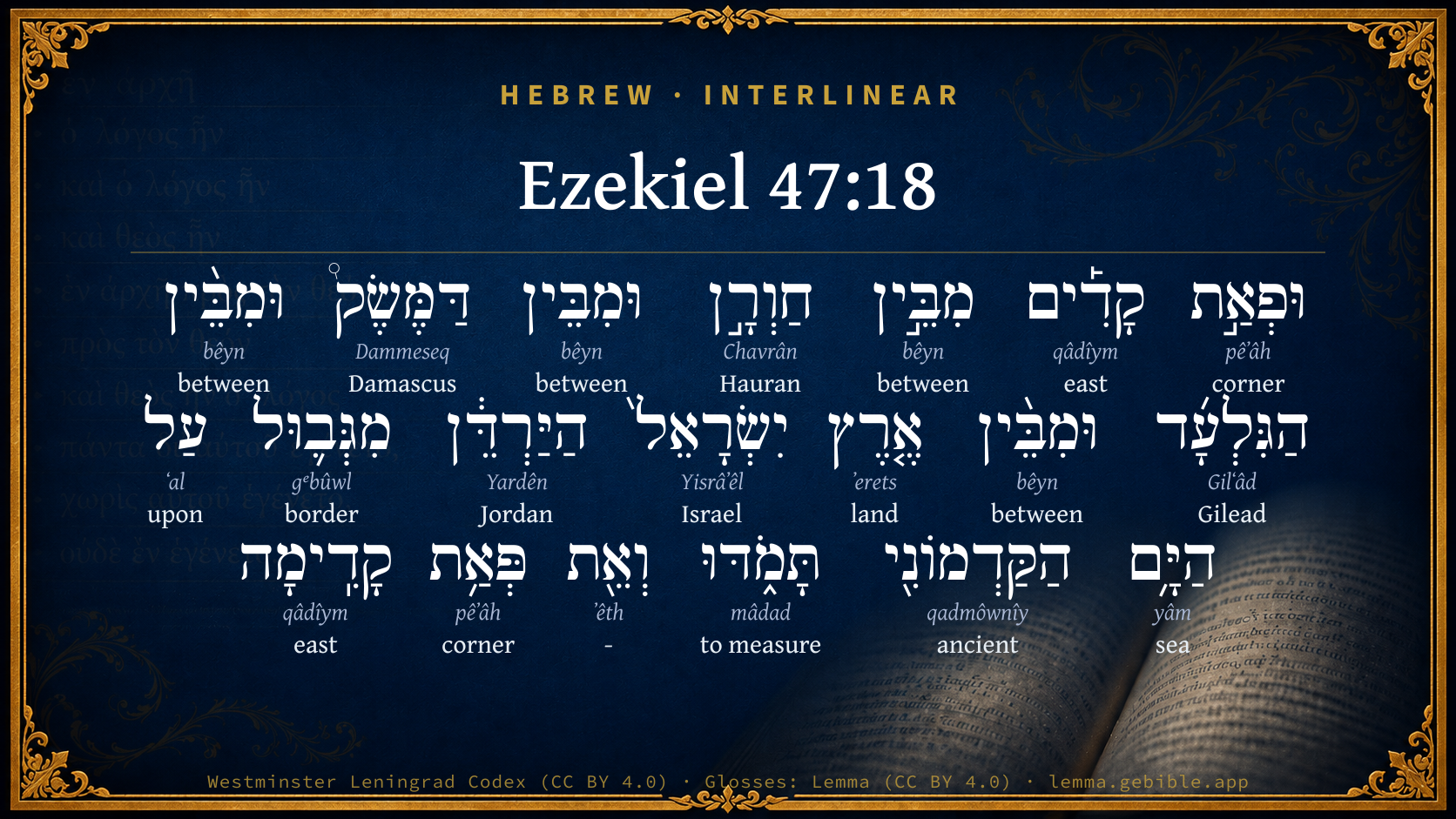
Hebrew (Westminster Leningrad Codex) Ezekiel 47:18 appears in the Hebrew Old Testament. The text above is from the Westminster Leningrad Codex. Each word links to its Strong’s number, a concise gloss, and parsing drawn from the Open Scriptures Hebrew Bible morphology. Click any word for its full Brown-Driver-Briggs (BDB) entry.
Download image
Cite this verse

Ezekiel 47:18 (World English Bible). Public Domain. Lemma interlinear Bible study tool, https://lemma.gebible.app/v/ezekiel/47/18.

Show BibTeX & RIS
BibTeX
RIS
English Translation
The east side, between Hauran and Damascus and Gilead, and the land of Israel, shall be the Jordan; from the [north] border to the east sea shall you measure. This is the east side.
World English Bible · Public Domain
Download a study sheet

One document with this verse’s original text, its word-by-word gloss line, the meaning frame, cross-references with their text, attributed commentary, and full source and license credits — printable, and it pastes into notes with its structure intact.

This verse Autodidact and up

Study sheet (.html) Plain text (.txt)

A passage Seminary Student

Up to 50 verses in one chapter. A passage sheet keeps up to 6 commentary sources and 12 cross-references per verse, in the order this page ranks them, and says so on the sheet whenever that leaves anything out. Ask for a single verse and you get the Autodidact verse sheet above.

Everything on this page stays free to read, with no account — the sheet is a download of what is already on screen, not access to it.

Want to remove ads? Support Godless Engineer
Compare translations 3

The same verse in 3 English versions, stacked beneath the original-language interlinear above. Click any original word for its lexicon entry.

Each is an independent rendering of the whole verse — the interlinear is not word-aligned to these translations.

Highlighted words mark where these versions differ — a whole-verse word diff, not a word-by-word alignment.

  • World English Bible Public Domain
    The east side, between Hauran and Damascus and Gilead, and the land of Israel, shall be the Jordan; from the [north] border to the east sea shall you measure. This is the east side.
  • King James Version Public Domain
    And the east side ye shall measure from Hauran, and from Damascus, and from Gilead, and from the land of Israel by Jordan, from the border unto the east sea. And this is the east side.
  • unfoldingWord Literal Text CC BY-SA 4.0
    On the east side the boundary will run between Hauran and Damascus, along the Jordan River between Gilead and the land of Israel. You will measure from the border to the eastern sea. This will be the eastern border.

unfoldingWord Literal Text — © unfoldingWord, licensed CC BY-SA 4.0. Word-aligned USFM3 via Door43 (git.door43.org/unfoldingWord/en_ult).

Versions to compare (up to 4)

3 of 4 selected

Show all 18 translations

Every available English version of this verse, each an independent rendering of the whole verse.

  • World English Bible Public Domain
    The east side, between Hauran and Damascus and Gilead, and the land of Israel, shall be the Jordan; from the [north] border to the east sea shall you measure. This is the east side.
  • Berean Standard Bible Public Domain
    On the east side the border will run between Hauran and Damascus, along the Jordan between Gilead and the land of Israel, to the Eastern Sea and as far as Tamar. This will be the eastern boundary.
  • Majority Standard Bible Public Domain
    On the east side the border will run between Hauran and Damascus, along the Jordan between Gilead and the land of Israel, to the Eastern Sea and as far as Tamar. This will be the eastern boundary.
  • King James Version Public Domain
    And the east side ye shall measure from Hauran, and from Damascus, and from Gilead, and from the land of Israel by Jordan, from the border unto the east sea. And this is the east side.
  • American Standard Version (1901) Public Domain
    And the east side, between Hauran and Damascus and Gilead, and the land of Israel, shall be the Jordan; from the `north' border unto the east sea shall ye measure. This is the east side.
  • Revised Version (1885) Public Domain
    And the east side, between Hauran and Damascus and Gilead, and the land of Israel, shall be Jordan; from the north border unto the east sea shall ye measure. This is the east side.
  • Geneva Bible (1599) Public Domain
    But the East side shall ye measure from Hauran, and from Damascus, and from Gilead, and from the lande of Israel by Iorden, and from the border vnto the East sea: and so shalbe the East part.
  • Douay-Rheims (1899) Public Domain
    And the east side is from the midst of Auran, and from the midst of Damascus, and from the midst of Galaad, and from the midst of the land of Israel, Jordan making the bound to the east sea, and thus you shall measure the east side.
  • Young's Literal Translation Public Domain
    `And the east quarter `is' from between Havran, and Damascus, and Gilead, and the land of Israel, `to' the Jordan; from the border over-against the eastern sea ye measure: and `this is' the east quarter.
  • Literal Standard Version CC BY-SA 4.0
    And the east quarter [is] from between Havran, and Damascus, and Gilead, and the land of Israel, [to] the Jordan; you measure from the border on the Eastern Sea: and [this is] the east quarter.
  • Unlocked Literal Bible CC BY-SA 4.0
    On the east side the boundary will run between Hauran and Damascus, along the Jordan River between Gilead and the land of Israel. You will measure from the border to the eastern sea. This will be the eastern border.
  • unfoldingWord Literal Text CC BY-SA 4.0
    On the east side the boundary will run between Hauran and Damascus, along the Jordan River between Gilead and the land of Israel. You will measure from the border to the eastern sea. This will be the eastern border.
  • Darby Bible Public Domain
    -- And on the east side ye shall measure between Hauran and Damascus, and Gilead and the land of Israel [by] the Jordan, from the border unto the east sea: this is the east side.
  • World Messianic Bible Public Domain
    “The east side, between Hauran, Damascus, Gilead, and Eretz-Israel, shall be the Jordan; from the north border to the east sea you shall measure. This is the east side.
  • Webster's Bible Public Domain
    And the east side ye shall measure from Hauran, and from Damascus, and from Gilead, and from the land of Israel by Jordan, from the border to the east sea. And this is the east side.
  • Free Bible Version CC BY-SA 4.0
    The eastern boundary runs from Hauran and Damascus, down along the Jordan between Gilead and the land of Israel, to the Dead Sea and on to Tamar. This is the eastern boundary.
  • Bible in Basic English Public Domain
    And the east side will be from Hazar-enon, which is between Hauran and Damascus; and between Gilead and the land of Israel the Jordan will be the limit, to the east sea, to Tamar. This is the east side.
  • JPS Tanakh (1917) Public Domain
    And the east side, between Hauran and Damascus and Gilead, and the land of Israel, by the Jordan, from the border unto the east sea shall ye measure. This is the east side.

Literal Standard Version (2020), Covenant Press — licensed CC BY-SA 4.0. Text via the HelloAO Bible API (eBible.org). Unlocked Literal Bible (unfoldingWord) — licensed CC BY-SA 4.0. Text via the HelloAO Bible API (eBible.org). unfoldingWord Literal Text — © unfoldingWord, licensed CC BY-SA 4.0. Word-aligned USFM3 via Door43 (git.door43.org/unfoldingWord/en_ult). Free Bible Version, Dr. Jonathan Gallagher — licensed CC BY-SA 4.0. Text via the HelloAO Bible API (eBible.org).

Word by word

More ways to search: Search by grammar → Find every occurrence → Compare this word →

Practice this passage: Drill this verse → Learn its vocabulary →

חַוְרָ֣ן
Chavrân
H2362
“Hauran”
Noun, Proper
Part of Speech
Noun
Type
Proper
Full BDB Definition

Origin: apparently from H2357 (in the sense of H2352 )

TWOT: None

Hauran = "caverns" - a province of Palestine east of the Sea of Galilee; exact region uncertain but probably on the borders of the desert in the tetrarchy of Philip
  1. וּפְאַ֣ת pêʼâh H6285 “and · corner of” Conjunction + Noun, Common, Feminine, Singular, Construct
  2. קָדִ֡ים qâdîym H6921 “east” Noun, Common, Masculine, Singular, Absolute
  3. מִבֵּ֣ין bêyn H996 “from · between” Preposition + Preposition
  4. וּמִבֵּין bêyn H996 “and · from · between” Conjunction + Preposition + Preposition
  5. דַּמֶּשֶׂק֩ Dammeseq H1834 “Damascus” Noun, Proper
  6. וּמִבֵּ֨ין bêyn H996 “and · from · between” Conjunction + Preposition + Preposition
  7. הַגִּלְעָ֜ד Gilʻâd H1568 “the · Gilead” Particle, Definite Article + Noun, Proper
  8. וּמִבֵּ֨ין bêyn H996 “and · from · between” Conjunction + Preposition + Preposition
  9. אֶ֤רֶץ ʼerets H776 “land of” Noun, Common, Both, Singular, Construct
  10. יִשְׂרָאֵל֙ Yisrâʼêl H3478 “Israel” Noun, Proper
  11. הַיַּרְדֵּ֔ן Yardên H3383 “the · Jordan” Particle, Definite Article + Noun, Proper
  12. מִגְּב֛וּל gᵉbûwl H1366 “from · border” Preposition + Noun, Common, Masculine, Singular, Absolute
  13. עַל ʻal H5921 “upon” Preposition
  14. הַיָּ֥ם yâm H3220 “the · sea” Particle, Definite Article + Noun, Common, Masculine, Singular, Absolute
  15. הַקַּדְמוֹנִ֖י qadmôwnîy H6931 “the · ancient” Particle, Definite Article + Adjective, Adjective, Masculine, Singular, Absolute
  16. תָּמֹ֑דּוּ mâdad H4058 “to measure” Verb, Qal, Imperfect, 2nd Person, Masculine, Plural
  17. וְאֵ֖ת ʼêth H853 “and · -” Conjunction + Particle, Direct Object
  18. פְּאַ֥ת pêʼâh H6285 “corner of” Noun, Common, Feminine, Singular, Construct
  19. קָדִֽימָה qâdîym H6921 “east · toward” Noun, Common, Masculine, Singular, Absolute + Suffix, Demonstrative

About this verse

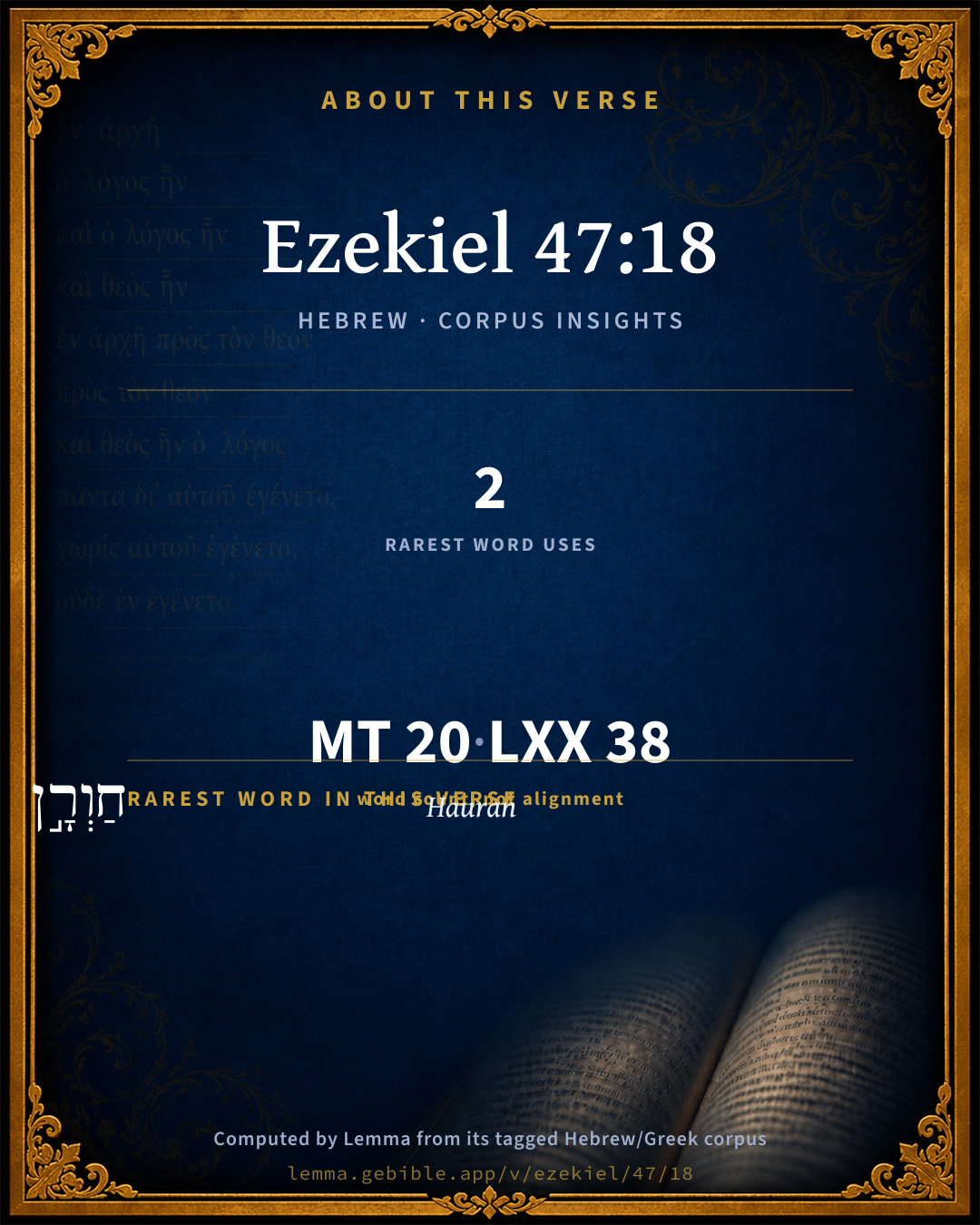
These counts appear in no published source. They are computed here, from the morphology-tagged text and Lemma’s own curated glosses. What Lemma adds →

20
words
15
distinct lemmas
Prophets
section

Notable vocabulary

The rarest word here is חַוְרָ֣ן Hauran H2362 — appearing just 2 times in the whole Hebrew Bible.

Shared distinctive vocabulary

חַוְרָ֣ן Hauran H2362 occurs in 2 verses of the Hebrew Bible. Also found in:

Grammatical profile

  • 1 verb
  • 12 nouns
  • 1 adjective
  • 5 prepositions
  • 1 particle

Verb forms

  • תָּמֹ֑דּוּ Qal · Imperfect

Repetition

Words recur within this verse — often emphatic in Hebrew:

  • מִבֵּ֣ין between H996 ×4
  • וּפְאַ֣ת corner H6285 ×2
  • קָדִ֡ים east H6921 ×2

Hebrew & Septuagint length

In English translation the verse runs 34 words from the Hebrew and 37 from the Septuagint (LXX English) — closely comparable.

A rough comparison of the two English renderings, which tokenize alike — not a word-level alignment.

Word counts can differ between the Hebrew and the Greek without any difference in meaning — e.g. the Hebrew direct-object marker אֵת has no separate Greek word, and Greek often adds the article ὁ.

In the original languages it is 20 Hebrew tokens and 38 Greek tokens — but the two are counted differently (Hebrew bundles its prefixes and suffixes into one token; the Greek is in lemma form), so that isn’t a like-for-like length.

Cross-references

6

Topical passages linked to Ezekiel 47:18 in the Treasury of Scripture Knowledge — connected by theme and wording, ordered by reader-vote popularity; previews shown in the World English Bible.

  • Genesis 13:10 Lot lifted up his eyes, and saw all the plain of the Jordan, that it was well watered every where, before Yahweh destroyed Sodom and Gomorrah, like the garden of Yahweh, like the land of Egypt, as you go to Zoar.
  • Genesis 31:23 He took his relatives with him, and pursued after him seven days' journey. He overtook him in the mountain of Gilead.
  • Genesis 31:47 Laban called it Jegar Sahadutha, but Jacob called it Galeed.
  • Numbers 32:1 Now the children of Reuben and the children of Gad had a very great multitude of cattle: and when they saw the land of Jazer, and the land of Gilead, that behold, the place was a place for cattle;
  • Judges 10:8 They vexed and oppressed the children of Israel that year: eighteen years [oppressed they] all the children of Israel that were beyond the Jordan in the land of the Amorites, which is in Gilead.
  • Job 40:23 Behold, if a river overflows, he doesn't tremble. He is confident, though the Jordan swells even to his mouth.

Cross-references courtesy of OpenBible.info (CC BY 4.0).

Hebrew and Greek witnesses Masoretic Hebrew ↔ Greek Septuagint

The same verse in the two great witnesses to the Old Testament, shown verse-for-verse.

These are two independent witnesses, not word-aligned to each other, and the Septuagint is shown in lemma (dictionary) form.

Hebrew Ezekiel 47:18 Masoretic · Westminster Leningrad Codex

וּפְאַ֣ת קָדִ֡ים מִבֵּ֣ין חַוְרָ֣ן וּמִבֵּין דַּמֶּשֶׂק֩ וּמִבֵּ֨ין הַגִּלְעָ֜ד וּמִבֵּ֨ין אֶ֤רֶץ יִשְׂרָאֵל֙ הַיַּרְדֵּ֔ן מִגְּב֛וּל עַל הַיָּ֥ם הַקַּדְמוֹנִ֖י תָּמֹ֑דּוּ וְאֵ֖ת פְּאַ֥ת קָדִֽימָה

The east side, between Hauran and Damascus and Gilead, and the land of Israel, shall be the Jordan; from the [north] border to the east sea shall you measure. This is the east side.

World English Bible · Public Domain

Greek LXX Ezekiel 47:18 Septuagint · lemma form

καί ὁ πρός ἀνατολή ἀνά μέσος ὁ αυρανίτις καί ἀνά μέσος δαμασκός καί ἀνά μέσος ὁ γαλααδῖτις καί ἀνά μέσος ὁ γῆ ὁ ἰσραήλ ὁ ἰορδάνης διαὁρίζω ἐπί ὁ θάλασσα ὁ πρός ἀνατολή φοινικών οὗτος ὁ πρός ἀνατολή

And the eastern coasts between Loranitis, and Damascus, and the land of Galaad, and the land of Israel, the Jordan divides to the sea that is east of the city of palm-trees. These are the eastern coasts.

LXX2012 (modern English Septuagint) · Public Domain

On this verse, The Cambridge Bible for Schools and Colleges discusses the Septuagint’s reading. Read the note in Commentary ↓

Hebrew: Westminster Leningrad Codex (CC BY 4.0). Greek: Septuagint (public domain); English from LXX2012 (modern English Septuagint) (Public Domain). How the Septuagint differs from the Hebrew →

Targum (Aramaic paraphrase)

1

The Targum is the ancient Jewish Aramaic paraphrase of the Hebrew Scriptures — an interpretive translation, not the Hebrew text itself. Onkelos (literal) and Pseudo-Jonathan (expansive) render the Torah, and Jonathan the Prophets. Coverage is partial: where no permissively-licensed English translation exists for a verse, only the Aramaic is shown. This is verse-level text, not a word-by-word alignment to the Hebrew.

  1. Targum Jonathan Prophets (Joshua–Malachi)
    וְרוּחַ מַדִינְחָא מִבֵּין חַרְוָן וּמִבֵּין דַמֶשֶׂק וּמִבֵּין גִלְעָד וּמִבֵּין אַרְעָא דְיִשְׂרָאֵל יַרְדָנָא מִתְּחוּמָא דִי עַל יַמָא מַדִינְחָא תִּמְשְׁחוּן וְיַת רוּחָא קִדוּמָא:

    (no public-domain English translation for this verse)

    Targum Jonathan — Aramaic: “Mikraot Gedolot” (public domain). English: “Sefaria Community Translation” (CC0 1.0 (public-domain dedication)); “London "Chaldee Paraphrase," 1871” (public domain). Text via Sefaria.

Commentary

Notes on Ezekiel 47:18 from classic Christian and Jewish commentators (each source and its license shown beneath its notes). The classic Christian expositions comment on the surrounding passage and are grouped to its opening verse, so a note may address several verses; the Jewish commentaries on the Tanakh (Rashi and others) are per-verse, so they appear only where the commentator wrote on this verse.

Lemma curates 59 commentaries, every one of them public domain or Creative Commons licensed, each selected and text-cleaned for this edition rather than reprinted as found. About our sources →

Trapp's Complete Commentary

John Trapp

Eze 47:18 And the east side ye shall measure from Hauran, and from Damascus, and from Gilead, and from the land of Israel [by] Jordan, from the border unto the east sea. And [this is] the east side.

Ver. 18. From Hauran.] A town of Arabia Deserts (Ptolemy calleth it Aurana), but Felix in this, that it is taken into the Church.

John Trapp, A Commentary or Exposition upon All the Books of the Old and New Testament (1647–1656) — public domain. Text from a community e-Sword module.

Joseph Benson's Commentary

Eze 47:18. And the east side ye shall measure from Hauran — The city Aurana, and the district Auranitis, the north-east limit of the Holy Land. Damascus lay more northerly than Hauran, but the country called Auranitis might reach near it. Gilead is well known to have been a long tract of land, which was extended to the country of Sihon king of the Amorites. From the land of Israel by Jordan — From the northern limits of the land of Israel near Cesarea Philippi, or Dan, where the river Jordan takes its rise. Unto the east sea — That is, the Dead sea, or the lake of Sodom: see Eze 47:8.

Joseph Benson's Commentary on the Old and New Testaments (1811–1818) — public domain. Text from a community e-Sword module.

Jamieson, Fausset & Brown

Robert Jamieson, A. R. Fausset & David Brown

east sea--the Dead Sea. The border is to go down straight to it by the valley of the Jordan. So Num 34:11-12.

Jamieson, Fausset & Brown — Commentary Critical and Explanatory on the Whole Bible (1871) — public domain (CC PDM 1.0). Text via the HelloAO Bible API.

Adam Clarke's Commentary

Verse 18. The east sea] The same as the Dead Sea.

Adam Clarke's Commentary on the Bible (1810–1826) — public domain. Text from a community e-Sword/MySword module.

Ellicott's Commentary for English Readers

(18) From Hauran, and from Damascus.—The eastern boundary is also the same as that given in Num_34:10-12, although more particularly described there. In both cases it excludes the territory of the trans- Jordanic tribes, which was not included in Palestine proper, even after its conquest by Moses, and in which the two and a half tribes were allowed to settle with some reluctance (Numbers 32). The word “from,” occurring four times in this verse, is literally from between, as is noted in the margin; it means that the boundary was to run between the territories of Hauran, Damascus, and Gilead on the one side, and that of Israel on the other. The boundary is to be the Jordan; but as this does not extend so far north, it became necessary to mention the territory of Damascus as bounding the land of Israel, and in this connection Hauran and Gilead are also spoken of. The boundary extends, as of old, beyond the mouth of the Jordan to the southern end of the Dead Sea and thence to Kadesh. The extreme length of the land is somewhat uncertain, but must have fallen short of 250 miles.

A Bible Commentary for English Readers, edited by Charles John Ellicott (1878–1897) — public domain. Text from a community e-Sword module.

The Cambridge Bible for Schools and Colleges

gen. ed. J. J. S. Perowne

18. The eastern border.

In Eze_47:16 the eastmost point of the north border was said to be Hazar Enon on the border of Hauran. The E. boundary will therefore start from this point. The verse may read: “and the east side: from between Hauran and Damascus, between Gilead and the land of Israel shall be the Jordan, from the (north) boundary to the eastern sea, even unto Tamar; this is the east side.” The line starts from Hazar Enon, a place lying where Damascus and Hauran adjoin one another (Eze_47:16). Instead of Hazar Enon, however, the point of contact between Damascus and Hauran is named as the starting-point (for the last two umibben read ben and uben). From this point the line runs south; its course is the Jordan between Gilead and the land of Israel. The order Hauran, Damascus, Gilead is entirely incomprehensible (for Hauran lay S. of Damascus) if R.V. be followed. The phrase “ye shall measure” is no doubt a misspelling for “unto Tamar” (LXX. Syr., d for r), from which the southern border starts in Eze_47:19. Tamar probably lay S. of the Dead Sea. The Onomasticon (Ed. Lagarde, p. 85) says: one day’s journey from Mampsis as you go to Aelia (?Elath) from Hebron. Robinson identifies Mampsis with Malatha, in his view el Milḥ.

The Cambridge Bible for Schools and Colleges (gen. ed. J. J. S. Perowne; Cambridge University Press, 1878–1918) — public domain. Text from a community e-Sword module.

John Gill's Exposition

And the east side ye shall measure Hauran,.... The line of the eastern border of the land shall begin at Hauran or Auranitis; see Eze 47:16, which lay to the south (s) of Damascus: and it follows,

and from the land of Israel by Jordan, from the border unto the east sea; and so from Damascus, the metropolis of Syria; and likewise from Gilead, a mountain and country beyond Jordan; and also from that part of the land of Israel near to Jordan; and so from the northern border to the east sea, or sea of Galilee or Tiberias:

and this is the east side: of the land, or the eastern border of it, reaching from Hauran to the lake of Gennesaret, or to the Salt sea, the sea of Sodom; see Num 34:10.

(s) Vid. Reland Palestina Illustrata, l. 1. c. 22. p. 107.

John Gill's Exposition of the Whole Bible (1746–1763) — public domain (CC PDM 1.0). Text via the HelloAO Bible API.

Albert Barnes' Notes on the Bible

The eastern boundary is to commence by separating off the territory of Damascus and Hauran, and then to follow the line of the Jordan to the Dead Sea. Further, the land occupied by the trans-Jordanic tribes was also to be separated off from the land of Israel. The trans-Jordanic tribes in fact occupied their ground (in Joshua’s allotment) by sufferance. This did not belong to Canaan proper, the land of promise. Hence, the tribes, formerly on the east of the Jordan, have here allotments in Canaan, though “the oblation” Eze 45:1 extends to a considerable distance beyond the Jordan (see Plan, Ezek. 48). The whole arrangement being ideal and symbolic, the vision here, as in the case of “the waters” (Eze 47:1 note), departs from the physical features of the land for the purpose of maintaining symbolic numbers.

Albert Barnes' Notes on the Bible (1834–1885) — public domain. Text from a community e-Sword/MySword module.

Haydock's Catholic Bible Commentary

Auran. Hence a line must be drawn through Damascus over Mount Galaad to the eastern or Dead Sea, to form the eastern borders. (Calmet) --- The Jordan River flowing from Genesareth to Sodom marked out this side, (Menochius) or rather was in this division; though the land as far as Galaad was to belong to Israel, as it had been before the captivity. Protestants, "by Jordan from the border unto," &c. (Haydock)

George Leo Haydock (1774–1849), Haydock's Catholic Family Bible and Commentary, 1859 edition — public domain. Excludes Psalms (Douay-Rheims chapter numbering differs from Protestant) and Deuterocanonical books (Catholic canon only).

Matthew Poole's English Annotations

From Hauran; that was the north-east bound, where we must begin to measure the east side.

From Damascus: this was more northward than the city Hauran, but the country Auranitis, for aught I know, might reach to Damascus, or near it, and so this more particularly direct the measuring: begin at Damascus, draw the line through Auranitis, and so on southerly to Gilead.

Gilead; a famous mountain about fifty miles in length from south to north, where it joins Mount Libanus at the east end of it, and hath many particular names in particular places, and seems to end its southern progress at the rock Arnon.

From the land of Israel by Jordan; from the outside of the land of Israel, which lay beyond Jordan.

Unto the east sea; thence to the

east sea, or Dead Sea, which lay on the east of Jerusalem. Thus a line drawn from Damascus through Auranitis, Gilead, the land of Israel beyond Jordan, to the east sea, made the eastern frontier.

Matthew Poole's English Annotations on the Holy Bible (1683–1685) — public domain. Text from a community e-Sword/MySword module.

Whedon's Commentary on the Bible

Daniel D. Whedon

THE HOLY LAND AS DIVIDED AMONG THE TWELVE TRIBES.

18. Davidson, following Smend, translates: “And the east side, from between Hauran and Damascus, between Gilead and the land of Israel, shall be the Jordan, from the (north) boundary to the eastern sea, even unto Tamar. This is the east side.” He adds: “The line starts from Hazar-enan, a place lying where Damascus and Hauran join one another (Eze_47:16)… From this point the line runs south; its course is the Jordan, between Gilead and the land of Israel.… The phrase ‘Ye shall measure’ is no doubt a misspelling for ‘unto Tamar’… Tamar probably lay south of the Dead Sea.”

Daniel D. Whedon (gen. ed.), Commentary on the Old and New Testaments (1874–1909) — public domain. Text from a community e-Sword module.

The Pulpit Commentary

The east boundary. And the east side ye shall measure from Hauran, etc. The Revised Version, after Keil and Kliefoth, translates, And the east side, between Hauran and Damascus and Gilead, and the land of Israel, shall be (the) Jordan; from the (north) border unto the east sea shall ye measure. Smend offers as the correct rendering, The east side goes from between Hauran and Damascus, and from between Gilead and the land of Israel, along the Jordan, from the border unto the east sea. In any case, by this instruction, first the land of Israel was defined as the territory lying west of the Jordan, and secondly its boundary should extend from the last-named north border at its easternmost point, Hazar-enan, down the Jordan valley to the Dead Sea. The practical effect of this would be to cut off the lands which in the earlier division. (Num_34:14, Num_34:15) had been assigned to Reuben, Gad, and the half-tribe of Manasseh. Otherwise the boundary hero given corresponds with that traced in Numbers, though the latter is more minute. Hengstenberg, however, thinks the prophet cannot have intended to assert that the new Israel should not possess the land of Gilead as a frontier in the future as formerly, as in that case he would have been at variance, not only with preexisting Scripture (Psa_60:7; Mic_7:14 Jer_1:19; Zec_10:10) but with subsequent history.

The Pulpit Commentary (1880–1919), ed. H.D.M. Spence-Jones & Joseph S. Exell — public domain. Text from a community e-Sword module.

John Wesley's Explanatory Notes

The east sea - The Dead-sea, which lay on the east of Jerusalem. Thus a line drawn from Damascus through Auranitis, Gilead, the land of Israel beyond Jordan to the east-sea, made the eastern frontier.

John Wesley, Explanatory Notes Upon the Whole Bible (1754–1765) — public domain. Text via the GEBible commentary corpus.

unfoldingWord translationNotes

Door43 World Missions Community

Hauran ... Tamar ... Meribah Kadesh ... Hamath

These are the names of towns. (See: How to Translate Names)

the brook of Egypt

a very large ravine in the northeast part of the Sinai

translationWords

Gilead

Jordan River

Kadesh

the sea

unfoldingWord translationNotes — © Distant Shores Media and the Door43 World Missions Community, licensed CC BY-SA 4.0. Source: git.door43.org/Door43/en_tn.

Rashi

Rabbi Shlomo Yitzchaki (Rashi)

between Gilead and the land of Israel The eastern border of the land of Canaan. Trans-Jordan is not included within these borders; only the land of Canaan. Similarly, the borders demarcated in the Torah do not include Trans Jordan. And this is the meaning of this verse: And from the eastern border of the land of Canaan, which is between Hauran and Damascus which are situated on its northeastern corner, as is stated above in this section, and between Gilead and the land of Israel that is on the eastern side of the Jordan.

is the Jordan; from the border by the eastern sea shall you measure The Jordan is its eastern border from the boundary of the northern corner—that is the Hazer-enan delineated above, until the eastern sea, the Dead Sea, which is in the south-eastern corner. This shall you measure as the length of the eastern border. In the Torah, too, the eastern boundary is delineated in this manner (Num. 34:12): “and its ends shall be the Salt Sea” in the southern corner.

this is the eastern side As if to say, [as translated,] this is the eastern side.

Rashi on the Tanakh — English translations: “The Judaica Press complete Tanach with Rashi, translated by A. J. Rosenberg” (CC BY 4.0); “Pentateuch with Rashi's commentary by M. Rosenbaum and A.M. Silbermann, 1929-1934” (public domain); “The Metsudah Tanach series, Lakewood, N.J” (CC BY 4.0); and “The Book of Joshua, Metsudah Publications, 1997” (CC BY 4.0). Text via Sefaria.

Lesson kit

Teaching starters — assembled from the data on this page, not authored interpretation. Every prompt links to the verse data it draws on. Edit before teaching.

Ezekiel, in the Prophets, opens this verse with 20 words (15 distinct Hebrew lemmas). Its most distinctive word is Chavrân (“Hauran”). A historical commentator’s framing appears above. Read the whole chapter for the surrounding context.

Discussion questions

  1. How does “Hauran” (Chavrân) shape what this verse is saying?
  2. How does Ezekiel 47:16, which shares the word «Hauran», read alongside this verse?
  3. What does the repetition of “between” (4× in this one verse) do in this verse?
  4. The translations on this page render this verse differently — a whole-verse word diff, not a word-by-word alignment. What might account for the different wordings?
  5. «תָּמֹ֑דּוּ» is a Qal Imperfect verb. How does that grammatical form shape the action described?
  6. Compare how Trapp's Complete Commentary and Joseph Benson's Commentary read this verse. Where do they agree or differ?

Things to notice

Reading settings

Reading text

Shown beneath each verse's original-language words.

Old Testament
Old Testament edition

Read the OT as the Masoretic Hebrew (MT) or the Greek Septuagint (LXX).

English shown for the Greek Septuagint (in the Hebrew ↔ Greek comparison).

Comparing translations? Open the Compare panel on any verse page to stack up to four side by side.