Genesis 13:7

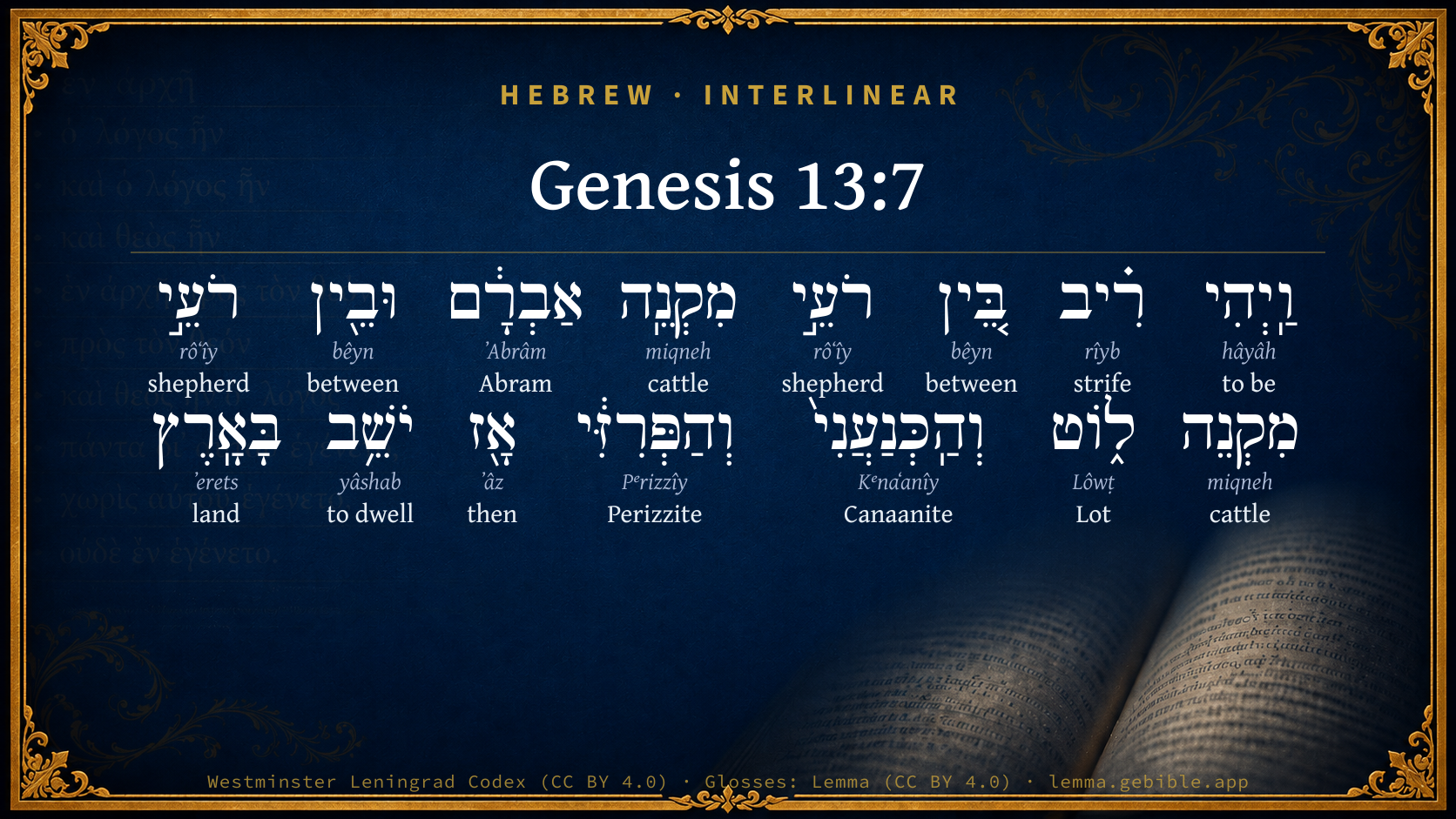
Hebrew (Westminster Leningrad Codex) Genesis 13:7 appears in the Hebrew Old Testament. The text above is from the Westminster Leningrad Codex. Each word links to its Strong’s number, a concise gloss, and parsing drawn from the Open Scriptures Hebrew Bible morphology. Click any word for its full Brown-Driver-Briggs (BDB) entry.
Download image
Cite this verse

Genesis 13:7 (World English Bible). Public Domain. Lemma interlinear Bible study tool, https://lemma.gebible.app/v/genesis/13/7.

Show BibTeX & RIS
BibTeX
RIS
English Translation
There was a strife between the herdsmen of Abram's cattle and the herdsmen of Lot's cattle: and the Canaanite and the Perizzite lived then in the land.
World English Bible · Public Domain
Highlights
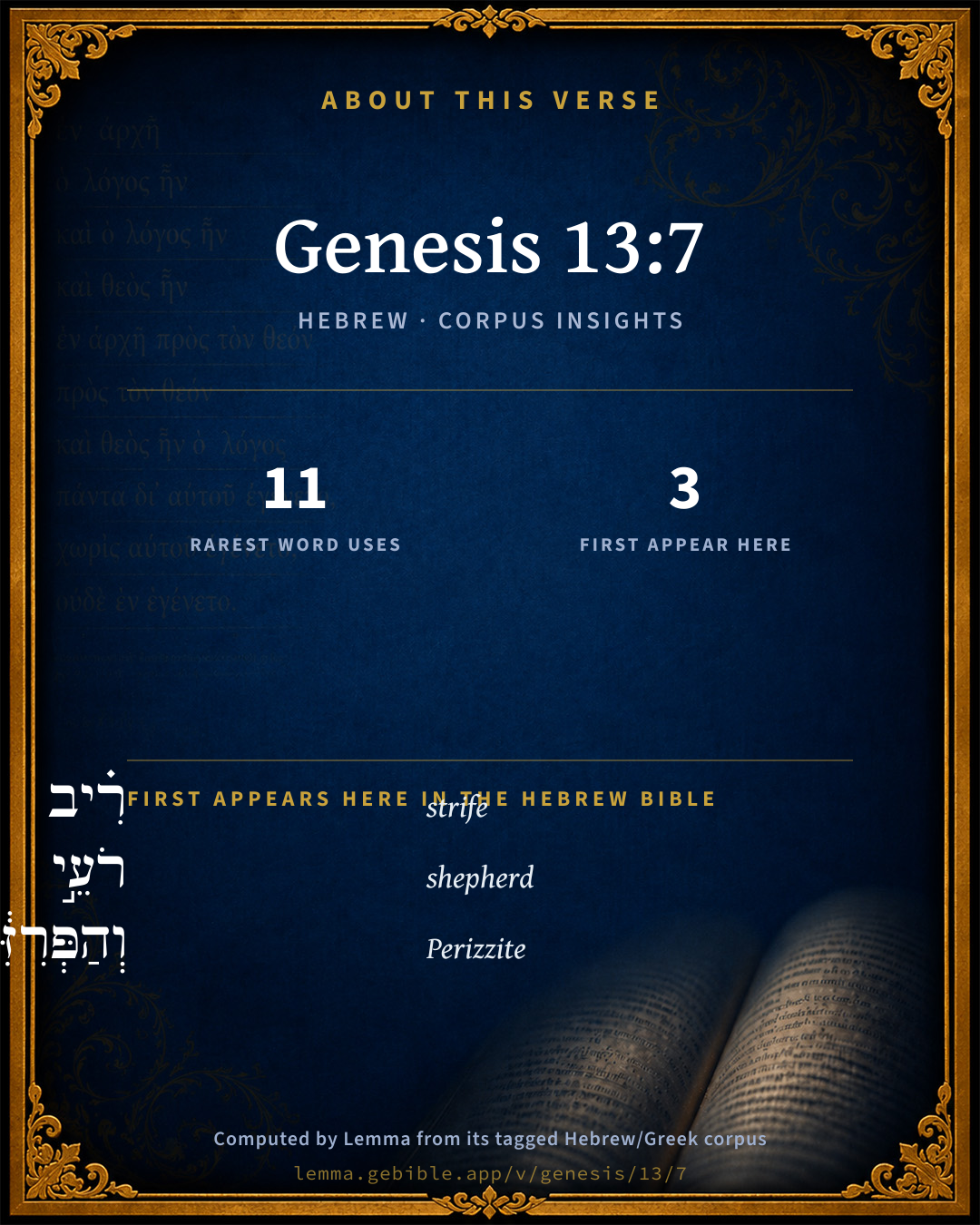
  • 3 first appearances in the Hebrew Bible
Full analysis ↓
Download a study sheet

One document with this verse’s original text, its word-by-word gloss line, the meaning frame, cross-references with their text, attributed commentary, and full source and license credits — printable, and it pastes into notes with its structure intact.

This verse Autodidact and up

Study sheet (.html) Plain text (.txt)

A passage Seminary Student

Up to 50 verses in one chapter. A passage sheet keeps up to 6 commentary sources and 12 cross-references per verse, in the order this page ranks them, and says so on the sheet whenever that leaves anything out. Ask for a single verse and you get the Autodidact verse sheet above.

Everything on this page stays free to read, with no account — the sheet is a download of what is already on screen, not access to it.

Want to remove ads? Support Godless Engineer
Compare translations 3

The same verse in 3 English versions, stacked beneath the original-language interlinear above. Click any original word for its lexicon entry.

Each is an independent rendering of the whole verse — the interlinear is not word-aligned to these translations.

Highlighted words mark where these versions differ — a whole-verse word diff, not a word-by-word alignment.

  • World English Bible Public Domain
    There was a strife between the herdsmen of Abram's cattle and the herdsmen of Lot's cattle: and the Canaanite and the Perizzite lived then in the land.
  • King James Version Public Domain
    And there was a strife between the herdmen of Abram's cattle and the herdmen of Lot's cattle: and the Canaanite and the Perizzite dwelled then in the land.
  • unfoldingWord Literal Text CC BY-SA 4.0
    Then there was strife between the herdsmen of Abram’s livestock and the herdsmen of Lot’s livestock. And the Canaanites and the Perizzites were living in the land then.

unfoldingWord Literal Text — © unfoldingWord, licensed CC BY-SA 4.0. Word-aligned USFM3 via Door43 (git.door43.org/unfoldingWord/en_ult).

Versions to compare (up to 4)

3 of 4 selected

Show all 18 translations

Every available English version of this verse, each an independent rendering of the whole verse.

  • World English Bible Public Domain
    There was a strife between the herdsmen of Abram's cattle and the herdsmen of Lot's cattle: and the Canaanite and the Perizzite lived then in the land.
  • Berean Standard Bible Public Domain
    And there was discord between the herdsmen of Abram and the herdsmen of Lot. At that time the Canaanites and the Perizzites were also living in the land.
  • Majority Standard Bible Public Domain
    And there was discord between the herdsmen of Abram and the herdsmen of Lot. At that time the Canaanites and the Perizzites were also living in the land.
  • King James Version Public Domain
    And there was a strife between the herdmen of Abram's cattle and the herdmen of Lot's cattle: and the Canaanite and the Perizzite dwelled then in the land.
  • American Standard Version (1901) Public Domain
    And there was a strife between the herdsmen of Abram's cattle and the herdsmen of Lot's cattle: and the Canaanite and the Perizzite dwelt then in the land.
  • Revised Version (1885) Public Domain
    And there was a strife between the herdmen of Abram’s cattle and the herdmen of Lot’s cattle: and the Canaanite and the Perizzite dwelled then in the land.
  • Geneva Bible (1599) Public Domain
    Also there was debate betweene ye heardmen of Abrams cattell, and the heardmen of Lots cattell. (and the Canaanites and the Perizzites dwelled at that time in the land.)
  • Douay-Rheims (1899) Public Domain
    Whereupon also there arose a strife between the herdsmen of Abram and of Lot. And at that time the Chanaanite and the Pherezite dwelled in that country.
  • Young's Literal Translation Public Domain
    and there is a strife between those feeding Abram's cattle and those feeding Lot's cattle; and the Canaanite and the Perizzite `are' then dwelling in the land.
  • Literal Standard Version CC BY-SA 4.0
    and there is a strife between those feeding Abram’s livestock and those feeding Lot’s livestock; and the Canaanite and the Perizzite [are] then dwelling in the land.
  • Unlocked Literal Bible CC BY-SA 4.0
    Also, there was a dispute between the herdsmen of Abram's animals and the herdsmen of Lot's animals. The Canaanites and the Perizzites were living in the land at that time.
  • unfoldingWord Literal Text CC BY-SA 4.0
    Then there was strife between the herdsmen of Abram’s livestock and the herdsmen of Lot’s livestock. And the Canaanites and the Perizzites were living in the land then.
  • Darby Bible Public Domain
    And there was strife between the herdsmen of Abram's cattle and the herdsmen of Lot's cattle. And the Canaanite and the Perizzite were dwelling then in the land.
  • World Messianic Bible Public Domain
    There was strife between the herdsmen of Abram’s livestock and the herdsmen of Lot’s livestock. The Canaanites and the Perizzites lived in the land at that time.
  • Webster's Bible Public Domain
    And there was a strife between the herdmen of Abram's cattle and the herdmen of Lot's cattle: and the Canaanite and the Perizzite dwelt then in the land.
  • Free Bible Version CC BY-SA 4.0
    Abram's and Lot's herdsmen were arguing, and in addition the Canaanites and Perizzites were also living in the land at that time.
  • Bible in Basic English Public Domain
    And there was an argument between the keepers of Abram's cattle and the keepers of Lot's cattle: at that time the Canaanites and Perizzites were still living in the land.
  • JPS Tanakh (1917) Public Domain
    And there was a strife between the herdmen of Abram's cattle and the herdmen of Lot's cattle. And the Canaanite and the Perizzite dwelt then in the land.

Literal Standard Version (2020), Covenant Press — licensed CC BY-SA 4.0. Text via the HelloAO Bible API (eBible.org). Unlocked Literal Bible (unfoldingWord) — licensed CC BY-SA 4.0. Text via the HelloAO Bible API (eBible.org). unfoldingWord Literal Text — © unfoldingWord, licensed CC BY-SA 4.0. Word-aligned USFM3 via Door43 (git.door43.org/unfoldingWord/en_ult). Free Bible Version, Dr. Jonathan Gallagher — licensed CC BY-SA 4.0. Text via the HelloAO Bible API (eBible.org).

Word by word

More ways to search: Search by grammar → Find every occurrence → Compare this word →

Practice this passage: Drill this verse → Learn its vocabulary →

רֹעֵ֣י
rôʻîy
H7473
“shepherd”
Verb, Qal, Participle Active, Masculine, Plural, Construct
Part of Speech
Verb
Stem
Qal
Form
Participle Active
Gender
Masculine
Number
Plural
State
Construct
Full BDB Definition

Origin: from act part of H7462

TWOT: None

shepherd (substantive)
  1. וַֽיְהִי hâyâh H1961 “and · to be” Conjunction + Verb, Qal, Sequential Imperfect, 3rd Person, Masculine, Singular
  2. רִ֗יב rîyb H7379 “strife” Noun, Common, Both, Singular, Absolute
  3. בֵּ֚ין bêyn H996 “between” Preposition
  4. מִקְנֵֽה miqneh H4735 “cattle of” Noun, Common, Masculine, Singular, Construct
  5. אַבְרָ֔ם ʼAbrâm H87 “Abram” Noun, Proper
  6. וּבֵ֖ין bêyn H996 “and · between” Conjunction + Preposition
  7. רֹעֵ֣י rôʻîy H7473 “shepherd” Verb, Qal, Participle Active, Masculine, Plural, Construct
  8. מִקְנֵה miqneh H4735 “cattle of” Noun, Common, Masculine, Singular, Construct
  9. ל֑וֹט Lôwṭ H3876 “Lot” Noun, Proper
  10. וְהַֽכְּנַעֲנִי֙ Kᵉnaʻanîy H3669 “and · the · Canaanite” Conjunction + Particle, Definite Article + Noun, Gentilic, Masculine, Singular, Absolute
  11. וְהַפְּרִזִּ֔י Pᵉrizzîy H6522 “and · the · Perizzite” Conjunction + Particle, Definite Article + Noun, Gentilic, Masculine, Singular, Absolute
  12. אָ֖ז ʼâz H227 “then” Adverb
  13. יֹשֵׁ֥ב yâshab H3427 “dwelling” Verb, Qal, Participle Active, Masculine, Singular, Absolute
  14. בָּאָֽרֶץ ʼerets H776 “in/at the · land” Preposition, Determined + Noun, Common, Both, Singular, Absolute

About this verse

These counts appear in no published source. They are computed here, from the morphology-tagged text and Lemma’s own curated glosses. What Lemma adds →

15
words
12
distinct lemmas
Pentateuch
section

Notable vocabulary

The rarest word here is רֹעֵ֣י shepherd H7473 — appearing just 11 times in the whole Hebrew Bible.

First appearance in Scripture

These words make their first canonical appearance in the Hebrew Bible here:

  • רִ֗יב strife H7379
  • רֹעֵ֣י shepherd H7473
  • וְהַפְּרִזִּ֔י Perizzite H6522

Shared distinctive vocabulary

רֹעֵ֣י shepherd H7473 occurs in 8 verses of the Hebrew Bible. Also found in:

Grammatical profile

  • 4 verbs
  • 8 nouns
  • 2 prepositions
  • 1 adverb

Verb forms

  • וַֽיְהִי Qal · Sequential Imperfect
  • רֹעֵ֣י Qal · Participle Active
  • רֹעֵ֣י Qal · Participle Active
  • יֹשֵׁ֥ב Qal · Participle Active

Repetition

Words recur within this verse — often emphatic in Hebrew:

  • בֵּ֚ין between H996 ×2
  • רֹעֵ֣י shepherd H7473 ×2
  • מִקְנֵֽה cattle H4735 ×2

Hebrew & Septuagint length

In English translation the verse runs 27 words from the Hebrew and 27 from the Septuagint (LXX English) — the same length.

A rough comparison of the two English renderings, which tokenize alike — not a word-level alignment.

Word counts can differ between the Hebrew and the Greek without any difference in meaning — e.g. the Hebrew direct-object marker אֵת has no separate Greek word, and Greek often adds the article ὁ.

Cross-references

17

Topical passages linked to Genesis 13:7 in the Treasury of Scripture Knowledge — connected by theme and wording, ordered by reader-vote popularity; previews shown in the World English Bible.

  • Genesis 26:20 The herdsmen of Gerar argued with Isaac's herdsmen, saying, "The water is ours." He called the name of the well Esek, because they contended with him.
  • Genesis 12:6 Abram passed through the land to the place of Shechem, to the oak of Moreh. The Canaanite was then in the land.
  • James 3:16 For where jealousy and selfish ambition are, there is confusion and every evil deed.
  • Genesis 34:30 Jacob said to Simeon and Levi, "You have troubled me, to make me odious to the inhabitants of the land, among the Canaanites and the Perizzites. I am few in number. They will gather themselves together against me and strike me, and I will be destroyed, I and my house."
  • Galatians 5:20 idolatry, sorcery, hatred, strife, jealousies, outbursts of anger, rivalries, divisions, heresies,
  • James 4:1 Where do wars and fightings among you come from? Don't they come from your pleasures that war in your members?
  • 1 Peter 2:12 having good behavior among the nations, so in that which they speak against you as evil-doers, they may by your good works, which they see, glorify God in the day of visitation.
  • Genesis 21:25 Abraham complained to Abimelech because of a water well, which Abimelech's servants had violently taken away.
  • Exodus 2:17 The shepherds came and drove them away; but Moses stood up and helped them, and watered their flock.
  • Nehemiah 5:9 Also I said, The thing that you do is not good: ought you not to walk in the fear of our God, because of the reproach of the nations our enemies?
  • 1 Corinthians 3:3 for you are still fleshly. For insofar as there is jealousy, strife, and factions among you, aren't you fleshly, and don't you walk in the ways of men?
  • Philippians 2:14–15 Do all things without murmurings and disputes,
  • Colossians 4:5 Walk in wisdom toward those who are outside, redeeming the time.
  • 1 Thessalonians 4:12 that you may walk properly toward those who are outside, and may have need of nothing.
  • Titus 3:3 For we were also once foolish, disobedient, deceived, serving various lusts and pleasures, living in malice and envy, hateful, and hating one another.
  • Genesis 10:19 The border of the Canaanites was from Sidon, as you go toward Gerar, to Gaza; as you go toward Sodom, Gomorrah, Admah, and Zeboiim, to Lasha.
  • Genesis 15:18–21 In that day Yahweh made a covenant with Abram, saying, "To your seed have I given this land, from the river of Egypt to the great river, the river Euphrates:

Cross-references courtesy of OpenBible.info (CC BY 4.0).

Hebrew and Greek witnesses Masoretic Hebrew ↔ Greek Septuagint

The same verse in the two great witnesses to the Old Testament, shown verse-for-verse.

These are two independent witnesses, not word-aligned to each other, and the Septuagint is shown in lemma (dictionary) form.

Hebrew Genesis 13:7 Masoretic · Westminster Leningrad Codex

וַֽיְהִי רִ֗יב בֵּ֚ין רֹעֵ֣י מִקְנֵֽה אַבְרָ֔ם וּבֵ֖ין רֹעֵ֣י מִקְנֵה ל֑וֹט וְהַֽכְּנַעֲנִי֙ וְהַפְּרִזִּ֔י אָ֖ז יֹשֵׁ֥ב בָּאָֽרֶץ

There was a strife between the herdsmen of Abram's cattle and the herdsmen of Lot's cattle: and the Canaanite and the Perizzite lived then in the land.

World English Bible · Public Domain

Greek LXX Genesis 13:7 Septuagint · lemma form

καί γίγνομαι μάχη ἀνά μέσος ὁ ποιμήν ὁ κτῆνος ὁ αβραμ καί ἀνά μέσος ὁ ποιμήν ὁ κτῆνος ὁ λωτ ὁ δέ χαναναῖος καί ὁ φερεζαῖος τότε καταοἰκέω ὁ γῆ

And there was a strife between the herdmen of Abram's cattle, and the herdmen of Lot's cattle, and the Chananites and the Pherezites then inhabited the land.

LXX2012 (modern English Septuagint) · Public Domain

Hebrew: Westminster Leningrad Codex (CC BY 4.0). Greek: Septuagint (public domain); English from LXX2012 (modern English Septuagint) (Public Domain). How the Septuagint differs from the Hebrew →

Targum (Aramaic paraphrase)

2

The Targum is the ancient Jewish Aramaic paraphrase of the Hebrew Scriptures — an interpretive translation, not the Hebrew text itself. Onkelos (literal) and Pseudo-Jonathan (expansive) render the Torah, and Jonathan the Prophets. Coverage is partial: where no permissively-licensed English translation exists for a verse, only the Aramaic is shown. This is verse-level text, not a word-by-word alignment to the Hebrew.

  1. Targum Onkelos Torah (Genesis–Deuteronomy)
    וַהַוַת מַצוּתָא בֵּין רָעֵי בְּעִירֵה דְאַבְרָם וּבֵין רָעֵי בְּעִירֵה דְלוֹט וּכְנַעֲנָאָה וּפְרִזָאָה בְּכֵן יָתִיב בְּאַרְעָא

    And there was contention between the shepherds of the flock of Abram and the shepherds of the flock of Lot; and the Kenaanah and the Pherizaah then dwelt in the land.

    Targum Onkelos — Aramaic: “Onkelos Genesis” (public domain); “Onkelos Exodus” (public domain); “Onkelos Leviticus” (public domain); “Onkelos Numbers” (public domain); “Onkelos Deuteronomy” (public domain). English: “Sefaria Community Translation” (CC0 1.0 (public-domain dedication)); “J.W. Etheridge. The Targums of Onkelos and Jonathan Ben Uzziel on the Pentateuch. London: Longmans, Green, 1862” (public domain). Text via Sefaria.

  2. Targum Pseudo-Jonathan Torah (Genesis–Deuteronomy)
    וַהֲוָה דַיָינִין בֵּין רִעָאֵי גֵיתֵיהּ דְאַבְרָם וּבֵין רִעָאֵי גֵיתֵיהּ דְלוֹט דִרְעָאֵי דְאַבְרָם הֲווֹ מִיפַקְדִין מִנֵיהּ לָא תֶהְכוּן בִּכְנַעֲנָאֵי וּבִפְרִיזָאֵי דְעַד כְּדוֹן אֵית לְהוֹם רְשׁוּתָא בְּאַרְעָא וַהֲווֹ זְמָמִין בְּעִירֵיהוֹן דְלָא יֵיכְלוּן גְזֵלָה עַד דַהֲווּ אַתְיָן לַאֲתַר מַרְעֵיהוֹן וְרָעֵי דְלוֹט הֲווֹ מְבַקְרִין וְאַזְלִין וְאָכְלִין בְּחַקְלֵי כְּנַעֲנָאֵי וּפְרִיזָאֵי דְעַד כְּדוֹן יַתְבִין בְּאַרְעָא

    And contentions arose between the shepherds of Abram's flock, and the shepherds of the flocks of Lot; for the shepherds of Abram had been instructed by him not to go among the Kenaanaee and the Pherizaee, who, as yet, had power in the land, and to restrain the cattle that they should make no depredation in going to the place of their pasture: but the shepherds of Lot would go and feed in the grounds of the Kenaanaee and Pherizaee who yet dwelt in the land.

    Targum Pseudo-Jonathan — Aramaic: “Targum Jonathan on Genesis” (public domain); “Targum Jonathan on Exodus” (public domain); “Targum Jonathan on Leviticus” (public domain); “Targum Jonathan on Numbers” (public domain); “Targum Jonathan on Deuteronomy” (public domain). English: “The Targum of Jonathan ben Uzziel, trans. J. W. Etheridge, London, 1862” (public domain). Text via Sefaria.

Commentary

Notes on Genesis 13:7 from classic Christian and Jewish commentators (each source and its license shown beneath its notes). The classic Christian expositions comment on the surrounding passage and are grouped to its opening verse, so a note may address several verses; the Jewish commentaries on the Tanakh (Rashi and others) are per-verse, so they appear only where the commentator wrote on this verse.

Lemma curates 59 commentaries, every one of them public domain or Creative Commons licensed, each selected and text-cleaned for this edition rather than reprinted as found. About our sources →

Trapp's Complete Commentary

John Trapp

Gen 13:7 And there was a strife between the herdmen of Abram’s cattle and the herdmen of Lot’s cattle: and the Canaanite and the Perizzite dwelled then in the land.

Ver. 7. And there was a strife between.] How oft do servants set masters at variance! But the devil is in it, when good folk fall out especially. He is restless himself, and doth what he can to disquiet others. He loves to fish in troubled waters; and well knows out of his "devilish wisdom," saith St James, that "where envying and strife is, there is confusion and every evil work". {Jas 3:15-16} But what was it that made the herdsmen fall out, but penury of pasture? and what bred penury of pasture, but plenty of cattle? Great riches many times breed great brabbles. This the heathen found, and therefore feigned that Mars was the son of Juno, {a} because Juno is the goddess of riches, which prove the cause of strife and stirs among many.

And the Canaanite and Perizzite dwelled then in the land.] This is added, either as a cause of their being straitened of fit pasture, because the Canaanites possessed the better grounds; or else to set forth how unseasonable and unsavoury it was, for such men to jar, and so to expose themselves to the scandal and scorn of such wicked neighbours as desired no better sport than to see them falling out. This latter is Lyra’s {b} gloss, and I like it well. One of the main scandals the Jews take at this day from Protestants, is their dissensions. Error condonari potest, modo fides adsit in Christum: discordiam, neque si sanguinem fundamus, expiabimus , said reverend Oecolampadius in a letter to the litigious Lutherans of Sueveland. {c}

{a} Natalis Comes.

{b} Nisi Lyra lyrasset &c.

{c} Scultet. Annal. Cyprianus inexpiabilem discordiae maculam martyrii sanguine ablui, et passione purgari negat.

John Trapp, A Commentary or Exposition upon All the Books of the Old and New Testament (1647–1656) — public domain. Text from a community e-Sword module.

Joseph Benson's Commentary

Gen 13:7. The Canaanite and Perizzite dwelt in the land — This made the quarrel, 1st, Very dangerous: if Abram and Lot cannot agree to feed their flocks together, it is well if the common enemy do not come upon them and plunder them both. 2d, Very scandalous: No doubt the eyes of all the neighbours were upon them; because of the singularity of their religion, and the extraordinary sanctity they professed; and notice would soon be taken of this quarrel, and improvement made of it to their reproach by the Canaanites and Perizzites.

Joseph Benson's Commentary on the Old and New Testaments (1811–1818) — public domain. Text from a community e-Sword module.

Geneva Bible (1599)

Geneva Bible translators

Who seeing their contention, might blaspheme God and destroy them.

Geneva Bible (1599) marginal notes — public domain. Text via Bolls.life.

Jamieson, Fausset & Brown

Robert Jamieson, A. R. Fausset & David Brown

And there was a strife--Abraham's character appears here in a most amiable light. Having a strong sense of religion, he was afraid of doing anything that might tend to injure its character or bring discredit on its name, and he rightly judged that such unhappy effects would be produced if two persons whom nature and grace had so closely connected should come to a rupture [Gen 13:8]. Waiving his right to dictate, he gave the freedom of choice to Lot. The conduct of Abraham was not only disinterested and peaceable, but generous and condescending in an extraordinary degree, exemplifying the Scripture precepts (Mat 6:32; Rom 12:10-11; Phi 2:4).

Jamieson, Fausset & Brown — Commentary Critical and Explanatory on the Whole Bible (1871) — public domain (CC PDM 1.0). Text via the HelloAO Bible API.

Adam Clarke's Commentary

Verse 7. The Canaanite and the Perizzite dwelled then in the land.] That is, they were there at the time Abram and Lot came to fix their tents in the land. See Clarke on Ge 12:6.

Adam Clarke's Commentary on the Bible (1810–1826) — public domain. Text from a community e-Sword/MySword module.

John Calvin's Commentaries

7. And there was a strife. What I hinted respecting riches, is also true respecting a large retinue of attendants. We see with what ambition many desire a great crowd of servants, almost amounting to a whole people. But since the family of Abram cost him so dear; let us be well content to have few servants, or even to be entirely without them, if it seem right to the Lord that it should be so. It was scarcely possible to avoid great confusion, in a house where there was a considerable number of men. And experience confirms the truth of the proverbs that a crowd is commonly turbulent. Now, if repose and tranquility be an inestimable good; let us know, that we best consult for our real welfare, when we have a small house, and privately pass our time, without tumult, in our families. We are also warned, by the example before us, to beware lest Satan, by indirect methods, should lead us into contention. For when he cannot light up mutual enmities between us, he would involve us in other men’s quarrels. Lot and Abram were at concord with each other; but a contention raised between their shepherds, carried them reluctantly away; so that they were compelled to separate from each other. There is no doubt that Abram faithfully instructed his own people to cultivate peace; yet he did not so far succeed in his desire and effort, as to prevent his witnessing the most destructive fire of discord kindled in his house. Wherefore, it is nothing wonderful, if we see tumults often arising in churches, where there is a still greater number of men. Abram had about three hundred servants; it is probable that the family of Lot was nearly equal to it: what then may be expected to take place between five or six thousand men, — especially free men, — when they contend with each other? As, however, we ought not to be disturbed by such scandals; so we must, in every way, take care that contentions do not become violent. For unless they be speedily met, they will soon break out into pernicious dissension.

The Canaanite and the Perizzite. Moses adds this for the sake of aggravating the evil. For he declares the heat of the contention to have been so great, that it could neither be extinguished nor assuaged, even by the fear of impending destruction. They were surrounded by as many enemies as they had neighbors. Nothing, therefore, was wanting in order to their destruction, but a suitable occasion; and this they themselves were affording by their quarrels. To such a degree does blind fury infatuate men, when once the vehemence of contention has prevailed, that they carelessly despise death, when placed before their eyes. Now, although we are not continually surrounded by Canaanites, we are yet in the midst of enemies, as long as we sojourn in the world. Wherefore, if we are influenced by any desire for the salvation of ourselves, and of our brethren, let us beware of contentions which will deliver us over to Satan to be destroyed.

John Calvin's Commentaries (1540-1563) — public domain. Text from the Calvin Translation Society English edition (1840s-50s) via the Christian Classics Ethereal Library (ccel.org). Calvin's coverage is partial (roughly two-thirds of the Bible); uncommented books and verses are honest gaps, never fabricated. The 19th-century editor's footnotes and remarks are omitted so the notes are faithfully Calvin's own voice.

Ellicott's Commentary for English Readers

(7) The Perizzite.—We find mention in the Bible both of Perazites, translated villages, in 1Sa_6:18, Est_9:19; and of Perizzites, who are sometimes opposed to the Canaanites, as here and in Gen_34:30, and sometimes described as one of the tribes settled in Palestine (Exo_3:8; Exo_3:17; Jos_17:15; Jdg_3:5). They are not mentioned among the races descended from Canaan, and probably were the earlier inhabitants of the country, who, being a pastoral people, possessed of no towns, were not able to make head against the Hamite settlers, but maintained themselves in the open country. Perazite and Perizzite are probably the same word, and both signify lowlander, though finally they were driven to the mountains (Jos_11:3). As the Canaanites devoted their main strength to a maritime life and trade, they would not attempt to extirpate these natives, but would be content with driving them into the interior. As thus some districts would be occupied by the dominant Canaanites, and others by these aborigines, two such large clans as those of Abram and Lot would find it difficult to discover unoccupied land enough to provide pasture for their cattle. The land must have been very thinly peopled for it to have been possible for them to do this, even when they had arranged to dwell apart.

A Bible Commentary for English Readers, edited by Charles John Ellicott (1878–1897) — public domain. Text from a community e-Sword module.

The Cambridge Bible for Schools and Colleges

gen. ed. J. J. S. Perowne

7. And there was a strife] The account according to J of the reason for the separation. Disputes were constantly arising between the herdsmen of the two caravans. For other examples of such causes of friction among shepherds and herdsmen, see Gen_21:24-32, Gen_26:15-33.

and the Canaanite and the Perizzite] Cf. Gen_12:6. The introduction of this clause is probably intended to emphasize the danger of dissensions between the Hebrew camps at a time when the native inhabitants, jealous of the wealth of the strangers, might be glad of a pretext for attacking them singly. “The Canaanite” is the indigenous inhabitant (Gen_10:15; Gen_10:19, Gen_12:6) in J.

The Perizzite is mentioned with the Canaanite in Gen_34:30, Jdg_1:4-5, and in the lists of the nations, e.g. Gen_15:20-21. In Jos_17:15 the Perizzites are named with the Rephaim; and in Jos_24:11 with the Amorites. There is no means of determining where they dwelt. Some have supposed that the Perizzites meant the peasantry, or dwellers in villages and unwalled towns, as distinct from the Canaanites who dwelt in walled cities: and that the name is connected with the word perazi, used in Deu_3:5 and 1Sa_6:18.

The Cambridge Bible for Schools and Colleges (gen. ed. J. J. S. Perowne; Cambridge University Press, 1878–1918) — public domain. Text from a community e-Sword module.

John Gill's Exposition

And there was a strife between the herdmen of Abram's cattle and the herdmen of Lot's cattle,.... Not between the two masters, but between their servants, their upper servants, that had the care of their herds to feed them, and water them; and it is very probable their strife was about pasturage and watering places, the one endeavouring to get them from the other, or to get the best; which is much more likely than what Jarchi suggests, that the herdmen of Lot were wicked men, and fed their cattle in the fields of others, and the herdmen of Abram reproved them for their robbery; but they said, the land is given of Abram, and he hath no heir, but Lot is his heir, and what robbery is this? and to this sense are the Targums of Jonathan and Jerusalem:

and the Canaanite and the Perizzite dwelt then in the land; which observation is made by Moses to point to a reason why they could not both of them have a sufficiency for their large flocks and herds, because the country was in the possession of others; and though there was to spare, yet not enough for them both. The Canaanite, though it was a general name for the people of the whole land, yet was given to a particular family in it, and was derived from their first founder Canaan, the son of Ham; the Perizzite was another family or tribe of the same nation, who had their name from "a village"; these being Pagans or villagers, living in huts, or houses, or tents scattered up and down in the fields, and were a rough, inhuman, and unsociable sort of people, and therefore it could not be expected that they would oblige them with much pasturage and water for their flocks: and besides, this may be remarked, partly to show the danger that Abram and Lot were in through the dissension of their herdmen, since those people that were so nigh might take the advantage of their quarrels among themselves, and fall upon them both, and destroy them, and therefore a reconciliation was necessary; and partly to observe the reproach that was like to come upon them, and upon the true religion, for their sakes, should they differ among themselves, which such sort of men would gladly catch at, and improve against them.

John Gill's Exposition of the Whole Bible (1746–1763) — public domain (CC PDM 1.0). Text via the HelloAO Bible API.

Matthew Poole's English Annotations

The Canaanite, i.e. the Canaanites, as Gen 12:6, the singular number for the plural, as Psa 78:45; 105:33,40.

Dwelled then in the land, i.e. were the lords and owners of it; and therefore Abram and Lot could not take what pastures they pleased, but such as the others left them, which was not sufficient for their conveniency. It may also be added as a reason of Abram's following motion, because that idolatrous people were present, and diligently observed all their contentions and other miscarriages; and would, doubtless, take occasion thence to disparage the true religion. And it must be remembered, that these are the words not of Abram, but of Moses; who, knowing that the Canaanites were then speedily to be turned out of the land, intimates that the case was otherwise in Abram's days, when the Canaanites were possessed, and were likely to continue the possessors and lords of the land.

Matthew Poole's English Annotations on the Holy Bible (1683–1685) — public domain. Text from a community e-Sword/MySword module.

Whedon's Commentary on the Bible

Daniel D. Whedon

7. A strife between the herd-men — “Such disputes were unavoidable in the circumstances. Neither party had any title to the land. Every body availed himself of the best spot for grazing he could find unoccupied. We can easily understand what facilities and temptations this would offer for the strong to overbear the weak. We meet with many incidental notices of such oppression: Gen_21:25; Gen_26:15-22; Exo_2:16-19.” — Murphy. “The germinal divisions of masters ofttimes reveal themselves clearly in the strifes of their servants and dependents. Even the wives are often in open hostility while their husbands are still at peace. Abram teaches us how to observe these symptoms in the right way.” — Lange.

The Canaanite — Comp. Gen_12:6.

Perizzite — This name, not appearing among the descendants of Canaan in Gen_10:15-17, is supposed to designate some tribe not of Hamite origin. The Hebrew word, which means rustics, or countrymen, may designate them as nomads, or dwellers in the country as distinguished from dwellers in towns and cities. See note on Jos_3:10. They probably occupied the best pastures, and so partly occasioned the strife between Abram and Lot’s herdmen.

Daniel D. Whedon (gen. ed.), Commentary on the Old and New Testaments (1874–1909) — public domain. Text from a community e-Sword module.

The Pulpit Commentary

And there was a strife (originating doubtless in the scarcity of pasture, and having for its object the possession of the best wells and most fertile grounds) between the herdmen of Abram"s cattle and the herdmen of Lot"s cattle: and the Canaanite the lowlander (vide Gen_9:22 Gen_12:6) and the Perizzite the highlander, or dweller in the hills and woods of Palestine (Josephus, Bochart); in the open country and in villages, as opposed to the Canaanites, who occupied walled towns (Kalisch, Wordsworth; a tribe of wandering nomads (Murphy), the origin of whose name is lost in obscurity (Keil), who, though not mentioned in Ge 10, are commonly introduced with the Canaanites. (Gen_15:20 Gen_34:30; Exo_3:8, Exo_3:17) as dividing the land between them, and are probably to be regarded as the remnant of an early Shemite race displaced by the Hamite invaders of Palestine. Their introduction here is neither a sign of post-Mosaic authorship nor an interpolation, but an explanation of the difficulty of finding pasture the land was occupied (Gen_12:6) dwelt then in the land.

The Pulpit Commentary (1880–1919), ed. H.D.M. Spence-Jones & Joseph S. Exell — public domain. Text from a community e-Sword module.

John Wesley's Explanatory Notes

And the Canaanite and the Perizzite dwelled in the land - This made the quarrel,

1. Very dangerous; if Abram and Lot cannot agree to feed their flocks together, it is well if the common enemy do not come upon them and plunder them both.

2. Very scandalous: No doubt the eyes of all the neighbours were upon them, because of the singularity of their religion, and the extraordinary sanctity they professed; and notice would soon be taken of this quarrel, and improvement made of it to their reproach by the Canaanites and Perizzites.

John Wesley, Explanatory Notes Upon the Whole Bible (1754–1765) — public domain. Text via the GEBible commentary corpus.

Rashi

Rabbi Shlomo Yitzchaki (Rashi)

ויהי ריב AND THERE WAS A QUARREL because Lot’s shepherds were wicked men and grazed their cattle in other people’s fields. Abram's shepherds rebuked them for this act of robbery, but they replied, “The land has been given to Abram, and since he has no son as heir, Lot will be his heir: consequently this is not robbery”. Scripture, however, states: “The Canaanite and the Perizzite abode then in the land”, so that Abram was not yet entitled to possession (Genesis Rabbah 41:5).

Rashi on the Tanakh — English translations: “The Judaica Press complete Tanach with Rashi, translated by A. J. Rosenberg” (CC BY 4.0); “Pentateuch with Rashi's commentary by M. Rosenbaum and A.M. Silbermann, 1929-1934” (public domain); “The Metsudah Tanach series, Lakewood, N.J” (CC BY 4.0); and “The Book of Joshua, Metsudah Publications, 1997” (CC BY 4.0). Text via Sefaria.

Ramban (Nachmanides)

Rabbi Moshe ben Nachman (Ramban / Nachmanides)

AND THERE WAS A QUARREL. Rashi wrote, “Because Lot’s shepherds grazed their cattle in other people’s fields, Abram’s shepherds rebuked them for this act of robbery, but they replied, ‘The land has been given to Abram, and he has no [son as an] heir, and so Lot will be his heir. Hence this is not robbery.’ Scripture however states, And the Canaanite and the Perrizite abode then in the land, so that Abram was not yet the legitimate owner.” This is a Midrash of our Rabbis. But I wonder: The gift of the Land declared to Abram was for his children, as it is said above, Unto thy seed will I give this land, so how can Lot inherit it? Perhaps the shepherds heard of the gift and they mistook its meaning, for Scripture states that in the meantime, the land belonged neither to Abram nor to Lot. Accordingly, the verse stating at the outset, for their possessions were great, intended to say that because of their extensive possessions, the land could not support them, and Lot’s shepherds therefore found it necessary to bring their cattle into fields that had owners. This was the cause of the quarrel.By way of the plain meaning of Scripture the quarrel concerned the pasture as the land could not support them both. When Abram’s cattle were grazing in the pasture, Lot’s shepherds would come into their territory and graze their cattle there. Now Abram and Lot were both strangers and sojourners in the land. Abram, therefore, feared that the Canaanite and the Perrizite, who inhabit the land, might hear of the abundance of their cattle, [whose great number was made apparent when Lot’s shepherds encroached on Abram’s land, thereby combining the flocks], and drive them out of the land or slay them by sword and take their cattle and wealth since the mastery of the land belonged to them, not to Abram. This is the purport of the verse, And the Canaanite and the Perrizite. Scripture thus mentioned that there were many peoples dwelling in that land, they and their cattle being innumerable, and the land could not support them and Abram and Lot.From the word oz (then) — [And the Canaanite and the Perrizite abode ‘then’ in the land] — it appears to me that the nations dwelling in the land at that time were those who live in tents and have cattle, some of them converging on one district and grazing there for a year or two and then journeying from there to another district in which they had not previously pastured. And so they continued to do, as is customary among “the children of the east.” The Canaanite and the Perrizite were thus “then” in the land of the south, and in the following years the Jebusite and the Amorite would come there.

Ramban (Nachmanides) on the Tanakh — English translation: “Commentary on the Torah by Ramban (Nachmanides). Translated and annotated by Charles B. Chavel. New York, Shilo Pub. House, 1971-1976” (CC BY 4.0). Text via Sefaria.

Radak

Rabbi David Kimhi (Radak)

ויהי ריב, we already explained the meaning of the words והכנעני אז בארץ on 12,6. In this verse the tribe פריזי has been mentioned which had not been featured previously. This tribe also resided in the region of Beyt El and Ai.

Radak on the Tanakh — English translations: “Sefaria Community Translation” (CC0 1.0 (public-domain dedication)); “Eliyahu Munk, HaChut Hameshulash” (CC BY 4.0); “Rabbi Mike Feuer, Jerusalem Anthology” (CC BY 4.0); and “R. David Kimhi on the first book of Psalms, Translated by R.G. Finch, London, 1919” (public domain). Text via Sefaria.

Lesson kit

Teaching starters — assembled from the data on this page, not authored interpretation. Every prompt links to the verse data it draws on. Edit before teaching.

Genesis, in the Pentateuch, opens this verse with 15 words (12 distinct Hebrew lemmas). Its most distinctive word is rôʻîy (“shepherd”). A historical commentator’s framing appears above. Read the whole chapter for the surrounding context.

Discussion questions

  1. How does “shepherd” (rôʻîy) shape what this verse is saying?
  2. 3 words make their first appearance in Scripture here. What does this debut establish?
  3. How does Genesis 13:8, which shares the word «shepherd», read alongside this verse?
  4. What does the repetition of “between” (2× in this one verse) do in this verse?
  5. These translations render this verse differently. What is at stake in choosing one wording over another?
  6. «וַֽיְהִי» is a Qal Sequential Imperfect verb. How does that grammatical form shape the action described?
  7. Compare how Trapp's Complete Commentary and Joseph Benson's Commentary read this verse. Where do they agree or differ?

Things to notice

  • 3 words make their first canonical appearance in Scripture here.
  • These translations choose different wording for 15 words in this verse.
  • “between” occurs 2× in this single verse.
  • 12 distinct Hebrew lemmas span 15 words in this verse.

Reading settings

Reading text

Shown beneath each verse's original-language words.

Old Testament
Old Testament edition

Read the OT as the Masoretic Hebrew (MT) or the Greek Septuagint (LXX).

English shown for the Greek Septuagint (in the Hebrew ↔ Greek comparison).

Comparing translations? Open the Compare panel on any verse page to stack up to four side by side.