Jeremiah 25:16

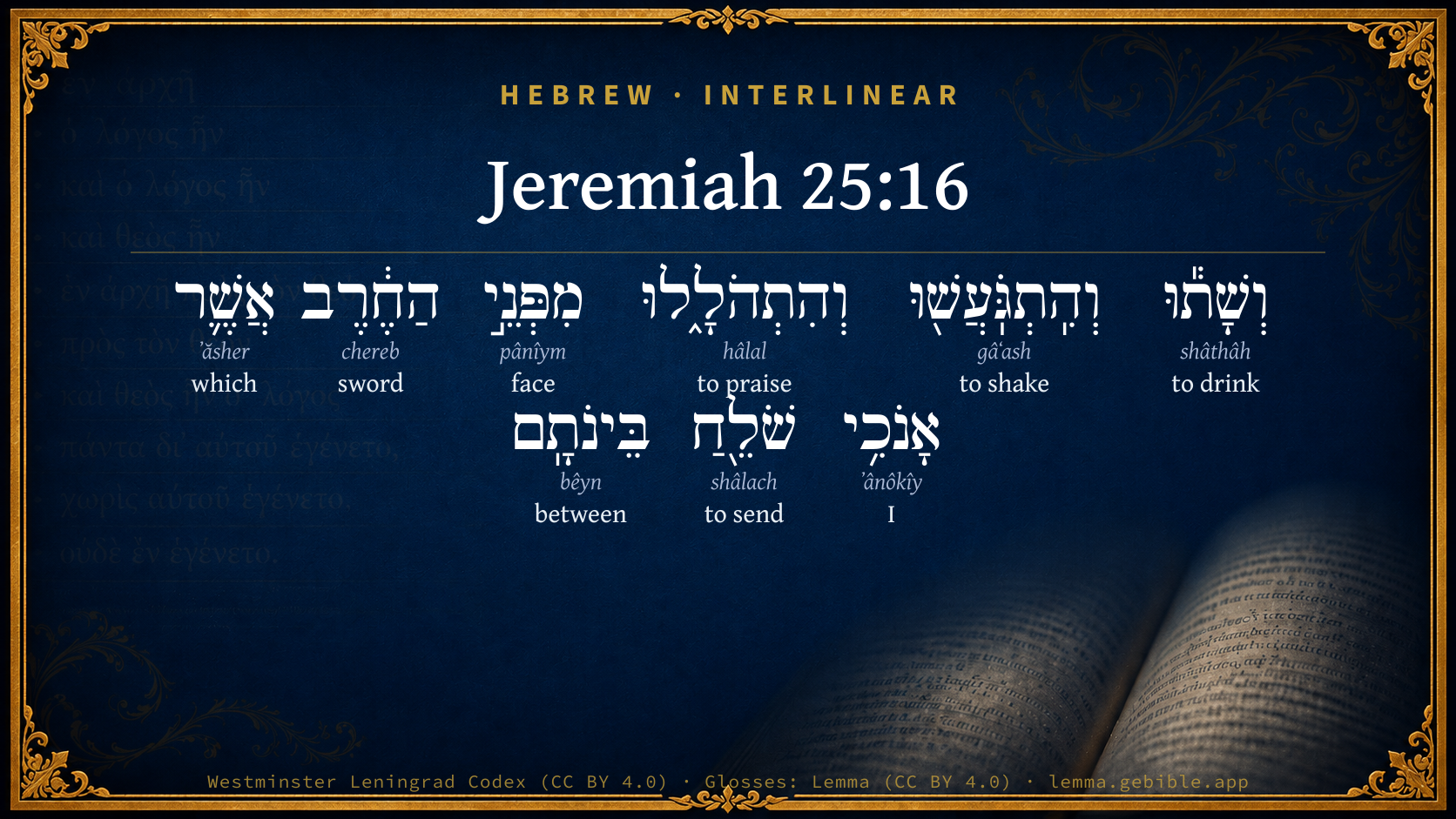
Hebrew (Westminster Leningrad Codex) Jeremiah 25:16 appears in the Hebrew Old Testament. The text above is from the Westminster Leningrad Codex. Each word links to its Strong’s number, a concise gloss, and parsing drawn from the Open Scriptures Hebrew Bible morphology. Click any word for its full Brown-Driver-Briggs (BDB) entry.
Download image
Cite this verse

Jeremiah 25:16 (World English Bible). Public Domain. Lemma interlinear Bible study tool, https://lemma.gebible.app/v/jeremiah/25/16.

Show BibTeX & RIS
BibTeX
RIS
English Translation
They shall drink, and reel back and forth, and be mad, because of the sword that I will send among them.
World English Bible · Public Domain
Download a study sheet

One document with this verse’s original text, its word-by-word gloss line, the meaning frame, cross-references with their text, attributed commentary, and full source and license credits — printable, and it pastes into notes with its structure intact.

This verse Autodidact and up

Study sheet (.html) Plain text (.txt)

A passage Seminary Student

Up to 50 verses in one chapter. A passage sheet keeps up to 6 commentary sources and 12 cross-references per verse, in the order this page ranks them, and says so on the sheet whenever that leaves anything out. Ask for a single verse and you get the Autodidact verse sheet above.

Everything on this page stays free to read, with no account — the sheet is a download of what is already on screen, not access to it.

Want to remove ads? Support Godless Engineer
Compare translations 3

The same verse in 3 English versions, stacked beneath the original-language interlinear above. Click any original word for its lexicon entry.

Each is an independent rendering of the whole verse — the interlinear is not word-aligned to these translations.

Highlighted words mark where these versions differ — a whole-verse word diff, not a word-by-word alignment.

  • World English Bible Public Domain
    They shall drink, and reel back and forth, and be mad, because of the sword that I will send among them.
  • King James Version Public Domain
    And they shall drink, and be moved, and be mad, because of the sword that I will send among them.
  • unfoldingWord Literal Text CC BY-SA 4.0
    And they will drink and will stagger and will act like madmen, from the face of the sword that I am sending among them.”

unfoldingWord Literal Text — © unfoldingWord, licensed CC BY-SA 4.0. Word-aligned USFM3 via Door43 (git.door43.org/unfoldingWord/en_ult).

Versions to compare (up to 4)

3 of 4 selected

Show all 18 translations

Every available English version of this verse, each an independent rendering of the whole verse.

  • World English Bible Public Domain
    They shall drink, and reel back and forth, and be mad, because of the sword that I will send among them.
  • Berean Standard Bible Public Domain
    And they will drink and stagger and go out of their minds, because of the sword that I will send among them.”
  • Majority Standard Bible Public Domain
    And they will drink and stagger and go out of their minds, because of the sword that I will send among them.”
  • King James Version Public Domain
    And they shall drink, and be moved, and be mad, because of the sword that I will send among them.
  • American Standard Version (1901) Public Domain
    And they shall drink, and reel to and fro, and be mad, because of the sword that I will send among them.
  • Revised Version (1885) Public Domain
    And they shall drink, and reel to and fro, and be mad, because of the sword that I will send among them.
  • Geneva Bible (1599) Public Domain
    And they shall drinke, and be moued and be mad, because of the sworde that I will sende among them.
  • Douay-Rheims (1899) Public Domain
    And they shall drink, and be troubled, and be mad because of the sword, which I shall send among them.
  • Young's Literal Translation Public Domain
    And they have drunk, and shaken themselves and shewn themselves foolish, because of the sword that I am sending among them.
  • Literal Standard Version CC BY-SA 4.0
    and they have drunk, and shaken themselves and shown themselves [to be] foolish, because of the sword that I am sending among them.”
  • Unlocked Literal Bible CC BY-SA 4.0
    For they will drink and then stagger about and rant madly before the sword that I am sending out among them.”
  • unfoldingWord Literal Text CC BY-SA 4.0
    And they will drink and will stagger and will act like madmen, from the face of the sword that I am sending among them.”
  • Darby Bible Public Domain
    And they shall drink, and reel to and fro, and be mad, because of the sword that I will send among them.
  • World Messianic Bible Public Domain
    They will drink, and reel back and forth, and be insane, because of the sword that I will send among them.”
  • Webster's Bible Public Domain
    And they shall drink, and be moved, and enraged, because of the sword that I will send among them.
  • Free Bible Version CC BY-SA 4.0
    They will drink and stumble around and go mad because of the war brought by the armies I'm sending to attack them.
  • Bible in Basic English Public Domain
    And after drinking it, they will go rolling from side to side, and be off their heads, because of the sword which I will send among them.
  • JPS Tanakh (1917) Public Domain
    And they shall drink, and reel to and fro, and be like madmen, because of the sword that I will send among them. —

Literal Standard Version (2020), Covenant Press — licensed CC BY-SA 4.0. Text via the HelloAO Bible API (eBible.org). Unlocked Literal Bible (unfoldingWord) — licensed CC BY-SA 4.0. Text via the HelloAO Bible API (eBible.org). unfoldingWord Literal Text — © unfoldingWord, licensed CC BY-SA 4.0. Word-aligned USFM3 via Door43 (git.door43.org/unfoldingWord/en_ult). Free Bible Version, Dr. Jonathan Gallagher — licensed CC BY-SA 4.0. Text via the HelloAO Bible API (eBible.org).

Word by word

More ways to search: Search by grammar → Find every occurrence → Compare this word →

Practice this passage: Drill this verse → Learn its vocabulary →

וְהִֽתְגֹּֽעֲשׁ֖וּ
gâʻash
H1607
“and · to shake”
Conjunction + Verb, Hithpolel, Sequential Perfect, 3rd Person, Common, Plural
Part of Speech
Conjunction + Verb
Stem
Hithpolel
Form
Sequential Perfect
Person
3rd Person
Gender
Common
Number
Plural
Full BDB Definition

Origin: a primitive root

TWOT: 371

to shake, quake - (Qal) to shake - (Pual) to be shaken up, convulsed - (Hithpael) to shake back and forth, toss or reel to and fro - (Hithpoel) to reel to and fro
  1. וְשָׁת֕וּ shâthâh H8354 “and · to drink” Conjunction + Verb, Qal, Sequential Perfect, 3rd Person, Common, Plural
  2. וְהִתְהֹלָ֑לוּ hâlal H1984 “and · to praise” Conjunction + Verb, Hithpolel, Sequential Perfect, 3rd Person, Common, Plural
  3. מִפְּנֵ֣י pânîym H6440 “from · face(s) of” Preposition + Noun, Common, Both, Plural, Construct
  4. הַחֶ֔רֶב chereb H2719 “the · sword” Particle, Definite Article + Noun, Common, Feminine, Singular, Absolute
  5. אֲשֶׁ֛ר ʼăsher H834 “which” Particle, Relative
  6. אָנֹכִ֥י ʼânôkîy H595 “I” Pronoun, Personal, 1st Person, Common, Singular
  7. שֹׁלֵ֖חַ shâlach H7971 “sending” Verb, Qal, Participle Active, Masculine, Singular, Absolute
  8. בֵּינֹתָֽם bêyn H996 “between · them” Preposition + Suffix, Personal, 3rd Person, Masculine, Plural

About this verse

These counts appear in no published source. They are computed here, from the morphology-tagged text and Lemma’s own curated glosses. What Lemma adds →

9
words
9
distinct lemmas
Prophets
section

Notable vocabulary

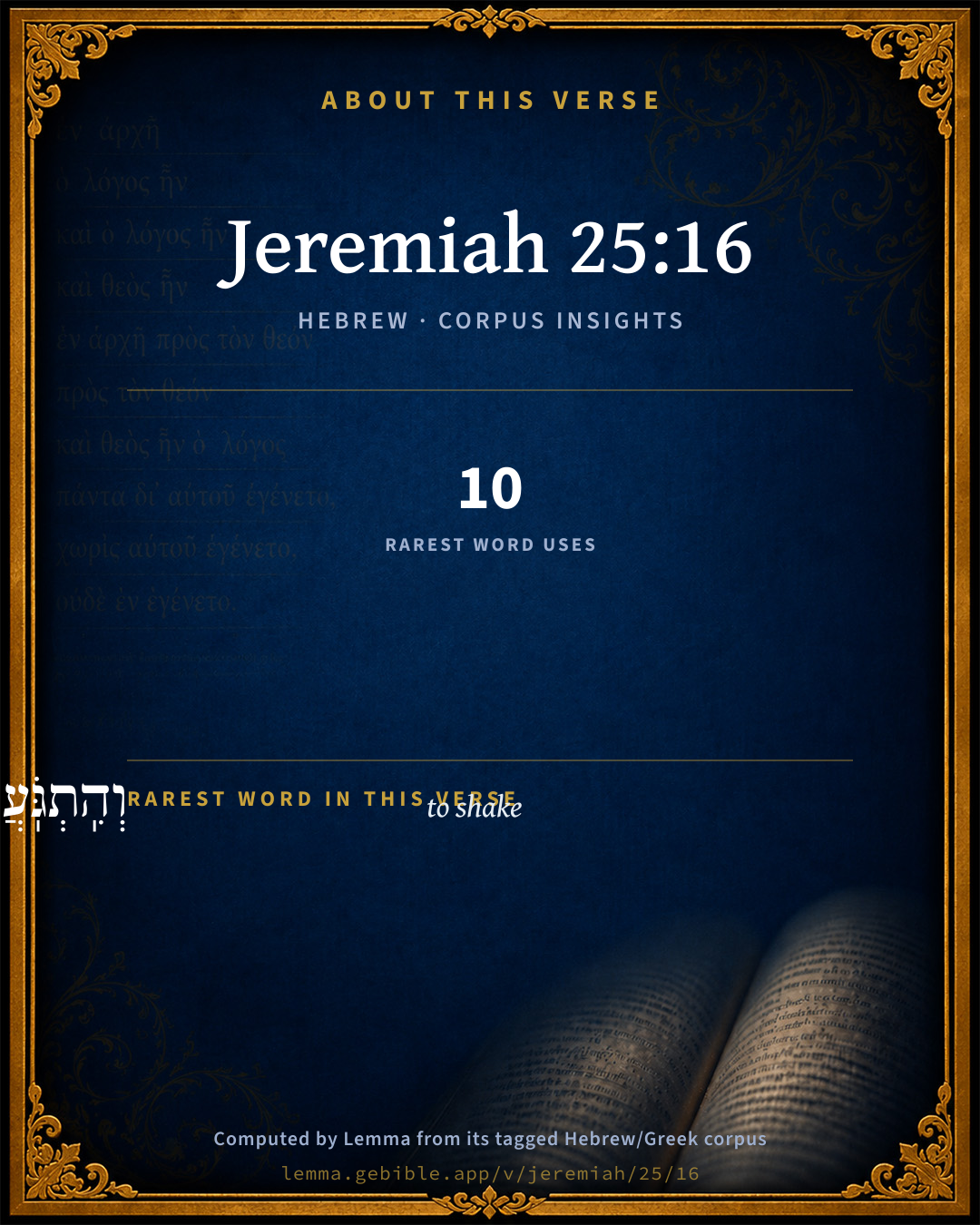
The rarest word here is וְהִֽתְגֹּֽעֲשׁ֖וּ to shake H1607 — appearing just 10 times in the whole Hebrew Bible.

Shared distinctive vocabulary

וְהִֽתְגֹּֽעֲשׁ֖וּ to shake H1607 occurs in 7 verses of the Hebrew Bible. Also found in:

Grammatical profile

  • 4 verbs
  • 2 nouns
  • 1 pronoun
  • 1 preposition
  • 1 particle

Verb forms

  • וְשָׁת֕וּ Qal · Sequential Perfect
  • וְהִֽתְגֹּֽעֲשׁ֖וּ Hithpolel · Sequential Perfect
  • וְהִתְהֹלָ֑לוּ Hithpolel · Sequential Perfect
  • שֹׁלֵ֖חַ Qal · Participle Active

Cross-references

11

Topical passages linked to Jeremiah 25:16 in the Treasury of Scripture Knowledge — connected by theme and wording, ordered by reader-vote popularity; previews shown in the World English Bible.

  • Jeremiah 51:7 Babylon has been a golden cup in Yahweh's hand, who made all the earth drunken: the nations have drunk of her wine; therefore the nations are mad.
  • Nahum 3:11 You also will be drunken. You will be hidden. You also will seek a stronghold because of the enemy.
  • Jeremiah 25:27 You shall tell them, Thus says Yahweh of Hosts, the God of Israel: Drink you, and be drunken, and spew, and fall, and rise no more, because of the sword which I will send among you.
  • Jeremiah 51:39 When they are heated, I will make their feast, and I will make them drunken, that they may rejoice, and sleep a perpetual sleep, and not wake, says Yahweh.
  • Lamentations 4:21 Rejoice and be glad, daughter of Edom, that dwell in the land of Uz: The cup shall pass through to you also; you shall be drunken, and shall make yourself naked.
  • Ezekiel 23:32–34 Thus says the Lord Yahweh: You shall drink of your sister's cup, which is deep and large; you shall ridiculed and had in derision; it contains much.
  • Revelation 14:10 he also will drink of the wine of the wrath of God, which is prepared unmixed in the cup of his anger. He will be tormented with fire and sulfur in the presence of the holy angels, and in the presence of the Lamb.
  • Revelation 16:9–11 People were scorched with great heat, and people blasphemed the name of God who has the power over these plagues. They didn't repent and give him glory.
  • Revelation 18:3 For all the nations have drunk of the wine of the wrath of her sexual immorality, the kings of the earth committed sexual immorality with her, and the merchants of the earth grew rich from the abundance of her luxury."
  • Lamentations 3:15 He has filled me with bitterness, he has sated me with wormwood.
  • Revelation 14:8 Another, a second angel, followed, saying, "Babylon the great has fallen, which has made all the nations to drink of the wine of the wrath of her sexual immorality."

Cross-references courtesy of OpenBible.info (CC BY 4.0).

Hebrew and Greek witnesses Masoretic Hebrew ↔ Greek Septuagint

The same verse in the two great witnesses to the Old Testament, shown verse-for-verse.

These are two independent witnesses, not word-aligned to each other, and the Septuagint is shown in lemma (dictionary) form.

Hebrew Jeremiah 25:16 Masoretic · Westminster Leningrad Codex

וְשָׁת֕וּ וְהִֽתְגֹּֽעֲשׁ֖וּ וְהִתְהֹלָ֑לוּ מִפְּנֵ֣י הַחֶ֔רֶב אֲשֶׁ֛ר אָנֹכִ֥י שֹׁלֵ֖חַ בֵּינֹתָֽם

They shall drink, and reel back and forth, and be mad, because of the sword that I will send among them.

World English Bible · Public Domain

Greek LXX Structure differs

In the Septuagint, Jeremiah is about an eighth shorter than the Hebrew and arranges its material differently — the Oracles Against the Nations (Hebrew chapters 46–51) appear in the middle of the Greek book, after 25:13. Because the chapter and verse boundaries do not line up, a verse-for-verse comparison with the Hebrew is not shown.

A verse-for-verse comparison isn’t shown here because the chapters and verses don’t line up. Switch to the LXX edition with the MT / LXX toggle above to read the Greek directly.

Hebrew: Westminster Leningrad Codex (CC BY 4.0). Greek: Septuagint (public domain); English from a public-domain English Septuagint. How the Septuagint differs from the Hebrew →

Targum (Aramaic paraphrase)

1

The Targum is the ancient Jewish Aramaic paraphrase of the Hebrew Scriptures — an interpretive translation, not the Hebrew text itself. Onkelos (literal) and Pseudo-Jonathan (expansive) render the Torah, and Jonathan the Prophets. Coverage is partial: where no permissively-licensed English translation exists for a verse, only the Aramaic is shown. This is verse-level text, not a word-by-word alignment to the Hebrew.

  1. Targum Jonathan Prophets (Joshua–Malachi)
    וְיִשְׁתּוּן וְיִשְׁתַּגְשׁוּן וְיִטְרְפוּן מִן קֳדָם דְקַטְלִין בְּחַרְבָּא דַאֲנָא שְׁלַח בֵּינֵיהוֹן:

    (no public-domain English translation for this verse)

    Targum Jonathan — Aramaic: “Mikraot Gedolot” (public domain). English: “Sefaria Community Translation” (CC0 1.0 (public-domain dedication)); “London "Chaldee Paraphrase," 1871” (public domain). Text via Sefaria.

Commentary

Notes on Jeremiah 25:16 from classic Christian and Jewish commentators (each source and its license shown beneath its notes). The classic Christian expositions comment on the surrounding passage and are grouped to its opening verse, so a note may address several verses; the Jewish commentaries on the Tanakh (Rashi and others) are per-verse, so they appear only where the commentator wrote on this verse.

Lemma curates 59 commentaries, every one of them public domain or Creative Commons licensed, each selected and text-cleaned for this edition rather than reprinted as found. About our sources →

Trapp's Complete Commentary

John Trapp

Jer 25:16 And they shall drink, and be moved, and be mad, because of the sword that I will send among them.

Ver. 16. And be moved and be mad.] As men that are overcome by some hot and heady liquor, are mad drunk.

Because of the sword that I shall send.] For it is God who puts the sword in commission, {Jer 47:6-7} and there it many times rideth circuit, as a judge, in scarlet. There are certain seasons, wherein, as the angel troubled the pool, so doth God the nations: and commonly when he doth it to one, he doth it to more, as here, and 2Ch 15:5-6, and as at this day in Europe.

John Trapp, A Commentary or Exposition upon All the Books of the Old and New Testament (1647–1656) — public domain. Text from a community e-Sword module.

Tyndale Open Study Notes

Tyndale Open Resources

25:16 Upon drinking from the cup (25:15), the nations would stagger as though drunken. They would be crazed by the warfare and would thus be unable to protect themselves. They would feel hopeless and helpless, and in their confusion, they would panic.

Tyndale Open Study Notes — © Tyndale Open Resources, licensed CC BY-SA 4.0. Text via the HelloAO Bible API.

Jamieson, Fausset & Brown

Robert Jamieson, A. R. Fausset & David Brown

be moved--reel (Nah 3:11).

Jamieson, Fausset & Brown — Commentary Critical and Explanatory on the Whole Bible (1871) — public domain (CC PDM 1.0). Text via the HelloAO Bible API.

John Calvin's Commentaries

Here the Prophet more fully shews what we have before stated, that they were not vain terrors when he denounced God’s judgments on all nations, for we call those threatenings childish which are not accomplished. But the Prophet here declares that however obstinately the Jews and others might resist, they could not possibly escape God’s vengeance, as he was the judge of all. Hence the Prophet is bidden to take a cup and to give it to others. But the Jews might have still objected and said, “We may, indeed, take the cup from thine hand, but what if we refuse? what if we cast away from us what thou givest us to drink?” Hence the Prophet says that, willing or unwilling, they were to take the cup, that they might drink and exhaust whatever was destined for them by God’s judgment; he therefore says that they may drink

He then adds, that they may be incensed and become distracted These two words refer, no doubt, to the grievousness of their punishment; for he intimates that they would become, as it were, destitute of mind and reason. When God kindly chastises us, and with paternal moderation, we are then able with resignation to submit to him and to flee to his mercy; but when we make a clamor and are driven almost to madness, we then shew that an extreme rigor is felt, and that there is no hope of pardon. The Prophet, then, intended to express, that so atrocious would be the calamities of the nations with whom God was angry, that they would become stupified and almost insane; and at the same time frantic, for despair would lay hold on their minds and hearts, that they would not be able to entertain any hope of deliverance, or to submit to God, but that they would, as it is usual with the reprobate, rise up against God and vomit forth their blasphemies.

He says, because of the sword that I will send among them. It appears from the word בינתם, bintem, “among them,” that there would be mutual conflicts, that they would destroy one another. God, then, would send his sword; but he would extend it now to the Chaldeans, then to the Egyptians; now to the Assyrians, then to other nations, so that with the same sword they would contend one with another, until at last it would prove a ruin to them all. It now follows, —

John Calvin's Commentaries (1540-1563) — public domain. Text from the Calvin Translation Society English edition (1840s-50s) via the Christian Classics Ethereal Library (ccel.org). Calvin's coverage is partial (roughly two-thirds of the Bible); uncommented books and verses are honest gaps, never fabricated. The 19th-century editor's footnotes and remarks are omitted so the notes are faithfully Calvin's own voice.

Ellicott's Commentary for English Readers

(16) They shall drink . . .—The words describe what history has often witnessed, the panic-terror of lesser nations before the onward march of a great conqueror—they are as if stricken with a drunken madness, and their despair or their resistance is equally infatuated. The imagery is one familiar in earlier prophets. (Isa_51:17; Isa_51:22; Hab_2:16; Psa_60:5; Psa_75:8; Eze_23:31.)

A Bible Commentary for English Readers, edited by Charles John Ellicott (1878–1897) — public domain. Text from a community e-Sword module.

John Gill's Exposition

And they shall drink, and be moved, and be mad,.... The judgments foretold shall come upon them, whether they will or not; which will have such effects upon them, as intoxicating liquor has on drunken persons; make them shake and tremble, and reel to and fro, and toss and tumble about, and behave like madmen:

because of the sword that I will send among them; this explains what is meant by the wine cup of fury, the sword of a foreign enemy that shall enter among them and destroy; and which would make them tremble, and be at their wits' end, like drunken and mad men.

John Gill's Exposition of the Whole Bible (1746–1763) — public domain (CC PDM 1.0). Text via the HelloAO Bible API.

Albert Barnes' Notes on the Bible

Be moved - Rather, stagger.

Albert Barnes' Notes on the Bible (1834–1885) — public domain. Text from a community e-Sword/MySword module.

Matthew Poole's English Annotations

Whether they will or no, they shall drink it, and be disturbed, and be mad, and rage like men overcome with wine, because of those dreadful judgments which I shall send amongst them.

Matthew Poole's English Annotations on the Holy Bible (1683–1685) — public domain. Text from a community e-Sword/MySword module.

The Pulpit Commentary

And be moved, and be mad; rather, and reel to and fro, and behave themselves madly. The inspired writers do not scruple to ascribe all phenomena, the "bad" as well as the "good," to a Divine operation. "Shall there be evil in a city, and Jehovah hath not done it?". (Amo_3:6) "An evil spirit from Elohim came upon Saul, and he became frenzied". (1Sa_18:10; see also Isa_19:14 Isa_29:10 1Ki_22:19-23, and especially the very remarkable prologue of the Book of Job) To understand this form of expression, we must remember the strength of the reaction experienced by the prophets against the polytheism of the surrounding nations. It was not open to them to account for the existence of evil by ascribing it to the activity of various divinities; they knew Jehovah to be the sole cause in the universe. To us, "sicklied o"er with the pale cast of thought," such a doctrine occasions "great searchings of heart," and is sometimes a sore trial of our faith. But the prophets were not logicians, and their faith, compared to ours, was as an oak tree to a sapling; hence they can generally (see, however, Isa_63:17) express the truth of the universal causation of Jehovah with perfect tranquility. Because of the sword. Here Jeremiah deserts the figure of the Cup, and, as most commentators think, uses the language of fact. It is not, however, certain that "the sword" means that of God"s human instruments; Jehovah himself has a sword, (Jer_46:10 Jer_47:6 Jer_50:35-38 Isa_27:1 Isa_34:5; and elsewhere) just as he has a hand (Isa_8:11 Isa_59:1) and an arm. (Isa_40:10 Isa_53:1) All these belong to a group of childlike symbolic expressions for the manifestation of the Deity. Jehovah"s "sword" is described more fully in Gen_3:24; it "turns hither and thither," like the lightning a striking figure of the completeness with which God performs his work of vengeance (see also on ver. 27).

The Pulpit Commentary (1880–1919), ed. H.D.M. Spence-Jones & Joseph S. Exell — public domain. Text from a community e-Sword module.

Rashi

Rabbi Shlomo Yitzchaki (Rashi)

and reel to and fro Jonathan renders: and they shall be confused.

and be like madmen an expression of madness, they shall be mad.

Rashi on the Tanakh — English translations: “The Judaica Press complete Tanach with Rashi, translated by A. J. Rosenberg” (CC BY 4.0); “Pentateuch with Rashi's commentary by M. Rosenbaum and A.M. Silbermann, 1929-1934” (public domain); “The Metsudah Tanach series, Lakewood, N.J” (CC BY 4.0); and “The Book of Joshua, Metsudah Publications, 1997” (CC BY 4.0). Text via Sefaria.

Lesson kit

Teaching starters — assembled from the data on this page, not authored interpretation. Every prompt links to the verse data it draws on. Edit before teaching.

Jeremiah, in the Prophets, opens this verse with 9 words (9 distinct Hebrew lemmas). Its most distinctive word is gâʻash (“to shake”). A historical commentator’s framing appears above. Read the whole chapter for the surrounding context.

Discussion questions

  1. What does “to shake” (gâʻash) contribute to the verse as a whole?
  2. How does 2 Samuel 22:8, which shares the word «to shake», read alongside this verse?
  3. These translations render this verse differently; the difference is in the English rendering, not the original. What questions does that raise?
  4. «וְשָׁת֕וּ» is a Qal Sequential Perfect verb. How does that grammatical form shape the action described?
  5. Compare how Trapp's Complete Commentary and Tyndale Open Study Notes read this verse. Where do they agree or differ?

Things to notice

Reading settings

Reading text

Shown beneath each verse's original-language words.

Old Testament
Old Testament edition

Read the OT as the Masoretic Hebrew (MT) or the Greek Septuagint (LXX).

English shown for the Greek Septuagint (in the Hebrew ↔ Greek comparison).

Comparing translations? Open the Compare panel on any verse page to stack up to four side by side.