
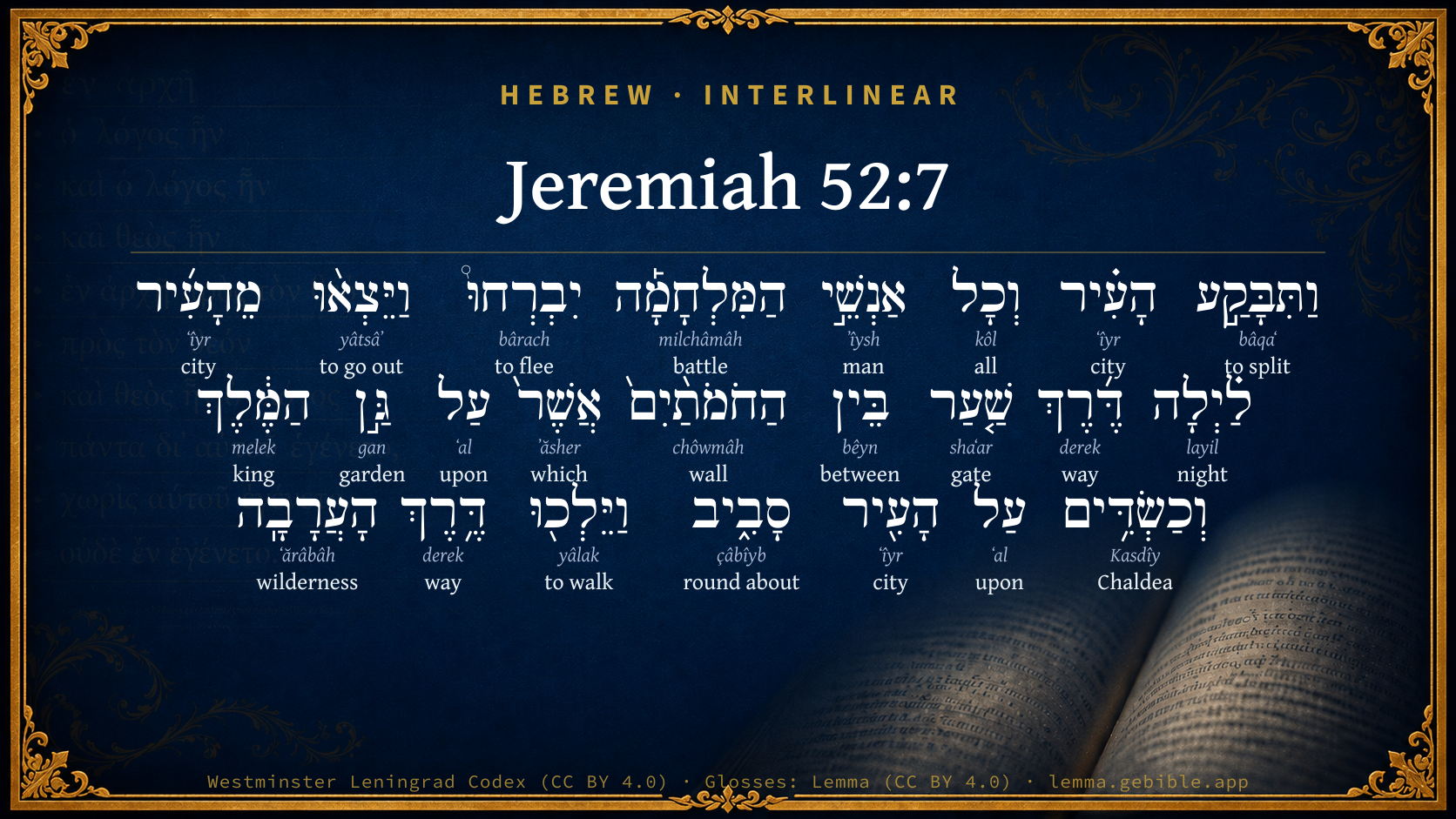
Jeremiah 52:7

Hebrew (Westminster Leningrad Codex) Jeremiah 52:7 appears in the Hebrew Old Testament. The text above is from the Westminster Leningrad Codex. Each word links to its Strong’s number, a concise gloss, and parsing drawn from the Open Scriptures Hebrew Bible morphology. Click any word for its full Brown-Driver-Briggs (BDB) entry.
Download image
Cite this verse

Jeremiah 52:7 (World English Bible). Public Domain. Lemma interlinear Bible study tool, https://lemma.gebible.app/v/jeremiah/52/7.

Show BibTeX & RIS
BibTeX
RIS
English Translation
Then a breach was made in the city, and all the men of war fled, and went forth out of the city by night by the way of the gate between the two walls, which was by the king's garden; (now the Chaldeans were against the city round about;) and they went toward the Arabah.
World English Bible · Public Domain
Download a study sheet

One document with this verse’s original text, its word-by-word gloss line, the meaning frame, cross-references with their text, attributed commentary, and full source and license credits — printable, and it pastes into notes with its structure intact.

This verse Autodidact and up

Study sheet (.html) Plain text (.txt)

A passage Seminary Student

Up to 50 verses in one chapter. A passage sheet keeps up to 6 commentary sources and 12 cross-references per verse, in the order this page ranks them, and says so on the sheet whenever that leaves anything out. Ask for a single verse and you get the Autodidact verse sheet above.

Everything on this page stays free to read, with no account — the sheet is a download of what is already on screen, not access to it.

Want to remove ads? Support Godless Engineer
Compare translations 3

The same verse in 3 English versions, stacked beneath the original-language interlinear above. Click any original word for its lexicon entry.

Each is an independent rendering of the whole verse — the interlinear is not word-aligned to these translations.

Highlighted words mark where these versions differ — a whole-verse word diff, not a word-by-word alignment.

  • World English Bible Public Domain
    Then a breach was made in the city, and all the men of war fled, and went forth out of the city by night by the way of the gate between the two walls, which was by the king's garden; (now the Chaldeans were against the city round about;) and they went toward the Arabah.
  • King James Version Public Domain
    Then the city was broken up, and all the men of war fled, and went forth out of the city by night by the way of the gate between the two walls, which was by the king's garden; (now the Chaldeans were by the city round about:) and they went by the way of the plain.
  • unfoldingWord Literal Text CC BY-SA 4.0
    Then the city was broken into, and all the fighting men fled and went out of the city at night by the way of the gate that was between the two walls, by the king’s garden, although the Chaldeans were all around the city. So they went in the direction of the Arabah.

unfoldingWord Literal Text — © unfoldingWord, licensed CC BY-SA 4.0. Word-aligned USFM3 via Door43 (git.door43.org/unfoldingWord/en_ult).

Versions to compare (up to 4)

3 of 4 selected

Show all 18 translations

Every available English version of this verse, each an independent rendering of the whole verse.

  • World English Bible Public Domain
    Then a breach was made in the city, and all the men of war fled, and went forth out of the city by night by the way of the gate between the two walls, which was by the king's garden; (now the Chaldeans were against the city round about;) and they went toward the Arabah.
  • Berean Standard Bible Public Domain
    Then the city was breached; and though the Chaldeans had surrounded the city, all the men of war fled the city by night by way of the gate between the two walls near the king’s garden. They headed toward the Arabah,
  • Majority Standard Bible Public Domain
    Then the city was breached; and though the Chaldeans had surrounded the city, all the men of war fled the city by night by way of the gate between the two walls near the king’s garden. They headed toward the Arabah,
  • King James Version Public Domain
    Then the city was broken up, and all the men of war fled, and went forth out of the city by night by the way of the gate between the two walls, which was by the king's garden; (now the Chaldeans were by the city round about:) and they went by the way of the plain.
  • American Standard Version (1901) Public Domain
    Then a breach was made in the city, and all the men of war fled, and went forth out of the city by night by the way of the gate between the two walls, which was by the king's garden; (now the Chaldeans were against the city round about;) and they went toward the Arabah.
  • Revised Version (1885) Public Domain
    Then a breach was made in the city, and all the men of war fled, and went forth out of the city by night by the way of the gate between the two walls, which was by the king’s garden; (now the Chaldeans were against the city round about:) and they went by the way of the Arabah.
  • Geneva Bible (1599) Public Domain
    Then the citie was broken vp and all the men of warre fled, and went out of the citie by night, by the way of the gate betweene the two walles, which was by the kings garden: (now the Caldeans were by the citie round about) and they went by the way of the wildernes.
  • Douay-Rheims (1899) Public Domain
    And the city was broken up, and the men of war fled, and went out of the city in the night by the way of the gate that is between the two walls, and leadeth to the king's garden, (the Chaldeans besieging the city round about, ) sad they went by the way that leadeth to the wilderness.
  • Young's Literal Translation Public Domain
    then is the city broken up, and all the men of war flee, and go forth from the city by night, the way of the gate between the two walls, that `is' by the king's garden -- and the Chaldeans `are' by the city round about -- and they go the way of the plain.
  • Literal Standard Version CC BY-SA 4.0
    then the city is broken up, and all the men of war flee, and go forth from the city by night, the way of the gate between the two walls that [is] by the king’s garden—and the Chaldeans [are] by the city all around—and they go the way of the plain.
  • Unlocked Literal Bible CC BY-SA 4.0
    Then the city was broken into, and all the fighting men fled and went out of the city at night by the way of the gate that was between the two walls, by the king's garden, although the Chaldeans were all around the city. So they went in the direction of the Arabah.
  • unfoldingWord Literal Text CC BY-SA 4.0
    Then the city was broken into, and all the fighting men fled and went out of the city at night by the way of the gate that was between the two walls, by the king’s garden, although the Chaldeans were all around the city. So they went in the direction of the Arabah.
  • Darby Bible Public Domain
    And the city was broken into: and all the men of war fled, and went forth out of the city by night, by the way of the gate between the two walls, which was by the king's garden (now the Chaldeans were near the city round about); and they went the way toward the plain.
  • World Messianic Bible Public Domain
    Then a breach was made in the city, and all the men of war fled, and went out of the city by night by the way of the gate between the two walls, which was by the king’s garden. Now the Kasdim were against the city all around. The men of war went toward the Arabah,
  • Webster's Bible Public Domain
    Then the city was broken up, and all the men of war fled, and went forth from the city by night by the way of the gate between the two walls, which was by the king's garden; (now the Chaldeans were by the city on all sides:) and they went by the way of the plain.
  • Free Bible Version CC BY-SA 4.0
    Then the city wall was broken through, and all the soldiers ran away, escaping at night through the gate between the two walls by the king's garden, even though the Babylonians had the city surrounded. They went in the direction of the Arabah,
  • Bible in Basic English Public Domain
    Then an opening was made in the wall of the town, and all the men of war went in flight out of the town by night through the doorway between the two walls which was by the king's garden; (now the Chaldaeans were stationed round the town:) and they went by the way of the Arabah.
  • JPS Tanakh (1917) Public Domain
    Then a breach was made in the city, and all the men of war fled, and went forth out of the city by night by the way of the gate between the two walls, which was by the king's garden — now the Chaldeans were against the city round about — and they went by the way of the Arabah.

Literal Standard Version (2020), Covenant Press — licensed CC BY-SA 4.0. Text via the HelloAO Bible API (eBible.org). Unlocked Literal Bible (unfoldingWord) — licensed CC BY-SA 4.0. Text via the HelloAO Bible API (eBible.org). unfoldingWord Literal Text — © unfoldingWord, licensed CC BY-SA 4.0. Word-aligned USFM3 via Door43 (git.door43.org/unfoldingWord/en_ult). Free Bible Version, Dr. Jonathan Gallagher — licensed CC BY-SA 4.0. Text via the HelloAO Bible API (eBible.org).

Word by word

More ways to search: Search by grammar → Find every occurrence → Compare this word →

Practice this passage: Drill this verse → Learn its vocabulary →

גַּ֣ן
gan
H1588
“garden of”
Noun, Common, Both, Singular, Construct
Part of Speech
Noun
Type
Common
Gender
Both
Number
Singular
State
Construct
Full BDB Definition

Origin: from H1598

TWOT: 367a

garden, enclosure (noun masculine or feminine) - enclosed garden - (figuratively of a bride) - garden (of plants) - Garden of Eden (noun proper locative)
  1. וַתִּבָּקַ֣ע bâqaʻ H1234 “and · to split” Conjunction + Verb, Niphal, Sequential Imperfect, 3rd Person, Feminine, Singular
  2. הָעִ֗יר ʻîyr H5892 “the · city” Particle, Definite Article + Noun, Common, Feminine, Singular, Absolute
  3. וְכָל kôl H3605 “and · all of” Conjunction + Noun, Common, Masculine, Singular, Construct
  4. אַנְשֵׁ֣י ʼîysh H376 “men of” Noun, Common, Masculine, Plural, Construct
  5. הַמִּלְחָמָ֡ה milchâmâh H4421 “the · battle” Particle, Definite Article + Noun, Common, Feminine, Singular, Absolute
  6. יִבְרְחוּ֩ bârach H1272 “to flee” Verb, Qal, Imperfect, 3rd Person, Masculine, Plural
  7. וַיֵּצְא֨וּ yâtsâʼ H3318 “and · to go out” Conjunction + Verb, Qal, Sequential Imperfect, 3rd Person, Masculine, Plural
  8. מֵהָעִ֜יר ʻîyr H5892 “from · the · city” Preposition + Particle, Definite Article + Noun, Common, Feminine, Singular, Absolute
  9. לַ֗יְלָה layil H3915 “night” Noun, Common, Masculine, Singular, Absolute
  10. דֶּ֜רֶךְ derek H1870 “way of” Noun, Common, Both, Singular, Construct
  11. שַׁ֤עַר shaʻar H8179 “gate” Noun, Common, Masculine, Singular, Absolute
  12. בֵּין bêyn H996 “between” Preposition
  13. הַחֹמֹתַ֨יִם֙ chôwmâh H2346 “the · walls” Particle, Definite Article + Noun, Common, Feminine, Dual, Absolute
  14. אֲשֶׁר֙ ʼăsher H834 “which” Particle, Relative
  15. עַל ʻal H5921 “upon” Preposition
  16. הַמֶּ֔לֶךְ melek H4428 “the · king” Particle, Definite Article + Noun, Common, Masculine, Singular, Absolute
  17. וְכַשְׂדִּ֥ים Kasdîy H3778 “and · Chaldea” Conjunction + Noun, Proper
  18. עַל ʻal H5921 “upon” Preposition
  19. הָעִ֖יר ʻîyr H5892 “the · city” Particle, Definite Article + Noun, Common, Feminine, Singular, Absolute
  20. סָבִ֑יב çâbîyb H5439 “round about” Noun, Common, Both, Singular, Absolute
  21. וַיֵּלְכ֖וּ yâlak H3212 “and · to walk” Conjunction + Verb, Qal, Sequential Imperfect, 3rd Person, Masculine, Plural
  22. דֶּ֥רֶךְ derek H1870 “way of” Noun, Common, Both, Singular, Construct
  23. הָעֲרָבָֽה ʻărâbâh H6160 “the · wilderness” Particle, Definite Article + Noun, Common, Feminine, Singular, Absolute

About this verse

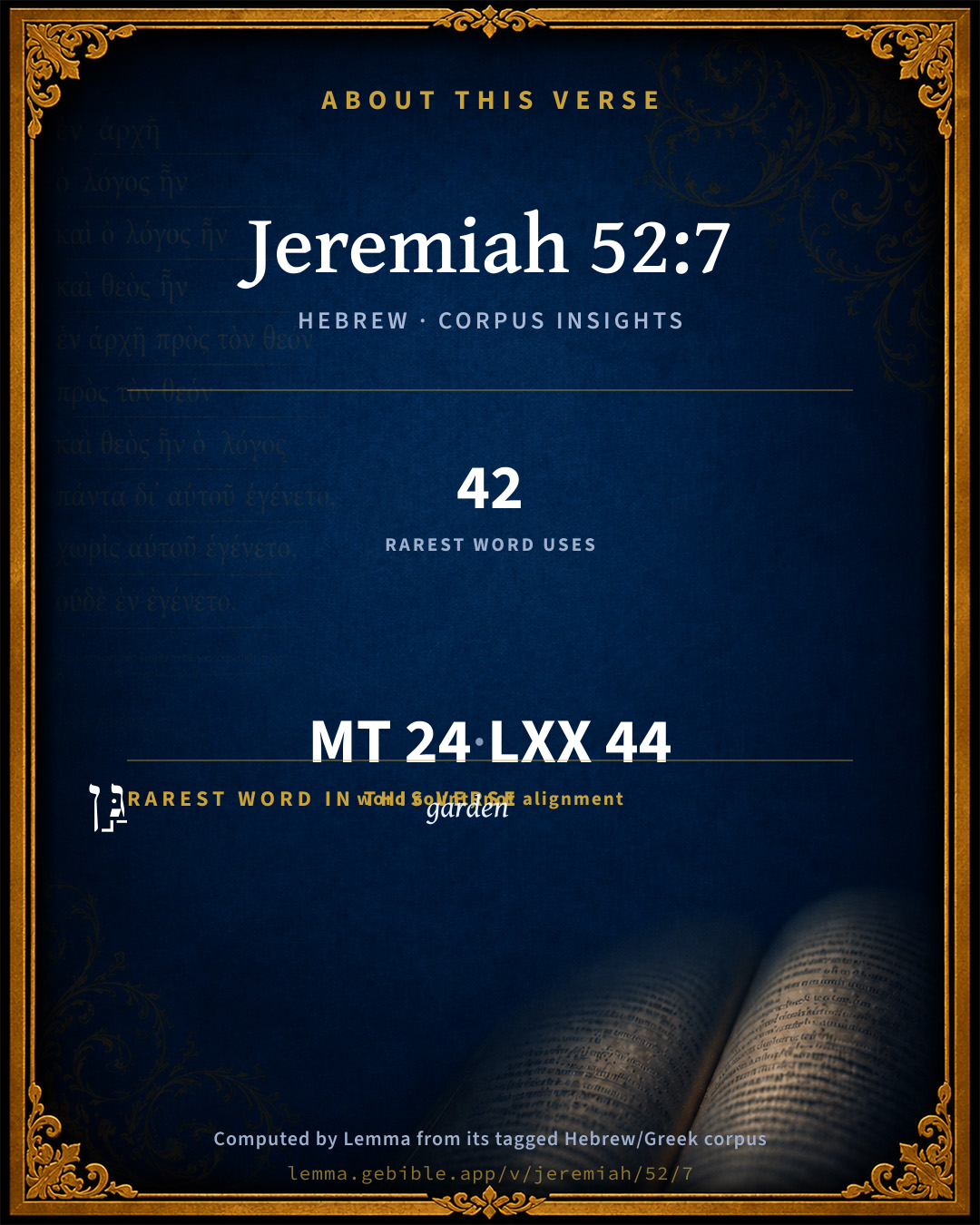
These counts appear in no published source. They are computed here, from the morphology-tagged text and Lemma’s own curated glosses. What Lemma adds →

24
words
20
distinct lemmas
Prophets
section

Shared distinctive vocabulary

גַּ֣ן garden H1588 occurs in 37 verses of the Hebrew Bible. Also found in:

Grammatical profile

  • 4 verbs
  • 16 nouns
  • 3 prepositions
  • 1 particle

Verb forms

  • וַתִּבָּקַ֣ע Niphal · Sequential Imperfect
  • יִבְרְחוּ֩ Qal · Imperfect
  • וַיֵּצְא֨וּ Qal · Sequential Imperfect
  • וַיֵּלְכ֖וּ Qal · Sequential Imperfect

Repetition

Words recur within this verse — often emphatic in Hebrew:

  • הָעִ֗יר city H5892 ×3
  • דֶּ֜רֶךְ way H1870 ×2
  • עַל upon H5921 ×2

Hebrew & Septuagint length

In the original languages it is 24 Hebrew tokens and 44 Greek tokens — but the two are counted differently (Hebrew bundles its prefixes and suffixes into one token; the Greek is in lemma form), so that isn’t a like-for-like length.

Cross-references

10

Topical passages linked to Jeremiah 52:7 in the Treasury of Scripture Knowledge — connected by theme and wording, ordered by reader-vote popularity; previews shown in the World English Bible.

  • 2 Kings 25:4 Then a breach was made in the city, and all the men of war [fled] by night by the way of the gate between the two walls, which was by the king's garden (now the Chaldeans were against the city round about); and [the king] went by the way of the Arabah.
  • Jeremiah 39:4–7 It happened that, when Zedekiah the king of Judah and all the men of war saw them, then they fled, and went forth out of the city by night, by the way of the king's garden, through the gate between the two walls; and he went out toward the Arabah.
  • Jeremiah 51:32 and the passages are seized, and the reeds they have burned with fire, and the men of war are frightened.
  • Leviticus 26:17 I will set my face against you, and you will be struck before your enemies. Those who hate you will rule over you; and you will flee when no one pursues you.
  • Leviticus 26:36 "'As for those of you who are left, I will send a faintness into their hearts in the lands of their enemies: and the sound of a driven leaf will put them to flight; and they shall flee, as one flees from the sword; and they will fall when no one pursues.
  • Deuteronomy 28:25 Yahweh will cause you to be struck before your enemies; you shall go out one way against them, and shall flee seven ways before them: and you shall be tossed back and forth among all the kingdoms of the earth.
  • Deuteronomy 32:30 How should one chase a thousand, Two put ten thousand to flight, Except their Rock had sold them, Yahweh had delivered them up?
  • Joshua 7:8–12 Oh, Lord, what shall I say, after that Israel has turned their backs before their enemies!
  • Jeremiah 34:2–3 Thus says Yahweh, the God of Israel, Go, and speak to Zedekiah king of Judah, and tell him, Thus says Yahweh, Behold, I will give this city into the hand of the king of Babylon, and he shall burn it with fire:
  • Jeremiah 49:26 Therefore her young men shall fall in her streets, and all the men of war shall be brought to silence in that day, says Yahweh of Hosts.

Cross-references courtesy of OpenBible.info (CC BY 4.0).

Hebrew and Greek witnesses Masoretic Hebrew ↔ Greek Septuagint

The same verse in the two great witnesses to the Old Testament, shown verse-for-verse.

These are two independent witnesses, not word-aligned to each other, and the Septuagint is shown in lemma (dictionary) form.

Hebrew Jeremiah 52:7 Masoretic · Westminster Leningrad Codex

וַתִּבָּקַ֣ע הָעִ֗יר וְכָל אַנְשֵׁ֣י הַמִּלְחָמָ֡ה יִבְרְחוּ֩ וַיֵּצְא֨וּ מֵהָעִ֜יר לַ֗יְלָה דֶּ֜רֶךְ שַׁ֤עַר בֵּין הַחֹמֹתַ֨יִם֙ אֲשֶׁר֙ עַל גַּ֣ן הַמֶּ֔לֶךְ וְכַשְׂדִּ֥ים עַל הָעִ֖יר סָבִ֑יב וַיֵּלְכ֖וּ דֶּ֥רֶךְ הָעֲרָבָֽה

Then a breach was made in the city, and all the men of war fled, and went forth out of the city by night by the way of the gate between the two walls, which was by the king's garden; (now the Chaldeans were against the city round about;) and they went toward the Arabah.

World English Bible · Public Domain

Greek LXX Structure differs

In the Septuagint, Jeremiah is about an eighth shorter than the Hebrew and arranges its material differently — the Oracles Against the Nations (Hebrew chapters 46–51) appear in the middle of the Greek book, after 25:13. Because the chapter and verse boundaries do not line up, a verse-for-verse comparison with the Hebrew is not shown.

A verse-for-verse comparison isn’t shown here because the chapters and verses don’t line up. Switch to the LXX edition with the MT / LXX toggle above to read the Greek directly.

Hebrew: Westminster Leningrad Codex (CC BY 4.0). Greek: Septuagint (public domain); English from a public-domain English Septuagint. How the Septuagint differs from the Hebrew →

Targum (Aramaic paraphrase)

1

The Targum is the ancient Jewish Aramaic paraphrase of the Hebrew Scriptures — an interpretive translation, not the Hebrew text itself. Onkelos (literal) and Pseudo-Jonathan (expansive) render the Torah, and Jonathan the Prophets. Coverage is partial: where no permissively-licensed English translation exists for a verse, only the Aramaic is shown. This is verse-level text, not a word-by-word alignment to the Hebrew.

  1. Targum Jonathan Prophets (Joshua–Malachi)
    וְאִתְּרַעַת קַרְתָּא וְכָל גַבְרֵי עָבְדֵי קְרָבָא עֲרָקוּ וּנְפָקוּ מִן קַרְתָּא בְּלֵילְיָא בְּאוֹרַח תְּרַע בֵּין שׁוּרַיָא דִי עַל גִנְתָא דְמַלְכָּא וְכַסְדָאֵי שָׁרָן עַל קַרְתָּא סְחוֹר סְחוֹר וַאֲזַלוּ בְּאוֹרַח מֵישְׁרָא:

    (no public-domain English translation for this verse)

    Targum Jonathan — Aramaic: “Mikraot Gedolot” (public domain). English: “Sefaria Community Translation” (CC0 1.0 (public-domain dedication)); “London "Chaldee Paraphrase," 1871” (public domain). Text via Sefaria.

Commentary

Notes on Jeremiah 52:7 from classic Christian and Jewish commentators (each source and its license shown beneath its notes). The classic Christian expositions comment on the surrounding passage and are grouped to its opening verse, so a note may address several verses; the Jewish commentaries on the Tanakh (Rashi and others) are per-verse, so they appear only where the commentator wrote on this verse.

Lemma curates 59 commentaries, every one of them public domain or Creative Commons licensed, each selected and text-cleaned for this edition rather than reprinted as found. About our sources →

Geneva Bible (1599)

Geneva Bible translators

Read Jer. 39:4.

Geneva Bible (1599) marginal notes — public domain. Text via Bolls.life.

Jamieson, Fausset & Brown

Robert Jamieson, A. R. Fausset & David Brown

(See on Jer 39:4).

Jamieson, Fausset & Brown — Commentary Critical and Explanatory on the Whole Bible (1871) — public domain (CC PDM 1.0). Text via the HelloAO Bible API.

Ellicott's Commentary for English Readers

(7) Went forth out of the city.—Omitted in 2Ki_25:4.

They went by the way of the plain.—In 2Ki_25:4 “the king (not in the Hebrew) went (verb in the singular) the way toward the plain.”

A Bible Commentary for English Readers, edited by Charles John Ellicott (1878–1897) — public domain. Text from a community e-Sword module.

The Cambridge Bible for Schools and Colleges

gen. ed. J. J. S. Perowne

7. See on Jer_39:4.

The Cambridge Bible for Schools and Colleges (gen. ed. J. J. S. Perowne; Cambridge University Press, 1878–1918) — public domain. Text from a community e-Sword module.

John Gill's Exposition

But the army of the Chaldeans pursued after the king,.... Not finding him in his palace, and being informed of his flight, and which way he took:

and overtook Zedekiah in the plains of Jericho: See Gill on Jer 39:5;

and all his army was scattered from him; when they saw the enemy pursuing them, and near unto them, they left him, as Josephus (q) says, and shifted for themselves.

(q) Ibid. (Antiqu. l. 10. c. 8. sect. 2. Ed. Hudson.)

John Gill's Exposition of the Whole Bible (1746–1763) — public domain (CC PDM 1.0). Text via the HelloAO Bible API.

Albert Barnes' Notes on the Bible

Broken up ... the plain - Or, “broken into ... the Arabah” Deu 1:1.

Albert Barnes' Notes on the Bible (1834–1885) — public domain. Text from a community e-Sword/MySword module.

The Pulpit Commentary

Broken up; rather, broken into. The plain. The Hebrew has," the Arabah," the name constantly given to the chalky depression in the midst of which the Jordan ran.

The Pulpit Commentary (1880–1919), ed. H.D.M. Spence-Jones & Joseph S. Exell — public domain. Text from a community e-Sword module.

Lesson kit

Teaching starters — assembled from the data on this page, not authored interpretation. Every prompt links to the verse data it draws on. Edit before teaching.

Jeremiah, in the Prophets, opens this verse with 24 words (20 distinct Hebrew lemmas). Its most distinctive word is gan (“garden”). A historical commentator’s framing appears above. Read the whole chapter for the surrounding context.

Discussion questions

  1. How does “garden” (gan) shape what this verse is saying?
  2. How does Genesis 2:8, which shares the word «garden», read alongside this verse?
  3. What does the repetition of “city” (3× in this one verse) do in this verse?
  4. These translations render this verse differently. What is at stake in choosing one wording over another?
  5. «וַתִּבָּקַ֣ע» is a Niphal Sequential Imperfect verb. How does that grammatical form shape the action described?
  6. Compare how Geneva Bible (1599) and Jamieson, Fausset & Brown read this verse. Where do they agree or differ?

Things to notice

Reading settings

Reading text

Shown beneath each verse's original-language words.

Old Testament
Old Testament edition

Read the OT as the Masoretic Hebrew (MT) or the Greek Septuagint (LXX).

English shown for the Greek Septuagint (in the Hebrew ↔ Greek comparison).

Comparing translations? Open the Compare panel on any verse page to stack up to four side by side.