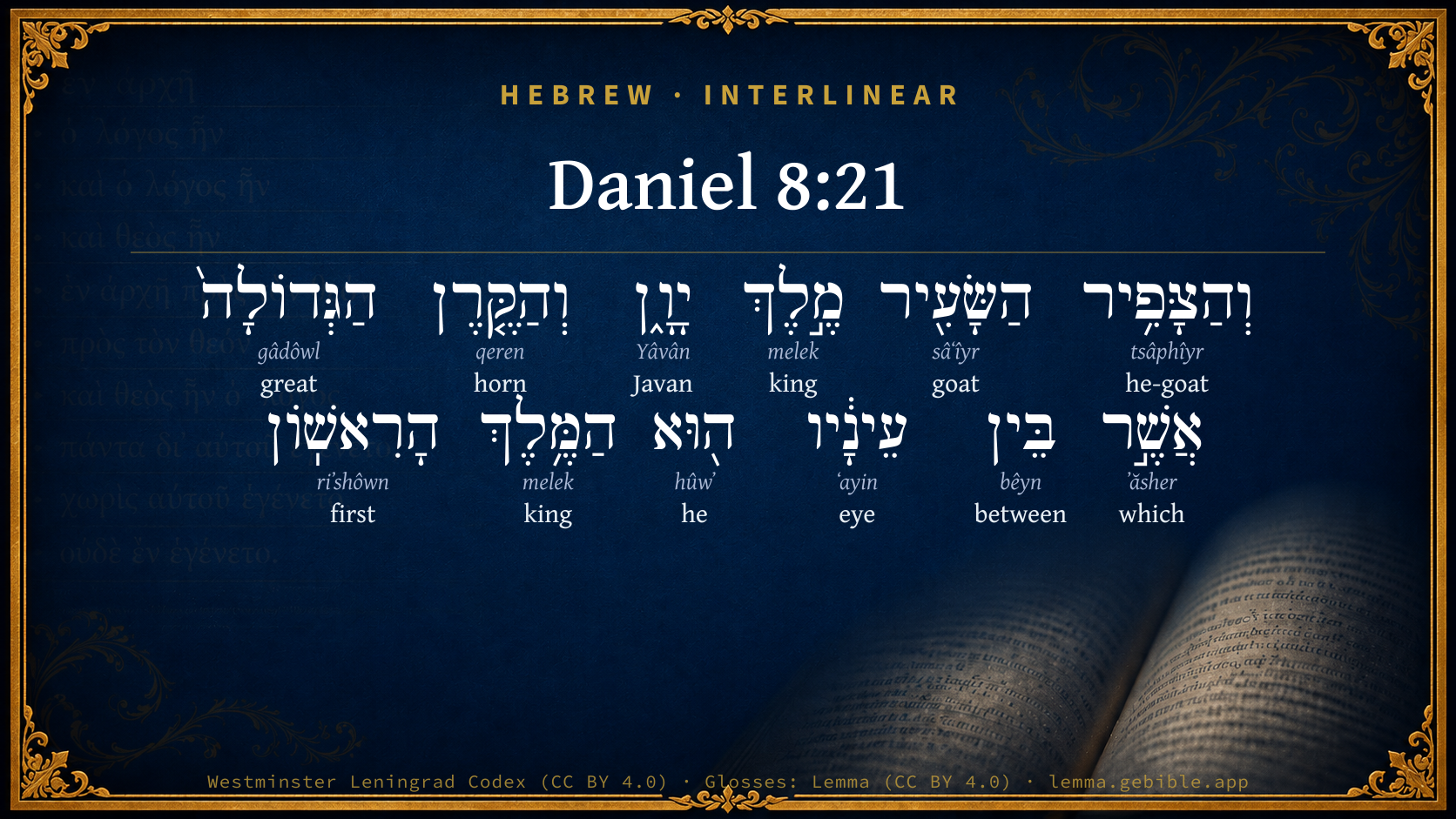
Daniel 8:21

Hebrew (Westminster Leningrad Codex) Daniel 8:21 appears in the Hebrew Old Testament. The text above is from the Westminster Leningrad Codex. Each word links to its Strong’s number, a concise gloss, and parsing drawn from the Open Scriptures Hebrew Bible morphology. Click any word for its full Brown-Driver-Briggs (BDB) entry.
Download image
Cite this verse

Daniel 8:21 (World English Bible). Public Domain. Lemma interlinear Bible study tool, https://lemma.gebible.app/v/daniel/8/21.

Show BibTeX & RIS
BibTeX
RIS
English Translation
The rough male goat is the king of Greece: and the great horn that is between his eyes is the first king.
World English Bible · Public Domain
Download a study sheet

One document with this verse’s original text, its word-by-word gloss line, the meaning frame, cross-references with their text, attributed commentary, and full source and license credits — printable, and it pastes into notes with its structure intact.

This verse Autodidact and up

Study sheet (.html) Plain text (.txt)

A passage Seminary Student

Up to 50 verses in one chapter. A passage sheet keeps up to 6 commentary sources and 12 cross-references per verse, in the order this page ranks them, and says so on the sheet whenever that leaves anything out. Ask for a single verse and you get the Autodidact verse sheet above.

Everything on this page stays free to read, with no account — the sheet is a download of what is already on screen, not access to it.

Want to remove ads? Support Godless Engineer
Compare translations 3

The same verse in 3 English versions, stacked beneath the original-language interlinear above. Click any original word for its lexicon entry.

Each is an independent rendering of the whole verse — the interlinear is not word-aligned to these translations.

Highlighted words mark where these versions differ — a whole-verse word diff, not a word-by-word alignment.

  • World English Bible Public Domain
    The rough male goat is the king of Greece: and the great horn that is between his eyes is the first king.
  • King James Version Public Domain
    And the rough goat is the king of Grecia: and the great horn that is between his eyes is the first king.
  • unfoldingWord Literal Text CC BY-SA 4.0
    The shaggy goat is the king of Greece, and the large horn that is between his eyes is the first king.

unfoldingWord Literal Text — © unfoldingWord, licensed CC BY-SA 4.0. Word-aligned USFM3 via Door43 (git.door43.org/unfoldingWord/en_ult).

Versions to compare (up to 4)

3 of 4 selected

Show all 18 translations

Every available English version of this verse, each an independent rendering of the whole verse.

  • World English Bible Public Domain
    The rough male goat is the king of Greece: and the great horn that is between his eyes is the first king.
  • Berean Standard Bible Public Domain
    The shaggy goat represents the king of Greece, and the large horn between his eyes is the first king.
  • Majority Standard Bible Public Domain
    The shaggy goat represents the king of Greece, and the large horn between his eyes is the first king.
  • King James Version Public Domain
    And the rough goat is the king of Grecia: and the great horn that is between his eyes is the first king.
  • American Standard Version (1901) Public Domain
    And the rough he-goat is the king of Greece: and the great horn that is between his eyes is the first king.
  • Revised Version (1885) Public Domain
    And the rough he-goat is the king of Greece: and the great horn that is between his eyes is the first king.
  • Geneva Bible (1599) Public Domain
    And the goate is the King of Grecia, and the great horne that is betweene his eyes, is the first King.
  • Douay-Rheims (1899) Public Domain
    And the he goat, is the king of the Greeks, and the great horn that was between his eyes, the same is the first king.
  • Young's Literal Translation Public Domain
    And the young he-goat, the hairy one, `is' the king of Javan; and the great horn that `is' between its eyes is the first king;
  • Literal Standard Version CC BY-SA 4.0
    And the young male goat, the hairy one, [is] the king of Javan; and the great horn that [is] between its eyes is the first king;
  • Unlocked Literal Bible CC BY-SA 4.0
    The male goat is the king of Greece. The large horn between his eyes is the first king.
  • unfoldingWord Literal Text CC BY-SA 4.0
    The shaggy goat is the king of Greece, and the large horn that is between his eyes is the first king.
  • Darby Bible Public Domain
    And the rough goat is the king of Greece; and the great horn that was between his eyes is the first king.
  • World Messianic Bible Public Domain
    The rough male goat is the king of Greece. The great horn that is between his eyes is the first king.
  • Webster's Bible Public Domain
    And the rough goat is the king of Grecia: and the great horn that is between his eyes is the first king.
  • Free Bible Version CC BY-SA 4.0
    The male goat is the kingdom of Greece, and the large horn between its eyes is its first king.
  • Bible in Basic English Public Domain
    And the he-goat is the king of Greece: and the great horn between his eyes is the first king.
  • JPS Tanakh (1917) Public Domain
    And the rough he-goat is the king of Greece; and the great horn that is between his eyes is the first king.

Literal Standard Version (2020), Covenant Press — licensed CC BY-SA 4.0. Text via the HelloAO Bible API (eBible.org). Unlocked Literal Bible (unfoldingWord) — licensed CC BY-SA 4.0. Text via the HelloAO Bible API (eBible.org). unfoldingWord Literal Text — © unfoldingWord, licensed CC BY-SA 4.0. Word-aligned USFM3 via Door43 (git.door43.org/unfoldingWord/en_ult). Free Bible Version, Dr. Jonathan Gallagher — licensed CC BY-SA 4.0. Text via the HelloAO Bible API (eBible.org).

Word by word

More ways to search: Search by grammar → Find every occurrence → Compare this word →

Practice this passage: Drill this verse → Learn its vocabulary →

וְהַצָּפִ֥יר
tsâphîyr
H6842
“and · the · he-goat”
Conjunction + Particle, Definite Article + Noun, Common, Masculine, Singular, Absolute
Part of Speech
Conjunction + Particle + Noun
Type
Common
Gender
Masculine
Number
Singular
State
Absolute
Full BDB Definition

Origin: from H6852

TWOT: 1962a

he-goat
  1. הַשָּׂעִ֖יר sâʻîyr H8163 “the · goat” Particle, Definite Article + Adjective, Adjective, Masculine, Singular, Absolute
  2. מֶ֣לֶךְ melek H4428 “king of” Noun, Common, Masculine, Singular, Construct
  3. יָוָ֑ן Yâvân H3120 “Javan” Noun, Proper
  4. וְהַקֶּ֤רֶן qeren H7161 “and · the · horn” Conjunction + Particle, Definite Article + Noun, Common, Both, Singular, Absolute
  5. הַגְּדוֹלָה֙ gâdôwl H1419 “the · great” Particle, Definite Article + Adjective, Adjective, Feminine, Singular, Absolute
  6. אֲשֶׁ֣ר ʼăsher H834 “which” Particle, Relative
  7. בֵּין bêyn H996 “between” Preposition
  8. עֵינָ֔יו ʻayin H5869 “eyes · his” Noun, Common, Both, Dual, Construct + Suffix, Personal, 3rd Person, Masculine, Singular
  9. ה֖וּא hûwʼ H1931 “he” Pronoun, Personal, 3rd Person, Masculine, Singular
  10. הַמֶּ֥לֶךְ melek H4428 “the · king” Particle, Definite Article + Noun, Common, Masculine, Singular, Absolute
  11. הָרִאשֽׁוֹן riʼshôwn H7223 “the · first” Particle, Definite Article + Adjective, Ordinal number, Masculine, Singular, Absolute

About this verse

These counts appear in no published source. They are computed here, from the morphology-tagged text and Lemma’s own curated glosses. What Lemma adds →

12
words
11
distinct lemmas
Prophets
section

Notable vocabulary

The rarest word here is וְהַצָּפִ֥יר he-goat H6842 — appearing just 6 times in the whole Hebrew Bible.

Shared distinctive vocabulary

וְהַצָּפִ֥יר he-goat H6842 occurs in 5 verses of the Hebrew Bible. Also found in:

Grammatical profile

  • 6 nouns
  • 3 adjectives
  • 1 pronoun
  • 1 preposition
  • 1 particle

Repetition

A word recurs within this verse — often emphatic in Hebrew:

  • מֶ֣לֶךְ king H4428 ×2

Hebrew & Septuagint length

In English translation the verse runs 22 words from the Hebrew and 22 from the Septuagint (LXX English) — the same length.

A rough comparison of the two English renderings, which tokenize alike — not a word-level alignment.

Word counts can differ between the Hebrew and the Greek without any difference in meaning — e.g. the Hebrew direct-object marker אֵת has no separate Greek word, and Greek often adds the article ὁ.

Cross-references

3

Topical passages linked to Daniel 8:21 in the Treasury of Scripture Knowledge — connected by theme and wording, ordered by reader-vote popularity; previews shown in the World English Bible.

  • Daniel 10:20 Then he said, "Do you know why I have come to you? Now I will return to fight with the prince of Persia. When I go forth, behold, the prince of Greece shall come.
  • Daniel 11:3 A mighty king shall stand up, who shall rule with great dominion, and do according to his will.
  • Daniel 8:5–8 As I was considering, behold, a male goat came from the west over the surface of the whole earth, and didn't touch the ground: and the goat had a notable horn between his eyes.

Cross-references courtesy of OpenBible.info (CC BY 4.0).

Hebrew and Greek witnesses Masoretic Hebrew ↔ Greek Septuagint

The same verse in the two great witnesses to the Old Testament, shown verse-for-verse.

These are two independent witnesses, not word-aligned to each other, and the Septuagint is shown in lemma (dictionary) form.

Hebrew Daniel 8:21 Masoretic · Westminster Leningrad Codex

וְהַצָּפִ֥יר הַשָּׂעִ֖יר מֶ֣לֶךְ יָוָ֑ן וְהַקֶּ֤רֶן הַגְּדוֹלָה֙ אֲשֶׁ֣ר בֵּין עֵינָ֔יו ה֖וּא הַמֶּ֥לֶךְ הָרִאשֽׁוֹן

The rough male goat is the king of Greece: and the great horn that is between his eyes is the first king.

World English Bible · Public Domain

Greek LXX Daniel 8:21 Septuagint · lemma form

καί ὁ τράγος ὁ αἴξ βασιλεύς ὁ ἕλλην εἰμί καί ὁ κέρας ὁ μέγας ὁ ἀνά μέσος ὁ ὀφθαλμός αὐτός αὐτός ὁ βασιλεύς ὁ πρῶτος

The he-goat is the King of the Greeks: and the great horn which was between his eyes, he is the first king.

LXX2012 (modern English Septuagint) · Public Domain

Hebrew: Westminster Leningrad Codex (CC BY 4.0). Greek: Septuagint (public domain); English from LXX2012 (modern English Septuagint) (Public Domain). How the Septuagint differs from the Hebrew →

Commentary

Notes on Daniel 8:21 from classic Christian and Jewish commentators (each source and its license shown beneath its notes). The classic Christian expositions comment on the surrounding passage and are grouped to its opening verse, so a note may address several verses; the Jewish commentaries on the Tanakh (Rashi and others) are per-verse, so they appear only where the commentator wrote on this verse.

Lemma curates 59 commentaries, every one of them public domain or Creative Commons licensed, each selected and text-cleaned for this edition rather than reprinted as found. About our sources →

Trapp's Complete Commentary

John Trapp

Dan 8:21 And the rough goat [is] the king of Grecia: and the great horn that [is] between his eyes [is] the first king.

Ver. 21. And the rough goat.] Hirtus hircus. See on Dan 8:5.

John Trapp, A Commentary or Exposition upon All the Books of the Old and New Testament (1647–1656) — public domain. Text from a community e-Sword module.

Tyndale Open Study Notes

Tyndale Open Resources

8:21 The large horn represents Alexander the Great, the mighty first king who forged the Greek Empire. Two centuries after Daniel, Alexander would swiftly conquer the world (8:5); he overcame Persia in 331 BC. Alexander died in 323 BC at the age of thirty-three, but not before he arrogantly allowed himself to be called a god. • Josephus records that some Jewish priests showed the book of Daniel to Alexander, but Alexander treated Homer’s Iliad as his Bible and relied on it for guidance.

Tyndale Open Study Notes — © Tyndale Open Resources, licensed CC BY-SA 4.0. Text via the HelloAO Bible API.

Jamieson, Fausset & Brown

Robert Jamieson, A. R. Fausset & David Brown

the first king--Philip was king of Macedon before Alexander, but the latter was the first who, as a generalissimo of Greece, subdued the Persian empire.

Jamieson, Fausset & Brown — Commentary Critical and Explanatory on the Whole Bible (1871) — public domain (CC PDM 1.0). Text via the HelloAO Bible API.

John Calvin's Commentaries

By the word “Javan” the Hebrews designate not only the Greeks but the: Macedonians, and the whole of that tract which is divided by the Hellespont, from Asia Minor as far as Illyricmn. Therefore the meaning is — the king of Greece.

John Calvin's Commentaries (1540-1563) — public domain. Text from the Calvin Translation Society English edition (1840s-50s) via the Christian Classics Ethereal Library (ccel.org). Calvin's coverage is partial (roughly two-thirds of the Bible); uncommented books and verses are honest gaps, never fabricated. The 19th-century editor's footnotes and remarks are omitted so the notes are faithfully Calvin's own voice.

The Cambridge Bible for Schools and Colleges

gen. ed. J. J. S. Perowne

21. the rough he-goat] Dan_8:5. The word rendering ‘rough’ (sâ‘îr), treated as a subst., is the usual old Hebrew word for a he-goat (Gen_37:31, &c.): the word here rendered ‘he-goat’ (ṣâphîr) being properly the Aramaic word for the same animal (Ezr_6:17, and in the Targums), and being found in Heb. only in late passages (Dan_8:5; Dan_8:8; 2Ch_29:21; Ezr_8:35). Perhaps, therefore, sâ‘îr is not intended here to be an adj., but is simply the old Heb. synonym of ṣâphîr, added by way of explanation; and the whole expression should be rendered simply the he-goat.

Grecia] or, as we should now say, Greece. So Dan_10:20; Dan_11:2 (but Zec_9:13 ‘Greece’); and similarly Grecians for Greeks, Joe_3:6, Act_6:1 al. The Heb. (both here and elsewhere) is Yavan, Gen_10:2; Gen_10:4 = 1Ch_1:5; 1Ch_1:7; Isa_66:19; Eze_27:13; Eze_27:19 (?), i.e. Ἰάϝων, Ἰάϝον-ες, the name by which the ‘Greeks’ were known also to the Assyrians and Egyptians. The reason is to be found in the fact that the ‘Ionians’ on the west coast of Asia Minor were that branch of the Greeks which was the earliest to develope civilization, and to engage extensively in commerce; it was thus the first to become generally known in the Eastern world.

the first king] i.e. Alexander the Great.

The Cambridge Bible for Schools and Colleges (gen. ed. J. J. S. Perowne; Cambridge University Press, 1878–1918) — public domain. Text from a community e-Sword module.

John Gill's Exposition

And the rough goat is the king of Grecia,.... Including all the kings of it, from Alexander to the end of the Grecian monarchy; or rather the kingdom of Greece, which began in him, and continued until it was destroyed by the Romans: this was signified by the rough or hairy goat, especially when Alexander was at the head of it, for his strength and prowess, his swiftness in his marches over rocks and mountains, his majesty and grandeur, and also his lust and uncleanness; See Gill on Dan 8:5,

and the great host that is between his eyes is the first king; this is Alexander, who, though he was not the first king of Macedon, his father Philip, and others, were kings before him; yet was the first king of the Grecian monarchy, which took place on the Persian monarchy being destroyed by him.

John Gill's Exposition of the Whole Bible (1746–1763) — public domain (CC PDM 1.0). Text via the HelloAO Bible API.

Albert Barnes' Notes on the Bible

And the rough goat - See the notes at Dan 8:5. In Dan 8:5 he is called a he-goat. Here the word rough or hairy - שׂעיר s'â‛ı̂yr - is applied to it. This appellation is often given to a goat Lev 4:24; Lev 16:9; Gen 37:31. It would seem that either term - a he-goat, or a hairy-goat - would serve to designate the animal, and it is probable that the terms were used indiscriminately.

Is the king of Grecia - Represents the king of Greece. The word here rendered Grecia (יון yâvân) denotes usually and properly Ionia, the western part of Asia Minor; but this name was extended so as to embrace the whole of Greece. See Aristoph. Acharn. 504, ibique Schol.; AEschyl. Pers. 176, 561; Gesenius, Lexicon Latin Vulgate and Theodotion, here render it “the king of the Grecians,” and there can be no doubt that the royal power among the Greeks is here referred to. See the notes at Dan 8:5.

And the great horn that is between his eyes is the first king - Alexander the Great. The first that consolidated the whole power, and that was known in the East as the king of Greece. So he is expressly called in 1 Macc. 1:1: “The first over Greece.” Philip, his father, was opposed in his attempts to conquer Greece, and was defeated. Alexander invaded Greece, burned Thebes, compelled the Athenians to submit, and was declared generalissimo of the Grecian forces against the Persians.

Albert Barnes' Notes on the Bible (1834–1885) — public domain. Text from a community e-Sword/MySword module.

Haydock's Catholic Bible Commentary

Is. Hebrew: "are the kings," (Haydock) including all. (ver. 3.)

George Leo Haydock (1774–1849), Haydock's Catholic Family Bible and Commentary, 1859 edition — public domain. Excludes Psalms (Douay-Rheims chapter numbering differs from Protestant) and Deuterocanonical books (Catholic canon only).

Matthew Poole's English Annotations

The king of Grecia; of Javan, or Ion, or Joan, which properly is Asia the Less, which was inhabited by Javan, Gen 10:2, but spread over all Greece, and all spake Greek, and the sea was thence called the Ionian Sea, See more in Bochart.

The first king, i.e. Alexander the Great; called the Great from his great power, success, and possessions; and the

first king, i.e. in Asia, and by his exploits and victories over the Persian monarchy; for else there were other kings of Greece before him, but none of them in the sense aforesaid.

Matthew Poole's English Annotations on the Holy Bible (1683–1685) — public domain. Text from a community e-Sword/MySword module.

The Pulpit Commentary

And the rough goat is the King of Grecia; and the great horn that is between his eyes is the first king. Again all the versions agree in omitting the word "rough," and in inserting "of the goats," as in the fifth verse. The authority of these is much too great to be resisted. The Massoretic reading is probably due to a confluence of readings, as the word translated "rough" also means "goats." The omission of the word "of the goats" is probably due to the inclusion of ryic; (sa"eer). Here, as in the previous case, "king" stands for dynasty; and this is proved by the fact that there is implied a series of kings, of whom the great horn is the first.

The Pulpit Commentary (1880–1919), ed. H.D.M. Spence-Jones & Joseph S. Exell — public domain. Text from a community e-Sword module.

Scofield Reference Notes

C. I. Scofield

first king

i.e. Alexander the Great.

The Scofield Reference Bible (1917 edition), notes by C. I. Scofield — public domain. Text from a community e-Sword module.

Rashi

Rabbi Shlomo Yitzchaki (Rashi)

the first king He is Alexander of Macedon who slew Darius, the son of Esther, as we find in the book of Josiphon (ch. 9).

Rashi on the Tanakh — English translations: “The Judaica Press complete Tanach with Rashi, translated by A. J. Rosenberg” (CC BY 4.0); “Pentateuch with Rashi's commentary by M. Rosenbaum and A.M. Silbermann, 1929-1934” (public domain); “The Metsudah Tanach series, Lakewood, N.J” (CC BY 4.0); and “The Book of Joshua, Metsudah Publications, 1997” (CC BY 4.0). Text via Sefaria.

Lesson kit

Teaching starters — assembled from the data on this page, not authored interpretation. Every prompt links to the verse data it draws on. Edit before teaching.

Daniel, in the Prophets, opens this verse with 12 words (11 distinct Hebrew lemmas). Its most distinctive word is tsâphîyr (“he-goat”). A historical commentator’s framing appears above. Read the whole chapter for the surrounding context.

Discussion questions

  1. The word tsâphîyr carries the sense “he-goat.” How does it shape the verse?
  2. 2 Chronicles 29:21 shares the word «he-goat» with this verse. How do the two illuminate each other?
  3. “king” occurs 2× in this one verse. What is the effect of the repetition?
  4. These translations render this verse differently. What is at stake in choosing one wording over another?
  5. Reading how Trapp's Complete Commentary and Tyndale Open Study Notes read this verse, where do the two commentators agree and where do they part?

Things to notice

Reading settings

Reading text

Shown beneath each verse's original-language words.

Old Testament
Old Testament edition

Read the OT as the Masoretic Hebrew (MT) or the Greek Septuagint (LXX).

English shown for the Greek Septuagint (in the Hebrew ↔ Greek comparison).

Comparing translations? Open the Compare panel on any verse page to stack up to four side by side.