
Ezekiel 19:11

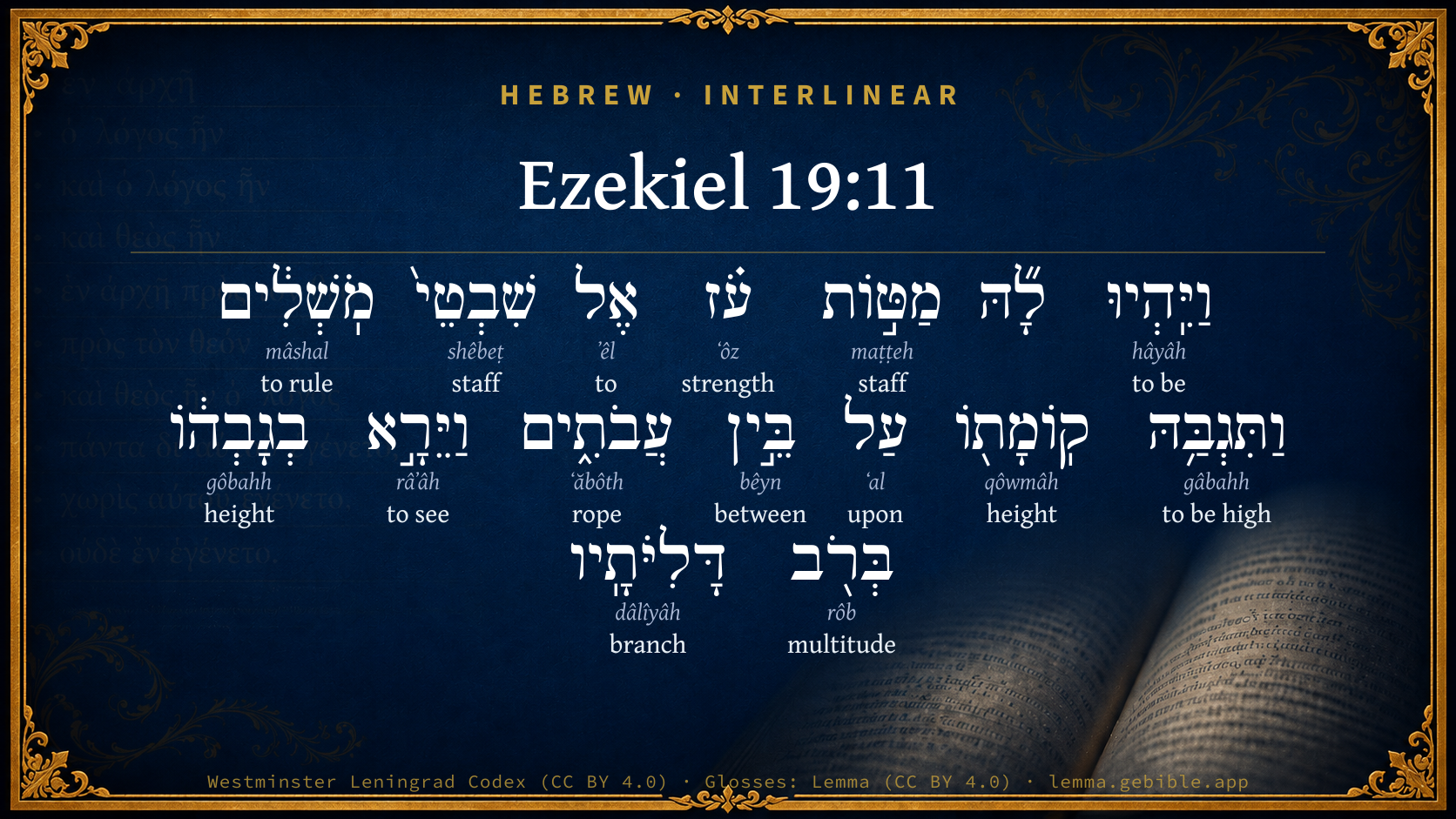
Hebrew (Westminster Leningrad Codex) Ezekiel 19:11 appears in the Hebrew Old Testament. The text above is from the Westminster Leningrad Codex. Each word links to its Strong’s number, a concise gloss, and parsing drawn from the Open Scriptures Hebrew Bible morphology. Click any word for its full Brown-Driver-Briggs (BDB) entry.
Download image
Cite this verse

Ezekiel 19:11 (World English Bible). Public Domain. Lemma interlinear Bible study tool, https://lemma.gebible.app/v/ezekiel/19/11.

Show BibTeX & RIS
BibTeX
RIS
English Translation
It had strong rods for the scepters of those who bore rule, and their stature was exalted among the thick boughs, and they were seen in their height with the multitude of their branches.
World English Bible · Public Domain
Download a study sheet

One document with this verse’s original text, its word-by-word gloss line, the meaning frame, cross-references with their text, attributed commentary, and full source and license credits — printable, and it pastes into notes with its structure intact.

This verse Autodidact and up

Study sheet (.html) Plain text (.txt)

A passage Seminary Student

Up to 50 verses in one chapter. A passage sheet keeps up to 6 commentary sources and 12 cross-references per verse, in the order this page ranks them, and says so on the sheet whenever that leaves anything out. Ask for a single verse and you get the Autodidact verse sheet above.

Everything on this page stays free to read, with no account — the sheet is a download of what is already on screen, not access to it.

Want to remove ads? Support Godless Engineer
Compare translations 3

The same verse in 3 English versions, stacked beneath the original-language interlinear above. Click any original word for its lexicon entry.

Each is an independent rendering of the whole verse — the interlinear is not word-aligned to these translations.

Highlighted words mark where these versions differ — a whole-verse word diff, not a word-by-word alignment.

  • World English Bible Public Domain
    It had strong rods for the scepters of those who bore rule, and their stature was exalted among the thick boughs, and they were seen in their height with the multitude of their branches.
  • King James Version Public Domain
    And she had strong rods for the sceptres of them that bare rule, and her stature was exalted among the thick branches, and she appeared in her height with the multitude of her branches.
  • unfoldingWord Literal Text CC BY-SA 4.0
    It had strong branches that were used for rulers’ scepters, and its size was exalted above the branches, and its height was seen by the greatness of its foliage.

unfoldingWord Literal Text — © unfoldingWord, licensed CC BY-SA 4.0. Word-aligned USFM3 via Door43 (git.door43.org/unfoldingWord/en_ult).

Versions to compare (up to 4)

3 of 4 selected

Show all 18 translations

Every available English version of this verse, each an independent rendering of the whole verse.

  • World English Bible Public Domain
    It had strong rods for the scepters of those who bore rule, and their stature was exalted among the thick boughs, and they were seen in their height with the multitude of their branches.
  • Berean Standard Bible Public Domain
    It had strong branches, fit for a ruler’s scepter. It towered high above the thick branches, conspicuous for its height and for its dense foliage.
  • Majority Standard Bible Public Domain
    It had strong branches, fit for a ruler’s scepter. It towered high above the thick branches, conspicuous for its height and for its dense foliage.
  • King James Version Public Domain
    And she had strong rods for the sceptres of them that bare rule, and her stature was exalted among the thick branches, and she appeared in her height with the multitude of her branches.
  • American Standard Version (1901) Public Domain
    And it had strong rods for the sceptres of them that bare rule, and their stature was exalted among the thick boughs, and they were seen in their height with the multitude of their branches.
  • Revised Version (1885) Public Domain
    And she had strong rods for the sceptres of them that bare rule, and their stature was exalted among the thick boughs, and they were seen in their height with the multitude of their branches.
  • Geneva Bible (1599) Public Domain
    And she had strong rods for the scepters of them that beare rule, and her stature was exalted among the branches, and she appeared in her height with the multitude of her branches.
  • Douay-Rheims (1899) Public Domain
    And she hath strong rods to make sceptres for them that bear rule, and her stature was exalted among the branches: and she saw her height in the multitude of her branches.
  • Young's Literal Translation Public Domain
    And it hath strong rods for sceptres of rulers, And high is its stature above thick branches, And it appeareth in its height In the multitude of its thin shoots.
  • Literal Standard Version CC BY-SA 4.0
    And she has strong rods for scepters of rulers, || And she is high in stature above—between thick branches, || And it appears in its height || In the multitude of its thin shoots.
  • Unlocked Literal Bible CC BY-SA 4.0
    It had strong branches that were used for rulers' scepters, and its size was exalted above the branches, and its height was seen by the greatness of its foliage.
  • unfoldingWord Literal Text CC BY-SA 4.0
    It had strong branches that were used for rulers’ scepters, and its size was exalted above the branches, and its height was seen by the greatness of its foliage.
  • Darby Bible Public Domain
    And it had strong rods for sceptres of them that bear rule, and its stature was exalted between the thick boughs; and it was conspicuous by its height with the multitude of its branches.
  • World Messianic Bible Public Domain
    It had strong branches for the scepters of those who ruled. Their stature was exalted among the thick boughs. They were seen in their height with the multitude of their branches.
  • Webster's Bible Public Domain
    And she had strong rods for the scepters of them that bore rule, and her stature was exalted among the thick branches, and she appeared in her hight with the multitude of her branches.
  • Free Bible Version CC BY-SA 4.0
    Its branches were strong like rulers' scepters. It grew high above the tree canopy. People could see how tall and full of leaves it was.
  • Bible in Basic English Public Domain
    And she had a strong rod for a rod of authority for the rulers, and it became tall among the clouds and it was seen lifted up among the number of its branches.
  • JPS Tanakh (1917) Public Domain
    And she had strong rods to be sceptres for them that bore rule; and her stature was exalted among the thick branches, and she was seen in her height with the multitude of her tendrils.

Literal Standard Version (2020), Covenant Press — licensed CC BY-SA 4.0. Text via the HelloAO Bible API (eBible.org). Unlocked Literal Bible (unfoldingWord) — licensed CC BY-SA 4.0. Text via the HelloAO Bible API (eBible.org). unfoldingWord Literal Text — © unfoldingWord, licensed CC BY-SA 4.0. Word-aligned USFM3 via Door43 (git.door43.org/unfoldingWord/en_ult). Free Bible Version, Dr. Jonathan Gallagher — licensed CC BY-SA 4.0. Text via the HelloAO Bible API (eBible.org).

Word by word

More ways to search: Search by grammar → Find every occurrence → Compare this word →

Practice this passage: Drill this verse → Learn its vocabulary →

דָּלִיֹּתָֽיו
dâlîyâh
H1808
“branches · his”
Noun, Common, Feminine, Plural, Construct + Suffix, Personal, 3rd Person, Masculine, Singular
Part of Speech
Noun
Type
Common
Gender
Feminine
Number
Plural
State
Construct
Full BDB Definition

Origin: from H1802

TWOT: 431d

branch, bough - of Israel (figuratively) (used with olive tree, vine, cedar tree)
  1. וַיִּֽהְיוּ hâyâh H1961 “and · to be” Conjunction + Verb, Qal, Sequential Imperfect, 3rd Person, Masculine, Plural
  2. מַטּ֣וֹת maṭṭeh H4294 “staffs of” Noun, Common, Masculine, Plural, Construct
  3. עֹ֗ז ʻôz H5797 “strength” Noun, Common, Masculine, Singular, Absolute
  4. אֶל ʼêl H413 “to” Preposition
  5. שִׁבְטֵי֙ shêbeṭ H7626 “staffs of” Noun, Common, Masculine, Plural, Construct
  6. מֹֽשְׁלִ֔ים mâshal H4910 “ruling” Verb, Qal, Participle Active, Masculine, Plural, Absolute
  7. וַתִּגְבַּ֥הּ gâbahh H1361 “and · to be high” Conjunction + Verb, Qal, Sequential Imperfect, 3rd Person, Feminine, Singular
  8. קֽוֹמָת֖וֹ qôwmâh H6967 “height · his” Noun, Common, Feminine, Singular, Construct + Suffix, Personal, 3rd Person, Masculine, Singular
  9. עַל ʻal H5921 “upon” Preposition
  10. בֵּ֣ין bêyn H996 “between” Preposition
  11. עֲבֹתִ֑ים ʻăbôth H5688 “ropes” Noun, Common, Both, Plural, Absolute
  12. וַיֵּרָ֣א râʼâh H7200 “and · to see” Conjunction + Verb, Niphal, Sequential Imperfect, 3rd Person, Masculine, Singular
  13. בְגָבְה֔וֹ gôbahh H1363 “in/at · height · his” Preposition + Noun, Common, Masculine, Singular, Construct + Suffix, Personal, 3rd Person, Masculine, Singular
  14. בְּרֹ֖ב rôb H7230 “in/at · multitude of” Preposition + Noun, Common, Both, Singular, Construct

About this verse

These counts appear in no published source. They are computed here, from the morphology-tagged text and Lemma’s own curated glosses. What Lemma adds →

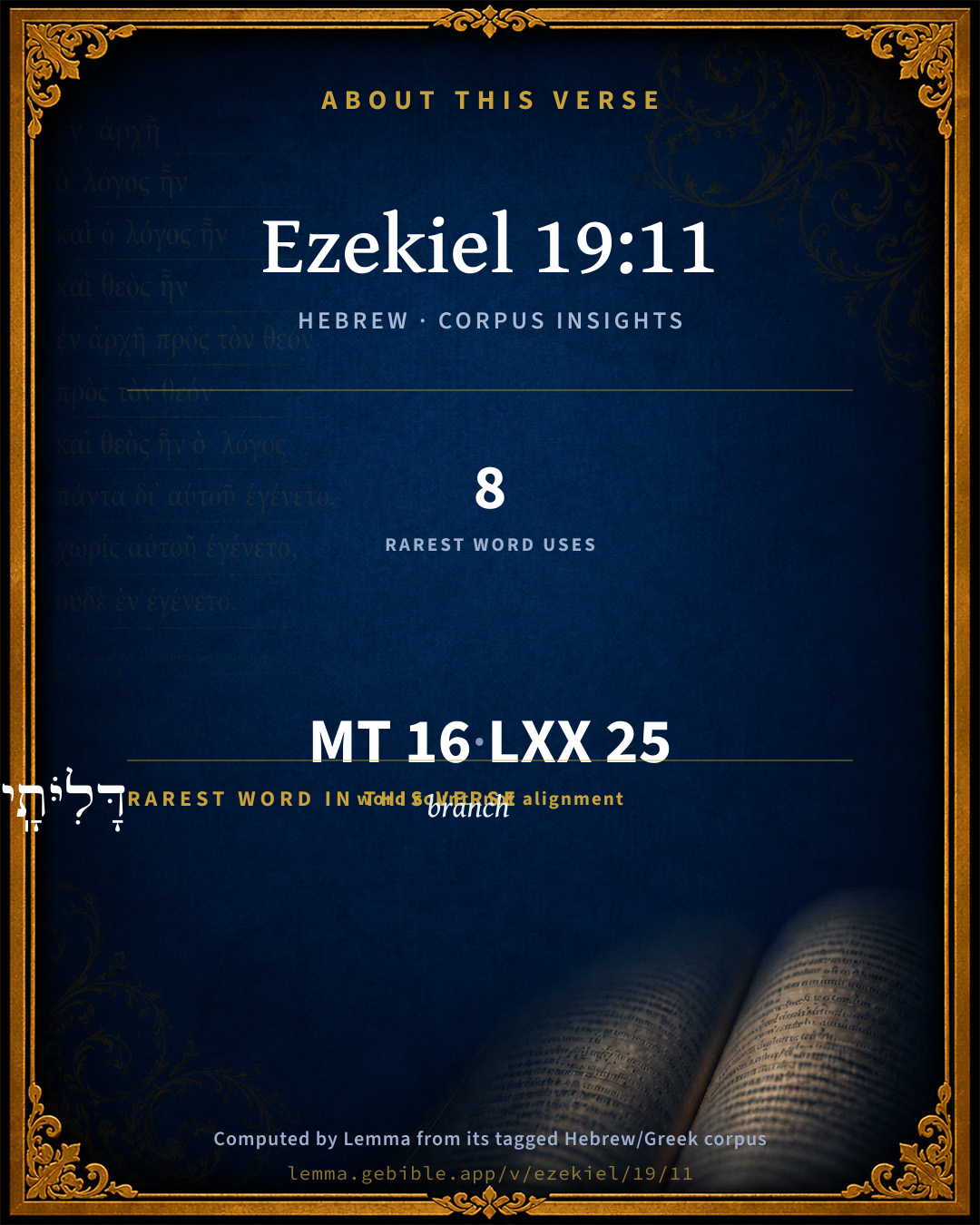
16
words
15
distinct lemmas
Prophets
section

Notable vocabulary

The rarest word here is דָּלִיֹּתָֽיו branch H1808 — appearing just 8 times in the whole Hebrew Bible.

Shared distinctive vocabulary

דָּלִיֹּתָֽיו branch H1808 occurs in 8 verses of the Hebrew Bible. Also found in:

Grammatical profile

  • 4 verbs
  • 8 nouns
  • 4 prepositions

Verb forms

  • וַיִּֽהְיוּ Qal · Sequential Imperfect
  • מֹֽשְׁלִ֔ים Qal · Participle Active
  • וַתִּגְבַּ֥הּ Qal · Sequential Imperfect
  • וַיֵּרָ֣א Niphal · Sequential Imperfect

Hebrew & Septuagint length

In English translation the verse runs 34 words from the Hebrew and 33 from the Septuagint (LXX English) — closely comparable.

A rough comparison of the two English renderings, which tokenize alike — not a word-level alignment.

Word counts can differ between the Hebrew and the Greek without any difference in meaning — e.g. the Hebrew direct-object marker אֵת has no separate Greek word, and Greek often adds the article ὁ.

In the original languages it is 16 Hebrew tokens and 25 Greek tokens — but the two are counted differently (Hebrew bundles its prefixes and suffixes into one token; the Greek is in lemma form), so that isn’t a like-for-like length.

Cross-references

17

Topical passages linked to Ezekiel 19:11 in the Treasury of Scripture Knowledge — connected by theme and wording, ordered by reader-vote popularity; previews shown in the World English Bible.

  • Ezekiel 31:3 Behold, the Assyrian was a cedar in Lebanon with beautiful branches, and with a forest-like shade, and of high stature; and its top was among the thick boughs.
  • Psalms 80:15 The stock which your right hand planted, The branch that you made strong for yourself.
  • Daniel 4:11 The tree grew, and was strong, and the height of it reached to the sky, and the sight of it to the end of all the earth.
  • Genesis 49:10 The scepter will not depart from Judah, Nor the ruler's staff from between his feet, Until he comes to whom it belongs. To him will the obedience of the peoples be.
  • Numbers 24:7–9 Water shall flow from his buckets, His seed shall be in many waters, His king shall be higher than Agag, His kingdom shall be exalted.
  • Numbers 24:17 I see him, but not now; I see him, but not near: There shall come forth a star out of Jacob, A scepter shall rise out of Israel, Shall strike through the corners of Moab, Break down all the sons of tumult.
  • Ezra 4:20 There have been mighty kings also over Jerusalem, who have ruled over all [the country] beyond the River; and tribute, custom, and toll, was paid to them.
  • Ezra 5:11 Thus they returned us answer, saying, We are the servants of the God of heaven and earth, and are building the house that was built these many years ago, which a great king of Israel built and finished.
  • Psalms 2:8–9 Ask of me, and I will give the nations for your inheritance, The uttermost parts of the earth for your possession.
  • Psalms 80:17 Let your hand be on the man of your right hand, On the son of man whom you made strong for yourself.
  • Psalms 110:2 Yahweh will send forth the rod of your strength out of Zion. Rule in the midst of your enemies.
  • Isaiah 11:1 There shall come forth a shoot out of the stock of Jesse, and a branch out of his roots shall bear fruit.
  • Ezekiel 19:12 But it was plucked up in fury, it was cast down to the ground, and the east wind dried up its fruit: its strong rods were broken off and withered; the fire consumed them.
  • Ezekiel 19:14 Fire is gone out of the rods of its branches, it has devoured its fruit, so that there is in it no strong rod to be a scepter to rule. This is a lamentation, and shall be for a lamentation.
  • Ezekiel 21:10 it is sharpened that it may make a slaughter; it is furbished that it may be as lightning: shall we then make mirth? the rod of my son, it condemns every tree.
  • Ezekiel 21:13 For there is a trial; and what if even the rod that condemns shall be no more? says the Lord Yahweh.
  • Daniel 4:20–21 The tree that you saw, which grew, and was strong, whose height reached to the sky, and the sight of it to all the earth;

Cross-references courtesy of OpenBible.info (CC BY 4.0).

Hebrew and Greek witnesses Masoretic Hebrew ↔ Greek Septuagint

The same verse in the two great witnesses to the Old Testament, shown verse-for-verse.

These are two independent witnesses, not word-aligned to each other, and the Septuagint is shown in lemma (dictionary) form.

Hebrew Ezekiel 19:11 Masoretic · Westminster Leningrad Codex

וַיִּֽהְיוּ לָ֞הּ מַטּ֣וֹת עֹ֗ז אֶל שִׁבְטֵי֙ מֹֽשְׁלִ֔ים וַתִּגְבַּ֥הּ קֽוֹמָת֖וֹ עַל בֵּ֣ין עֲבֹתִ֑ים וַיֵּרָ֣א בְגָבְה֔וֹ בְּרֹ֖ב דָּלִיֹּתָֽיו

It had strong rods for the scepters of those who bore rule, and their stature was exalted among the thick boughs, and they were seen in their height with the multitude of their branches.

World English Bible · Public Domain

Greek LXX Ezekiel 19:11 Septuagint · lemma form

καί γίγνομαι αὐτός ῥάβδος ἰσχύς ἐπί φυλή ἡγέομαι καί ὑψόω ὁ μέγεθος αὐτός ἐν μέσος στέλεχος καί ὁράω ὁ μέγεθος αὐτός ἐν πλῆθος κλῆμα αὐτός

And she became a rod for a tribe of princes, and was elevated in her bulk in the midst of other trees, and she saw her bulk in the multitude of her branches.

LXX2012 (modern English Septuagint) · Public Domain

On this verse, Whedon's Commentary on the Bible discusses the Septuagint’s reading. Read the note in Commentary ↓

Hebrew: Westminster Leningrad Codex (CC BY 4.0). Greek: Septuagint (public domain); English from LXX2012 (modern English Septuagint) (Public Domain). How the Septuagint differs from the Hebrew →

Targum (Aramaic paraphrase)

1

The Targum is the ancient Jewish Aramaic paraphrase of the Hebrew Scriptures — an interpretive translation, not the Hebrew text itself. Onkelos (literal) and Pseudo-Jonathan (expansive) render the Torah, and Jonathan the Prophets. Coverage is partial: where no permissively-licensed English translation exists for a verse, only the Aramaic is shown. This is verse-level text, not a word-by-word alignment to the Hebrew.

  1. Targum Jonathan Prophets (Joshua–Malachi)
    וַהֲווֹ בָּהּ שִׁכלְטוֹנִין תַּקִיפִין וּמַלְכִין דְגִבָּרִין לְשַׁעְבְּדָא מַלְכוּ וְרָאֵים בְּתוּקְפֵיהּ עַל מַלְכוּתֵיהּ וְאִתְנְצַח בְּסוּמְכְוָתֵיהּ בִּסְגֵי גִבָּרוֹהִי:

    (no public-domain English translation for this verse)

    Targum Jonathan — Aramaic: “Mikraot Gedolot” (public domain). English: “Sefaria Community Translation” (CC0 1.0 (public-domain dedication)); “London "Chaldee Paraphrase," 1871” (public domain). Text via Sefaria.

Commentary

Notes on Ezekiel 19:11 from classic Christian and Jewish commentators (each source and its license shown beneath its notes). The classic Christian expositions comment on the surrounding passage and are grouped to its opening verse, so a note may address several verses; the Jewish commentaries on the Tanakh (Rashi and others) are per-verse, so they appear only where the commentator wrote on this verse.

Lemma curates 59 commentaries, every one of them public domain or Creative Commons licensed, each selected and text-cleaned for this edition rather than reprinted as found. About our sources →

Trapp's Complete Commentary

John Trapp

Eze 19:11 And she had strong rods for the sceptres of them that bare rule, and her stature was exalted among the thick branches, and she appeared in her height with the multitude of her branches.

Ver. 11. And she had strong rods for sceptres.] So firm were the branches of this vine, so many and likely to succeed him in the kingdom were Zedekiah’s children; his nobles also were men of great parts, and fit for greater employments.

And she appeared in her height.] High she grew, and in addition high minded, and so ripe for ruin.

John Trapp, A Commentary or Exposition upon All the Books of the Old and New Testament (1647–1656) — public domain. Text from a community e-Sword module.

The Biblical Illustrator

Joseph S. Exell

Eze_19:11-12

And she had strong rods for the sceptres of them that bare rule.

The renewal of ruined nations

1. States and kingdoms broken to pieces, ruined in times of war and trouble, do flourish again in times of quiet and silence. Peace after war is like spring after a sharp winter, which revives, causeth growth and greenness; yet know that states ruined by tyranny of princes, by wars, do not suddenly recover themselves, or attain to their former greatness and splendour: though Jerusalem became a vine after the roaring and spoil of Jehoiakim, yet she was a vine of a low stature.

2. It is through the mercy, goodness, and blessing of God that wasted kingdoms do become as vines, and flourish again.

3. When mercies are multiplied, men are apt to abuse them, and swell with the enjoyment of them. Prosperity is a dangerous thing, and hath hazarded many (Isa_47:5; Isa_47:7). After Hezekiah had received many mercies, his heart was lifted up (2Ch_32:23-25). Rehoboam, when he was strengthened in the kingdom, forsook the law of the Lord, and all Israel with him; here was a sad effect of prosperity (2Ch_12:1). (W. Greenhill, M. A.)

The Biblical Illustrator, edited by Joseph S. Exell (c. 1880s–1900s) — public domain. Text from a community e-Sword module.

Tyndale Open Study Notes

Tyndale Open Resources

19:11-12 Judah’s pride led to its downfall as the Lord uprooted it in his wrath (cp. 17:1-10). He then replanted Judah in the desert of exile.

Tyndale Open Study Notes — © Tyndale Open Resources, licensed CC BY-SA 4.0. Text via the HelloAO Bible API.

Jamieson, Fausset & Brown

Robert Jamieson, A. R. Fausset & David Brown

strong rods--princes of the royal house of David. The vine shot forth her branches like so many scepters, not creeping lowly on the ground like many vines, but trained aloft on a tree or wall. The mention of their former royal dignity, contrasting sadly with her present sunken state, would remind the Jews of their sins whereby they had incurred such judgments.

stature-- (Dan 4:11).

among the thick branches--that is, the central stock or trunk of the tree shot up highest "among its own branches" or offshoots, surrounding it. Emblematic of the numbers and resources of the people. HENGSTENBERG translates, "among the clouds." But Eze 31:3, Eze 31:10, Eze 31:14, supports English Version.

Jamieson, Fausset & Brown — Commentary Critical and Explanatory on the Whole Bible (1871) — public domain (CC PDM 1.0). Text via the HelloAO Bible API.

Adam Clarke's Commentary

Verse 11. She had strong rods] Zedekiah, and his many sons.

Her stature was exalted] Zedekiah grew proud of his numerous offspring and prosperity; and although he copied the example of Jehoiakim, yet he thought he might safely rebel against the king of Babylon.

Adam Clarke's Commentary on the Bible (1810–1826) — public domain. Text from a community e-Sword/MySword module.

John Calvin's Commentaries

He adds, she had branches, that is, vine twigs, for the scepters of those who bear rule. Those who translate with or above the scepters of rulers do not seem to me to comprehend the Prophet’s meaning. I have no doubt he intends that scepters were gathered from these vine branches, or rather that they were so formed as to be like royal scepters. Although this translation seems rather rough, yet the sense is not doubtful; because the Prophet means that kings were taken from the people just as branches from the vine, as God chose king’s from David to Zedekiah. In this sense he says that the vine branches became scepters of the rulers. He afterwards adds, her stature was conspicuous, that she was remarkable for her loftiness even in the multitude of the vine branches. This is extended to the whole body of the people. Since mention is made of the king, there is no doubt that God commends his grace towards the whole people, whose safety and happiness were placed in the king, as we saw elsewhere. But he asserts more clearly that the people had increased, so that they excelled in population, power, and wealth. On the whole, the Prophet teaches that the Jews were adorned from the beginning with all kinds of advantages, since God’s best gifts shone forth there, and their dignity was conspicuous, and their opulence great, since he unites the multitude of the boughs or vine branches with their height.

John Calvin's Commentaries (1540-1563) — public domain. Text from the Calvin Translation Society English edition (1840s-50s) via the Christian Classics Ethereal Library (ccel.org). Calvin's coverage is partial (roughly two-thirds of the Bible); uncommented books and verses are honest gaps, never fabricated. The 19th-century editor's footnotes and remarks are omitted so the notes are faithfully Calvin's own voice.

Ellicott's Commentary for English Readers

(11) Thick branches should rather be translated clouds. It is a hyperbolical expression in the figure, to express the excellence of the vine of Israel.

A Bible Commentary for English Readers, edited by Charles John Ellicott (1878–1897) — public domain. Text from a community e-Sword module.

The Cambridge Bible for Schools and Colleges

gen. ed. J. J. S. Perowne

11. sceptres … bare rule] Or, for rulers’ sceptres, i.e. royal sceptres. Out of Israel this vine there rose powerful native kings.

among the thick branches] Or, into the clouds, cf. Eze_31:3; Eze_31:10; Eze_31:14. The phrase is designedly hyperbolical, to express the power of Israel in earlier times. Jer_11:16-17.

appeared in her height] Lit. was seen—conspicuously and from afar.

The Cambridge Bible for Schools and Colleges (gen. ed. J. J. S. Perowne; Cambridge University Press, 1878–1918) — public domain. Text from a community e-Sword module.

John Gill's Exposition

And she had strong rods for the sceptres of them that bear rule,.... That is, many sprung from her, and rose up in that nation who were fit to hold sceptres to be kings, rulers and governors, and were such. So the Targum.

"and there were in her strong rulers, kings that were, highly to subdue kingdoms;''

such as David, Solomon, and at hers after them: or this may refer to the times of Josiah, and at his death, who left behind him several sons, who became kings, besides other princes of the blood; as his brother Mattaniah, who also was king: and some even carry this to Zedekiah himself, who had many children, who seemed to be strong rods, fit for sceptres, or sceptre bearers; that is, to be kings. The allusion seems to be to the sceptres of the ancients, which were no other than walking sticks, cut off of the stems or branches of trees, and decorated with gold, or studded with golden nails. Thus Achilles is introduced by Homer (c) as swearing by a sceptre; which, being cut off of a trunk of a tree left on the mountains, and stripped of its bark and leaves, should never more produce leaves and branches, or sprout again: and such an one, he observes, the Grecian judges, carry in their hands. Sometimes they were made of the "oleaster" (d), or wild olive, the same as a shepherd's staff; for what shepherds were to their flocks, that were kings to men;

and her stature was exalted among the thick branches; as the body and trunk of a tree rises up higher than the branches, which are thickest about the middle of it, and so more eminent and conspicuous; thus it was with the nation of the Jews, and the royal family in it, that appeared more glorious and excellent among the nobles and princes of it; or, as the Targum expresses it,

"it was lifted up in its strength above its own kingdom;''

or rather the sense is, that in the days of David and Solomon, and some others, it greatly exceeded all the kingdoms of the nations round about it:

and she appeared in her height with the multitude of her branches; was seen and taken notice of for the multitude of her people, and the grandeur of her state.

(c) Iliad. 1. l. 234, &c. (d) Paschal. de Coronis, l. 6. c. 19. p. 406, 407.

John Gill's Exposition of the Whole Bible (1746–1763) — public domain (CC PDM 1.0). Text via the HelloAO Bible API.

Albert Barnes' Notes on the Bible

Sceptres - Gen 49:10.

The thick branches - Or, the clouds; so Eze 31:3, Eze 31:10, Eze 31:14.

Albert Barnes' Notes on the Bible (1834–1885) — public domain. Text from a community e-Sword/MySword module.

Haydock's Catholic Bible Commentary

Rods. The king had many children, and confided in them, but they were slain.

George Leo Haydock (1774–1849), Haydock's Catholic Family Bible and Commentary, 1859 edition — public domain. Excludes Psalms (Douay-Rheims chapter numbering differs from Protestant) and Deuterocanonical books (Catholic canon only).

Matthew Poole's English Annotations

Strong rods; many excellent persons endowed with qualifications befitting kings, that they might sway the sceptre, and rule the people with equity.

Her stature; the grandeur of the kings and kingdom.

Exalted among the thick branches; exalted above the ordinary majesty of other kingdoms.

The thick branches; the goodly cedars and their thick branches; i.e. this kingdom equalled, if not excelled, the greatest neighbour kingdoms, and her kings, as David, Solomon, &c. exceeded all their neighbour kings in riches and power.

She appeared in her height; like a mighty tree, that overtops all the forest, so did this goodly kingdom over all kingdoms, and it was seen and noted, according to God’s promise that it should be the head, and not the tail, and to that Deu 4:6-8.

Matthew Poole's English Annotations on the Holy Bible (1683–1685) — public domain. Text from a community e-Sword/MySword module.

Whedon's Commentary on the Bible

Daniel D. Whedon

11. Rods — Perhaps, a strong rod (LXX.).

For — Rather, growing up into.

Scepters of them that bare rule — Rather, for royal scepters (or, “rulers’ staffs”).

Among the thick branches — Rather, high among the clouds, or, as Kautzsch, high up between thick twigs. (Compare Orelli.)

Daniel D. Whedon (gen. ed.), Commentary on the Old and New Testaments (1874–1909) — public domain. Text from a community e-Sword module.

The Pulpit Commentary

The verse describes generally the apparent strength of the kingly line of David. The word for thick branches, which occurs again in Eze_31:3, Eze_31:10, Eze_31:14, is taken by Keil and Furst as meaning "thick clouds," as describing the height to which the tree grew. So the Revised Version (margin).

The Pulpit Commentary (1880–1919), ed. H.D.M. Spence-Jones & Joseph S. Exell — public domain. Text from a community e-Sword module.

John Wesley's Explanatory Notes

Strong rods - Many excellent persons endowed with qualifications befitting kings, that they might sway the scepter. Exalted - Above the ordinary majesty of other kingdoms. Thick branches - This kingdom equalled, if not excelled, the greatest neighbour-kingdoms, and her kings exceeded all their neighbouring kings, in riches and power.

John Wesley, Explanatory Notes Upon the Whole Bible (1754–1765) — public domain. Text via the GEBible commentary corpus.

Rashi

Rabbi Shlomo Yitzchaki (Rashi)

sturdy rods for the scepters of the rulers Powerful rulers and mighty kings.

over between the interwoven branches The trees whose branches were many.

Rashi on the Tanakh — English translations: “The Judaica Press complete Tanach with Rashi, translated by A. J. Rosenberg” (CC BY 4.0); “Pentateuch with Rashi's commentary by M. Rosenbaum and A.M. Silbermann, 1929-1934” (public domain); “The Metsudah Tanach series, Lakewood, N.J” (CC BY 4.0); and “The Book of Joshua, Metsudah Publications, 1997” (CC BY 4.0). Text via Sefaria.

Lesson kit

Teaching starters — assembled from the data on this page, not authored interpretation. Every prompt links to the verse data it draws on. Edit before teaching.

Ezekiel, in the Prophets, opens this verse with 16 words (15 distinct Hebrew lemmas). Its most distinctive word is dâlîyâh (“branch”). A historical commentator’s framing appears above. Read the whole chapter for the surrounding context.

Discussion questions

  1. What does “branch” (dâlîyâh) contribute to the verse as a whole?
  2. How does Jeremiah 11:16, which shares the word «branch», read alongside this verse?
  3. These translations render this verse differently. What is at stake in choosing one wording over another?
  4. «וַיִּֽהְיוּ» is a Qal Sequential Imperfect verb. How does that grammatical form shape the action described?
  5. Compare how Trapp's Complete Commentary and The Biblical Illustrator read this verse. Where do they agree or differ?

Things to notice

Reading settings

Reading text

Shown beneath each verse's original-language words.

Old Testament
Old Testament edition

Read the OT as the Masoretic Hebrew (MT) or the Greek Septuagint (LXX).

English shown for the Greek Septuagint (in the Hebrew ↔ Greek comparison).

Comparing translations? Open the Compare panel on any verse page to stack up to four side by side.