

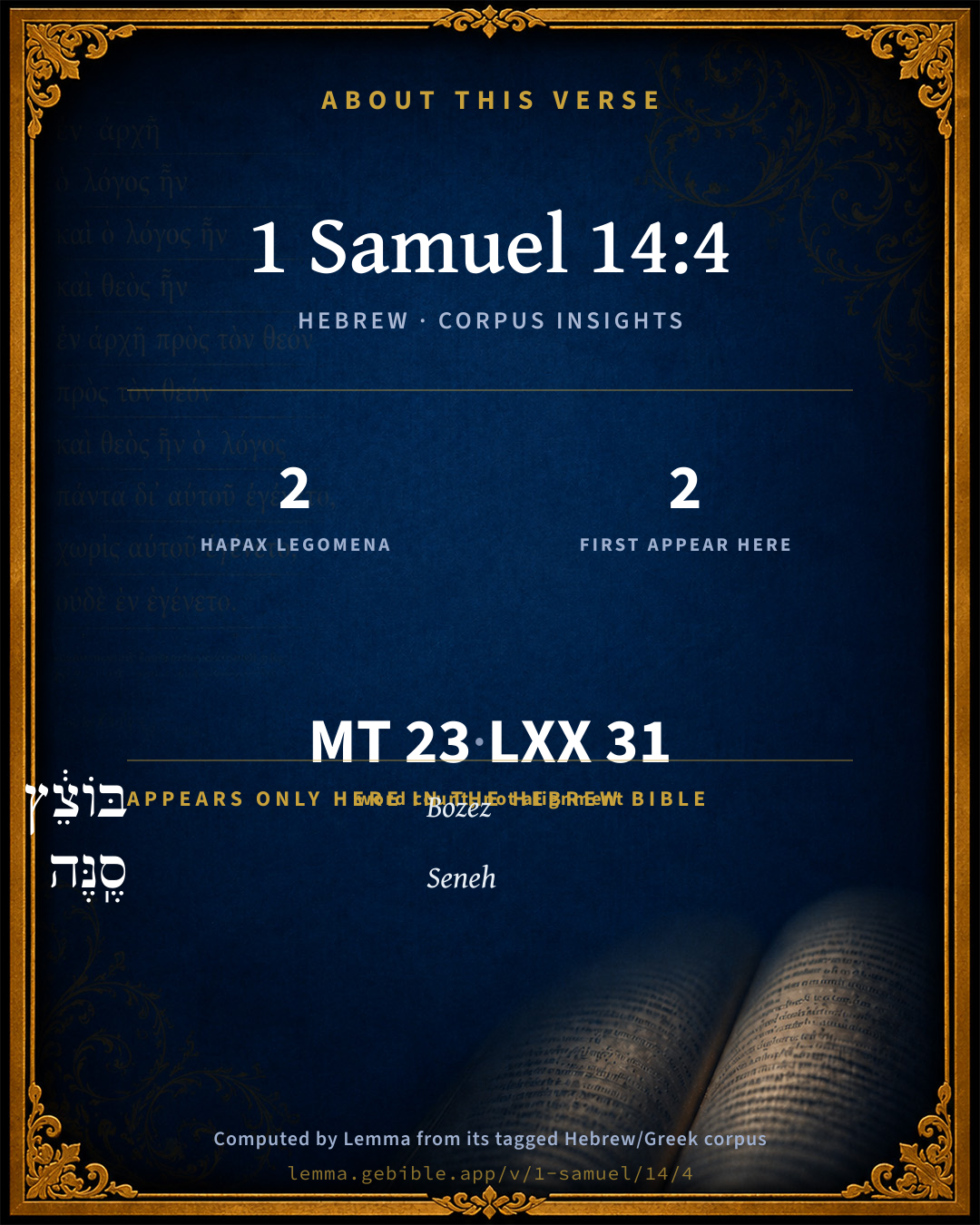
1 Samuel 14:4

Hebrew (Westminster Leningrad Codex) 1 Samuel 14:4 appears in the Hebrew Old Testament. The text above is from the Westminster Leningrad Codex. Each word links to its Strong’s number, a concise gloss, and parsing drawn from the Open Scriptures Hebrew Bible morphology. Click any word for its full Brown-Driver-Briggs (BDB) entry.
Download image
Cite this verse

1 Samuel 14:4 (World English Bible). Public Domain. Lemma interlinear Bible study tool, https://lemma.gebible.app/v/1-samuel/14/4.

Show BibTeX & RIS
BibTeX
RIS
English Translation
Between the passes, by which Jonathan sought to go over to the Philistines' garrison, there was a rocky crag on the one side, and a rocky crag on the other side: and the name of the one was Bozez, and the name of the other Seneh.
World English Bible · Public Domain
Highlights
  • 2 hapax legomena — only here in the Hebrew Bible
  • 2 first appearances in the Hebrew Bible
Full analysis ↓
Download a study sheet

One document with this verse’s original text, its word-by-word gloss line, the meaning frame, cross-references with their text, attributed commentary, and full source and license credits — printable, and it pastes into notes with its structure intact.

This verse Autodidact and up

Study sheet (.html) Plain text (.txt)

A passage Seminary Student

Up to 50 verses in one chapter. A passage sheet keeps up to 6 commentary sources and 12 cross-references per verse, in the order this page ranks them, and says so on the sheet whenever that leaves anything out. Ask for a single verse and you get the Autodidact verse sheet above.

Everything on this page stays free to read, with no account — the sheet is a download of what is already on screen, not access to it.

Want to remove ads? Support Godless Engineer
Compare translations 3

The same verse in 3 English versions, stacked beneath the original-language interlinear above. Click any original word for its lexicon entry.

Each is an independent rendering of the whole verse — the interlinear is not word-aligned to these translations.

Highlighted words mark where these versions differ — a whole-verse word diff, not a word-by-word alignment.

  • World English Bible Public Domain
    Between the passes, by which Jonathan sought to go over to the Philistines' garrison, there was a rocky crag on the one side, and a rocky crag on the other side: and the name of the one was Bozez, and the name of the other Seneh.
  • King James Version Public Domain
    And between the passages, by which Jonathan sought to go over unto the Philistines' garrison, there was a sharp rock on the one side, and a sharp rock on the other side: and the name of the one was Bozez, and the name of the other Seneh.
  • unfoldingWord Literal Text CC BY-SA 4.0
    Now within the passes that Jonathan sought to pass through to the garrison of the Philistines the tooth of a rock on the side from that and the tooth of a rock on the side from this. And the name of the one Bozez, and the name of the one Seneh.

unfoldingWord Literal Text — © unfoldingWord, licensed CC BY-SA 4.0. Word-aligned USFM3 via Door43 (git.door43.org/unfoldingWord/en_ult).

Versions to compare (up to 4)

3 of 4 selected

Show all 18 translations

Every available English version of this verse, each an independent rendering of the whole verse.

  • World English Bible Public Domain
    Between the passes, by which Jonathan sought to go over to the Philistines' garrison, there was a rocky crag on the one side, and a rocky crag on the other side: and the name of the one was Bozez, and the name of the other Seneh.
  • Berean Standard Bible Public Domain
    Now there were cliffs on both sides of the pass that Jonathan intended to cross to reach the Philistine outpost. One was named Bozez and the other Seneh.
  • Majority Standard Bible Public Domain
    Now there were cliffs on both sides of the pass that Jonathan intended to cross to reach the Philistine outpost. One was named Bozez and the other Seneh.
  • King James Version Public Domain
    And between the passages, by which Jonathan sought to go over unto the Philistines' garrison, there was a sharp rock on the one side, and a sharp rock on the other side: and the name of the one was Bozez, and the name of the other Seneh.
  • American Standard Version (1901) Public Domain
    And between the passes, by which Jonathan sought to go over unto the Philistines' garrison, there was a rocky crag on the one side, and a rocky crag on the other side: and the name of the one was Bozez, and the name of the other Seneh.
  • Revised Version (1885) Public Domain
    And between the passes, by which Jonathan sought to go over unto the Philistines’ garrison, there was a rocky crag on the one side, and a rocky crag on the other side: and the name of the one was Bozez, and the name of the other Seneh.
  • Geneva Bible (1599) Public Domain
    Nowe in the way whereby Ionathan sought to go ouer to the Philistims garison, there was a sharpe rocke on the one side, and a sharpe rocke on the other side: the name of the one was called Bozez, and the name of the other Seneh.
  • Douay-Rheims (1899) Public Domain
    Now there were between the ascents, by which Jonathan sought to go over to the garrison of the Philistines, rocks standing up on both sides, and steep cliffs like teeth on the one side, and on the other, the name of the one was Boses, and the name of the other was Sene:
  • Young's Literal Translation Public Domain
    And between the passages where Jonathan sought to pass over unto the station of the Philistines `is' the edge of a rock on the one side, and the edge of a rock on the other side, and the name of the one is Bozez, and the name of the other Seneh.
  • Literal Standard Version CC BY-SA 4.0
    And between the passages where Jonathan sought to pass over to the station of the Philistines [is] the edge of a rock on one side, and the edge of a rock on the other side, and the name of one is Bozez, and the name of the other Seneh.
  • Unlocked Literal Bible CC BY-SA 4.0
    On each side of the pass through which Jonathan wanted to go in order to get to the Philistines' garrison, there was a rocky cliff on one side and another rocky cliff on the other side. One rocky cliff was called Bozez and the other rocky cliff was called Seneh.
  • unfoldingWord Literal Text CC BY-SA 4.0
    Now within the passes that Jonathan sought to pass through to the garrison of the Philistines the tooth of a rock on the side from that and the tooth of a rock on the side from this. And the name of the one Bozez, and the name of the one Seneh.
  • Darby Bible Public Domain
    Now between the passes by which Jonathan sought to go over to the Philistines' garrison there was a sharp rock on the one side and a sharp rock on the other side; and the name of the one [was] Bozez, and the name of the other Seneh.
  • World Messianic Bible Public Domain
    Between the passes, by which Jonathan sought to go over to the Philistines’ garrison, there was a rocky crag on the one side and a rocky crag on the other side; and the name of the one was Bozez, and the name of the other Seneh.
  • Webster's Bible Public Domain
    And between the passages by which Jonathan sought to go over to the garrison of the Philistines, there was a sharp rock on the one side, and a sharp rock on the other side: and the name of the one was Bozez, and the name of the other Seneh.
  • Free Bible Version CC BY-SA 4.0
    Cliffs stood on both sides of the pass that Jonathan planned to cross to reach the Philistine garrison, one called Bozez and the other Seneh.
  • Bible in Basic English Public Domain
    Now between the narrow roads over the mountains by which Jonathan was making his way to the Philistines' forces, there was a sharp overhanging rock on one side, and a sharp rock on the other side: one was named Bozez and the other Seneh.
  • JPS Tanakh (1917) Public Domain
    And between the passes, by which Jonathan sought to go over unto the Philistines' garrison, there was a rocky crag on the one side, and a rocky crag on the other side; and the name of the one was Bozez, and the name of the other Seneh.

Literal Standard Version (2020), Covenant Press — licensed CC BY-SA 4.0. Text via the HelloAO Bible API (eBible.org). Unlocked Literal Bible (unfoldingWord) — licensed CC BY-SA 4.0. Text via the HelloAO Bible API (eBible.org). unfoldingWord Literal Text — © unfoldingWord, licensed CC BY-SA 4.0. Word-aligned USFM3 via Door43 (git.door43.org/unfoldingWord/en_ult). Free Bible Version, Dr. Jonathan Gallagher — licensed CC BY-SA 4.0. Text via the HelloAO Bible API (eBible.org).

Word by word

More ways to search: Search by grammar → Find every occurrence → Compare this word →

Practice this passage: Drill this verse → Learn its vocabulary →

בּוֹצֵ֔ץ
Bôwtsêts
H949
“Bozez”
Noun, Proper
Part of Speech
Noun
Type
Proper
Full BDB Definition

Origin: from the same as H948

TWOT: None

Bozez = "surpassing white: glistening" - a rock formation near Michmash by which Jonathan approached the Philistine troop
  1. וּבֵ֣ין bêyn H996 “and · between” Conjunction + Preposition
  2. הַֽמַּעְבְּר֗וֹת maʻăbâr H4569 “the · fords” Particle, Definite Article + Noun, Common, Feminine, Plural, Absolute
  3. אֲשֶׁ֨ר ʼăsher H834 “which” Particle, Relative
  4. בִּקֵּ֤שׁ bâqash H1245 “to seek” Verb, Piel, Perfect, 3rd Person, Masculine, Singular
  5. יֽוֹנָתָן֙ Yôwnâthân H3129 “Jonathan” Noun, Proper
  6. לַֽעֲבֹר֙ ʻâbar H5674 “to pass over” Preposition + Verb, Qal, Infinitive Construct
  7. עַל ʻal H5921 “upon” Preposition
  8. מַצַּ֣ב matstsâb H4673 “station of” Noun, Common, Masculine, Singular, Construct
  9. פְּלִשְׁתִּ֔ים Pᵉlishtîy H6430 “Philistines” Noun, Gentilic, Masculine, Plural, Absolute
  10. שֵׁן shên H8127 “tooth of” Noun, Common, Both, Singular, Construct
  11. הַסֶּ֤לַע çelaʻ H5553 “the · rock” Particle, Definite Article + Noun, Common, Masculine, Singular, Absolute
  12. מֵהָעֵ֨בֶר֙ ʻêber H5676 “from · the · side” Preposition + Particle, Definite Article + Noun, Common, Masculine, Singular, Absolute
  13. מִזֶּ֔ה zeh H2088 “from · this” Preposition + Pronoun, Demonstrative, Masculine, Singular
  14. וְשֵׁן shên H8127 “and · tooth of” Conjunction + Noun, Common, Both, Singular, Construct
  15. הַסֶּ֥לַע çelaʻ H5553 “the · rock” Particle, Definite Article + Noun, Common, Masculine, Singular, Absolute
  16. מֵהָעֵ֖בֶר ʻêber H5676 “from · the · side” Preposition + Particle, Definite Article + Noun, Common, Masculine, Singular, Absolute
  17. מִזֶּ֑ה zeh H2088 “from · this” Preposition + Pronoun, Demonstrative, Masculine, Singular
  18. וְשֵׁ֤ם shêm H8034 “and · name of” Conjunction + Noun, Common, Masculine, Singular, Construct
  19. הָֽאֶחָד֙ ʼechâd H259 “the · one” Particle, Definite Article + Adjective, Cardinal number, Masculine, Singular, Absolute
  20. וְשֵׁ֥ם shêm H8034 “and · name of” Conjunction + Noun, Common, Masculine, Singular, Construct
  21. הָאֶחָ֖ד ʼechâd H259 “the · one” Particle, Definite Article + Adjective, Cardinal number, Masculine, Singular, Absolute
  22. סֶֽנֶּה Çeneh H5573 “Seneh” Noun, Proper

About this verse

These counts appear in no published source. They are computed here, from the morphology-tagged text and Lemma’s own curated glosses. What Lemma adds →

23
words
17
distinct lemmas
Historical
section

Notable vocabulary

2 hapax legomena — words that appear only here in the entire Hebrew Bible:

  • בּוֹצֵ֔ץ Bozez H949
  • סֶֽנֶּה Seneh H5573

First appearance in Scripture

These words make their first canonical appearance in the Hebrew Bible here:

  • בּוֹצֵ֔ץ Bozez H949
  • סֶֽנֶּה Seneh H5573

Shared distinctive vocabulary

מַצַּ֣ב station H4673 occurs in 10 verses of the Hebrew Bible. Also found in:

Grammatical profile

  • 2 verbs
  • 14 nouns
  • 2 adjectives
  • 2 pronouns
  • 2 prepositions
  • 1 particle

Verb forms

  • בִּקֵּ֤שׁ Piel · Perfect
  • לַֽעֲבֹר֙ Qal · Infinitive Construct

Repetition

Words recur within this verse — often emphatic in Hebrew:

  • שֵׁן tooth H8127 ×2
  • הַסֶּ֤לַע rock H5553 ×2
  • מֵהָעֵ֨בֶר֙ side H5676 ×2
  • וְשֵׁ֤ם name H8034 ×2
  • הָֽאֶחָד֙ one H259 ×2
  • מִזֶּ֔ה this H2088 ×2

Hebrew & Septuagint length

In English translation the verse runs 46 words from the Hebrew and 50 from the Septuagint (LXX English) — closely comparable.

A rough comparison of the two English renderings, which tokenize alike — not a word-level alignment.

Word counts can differ between the Hebrew and the Greek without any difference in meaning — e.g. the Hebrew direct-object marker אֵת has no separate Greek word, and Greek often adds the article ὁ.

In the original languages it is 23 Hebrew tokens and 31 Greek tokens — but the two are counted differently (Hebrew bundles its prefixes and suffixes into one token; the Greek is in lemma form), so that isn’t a like-for-like length.

Cross-references

1

Topical passages linked to 1 Samuel 14:4 in the Treasury of Scripture Knowledge — connected by theme and wording, ordered by reader-vote popularity; previews shown in the World English Bible.

  • 1 Samuel 13:23 The garrison of the Philistines went out to the pass of Michmash.

Cross-references courtesy of OpenBible.info (CC BY 4.0).

Hebrew and Greek witnesses Masoretic Hebrew ↔ Greek Septuagint

The same verse in the two great witnesses to the Old Testament, shown verse-for-verse.

These are two independent witnesses, not word-aligned to each other, and the Septuagint is shown in lemma (dictionary) form.

Hebrew 1 Samuel 14:4 Masoretic · Westminster Leningrad Codex

וּבֵ֣ין הַֽמַּעְבְּר֗וֹת אֲשֶׁ֨ר בִּקֵּ֤שׁ יֽוֹנָתָן֙ לַֽעֲבֹר֙ עַל מַצַּ֣ב פְּלִשְׁתִּ֔ים שֵׁן הַסֶּ֤לַע מֵהָעֵ֨בֶר֙ מִזֶּ֔ה וְשֵׁן הַסֶּ֥לַע מֵהָעֵ֖בֶר מִזֶּ֑ה וְשֵׁ֤ם הָֽאֶחָד֙ בּוֹצֵ֔ץ וְשֵׁ֥ם הָאֶחָ֖ד סֶֽנֶּה

Between the passes, by which Jonathan sought to go over to the Philistines' garrison, there was a rocky crag on the one side, and a rocky crag on the other side: and the name of the one was Bozez, and the name of the other Seneh.

World English Bible · Public Domain

Greek LXX 1 Samuel 14:4 Septuagint · lemma form

καί ἀνά μέσος ὁ διάβασις ὅς ζητέω ιωναθαν διαβαίνω εἰς ὁ ὑπόστασις ὁ ἀλλόφυλος καί ἀκρωτήριον πέτρα ἔνθεν καί ἀκρωτήριον πέτρα ἔνθεν ὄνομα ὁ εἷς βαζες καί ὄνομα ὁ ἄλλος σεννα

And in the midst of the passage whereby Jonathan sought to pass over to the encampment of the Philistines, there was both a sharp rock on this side, and a sharp rock on the other side: the name of the one was Bases, and the name of the other Senna.

LXX2012 (modern English Septuagint) · Public Domain

Hebrew: Westminster Leningrad Codex (CC BY 4.0). Greek: Septuagint (public domain); English from LXX2012 (modern English Septuagint) (Public Domain). How the Septuagint differs from the Hebrew →

Targum (Aramaic paraphrase)

1

The Targum is the ancient Jewish Aramaic paraphrase of the Hebrew Scriptures — an interpretive translation, not the Hebrew text itself. Onkelos (literal) and Pseudo-Jonathan (expansive) render the Torah, and Jonathan the Prophets. Coverage is partial: where no permissively-licensed English translation exists for a verse, only the Aramaic is shown. This is verse-level text, not a word-by-word alignment to the Hebrew.

  1. Targum Jonathan Prophets (Joshua–Malachi)
    וּבֵין מְגִיזָתָא דִבְעָא יוֹנָתָן לְמֶעְבַּר עַל אִסְטַרְטִיג פְּלִשְׁתָּאֵי שִׁנָא דְכֵיפָא מֵעֶבְרָא מִכָּא וְשִׁנָא דְכֵיפָא מֵעֶבְרָא מִכָּא וְשׁוּם חֲדָא מַשְׁרוּעִיתָא וְשׁוּם חֲדָא מַדְרוֹכִיתָא:

    (no public-domain English translation for this verse)

    Targum Jonathan — Aramaic: “Mikraot Gedolot” (public domain). English: “Sefaria Community Translation” (CC0 1.0 (public-domain dedication)); “London "Chaldee Paraphrase," 1871” (public domain). Text via Sefaria.

Commentary

Notes on 1 Samuel 14:4 from classic Christian and Jewish commentators (each source and its license shown beneath its notes). The classic Christian expositions comment on the surrounding passage and are grouped to its opening verse, so a note may address several verses; the Jewish commentaries on the Tanakh (Rashi and others) are per-verse, so they appear only where the commentator wrote on this verse.

Lemma curates 59 commentaries, every one of them public domain or Creative Commons licensed, each selected and text-cleaned for this edition rather than reprinted as found. About our sources →

Trapp's Complete Commentary

John Trapp

1Sa 14:4 And between the passages, by which Jonathan sought to go over unto the Philistines’ garrison, [there was] a sharp rock on the one side, and a sharp rock on the other side: and the name of the one [was] Bozez, and the name of the other Seneh.

Ver. 4. There was a sharp rock.] Heb., The tooth of a rock: {a} these were two promontories which hung over and ran out, after the manner of dogs’ teeth, or boars’ tusks, and so rendered the passage to the enemy’s camp hard, and as might be thought impossible. But what may not be done by daring? Alexander the Great got a strong fort, set on a high steep rock from his enemies, - who asked him in derision, Whether he could fly? - by the help of three hundred gallant soldier, and then used these words, En, ostendi me posse volare, {b} Lo, I have showed you that I can fly: but Jonathan, with one only, made a harder and higher attempt, and achieved a far greater victory by the force of his faith, whereunto nothing is impossible. See Heb 11:33-34.

{a} Vat.

{b} Curtius.

John Trapp, A Commentary or Exposition upon All the Books of the Old and New Testament (1647–1656) — public domain. Text from a community e-Sword module.

The Biblical Illustrator

Joseph S. Exell

1Sa_14:4

There was a sharp rock on the one side, and a sharp rock on the other side.

Rocks on both sides

The cruel army of the Philistines must be taken and scattered. There is just one man, accompanied by his bodyguard, to do that thing Jonathan is the hero of the scene. These two men, Jonathan and his bodyguard, drive back and drive down the Philistines over the rocks, and open a campaign which demolishes the enemies of Israel. I suppose that the overhanging and overshadowing rocks on either side did not baulk or dishearten Jonathan or his bodyguard, but only roused and filled them with enthusiasm as they went up. There was a sharp rock on the one side, and a sharp rock on the other side. You have been, or are now, some of you, in this crisis of the text. If a man meets one trouble, he can go through with it. He gathers all his energies, concentrates them upon one point, and in the strength of God, or by his own natural determination, goes through it,. But the man who has trouble to the right of him, and trouble to the left of him is to be pitied. Did either trouble come alone, he might endure it but two troubles, two disasters, two overshadowing misfortunes, are Bozez and Seneh. God pity him! There is a sharp rock on the one side, and a sharp rock on the ether side

I. In this crisis of the text is that man whose fortune and health fail at the same time. Nine tenths of all our merchants capsize is business before they come to forty-five years of age. There is some collision in commercial circles, and they stop payment. When the calamity does come, if; is awful. The man goes home in despair, and he tells his family: Well have to go to the poor house. He takes a dolorous view of everything. It seems as if he never could rise. But a little time passes, and he says: Why, I am not so badly off after all; I have my family left. Before the Lord turned Adam out of Paradise he gave him Eve, so that when he lost Paradise he could stand it. Well, this man of whom I am speaking looks around, and he finds his family is left, and he rallies, and the light comes to his eyes, and the smile to his face, and the courage to his heart. In two years he is quite over it. He makes his financial calamity the first chapter in a new era of prosperity. He met that one trouble--conquered it. He sat down for a little while under the grim shadow of the rock Bozez; yet he soon rose, and began, like Jonathan, to climb. But how often it is that physical ailment comes with financial embarrassment. When the fortune failed it broke the mans spirit. His nerves were shattered. His brain was stunned. I can show you hundreds of men in New York tomorrow whose fortune and health failed at the same time. Now, what is such a man to do? In the name of Almighty God, I will tell him what to do. Do as Jonathan did--climb; climb up into the sunlight of Gods favour and consolation. I can go through the Churches, and shew you men who lost fortune and health at the same time, and yet who sing all day and dream of heaven all night.

II. Again, that man is in the crisis of the text who has home troubles and outside persecution at the same time. The world treats a man well just as long as it, pays best to treat him well. As long as it can manufacture success out of his bone, and brain, and muscle, it favours him. The world fattens the horse it wants to drive. But let a man see it his duty to cross the track of the world, then every bush is full of horns and tusks thrust at him. They will belittle him. They will caricature him. They will call his generosity self-aggrandisement, and his piety sanctimoniousness. The very worst persecution will some time come upon him from those who profess to be Christians. Now a certain amount of persecution rouses a mans defiance, stirs his blood for magnificent battle, and makes him fifty times more a man than he would have been without the persecution. So it was with Millard, the preacher, in the time of Louis XI. When Louis XI sent word to him that unless he stopped preaching in that style he would throw him into the river, he replied: Tell the king that I will reach heaven sooner by water than he will reach it by fast horses. A certain amount of persecution is a tonic and an inspiration, but too much of it, and too long continued, becomes the rock Bozez, throwing a dark shadow over a mans life. What is he to do then? Go home, you say. Good advice, that. That is just the place for a man to go when the world abuses him. Go home. Blessed be God for our quiet and sympathetic homes. But there is many a man who has the reputation of having a home when he has none. Sometimes men have awakened to find on one side of them the rock of persecution, and on the other side the rock of domestic infelicity. What shall such an one do? Do as Jonathan did--climb. Get up into the heights of Gods consolation, from which he may look down in triumph upon outside persecution and home trouble.

III. Again, that woman stands in the crisis of the text, who has bereavement and a struggle for a livelihood at the same time. How many women there are seated between the rock of bereavement on the one side, and the rock of destitution on the other, Bozez and Seneh interlocking their shadow and dropping them upon her miserable way. There is a sharp rock on the one side, and a sharp rock on the other side. What are such to do? Somehow, let them climb up into the heights of the glorious promise: Leave thy fatherless children; I will preserve them alive, and let thy widows trust in Me. Or get up into the heights of that other glorious promise: The Lord preserveth the stranger and relieveth the widow and the fatherless.

IV. That man is in the crisis of the text who has a wasted life on the one side and an unilluminated eternity on the other. Though a man may all his life have cultured deliberation and self-poise, if he gets into that position, all his self-possession is gone. There are all the wrong thoughts of his existence, all the wrong deeds, all the wrong words--strata above strata, granitic, ponderous, overshadowing. That rock I call Bozez. On the other side are all the retributions of the future, the thrones of judgment, the eternal ages, angry with his long defiance. That rock I call Seneh. Between these two rocks ten thousand times ten thousand have perished. O man immortal, man redeemed, man blood-bought, climb up out of those shadows! Climb up by the way of the Cross. To become a Christian is not to go meanly down; it is to come gloriously up--up into the communion of saints; up into the peace that passeth all understanding; up into the companionship of angels. He lives upward; he dies upward. (T. De Witt Talmage.)

Difficult extremes

There are critical periods in the life of man, where decision is of the utmost importance. Life and honour, or disgrace and death, are dependent on the course to be taken at such periods. If difficulties multiply, the greater decision is required. This was precisely the case with Jonathan. The approach to the garrison would have been pronounced impassable by a less decisive and less courageous mind. But nothing is too hard to accomplish, with the help of God on your side and a decided perseverance.

I. The difficult extremes of the present crisis are a sceptical spirit on one hand and a superstitious spirit on the other. Infidelity and superstition are like two rocks.

1. The mind commencing an independent train of thinking, and directing its thoughts to the inquiry, What is truth? is met by the avowed infidel, who begins by a subtle augmentation to burden and perplex the soul.

2. On the other hand, superstition claims from the inquirer after truth implicit confidence in its priests and reliance on its ceremonies.

II. The second class of difficult extremes may be seen in the urgent claims on business and the temptations of leisure.

1. The competition in business. The large portion of time and mental energy consumed in providing for the bread that perisheth, leaves but fragments of time and mental power for the interests of the immortal soul--the less has the first claim, the greater has the second. But when the first has been answered there is little but exhaustion left.

2. The temptations of leisure are usually in the same proportion as the demands of business are exhausting. Mind and body endeavour to recruit expended energy. Then the allurement to pleasure becomes powerful.

III. The third class of difficult extremes may be seen in the danger of presumption on the one hand and the equal danger of despondency on the other.

1. Presumption sometimes so infatuates the mind as to subdue it with an entire indifference to the realities of eternity.

2. Despondency. The remedy must be prompt and decided faith. An acquaintance with the Word of God. Courageous decision in complying with its requirements. There are no rocks before the cross, though there may be one on either side. (Preachers Assistant.)

The Biblical Illustrator, edited by Joseph S. Exell (c. 1880s–1900s) — public domain. Text from a community e-Sword module.

Joseph Benson's Commentary

1Sa 14:4. Between the passages — Two passages, both which Jonathan must cross, to go to the Philistines, and between which the following rocks lay; but the words may be rendered, in the middle of the passage; the plural number being put for the singular. There was a sharp rock — Which is not to be understood, as if in this passage one rock was on the right hand, and the other on the left; for so he might have gone between both, and there was no need of climbing up to them. But the meaning is, that the tooth (or prominence) of one rock (as it is in the Hebrew) was on the one side; that is, northward, looking toward Michmash, (the garrison of the Philistines,) and the tooth of the other rock was on the other side; that is, southward, looking toward Gibeah, (where Saul’s camp lay,) and Jonathan was forced to climb over these two rocks, because the common ways from one town to the other were obstructed.

Joseph Benson's Commentary on the Old and New Testaments (1811–1818) — public domain. Text from a community e-Sword module.

Tyndale Open Study Notes

Tyndale Open Resources

14:4-5 The Philistines had already secured this area (13:23), so Jonathan and his armor bearer had to move carefully.

Tyndale Open Study Notes — © Tyndale Open Resources, licensed CC BY-SA 4.0. Text via the HelloAO Bible API.

Geneva Bible (1599)

Geneva Bible translators

Or, like a tooth.

Geneva Bible (1599) marginal notes — public domain. Text via Bolls.life.

Jamieson, Fausset & Brown

Robert Jamieson, A. R. Fausset & David Brown

between the passages--that is, the deep and great ravine of Suweinit.

Jonathan sought to go over unto the Philistines' garrison--a distance of about three miles running between two jagged points; Hebrew, "teeth of the cliff."

there was a sharp rock on the one side, and a sharp rock on the other side . . . Bozez--("shining") from the aspect of the chalky rock.

Seneh--("the thorn") probably from a solitary acacia on its top. They are the only rocks of the kind in this vicinity; and the top of the crag towards Michmash was occupied as the post of the Philistines. The two camps were in sight of each other; and it was up the steep rocky sides of this isolated eminence that Jonathan and his armorbearer (Sa1 14:6) made their adventurous approach. This enterprise is one of the most gallant that history or romance records. The action, viewed in itself, was rash and contrary to all established rules of military discipline, which do not permit soldiers to fight or to undertake any enterprise that may involve important consequences without the order of the generals.

Jamieson, Fausset & Brown — Commentary Critical and Explanatory on the Whole Bible (1871) — public domain (CC PDM 1.0). Text via the HelloAO Bible API.

Adam Clarke's Commentary

Verse 4. The name of the one was Bozez] Slippery; and the name of the other Seneh, treading down. - Targum.

Adam Clarke's Commentary on the Bible (1810–1826) — public domain. Text from a community e-Sword/MySword module.

Ellicott's Commentary for English Readers

(4) Bozez . . . Seneh.—These names are of extreme antiquity. Their signification is disputed. Possibly Bozez signifies “shining,” and Seneh “the accacia.” These rocks have been identified by modern travellers.

A Bible Commentary for English Readers, edited by Charles John Ellicott (1878–1897) — public domain. Text from a community e-Sword module.

The Cambridge Bible for Schools and Colleges

gen. ed. J. J. S. Perowne

4. And between the passages, &c.] The scene of Jonathan’s adventure is accurately described. The “passages” appear to be ravines running down into the main valley, by which it was possible to get down and cross over. “In the valley, [the Wady es-Suweinit] just at the left of where we crossed, are two hills of a conical or rather a spherical form, having steep rocky sides, with small wadys running up behind each so as almost to isolate them. One is on the side toward Jeba and the other towards Mukhmas. These would seem to be the two rocks mentioned in connexion with Jonathan’s adventure.” Robinson, Bibl. Res. I. 441.

a sharp rock] Lit. “a tooth of the rock.” Cp. note on 1Sa_7:12.

the name of the one was Bozez] “The northern cliff was named Bozez or “shining,” and the true explanation of this name only presents itself on the spot. The great valley runs nearly due east, and thus the southern cliff is almost entirely in shade during the day. The contrast is surprising and picturesque between the dark cool colour of the south side and the ruddy or tawny tints of the northern cliff crowned with the gleaming white of the upper chalky strata. The picture is unchanged since the days when Jonathan looked over to the white camping-ground of the Philistines, and Bozez must then have shone as brightly as it does now, in the full light of an eastern sun.” Conder’s Tent Work, II. 113.

the name of the other Seneh] “The southern cliff was called Seneh or ‘the Acacia,’ and the same name still applies to the modern valley, due to the acacia trees which dot its course.” Wady es-Suweinit = “Valley of the little thorn tree” or “acacia.” Id.

The Cambridge Bible for Schools and Colleges (gen. ed. J. J. S. Perowne; Cambridge University Press, 1878–1918) — public domain. Text from a community e-Sword module.

John Gill's Exposition

And between the passages by which Jonathan sought to go over unto the Philistines' garrison,.... One of which is called the passage of Michmash, Sa1 13:23 and was that by which they went from Gibeah to Michmash; the other, which might be called the passage of Gibeah, was that by which they went from Michmash to Gibeah, and in effect was but one; and this was seized by the garrison of the Philistines, on that part of it which was towards Michmash; so that there was no way of access to the camp of the Philistines, which Jonathan therefore proposed to go over to and destroy, but his difficulties were very great:

there was a sharp rock on the one side, and a sharp rock on the other side; not that there was on each side of the passage or passages to the right and left a cragged rock, between which men passed as they went from place to place; for the position of them in the next verse shows the contrary; but there was "the tooth of a rock" (l), as it is in the original text; or a promontory or prominence on the one side towards Michmash, which stood out like a tooth; and another promontory or prominence on that towards Gibeah; so that both must be gone over to get to the camp, the only passage being guarded by the garrison; and indeed it seems to me there was but one rock, and two precipices at the opposite parts of it, and which stood between the passages, which precipices must be climbed over:

and the name of the one was Bozez, and the name of the other Seneh; which, according to the Targum, the one signifies "lubrication", being smooth and slippery, and the other "treading", being more trodden and beaten: but Hillerus (m) derives both from clay, which seems not so agreeable to a rock; though in another place (n) he makes the former to have its name from whiteness, which is the colour of some rocks and clifts; and one should think the latter rather has its name from bushes, brambles, and thorns, that might grow upon it.

(l) "dens petrae", Pagninus, Montanus; "scopulus", Junius & Tremellius, Piscator. (m) Onomastic. Sacr. p. 73, 82. (n) Ibid. p. 43.

John Gill's Exposition of the Whole Bible (1746–1763) — public domain (CC PDM 1.0). Text via the HelloAO Bible API.

Albert Barnes' Notes on the Bible

(The southern cliff was called “Seneh,” or “the acacia,” and the same name still applies to the modern valley, dotted by acacias. The northern cliff was named “Bozez” or “Shining.” The valley runs nearly due east, and the northern cliff is of ruddy and tawny tint, crowned with gleaming white chalk, and in the full glare of the sun almost all the day. (Conder.))

Albert Barnes' Notes on the Bible (1834–1885) — public domain. Text from a community e-Sword/MySword module.

Matthew Poole's English Annotations

The passages; so these might be two known and common passages, both which Jonathan must cross, or pass over, to go to the Philistines, between which the following rocks lay. But the words may be rendered thus, In the middle (for so the Hebrew particle ben signifies, as Isa 44:4; and beth, in, is understood by a very frequent ellipsis) of the passage; the plural number being put for the singular, as is frequent. A sharp rock on the one side, and on the other side; which is not so to be understood, as if in this passage one rock was on the right hand, and the other on the left; for so he should have gone between both; and there was no need of climbing up to them, which is mentioned below, 1Sa 14:13. But the meaning is, that the tooth (or prominency) of the one rock (as it is in the Hebrew) was on the one side, i.e. northward, looking towards Michmash, (the garrison of the Philistines,) and the tooth of the other rock was on the other side, i.e. southward, looking towards Gibeah, (where Saul’s camp lay,) as the next verse informs us; and Jonathan was forced to climb over these two rocks, because the other and common ways from one town to the other might now be obstructed, or were not so fit for his present design.

Matthew Poole's English Annotations on the Holy Bible (1683–1685) — public domain. Text from a community e-Sword/MySword module.

Whedon's Commentary on the Bible

Daniel D. Whedon

4. Bozez and… Seneh — These rocks were in the valley that lay between Geba and Michmash. The statements of this verse and the next are well explained by Robinson, (Bib. Res., vol. i, p. 441:) “In the valley, just at the left of where we crossed, are two hills of a conical, or, rather, a spherical form, having steep, rocky sides, with small wadies running up behind each, so as almost to isolate them. One is on the side towards Jeba, and the other towards Mukhmas. These would seem to be the two rocks mentioned in connexion with Jonathan’s adventure: they are not, indeed, so ‘sharp’ as the language of Scripture would seem to imply, but they are the only rocks of the kind in this vicinity. The northern one is connected towards the west with an eminence still more distinctly isolated.”

Daniel D. Whedon (gen. ed.), Commentary on the Old and New Testaments (1874–1909) — public domain. Text from a community e-Sword module.

The Pulpit Commentary

Between the passages. Ie. the passes. A sharp rock. Literally, "a tooth of rock." Conder ("Tent Work," 2:112) says, "The site of the Philistine camp at Michmash, which Jonathan and his armour bearer attacked, is very minutely described by Josephus. It was, he says, a precipice with three tops, ending in a long, sharp tongue, and protected by surrounding cliffs. Exactly such a natural fortress exists immediately east of the village of Michmash, and is still called "the fort" by the peasantry. It is a ridge rising in three rounded knolls above a perpendicular crag, ending in a narrow tongue to the east, with cliffs below, and having an open valley behind it, and a saddle towards the west, on which Michmash itself is situate. Opposite this fortress, on the south, there is a crag of equal height, and seemingly impassable. Thus the description of the Old Testament is fully borne out sharp rock on one side, and a sharp rock on the other." The southern cliff was called Seneh, or "the acacia," and the same name still applies to the modern valley, due to the acacia trees which dot its course. The northern cliff was called Bozez, or "shining," and the true explanation of the name only presents itself on the spot." Conder then describes how, "treading perhaps almost in the steps of Jonathan, after arriving on the brink of the chasm, or defile of Michmash, they were able to descend Seneh, even with horses and mules. "I noticed," he says, "that the dip of the strata down eastward gave hopes that by one of the long ledges we might be able to slide, as it were, towards the bottom. It is not likely that horses had ever before been led along this ledge, or will perhaps ever again cross the pathless chasm, but it was just possible, and by jumping them down one or two steps some three feet high, we succeeded in making the passage. Though we got down Seneh, we did not attempt to climb up Bozez.... Horses could scarcely find a footing anywhere on the sides of the northern precipice; but judging from the descent, it seems possible that Jonathan, with immense labour, could have "climbed up upon his hands and upon his feet, and his armour bearer after him" (ver. 13).

That a man exhausted by such an effort could have fought successfully on arriving at the top can only be accounted for on the supposition of a sudden panic among the Philistines, when they found the enemy actually within their apparently impregnable fortress."

The Pulpit Commentary (1880–1919), ed. H.D.M. Spence-Jones & Joseph S. Exell — public domain. Text from a community e-Sword module.

John Wesley's Explanatory Notes

Passages - Two passages, both which Jonathan must cross, to go to the Philistines, between which the following rocks lay, but the words may be rendered, in the middle of the passage, the plural number being put for the singular. Rock - Which is not to be understood, as if in this passage one rock was on the right hand, and the other on the left; for so he might have gone between both: and there was no need of climbing up to them. But the meaning is, that the tooth (or prominency) of one rock, (as it is in the Hebrew) was on the side; that is northward, looking towards Michmash (the garrison of the Philistines) and the tooth of the other rock was on the other side; that is, southward, looking towards Gibeah, (where Saul's camp lay): and Jonathan was forced to climb over these two rocks, because the common ways from one town to the other were obstructed.

John Wesley, Explanatory Notes Upon the Whole Bible (1754–1765) — public domain. Text via the GEBible commentary corpus.

unfoldingWord translationNotes

Door43 World Missions Community

One rocky cliff was called Bozez

A "cliff" is a rocky height with a steep drop. The cliff was well-known and given the name "Bozez." (See: How to Translate Names)

the other rocky cliff was called Seneh

This was the name of the other cliff. (See: How to Translate Names)

Michmash ... Geba

towns north of Jerusalem (See: How to Translate Names)

unfoldingWord translationNotes — © Distant Shores Media and the Door43 World Missions Community, licensed CC BY-SA 4.0. Source: git.door43.org/Door43/en_tn.

Rashi

Rabbi Shlomo Yitzchaki (Rashi)

Between the passes that Yonoson wanted to cross. It was thus made: There was a rocky precipice from this side of 'between the passes,' and there was a rocky precipice from the other side of 'between the passes.' The valley is called 'between the passes,' and it had a stone from here, and a stone from here, one on this side and one on the other side, and the valley was between the two passes. It was that valley that Yonoson wanted to cross.

Rocky precipice. The name of one precipice was Botzeitz and the name of the second was Seneh.

Rashi on the Tanakh — English translations: “The Judaica Press complete Tanach with Rashi, translated by A. J. Rosenberg” (CC BY 4.0); “Pentateuch with Rashi's commentary by M. Rosenbaum and A.M. Silbermann, 1929-1934” (public domain); “The Metsudah Tanach series, Lakewood, N.J” (CC BY 4.0); and “The Book of Joshua, Metsudah Publications, 1997” (CC BY 4.0). Text via Sefaria.

Lesson kit

Teaching starters — assembled from the data on this page, not authored interpretation. Every prompt links to the verse data it draws on. Edit before teaching.

1 Samuel, in the Historical, opens this verse with 23 words (17 distinct Hebrew lemmas). Its most distinctive word is Bôwtsêts (“Bozez”). A historical commentator’s framing appears above. Read the whole chapter for the surrounding context.

Discussion questions

  1. The word Bôwtsêts carries the sense “Bozez.” How does it shape the verse?
  2. 2 words here appear nowhere else in the Hebrew Bible. Why might the author reach for such rare wording?
  3. 2 words make their first appearance in Scripture here. What does this debut establish?
  4. How does Joshua 4:3, which shares the word «station», read alongside this verse?
  5. What does the repetition of “tooth” (2× in this one verse) do in this verse?
  6. These translations render this verse differently. What is at stake in choosing one wording over another?
  7. «בִּקֵּ֤שׁ» is a Piel Perfect verb. How does that grammatical form shape the action described?
  8. Compare how Trapp's Complete Commentary and The Biblical Illustrator read this verse. Where do they agree or differ?

Things to notice

  • 2 words in this verse appear nowhere else in the Hebrew Bible.
  • 2 words make their first canonical appearance in Scripture here.
  • This verse counts 23 Hebrew ↔ 31 Greek words.
  • These translations choose different wording for 17 words in this verse.
  • “tooth” occurs 2× in this single verse.

Reading settings

Reading text

Shown beneath each verse's original-language words.

Old Testament
Old Testament edition

Read the OT as the Masoretic Hebrew (MT) or the Greek Septuagint (LXX).

English shown for the Greek Septuagint (in the Hebrew ↔ Greek comparison).

Comparing translations? Open the Compare panel on any verse page to stack up to four side by side.