
Judges 11:27

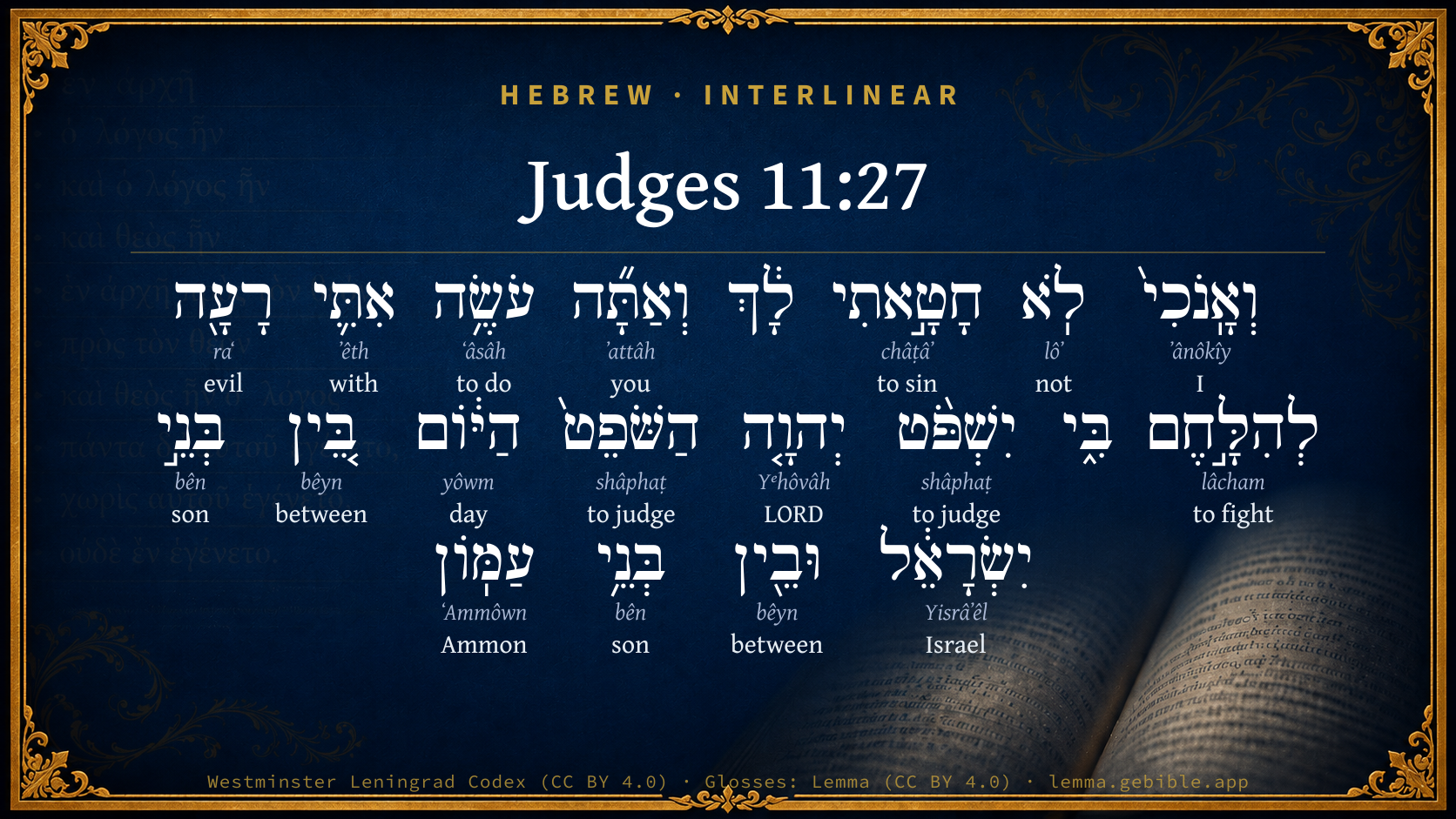
Hebrew (Westminster Leningrad Codex) Judges 11:27 appears in the Hebrew Old Testament. The text above is from the Westminster Leningrad Codex. Each word links to its Strong’s number, a concise gloss, and parsing drawn from the Open Scriptures Hebrew Bible morphology. Click any word for its full Brown-Driver-Briggs (BDB) entry.
Download image
Cite this verse

Judges 11:27 (World English Bible). Public Domain. Lemma interlinear Bible study tool, https://lemma.gebible.app/v/judges/11/27.

Show BibTeX & RIS
BibTeX
RIS
English Translation
I therefore have not sinned against you, but you do me wrong to war against me: Yahweh, the Judge, be judge this day between the children of Israel and the children of Ammon.
World English Bible · Public Domain
Download a study sheet

One document with this verse’s original text, its word-by-word gloss line, the meaning frame, cross-references with their text, attributed commentary, and full source and license credits — printable, and it pastes into notes with its structure intact.

This verse Autodidact and up

Study sheet (.html) Plain text (.txt)

A passage Seminary Student

Up to 50 verses in one chapter. A passage sheet keeps up to 6 commentary sources and 12 cross-references per verse, in the order this page ranks them, and says so on the sheet whenever that leaves anything out. Ask for a single verse and you get the Autodidact verse sheet above.

Everything on this page stays free to read, with no account — the sheet is a download of what is already on screen, not access to it.

Want to remove ads? Support Godless Engineer
Compare translations 3

The same verse in 3 English versions, stacked beneath the original-language interlinear above. Click any original word for its lexicon entry.

Each is an independent rendering of the whole verse — the interlinear is not word-aligned to these translations.

Highlighted words mark where these versions differ — a whole-verse word diff, not a word-by-word alignment.

  • World English Bible Public Domain
    I therefore have not sinned against you, but you do me wrong to war against me: Yahweh, the Judge, be judge this day between the children of Israel and the children of Ammon.
  • King James Version Public Domain
    Wherefore I have not sinned against thee, but thou doest me wrong to war against me: the LORD the Judge be judge this day between the children of Israel and the children of Ammon.
  • unfoldingWord Literal Text CC BY-SA 4.0
    So I have not sinned against you, but you are doing me wrong by fighting with me. Yahweh, the judge, will judge today between the sons of Israel and between the sons of Ammon.’”

unfoldingWord Literal Text — © unfoldingWord, licensed CC BY-SA 4.0. Word-aligned USFM3 via Door43 (git.door43.org/unfoldingWord/en_ult).

Versions to compare (up to 4)

3 of 4 selected

Show all 18 translations

Every available English version of this verse, each an independent rendering of the whole verse.

  • World English Bible Public Domain
    I therefore have not sinned against you, but you do me wrong to war against me: Yahweh, the Judge, be judge this day between the children of Israel and the children of Ammon.
  • Berean Standard Bible Public Domain
    I have not sinned against you, but you have done me wrong by waging war against me. May the LORD, the Judge, decide today between the Israelites and the Ammonites.”
  • Majority Standard Bible Public Domain
    I have not sinned against you, but you have done me wrong by waging war against me. May the LORD, the Judge, decide today between the Israelites and the Ammonites.”
  • King James Version Public Domain
    Wherefore I have not sinned against thee, but thou doest me wrong to war against me: the LORD the Judge be judge this day between the children of Israel and the children of Ammon.
  • American Standard Version (1901) Public Domain
    I therefore have not sinned against thee, but thou doest me wrong to war against me: Jehovah, the Judge, be judge this day between the children of Israel and the children of Ammon.
  • Revised Version (1885) Public Domain
    I therefore have not sinned against thee, but thou doest me wrong to war against me: the LORD, the Judge, be judge this day between the children of Israel and the children of Ammon.
  • Geneva Bible (1599) Public Domain
    Wherefore, I haue not offended thee: but thou doest me wrong to warre against me. The Lord the Iudge be iudge this day betweene the children of Israel, and the children of Ammon.
  • Douay-Rheims (1899) Public Domain
    Therefore I do not trespass against thee, but thou wrongest me by declaring an unjust war against me. The Lord be judge and decide this day between Israel and the children of Ammon.
  • Young's Literal Translation Public Domain
    And I -- I have not sinned against thee, and thou art doing with me evil -- to fight against me. Jehovah, the Judge, doth judge to-day between the sons of Israel and the sons of Ammon.'
  • Literal Standard Version CC BY-SA 4.0
    And I have not sinned against you, and you are doing evil with me—to fight against me. YHWH, the Judge, judges between the sons of Israel and the sons of Ammon today.”
  • Unlocked Literal Bible CC BY-SA 4.0
    I have not done you wrong, but you are doing me wrong by attacking me. Yahweh, the judge, will decide today between the people of Israel and the people of Ammon.”
  • unfoldingWord Literal Text CC BY-SA 4.0
    So I have not sinned against you, but you are doing me wrong by fighting with me. Yahweh, the judge, will judge today between the sons of Israel and between the sons of Ammon.’”
  • Darby Bible Public Domain
    I therefore have not sinned against you, and you do me wrong by making war on me; the LORD, the Judge, decide this day between the people of Israel and the people of Ammon."
  • World Messianic Bible Public Domain
    Therefore I have not sinned against you, but you do me wrong to war against me. May the LORD the Judge be judge today between the children of Israel and the children of Ammon.”
  • Webster's Bible Public Domain
    Wherefore I have not sinned against thee, but thou doest me wrong to war against me: the LORD the Judge be judge this day between the children of Israel and the children of Ammon.
  • Free Bible Version CC BY-SA 4.0
    I have not sinned against you, but you have done me wrong by going to war against me. Let the Lord, the Judge, decide today between the Israelites and the Ammonites.”
  • Bible in Basic English Public Domain
    So I have done no wrong against you, but you are doing wrong to me in fighting against me: may the Lord, who is Judge this day, be judge between the children of Israel and the children of Ammon.
  • JPS Tanakh (1917) Public Domain
    I therefore have not sinned against thee, but thou doest me wrong to war against me; the LORD, the Judge, be judge this day between the children of Israel and the children of Ammon.'

Literal Standard Version (2020), Covenant Press — licensed CC BY-SA 4.0. Text via the HelloAO Bible API (eBible.org). Unlocked Literal Bible (unfoldingWord) — licensed CC BY-SA 4.0. Text via the HelloAO Bible API (eBible.org). unfoldingWord Literal Text — © unfoldingWord, licensed CC BY-SA 4.0. Word-aligned USFM3 via Door43 (git.door43.org/unfoldingWord/en_ult). Free Bible Version, Dr. Jonathan Gallagher — licensed CC BY-SA 4.0. Text via the HelloAO Bible API (eBible.org).

Word by word

More ways to search: Search by grammar → Find every occurrence → Compare this word →

Practice this passage: Drill this verse → Learn its vocabulary →

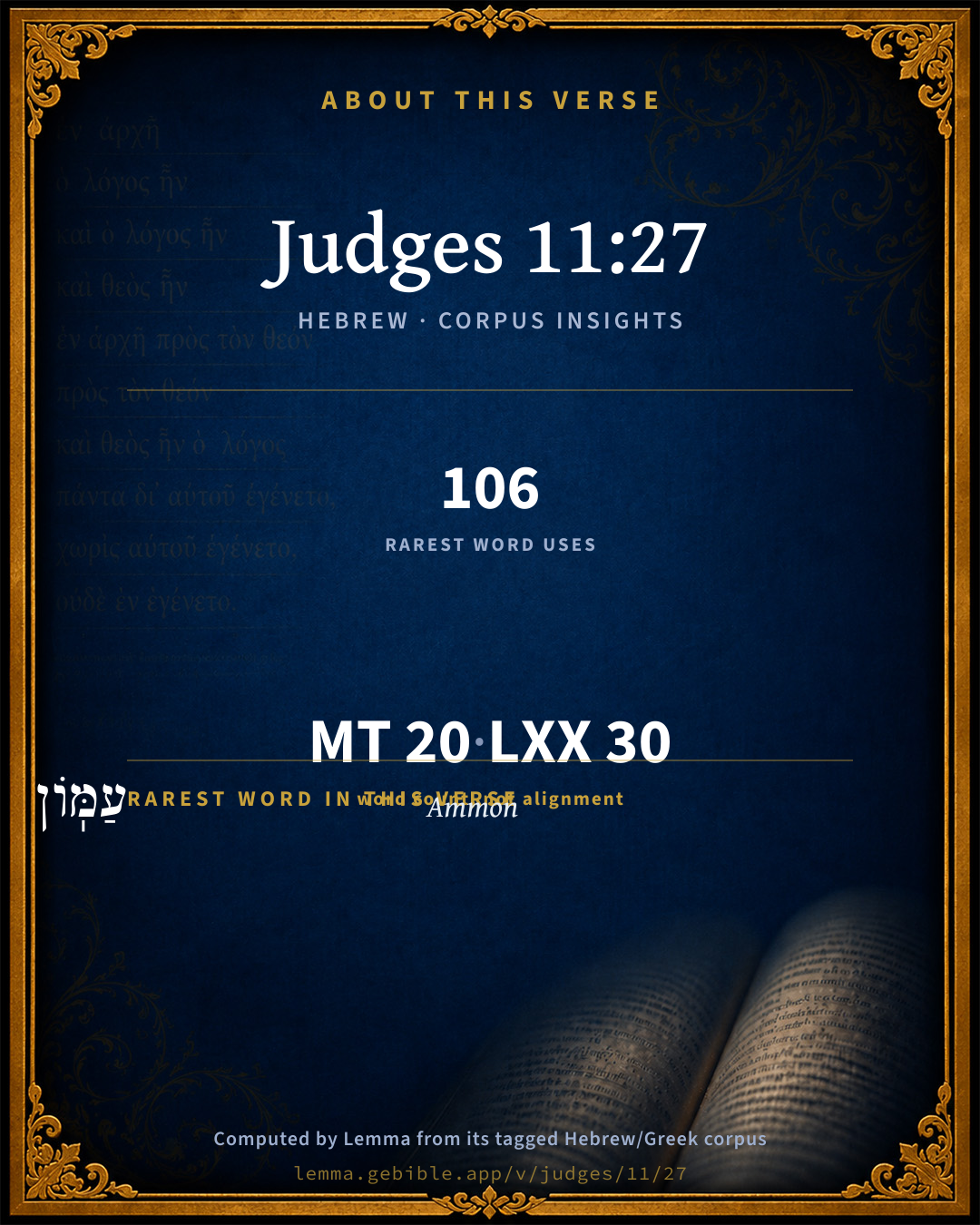
עַמּֽוֹן
ʻAmmôwn
H5983
“Ammon”
Noun, Proper
Part of Speech
Noun
Type
Proper
Full BDB Definition

Origin: from H5971

TWOT: 1642

Ammon = "tribal" - a people dwelling in Transjordan descended from Lot through Ben-ammi
  1. וְאָֽנֹכִי֙ ʼânôkîy H595 “and · I” Conjunction + Pronoun, Personal, 1st Person, Common, Singular
  2. לֹֽא lôʼ H3808 “not” Particle, Negative
  3. חָטָ֣אתִי châṭâʼ H2398 “to sin” Verb, Qal, Perfect, 1st Person, Common, Singular
  4. וְאַתָּ֞ה ʼattâh H859 “and · you” Conjunction + Pronoun, Personal, 2nd Person, Masculine, Singular
  5. עֹשֶׂ֥ה ʻâsâh H6213 “doing” Verb, Qal, Participle Active, Masculine, Singular, Absolute
  6. אִתִּ֛י ʼêth H854 “with · me” Preposition + Suffix, Personal, 1st Person, Common, Singular
  7. רָעָ֖ה raʻ H7451 “evil” Noun, Common, Feminine, Singular, Absolute
  8. לְהִלָּ֣חֶם lâcham H3898 “to fight” Preposition + Verb, Niphal, Infinitive Construct
  9. יִשְׁפֹּ֨ט shâphaṭ H8199 “to judge” Verb, Qal, Imperfect, 3rd Person, Masculine, Singular
  10. יְהוָ֤ה Yᵉhôvâh H3068 “LORD” Noun, Proper
  11. הַשֹּׁפֵט֙ shâphaṭ H8199 “the · judging” Particle, Definite Article + Verb, Qal, Participle Active, Masculine, Singular, Absolute
  12. הַיּ֔וֹם yôwm H3117 “the · day” Particle, Definite Article + Noun, Common, Masculine, Singular, Absolute
  13. בֵּ֚ין bêyn H996 “between” Preposition
  14. בְּנֵ֣י bên H1121 “sons of” Noun, Common, Masculine, Plural, Construct
  15. יִשְׂרָאֵ֔ל Yisrâʼêl H3478 “Israel” Noun, Proper
  16. וּבֵ֖ין bêyn H996 “and · between” Conjunction + Preposition
  17. בְּנֵ֥י bên H1121 “sons of” Noun, Common, Masculine, Plural, Construct

About this verse

These counts appear in no published source. They are computed here, from the morphology-tagged text and Lemma’s own curated glosses. What Lemma adds →

20
words
15
distinct lemmas
Historical
section

Grammatical profile

  • 5 verbs
  • 7 nouns
  • 2 pronouns
  • 5 prepositions
  • 1 particle

Verb forms

  • חָטָ֣אתִי Qal · Perfect
  • עֹשֶׂ֥ה Qal · Participle Active
  • לְהִלָּ֣חֶם Niphal · Infinitive Construct
  • יִשְׁפֹּ֨ט Qal · Imperfect
  • הַשֹּׁפֵט֙ Qal · Participle Active

Repetition

Words recur within this verse — often emphatic in Hebrew:

  • יִשְׁפֹּ֨ט to judge H8199 ×2
  • בֵּ֚ין between H996 ×2
  • בְּנֵ֣י son H1121 ×2

Hebrew & Septuagint length

In English translation the verse runs 33 words from the Hebrew and 35 from the Septuagint (LXX English) — closely comparable.

A rough comparison of the two English renderings, which tokenize alike — not a word-level alignment.

Word counts can differ between the Hebrew and the Greek without any difference in meaning — e.g. the Hebrew direct-object marker אֵת has no separate Greek word, and Greek often adds the article ὁ.

In the original languages it is 20 Hebrew tokens and 30 Greek tokens — but the two are counted differently (Hebrew bundles its prefixes and suffixes into one token; the Greek is in lemma form), so that isn’t a like-for-like length.

Cross-references

23

Topical passages linked to Judges 11:27 in the Treasury of Scripture Knowledge — connected by theme and wording, ordered by reader-vote popularity; previews shown in the World English Bible.

  • Genesis 16:5 Sarai said to Abram, "This wrong is your fault. I gave my handmaid into your bosom, and when she saw that she had conceived, I was despised in her eyes. Yahweh judge between me and you."
  • Genesis 18:25 Be it far from you to do things like that, to kill the righteous with the wicked, that so the righteous should be as the wicked. May that be far from you. Shouldn't the Judge of all the earth do right?"
  • 1 Samuel 24:12 Yahweh judge between me and you, and Yahweh avenge me of you; but my hand shall not be on you.
  • 1 Samuel 24:15 Yahweh therefore be judge, and give sentence between me and you, and see, and plead my cause, and deliver me out of your hand.
  • Genesis 31:53 The God of Abraham, and the God of Nahor, the God of their father, judge between us." Then Jacob swore by the fear of his father, Isaac.
  • Romans 14:10–12 But you, why do you judge your brother? Or you again, why do you despise your brother? For we will all stand before the judgment seat of Christ.
  • Psalms 75:7 But God is the judge. He puts down one, and lifts up another.
  • Psalms 82:8 Arise, God, judge the earth, For you inherit all of the nations.
  • Psalms 94:2 Rise up, you judge of the earth. Pay back the proud what they deserve.
  • Psalms 98:9 Let them sing before Yahweh, For he comes to judge the earth. He will judge the world with righteousness, And the peoples with equity.
  • Ecclesiastes 11:9 Rejoice, young man, in your youth, And let your heart cheer you in the days of your youth, And walk in the ways of your heart, And in the sight of your eyes; But know that for all these things God will bring you into judgment.
  • 1 Samuel 2:10 Those who strive with Yahweh shall be broken to pieces; Against them will he thunder in the sky: Yahweh will judge the ends of the earth; He will give strength to his king, Exalt the horn of his anointed.
  • Job 9:15 Whom, though I were righteous, yet would I not answer. I would make supplication to my judge.
  • Job 23:7 There the upright might reason with him, So I should be delivered forever from my judge.
  • Psalms 7:8–9 Yahweh administers judgment to the peoples. Judge me, Yahweh, according to my righteousness, And to my integrity that is in me.
  • Psalms 7:11 God is a righteous judge, Yes, a God who has indignation every day.
  • Psalms 50:6 The heavens shall declare his righteousness, For God himself is judge. Selah.
  • John 5:22–23 For the Father judges no one, but he has given all judgment to the Son,
  • 2 Corinthians 5:10 For we must all be revealed before the judgment seat of Christ; that each one may receive the things in the body, according to what he has done, whether good or bad.
  • 2 Timothy 4:8 From now on, there is stored up for me the crown of righteousness, which the Lord, the righteous judge, will give to me on that day; and not to me only, but also to all those who have loved his appearing.
  • Ecclesiastes 12:14 For God will bring every work into judgment, with every hidden thing, whether it is good, or whether it is evil.
  • 2 Corinthians 11:11 Why? Because I don't love you? God knows.
  • Hebrews 12:23 to the general assembly and assembly of the firstborn who are enrolled in heaven, to God the Judge of all, to the spirits of just men made perfect,

Cross-references courtesy of OpenBible.info (CC BY 4.0).

Hebrew and Greek witnesses Masoretic Hebrew ↔ Greek Septuagint

The same verse in the two great witnesses to the Old Testament, shown verse-for-verse.

These are two independent witnesses, not word-aligned to each other, and the Septuagint is shown in lemma (dictionary) form.

Hebrew Judges 11:27 Masoretic · Westminster Leningrad Codex

וְאָֽנֹכִי֙ לֹֽא חָטָ֣אתִי לָ֔ךְ וְאַתָּ֞ה עֹשֶׂ֥ה אִתִּ֛י רָעָ֖ה לְהִלָּ֣חֶם בִּ֑י יִשְׁפֹּ֨ט יְהוָ֤ה הַשֹּׁפֵט֙ הַיּ֔וֹם בֵּ֚ין בְּנֵ֣י יִשְׂרָאֵ֔ל וּבֵ֖ין בְּנֵ֥י עַמּֽוֹן

I therefore have not sinned against you, but you do me wrong to war against me: Yahweh, the Judge, be judge this day between the children of Israel and the children of Ammon.

World English Bible · Public Domain

Greek LXX Judges 11:27 Septuagint · lemma form

καί νῦν ἐγώ εἰμί οὐ ἁμαρτάνω σύ καί σύ ποιέω μετά ἐγώ πονηρία ὁ παρατάσσω ἐν ἐγώ κρίνω κύριος κρίνω σήμερον ἀνά μέσος υἱός ἰσραήλ καί ἀνά μέσος υἱός αμμων

And now I have not sinned against you, but you wrong me in preparing war against me: may the Lord the Judge judge this day between the children of Israel and the children of Ammon.

LXX2012 (modern English Septuagint) · Public Domain

Hebrew: Westminster Leningrad Codex (CC BY 4.0). Greek: Septuagint (public domain); English from LXX2012 (modern English Septuagint) (Public Domain). How the Septuagint differs from the Hebrew →

Targum (Aramaic paraphrase)

1

The Targum is the ancient Jewish Aramaic paraphrase of the Hebrew Scriptures — an interpretive translation, not the Hebrew text itself. Onkelos (literal) and Pseudo-Jonathan (expansive) render the Torah, and Jonathan the Prophets. Coverage is partial: where no permissively-licensed English translation exists for a verse, only the Aramaic is shown. This is verse-level text, not a word-by-word alignment to the Hebrew.

  1. Targum Jonathan Prophets (Joshua–Malachi)
    וַאֲנָא לָא חָטֵית לָךְ וְאַתְּ עָבֵיד עִמִי בִּישָׁא לְאַגָחָא קְרָבָא בִי יְדִין יְיָ דַעֲבַד דִינָא יוֹמָא דֵין בֵּין בְּנֵי יִשְׂרָאֵל וּבֵין בְּנֵי עַמוֹן:

    (no public-domain English translation for this verse)

    Targum Jonathan — Aramaic: “Mikraot Gedolot” (public domain). English: “Sefaria Community Translation” (CC0 1.0 (public-domain dedication)); “London "Chaldee Paraphrase," 1871” (public domain). Text via Sefaria.

Commentary

Notes on Judges 11:27 from classic Christian and Jewish commentators (each source and its license shown beneath its notes). The classic Christian expositions comment on the surrounding passage and are grouped to its opening verse, so a note may address several verses; the Jewish commentaries on the Tanakh (Rashi and others) are per-verse, so they appear only where the commentator wrote on this verse.

Lemma curates 59 commentaries, every one of them public domain or Creative Commons licensed, each selected and text-cleaned for this edition rather than reprinted as found. About our sources →

Trapp's Complete Commentary

John Trapp

Jdg 11:27 Wherefore I have not sinned against thee, but thou doest me wrong to war against me: the LORD the Judge be judge this day between the children of Israel and the children of Ammon.

Ver. 27. Wherefore I have not sinned against thee,] q.d., My cause is good, and so shall my courage be.

“ Transit et attollit vires in milite causa:

Quae nisi iusto subest, excutit arma pudor. ”

The Lord the Judge be judge this day.] It appeareth by this whole discourse, that Jephtha was an orator as well as a soldier. Achilles had this charge from his father,

“Mυθων τε ρητηρ εμεναι, πρηκτηρα τε εργων.” - Homer.

John Trapp, A Commentary or Exposition upon All the Books of the Old and New Testament (1647–1656) — public domain. Text from a community e-Sword module.

Joseph Benson's Commentary

Jdg 11:27. Wherefore I have not sinned — I have done thee no wrong. The Lord, the Judge, be judge — Let him determine this controversy by the success of this day and war. The meaning is, that if they were not moved by these reasons, but the controversy must be decided by arms, he committed his cause to God, the righteous Judge of the whole world, who, he doubted not, would do him right. Be judge this day — He does not mean that God would determine the right by giving him the victory then, when he spake these words, (for he was not yet ready to give them battle,) but that God would judge of the justice of his present plea, and accordingly give sentence when the matter came to be tried in battle. There cannot be a finer picture of justice, candour, fair reasoning, moderation, and unwillingness to proceed to the dreadful miseries of war, joined with a noble spirit to defend his country in its just rights, than that which Jephthah shows in his messages to the Ammonites. It were to be wished that all kings would follow his steps, and not rush into the shocking inhumanities and miseries of war with too much precipitation, but first try what good temper, moderation, fair reasoning, and a claim to no more than their just rights, will do with their enemies.

Joseph Benson's Commentary on the Old and New Testaments (1811–1818) — public domain. Text from a community e-Sword module.

Geneva Bible (1599)

Geneva Bible translators

To punish the offender.

Geneva Bible (1599) marginal notes — public domain. Text via Bolls.life.

Adam Clarke's Commentary

Verse 27. The Lord the Judge be judge - between the children of Israel] If you be right, and we be wrong, then Jehovah, who is the sovereign and incorruptible Judge, shall determine in your favour; and to Him I submit the righteousness of my cause.

Adam Clarke's Commentary on the Bible (1810–1826) — public domain. Text from a community e-Sword/MySword module.

Ellicott's Commentary for English Readers

(27) The Lord the Judge be judge this day.—An appeal to the arbitrament of Jehovah to decide on the justice of an appeal to arms. (Comp. Gen_16:5; Gen_31:53; Gen_18:25; 1Sa_24:15.)

These verses contain a deeply interesting specimen of what may be called ancient diplomacy, and very powerful and straightforward it is—at once honest, conciliatory, and firm. Jephthah maintains the rights of Israel on three grounds, viz., (1) Right of direct conquest, not from Ammon but from the Amorites (15-20); (2) The decision of God (Jdg_11:21-23), which he supports by an argumentum ad hominem—namely, the acquiescence in this decision of the Moabite god Chemosh (Jdg_11:24); (3) Undisputed possession from the first (Jdg_11:25-26). He ends by an appeal to God to approve the justice of his cause.

A Bible Commentary for English Readers, edited by Charles John Ellicott (1878–1897) — public domain. Text from a community e-Sword module.

The Cambridge Bible for Schools and Colleges

gen. ed. J. J. S. Perowne

27. the Lord … be judge] Cf. Gen_31:53, 1Sa_24:12; 1Sa_24:15. Even in early Israel Jehovah could be appealed to as the Judge, who in the quarrels of men or nations was known to take the side of justice against unfair aggression. The fundamental difference between Jehovah and the gods of the nations, and His superiority to them, lay in His essentially moral character.

The Cambridge Bible for Schools and Colleges (gen. ed. J. J. S. Perowne; Cambridge University Press, 1878–1918) — public domain. Text from a community e-Sword module.

John Gill's Exposition

Howbeit, the king of the children of Ammon hearkened not unto the words of Jephthah which he sent him. He attended not to the arguments Jephthah made use of, and did not choose to seem at least to be convinced by them, nor to regard the awful appeal he had made to the great Jehovah.

Howbeit, the king of the children of Ammon hearkened not unto the words of Jephthah which he sent him. He attended not to the arguments Jephthah made use of, and did not choose to seem at least to be convinced by them, nor to regard the awful appeal he had made to the great Jehovah.

Judges 11:29

jdg 11:29

jdg 11:29

jdg 11:29Then the Spirit of the Lord came upon Jephthah,.... The spirit of strength, as the Targum; of fortitude of mind, of uncommon valour and courage, and of zeal for God and Israel, and against their enemies; such a spirit as used to be given to men, when they were in an extraordinary manner raised up by the Lord, to be judges, saviours, and deliverers of his people; so that as Jephthah was before chosen by the people to be the general and head of the tribes beyond Jordan, he was raised up and qualified by the Lord now to be the judge of all Israel; of which the Spirit of the Lord coming on him was a sufficient proof and evidence:

and he passed over Gilead and Manasseh; the countries that belonged to Reuben, Gad, and the half tribe of Manasseh; however, all that part of it which lay from the place where he was, to the land of the children of Ammon:

and passed over Mizpeh of Gilead; which lay to the north of the land of Gilead, or tribe of Gad:

and from Mizpeh of Gilead he passed over to the children of Ammon; did not stay for them, to bring on the war in the land of Gilead, but prevented it by carrying it into the land of the children of Ammon. It seems by this, that though the children of Ammon had encamped in Gilead some time before, Jdg 10:17, yet for some reason or another they had decamped, and had retired into their own country; but yet threatening Israel with a war, and preparing for it.

John Gill's Exposition of the Whole Bible (1746–1763) — public domain (CC PDM 1.0). Text via the HelloAO Bible API.

Haydock's Catholic Bible Commentary

And decide. Literally, "the arbiter of this day." Jephte is so well convinced of the justice of his cause, that he is willing to abide by God’s decision, (Haydock) to be manifested by the issue of the battle. (Menochius) --- At the same time, he threatens the Ammonites with God’s judgments, if by their fault blood be shed unjustly, as he, like a good prince, had tried every means to prevent that misfortune, and to bring things to an amicable conclusion. (Calmet)

George Leo Haydock (1774–1849), Haydock's Catholic Family Bible and Commentary, 1859 edition — public domain. Excludes Psalms (Douay-Rheims chapter numbering differs from Protestant) and Deuterocanonical books (Catholic canon only).

Matthew Poole's English Annotations

I have not sinned against thee; I have done thee no wrong.

The Lord be judge this day; let him determine this controversy by the success of this day and war.

Matthew Poole's English Annotations on the Holy Bible (1683–1685) — public domain. Text from a community e-Sword/MySword module.

The Pulpit Commentary

Jephthah now asserts his own entire blamelessness, and appeals to the justice of God to decide between him and the Ammonites.

The Pulpit Commentary (1880–1919), ed. H.D.M. Spence-Jones & Joseph S. Exell — public domain. Text from a community e-Sword module.

John Wesley's Explanatory Notes

I have not - I have done thee no wrong. Be judge - Let him determine this controversy by the success of this day and war.

John Wesley, Explanatory Notes Upon the Whole Bible (1754–1765) — public domain. Text via the GEBible commentary corpus.

Lesson kit

Teaching starters — assembled from the data on this page, not authored interpretation. Every prompt links to the verse data it draws on. Edit before teaching.

Judges, in the Historical, opens this verse with 20 words (15 distinct Hebrew lemmas). Its most distinctive word is ʻAmmôwn (“Ammon”). A historical commentator’s framing appears above. Read the whole chapter for the surrounding context.

Discussion questions

  1. How does “Ammon” (ʻAmmôwn) shape what this verse is saying?
  2. How does Genesis 16:5, which shares this passage’s theme, read alongside this verse?
  3. What does the repetition of “to judge” (2× in this one verse) do in this verse?
  4. These translations render this verse differently; the difference is in the English rendering, not the original. What questions does that raise?
  5. «חָטָ֣אתִי» is a Qal Perfect verb. How does that grammatical form shape the action described?
  6. Compare how Trapp's Complete Commentary and Joseph Benson's Commentary read this verse. Where do they agree or differ?

Things to notice

Reading settings

Reading text

Shown beneath each verse's original-language words.

Old Testament
Old Testament edition

Read the OT as the Masoretic Hebrew (MT) or the Greek Septuagint (LXX).

English shown for the Greek Septuagint (in the Hebrew ↔ Greek comparison).

Comparing translations? Open the Compare panel on any verse page to stack up to four side by side.