Amos 7:16

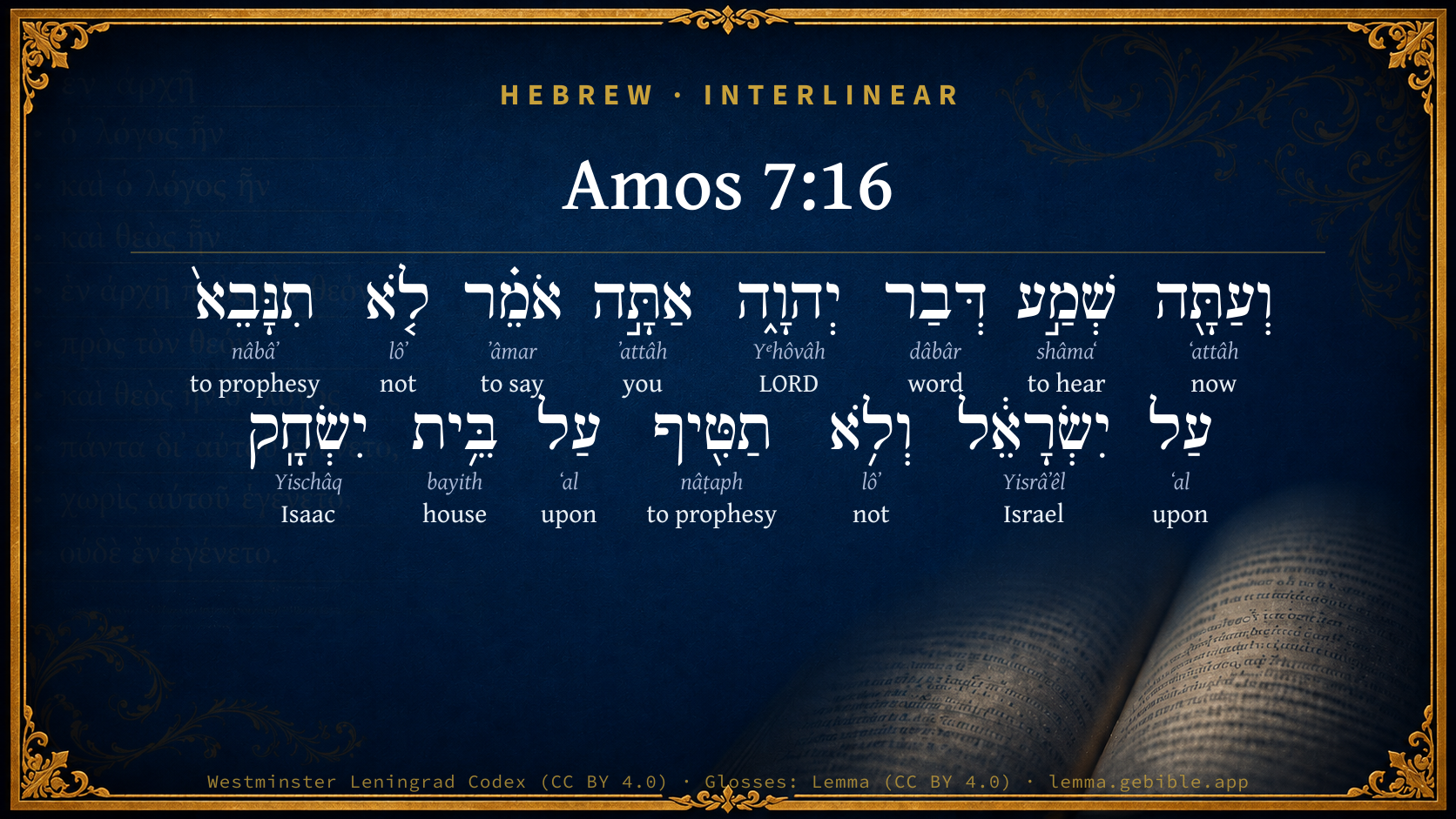
Hebrew (Westminster Leningrad Codex) Amos 7:16 appears in the Hebrew Old Testament. The text above is from the Westminster Leningrad Codex. Each word links to its Strong’s number, a concise gloss, and parsing drawn from the Open Scriptures Hebrew Bible morphology. Click any word for its full Brown-Driver-Briggs (BDB) entry.
Download image
Cite this verse

Amos 7:16 (World English Bible). Public Domain. Lemma interlinear Bible study tool, https://lemma.gebible.app/v/amos/7/16.

Show BibTeX & RIS
BibTeX
RIS
English Translation
Now therefore listen to the word of Yahweh: 'You say, Don't prophesy against Israel, and don't preach against the house of Isaac.'
World English Bible · Public Domain
Download a study sheet

One document with this verse’s original text, its word-by-word gloss line, the meaning frame, cross-references with their text, attributed commentary, and full source and license credits — printable, and it pastes into notes with its structure intact.

This verse Autodidact and up

Study sheet (.html) Plain text (.txt)

A passage Seminary Student

Up to 50 verses in one chapter. A passage sheet keeps up to 6 commentary sources and 12 cross-references per verse, in the order this page ranks them, and says so on the sheet whenever that leaves anything out. Ask for a single verse and you get the Autodidact verse sheet above.

Everything on this page stays free to read, with no account — the sheet is a download of what is already on screen, not access to it.

Want to remove ads? Support Godless Engineer
Compare translations 3

The same verse in 3 English versions, stacked beneath the original-language interlinear above. Click any original word for its lexicon entry.

Each is an independent rendering of the whole verse — the interlinear is not word-aligned to these translations.

Highlighted words mark where these versions differ — a whole-verse word diff, not a word-by-word alignment.

  • World English Bible Public Domain
    Now therefore listen to the word of Yahweh: 'You say, Don't prophesy against Israel, and don't preach against the house of Isaac.'
  • King James Version Public Domain
    Now therefore hear thou the word of the LORD: Thou sayest, Prophesy not against Israel, and drop not thy word against the house of Isaac.
  • unfoldingWord Literal Text CC BY-SA 4.0
    Now hear the word of Yahweh. You say, ‘Do not prophesy against Israel, and do not speak against the house of Isaac.’

unfoldingWord Literal Text — © unfoldingWord, licensed CC BY-SA 4.0. Word-aligned USFM3 via Door43 (git.door43.org/unfoldingWord/en_ult).

Versions to compare (up to 4)

3 of 4 selected

Show all 18 translations

Every available English version of this verse, each an independent rendering of the whole verse.

  • World English Bible Public Domain
    Now therefore listen to the word of Yahweh: 'You say, Don't prophesy against Israel, and don't preach against the house of Isaac.'
  • Berean Standard Bible Public Domain
    Now, therefore, hear the word of the LORD. You say: ‘Do not prophesy against Israel; do not preach against the house of Isaac.’
  • Majority Standard Bible Public Domain
    Now, therefore, hear the word of the LORD. You say: ‘Do not prophesy against Israel; do not preach against the house of Isaac.’
  • King James Version Public Domain
    Now therefore hear thou the word of the LORD: Thou sayest, Prophesy not against Israel, and drop not thy word against the house of Isaac.
  • American Standard Version (1901) Public Domain
    Now therefore hear thou the word of Jehovah: Thou sayest, Prophesy not against Israel, and drop not `thy word' against the house of Isaac;
  • Revised Version (1885) Public Domain
    Now therefore hear thou the word of the LORD: Thou sayest, Prophesy not against Israel, and drop not thy word against the house of Isaac;
  • Geneva Bible (1599) Public Domain
    Now therefore heare thou the word of the Lord. Thou sayest, Prophecie not against Israel, and speake nothing against the house of Izhak.
  • Douay-Rheims (1899) Public Domain
    And now hear thou the word of the Lord: Thou sayest, thou shalt not prophesy against Israel, and thou shalt not drop thy word upon the house of the idol.
  • Young's Literal Translation Public Domain
    And now, hear a word of Jehovah: thou art saying, Do not prophesy against Israel, nor drop `any thing' against the house of Isaac,
  • Literal Standard Version CC BY-SA 4.0
    And now, hear a word of YHWH: You are saying, Do not prophesy against Israel, nor drop [anything] against the house of Isaac,
  • Unlocked Literal Bible CC BY-SA 4.0
    Now hear the word of Yahweh. You say, 'Do not prophesy against Israel, and do not speak against the house of Isaac.'
  • unfoldingWord Literal Text CC BY-SA 4.0
    Now hear the word of Yahweh. You say, ‘Do not prophesy against Israel, and do not speak against the house of Isaac.’
  • Darby Bible Public Domain
    And now hear thou the word of Jehovah: Thou sayest, Prophesy not against Israel, and utter not [words] against the house of Isaac.
  • World Messianic Bible Public Domain
    Now therefore listen to the LORD’s word: ‘You say, Don’t prophesy against Israel, and don’t proclaim against the house of Isaac.’
  • Webster's Bible Public Domain
    Now therefore hear thou the word of the LORD: Thou sayest, Prophesy not against Israel, and drop not thy word against the house of Isaac.
  • Free Bible Version CC BY-SA 4.0
    So now hear what the Lord is telling you: You say, “Don't prophesy against Israel, and don't preach against the descendants of Isaac.”
  • Bible in Basic English Public Domain
    Now then, give ear to the word of the Lord: You say, Be no prophet to Israel, and say not a word against the people of Isaac.
  • JPS Tanakh (1917) Public Domain
    Now therefore hear thou the word of the LORD: Thou sayest: Prophesy not against Israel, and preach not against the house of Isaac;

Literal Standard Version (2020), Covenant Press — licensed CC BY-SA 4.0. Text via the HelloAO Bible API (eBible.org). Unlocked Literal Bible (unfoldingWord) — licensed CC BY-SA 4.0. Text via the HelloAO Bible API (eBible.org). unfoldingWord Literal Text — © unfoldingWord, licensed CC BY-SA 4.0. Word-aligned USFM3 via Door43 (git.door43.org/unfoldingWord/en_ult). Free Bible Version, Dr. Jonathan Gallagher — licensed CC BY-SA 4.0. Text via the HelloAO Bible API (eBible.org).

Word by word

More ways to search: Search by grammar → Find every occurrence → Compare this word →

Practice this passage: Drill this verse → Learn its vocabulary →

יִשְׂחָֽק
Yischâq
H3446
“Isaac”
Noun, Proper
Part of Speech
Noun
Type
Proper
Full BDB Definition

Origin: from H7831

TWOT: 1905b

Isaac = "he laughs" - son of Abraham by Sarah his wife and father of Jacob and Esau
  1. וְעַתָּ֖ה ʻattâh H6258 “and · now” Conjunction + Adverb
  2. שְׁמַ֣ע shâmaʻ H8085 “hear” Verb, Qal, Imperative, 2nd Person, Masculine, Singular
  3. דְּבַר dâbâr H1697 “word of” Noun, Common, Masculine, Singular, Construct
  4. יְהוָ֑ה Yᵉhôvâh H3068 “LORD” Noun, Proper
  5. אַתָּ֣ה ʼattâh H859 “you” Pronoun, Personal, 2nd Person, Masculine, Singular
  6. אֹמֵ֗ר ʼâmar H559 “saying” Verb, Qal, Participle Active, Masculine, Singular, Absolute
  7. לֹ֤א lôʼ H3808 “not” Particle, Negative
  8. תִנָּבֵא֙ nâbâʼ H5012 “to prophesy” Verb, Niphal, Imperfect, 2nd Person, Masculine, Singular
  9. עַל ʻal H5921 “upon” Preposition
  10. יִשְׂרָאֵ֔ל Yisrâʼêl H3478 “Israel” Noun, Proper
  11. וְלֹ֥א lôʼ H3808 “and · not” Conjunction + Particle, Negative
  12. תַטִּ֖יף nâṭaph H5197 “to prophesy” Verb, Hiphil, Imperfect, 2nd Person, Masculine, Singular
  13. עַל ʻal H5921 “upon” Preposition
  14. בֵּ֥ית bayith H1004 “house of” Noun, Common, Masculine, Singular, Construct

About this verse

These counts appear in no published source. They are computed here, from the morphology-tagged text and Lemma’s own curated glosses. What Lemma adds →

15
words
13
distinct lemmas
Prophets
section

Notable vocabulary

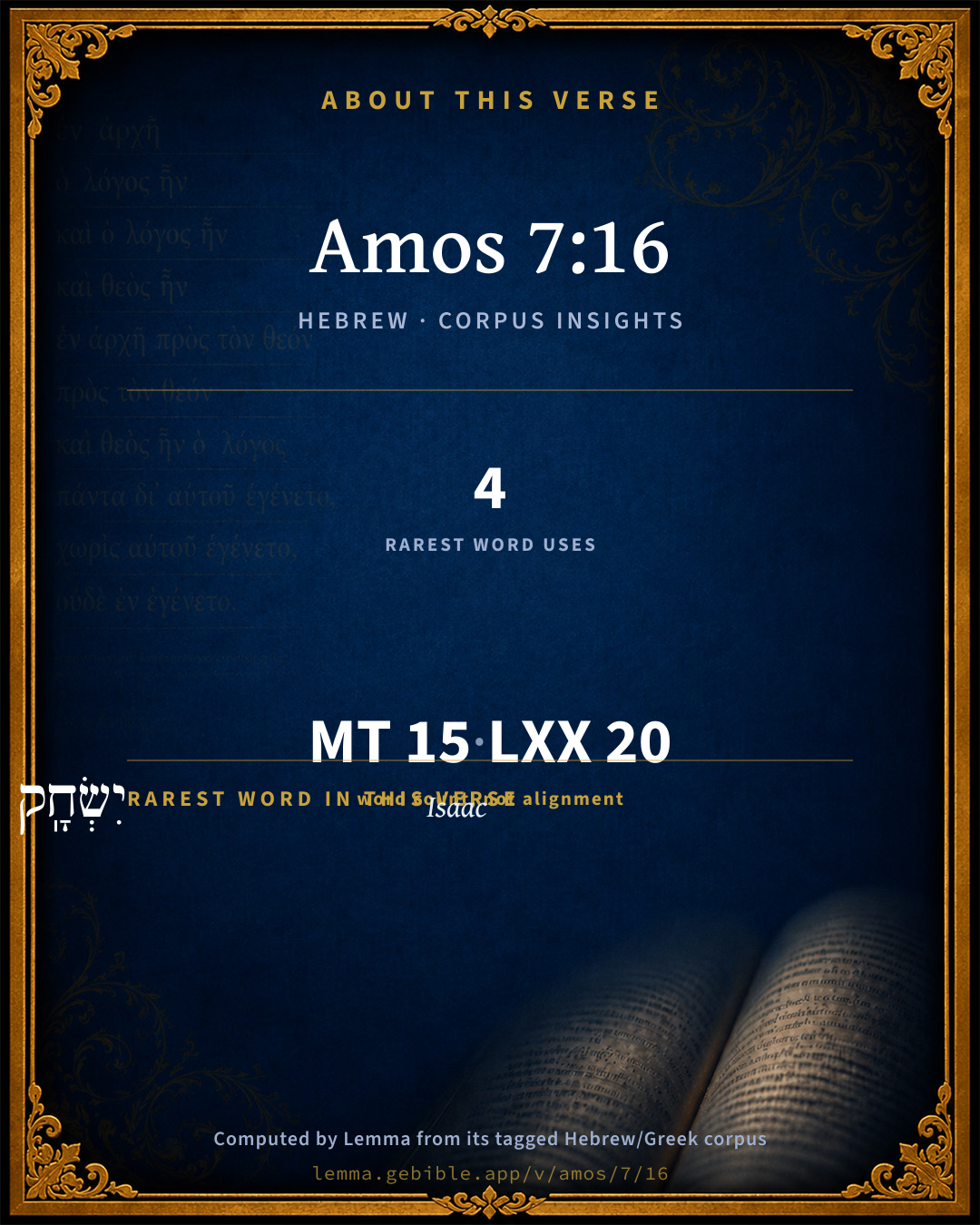
The rarest word here is יִשְׂחָֽק Isaac H3446 — appearing just 4 times in the whole Hebrew Bible.

Shared distinctive vocabulary

יִשְׂחָֽק Isaac H3446 occurs in 4 verses of the Hebrew Bible. Also found in:

Grammatical profile

  • 4 verbs
  • 5 nouns
  • 1 pronoun
  • 2 prepositions
  • 1 adverb
  • 2 particles

Verb forms

  • שְׁמַ֣ע Qal · Imperative
  • אֹמֵ֗ר Qal · Participle Active
  • תִנָּבֵא֙ Niphal · Imperfect
  • תַטִּ֖יף Hiphil · Imperfect

Repetition

Words recur within this verse — often emphatic in Hebrew:

Hebrew & Septuagint length

In English translation the verse runs 22 words from the Hebrew and 24 from the Septuagint (LXX English) — closely comparable.

A rough comparison of the two English renderings, which tokenize alike — not a word-level alignment.

Word counts can differ between the Hebrew and the Greek without any difference in meaning — e.g. the Hebrew direct-object marker אֵת has no separate Greek word, and Greek often adds the article ὁ.

In the original languages it is 15 Hebrew tokens and 20 Greek tokens — but the two are counted differently (Hebrew bundles its prefixes and suffixes into one token; the Greek is in lemma form), so that isn’t a like-for-like length.

Cross-references

9

Topical passages linked to Amos 7:16 in the Treasury of Scripture Knowledge — connected by theme and wording, ordered by reader-vote popularity; previews shown in the World English Bible.

  • Ezekiel 20:46 Son of man, set your face toward the south, and drop [your word] toward the south, and prophesy against the forest of the field in the South;
  • Ezekiel 21:2 Son of man, set your face toward Jerusalem, and drop [your word] toward the sanctuaries, and prophesy against the land of Israel;
  • Micah 2:6 "Don't you prophesy!" They prophesy. "Don't prophesy about these things. Disgrace won't overtake us."
  • Deuteronomy 32:2 My doctrine shall drop as the rain; My speech shall condense as the dew, As the small rain on the tender grass, As the showers on the herb.
  • Jeremiah 28:15–17 Then said the prophet Jeremiah to Hananiah the prophet, Hear now, Hananiah: Yahweh has not sent you; but you make this people to trust in a lie.
  • Amos 7:13 but don't prophesy again any more at Bethel; for it is the king's sanctuary, and it is a royal house!"
  • 1 Samuel 15:16 Then Samuel said to Saul, Stay, and I will tell you what Yahweh has said to me this night. He said to him, Say on.
  • 1 Kings 22:19 [Micaiah] said, Therefore hear you the word of Yahweh: I saw Yahweh sitting on his throne, and all the host of heaven standing by him on his right hand and on his left.
  • Isaiah 30:10 who tell the seers, "Don't see;" and to the prophets, "Don't prophesy to us right things, speak to us smooth things, prophesy deceits,

Cross-references courtesy of OpenBible.info (CC BY 4.0).

Hebrew and Greek witnesses Masoretic Hebrew ↔ Greek Septuagint

The same verse in the two great witnesses to the Old Testament, shown verse-for-verse.

These are two independent witnesses, not word-aligned to each other, and the Septuagint is shown in lemma (dictionary) form.

Hebrew Amos 7:16 Masoretic · Westminster Leningrad Codex

וְעַתָּ֖ה שְׁמַ֣ע דְּבַר יְהוָ֑ה אַתָּ֣ה אֹמֵ֗ר לֹ֤א תִנָּבֵא֙ עַל יִשְׂרָאֵ֔ל וְלֹ֥א תַטִּ֖יף עַל בֵּ֥ית יִשְׂחָֽק

Now therefore listen to the word of Yahweh: 'You say, Don't prophesy against Israel, and don't preach against the house of Isaac.'

World English Bible · Public Domain

Greek LXX Amos 7:16 Septuagint · lemma form

καί νῦν ἀκούω λόγος κύριος σύ λέγω μή προφητεύω ἐπί ὁ ἰσραήλ καί οὐ μή ὀχλαγωγέω ἐπί ὁ οἶκος ἰακώβ

And now hear the word of the Lord: You say, Prophesy not to Israel, and raise not a tumult against the house of Jacob.

LXX2012 (modern English Septuagint) · Public Domain

On this verse, Haydock's Catholic Bible Commentary discusses the Septuagint’s reading. Read the note in Commentary ↓

Hebrew: Westminster Leningrad Codex (CC BY 4.0). Greek: Septuagint (public domain); English from LXX2012 (modern English Septuagint) (Public Domain). How the Septuagint differs from the Hebrew →

Targum (Aramaic paraphrase)

1

The Targum is the ancient Jewish Aramaic paraphrase of the Hebrew Scriptures — an interpretive translation, not the Hebrew text itself. Onkelos (literal) and Pseudo-Jonathan (expansive) render the Torah, and Jonathan the Prophets. Coverage is partial: where no permissively-licensed English translation exists for a verse, only the Aramaic is shown. This is verse-level text, not a word-by-word alignment to the Hebrew.

  1. Targum Jonathan Prophets (Joshua–Malachi)
    וּכְעַן קַבֵּל פִּתְגָמָא דַייָ אַתְּ אֲמַרְתְּ לָא תִּתְנַבֵּי בִּשְׁמָא דַיְיָָ עַל יִשְׂרָאֵל וְלָא תַלֵיף עַל בֵּית יִשְׂחָק:

    (no public-domain English translation for this verse)

    Targum Jonathan — Aramaic: “Mikraot Gedolot” (public domain). English: “Sefaria Community Translation” (CC0 1.0 (public-domain dedication)); “London "Chaldee Paraphrase," 1871” (public domain). Text via Sefaria.

Commentary

Notes on Amos 7:16 from classic Christian and Jewish commentators (each source and its license shown beneath its notes). The classic Christian expositions comment on the surrounding passage and are grouped to its opening verse, so a note may address several verses; the Jewish commentaries on the Tanakh (Rashi and others) are per-verse, so they appear only where the commentator wrote on this verse.

Lemma curates 59 commentaries, every one of them public domain or Creative Commons licensed, each selected and text-cleaned for this edition rather than reprinted as found. About our sources →

Trapp's Complete Commentary

John Trapp

Amo 7:16 Now therefore hear thou the word of the LORD: Thou sayest, Prophesy not against Israel, and drop not [thy word] against the house of Isaac.

Ver. 16. Now therefore hear thou the word of the Lord] Hear, thou despiser, and wonder, and perish; for I work a work in thy days, a work which thou wilt in nowise believe, though a man declare it unto thee, Act 13:41. But whether thou wilt hear or forbear, believe or otherwise, thy doom is determined, and shall be pronounced, Eze 3:27 : "Hear, therefore, and give ear; be not proud: for the Lord hath spoken it." Oh that thou wouldst give glory to the Lord, and confess thy sin! Jer 13:15-16. Oh that thou wouldst submit to Divine justice, implore his mercy, and putting thy mouth in the dust, say, as once that good man did, Veniat, veniat, verbum Domini, et submittemus, ei sexcenta si nobis essent colla. Let the Lord speak, for his servant heareth! But because there is little hopes of that, stand forth and hear thy sentence, and the evil that shall befall thee, as sure as the coat is on thy back, or the heart in thy body. For hath the Lord spoken, and shall he not do it?

Thou sayest, Prophesy not] By a bold countermand to that of God in the former verse, "Go, prophesy," &c. "But woe to him that striveth with his Maker I Let the potsherds strive with the potsherds of the earth," Isa 45:9; let men meddle with their matches, and not "with him that is mightier than they," Ecc 6:10.

And drop not thy word] Which is as sharp as vinegar and nitre. Or, though it were as sweet as honey, yet it would cause pain to exulcerate parts when dropped upon them.

Against the house of Isaac] Though commanded so to do, Amo 7:9. Toothless truths would be better digested.

John Trapp, A Commentary or Exposition upon All the Books of the Old and New Testament (1647–1656) — public domain. Text from a community e-Sword module.

Joseph Benson's Commentary

Amo 7:16-17. Now, hear thou the word of the Lord — Who hath sent me, and whom thou contradictest; from him I have a message to thee also, which much concerns thee. Thou sayest, Prophesy not against Israel — Thou usest thy power to silence me; therefore thus saith the Lord — Because thou hast so directly and wilfully opposed the Lord; Thy wife shall be a harlot in the city — Shall be treated as a harlot in this very city of Beth-el. The meaning probably is, that she should be abused, or ravished, by the Assyrian soldiers, when they should take Beth-el. Thy land shall be divided by line — Conquerors were used to divide conquered lands in portions among their soldiers, which was done by measuring out every one’s part by a line; so that this expression signified, his land should be divided among the enemy. And thou shalt die in a polluted land — Thou shalt be carried captive from thine own country, and die in a land where the inhabitants are idolatrous.

Joseph Benson's Commentary on the Old and New Testaments (1811–1818) — public domain. Text from a community e-Sword module.

Tyndale Open Study Notes

Tyndale Open Resources

7:16 against my people (literally against the house of Isaac): Isaac represents all Israel (see also study note on 7:9; cp. 5:6, 15; 6:6).

Tyndale Open Study Notes — © Tyndale Open Resources, licensed CC BY-SA 4.0. Text via the HelloAO Bible API.

Jamieson, Fausset & Brown

Robert Jamieson, A. R. Fausset & David Brown

drop--distil as the refreshing drops of rain (Deu 32:2; Eze 21:2; compare Mic 2:6, Mic 2:11).

Jamieson, Fausset & Brown — Commentary Critical and Explanatory on the Whole Bible (1871) — public domain (CC PDM 1.0). Text via the HelloAO Bible API.

Adam Clarke's Commentary

Verse 16. Now therefore hear thou the word of the Lord] While he was speaking in his own vindication, God seems to have inspired him with the awful prediction which he immediately delivers.

Adam Clarke's Commentary on the Bible (1810–1826) — public domain. Text from a community e-Sword/MySword module.

John Calvin's Commentaries

Amos having shown that he must obey God, who had committed to him the office of teaching, now turns his discourse to Amaziah, and points out what he would gain by his insolence in daring to forbid a Prophet, an ambassador of the God of heaven, to proclaim what he had in command. As, then, Amaziah had proceeded into such a degree of rashness or rather of madness Amos now assails him and says, Hear then now the word of Jehovah He sets here the word or the decree of God in opposition to the prohibition of Amaziah: for the ungodly priest had forbidden God’s servant to proclaim his words any more in the land of Israel: “Who art thou? Thou indeed thus speakest; but God will also speak in his turn.” He shows, at the same time, the difference between the speech of Amaziah and the word of God: the impostor had indeed attempted to terrify the holy man so as to makehim to desist from his office, though the attempt was vain; but Amos shows that God’s word would not be without effect: “Whether I hold my peace or speak,” he seems to say, “this vengeance is suspended over thee.” But he, at the same time, connects God’s vengeance with his doctrine; for this was also necessary, that the ungodly priest might know that he gained nothing else, by attempting to do everything, than that he had doubly increased the vengeance of God.

There is, therefore, great emphasis in these words, Now hear the word of Jehovah thou who sayest, Prophesy not. Amaziah was indeed worthy of being destroyed by God a hundred times, together with all his offspring: but Amos intimates that God’s wrath was especially kindled by this madness, — that Amaziah dared to put a restraint on God, and to forbid his Spirit freely to reprove the sins of the whole people. Since, then, he proceeded so far, Amos shows that he would have justly to suffer the punishment due to his presumption, yea, to his furious and sacrilegious audacity, inasmuch as he set himself up against God, and sought to take from him his supreme authority, for nothing belongs more peculiarly to God than the office of judging the world; and this he does by his word and his Prophets. As, then, Amaziah had attempted to rob God of his own right and authority, the Prophet shows that vengeance had been thereby increased: Thou then, who sayest, Prophesy not against Israel, and speak not, hear the word of Jehovah

Remarkable is this passage, and from it we learn that nothing is better for us, when God rebukes us, than to descend into our own consciences, and to submit to the sentence which proceeds from his mouth, and humbly to entreat pardon as soon as he condemns us: for if we be refractory, God will not cease to speak, though we a hundred times forbid him; he will therefore go on notwithstanding our unwillingness. Further, we may vomit forth many blasphemies; but what can our clamorous words do? The Lord will, at the same time, speak with effect; he will not scatter his threatening in the air, but will really fulfill what proceeds from his mouth; and for this reason Paul compares heavenly truth to a sword, for vengeance is prepared for despisers. We ought therefore to take notice of this in the Prophet’s words, — that when profane men attempt to repel every tenth and all threatening, they gain nothing by their perverseness; for the lord will exercise his own right; and he will also join to his word, as they say, its execution. Thou then who sayest, Prophesy not, hear the word of Jehovah; though thou mayest growl, yet God will not be hindered by these thy commands; but he will ever continue complete in his own authority.” And he mentions word, as we have already said, to show that the truth, with which the ungodly contend, is connected with the power of God. God might indeed destroy all the unbelieving in silence, without uttering his voice; but he will have his Word honored, that the ungodly may know that they contend in vain, while they vomit forth their rage against his word, for they will at length find that in his word is included their condemnation.

Now, when he says, Prophecy not against Israel, and speak not against the house of Isaac, we may learn again from these words, that the word Isaac is used by the Prophet by way of concession; for the people of Israel were then wont to adduce the example of this holy patriarch. Thus superstitious men, neglecting the law of God, the common rule, ever turn aside to the examples of the saints; and they do this without any discrimination; nay, as their minds are perverted, when anything has been wrongfully done by the fathers, they instantly lay hold on it: and then, when there is anything peculiar, which God had approved in the fathers but wished not to be drawn, as they commonly say, into a precedent, the superstitious think that they have the best reason in their favor, when they can set up such a shield against God. As, then, the Israelites had at that time the name of their father Isaac in their mouths while they were foolishly worshipping God in Bethel and in other places, contrary to what the law prescribed, the Prophet Amos designedly repeats here again the name of Isaac, expressing it probably in imitation of what had been said by Amaziah.

John Calvin's Commentaries (1540-1563) — public domain. Text from the Calvin Translation Society English edition (1840s-50s) via the Christian Classics Ethereal Library (ccel.org). Calvin's coverage is partial (roughly two-thirds of the Bible); uncommented books and verses are honest gaps, never fabricated. The 19th-century editor's footnotes and remarks are omitted so the notes are faithfully Calvin's own voice.

Ellicott's Commentary for English Readers

(16) Drop not.—A word used in the Song of Moses for “distil,” expressing persuasive and flowing discourse (Deu_32:2; Eze_21:2; Eze_21:7; Mic_2:6; Mic_2:11).

A Bible Commentary for English Readers, edited by Charles John Ellicott (1878–1897) — public domain. Text from a community e-Sword module.

The Cambridge Bible for Schools and Colleges

gen. ed. J. J. S. Perowne

16. drop not thy word] The same expression, also used figuratively of a prophetic utterance, in Mic_2:6; Mic_2:11 and Eze_20:46; Eze_21:2 [Heb. 21:2, 7]. It was suggested probably by the flow of words, which were apt to stream from the prophets’ lips, when they were under the influence of the prophetic inspiration.

16–17. Amaziah had sought to silence Amos: Amos, speaking in the name of the God who had thus called him to be His prophet, so far from modifying or withdrawing his previous utterances, reaffirms them even more emphatically and distinctly than before.

The Cambridge Bible for Schools and Colleges (gen. ed. J. J. S. Perowne; Cambridge University Press, 1878–1918) — public domain. Text from a community e-Sword module.

John Gill's Exposition

Now therefore hear thou the word of the Lord,.... Which I have from him concerning thee, and which he has pronounced upon thee and thy family:

thou sayest, prophesy not against Israel; when God has bid me prophesy:

and drop not thy word against the house of Isaac; say nothing against it, though in ever so soft and gentle a manner: it designs the same thing as before, only in different words; and is a prohibition of the prophet to prophesy against the ten tribes that descended from Isaac, in the line of Jacob. So the Targum paraphrases it,

"thou shalt not teach against the house of Isaac;''

or deliver out any prophecy or doctrine that is against them, or threatens them with any calamity. Jarchi says the phrase is expressive of prophecy; see Deu 32:2.

John Gill's Exposition of the Whole Bible (1746–1763) — public domain (CC PDM 1.0). Text via the HelloAO Bible API.

Albert Barnes' Notes on the Bible

Amaziah then was in direct rebellion and contradiction against God. He was in an office forbidden by God. God’s word came to him. He had his choice; and, as people do, when entangled in evil courses, he chose the more consciously amiss. He had to resign his lucrative office and to submit to God speaking to him through a shepherd, or to stand in direct opposition to God, and to confront God; and in silencing Amos, he would silence God. But, like one who would arrest the lightning, he draws it on his own head. Amos contrasts the word of Amaziah, and the word of God; Rup.: “Hear thou the word of the Lord; Thou sayest; prophesy not against Israel. Therefore thus saith the Lord.” Not only will I not cease to prophesy against Israel, but I will also prophesy to thee. Hear now thine own part of the prophecy.”

Drop not - The form of expression, (not the word) is probably taken from Moses. “My doctrine shall drop as the rain, my speech shall distill as the dew; as the small rain upon the tender herb, and as the showers upon the grass” Deu 32:2. Micah speaks of the word as used by those who forbade to prophesy, as though the prophecy were a continual wearisome “dropping.” God’s word comes as a gentle dew or soft rain, not beating down but refreshing; not sweeping away, like a storm, but sinking in and softening even hard ground, all but the rock; gentle, so as they can bear it. God’s word was to people, such as they were toward it; dropping like the dew on those who received it; wearing, to those who hardened themselves against it. It drops in measure upon the hearts which it fertilizes, being adapted to their capacity to receive it. And so contrariwise as to the judgments with which God’s prophets are charged. : “The prophets do not discharge at once the whole wrath of God, but, in their threatenings, denounce little drops of it.”

Albert Barnes' Notes on the Bible (1834–1885) — public domain. Text from a community e-Sword/MySword module.

Haydock's Catholic Bible Commentary

Drop. menaces, Ezechiel xx. 46. Septuagint, "thou shalt not disturb (Calmet) or threaten the house of Jacob." (St. Jerome) --- Idol; the calf, worshipped in Bethel. (Challoner) --- Hebrew, "Isaac," as [in] ver. 9. (Haydock)

George Leo Haydock (1774–1849), Haydock's Catholic Family Bible and Commentary, 1859 edition — public domain. Excludes Psalms (Douay-Rheims chapter numbering differs from Protestant) and Deuterocanonical books (Catholic canon only).

Matthew Poole's English Annotations

Now; when forbidden, Amos, undaunted, prophesieth to him that forbade him.

Hear thou, Amaziah, who hast accused, yet pretendest to wish and advise my safety, the word of the Lord, who sent me, whom thou contradictest; from him I have somewhat to say to thee, and of much concern also to thee.

Thou sayest, usest thy power to silence me,

Prophesy not against Israel; preach not sedition, or what tends to it, under pretence that God speaks it against Israel: if thou canst speak good of us, and to us, this may be good for thee; but if thou wilt speak sad news against us, it will not be believed; it may hurt thee, it will do no good to others.

Drop not; distil not: see Eze 21:2; Mic 2:6.

Against the house of Isaac; the posterity of Isaac: this explains the former, and is a hendiadis, or elegant ingemination.

Matthew Poole's English Annotations on the Holy Bible (1683–1685) — public domain. Text from a community e-Sword/MySword module.

Whedon's Commentary on the Bible

Daniel D. Whedon

16, 17. Amos, having justified his preaching by an appeal to his divine commission, reiterates and expands his previous message.

Now therefore — The defense in 14, 15 had put the case in its proper light; now the argument may proceed.

Thou sayest,… Thus saith Jehovah — A striking antithesis. Whose words will prevail can easily be imagined.

Prophesy not — Compare Amo_7:13.

Drop not — That is, thy words (Mic_2:6; Mic_2:11); a synonym of prophesy.

Isaac — As in Amo_7:9.

Therefore — The attempt to silence a divinely commissioned prophet deserves severest punishment; and this Amos proceeds to announce in Amo_7:17.

An harlot — Now she is a lady of the palace, but the invader will dishonor her and compel her to live a life of shame.

In the city — In public (Zec_14:2; Isa_13:16); compare the colloquial “street-walker.” Such outrages were committed by the Assyrians, as we learn from the inscriptions; Ashur-nasir-pal boasts, “Their boys and maidens I dishonored” (Records of the Past, iii, p. 51). His children will be slain, and his land divided among new settlers (compare Mic_2:4; Jer_6:12; 2Ki_17:24).

Line — The measuring line. Polluted land [“land that is unclean”] — See Hos_9:3, on “Jehovah’s land” and “unclean food.” Israel shall surely go into captivity [“be led away captive”] — He repeats the very words which Amaziah had made the basis of his accusation.

The closing words of the historical section take us back to the message of the third vision, and thus they prepare the way for the fourth.

Daniel D. Whedon (gen. ed.), Commentary on the Old and New Testaments (1874–1909) — public domain. Text from a community e-Sword module.

The Pulpit Commentary

Hear thou the word of the Lord. The punishment of him who tried to impede God"s message. Drop not thy word. Be not continually pouring forth prophecy. The word is used similarly in Mic_2:6, 11 and Eze_21:2. The idea, though not the term, is taken from Deu_32:2. Septuagint, mh oclagwghshv , "raise no tumult," which rather expresses Amaziah"s fear of the effect of the utterance than translates the word. St. Jerome"s explanation is somewhat too subtle, Stillare prophetas idioma Scripturarum est, quod non totam Dei simul inferant iram, sed parvas stillas comminatione denuntient. "

The Pulpit Commentary (1880–1919), ed. H.D.M. Spence-Jones & Joseph S. Exell — public domain. Text from a community e-Sword module.

John Wesley's Explanatory Notes

The house of Isaac - The posterity of Isaac.

John Wesley, Explanatory Notes Upon the Whole Bible (1754–1765) — public domain. Text via the GEBible commentary corpus.

Keil & Delitzsch

C. F. Keil & F. Delitzsch

In return for this rebellion against Jehovah, Amos foretels to the priest the punishment which will fall upon him when the judgment shall come upon Israel, meeting his words, "Thou sayst, Thou shalt not prophesy," with the keen retort, "Thus saith Jehovah." הטּיף, to drip, applied to prophesying here and at Mic 2:6, Mic 2:11, and Eze 21:2, Eze 21:7, is taken from Deu 32:2, "My teaching shall drip as the rain," etc. Isaac (yishâq) for Israel, as in Amo 7:9. The punishment is thus described in Amo 7:17 : "Thy wife will be a harlot in the city," i.e., at the taking of the city she will become a harlot through violation. His children would also be slain by the foe, and his landed possession assigned to others, namely, to the fresh settlers in the land. He himself, viz., the priest, would die in an unclean land, that is to say, in the land of the Gentiles, - in other words, would be carried away captive, and that with the whole nation, the carrying away of which is repeated by Amos in the words which the priest had reported to the king (Amo 7:11), as a sign that what he has prophesied will assuredly stand.

Keil & Delitzsch — Biblical Commentary on the Old Testament (1861–1891) — public domain (CC PDM 1.0). Text via the HelloAO Bible API. (Old Testament only.)

unfoldingWord translationNotes

Door43 World Missions Community

Now

Here the word "now" is used to draw attention to the important point that follows.

do not speak against the house of Isaac

Here "house" represents the family or descendants of Isaac. AT: "do not speak against the descendants of Isaac" (See: Metonymy)

your sons and your daughters will fall by the sword

Here "sword" represents enemies. AT: "enemies will kill your sons and daughters" (See: Metonymy)

your land will be measured and divided up

This can be stated in active form. AT: "other people will take your land and divide it up among themselves" (See: Active or Passive)

an unclean land

A land full of people that are unacceptable to God is spoken of as if the land were physically unclean. Here it means a land other than Israel. AT: "a foreign land" (See: Metaphor)

translationWords

word of God

Isaac

prostitute

clean

exile

unfoldingWord translationNotes — © Distant Shores Media and the Door43 World Missions Community, licensed CC BY-SA 4.0. Source: git.door43.org/Door43/en_tn.

Rashi

Rabbi Shlomo Yitzchaki (Rashi)

and do not prophesy [Heb.. וְלֹאתַטִּיף. It is an expression of prophecy, and there are many in Scripture, e.g. (Ezekiel 21:2) “And prophesy (וְהַטֵּף) to the south.”

Rashi on the Tanakh — English translations: “The Judaica Press complete Tanach with Rashi, translated by A. J. Rosenberg” (CC BY 4.0); “Pentateuch with Rashi's commentary by M. Rosenbaum and A.M. Silbermann, 1929-1934” (public domain); “The Metsudah Tanach series, Lakewood, N.J” (CC BY 4.0); and “The Book of Joshua, Metsudah Publications, 1997” (CC BY 4.0). Text via Sefaria.

Lesson kit

Teaching starters — assembled from the data on this page, not authored interpretation. Every prompt links to the verse data it draws on. Edit before teaching.

Amos, in the Prophets, opens this verse with 15 words (13 distinct Hebrew lemmas). Its most distinctive word is Yischâq (“Isaac”). A historical commentator’s framing appears above. Read the whole chapter for the surrounding context.

Discussion questions

  1. What does “Isaac” (Yischâq) contribute to the verse as a whole?
  2. Psalms 105:9 shares the word «Isaac» with this verse. How do the two illuminate each other?
  3. “upon” occurs 2× in this one verse. What is the effect of the repetition?
  4. These translations render this verse differently; the difference is in the English rendering, not the original. What questions does that raise?
  5. The verb «שְׁמַ֣ע» is Qal Imperative. How does its form color the action?
  6. Reading how Trapp's Complete Commentary and Joseph Benson's Commentary read this verse, where do the two commentators agree and where do they part?

Things to notice

Reading settings

Reading text

Shown beneath each verse's original-language words.

Old Testament
Old Testament edition

Read the OT as the Masoretic Hebrew (MT) or the Greek Septuagint (LXX).

English shown for the Greek Septuagint (in the Hebrew ↔ Greek comparison).

Comparing translations? Open the Compare panel on any verse page to stack up to four side by side.