Judges 9:23

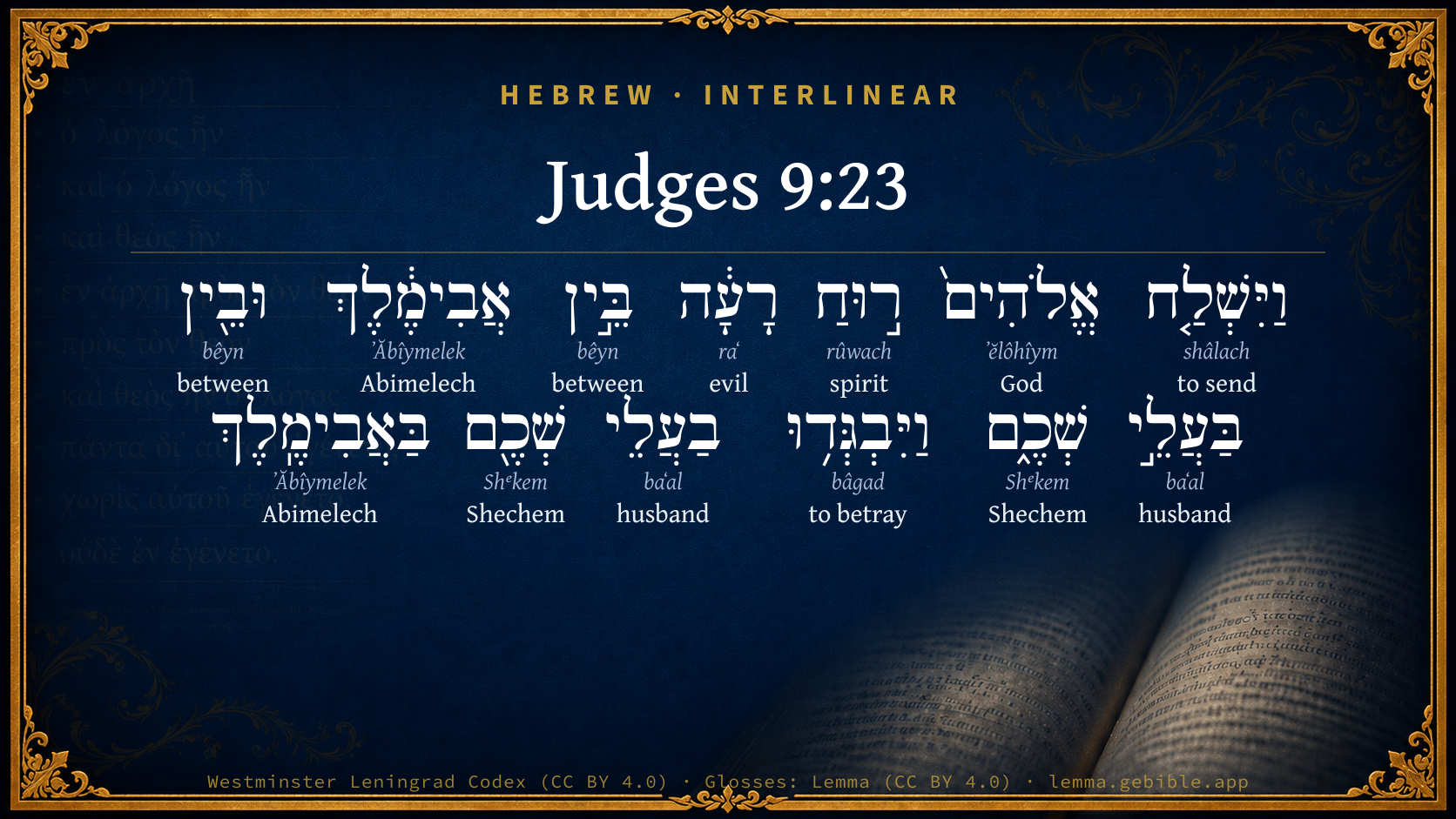
Hebrew (Westminster Leningrad Codex) Judges 9:23 appears in the Hebrew Old Testament. The text above is from the Westminster Leningrad Codex. Each word links to its Strong’s number, a concise gloss, and parsing drawn from the Open Scriptures Hebrew Bible morphology. Click any word for its full Brown-Driver-Briggs (BDB) entry.
Download image
Cite this verse

Judges 9:23 (World English Bible). Public Domain. Lemma interlinear Bible study tool, https://lemma.gebible.app/v/judges/9/23.

Show BibTeX & RIS
BibTeX
RIS
English Translation
God sent an evil spirit between Abimelech and the men of Shechem; and the men of Shechem dealt treacherously with Abimelech:
World English Bible · Public Domain
Download a study sheet

One document with this verse’s original text, its word-by-word gloss line, the meaning frame, cross-references with their text, attributed commentary, and full source and license credits — printable, and it pastes into notes with its structure intact.

This verse Autodidact and up

Study sheet (.html) Plain text (.txt)

A passage Seminary Student

Up to 50 verses in one chapter. A passage sheet keeps up to 6 commentary sources and 12 cross-references per verse, in the order this page ranks them, and says so on the sheet whenever that leaves anything out. Ask for a single verse and you get the Autodidact verse sheet above.

Everything on this page stays free to read, with no account — the sheet is a download of what is already on screen, not access to it.

Want to remove ads? Support Godless Engineer
Compare translations 3

The same verse in 3 English versions, stacked beneath the original-language interlinear above. Click any original word for its lexicon entry.

Each is an independent rendering of the whole verse — the interlinear is not word-aligned to these translations.

Highlighted words mark where these versions differ — a whole-verse word diff, not a word-by-word alignment.

  • World English Bible Public Domain
    God sent an evil spirit between Abimelech and the men of Shechem; and the men of Shechem dealt treacherously with Abimelech:
  • King James Version Public Domain
    Then God sent an evil spirit between Abimelech and the men of Shechem; and the men of Shechem dealt treacherously with Abimelech:
  • unfoldingWord Literal Text CC BY-SA 4.0
    Then God sent a bad spirit between Abimelech and between the lords of Shechem, and the lords of Shechem dealt treacherously with Abimelech,

unfoldingWord Literal Text — © unfoldingWord, licensed CC BY-SA 4.0. Word-aligned USFM3 via Door43 (git.door43.org/unfoldingWord/en_ult).

Versions to compare (up to 4)

3 of 4 selected

Show all 18 translations

Every available English version of this verse, each an independent rendering of the whole verse.

  • World English Bible Public Domain
    God sent an evil spirit between Abimelech and the men of Shechem; and the men of Shechem dealt treacherously with Abimelech:
  • Berean Standard Bible Public Domain
    God sent a spirit of animosity between Abimelech and the leaders of Shechem and caused them to treat Abimelech deceitfully,
  • Majority Standard Bible Public Domain
    God sent a spirit of animosity between Abimelech and the leaders of Shechem and caused them to treat Abimelech deceitfully,
  • King James Version Public Domain
    Then God sent an evil spirit between Abimelech and the men of Shechem; and the men of Shechem dealt treacherously with Abimelech:
  • American Standard Version (1901) Public Domain
    And God sent an evil spirit between Abimelech and the men of Shechem; and the men of Shechem dealt treacherously with Abimelech:
  • Revised Version (1885) Public Domain
    And God sent an evil spirit between Abimelech and the men of Shechem; and the men of Shechem dealt treacherously with Abimelech:
  • Geneva Bible (1599) Public Domain
    But God sent an euil spirit betweene Abimelech, and the men of Shechem: and the men of Shechem brake their promise to Abimelech,
  • Douay-Rheims (1899) Public Domain
    And the Lord sent a very evil spirit between Abimelech and the inhabitants of Sichem: who began to detest him,
  • Young's Literal Translation Public Domain
    and God sendeth an evil spirit between Abimelech and the masters of Shechem, and the masters of Shechem deal treacherously with Abimelech,
  • Literal Standard Version CC BY-SA 4.0
    and God sends an evil spirit between Abimelech and the masters of Shechem, and the masters of Shechem deal treacherously with Abimelech,
  • Unlocked Literal Bible CC BY-SA 4.0
    God sent an evil spirit between Abimelech and the leaders of Shechem. The leaders of Shechem betrayed the trust they had with Abimelech.
  • unfoldingWord Literal Text CC BY-SA 4.0
    Then God sent a bad spirit between Abimelech and between the lords of Shechem, and the lords of Shechem dealt treacherously with Abimelech,
  • Darby Bible Public Domain
    And God sent an evil spirit between Abim'elech and the men of Shechem; and the men of Shechem dealt treacherously with Abim'elech;
  • World Messianic Bible Public Domain
    Then God sent an evil spirit between Abimelech and the men of Shechem; and the men of Shechem dealt treacherously with Abimelech,
  • Webster's Bible Public Domain
    Then God sent an evil spirit between Abimelech and the men of Shechem; and the men of Shechem dealt treacherously with Abimelech:
  • Free Bible Version CC BY-SA 4.0
    Then God sent an evil spirit to cause trouble between Abimelech and the leaders of Shechem. The leaders of Shechem betrayed Abimelech.
  • Bible in Basic English Public Domain
    And God sent an evil spirit between Abimelech and the townsmen of Shechem; and the townsmen of Shechem were false to Abimelech;
  • JPS Tanakh (1917) Public Domain
    And God sent an evil spirit between Abimelech and the men of Shechem; and the men of Shechem dealt treacherously with Abimelech;

Literal Standard Version (2020), Covenant Press — licensed CC BY-SA 4.0. Text via the HelloAO Bible API (eBible.org). Unlocked Literal Bible (unfoldingWord) — licensed CC BY-SA 4.0. Text via the HelloAO Bible API (eBible.org). unfoldingWord Literal Text — © unfoldingWord, licensed CC BY-SA 4.0. Word-aligned USFM3 via Door43 (git.door43.org/unfoldingWord/en_ult). Free Bible Version, Dr. Jonathan Gallagher — licensed CC BY-SA 4.0. Text via the HelloAO Bible API (eBible.org).

Word by word

More ways to search: Search by grammar → Find every occurrence → Compare this word →

Practice this passage: Drill this verse → Learn its vocabulary →

וַיִּבְגְּד֥וּ
bâgad
H898
“and · to betray”
Conjunction + Verb, Qal, Sequential Imperfect, 3rd Person, Masculine, Plural
Part of Speech
Conjunction + Verb
Stem
Qal
Form
Sequential Imperfect
Person
3rd Person
Gender
Masculine
Number
Plural
Full BDB Definition

Origin: a primitive root

TWOT: 198

to act treacherously, deceitfully, deal treacherously - (Qal) to act or deal treacherously, faithlessly, deceitfully, offend
  1. וַיִּשְׁלַ֤ח shâlach H7971 “and · to send” Conjunction + Verb, Qal, Sequential Imperfect, 3rd Person, Masculine, Singular
  2. אֱלֹהִים֙ ʼĕlôhîym H430 “God(s)” Noun, Common, Masculine, Plural, Absolute
  3. ר֣וּחַ rûwach H7307 “spirit” Noun, Common, Both, Singular, Absolute
  4. רָעָ֔ה raʻ H7451 “evil” Adjective, Adjective, Feminine, Singular, Absolute
  5. בֵּ֣ין bêyn H996 “between” Preposition
  6. אֲבִימֶ֔לֶךְ ʼĂbîymelek H40 “Abimelech” Noun, Proper
  7. וּבֵ֖ין bêyn H996 “and · between” Conjunction + Preposition
  8. בַּעֲלֵ֣י baʻal H1167 “husbands of” Noun, Common, Masculine, Plural, Construct
  9. שְׁכֶ֑ם Shᵉkem H7927 “Shechem” Noun, Proper
  10. בַעֲלֵי baʻal H1167 “husbands of” Noun, Common, Masculine, Plural, Construct
  11. שְׁכֶ֖ם Shᵉkem H7927 “Shechem” Noun, Proper
  12. בַּאֲבִימֶֽלֶךְ ʼĂbîymelek H40 “in/at · Abimelech” Preposition + Noun, Proper

About this verse

These counts appear in no published source. They are computed here, from the morphology-tagged text and Lemma’s own curated glosses. What Lemma adds →

13
words
9
distinct lemmas
Historical
section

Shared distinctive vocabulary

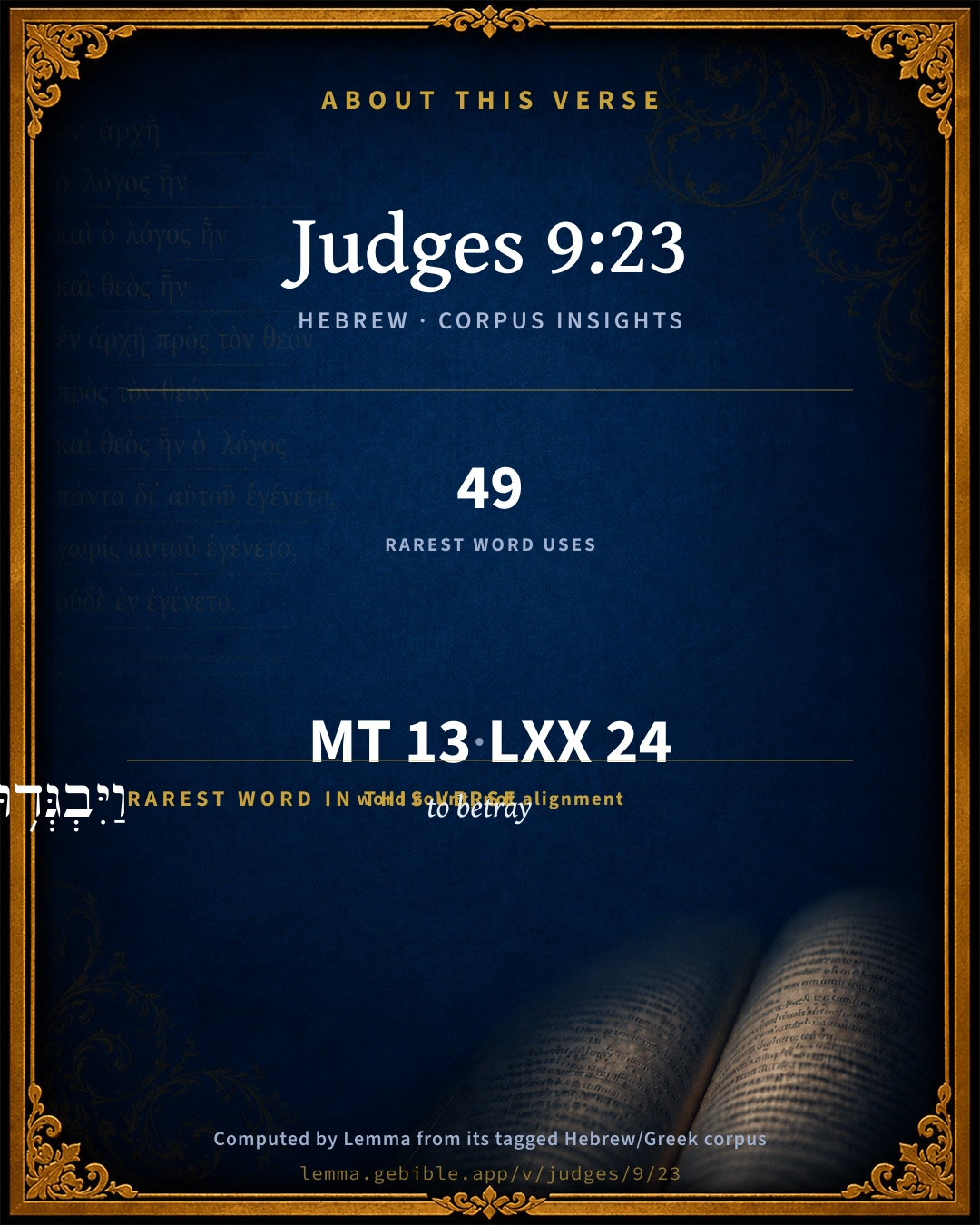
וַיִּבְגְּד֥וּ to betray H898 occurs in 39 verses of the Hebrew Bible. Also found in:

Grammatical profile

  • 2 verbs
  • 8 nouns
  • 1 adjective
  • 2 prepositions

Verb forms

  • וַיִּשְׁלַ֤ח Qal · Sequential Imperfect
  • וַיִּבְגְּד֥וּ Qal · Sequential Imperfect

Repetition

Words recur within this verse — often emphatic in Hebrew:

  • בֵּ֣ין between H996 ×2
  • אֲבִימֶ֔לֶךְ Abimelech H40 ×2
  • בַּעֲלֵ֣י husband H1167 ×2
  • שְׁכֶ֑ם Shechem H7927 ×2

Hebrew & Septuagint length

In English translation the verse runs 21 words from the Hebrew and 25 from the Septuagint (LXX English) — closely comparable.

A rough comparison of the two English renderings, which tokenize alike — not a word-level alignment.

Word counts can differ between the Hebrew and the Greek without any difference in meaning — e.g. the Hebrew direct-object marker אֵת has no separate Greek word, and Greek often adds the article ὁ.

In the original languages it is 13 Hebrew tokens and 24 Greek tokens — but the two are counted differently (Hebrew bundles its prefixes and suffixes into one token; the Greek is in lemma form), so that isn’t a like-for-like length.

Cross-references

13

Topical passages linked to Judges 9:23 in the Treasury of Scripture Knowledge — connected by theme and wording, ordered by reader-vote popularity; previews shown in the World English Bible.

  • Isaiah 33:1 Woe to you who destroy, and you weren't destroyed; and deal treacherously, and they didn't deal treacherously with you! When you have ceased to destroy, you shall be destroyed; and when you have made an end of dealing treacherously, they shall deal treacherously with you.
  • Isaiah 19:14 Yahweh has mixed a spirit of perverseness in the midst of her; and they have caused Egypt to go astray in every work of it, as a drunken man staggers in his vomit.
  • Isaiah 19:2 I will stir up the Egyptians against the Egyptians: and they shall fight everyone against his brother, and everyone against his neighbor; city against city, [and] kingdom against kingdom.
  • 2 Thessalonians 2:11–12 Because of this, God sends them a working of error, that they should believe a lie;
  • Judges 9:15–16 The bramble said to the trees, If in truth you anoint me king over you, then come and take refuge in my shade; and if not, let fire come out of the bramble, and devour the cedars of Lebanon.
  • Judges 9:20 but if not, let fire come out from Abimelech, and devour the men of Shechem, and the house of Millo; and let fire come out from the men of Shechem, and from the house of Millo, and devour Abimelech.
  • 1 Samuel 16:14–16 Now the Spirit of Yahweh departed from Saul, and an evil spirit from Yahweh troubled him.
  • 1 Samuel 18:9–10 Saul eyed David from that day and forward.
  • 1 Kings 12:15 So the king didn't listen to the people; for it was a thing brought about of Yahweh, that he might establish his word, which Yahweh spoke by Ahijah the Shilonite to Jeroboam the son of Nebat.
  • 1 Kings 22:22–23 Yahweh said to him, 'How?' He said, 'I will go forth, and will be a lying spirit in the mouth of all his prophets.' He said, 'You shall entice him, and shall prevail also: go forth, and do so.'
  • 2 Chronicles 10:15 So the king didn't listen to the people; for it was brought about of God, that Yahweh might establish his word, which he spoke by Ahijah the Shilonite to Jeroboam the son of Nebat.
  • 2 Chronicles 18:19–22 Yahweh said, Who shall entice Ahab king of Israel, that he may go up and fall at Ramoth-gilead? One spoke saying after this manner, and another saying after that manner.
  • Matthew 7:2 For with whatever judgment you judge, you will be judged; and with whatever measure you measure, it will be measured to you.

Cross-references courtesy of OpenBible.info (CC BY 4.0).

Hebrew and Greek witnesses Masoretic Hebrew ↔ Greek Septuagint

The same verse in the two great witnesses to the Old Testament, shown verse-for-verse.

These are two independent witnesses, not word-aligned to each other, and the Septuagint is shown in lemma (dictionary) form.

Hebrew Judges 9:23 Masoretic · Westminster Leningrad Codex

וַיִּשְׁלַ֤ח אֱלֹהִים֙ ר֣וּחַ רָעָ֔ה בֵּ֣ין אֲבִימֶ֔לֶךְ וּבֵ֖ין בַּעֲלֵ֣י שְׁכֶ֑ם וַיִּבְגְּד֥וּ בַעֲלֵי שְׁכֶ֖ם בַּאֲבִימֶֽלֶךְ

God sent an evil spirit between Abimelech and the men of Shechem; and the men of Shechem dealt treacherously with Abimelech:

World English Bible · Public Domain

Greek LXX Judges 9:23 Septuagint · lemma form

καί ἐκ ἀποστέλλω ὁ θεός πνεῦμα πονηρός ἀνά μέσος αβιμελεχ καί ἀνά μέσος ὁ ἀνήρ σικιμα καί ἀθετέω ἀνήρ σικιμα ἐν ὁ οἶκος αβιμελεχ

And God sent an evil spirit between Abimelech and the men of Sicima; and the men of Sicima dealt treacherously with the house of Abimelech:

LXX2012 (modern English Septuagint) · Public Domain

Hebrew: Westminster Leningrad Codex (CC BY 4.0). Greek: Septuagint (public domain); English from LXX2012 (modern English Septuagint) (Public Domain). How the Septuagint differs from the Hebrew →

Targum (Aramaic paraphrase)

1

The Targum is the ancient Jewish Aramaic paraphrase of the Hebrew Scriptures — an interpretive translation, not the Hebrew text itself. Onkelos (literal) and Pseudo-Jonathan (expansive) render the Torah, and Jonathan the Prophets. Coverage is partial: where no permissively-licensed English translation exists for a verse, only the Aramaic is shown. This is verse-level text, not a word-by-word alignment to the Hebrew.

  1. Targum Jonathan Prophets (Joshua–Malachi)
    וּשְׁלַח יְיָ רוּחָא בִּישָׁא בֵּין אֲבִימֶלֶךְ וּבֵין יַתְבֵי שְׁכֶם וְשַׁקָרוּ יַתְבֵי שְׁכֶם בַּאֲבִימֶלֶךְ:

    (no public-domain English translation for this verse)

    Targum Jonathan — Aramaic: “Mikraot Gedolot” (public domain). English: “Sefaria Community Translation” (CC0 1.0 (public-domain dedication)); “London "Chaldee Paraphrase," 1871” (public domain). Text via Sefaria.

Commentary

Notes on Judges 9:23 from classic Christian and Jewish commentators (each source and its license shown beneath its notes). The classic Christian expositions comment on the surrounding passage and are grouped to its opening verse, so a note may address several verses; the Jewish commentaries on the Tanakh (Rashi and others) are per-verse, so they appear only where the commentator wrote on this verse.

Lemma curates 59 commentaries, every one of them public domain or Creative Commons licensed, each selected and text-cleaned for this edition rather than reprinted as found. About our sources →

Trapp's Complete Commentary

John Trapp

Jdg 9:23 Then God sent an evil spirit between Abimelech and the men of Shechem; and the men of Shechem dealt treacherously with Abimelech:

Ver. 23. Then God sent an evil spirit.] The devil, that troubler, that seedsman of sedition, that great kindle coal and mischief maker of the world, who, working upon these men’s corruptions, whom God had justly given over to a reprobate mind, filled them with "envy, murder, debate, deceit, malignity," &c. {Rom 1:28-29}

Dealt treacherously with Abimelech.] Whom themselves had chosen and set up. What a fickle tenure holdeth he by, who holdeth of the multitude! Neutrum modo, mas modo Vulgus. So the English were soon weary of Richard III, who yet was a good prince though an evil man, and made many good laws against those evils in others which himself practised.

John Trapp, A Commentary or Exposition upon All the Books of the Old and New Testament (1647–1656) — public domain. Text from a community e-Sword module.

The Biblical Illustrator

Joseph S. Exell

Jdg_9:23

God sent an evil spirit between Abimelech and the men of Shechem.

Disunion

It is not said that he was judge over Israel, for they were raised up by God, but he ruled and usurped, as tyrants use to do. And to begin first with his prosperity in that God gave him this short time to enjoy his desire, and to domineer as he did, it is to teach us that He doth for some little time give wicked men their longed-for desires; and yet not for that He applaudeth them therein, but that they may have time to repent, and to bethink themselves what they have done, and how they have gone to work, and how many ways they have provoked God. But to go forward: this evil spirit that was sent betwixt them, being the first occasion of their overthrow, was the devil, by whose malice and subtlety ill-will and hatred were kindled betwixt them, and this, with the breaking their promise, doth show us clearly that the league and friendship of the wicked is soon broken off. For why? It hath no good ground. The use whereof is that we make no such wicked and cursed leagues. Secondly, that we account no otherwise of them where they be made, but as of the spiders web, soon swept down; and thirdly, praise God highly when we see them broken. And in that it is said that the Lord sent an evil spirit betwixt them, we may note, that though God be not the author of evil, yet that sin which is in the wicked, hidden in their hearts, and never so secret, He bringeth forth at His pleasure, and lets it break out at His commandment, ruling and overruling the same. And they that nourish it in themselves, and do not give it a vent by repentance, may ever justly fear, and do sometime too truly find, that as water pent in breaks out violently in some place or other, even so the sin that is entertained in mens hearts shall one time or other break out to their shame in their lives. But as the stink of the dunghill riseth not from the sun, no more doth sin proceed from God. Also, by this division betwixt them we may note, that when God suffers division among the wicked, or an evil spirit any way to lead them, it is to punish their lewd fellowship, and to revenge the sin of both parts, and to make each the others executioner. And yet, oh what a sweet liberty it is thought to be, to enjoy fellowship with such? And first, grudges secretly being conceived, they are nourished by jealousies and suspicions exasperated by daily injuries, till they break out into hatred, and end in extremity. These things are commonly seen, but who beholdeth Gods justice therein? or is thereby prevented from having anything to do with such? or made wise to lay a better foundation of their amity and friendship. Furthermore, by this, that God would have the blood of the innocent sons of Gideon revenged upon Abimelech and the men of Shechem, He teacheth us that He will revenge the innocents cause. The Lord will bless them that bless His, and curse them that curse His. (R. Rogers.)

The Biblical Illustrator, edited by Joseph S. Exell (c. 1880s–1900s) — public domain. Text from a community e-Sword module.

Joseph Benson's Commentary

Jdg 9:23-24. God sent an evil spirit — That is, gave Satan permission to work upon their minds. That the cruelty done to the sons of Jerubbaal, &c. — That is, the punishment of the cruelty. Men may do evil, and think they have profited themselves; may imagine they have strengthened themselves in their wickedness, and are quite secure; that they have procured themselves friends, who will stand by them, and save them: but God can, with the greatest ease, make all the devices of the wicked of none effect; can turn their best contrivances to their ruin, and punish them by those on whom they depended for help and security. The example of Abimelech and the men of Shechem, recorded in this chapter, may assure us, that God will not suffer the murderer to escape even in this world; but will punish him in some grievous manner or other.

Joseph Benson's Commentary on the Old and New Testaments (1811–1818) — public domain. Text from a community e-Sword module.

Geneva Bible (1599)

Geneva Bible translators

Because the people consented with the king in shedding innocent blood, therefore God destroyeth both one and the other.

Geneva Bible (1599) marginal notes — public domain. Text via Bolls.life.

Jamieson, Fausset & Brown

Robert Jamieson, A. R. Fausset & David Brown

Then God sent an evil spirit between Abimelech and the men of Shechem--In the course of providence, jealousy, distrust, secret disaffection, and smothered rebellion appeared among his subjects disappointed and disgusted with his tyranny; and God permitted those disorders to punish the complicated crimes of the royal fratricide and idolatrous usurper.

Jamieson, Fausset & Brown — Commentary Critical and Explanatory on the Whole Bible (1871) — public domain (CC PDM 1.0). Text via the HelloAO Bible API.

Adam Clarke's Commentary

Verse 23. God sent an evil spirit] He permitted jealousies to take place which produced factions; and these factions produced insurrections, civil contentions, and slaughter.

Adam Clarke's Commentary on the Bible (1810–1826) — public domain. Text from a community e-Sword/MySword module.

Ellicott's Commentary for English Readers

(23) An evil spirit.—Whether the word used for spirit (ruach) is here meant to be personal or not we cannot say. Sometimes it seems to mean an evil being (1Sa_16:14), sometimes only an evil temper (Num_14:24). The later Jews would have made little or no difference between the two, since they attributed almost every evil to the direct agency of demons.

Dealt treacherously.—The word is used for the beginning of a defection.

A Bible Commentary for English Readers, edited by Charles John Ellicott (1878–1897) — public domain. Text from a community e-Sword module.

The Cambridge Bible for Schools and Colleges

gen. ed. J. J. S. Perowne

23. God sent an evil spirit] i.e. an infatuation which led to their destruction, and so carried out the punishment which God determined. Where we speak of secondary causes, the ancients thought of the direct intervention of God; cf. 1Sa_16:14, 1Ki_22:21 ff., Amo_3:6. Elohim is thought to indicate that Jdg_9:22-25 come from the source E; Jdg_9:24 goes with Jdg_9:16-18.

The Cambridge Bible for Schools and Colleges (gen. ed. J. J. S. Perowne; Cambridge University Press, 1878–1918) — public domain. Text from a community e-Sword module.

John Gill's Exposition

That the cruelty done to the seventy sons of Jerubbaal might come,.... That vengeance might come on the authors of it; so things were ordered in Providence that this might come to pass:

and their blood be laid upon Abimelech their brother, which slew them; be charged to his account, and he suffer for shedding it:

and upon the men of Shechem which aided him in killing of his brethren; by giving him money to hire men to go with him to do it, and perhaps by words encouraging the assassins, and who might be of the city of Shechem.

John Gill's Exposition of the Whole Bible (1746–1763) — public domain (CC PDM 1.0). Text via the HelloAO Bible API.

Haydock's Catholic Bible Commentary

Spirit. God permitted the spirit of discord to arise, like an executioner, (Calmet) to punish the sins both of the ruler and of his subjects. (Haydock) --- St. Augustine (q. 45.) observes, that God caused the people to be sorry for what they had done: but they afterwards proceeded to acts of violence and enmity, at the instigation of the devil, to whose advice they gave ear, in consequence of their former transgression. (Worthington) --- The common people began to open their eyes, and beheld the cruelty of Abimelech, and of some of the principal citizens, who had espoused his cause, with abhorrence. (Menochius) --- They reflected on the justice of Joatham’s parable, which tended to rouse them not to suffer the tyrant to remain unpunished any longer. (Haydock) --- Detest him. Hebrew, "revolted against (or dealt treacherously with) Abimelech, (24) that the crime (or punishment of the murder) of the, &c., might come, and their blood be laid upon," &c. (Haydock) --- God permitted that Abimelech should be punished by those very men who had been the occasion of his sin. To obtain the sceptre over them, he had committed the most horrible cruelty. (Calmet)

George Leo Haydock (1774–1849), Haydock's Catholic Family Bible and Commentary, 1859 edition — public domain. Excludes Psalms (Douay-Rheims chapter numbering differs from Protestant) and Deuterocanonical books (Catholic canon only).

Matthew Poole's English Annotations

God gave the devil commission to enter into or work upon their minds and hearts; knowing that he of himself, and by his own inclination, would fill them with mistakes, and jealousies, and dissensions, and heart-burnings, which would end in civil wars and mutual ruin.

Matthew Poole's English Annotations on the Holy Bible (1683–1685) — public domain. Text from a community e-Sword/MySword module.

Whedon's Commentary on the Bible

Daniel D. Whedon

23. God sent an evil spirit — Not merely “permitted jealousies to take place, which produced factions, but actually sent, or permitted to go, a personal evil demon, to generate discords among the Shechemites, and thus bring judgment on them for their wickedness. The Scriptures everywhere recognise a kingdom of darkness, as well as a kingdom of light; and it is contrary to reason and experience, as well as Scripture, to assume the impossibility of personal evil spirits having influence over the human soul. But these powers of darkness are held in check, and their agency is circumscribed, by the mightier power of God, who sometimes sends them, as a huntsman sends his dog after the game, by unbinding their powers and letting them loose to their own route. See note on Mar_5:13. The evil spirit that troubled Saul came by permission and command of God, (1Sa_16:14,) and even Satan goes forth to afflict pious Job by permission of Jehovah. Job_1:12; Job_2:6.

Dealt treacherously — The very men who had been so ready to make Abimelech king are the first to seek his overthrow.

Daniel D. Whedon (gen. ed.), Commentary on the Old and New Testaments (1874–1909) — public domain. Text from a community e-Sword module.

The Pulpit Commentary

Vers. 23, 24. These two verses contain the summary of what is related in detail in the rest of the chapter, and we arc told that it all happened providentially, that the violence done to the sons of Jerubbaal, and their blood, might come to be laid (literally, for some one to lay) upon Abimelech, etc. Which aided him literally, strengthened his hands, by giving him money, and encouraging him to make way to the throne by killing his brothers.

The Pulpit Commentary (1880–1919), ed. H.D.M. Spence-Jones & Joseph S. Exell — public domain. Text from a community e-Sword module.

John Wesley's Explanatory Notes

God sent - God gave the devil commission to work upon their minds.

John Wesley, Explanatory Notes Upon the Whole Bible (1754–1765) — public domain. Text via the GEBible commentary corpus.

Rashi

Rabbi Shlomo Yitzchaki (Rashi)

A malicious sentiment. Hatred. "Talent" in old French.

Rashi on the Tanakh — English translations: “The Judaica Press complete Tanach with Rashi, translated by A. J. Rosenberg” (CC BY 4.0); “Pentateuch with Rashi's commentary by M. Rosenbaum and A.M. Silbermann, 1929-1934” (public domain); “The Metsudah Tanach series, Lakewood, N.J” (CC BY 4.0); and “The Book of Joshua, Metsudah Publications, 1997” (CC BY 4.0). Text via Sefaria.

Lesson kit

Teaching starters — assembled from the data on this page, not authored interpretation. Every prompt links to the verse data it draws on. Edit before teaching.

Judges, in the Historical, opens this verse with 13 words (9 distinct Hebrew lemmas). Its most distinctive word is bâgad (“to betray”). A historical commentator’s framing appears above. Read the whole chapter for the surrounding context.

Discussion questions

  1. How does “to betray” (bâgad) shape what this verse is saying?
  2. Exodus 21:8 shares the word «to betray» with this verse. How do the two illuminate each other?
  3. “between” occurs 2× in this one verse. What is the effect of the repetition?
  4. These translations render this verse differently; the difference is in the English rendering, not the original. What questions does that raise?
  5. The verb «וַיִּשְׁלַ֤ח» is Qal Sequential Imperfect. How does its form color the action?
  6. Reading how Trapp's Complete Commentary and The Biblical Illustrator read this verse, where do the two commentators agree and where do they part?

Things to notice

Reading settings

Reading text

Shown beneath each verse's original-language words.

Old Testament
Old Testament edition

Read the OT as the Masoretic Hebrew (MT) or the Greek Septuagint (LXX).

English shown for the Greek Septuagint (in the Hebrew ↔ Greek comparison).

Comparing translations? Open the Compare panel on any verse page to stack up to four side by side.