
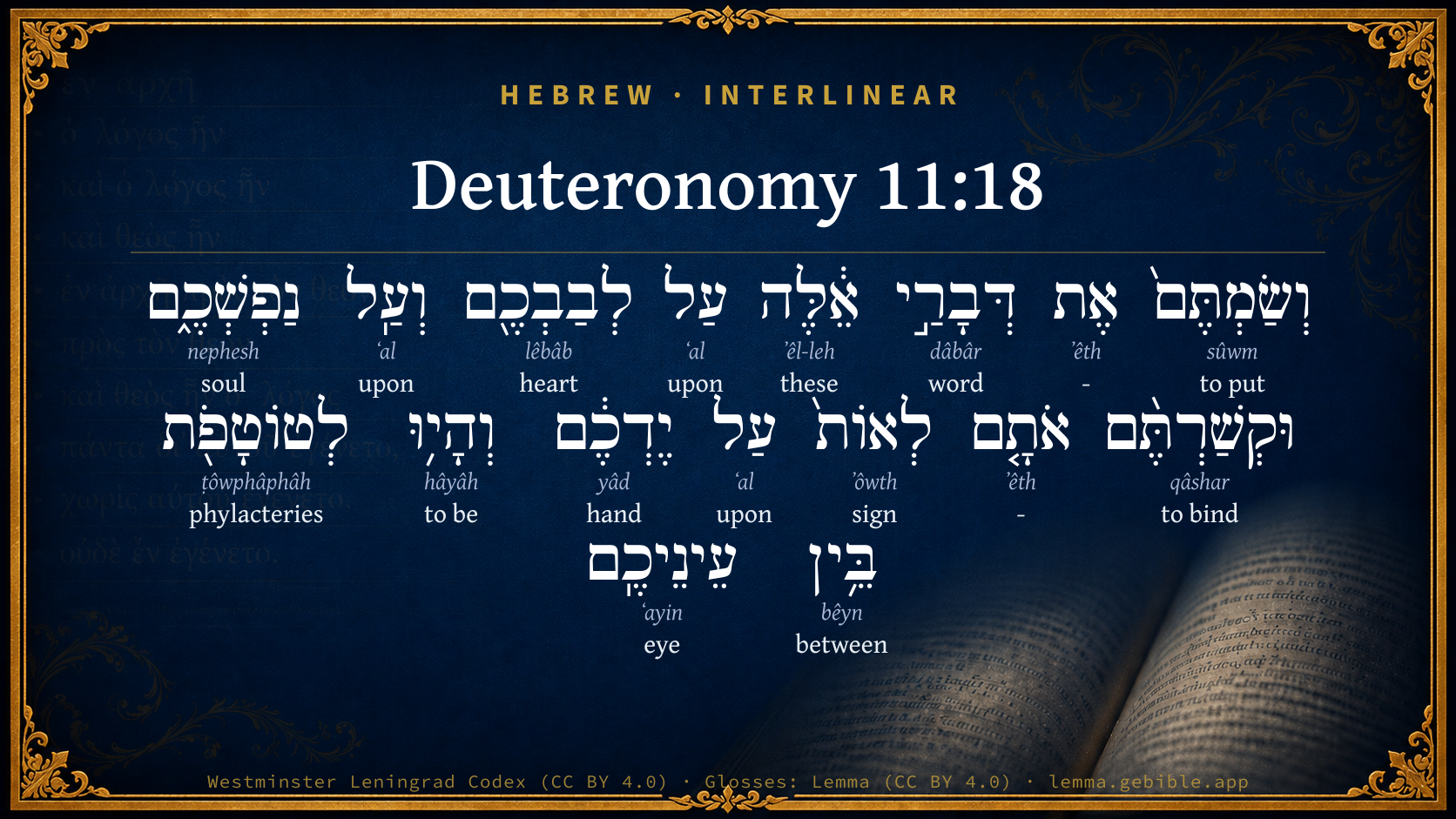
Deuteronomy 11:18

Hebrew (Westminster Leningrad Codex) Deuteronomy 11:18 appears in the Hebrew Old Testament. The text above is from the Westminster Leningrad Codex. Each word links to its Strong’s number, a concise gloss, and parsing drawn from the Open Scriptures Hebrew Bible morphology. Click any word for its full Brown-Driver-Briggs (BDB) entry.
Download image
Cite this verse

Deuteronomy 11:18 (World English Bible). Public Domain. Lemma interlinear Bible study tool, https://lemma.gebible.app/v/deuteronomy/11/18.

Show BibTeX & RIS
BibTeX
RIS
English Translation
Therefore shall you lay up these my words in your heart and in your soul; and you shall bind them for a sign on your hand, and they shall be for symbols between your eyes.
World English Bible · Public Domain
Download a study sheet

One document with this verse’s original text, its word-by-word gloss line, the meaning frame, cross-references with their text, attributed commentary, and full source and license credits — printable, and it pastes into notes with its structure intact.

This verse Autodidact and up

Study sheet (.html) Plain text (.txt)

A passage Seminary Student

Up to 50 verses in one chapter. A passage sheet keeps up to 6 commentary sources and 12 cross-references per verse, in the order this page ranks them, and says so on the sheet whenever that leaves anything out. Ask for a single verse and you get the Autodidact verse sheet above.

Everything on this page stays free to read, with no account — the sheet is a download of what is already on screen, not access to it.

Want to remove ads? Support Godless Engineer
Compare translations 3

The same verse in 3 English versions, stacked beneath the original-language interlinear above. Click any original word for its lexicon entry.

Each is an independent rendering of the whole verse — the interlinear is not word-aligned to these translations.

Highlighted words mark where these versions differ — a whole-verse word diff, not a word-by-word alignment.

  • World English Bible Public Domain
    Therefore shall you lay up these my words in your heart and in your soul; and you shall bind them for a sign on your hand, and they shall be for symbols between your eyes.
  • King James Version Public Domain
    Therefore shall ye lay up these my words in your heart and in your soul, and bind them for a sign upon your hand, that they may be as frontlets between your eyes.
  • unfoldingWord Literal Text CC BY-SA 4.0
    And you shall place these words of mine on your heart and on your soul, and you shall bind them as a sign on your hand, and they will be as frontlets between your eyes.

unfoldingWord Literal Text — © unfoldingWord, licensed CC BY-SA 4.0. Word-aligned USFM3 via Door43 (git.door43.org/unfoldingWord/en_ult).

Versions to compare (up to 4)

3 of 4 selected

Show all 18 translations

Every available English version of this verse, each an independent rendering of the whole verse.

  • World English Bible Public Domain
    Therefore shall you lay up these my words in your heart and in your soul; and you shall bind them for a sign on your hand, and they shall be for symbols between your eyes.
  • Berean Standard Bible Public Domain
    Fix these words of mine in your hearts and minds; tie them as reminders on your hands and bind them on your foreheads.
  • Majority Standard Bible Public Domain
    Fix these words of mine in your hearts and minds; tie them as reminders on your hands and bind them on your foreheads.
  • King James Version Public Domain
    Therefore shall ye lay up these my words in your heart and in your soul, and bind them for a sign upon your hand, that they may be as frontlets between your eyes.
  • American Standard Version (1901) Public Domain
    Therefore shall ye lay up these my words in your heart and in your soul; and ye shall bind them for a sign upon your hand, and they shall be for frontlets between your eyes.
  • Revised Version (1885) Public Domain
    Therefore shall ye lay up these my words in your heart and in your soul; and ye shall bind them for a sign upon your hand, and they shall be for frontlets between your eyes.
  • Geneva Bible (1599) Public Domain
    Therefore shall ye lay vp these my words in your heart and in your soule, and binde them for a signe vpon your hand, that they may be as a frontlet betweene your eyes,
  • Douay-Rheims (1899) Public Domain
    And the Lord being angry shut up heaven, that the rain come not down, nor the earth yield her fruit, and you perish quickly from the excellent land, which the Lord will give you.
  • Young's Literal Translation Public Domain
    `And ye have placed these my words on your heart, and on your soul, and have bound them for a sign on your hand, and they have been for frontlets between your eyes;
  • Literal Standard Version CC BY-SA 4.0
    And you have placed these words of mine on your heart and on your soul, and have bound them for a sign on your hand, and they have been for frontlets between your eyes;
  • Unlocked Literal Bible CC BY-SA 4.0
    Therefore lay up these words of mine in your heart and soul, bind them as a sign on your hand, and let them be as frontlets between your eyes.
  • unfoldingWord Literal Text CC BY-SA 4.0
    And you shall place these words of mine on your heart and on your soul, and you shall bind them as a sign on your hand, and they will be as frontlets between your eyes.
  • Darby Bible Public Domain
    And ye shall lay up these my words in your heart and in your soul, and bind them for a sign upon your hand, and they shall be for frontlets between your eyes.
  • World Messianic Bible Public Domain
    Therefore you shall lay up these words of mine in your heart and in your soul. You shall bind them for a sign on your hand, and they shall be for frontlets between your eyes.
  • Webster's Bible Public Domain
    Therefore shall ye lay up these my words in your heart and in your soul, and bind them for a sign upon your hand, that they may be as frontlets between your eyes.
  • Free Bible Version CC BY-SA 4.0
    Focus your minds on the words that I'm saying. Tie them on your hands as reminders and put them on your foreheads as well.
  • Bible in Basic English Public Domain
    So keep these words deep in your heart and in your soul, and have them fixed on your hand for a sign and marked on your brow;
  • JPS Tanakh (1917) Public Domain
    Therefore shall ye lay up these My words in your heart and in your soul; and ye shall bind them for a sign upon your hand, and they shall be for frontlets between your eyes.

Literal Standard Version (2020), Covenant Press — licensed CC BY-SA 4.0. Text via the HelloAO Bible API (eBible.org). Unlocked Literal Bible (unfoldingWord) — licensed CC BY-SA 4.0. Text via the HelloAO Bible API (eBible.org). unfoldingWord Literal Text — © unfoldingWord, licensed CC BY-SA 4.0. Word-aligned USFM3 via Door43 (git.door43.org/unfoldingWord/en_ult). Free Bible Version, Dr. Jonathan Gallagher — licensed CC BY-SA 4.0. Text via the HelloAO Bible API (eBible.org).

Word by word

More ways to search: Search by grammar → Find every occurrence → Compare this word →

Practice this passage: Drill this verse → Learn its vocabulary →

לְטוֹטָפֹ֖ת
ṭôwphâphâh
H2903
“to/for · phylacteries”
Preposition + Noun, Common, Feminine, Plural, Absolute
Part of Speech
Preposition + Noun
Type
Common
Gender
Feminine
Number
Plural
State
Absolute
Full BDB Definition

Origin: from an unused root meaning to go around or bind

TWOT: 804a

bands, phylacteries, frontlets, marks
  1. וְשַׂמְתֶּם֙ sûwm H7760 “and · to put” Conjunction + Verb, Qal, Sequential Perfect, 2nd Person, Masculine, Plural
  2. אֶת ʼêth H853 “-” Particle, Direct Object
  3. דְּבָרַ֣י dâbâr H1697 “words · my” Noun, Common, Masculine, Plural, Construct + Suffix, Personal, 1st Person, Common, Singular
  4. אֵ֔לֶּה ʼêl-leh H428 “these” Pronoun, Demonstrative, Common, Plural
  5. עַל ʻal H5921 “upon” Preposition
  6. לְבַבְכֶ֖ם lêbâb H3824 “heart · your” Noun, Common, Masculine, Singular, Construct + Suffix, Personal, 2nd Person, Masculine, Plural
  7. וְעַֽל ʻal H5921 “and · upon” Conjunction + Preposition
  8. נַפְשְׁכֶ֑ם nephesh H5315 “soul · your” Noun, Common, Both, Singular, Construct + Suffix, Personal, 2nd Person, Masculine, Plural
  9. וּקְשַׁרְתֶּ֨ם qâshar H7194 “and · to bind” Conjunction + Verb, Qal, Sequential Perfect, 2nd Person, Masculine, Plural
  10. אֹתָ֤ם ʼêth H853 “- · them” Particle, Direct Object + Suffix, Personal, 3rd Person, Masculine, Plural
  11. לְאוֹת֙ ʼôwth H226 “to/for · sign” Preposition + Noun, Common, Both, Singular, Absolute
  12. עַל ʻal H5921 “upon” Preposition
  13. יֶדְכֶ֔ם yâd H3027 “hand · your” Noun, Common, Both, Singular, Construct + Suffix, Personal, 2nd Person, Masculine, Plural
  14. וְהָי֥וּ hâyâh H1961 “and · to be” Conjunction + Verb, Qal, Sequential Perfect, 3rd Person, Common, Plural
  15. בֵּ֥ין bêyn H996 “between” Preposition
  16. עֵינֵיכֶֽם ʻayin H5869 “eyes · your” Noun, Common, Both, Dual, Construct + Suffix, Personal, 2nd Person, Masculine, Plural

About this verse

These counts appear in no published source. They are computed here, from the morphology-tagged text and Lemma’s own curated glosses. What Lemma adds →

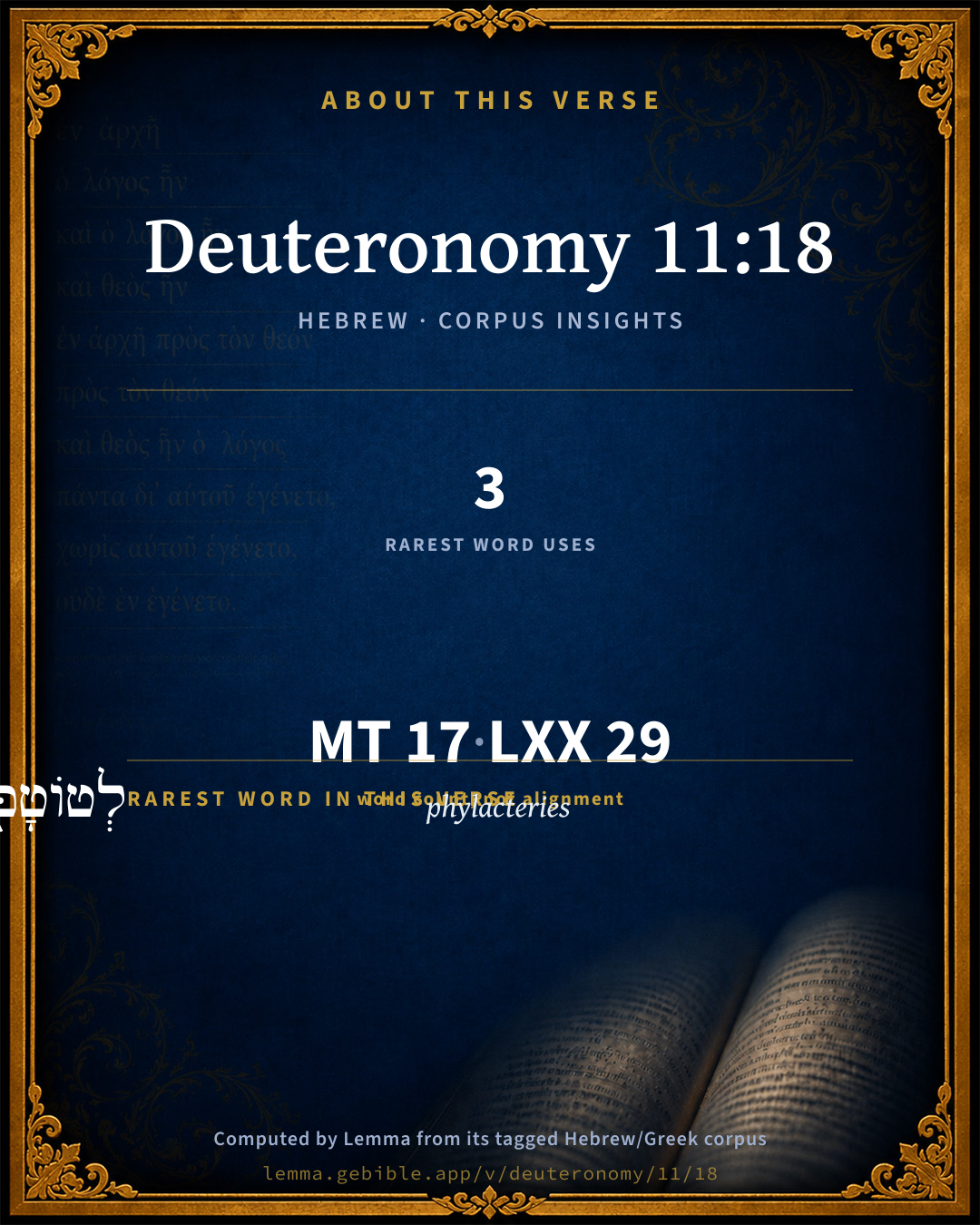
17
words
14
distinct lemmas
Pentateuch
section

Notable vocabulary

The rarest word here is לְטוֹטָפֹ֖ת phylacteries H2903 — appearing just 3 times in the whole Hebrew Bible.

Shared distinctive vocabulary

לְטוֹטָפֹ֖ת phylacteries H2903 occurs in 3 verses of the Hebrew Bible. Also found in:

Grammatical profile

  • 3 verbs
  • 7 nouns
  • 1 pronoun
  • 4 prepositions
  • 2 particles

Verb forms

  • וְשַׂמְתֶּם֙ Qal · Sequential Perfect
  • וּקְשַׁרְתֶּ֨ם Qal · Sequential Perfect
  • וְהָי֥וּ Qal · Sequential Perfect

Repetition

A word recurs within this verse — often emphatic in Hebrew:

Hebrew & Septuagint length

In English translation the verse runs 35 words from the Hebrew and 32 from the Septuagint (LXX English) — closely comparable.

A rough comparison of the two English renderings, which tokenize alike — not a word-level alignment.

Word counts can differ between the Hebrew and the Greek without any difference in meaning — e.g. the Hebrew direct-object marker אֵת has no separate Greek word, and Greek often adds the article ὁ.

In the original languages it is 17 Hebrew tokens and 29 Greek tokens — but the two are counted differently (Hebrew bundles its prefixes and suffixes into one token; the Greek is in lemma form), so that isn’t a like-for-like length.

Cross-references

13

Topical passages linked to Deuteronomy 11:18 in the Treasury of Scripture Knowledge — connected by theme and wording, ordered by reader-vote popularity; previews shown in the World English Bible.

  • Colossians 3:16 Let the word of Christ dwell in you richly; in all wisdom teaching and admonishing one another with psalms, hymns, and spiritual songs, singing with grace in your heart to the Lord.
  • Deuteronomy 6:6–9 These words, which I command you this day, shall be on your heart;
  • Proverbs 3:1 My son, don't forget my teaching; But let your heart keep my commandments:
  • Psalms 119:11 I have hidden your word in my heart, That I might not sin against you.
  • 2 Peter 3:1–2 This is now, beloved, the second letter that I have written to you; and in both of them I stir up your sincere mind by reminding you;
  • Exodus 13:9 It shall be for a sign to you on your hand, and for a memorial between your eyes, that the law of Yahweh may be in your mouth; for with a strong hand Yahweh has brought you out of Egypt.
  • Proverbs 6:20–23 My son, keep your father's commandment, And don't forsake your mother's teaching.
  • 2 Peter 1:12 Therefore I will not be negligent to remind you of these things, though you know them, and are established in the present truth.
  • Exodus 13:16 It shall be for a sign on your hand, and for symbols between your eyes: for by strength of hand Yahweh brought us forth out of Egypt."
  • Deuteronomy 32:46 He said to them, Set your heart to all the words which I testify to you this day, which you shall command your children to observe to do, [even] all the words of this law.
  • Proverbs 7:2–3 Keep my commandments and live; Guard my teaching as the apple of your eye.
  • Hebrews 2:1 Therefore we ought to pay greater attention to the things that were heard, lest perhaps we drift away.
  • Matthew 23:5 But all their works they do to be seen by men. They make their phylacteries broad, enlarge the fringes of their garments,

Cross-references courtesy of OpenBible.info (CC BY 4.0).

Hebrew and Greek witnesses Masoretic Hebrew ↔ Greek Septuagint

The same verse in the two great witnesses to the Old Testament, shown verse-for-verse.

These are two independent witnesses, not word-aligned to each other, and the Septuagint is shown in lemma (dictionary) form.

Hebrew Deuteronomy 11:18 Masoretic · Westminster Leningrad Codex

וְשַׂמְתֶּם֙ אֶת דְּבָרַ֣י אֵ֔לֶּה עַל לְבַבְכֶ֖ם וְעַֽל נַפְשְׁכֶ֑ם וּקְשַׁרְתֶּ֨ם אֹתָ֤ם לְאוֹת֙ עַל יֶדְכֶ֔ם וְהָי֥וּ לְטוֹטָפֹ֖ת בֵּ֥ין עֵינֵיכֶֽם

Therefore shall you lay up these my words in your heart and in your soul; and you shall bind them for a sign on your hand, and they shall be for symbols between your eyes.

World English Bible · Public Domain

Greek LXX Deuteronomy 11:18 Septuagint · lemma form

καί ἐνβάλλω ὁ ῥῆμα οὗτος εἰς ὁ καρδία σύ καί εἰς ὁ ψυχή σύ καί ἀποἅπτω αὐτός εἰς σημεῖον ἐπί ὁ χείρ σύ καί εἰμί ἀσάλευτος πρό ὀφθαλμός σύ

And you⌃ shall store these words in your heart and in your soul, and you⌃ shall bind them as a sign on your hand, and it shall be fixed before your eyes.

LXX2012 (modern English Septuagint) · Public Domain

On this verse, The Cambridge Bible for Schools and Colleges discusses the Septuagint’s reading. Read the note in Commentary ↓

Hebrew: Westminster Leningrad Codex (CC BY 4.0). Greek: Septuagint (public domain); English from LXX2012 (modern English Septuagint) (Public Domain). How the Septuagint differs from the Hebrew →

Targum (Aramaic paraphrase)

2

The Targum is the ancient Jewish Aramaic paraphrase of the Hebrew Scriptures — an interpretive translation, not the Hebrew text itself. Onkelos (literal) and Pseudo-Jonathan (expansive) render the Torah, and Jonathan the Prophets. Coverage is partial: where no permissively-licensed English translation exists for a verse, only the Aramaic is shown. This is verse-level text, not a word-by-word alignment to the Hebrew.

  1. Targum Onkelos Torah (Genesis–Deuteronomy)
    וּתְשַׁווּן יָת פִּתְגָמַי אִלֵין עַל לִבְּכוֹן וְעַל נַפְשְׁכוֹן וְתִקְטְרוּן יָתְהוֹן לְאָת עַל יֶדְכוֹן וִיהוֹן לִתְפִלִין בֵּין עֵינֵיכוֹן

    (no public-domain English translation for this verse)

    Targum Onkelos — Aramaic: “Onkelos Genesis” (public domain); “Onkelos Exodus” (public domain); “Onkelos Leviticus” (public domain); “Onkelos Numbers” (public domain); “Onkelos Deuteronomy” (public domain). English: “Sefaria Community Translation” (CC0 1.0 (public-domain dedication)); “J.W. Etheridge. The Targums of Onkelos and Jonathan Ben Uzziel on the Pentateuch. London: Longmans, Green, 1862” (public domain). Text via Sefaria.

  2. Targum Pseudo-Jonathan Torah (Genesis–Deuteronomy)
    וּתְשַׁוּוּן יַת פִּתְגָמַי אִלֵין עַל לִבְּכוֹן וְעַל נַפְשְׁכוֹן וְתִקְטוֹרוּן יַתְהוֹן כַּד הִנּוּן כְּתִיבִין עַל תְּפִילָא לְאָת עַל רוּם יֶדְכוֹן שְמָאלִיתָא וִיהוֹן לִתְפִילִין קֳבֵיל מוֹקְדֵיכוֹן בֵּין עֵינֵיכוֹן

    But lay these my words upon your heart, and upon your soul, and bind them, written upon tephillin, as a sign upon the upper part (wrist?) of your left hands, and let them be for tephillin over thy forehead between thy eyes.

    Targum Pseudo-Jonathan — Aramaic: “Targum Jonathan on Genesis” (public domain); “Targum Jonathan on Exodus” (public domain); “Targum Jonathan on Leviticus” (public domain); “Targum Jonathan on Numbers” (public domain); “Targum Jonathan on Deuteronomy” (public domain). English: “The Targum of Jonathan ben Uzziel, trans. J. W. Etheridge, London, 1862” (public domain). Text via Sefaria.

Commentary

Notes on Deuteronomy 11:18 from classic Christian and Jewish commentators (each source and its license shown beneath its notes). The classic Christian expositions comment on the surrounding passage and are grouped to its opening verse, so a note may address several verses; the Jewish commentaries on the Tanakh (Rashi and others) are per-verse, so they appear only where the commentator wrote on this verse.

Lemma curates 59 commentaries, every one of them public domain or Creative Commons licensed, each selected and text-cleaned for this edition rather than reprinted as found. About our sources →

Matthew Henry's Commentary

Here, I. Moses repeats the directions he had given for the guidance and assistance of the people in their obedience, and for the keeping up of religion among them (Deu 11:18-20), which is much to the same purport with what we had before, Deu 6:6, etc. Let us all be directed by the three rules here given: - 1. Let our hearts be filled with the word of God: Lay up these words in your heart and in your soul. The heart must be the treasury or store-house in which the word of God must be laid up, to be used upon all occasions. We cannot expect good practices in the conversation, unless there be good thoughts, good affections, and good principles, in the heart. 2. Let our eyes be fixed upon the word of God. "Bind these words for a sign upon your hand, which is always in view (Isa 49:16), and as frontlets between your eyes, which you cannot avoid the sight of; let them be as ready and familiar to you, and have your eye as constantly upon them, as if they were written upon your door-posts, and could not be overlooked either when you go out or when you come in." Thus we must lay God's judgments before us, having a constant regard to them, as the guide of our way, as the rule of our work, Psa 119:30. 3. Let our tongues be employed about the word of God. Let it be the subject of our familiar discourse, wherever we are; especially with our children, who must be taught the service of God, as the one thing needful, much more needful than either the rules of decency or the calling they must live by in this world. Great care and pains must be taken to acquaint children betimes, and to affect them, with the word of God and the wondrous things of his law. Nor will any thing contribute more to the prosperity and perpetuity of religion in a nation than the good education of children: if the seed be holy, it is the substance of a land.

II. He repeats the assurances he had before given them, in God's name, of prosperity and success if they were obedient. 1. They should have a happy settlement, Deu 11:21. Their days should be multiplied; and, when they were fulfilled, the days of their children likewise should be many, as the days of heaven, that is, Canaan should be sure to them and their heirs for ever, as long as the world stands, if they did not by their own sin throw themselves out of it. 2. It should not be in the power of their enemies to give them any disturbance, nor make them upon any account uneasy. "If you will keep God's commandments, and be careful to do your duty (Deu 11:22), God will not only crown the labours of the husbandman with plenty of the fruits of the earth, but he will own and succeed the more glorious undertakings of the men of war. Victory shall attend your arms; which way soever they turn, God will drive out these nations, and put you in possession of their land," Deu 11:23, Deu 11:24. Their territories should be enlarged to the utmost extent of the promise, Gen 15:18. And all their neighbours should stand in awe of them, Deu 11:25. Nothing contributes more to the making of a nation considerable abroad, valuable to its friends and formidable to its enemies, than religion reigning in it; for who can be against those that have God for them? And he is certainly for those that are sincerely for him, Pro 14:34.

Matthew Henry's Commentary on the Whole Bible (1708–1710) — public domain (CC PDM 1.0). Text via the HelloAO Bible API.

The Cambridge Bible for Schools and Colleges

gen. ed. J. J. S. Perowne

18–25. The Pl. address is continued in a series of formulas, repeated with some variations from previous passages. The secondary nature of part of this section cannot be doubted. The emergence of the Sg. in Deu_11:19 shows that the passage is a quotation (slightly varied) of Deu_6:6-9; it has been partly adapted to the compiler’s Pl., while Deu_11:22 naturally follows on to Deu_11:17. The rest only partly repeats, and contains some matter peculiar to this section of Deut.

18–21. See on Deu_6:6-9. Besides the form of address, Sg. there, Pl. here, there are the following differences: Deu_6:6-9 has shall be upon thine heart, and wants and in your soul; takes next thou shalt teach them diligently to thy children (a more natural place and a sign of the originality of Deu_6:6-9), and wants Deu_11:21, which is repeated from other passages. See Deu_4:40, Deu_6:2, Deu_11:9. In Deu_11:19 read with Sam., LXX, in the house. Deu_11:18-21 break the connection: Deu_11:22 follows naturally on Deu_11:17.

21. as the days of the heavens above the earth] Not repeated in Deut.; the phrase is equivalent to for ever, cp. Psa_89:29; Job_14:12. The eternity of the heavens was self-evident to primitive Israel, and for long it appeared that they could be shaken only by the appearance of God in His glory, 2Sa_22:8 (cp. Job_26:11). It was not till the later Apocalypse that the imagination became frequent of the passing away both of heaven and earth.

22. Repetitions of previous verses: diligently keep all this commandment, Deu_5:31, Deu_6:17 (the commandments), Deu_6:1, this is the commandment; to love, Deu_6:5; to walk, Deu_10:12; to cleave, Deu_10:20. To I command you, Sam., LXX add to-day.

23. drive out] Deu_4:38.

possess nations greater, etc.] Deu_9:1, but Sg.

24. whereon the sole of your foot shall tread] For the idiom see Deu_2:5; Jos_1:3.

from the wilderness, and Lebanon] Jos_1:4; perhaps we should read and unto Lebanon (Grätz, Dillm. and others).

and from the river, the river Euphrates] See on Deu_1:7.

unto the hinder sea] i.e. according to the Semitic orientation, the western sea, the Mediterranean. These limits are, of course, ideal, but observe how the promise is limited by the words every place whereon the sole of your foot shall tread.

25. There shall no man, etc.] So Deu_7:24, but Sg.

the fear of you and the dread of you] So Deu_2:25, but Sg.

The Cambridge Bible for Schools and Colleges (gen. ed. J. J. S. Perowne; Cambridge University Press, 1878–1918) — public domain. Text from a community e-Sword module.

Trapp's Complete Commentary

John Trapp

Deu 11:18 Therefore shall ye lay up these my words in your heart and in your soul, and bind them for a sign upon your hand, that they may be as frontlets between your eyes.

Ver. 18. In your heart.] Yea, upon your heart, {Isa 47:7; Isa 57:11} so as they may sink thereinto, {Luk 9:44} as the best balm cast into water sinks to the bottom.

John Trapp, A Commentary or Exposition upon All the Books of the Old and New Testament (1647–1656) — public domain. Text from a community e-Sword module.

The Biblical Illustrator

Joseph S. Exell

Deu_11:18

Lay up these my words.

The four places in which a good male keeps Gods truth

The four places are here: heart, soul, hand, head; or put it another way: there are two departments of the religious life--first, the truth of God, the reality of religion revealed in us, that is in the heart and soul; and second, the truth of God revealed by us, that is, by the hand and by the head. Even as it is said there were four rivers flowing from paradise, so also there are four rivers which flow through the paradise of a good mans life. They, are love, truth, use, beauty.

I. The first place is the heart.

1. Lay up Gods words like treasure in a chest; they are the family plate of believers, the heirlooms of the household of faith.

2. Like books in a library, ready for reference. We cannot read all books at once; we cannot read the whole Bible at one time, it is neither necessary nor desirable. In a very large library well selected, it may be thought there are no books useless, every book has its place and worth, and may be referred to again and again; but it is laid up on the shelf against the time.

3. Like clothes in a wardrobe, ready for all weathers: for summers sunshine, and for winters storms. The truth of God should be the garment of the soul.

4. Like conserves of precious fruit, gathered in the time of plenty to be eaten in the snow time of winter scarcity; as of Mary, the mother of our Lord, we read, She kept all these sayings and pondered them, she laid them up for love to brood over.

5. Like knowledge hidden but not lost. It does not follow always that what does not appear does not exist. A capable captain on shore is not always telling you how he would manage a ship in difficulties; an accomplished musician may be sitting quite still, and saying nothing of the art he loves and of which he knows so much; but in both of these, and many such men, the knowledge only needs the occasion; it is there.

6. Lay them up in the heart as guides. We are not always studying the map, but if we desire to know a country, it is useful to have it; and these words are for use, meditation, and memory.

7. In the heart: not like misers hoards, but like bankers gold, which turns into capital, and is not only wealth itself, but a means of creating more.

II. The second place is the soul.

1. The soul is the seat of thought or understanding.

2. The soul is the seat and place of mind-life.

3. The soul is the scat of conviction, and conviction is mental activity and independence.

III. And now the relations of the text change; and this third head brings us to the second department. I said at the first, those two places to which I have referred speak of the truth of God revealed in your heart and soul--refer to the moral and mental power of man. Now in this third particular religion is brought into notice; it is the truth of God revealed by us, therefore shall ye bind these words for a sign upon your hand. I suppose, that is as much as to say, realise them in your life. Religion is for use, fuel is for fire, wood cut down is to be used, bricks are to build, cloth is for clothes, religion is for life. If you have any religion, use it. Some years ago there was a sect of people called the Rosicrucians; they were a very remarkable people. It was said of them that they had discovered the principle of an ever-burning flame; but then nobody was able to see it; the singularity of the lamp was, that it only shed its lustre in vaults, in closely sealed and concealed tombs. I do not so much doubt the discovery, as I deny the use of such a flame; open the door, it was said, and instantly the light was extinguished. Why, whatever is the use of such a light as that--a light that nobody ever sees? And so it is with the religion of some people; if they have got any, they keep it all to themselves as in a vault or a tomb. Therefore bind these words as a sign upon the hand.

1. Like a glove, on the hand for defence. The hedger and ditcher tears up many a weed, and encounters fearlessly many a prickly thorn with his rough glove, which he would be fearful to grapple with his ungloved hand.

2. Like a gauntlet, as a sign of challenge.

3. Like a tool, an implement of labour, something to work with, to build with.

4. Like a sword.

IV. The head. Lay up these words in the heart, that they may be a frontlet to the eye, that is, before you; what you possess you will profess; in a word, avow the Word; do not be ashamed of it. On the other hand, do not make profession of it before you possess it. Thus--

1. These words are to be a source of pride; for what is worn on the head, or between the eyes, is usually a source of pride, or a manifestation of it. Be proud then, not of yourself, of your attainments, but of that which has been conferred upon you in the possession of these words.

2. As frontlets between the eyes, for this implies dignity, giving ornament, rank, elevation; so it ought to be if these words are laid up in heart and soul and are manifested in the life; they will be like an ornament of grace to the head, and chains about the neck; they will be wreathed into a coronet, diadem, a tiara, a crown--all these are worn on the head; and I cannot imagine religion really possessed without its giving beauty, some royalty and elevation to character, something that alike dignifies person and speech.

3. That they may be as frontiers between your eyes, that they may be a source of protection. Wear them as helmets are worn, like that of which we read, for a helmet the hope of salvation. And is not this also in the words of God? for they constitute not only the ornament or character, but its defence too, as it is written, Thou through Thy commandments hast made me wiser than my enemies, for they are ever with me. These are the principles of a religious, life--these, are the principles which the great Hebrew lawgiver beheld as lying at the foundation of all prosperous states, and all truly noble personal character. (The Preachers Lantern.)

Intellectual religion

You cannot read this Book without perceiving that Moses delivers himself with the energy and affection of one who knew that though his strength was unabated and his eye not dimmed, he had but few days to remain upon earth, and who therefore desired to gather into a parting address whatever was most calculated to arrest the attention and confirm Israel in loyalty to Jehovah. And if we attach a more than ordinary interest to the last words of distinguished individuals, ought we not to listen with a reverent attention to the lawgiver with whom God had spoken face to face, whilst in the thought of a speedy dissolution he pours forth lessons, warns, and exhorts? Now, we believe that in our own day, perhaps more than in any other, there is a risk of men being satisfied with a merely intellectual religion. Undoubtedly the character of the age will tell upon the character of the religion of the age, and a mere head knowledge of Christianity will satisfy many of the admirers and cultivators of intellect. And besides this possible case of surrendering to religion an intellectual homage, in which, from the beginning to the end, the heart has no share, we believe that with those who are really converted the head very often outruns the heart, and that many truths are acknowledged which are not at all felt.

I. Now, let it be distinctly observed, that there is a great province for the understanding as well as for the affections in the matter of true religion. It is the business of reason to scrutinise the claims of the Bible to the being received as inspired; and there can be no proper place for the exercise of faith until there be in some shape this exercise of reason. I can never ask a man to believe that the Bible is Gods Word, except as the result of a painstaking inquiry; but when once this inquiry has been made, when once the conclusion has been arrived at, that the Bible is inspired, then, indeed, we expect of a man that he prostrate his reason before the disclosures of the Book, and that, whenever these disclosures surpass his comprehension, he give them that unhesitating admission which is due to the confessed fact that they are communications from God. And over and above this employment of the understanding in determining the evidence of the Volume, and therefore the veracity of the doctrines, a man is to read Scripture with just the same endeavour to gain a clear and intelligent acquaintance with its statements which he would make in perusing an ordinary book. There is no fault in the effort to comprehend whatever comes within the range of a finite comprehension; the only fault is in the refusing, when a point is reached by which the understanding is baffled, to receive on Gods Word what we cannot clear up by human reason. And thus the intellect is to be no idle agent in religion, for a man must know what he is to believe before he can believe it. We contend that faith cannot be in advance of the understanding; but we are equally clear that the understanding may often be in advance of faith. We are not speaking of mere historical faith, but of that powerful principle which the Scriptures alone recognise as faith; and we say that faith cannot be in advance of the understanding, for according to the foregoing statements, a man must know the object of faith before he can believe: he must know that there are Three Persons and but One God, ere he can believe a Trinity in Unity. But then, on the other hand, the understanding may be very far in advance of the faith, for a man may have knowledge of a vast variety of truths, on not one of which is there any influential fastening of his belief. So that whilst there is a kind of necessity that the intellect possesses itself of doctrines before they can become objects of faith, it by no means follows that the intellect will send them on to the heart; on the contrary, it is a thing of most common occurrence, that the intellect will retain them as merely speculative truths, and that the historical uninfluential assent is the highest homage which they shall ever obtain. And our business is to endeavour to show you the danger of this laying up of religious truth within the confines of the intellect, and the consequent importance of attempting all obedience to the precept of our text. There is a danger to those who are unconverted; there is a danger also to those who are converted. We begin with the former, and we declare that the parties on whom it seems hardest to make a moral impression are those who are thoroughly well acquainted with the letter of the Gospel. If there be one of you who knows thoroughly well the whole plan of salvation, but who has nothing more than an intellectual religion, we should like to look over what may be called the elements of his knowledge, and see whether he can stand acquitted of the charge of hindering his own conversion. It is a part of your knowledge that it is your duty, to detach yourselves from those habits and associations which are opposed to Gods Word. Do you labour to effect this detachment? You have the intellectual persuasion that you must be lost, unless Christ heal your moral disease. Do you act as you would do, if you had the intellectual persuasion that you must speedily die unless you betake yourself to this or that physician? We are sure that if there were anything of candour in your replies, they would furnish an ample demonstration that man is himself chargeable with detaining truth in the intellect, when it ought to go forward to the heart, and that it is simply through his not making that use of religious knowledge which he would and does make use of any other sort of knowledge, that he fails to become spiritually as well as intellectually a Christian. Now, up to this point we have confined our remarks to the case of unconverted men; and it may be thought at first sight that intellectual religion can never be attributed to the converted; yet, if you examine with a little attention you will perceive, that in respect of every man there is a likelihood of the understanding outstripping the affections, so that many truths may be held by the intellect which are not known in the experience. Now, look, for example, at the priesthood of our Lord Jesus Christ. It is not possible that a renewed man should fail to give his unqualified assent to the truth that the death of Christ was an expiation for sin, so that he will unreservedly hold the doctrine of the atonement. But all this, you observe, is purely intellectual. The truth may be thus held, but yet held only in the understanding; and the question is, whether the believer lives in the daily experience of this truth--whether as fast as sin is committed it is carried to the blood of the atonement, and whether, therefore, the opening of a fountain for human defilement is a fact which has only gained the assent of the intellect, or one in which the heart feels a deep and abiding concern. And thus, again, there must be with every real Christian an intellectual holding of the truth, that we are to live each moment in a realised dependence upon God; that we are to cast our burdens upon the Lord, that we are to refer to Him our every care, our every want, our every anxiety. But we want to know whether, in respect of the providence of God, as well as of the priesthood of Christ, the intellect is not often in advance of the experience. There may be an unqualified admission by the understanding of the noble truth, that not a sparrow falls without our Heavenly Father. But unless a man continually act on the admission--unless, indeed, he carry his every concern to the Almighty, so as to ask His counsel in each difficulty, His support in each trial, His guardianship in each danger, why, we contend that the understanding has outstripped the heart--in other words, that the intellect is in advance of the experience. And there are, we suppose, but few Christians who will deny that they are chargeable with this inequality of pace in the understanding and the heart.

II. We will just show you what we think the consequences of the intellect being in advance of the experience. If you know a doctrine whose power and preciousness you do not feel--and this is, in other words, the outstripping of the heart by the understanding--then you receive that doctrine only as an unconverted man receives it, and you must be chargeable even in a greater degree with its detention in the intellect, when it ought to be sent on to the affections; and there must be produced something of the like effect in two cases. You strip the doctrine of energy by allowing it to remain inert in the understanding; you reduce it into a dead letter, and thus you grieve the Holy Spirit, who intended it as an engine by which you might carry on the conflict with the world, the flesh, and the devil; and we need not tell you that what grieves the Spirit must sensibly affect your well-being as Christians. Besides, in all your religious intercourse with others, the probability is that your conversation will take its measure from your knowledge and not from your experience. Take the case of a preacher. The preacher, and we suppose it to be his duty, will press upon his congregation the amount of truth which is known to himself, whether or not it be felt by himself. When I speak up to the extent of my knowledge, if that knowledge outruns my experience, I represent myself as attaching value to certain truths of which, after all, I have not tasted the preciousness. And what is this but representing myself as a more thorough believer than I am? And what again is this but the playing the hypocrite, though I may have no distinct purpose of palming a false estimate upon others? And if the excess of knowledge over experience thus makes it almost certain that in attempting to instruct others we shall virtually be hypocrites, you have only to remember how hateful is hypocrisy in every degree, and under every disguise, to the Almighty, and you will have no difficulty in discerning the signal danger of allowing the intellect to outstrip the heart. It is true, you may say, we will avoid the danger by abstaining from all endeavour to instruct, but you will thus again be neglecting a positive duty--and is not this perilous? You may say, We will never, speak beyond our experience, and this will secure us against the alleged risk; but since your experience comes not up to your knowledge, you would thus be guilty of keeping back truths which God has given to be advanced, and you would hardly then think that the danger which you incur would be less than the danger you avoid. If, therefore, any one of you as a true Christian values peace, then his constant aim will be, that whatever of religious truth finds its way into the understanding may be sent onward at once to the affections, and that thus the precept of Moses may be sedulously obeyed--Therefore shall ye lay up these my words in your heart and in your soul. (H. Melvill, B. D.)

Attention to the Scriptures

Attention to the Word of God is strongly urged upon the Israelites in my text. At that time, however, only a small part of that Word--the five books of Moses--had been given by God to marl. How much more strongly, then, is our attention called to the Holy Scriptures, now that every part of the Bible, containing the will of God, is made known to us!

I. We have the reason given why we are to attend to the words of the Bible, namely, because they are the words of God; therefore shall ye lay up these My words. If an earthly king were to write a book for his subjects, how eagerly would it be read! In proportion to his authority would be the attention paid to what he wrote, especially if he were a king from whom his subjects had received great blessings, and who had no other object in view than their real good. What attention, then, ought to be paid to the Bible! It is the word of the King of kings. It also contains treasures worth more than thousands of worlds, even the Gospel of salvation to perishing sinners. Yet, alas! nothing, in general, is more neglected than the Bible. Or, if it is read, it is only in a formal manner, as a matter of duty, undertaken in order to work out a supposed righteousness. The Bible must be searched into as for hidden treasures, by all that are really anxious for the salvation of their souls; and the glorious truths it contains must be laid up in the storehouse of the heart.

II. We are commanded not only to lay up the Word of God in our own hearts, but also to teach it to the rising generation. And ye shall teach them your children. We have here another melancholy proof of the blindness of the natural man. We see children taught, indeed, but not taught the Word of God. We see boys taught to seek after the good things of this life. We see girls taught to adorn their perishing bodies. But we look around, almost in vain, for those who teach their children the words of the Lord. All, however, to whom the Word of God is precious, should teach it to the rising generation.

III. The next command given is to speak of the words of God, when thou sittest in thine house, and when thou walkest by the way, when thou liest down, and when thou risest up. Alas! there is, in general, no subject so completely banished from conversation as religion. To hear men in their common discourse, we might suppose that God had commanded His creatures never to talk of His words. And, surely, if the command were given to the Israelites, it is urged with far greater force upon us, in proportion as the reason is stronger. The Israelites could only talk of the wonders of creation, of the history of their forefathers, and of the law of Moses--that law which, from its very holiness, is a law of sin and death to fallen man. But, beside all this, we can talk of the wonders of redemption, and of the gracious dealings of the Lord with His people in all ages.

IV. But still further, the words of God should always be had in remembrance. The text commands the Israelites to write His words upon the doorposts of their houses. There might be some reason for this, when printing was unknown, and therefore copies of the whole Word of God scarce--but that reason exists not now. Through the mercy of God the whole of His Word may now be in the hands of everyone who wishes it. We therefore must enter into the spirit of the text. We should have the precepts and promises of the Bible fastened to the gates of our hearts, to direct our actions, words, and thoughts.

V. In the close of our text we are reminded of the encouragement given to obey the command--that your days may be multiplied, and the days of your children, in the land which the Lord sware unto your fathers to give them, as the days of heaven upon earth. Those who govern their lives by the Word of God are the only really happy people in this world. Faith in Christ delivers believers from the hard service and bondage of this world, and leads them into the glorious liberty of the Gospel of Jesus Christ. (H. Gipps, LL. B.)

The Biblical Illustrator, edited by Joseph S. Exell (c. 1880s–1900s) — public domain. Text from a community e-Sword module.

Joseph Benson's Commentary

Deu 11:18. Lay up these my words — Let us all observe these three rules: 1st, Let our hearts be filled with the word of God; let it dwell in us richly, in all wisdom, (Col 3:16,) and be laid up within us as in a store- house, to be used upon all occasions. 2d, Let our eyes be fixed upon it: Bind these words for a sign upon your hand — Which is always in view; and as frontlets between your eyes — Which you cannot avoid the sight of. 3d, Let our tongues be employed about the word of God, especially with our children, who must be taught this, as far more needful than the rules of decency, any branch of human learning, or the calling they are to live by.

Joseph Benson's Commentary on the Old and New Testaments (1811–1818) — public domain. Text from a community e-Sword module.

Jamieson, Fausset & Brown

Robert Jamieson, A. R. Fausset & David Brown

lay up these my words in your heart and in your soul, and bind them--(See on Deu 6:1).

Jamieson, Fausset & Brown — Commentary Critical and Explanatory on the Whole Bible (1871) — public domain (CC PDM 1.0). Text via the HelloAO Bible API.

Adam Clarke's Commentary

Verse 18. Therefore shall ye lay up these my words] See De 6:4-8, and See Clarke on Ex 13:9.

Adam Clarke's Commentary on the Bible (1810–1826) — public domain. Text from a community e-Sword/MySword module.

Ellicott's Commentary for English Readers

(18) Therefore shall ye lay up these my words.—The same injunctions are found above (Deu_6:6-9). The Jewish commentator remarks, somewhat sadly, here, that they would remember them in their captivity, if not before. The “therefore” at the commencement of the verse is a simple “and,” so that the passage can be read in connection with what precedes: “Ye will perish quickly from off the good land, and ye will lay these my words to your hearts.” But the words of Deu_11:21 seem to show that this is not the primary meaning—only an application suggested, like many other applications of Scripture, by the actual event.

A Bible Commentary for English Readers, edited by Charles John Ellicott (1878–1897) — public domain. Text from a community e-Sword module.

John Gill's Exposition

Then will the Lord drive out all those nations from before you,.... By little and little, even all the seven nations which then inhabited the land of Canaan; and this he would do to make room for them, that they might inherit the land; see Deu 7:1.

and ye shall possess greater nations, and mightier than yourselves; countries whose inhabitants were more in number, and greater in strength, than they; and therefore the conquest of them was not to be ascribed to themselves, but to the Lord; this is often observed; see Deu 7:1.

John Gill's Exposition of the Whole Bible (1746–1763) — public domain (CC PDM 1.0). Text via the HelloAO Bible API.

Haydock's Catholic Bible Commentary

Place. Hebrew, "that they may be as frontlets between your eyes," chap. vi. 9., and Exodus xiii. 9. (Haydock)

George Leo Haydock (1774–1849), Haydock's Catholic Family Bible and Commentary, 1859 edition — public domain. Excludes Psalms (Douay-Rheims chapter numbering differs from Protestant) and Deuterocanonical books (Catholic canon only).

The Pulpit Commentary

Vers. 18-20 (cf. Deu_6:7-9)

Vers. 18-21. (See Homily on Deu_6:4-9)

Vers. 18-21. God"s Word potent to dominate the whole life.

The Word of God, like light, is diffusive. It propagates itself. So long as its proper field of activity is unoccupied, it must spread. It radiates its magnetic influence on every side.

I TRUTH, POSSESSING THE HEART, BECOMES THE FOUNT OF ALL RIGHTEOUS PRINCIPLE. As the pulverized soil is the proper home of seed; as the housewife"s dough is the proper home of leaven; so the heart of man is the proper abode of truth. On stony tablets, in books, or in speech, it is only in transit towards its proper destination. Received and welcomed into the soul, it begins a process of blessed activity; it vitalizes, ennobles, beautifies every part of human nature. It is the seed of all virtue and goodness the root of immortal blessedness.

II RIGHTEOUS PRINCIPLE DOMINATES ALL OUR ACTIVE POWERS. The hand is the servant of the heart. What the mind plans, the hand executes. To bind God"s precepts upon our hands is to remind ourselves that the hand, as the representative of active faculty, belongs to God. Embargo is laid upon it to do no violence to others" persons or to others" property. It must not strike nor steal, for it has become an instrument sacred to God. Nor must it be defiled with idleness, for it is the property of him who incessantly works, nor may the eye wantonly wander after forbidden objects. The eye led Eve into transgression. "Let thine eye look straight before thee." "Look not upon the wine when it sparkles in the cup." The eye is a potent instrument for evil or for good.

III RIGHTEOUS PRINCIPLE, SPRINGING OUT OF LOVE OF TRUTH, MAKES US WITNESSES FOR GOD. As on the high priest"s forehead there was inscribed the motto, "Holiness unto the Lord;" so, in substance, the same truth is written on every servant of God. He is a consecrated man. His finely arched brow is his glory, and his glory is devoted to God. In every circumstance he desires to magnify his God. His house is God"s house; hence on gate and lintel the precepts of God are conspicuous. Hospitality and contentment, peace and kindness, dwell there, for it is the home of God.

IV RIGHTEOUS PRINCIPLE MOLDS POSTERITY. What we are, in great measure our children will be. Moral qualities are entailed. In their tender years, their young nature is plastic and impressible. If our hearts are full of God"s truth, it will rise and overflow our lips as water from a well. Far from being an irksome task to speak God"s truth, it will be a pleasurable instinct. All time, from early morn till evening repose, will be too short to utter all God"s truth. "Living epistles" describe the office of the godly.

V RIGHTEOUS PRINCIPLE SECURES PERMANENT ENJOYMENT. Truth in the heart is translated into righteousness in the life, and righteousness makes heaven. No enjoyment can be perfect in which our children do not share; and in sharing our joys with our children, we multiply our joys beyond all arithmetical measure. Such days of consecrated service will be "days of heaven upon earth. D.

Vers. 18-25. Family training a dement of success.

Deu_6:6-25, Moses again insists on the words of God being preserved among the people by faithful family instruction. The "home school" is, in fact, the great factor in national success. Education must give due prominence to the family institution, as the providential unit of mankind. And here let us notice

I GOD"S WORDS ARE TO BE RECEIVED FIRST OF ALL INTO THE HEART. It is when individuals, and especially parents, receive God"s testimony into the heart, as Lydia did Cf. Sir Henry Taylor"s "Notes from Life," Essay 2., "Humility and Independence", (Act_16:14) that it is likely to bloom out in a fitting public profession. It is with the heart man believeth unto righteousness," and then "with the mouth confession is made unto salvation". (Rom_10:10) As the ark received the tables of the Law, so the heart of man is to be the depository of the Divine commandments.

II GOD"S WORDS ARE TO BE KEPT BEFORE OUR OWN EYES AND THE EYES OF OTHERS. This seems to be the idea about the frontiers between the eyes in this way others had the words displayed for their benefit; whereas the placing them upon the hand was for the individual"s own memorial. (cf. Isa_49:16) So the person heartily interested in God"s Word will make arrangements to remind himself continually of it, and also to keep it before the minds of others. Religion thus becomes not only a constant personal experience, but a constant public profession.

III GOD"S WORDS ARE TO BE THE STAPLE OF HOME TRAINING. The children are to be taught them at home, when the "home school" is gathered together. God"s words are also to be the staple of conversation when parents and children are enjoying their saunters together. And the first thought of the morning and the last at night should be of God"s commandments. In this way the indoctrination of the rising generation is to be secured. Well would it be for us still if these old Jewish rules were practiced.

IV THE HOUSEHOLD IS TO MAKE PUBLIC PROFESSION OF RELIGION AS WELL AS THE INDIVIDUAL. Some individuals content themselves with a personal concern in religion, and are willing to be members of a household which does not collectively identify itself with God. But the Jew was to write God"s commandments on the doorposts and on the gates of his house. The household was thus to be God"s. The fact is that households need conversion just as individuals do. There is as much difference between a religious household and a worldly one as there is between a converted and an unconverted individual. The direction given consequently to the Jews covered the household as well as the person, and was thus perfect.

V THE RESULT OF SUCH FAITHFULNESS WILL BE COMPLETE SUCCESS, The Lord engages to drive out the nations from before them, even though they be greater and mightier than Israel. He will make the obedient ones resistless. He will make the fear of them to fall like a nightmare on their enemies, and not one of them will be able to stand before them.

And surely all this is but a type of the success which still waits upon God"s obedient people. Not, of course, that temporal success is the form of success desired or granted now. Many of God"s people continue poor, but they succeed in life nevertheless. When they have grace to show a contented spirit amid their limited resources, they succeed in demonstrating that God is all-sufficient, and are the best testimony to the reality of religion before men. When the saints can sing with Habakkuk, "Although the fig tree shall not blossom," etc., yet I will rejoice in the Lord, I will joy in the God of my salvation", (Heb_3:17, Heb_3:18) they have really prospered in all life"s essentials. It is thus in various ways the Lord fulfils his covenant engagements, and. makes all that his people do to prosper. (Psa_1:3)

Obedience is consequently the charter of success. But we leave to our loving Father to determine what our success will be. We do not insist on its assuming the form of gold and silver, venison and champagne. The success of self-conquest, the success of being public benefactors, the success of serving our generation by the will of God ere we fall on sleep, this is better far than the success of invading hosts with the laurels dipped in gore.

Not fruitless is thy toil If thou my cross wouldst bear; I do but ask thy willing heart, To grave my image there.

For each net vainly cast, Stronger thine arm will prove; The trial of thy patient hope Is witness of thy love.

The time, the place, the way, Are open to mine eye; I sent them not to gather spoil To labor patiently. R.M.E.

The Pulpit Commentary (1880–1919), ed. H.D.M. Spence-Jones & Joseph S. Exell — public domain. Text from a community e-Sword module.

John Wesley's Explanatory Notes

Lay up - Let us all observe these three rules,

1. Let our hearts be filled with the word of God. Lay up these words in your hearts, as in a store-house, to be used upon all occasions.

2. Let our eyes be fixed upon the word of God: Bind them for a sign upon your hand, which is always in view, and as frontlets between your eyes, which you cannot avoid the sight of.

3. Let our tongues be employed about the word of God, especially with our children, who must be taught this, as far more needful than the rules of decency, or the calling they are to live by.

John Wesley, Explanatory Notes Upon the Whole Bible (1754–1765) — public domain. Text via the GEBible commentary corpus.

Kretzmann's Popular Commentary

Paul E. Kretzmann

Obedience Enjoined

v. 18. Therefore shall ye lay up these my words in your heart and in your soul, stamp them indelibly on both reason and will, and bind them for a sign upon your hand, that they may be as frontlets between your eyes,

v. 19. and ye shall teach them your children, speaking of them when thou sittest in thine house, and when thou walkest by the way, when thou liest down and when thou risest up.

v. 20. And thou shalt write them upon the door-posts of thine house and upon thy gates. Cf Deu 6:6-9. This passage is an excellent summary of hints for the bringing up of children in the nurture and admonition of the Lord, namely, through the constant use and application of the Word of God,

v. 21. That your days may be multiplied, and the days of your children, this blessing being again made prominent, in the land which the Lord sware unto your fathers to give them, as the days of heaven upon the earth, that is, as long as the heaven, with its rich blessings, stands over the earth, so long shall Israel, if faithful to the Lord and His covenant, enjoy the riches of Canaan.

v. 22. For if ye shall diligently keep all these commandments which I command you, to do them, to love the Lord, your God, to walk in all His ways, and to cleave unto Him, Deu 10:20;

v. 23. then will the Lord drive out all these nations from before you, Deu 4:38, and ye shall possess greater nations and mightier than yourselves, that is, enter into their possessions, inherit their land.

v. 24. Every place whereon the soles of your feet shall tread shall be yours; from the wilderness, namely, that of Arabia in the south and southeast, and Lebanon, in the north, from the river, the river Euphrates, even unto the uttermost sea shall your coast be, extending to the Mediterranean Sea on the west.

v. 25. There shall no man be able to stand before you; for the Lord, your God, shall lay the fear of you, Deu 2:25, and the dread of you upon all the land that ye shall tread upon, into the hearts of all the inhabitants of these countries, as He hath said unto you, Deu 7:24; Exo 23:27. All these promises were intended for the purpose of filling the Israelites with good cheer and courage, of strengthening their trust in the Lord.

Paul E. Kretzmann, Popular Commentary of the Bible (1921–1924) — public domain. Text from a community e-Sword module.

unfoldingWord translationNotes

Door43 World Missions Community

lay up these words of mine in your heart and soul

A person always thinking about and considering what Moses commands is spoken of as if the heart and soul were a container and Moses's words were the content to fill the container. AT: "be very careful to remember these words that I am saying to you" (See: Metaphor)

these words of mine

"these commands that I have given you"

your heart and soul

Here "heart" and "soul" represent a person's mind or thoughts. (See: Metonymy)

bind them

"tie these words." This is a metonym that represents a person writing the words on a parchment, putting the parchment in a pouch, and tying the pouch. This metonymy in turn may be a metaphor meaning the people must be careful to obey Moses's commands. See how you translated similar phrases in Deuteronomy 6:8. (See: Metonymy and Metaphor)

as a sign on your hand

"as something to make you remember my laws"

let them be as frontlets between your eyes

"let my words be as as frontlets between your eyes." This is a metonym that represents a person writing Moses' words on parchement, putting the parchement in a pouch, and tying the pouch so it sits between his eyes. This metonymy in turn may be a metaphor that means the person must be careful to obey all of Moses' commands. See how you translated similar phrases in Deuteronomy 6:8. (See: Metonymy and Metaphor)

frontlets

ornaments a person wears on the forehead

when you sit in your house, when you walk on the road, when you lie down, and when you get up

Using the different places "in your house" and "on the road," and the opposites "when you lie down" and "get up," represent anywhere, anytime. The people of Israel were to discuss God's commandments and teach them to their children anytime and anywhere. (See: Merism)

translationWords

word

heart

soul

bind

sign

unfoldingWord translationNotes — © Distant Shores Media and the Door43 World Missions Community, licensed CC BY-SA 4.0. Source: git.door43.org/Door43/en_tn.

Rashi

Rabbi Shlomo Yitzchaki (Rashi)

ושמתם את דברי AND YE SHALL PLACE MY WORDS [UPON YOUR HEART] — Even after you have been banished make yourselves distinctive by means of My commands: lay Tephillin, attach Mezuzoth to your doorposts, so that these shall not be novelties to you when you return. Similarly does it state, (Jeremiah 31:21) “Set thee up distinguishing marks” (Sifrei Devarim 43:34).

Rashi on the Tanakh — English translations: “The Judaica Press complete Tanach with Rashi, translated by A. J. Rosenberg” (CC BY 4.0); “Pentateuch with Rashi's commentary by M. Rosenbaum and A.M. Silbermann, 1929-1934” (public domain); “The Metsudah Tanach series, Lakewood, N.J” (CC BY 4.0); and “The Book of Joshua, Metsudah Publications, 1997” (CC BY 4.0). Text via Sefaria.

Ramban (Nachmanides)

Rabbi Moshe ben Nachman (Ramban / Nachmanides)

THEREFORE SHALL YE PUT THESE MY WORDS IN YOUR HEART. “Even after you have been exiled, be distinguished by the commandments. Put on the T’fillin, attach a Mezuzah [to the doorpost of your home], so that they will not be novelties to you when you return to the Land. And so Scripture states, Set thee up waymarks.”, Verse 21. Jeremiah lived in the time when the people were about to go into the Babylonian exile. His prophecy was thus a warning that they were to retain their distinctiveness through the commandments. This is Rashi’s language. Now I have already written on the meaning of this matter, that these commandments [the T’fillin and the Mezuzah mentioned by Rashi] are personal obligations and, as such, their laws apply in all places just as in the Land! But there is in this Midrash 43. Hence Ramban refers to it as “this Midrash.” a profound secret, and I have already alluded to it. Now he repeated these commandments about the T’fillin, the study of the words of the Torah, and the Mezuzah, a second time in order to allude to this analogy, that we shall be obligated to observe them after being exiled from the Land of Israel. From these [texts] we learn that all commandments that are personal obligations are binding in all places and that, outside the Land of Israel, we are exempt from duties which apply to ground, such as heave-offering and tithes. So it is interpreted in the Sifre. 44. And the intent of this interpretation is suggested by the fact that he placed the expression therefore shall ye put [these my words in your heart] next to [the verse], and ye shall perish [quickly from off the good Land thus clearly intimating that even after ye shall perish from off the good Land you shall still put these My words in your heart]. But the main reference of the verse [even regarding personal obligations] applies to the Land, as it is written, that your days may be multiplied, and the days of your children, upon the Land; or it may be that the verse is stating: “that your days may be multiplied, so that you will return [to the Land] and you will prolong your days on it forever.” is to the Land of Israel; this is evidenced by the concluding verse, that your days may be multiplied …upon the Land. According to the second interpretation the former verse has reference to the exile, while the second verse states the reward, that your days may be multiplied, so that you return and live upon the Land.In line with the plain meaning of Scripture, it is possible that he comes to add here the expression to speak of them,.’ for there [in the first charge to the individual] he commanded and ‘thou’ shalt speak — you yourself — of them when ‘thou’ sittest in thy house, and here [in the charge to the community he stated that we are to teach the words of Torah to our children until they speak of them always. So also he added here and ye shall ‘teach’ them,.’ for the term v’shinantom [mentioned there] means only that he shall “tell” them the commandments, and here [he added that the obligation extends] until they teach the words of Torah [to their children] and they understand them and their reasons [well enough] to discuss them with you at all times. So also he added here as the days of the heavens above the earth which means “for all generations,” or it may refer to the first heaven and earth, and the days of old. The student learned [in the mysteries of the Cabala] will understand.

Ramban (Nachmanides) on the Tanakh — English translation: “Commentary on the Torah by Ramban (Nachmanides). Translated and annotated by Charles B. Chavel. New York, Shilo Pub. House, 1971-1976” (CC BY 4.0). Text via Sefaria.

Lesson kit

Teaching starters — assembled from the data on this page, not authored interpretation. Every prompt links to the verse data it draws on. Edit before teaching.

Deuteronomy, in the Pentateuch, opens this verse with 17 words (14 distinct Hebrew lemmas). Its most distinctive word is ṭôwphâphâh (“phylacteries”). A historical commentator’s framing appears above. Read the whole chapter for the surrounding context.

Discussion questions

  1. How does “phylacteries” (ṭôwphâphâh) shape what this verse is saying?
  2. Exodus 13:16 shares the word «phylacteries» with this verse. How do the two illuminate each other?
  3. “upon” occurs 3× in this one verse. What is the effect of the repetition?
  4. These translations render this verse differently. What is at stake in choosing one wording over another?
  5. The verb «וְשַׂמְתֶּם֙» is Qal Sequential Perfect. How does its form color the action?
  6. Reading how Matthew Henry's Commentary and The Cambridge Bible for Schools and Colleges read this verse, where do the two commentators agree and where do they part?

Things to notice

Reading settings

Reading text

Shown beneath each verse's original-language words.

Old Testament
Old Testament edition

Read the OT as the Masoretic Hebrew (MT) or the Greek Septuagint (LXX).

English shown for the Greek Septuagint (in the Hebrew ↔ Greek comparison).

Comparing translations? Open the Compare panel on any verse page to stack up to four side by side.