
Ezekiel 31:10

Hebrew (Westminster Leningrad Codex) Ezekiel 31:10 appears in the Hebrew Old Testament. The text above is from the Westminster Leningrad Codex. Each word links to its Strong’s number, a concise gloss, and parsing drawn from the Open Scriptures Hebrew Bible morphology. Click any word for its full Brown-Driver-Briggs (BDB) entry.
Download image
Cite this verse

Ezekiel 31:10 (World English Bible). Public Domain. Lemma interlinear Bible study tool, https://lemma.gebible.app/v/ezekiel/31/10.

Show BibTeX & RIS
BibTeX
RIS
English Translation
Therefore thus said the Lord Yahweh: Because you are exalted in stature, and he has set his top among the thick boughs, and his heart is lifted up in his height;
World English Bible · Public Domain
Download a study sheet

One document with this verse’s original text, its word-by-word gloss line, the meaning frame, cross-references with their text, attributed commentary, and full source and license credits — printable, and it pastes into notes with its structure intact.

This verse Autodidact and up

Study sheet (.html) Plain text (.txt)

A passage Seminary Student

Up to 50 verses in one chapter. A passage sheet keeps up to 6 commentary sources and 12 cross-references per verse, in the order this page ranks them, and says so on the sheet whenever that leaves anything out. Ask for a single verse and you get the Autodidact verse sheet above.

Everything on this page stays free to read, with no account — the sheet is a download of what is already on screen, not access to it.

Want to remove ads? Support Godless Engineer
Compare translations 3

The same verse in 3 English versions, stacked beneath the original-language interlinear above. Click any original word for its lexicon entry.

Each is an independent rendering of the whole verse — the interlinear is not word-aligned to these translations.

Highlighted words mark where these versions differ — a whole-verse word diff, not a word-by-word alignment.

  • World English Bible Public Domain
    Therefore thus said the Lord Yahweh: Because you are exalted in stature, and he has set his top among the thick boughs, and his heart is lifted up in his height;
  • King James Version Public Domain
    Therefore thus saith the Lord GOD; Because thou hast lifted up thyself in height, and he hath shot up his top among the thick boughs, and his heart is lifted up in his height;
  • unfoldingWord Literal Text CC BY-SA 4.0
    Therefore the Lord Yahweh says this: Because it was tall in height, and it set its treetop between its branches, it lifted up its heart because of its height.

unfoldingWord Literal Text — © unfoldingWord, licensed CC BY-SA 4.0. Word-aligned USFM3 via Door43 (git.door43.org/unfoldingWord/en_ult).

Versions to compare (up to 4)

3 of 4 selected

Show all 18 translations

Every available English version of this verse, each an independent rendering of the whole verse.

  • World English Bible Public Domain
    Therefore thus said the Lord Yahweh: Because you are exalted in stature, and he has set his top among the thick boughs, and his heart is lifted up in his height;
  • Berean Standard Bible Public Domain
    Therefore this is what the Lord GOD says: ‘Since it became great in height and set its top among the clouds, and it grew proud on account of its height,
  • Majority Standard Bible Public Domain
    Therefore this is what the Lord GOD says: ‘Since it became great in height and set its top among the clouds, and it grew proud on account of its height,
  • King James Version Public Domain
    Therefore thus saith the Lord GOD; Because thou hast lifted up thyself in height, and he hath shot up his top among the thick boughs, and his heart is lifted up in his height;
  • American Standard Version (1901) Public Domain
    Therefore thus said the Lord Jehovah: Because thou art exalted in stature, and he hath set his top among the thick boughs, and his heart is lifted up in his height;
  • Revised Version (1885) Public Domain
    Therefore thus said the Lord GOD: Because thou art exalted in stature, and he hath set his top among the thick boughs, and his heart is lifted up in his height;
  • Geneva Bible (1599) Public Domain
    Therefore thus sayeth the Lord God, Because he is lift vp on high, and hath shot vp his toppe among the thicke boughes, and his heart is lift vp in his height,
  • Douay-Rheims (1899) Public Domain
    Therefore thus saith the Lord God Because he was exalted in height, and shot up his top green and thick, and his heart was lifted up in his height:
  • Young's Literal Translation Public Domain
    Therefore, thus said the Lord Jehovah: Because that thou hast been high in stature, And he yieldeth his foliage between thickets, And high is his heart in his haughtiness,
  • Literal Standard Version CC BY-SA 4.0
    Therefore, thus said Lord YHWH: Because that you have been high in stature, || And he yields his foliage between thickets, || And his heart is high in his haughtiness,
  • Unlocked Literal Bible CC BY-SA 4.0
    Therefore the Lord Yahweh says this: Because it was tall in height, and it set its treetop between its branches, it lifted up its heart because of its height.
  • unfoldingWord Literal Text CC BY-SA 4.0
    Therefore the Lord Yahweh says this: Because it was tall in height, and it set its treetop between its branches, it lifted up its heart because of its height.
  • Darby Bible Public Domain
    Therefore thus saith the Lord Jehovah: Because thou hast lifted up thyself in stature,... and he hath set his top amidst the thick boughs, and his heart is lifted up in his height,
  • World Messianic Bible Public Domain
    “Therefore thus said the Lord GOD: ‘Because he is exalted in stature, and he has set his top among the thick branches, and his heart is lifted up in his height,
  • Webster's Bible Public Domain
    Therefore thus saith the Lord GOD; Because thou hast lifted up thyself in hight, and he hath shot up his top among the thick boughs, and his heart is lifted up in his hight;
  • Free Bible Version CC BY-SA 4.0
    So this is what the Lord God says: Since it became so tall, reaching up into the clouds, it grew proud because of its height.
  • Bible in Basic English Public Domain
    For this cause the Lord has said: Because he is tall, and has put his top among the clouds, and his heart is full of pride because he is so high,
  • JPS Tanakh (1917) Public Domain
    Therefore thus saith the Lord GOD: Because thou art exalted in stature, and he hath set his top among the thick boughs, and his heart is lifted up in his height;

Literal Standard Version (2020), Covenant Press — licensed CC BY-SA 4.0. Text via the HelloAO Bible API (eBible.org). Unlocked Literal Bible (unfoldingWord) — licensed CC BY-SA 4.0. Text via the HelloAO Bible API (eBible.org). unfoldingWord Literal Text — © unfoldingWord, licensed CC BY-SA 4.0. Word-aligned USFM3 via Door43 (git.door43.org/unfoldingWord/en_ult). Free Bible Version, Dr. Jonathan Gallagher — licensed CC BY-SA 4.0. Text via the HelloAO Bible API (eBible.org).

Word by word

More ways to search: Search by grammar → Find every occurrence → Compare this word →

Practice this passage: Drill this verse → Learn its vocabulary →

צַמַּרְתּוֹ֙
tsammereth
H6788
“treetop · his”
Noun, Common, Feminine, Singular, Construct + Suffix, Personal, 3rd Person, Masculine, Singular
Part of Speech
Noun
Type
Common
Gender
Feminine
Number
Singular
State
Construct
Full BDB Definition

Origin: from the same as H6785

TWOT: 1931b

treetop
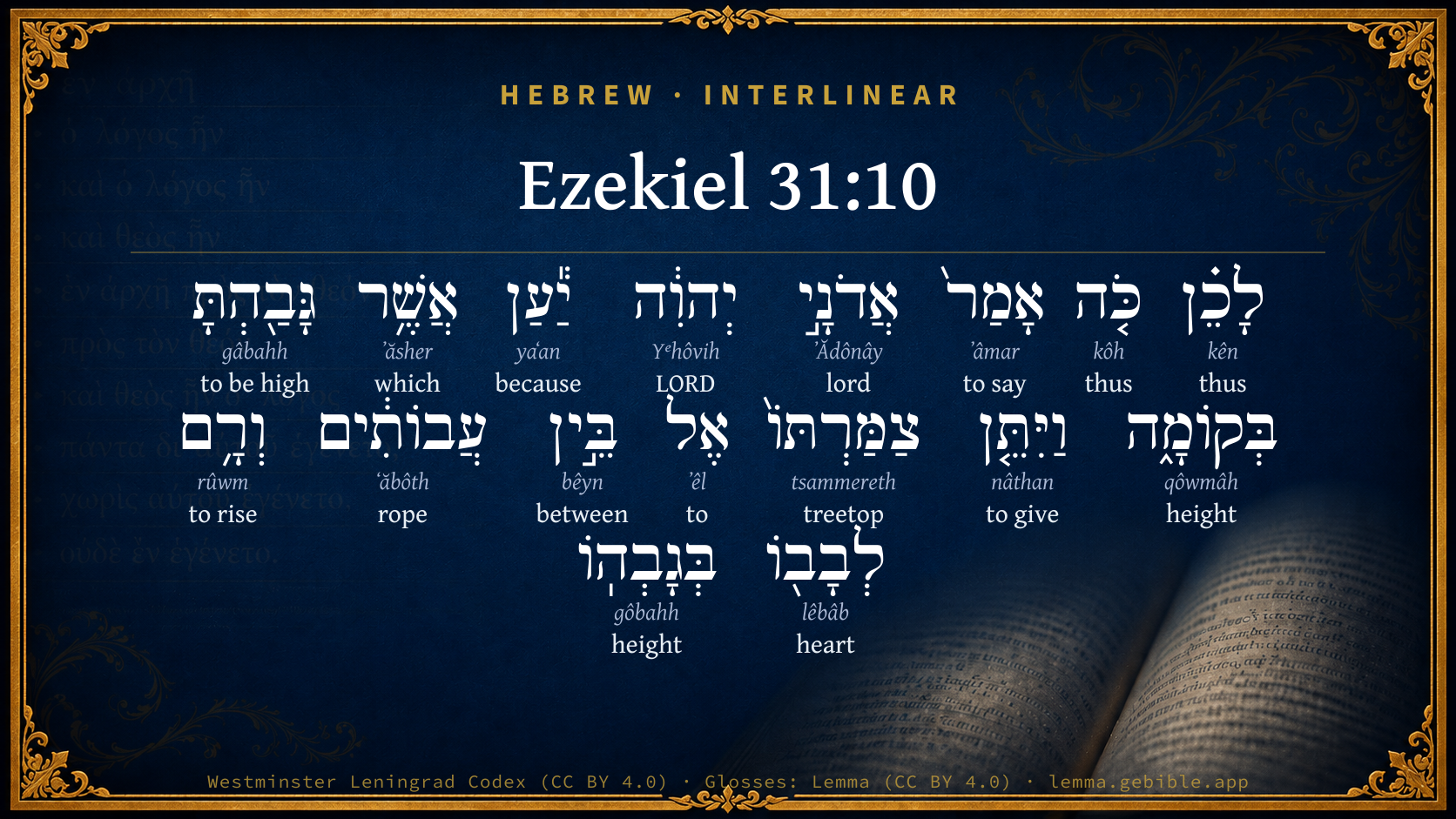
  1. לָכֵ֗ן kên H3651 “to/for · thus” Preposition + Adverb
  2. כֹּ֤ה kôh H3541 “thus” Adverb
  3. אָמַר֙ ʼâmar H559 “to say” Verb, Qal, Perfect, 3rd Person, Masculine, Singular
  4. אֲדֹנָ֣י ʼĂdônây H136 “Lord · my” Noun, Common, Masculine, Plural, Construct + Suffix, Personal, 1st Person, Common, Singular
  5. יְהוִ֔ה Yᵉhôvih H3069 “LORD” Noun, Proper
  6. יַ֕עַן yaʻan H3282 “because” Conjunction
  7. אֲשֶׁ֥ר ʼăsher H834 “which” Particle, Relative
  8. גָּבַ֖הְתָּ gâbahh H1361 “to be high” Verb, Qal, Perfect, 2nd Person, Masculine, Singular
  9. בְּקוֹמָ֑ה qôwmâh H6967 “in/at · height” Preposition + Noun, Common, Feminine, Singular, Absolute
  10. וַיִּתֵּ֤ן nâthan H5414 “and · to give” Conjunction + Verb, Qal, Sequential Imperfect, 3rd Person, Masculine, Singular
  11. אֶל ʼêl H413 “to” Preposition
  12. בֵּ֣ין bêyn H996 “between” Preposition
  13. עֲבוֹתִ֔ים ʻăbôth H5688 “ropes” Noun, Common, Both, Plural, Absolute
  14. וְרָ֥ם rûwm H7311 “and · to rise” Conjunction + Verb, Qal, Perfect, 3rd Person, Masculine, Singular
  15. לְבָב֖וֹ lêbâb H3824 “heart · his” Noun, Common, Masculine, Singular, Construct + Suffix, Personal, 3rd Person, Masculine, Singular
  16. בְּגָבְהֽוֹ gôbahh H1363 “in/at · height · his” Preposition + Noun, Common, Masculine, Singular, Construct + Suffix, Personal, 3rd Person, Masculine, Singular

About this verse

These counts appear in no published source. They are computed here, from the morphology-tagged text and Lemma’s own curated glosses. What Lemma adds →

17
words
17
distinct lemmas
Prophets
section

Notable vocabulary

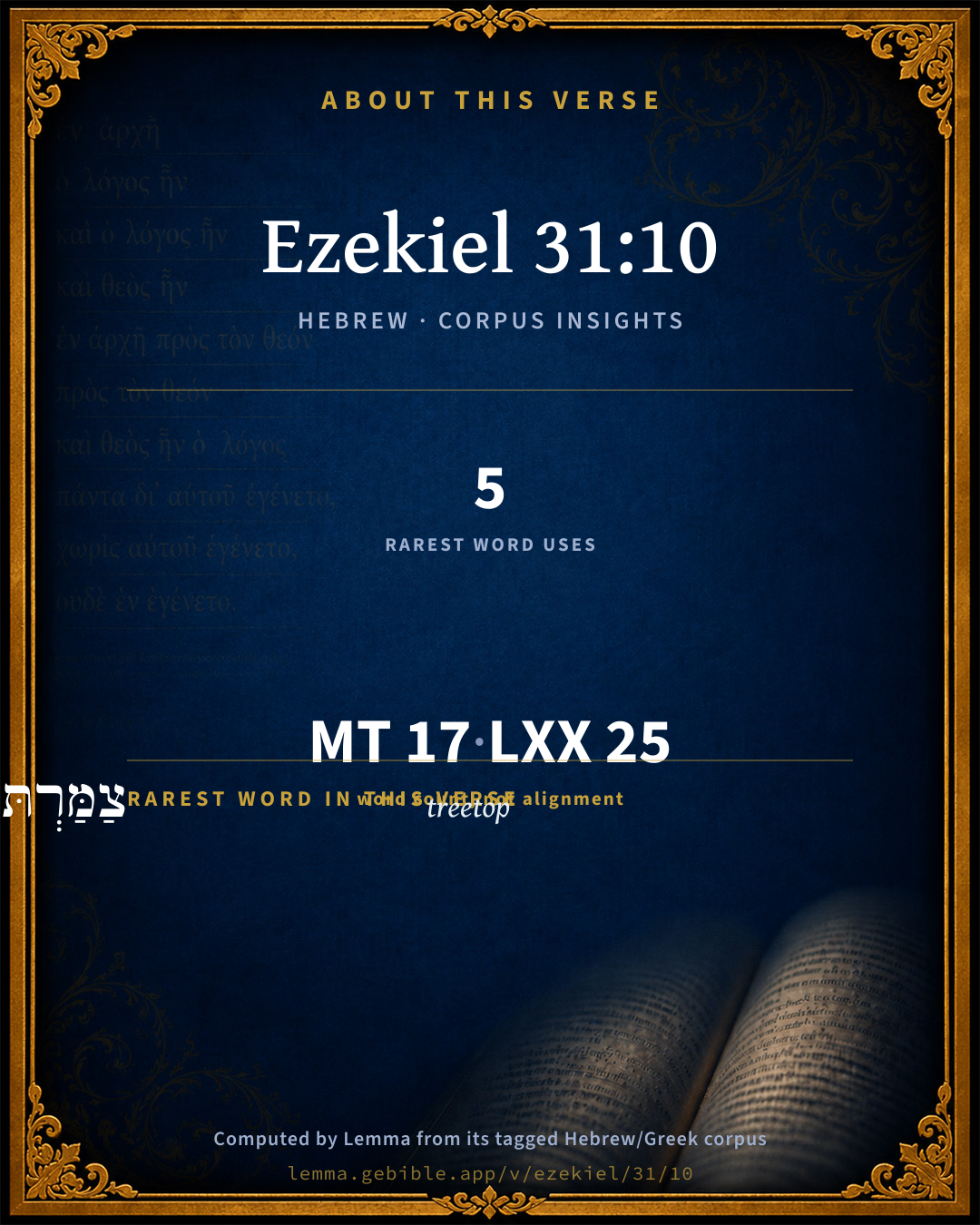
The rarest word here is צַמַּרְתּוֹ֙ treetop H6788 — appearing just 5 times in the whole Hebrew Bible.

Shared distinctive vocabulary

צַמַּרְתּוֹ֙ treetop H6788 occurs in 5 verses of the Hebrew Bible. Also found in:

Grammatical profile

  • 4 verbs
  • 7 nouns
  • 2 prepositions
  • 1 conjunction
  • 2 adverbs
  • 1 particle

Verb forms

  • אָמַר֙ Qal · Perfect
  • גָּבַ֖הְתָּ Qal · Perfect
  • וַיִּתֵּ֤ן Qal · Sequential Imperfect
  • וְרָ֥ם Qal · Perfect

Hebrew & Septuagint length

In English translation the verse runs 31 words from the Hebrew and 28 from the Septuagint (LXX English) — closely comparable.

A rough comparison of the two English renderings, which tokenize alike — not a word-level alignment.

Word counts can differ between the Hebrew and the Greek without any difference in meaning — e.g. the Hebrew direct-object marker אֵת has no separate Greek word, and Greek often adds the article ὁ.

In the original languages it is 17 Hebrew tokens and 25 Greek tokens — but the two are counted differently (Hebrew bundles its prefixes and suffixes into one token; the Greek is in lemma form), so that isn’t a like-for-like length.

Cross-references

14

Topical passages linked to Ezekiel 31:10 in the Treasury of Scripture Knowledge — connected by theme and wording, ordered by reader-vote popularity; previews shown in the World English Bible.

  • Ezekiel 28:17 Your heart was lifted up because of your beauty; you have corrupted your wisdom by reason of your brightness: I have cast you to the ground; I have laid you before kings, that they may see you.
  • Daniel 5:20 But when his heart was lifted up, and his spirit was hardened so that he dealt proudly, he was deposed from his kingly throne, and they took his glory from him:
  • 2 Chronicles 32:25 But Hezekiah didn't render again according to the benefit done to him; for his heart was lifted up: therefore there was wrath on him, and on Judah and Jerusalem.
  • 2 Chronicles 25:19 You say, Behold, you have struck Edom; and your heart lifts you up to boast: abide now at home; why should you meddle to [your] hurt, that you should fall, even you, and Judah with you?
  • Job 11:11–12 For he knows false men. He sees iniquity also, even though he doesn't consider it.
  • Proverbs 16:18 Pride goes before destruction, And a haughty spirit before a fall.
  • Proverbs 18:12 Before destruction the heart of man is proud, But before honor is humility.
  • Isaiah 10:12 Therefore it shall happen that, when the Lord has performed his whole work on Mount Zion and on Jerusalem, I will punish the fruit of the stout heart of the king of Assyria, and the glory of his high looks.
  • Isaiah 14:13–15 You said in your heart, I will ascend into heaven, I will exalt my throne above the stars of God; and I will sit on the mountain of congregation, in the uttermost parts of the north;
  • Ezekiel 31:14 to the end that none of all the trees by the waters exalt themselves in their stature, neither set their top among the thick boughs, nor that their mighty ones stand up on their height, [even] all who drink water: for they are all delivered to death, to the lower parts of the earth, in the midst of the children of men, with those who go down to the pit.
  • Daniel 4:30 The king spoke and said, Is not this great Babylon, which I have built for the royal dwelling-place, by the might of my power and for the glory of my majesty?
  • Obadiah 1:3 The pride of your heart has deceived you, you who dwell in the clefts of the rock, whose habitation is high, who says in his heart, 'Who will bring me down to the ground?'
  • Matthew 23:12 Whoever exalts himself will be humbled, and whoever humbles himself will be exalted.
  • James 4:6 But he gives more grace. Therefore it says, "God resists the proud, but gives grace to the humble."

Cross-references courtesy of OpenBible.info (CC BY 4.0).

Hebrew and Greek witnesses Masoretic Hebrew ↔ Greek Septuagint

The same verse in the two great witnesses to the Old Testament, shown verse-for-verse.

These are two independent witnesses, not word-aligned to each other, and the Septuagint is shown in lemma (dictionary) form.

Hebrew Ezekiel 31:10 Masoretic · Westminster Leningrad Codex

לָכֵ֗ן כֹּ֤ה אָמַר֙ אֲדֹנָ֣י יְהוִ֔ה יַ֕עַן אֲשֶׁ֥ר גָּבַ֖הְתָּ בְּקוֹמָ֑ה וַיִּתֵּ֤ן צַמַּרְתּוֹ֙ אֶל בֵּ֣ין עֲבוֹתִ֔ים וְרָ֥ם לְבָב֖וֹ בְּגָבְהֽוֹ

Therefore thus said the Lord Yahweh: Because you are exalted in stature, and he has set his top among the thick boughs, and his heart is lifted up in his height;

World English Bible · Public Domain

Greek LXX Ezekiel 31:10 Septuagint · lemma form

διά οὗτος ὅδε λέγω κύριος ἀντί ὅς γίγνομαι μέγας ὁ μέγεθος καί δίδωμι ὁ ἀρχή σύ εἰς μέσος νεφέλη καί ὁράω ἐν ὁ ὑψόω αὐτός

Therefore thus says the Lord; Because you are grown great, and have set your top in the midst of the clouds, and I saw when he was exalted;

LXX2012 (modern English Septuagint) · Public Domain

On this verse, Keil & Delitzsch discusses the Septuagint’s reading. Read the note in Commentary ↓

Hebrew: Westminster Leningrad Codex (CC BY 4.0). Greek: Septuagint (public domain); English from LXX2012 (modern English Septuagint) (Public Domain). How the Septuagint differs from the Hebrew →

Targum (Aramaic paraphrase)

1

The Targum is the ancient Jewish Aramaic paraphrase of the Hebrew Scriptures — an interpretive translation, not the Hebrew text itself. Onkelos (literal) and Pseudo-Jonathan (expansive) render the Torah, and Jonathan the Prophets. Coverage is partial: where no permissively-licensed English translation exists for a verse, only the Aramaic is shown. This is verse-level text, not a word-by-word alignment to the Hebrew.

  1. Targum Jonathan Prophets (Joshua–Malachi)
    בְּכֵן כִּדְנַן אֲמַר יְיָ אֱלֹהִים חֲלַף דְרָמְתָּא בְּקוֹמָה וִיהַב מַרְוָתֵיהּ עַל מַלְכְּוָתָא וְרָאֵים לִבֵּיהּ בְּתוּקְפֵיהּ:

    (no public-domain English translation for this verse)

    Targum Jonathan — Aramaic: “Mikraot Gedolot” (public domain). English: “Sefaria Community Translation” (CC0 1.0 (public-domain dedication)); “London "Chaldee Paraphrase," 1871” (public domain). Text via Sefaria.

Commentary

Notes on Ezekiel 31:10 from classic Christian and Jewish commentators (each source and its license shown beneath its notes). The classic Christian expositions comment on the surrounding passage and are grouped to its opening verse, so a note may address several verses; the Jewish commentaries on the Tanakh (Rashi and others) are per-verse, so they appear only where the commentator wrote on this verse.

Lemma curates 59 commentaries, every one of them public domain or Creative Commons licensed, each selected and text-cleaned for this edition rather than reprinted as found. About our sources →

Matthew Henry's Commentary

We have seen the king of Egypt resembling the king of Assyria in pomp, and power, and prosperity, how like he was to him in his greatness; now here we see,

I. How he does likewise resemble him in his pride, Eze 31:10. For, as face answers to face in a glass, so does one corrupt carnal heart to another; and the same temptations of a prosperous state by which some are overcome are fatal to many others too. "Thou, O king of Egypt! hast lifted up thyself in height, hast been proud of thy wealth and power, Eze 29:3. And just so he (that is, the king of Assyria); when he had shot up his top among the thick boughs his heart was immediately lifted up in his height, and he grew insolent and imperious, set God himself at defiance, and trampled upon his people;" witness the messages and letter which the great king, the king of Assyria, sent to Hezekiah, Isa 36:4. How haughtily does he speak of himself and his own achievements! how scornfully of that great and good man! There were other sins in which the Egyptians and the Assyrians did concur, particularly that of oppressing God's people, which is charged upon them both together (Isa 52:4); but here that sin is traced up to its cause, and that was pride; for it is the contempt of the proud that they are filled with. Note, When men's outward condition rises their minds commonly rise with it; and it is very rare to find a humble spirit in the midst of great advancements.

II. How he shall therefore resemble him in his fall; and for the opening of this part of the comparison,

1. Here is a history of the fall of the king of Assyria. For his part, says God (Eze 31:11), I have therefore, because he was thus lifted up, delivered him into the hand of the mighty one of the heathen. Cyaxares, king of the Medes, in the twenty-sixth year of his reign, in conjunction with Nebuchadnezzar king of Babylon in the first year of his reign, destroyed Nineveh, and with it the Assyrian empire. Nebuchadnezzar, though he was not then, yet afterwards became, very emphatically, the mighty one of the heathen, most mighty among them and most mighty over them, to prevail against them.

(1.) Respecting the fall of the Assyrian three things are affirmed: - [1.] It is God himself that orders his ruin: I have delivered him into the hand of the executioner; I have driven him out. Note, God is the Judge, who puts down one and sets up another (Psa 75:7); and when he pleases he can extirpate and expel those who think themselves, and seem to others, to have taken deepest root. And the mightiest ones of the heathens could not gain their point against those they contended with if the Almighty did not himself deliver them into their hands. [2.] It is his own sin that procures his ruin: I have driven him out for his wickedness. None are driven out from their honour, power, and possessions, but it is for their wickedness. None of our comforts are ever lost but what have been a thousand times forfeited. If the wicked are driven away, it is in their wickedness. [3.] It is a mighty one of the heathen that shall be the instrument of his ruin; for God often employs one wicked man in punishing another. He shall surely deal with him, shall know how to manage him, great as he is. Note, Proud imperious men will, sooner or later, meet with their match.

(2.) In this history of the fall of the Assyrian observe, [1.] A continuation of the similitude of the cedar. He grew very high, and extended his boughs very far; but his day comes to fall. First, This stately cedar was cropped: The terrible of the nations cut him off. Soldiers, who being both armed and commissioned to kill, and slay, and destroy, may well be reckoned among the terrible of the nations. They have lopped off his branches first, have seized upon some parts of his dominion and forced them out of his hands; so that in all mountains and valleys of the nations about, in the high-lands and low-lands, and by all the rivers, there were cities or countries that were broken off from the Assyrian monarchy, that had been subject to it, but had either revolted or were recovered from it. Its feathers were borrowed; and, when every bird had fetched back its own, it was naked like the stump of a tree. Secondly, It was deserted: All the people of the earth, that had fled to him for shelter, have gone down from his shadow and have left him. When he was disabled to give them protection they thought they no longer owed him allegiance. Let not great men be proud of the number of those that attend them and have a dependence upon them; it is only for what they can get. When Providence frowns upon them their retinue is soon dispersed and scattered from them. Thirdly, It was insulted over, and its fall triumphed in (Eze 31:13): Upon his ruin shall all the fowls of the heaven remain, to tread upon the broken branches of this cedar. Its fall is triumphed in by the other trees, who were angry to see themselves overtopped so much: All the trees of Eden, that were cut down and had fallen before him, all that drank water of the rain of heaven, as the stump of the tree that is left in the south is said to be wet with the dew of heaven (Dan 4:23) and to bud through the scent of water (Job 14:9), shall be comforted in the nether parts of the earth when they see this proud cedar brought as low as themselves. Solamen miseris socios habuisse doloris - To have companions in woe is a solace to those who suffer. But, on the contrary, the trees of Lebanon, that are yet standing in their height and strength, mourned for him, and the trees of the field fainted for him, because they could not but read their own destiny in his fall. Howl, fir-trees, if the cedar be shaken, for they cannot expect to stand long, Zac 11:2. [2.] An explanation of the similitude of the cedar. By the cutting down of this cedar is signified the slaughter of this mighty monarch and all his adherents and supporters; they are all delivered to death, to fall by the sword, as the cedar by the axe. He and his princes, who, he said, were altogether kings, go down to the grace, to the nether parts of the earth, in the midst of the children of men, as common persons of no quality or distinction. They died like men (Psa 82:7); they were carried away with those that go down to the pit, and their pomp did neither protect them nor descend after them. Again (Eze 31:16), He was cast down to hell with those that descend into the pit; he went into the state of the dead, and was buried as others are, in obscurity and oblivion. Again (Eze 31:17), They all that were his arm, on whom he stayed, by whom he acted and exerted his power, all that dwelt under his shadow, his subjects and allies, and all that had any dependence on him, they all went down into ruin, down into the grace with him, unto those that were slain with the sword, to those that were cut off by untimely deaths before them, under the load of guilt and shame. When great men fall a great many fall with them, as a great many in like manner have fallen before them. [3.] What God designed, and aimed at, in bringing down this mighty monarch and his monarchy. He designed thereby, First, To give an alarm to the nations about, to put them all to a stand, to put them all to a gaze (Eze 31:16): I made the nations to shake at the sound of his fall. They were all struck with astonishment to see so mighty a prince brought down thus. It give a shock to all their confidences, every one thinking his turn would be next. When he went down to the grace (Eze 31:15) I caused a mourning, a general lamentation, as the whole kingdom goes into mourning at the death of the king. In token of this general grief, I covered the deep for him, put that into black, gave a stop to business, in complaisance to this universal mourning. I restrained the floods, and the great waters were stayed, that they might run into another channel, that of lamentation. Lebanon particularly, the kingdom of Syria, that was sometimes in confederacy with the Assyrian, mourned for him; as the allies of Babylon, Rev 18:9. Secondly, To give an admonition to the nations about, and to their kings (Eze 31:14): To the end that none of all the trees by the waters, though ever so advantageously situated, may exalt themselves for their height, may be proud and conceited of themselves and shoot up their top among the thick boughs, looking disdainfully upon others, nor stand upon themselves for their height, confiding in their own politics and powers, as if they could never be brought down. Let them all take warning by the Assyrian, for he once held up his head as high, and thought he kept his footing as firm, as any of them; but his pride went before his destruction, and his confidence failed him. Note, The fall of proud presumptuous men is intended for warning to others to keep humble. It would have been well for Nebuchadnezzar, who was himself active in bringing down the Assyrian, if he had taken the admonition.

2. Here is a prophecy of the fall of the king of Egypt in like manner, Eze 31:18. He thought himself like the Assyrian in glory and greatness, over-topping all the trees of Eden, as the cypress does the shrubs. "But thou also shalt be brought down, with the other trees that are pleasant to the sight, as those in Eden. Thou shalt be brought to the grave, to the nether or lower parts of the earth; thou shalt lie in the midst of the uncircumcised, that die in their uncleanness, die ingloriously, die under a curse and at a distance from God; then shall those whom thou hast trampled upon triumph over thee, saying, This is Pharaoh and all his multitude. See how mean he looks, how low he lies; see what all his pomp and pride have come to; here is all that is left of him." Note, Great men and great multitudes, with the great figure and great noise they make in the world, when God comes to contend with them, will soon become little, less than nothing, such as Pharaoh and all his multitude.

Matthew Henry's Commentary on the Whole Bible (1708–1710) — public domain (CC PDM 1.0). Text via the HelloAO Bible API.

Ellicott's Commentary for English Readers

(10) Among the thick boughs.—The clouds, as in Eze_31:3; Eze_31:14, and Eze_19:11. As Eze_31:3-9 have described Assyria’s greatness, so Eze_31:10-14 speak of her fall. This was now a past event, yet is in part poetically spoken of in the future (Eze_31:11; Eze_31:13), making the whole more graphic and effective. The future may also have been used because the object of this parable is not Assyria, but Egypt, whose fall was still to come. At the outset Assyria is directly addressed in the second person in the vividness of the description, but the third person is used afterwards. The ground of the judgment upon Assyria is its pride, on which 2Ki_18:32-35 may be considered a commentary.

A Bible Commentary for English Readers, edited by Charles John Ellicott (1878–1897) — public domain. Text from a community e-Sword module.

Trapp's Complete Commentary

John Trapp

Eze 31:10 Therefore thus saith the Lord GOD; Because thou hast lifted up thyself in height, and he hath shot up his top among the thick boughs, and his heart is lifted up in his height;

Ver. 10. Because thou hast lifted up thyself.] Here he comes to describe casum et cladem, the downfall and destruction of this flourishing empire, beginning with a short apostrophe to Pharaoh: "Be not high minded, but fear." Believe not him who said, Decent secundas fortunas superbiae, {a} Pride well becometh prosperity; but rather believe what another saith, and experience confirmeth, Sequitur superbos ultora tergo Deus, {b} God punisheth the proud surely and severely. A better author than either of them telleth us that "pride goeth before destruction, and a haughty spirit before a fall. Better it is to be of a humble spirit with the lowly, than to divide the spoil with the proud." {Pro 16:18-19}

{a} Plaut.

{b} Seneca.

John Trapp, A Commentary or Exposition upon All the Books of the Old and New Testament (1647–1656) — public domain. Text from a community e-Sword module.

Joseph Benson's Commentary

Eze 31:10-14. Because thou hast lifted up thyself — Because thy pride hath still increased with thy prosperity. I have delivered him into the hand of the mighty one of the heathen — Or, the mighty one of the nations, as the word גויםis rendered in the next verse. The word אל, eel, here rendered mighty one, though generally spoken of God, yet is sometimes applied to heroes, (see Eze 32:21,) sometimes to angels, as excelling in strength, as Psa 89:6. So God here says, he delivered the Assyrian into the hand of Nabopolassar, king of Babylon, who, joining his forces with those of the king of Media, made himself master of Nineveh, and of the king of Assyria, whose seat it was. And the terrible of the nations have cut him off — The armies of the kings of Babylon and Media shall utterly destroy him and his empire, and leave him without life or power. Upon the mountains, &c., his branches are fallen — As the limbs of a tree are broken by the fall, and those that rested under its shadow are frighted away and forsake the place, so the Assyrian’s power was overthrown in all the places of his dominion. Upon his ruin shall all the fowls of the heaven remain, &c. — As the birds sit upon the boughs of a tree cut down, and the beasts browse upon its branches, so his dominions shall be a prey to the conquerors: or, his armies that are slain shall become meat to the birds and beasts. To the end that none of all the trees exalt themselves — That his destruction may be a warning to other kings and potentates, to deter them from priding themselves in the time of their prosperity. For they are all delivered unto death — The mighty men of the Assyrians were delivered to death as well as those of the meaner sort. The fall of the Assyrian was thus largely spoken of to convince the king of Egypt, if he would be instructed, that no human power, however great, was able to secure its possessor from the wrath of God and his judgments, or to maintain itself against his attacks.

Joseph Benson's Commentary on the Old and New Testaments (1811–1818) — public domain. Text from a community e-Sword module.

Keil & Delitzsch

C. F. Keil & F. Delitzsch

The Felling of this Cedar, or the Overthrow of Asshur on Account of Its Pride

Eze 31:10. Therefore thus said the Lord Jehovah, Because thou didst exalt thyself in height, and he stretched his top to the midst of the clouds, and his heart exalted itself in its height, Eze 31:11. I will give him into the hand of the prince of the nations; he shall deal with him: for his wickedness I rejected him. Eze 31:12. And strangers cut him down, violent ones of the nations, and cast him away: upon the mountains and in all the valleys his shoots fell, and his boughs were broken in pieces into all the deep places of the earth; and all the nations of the earth withdrew from his shadow, and let him lie. Eze 31:13. Upon his fallen trunk all the birds of the heaven settle, and all the beasts of the field are over his branches: Eze 31:14. That no trees by the water may exalt themselves on account of their height, or stretch their top to the midst of the clouds, and no water-drinkers stand upon themselves in their exaltation: for they are all given up to death into hell, in the midst of the children of men, to those that go into the grave. - In the description of the cause of the overthrow of Asshur which commences with יען אשׁר, the figurative language changes in the third clause into the literal fact, the towering of the cedar being interpreted as signifying the lifting up of the heart in his height, - that is to say, in his pride. In the first clause the tree itself is addressed; but in the clauses which follow, it is spoken of in the third person. The direct address in the first clause is to be explained from the vivid manner in which the fact presented itself. The divine sentence in Eze 31:10 and Eze 31:11 is not directed against Pharaoh, but against the Assyrian, who is depicted as a stately cedar; whilst the address in Eze 31:10, and the imperfect (future) in Eze 31:11, are both to be accounted for from the fact that the fall of Asshur is related in the form in which it was denounced on the part of Jehovah upon that imperial kingdom. The perfect אמר is therefore a preterite here: the Lord said...for His part: because Asshur has exalted itself in the pride of its greatness, I give it up. The form ואתנהוּ is not to be changed into ואתנהוּ, but is defended against critical caprice by the imperfect יעשׂה which follows. That the penal sentence of God is not to be regarded as being first uttered in the time then present, but belongs to the past, - and therefore the words merely communicate what God had already spoken, - is clearly shown by the preterites commencing with גּרשׁתּיהוּ, the historical tenses ויּכרתהוּ and ויּטּשׁהוּ, and the preterite נפלוּ, which must not be turned into futures in violation of grammar. גּבהּ בּקומה does not mean, to be high in its height, which would be a tautology; but to exalt itself (be proud) in, or on account of, its height. And in the same way is רוּם also affirmed of the heart, in the sense of exultation from pride. For the fact itself, compare Isa 10:5. אל גּוים does not mean God, but a powerful one of the nations, i.e., Nebuchadnezzar. אל is a simple appellative from אוּל, the strong one; and is neither a name of God nor a defective form for איל, the construct state of איל, a ram. For this defective form is only met with once in the case of איל, a ram, namely, in Job 42:8, where we have the plural אלים, and nowhere else; whereas, in the case of אל, אלים, in the sense of a strong one, the scriptio plena very frequently alternates with the defectiva. Compare, for example, Job 42:8, where both readings occur just as in this instance, where many MSS have איל (vid., de Rossi, variae lectt. ad h. l.); also Exo 15:15 and Eze 17:13, אילי, compared with אלי in Eze 32:21, after the analogy of נירי, Sa2 22:29, and גּירים, Ch2 2:16. עשׂו is not a relative clause, "who should treat him ill," nor is the w relat. omitted on account of the preceding עשׂו, as Hitzig imagines; but it is an independent sentence, and יעשׂה is a forcible expression for the imperative: he will deal with him, equivalent to, "let him deal with him." עשׂה ל, to do anything to a person, used here as it frequently is in an evil sense; compare Psa 56:5. בּרשׁעו-or כּרשׁעו, which Norzi and Abarbanel (in de Rossi, variae lectt. ad. h. l.) uphold as the reading of many of the more exact manuscripts and editions - belongs to גּרשׁתּיהוּ: for, or according to, his wickedness, I rejected him.

In Eze 31:12 the figure of the tree is resumed; and the extinction of the Assyrian empire is described as the cutting down of the proud cedar. זרים עריצי גּוים as in Eze 28:7 and Eze 30:11-12. ויּטּשׁהוּ: they cast him away and let him lie, as in Eze 29:5; Eze 32:4; so that in the first sentence the idea of casting away predominates, and in the second that of letting lie. By the casting away, the tree became so shattered to atoms that its boughs and branches fell upon the mountains and on the low ground and valleys of the earth, and the nations which had sat under its shadow withdrew. ויּרדוּ (they descended) is to be explained from the idea that the three had grown upon a high mountain (namely Lebanon); and Hitzig is mistaken in his conjecture that ויּרדוּ was the original reading, as נדד, to fly, is not an appropriate expression for עמּים. On the falling of the tree, the birds which had made their nests in its branches naturally flew away. If, then, in Eze 31:13, birds and beasts are said to settle upon the fallen trunk, as several of the commentators have correctly observed, the description is based upon the idea of a corpse, a מפּלת (Jdg 14:8), around which both birds and beasts of prey gather together to tear it in pieces (cf. Eze 32:4 and Isa 18:6). היה אל, to come towards or over any one, to be above it. The thought expressed is, that many nations took advantage of the fall of Asshur and rose into new life upon its ruins. - Eze 31:14. This fate was prepared for Asshur in order that henceforth no tree should grow up to the sky any more, i.e., that no powerful one of this earth (no king or prince) should strive after superhuman greatness and might. למען אשׁר is dependent upon גּרשׁתּיהוּ in Eze 31:11; for Eze 31:12 and Eze 31:13 are simply a further expansion of the thought expressed in that word. עצי מים are trees growing near the water, and therefore nourished by water. For 'לא , see Eze 31:10. The words 'ולא יעמדוּ are difficult. As אליהם, with Tzere under א, to which the Masora calls attention, cannot be the preposition אל with the suffix, many have taken אליהם to be a noun, in the sense of fortes, principes, or terebinthi (vid., Isa 61:3), and have rendered the clause either ut non perstent terebinthi eorum in altitudine sua, omnes (ceterae arbores) bibentes aquam (Vatabl., Starck, Maurer, and Kliefoth), or, that their princes may not lift themselves up in their pride, all the drinkers of water (Hvernick). But both renderings founder on the simple fact that they leave the suffix הם in אליהם either unnoticed or unexplained. As only the trees of the water have been spoken of previously, the suffix must be taken as referring to them. But the water-trees have neither terebinths nor princes; on the contrary, these are what they must either be, or signify. Terebinths, or princes of the water-trees, would be senseless ideas. Ewald has therefore taken אליהם as the object, and rendered it thus: "and (that) no water-drinkers may contend with their gods in their pride." He has not proved, however, but has simply asserted, that עמד is to endure = to contend (!). The only remaining course is to follow the lxx, Targum, and many commentators, and to take אליהם as a pronoun, and point it אליהם. עמד אל: to station oneself against, or upon = עמד על (Eze 33:26), in the sense of resting, or relying upon anything. The suffix is to be taken in a reflective sense, as in Eze 34:2, etc. (vid., Ewald, 314c), and precedes the noun to which it refers, as in Pro 14:20 for example. בּגבהם, as in Eze 31:10, referring to pride. כּל־שׁתי מים, the subject of the sentence, is really synonymous with כּל־עצי מים, except that the figure of the tree falls into the background behind the fact portrayed. The rendering of the Berleburg Bible is very good: "and no trees abounding in water stand upon themselves (rely upon themselves) on account of their height." The water-drinkers are princes of this earth who have attained to great power through rich resources. "As a tree grows through the moisture of water, so men are accustomed to become proud through their abundance, not reflecting that these waters have been supplied to them by God" (Starck). The reason for this warning against proud self-exaltation is given in Eze 31:14 in the general statement, that all the proud great ones of this earth are delivered up to death. כּלּם, all of them, the water-drinkers or water-trees already named, by whom kings, earthly potentates, are intended. ארץ תּחתּית = ארץ תּח (Eze 26:20). בּתוך בּני אדם: in the midst of the children of men, i.e., like all other men. "Thus the prophet teaches that princes must die as well as the people, that death and decomposition are common to both. Hence he takes all ground of proud boasting away" (Starck).

Keil & Delitzsch — Biblical Commentary on the Old Testament (1861–1891) — public domain (CC PDM 1.0). Text via the HelloAO Bible API. (Old Testament only.)

Tyndale Open Study Notes

Tyndale Open Resources

31:10-11 Egypt forgot that God had created her beauty, and she became proud and arrogant. As with Tyre, such pride would inevitably lead to a fall. The God who set Egypt in such an exalted position would send a divine lumberjack, in the form of a mighty nation that would destroy it as its wickedness deserved. • I have already discarded it: The human agent would simply be carrying out God’s decree.

Tyndale Open Study Notes — © Tyndale Open Resources, licensed CC BY-SA 4.0. Text via the HelloAO Bible API.

Geneva Bible (1599)

Geneva Bible translators

Or, thou wast lifted up.

Geneva Bible (1599) marginal notes — public domain. Text via Bolls.life.

Jamieson, Fausset & Brown

Robert Jamieson, A. R. Fausset & David Brown

thou . . . he--The change of persons is because the language refers partly to the cedar, partly to the person signified by the cedar.

Jamieson, Fausset & Brown — Commentary Critical and Explanatory on the Whole Bible (1871) — public domain (CC PDM 1.0). Text via the HelloAO Bible API.

The Cambridge Bible for Schools and Colleges

gen. ed. J. J. S. Perowne

10. the thick boughs] the clouds.

10–14. Because of his pride in his height he shall be cut down. Nebuchadnezzar, the mighty one of the nations, shall hew him to the ground, and the beasts shall feed on him. Such judgment must overtake any great tree that exalts itself into the heavens

The Cambridge Bible for Schools and Colleges (gen. ed. J. J. S. Perowne; Cambridge University Press, 1878–1918) — public domain. Text from a community e-Sword module.

John Gill's Exposition

Therefore thus saith the Lord God,.... Having described the greatness of the Assyrian monarch; now follows the account of his fall, and the cause of it, pride:

because thou hast lifted up thyself in height; this is either an address to Pharaoh king of Egypt, who, though he did not rise up so high as the Assyrian monarch in glory and grandeur; yet he lifted up himself, and thought himself superior to any; which reason he must be brought down: or the words are directed to the Assyrian monarch, by a change of person frequent in Scripture; who, though he was raised by the Lord to the height of honour and dignity he was, yet ascribed it to himself:

and he hath shot up his top among the thick boughs; the multitude of provinces over which he became head and governor; See Gill on Eze 31:3,

and his heart is lifted up in his height; with pride, insolence, and contempt of God and men; of which see the instances in Isa 10:8.

John Gill's Exposition of the Whole Bible (1746–1763) — public domain (CC PDM 1.0). Text via the HelloAO Bible API.

Albert Barnes' Notes on the Bible

Assyria’s fall.

Eze 31:11

More accurately: Therefore I will deliver him, etc ... he shall surely deal with him. I have driven him out, etc.

Eze 31:14

Their trees - Rather, as in the margin, “standing unto themselves” meaning “standing in their own strength.” The clause will then run thus: “Neither all that drink water stand up” in their own strength. “All that drink water” means mighty princes to whom wealth and prosperity flow in. The Egyptians owed everything to the waters of the Nile. The substance is, that Assyria’s fall was decreed in order that the mighty ones of the earth might learn not to exalt themselves in pride or to rely on themselves, seeing that they must share the common lot of mortality.

Albert Barnes' Notes on the Bible (1834–1885) — public domain. Text from a community e-Sword/MySword module.

Matthew Poole's English Annotations

Now you shall hear the sin and the fall of this great kingdom of Assyria. His mind could not longer bear so great prosperity, he lifts up himself, and in his pride forgets God who lifted him up and will cast him down. You have a specimen of it in that of Isa 10:7-20 Isa 36:9,15,18. This, as other best framed politics, degenerated into pride and violence against neighbours, subjects, friends, as well as against enemies; though it was too much to despise man, yet it was intolerably more insolent to reproach God. It is but time to lop, nay, cut down this cedar, as Isa 10:33, with Isa 37:36,38.

Matthew Poole's English Annotations on the Holy Bible (1683–1685) — public domain. Text from a community e-Sword/MySword module.

The Pulpit Commentary

Vers. 10, 11. Because thou hast lifted up thyself. The second and third persons are curiously mixed; probably the former was in the nature of a warning addressed to the King of Egypt, while the latter continues the parable of the history of Assyria. For boughs read clouds, as in Ver. 3. Ezekiel writes as with the feeling which led Solon to note that the loftiest trees are those which are most exposed to the strokes of the thunderbolts of Zeus (Herod., 7:10). The Assyrian"s heart was "lifted up with pride", (Isa_10:5) and therefore he was delivered to the mighty one of the nations; sc. to Nebuchadnezzar.

Vers. 10-14. Pride humiliated.

The proud cedar is laid low. Assyria falls. The fate of this great empire gives warning for all ages. Magnificence does not secure protection.

I PRIDE IS THE BESETTING FAULT OF WORLDLY SUCCESS. Many things contribute to the excitement of this passion.

1. The perception of the success. No man can thrive in a worldly way without perceiving the fact.

2. The consciousness of power. The greatest success is that to which a person attains by his own efforts. When he puts forth energy and finds it fruitful, he is naturally tempted to think much of himself.

3. The attraction of the superficial. This worldly success is but a shallow growth. But lying all on the surface, it is very obvious to the eye and appears to be much more important than it really is.

4. The flattery of others. Directly a man is successful a host of flatterers arise about, him, some greedily expecting- crumbs from his table, others slavishly adoring his worldly greatness. Now, flattery accepted makes for pride.

II THE PRIDE OF WORLDLY SUCCESS IS A GREAT SIN IN THE SIGHT OF GOD.

1. It is false. The success is not so glorious a thing as the proud man imagines it to be. Moreover, it is not purely created by the man who attains to it. He takes many advantages that are given to him by Providence, and claims them as of his own making.

2. It is ungrateful. The gifts of Heaven are held as though their owner were under no obligation to him who sent them.

3. It is impenitent. The proud man will not admit his faults. He attempts to hide his sin under his success.

4. It is selfish. Proud Assyria crushed her subject-nations. All pride is a glorification of self, too often at the expense of others. Pride excludes love.

5. It is worldly. This pride is simply concerned with earthly success. It shuts out all contemplation of the spiritual and the eternal Thus it beclouds the view of heaven and destroys the reverence that should be felt for God; it lowers the soul while it exalts self-esteem.

III THIS PRIDE WILL BRING ITS OWN DOWNFALL. Because the cedar has lifted himself up in height, God has delivered him into the hands of the mighty one.

1. This is a Divine judgment. God is higher than the highest. He has power over the greatest. No pride can assert itself successfully in face of his wrath. At a touch from the hand of God the grandest pretensions crumble to dust. Empires topple to the earth at a glance from the Almighty.

2. This is brought about through the direct working of pride. It acts inwardly on the proud man and compasses his ruin. The height and breadth of the majestic cedar make it a prey to the whirlwind. The tall tree attracts the lightning. The rich man is waylaid by thieves, who neglect the poor man and so leave him in safety. The successful man is an object of envy. But pride increases the danger tenfold. It destroys sympathy and excites animosity. It also throws a man off his guard, making him think himself safe from attack or strong to defend himself. The false sense of security which it induces lays a snare for the man who harbors it. Our safety lies in the opposite direction in humility, confession of sin, and trust in the pardoning, protecting grace of God.

Vers. 10-13. The penalty of pride.

The description of Assyria"s power and glory is introduced by the prophet in order to give point to the account now given of that nation"s tragic fate. The more majestic the cedar, the more awful its downfall, and the more affecting the desolation thus wrought. For the warning of Egypt the prophet brings to memory the fate of one of the mightiest and most famous of the kingdoms of the East.

I THE OFFENSE. This lay, not in the greatness and the might of the nation, which were appointed by Divine providence, but in the misuse of the position attained. The language used by Ezekiel concerning Assyria is very instructive as to Assyria"s sin: "His heart is lifted up in his height." It is not the gifts bestowed in which the offence is to be sought, but it is in the erroneous view taken by the possessor, and in his abuse of those gifts. When we read of the heart being lifted up, we are led to understand that the nation took credit to itself for its position and acquirements, and for the influence thus enjoyed. In fact, as our Lord has expressly taught us, the heart is the seat and the source of all sin. Especially apparent is this in the case of the gifts of national exaltation, wealth, and military power; when the hearts of king and of people are filled with pride, self-confidence, and self-glorification.

II THE CHASTISEMENT. The tree was smitten and felled by the hand of the stranger. A foreign foe, a rival nation, was employed to humble the pride of Assyria. The mighty one of the nations (by which we are to understand the King of the Babylonians) dealt with Assyria"s pretensions to supremacy, and confounded them. "Strangers, the terrible of the nations, have cut him off." No greater calamity could have befallen the proud and boastful nation; no more unexpected disaster!

III THE RUIN. The figurative language used to describe this, though succinct, is conclusive and appalling: "Upon the mountains and in all the valleys his branches are fallen, and his boughs are broken by all the watercourses of the land," etc. The description affirms of the conquered Assyria:

1. Humiliation; for the lofty is laid low.

2. Desertion: "All the people of the earth have gone down from his shadow, and have left him." Those who praised and flattered Assyria in prosperity, in the time of adversity forsake and flout her.

3. The ruined nation becomes the prey of other peoples, who seek to profit by its fall. T.

Vers. 10-18. The spectacle of fallen greatness.

This very beautiful parable is suggestive of many things. The latter verses of the chapter bring the Divine meaning into full view. By the fact of the prophecy itself, we are reminded of

I THE DELUSION TO WHICH GREATNESS IS SUBJECT; Viz. that of imagining that it is invulnerable and irremovable. The strong kingdom says, "What power will touch me to hurt me? " The strong man says, "What misfortune will overtake, what enemy will prevail against me?" (see Psa_49:11) It is in the very nature of human exaltation to become foolishly assured of its own security, and to defy the assaults of time and change.

II THE PREGNANT LESSON OF HISTORY. Egypt was now to learn of Assyria; to consider how surpassingly great she had been in her prime (Vers. 1-9), and to reflect upon the utter humiliation to which she had been condemned in the retributive providence of God. We may now learn of Egypt herself, to whom this lesson was addressed, and also of Macedonia, of Greece, of Rome, of Spain, etc., that a nation may tower high and far above the others, like this parabolic cedar (Ver. 5) above the trees of the garden, and yet be discrowned, be leveled to the very dust. And not only the lofty nation, but the ancient family, the proud dynasty, the titled and wealthy individual.

III THE PENALTY OF UNRIGHTEOUSNESS. It is certain that no kingdom or "power" of any kind will very long outlive its purity, its virtue, its simplicity. Two things determine its doom.

1. God will punish its pride (see Vers. 10, 11, 18).

2. Iniquity begets strife, folly, inward corruption, weakness; and this must end, in time, in disaster and ruin. The seeds of death are already sown when power, either in the aggregate or in the individual man, gives way to iniquity. Without any extraordinary means, by God letting his righteous laws do their constant work, such a one is "driven away for his wickedness" (Ver. 11). And the end of evil is nakedness and desertion, emptiness and misery (Ver. 12). Incidental truths are here portrayed, viz.

IV THE UNRELIABLENESS OF HUMAN PROPS. Ver. 12, "All the people of the land have gone from his shade, and have left him." There are noble souls that will cleave to the sinking cause or to the failing man just because it is sinking, because he is failing. But their name is not legion; these are not the rule, but the exception. When the day of decadence comes, and the hour when the house is likely to fall, then expect those who have lived in the shadow of it to leave it to its fate. Nay, there will be found many of those who in the day of its strength enjoyed its hospitality that on the night of its adversity will find themselves comfortable seats upon its ruins (Ver. 13). We have another trace of

V THE DEPTH TO WHICH GREATNESS WILL DESCEND IN BECOMING THE OBJECT OF GENERAL COMPASSION. (Ver. 15.) Once it was the province of the great power to pity the necessitous and to stretch forth its strong hand of help and healing; now it lies prostrate and is itself the object of universal commiseration. "And none so poor to do it reverence.

1. Let human greatness beware. It is high and uplifted in the sight of men; but beware lest its heart be lifted up in arrogance and in self-confidence; for, if that be so, or if it be allowing evil to creep into any cracks of its walls, it will call down the condemnation of Heaven, and, in time, it will meet its doom. Where other prostrate powers lie, where the humblest and commonest are stretched, "in the midst of the children of men," "delivered to death" (Ver. 14), there shall it also be found, down and dishonored.

2. Let the holy humble-hearted be filled with a wise contentment. How much better than the greatness which is humiliated is the lowliness which is blessed and crowned! blessed with the benediction of God and man, crowned with the glory to which righteousness conducts and in which it ends. C.

The Pulpit Commentary (1880–1919), ed. H.D.M. Spence-Jones & Joseph S. Exell — public domain. Text from a community e-Sword module.

Kretzmann's Popular Commentary

Paul E. Kretzmann

The Lesson of Assyria’s Fall

v. 10. Therefore, thus saith the Lord God, here addressing the king of Assyria directly, although the object, bringing home the lesson to Pharaoh by means of the message, is unmistakable, because thou hast lifted up thyself in height, in blasphemous high-mindedness on account of a prosperity which was nothing but a gift from above, and he, the address here turning to the third person, hath shot up his top among the thick boughs, up into the very clouds, and his heart is lifted up in his height, in sinful and insulting pride,

v. 11. I have therefore delivered him into the hand of the mighty one of the heathen, namely, Nebuchadnezzar of Babylon; he shall surely deal with him, literally, "he will do, do to him," or, in modern form, he will surely do away with him; I have driven him out for his wickedness, the Lord rejecting Assyria from before His face.

v. 12. And strangers, foreign invaders, the terrible of the nations, the Chaldean soldiers, known for their fierceness, have cut him off and have left him, the picture of a tree that is felled being retained here; upon the mountains and in all the valleys his branches are fallen, all the tributary nations and provinces being lopped off, and his boughs, all the colonies and dependent cities, are broken by all the rivers of the land, as when a mighty tree, in falling down the mountainside, is shattered into little pieces; and all the people of the earth, formerly in dependence upon Assyria, are gone down from his shadow and have left him.

v. 13. Upon his ruin, as he has fallen headlong, thus presenting the picture of a carcass, shall all the fowls of the heaven remain, and all the beasts of the field shall be upon his branches, the very ones that had formerly been under his dominion now turning to birds and beasts of prey in tearing the carcass to pieces, that is, in deriving life from Assyria’s downfall, in building themselves up on its ruins:

v. 14. to the end, with this final object in mind, that none of all the trees by the waters exalt themselves for their height, all other nations profiting by the example of Assyria, neither shoot up their top among the thick boughs, between the very clouds of the sky, neither their trees stand up in their height, in the same sinful pride, all that drink water, while they are deriving their strength from the Lord alone; for they are all delivered unto death, to the nether parts of the earth, to the underground kingdom of death, in the midst of the children of men, with them that go down to the pit. How foolish for the mighty of the earth to lift themselves up in sinful pride, when, after all, they are all weak and mortal men, entirely dependent upon the goodness of the God whose providence alone upholds them!

v. 15. Thus saith the Lord God, in describing the impression which the fall of Assyria made upon other nations and making the application to the case of Pharaoh, In the day when he went down to the grave, when the Assyrian world-power was destroyed, I caused a mourning, men stopping for a time to consider the calamity in horror and grief; I covered the deep for him, literally, "I veiled, on his account, the flood," that which had given him his life-giving power, and I restrained the floods thereof, holding back the various streams spoken of in verse 4, and the great waters were stayed; and I caused Lebanon to mourn for him, literally, "to become dark over him, in mourning over the fall of the mighty cedar Assyria," and all the trees of the field fainted for him. On account of the overthrow of Assyria the entire world was drawn into suffering, so that all sources of wealth and power were cut off.

v. 16. I made the nations to shake at the sound of his fall, foreseeing in his overthrow a similar calamity for themselves, when I cast him down to hell with them that descend into the pit, to the kingdom of death; and all the trees of Eden, the choice and best of Lebanon, spoken of in verses 8 and 9, all that drink water, shall be comforted in the nether parts of the earth, since mighty Assyria was obliged to share their fate in the realm of those destroyed from off the face of the earth.

v. 17. They also went down into hell with him, sharing the fate of Assyria, unto them that be slain with the sword; and they that were his arm, his auxiliaries, or allies, that dwelt under his shadow in the midst of the heathen, depending upon his military power. In concluding this paragraph and chapter, the application is made to Pharaoh, who is here once more directly addressed.

v. 18. To whom art thou thus like in glory and in greatness among the trees of Eden? among the various nations of the world, blessed by God, as they are, with many and great gifts of his goodness. Yet shalt thou be brought down with the trees of Eden, just as Assyria had been, unto the nether parts of the earth; thou shalt lie in the midst of the uncircumcised, the godless heathen, with them that be slain by the sword. Thus would the fate of Egypt he like that of Assyria. This is Pharaoh and all his multitude, so would it happen to him and all his people with their proud wealth and their boastful behavior, saith the Lord God. It is an easy matter for God to make an example and a spectacle of all His enemies.

Paul E. Kretzmann, Popular Commentary of the Bible (1921–1924) — public domain. Text from a community e-Sword module.

unfoldingWord translationNotes

Door43 World Missions Community

General Information:

Yahweh's parable about the cedar continues.

Therefore the Lord Yahweh says this

Since Yahweh is speaking this can be stated in first person. AT: "Therefore, this is what I, Yahweh the Lord, say" (See: First, Second, or Third Person)

it set its treetop between its branches

"its top was above the branches of the other trees." Some versions of the Bible translate this as "the top of the tree was in the clouds."

I have given it into the hand of a mighty one of the nations

The word "hand" represents control. AT: "I put it in the power of the strongest nation" or "I gave the strongest nation power over it" (See: Metonymy)

I have thrown it out

"I sent the cedar away from the cedar's land because the cedar was wicked"

translationWords

Lord Yahweh

heart

hand

nation

evil

unfoldingWord translationNotes — © Distant Shores Media and the Door43 World Missions Community, licensed CC BY-SA 4.0. Source: git.door43.org/Door43/en_tn.

Rashi

Rabbi Shlomo Yitzchaki (Rashi)

Because you grew haughty with your height So I said to Assyria.

Rashi on the Tanakh — English translations: “The Judaica Press complete Tanach with Rashi, translated by A. J. Rosenberg” (CC BY 4.0); “Pentateuch with Rashi's commentary by M. Rosenbaum and A.M. Silbermann, 1929-1934” (public domain); “The Metsudah Tanach series, Lakewood, N.J” (CC BY 4.0); and “The Book of Joshua, Metsudah Publications, 1997” (CC BY 4.0). Text via Sefaria.

Lesson kit

Teaching starters — assembled from the data on this page, not authored interpretation. Every prompt links to the verse data it draws on. Edit before teaching.

Ezekiel, in the Prophets, opens this verse with 17 words (17 distinct Hebrew lemmas). Its most distinctive word is tsammereth (“treetop”). A historical commentator’s framing appears above. Read the whole chapter for the surrounding context.

Discussion questions

  1. How does “treetop” (tsammereth) shape what this verse is saying?
  2. Ezekiel 17:3 shares the word «treetop» with this verse. How do the two illuminate each other?
  3. These translations render this verse differently; the difference is in the English rendering, not the original. What questions does that raise?
  4. The verb «אָמַר֙» is Qal Perfect. How does its form color the action?
  5. Reading how Matthew Henry's Commentary and Ellicott's Commentary for English Readers read this verse, where do the two commentators agree and where do they part?

Things to notice

Reading settings

Reading text

Shown beneath each verse's original-language words.

Old Testament
Old Testament edition

Read the OT as the Masoretic Hebrew (MT) or the Greek Septuagint (LXX).

English shown for the Greek Septuagint (in the Hebrew ↔ Greek comparison).

Comparing translations? Open the Compare panel on any verse page to stack up to four side by side.