1 Kings 18:32

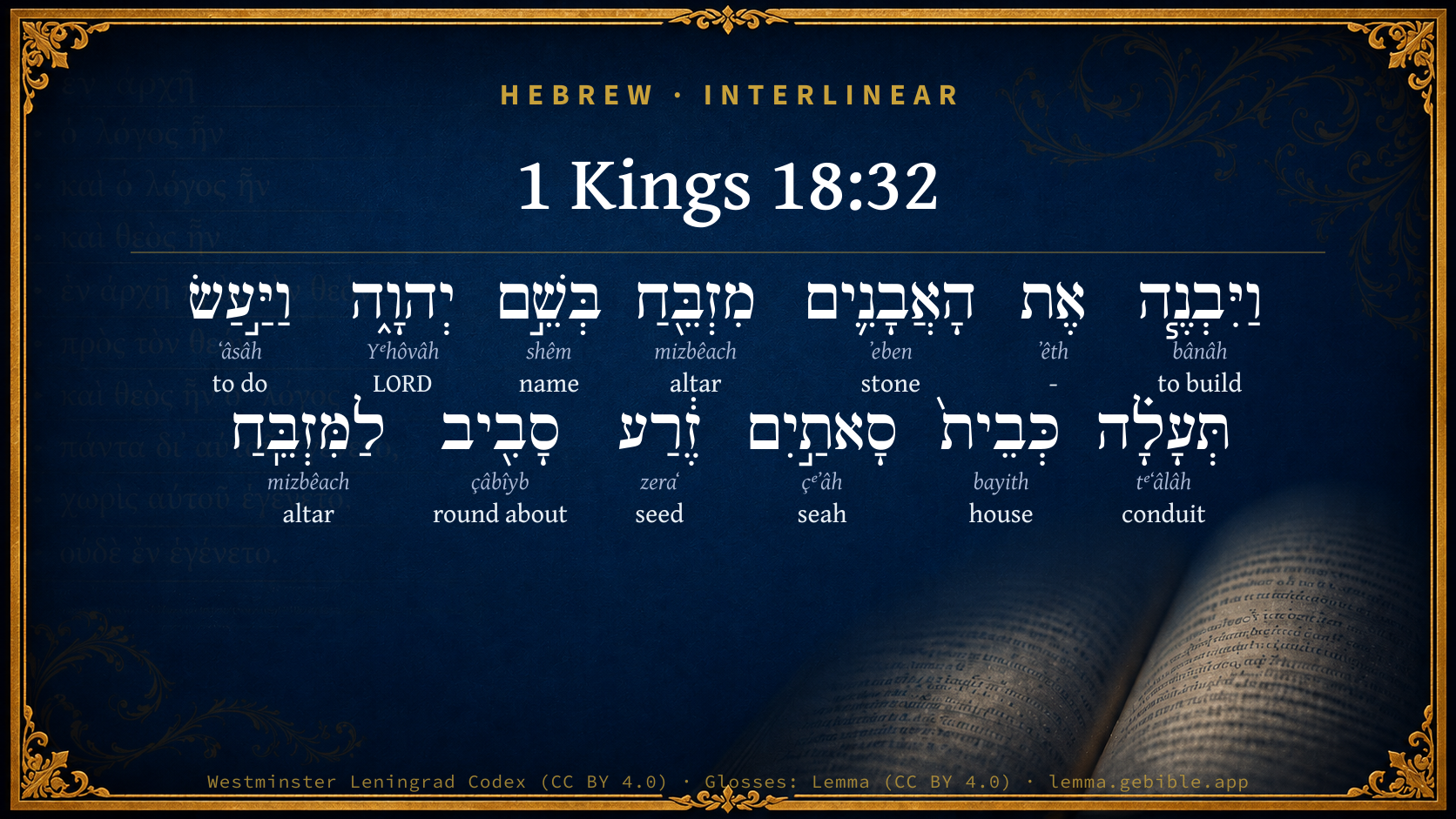
Hebrew (Westminster Leningrad Codex) 1 Kings 18:32 appears in the Hebrew Old Testament. The text above is from the Westminster Leningrad Codex. Each word links to its Strong’s number, a concise gloss, and parsing drawn from the Open Scriptures Hebrew Bible morphology. Click any word for its full Brown-Driver-Briggs (BDB) entry.
Download image
Cite this verse

1 Kings 18:32 (World English Bible). Public Domain. Lemma interlinear Bible study tool, https://lemma.gebible.app/v/1-kings/18/32.

Show BibTeX & RIS
BibTeX
RIS
English Translation
With the stones he built an altar in the name of Yahweh; and he made a trench about the altar, as great as would contain two measures of seed.
World English Bible · Public Domain
Highlights
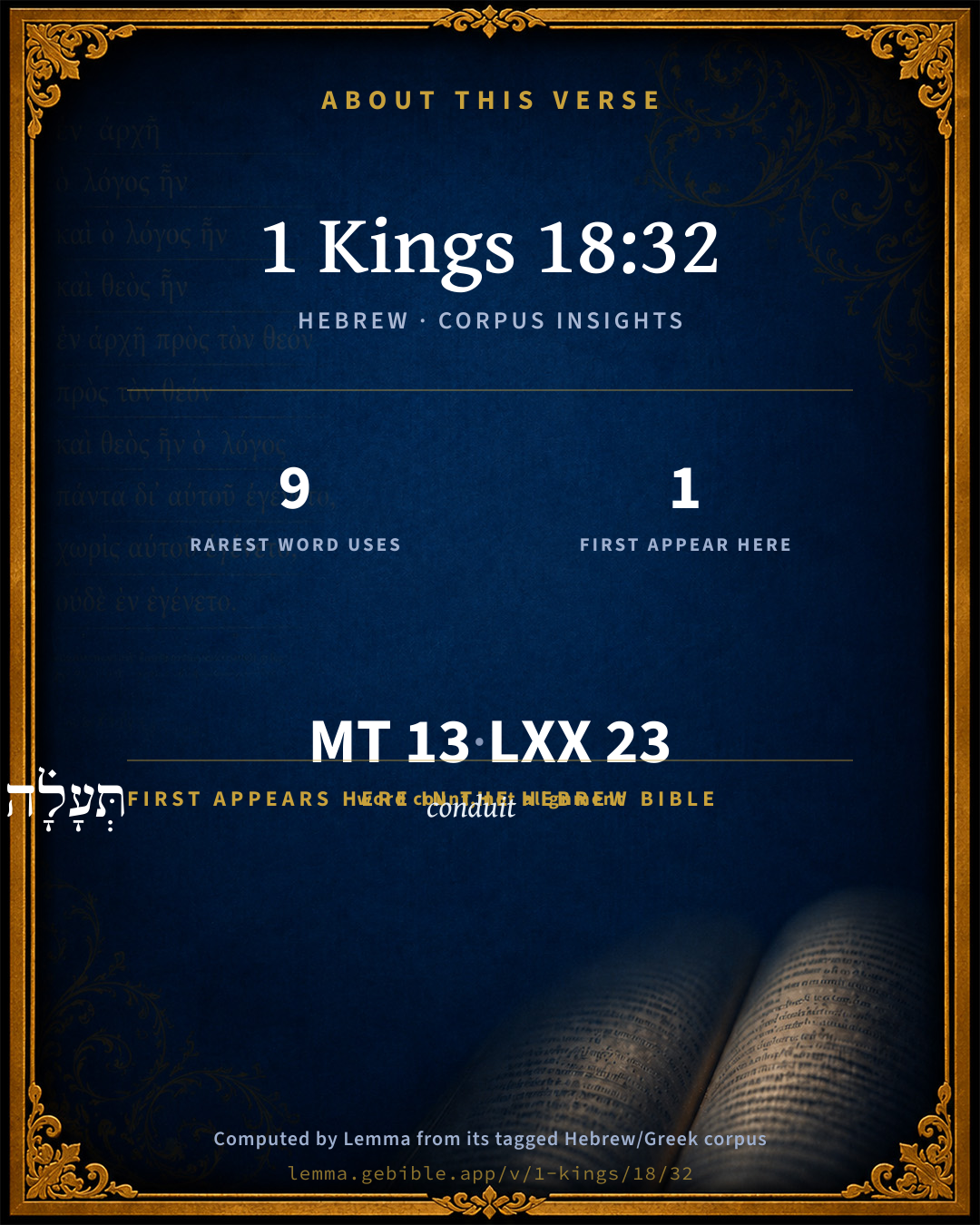
  • 1 first appearance in the Hebrew Bible
Full analysis ↓
Download a study sheet

One document with this verse’s original text, its word-by-word gloss line, the meaning frame, cross-references with their text, attributed commentary, and full source and license credits — printable, and it pastes into notes with its structure intact.

This verse Autodidact and up

Study sheet (.html) Plain text (.txt)

A passage Seminary Student

Up to 50 verses in one chapter. A passage sheet keeps up to 6 commentary sources and 12 cross-references per verse, in the order this page ranks them, and says so on the sheet whenever that leaves anything out. Ask for a single verse and you get the Autodidact verse sheet above.

Everything on this page stays free to read, with no account — the sheet is a download of what is already on screen, not access to it.

Want to remove ads? Support Godless Engineer
Compare translations 3

The same verse in 3 English versions, stacked beneath the original-language interlinear above. Click any original word for its lexicon entry.

Each is an independent rendering of the whole verse — the interlinear is not word-aligned to these translations.

Highlighted words mark where these versions differ — a whole-verse word diff, not a word-by-word alignment.

  • World English Bible Public Domain
    With the stones he built an altar in the name of Yahweh; and he made a trench about the altar, as great as would contain two measures of seed.
  • King James Version Public Domain
    And with the stones he built an altar in the name of the LORD: and he made a trench about the altar, as great as would contain two measures of seed.
  • unfoldingWord Literal Text CC BY-SA 4.0
    And with the stones he built an altar in the name of Yahweh. And he made a trench around the altar like the house of two seahs seed.

unfoldingWord Literal Text — © unfoldingWord, licensed CC BY-SA 4.0. Word-aligned USFM3 via Door43 (git.door43.org/unfoldingWord/en_ult).

Versions to compare (up to 4)

3 of 4 selected

Show all 18 translations

Every available English version of this verse, each an independent rendering of the whole verse.

  • World English Bible Public Domain
    With the stones he built an altar in the name of Yahweh; and he made a trench about the altar, as great as would contain two measures of seed.
  • Berean Standard Bible Public Domain
    And with the stones, Elijah built an altar in the name of the LORD. Then he dug a trench around the altar large enough to hold two seahs of seed.
  • Majority Standard Bible Public Domain
    And with the stones, Elijah built an altar in the name of the LORD. Then he dug a trench around the altar large enough to hold two seahs of seed.
  • King James Version Public Domain
    And with the stones he built an altar in the name of the LORD: and he made a trench about the altar, as great as would contain two measures of seed.
  • American Standard Version (1901) Public Domain
    And with the stones he built an altar in the name of Jehovah; and he made a trench about the altar, as great as would contain two measures of seed.
  • Revised Version (1885) Public Domain
    And with the stones he built an altar in the name of the LORD; and he made a trench about the altar, as great as would contain two measures of seed.
  • Geneva Bible (1599) Public Domain
    And with the stones he buylt an altar in the Name of the Lord: and he made a ditch round about the altar, as great as woulde conteine two measures of seede.
  • Douay-Rheims (1899) Public Domain
    And he built with the stones an altar to the name of the Lord: and he made a trench for water, of the breadth of two furrows round about the altar.
  • Young's Literal Translation Public Domain
    and he buildeth with the stones an altar, in the name of Jehovah, and maketh a trench, as about the space of two measures of seed, round about the altar.
  • Literal Standard Version CC BY-SA 4.0
    and he builds an altar with the stones, in the Name of YHWH, and makes a trench, as about the space of two measures of seed, around the altar.
  • Unlocked Literal Bible CC BY-SA 4.0
    With the stones he built an altar in the name of Yahweh and he dug a trench around the altar large enough to contain two seahs of seeds.
  • unfoldingWord Literal Text CC BY-SA 4.0
    And with the stones he built an altar in the name of Yahweh. And he made a trench around the altar like the house of two seahs seed.
  • Darby Bible Public Domain
    and with the stones he built an altar in the name of Jehovah, and made a trench round about the altar, of the capacity of two measures of seed;
  • World Messianic Bible Public Domain
    With the stones he built an altar in the LORD’s name. He made a trench around the altar large enough to contain two seahs of seed.
  • Webster's Bible Public Domain
    And with the stones he built an altar in the name of the LORD: and he made a trench about the altar, as great as would contain two measures of seed.
  • Free Bible Version CC BY-SA 4.0
    With the stones he built an altar in the Lord's name. He dug a ditch around it that could hold two seahs of seed.
  • Bible in Basic English Public Domain
    And with the stones he made an altar to the name of the Lord; and he made a deep drain all round the altar, great enough to take two measures of seed.
  • JPS Tanakh (1917) Public Domain
    And with the stones he built an altar in the name of the LORD; and he made a trench about the altar, as great as would contain two measures of seed.

Literal Standard Version (2020), Covenant Press — licensed CC BY-SA 4.0. Text via the HelloAO Bible API (eBible.org). Unlocked Literal Bible (unfoldingWord) — licensed CC BY-SA 4.0. Text via the HelloAO Bible API (eBible.org). unfoldingWord Literal Text — © unfoldingWord, licensed CC BY-SA 4.0. Word-aligned USFM3 via Door43 (git.door43.org/unfoldingWord/en_ult). Free Bible Version, Dr. Jonathan Gallagher — licensed CC BY-SA 4.0. Text via the HelloAO Bible API (eBible.org).

Word by word

More ways to search: Search by grammar → Find every occurrence → Compare this word →

Practice this passage: Drill this verse → Learn its vocabulary →

סָאתַ֣יִם
çᵉʼâh
H5429
“seahs”
Noun, Common, Feminine, Dual, Absolute
Part of Speech
Noun
Type
Common
Gender
Feminine
Number
Dual
State
Absolute
Full BDB Definition

Origin: from an unused root meaning to define

TWOT: 1452

seah, a measure of flour or grain - probably equal to 1/3 ephah
  1. וַיִּבְנֶ֧ה bânâh H1129 “and · to build” Conjunction + Verb, Qal, Sequential Imperfect, 3rd Person, Masculine, Singular
  2. אֶת ʼêth H853 “-” Particle, Direct Object
  3. הָאֲבָנִ֛ים ʼeben H68 “the · stones” Particle, Definite Article + Noun, Common, Feminine, Plural, Absolute
  4. מִזְבֵּ֖חַ mizbêach H4196 “altar” Noun, Common, Masculine, Singular, Absolute
  5. בְּשֵׁ֣ם shêm H8034 “in/at · name of” Preposition + Noun, Common, Masculine, Singular, Construct
  6. יְהוָ֑ה Yᵉhôvâh H3068 “LORD” Noun, Proper
  7. וַיַּ֣עַשׂ ʻâsâh H6213 “and · to do” Conjunction + Verb, Qal, Sequential Imperfect, 3rd Person, Masculine, Singular
  8. תְּעָלָ֗ה tᵉʻâlâh H8585 “conduit” Noun, Common, Feminine, Singular, Absolute
  9. כְּבֵית֙ bayith H1004 “like/as · house of” Preposition + Noun, Common, Masculine, Singular, Construct
  10. זֶ֔רַע zeraʻ H2233 “seed” Noun, Common, Masculine, Singular, Absolute
  11. סָבִ֖יב çâbîyb H5439 “round about” Noun, Common, Both, Singular, Absolute
  12. לַמִּזְבֵּֽחַ mizbêach H4196 “to/for the · altar” Preposition, Determined + Noun, Common, Masculine, Singular, Absolute

About this verse

These counts appear in no published source. They are computed here, from the morphology-tagged text and Lemma’s own curated glosses. What Lemma adds →

13
words
12
distinct lemmas
Historical
section

Notable vocabulary

The rarest word here is סָאתַ֣יִם seah H5429 — appearing just 9 times in the whole Hebrew Bible.

First appearance in Scripture

This word makes its first canonical appearance in the Hebrew Bible here:

  • תְּעָלָ֗ה conduit H8585

Shared distinctive vocabulary

סָאתַ֣יִם seah H5429 occurs in 6 verses of the Hebrew Bible. Also found in:

Grammatical profile

  • 2 verbs
  • 10 nouns
  • 1 particle

Verb forms

  • וַיִּבְנֶ֧ה Qal · Sequential Imperfect
  • וַיַּ֣עַשׂ Qal · Sequential Imperfect

Repetition

A word recurs within this verse — often emphatic in Hebrew:

  • מִזְבֵּ֖חַ altar H4196 ×2

Hebrew & Septuagint length

In English translation the verse runs 29 words from the Hebrew and 37 from the Septuagint (LXX English) — closely comparable.

A rough comparison of the two English renderings, which tokenize alike — not a word-level alignment.

Word counts can differ between the Hebrew and the Greek without any difference in meaning — e.g. the Hebrew direct-object marker אֵת has no separate Greek word, and Greek often adds the article ὁ.

In the original languages it is 13 Hebrew tokens and 23 Greek tokens — but the two are counted differently (Hebrew bundles its prefixes and suffixes into one token; the Greek is in lemma form), so that isn’t a like-for-like length.

Cross-references

7

Topical passages linked to 1 Kings 18:32 in the Treasury of Scripture Knowledge — connected by theme and wording, ordered by reader-vote popularity; previews shown in the World English Bible.

  • Colossians 3:17 Whatever you do, in word or in deed, do all in the name of the Lord Jesus, giving thanks to God the Father, through him.
  • Exodus 20:24–25 You shall make an altar of earth for me, and shall sacrifice on it your burnt offerings and your peace-offerings, your sheep and your oxen. In every place where I record my name I will come to you and I will bless you.
  • Judges 6:26 and build an altar to Yahweh your God on the top of this stronghold, in the orderly manner, and take the second bull, and offer a burnt offering with the wood of the Asherah which you shall cut down.
  • Judges 21:4 It happened on the next day that the people rose early, and built there an altar, and offered burnt offerings and peace-offerings.
  • 1 Samuel 7:9 Samuel took a sucking lamb, and offered it for a whole burnt-offering to Yahweh: and Samuel cried to Yahweh for Israel; and Yahweh answered him.
  • 1 Samuel 7:17 His return was to Ramah, for there was his house; and there he judged Israel: and he built there an altar to Yahweh.
  • 1 Corinthians 10:31 Whether therefore you eat, or drink, or whatever you do, do all to the glory of God.

Cross-references courtesy of OpenBible.info (CC BY 4.0).

Hebrew and Greek witnesses Masoretic Hebrew ↔ Greek Septuagint

The same verse in the two great witnesses to the Old Testament, shown verse-for-verse.

These are two independent witnesses, not word-aligned to each other, and the Septuagint is shown in lemma (dictionary) form.

Hebrew 1 Kings 18:32 Masoretic · Westminster Leningrad Codex

וַיִּבְנֶ֧ה אֶת הָאֲבָנִ֛ים מִזְבֵּ֖חַ בְּשֵׁ֣ם יְהוָ֑ה וַיַּ֣עַשׂ תְּעָלָ֗ה כְּבֵית֙ סָאתַ֣יִם זֶ֔רַע סָבִ֖יב לַמִּזְבֵּֽחַ

With the stones he built an altar in the name of Yahweh; and he made a trench about the altar, as great as would contain two measures of seed.

World English Bible · Public Domain

Greek LXX 1 Kings 18:32 Septuagint · lemma form

καί οἰκοδομέω ὁ λίθος ἐν ὄνομα κύριος καί ἰάομαι ὁ θυσιαστήριον ὁ κατασκάπτω καί ποιέω θααλα χωρέω δύο μετρητής σπέρμα κυκλόθεν ὁ θυσιαστήριον

And he built up the stones in the name of the Lord, and repaired the altar that had been broken down; and he made a trench that would hold two measures of seed round about the altar.

LXX2012 (modern English Septuagint) · Public Domain

On this verse, The Cambridge Bible for Schools and Colleges discusses the Septuagint’s reading. Read the note in Commentary ↓

Hebrew: Westminster Leningrad Codex (CC BY 4.0). Greek: Septuagint (public domain); English from LXX2012 (modern English Septuagint) (Public Domain). How the Septuagint differs from the Hebrew →

Targum (Aramaic paraphrase)

1

The Targum is the ancient Jewish Aramaic paraphrase of the Hebrew Scriptures — an interpretive translation, not the Hebrew text itself. Onkelos (literal) and Pseudo-Jonathan (expansive) render the Torah, and Jonathan the Prophets. Coverage is partial: where no permissively-licensed English translation exists for a verse, only the Aramaic is shown. This is verse-level text, not a word-by-word alignment to the Hebrew.

  1. Targum Jonathan Prophets (Joshua–Malachi)
    וּבְנָא יַת אַבְנַיָא מַדְבְּחָא בִּשְׁמָא דַייָ וַעֲבַד מְזִיקָתָא כְּבֵית סָאתָן זַרְעָא סְחוֹר סְחוֹר לְמַדְבְּחָא:

    (no public-domain English translation for this verse)

    Targum Jonathan — Aramaic: “Mikraot Gedolot” (public domain). English: “Sefaria Community Translation” (CC0 1.0 (public-domain dedication)); “London "Chaldee Paraphrase," 1871” (public domain). Text via Sefaria.

Commentary

Notes on 1 Kings 18:32 from classic Christian and Jewish commentators (each source and its license shown beneath its notes). The classic Christian expositions comment on the surrounding passage and are grouped to its opening verse, so a note may address several verses; the Jewish commentaries on the Tanakh (Rashi and others) are per-verse, so they appear only where the commentator wrote on this verse.

Lemma curates 59 commentaries, every one of them public domain or Creative Commons licensed, each selected and text-cleaned for this edition rather than reprinted as found. About our sources →

Trapp's Complete Commentary

John Trapp

1Ki 18:32 And with the stones he built an altar in the name of the LORD: and he made a trench about the altar, as great as would contain two measures of seed.

Ver. 32. In the name of the Lord,] i.e., By his special warrant, and for his honour and service.

John Trapp, A Commentary or Exposition upon All the Books of the Old and New Testament (1647–1656) — public domain. Text from a community e-Sword module.

Joseph Benson's Commentary

1Ki 18:32-33. With the stones he built an altar — With the assistance of the people, who now readily yielded their helping hands. In the name of the Lord — By the authority of God and for his worship. He made a trench, as great as would contain two measures of seed — As capacious, say some, as a sack that would contain that quantity, namely, two third parts of an ephah. Others understand the words as meaning a trench of sufficient breadth and circuit to sow therein that quantity of seed, or about twenty pounds’ weight of barley: which must have been very large indeed. Fill four barrels with water — This they could quickly fetch, either from the river Kishon; or, if that was dried up, from the sea; both were at the foot of the mountain. This he did to make the miracle more glorious, and more unquestionable; to show that there was no fallacy in it, no fire concealed in or about the altar; but that the lightning which was to consume the sacrifice came from heaven; and came at Elijah’s invocation; and Josephus tells us, that Elijah invited the people to draw near, that they might search and spy everywhere, if they could find any fire secretly conveyed under the altar. Antiq. lib. 8. cap. 7.

Joseph Benson's Commentary on the Old and New Testaments (1811–1818) — public domain. Text from a community e-Sword module.

Geneva Bible (1599)

Geneva Bible translators

Hebrew, seahs, which some think contain about three pottles and a third part a piece.

Geneva Bible (1599) marginal notes — public domain. Text via Bolls.life.

Adam Clarke's Commentary

Verse 32. He made a trench] This was to detain the water that might fall down from the altar when the barrels should be poured upon it, 1Kg 18:35.

Adam Clarke's Commentary on the Bible (1810–1826) — public domain. Text from a community e-Sword/MySword module.

Ellicott's Commentary for English Readers

(32) Measures.—The “measure,” the third part of the ephah, hence also often called shalish (a “tierce,” or “third”), was something less than three gallons. A trench to contain only six gallons seems too insignificant for the context; hence it is supposed that the sense is “large enough for the sowing (as in a furrow) of two measures of seed.”

A Bible Commentary for English Readers, edited by Charles John Ellicott (1878–1897) — public domain. Text from a community e-Sword module.

The Cambridge Bible for Schools and Colleges

gen. ed. J. J. S. Perowne

32. a trench] The LXX. has θάλασσαν = a sea, which is interesting in connexion with the name given to the great cistern which Solomon caused to be made for the temple-services. Cf. 1Ki_7:23 above.

as great as would contain two measures of seed] The LXX. omits these words, which are not quite easy of explanation. The measure mentioned is a seah, which is the third part of an ephah. But whether the dimension applies to each side of the altar, so that on each of the four sides there would be a ditch of this capacity, or whether this was the capacity of the whole surrounding trench is not evident. It was clearly intended to catch the water that was poured over the sacrifice.

The Cambridge Bible for Schools and Colleges (gen. ed. J. J. S. Perowne; Cambridge University Press, 1878–1918) — public domain. Text from a community e-Sword module.

John Gill's Exposition

And he said, do it the second time, and they did it the second time,.... That is, poured four barrels of water more upon the wood:

and he said, do it the third time, and they did it the third time; so that there were in all twelve barrels of water poured on the wood, agreeably to the number of the twelve stones the altar was built with, and may have respect to the same as they.

John Gill's Exposition of the Whole Bible (1746–1763) — public domain (CC PDM 1.0). Text via the HelloAO Bible API.

Albert Barnes' Notes on the Bible

He built an altar in the name of the Lord - i. e., calling, as he built it, on the name of Yahweh, and so dedicating it to His service.

Two measures of seed - literally, “two seahs of seed.” The seah contained about three gallons.

Albert Barnes' Notes on the Bible (1834–1885) — public domain. Text from a community e-Sword/MySword module.

Haydock's Catholic Bible Commentary

Furrows. Hebrew, "of two (sathayim) measures of seed." These furrows Elias filled with water, to impede the natural activity of fire, and to shew the miracle in a more striking light; (Haydock) as also to convince all that there was no deceit. An author quoted, under the name of St. Chrysostom, says that the pagans had sometimes subterraneous passages, by which they kindled the wood on the altar, as if by miracle, ita ut multi decepti ignem illum cœlestem esse existiment. (ap. Surium iv.)

George Leo Haydock (1774–1849), Haydock's Catholic Family Bible and Commentary, 1859 edition — public domain. Excludes Psalms (Douay-Rheims chapter numbering differs from Protestant) and Deuterocanonical books (Catholic canon only).

Matthew Poole's English Annotations

With the assistance of the people, who readily yielded their helping hand,

he built an altar; which, though generally forbidden, he might do, because he did it by the command and suggestion of God, who can dispense with his own laws, and upon apparent and urgent necessity, and for a work of great mercy, (to which even by God’s command the ceremonial laws must give place, Hos 6:6; Mar 2:27) even for the conversion of the Israelites, whom it was impossible to bring to the altar of Jerusalem at this time.

In the name of the Lord; by the authority of God, and for his worship.

Two measures, i.e. two third parts of an ephah; which shows that the trench was of a competent largeness.

Matthew Poole's English Annotations on the Holy Bible (1683–1685) — public domain. Text from a community e-Sword/MySword module.

Whedon's Commentary on the Bible

Daniel D. Whedon

32. As great as would contain two measures of seed — This means, according to Thenius and Keil, that the space taken up by the whole trench was as large as that on which two measures of grain would ordinarily be sown. But this would have made the trench enclose a space incredibly large. The measures here mentioned are in the Hebrew seahs, containing at the lowest estimate about six quarts, and twelve quarts of grain would be more than enough to sow over the entire level space of the summit of el-Mohrakah, which is about twenty rods square. It is better, therefore, to understand that the trench itself would hold about twelve quarts of grain or water. It was dug to catch and hold the water which Elijah proposed to pour over the altar, and thus to show the people that there was no secret way of letting it off. It needed no large trench to answer this purpose, and no deep trench could easily be dug in that rocky surface; but the shallow soil now on the rock would be sufficient for a trench capable of holding three gallons, and the soil may have been deeper in Elijah’s time. “I myself observed,” writes Professor Mead, (Bibliotheca Sacra, 1873, p. 685,) “close to the Mohrakah, a rocky surface, artificially smoothed, about eight feet square, around the edge of which had been dug a groove an inch or two in depth. One might almost be tempted to find in that the foundation and trench of the very altar itself.”

Daniel D. Whedon (gen. ed.), Commentary on the Old and New Testaments (1874–1909) — public domain. Text from a community e-Sword module.

The Pulpit Commentary

And with the stones the twelve he had chosen out of the ruins. (Exo_20:25) he built an altar in the name of the Lord not "by the command of Jehovah" (Bahr), but rather as the minister and for the service of Jehovah, or, as Keil. "by the authority and for the glory of Jehovah." Nor is it certain that "he called, as he Built it, on the name of Jehovah, and so dedicated it to His service" (Rawl.) (See: Gen_12:8 Gen_13:4 Gen_33:20 Gen_35:7) and he made a trench or channel, 2Ki_18:17; Isa_7:3 Isa_36:2; Eze_31:4. The word implies that it was for holding the water, not for keeping off the people about the altar, as great as would contain two measures of seed Heb. as the inside (lit., house) of two seahs of seed. These words have been variously interpreted. Keil, with Thenius and Wordsworth, understands that "the trench was so large that you could sow two seahs of seed upon the ground which it covered." But apart from the fact that tyiB" must refer to capacity rather than superficial extent, one does not measure a trench, as Bahr observes, by the ground which it covers, but by its depth. He would follow Gesenius in understanding that the trench was so deep as to hold two seahs of seed; i.e., as deep as the grain measure containing two seahs. The ha; s was the third of an ephah. Cf. Jos., Ant. 9:4. 5, and the sata tria of Mat_13:33

The Pulpit Commentary (1880–1919), ed. H.D.M. Spence-Jones & Joseph S. Exell — public domain. Text from a community e-Sword module.

Rashi

Rabbi Shlomo Yitzchaki (Rashi)

A ditch. Fosse, in O.F.

Which would contain two se’ah. Its width [i.e., capacity] was as great as to hold two se’ah, [i.e.,] one hundred amohs by fifty amohs, like [the area of] the Tabernacle’s courtyard. by 50 amohs.—Radak

Rashi on the Tanakh — English translations: “The Judaica Press complete Tanach with Rashi, translated by A. J. Rosenberg” (CC BY 4.0); “Pentateuch with Rashi's commentary by M. Rosenbaum and A.M. Silbermann, 1929-1934” (public domain); “The Metsudah Tanach series, Lakewood, N.J” (CC BY 4.0); and “The Book of Joshua, Metsudah Publications, 1997” (CC BY 4.0). Text via Sefaria.

Lesson kit

Teaching starters — assembled from the data on this page, not authored interpretation. Every prompt links to the verse data it draws on. Edit before teaching.

1 Kings, in the Historical, opens this verse with 13 words (12 distinct Hebrew lemmas). Its most distinctive word is çᵉʼâh (“seah”). A historical commentator’s framing appears above. Read the whole chapter for the surrounding context.

Discussion questions

  1. What does “seah” (çᵉʼâh) contribute to the verse as a whole?
  2. This is the first place “conduit” appears in Scripture (first appears here). What does its debut here establish?
  3. How does Genesis 18:6, which shares the word «seah», read alongside this verse?
  4. What does the repetition of “altar” (2× in this one verse) do in this verse?
  5. These translations render this verse differently. What is at stake in choosing one wording over another?
  6. «וַיִּבְנֶ֧ה» is a Qal Sequential Imperfect verb. How does that grammatical form shape the action described?
  7. Compare how Trapp's Complete Commentary and Joseph Benson's Commentary read this verse. Where do they agree or differ?

Things to notice

Reading settings

Reading text

Shown beneath each verse's original-language words.

Old Testament
Old Testament edition

Read the OT as the Masoretic Hebrew (MT) or the Greek Septuagint (LXX).

English shown for the Greek Septuagint (in the Hebrew ↔ Greek comparison).

Comparing translations? Open the Compare panel on any verse page to stack up to four side by side.