
1 Samuel 7:14

Hebrew (Westminster Leningrad Codex) 1 Samuel 7:14 appears in the Hebrew Old Testament. The text above is from the Westminster Leningrad Codex. Each word links to its Strong’s number, a concise gloss, and parsing drawn from the Open Scriptures Hebrew Bible morphology. Click any word for its full Brown-Driver-Briggs (BDB) entry.
Download image
Cite this verse

1 Samuel 7:14 (World English Bible). Public Domain. Lemma interlinear Bible study tool, https://lemma.gebible.app/v/1-samuel/7/14.

Show BibTeX & RIS
BibTeX
RIS
English Translation
The cities which the Philistines had taken from Israel were restored to Israel, from Ekron even to Gath; and the border of it did Israel deliver out of the hand of the Philistines. There was peace between Israel and the Amorites.
World English Bible · Public Domain
Download a study sheet

One document with this verse’s original text, its word-by-word gloss line, the meaning frame, cross-references with their text, attributed commentary, and full source and license credits — printable, and it pastes into notes with its structure intact.

This verse Autodidact and up

Study sheet (.html) Plain text (.txt)

A passage Seminary Student

Up to 50 verses in one chapter. A passage sheet keeps up to 6 commentary sources and 12 cross-references per verse, in the order this page ranks them, and says so on the sheet whenever that leaves anything out. Ask for a single verse and you get the Autodidact verse sheet above.

Everything on this page stays free to read, with no account — the sheet is a download of what is already on screen, not access to it.

Want to remove ads? Support Godless Engineer
Compare translations 3

The same verse in 3 English versions, stacked beneath the original-language interlinear above. Click any original word for its lexicon entry.

Each is an independent rendering of the whole verse — the interlinear is not word-aligned to these translations.

Highlighted words mark where these versions differ — a whole-verse word diff, not a word-by-word alignment.

  • World English Bible Public Domain
    The cities which the Philistines had taken from Israel were restored to Israel, from Ekron even to Gath; and the border of it did Israel deliver out of the hand of the Philistines. There was peace between Israel and the Amorites.
  • King James Version Public Domain
    And the cities which the Philistines had taken from Israel were restored to Israel, from Ekron even unto Gath; and the coasts thereof did Israel deliver out of the hands of the Philistines. And there was peace between Israel and the Amorites.
  • unfoldingWord Literal Text CC BY-SA 4.0
    And the cities that the Philistines had taken from Israel returned to Israel, from Ekron and unto Gath, and Israel delivered their border from the hand of the Philistines. And peace was between Israel and between the Amorite.

unfoldingWord Literal Text — © unfoldingWord, licensed CC BY-SA 4.0. Word-aligned USFM3 via Door43 (git.door43.org/unfoldingWord/en_ult).

Versions to compare (up to 4)

3 of 4 selected

Show all 18 translations

Every available English version of this verse, each an independent rendering of the whole verse.

  • World English Bible Public Domain
    The cities which the Philistines had taken from Israel were restored to Israel, from Ekron even to Gath; and the border of it did Israel deliver out of the hand of the Philistines. There was peace between Israel and the Amorites.
  • Berean Standard Bible Public Domain
    The cities from Ekron to Gath, which the Philistines had taken, were restored to Israel, who also delivered the surrounding territory from the hand of the Philistines. And there was peace between the Israelites and the Amorites.
  • Majority Standard Bible Public Domain
    The cities from Ekron to Gath, which the Philistines had taken, were restored to Israel, who also delivered the surrounding territory from the hand of the Philistines. And there was peace between the Israelites and the Amorites.
  • King James Version Public Domain
    And the cities which the Philistines had taken from Israel were restored to Israel, from Ekron even unto Gath; and the coasts thereof did Israel deliver out of the hands of the Philistines. And there was peace between Israel and the Amorites.
  • American Standard Version (1901) Public Domain
    And the cities which the Philistines had taken from Israel were restored to Israel, from Ekron even unto Gath; and the border thereof did Israel deliver out of the hand of the Philistines. And there was peace between Israel and the Amorites.
  • Revised Version (1885) Public Domain
    And the cities which the Philistines had taken from Israel were restored to Israel, from Ekron even unto Gath; and the border thereof did Israel deliver out of the hand of the Philistines. And there was peace between Israel and the Amorites.
  • Geneva Bible (1599) Public Domain
    Also the cities which the Philistims had taken from Israel, were restored to Israel, from Ekron euen to Gath: and Israel deliuered the coastes of the same out of the hands of the Philistims: and there was peace betweene Israel and the Amorites.
  • Douay-Rheims (1899) Public Domain
    And the cities, which the Philistines had taken from Israel, were restored to Israel, from Accaron to Geth, and their borders: and he delivered Israel from the hand of the Philistines, and there was peace between Israel and the Amorrhites.
  • Young's Literal Translation Public Domain
    And the cities which the Philistines have taken from Israel are restored to Israel -- from Ekron even unto Gath -- and their border hath Israel delivered out of the hand of the Philistines; and there is peace between Israel and the Amorite.
  • Literal Standard Version CC BY-SA 4.0
    And the cities which the Philistines have taken from Israel are restored to Israel—from Ekron even to Gath—and Israel has delivered their border out of the hand of the Philistines; and there is peace between Israel and the Amorite.
  • Unlocked Literal Bible CC BY-SA 4.0
    The towns that the Philistines had taken from Israel were restored to Israel, from Ekron to Gath; Israel brought back their territory from the Philistines. Then there was peace between Israel and the Amorites.
  • unfoldingWord Literal Text CC BY-SA 4.0
    And the cities that the Philistines had taken from Israel returned to Israel, from Ekron and unto Gath, and Israel delivered their border from the hand of the Philistines. And peace was between Israel and between the Amorite.
  • Darby Bible Public Domain
    And the cities that the Philistines had taken from Israel were restored to Israel, from Ekron even to Gath; and their territory did Israel deliver out of the hand of the Philistines. And there was peace between Israel and the Amorite.
  • World Messianic Bible Public Domain
    The cities which the Philistines had taken from Israel were restored to Israel, from Ekron even to Gath; and Israel recovered its border out of the hand of the Philistines. There was peace between Israel and the Amorites.
  • Webster's Bible Public Domain
    And the cities which the Philistines had taken from Israel were restored to Israel, from Ekron even to Gath; and the borders of it did Israel deliver from the hands of the Philistines: and there was peace between Israel and the Amorites.
  • Free Bible Version CC BY-SA 4.0
    The towns the Philistines had taken from Israel were restored to Israel, all the way from Ekron to Gath, and Israel also liberated the neighboring territory from the hands of the Philistines. There was also peace between Israel and the Amorites.
  • Bible in Basic English Public Domain
    And the towns which the Philistines had taken were given back to Israel, from Ekron to Gath, and all the country round them Israel made free from the power of the Philistines. And there was peace between Israel and the Amorites.
  • JPS Tanakh (1917) Public Domain
    And the cities which the Philistines had taken from Israel were restored to Israel, from Ekron even unto Gath; and the border thereof did Israel deliver out of the hand of the Philistines. And there was peace between Israel and the Amorites.

Literal Standard Version (2020), Covenant Press — licensed CC BY-SA 4.0. Text via the HelloAO Bible API (eBible.org). Unlocked Literal Bible (unfoldingWord) — licensed CC BY-SA 4.0. Text via the HelloAO Bible API (eBible.org). unfoldingWord Literal Text — © unfoldingWord, licensed CC BY-SA 4.0. Word-aligned USFM3 via Door43 (git.door43.org/unfoldingWord/en_ult). Free Bible Version, Dr. Jonathan Gallagher — licensed CC BY-SA 4.0. Text via the HelloAO Bible API (eBible.org).

Word by word

More ways to search: Search by grammar → Find every occurrence → Compare this word →

Practice this passage: Drill this verse → Learn its vocabulary →

מֵעֶקְר֣וֹן
ʻEqrôwn
H6138
“from · Ekron”
Preposition + Noun, Proper
Part of Speech
Preposition + Noun
Type
Proper
Full BDB Definition

Origin: from H6131

TWOT: None

Ekron = "emigration" or " torn up by the roots" - the most northerly of the 5 principal cities of the Philistines; located in the lowlands of Judah and later given to Dan
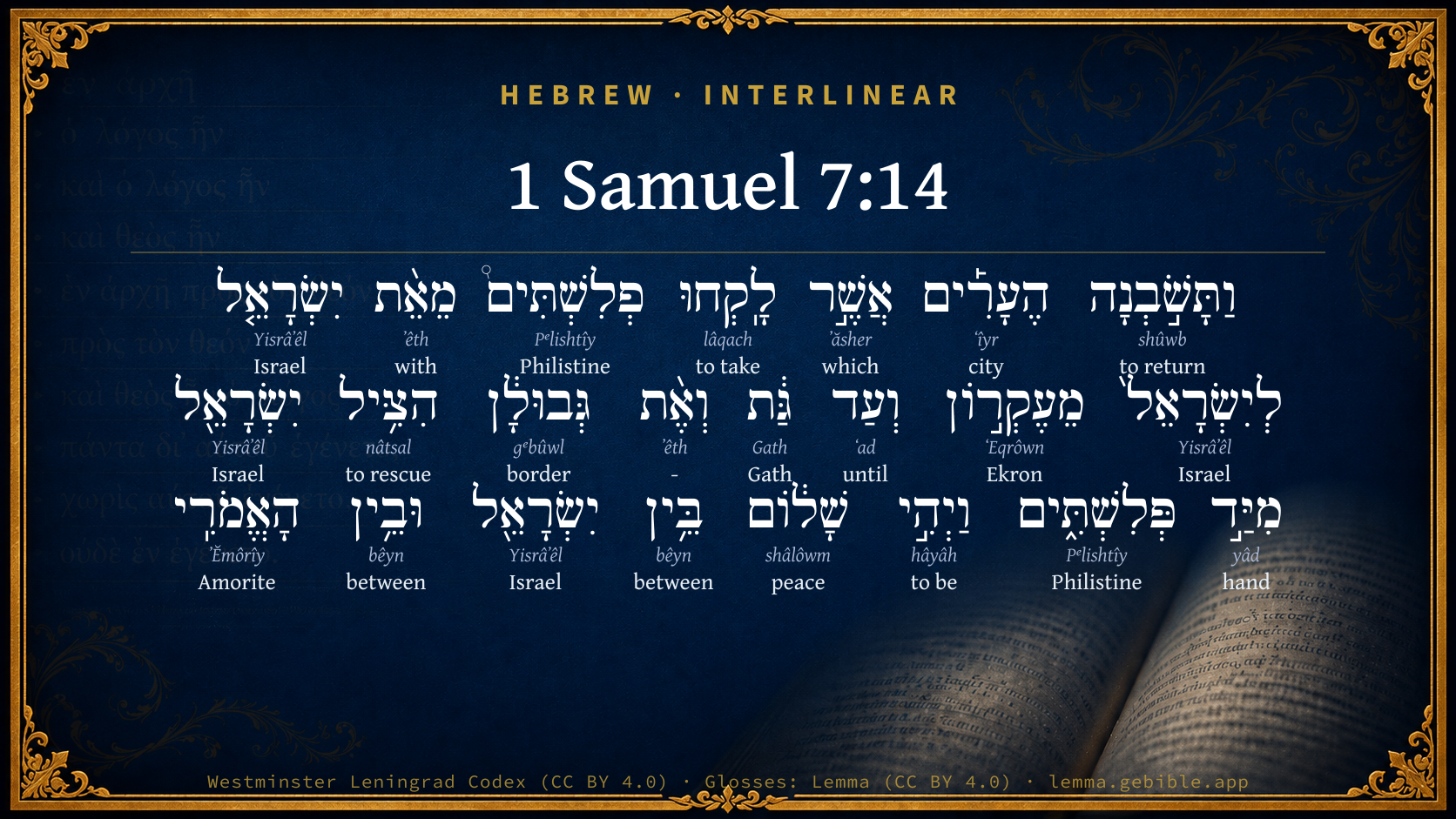
  1. וַתָּשֹׁ֣בְנָה shûwb H7725 “and · to return” Conjunction + Verb, Qal, Sequential Imperfect, 3rd Person, Feminine, Plural
  2. הֶעָרִ֡ים ʻîyr H5892 “the · cities” Particle, Definite Article + Noun, Common, Feminine, Plural, Absolute
  3. אֲשֶׁ֣ר ʼăsher H834 “which” Particle, Relative
  4. לָֽקְחוּ lâqach H3947 “to take” Verb, Qal, Perfect, 3rd Person, Common, Plural
  5. פְלִשְׁתִּים֩ Pᵉlishtîy H6430 “Philistines” Noun, Gentilic, Masculine, Plural, Absolute
  6. מֵאֵ֨ת ʼêth H854 “from · with” Preposition + Preposition
  7. יִשְׂרָאֵ֤ל Yisrâʼêl H3478 “Israel” Noun, Proper
  8. לְיִשְׂרָאֵל֙ Yisrâʼêl H3478 “to/for · Israel” Preposition + Noun, Proper
  9. וְעַד ʻad H5704 “and · until” Conjunction + Preposition
  10. גַּ֔ת Gath H1661 “Gath” Noun, Proper
  11. וְאֶ֨ת ʼêth H853 “and · -” Conjunction + Particle, Direct Object
  12. גְּבוּלָ֔ן gᵉbûwl H1366 “border · their” Noun, Common, Masculine, Singular, Construct + Suffix, Personal, 3rd Person, Feminine, Plural
  13. הִצִּ֥יל nâtsal H5337 “to rescue” Verb, Hiphil, Perfect, 3rd Person, Masculine, Singular
  14. יִשְׂרָאֵ֖ל Yisrâʼêl H3478 “Israel” Noun, Proper
  15. מִיַּ֣ד yâd H3027 “from · hand of” Preposition + Noun, Common, Both, Singular, Construct
  16. פְּלִשְׁתִּ֑ים Pᵉlishtîy H6430 “Philistines” Noun, Gentilic, Masculine, Plural, Absolute
  17. וַיְהִ֣י hâyâh H1961 “and · to be” Conjunction + Verb, Qal, Sequential Imperfect, 3rd Person, Masculine, Singular
  18. שָׁל֔וֹם shâlôwm H7965 “peace” Noun, Common, Masculine, Singular, Absolute
  19. בֵּ֥ין bêyn H996 “between” Preposition
  20. יִשְׂרָאֵ֖ל Yisrâʼêl H3478 “Israel” Noun, Proper
  21. וּבֵ֥ין bêyn H996 “and · between” Conjunction + Preposition
  22. הָאֱמֹרִֽי ʼĔmôrîy H567 “the · Amorite” Particle, Definite Article + Noun, Gentilic, Masculine, Singular, Absolute

About this verse

These counts appear in no published source. They are computed here, from the morphology-tagged text and Lemma’s own curated glosses. What Lemma adds →

23
words
18
distinct lemmas
Historical
section

Notable vocabulary

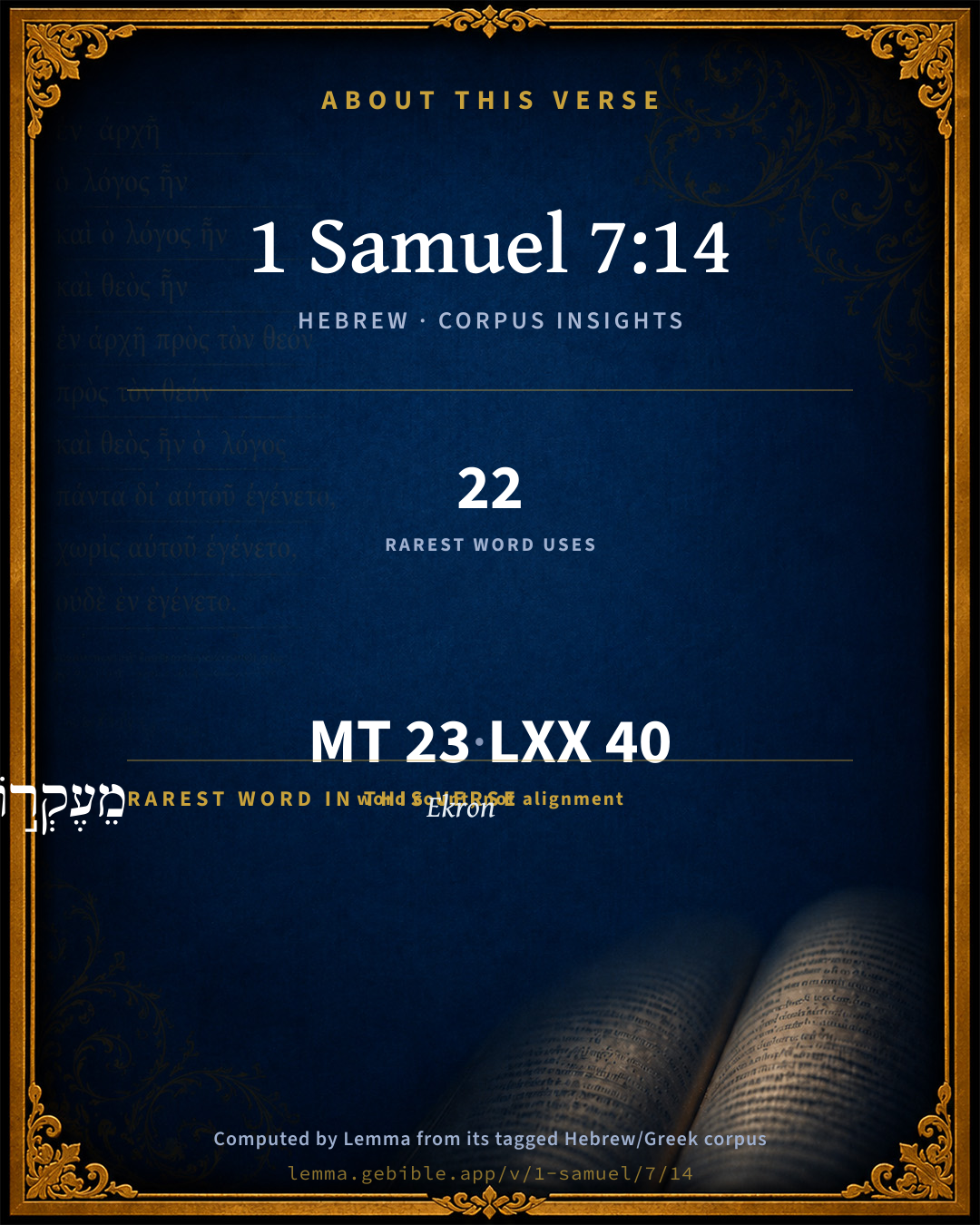
The rarest word here is מֵעֶקְר֣וֹן Ekron H6138 — appearing just 22 times in the whole Hebrew Bible.

Shared distinctive vocabulary

מֵעֶקְר֣וֹן Ekron H6138 occurs in 20 verses of the Hebrew Bible. Also found in:

Grammatical profile

  • 4 verbs
  • 13 nouns
  • 4 prepositions
  • 2 particles

Verb forms

  • וַתָּשֹׁ֣בְנָה Qal · Sequential Imperfect
  • לָֽקְחוּ Qal · Perfect
  • הִצִּ֥יל Hiphil · Perfect
  • וַיְהִ֣י Qal · Sequential Imperfect

Repetition

Words recur within this verse — often emphatic in Hebrew:

  • יִשְׂרָאֵ֤ל Israel H3478 ×4
  • פְלִשְׁתִּים֩ Philistine H6430 ×2
  • בֵּ֥ין between H996 ×2

Hebrew & Septuagint length

In English translation the verse runs 41 words from the Hebrew and 47 from the Septuagint (LXX English) — closely comparable.

A rough comparison of the two English renderings, which tokenize alike — not a word-level alignment.

Word counts can differ between the Hebrew and the Greek without any difference in meaning — e.g. the Hebrew direct-object marker אֵת has no separate Greek word, and Greek often adds the article ὁ.

In the original languages it is 23 Hebrew tokens and 40 Greek tokens — but the two are counted differently (Hebrew bundles its prefixes and suffixes into one token; the Greek is in lemma form), so that isn’t a like-for-like length.

Cross-references

4

Topical passages linked to 1 Samuel 7:14 in the Treasury of Scripture Knowledge — connected by theme and wording, ordered by reader-vote popularity; previews shown in the World English Bible.

  • Psalms 106:34 They didn't destroy the peoples, As Yahweh commanded them,
  • Deuteronomy 7:2 and when Yahweh your God shall deliver them up before you, and you shall strike them; then you shall utterly destroy them: you shall make no covenant with them, nor show mercy to them;
  • Deuteronomy 7:16 You shall consume all the peoples who Yahweh your God shall deliver to you; your eye shall not pity them: neither shall you serve their gods; for that will be a snare to you.
  • Judges 4:17 However Sisera fled away on his feet to the tent of Jael the wife of Heber the Kenite; for there was peace between Jabin the king of Hazor and the house of Heber the Kenite.

Cross-references courtesy of OpenBible.info (CC BY 4.0).

Hebrew and Greek witnesses Masoretic Hebrew ↔ Greek Septuagint

The same verse in the two great witnesses to the Old Testament, shown verse-for-verse.

These are two independent witnesses, not word-aligned to each other, and the Septuagint is shown in lemma (dictionary) form.

Hebrew 1 Samuel 7:14 Masoretic · Westminster Leningrad Codex

וַתָּשֹׁ֣בְנָה הֶעָרִ֡ים אֲשֶׁ֣ר לָֽקְחוּ פְלִשְׁתִּים֩ מֵאֵ֨ת יִשְׂרָאֵ֤ל לְיִשְׂרָאֵל֙ מֵעֶקְר֣וֹן וְעַד גַּ֔ת וְאֶ֨ת גְּבוּלָ֔ן הִצִּ֥יל יִשְׂרָאֵ֖ל מִיַּ֣ד פְּלִשְׁתִּ֑ים וַיְהִ֣י שָׁל֔וֹם בֵּ֥ין יִשְׂרָאֵ֖ל וּבֵ֥ין הָאֱמֹרִֽי

The cities which the Philistines had taken from Israel were restored to Israel, from Ekron even to Gath; and the border of it did Israel deliver out of the hand of the Philistines. There was peace between Israel and the Amorites.

World English Bible · Public Domain

Greek LXX 1 Samuel 7:14 Septuagint · lemma form

καί ἀποδίδωμι ὁ πόλις ὅς λαμβάνω ὁ ἀλλόφυλος παρά ὁ υἱός ἰσραήλ καί ἀποδίδωμι αὐτός ὁ ἰσραήλ ἀπό ἀσκαλών ἕως αζοβ καί ὁ ὅριον ἰσραήλ ἀποαἱρέω ἐκ χείρ ἀλλόφυλος καί εἰμί εἰρήνη ἀνά μέσος ἰσραήλ καί ἀνά μέσος ὁ ἀμορραῖος

And the cities which the Philistines took from the children of Israel were restored; and they restored them to Israel from Ascalon to Azob: and they took the coast of Israel out of the hand of the Philistines; and there was peace between Israel and the Amorite.

LXX2012 (modern English Septuagint) · Public Domain

Hebrew: Westminster Leningrad Codex (CC BY 4.0). Greek: Septuagint (public domain); English from LXX2012 (modern English Septuagint) (Public Domain). How the Septuagint differs from the Hebrew →

Targum (Aramaic paraphrase)

1

The Targum is the ancient Jewish Aramaic paraphrase of the Hebrew Scriptures — an interpretive translation, not the Hebrew text itself. Onkelos (literal) and Pseudo-Jonathan (expansive) render the Torah, and Jonathan the Prophets. Coverage is partial: where no permissively-licensed English translation exists for a verse, only the Aramaic is shown. This is verse-level text, not a word-by-word alignment to the Hebrew.

  1. Targum Jonathan Prophets (Joshua–Malachi)
    וְתָבָא קִירְוַיָא דִנְסִיבוּ פְלִשְׁתָּאֵי מִן יִשְׂרָאֵל לְיִשְׂרָאֵל מֵעֶקְרוֹן וְעַד גַת וְיַת תְּחוּמֵיהוֹן שֵׁיזִיב יִשְׂרָאֵל מִידָא דִפְלִשְׁתָּאֵי וַהֲוָה שְׁלָמָא בֵּין יִשְׂרָאֵל וּבֵין אֱמוֹרָאֵי:

    (no public-domain English translation for this verse)

    Targum Jonathan — Aramaic: “Mikraot Gedolot” (public domain). English: “Sefaria Community Translation” (CC0 1.0 (public-domain dedication)); “London "Chaldee Paraphrase," 1871” (public domain). Text via Sefaria.

Commentary

Notes on 1 Samuel 7:14 from classic Christian and Jewish commentators (each source and its license shown beneath its notes). The classic Christian expositions comment on the surrounding passage and are grouped to its opening verse, so a note may address several verses; the Jewish commentaries on the Tanakh (Rashi and others) are per-verse, so they appear only where the commentator wrote on this verse.

Lemma curates 59 commentaries, every one of them public domain or Creative Commons licensed, each selected and text-cleaned for this edition rather than reprinted as found. About our sources →

Trapp's Complete Commentary

John Trapp

1Sa 7:14 And the cities which the Philistines had taken from Israel were restored to Israel, from Ekron even unto Gath; and the coasts thereof did Israel deliver out of the hands of the Philistines. And there was peace between Israel and the Amorites.

Ver. 14. And the cities.] So crest fallen were the Philistines after their recent overthrow. Nemo confidat nimium secundis. Let no one be excessively confident the second time.

Between Israel and the Amorites.] The Philistines and the rest.

John Trapp, A Commentary or Exposition upon All the Books of the Old and New Testament (1647–1656) — public domain. Text from a community e-Sword module.

Joseph Benson's Commentary

1Sa 7:14. There was peace — An agreement for the cessation of all acts of hostility. Between Israel and the Amorites — That is, the Canaanites, often called Amorites, because these were formerly the most valiant of all those nations, and the first enemies which the Israelites met with, when they went to take possession of their land. They made this peace with the Canaanites, that they might be more at leisure to oppose the Philistines, now their most potent enemies.

Joseph Benson's Commentary on the Old and New Testaments (1811–1818) — public domain. Text from a community e-Sword module.

Tyndale Open Study Notes

Tyndale Open Resources

7:14 The Amorites had inhabited Canaan and the region east of the Jordan before Israel’s conquest of the Promised Land (see Gen 15:16; Deut 3:8; Josh 2:10). Some Amorites remained in the area after the conquest (see 2 Sam 21:2).

Tyndale Open Study Notes — © Tyndale Open Resources, licensed CC BY-SA 4.0. Text via the HelloAO Bible API.

Geneva Bible (1599)

Geneva Bible translators

Meaning, the Philistines.

Geneva Bible (1599) marginal notes — public domain. Text via Bolls.life.

Adam Clarke's Commentary

Verse 14. The cities which the Philistines had taken] We are not informed of the particulars of these reprisals, but we may rest assured all this was not done in one day: perhaps the retaking of the cities was by slow degrees, through the space of several years.

There was peace between Israel and the Amorites.] That is, all the remaining Canaanites kept quiet, and did not attempt to molest the Israelites, when they found the Philistines, the most powerful of the ancient inhabitants of the land, broken and subdued before them.

Adam Clarke's Commentary on the Bible (1810–1826) — public domain. Text from a community e-Sword/MySword module.

Ellicott's Commentary for English Readers

(14) The cities.—The immediate result of Samuel’s great victory at Eben-ezer, and the renovated national spirit of the people, was their recovery of the towns and villages which during the late disastrous period had fallen into the Philistines’ hands.

From Ekron even unto Gath.—It is doubtful whether these words signify that at this period these famous Philistine cities fell into the hands of Samuel. This expression more probably indicates on the Philistine side the direction and limits of the space in which the Israelites recovered their lost territory.

The Amorites.—The Amorites here, as representing the most powerful of the old Canaanite tribes, are especially mentioned. This note respecting them tells us that in these glorious days of the restoration of Israel under Samuel, not only were the Philistines of the coast kept in check and gradually subdued, but that the Canaanite tribes of the interior of the land submitted quietly to the old conditions imposed by Joshua at the time of the conquest.

A Bible Commentary for English Readers, edited by Charles John Ellicott (1878–1897) — public domain. Text from a community e-Sword module.

The Cambridge Bible for Schools and Colleges

gen. ed. J. J. S. Perowne

14. from Ekron even unto Gath] The towns which lay on the Danite frontier between these places were restored to Israel, not however including Ekron and Gath themselves. There is no evidence that Gath had ever been occupied by the Israelites, and Ekron was only held for a short time (Jdg_1:18).

the coasts thereof] The territory belonging to these frontier towns. The Sept. reads “the border of Israel.”

there was peace between Israel and the Amorites] The Amorites are mentioned as the most powerful enemies of Israel next to the Philistines. “Amorite” is probably a local not a tribal name, meaning “highlander,” contrasted with “Canaanite,” which means “lowlander.” On the W. of Jordan they lived chiefly in the mountainous country of Judah and Ephraim (Num_13:29; Jos_10:5): E. of Jordan they occupied the high plateau of rich pasture-land between the Jabbok and the Arnon, from which they had expelled the Moabites (Num_21:13; Num_21:26), and were in their turn dispossessed by the Israelites.

In the Egyptian inscriptions the Amorites give their name to the whole country of Canaan, and in several passages of the O.T. the name appears to be used loosely of the original inhabitants in general. Possibly this is the case here.

The Cambridge Bible for Schools and Colleges (gen. ed. J. J. S. Perowne; Cambridge University Press, 1878–1918) — public domain. Text from a community e-Sword module.

John Gill's Exposition

And the cities which the Philistines had taken from Israel were restored to Israel,.... We nowhere read that the Israelites went out to war with them, and took these cities from them by besieging and assaulting them; but they made a demand of them after the above victory obtained, by which the Philistines were so intimidated, that they quietly surrendered them to them:

from Ekron even unto Gath, and the coasts thereof, did Israel deliver out of the hands of the Philistines; not by dint of sword, but by demand, to which they submitted; and though Ekron, if not Gath, fell to the tribe of Judah by lot, yet were never in their possession; and so are to be understood exclusively here, that not they, but the cities and towns that lay between them and the coasts thereof, which the Philistines had seized upon, these they were obliged to deliver up again to Israel; and if Ekron and Gath were delivered, they were not long held by them, for we soon read of them as in the hands of others:

and there was peace between Israel and the Amorites; who were a principal nation of the Canaanites, and are put for the whole of them that remained; and so Josephus (p) calls them the remnant of the Canaanites; these, finding the Philistines were subdued, were quiet and peaceable, and gave Israel no more trouble.

(p) Ut supra. (Antiqu. l. 6. c. 2. sect. 2.)

John Gill's Exposition of the Whole Bible (1746–1763) — public domain (CC PDM 1.0). Text via the HelloAO Bible API.

Albert Barnes' Notes on the Bible

This shows the vigour and success of Samuel’s government. He seems not only to have expelled the Philistines from the interior of the Israelite country, but to have attacked them in their own land, and taken from them the cities, with the adjacent territory, which properly belonged to Israel, but which the Philistines had taken possession of. In this war the Amorites, finding the Philistines worse masters than the Israelites, made common cause with Samuel, and assisted the Israelites in their wars against the Philistines.

Albert Barnes' Notes on the Bible (1834–1885) — public domain. Text from a community e-Sword/MySword module.

Haydock's Catholic Bible Commentary

Geth, which two cities still continued in their possession. Others, which had fallen to the share of Dan, they gave up, which explains Judges xviii. 1, 31. --- Philistines. Here ended the forty years’ servitude. (Calmet) --- Salien (the year of the world 2860) rather thinks that it terminated in the death of Samson, when it was judged expedient to entrust the reins of government into the hands of an ole man, Heli, the high priest, as there was no need of an expert general, the heads of the Philistines being all destroyed, Judges xiii. 1. (Haydock) --- Amorrhites: the dispersed nations of Chanaan were all dept under. (Calmet)

George Leo Haydock (1774–1849), Haydock's Catholic Family Bible and Commentary, 1859 edition — public domain. Excludes Psalms (Douay-Rheims chapter numbering differs from Protestant) and Deuterocanonical books (Catholic canon only).

Matthew Poole's English Annotations

The cities were restored to Israel by the Philistines, who, it seems, were frightened into this restitution by their dread of Samuel, and of the Divine vengeance.

Object. The Philistines had cities and garrisons in Israel’s land after this time; as 1Sa 10:5; 13:3. Answ. Either therefore those places were not any of these here mentioned; for it is not said that all their cities were restored, but only indefinitely the cities, and those limited to a certain compass, from

Ekron to Gath; or some of the cities now restored by the Philistines, were afterwards retaken by them.

There was peace; an agreement for the cessation of all acts of hostility.

The Amorites, i.e. the Canaanites, oft called Amorites, because these were formerly the most valiant and terrible of all those nations, and the first enemies which the Israelites met with, when they went to take possession of their land. They made this peace with the Canaanites, that they might be more at leisure to oppose the Philistines, now their most potent enemies.

Matthew Poole's English Annotations on the Holy Bible (1683–1685) — public domain. Text from a community e-Sword/MySword module.

Whedon's Commentary on the Bible

Daniel D. Whedon

14. From Ekron even unto Gath — That is, all the cities within a supposed boundary line running from one of these places to the other, but not including these places themselves, for it nowhere appears that Ekron and Gath had ever hitherto been in possession of the Israelites.

Peace between Israel and the Amorites — This signal fact is mentioned because the Amorites were the most powerful of the Canaanitish nations, and therefore the historical importance of such a peace between them and Israel. Some expositors understand that the word Amorites here designates all the Canaanitish nations besides the Philistines. They were overawed by the great victory of Israel, and thought it wise to make peace with them.

Daniel D. Whedon (gen. ed.), Commentary on the Old and New Testaments (1874–1909) — public domain. Text from a community e-Sword module.

The Pulpit Commentary

From Ekron even unto Gath. Not that Israel captured these two towns, but they mark the limits upon the borders, within which the Philistines had previously seized towns and villages belonging to Israel, and which Samuel now recovered. There was peace between Israel and the Amorites. In Israel"s weakness the remains of this once powerful Canaanitish stock had probably made many a marauding expedition into the land, and carried off cattle and other plunder; now they sue for peace, and unite with Israel against the Philistines.

The Pulpit Commentary (1880–1919), ed. H.D.M. Spence-Jones & Joseph S. Exell — public domain. Text from a community e-Sword module.

John Wesley's Explanatory Notes

Peace - An agreement for the cessation of all acts of hostility. Amorites - That is, the Canaanites, often called Amorites, because these were formerly the most valiant of all those nations, and the first Enemies which the Israelites met with, when they went to take possession of their land. They made this peace with the Canaanites, that they might he more at leisure to oppose the Philistines, now their most potent enemies.

John Wesley, Explanatory Notes Upon the Whole Bible (1754–1765) — public domain. Text via the GEBible commentary corpus.

Lesson kit

Teaching starters — assembled from the data on this page, not authored interpretation. Every prompt links to the verse data it draws on. Edit before teaching.

1 Samuel, in the Historical, opens this verse with 23 words (18 distinct Hebrew lemmas). Its most distinctive word is ʻEqrôwn (“Ekron”). A historical commentator’s framing appears above. Read the whole chapter for the surrounding context.

Discussion questions

  1. The word ʻEqrôwn carries the sense “Ekron.” How does it shape the verse?
  2. Joshua 13:3 shares the word «Ekron» with this verse. How do the two illuminate each other?
  3. “Israel” occurs 4× in this one verse. What is the effect of the repetition?
  4. These translations render this verse differently; the difference is in the English rendering, not the original. What questions does that raise?
  5. The verb «וַתָּשֹׁ֣בְנָה» is Qal Sequential Imperfect. How does its form color the action?
  6. Reading how Trapp's Complete Commentary and Joseph Benson's Commentary read this verse, where do the two commentators agree and where do they part?

Things to notice

Reading settings

Reading text

Shown beneath each verse's original-language words.

Old Testament
Old Testament edition

Read the OT as the Masoretic Hebrew (MT) or the Greek Septuagint (LXX).

English shown for the Greek Septuagint (in the Hebrew ↔ Greek comparison).

Comparing translations? Open the Compare panel on any verse page to stack up to four side by side.