
Lamentations 1:17

Hebrew (Westminster Leningrad Codex) Lamentations 1:17 appears in the Hebrew Old Testament. The text above is from the Westminster Leningrad Codex. Each word links to its Strong’s number, a concise gloss, and parsing drawn from the Open Scriptures Hebrew Bible morphology. Click any word for its full Brown-Driver-Briggs (BDB) entry.
Download image
Cite this verse

Lamentations 1:17 (World English Bible). Public Domain. Lemma interlinear Bible study tool, https://lemma.gebible.app/v/lamentations/1/17.

Show BibTeX & RIS
BibTeX
RIS
English Translation
Zion spreads forth her hands; there is none to comfort her; Yahweh has commanded concerning Jacob, that those who are round about him should be his adversaries: Jerusalem is among them as an unclean thing.
World English Bible · Public Domain
Download a study sheet

One document with this verse’s original text, its word-by-word gloss line, the meaning frame, cross-references with their text, attributed commentary, and full source and license credits — printable, and it pastes into notes with its structure intact.

This verse Autodidact and up

Study sheet (.html) Plain text (.txt)

A passage Seminary Student

Up to 50 verses in one chapter. A passage sheet keeps up to 6 commentary sources and 12 cross-references per verse, in the order this page ranks them, and says so on the sheet whenever that leaves anything out. Ask for a single verse and you get the Autodidact verse sheet above.

Everything on this page stays free to read, with no account — the sheet is a download of what is already on screen, not access to it.

Want to remove ads? Support Godless Engineer
Compare translations 3

The same verse in 3 English versions, stacked beneath the original-language interlinear above. Click any original word for its lexicon entry.

Each is an independent rendering of the whole verse — the interlinear is not word-aligned to these translations.

Highlighted words mark where these versions differ — a whole-verse word diff, not a word-by-word alignment.

  • World English Bible Public Domain
    Zion spreads forth her hands; there is none to comfort her; Yahweh has commanded concerning Jacob, that those who are round about him should be his adversaries: Jerusalem is among them as an unclean thing.
  • King James Version Public Domain
    Zion spreadeth forth her hands, and there is none to comfort her: the LORD hath commanded concerning Jacob, that his adversaries should be round about him: Jerusalem is as a menstruous woman among them.
  • unfoldingWord Literal Text CC BY-SA 4.0
    Zion has spread out her hands; there is no comforter for her. Yahweh has commanded against Jacob that his adversaries be around him. Jerusalem has become an abhorrence among them. TSADHE

unfoldingWord Literal Text — © unfoldingWord, licensed CC BY-SA 4.0. Word-aligned USFM3 via Door43 (git.door43.org/unfoldingWord/en_ult).

Versions to compare (up to 4)

3 of 4 selected

Show all 18 translations

Every available English version of this verse, each an independent rendering of the whole verse.

  • World English Bible Public Domain
    Zion spreads forth her hands; there is none to comfort her; Yahweh has commanded concerning Jacob, that those who are round about him should be his adversaries: Jerusalem is among them as an unclean thing.
  • Berean Standard Bible Public Domain
    Zion stretches out her hands, but there is no one to comfort her. The LORD has decreed against Jacob that his neighbors become his foes. Jerusalem has become an unclean thing among them.
  • Majority Standard Bible Public Domain
    Zion stretches out her hands, but there is no one to comfort her. The LORD has decreed against Jacob that his neighbors become his foes. Jerusalem has become an unclean thing among them.
  • King James Version Public Domain
    Zion spreadeth forth her hands, and there is none to comfort her: the LORD hath commanded concerning Jacob, that his adversaries should be round about him: Jerusalem is as a menstruous woman among them.
  • American Standard Version (1901) Public Domain
    Zion spreadeth forth her hands; there is none to comfort her; Jehovah hath commanded concerning Jacob, that they that are round about him should be his adversaries: Jerusalem is among them as an unclean thing.
  • Revised Version (1885) Public Domain
    Zion spreadeth forth her hands; there is none to comfort her; the LORD hath commanded concerning Jacob, that they that are round about him should be his adversaries: Jerusalem is among them as an unclean thing.
  • Geneva Bible (1599) Public Domain
    Zion stretcheth out her handes, and there is none to comfort her: the Lord hath appoynted the enemies of Iaakob rounde about him: Ierusalem is as a menstruous woman in the middes of them.
  • Douay-Rheims (1899) Public Domain
    Phe. Sion hath spread forth her hands, there is none to comfort her: the Lord hath commanded against Jacob, his enemies are round about him: Jerusalem is as a menstruous woman among them.
  • Young's Literal Translation Public Domain
    Spread forth hath Zion her hands, There is no comforter for her, Jehovah hath charged concerning Jacob, His neighbours `are' his adversaries, Jerusalem hath become impure among them.
  • Literal Standard Version CC BY-SA 4.0
    Zion has spread forth her hands, || There is no comforter for her, || YHWH has charged concerning Jacob, || His neighbors [are] his adversaries, || Jerusalem has become impure among them.
  • Unlocked Literal Bible CC BY-SA 4.0
    Zion has spread her hands wide; there is none to comfort her. Yahweh has commanded that those around Jacob should be his adversaries. Jerusalem is something unclean to them.
  • unfoldingWord Literal Text CC BY-SA 4.0
    Zion has spread out her hands; there is no comforter for her. Yahweh has commanded against Jacob that his adversaries be around him. Jerusalem has become an abhorrence among them. TSADHE
  • Darby Bible Public Domain
    Zion spreadeth forth her hands; there is none to comfort her; Jehovah hath commanded concerning Jacob, [that] his adversaries [should be] round about him; Jerusalem is as an impurity among them.
  • World Messianic Bible Public Domain
    Zion spreads out her hands. There is no one to comfort her. The LORD has commanded concerning Jacob, that those who are around him should be his adversaries. Jerusalem is among them as an unclean thing.
  • Webster's Bible Public Domain
    Zion spreadeth forth her hands, and there is none to comfort her: the LORD hath commanded concerning Jacob, that his adversaries should be around him: Jerusalem is as a menstruous woman among them.
  • Free Bible Version CC BY-SA 4.0
    Zion holds out her hands in distress, but there's no one to comfort her. The Lord issued orders against Jacob, and his neighbors became his enemies. Jerusalem is to them something disgusting.
  • Bible in Basic English Public Domain
    Zion's hands are outstretched; she has no comforter; the Lord has given orders to the attackers of Jacob round about him: Jerusalem has become like an unclean thing among them.
  • JPS Tanakh (1917) Public Domain
    Zion spreadeth forth her hands; there is none to comfort her; the LORD hath commanded concerning Jacob, that they that are round about him should be his adversaries; Jerusalem is among them as one unclean.

Literal Standard Version (2020), Covenant Press — licensed CC BY-SA 4.0. Text via the HelloAO Bible API (eBible.org). Unlocked Literal Bible (unfoldingWord) — licensed CC BY-SA 4.0. Text via the HelloAO Bible API (eBible.org). unfoldingWord Literal Text — © unfoldingWord, licensed CC BY-SA 4.0. Word-aligned USFM3 via Door43 (git.door43.org/unfoldingWord/en_ult). Free Bible Version, Dr. Jonathan Gallagher — licensed CC BY-SA 4.0. Text via the HelloAO Bible API (eBible.org).

Word by word

More ways to search: Search by grammar → Find every occurrence → Compare this word →

Practice this passage: Drill this verse → Learn its vocabulary →

לְנִדָּ֖ה
niddâh
H5079
“to/for · impurity”
Preposition + Noun, Common, Feminine, Singular, Absolute
Part of Speech
Preposition + Noun
Type
Common
Gender
Feminine
Number
Singular
State
Absolute
Full BDB Definition

Origin: from H5074

TWOT: 1302a

impurity, filthiness, menstruous, set apart - impurity - of ceremonial impurity - of menstruation - impure thing (figuratively) - of idolatry, immorality
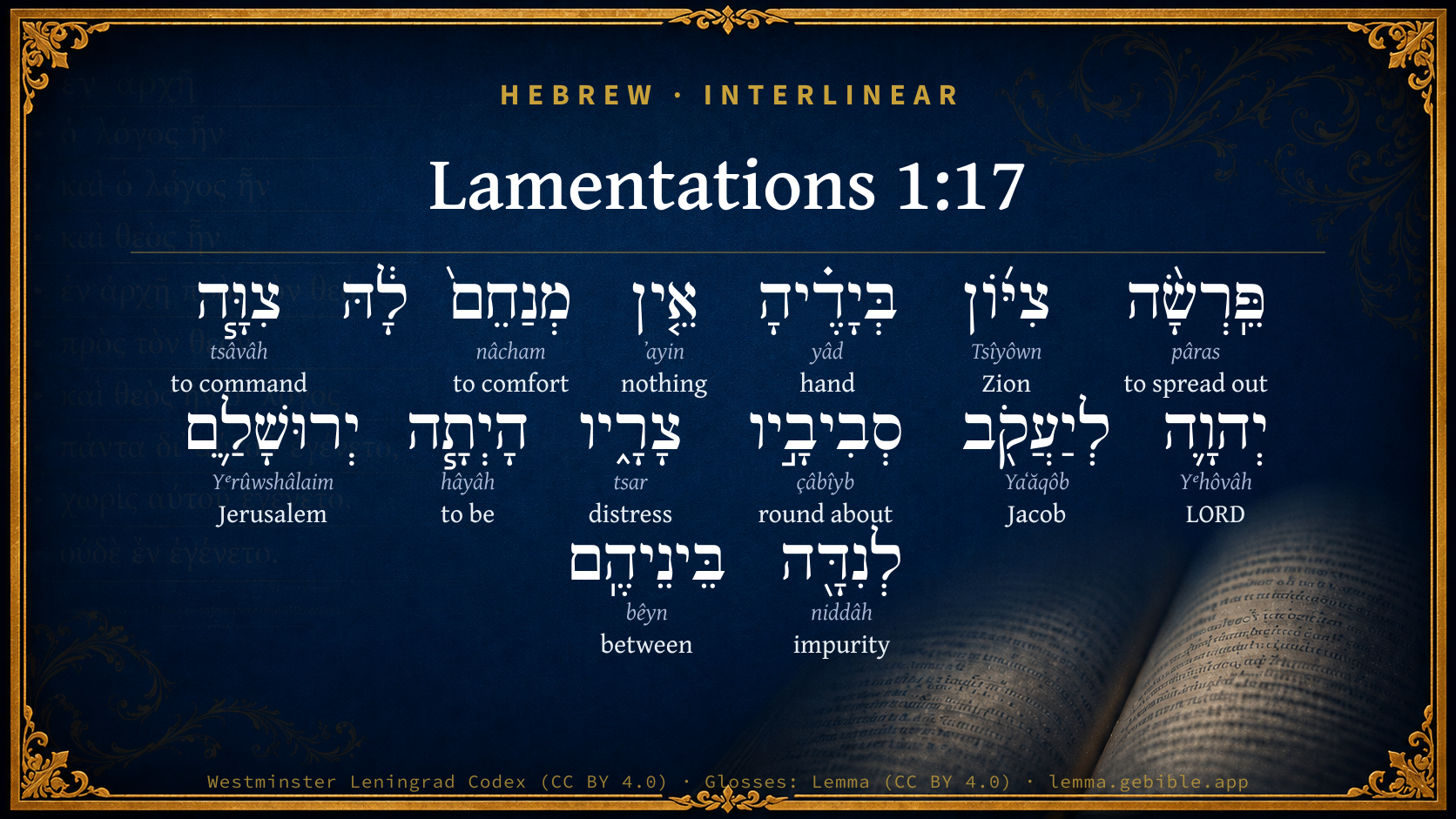
  1. פֵּֽרְשָׂ֨ה pâras H6566 “to spread out” Verb, Piel, Perfect, 3rd Person, Feminine, Singular
  2. צִיּ֜וֹן Tsîyôwn H6726 “Zion” Noun, Proper
  3. בְּיָדֶ֗יהָ yâd H3027 “in/at · hands · her” Preposition + Noun, Common, Both, Dual, Construct + Suffix, Personal, 3rd Person, Feminine, Singular
  4. אֵ֤ין ʼayin H369 “nothing” Particle, Negative
  5. מְנַחֵם֙ nâcham H5162 “comforting” Verb, Piel, Participle Active, Masculine, Singular, Absolute
  6. צִוָּ֧ה tsâvâh H6680 “to command” Verb, Piel, Perfect, 3rd Person, Masculine, Singular
  7. יְהוָ֛ה Yᵉhôvâh H3068 “LORD” Noun, Proper
  8. לְיַעֲקֹ֖ב Yaʻăqôb H3290 “to/for · Jacob” Preposition + Noun, Proper
  9. סְבִיבָ֣יו çâbîyb H5439 “surroundings · his” Noun, Common, Both, Plural, Construct + Suffix, Personal, 3rd Person, Masculine, Singular
  10. צָרָ֑יו tsar H6862 “distresses · his” Noun, Common, Masculine, Plural, Construct + Suffix, Personal, 3rd Person, Masculine, Singular
  11. הָיְתָ֧ה hâyâh H1961 “to be” Verb, Qal, Perfect, 3rd Person, Feminine, Singular
  12. יְרוּשָׁלִַ֛ם Yᵉrûwshâlaim H3389 “Jerusalem” Noun, Proper
  13. בֵּינֵיהֶֽם bêyn H996 “between · them” Preposition + Suffix, Personal, 3rd Person, Masculine, Plural

About this verse

These counts appear in no published source. They are computed here, from the morphology-tagged text and Lemma’s own curated glosses. What Lemma adds →

15
words
14
distinct lemmas
Prophets
section

Shared distinctive vocabulary

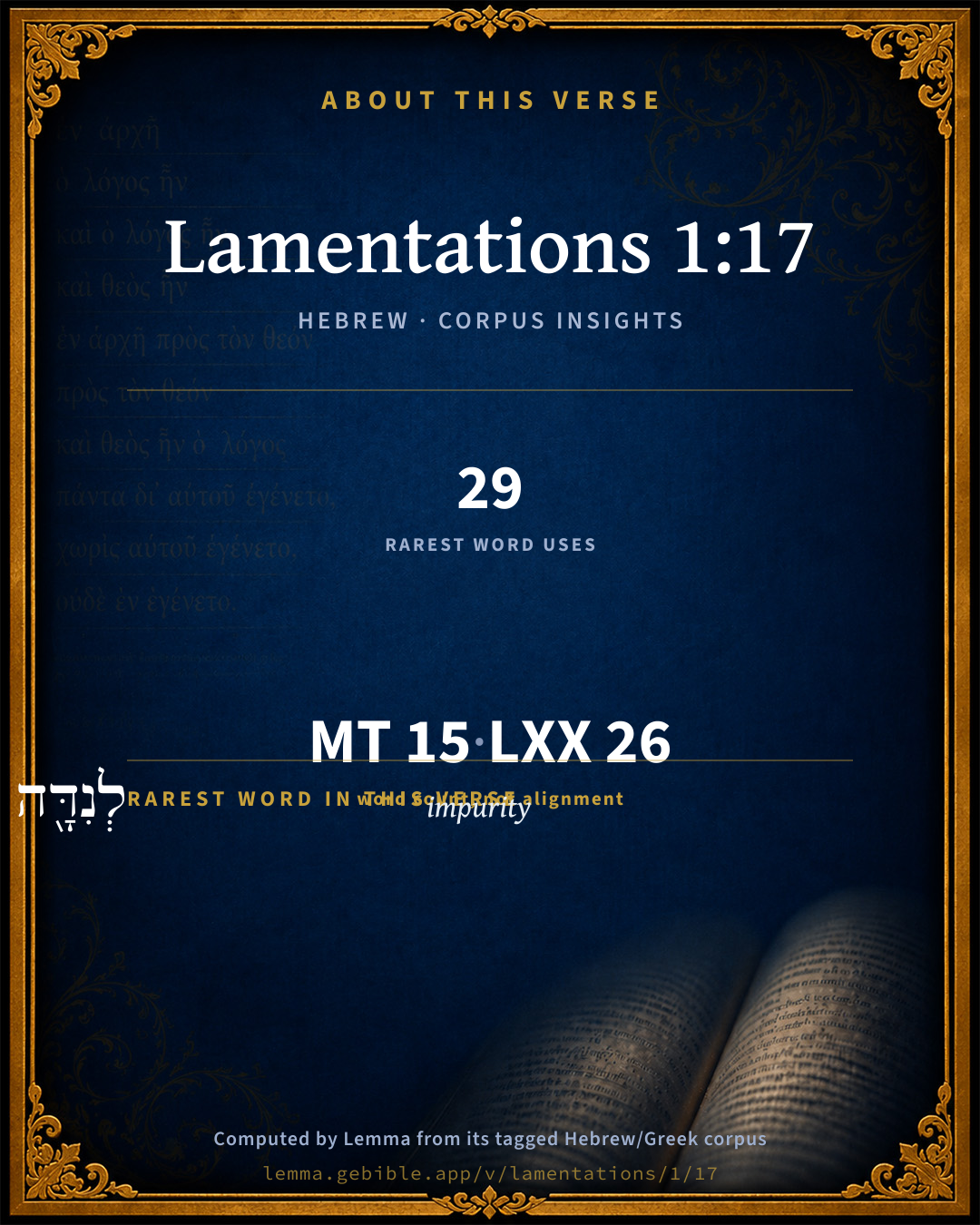
לְנִדָּ֖ה impurity H5079 occurs in 24 verses of the Hebrew Bible. Also found in:

Grammatical profile

  • 4 verbs
  • 8 nouns
  • 2 prepositions
  • 1 particle

Verb forms

  • פֵּֽרְשָׂ֨ה Piel · Perfect
  • מְנַחֵם֙ Piel · Participle Active
  • צִוָּ֧ה Piel · Perfect
  • הָיְתָ֧ה Qal · Perfect

Hebrew & Septuagint length

In English translation the verse runs 35 words from the Hebrew and 35 from the Septuagint (LXX English) — the same length.

A rough comparison of the two English renderings, which tokenize alike — not a word-level alignment.

Word counts can differ between the Hebrew and the Greek without any difference in meaning — e.g. the Hebrew direct-object marker אֵת has no separate Greek word, and Greek often adds the article ὁ.

In the original languages it is 15 Hebrew tokens and 26 Greek tokens — but the two are counted differently (Hebrew bundles its prefixes and suffixes into one token; the Greek is in lemma form), so that isn’t a like-for-like length.

Cross-references

23

Topical passages linked to Lamentations 1:17 in the Treasury of Scripture Knowledge — connected by theme and wording, ordered by reader-vote popularity; previews shown in the World English Bible.

  • Jeremiah 4:31 For I have heard a voice as of a woman in travail, the anguish as of her who brings forth her first child, the voice of the daughter of Zion, who gasps for breath, who spreads her hands, [saying], Woe is me now! for my soul faints before the murderers.
  • Isaiah 1:15 When you spread forth your hands, I will hide my eyes from you; Yes, when you make many prayers, I will not hear. Your hands are full of blood.
  • Lamentations 1:9 Her filthiness was in her skirts; she didn't remember her latter end; Therefore is she come down wonderfully; she has no comforter: See, Yahweh, my affliction; for the enemy has magnified himself.
  • 2 Kings 24:2–4 Yahweh sent against him bands of the Chaldeans, and bands of the Syrians, and bands of the Moabites, and bands of the children of Ammon, and sent them against Judah to destroy it, according to the word of Yahweh, which he spoke by his servants the prophets.
  • 2 Kings 25:1 It happened in the ninth year of his reign, in the tenth month, in the tenth day of the month, that Nebuchadnezzar king of Babylon came, he and all his army, against Jerusalem, and encamped against it; and they built forts against it round about.
  • Jeremiah 21:4–5 Thus says Yahweh, the God of Israel, Behold, I will turn back the weapons of war that are in your hands, with which you fight against the king of Babylon, and against the Chaldeans who besiege you, without the walls; and I will gather them into the midst of this city.
  • Jeremiah 34:22 Behold, I will command, says Yahweh, and cause them to return to this city; and they shall fight against it, and take it, and burn it with fire: and I will make the cities of Judah a desolation, without inhabitant.
  • Lamentations 1:16 For these things I weep; my eye, my eye runs down with water; Because the comforter who should refresh my soul is far from me: My children are desolate, because the enemy has prevailed.
  • Lamentations 1:19 I called for my lovers, [but] they deceived me: My priests and my elders gave up the spirit in the city, While they sought them food to refresh their souls.
  • Leviticus 15:19–27 "'If a woman has a discharge, and her discharge in her flesh is blood, she shall be in her impurity seven days: and whoever touches her shall be unclean until the evening.
  • 1 Kings 8:22 Solomon stood before the altar of Yahweh in the presence of all the assembly of Israel, and spread forth his hands toward heaven;
  • 1 Kings 8:38 whatever prayer and supplication be made by any man, [or] by all your people Israel, who shall know every man the plague of his own heart, and spread forth his hands toward this house:
  • Jeremiah 6:3 Shepherds with their flocks shall come to her; they shall pitch their tents against her round about; they shall feed everyone in his place.
  • Jeremiah 16:6 Both great and small shall die in this land; they shall not be buried, neither shall men lament for them, nor cut themselves, nor make themselves bald for them;
  • Lamentations 1:2 She weeps sore in the night, and her tears are on her cheeks; Among all her lovers she has none to comfort her: All her friends have dealt treacherously with her; they are become her enemies.
  • Lamentations 1:21 They have heard that I sigh; there is none to comfort me; All my enemies have heard of my trouble; they are glad that you have done it: You will bring the day that you have proclaimed, and they shall be like me.
  • Lamentations 2:1–8 How has the Lord covered the daughter of Zion with a cloud in his anger! He has cast down from heaven to the earth the beauty of Israel, And hasn't remembered his footstool in the day of his anger.
  • Lamentations 2:17–22 Yahweh has done that which he purposed; he has fulfilled his word that he commanded in the days of old; He has thrown down, and has not pitied: He has caused the enemy to rejoice over you; he has exalted the horn of your adversaries.
  • Lamentations 4:15 Depart you, they cried to them, Unclean! depart, depart, don't touch! When they fled away and wandered, men said among the nations, They shall no more sojourn [here].
  • Ezekiel 7:23–24 Make the chain; for the land is full of bloody crimes, and the city is full of violence.
  • Ezekiel 36:17 Son of man, when the house of Israel lived in their own land, they defiled it by their way and by their doings: their way before me was as the uncleanness of a woman in her impurity.
  • Hosea 8:8 Israel is swallowed up. Now they are among the nations like a worthless thing.
  • Luke 19:43–44 For the days will come on you, when your enemies will throw up a barricade against you, surround you, hem you in on every side,

Cross-references courtesy of OpenBible.info (CC BY 4.0).

Hebrew and Greek witnesses Masoretic Hebrew ↔ Greek Septuagint

The same verse in the two great witnesses to the Old Testament, shown verse-for-verse.

These are two independent witnesses, not word-aligned to each other, and the Septuagint is shown in lemma (dictionary) form.

Hebrew Lamentations 1:17 Masoretic · Westminster Leningrad Codex

פֵּֽרְשָׂ֨ה צִיּ֜וֹן בְּיָדֶ֗יהָ אֵ֤ין מְנַחֵם֙ לָ֔הּ צִוָּ֧ה יְהוָ֛ה לְיַעֲקֹ֖ב סְבִיבָ֣יו צָרָ֑יו הָיְתָ֧ה יְרוּשָׁלִַ֛ם לְנִדָּ֖ה בֵּינֵיהֶֽם

Zion spreads forth her hands; there is none to comfort her; Yahweh has commanded concerning Jacob, that those who are round about him should be his adversaries: Jerusalem is among them as an unclean thing.

World English Bible · Public Domain

Greek LXX Lamentations 1:17 Septuagint · lemma form

διαπετάζω σιων χείρ αὐτός οὐ εἰμί ὁ παρακαλέω αὐτός ἐντέλλομαι κύριος ὁ ἰακώβ κύκλος αὐτός ὁ θλίβω αὐτός γίγνομαι ἰερουσαλήμ εἰς ἀπο καταἧμαι ἀνά μέσος αὐτός

PHE. Sion has spread out her hand, and there is none to comfort her: the Lord has commanded concerning Jacob, his oppressors are round about him: Jerusalem has become among them as a removed woman.

LXX2012 (modern English Septuagint) · Public Domain

Hebrew: Westminster Leningrad Codex (CC BY 4.0). Greek: Septuagint (public domain); English from LXX2012 (modern English Septuagint) (Public Domain). How the Septuagint differs from the Hebrew →

Commentary

Notes on Lamentations 1:17 from classic Christian and Jewish commentators (each source and its license shown beneath its notes). The classic Christian expositions comment on the surrounding passage and are grouped to its opening verse, so a note may address several verses; the Jewish commentaries on the Tanakh (Rashi and others) are per-verse, so they appear only where the commentator wrote on this verse.

Lemma curates 59 commentaries, every one of them public domain or Creative Commons licensed, each selected and text-cleaned for this edition rather than reprinted as found. About our sources →

Trapp's Complete Commentary

John Trapp

Lam 1:17 Zion spreadeth forth her hands, [and there is] none to comfort her: the LORD hath commanded concerning Jacob, [that] his adversaries [should be] round about him: Jerusalem is as a menstruous woman among them.

Ver. 17. Zion spreadeth forth her hands.] But to whom? To God? She should have done it sooner - namely, while he stretched out his hands to her all the day long. To the Babylonian? At barbarus nil nisi iras spirat, but his tender mercies are mere cruelties. God will not take the wicked by the hand, saith Bildad; {Job 8:20} men may not, whenas God will not. No better course can be taken in this case than that prescribed, Lam 3:40-41; then God will repent, and men shall relent, toward a distressed creature.

And there is none to comfort her.] See Lam 1:16. This is oft complained of as a most heavy affliction.

The Lord hath commanded.] What marvel, then, that their hearts were so set off from him, Who had been so careless of keeping God’s commands?

Jerusalem is as a menstruous woman among them.] Or, As an abomination, tanquam quisquiliae, vel tanquam foetidae aliquae sordes. God’s people are more shamefully slighted and reproached in the world than any else, and the godliest most of all.

John Trapp, A Commentary or Exposition upon All the Books of the Old and New Testament (1647–1656) — public domain. Text from a community e-Sword module.

Joseph Benson's Commentary

Lam 1:17. Zion spreadeth forth her hands — She extendeth her hands as a suppliant praying for relief and consolation. And there is none to comfort her — None who can, or are even inclined to do it. The Lord hath commanded, &c. — That is, it came to pass by God’s command, that the surrounding nations were the adversaries of Jacob. We meet with a similar form of expression Psa 68:11, The Lord gave the word, great was the company of those that published it. Jerusalem is as a menstruous woman — She is become loathsome and filthy in the eyes of her former friends, like women separated from the congregation in the time of their legal uncleanness.

Joseph Benson's Commentary on the Old and New Testaments (1811–1818) — public domain. Text from a community e-Sword module.

Geneva Bible (1599)

Geneva Bible translators

Which because of her pollution was separate from her husband, Lev. 15:19, and was abhorred for the time.

Geneva Bible (1599) marginal notes — public domain. Text via Bolls.life.

Jamieson, Fausset & Brown

Robert Jamieson, A. R. Fausset & David Brown

Like a woman in labor-throes (Jer 4:31).

menstruous woman--held unclean, and shunned by all; separated from her husband and from the temple (compare Lam 1:8; Lev 14:19, &c.).

Jamieson, Fausset & Brown — Commentary Critical and Explanatory on the Whole Bible (1871) — public domain (CC PDM 1.0). Text via the HelloAO Bible API.

Adam Clarke's Commentary

Verse 17. Zion spreadeth forth her hands] Extending the hands is the form in supplication.

Jerusalem is as a menstruous woman] To whom none dared to approach, either to help or comfort, because of the law, Le 15:19-27.

Adam Clarke's Commentary on the Bible (1810–1826) — public domain. Text from a community e-Sword/MySword module.

John Calvin's Commentaries

The Prophet first says that Jerusalem had expanded her hands, as a token of sorrow, or that she might seek friends from every side; for when we wish to move men to pity, we stretch forth our arms. I wonder how it came to the minds of some to say that Jerusalem had broken bread with her hands. This is extremely puerile. Some have rendered the words, that she had broken with her hands, understanding thereby that she had clapped with her hands. It is, however, a harsh mode of speaking; I retain the most suitable sense, that Jerusalem had expanded her hands. The word פרש, peresh, means also to disperse, or scatter; but the Prophet no doubt means the expansion of the hands, as though Jerusalem had said that she was like a woman lamenting her calamities, and seeking friends on every side to give her some consolation. And we may gather the meaning of the Prophet from the passage itself, Sion, it is said, by spreading hands calls her friends, and no one is a comforter: these clauses ought to be read together, that is, that Sion expanded her hands, and yet no one responded to alleviate her sorrow by consolation.

It follows, that Jehovah had commanded respecting Jacob, that through his circuits adversaries should afflict him. The Prophet again reminds us that these evils did not happen through men, but that God had resolved in this manner to punish the obstinate impiety of the people. Lest, then, the Jews should give vent to their sorrow, and ascribe it to the Chaldeans, as it was commonly done, he recalls their attention to God himself, and says that the Chaldeans, however cruel they were, yet did nothing merely through their own impulse, but through God’s command. He adds, through the circuits, that the Jews might know that there was no escape, for God held them all as though they were shut up. For we can in various ways escape from the hands of men; but when God is our enemy, we in vain seek hiding-places. The Prophet then teaches us that subterfuges did not avail the Jews, because God on every side kept them shut up.

He says at length that Jerusalem was like a menstruous woman, or was an abomination; for נדה, nede, may be rendered uncleanness, or abomination, and is often a noun substantive; and I am disposed so to render it, even that Jerusalem was regarded as filth, as though the Prophet had said that there was no humanity or moderation in the enemies of the Jews, because they were not counted as men, but as offscourings, as an abominable filth.

Now, if such a thing happened to the ancient Church, let us not wonder if at this day also God should deal with us more severely than we wish. It is, indeed, a very bitter thing to see the Church so afflicted as to have the ungodly exulting over its calamities, and that God’s children should be as the refuse and filth of the world. But let us patiently bear such a condition; and when we are thus contemptuously treated by our enemies, let us know that God visits us with punishment, and that the wicked do nothing except through the providence of God, for it is his will to try our faith, and thus to shew himself a righteous judge: for if we rightly consider in how many ways, and how obstinately we have provoked his wrath, we shall not wonder if we also be counted at this day an abomination and a curse. It follows, —

John Calvin's Commentaries (1540-1563) — public domain. Text from the Calvin Translation Society English edition (1840s-50s) via the Christian Classics Ethereal Library (ccel.org). Calvin's coverage is partial (roughly two-thirds of the Bible); uncommented books and verses are honest gaps, never fabricated. The 19th-century editor's footnotes and remarks are omitted so the notes are faithfully Calvin's own voice.

Ellicott's Commentary for English Readers

(17) Zion spreadeth forth her hands . . .—The normal attitude of Eastern prayer, or, perhaps, of lamentation and despair.

That his adversaries . . .—Better, that those round about him should be his adversaries, the nearest neighbours being the bitterest foes.

Jerusalem is as . . .—The image is the same as in Lam_1:8, and might be rendered as one polluted, or as an abomination.

A Bible Commentary for English Readers, edited by Charles John Ellicott (1878–1897) — public domain. Text from a community e-Sword module.

The Cambridge Bible for Schools and Colleges

gen. ed. J. J. S. Perowne

17. Here the poet speaks, while Zion resumes her lament from Lam_1:18 to the end of the ch.

spreadeth forth her hands] in fruitless supplication. For the phrase itself cp. Exo_9:29; 1Ki_8:38, etc. The Targ., however, takes the expression to indicate a gesture of pain.

Jerusalem is, etc.] They look on her with loathing, as though ceremonially defiled.

The Cambridge Bible for Schools and Colleges (gen. ed. J. J. S. Perowne; Cambridge University Press, 1878–1918) — public domain. Text from a community e-Sword module.

John Gill's Exposition

Zion spreadeth forth her hands,.... Either as submitting to the conqueror, and imploring mercy; or rather as calling to her friends to help and relieve her. The Targum is,

"Zion spreadeth out her hands through distress, as a woman spreads out her hands upon the seat to bring forth;''

see Jer 4:31. Some render the words, "Zion breaks with her hands" (f); that is, breaks bread; and Joseph Kimchi observes, that it was the custom of comforters to break bread to the mourner; but here she herself breaks it with her hands, because there was none to comfort her:

and there is none to comfort her; to speak a word of comfort to her, or to help her out of her trouble; her children gone into captivity; her friends and lovers at a distance; and God himself departed from her; See Gill on Lam 1:16;

the Lord hath commanded concerning Jacob, that his adversaries should be round about him; that he should be surrounded by them, and carried captive, and should be in the midst of them in captivity: this was the decree and determination of God; and, agreeably to it, he ordered it in his providence that the Chaldeans should come against him, encompass him, and overcome him; and that because he had slighted and broken the commandments of the Lord; and therefore was justly dealt with, as is acknowledged in Lam 1:18. So the Targum,

"the Lord gave to the house of Jacob commandments, and a law to keep, but they transgressed the decree of his word; therefore his enemies encompassed the house of Jacob round about:''

Jerusalem is as a menstruous woman among them; reckoned filthy and unclean, abominable and nauseous; whom none cared to come near, but shunned, despised, and abhorred; as the Jews separated from the Gentiles, and would not converse with them; so neither now would the Chaldeans with the Jews; but treat them as the offscouring of all things.

(f) "frangit Sion manibus suis", sub. "panem", Vatablus.

John Gill's Exposition of the Whole Bible (1746–1763) — public domain (CC PDM 1.0). Text via the HelloAO Bible API.

Albert Barnes' Notes on the Bible

Spreadeth forth her hands - In prayer Exo 9:29, Exo 9:33, but Zion entreats in vain. There is no one to comfort her - not God, for He is chastising her, nor man, for all the neighboring nations have become her enemies. See Lam 1:2.

That his adversaries ... - Rather, that those round about him should be his adversaries; all the neighboring states should regard him with aversion.

Jerusalem is ... - i. e. is become an abomination. The words are virtually the same as in Lam 1:8.

Albert Barnes' Notes on the Bible (1834–1885) — public domain. Text from a community e-Sword/MySword module.

Haydock's Catholic Bible Commentary

Then. They surround the city, to starve the inhabitants, ver. 8.

George Leo Haydock (1774–1849), Haydock's Catholic Family Bible and Commentary, 1859 edition — public domain. Excludes Psalms (Douay-Rheims chapter numbering differs from Protestant) and Deuterocanonical books (Catholic canon only).

Matthew Poole's English Annotations

The same in this verse is meant by Zion, Jacob, and Jerusalem, unless Zion more specially signifieth the Jews considered as a church, because of the temple built upon it. She spreadeth out her hands as in a posture of mourning, and bewailing herself; but she had none that could afford her any comfort. God had commanded concerning the Jews who were descended from Jacob, (their twelve tribes from his twelve sons,) that their enemies should encompass them. They were become loathsome and filthy even in the eyes of their enemies, like women which were separated from the congregation during their legal uncleanness.

Matthew Poole's English Annotations on the Holy Bible (1683–1685) — public domain. Text from a community e-Sword/MySword module.

Whedon's Commentary on the Bible

Daniel D. Whedon

17. Spreadeth forth her hands — In supplication of help; but instead of comforters the Lord hath commanded that she shall find only adversaries. Jerusalem is as, etc. — The language is nearly identical with that in Lam_1:8, and should be rendered, Jerusalem hath become an abomination among them.

Daniel D. Whedon (gen. ed.), Commentary on the Old and New Testaments (1874–1909) — public domain. Text from a community e-Sword module.

The Pulpit Commentary

Again the poet passes into the tone of reflection, thus relieving the strain upon the feelings of the reader. Spreadeth forth her hands. The gesture of supplication and entreaty. (comp. Psa_28:2 Psa_63:4 Isa_65:2) That his adversaries, etc.; rather, those who are about him are his adversaries. The neighbouring peoples, who ought to be sympathetic and friendly, gloat over the spectacle of his calamities. They both hate and (comp. ver. 8) despise the fallen city.

The Pulpit Commentary (1880–1919), ed. H.D.M. Spence-Jones & Joseph S. Exell — public domain. Text from a community e-Sword module.

John Wesley's Explanatory Notes

Jerusalem - Is become loathsome and filthy.

John Wesley, Explanatory Notes Upon the Whole Bible (1754–1765) — public domain. Text via the GEBible commentary corpus.

Keil & Delitzsch

C. F. Keil & F. Delitzsch

The complaint regarding the want of comforters is corroborated by the writer, who further developes this thought, and gives some proof of it. By this contemplative digression he breaks in on the lamentation of the city, as if the voice of the weeping one were choked with tears, thus he introduces into the complaint a suitable pause, that both serves to divide the lamentation into two, and also brings a turn in its contents. It is in vain that Zion stretches out her hands (פּרשׁ בּ, to make a spreading out with the hands) for comforters and helpers; there is none she can embrace, for Jahveh has given orders against Jacob, that those round about him should act as oppressors. סביביו are the neighbouring nations round about Israel. These are all of hostile disposition, and strive but to increase his misery; cf. Lam 1:2. Jerusalem has become their abomination (cf. Lam 1:8), since God, in punishment for sins, has exposed her before the heathen nations (cf. Lam 1:8). בּיניהם, "between them," the neighbouring nations, who live round about Judah. The thought that Jahveh has decreed the suffering which has come on Jerusalem, is laid to heart by her who makes complaint, so that, in Lam 1:18, she owns God's justice, and lets herself be roused to ask for pity, Lam 1:19-22.

Starting with the acknowledgment that Jahveh is righteous, because Jerusalem has opposed His word, the sorrowing one anew (Lam 1:18, as in Lam 1:12) calls on the nations to regard her sorrow, which attains its climax when her children, in the bloom of youth, are taken captives by the enemy. But she finds no commiseration among men; for some, her former friends, prove faithless, and her counsellors have perished (Lam 1:19); therefore she turns to God, making complaint to Him of her great misery (Lam 1:20), because the rest, her enemies, even rejoice over her misery (Lam 1:21): she prays that God may punish these. Gerlach has properly remarked, that this conclusion of the chapter shows Jerusalem does not set forth her fate as an example for the warning of the nations, nor desires thereby to obtain commiseration from them in her present state (Michaelis, Rosenmller, Thenius, Vaihinger); but that the apostrophe addressed to the nations, as well as that to passers-by (Lam 1:12), is nothing more than a poetic turn, used to express the boundless magnitude of this her sorrow and her suffering. On the confession "Righteous is Jahveh," cf. Jer 12:1; Deu 32:4; Ch2 12:6; Psa 119:37, etc. "Because I have rebelled against His mouth" (i.e., His words and commandments), therefore I am suffering what I have merited. On מרה , cf. Num 20:24; Kg1 13:26. כּל־עמּים (without the article, which the Qeri supplies) is a form of expression used in poetry, which often drops the article; moreover, we must here bear in mind, that it is not by any means the idea of the totality of the nations that predominates, but nations are addressed merely in indefinite generality: the expression in the text means nations of all places and countries. In order to indicate the greatness of her grief, the sorrowing one mentions the carrying into captivity of the young men and virgins, who are a mother's joy and hope.

Keil & Delitzsch — Biblical Commentary on the Old Testament (1861–1891) — public domain (CC PDM 1.0). Text via the HelloAO Bible API. (Old Testament only.)

Rashi

Rabbi Shlomo Yitzchaki (Rashi)

Zion spreads out her hands Heb. פֵּרְשָּׂה. Like (Isa. 25:11): “And he shall spread out (וּפֵרַשּׂ) his hands in his midst,” like a person who moves his hands to and fro and demonstrates his pain with them. Another explanation is: Zion broke, an expression of breaking, like (Lam. 4:4): “no one breaks it for them”; (Jer. 16:7): “and they shall not break [bread] (יִפְרְסוּ) for them in mourning,” to console him for his dead [kinsman]. So did Menachem classify it (Machbereth Menachem p. 146). And in the language of the Mishnah (Ber. 37a), the broken piece of bread (פְּרוּסָה) is intact. And it means that Zion was in pain like a person who clasps his hands and breaks them. I found an addendum.

the Lord has commanded concerning Jacob that his adversaries shall be round about him He commanded concerning Jacob that his adversaries would surround him. Even when they were exiled to Babylon and to Assyria, Sennacherib exiled their enemies, Ammon and Moab, and settled them beside them, and they taunted them, as is stated in Tractate Kiddushin (72a): Humania was in Babylon, entirely occupied by Ammonites.

an outcast Heb. לְנִדָה, for an outcast and a disgrace.

Rashi on the Tanakh — English translations: “The Judaica Press complete Tanach with Rashi, translated by A. J. Rosenberg” (CC BY 4.0); “Pentateuch with Rashi's commentary by M. Rosenbaum and A.M. Silbermann, 1929-1934” (public domain); “The Metsudah Tanach series, Lakewood, N.J” (CC BY 4.0); and “The Book of Joshua, Metsudah Publications, 1997” (CC BY 4.0). Text via Sefaria.

Lesson kit

Teaching starters — assembled from the data on this page, not authored interpretation. Every prompt links to the verse data it draws on. Edit before teaching.

Lamentations, in the Prophets, opens this verse with 15 words (14 distinct Hebrew lemmas). Its most distinctive word is niddâh (“impurity”). A historical commentator’s framing appears above. Read the whole chapter for the surrounding context.

Discussion questions

  1. What does “impurity” (niddâh) contribute to the verse as a whole?
  2. Leviticus 12:2 shares the word «impurity» with this verse. How do the two illuminate each other?
  3. These translations render this verse differently. What is at stake in choosing one wording over another?
  4. The verb «פֵּֽרְשָׂ֨ה» is Piel Perfect. How does its form color the action?
  5. Reading how Trapp's Complete Commentary and Joseph Benson's Commentary read this verse, where do the two commentators agree and where do they part?

Things to notice

Reading settings

Reading text

Shown beneath each verse's original-language words.

Old Testament
Old Testament edition

Read the OT as the Masoretic Hebrew (MT) or the Greek Septuagint (LXX).

English shown for the Greek Septuagint (in the Hebrew ↔ Greek comparison).

Comparing translations? Open the Compare panel on any verse page to stack up to four side by side.