
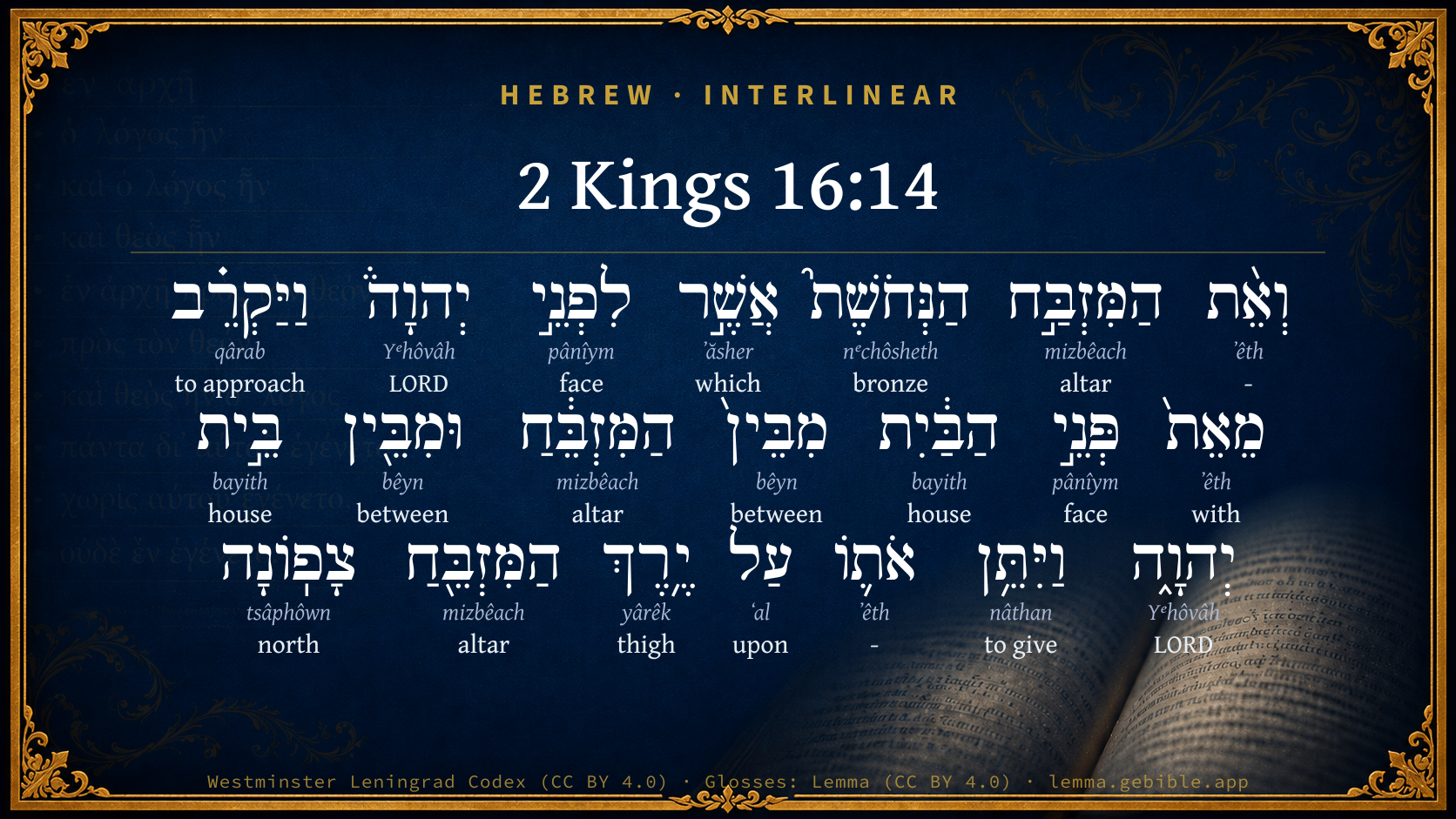
2 Kings 16:14

Hebrew (Westminster Leningrad Codex) 2 Kings 16:14 appears in the Hebrew Old Testament. The text above is from the Westminster Leningrad Codex. Each word links to its Strong’s number, a concise gloss, and parsing drawn from the Open Scriptures Hebrew Bible morphology. Click any word for its full Brown-Driver-Briggs (BDB) entry.
Download image
Cite this verse

2 Kings 16:14 (World English Bible). Public Domain. Lemma interlinear Bible study tool, https://lemma.gebible.app/v/2-kings/16/14.

Show BibTeX & RIS
BibTeX
RIS
English Translation
The brazen altar, which was before Yahweh, he brought from the forefront of the house, from between his altar and the house of Yahweh, and put it on the north side of his altar.
World English Bible · Public Domain
Download a study sheet

One document with this verse’s original text, its word-by-word gloss line, the meaning frame, cross-references with their text, attributed commentary, and full source and license credits — printable, and it pastes into notes with its structure intact.

This verse Autodidact and up

Study sheet (.html) Plain text (.txt)

A passage Seminary Student

Up to 50 verses in one chapter. A passage sheet keeps up to 6 commentary sources and 12 cross-references per verse, in the order this page ranks them, and says so on the sheet whenever that leaves anything out. Ask for a single verse and you get the Autodidact verse sheet above.

Everything on this page stays free to read, with no account — the sheet is a download of what is already on screen, not access to it.

Want to remove ads? Support Godless Engineer
Compare translations 3

The same verse in 3 English versions, stacked beneath the original-language interlinear above. Click any original word for its lexicon entry.

Each is an independent rendering of the whole verse — the interlinear is not word-aligned to these translations.

Highlighted words mark where these versions differ — a whole-verse word diff, not a word-by-word alignment.

  • World English Bible Public Domain
    The brazen altar, which was before Yahweh, he brought from the forefront of the house, from between his altar and the house of Yahweh, and put it on the north side of his altar.
  • King James Version Public Domain
    And he brought also the brazen altar, which was before the LORD, from the forefront of the house, from between the altar and the house of the LORD, and put it on the north side of the altar.
  • unfoldingWord Literal Text CC BY-SA 4.0
    And the altar of bronze that to the face of Yahweh, he then brought forward from the face of the house, from between the altar and from between the house of Yahweh, and he put it to the side of the altar, to the north.

unfoldingWord Literal Text — © unfoldingWord, licensed CC BY-SA 4.0. Word-aligned USFM3 via Door43 (git.door43.org/unfoldingWord/en_ult).

Versions to compare (up to 4)

3 of 4 selected

Show all 18 translations

Every available English version of this verse, each an independent rendering of the whole verse.

  • World English Bible Public Domain
    The brazen altar, which was before Yahweh, he brought from the forefront of the house, from between his altar and the house of Yahweh, and put it on the north side of his altar.
  • Berean Standard Bible Public Domain
    He also took the bronze altar that stood before the LORD from the front of the temple (between the new altar and the house of the LORD) and he put it on the north side of the new altar.
  • Majority Standard Bible Public Domain
    He also took the bronze altar that stood before the LORD from the front of the temple (between the new altar and the house of the LORD) and he put it on the north side of the new altar.
  • King James Version Public Domain
    And he brought also the brazen altar, which was before the LORD, from the forefront of the house, from between the altar and the house of the LORD, and put it on the north side of the altar.
  • American Standard Version (1901) Public Domain
    And the brazen altar, which was before Jehovah, he brought from the forefront of the house, from between his altar and the house of Jehovah, and put it on the north side of his altar.
  • Revised Version (1885) Public Domain
    And the brasen altar, which was before the LORD, he brought from the forefront of the house, from between his altar and the house of the LORD, and put it on the north side of his altar.
  • Geneva Bible (1599) Public Domain
    And set it by the brasen altar which was before the Lord, and brought it in farther before the house betweene the altar and the house of the Lord, and set it on the North side of the altar.
  • Douay-Rheims (1899) Public Domain
    But the altar of brass that was before the Lord, he removed from the face of the temple, and from the place of the altar, and from the place of the temple of the Lord: and he set it at the side of the altar toward the north.
  • Young's Literal Translation Public Domain
    As to the altar of brass that `is' before Jehovah -- he bringeth `it' near from the front of the house, from between the altar and the house of Jehovah, and putteth it on the side of the altar, northward.
  • Literal Standard Version CC BY-SA 4.0
    As for the altar of bronze that [is] before YHWH—he brings [it] near from the front of the house, from between the altar and the house of YHWH, and puts it on the side of the altar, northward.
  • Unlocked Literal Bible CC BY-SA 4.0
    The bronze altar that was before Yahweh—he brought it from the front of the temple, from between his altar and the temple of Yahweh and put it on the north side of his altar.
  • unfoldingWord Literal Text CC BY-SA 4.0
    And the altar of bronze that to the face of Yahweh, he then brought forward from the face of the house, from between the altar and from between the house of Yahweh, and he put it to the side of the altar, to the north.
  • Darby Bible Public Domain
    And the brazen altar which was before Jehovah, he brought forward from the forefront of the house, from between [his] altar and the house of Jehovah, and put it by the side of [his] altar on the north.
  • World Messianic Bible Public Domain
    The bronze altar, which was before the LORD, he brought from the front of the house, from between his altar and the LORD’s house, and put it on the north side of his altar.
  • Webster's Bible Public Domain
    And he brought also the brazen altar, which was before the LORD, from the front of the house, from between the altar and the house of the LORD, and put it on the north side of the altar.
  • Free Bible Version CC BY-SA 4.0
    He also moved the bronze altar that stood before the Lord from the front of the Temple, between the new altar and the Lord's Temple, and he placed it to the north of the new altar.
  • Bible in Basic English Public Domain
    And the brass altar, which was before the Lord, he took from the front of the house, from between his altar and the house of the Lord, and put it on the north side of his altar.
  • JPS Tanakh (1917) Public Domain
    And the brazen altar, which was before the LORD, he brought from the forefront of the house, from between his altar and the house of the LORD, and put it on the north side of his altar.

Literal Standard Version (2020), Covenant Press — licensed CC BY-SA 4.0. Text via the HelloAO Bible API (eBible.org). Unlocked Literal Bible (unfoldingWord) — licensed CC BY-SA 4.0. Text via the HelloAO Bible API (eBible.org). unfoldingWord Literal Text — © unfoldingWord, licensed CC BY-SA 4.0. Word-aligned USFM3 via Door43 (git.door43.org/unfoldingWord/en_ult). Free Bible Version, Dr. Jonathan Gallagher — licensed CC BY-SA 4.0. Text via the HelloAO Bible API (eBible.org).

Word by word

More ways to search: Search by grammar → Find every occurrence → Compare this word →

Practice this passage: Drill this verse → Learn its vocabulary →

יֶ֥רֶךְ
yârêk
H3409
“thigh of”
Noun, Common, Feminine, Singular, Construct
Part of Speech
Noun
Type
Common
Gender
Feminine
Number
Singular
State
Construct
Full BDB Definition

Origin: from an unused root meaning to be soft

TWOT: 916a

thigh, side, loin, base - thigh - outside of thigh (where sword was worn) - loins (as the seat of procreative power) - side (flank) (of object) - base
  1. וְאֵ֨ת ʼêth H853 “and · -” Conjunction + Particle, Direct Object
  2. הַמִּזְבַּ֣ח mizbêach H4196 “the · altar of” Particle, Definite Article + Noun, Common, Masculine, Singular, Construct
  3. הַנְּחֹשֶׁת֮ nᵉchôsheth H5178 “the · bronze” Particle, Definite Article + Noun, Common, Feminine, Singular, Absolute
  4. אֲשֶׁ֣ר ʼăsher H834 “which” Particle, Relative
  5. לִפְנֵ֣י pânîym H6440 “to/for · face(s) of” Preposition + Noun, Common, Both, Plural, Construct
  6. יְהוָה֒ Yᵉhôvâh H3068 “LORD” Noun, Proper
  7. וַיַּקְרֵ֗ב qârab H7126 “and · to approach” Conjunction + Verb, Hiphil, Sequential Imperfect, 3rd Person, Masculine, Singular
  8. מֵאֵת֙ ʼêth H854 “from · with” Preposition + Preposition
  9. פְּנֵ֣י pânîym H6440 “face(s) of” Noun, Common, Both, Plural, Construct
  10. הַבַּ֔יִת bayith H1004 “the · house” Particle, Definite Article + Noun, Common, Masculine, Singular, Absolute
  11. מִבֵּין֙ bêyn H996 “from · between” Preposition + Preposition
  12. הַמִּזְבֵּ֔חַ mizbêach H4196 “the · altar” Particle, Definite Article + Noun, Common, Masculine, Singular, Absolute
  13. וּמִבֵּ֖ין bêyn H996 “and · from · between” Conjunction + Preposition + Preposition
  14. בֵּ֣ית bayith H1004 “house of” Noun, Common, Masculine, Singular, Construct
  15. יְהוָ֑ה Yᵉhôvâh H3068 “LORD” Noun, Proper
  16. וַיִּתֵּ֥ן nâthan H5414 “and · to give” Conjunction + Verb, Qal, Sequential Imperfect, 3rd Person, Masculine, Singular
  17. אֹת֛וֹ ʼêth H853 “- · him” Particle, Direct Object + Suffix, Personal, 3rd Person, Masculine, Singular
  18. עַל ʻal H5921 “upon” Preposition
  19. הַמִּזְבֵּ֖חַ mizbêach H4196 “the · altar” Particle, Definite Article + Noun, Common, Masculine, Singular, Absolute
  20. צָפֽוֹנָה tsâphôwn H6828 “north · toward” Noun, Common, Feminine, Singular, Absolute + Suffix, Demonstrative

About this verse

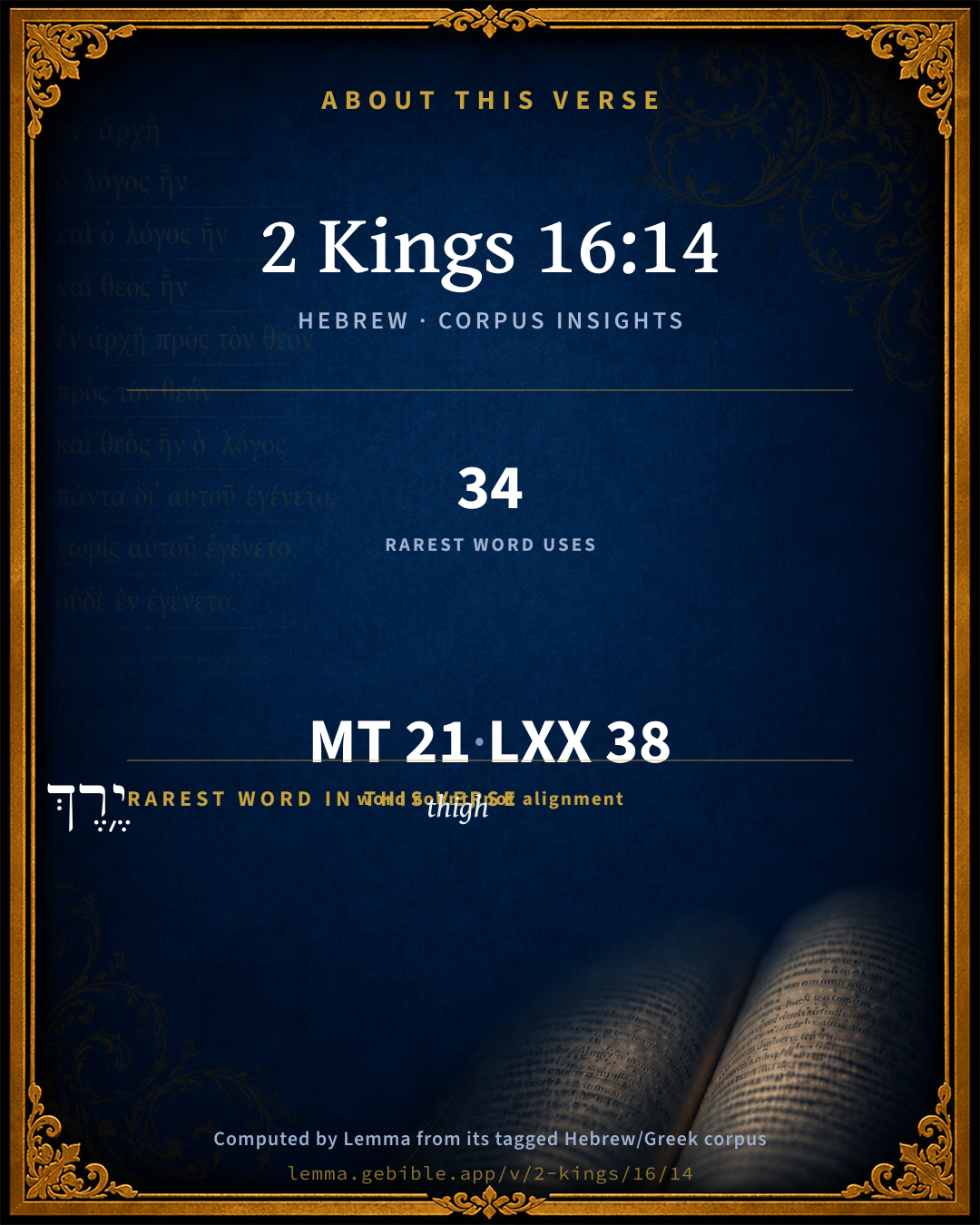
These counts appear in no published source. They are computed here, from the morphology-tagged text and Lemma’s own curated glosses. What Lemma adds →

21
words
14
distinct lemmas
Historical
section

Shared distinctive vocabulary

יֶ֥רֶךְ thigh H3409 occurs in 32 verses of the Hebrew Bible. Also found in:

Grammatical profile

  • 2 verbs
  • 12 nouns
  • 4 prepositions
  • 3 particles

Verb forms

  • וַיַּקְרֵ֗ב Hiphil · Sequential Imperfect
  • וַיִּתֵּ֥ן Qal · Sequential Imperfect

Repetition

Words recur within this verse — often emphatic in Hebrew:

  • הַמִּזְבַּ֣ח altar H4196 ×3
  • לִפְנֵ֣י face H6440 ×2
  • יְהוָה֒ LORD H3068 ×2
  • הַבַּ֔יִת house H1004 ×2
  • מִבֵּין֙ between H996 ×2

Hebrew & Septuagint length

In English translation the verse runs 34 words from the Hebrew and 34 from the Septuagint (LXX English) — the same length.

A rough comparison of the two English renderings, which tokenize alike — not a word-level alignment.

Word counts can differ between the Hebrew and the Greek without any difference in meaning — e.g. the Hebrew direct-object marker אֵת has no separate Greek word, and Greek often adds the article ὁ.

In the original languages it is 21 Hebrew tokens and 38 Greek tokens — but the two are counted differently (Hebrew bundles its prefixes and suffixes into one token; the Greek is in lemma form), so that isn’t a like-for-like length.

Cross-references

6

Topical passages linked to 2 Kings 16:14 in the Treasury of Scripture Knowledge — connected by theme and wording, ordered by reader-vote popularity; previews shown in the World English Bible.

  • 2 Chronicles 4:1 Moreover he made an altar of brass, twenty cubits the length of it, and twenty cubits the breadth of it, and ten cubits the height of it.
  • Exodus 40:6 You shall set the altar of burnt offering before the door of the tent of the tent of meeting.
  • Exodus 40:29 He set the altar of burnt offering at the door of the tent of the tent of meeting, and offered on it the burnt offering and the meal-offering, as Yahweh commanded Moses.
  • 2 Kings 16:11 Urijah the priest built an altar: according to all that king Ahaz had sent from Damascus, so did Urijah the priest make it against the coming of king Ahaz from Damascus.
  • 2 Chronicles 1:5 Moreover the brazen altar, that Bezalel the son of Uri, the son of Hur, had made, was there before the tent of Yahweh: and Solomon and the assembly sought to it.
  • Matthew 23:35 that on you may come all the righteous blood shed on the earth, from the blood of righteous Abel to the blood of Zachariah son of Barachiah, whom you killed between the sanctuary and the altar.

Cross-references courtesy of OpenBible.info (CC BY 4.0).

Hebrew and Greek witnesses Masoretic Hebrew ↔ Greek Septuagint

The same verse in the two great witnesses to the Old Testament, shown verse-for-verse.

These are two independent witnesses, not word-aligned to each other, and the Septuagint is shown in lemma (dictionary) form.

Hebrew 2 Kings 16:14 Masoretic · Westminster Leningrad Codex

וְאֵ֨ת הַמִּזְבַּ֣ח הַנְּחֹשֶׁת֮ אֲשֶׁ֣ר לִפְנֵ֣י יְהוָה֒ וַיַּקְרֵ֗ב מֵאֵת֙ פְּנֵ֣י הַבַּ֔יִת מִבֵּין֙ הַמִּזְבֵּ֔חַ וּמִבֵּ֖ין בֵּ֣ית יְהוָ֑ה וַיִּתֵּ֥ן אֹת֛וֹ עַל יֶ֥רֶךְ הַמִּזְבֵּ֖חַ צָפֽוֹנָה

The brazen altar, which was before Yahweh, he brought from the forefront of the house, from between his altar and the house of Yahweh, and put it on the north side of his altar.

World English Bible · Public Domain

Greek LXX 2 Kings 16:14 Septuagint · lemma form

καί ὁ θυσιαστήριον ὁ χαλκοῦς ὁ ἀπέναντι κύριος καί προςἄγω ἀπό πρόσωπον ὁ οἶκος κύριος ἀπό ὁ ἀνά μέσος ὁ θυσιαστήριον καί ἀπό ὁ ἀνά μέσος ὁ οἶκος κύριος καί δίδωμι αὐτός ἐπί μηρός ὁ θυσιαστήριον κατά βορέας

And he brought forward the one before the house of the Lord from between the altar and the house of the Lord, and he set it openly by the side of the altar northwards.

LXX2012 (modern English Septuagint) · Public Domain

Hebrew: Westminster Leningrad Codex (CC BY 4.0). Greek: Septuagint (public domain); English from LXX2012 (modern English Septuagint) (Public Domain). How the Septuagint differs from the Hebrew →

Targum (Aramaic paraphrase)

1

The Targum is the ancient Jewish Aramaic paraphrase of the Hebrew Scriptures — an interpretive translation, not the Hebrew text itself. Onkelos (literal) and Pseudo-Jonathan (expansive) render the Torah, and Jonathan the Prophets. Coverage is partial: where no permissively-licensed English translation exists for a verse, only the Aramaic is shown. This is verse-level text, not a word-by-word alignment to the Hebrew.

  1. Targum Jonathan Prophets (Joshua–Malachi)
    וְיַת מַדְבְּחָא דִנְחָשָׁא דִי קֳדָם יְיָ וְקָרֵיב מִן קֳדָם בֵּיתָא מִבֵּין מַדְבְּחָא וּמִבֵּין בֵּית מַקְדְשָׁא דַייָ וִיהַב יָתֵיהּ עַל צִידָא דְמַדְבְּחָא צִפּוּנָא:

    (no public-domain English translation for this verse)

    Targum Jonathan — Aramaic: “Mikraot Gedolot” (public domain). English: “Sefaria Community Translation” (CC0 1.0 (public-domain dedication)); “London "Chaldee Paraphrase," 1871” (public domain). Text via Sefaria.

Commentary

Notes on 2 Kings 16:14 from classic Christian and Jewish commentators (each source and its license shown beneath its notes). The classic Christian expositions comment on the surrounding passage and are grouped to its opening verse, so a note may address several verses; the Jewish commentaries on the Tanakh (Rashi and others) are per-verse, so they appear only where the commentator wrote on this verse.

Lemma curates 59 commentaries, every one of them public domain or Creative Commons licensed, each selected and text-cleaned for this edition rather than reprinted as found. About our sources →

Trapp's Complete Commentary

John Trapp

2Ki 16:14 And he brought also the brasen altar, which [was] before the LORD, from the forefront of the house, from between the altar and the house of the LORD, and put it on the north side of the altar.

Ver. 14. And put it on the north side.] As it were, in a corner out of the way. {a}

{a} Quasi vicarium et precarium in angulo collocavit. - Vatab.

John Trapp, A Commentary or Exposition upon All the Books of the Old and New Testament (1647–1656) — public domain. Text from a community e-Sword module.

Tyndale Open Study Notes

Tyndale Open Resources

16:14 Solomon had originally placed the bronze altar in front of the Temple (see Exod 40:6; 2 Chr 4:1; 7:7-10). At first, Ahaz positioned his new altar so that worshipers would come to it before coming to the bronze altar. Then Ahaz had the bronze altar placed . . . on the north side of the new altar, completely replacing the bronze altar as the center of sacrificial activity.

Tyndale Open Study Notes — © Tyndale Open Resources, licensed CC BY-SA 4.0. Text via the HelloAO Bible API.

Geneva Bible (1599)

Geneva Bible translators

That is, at the right hand, as men went into to Temple.

Geneva Bible (1599) marginal notes — public domain. Text via Bolls.life.

Adam Clarke's Commentary

Verse 14. Put it on the north side] He seems to have intended to conform every thing in the Lord's house as much as possible to the idolatrous temples which he saw at Damascus, and to model the Divine worship in the same way: in a word to honour and worship the gods of Syria, and not the God of heaven. All the alterations specified here were in contempt of the true God. Thus he provoked to anger the Lord God of his fathers, 2Ch 28:25.

Adam Clarke's Commentary on the Bible (1810–1826) — public domain. Text from a community e-Sword/MySword module.

Ellicott's Commentary for English Readers

(14) And he brought also the brasen altar . . .—Literally, And as for the brasen altar, he brought it near (to the new one), away from the front of the house, to wit, from between the (new) altar, and the house of Jehovah; and put it at the side of the (new) altar northward. The brasen altar used to stand “before the Lord,” i.e., in the middle of the court of the priests, and in front of the Temple proper. The verse seems to imply that Urijah had pushed it forward nearer to the sanctuary, and set the new Syrian altar in its place. Ahaz, not satisfied with this arrangement, which appeared to confer a kind of precedence on the old altar, drew it back again, and fixed it on the north side of his new altar.

A Bible Commentary for English Readers, edited by Charles John Ellicott (1878–1897) — public domain. Text from a community e-Sword module.

The Cambridge Bible for Schools and Colleges

gen. ed. J. J. S. Perowne

14. And he brought &c.] The R.V. adheres to the Hebrew order. And the brasen altar which was before the Lord, he brought from the forefront of the house. This brasen altar is described 2Ch_4:1, its length and breadth being each twenty cubits, and its height ten cubits. It is also mentioned, but not described, 1Ki_8:64. This altar, placed in its position when the temple was built, and standing exactly in front of the porch and entrance to the temple, Ahaz now removed.

from between the [R.V. his] altar and the house] At first the new altar was set a little behind the brasen one, but on the same line as one looked at them from the temple-porch. This arrangement Ahaz changes, and taking away the brasen altar, he leaves his own in the front of the temple, and carries the older and more sacred altar to the north side of the new one. Thus they both stood in a line parallel to the front of the house, but the king’s new altar had the place of honour, before the temple-doors.

north side of the [R.V. his] altar] As before.

The Cambridge Bible for Schools and Colleges (gen. ed. J. J. S. Perowne; Cambridge University Press, 1878–1918) — public domain. Text from a community e-Sword module.

John Gill's Exposition

And King Ahaz commanded Urijah the priest, saying,.... Who was not to be commanded by the king in matters of worship, but to attend to the laws and institutions of God:

saying, upon the great altar; meaning the new one, which either was of a larger size than the altar of God, or was greater in the esteem of Ahaz:

burn the morning burnt offering, and the evening meat offering; the daily sacrifice, morning and evening:

and the king's burnt sacrifice, and his meat offering, with the burnt offering of all the people of the land, and their meat offering, and their drink offerings; such as were offered up at any time on the account of the rulers of the land in particular, or of the whole congregation of Israel, see Lev 4:1

and sprinkle upon it all the blood of the burnt offering, and all the blood of the sacrifice; as it used to be sprinkled upon the altar of the Lord:

and the brasen altar shall be for me to inquire by; to search, inquire, and consider what was to be done with it; for altars were never inquired by as oracles; the meaning is, that it was never to be made use of but by him, and when he pleased.

John Gill's Exposition of the Whole Bible (1746–1763) — public domain (CC PDM 1.0). Text via the HelloAO Bible API.

Albert Barnes' Notes on the Bible

Hereto the “Brasen altar” (marginal reference) had, it would seem, occupied a position directly in front of the temple porch, which it exactly equalled in width. Now Ahaz removed it from this place, and gave the honorable position to his new altar, which he designed to supersede the old far all ordinary purposes 2Ki 16:15.

From between the altar ... - Urijah, having received no official directions, had placed the new altar in front of the old, between it and the eastern gate of the court. Ahaz consequently on his arrival found the brasen altar “between the (new) altar and the house of the Lord.”

Albert Barnes' Notes on the Bible (1834–1885) — public domain. Text from a community e-Sword/MySword module.

Haydock's Catholic Bible Commentary

And from. Hebrew, "from between the new altar and the house of," &c. (Haydock) --- Achaz had placed his altar before that of Solomon: but he afterwards removed the latter from the right-hand of the sanctuary, to a corner of the court, on the north side. (Calmet) --- In the midst of his distress, he despised God; sacrificed to the gods of the Syrians, as more powerful and victorious than the Lord; pillaged the temple, which he shut up during the remainder of his reign, (Haydock) and erected altars for himself in all the corners of Jerusalem, 2 Paralipomenon xxviii. 24.

George Leo Haydock (1774–1849), Haydock's Catholic Family Bible and Commentary, 1859 edition — public domain. Excludes Psalms (Douay-Rheims chapter numbering differs from Protestant) and Deuterocanonical books (Catholic canon only).

Matthew Poole's English Annotations

The brazen altar of burnt-offerings, made by Solomon, and placed there by God’s appointment. Which was before the Lord, i.e. from before the Lord’s house: See Poole "Lev 1:3". From between the altar and the house of the Lord; or rather, from between his altar, &c., or, that altar, &c. His new altar was at first set below the brazen altar, and at a further distance from the temple. This he took for a disparagement to his altar; and therefore most impiously and audaciously takes that away, and puts his in its place.

On the north side of the altar; or, of that altar; or, of his altar; as before. So he put God’s altar out of its place and use.

Matthew Poole's English Annotations on the Holy Bible (1683–1685) — public domain. Text from a community e-Sword/MySword module.

Whedon's Commentary on the Bible

Daniel D. Whedon

14. The brazen altar — This stood in the midst of the inner court, the court of the priests. See cut, page 68. It was, according to 2Ch_4:1, twenty cubits square and ten cubits high. Its position is described as before the Lord, that is, in front of the holy place.

Brought… from the forefront of the house — Moved from its old sacred place in front of the temple, and placed, as the sequel shows, nearer to the north side of the court, so as not to stand between the (new) altar and the house of the Lord. In the spot where Urijah had placed it, the new altar was not properly before the Lord, inasmuch as the brazen altar stood between it and the holy place. So the king changed the position of both altars, placing the new one nearer to the temple, and the brazen altar on the north side of it. He would not have the new altar occupy a secondary place. So, says Wordsworth, “the new altar became the principal central object, and the brazen altar was only an adjunct and appendage to it.”

Daniel D. Whedon (gen. ed.), Commentary on the Old and New Testaments (1874–1909) — public domain. Text from a community e-Sword module.

The Pulpit Commentary

And he brought also the brazen altar, which was before the Lord. One sin leads on to another. Having introduced his self-invented quasi-idolatrous altar into the temple, and so inserted "the thin end of the wedge," Ahaz was not satisfied, but proceeded to another innovation. Urijah, having had no express order from the king with respect to the position of the new altar, had placed it in front of the old one, between it and the eastern gate of the court. Thus the old altar, which was directly in front of the temple porch, seemed to cut the new altar off from the temple. Ahaz would not have this continue, and resolved on removing the altar of Solomon from, its place, and putting it elsewhere. From the forefront of the house, (comp. 1Ki_8:54) from between the altari.e. , the new altarand the house of the Lordi.e. the temple buildingand put it on the north side of the altar. The removal of Solomon"s altar from its place of honor to a side position left the space clear between the temple and the new altar, which thus, without exactly occupying the same site, took practically the place of Solomon"s altar. Solomon"s altar, shifted to one side, was put, as it were, in the background; the eye rested on the new altar, right in front of the porch and temple, which so became "the main altar" (lwOdGj tBzMih), as it is called in the next verse.

The Pulpit Commentary (1880–1919), ed. H.D.M. Spence-Jones & Joseph S. Exell — public domain. Text from a community e-Sword module.

John Wesley's Explanatory Notes

Brazen altar - Of burnt-offerings, made by Solomon, and placed there by God's appointment. From between, &c. - His new altar was at first set below the brazen altar, and at a farther distance from the temple. This he took for a disparagement to his altar; and therefore impiously takes that away, and puts his in its place. And put, &c. - So he put God's altar out of its place and use! A bolder stroke than the very worst of kings had hitherto given to religion.

John Wesley, Explanatory Notes Upon the Whole Bible (1754–1765) — public domain. Text via the GEBible commentary corpus.

Keil & Delitzsch

C. F. Keil & F. Delitzsch

Soon after this Ahaz went still further, and had "the copper altar before Jehovah," i.e., the altar of burnt-offering in the midst of the court before the entrance into the Holy Place, removed "from the front of the (temple-) house, from (the spot) between the altar (the new one built by Urijah) and the house of Jehovah (i.e., the temple-house(, and placed at the north side of the altar." הקריב does not mean removit, caused to be taken away, but admovit, and is properly to be connected with הם על־ירך, notwithstanding the fact that אתו ויּתּן is inserted between for the sake of greater clearness, as Maurer has already pointed out.

(Note: There is nothing in the text to support the view of Thenius, that Urijah had the brazen altar of burnt-offering erected by Solomon moved farther forwards, nearer to the temple-house, and the new one put in its place, whence it was afterwards shifted by Ahaz and the new one moved a little farther to the south, that is to say, that he placed the two altars close to one another, so that they now occupied the centre of the court.)

On the use of the article with המּזבּח in the construct state, see Ewald, 290, d.

Keil & Delitzsch — Biblical Commentary on the Old Testament (1861–1891) — public domain (CC PDM 1.0). Text via the HelloAO Bible API. (Old Testament only.)

Rashi

Rabbi Shlomo Yitzchaki (Rashi)

And the Copper Altar … he brought, etc. It is impossible to say that this was the Copper Altar that Moshe made, because it was hidden. It is also impossible to say that his was the stone altar that Shlomo made, and he called it the “Copper Altar,” because it was impossible to move it from one corner to another without taking it apart, but we learned that the fire that descended in Shlomo's time, did not leave the altar until Menashe came and removed it, for he demolished the altar, as we find in the Aggadah of [the chapter entitled] “Cheilek.” I have no way to explain this “[copper] altar” except as [referring to] the basin and the bases of copper, which were accessories of the altar and were near the holy altar. Now, when Achaz made the altar for the idols, he removed the basin and moved it to another side, [farther] away from the Temple, so as not to intervene between the altar he made and the Temple of Adonoy, and he placed it next to the holy altar on the north. We find that our Rabbis explained a passage in a similar manner, ”And they came and stood next to the Copper Altar.” Did the Copper Altar exist? He said to them, ”Begin from the place where they recite songs before Me.” Thus we see here that copper musical instruments are referred to as a “[copper] altar.”

Rashi on the Tanakh — English translations: “The Judaica Press complete Tanach with Rashi, translated by A. J. Rosenberg” (CC BY 4.0); “Pentateuch with Rashi's commentary by M. Rosenbaum and A.M. Silbermann, 1929-1934” (public domain); “The Metsudah Tanach series, Lakewood, N.J” (CC BY 4.0); and “The Book of Joshua, Metsudah Publications, 1997” (CC BY 4.0). Text via Sefaria.

Lesson kit

Teaching starters — assembled from the data on this page, not authored interpretation. Every prompt links to the verse data it draws on. Edit before teaching.

2 Kings, in the Historical, opens this verse with 21 words (14 distinct Hebrew lemmas). Its most distinctive word is yârêk (“thigh”). A historical commentator’s framing appears above. Read the whole chapter for the surrounding context.

Discussion questions

  1. What does “thigh” (yârêk) contribute to the verse as a whole?
  2. Genesis 24:2 shares the word «thigh» with this verse. How do the two illuminate each other?
  3. “altar” occurs 3× in this one verse. What is the effect of the repetition?
  4. The translations on this page render this verse differently — a whole-verse word diff, not a word-by-word alignment. What might account for the different wordings?
  5. The verb «וַיַּקְרֵ֗ב» is Hiphil Sequential Imperfect. How does its form color the action?
  6. Reading how Trapp's Complete Commentary and Tyndale Open Study Notes read this verse, where do the two commentators agree and where do they part?

Things to notice

Reading settings

Reading text

Shown beneath each verse's original-language words.

Old Testament
Old Testament edition

Read the OT as the Masoretic Hebrew (MT) or the Greek Septuagint (LXX).

English shown for the Greek Septuagint (in the Hebrew ↔ Greek comparison).

Comparing translations? Open the Compare panel on any verse page to stack up to four side by side.