2 Chronicles 4:17

Hebrew (Westminster Leningrad Codex) 2 Chronicles 4:17 appears in the Hebrew Old Testament. The text above is from the Westminster Leningrad Codex. Each word links to its Strong’s number, a concise gloss, and parsing drawn from the Open Scriptures Hebrew Bible morphology. Click any word for its full Brown-Driver-Briggs (BDB) entry.
Download image
Cite this verse

2 Chronicles 4:17 (World English Bible). Public Domain. Lemma interlinear Bible study tool, https://lemma.gebible.app/v/2-chronicles/4/17.

Show BibTeX & RIS
BibTeX
RIS
English Translation
In the plain of the Jordan did the king cast them, in the clay ground between Succoth and Zeredah.
World English Bible · Public Domain
Download a study sheet

One document with this verse’s original text, its word-by-word gloss line, the meaning frame, cross-references with their text, attributed commentary, and full source and license credits — printable, and it pastes into notes with its structure intact.

This verse Autodidact and up

Study sheet (.html) Plain text (.txt)

A passage Seminary Student

Up to 50 verses in one chapter. A passage sheet keeps up to 6 commentary sources and 12 cross-references per verse, in the order this page ranks them, and says so on the sheet whenever that leaves anything out. Ask for a single verse and you get the Autodidact verse sheet above.

Everything on this page stays free to read, with no account — the sheet is a download of what is already on screen, not access to it.

Want to remove ads? Support Godless Engineer
Compare translations 3

The same verse in 3 English versions, stacked beneath the original-language interlinear above. Click any original word for its lexicon entry.

Each is an independent rendering of the whole verse — the interlinear is not word-aligned to these translations.

Highlighted words mark where these versions differ — a whole-verse word diff, not a word-by-word alignment.

  • World English Bible Public Domain
    In the plain of the Jordan did the king cast them, in the clay ground between Succoth and Zeredah.
  • King James Version Public Domain
    In the plain of Jordan did the king cast them, in the clay ground between Succoth and Zeredathah.
  • unfoldingWord Literal Text CC BY-SA 4.0
    In the vicinity of the Jordan the king cast them, in the thick ground between Succoth and between Zeredathah.

unfoldingWord Literal Text — © unfoldingWord, licensed CC BY-SA 4.0. Word-aligned USFM3 via Door43 (git.door43.org/unfoldingWord/en_ult).

Versions to compare (up to 4)

3 of 4 selected

Show all 18 translations

Every available English version of this verse, each an independent rendering of the whole verse.

  • World English Bible Public Domain
    In the plain of the Jordan did the king cast them, in the clay ground between Succoth and Zeredah.
  • Berean Standard Bible Public Domain
    The king had them cast in clay molds in the plain of the Jordan between Succoth and Zeredah.
  • Majority Standard Bible Public Domain
    The king had them cast in clay molds in the plain of the Jordan between Succoth and Zeredah.
  • King James Version Public Domain
    In the plain of Jordan did the king cast them, in the clay ground between Succoth and Zeredathah.
  • American Standard Version (1901) Public Domain
    In the plain of the Jordan did the king cast them, in the clay ground between Succoth and Zeredah.
  • Revised Version (1885) Public Domain
    In the Plain of Jordan did the king cast them, in the clay ground between Succoth and Zeredah.
  • Geneva Bible (1599) Public Domain
    In the playne of Iorden did the King cast them in clay betweene Succoth and Zeredathah.
  • Douay-Rheims (1899) Public Domain
    And the caldrons, and fleshhooks, and bowls. All the vessels did Hiram his father make for Solomon in the house of the Lord of the finest brass.
  • Young's Literal Translation Public Domain
    In the circuit of the Jordan hath the king cast them, in the thick soil of the ground, between Succoth and Zeredathah.
  • Literal Standard Version CC BY-SA 4.0
    The king has cast them in the circuit of the Jordan, in the thick soil of the ground, between Succoth and Zeredathah.
  • Unlocked Literal Bible CC BY-SA 4.0
    The king had cast them in the plain of the Jordan, in the clay ground between Succoth and Zarethan.
  • unfoldingWord Literal Text CC BY-SA 4.0
    In the vicinity of the Jordan the king cast them, in the thick ground between Succoth and between Zeredathah.
  • Darby Bible Public Domain
    In the plain of the Jordan did the king cast them, in the clay-ground between Succoth and Zeredathah.
  • World Messianic Bible Public Domain
    The king cast them in the plain of the Jordan, in the clay ground between Succoth and Zeredah.
  • Webster's Bible Public Domain
    In the plain of Jordan did the king cast them, in the clay ground between Succoth and Zeredathah.
  • Free Bible Version CC BY-SA 4.0
    The king cast them in clay molds in the plain of the Jordan between Succoth and Zeredah.
  • Bible in Basic English Public Domain
    The king made them of liquid metal in the lowland of Jordan, in the soft earth between Succoth and Zeredah.
  • JPS Tanakh (1917) Public Domain
    In the plain of the Jordan did the king cast them, in the clay ground between Succoth and Zeredah.

Literal Standard Version (2020), Covenant Press — licensed CC BY-SA 4.0. Text via the HelloAO Bible API (eBible.org). Unlocked Literal Bible (unfoldingWord) — licensed CC BY-SA 4.0. Text via the HelloAO Bible API (eBible.org). unfoldingWord Literal Text — © unfoldingWord, licensed CC BY-SA 4.0. Word-aligned USFM3 via Door43 (git.door43.org/unfoldingWord/en_ult). Free Bible Version, Dr. Jonathan Gallagher — licensed CC BY-SA 4.0. Text via the HelloAO Bible API (eBible.org).

Word by word

More ways to search: Search by grammar → Find every occurrence → Compare this word →

Practice this passage: Drill this verse → Learn its vocabulary →

צְרֵדָֽתָה
Tsᵉrêdâh
H6868
“Zereda · toward”
Noun, Proper + Suffix, Demonstrative
Part of Speech
Noun
Type
Proper
Full BDB Definition

Origin: apparently from an unused root meaning to pierce

TWOT: None

Zereda or Zeredathah = "fortress" - a town or territory in Manasseh and the home of Jeroboam
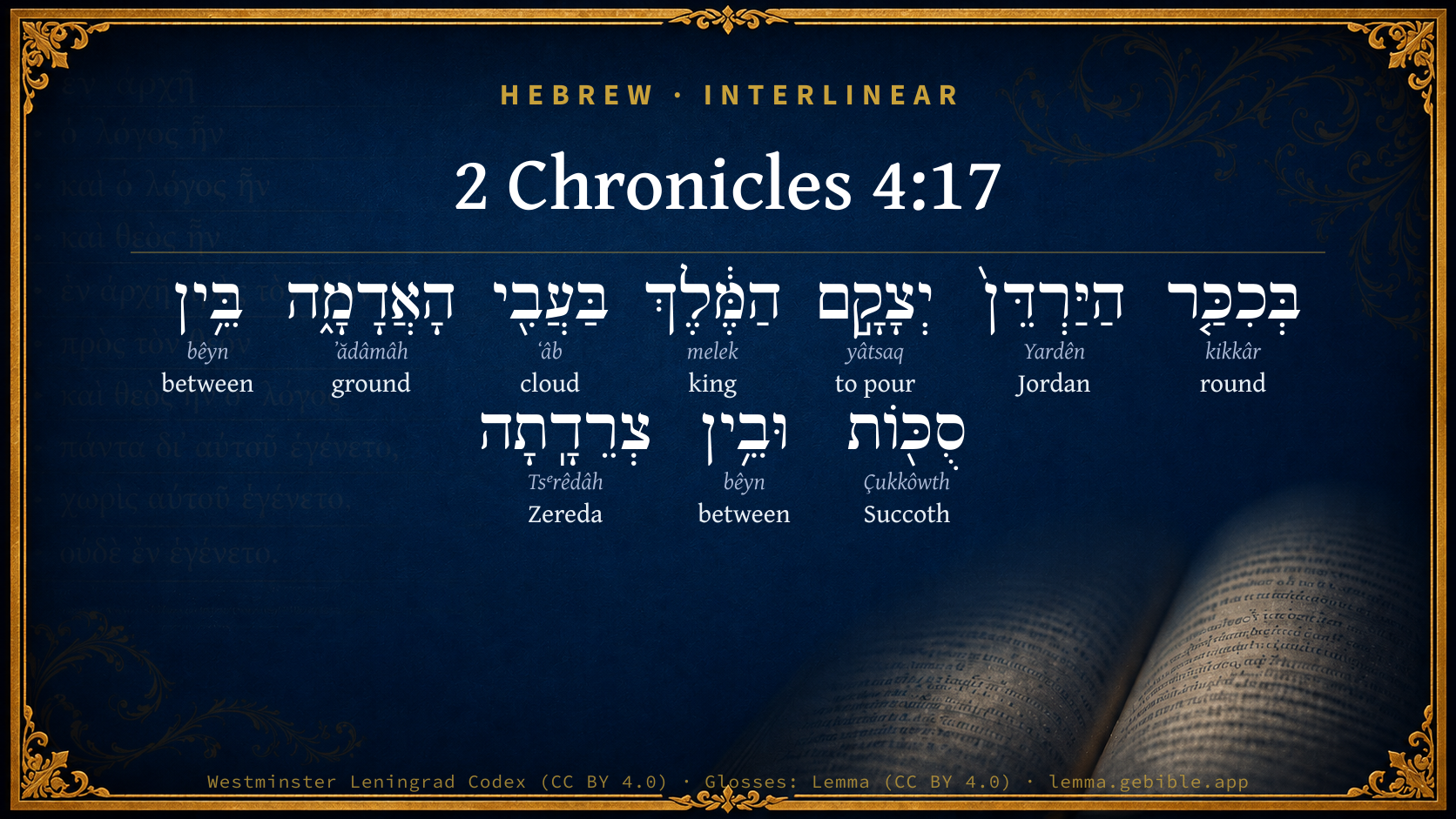
  1. בְּכִכַּ֤ר kikkâr H3603 “in/at · round of” Preposition + Noun, Common, Both, Singular, Construct
  2. הַיַּרְדֵּן֙ Yardên H3383 “the · Jordan” Particle, Definite Article + Noun, Proper
  3. יְצָקָ֣ם yâtsaq H3332 “to pour · them” Verb, Qal, Perfect, 3rd Person, Masculine, Singular + Suffix, Personal, 3rd Person, Masculine, Plural
  4. הַמֶּ֔לֶךְ melek H4428 “the · king” Particle, Definite Article + Noun, Common, Masculine, Singular, Absolute
  5. בַּעֲבִ֖י ʻâb H5645 “in/at · cloud of” Preposition + Noun, Common, Both, Singular, Construct
  6. הָאֲדָמָ֑ה ʼădâmâh H127 “the · ground” Particle, Definite Article + Noun, Common, Feminine, Singular, Absolute
  7. בֵּ֥ין bêyn H996 “between” Preposition
  8. סֻכּ֖וֹת Çukkôwth H5523 “Succoth” Noun, Proper
  9. וּבֵ֥ין bêyn H996 “and · between” Conjunction + Preposition

About this verse

These counts appear in no published source. They are computed here, from the morphology-tagged text and Lemma’s own curated glosses. What Lemma adds →

10
words
9
distinct lemmas
Historical
section

Notable vocabulary

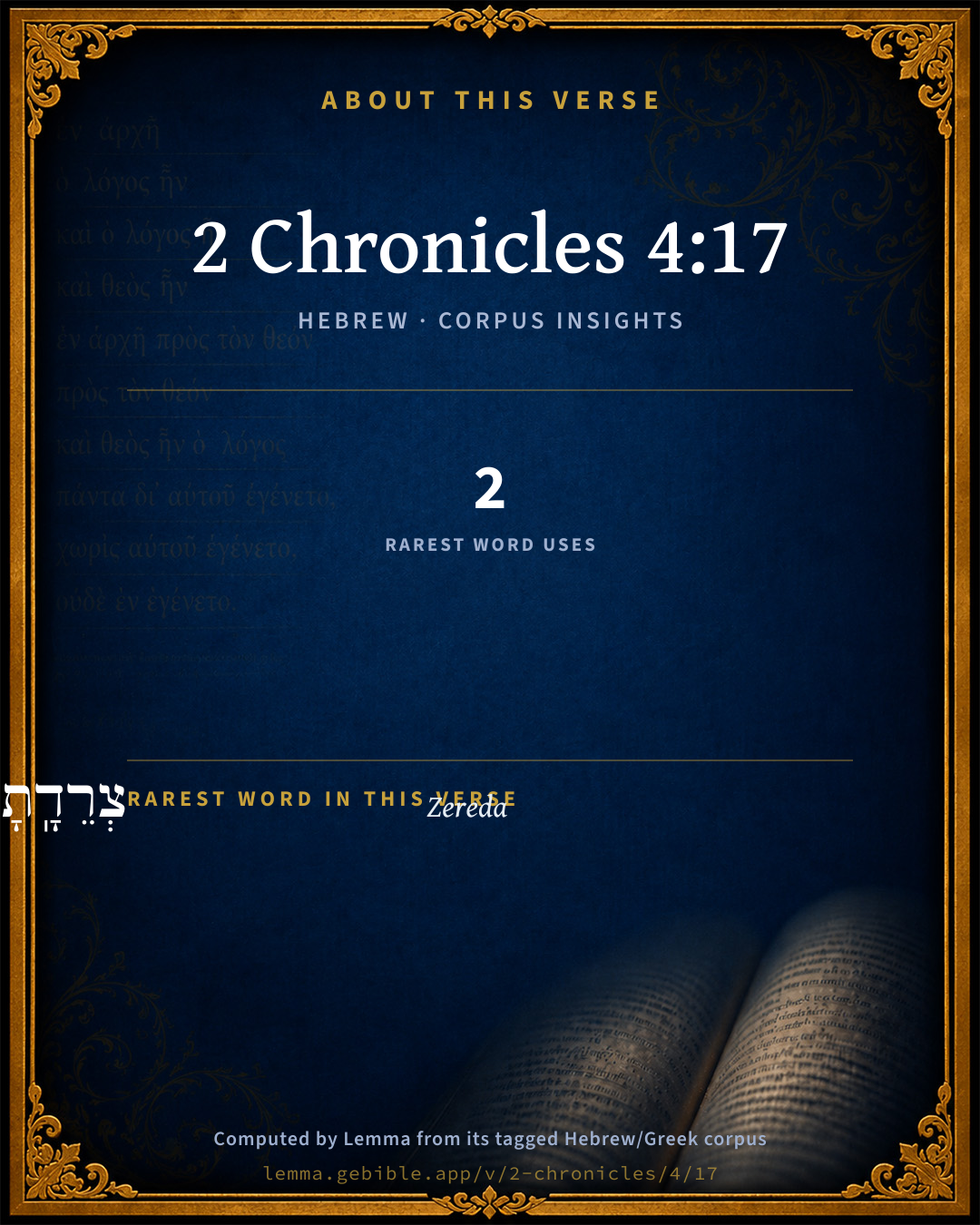
The rarest word here is צְרֵדָֽתָה Zereda H6868 — appearing just 2 times in the whole Hebrew Bible.

Shared distinctive vocabulary

צְרֵדָֽתָה Zereda H6868 occurs in 2 verses of the Hebrew Bible. Also found in:

Grammatical profile

  • 1 verb
  • 7 nouns
  • 2 prepositions

Verb forms

  • יְצָקָ֣ם Qal · Perfect

Repetition

A word recurs within this verse — often emphatic in Hebrew:

  • בֵּ֥ין between H996 ×2

Hebrew & Septuagint length

In English translation the verse runs 19 words from the Hebrew and 24 from the Septuagint (LXX English) — closely comparable.

A rough comparison of the two English renderings, which tokenize alike — not a word-level alignment.

Word counts can differ between the Hebrew and the Greek without any difference in meaning — e.g. the Hebrew direct-object marker אֵת has no separate Greek word, and Greek often adds the article ὁ.

Cross-references

1

Topical passages linked to 2 Chronicles 4:17 in the Treasury of Scripture Knowledge — connected by theme and wording, ordered by reader-vote popularity; previews shown in the World English Bible.

  • 1 Kings 7:46 In the plain of the Jordan did the king cast them, in the clay ground between Succoth and Zarethan.

Cross-references courtesy of OpenBible.info (CC BY 4.0).

Hebrew and Greek witnesses Masoretic Hebrew ↔ Greek Septuagint

The same verse in the two great witnesses to the Old Testament, shown verse-for-verse.

These are two independent witnesses, not word-aligned to each other, and the Septuagint is shown in lemma (dictionary) form.

Hebrew 2 Chronicles 4:17 Masoretic · Westminster Leningrad Codex

בְּכִכַּ֤ר הַיַּרְדֵּן֙ יְצָקָ֣ם הַמֶּ֔לֶךְ בַּעֲבִ֖י הָאֲדָמָ֑ה בֵּ֥ין סֻכּ֖וֹת וּבֵ֥ין צְרֵדָֽתָה

In the plain of the Jordan did the king cast them, in the clay ground between Succoth and Zeredah.

World English Bible · Public Domain

Greek LXX 2 Chronicles 4:17 Septuagint · lemma form

ἐν ὁ περίχωρος ὁ ἰορδάνης χωνεύω αὐτός ὁ βασιλεύς ἐν ὁ πάχος ὁ γῆ ἐν οἶκος σοκχωθ καί ἀνά μέσος σιρδαθα

In the country round about Jordan the king cast them, in the clay ground in the house of Socchoth, and between that and Saredatha.

LXX2012 (modern English Septuagint) · Public Domain

Hebrew: Westminster Leningrad Codex (CC BY 4.0). Greek: Septuagint (public domain); English from LXX2012 (modern English Septuagint) (Public Domain). How the Septuagint differs from the Hebrew →

Commentary

Notes on 2 Chronicles 4:17 from classic Christian and Jewish commentators (each source and its license shown beneath its notes). The classic Christian expositions comment on the surrounding passage and are grouped to its opening verse, so a note may address several verses; the Jewish commentaries on the Tanakh (Rashi and others) are per-verse, so they appear only where the commentator wrote on this verse.

Lemma curates 59 commentaries, every one of them public domain or Creative Commons licensed, each selected and text-cleaned for this edition rather than reprinted as found. About our sources →

Trapp's Complete Commentary

John Trapp

2Ch 4:17 In the plain of Jordan did the king cast them, in the clay ground between Succoth and Zeredathah.

Ver. 17. In the clay ground.] In holes digged in the earth, without moulds did he cast them, say some.

John Trapp, A Commentary or Exposition upon All the Books of the Old and New Testament (1647–1656) — public domain. Text from a community e-Sword module.

Adam Clarke's Commentary

Verse 17. In the clay ground ] See on 1Kg 7:46. Some suppose that he did not actually cast those instruments at those places, but that he brought the clay from that quarter, as being the most proper for making moulds to cast in.

Adam Clarke's Commentary on the Bible (1810–1826) — public domain. Text from a community e-Sword/MySword module.

Ellicott's Commentary for English Readers

(17) In the clay ground.—Heb., in the thickness of the ground—i.e., in the stiff or clayey soil. Vulg., “in argillosa terra.” For ‘ãbî, “thickness,” see Job_15:26. Kings has ma‘ãbeh, which occurs nowhere else.

Zeredathah.—Kings, Zârĕthân (Jos_3:16). Zĕrçdâthâh means towards Zĕrĕthâh (1Ki_11:26). The two names denote the same place.

A Bible Commentary for English Readers, edited by Charles John Ellicott (1878–1897) — public domain. Text from a community e-Sword module.

The Cambridge Bible for Schools and Colleges

gen. ed. J. J. S. Perowne

17. in the clay ground] G. A. Smith (Historical Geography, p. 488) speaks of traces of old brick-fields found by Sir C. Warren in the Jordan valley. Succoth is perhaps Tell Deir ‘Alla, east of Jordan, north of the Jabbok.

Zeredathah] R.V. Zeredah (1Ki_11:26); but in 1Ki_7:46 (R.V.) Zarethan (cp. Jos_3:16, R.V.). It was not far from Scythopolis (Bethshan), but its exact position is unknown.

The Cambridge Bible for Schools and Colleges (gen. ed. J. J. S. Perowne; Cambridge University Press, 1878–1918) — public domain. Text from a community e-Sword module.

Albert Barnes' Notes on the Bible

Zeredathah - Or, Zarthan (marginal reference). The writer of Chronicles probably uses the name which the place bore in his own day.

Albert Barnes' Notes on the Bible (1834–1885) — public domain. Text from a community e-Sword/MySword module.

Haydock's Catholic Bible Commentary

CHAPTER IV.

Saredatha, or Sarthan, (3 Kings vii. 46.) not far from Bethsan, 3 Kings iv. 12. (Calmet)

George Leo Haydock (1774–1849), Haydock's Catholic Family Bible and Commentary, 1859 edition — public domain. Excludes Psalms (Douay-Rheims chapter numbering differs from Protestant) and Deuterocanonical books (Catholic canon only).

The Pulpit Commentary

In the plain in the clay; i.e. in the Ciccar (or round, equivalent to the New Testament "region round about") of Jordan, a distinctive designation of the Jordan valley (Conder"s Handbook to the Bible," p. 213). The region here intended lies east of the river, in what became the division of Gad. Succoth lay a little to the north of the river Jabbok, which flows almost east to west into the Jordan. Zeredathah; i.q. Zarthan of 1Ki_7:46; and this latter is in the Hebrew also the same in characters and all with the Zaretan of Jos_3:16. Very possibly theplace is the same as Zererath. (Jud_1:7:22) The exact sites of these places are not known, though the range within which they all lay is clear (see Grove"s article in Smith"s "Bible Dictionary," 3:1817). The clay ground; that is," the clay of the ground "(Hebrew). The radical idea of the word here translated "clay" is "thickness," which should not be rendered, as in margin, "thicknesses." The word (b;) occurs in all thirty.five times, and is rendered a large proportion of these times "clouds" or "thick clouds" (e.g. , Exo_19:9) clouds being presumably thicknesses in air; but if the subject-matter in question be in wood, or growing timber, or the ground, the word is rendered conformably "thick planks" (1Ki_7:6; Eze_41:25, Eze_41:26) or "thickets", (Jer_4:29) or "clay" (as here), to distinguish from other lighter or more friable soil.

An ancient manufactory.

I To WHOM IT BELONGED. To Solomon the king.

II WHERE IT WAS SITUATED. In the clay ground between Succoth and Zeredathah, both of which were in the plain of Jordan.

III BY WHOM IT WAS MANAGED. By Hiram the artist.

IV THE FABRICS IT PRODUCED. The articles above described, all the vessels for the house of God. W.

The Pulpit Commentary (1880–1919), ed. H.D.M. Spence-Jones & Joseph S. Exell — public domain. Text from a community e-Sword module.

unfoldingWord translationNotes

Door43 World Missions Community

The king had cast them ... Solomon made

The readers should understand that Solomon probably commanded other people to do the actual work. AT: "The king commanded his workers to cast them ... Solomon's workers made" (See: Metonymy)

Zarethan

This is the name of a city. (See: How to Translate Names)

the weight of the bronze could not be known

This can be stated in active form. Possible meanings are 1) there was so much bronze no one tried to weigh it. AT: "no one even tried to weigh the bronze" or 2) this is a hyperbole that emphasizes the great amount of bronze. AT: "no one could even determine how much all the bronze weighed" (See: Active or Passive and Hyperbole and Generalization)

translationWords

Jordan River

Succoth

unfoldingWord translationNotes — © Distant Shores Media and the Door43 World Missions Community, licensed CC BY-SA 4.0. Source: git.door43.org/Door43/en_tn.

Rashi

Rabbi Shlomo Yitzchaki (Rashi)

in the thickness of the ground The Targum renders: clay, ardille in Old French.

between Succoth and Zeredathah In I Kings (7: 46) it says Zarethan. Zeredathah was the place of Jeroboam, (11: 26): “And Jeroboam the son of Nebat, an Ephraimite of Zeredah, whose mother’s name was Zeruah, a widow.” Since a corpse conveys ritual contamination in a tent, and a mezora likewise, and so it is with an idol, as we learned at the end of the third chapter of Abodah Zarah (Mishnah 8). “A widow” means that he widowed [isolated] Israel from its God. “From Zeredah” means that he narrowed the Torah and did not broaden it; i.e., מִן הַצְרֵדָתָה, means הֵצַר דַּת אֱלֹהֵינוּ he narrowed the law of our God. My uncle of blessed memory explained it to me in this manner.

Rashi on the Tanakh — English translations: “The Judaica Press complete Tanach with Rashi, translated by A. J. Rosenberg” (CC BY 4.0); “Pentateuch with Rashi's commentary by M. Rosenbaum and A.M. Silbermann, 1929-1934” (public domain); “The Metsudah Tanach series, Lakewood, N.J” (CC BY 4.0); and “The Book of Joshua, Metsudah Publications, 1997” (CC BY 4.0). Text via Sefaria.

Lesson kit

Teaching starters — assembled from the data on this page, not authored interpretation. Every prompt links to the verse data it draws on. Edit before teaching.

2 Chronicles, in the Historical, opens this verse with 10 words (9 distinct Hebrew lemmas). Its most distinctive word is Tsᵉrêdâh (“Zereda”). A historical commentator’s framing appears above. Read the whole chapter for the surrounding context.

Discussion questions

  1. The word Tsᵉrêdâh carries the sense “Zereda.” How does it shape the verse?
  2. 1 Kings 11:26 shares the word «Zereda» with this verse. How do the two illuminate each other?
  3. “between” occurs 2× in this one verse. What is the effect of the repetition?
  4. These translations render this verse differently. What is at stake in choosing one wording over another?
  5. The verb «יְצָקָ֣ם» is Qal Perfect. How does its form color the action?
  6. Reading how Trapp's Complete Commentary and Adam Clarke's Commentary read this verse, where do the two commentators agree and where do they part?

Things to notice

  • These translations choose different wording for 7 words in this verse.
  • “between” occurs 2× in this single verse.
  • 9 distinct Hebrew lemmas span 10 words in this verse.

Reading settings

Reading text

Shown beneath each verse's original-language words.

Old Testament
Old Testament edition

Read the OT as the Masoretic Hebrew (MT) or the Greek Septuagint (LXX).

English shown for the Greek Septuagint (in the Hebrew ↔ Greek comparison).

Comparing translations? Open the Compare panel on any verse page to stack up to four side by side.