
Ezekiel 10:7

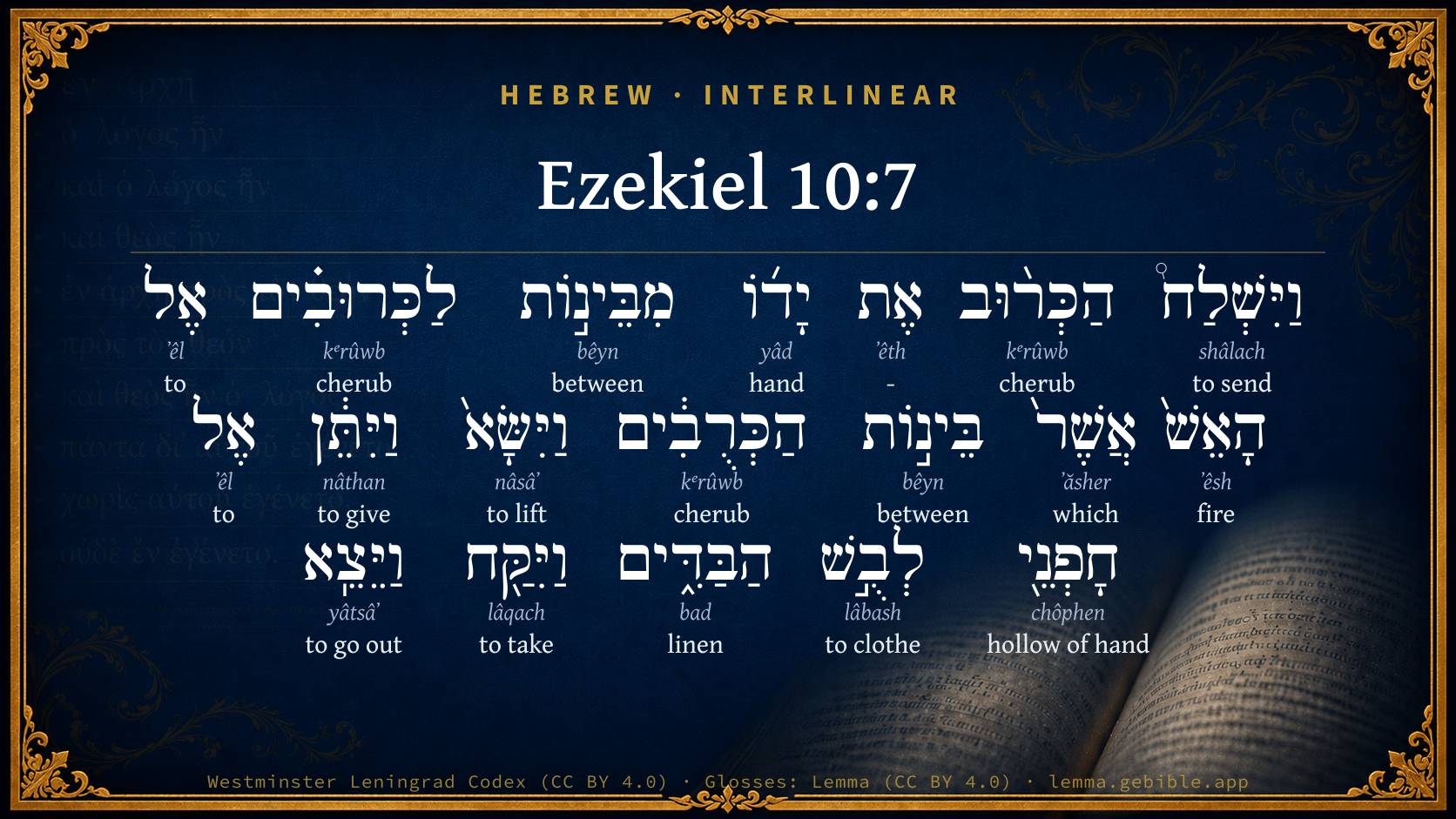
Hebrew (Westminster Leningrad Codex) Ezekiel 10:7 appears in the Hebrew Old Testament. The text above is from the Westminster Leningrad Codex. Each word links to its Strong’s number, a concise gloss, and parsing drawn from the Open Scriptures Hebrew Bible morphology. Click any word for its full Brown-Driver-Briggs (BDB) entry.
Download image
Cite this verse

Ezekiel 10:7 (World English Bible). Public Domain. Lemma interlinear Bible study tool, https://lemma.gebible.app/v/ezekiel/10/7.

Show BibTeX & RIS
BibTeX
RIS
English Translation
The cherub stretched forth his hand from between the cherubim to the fire that was between the cherubim, and took [of it], and put it into the hands of him who was clothed in linen, who took it and went out.
World English Bible · Public Domain
Download a study sheet

One document with this verse’s original text, its word-by-word gloss line, the meaning frame, cross-references with their text, attributed commentary, and full source and license credits — printable, and it pastes into notes with its structure intact.

This verse Autodidact and up

Study sheet (.html) Plain text (.txt)

A passage Seminary Student

Up to 50 verses in one chapter. A passage sheet keeps up to 6 commentary sources and 12 cross-references per verse, in the order this page ranks them, and says so on the sheet whenever that leaves anything out. Ask for a single verse and you get the Autodidact verse sheet above.

Everything on this page stays free to read, with no account — the sheet is a download of what is already on screen, not access to it.

Want to remove ads? Support Godless Engineer
Compare translations 3

The same verse in 3 English versions, stacked beneath the original-language interlinear above. Click any original word for its lexicon entry.

Each is an independent rendering of the whole verse — the interlinear is not word-aligned to these translations.

Highlighted words mark where these versions differ — a whole-verse word diff, not a word-by-word alignment.

  • World English Bible Public Domain
    The cherub stretched forth his hand from between the cherubim to the fire that was between the cherubim, and took [of it], and put it into the hands of him who was clothed in linen, who took it and went out.
  • King James Version Public Domain
    And one cherub stretched forth his hand from between the cherubims unto the fire that was between the cherubims, and took thereof, and put it into the hands of him that was clothed with linen: who took it, and went out.
  • unfoldingWord Literal Text CC BY-SA 4.0
    A cherub reached out his hand between the cherubim to the fire that was among the cherubim, and lifted it up and placed it into the hands of the one dressed in linen. The man took it and went back out.

unfoldingWord Literal Text — © unfoldingWord, licensed CC BY-SA 4.0. Word-aligned USFM3 via Door43 (git.door43.org/unfoldingWord/en_ult).

Versions to compare (up to 4)

3 of 4 selected

Show all 18 translations

Every available English version of this verse, each an independent rendering of the whole verse.

  • World English Bible Public Domain
    The cherub stretched forth his hand from between the cherubim to the fire that was between the cherubim, and took [of it], and put it into the hands of him who was clothed in linen, who took it and went out.
  • Berean Standard Bible Public Domain
    Then one of the cherubim reached out his hand and took some of the fire that was among them. And he put it into the hands of the man clothed in linen, who received it and went out.
  • Majority Standard Bible Public Domain
    Then one of the cherubim reached out his hand and took some of the fire that was among them. And he put it into the hands of the man clothed in linen, who received it and went out.
  • King James Version Public Domain
    And one cherub stretched forth his hand from between the cherubims unto the fire that was between the cherubims, and took thereof, and put it into the hands of him that was clothed with linen: who took it, and went out.
  • American Standard Version (1901) Public Domain
    And the cherub stretched forth his hand from between the cherubim unto the fire that was between the cherubim, and took `thereof', and put it into the hands of him that was clothed in linen, who took it and went out.
  • Revised Version (1885) Public Domain
    And the cherub stretched forth his hand from between the cherubim unto the fire that was between the cherubim, and took thereof, and put it into the hands of him that was clothed in linen, who took it and went out.
  • Geneva Bible (1599) Public Domain
    And one Cherub stretched forth his hand from betweene the Cherubims vnto the fire, that was betweene the Cherubims, and tooke thereof, and put it into the hands of him that was clothed with linnen: who tooke it and went out.
  • Douay-Rheims (1899) Public Domain
    And one cherub stretched out his arm from the midst of the cherubims to the fire that was between the cherubims: and he took, and put it into the hands of him that was clothed with linen: who took it and went forth.
  • Young's Literal Translation Public Domain
    that the `one' cherub putteth forth his hand from between the cherubs unto the fire that `is' between the cherubs, and lifteth up, and giveth into the hands of him who is clothed with linen, and he receiveth, and cometh forth.
  • Literal Standard Version CC BY-SA 4.0
    that the [one] cherub puts forth his hand from between the cherubim to the fire that [is] between the cherubim, and lifts up, and gives [it] into the hands of him who is clothed with linen, and he receives, and comes forth.
  • Unlocked Literal Bible CC BY-SA 4.0
    A cherub reached out his hand between the cherubim to the fire that was among the cherubim, and lifted it up and placed it into the hands of the one dressed in linen. The man took it and went back out.
  • unfoldingWord Literal Text CC BY-SA 4.0
    A cherub reached out his hand between the cherubim to the fire that was among the cherubim, and lifted it up and placed it into the hands of the one dressed in linen. The man took it and went back out.
  • Darby Bible Public Domain
    And the cherub stretched forth his hand from between the cherubim unto the fire that was between the cherubim, and took and put it into the hands of him [that was] clothed with linen; who took [it], and went out.
  • World Messianic Bible Public Domain
    The cherub stretched out his hand from between the cherubim to the fire that was between the cherubim, and took some of it, and put it into the hands of him who was clothed in linen, who took it and went out.
  • Webster's Bible Public Domain
    And one cherub stretched forth his hand from between the cherubim, to the fire that was between the cherubim, and took of it, and put it into the hands of him that was clothed with linen: who took it, and went out.
  • Free Bible Version CC BY-SA 4.0
    Then one of the cherubim reached out and took some of the fire among them. He handed it to the man in linen, who took it and left.
  • Bible in Basic English Public Domain
    And stretching out his hand to the fire which was between the winged ones, he took some of it and went out.
  • JPS Tanakh (1917) Public Domain
    And the cherub stretched forth his hand from between the cherubim unto the fire that was between the cherubim, and took thereof, and put it into the hands of him that was clothed in linen, who took it and went out.

Literal Standard Version (2020), Covenant Press — licensed CC BY-SA 4.0. Text via the HelloAO Bible API (eBible.org). Unlocked Literal Bible (unfoldingWord) — licensed CC BY-SA 4.0. Text via the HelloAO Bible API (eBible.org). unfoldingWord Literal Text — © unfoldingWord, licensed CC BY-SA 4.0. Word-aligned USFM3 via Door43 (git.door43.org/unfoldingWord/en_ult). Free Bible Version, Dr. Jonathan Gallagher — licensed CC BY-SA 4.0. Text via the HelloAO Bible API (eBible.org).

Word by word

More ways to search: Search by grammar → Find every occurrence → Compare this word →

Practice this passage: Drill this verse → Learn its vocabulary →

חָפְנֵ֖י
chôphen
H2651
“handfuls of”
Noun, Common, Masculine, Dual, Construct
Part of Speech
Noun
Type
Common
Gender
Masculine
Number
Dual
State
Construct
Full BDB Definition

Origin: from an unused root of uncertain signification

TWOT: 709a

handfuls, hollow of the hand
  1. וַיִּשְׁלַח֩ shâlach H7971 “and · to send” Conjunction + Verb, Qal, Sequential Imperfect, 3rd Person, Masculine, Singular
  2. הַכְּר֨וּב kᵉrûwb H3742 “the · cherub” Particle, Definite Article + Noun, Common, Masculine, Singular, Absolute
  3. אֶת ʼêth H853 “-” Particle, Direct Object
  4. יָד֜וֹ yâd H3027 “hand · his” Noun, Common, Both, Singular, Construct + Suffix, Personal, 3rd Person, Masculine, Singular
  5. מִבֵּינ֣וֹת bêyn H996 “from · between” Preposition + Preposition
  6. לַכְּרוּבִ֗ים kᵉrûwb H3742 “to/for the · cherubim” Preposition, Determined + Noun, Common, Masculine, Plural, Absolute
  7. אֶל ʼêl H413 “to” Preposition
  8. הָאֵשׁ֙ ʼêsh H784 “the · fire” Particle, Definite Article + Noun, Common, Both, Singular, Absolute
  9. אֲשֶׁר֙ ʼăsher H834 “which” Particle, Relative
  10. בֵּינ֣וֹת bêyn H996 “between” Preposition
  11. הַכְּרֻבִ֔ים kᵉrûwb H3742 “the · cherubim” Particle, Definite Article + Noun, Common, Masculine, Plural, Absolute
  12. וַיִּשָּׂא֙ nâsâʼ H5375 “and · to lift” Conjunction + Verb, Qal, Sequential Imperfect, 3rd Person, Masculine, Singular
  13. וַיִּתֵּ֔ן nâthan H5414 “and · to give” Conjunction + Verb, Qal, Sequential Imperfect, 3rd Person, Masculine, Singular
  14. אֶל ʼêl H413 “to” Preposition
  15. לְבֻ֣שׁ lâbash H3847 “clothed” Verb, Qal, Participle Passive, Masculine, Singular, Construct
  16. הַבַּדִּ֑ים bad H906 “the · linen” Particle, Definite Article + Noun, Common, Masculine, Plural, Absolute
  17. וַיִּקַּ֖ח lâqach H3947 “and · to take” Conjunction + Verb, Qal, Sequential Imperfect, 3rd Person, Masculine, Singular
  18. וַיֵּצֵֽא yâtsâʼ H3318 “and · to go out” Conjunction + Verb, Qal, Sequential Imperfect, 3rd Person, Masculine, Singular

About this verse

These counts appear in no published source. They are computed here, from the morphology-tagged text and Lemma’s own curated glosses. What Lemma adds →

19
words
15
distinct lemmas
Prophets
section

Notable vocabulary

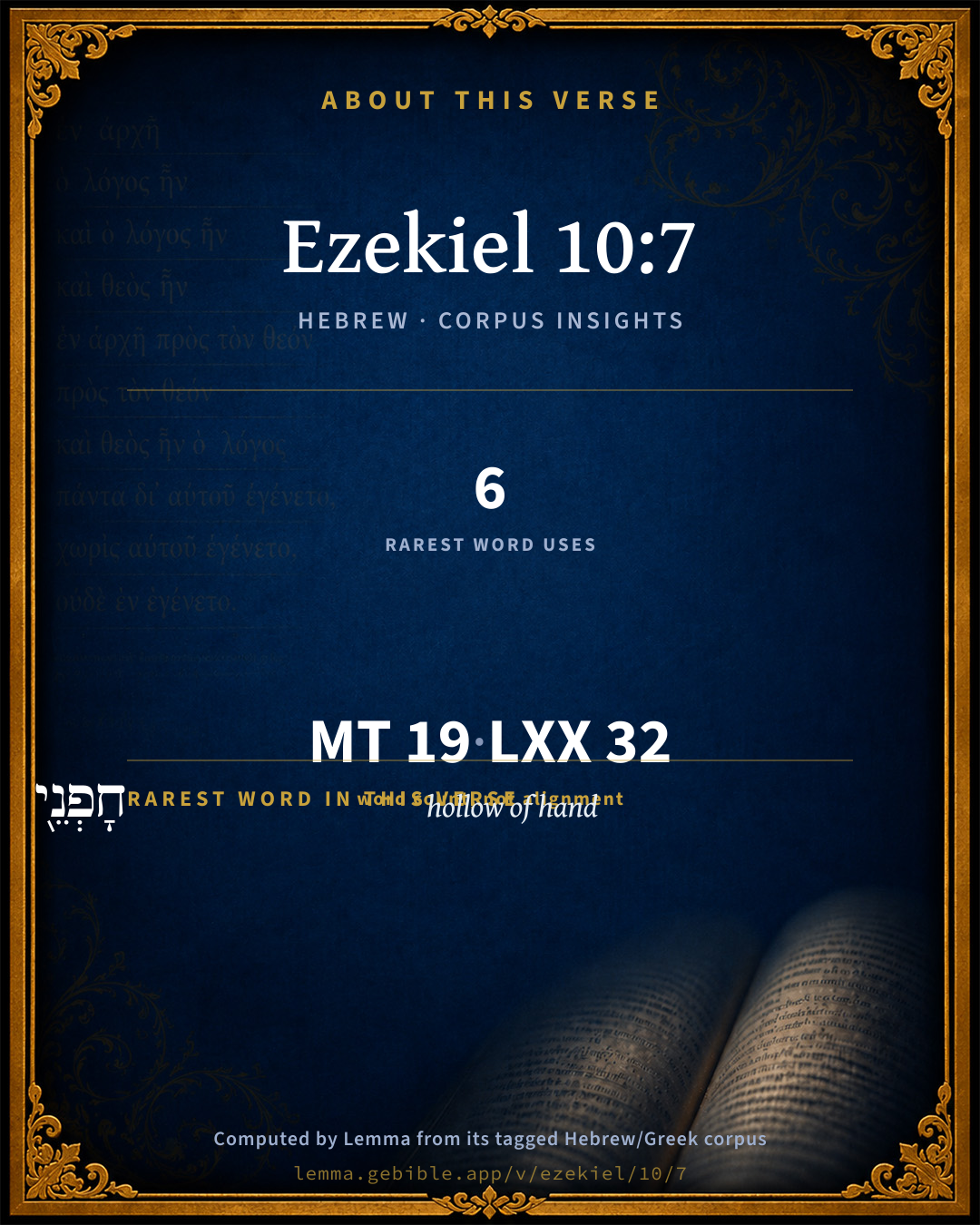
The rarest word here is חָפְנֵ֖י hollow of hand H2651 — appearing just 6 times in the whole Hebrew Bible.

Shared distinctive vocabulary

חָפְנֵ֖י hollow of hand H2651 occurs in 6 verses of the Hebrew Bible. Also found in:

Grammatical profile

  • 6 verbs
  • 7 nouns
  • 4 prepositions
  • 2 particles

Verb forms

  • וַיִּשְׁלַח֩ Qal · Sequential Imperfect
  • וַיִּשָּׂא֙ Qal · Sequential Imperfect
  • וַיִּתֵּ֔ן Qal · Sequential Imperfect
  • לְבֻ֣שׁ Qal · Participle Passive
  • וַיִּקַּ֖ח Qal · Sequential Imperfect
  • וַיֵּצֵֽא Qal · Sequential Imperfect

Repetition

Words recur within this verse — often emphatic in Hebrew:

  • הַכְּר֨וּב cherub H3742 ×3
  • מִבֵּינ֣וֹת between H996 ×2
  • אֶל to H413 ×2

Hebrew & Septuagint length

In English translation the verse runs 41 words from the Hebrew and 41 from the Septuagint (LXX English) — the same length.

A rough comparison of the two English renderings, which tokenize alike — not a word-level alignment.

Word counts can differ between the Hebrew and the Greek without any difference in meaning — e.g. the Hebrew direct-object marker אֵת has no separate Greek word, and Greek often adds the article ὁ.

In the original languages it is 19 Hebrew tokens and 32 Greek tokens — but the two are counted differently (Hebrew bundles its prefixes and suffixes into one token; the Greek is in lemma form), so that isn’t a like-for-like length.

Cross-references

6

Topical passages linked to Ezekiel 10:7 in the Treasury of Scripture Knowledge — connected by theme and wording, ordered by reader-vote popularity; previews shown in the World English Bible.

  • Ezekiel 1:13 As for the likeness of the living creatures, their appearance was like burning coals of fire, like the appearance of torches: [the fire] went up and down among the living creatures; and the fire was bright, and out of the fire went forth lightning.
  • Ezekiel 10:6 It came to pass, when he commanded the man clothed in linen, saying, Take fire from between the whirling wheels, from between the cherubim, that he went in, and stood beside a wheel.
  • Ezekiel 41:23–26 The temple and the sanctuary had two doors.
  • Matthew 13:41–42 The Son of Man will send out his angels, and they will gather out of his Kingdom all things that cause stumbling, and those who do iniquity,
  • Matthew 24:34–35 Most assuredly I tell you, this generation will not pass away, until all these things are accomplished.
  • Matthew 13:49–50 So will it be in the end of the world. The angels will come forth, and separate the wicked from among the righteous,

Cross-references courtesy of OpenBible.info (CC BY 4.0).

Hebrew and Greek witnesses Masoretic Hebrew ↔ Greek Septuagint

The same verse in the two great witnesses to the Old Testament, shown verse-for-verse.

These are two independent witnesses, not word-aligned to each other, and the Septuagint is shown in lemma (dictionary) form.

Hebrew Ezekiel 10:7 Masoretic · Westminster Leningrad Codex

וַיִּשְׁלַח֩ הַכְּר֨וּב אֶת יָד֜וֹ מִבֵּינ֣וֹת לַכְּרוּבִ֗ים אֶל הָאֵשׁ֙ אֲשֶׁר֙ בֵּינ֣וֹת הַכְּרֻבִ֔ים וַיִּשָּׂא֙ וַיִּתֵּ֔ן אֶל חָפְנֵ֖י לְבֻ֣שׁ הַבַּדִּ֑ים וַיִּקַּ֖ח וַיֵּצֵֽא

The cherub stretched forth his hand from between the cherubim to the fire that was between the cherubim, and took [of it], and put it into the hands of him who was clothed in linen, who took it and went out.

World English Bible · Public Domain

Greek LXX Ezekiel 10:7 Septuagint · lemma form

καί ἐκτείνω ὁ χείρ αὐτός εἰς μέσος ὁ πῦρ ὁ εἰμί ἐν μέσος ὁ χερουβείμ καί λαμβάνω καί δίδωμι εἰς ὁ χείρ ὁ ἐνδύω ὁ στολή ὁ ἅγιος καί λαμβάνω καί ἐκἔρχομαι

And he stretched forth his hand into the midst of the fire that was between the cherubs, and took thereof, and put it into the hands of the man clothed with the sacred robe: and he took it, and went out.

LXX2012 (modern English Septuagint) · Public Domain

Hebrew: Westminster Leningrad Codex (CC BY 4.0). Greek: Septuagint (public domain); English from LXX2012 (modern English Septuagint) (Public Domain). How the Septuagint differs from the Hebrew →

Targum (Aramaic paraphrase)

1

The Targum is the ancient Jewish Aramaic paraphrase of the Hebrew Scriptures — an interpretive translation, not the Hebrew text itself. Onkelos (literal) and Pseudo-Jonathan (expansive) render the Torah, and Jonathan the Prophets. Coverage is partial: where no permissively-licensed English translation exists for a verse, only the Aramaic is shown. This is verse-level text, not a word-by-word alignment to the Hebrew.

  1. Targum Jonathan Prophets (Joshua–Malachi)
    וְאוֹשִׁיט כְּרוּבָא יַת יְדֵיהּ מִבֵּינֵי כְרוּבַיָא לְאֶשְׁתָּא דִי בֵּינֵי כְרוּבַיָא וּנְסֵיב וִיהַב לְחָפְנִי דְלָבֵישׁ לְבוּשַׁיָא וּנְסִיב וּנְפַק:

    (no public-domain English translation for this verse)

    Targum Jonathan — Aramaic: “Mikraot Gedolot” (public domain). English: “Sefaria Community Translation” (CC0 1.0 (public-domain dedication)); “London "Chaldee Paraphrase," 1871” (public domain). Text via Sefaria.

Commentary

Notes on Ezekiel 10:7 from classic Christian and Jewish commentators (each source and its license shown beneath its notes). The classic Christian expositions comment on the surrounding passage and are grouped to its opening verse, so a note may address several verses; the Jewish commentaries on the Tanakh (Rashi and others) are per-verse, so they appear only where the commentator wrote on this verse.

Lemma curates 59 commentaries, every one of them public domain or Creative Commons licensed, each selected and text-cleaned for this edition rather than reprinted as found. About our sources →

Trapp's Complete Commentary

John Trapp

Eze 10:7 And [one] cherub stretched forth his hand from between the cherubims unto the fire that [was] between the cherubims, and took [thereof], and put [it] into the hands of [him that was] clothed with linen: who took [it], and went out.

Ver. 7. And one cherub stretched forth his hand.] The holy angels, whom the Jews looked upon as ministers of God’s grace unto them (Josephus calleth them the keepers of the Jewish people), are here brought in as ministers of those weapons wherewith they were to be destroyed.

Who took it, and went out.] Nevertheless the city was not burned till four or five years after this vision.

“ Tam piger ad poenas Deus est, ad praemia velox. ”

- Ovid.

Meanwhile, how jovial were the Jews! as if no such judgment were likely to befall them.

John Trapp, A Commentary or Exposition upon All the Books of the Old and New Testament (1647–1656) — public domain. Text from a community e-Sword module.

Jamieson, Fausset & Brown

Robert Jamieson, A. R. Fausset & David Brown

See on Eze 10:3.

one cherub--one of the four cherubim.

his hand-- (Eze 1:8).

went out--to burn the city.

Jamieson, Fausset & Brown — Commentary Critical and Explanatory on the Whole Bible (1871) — public domain (CC PDM 1.0). Text via the HelloAO Bible API.

The Cambridge Bible for Schools and Colleges

gen. ed. J. J. S. Perowne

7. and one cherub] lit, the cherub; the one on the side approached by the man. The cherubim interposed to hand the fire to the man in linen garments, who received it and went forth (Job_1:12; Job_2:7). The symbolism is suggested by Isa_6:6.

The Cambridge Bible for Schools and Colleges (gen. ed. J. J. S. Perowne; Cambridge University Press, 1878–1918) — public domain. Text from a community e-Sword module.

John Gill's Exposition

And one cherub stretched forth his hand from between the cherubim,.... One of the four living creatures, or cherubim, put out his hand from among the rest:

unto the fire that was between the cherubim; so fire is said to go up and down among them, Eze 1:13; to which the reference is here:

and took thereof, and put it into the hands of him that was clothed with linen: denoting, as before observed, that it was for the ill usage of the ministers of God's word that wrath came upon the people of the Jews, and the destruction of their city by fire; so wrath will come upon antichrist, and the antichristian states, for their usage of the ministers and churches of Christ, and in consequence of the prayers, and by the instigation of such persons; see Rev 6:9; so one of the four beasts or living creatures, the same with the cherubim here, is said to give to the seven angels seven golden vials, full of the wrath of God, Rev 15:7;

who took it, and went out; took the fire, and went out of the temple, and scattered it upon the city of Jerusalem; so representing the Chaldean, or rather the Roman army, burning it with fire; see Mat 22:7; where they are called the armies of the King of kings.

John Gill's Exposition of the Whole Bible (1746–1763) — public domain (CC PDM 1.0). Text via the HelloAO Bible API.

Albert Barnes' Notes on the Bible

One cherub - The “cherub” who stood next the wheel by the side of which the man stood. The representative of the priestly office now gives up his post of reconciliation, and becomes simply a minister of wrath; another sign that God will turn from Jerusalem.

Albert Barnes' Notes on the Bible (1834–1885) — public domain. Text from a community e-Sword/MySword module.

Matthew Poole's English Annotations

One cherub; one of the four.

Stretched forth his hand; which was under his wing, as Eze 1:8, which see.

From between the cherubims; this that reached the fire to Christ stood among the cherubims, and putting forth his hand, or exerting his strength and power, serveth Christ, our Lord and his.

Unto the fire: see Eze 10:2, and Eze 1:13.

Took thereof; as a servant that reacheth what his master would have and use.

The hands; both hands, for it is in the plural number.

Who took it; received it of the angel, as one who might employ it when he would.

Went out, from amidst the angels, and out of the temple; or from the threshold, where all this vision appeared as on its stage; and he goes into the city to prepare all, that nothing be done too soon, or too late.

Matthew Poole's English Annotations on the Holy Bible (1683–1685) — public domain. Text from a community e-Sword/MySword module.

Whedon's Commentary on the Bible

Daniel D. Whedon

7. And one cherub — Literally, the cherub — the one nearest to him. Even though the divine glory is compassionately absent, yet human weakness seems to be inadequate to the task assigned until the guardian of the divine honor assists him in doing what was commanded. (Compare Isa_6:5-6.) We lose sight now of this man clothed with linen, and there is no attempt whatever to picture the conflagration.

Daniel D. Whedon (gen. ed.), Commentary on the Old and New Testaments (1874–1909) — public domain. Text from a community e-Sword module.

John Wesley's Explanatory Notes

One Cherub - One of the four. And took - As a servant that reaches what his master would have. Went out - Out of the temple.

John Wesley, Explanatory Notes Upon the Whole Bible (1754–1765) — public domain. Text via the GEBible commentary corpus.

Lesson kit

Teaching starters — assembled from the data on this page, not authored interpretation. Every prompt links to the verse data it draws on. Edit before teaching.

Ezekiel, in the Prophets, opens this verse with 19 words (15 distinct Hebrew lemmas). Its most distinctive word is chôphen (“hollow of hand”). A historical commentator’s framing appears above. Read the whole chapter for the surrounding context.

Discussion questions

  1. How does “hollow of hand” (chôphen) shape what this verse is saying?
  2. How does Exodus 9:8, which shares the word «hollow of hand», read alongside this verse?
  3. What does the repetition of “cherub” (3× in this one verse) do in this verse?
  4. The translations on this page render this verse differently — a whole-verse word diff, not a word-by-word alignment. What might account for the different wordings?
  5. «וַיִּשְׁלַח֩» is a Qal Sequential Imperfect verb. How does that grammatical form shape the action described?
  6. Compare how Trapp's Complete Commentary and Jamieson, Fausset & Brown read this verse. Where do they agree or differ?

Things to notice

Reading settings

Reading text

Shown beneath each verse's original-language words.

Old Testament
Old Testament edition

Read the OT as the Masoretic Hebrew (MT) or the Greek Septuagint (LXX).

English shown for the Greek Septuagint (in the Hebrew ↔ Greek comparison).

Comparing translations? Open the Compare panel on any verse page to stack up to four side by side.