
Ezekiel 4:3

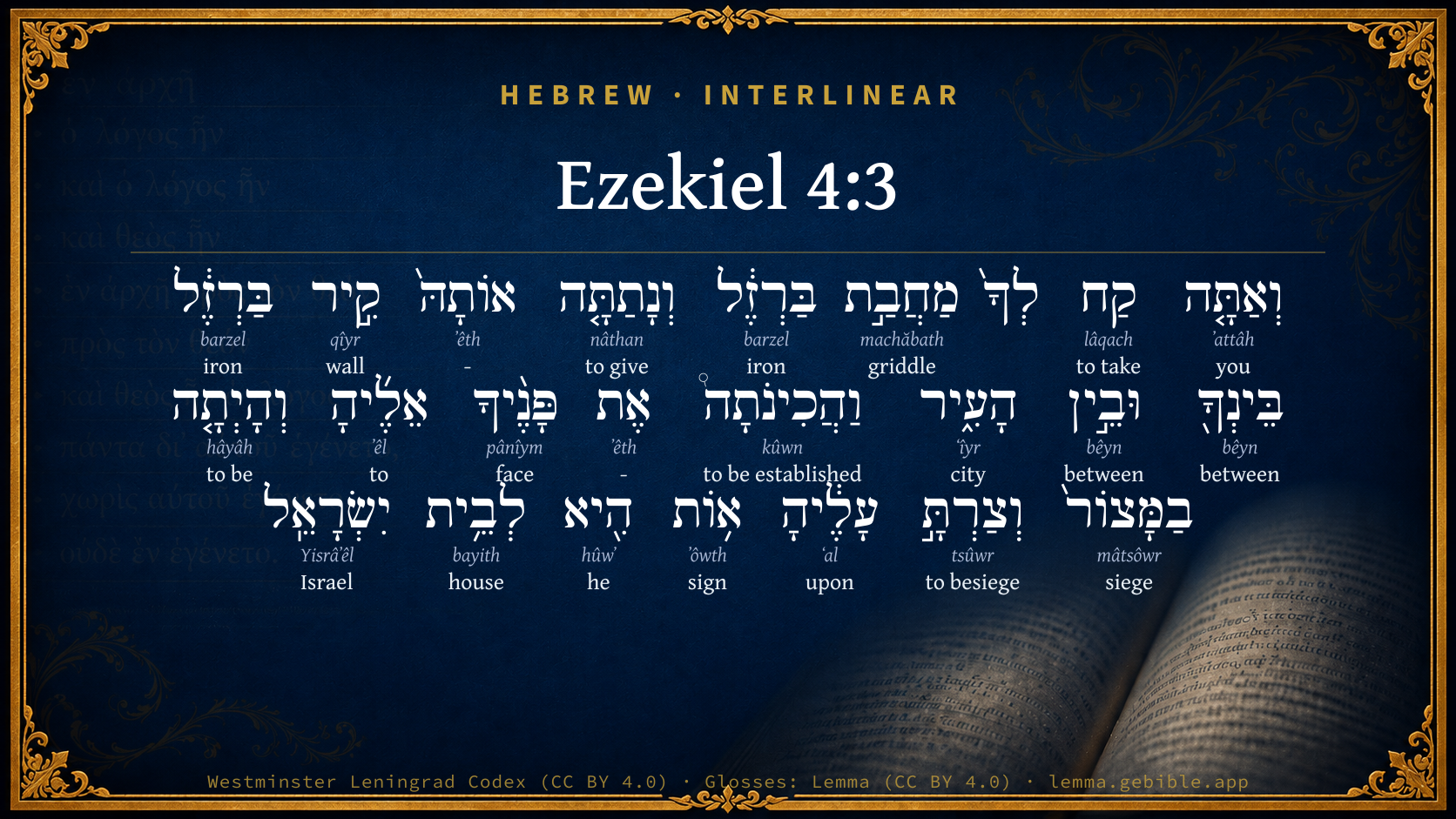
Hebrew (Westminster Leningrad Codex) Ezekiel 4:3 appears in the Hebrew Old Testament. The text above is from the Westminster Leningrad Codex. Each word links to its Strong’s number, a concise gloss, and parsing drawn from the Open Scriptures Hebrew Bible morphology. Click any word for its full Brown-Driver-Briggs (BDB) entry.
Download image
Cite this verse

Ezekiel 4:3 (World English Bible). Public Domain. Lemma interlinear Bible study tool, https://lemma.gebible.app/v/ezekiel/4/3.

Show BibTeX & RIS
BibTeX
RIS
English Translation
Take for yourself an iron pan, and set it for a wall of iron between you and the city: and set your face toward it, and it shall be besieged, and you shall lay siege against it. This shall be a sign to the house of Israel.
World English Bible · Public Domain
Download a study sheet

One document with this verse’s original text, its word-by-word gloss line, the meaning frame, cross-references with their text, attributed commentary, and full source and license credits — printable, and it pastes into notes with its structure intact.

This verse Autodidact and up

Study sheet (.html) Plain text (.txt)

A passage Seminary Student

Up to 50 verses in one chapter. A passage sheet keeps up to 6 commentary sources and 12 cross-references per verse, in the order this page ranks them, and says so on the sheet whenever that leaves anything out. Ask for a single verse and you get the Autodidact verse sheet above.

Everything on this page stays free to read, with no account — the sheet is a download of what is already on screen, not access to it.

Want to remove ads? Support Godless Engineer
Compare translations 3

The same verse in 3 English versions, stacked beneath the original-language interlinear above. Click any original word for its lexicon entry.

Each is an independent rendering of the whole verse — the interlinear is not word-aligned to these translations.

Highlighted words mark where these versions differ — a whole-verse word diff, not a word-by-word alignment.

  • World English Bible Public Domain
    Take for yourself an iron pan, and set it for a wall of iron between you and the city: and set your face toward it, and it shall be besieged, and you shall lay siege against it. This shall be a sign to the house of Israel.
  • King James Version Public Domain
    Moreover take thou unto thee an iron pan, and set it for a wall of iron between thee and the city: and set thy face against it, and it shall be besieged, and thou shalt lay siege against it. This shall be a sign to the house of Israel.
  • unfoldingWord Literal Text CC BY-SA 4.0
    Then take for yourself an iron pan and use it as an iron wall between yourself and the city and set your face against it, for it will be under siege, and you are to put the siege against it. This will be a sign to the house of Israel.

unfoldingWord Literal Text — © unfoldingWord, licensed CC BY-SA 4.0. Word-aligned USFM3 via Door43 (git.door43.org/unfoldingWord/en_ult).

Versions to compare (up to 4)

3 of 4 selected

Show all 18 translations

Every available English version of this verse, each an independent rendering of the whole verse.

  • World English Bible Public Domain
    Take for yourself an iron pan, and set it for a wall of iron between you and the city: and set your face toward it, and it shall be besieged, and you shall lay siege against it. This shall be a sign to the house of Israel.
  • Berean Standard Bible Public Domain
    Then take an iron plate and set it up as an iron wall between yourself and the city. Turn your face toward it so that it is under siege, and besiege it. This will be a sign to the house of Israel.
  • Majority Standard Bible Public Domain
    Then take an iron plate and set it up as an iron wall between yourself and the city. Turn your face toward it so that it is under siege, and besiege it. This will be a sign to the house of Israel.
  • King James Version Public Domain
    Moreover take thou unto thee an iron pan, and set it for a wall of iron between thee and the city: and set thy face against it, and it shall be besieged, and thou shalt lay siege against it. This shall be a sign to the house of Israel.
  • American Standard Version (1901) Public Domain
    And take thou unto thee an iron pan, and set it for a wall of iron between thee and the city: and set thy face toward it, and it shall be besieged, and thou shalt lay siege against it. This shall be a sign to the house of Israel.
  • Revised Version (1885) Public Domain
    And take thou unto thee an iron pan, and set it for a wall of iron between thee and the city: and set thy face toward it, and it shall be besieged, and thou shalt lay siege against it. This shall be a sign to the house of Israel.
  • Geneva Bible (1599) Public Domain
    Moreouer, take an yron pan, and set it for a wall of yron betweene thee and the citie, and direct thy face towarde it, and it shall be besieged, and thou shalt lay siege against it: this shall be a signe vnto the house of Israel.
  • Douay-Rheims (1899) Public Domain
    And take unto thee an iron pan, and set it for a wall of iron between thee and the city: and set thy face resolutely against it, and it shall be besieged, and thou shalt lay siege against it: it is a sign to the house of Israel.
  • Young's Literal Translation Public Domain
    And thou, take to thee an iron pan, and thou hast made it a wall of iron between thee and the city; and thou hast prepared thy face against it, and it hath been in a siege, yea, thou hast laid siege against it. A sign it `is' to the house of Israel.
  • Literal Standard Version CC BY-SA 4.0
    And you, take an iron pan for yourself, and you have made it a wall of iron between you and the city; and you have prepared your face against it, and it has been in a siege, indeed, you have laid siege against it. It [is] a sign to the house of Israel.
  • Unlocked Literal Bible CC BY-SA 4.0
    Then take for yourself an iron pan and use it as an iron wall between yourself and the city and set your face against it, for it will be under siege, and you are to put the siege against it. This will be a sign to the house of Israel.
  • unfoldingWord Literal Text CC BY-SA 4.0
    Then take for yourself an iron pan and use it as an iron wall between yourself and the city and set your face against it, for it will be under siege, and you are to put the siege against it. This will be a sign to the house of Israel.
  • Darby Bible Public Domain
    And take thou unto thee an iron plate, and put it [for] a wall of iron between thee and the city; and set thy face against it, and it shall be besieged, and thou shalt lay siege against it: this shall be a sign to the house of Israel.
  • World Messianic Bible Public Domain
    Take for yourself an iron pan and set it for a wall of iron between you and the city. Then set your face toward it. It will be besieged, and you shall lay siege against it. This shall be a sign to the house of Israel.
  • Webster's Bible Public Domain
    Moreover take thou to thee an iron pan, and set it for a wall of iron between thee and the city: and set thy face against it, and it shall be besieged, and thou shalt lay siege against it. This shall be a sign to the house of Israel.
  • Free Bible Version CC BY-SA 4.0
    Put an iron plate between yourself and the city so it's like an iron wall. Face the city and demonstrate that it's under siege, and that you are the one attacking it. This is a symbolic warning to the people of Israel.
  • Bible in Basic English Public Domain
    And take a flat iron plate, and put it for a wall of iron between you and the town: and let your face be turned to it, and it will be shut in and you will make an attack on it. This will be a sign to the children of Israel.
  • JPS Tanakh (1917) Public Domain
    And take thou unto thee an iron griddle, and set it for a wall of iron between thee and the city; and set thy face toward it, and it shall be besieged, and thou shalt lay siege against it. This shall be a sign to the house of Israel.

Literal Standard Version (2020), Covenant Press — licensed CC BY-SA 4.0. Text via the HelloAO Bible API (eBible.org). Unlocked Literal Bible (unfoldingWord) — licensed CC BY-SA 4.0. Text via the HelloAO Bible API (eBible.org). unfoldingWord Literal Text — © unfoldingWord, licensed CC BY-SA 4.0. Word-aligned USFM3 via Door43 (git.door43.org/unfoldingWord/en_ult). Free Bible Version, Dr. Jonathan Gallagher — licensed CC BY-SA 4.0. Text via the HelloAO Bible API (eBible.org).

Word by word

More ways to search: Search by grammar → Find every occurrence → Compare this word →

Practice this passage: Drill this verse → Learn its vocabulary →

מַחֲבַ֣ת
machăbath
H4227
“griddle of”
Noun, Common, Feminine, Singular, Construct
Part of Speech
Noun
Type
Common
Gender
Feminine
Number
Singular
State
Construct
Full BDB Definition

Origin: from the same as H2281

TWOT: 600b

flat plate, pan, griddle - for baking
  1. וְאַתָּ֤ה ʼattâh H859 “and · you” Conjunction + Pronoun, Personal, 2nd Person, Masculine, Singular
  2. קַח lâqach H3947 “take” Verb, Qal, Imperative, 2nd Person, Masculine, Singular
  3. בַּרְזֶ֔ל barzel H1270 “iron” Noun, Common, Masculine, Singular, Absolute
  4. וְנָתַתָּ֤ה nâthan H5414 “and · to give” Conjunction + Verb, Qal, Sequential Perfect, 2nd Person, Masculine, Singular
  5. אוֹתָהּ֙ ʼêth H853 “- · her” Particle, Direct Object + Suffix, Personal, 3rd Person, Feminine, Singular
  6. קִ֣יר qîyr H7023 “wall of” Noun, Common, Masculine, Singular, Construct
  7. בַּרְזֶ֔ל barzel H1270 “iron” Noun, Common, Masculine, Singular, Absolute
  8. בֵּינְךָ֖ bêyn H996 “between · you” Preposition + Suffix, Personal, 2nd Person, Masculine, Singular
  9. וּבֵ֣ין bêyn H996 “and · between” Conjunction + Preposition
  10. הָעִ֑יר ʻîyr H5892 “the · city” Particle, Definite Article + Noun, Common, Feminine, Singular, Absolute
  11. וַהֲכִינֹתָה֩ kûwn H3559 “and · to be established” Conjunction + Verb, Hiphil, Sequential Perfect, 2nd Person, Masculine, Singular
  12. אֶת ʼêth H853 “-” Particle, Direct Object
  13. פָּנֶ֨יךָ pânîym H6440 “face(s) · your” Noun, Common, Both, Plural, Construct + Suffix, Personal, 2nd Person, Masculine, Singular
  14. אֵלֶ֜יהָ ʼêl H413 “to · her” Preposition + Suffix, Personal, 3rd Person, Feminine, Singular
  15. וְהָיְתָ֤ה hâyâh H1961 “and · to be” Conjunction + Verb, Qal, Sequential Perfect, 3rd Person, Feminine, Singular
  16. בַמָּצוֹר֙ mâtsôwr H4692 “in/at the · siege” Preposition, Determined + Noun, Common, Masculine, Singular, Absolute
  17. וְצַרְתָּ֣ tsûwr H6696 “and · to besiege” Conjunction + Verb, Qal, Sequential Perfect, 2nd Person, Masculine, Singular
  18. עָלֶ֔יהָ ʻal H5921 “upon · her” Preposition + Suffix, Personal, 3rd Person, Feminine, Singular
  19. א֥וֹת ʼôwth H226 “sign” Noun, Common, Both, Singular, Absolute
  20. הִ֖יא hûwʼ H1931 “he” Pronoun, Personal, 3rd Person, Feminine, Singular
  21. לְבֵ֥ית bayith H1004 “to/for · house of” Preposition + Noun, Common, Masculine, Singular, Construct
  22. יִשְׂרָאֵֽל Yisrâʼêl H3478 “Israel” Noun, Proper

About this verse

These counts appear in no published source. They are computed here, from the morphology-tagged text and Lemma’s own curated glosses. What Lemma adds →

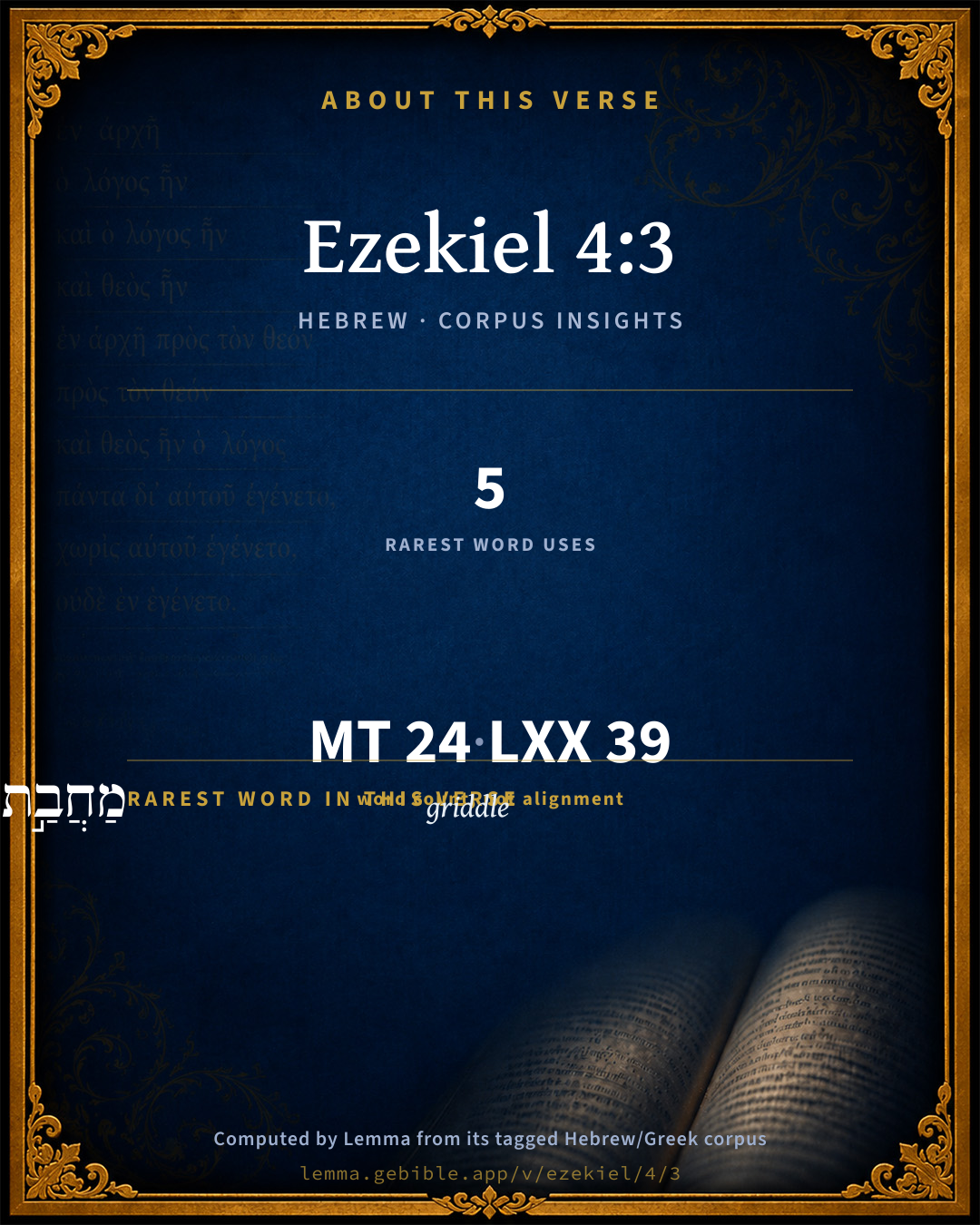
24
words
20
distinct lemmas
Prophets
section

Notable vocabulary

The rarest word here is מַחֲבַ֣ת griddle H4227 — appearing just 5 times in the whole Hebrew Bible.

Shared distinctive vocabulary

מַחֲבַ֣ת griddle H4227 occurs in 5 verses of the Hebrew Bible. Also found in:

Grammatical profile

  • 5 verbs
  • 10 nouns
  • 2 pronouns
  • 5 prepositions
  • 2 particles

Verb forms

  • קַח Qal · Imperative
  • וְנָתַתָּ֤ה Qal · Sequential Perfect
  • וַהֲכִינֹתָה֩ Hiphil · Sequential Perfect
  • וְהָיְתָ֤ה Qal · Sequential Perfect
  • וְצַרְתָּ֣ Qal · Sequential Perfect

Repetition

Words recur within this verse — often emphatic in Hebrew:

  • בַּרְזֶ֔ל iron H1270 ×2
  • בֵּינְךָ֖ between H996 ×2

Hebrew & Septuagint length

In English translation the verse runs 47 words from the Hebrew and 51 from the Septuagint (LXX English) — closely comparable.

A rough comparison of the two English renderings, which tokenize alike — not a word-level alignment.

Word counts can differ between the Hebrew and the Greek without any difference in meaning — e.g. the Hebrew direct-object marker אֵת has no separate Greek word, and Greek often adds the article ὁ.

In the original languages it is 24 Hebrew tokens and 39 Greek tokens — but the two are counted differently (Hebrew bundles its prefixes and suffixes into one token; the Greek is in lemma form), so that isn’t a like-for-like length.

Cross-references

9

Topical passages linked to Ezekiel 4:3 in the Treasury of Scripture Knowledge — connected by theme and wording, ordered by reader-vote popularity; previews shown in the World English Bible.

  • Isaiah 8:18 Behold, I and the children whom Yahweh has given me are for signs and for wonders in Israel from Yahweh of Hosts, who dwells in Mount Zion.
  • Isaiah 20:3 Yahweh said, Like as my servant Isaiah has walked naked and barefoot three years for a sign and a wonder concerning Egypt and concerning Ethiopia;
  • Ezekiel 12:6 In their sight shall you bear it on your shoulder, and carry it forth in the dark; you shall cover your face, that you don't see the land: for I have set you for a sign to the house of Israel.
  • Ezekiel 12:11 Say, I am your sign: like as I have done, so shall it be done to them; they shall go into exile, into captivity.
  • Ezekiel 24:24–27 Thus shall Ezekiel be to you a sign; according to all that he has done shall you do: when this comes, then shall you know that I am the Lord Yahweh.
  • Leviticus 2:5 If your offering is a meal offering of the baking pan, it shall be of unleavened fine flour, mixed with oil.
  • Jeremiah 39:1 It happened when Jerusalem was taken, (in the ninth year of Zedekiah king of Judah, in the tenth month, came Nebuchadrezzar king of Babylon and all his army against Jerusalem, and besieged it;
  • Luke 2:34 and Simeon blessed them, and said to Mary, his mother, "Behold, this child is set for the falling and the rising of many in Israel, and for a sign which is spoken against.
  • Hebrews 2:4 God also bearing witness with them, both by signs and wonders, and by various works of power, and by gifts of the Holy Spirit, according to his own will?

Cross-references courtesy of OpenBible.info (CC BY 4.0).

Hebrew and Greek witnesses Masoretic Hebrew ↔ Greek Septuagint

The same verse in the two great witnesses to the Old Testament, shown verse-for-verse.

These are two independent witnesses, not word-aligned to each other, and the Septuagint is shown in lemma (dictionary) form.

Hebrew Ezekiel 4:3 Masoretic · Westminster Leningrad Codex

וְאַתָּ֤ה קַח לְךָ֙ מַחֲבַ֣ת בַּרְזֶ֔ל וְנָתַתָּ֤ה אוֹתָהּ֙ קִ֣יר בַּרְזֶ֔ל בֵּינְךָ֖ וּבֵ֣ין הָעִ֑יר וַהֲכִינֹתָה֩ אֶת פָּנֶ֨יךָ אֵלֶ֜יהָ וְהָיְתָ֤ה בַמָּצוֹר֙ וְצַרְתָּ֣ עָלֶ֔יהָ א֥וֹת הִ֖יא לְבֵ֥ית יִשְׂרָאֵֽל

Take for yourself an iron pan, and set it for a wall of iron between you and the city: and set your face toward it, and it shall be besieged, and you shall lay siege against it. This shall be a sign to the house of Israel.

World English Bible · Public Domain

Greek LXX Ezekiel 4:3 Septuagint · lemma form

καί σύ λαμβάνω σεαυτοῦ τήγανον σιδηροῦς καί τίθημι αὐτός τοῖχος σιδηροῦς ἀνά μέσος σύ καί ἀνά μέσος ὁ πόλις καί ἑτοιμάζω ὁ πρόσωπον σύ ἐπί αὐτός καί εἰμί ἐν συγκλεισμός καί συνκλείω αὐτός σημεῖον εἰμί οὗτος ὁ υἱός ἰσραήλ

And take you to yourself an iron pan, and you shall set it for an iron wall between you and the city: and you shall set your face against it, and it shall be in a siege, and you shall besiege it. This is a sign to the children of Israel.

LXX2012 (modern English Septuagint) · Public Domain

Hebrew: Westminster Leningrad Codex (CC BY 4.0). Greek: Septuagint (public domain); English from LXX2012 (modern English Septuagint) (Public Domain). How the Septuagint differs from the Hebrew →

Targum (Aramaic paraphrase)

1

The Targum is the ancient Jewish Aramaic paraphrase of the Hebrew Scriptures — an interpretive translation, not the Hebrew text itself. Onkelos (literal) and Pseudo-Jonathan (expansive) render the Torah, and Jonathan the Prophets. Coverage is partial: where no permissively-licensed English translation exists for a verse, only the Aramaic is shown. This is verse-level text, not a word-by-word alignment to the Hebrew.

  1. Targum Jonathan Prophets (Joshua–Malachi)
    וְאַתְּ סַב לָךְ מַסְרֵית בַּרְזֵל וְתִתֵּן יָתָהּ כּוֹתֶל בַּרְזֶל בֵּינָךְ וּבֵין קַרְתָּא וְתַתְקֵן יַת אַפָךְ לָהּ וּתְהֵי בְצַיְרָא וּתְצוּר עֲלָהּ אָת הִיא לְבֵית יִשְׂרָאֵל:

    (no public-domain English translation for this verse)

    Targum Jonathan — Aramaic: “Mikraot Gedolot” (public domain). English: “Sefaria Community Translation” (CC0 1.0 (public-domain dedication)); “London "Chaldee Paraphrase," 1871” (public domain). Text via Sefaria.

Commentary

Notes on Ezekiel 4:3 from classic Christian and Jewish commentators (each source and its license shown beneath its notes). The classic Christian expositions comment on the surrounding passage and are grouped to its opening verse, so a note may address several verses; the Jewish commentaries on the Tanakh (Rashi and others) are per-verse, so they appear only where the commentator wrote on this verse.

Lemma curates 59 commentaries, every one of them public domain or Creative Commons licensed, each selected and text-cleaned for this edition rather than reprinted as found. About our sources →

Trapp's Complete Commentary

John Trapp

Eze 4:3 Moreover take thou unto thee an iron pan, and set it [for] a wall of iron between thee and the city: and set thy face against it, and it shall be besieged, and thou shalt lay siege against it. This [shall be] a sign to the house of Israel.

Ver. 3. Moreover take thou unto thee an iron pan.] Sartaginem ferream, in token of God’s hard and inflexible hatred bent against so hard-hearted a people; whom he will therefore fry as in a pan, and seethe as in a pot, {Jer 1:13} so that they shall "pine away in their iniquities."

Set thy face against it, and thou shalt lay siege.] This the prophet was to do in the name and person of God and his soldiers, the Chaldeans. Hard hearts make hard times, yea, they make Deum, natura sua mollem, misericordem, et melleum, durum esse et ferreum, as one saith - God to harden his hand, and hasten men’s destruction.

John Trapp, A Commentary or Exposition upon All the Books of the Old and New Testament (1647–1656) — public domain. Text from a community e-Sword module.

Tyndale Open Study Notes

Tyndale Open Resources

4:3 The prophet was to take on the role of God in this dramatic scene. The iron griddle set up between him and the city showed that Jerusalem had cut itself off from God. Meanwhile, the prophet was to turn his face aggressively toward the city, showing that God’s attention had not flagged but that he was implacably determined to destroy Jerusalem in the coming siege.

Tyndale Open Study Notes — © Tyndale Open Resources, licensed CC BY-SA 4.0. Text via the HelloAO Bible API.

Geneva Bible (1599)

Geneva Bible translators

Which signified the stubbornness and hardness of their heart.

Geneva Bible (1599) marginal notes — public domain. Text via Bolls.life.

Jamieson, Fausset & Brown

Robert Jamieson, A. R. Fausset & David Brown

iron pan--the divine decree as to the Chaldean army investing the city.

set it for a wall of iron between thee and the city--Ezekiel, in the person of God, represents the wall of separation between him and the people as one of iron: and the Chaldean investing army. His instrument of separating them from him, as one impossible to burst through.

set . . . face against it--inexorably (Psa 34:16). The exiles envied their brethren remaining in Jerusalem, but exile is better than the straitness of a siege.

Jamieson, Fausset & Brown — Commentary Critical and Explanatory on the Whole Bible (1871) — public domain (CC PDM 1.0). Text via the HelloAO Bible API.

Adam Clarke's Commentary

Verse 3. Take thou unto thee an iron pan] מחבת machabath, a flat plate or slice, as the margin properly renders it: such as are used in some countries to bake bread on, called a griddle or girdle, being suspended above the fire, and kept in a proper degree of heat for the purpose. A plate like this, stuck perpendicularly in the earth, would show the nature of a wall much better than any pan could do. The Chaldeans threw such a wall round Jerusalem, to prevent the besieged from receiving any succours, and from escaping from the city.

This shall be a sign to the house of Israel.] This shall be an emblematical representation of what shall actually take place.

Adam Clarke's Commentary on the Bible (1810–1826) — public domain. Text from a community e-Sword/MySword module.

Ellicott's Commentary for English Readers

(3) An iron pan.—The margin gives the sense more accurately, a flat plate. It was used for baking cakes (see Lev_2:5, marg.). This was to be set for a wall of iron between the prophet (representing the besiegers) and the city, doubtless as symbolical of the strength of the besiegers’ lines, and of the impossibility there would be of an escape from the city by a sally. Their foes should be made too strong for them defensively as well as offensively.

A sign to the house of Israel.—As already said, the tribe of Judah, with the associated remnants of the other tribes, is considered as representing the whole nation after the Assyrian captivity, and is spoken of as “the house of Israel” except when there is occasion to distinguish especially between the two parts of the nation. (See Eze_3:7; Eze_3:17; Eze_5:4; Eze_8:6; 2Ch_21:2; 2Ch_28:27, &c.) The prophecy would have been equally effective whether seen as a symbolic act or only related.

A Bible Commentary for English Readers, edited by Charles John Ellicott (1878–1897) — public domain. Text from a community e-Sword module.

The Cambridge Bible for Schools and Colleges

gen. ed. J. J. S. Perowne

3. an iron pan] As marg. plate, i.e. griddle on which cakes were fired (Lev_2:5). This common article the prophet is to set up between him and the city to represent an iron wall. As the plate is said to be an iron wall between him and the city it is most natural to interpret it of the powerful fortifications of Jerusalem (Ew.). It might, however, be a symbol of the implacable and iron severity of the siege, which itself but shews the inexorable grasp which the judgment of God has taken of the city. The word it in the end of the verse refers to the city; and the prophet plays the rôle of besieger.

All this is a sign to the house of Israel of what shall come to pass. Comp. ch. Eze_12:11.

The Cambridge Bible for Schools and Colleges (gen. ed. J. J. S. Perowne; Cambridge University Press, 1878–1918) — public domain. Text from a community e-Sword module.

John Gill's Exposition

Moreover take thou unto thee an iron pan,.... Which Kimchi thinks, for its metal, represented the hardness of the hearts of the people of Israel; and, for its colour, the blackness of their sins: though others are of opinion, this being a pan in which things are fried, it may signify the miseries of the Jews in captivity; the roasting of Ahab and Zedekiah in the fire, and particularly the burning of the city: others, the wrath of God against them, and his resolution to destroy them: but rather, since the use of it was as follows,

and set it for a wall of iron between thee and the city, it seems to represent all such things as are made use of by besiegers to screen them from the besieged; such as are now used are trenches, parapets, bastions, &c. for the prophet in this type is the besieger, representing the Chaldean army secure from the annoyance of those within the walls of the city:

and set thy face against it; with a firm resolution to besiege and take the city; which denotes both the settled wrath of God against this people, and the determined purpose of the king of Babylon not to move from it until he had taken it:

and it shall be besieged, and thou shalt lay siege against it; as an emblem of the army of the Chaldeans besieging it, which is confirmed by the next clause:

this shall be a sign to the house of Israel; of the city of Jerusalem being besieged by the Babylonians; this was a sign representing it, and giving them assurance of it.

John Gill's Exposition of the Whole Bible (1746–1763) — public domain (CC PDM 1.0). Text via the HelloAO Bible API.

Albert Barnes' Notes on the Bible

An iron pan - Another figure in the coming siege. On Assyrian sculptures from Nimroud and Kouyunjik there are sieges of cities with “forts, mounts, and rams;” and together with these we see a kind of shield set up on the ground, behind which archers are shooting. Such a shield would be represented by the “flat plate” (margin). Ezekiel was directed to take such a plate (part of his household furniture) and place it between him and the representation of the city.

A sign to the house of Israel - This “sign” was not necessarily acted before the people, but may simply have been described to them as a vivid representation of the event which it foretold. “Israel” stands here for the kingdom of Judah (compare Eze 3:7, Eze 3:17; Eze 5:4; Eze 8:6). After the captivity of the ten tribes the kingdom of Judah represented the whole nation. Hence, prophets writing after this event constantly address their countrymen as the house of Israel without distinction of tribes.

Albert Barnes' Notes on the Bible (1834–1885) — public domain. Text from a community e-Sword/MySword module.

Haydock's Catholic Bible Commentary

Pan, or plate, on which bread was usually baked. This was to represent the walls of the city. (Calmet)

George Leo Haydock (1774–1849), Haydock's Catholic Family Bible and Commentary, 1859 edition — public domain. Excludes Psalms (Douay-Rheims chapter numbering differs from Protestant) and Deuterocanonical books (Catholic canon only).

Matthew Poole's English Annotations

An iron pan, to signify the hardness and obstinacy of the besiegers; probably a frying-pan, on the plain part of which the the bearing the portrait of Jerusalem lying, the iron edges or brims compassed it round about, as a line drawn round a besieged city, out of which the distressed could not flee, into which no relief could be brought. It plainly noted the cruelty of the Chaldeans and future tortures of the Jews, who were like to be fried or broiled in this iron pan, as Jer 29:22; 2Ma 7:5.

Set it for a wall of iron; that it may resemble a wall of iron; for as impregnable as such a wall should the courage, resolution, and patience of the Chaldeans be attacking it.

Set thy face against it; fix thy displeased countenance against it, in token of my displeasure.

Thou shalt lay siege: if the prophet do represent him that sent him, then it speaks God’s appearing against these wicked ones.

This shall be a sign; all these things are signs and emblems usual with all, most usual with this prophet, who in this hieroglyphic foreshows the state of those that lived at Jerusalem.

Matthew Poole's English Annotations on the Holy Bible (1683–1685) — public domain. Text from a community e-Sword/MySword module.

Whedon's Commentary on the Bible

Daniel D. Whedon

3. An iron pan — This expression probably refers to the machines used by the Babylonians and Assyrians behind which the archers stood, shooting through a hole or window. Representations of these may be seen on the bas-reliefs from Nineveh where engines of this kind are shown in actual use. From fragments of these discovered, and now in the Louvre, it would appear that they were made of bronze or wickerwork and cased with leather (Private note from a well-known English Assyriologist). The prophet used the best representation of this well-known bulwark which his kitchen contained. The ordinary view merely regards this as representing “a firm, impregnable wall of partition, which the prophet, as messenger and representative of God, is to raise between himself and the beleaguered city” (Keil).

Set thy face against it — It was no new thing for Jerusalem to be besieged; but for the first time in history the people of Israel now see that the prophet and representative of Jehovah is taking sides with its enemies.

No wonder that Ezekiel at first grew “hot” (Eze_3:14) at the thought of acting such a part before his countrymen. No wonder that such a “sign” aroused attention and bitterest antagonism.

Daniel D. Whedon (gen. ed.), Commentary on the Old and New Testaments (1874–1909) — public domain. Text from a community e-Sword module.

The Pulpit Commentary

An iron pan. The word is used in Lev_2:5 Lev_6:21, et al., for a flat or shallow vessel in which cakes were baked or fried. Such a pan, like the Scotch "girdle," or our "gridiron," may well have formed part of the furniture of the prophet"s house when it was taken for this strange use. It was to represent the kind of shield or fence set up on the ground, from behind which the besiegers discharged their arrows. Such shields are seen, like the battering rams, in Assyrian bas-reliefs (Layard, "Nineveh," etc., 2:345). Other interpretations, which see in it the symbol of the circumvallation of the city, or of the impenetrable barrier which the sins of the people had set up between themselves and Jehovah, or of the prophet himself as strong and unyielding, (Jer_1:18) do not commendthemselves. The flat plate did not go round the city, and the spiritual meaning is out of harmony with the context. This shall be a sign, etc.. (comp. like forms in Eze_12:6, 11 24:25, 27) The exiles of Tel-Abib, who wore the only spectators of the prophet"s acts, are taken as representatives of "the house of Israel," that phrase being commonly used by Ezekiel, unless, as in vers. 5, 6, and Eze_37:16, there is a special reason for noting a distinction for Jonah as representing the whole nation.

The Pulpit Commentary (1880–1919), ed. H.D.M. Spence-Jones & Joseph S. Exell — public domain. Text from a community e-Sword module.

John Wesley's Explanatory Notes

A wall - That it may resemble a wall of iron, for as impregnable as such a wall, shall the resolution and patience of the Chaldeans be.

John Wesley, Explanatory Notes Upon the Whole Bible (1754–1765) — public domain. Text via the GEBible commentary corpus.

Rashi

Rabbi Shlomo Yitzchaki (Rashi)

an iron wall A semblance of the city wall that serves as a partition between the army and the city.

that is a sign that so will Jerusalem come under siege.

Rashi on the Tanakh — English translations: “The Judaica Press complete Tanach with Rashi, translated by A. J. Rosenberg” (CC BY 4.0); “Pentateuch with Rashi's commentary by M. Rosenbaum and A.M. Silbermann, 1929-1934” (public domain); “The Metsudah Tanach series, Lakewood, N.J” (CC BY 4.0); and “The Book of Joshua, Metsudah Publications, 1997” (CC BY 4.0). Text via Sefaria.

Lesson kit

Teaching starters — assembled from the data on this page, not authored interpretation. Every prompt links to the verse data it draws on. Edit before teaching.

Ezekiel, in the Prophets, opens this verse with 24 words (20 distinct Hebrew lemmas). Its most distinctive word is machăbath (“griddle”). A historical commentator’s framing appears above. Read the whole chapter for the surrounding context.

Discussion questions

  1. The word machăbath carries the sense “griddle.” How does it shape the verse?
  2. Leviticus 2:5 shares the word «griddle» with this verse. How do the two illuminate each other?
  3. “iron” occurs 2× in this one verse. What is the effect of the repetition?
  4. The translations on this page render this verse differently — a whole-verse word diff, not a word-by-word alignment. What might account for the different wordings?
  5. The verb «קַח» is Qal Imperative. How does its form color the action?
  6. Reading how Trapp's Complete Commentary and Tyndale Open Study Notes read this verse, where do the two commentators agree and where do they part?

Things to notice

Reading settings

Reading text

Shown beneath each verse's original-language words.

Old Testament
Old Testament edition

Read the OT as the Masoretic Hebrew (MT) or the Greek Septuagint (LXX).

English shown for the Greek Septuagint (in the Hebrew ↔ Greek comparison).

Comparing translations? Open the Compare panel on any verse page to stack up to four side by side.