
Isaiah 44:4

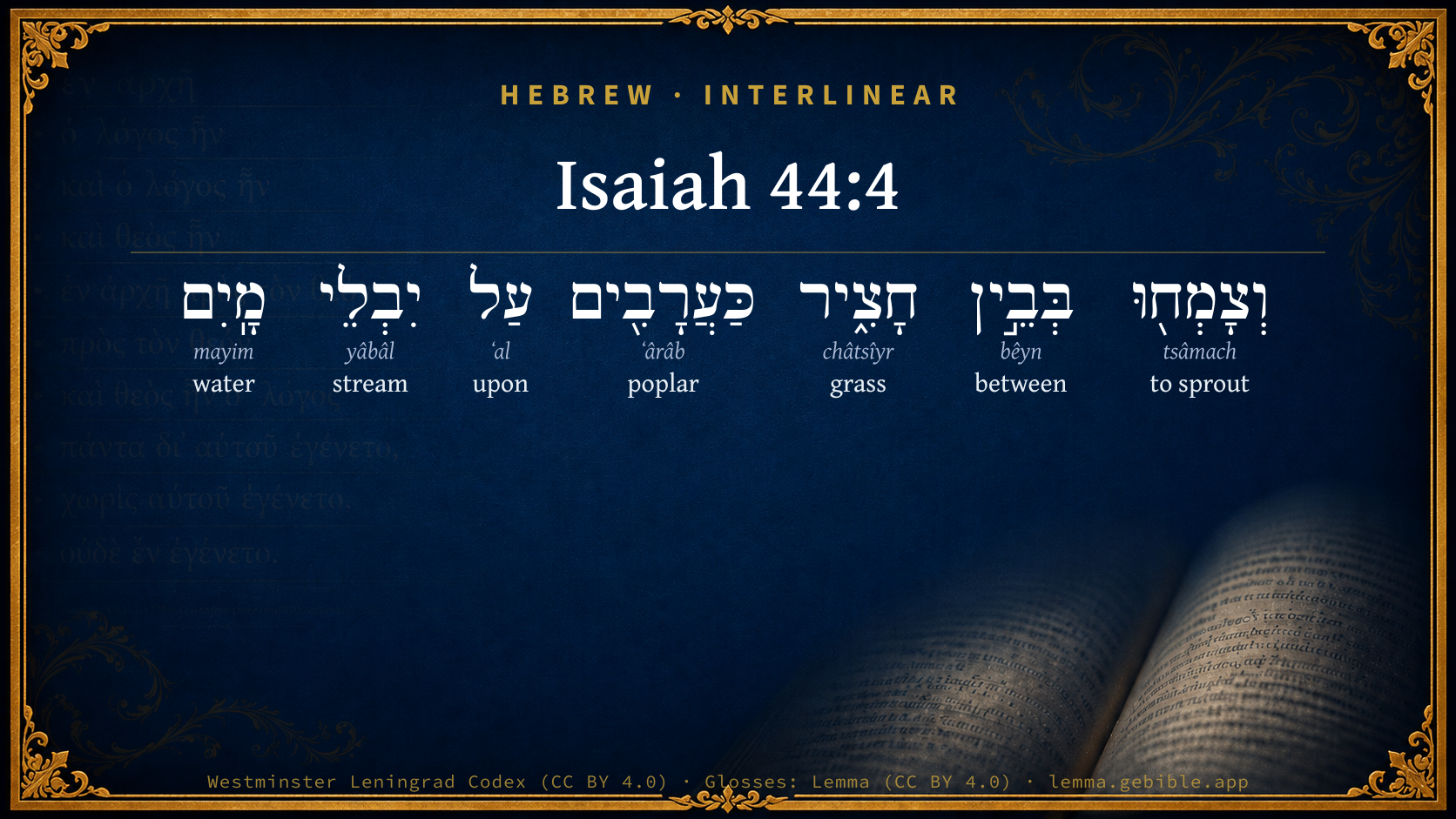
Hebrew (Westminster Leningrad Codex) Isaiah 44:4 appears in the Hebrew Old Testament. The text above is from the Westminster Leningrad Codex. Each word links to its Strong’s number, a concise gloss, and parsing drawn from the Open Scriptures Hebrew Bible morphology. Click any word for its full Brown-Driver-Briggs (BDB) entry.
Download image
Cite this verse

Isaiah 44:4 (World English Bible). Public Domain. Lemma interlinear Bible study tool, https://lemma.gebible.app/v/isaiah/44/4.

Show BibTeX & RIS
BibTeX
RIS
English Translation
and they shall spring up among the grass, as willows by the watercourses.
World English Bible · Public Domain
Download a study sheet

One document with this verse’s original text, its word-by-word gloss line, the meaning frame, cross-references with their text, attributed commentary, and full source and license credits — printable, and it pastes into notes with its structure intact.

This verse Autodidact and up

Study sheet (.html) Plain text (.txt)

A passage Seminary Student

Up to 50 verses in one chapter. A passage sheet keeps up to 6 commentary sources and 12 cross-references per verse, in the order this page ranks them, and says so on the sheet whenever that leaves anything out. Ask for a single verse and you get the Autodidact verse sheet above.

Everything on this page stays free to read, with no account — the sheet is a download of what is already on screen, not access to it.

Want to remove ads? Support Godless Engineer
Compare translations 3

The same verse in 3 English versions, stacked beneath the original-language interlinear above. Click any original word for its lexicon entry.

Each is an independent rendering of the whole verse — the interlinear is not word-aligned to these translations.

Highlighted words mark where these versions differ — a whole-verse word diff, not a word-by-word alignment.

  • World English Bible Public Domain
    and they shall spring up among the grass, as willows by the watercourses.
  • King James Version Public Domain
    And they shall spring up as among the grass, as willows by the water courses.
  • unfoldingWord Literal Text CC BY-SA 4.0
    And they will sprout in between the grass, like willows by courses of water.

unfoldingWord Literal Text — © unfoldingWord, licensed CC BY-SA 4.0. Word-aligned USFM3 via Door43 (git.door43.org/unfoldingWord/en_ult).

Versions to compare (up to 4)

3 of 4 selected

Show all 18 translations

Every available English version of this verse, each an independent rendering of the whole verse.

  • World English Bible Public Domain
    and they shall spring up among the grass, as willows by the watercourses.
  • Berean Standard Bible Public Domain
    They will sprout among the grass like willows by flowing streams.
  • Majority Standard Bible Public Domain
    They will sprout among the grass like willows by flowing streams.
  • King James Version Public Domain
    And they shall spring up as among the grass, as willows by the water courses.
  • American Standard Version (1901) Public Domain
    and they shall spring up among the grass, as willows by the watercourses.
  • Revised Version (1885) Public Domain
    and they shall spring up among the grass, as willows by the watercourses.
  • Geneva Bible (1599) Public Domain
    And they shall grow as among the grasse, and as the willowes by the riuers of waters.
  • Douay-Rheims (1899) Public Domain
    And they shall spring up among the herbs, as willows beside the running waters.
  • Young's Literal Translation Public Domain
    And they have sprung up as among grass, As willows by streams of water.
  • Literal Standard Version CC BY-SA 4.0
    And they have sprung up as among grass, || As willows by conduits of water.
  • Unlocked Literal Bible CC BY-SA 4.0
    They will spring up among the grass, like willows by the streams of water.
  • unfoldingWord Literal Text CC BY-SA 4.0
    And they will sprout in between the grass, like willows by courses of water.
  • Darby Bible Public Domain
    And they shall spring up among the grass, as willows by the water-courses.
  • World Messianic Bible Public Domain
    and they will spring up among the grass, as willows by the watercourses.
  • Webster's Bible Public Domain
    And they shall spring up as among the grass, as willows by the watercourses.
  • Free Bible Version CC BY-SA 4.0
    They will grow up among the grass, like willows beside streams.
  • Bible in Basic English Public Domain
    And they will come up like grass in a well-watered field, like water-plants by the streams.
  • JPS Tanakh (1917) Public Domain
    And they shall spring up among the grass, as willows by the watercourses.

Literal Standard Version (2020), Covenant Press — licensed CC BY-SA 4.0. Text via the HelloAO Bible API (eBible.org). Unlocked Literal Bible (unfoldingWord) — licensed CC BY-SA 4.0. Text via the HelloAO Bible API (eBible.org). unfoldingWord Literal Text — © unfoldingWord, licensed CC BY-SA 4.0. Word-aligned USFM3 via Door43 (git.door43.org/unfoldingWord/en_ult). Free Bible Version, Dr. Jonathan Gallagher — licensed CC BY-SA 4.0. Text via the HelloAO Bible API (eBible.org).

Word by word

More ways to search: Search by grammar → Find every occurrence → Compare this word →

Practice this passage: Drill this verse → Learn its vocabulary →

About this verse

These counts appear in no published source. They are computed here, from the morphology-tagged text and Lemma’s own curated glosses. What Lemma adds →

7
words
7
distinct lemmas
Prophets
section

Notable vocabulary

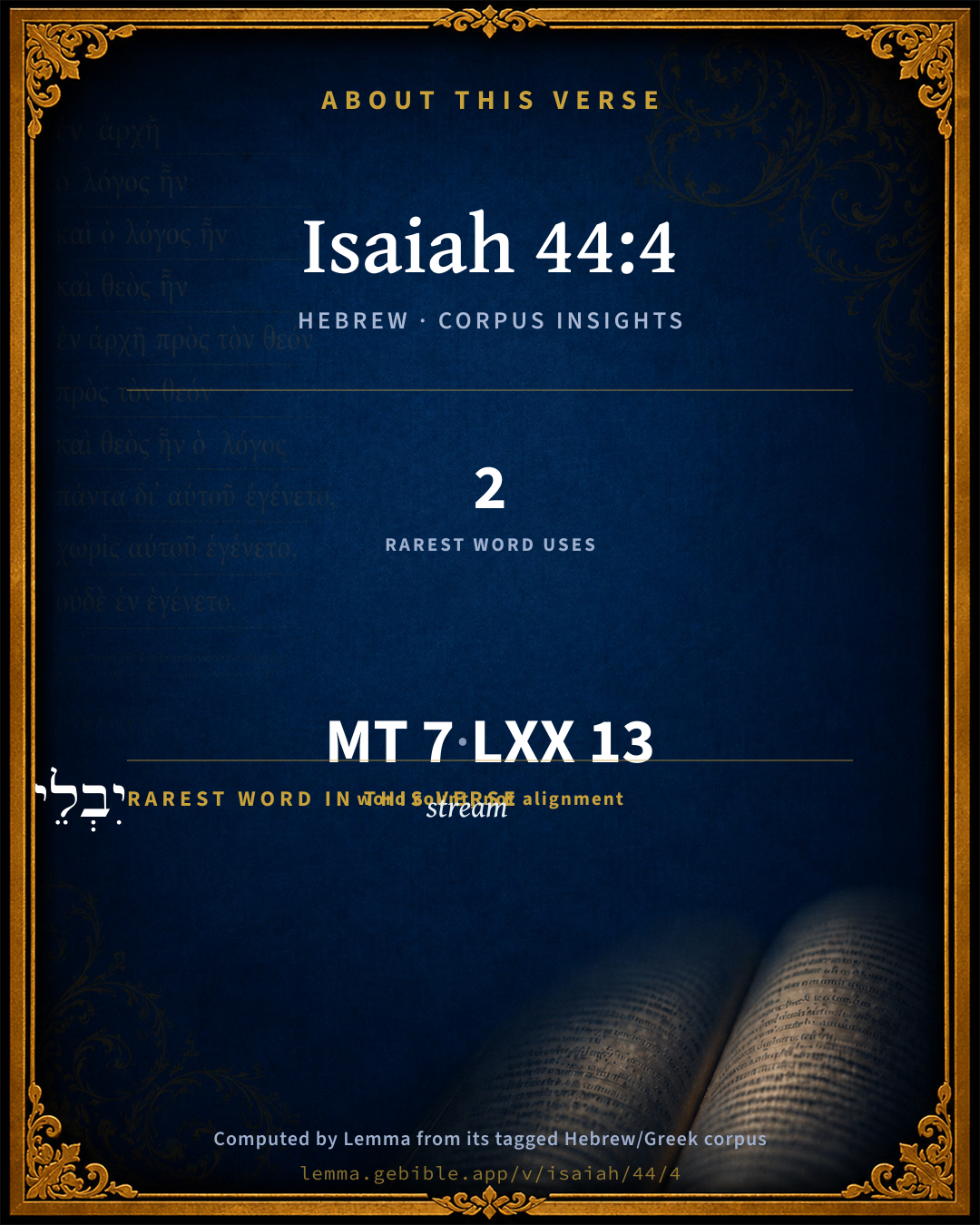
The rarest word here is יִבְלֵי stream H2988 — appearing just 2 times in the whole Hebrew Bible.

Shared distinctive vocabulary

יִבְלֵי stream H2988 occurs in 2 verses of the Hebrew Bible. Also found in:

Grammatical profile

  • 1 verb
  • 4 nouns
  • 2 prepositions

Verb forms

  • וְצָמְח֖וּ Qal · Sequential Perfect

Hebrew & Septuagint length

In English translation the verse runs 13 words from the Hebrew and 18 from the Septuagint (LXX English) — closely comparable.

A rough comparison of the two English renderings, which tokenize alike — not a word-level alignment.

Word counts can differ between the Hebrew and the Greek without any difference in meaning — e.g. the Hebrew direct-object marker אֵת has no separate Greek word, and Greek often adds the article ὁ.

In the original languages it is 7 Hebrew tokens and 13 Greek tokens — but the two are counted differently (Hebrew bundles its prefixes and suffixes into one token; the Greek is in lemma form), so that isn’t a like-for-like length.

Cross-references

11

Topical passages linked to Isaiah 44:4 in the Treasury of Scripture Knowledge — connected by theme and wording, ordered by reader-vote popularity; previews shown in the World English Bible.

  • Isaiah 58:11 and Yahweh will guide you continually, and satisfy your soul in dry places, and make strong your bones; and you shall be like a watered garden, and like a spring of water, whose waters don't fail.
  • Psalms 1:3 He will be like a tree planted by the streams of water, That brings forth its fruit in its season, Whose leaf also does not wither. Whatever he does shall prosper.
  • Psalms 92:13–15 They are planted in Yahweh's house. They will flourish in our God's courts.
  • Ezekiel 17:5 He took also of the seed of the land, and planted it in a fruitful soil; he placed it beside many waters; he set it as a willow tree.
  • Psalms 137:1–2 By the rivers of Babylon, there we sat down. Yes, we wept, when we remembered Zion.
  • Acts 4:4 But many of those who heard the word believed, and the number of the men came to be about five thousand.
  • Isaiah 61:11 For as the earth brings forth its bud, and as the garden causes the things that are sown in it to spring forth; so the Lord Yahweh will cause righteousness and praise to spring forth before all the nations.
  • Acts 2:41–47 Then those who gladly received his word were baptized. There were added that day about three thousand souls.
  • Acts 5:14 More believers were added to the Lord, multitudes of both men and women.
  • Leviticus 23:40 You shall take on the first day the fruit of goodly trees, branches of palm trees, and boughs of thick trees, and willows of the brook; and you shall rejoice before Yahweh your God seven days.
  • Job 40:22 The lotuses cover him with their shade. The willows of the brook surround him.

Cross-references courtesy of OpenBible.info (CC BY 4.0).

Hebrew and Greek witnesses Masoretic Hebrew ↔ Greek Septuagint

The same verse in the two great witnesses to the Old Testament, shown verse-for-verse.

These are two independent witnesses, not word-aligned to each other, and the Septuagint is shown in lemma (dictionary) form.

Hebrew Isaiah 44:4 Masoretic · Westminster Leningrad Codex

וְצָמְח֖וּ בְּבֵ֣ין חָצִ֑יר כַּעֲרָבִ֖ים עַל יִבְלֵי מָֽיִם

and they shall spring up among the grass, as willows by the watercourses.

World English Bible · Public Domain

Greek LXX Isaiah 44:4 Septuagint · lemma form

καί ἀνατέλλω ὡσεί χόρτος ἀνά μέσος ὕδωρ καί ὡς ἰτέα ἐπί παραῥέω ὕδωρ

and they shall spring up as grass between brooks, and as willows on the banks of running water.

LXX2012 (modern English Septuagint) · Public Domain

On this verse, The Biblical Illustrator discusses the Septuagint’s reading. Read the note in Commentary ↓

Hebrew: Westminster Leningrad Codex (CC BY 4.0). Greek: Septuagint (public domain); English from LXX2012 (modern English Septuagint) (Public Domain). How the Septuagint differs from the Hebrew →

Targum (Aramaic paraphrase)

1

The Targum is the ancient Jewish Aramaic paraphrase of the Hebrew Scriptures — an interpretive translation, not the Hebrew text itself. Onkelos (literal) and Pseudo-Jonathan (expansive) render the Torah, and Jonathan the Prophets. Coverage is partial: where no permissively-licensed English translation exists for a verse, only the Aramaic is shown. This is verse-level text, not a word-by-word alignment to the Hebrew.

  1. Targum Jonathan Prophets (Joshua–Malachi)
    וְיִתְרַבּוּן צַדִיקַיָא רַכִּיכִין וּמְפַנְקִין כְּלַבְלַבֵי עֲסַב כְּאִילָן דִמְשַׁלַח שָׁרְשׁוֹהִי עַל נַגְדִין דְמַיִין:

    The righteous shall grow, and tender and delicate as the flowers of the grass, as a tree that sends forth its roots by the streams of waters.

    Targum Jonathan — Aramaic: “Mikraot Gedolot” (public domain). English: “Sefaria Community Translation” (CC0 1.0 (public-domain dedication)); “London "Chaldee Paraphrase," 1871” (public domain). Text via Sefaria.

Commentary

Notes on Isaiah 44:4 from classic Christian and Jewish commentators (each source and its license shown beneath its notes). The classic Christian expositions comment on the surrounding passage and are grouped to its opening verse, so a note may address several verses; the Jewish commentaries on the Tanakh (Rashi and others) are per-verse, so they appear only where the commentator wrote on this verse.

Lemma curates 59 commentaries, every one of them public domain or Creative Commons licensed, each selected and text-cleaned for this edition rather than reprinted as found. About our sources →

Trapp's Complete Commentary

John Trapp

Isa 44:4 And they shall spring up [as] among the grass, as willows by the water courses.

Ver. 4. As willows by the water courses.] Not only as the grass, but by a further growth, as the willows, which are often looped, sed ab ipso vulnere vires sumunt, but soon thrust forth new branches; and though cut down to the bottom, yet will grow up again; {a} so will the Church and her children.

{a} Uberius resurgunt, altiusque excrescunt.

John Trapp, A Commentary or Exposition upon All the Books of the Old and New Testament (1647–1656) — public domain. Text from a community e-Sword module.

The Biblical Illustrator

Joseph S. Exell

Isa_44:4

And they shall spring up as among the grass

Springing up as grass

R.., more accurately, omits as; but the text is unquestionably corrupt. There is no doubt that the LXX. preserves the true reading: spring up as grass among the waters. (Prof. J. Skinner, D. D.)

As willows by the water-courses

The willow

Hebrews arab, a tree growing on the banks of streams in Palestine, Egypt, and Babylon (Lev_23:40; Job_40:22; Psa_137:2). It grows to a considerable size, and was found generally in groves. It has, indeed, been pointed out that the tree now called arab by the Arabs is not a willow but a species of poplar (Populus Euphratica)

As, however, this tree is confined to hot countries like those on the lower Euphrates, it seems more likely that the name was originally that of the willow, and that it was subsequently transferred to the poplar. The Arabic translation of the Bible renders the Hebrews arab by saphsaph, which means willow, or, according to the Talmud, a species of the willow growing by brooks. (J. Macpherson, M. A.)

Willows

(Hebrews arabim) are mentioned five times in the Bible, always associated with rivers or watercourses. The willow (Salix) is represented in Palestine by several species, though it is by no means a conspicuous tree in any part of the country. The weight of authority is decidedly in favour of the willow, which though not a conspicuous tree would be doubtless associated in the minds of the inhabitants with pleasurable feelings, as testifying to the presence of the much-prized water. (W. Houghton, M. A.)

The willow:

Branches of the garab, which R. Kiepert brought with him, according to Wetzsteins indication of the place, and which O. Kersten, the secretary of the Imperial German Consulate, sent to the Royal Herbarium at Berlin, show that the garab is the Oriental poplar, Populus Euphratica (Olivier), whose undergrowth may easily on superficial observation be confounded with willow bushes; but it is distinguished from the willow by its leaves, which, although small, are almost quite smooth-edged, and not saw-like. (F. Delitzsch, D. D.)

The growth of the willow:

In the Duke of Bedfords willow garden was a willow which grew in twenty years to the height of between 60 and 70 feet. Four feet from the ground it was 7 feet in circumference. A small cutting grew to the height of 25 feet in four years Fuller says. In the isle of Ely where willows flourish, there is a proverb to this effect, The profit by willows will buy the owner a horse, before that by other trees will pay for the saddle.

Willows by the water-courses

Every year we welcome the opening buds of the willow with their silky down, as among the first indications of approaching spring. The children delight to pluck off the shooting twigs, in their rambles in the meadows in search of early flowers. They call them palm branches, though they have little in common with the palm save that willow branches as well as palm branches were carried in the hand of the Jews on their great festival. There are many varieties of the willow, distributed over all parts of the globe, but they are most common in the temperate and sub-tropical regions, where they form a pleasing feature in the landscape, especially in the vicinity of ponds and rivers. The Jewish exiles in the watered plains of Babylon were painfully familiar with the willows, for on their branches they hung their silent harps and wept as they thought of far-away Zion (Psa_137:1-9.). Yet the prophet who came to his countrymen with the cheering promise of Divine pardon and speedy restoration to their native land, found in these same willows a beautiful illustration of the happy change that would be produced and the blessings that would speedily follow their restoration to Divine favour and Fatherland.

1. The rapid and luxuriant growth of the willow is suggestive. A mere stake driven into the ground in the vicinity of water where there is plenty of moisture will take root and bud into leaf and branch in a remarkably short space of time. We are familiar with the immense crop of long and slender twigs that shoot up in the summer months and are yearly cut for basket-making in the osier beds by the banks of our rivers. A well-watered soil seems to be the one thing necessary to ensure the life and growth of the willow. In the winter the pollards stand out in the landscape, gaunt and desolate, like old and rotten sign-posts, and the osier beds look like a muddled mass of chopped root stumps. But in summer there is a perfect transformation from apparent death into new life, with graceful and luxuriant growth and greenness. Now, it is winter with men when they live apart from God and strangers to the blessings and comforts of the Gospel. But as soon as men are brought under the gracious influence of the Gospel of Christ, and come into touch with the river of the water of life, all things are changed in them and for them. And the beauty and the joy for us is that so much of this change comes quickly. Certainly, for some of the choicest experiences of the Divine life the Christian has to wait. But very many of the comforts and beauties of the Gospel come to the Christian speedily.

2. The willow is capable of service. The wood of the willow is not to be compared to that of the oak and the other slow-growing forest trees. And yet there is a special power and service in the willow which make its cultivation important and of commercial value. Indeed, no growth in nature is without this capacity for service when it falls into the hands of those who know how to use it. You know what power may be found in the delicate pore of such grasses as the flax and hemp when it is properly prepared and spun into cordage. And the slender twigs of the willow, though so rapid in their growth, are yet so tough and flexible that they are extensively used in basket-making, which is, perhaps, the oldest industry in the world. The wood of the larger kinds of willow also is so tough and durable as well as flexible that the ancients employed it in the making of shields for the soldier and warships for the sailor. While the steamer has largely superseded the sailing boat, the paddle-blades of steamers are still made of willow-wood, and if shields have been superseded, the cricket fields of the world still make a large demand upon the willow for the best bats. Even more surprising is it to find that the most suitable charcoal for making gunpowder is procured from the willow-wood, so that even the slender willow, the whip and plaything of the child, can become a powerful force in war. And as soon as men come under the influence of the Gospel of Christ they become serviceable as they never were before. Even the youngest Christians are powers for good in many ways in all our Churches. While there are some things for which we need the firmness, wisdom, and experience of years, we have almost endless capacity and readiness for service in the young Christians. (J. Menzies.)

The Biblical Illustrator, edited by Joseph S. Exell (c. 1880s–1900s) — public domain. Text from a community e-Sword module.

Geneva Bible (1599)

Geneva Bible translators

That is, thy children and posterity shall increase wonderfully after their deliverance from Babylon.

Geneva Bible (1599) marginal notes — public domain. Text via Bolls.life.

Jamieson, Fausset & Brown

Robert Jamieson, A. R. Fausset & David Brown

they--thy "seed" and "offspring" (Isa 44:3).

as among--needlessly inserted in English Version. Rather, "The seed shall spring up as willows among the grass beside canals of water" [HORSLEY]. Or, "They shall spring up among the grass (that is, luxuriantly; for what grows in the midst of grass grows luxuriantly) as willows by the water-courses," which makes the parallel clauses better balanced [MAURER].

Jamieson, Fausset & Brown — Commentary Critical and Explanatory on the Whole Bible (1871) — public domain (CC PDM 1.0). Text via the HelloAO Bible API.

Adam Clarke's Commentary

Verse 4. They shall spring up as among the grass - "They shall spring up as the grass among the waters"] בבין חציר bebeyn chatsir, "They shall spring up in the midst of, or rather, in among, the grass." This cannot be right: eleven MSS., and thirteen editions, have כבין kebeyn, or כבן keben. Twenty-four MSS. read it without the י yod, בבן beben, in the son of the grass; and so reads the Chaldee; בבן beben, in the son of the grass.

Twenty-four MSS. of Dr. Kennicott's, thirty-three of De Rossi's, and one of my own, with six editions, have this reading. The Syriac, מבין mibbeyn. The true reading is in all probability כבין kebeyn; and the word מים mayim, which should have followed it, is lost out of the text: but it is happily supplied by the Septuagint, ὡς ανα μεσον ὑδατος, as among the water. "In every place where there is water, there is always grass; for water makes every thing grow in the east." Sir John Chardin's note on 1Kg 17:5. Harmer's Observations i. 64.

Adam Clarke's Commentary on the Bible (1810–1826) — public domain. Text from a community e-Sword/MySword module.

Ellicott's Commentary for English Readers

(4) As willows.—The same word as in Psa_137:2 and Isa_15:7. Botanists identify it with a species of Viburnum, which grows on the banks of streams, rather than with the “weeping” or other species of Salix.

A Bible Commentary for English Readers, edited by Charles John Ellicott (1878–1897) — public domain. Text from a community e-Sword module.

The Cambridge Bible for Schools and Colleges

gen. ed. J. J. S. Perowne

4. spring up as among the grass] R.V., more accurately, omits “as”; but the text is unquestionably corrupt. There is no doubt that the LXX. preserves the true reading: spring up as grass among the waters. (Instead of the impossible בבן חציר, read כבין מים חציר.)

willows] or poplars; see on ch. Isa_15:7.

The Cambridge Bible for Schools and Colleges (gen. ed. J. J. S. Perowne; Cambridge University Press, 1878–1918) — public domain. Text from a community e-Sword module.

John Gill's Exposition

And they shall spring up as among the grass,.... That is, such on whom the Spirit of the Lord shall be poured with his gifts and grace, and with the blessings of it: by the "grass" may be meant common believers, comparable to green grass, for their numbers, being many; for their weakness in themselves; for their flourishing condition; like grass for its greenness, and verdure, and its springing up by clear shining after rain; see Psa 72:6 and by those that "spring up among them" are intended the apostles and ministers of the word, who exceed common Christians in their gifts, and grace, and usefulness; grow up higher and taller than they, like palm trees and cedars in Lebanon; and as such exceed private saints as tall trees exceed the grass they grow among:

as willows by the water courses; a sort of trees well known, and which delight in watery places, and grow best on banks of rivers, and shoot up apace in a very short time, and spread their branches; so the apostles, after the effusion of the Spirit on them, grew quickly in gifts, and grace, and evangelic knowledge; and their usefulness spread far and near. The Targum is,

"the righteous shall grow tender and delicate as the flowers of the grass, as a tree that sends forth its roots by flows of water.''

John Gill's Exposition of the Whole Bible (1746–1763) — public domain (CC PDM 1.0). Text via the HelloAO Bible API.

Albert Barnes' Notes on the Bible

And they shall spring up - The idea is, that as plants and trees planted by water-courses, and in well-watered fields, grow and flourish, so should their children grow in virtue, hope, piety, and zeal.

As among the grass - They shall spring up and flourish as the grass does when abundantly watered from heaven. On the meaning of the unusual form of the word בבים bebēyn, in the Hebrew (“in among”), see Vitringa and Rosenmuller. The ב (b) here is undoubtedly an error of the transcriber for כ (k) (“as”) - an error which, from the similarity of the letters, might be readily made. The Septuagint reads it, Ὡς Hōs - ‘As.’ The Chaldee reads it, כ (k) (“as”).

As willows by the water-courses - Willows are usually planted in such places, and grow rapidly and luxuriantly. It denotes here, abundant increase, vigor and beauty; and means that their posterity would be greatly blessed of God. A similar figure to denote the prosperity and happiness of the righteous occurs in Psa 1:3 :

And he shall be like a tree planted by the rivers of water,

That bringeth forth his fruit in his season;

His leaf also shall not wither.

These two verses teach us:

1. That God will pour his blessings on the children of his people - a promise which in all ages, when parents are faithful, is abundantly fulfilled.

2. That one of the richest blessings which can be imparted to a people is, that God’s Spirit should descend on their children.

3. That the Spirit of God alone is the source of true happiness and prosperity to our children. All else - property, learning, accomplishment. beauty, vigor, will be vain. It is by his blessing only - by the influence of piety - that they will spring forth as among the grass, and like willows by the streams of water.

4. Parents should pray earnestly for a revival of religion. No better description can be given of a revival than that given here - the Spirit of God descending like streams and floods on the young; and their springing forth in the graces of piety as among the grass, and growing in love to God and love to mankind like willows by the water-courses. Who would not pray for such a work of grace? What family, what congregation, what people can be happy without it?

Albert Barnes' Notes on the Bible (1834–1885) — public domain. Text from a community e-Sword/MySword module.

Matthew Poole's English Annotations

They shall spring up as among the grass; they shall increase and flourish like grass, and those herbs and plants which grow up in the midst of it.

Matthew Poole's English Annotations on the Holy Bible (1683–1685) — public domain. Text from a community e-Sword/MySword module.

Whedon's Commentary on the Bible

Daniel D. Whedon

4. They — Jehovah’s spiritual seed, converted Jews and Gentiles.

Spring up as among the grass — In Isa_40:6-8, grass was the emblem for perishable mankind. In the midst of a frail human race God’s people are to flourish in beauty and abiding strength.

Daniel D. Whedon (gen. ed.), Commentary on the Old and New Testaments (1874–1909) — public domain. Text from a community e-Sword module.

The Pulpit Commentary

They shall spring up as among the grass. The LXX have, "As grass among the waters;" and this reading is followed by Bishop Lowth, Ewald, and Mr. Cheyne. But there does not seem to be any necessity for departing from the existing Hebrew text. As willows. There is some doubt whether the Hebrew word used (ereb) is rightly translated "willows." The modern yarab seems certainly not to be a "willow," but rather a species of Viburnum (see the long note in Delitzsch"s "Commentary on Isaiah," vol. 2. pp. 203, 204, Eng. trans.). It is, however, most strictly a water-plant, growing only "near flowing water."

The Pulpit Commentary (1880–1919), ed. H.D.M. Spence-Jones & Joseph S. Exell — public domain. Text from a community e-Sword module.

J. A. Alexander on Isaiah

Joseph Addison Alexander

“And they shall spring up in the midst of the grass, like willows on (or by) the water-courses.” This verse describes the effect of the irrigation and effusion promised in the one before it. The subject of the verb is the offspring or descendants of Israel, by whom the blessing was to be experienced. The grass and the willows are separated only by the rhythmical arrangement of the sentence. The simple meaning of the whole verse is, that they shall grow as willows grow among the grass, (i.e., in a moist or marshy spot).

Joseph Addison Alexander, The Prophecies of Isaiah (1846–1847; New York: Scribner, 1870–1878) — public domain. Text from a community e-Sword module.

Rashi

Rabbi Shlomo Yitzchaki (Rashi)

And they shall sprout among the grass among Esau (mss. and K’li Paz). [The Jewish nation will grow] through the proselytes who will join them. [The expression,] “among the grass” refers to Esau, for it is stated concerning Edom (supra 34:13): “And it shall be the habitat of jackals, an abode (חָצִיר) for ostriches.” (Editions reading, “Amalek,” are erroneous cf. reference.)

Rashi on the Tanakh — English translations: “The Judaica Press complete Tanach with Rashi, translated by A. J. Rosenberg” (CC BY 4.0); “Pentateuch with Rashi's commentary by M. Rosenbaum and A.M. Silbermann, 1929-1934” (public domain); “The Metsudah Tanach series, Lakewood, N.J” (CC BY 4.0); and “The Book of Joshua, Metsudah Publications, 1997” (CC BY 4.0). Text via Sefaria.

Ibn Ezra

Rabbi Abraham ibn Ezra

And they shall spring up. The pronoun they refers to My spirit, and My blessing, of the preceding verse; according to others to thine offspring. בבין חציר Like grass. Lit., between the grass, that is, as if they were between grass. They will increase and multiply.

Ibn Ezra on the Tanakh — English translations: “Sefaria Community Translation” (CC0 1.0 (public-domain dedication)); “Yalkut, Sifsei Chachomim Chumash, Metsudah Publications, 2009” (CC BY 4.0); and “Commentary of Ibn Ezra on Isaiah - trans. by M. Friedlander, 1873” (public domain). Text via Sefaria.

Lesson kit

Teaching starters — assembled from the data on this page, not authored interpretation. Every prompt links to the verse data it draws on. Edit before teaching.

Isaiah, in the Prophets, opens this verse with 7 words (7 distinct Hebrew lemmas). Its most distinctive word is yâbâl (“stream”). A historical commentator’s framing appears above. Read the whole chapter for the surrounding context.

Discussion questions

  1. The word yâbâl carries the sense “stream.” How does it shape the verse?
  2. How does Isaiah 30:25, which shares the word «stream», read alongside this verse?
  3. These translations render this verse differently; the difference is in the English rendering, not the original. What questions does that raise?
  4. «וְצָמְח֖וּ» is a Qal Sequential Perfect verb. How does that grammatical form shape the action described?
  5. Compare how Trapp's Complete Commentary and The Biblical Illustrator read this verse. Where do they agree or differ?

Things to notice

Reading settings

Reading text

Shown beneath each verse's original-language words.

Old Testament
Old Testament edition

Read the OT as the Masoretic Hebrew (MT) or the Greek Septuagint (LXX).

English shown for the Greek Septuagint (in the Hebrew ↔ Greek comparison).

Comparing translations? Open the Compare panel on any verse page to stack up to four side by side.