Joshua 8:12

Hebrew (Westminster Leningrad Codex) Joshua 8:12 appears in the Hebrew Old Testament. The text above is from the Westminster Leningrad Codex. Each word links to its Strong’s number, a concise gloss, and parsing drawn from the Open Scriptures Hebrew Bible morphology. Click any word for its full Brown-Driver-Briggs (BDB) entry.
Download image
Cite this verse

Joshua 8:12 (World English Bible). Public Domain. Lemma interlinear Bible study tool, https://lemma.gebible.app/v/joshua/8/12.

Show BibTeX & RIS
BibTeX
RIS
English Translation
He took about five thousand men, and set them in ambush between Bethel and Ai, on the west side of the city.
World English Bible · Public Domain
Download a study sheet

One document with this verse’s original text, its word-by-word gloss line, the meaning frame, cross-references with their text, attributed commentary, and full source and license credits — printable, and it pastes into notes with its structure intact.

This verse Autodidact and up

Study sheet (.html) Plain text (.txt)

A passage Seminary Student

Up to 50 verses in one chapter. A passage sheet keeps up to 6 commentary sources and 12 cross-references per verse, in the order this page ranks them, and says so on the sheet whenever that leaves anything out. Ask for a single verse and you get the Autodidact verse sheet above.

Everything on this page stays free to read, with no account — the sheet is a download of what is already on screen, not access to it.

Want to remove ads? Support Godless Engineer
Compare translations 3

The same verse in 3 English versions, stacked beneath the original-language interlinear above. Click any original word for its lexicon entry.

Each is an independent rendering of the whole verse — the interlinear is not word-aligned to these translations.

Highlighted words mark where these versions differ — a whole-verse word diff, not a word-by-word alignment.

  • World English Bible Public Domain
    He took about five thousand men, and set them in ambush between Bethel and Ai, on the west side of the city.
  • King James Version Public Domain
    And he took about five thousand men, and set them to lie in ambush between Bethel and Ai, on the west side of the city.
  • unfoldingWord Literal Text CC BY-SA 4.0
    And he had taken about 5, 000 men, and he had set them ambush between Bethel and between Ai, from the west of the city.

unfoldingWord Literal Text — © unfoldingWord, licensed CC BY-SA 4.0. Word-aligned USFM3 via Door43 (git.door43.org/unfoldingWord/en_ult).

Versions to compare (up to 4)

3 of 4 selected

Show all 18 translations

Every available English version of this verse, each an independent rendering of the whole verse.

  • World English Bible Public Domain
    He took about five thousand men, and set them in ambush between Bethel and Ai, on the west side of the city.
  • Berean Standard Bible Public Domain
    Now Joshua had taken about five thousand men and set up an ambush between Bethel and Ai, to the west of the city.
  • Majority Standard Bible Public Domain
    Now Joshua had taken about five thousand men and set up an ambush between Bethel and Ai, to the west of the city.
  • King James Version Public Domain
    And he took about five thousand men, and set them to lie in ambush between Bethel and Ai, on the west side of the city.
  • American Standard Version (1901) Public Domain
    And he took about five thousand men, and set them in ambush between Beth-el and Ai, on the west side of the city.
  • Revised Version (1885) Public Domain
    And he took about five thousand men, and set them in ambush between Beth-el and Ai, on the west side of the city.
  • Geneva Bible (1599) Public Domain
    And hee tooke about fiue thousande men, and set them to lye in waite betweene Beth-el and Ai, on the Westside of the citie.
  • Douay-Rheims (1899) Public Domain
    And he had chosen five thousand men, and set them to lie in ambush between Bethel and Hai, on the west side of the same city:
  • Young's Literal Translation Public Domain
    And he taketh about five thousand men, and setteth them an ambush between Bethel and Ai, on the west of the city;
  • Literal Standard Version CC BY-SA 4.0
    And he takes about five thousand men, and sets them [for] an ambush between Bethel and Ai, on the west of the city;
  • Unlocked Literal Bible CC BY-SA 4.0
    He took about five thousand men and set them in ambush on the west side of the city between Bethel and Ai.
  • unfoldingWord Literal Text CC BY-SA 4.0
    And he had taken about 5, 000 men, and he had set them ambush between Bethel and between Ai, from the west of the city.
  • Darby Bible Public Domain
    Now he had taken about five thousand men, and set them in ambush between Bethel and Ai, on the west of the city.
  • World Messianic Bible Public Domain
    He took about five thousand men, and set them in ambush between Bethel and Ai, on the west side of the city.
  • Webster's Bible Public Domain
    And he took about five thousand men; and set them to lie in ambush between Beth-el and Ai, on the west side of the city.
  • Free Bible Version CC BY-SA 4.0
    He took about five thousand men and had them lie in ambush between Bethel and Ai, to the west of the town.
  • Bible in Basic English Public Domain
    And taking about five thousand men, he put them in position for a surprise attack on the west side of Ai, between Beth-el and Ai.
  • JPS Tanakh (1917) Public Domain
    And he took about five thousand men, and set them in ambush between Beth-el and Ai, on the west side of Ai.

Literal Standard Version (2020), Covenant Press — licensed CC BY-SA 4.0. Text via the HelloAO Bible API (eBible.org). Unlocked Literal Bible (unfoldingWord) — licensed CC BY-SA 4.0. Text via the HelloAO Bible API (eBible.org). unfoldingWord Literal Text — © unfoldingWord, licensed CC BY-SA 4.0. Word-aligned USFM3 via Door43 (git.door43.org/unfoldingWord/en_ult). Free Bible Version, Dr. Jonathan Gallagher — licensed CC BY-SA 4.0. Text via the HelloAO Bible API (eBible.org).

Word by word

More ways to search: Search by grammar → Find every occurrence → Compare this word →

Practice this passage: Drill this verse → Learn its vocabulary →

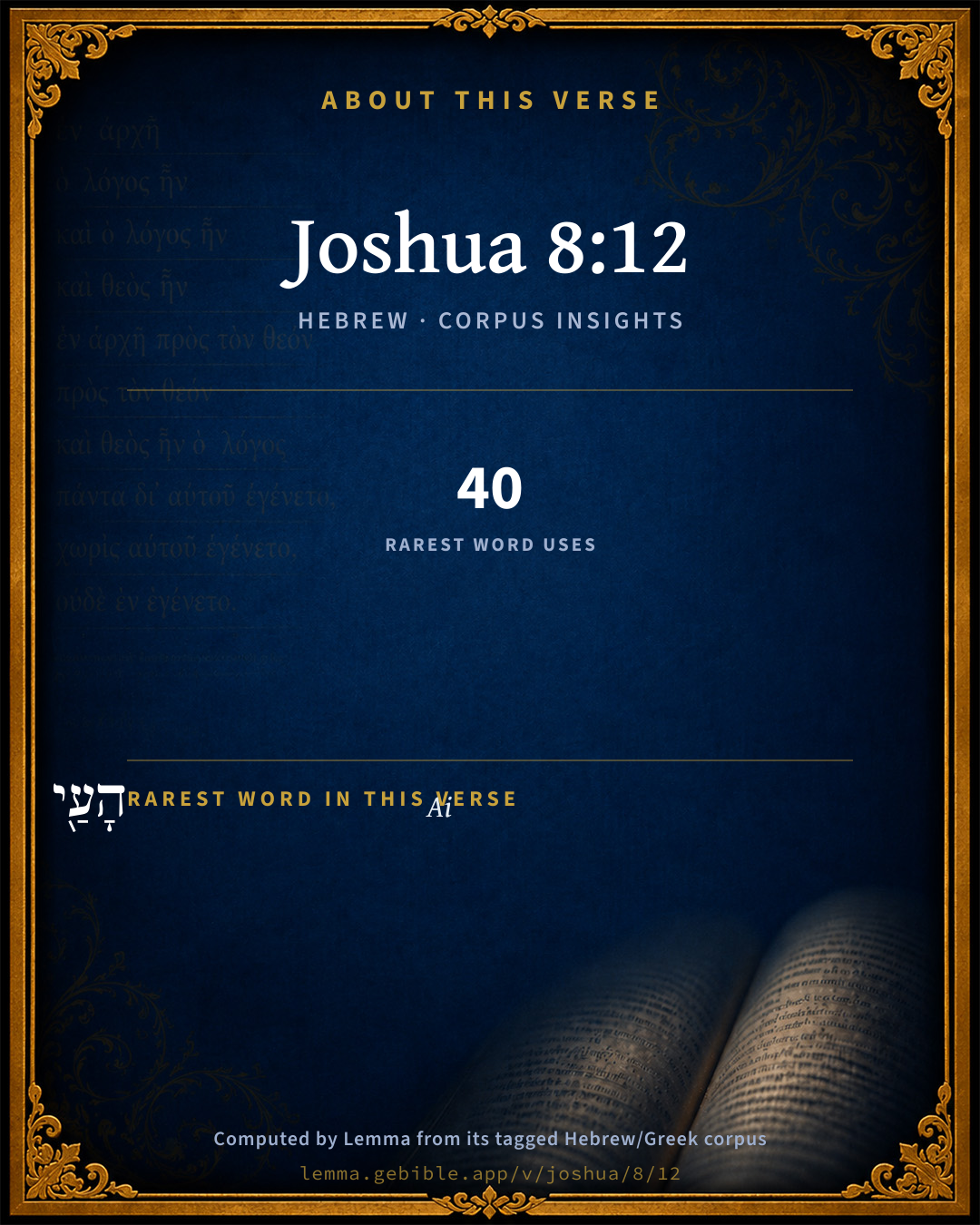
הָעַ֖י
ʻAy
H5857
“the · Ai”
Particle, Definite Article + Noun, Proper
Part of Speech
Particle + Noun
Type
Proper
Full BDB Definition

Origin: for H5856

TWOT: None

Ai or Aija or Aiath or Hai = "heap of ruins" - a city lying east of Bethel and beside Bethaven near Jericho and the 2nd city taken on the invasion of Canaan - a city of the Ammonites on the east of the Jordan and apparently attached to Heshbon
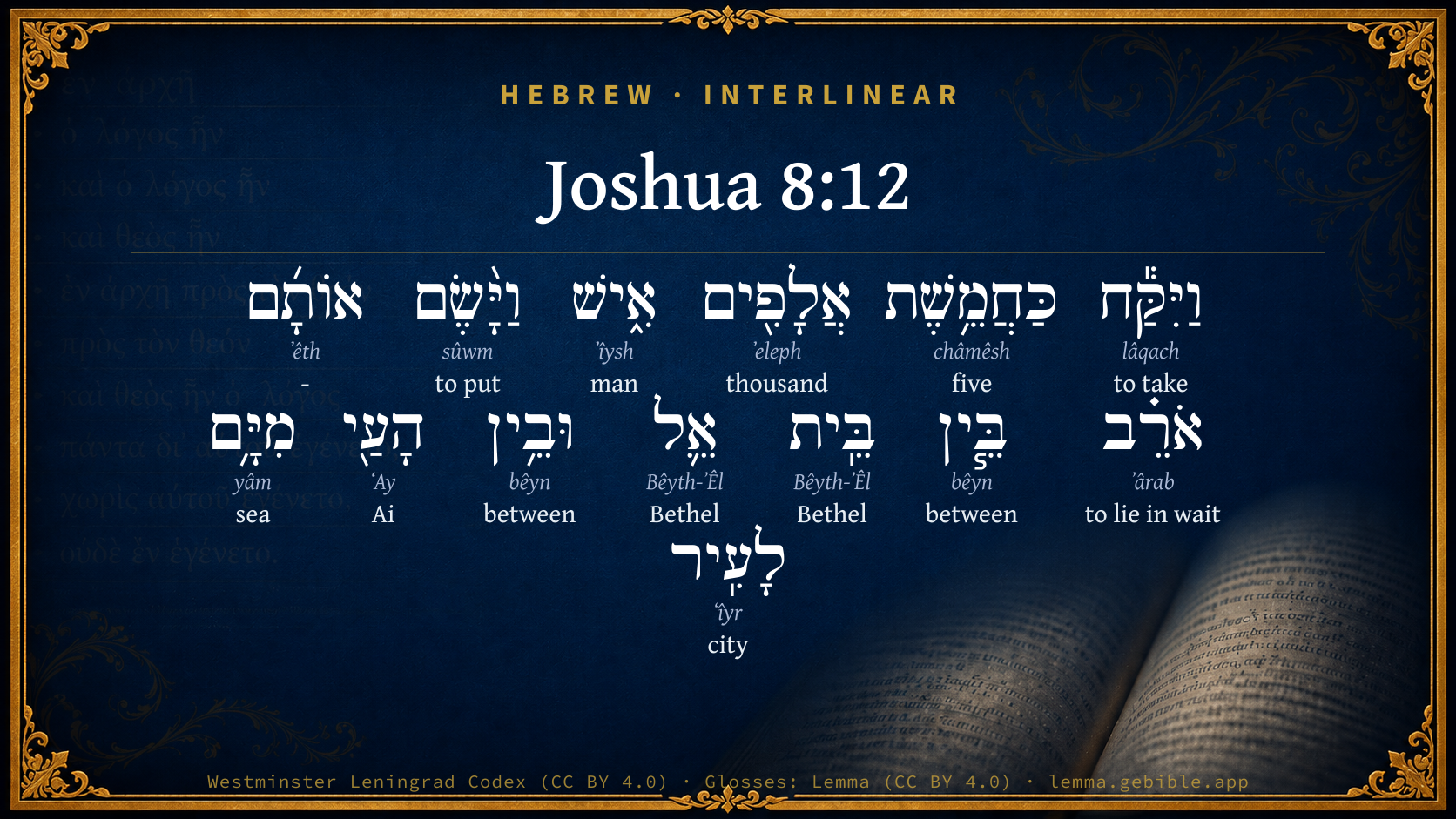
  1. וַיִּקַּ֕ח lâqach H3947 “and · to take” Conjunction + Verb, Qal, Sequential Imperfect, 3rd Person, Masculine, Singular
  2. כַּחֲמֵ֥שֶׁת châmêsh H2568 “like/as · five” Preposition + Adjective, Cardinal number, Masculine, Singular, Construct
  3. אֲלָפִ֖ים ʼeleph H505 “thousand” Adjective, Cardinal number, Both, Plural, Absolute
  4. אִ֑ישׁ ʼîysh H376 “man” Noun, Common, Masculine, Singular, Absolute
  5. וַיָּ֨שֶׂם sûwm H7760 “and · to put” Conjunction + Verb, Qal, Sequential Imperfect, 3rd Person, Masculine, Singular
  6. אוֹתָ֜ם ʼêth H853 “- · them” Particle, Direct Object + Suffix, Personal, 3rd Person, Masculine, Plural
  7. אֹרֵ֗ב ʼârab H693 “lying in wait” Verb, Qal, Participle Active, Masculine, Singular, Absolute
  8. בֵּ֧ין bêyn H996 “between” Preposition
  9. בֵּֽית Bêyth-ʼÊl H1008 “Bethel” Noun, Proper
  10. אֵ֛ל Bêyth-ʼÊl H1008 “Bethel” Noun, Proper
  11. וּבֵ֥ין bêyn H996 “and · between” Conjunction + Preposition
  12. מִיָּ֥ם yâm H3220 “from · sea” Preposition + Noun, Common, Masculine, Singular, Absolute
  13. לָעִֽיר ʻîyr H5892 “to/for the · city” Preposition, Determined + Noun, Common, Feminine, Singular, Absolute

About this verse

These counts appear in no published source. They are computed here, from the morphology-tagged text and Lemma’s own curated glosses. What Lemma adds →

14
words
12
distinct lemmas
Historical
section

Shared distinctive vocabulary

הָעַ֖י Ai H5857 occurs in 34 verses of the Hebrew Bible. Also found in:

Grammatical profile

  • 3 verbs
  • 6 nouns
  • 2 adjectives
  • 2 prepositions
  • 1 particle

Verb forms

  • וַיִּקַּ֕ח Qal · Sequential Imperfect
  • וַיָּ֨שֶׂם Qal · Sequential Imperfect
  • אֹרֵ֗ב Qal · Participle Active

Repetition

Words recur within this verse — often emphatic in Hebrew:

  • בֵּ֧ין between H996 ×2
  • בֵּֽית Bethel H1008 ×2

Hebrew & Septuagint length

In English translation the verse runs 22 words from the Hebrew and 11 from the Septuagint (LXX English) — the Septuagint runs noticeably shorter here. See the side-by-side →

A rough comparison of the two English renderings, which tokenize alike — not a word-level alignment.

Word counts can differ between the Hebrew and the Greek without any difference in meaning — e.g. the Hebrew direct-object marker אֵת has no separate Greek word, and Greek often adds the article ὁ.

Cross-references

1

Topical passages linked to Joshua 8:12 in the Treasury of Scripture Knowledge — connected by theme and wording, ordered by reader-vote popularity; previews shown in the World English Bible.

  • Joshua 8:2–3 You shall do to Ai and her king as you did to Jericho and her king: only the spoil of it, and the cattle of it, shall you take for a prey to yourselves: set you an ambush for the city behind it.

Cross-references courtesy of OpenBible.info (CC BY 4.0).

Hebrew and Greek witnesses Masoretic Hebrew ↔ Greek Septuagint

The same verse in the two great witnesses to the Old Testament, shown verse-for-verse.

Here the Septuagint runs noticeably shorter than the Hebrew — LXX2012 (modern English Septuagint) 11 words vs World English Bible 22. A rough length comparison of the two English translations, not a word-level alignment — read both below.

These are two independent witnesses, not word-aligned to each other, and the Septuagint is shown in lemma (dictionary) form.

Hebrew Joshua 8:12 Masoretic · Westminster Leningrad Codex

וַיִּקַּ֕ח כַּחֲמֵ֥שֶׁת אֲלָפִ֖ים אִ֑ישׁ וַיָּ֨שֶׂם אוֹתָ֜ם אֹרֵ֗ב בֵּ֧ין בֵּֽית אֵ֛ל וּבֵ֥ין הָעַ֖י מִיָּ֥ם לָעִֽיר

He took about five thousand men, and set them in ambush between Bethel and Ai, on the west side of the city.

World English Bible · Public Domain

Greek LXX Joshua 8:12 Septuagint · lemma form

καί ὁ ἔνεδρον ὁ πόλις ἀπό θάλασσα

And the ambuscade was on the west side of the city.

LXX2012 (modern English Septuagint) · Public Domain

On this verse, The Pulpit Commentary discusses the Septuagint’s reading. Read the note in Commentary ↓

Hebrew: Westminster Leningrad Codex (CC BY 4.0). Greek: Septuagint (public domain); English from LXX2012 (modern English Septuagint) (Public Domain). How the Septuagint differs from the Hebrew →

Targum (Aramaic paraphrase)

1

The Targum is the ancient Jewish Aramaic paraphrase of the Hebrew Scriptures — an interpretive translation, not the Hebrew text itself. Onkelos (literal) and Pseudo-Jonathan (expansive) render the Torah, and Jonathan the Prophets. Coverage is partial: where no permissively-licensed English translation exists for a verse, only the Aramaic is shown. This is verse-level text, not a word-by-word alignment to the Hebrew.

  1. Targum Jonathan Prophets (Joshua–Malachi)
    וּדְבַר כְּחַמְשָׁא אַלְפִין גַבְרָא וְשַׁוִי יַתְהוֹן כְּמָנָא בֵּין בֵּית אֵל וּבֵין עָי מִמַעֲרָב לְעָי:

    (no public-domain English translation for this verse)

    Targum Jonathan — Aramaic: “Mikraot Gedolot” (public domain). English: “Sefaria Community Translation” (CC0 1.0 (public-domain dedication)); “London "Chaldee Paraphrase," 1871” (public domain). Text via Sefaria.

Commentary

Notes on Joshua 8:12 from classic Christian and Jewish commentators (each source and its license shown beneath its notes). The classic Christian expositions comment on the surrounding passage and are grouped to its opening verse, so a note may address several verses; the Jewish commentaries on the Tanakh (Rashi and others) are per-verse, so they appear only where the commentator wrote on this verse.

Lemma curates 59 commentaries, every one of them public domain or Creative Commons licensed, each selected and text-cleaned for this edition rather than reprinted as found. About our sources →

Trapp's Complete Commentary

John Trapp

Jos 8:12 And he took about five thousand men, and set them to lie in ambush between Bethel and Ai, on the west side of the city.

Ver. 12. Between Bethel and Ai.] Those two confederate cities, in woods and coverts, probably in the wilderness of Bethaven. {Jos 18:12-13}

John Trapp, A Commentary or Exposition upon All the Books of the Old and New Testament (1647–1656) — public domain. Text from a community e-Sword module.

Joseph Benson's Commentary

Jos 8:12. He took about five thousand men and set them to lie in ambush — Here commentators are divided. The learned Bishop Patrick, with many others, (see Le Clerc and Calmet,) has given it as his opinion, that, besides the thirty thousand whom Joshua had sent off before to lie in ambush, (Jos 8:3-4,) he now detached five thousand more to guard the roads, and intercept such as might endeavour to save themselves by flight; or to strengthen those that were first sent and that he appeared in arms against the city; with his whole force, according to God’s express command, (Jos 8:1,) to take all the people of war with him. And certainly the letter of the text favours this interpretation. Many, however, think, that all the people were taken only to encamp near the city, and that out of them Joshua chose thirty thousand to be employed in the action, out of which he detached five thousand to lie in ambush, which were as many, they think, as could be supposed to march without being discovered, and then, that with the remaining twenty-five thousand he made the open attack. Or else that the attack was made with the thirty thousand, and that the five thousand formed a separate detachment drawn from the rest of the people. The matter is not perfectly clear, or free from difficulty, either way; and the reader is left to form his own judgment of it from the statement now given.

Joseph Benson's Commentary on the Old and New Testaments (1811–1818) — public domain. Text from a community e-Sword module.

Geneva Bible (1599)

Geneva Bible translators

He sent these few, that the others which lay in ambush might not be discovered.

Geneva Bible (1599) marginal notes — public domain. Text via Bolls.life.

Ellicott's Commentary for English Readers

(12) And he took about five thousand men, and set them to lie in ambush . . .—Is this a fresh body, or only a portion of the thirty thousand mentioned in Jos_8:3? It is, of course, possible that the body of thirty thousand, having closed the communications between Bethel and Ai on the first night, and finding that they were more numerous than was necessary, had rejoined Joshua when he came up, and that a small body of five thousand was told off for the service on the next day. But after carefully studying the natural features of the position by the Ordnance map (of which I have been able to enjoy the advantage at this point of my work), I am inclined to think that both forces were employed—the thirty thousand and the five thousand—and for distinct services. There are two ravines, which come to a head between Beitin (Bethel) and et-Tel (Ai). The body of men who were to fire the town of Ai were posted in the one nearer to Ai. The larger body, whose business was to prevent any interference from the side of Bethel, were posted in the ravine next to that city, where they had been from the first. If it be remembered, as was before observed, that Joshua was attacking a fortified town, which was protected in flank by another town, and that it was necessary to be prepared for all contingencies from the first, the meaning of his movements will be apparent.

A Bible Commentary for English Readers, edited by Charles John Ellicott (1878–1897) — public domain. Text from a community e-Sword module.

The Cambridge Bible for Schools and Colleges

gen. ed. J. J. S. Perowne

12. he took] Or rather, had taken.

between Beth-el and Ai] Comp. ch. Jos_7:2 with Gen_12:8; Gen_13:3.

The Cambridge Bible for Schools and Colleges (gen. ed. J. J. S. Perowne; Cambridge University Press, 1878–1918) — public domain. Text from a community e-Sword module.

John Gill's Exposition

And he took about five thousand men, and set them to lie in ambush,.... This was another ambush, as both Jarchi and Kimchi observe; and the latter adds, perhaps he set them nearer the city than the former; though some are of opinion that these are the same ambush spoken of, whose number is here given, being set on the same side of the city; and they suppose that Joshua had with him but thirty thousand men in all, five thousand of which he sent to lie in ambush, and the other twenty five thousand remained with him; but it seems clear that all the men of war were to be taken, and were taken by them, and that out of them thirty thousand were sent by him to lie in wait at first, and now five thousand more:

between Bethel and Ai, on the west side of the city; and though they were on the same side of the city with the first and larger ambush, yet, as Abarbinel observes, they might be set nearer the city and to the army; and he supposes the first ambush was to take the city, and the second little ambush, as he calls it, was placed, that when the men of the city came out, they might make a noise and a stir, and skirmish with them, that so they might not come upon the camp suddenly.

John Gill's Exposition of the Whole Bible (1746–1763) — public domain (CC PDM 1.0). Text via the HelloAO Bible API.

Albert Barnes' Notes on the Bible

He took - Rather “had taken;” the words refer to the ambuscade which Joshua had detached during the previous night.

Albert Barnes' Notes on the Bible (1834–1885) — public domain. Text from a community e-Sword/MySword module.

Haydock's Catholic Bible Commentary

Five thousand. These were part of the 30,000 mentioned above, ver. 3 . (Challoner) --- Josue had given orders to have them placed in ambush apart; (Calmet) unless, perhaps, he places these himself in some secret place. (Haydock)

George Leo Haydock (1774–1849), Haydock's Catholic Family Bible and Commentary, 1859 edition — public domain. Excludes Psalms (Douay-Rheims chapter numbering differs from Protestant) and Deuterocanonical books (Catholic canon only).

Matthew Poole's English Annotations

And he took, or, rather, but he had taken, to wit, out of the said number of thirty thousand, for this is added by way of recapitulation and further explication of what is said in general, Jos 8:9.

Matthew Poole's English Annotations on the Holy Bible (1683–1685) — public domain. Text from a community e-Sword/MySword module.

Whedon's Commentary on the Bible

Daniel D. Whedon

12. And he took about five thousand — The Hebrew has no separate form for the pluperfect tense, hence we are justified in rendering an indefinite past tense by the pluperfect when the context requires it, as the Vulgate has rendered this — had taken and had set.

Daniel D. Whedon (gen. ed.), Commentary on the Old and New Testaments (1874–1909) — public domain. Text from a community e-Sword module.

The Pulpit Commentary

And he took about five thousand men (see above, ver. 3). We must translate had taken. The repetition is quite in the manner of the Hebrew writers. This passage is of course, according to the Jehovist and Elohist theory, "quite irreconeilable" with the rest of the narrative. So we are told that this is a Jehovistic interpolation (Knobel). Of the city. The Masorites and LXX prefer the reading Ai (i.e., y for ryi), in the margin of our Bibles, to that in the text, which is followed by the Vulgate and Luther.

The Pulpit Commentary (1880–1919), ed. H.D.M. Spence-Jones & Joseph S. Exell — public domain. Text from a community e-Sword module.

John Wesley's Explanatory Notes

And he took - Or rather, but he had taken, namely, out of the said number of thirty thousand, for this is added by way of recapitulation and farther explication of what is said in general, ver. 9.

John Wesley, Explanatory Notes Upon the Whole Bible (1754–1765) — public domain. Text via the GEBible commentary corpus.

Rashi

Rabbi Shlomo Yitzchaki (Rashi)

He took about five thousand men. One ambush contingent following the other each approaching nearer to the city than its fellow.

Rashi on the Tanakh — English translations: “The Judaica Press complete Tanach with Rashi, translated by A. J. Rosenberg” (CC BY 4.0); “Pentateuch with Rashi's commentary by M. Rosenbaum and A.M. Silbermann, 1929-1934” (public domain); “The Metsudah Tanach series, Lakewood, N.J” (CC BY 4.0); and “The Book of Joshua, Metsudah Publications, 1997” (CC BY 4.0). Text via Sefaria.

Lesson kit

Teaching starters — assembled from the data on this page, not authored interpretation. Every prompt links to the verse data it draws on. Edit before teaching.

Joshua, in the Historical, opens this verse with 14 words (12 distinct Hebrew lemmas). Its most distinctive word is ʻAy (“Ai”). The Greek Septuagint runs shorter here. A historical commentator’s framing appears above. Read the whole chapter for the surrounding context.

Discussion questions

  1. The word ʻAy carries the sense “Ai.” How does it shape the verse?
  2. How does Genesis 12:8, which shares the word «Ai», read alongside this verse?
  3. What does the repetition of “between” (2× in this one verse) do in this verse?
  4. The Septuagint runs shorter here than the Hebrew. What might account for the difference?
  5. The translations on this page render this verse differently — a whole-verse word diff, not a word-by-word alignment. What might account for the different wordings?
  6. «וַיִּקַּ֕ח» is a Qal Sequential Imperfect verb. How does that grammatical form shape the action described?
  7. Compare how Trapp's Complete Commentary and Joseph Benson's Commentary read this verse. Where do they agree or differ?

Things to notice

Reading settings

Reading text

Shown beneath each verse's original-language words.

Old Testament
Old Testament edition

Read the OT as the Masoretic Hebrew (MT) or the Greek Septuagint (LXX).

English shown for the Greek Septuagint (in the Hebrew ↔ Greek comparison).

Comparing translations? Open the Compare panel on any verse page to stack up to four side by side.