Numbers 31:27

Hebrew (Westminster Leningrad Codex) Numbers 31:27 appears in the Hebrew Old Testament. The text above is from the Westminster Leningrad Codex. Each word links to its Strong’s number, a concise gloss, and parsing drawn from the Open Scriptures Hebrew Bible morphology. Click any word for its full Brown-Driver-Briggs (BDB) entry.
Download image
Cite this verse

Numbers 31:27 (World English Bible). Public Domain. Lemma interlinear Bible study tool, https://lemma.gebible.app/v/numbers/31/27.

Show BibTeX & RIS
BibTeX
RIS
English Translation
and divide the prey into two parts: between the men skilled in war, who went out to battle, and all the congregation.
World English Bible · Public Domain
Download a study sheet

One document with this verse’s original text, its word-by-word gloss line, the meaning frame, cross-references with their text, attributed commentary, and full source and license credits — printable, and it pastes into notes with its structure intact.

This verse Autodidact and up

Study sheet (.html) Plain text (.txt)

A passage Seminary Student

Up to 50 verses in one chapter. A passage sheet keeps up to 6 commentary sources and 12 cross-references per verse, in the order this page ranks them, and says so on the sheet whenever that leaves anything out. Ask for a single verse and you get the Autodidact verse sheet above.

Everything on this page stays free to read, with no account — the sheet is a download of what is already on screen, not access to it.

Want to remove ads? Support Godless Engineer
Compare translations 3

The same verse in 3 English versions, stacked beneath the original-language interlinear above. Click any original word for its lexicon entry.

Each is an independent rendering of the whole verse — the interlinear is not word-aligned to these translations.

Highlighted words mark where these versions differ — a whole-verse word diff, not a word-by-word alignment.

  • World English Bible Public Domain
    and divide the prey into two parts: between the men skilled in war, who went out to battle, and all the congregation.
  • King James Version Public Domain
    And divide the prey into two parts; between them that took the war upon them, who went out to battle, and between all the congregation:
  • unfoldingWord Literal Text CC BY-SA 4.0
    And you shall divide the booty between the wielders of the war who went out to the battle and all the congregation.

unfoldingWord Literal Text — © unfoldingWord, licensed CC BY-SA 4.0. Word-aligned USFM3 via Door43 (git.door43.org/unfoldingWord/en_ult).

Versions to compare (up to 4)

3 of 4 selected

Show all 18 translations

Every available English version of this verse, each an independent rendering of the whole verse.

  • World English Bible Public Domain
    and divide the prey into two parts: between the men skilled in war, who went out to battle, and all the congregation.
  • Berean Standard Bible Public Domain
    Then divide the captives between the troops who went out to battle and the rest of the congregation.
  • Majority Standard Bible Public Domain
    Then divide the captives between the troops who went out to battle and the rest of the congregation.
  • King James Version Public Domain
    And divide the prey into two parts; between them that took the war upon them, who went out to battle, and between all the congregation:
  • American Standard Version (1901) Public Domain
    and divide the prey into two parts: between the men skilled in war, that went out to battle, and all the congregation.
  • Revised Version (1885) Public Domain
    and divide the prey into two parts; between the men skilled in war, that went out to battle, and all the congregation:
  • Geneva Bible (1599) Public Domain
    And deuide the praye betweene the souldiers that went to the warre, and all the Congregation.
  • Douay-Rheims (1899) Public Domain
    And thou shalt divide the spoil equally, between them that fought and went out to the war, and between the rest of the multitude.
  • Young's Literal Translation Public Domain
    and thou hast halved the prey between those handling the battle who go out to the host and all the company;
  • Literal Standard Version CC BY-SA 4.0
    and you have halved the prey between those handling the battle, who go out to the war, and all the congregation;
  • Unlocked Literal Bible CC BY-SA 4.0
    must divide the plunder into two parts. Divide it between the soldiers who went out to battle and all the rest of the community.
  • unfoldingWord Literal Text CC BY-SA 4.0
    And you shall divide the booty between the wielders of the war who went out to the battle and all the congregation.
  • Darby Bible Public Domain
    and divide the prey into halves, between them that conducted the war, who went out to the battle, and the whole assembly.
  • World Messianic Bible Public Domain
    and divide the plunder into two parts: between the men skilled in war, who went out to battle, and all the congregation.
  • Webster's Bible Public Domain
    And divide the prey into two parts; between them that took the war upon them, who went out to battle, and between all the congregation:
  • Free Bible Version CC BY-SA 4.0
    Then divide them between the troops who went into battle and the rest of the Israelites.
  • Bible in Basic English Public Domain
    And let division be made of it into two parts, one for the men of war who went out to the fight, and one for all the people:
  • JPS Tanakh (1917) Public Domain
    and divide the prey into two parts: between the men skilled in war, that went out to battle, and all the congregation;

Literal Standard Version (2020), Covenant Press — licensed CC BY-SA 4.0. Text via the HelloAO Bible API (eBible.org). Unlocked Literal Bible (unfoldingWord) — licensed CC BY-SA 4.0. Text via the HelloAO Bible API (eBible.org). unfoldingWord Literal Text — © unfoldingWord, licensed CC BY-SA 4.0. Word-aligned USFM3 via Door43 (git.door43.org/unfoldingWord/en_ult). Free Bible Version, Dr. Jonathan Gallagher — licensed CC BY-SA 4.0. Text via the HelloAO Bible API (eBible.org).

Word by word

More ways to search: Search by grammar → Find every occurrence → Compare this word →

Practice this passage: Drill this verse → Learn its vocabulary →

הַמַּלְק֔וֹחַ
malqôwach
H4455
“the · prey”
Particle, Definite Article + Noun, Common, Masculine, Singular, Absolute
Part of Speech
Particle + Noun
Type
Common
Gender
Masculine
Number
Singular
State
Absolute
Full BDB Definition

Origin: from H3947

TWOT: 1124b , 1124c

booty, prey - jaw
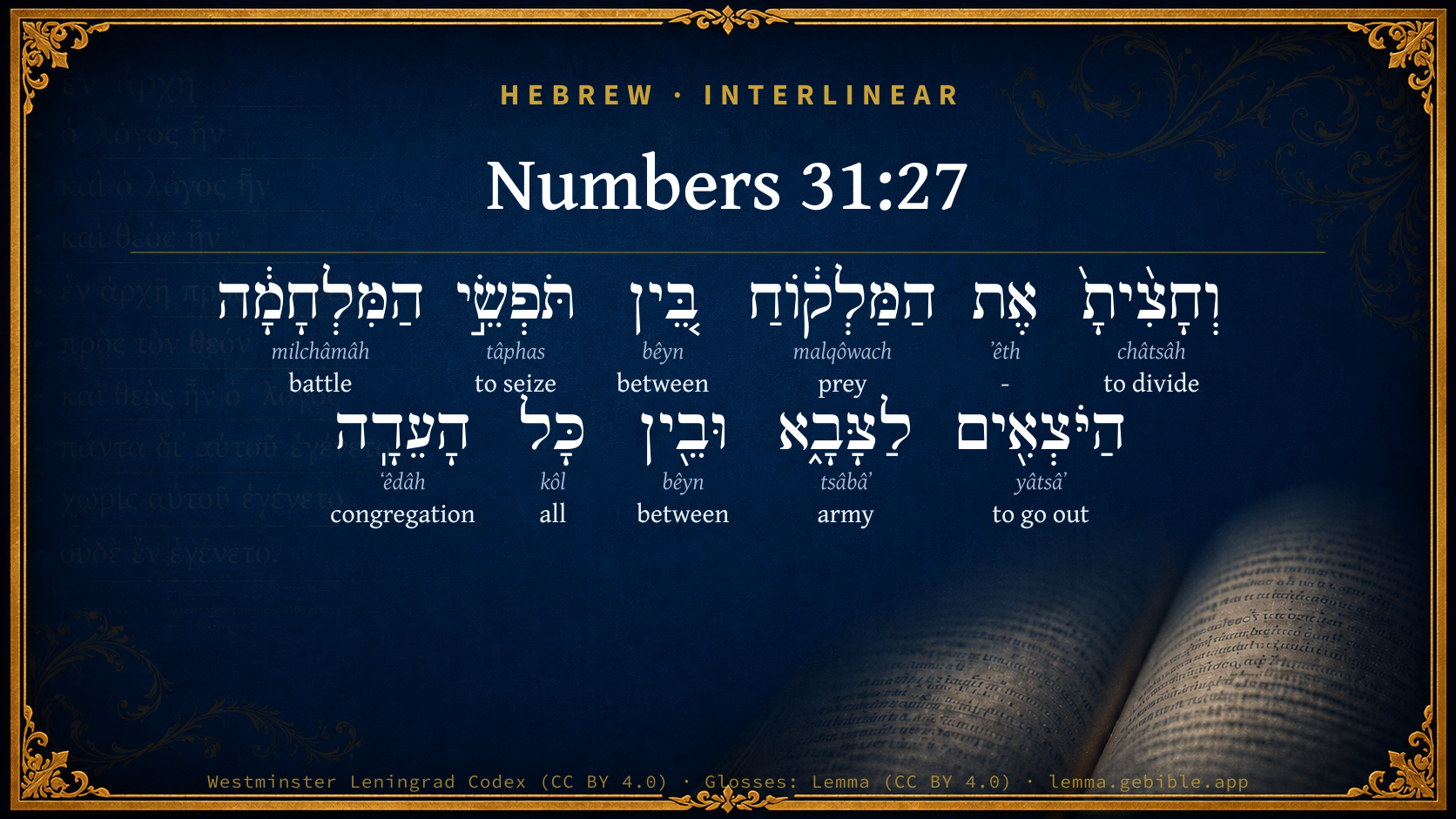
  1. וְחָצִ֨יתָ֙ châtsâh H2673 “and · to divide” Conjunction + Verb, Qal, Sequential Perfect, 2nd Person, Masculine, Singular
  2. אֶת ʼêth H853 “-” Particle, Direct Object
  3. בֵּ֚ין bêyn H996 “between” Preposition
  4. תֹּפְשֵׂ֣י tâphas H8610 “seizing” Verb, Qal, Participle Active, Masculine, Plural, Construct
  5. הַמִּלְחָמָ֔ה milchâmâh H4421 “the · battle” Particle, Definite Article + Noun, Common, Feminine, Singular, Absolute
  6. הַיֹּצְאִ֖ים yâtsâʼ H3318 “the · going out” Particle, Definite Article + Verb, Qal, Participle Active, Masculine, Plural, Absolute
  7. לַצָּבָ֑א tsâbâʼ H6635 “to/for the · army” Preposition, Determined + Noun, Common, Both, Singular, Absolute
  8. וּבֵ֖ין bêyn H996 “and · between” Conjunction + Preposition
  9. כָּל kôl H3605 “all of” Noun, Common, Masculine, Singular, Construct
  10. הָעֵדָֽה ʻêdâh H5712 “the · congregation” Particle, Definite Article + Noun, Common, Feminine, Singular, Absolute

About this verse

These counts appear in no published source. They are computed here, from the morphology-tagged text and Lemma’s own curated glosses. What Lemma adds →

11
words
10
distinct lemmas
Pentateuch
section

Notable vocabulary

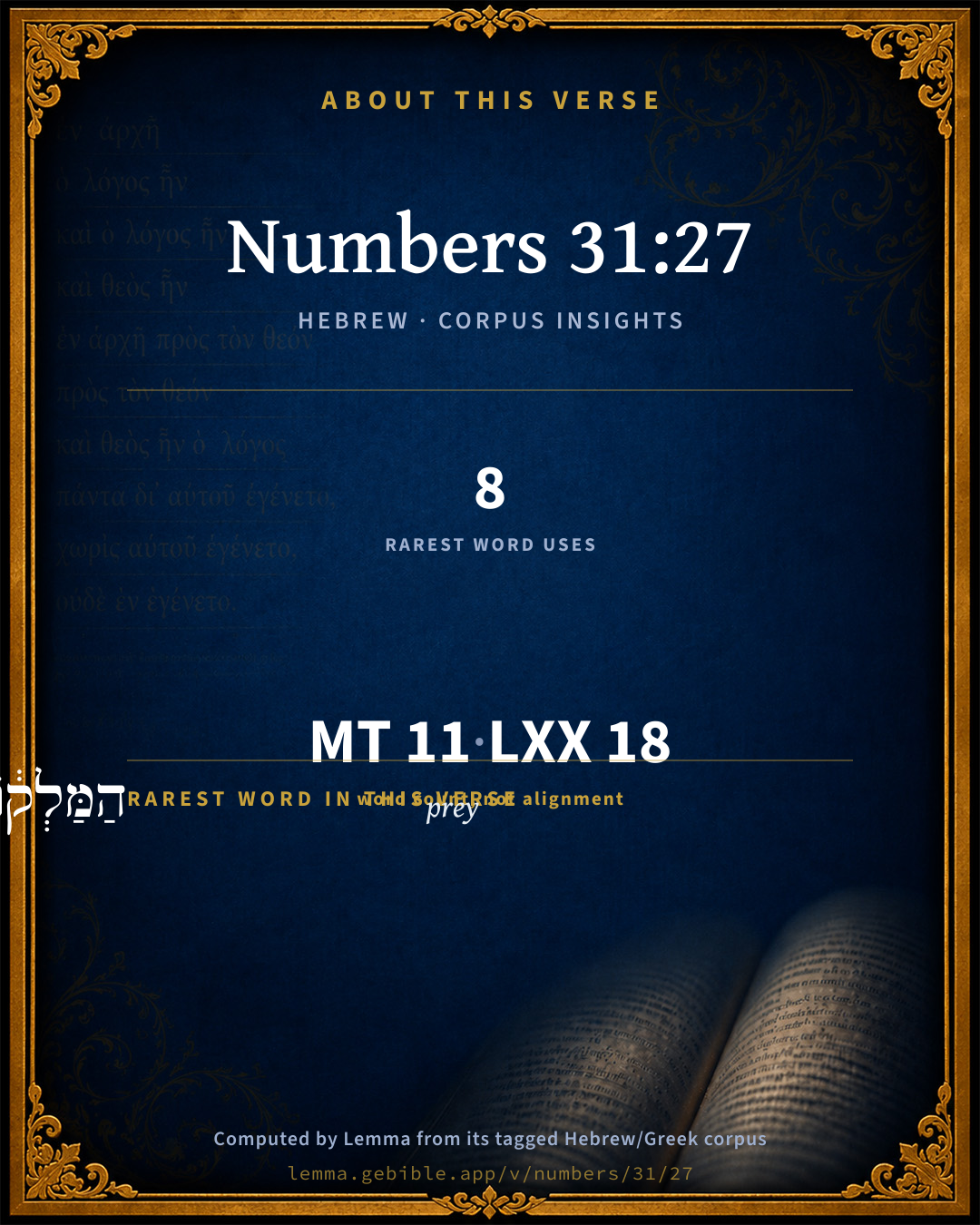
The rarest word here is הַמַּלְק֔וֹחַ prey H4455 — appearing just 8 times in the whole Hebrew Bible.

Shared distinctive vocabulary

הַמַּלְק֔וֹחַ prey H4455 occurs in 8 verses of the Hebrew Bible. Also found in:

Grammatical profile

  • 3 verbs
  • 5 nouns
  • 2 prepositions
  • 1 particle

Verb forms

  • וְחָצִ֨יתָ֙ Qal · Sequential Perfect
  • תֹּפְשֵׂ֣י Qal · Participle Active
  • הַיֹּצְאִ֖ים Qal · Participle Active

Repetition

A word recurs within this verse — often emphatic in Hebrew:

  • בֵּ֚ין between H996 ×2

Hebrew & Septuagint length

In English translation the verse runs 22 words from the Hebrew and 18 from the Septuagint (LXX English) — closely comparable.

A rough comparison of the two English renderings, which tokenize alike — not a word-level alignment.

Word counts can differ between the Hebrew and the Greek without any difference in meaning — e.g. the Hebrew direct-object marker אֵת has no separate Greek word, and Greek often adds the article ὁ.

In the original languages it is 11 Hebrew tokens and 18 Greek tokens — but the two are counted differently (Hebrew bundles its prefixes and suffixes into one token; the Greek is in lemma form), so that isn’t a like-for-like length.

Cross-references

4

Topical passages linked to Numbers 31:27 in the Treasury of Scripture Knowledge — connected by theme and wording, ordered by reader-vote popularity; previews shown in the World English Bible.

  • Joshua 22:8 and spoke to them, saying, Return with much wealth to your tents, and with very much cattle, with silver, and with gold, and with brass, and with iron, and with very much clothing: divide the spoil of your enemies with your brothers.
  • 1 Samuel 30:24–25 Who will listen to you in this matter? for as his share is who goes down to the battle, so shall his share be who tarries by the baggage: they shall share alike.
  • Psalms 68:12 "Kings of armies flee! They flee!" She who waits at home divides the spoil,
  • 1 Samuel 30:4 Then David and the people who were with him lifted up their voice and wept, until they had no more power to weep.

Cross-references courtesy of OpenBible.info (CC BY 4.0).

Hebrew and Greek witnesses Masoretic Hebrew ↔ Greek Septuagint

The same verse in the two great witnesses to the Old Testament, shown verse-for-verse.

These are two independent witnesses, not word-aligned to each other, and the Septuagint is shown in lemma (dictionary) form.

Hebrew Numbers 31:27 Masoretic · Westminster Leningrad Codex

וְחָצִ֨יתָ֙ אֶת הַמַּלְק֔וֹחַ בֵּ֚ין תֹּפְשֵׂ֣י הַמִּלְחָמָ֔ה הַיֹּצְאִ֖ים לַצָּבָ֑א וּבֵ֖ין כָּל הָעֵדָֽה

and divide the prey into two parts: between the men skilled in war, who went out to battle, and all the congregation.

World English Bible · Public Domain

Greek LXX Numbers 31:27 Septuagint · lemma form

καί διααἱρέω ὁ σκῦλον ἀνά μέσος ὁ πολεμιστής ὁ ἐκπορεύομαι εἰς ὁ παράταξις καί ἀνά μέσος πᾶς συναγωγή

And you⌃ shall divide the spoils between the warriors that went out to battle, and the whole congregation.

LXX2012 (modern English Septuagint) · Public Domain

Hebrew: Westminster Leningrad Codex (CC BY 4.0). Greek: Septuagint (public domain); English from LXX2012 (modern English Septuagint) (Public Domain). How the Septuagint differs from the Hebrew →

Targum (Aramaic paraphrase)

2

The Targum is the ancient Jewish Aramaic paraphrase of the Hebrew Scriptures — an interpretive translation, not the Hebrew text itself. Onkelos (literal) and Pseudo-Jonathan (expansive) render the Torah, and Jonathan the Prophets. Coverage is partial: where no permissively-licensed English translation exists for a verse, only the Aramaic is shown. This is verse-level text, not a word-by-word alignment to the Hebrew.

  1. Targum Onkelos Torah (Genesis–Deuteronomy)
    וּתְפַלֵג יָת דְבַרְתָּא בֵּין גַבְרֵי מַגִיחֵי קְרָבָא דְנְפָקוּ לְחֵילָא וּבֵין כָּל כְּנִשְׁתָּא

    (no public-domain English translation for this verse)

    Targum Onkelos — Aramaic: “Onkelos Genesis” (public domain); “Onkelos Exodus” (public domain); “Onkelos Leviticus” (public domain); “Onkelos Numbers” (public domain); “Onkelos Deuteronomy” (public domain). English: “Sefaria Community Translation” (CC0 1.0 (public-domain dedication)); “J.W. Etheridge. The Targums of Onkelos and Jonathan Ben Uzziel on the Pentateuch. London: Longmans, Green, 1862” (public domain). Text via Sefaria.

  2. Targum Pseudo-Jonathan Torah (Genesis–Deuteronomy)
    וּתְפַלֵיג יַת דְבַרְתָּא בֵּין גוּבְרַיָא בְּלוּשַׁיָא דְאַחֲדוּ יַת עָדִיתָא בְּאַגְחוּת קְרָבָא דִנְפָקוּ לְחֵילָא וּבֵין כָּל כְּנִשְׁתָּא

    and divide the spoil between the men of war who took the spoil in the conflict of battle, having gone forth with the host, and between all the congregation;

    Targum Pseudo-Jonathan — Aramaic: “Targum Jonathan on Genesis” (public domain); “Targum Jonathan on Exodus” (public domain); “Targum Jonathan on Leviticus” (public domain); “Targum Jonathan on Numbers” (public domain); “Targum Jonathan on Deuteronomy” (public domain). English: “The Targum of Jonathan ben Uzziel, trans. J. W. Etheridge, London, 1862” (public domain). Text via Sefaria.

Commentary

Notes on Numbers 31:27 from classic Christian and Jewish commentators (each source and its license shown beneath its notes). The classic Christian expositions comment on the surrounding passage and are grouped to its opening verse, so a note may address several verses; the Jewish commentaries on the Tanakh (Rashi and others) are per-verse, so they appear only where the commentator wrote on this verse.

Lemma curates 59 commentaries, every one of them public domain or Creative Commons licensed, each selected and text-cleaned for this edition rather than reprinted as found. About our sources →

Joseph Benson's Commentary

Num 31:27. Two parts — The congregation was to have some share, because the warriors went in the name of all, and because all having been injured by the Midianites, all were to have some share in the reparations: but the warriors, who were but twelve thousand, were to have a far greater share than their brethren, because they underwent greater pains and dangers.

Joseph Benson's Commentary on the Old and New Testaments (1811–1818) — public domain. Text from a community e-Sword module.

Geneva Bible (1599)

Geneva Bible translators

The prey is first divided equally among all.

Geneva Bible (1599) marginal notes — public domain. Text via Bolls.life.

Ellicott's Commentary for English Readers

(27) And divide the prey into two parts . . . —It was reasonable that those who had encountered the perils and hardships of the war should receive a larger share of the spoil than those who had remained in the camp. It was equally reasonable that the latter should not be left without some substantial benefit from the victory miraculously achieved over the enemies of the Lord and of His people. A similar direction is found in Jos_22:8 in regard to the division of spoil taken from enemies, but no general ordinance appears to have been made in regard to the division of the spoils of war until the time of David. (See 1Sa_30:24-25.)

A Bible Commentary for English Readers, edited by Charles John Ellicott (1878–1897) — public domain. Text from a community e-Sword module.

John Gill's Exposition

And of the children of Israel's half, thou shall take one portion of fifty,.... Which was abundantly more than what was taken out of the part of the soldiers; and the reason of it is plain and easy to be discerned; the soldiers had taken much pains, and gone through much fatigue, as well as had hazarded their lives, and therefore less was to be taken from them; and besides the tribute levied out of their half was to be given to the priests, who were not so numerous as the Levites, among whom the part out of the half of the congregation was to be distributed:

of the persons; of the women, as the Targums of Jonathan, one of fifty out of them was to be given to the Levites to be their handmaids, or to be taken in marriage by them, or their sons, when fit for it:

of the beeves, of the asses, and of the sheep, of all manner of beasts; of oxen, asses, sheep, and goats, one out of fifty of each of these sorts were to be taken. Aben Ezra observes, no mention is made of camels, being but few, and no part taken:

and give them unto the Levites, which keep the charge of the tabernacle of the Lord; for these being employed in the service of the tabernacle, came in for their share of the tribute levied unto the Lord.

John Gill's Exposition of the Whole Bible (1746–1763) — public domain (CC PDM 1.0). Text via the HelloAO Bible API.

Haydock's Catholic Bible Commentary

Equally. Those who had been in battle, had about a 50th part more than the rest. They gave the first-fruits to the priests, while those in the camp presented theirs to the Levites. Other rules were afterwards observed. See 1 Kings xxx. 24., and 2 Machabees viii. 28. The Rabbins assign the greatest share to the king, (Selden, Jur. vi. 16,) and Homer gives the largest portion to the general; after which the rest was equally divided, and even the absent partook. The gods were not forgotten. So also among the Hebrews, Syrians, &c., the general make an equal division. David assigns a part of the booty for sacred uses, 1 Paralipomenon xxvi. 26. See Exodus xv. 9. (Calmet)

George Leo Haydock (1774–1849), Haydock's Catholic Family Bible and Commentary, 1859 edition — public domain. Excludes Psalms (Douay-Rheims chapter numbering differs from Protestant) and Deuterocanonical books (Catholic canon only).

Matthew Poole's English Annotations

The congregation hath some share, because the warriors went in the name of all, and because all having been injured by the Midianites, all were to have some share in the reparations; but the warriors, who were but 12,000, have a far greater share than others of their brethren, because they underwent greater pains and dangers.

Matthew Poole's English Annotations on the Holy Bible (1683–1685) — public domain. Text from a community e-Sword/MySword module.

Whedon's Commentary on the Bible

Daniel D. Whedon

27. The prey — The spoils and captives.

Two parts — The soldiers and the congregation were to share equally. Jos_22:8, note.

Daniel D. Whedon (gen. ed.), Commentary on the Old and New Testaments (1874–1909) — public domain. Text from a community e-Sword module.

The Pulpit Commentary

Divide the prey into two parts. This division was founded roughly upon the equity of the case; on the one hand, all Israel had suffered from Midian; on the other, only the twelve thousand had risked their lives to smite Midian. For the application of a like principle to other cases see Jos_22:8 1Sa_30:24 RAPC 2Ma 8:28, 30.

The Pulpit Commentary (1880–1919), ed. H.D.M. Spence-Jones & Joseph S. Exell — public domain. Text from a community e-Sword module.

John Wesley's Explanatory Notes

Two parts - The congregation hath some share, because the warriors went in the name of all, and because all having been injured by the Midianites, all were to have some share in the reparations: but the warriors who were but 12000, have a far greater share than their brethren, because they underwent greater pains and dangers.

John Wesley, Explanatory Notes Upon the Whole Bible (1754–1765) — public domain. Text via the GEBible commentary corpus.

Rashi

Rabbi Shlomo Yitzchaki (Rashi)

וחצית את המלקוח בין תפשי המלחמה וגו׳ AND THOU SHALT DIVIDE THE PREY INTO TWO PARTS: BETWEEN THEM THAT TOOK THE WAR UPON THEMSELVES, etc. — half of it for these and half of it for those.

Rashi on the Tanakh — English translations: “The Judaica Press complete Tanach with Rashi, translated by A. J. Rosenberg” (CC BY 4.0); “Pentateuch with Rashi's commentary by M. Rosenbaum and A.M. Silbermann, 1929-1934” (public domain); “The Metsudah Tanach series, Lakewood, N.J” (CC BY 4.0); and “The Book of Joshua, Metsudah Publications, 1997” (CC BY 4.0). Text via Sefaria.

Lesson kit

Teaching starters — assembled from the data on this page, not authored interpretation. Every prompt links to the verse data it draws on. Edit before teaching.

Numbers, in the Pentateuch, opens this verse with 11 words (10 distinct Hebrew lemmas). Its most distinctive word is malqôwach (“prey”). A historical commentator’s framing appears above. Read the whole chapter for the surrounding context.

Discussion questions

  1. How does “prey” (malqôwach) shape what this verse is saying?
  2. How does Numbers 31:11, which shares the word «prey», read alongside this verse?
  3. What does the repetition of “between” (2× in this one verse) do in this verse?
  4. These translations render this verse differently. What is at stake in choosing one wording over another?
  5. «וְחָצִ֨יתָ֙» is a Qal Sequential Perfect verb. How does that grammatical form shape the action described?
  6. Compare how Joseph Benson's Commentary and Geneva Bible (1599) read this verse. Where do they agree or differ?

Things to notice

Reading settings

Reading text

Shown beneath each verse's original-language words.

Old Testament
Old Testament edition

Read the OT as the Masoretic Hebrew (MT) or the Greek Septuagint (LXX).

English shown for the Greek Septuagint (in the Hebrew ↔ Greek comparison).

Comparing translations? Open the Compare panel on any verse page to stack up to four side by side.