Genesis 17:11

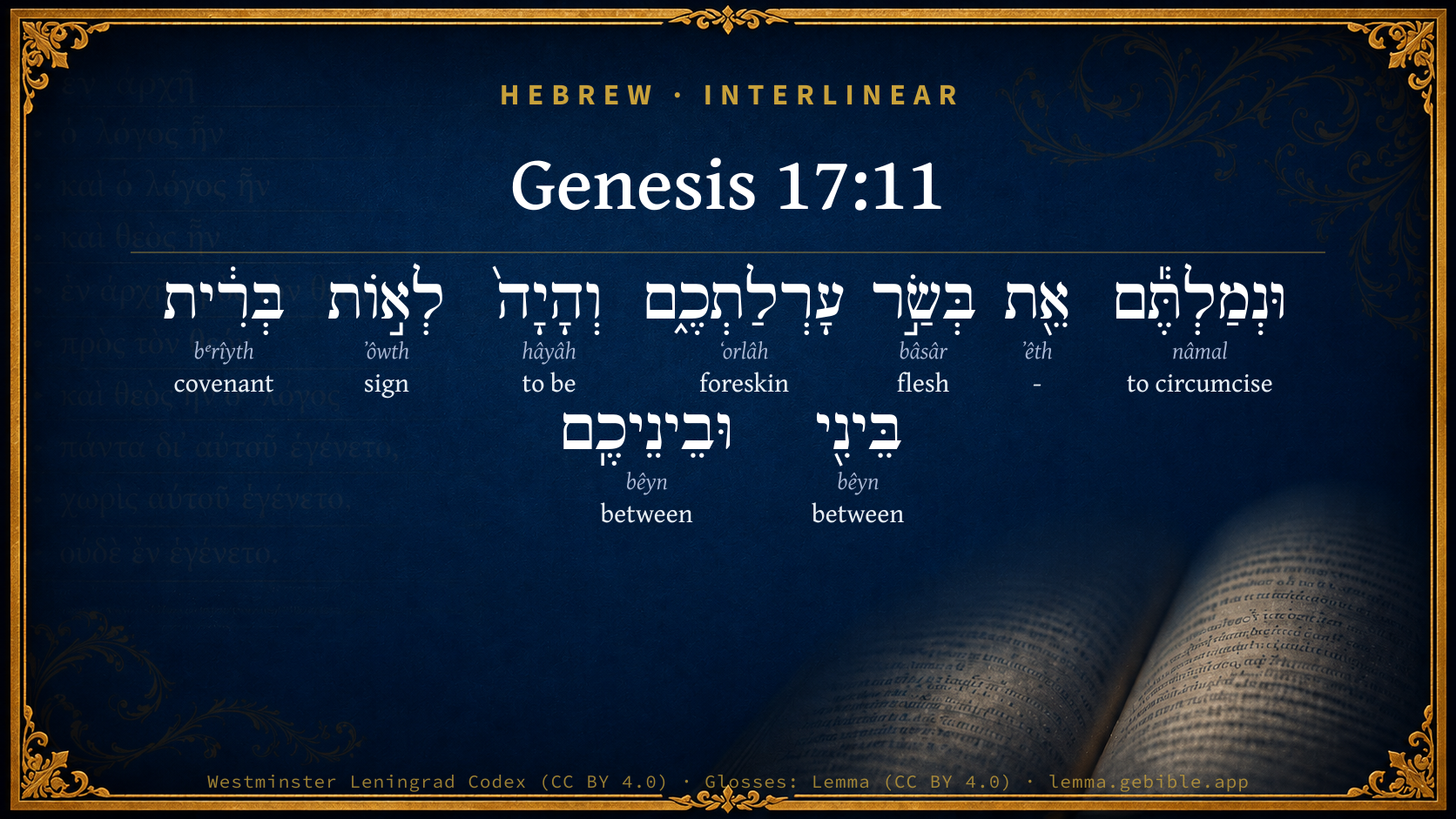
Hebrew (Westminster Leningrad Codex) Genesis 17:11 appears in the Hebrew Old Testament. The text above is from the Westminster Leningrad Codex. Each word links to its Strong’s number, a concise gloss, and parsing drawn from the Open Scriptures Hebrew Bible morphology. Click any word for its full Brown-Driver-Briggs (BDB) entry.
Download image
Cite this verse

Genesis 17:11 (World English Bible). Public Domain. Lemma interlinear Bible study tool, https://lemma.gebible.app/v/genesis/17/11.

Show BibTeX & RIS
BibTeX
RIS
English Translation
You shall be circumcised in the flesh of your foreskin. It will be a token of a covenant between me and you.
World English Bible · Public Domain
Highlights
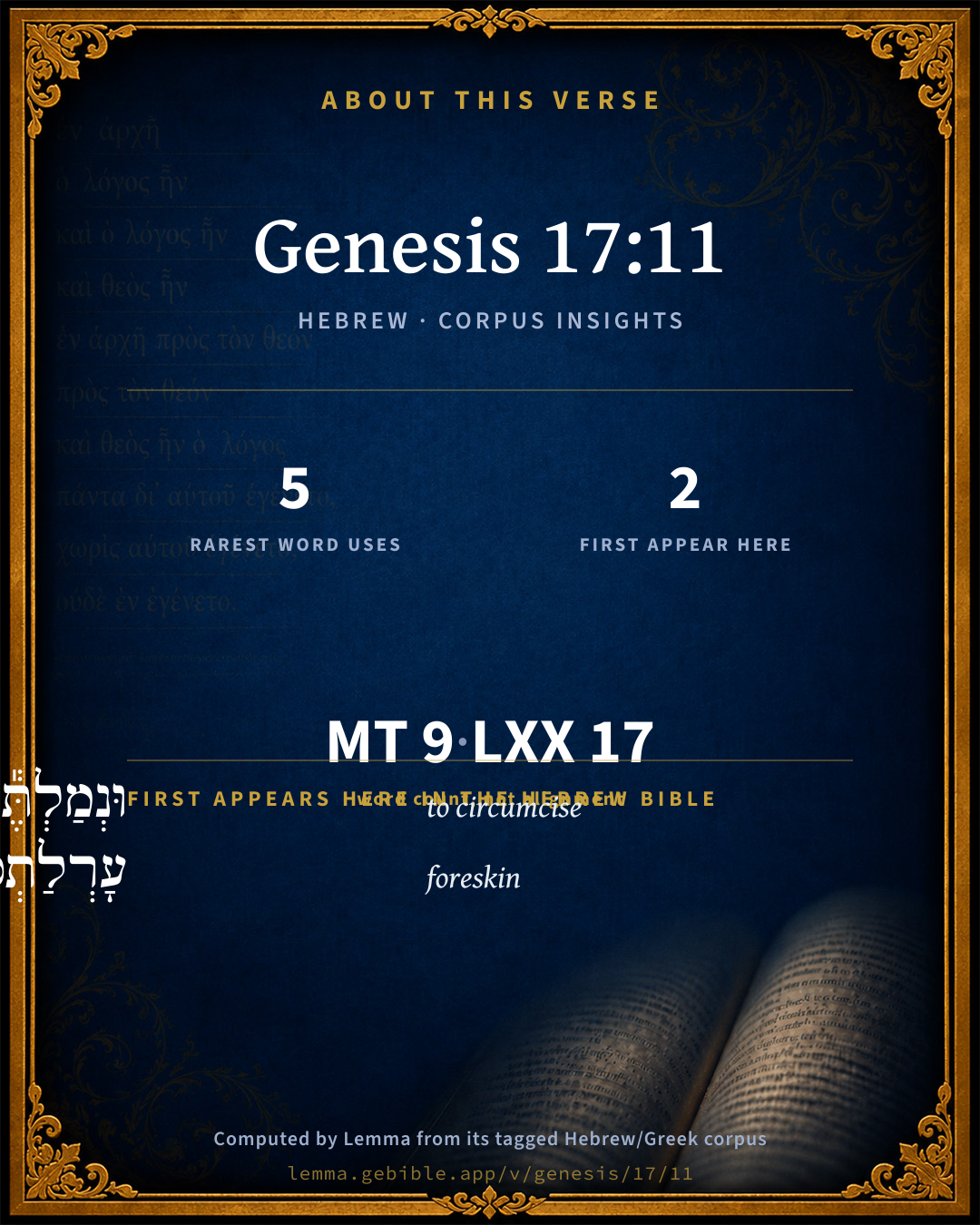
  • 2 first appearances in the Hebrew Bible
Full analysis ↓
Download a study sheet

One document with this verse’s original text, its word-by-word gloss line, the meaning frame, cross-references with their text, attributed commentary, and full source and license credits — printable, and it pastes into notes with its structure intact.

This verse Autodidact and up

Study sheet (.html) Plain text (.txt)

A passage Seminary Student

Up to 50 verses in one chapter. A passage sheet keeps up to 6 commentary sources and 12 cross-references per verse, in the order this page ranks them, and says so on the sheet whenever that leaves anything out. Ask for a single verse and you get the Autodidact verse sheet above.

Everything on this page stays free to read, with no account — the sheet is a download of what is already on screen, not access to it.

Want to remove ads? Support Godless Engineer
Compare translations 3

The same verse in 3 English versions, stacked beneath the original-language interlinear above. Click any original word for its lexicon entry.

Each is an independent rendering of the whole verse — the interlinear is not word-aligned to these translations.

Highlighted words mark where these versions differ — a whole-verse word diff, not a word-by-word alignment.

  • World English Bible Public Domain
    You shall be circumcised in the flesh of your foreskin. It will be a token of a covenant between me and you.
  • King James Version Public Domain
    And ye shall circumcise the flesh of your foreskin; and it shall be a token of the covenant betwixt me and you.
  • unfoldingWord Literal Text CC BY-SA 4.0
    Indeed, you must be circumcised the flesh of your foreskins, and it will be the sign of the covenant between me and you.

unfoldingWord Literal Text — © unfoldingWord, licensed CC BY-SA 4.0. Word-aligned USFM3 via Door43 (git.door43.org/unfoldingWord/en_ult).

Versions to compare (up to 4)

3 of 4 selected

Show all 18 translations

Every available English version of this verse, each an independent rendering of the whole verse.

  • World English Bible Public Domain
    You shall be circumcised in the flesh of your foreskin. It will be a token of a covenant between me and you.
  • Berean Standard Bible Public Domain
    You are to circumcise the flesh of your foreskin, and this will be a sign of the covenant between Me and you.
  • Majority Standard Bible Public Domain
    You are to circumcise the flesh of your foreskin, and this will be a sign of the covenant between Me and you.
  • King James Version Public Domain
    And ye shall circumcise the flesh of your foreskin; and it shall be a token of the covenant betwixt me and you.
  • American Standard Version (1901) Public Domain
    And ye shall be circumcised in the flesh of your foreskin; and it shall be a token of a covenant betwixt me and you.
  • Revised Version (1885) Public Domain
    And ye shall be circumcised in the flesh of your foreskin; and it shall be a token of a covenant betwixt me and you.
  • Geneva Bible (1599) Public Domain
    That is, ye shall circumcise the foreskin of your flesh, and it shalbe a signe of the couenant betweene me and you.
  • Douay-Rheims (1899) Public Domain
    And you shall circumcise the flesh of your foreskin, that it may be for a h sign of the covenant between me and you.
  • Young's Literal Translation Public Domain
    and ye have circumcised the flesh of your foreskin, and it hath become a token of a covenant between Me and you.
  • Literal Standard Version CC BY-SA 4.0
    and you have circumcised the flesh of your foreskin, and it has become a token of a covenant between Me and you.
  • Unlocked Literal Bible CC BY-SA 4.0
    You must be circumcised in the flesh of your foreskin, and this will be the sign of the covenant between me and you.
  • unfoldingWord Literal Text CC BY-SA 4.0
    Indeed, you must be circumcised the flesh of your foreskins, and it will be the sign of the covenant between me and you.
  • Darby Bible Public Domain
    And ye shall circumcise the flesh of your foreskin; and [that] shall be a sign of the covenant between me and you.
  • World Messianic Bible Public Domain
    You shall be circumcised in the flesh of your foreskin. It will be a token of the covenant between me and you.
  • Webster's Bible Public Domain
    And ye shall circumcise the flesh of your foreskin; and it shall be a token of the covenant betwixt me and you.
  • Free Bible Version CC BY-SA 4.0
    You are to circumcise your foreskin, and this will be the sign of the agreement between me and you.
  • Bible in Basic English Public Domain
    In the flesh of your private parts you are to undergo it, as a mark of the agreement between me and you.
  • JPS Tanakh (1917) Public Domain
    And ye shall be circumcised in the flesh of your foreskin; and it shall be a token of a covenant betwixt Me and you.

Literal Standard Version (2020), Covenant Press — licensed CC BY-SA 4.0. Text via the HelloAO Bible API (eBible.org). Unlocked Literal Bible (unfoldingWord) — licensed CC BY-SA 4.0. Text via the HelloAO Bible API (eBible.org). unfoldingWord Literal Text — © unfoldingWord, licensed CC BY-SA 4.0. Word-aligned USFM3 via Door43 (git.door43.org/unfoldingWord/en_ult). Free Bible Version, Dr. Jonathan Gallagher — licensed CC BY-SA 4.0. Text via the HelloAO Bible API (eBible.org).

Word by word

More ways to search: Search by grammar → Find every occurrence → Compare this word →

Practice this passage: Drill this verse → Learn its vocabulary →

וּנְמַלְתֶּ֕ם
nâmal
H5243
“and · to circumcise”
Conjunction + Verb, Niphal, Sequential Perfect, 2nd Person, Masculine, Plural
Part of Speech
Conjunction + Verb
Stem
Niphal
Form
Sequential Perfect
Person
2nd Person
Gender
Masculine
Number
Plural
Full BDB Definition

Origin: a primitive root

TWOT: 1161

(Qal) to circumcise, become clipped, be circumcised, be cut off
  1. אֵ֖ת ʼêth H853 “-” Particle, Direct Object
  2. בְּשַׂ֣ר bâsâr H1320 “flesh of” Noun, Common, Masculine, Singular, Construct
  3. עָרְלַתְכֶ֑ם ʻorlâh H6190 “foreskin · your” Noun, Common, Feminine, Singular, Construct + Suffix, Personal, 2nd Person, Masculine, Plural
  4. וְהָיָה֙ hâyâh H1961 “and · to be” Conjunction + Verb, Qal, Sequential Perfect, 3rd Person, Masculine, Singular
  5. לְא֣וֹת ʼôwth H226 “to/for · sign of” Preposition + Noun, Common, Both, Singular, Construct
  6. בְּרִ֔ית bᵉrîyth H1285 “covenant” Noun, Common, Feminine, Singular, Absolute
  7. בֵּינִ֖י bêyn H996 “between · me” Preposition + Suffix, Personal, 1st Person, Common, Singular
  8. וּבֵינֵיכֶֽם bêyn H996 “and · between · you” Conjunction + Preposition + Suffix, Personal, 2nd Person, Masculine, Plural

About this verse

These counts appear in no published source. They are computed here, from the morphology-tagged text and Lemma’s own curated glosses. What Lemma adds →

9
words
8
distinct lemmas
Pentateuch
section

Notable vocabulary

The rarest word here is וּנְמַלְתֶּ֕ם to circumcise H5243 — appearing just 5 times in the whole Hebrew Bible.

First appearance in Scripture

These words make their first canonical appearance in the Hebrew Bible here:

  • וּנְמַלְתֶּ֕ם to circumcise H5243
  • עָרְלַתְכֶ֑ם foreskin H6190

Shared distinctive vocabulary

וּנְמַלְתֶּ֕ם to circumcise H5243 occurs in 5 verses of the Hebrew Bible. Also found in:

Grammatical profile

  • 2 verbs
  • 4 nouns
  • 2 prepositions
  • 1 particle

Verb forms

  • וּנְמַלְתֶּ֕ם Niphal · Sequential Perfect
  • וְהָיָה֙ Qal · Sequential Perfect

Repetition

A word recurs within this verse — often emphatic in Hebrew:

  • בֵּינִ֖י between H996 ×2

Hebrew & Septuagint length

In English translation the verse runs 22 words from the Hebrew and 25 from the Septuagint (LXX English) — closely comparable.

A rough comparison of the two English renderings, which tokenize alike — not a word-level alignment.

Word counts can differ between the Hebrew and the Greek without any difference in meaning — e.g. the Hebrew direct-object marker אֵת has no separate Greek word, and Greek often adds the article ὁ.

In the original languages it is 9 Hebrew tokens and 17 Greek tokens — but the two are counted differently (Hebrew bundles its prefixes and suffixes into one token; the Greek is in lemma form), so that isn’t a like-for-like length.

Cross-references

8

Topical passages linked to Genesis 17:11 in the Treasury of Scripture Knowledge — connected by theme and wording, ordered by reader-vote popularity; previews shown in the World English Bible.

  • Romans 4:11 He received the sign of circumcision, a seal of the righteousness of the faith which he had while he was in uncircumcision, that he might be the father of all those who believe, though they be in uncircumcision, that righteousness might also be accounted to them.
  • Deuteronomy 10:16 Circumcise therefore the foreskin of your heart, and be no more stiff-necked.
  • Acts 7:8 He gave him the covenant of circumcision. So Abraham became the father of Isaac, and circumcised him the eighth day. Isaac became the father of Jacob, and Jacob became the father of the twelve patriarchs.
  • Exodus 4:25 Then Zipporah took a flint, and cut off the foreskin of her son, and cast it at his feet; and she said, "Surely you are a bridegroom of blood to me."
  • Exodus 12:48 When a stranger shall live as a foreigner with you, and will keep the Passover to Yahweh, let all his males be circumcised, and then let him come near and keep it; and he shall be as one who is born in the land: but no uncircumcised person shall eat of it.
  • Joshua 5:3 Joshua made himself flint knives, and circumcised the children of Israel at the hill of the foreskins.
  • 1 Samuel 18:25–27 Saul said, Thus shall you tell David, The king desires no dowry except one hundred foreskins of the Philistines, to be avenged of the king's enemies. Now Saul thought to make David fall by the hand of the Philistines.
  • 2 Samuel 3:14 David sent messengers to Ish-bosheth, Saul's son, saying, Deliver me my wife Michal, whom I pledged to be married to me for one hundred foreskins of the Philistines.

Cross-references courtesy of OpenBible.info (CC BY 4.0).

Hebrew and Greek witnesses Masoretic Hebrew ↔ Greek Septuagint

The same verse in the two great witnesses to the Old Testament, shown verse-for-verse.

These are two independent witnesses, not word-aligned to each other, and the Septuagint is shown in lemma (dictionary) form.

Hebrew Genesis 17:11 Masoretic · Westminster Leningrad Codex

וּנְמַלְתֶּ֕ם אֵ֖ת בְּשַׂ֣ר עָרְלַתְכֶ֑ם וְהָיָה֙ לְא֣וֹת בְּרִ֔ית בֵּינִ֖י וּבֵינֵיכֶֽם

You shall be circumcised in the flesh of your foreskin. It will be a token of a covenant between me and you.

World English Bible · Public Domain

Greek LXX Genesis 17:11 Septuagint · lemma form

καί περιτέμνω ὁ σάρξ ὁ ἀκροβυστία σύ καί εἰμί ἐν σημεῖον διαθήκη ἀνά μέσος ἐγώ καί σύ

And you⌃ shall be circumcised in the flesh of your foreskin, and it shall be for a sign of a covenant between me and you.

LXX2012 (modern English Septuagint) · Public Domain

Hebrew: Westminster Leningrad Codex (CC BY 4.0). Greek: Septuagint (public domain); English from LXX2012 (modern English Septuagint) (Public Domain). How the Septuagint differs from the Hebrew →

Targum (Aramaic paraphrase)

2

The Targum is the ancient Jewish Aramaic paraphrase of the Hebrew Scriptures — an interpretive translation, not the Hebrew text itself. Onkelos (literal) and Pseudo-Jonathan (expansive) render the Torah, and Jonathan the Prophets. Coverage is partial: where no permissively-licensed English translation exists for a verse, only the Aramaic is shown. This is verse-level text, not a word-by-word alignment to the Hebrew.

  1. Targum Onkelos Torah (Genesis–Deuteronomy)
    וְתִגְזְרוּן יָת בִּשְׂרָא דְעָרְלָתְכוֹן וּתְהֵי (נ''י וּתְהֵא) לְאָת קְיָם בֵּין מֵימְרִי וּבֵינֵיכוֹן

    (no public-domain English translation for this verse)

    Targum Onkelos — Aramaic: “Onkelos Genesis” (public domain); “Onkelos Exodus” (public domain); “Onkelos Leviticus” (public domain); “Onkelos Numbers” (public domain); “Onkelos Deuteronomy” (public domain). English: “Sefaria Community Translation” (CC0 1.0 (public-domain dedication)); “J.W. Etheridge. The Targums of Onkelos and Jonathan Ben Uzziel on the Pentateuch. London: Longmans, Green, 1862” (public domain). Text via Sefaria.

  2. Targum Pseudo-Jonathan Torah (Genesis–Deuteronomy)
    וְתִגְזְרוּן יַת בִּשְרָא דְעוּרְלַתְכוֹן וִיהֵי לְאָת קְיָם בֵּין מֵימְרִי וּבֵינֵיכוֹן

    And you shall circumcise the flesh of your foreskin, as a sign of the covenant between My Word and you.

    Targum Pseudo-Jonathan — Aramaic: “Targum Jonathan on Genesis” (public domain); “Targum Jonathan on Exodus” (public domain); “Targum Jonathan on Leviticus” (public domain); “Targum Jonathan on Numbers” (public domain); “Targum Jonathan on Deuteronomy” (public domain). English: “The Targum of Jonathan ben Uzziel, trans. J. W. Etheridge, London, 1862” (public domain). Text via Sefaria.

Commentary

Notes on Genesis 17:11 from classic Christian and Jewish commentators (each source and its license shown beneath its notes). The classic Christian expositions comment on the surrounding passage and are grouped to its opening verse, so a note may address several verses; the Jewish commentaries on the Tanakh (Rashi and others) are per-verse, so they appear only where the commentator wrote on this verse.

Lemma curates 59 commentaries, every one of them public domain or Creative Commons licensed, each selected and text-cleaned for this edition rather than reprinted as found. About our sources →

Trapp's Complete Commentary

John Trapp

Gen 17:11 And ye shall circumcise the flesh of your foreskin; and it shall be a token of the covenant betwixt me and you.

Ver. 11. It shall be a token of the covenant.] It seals up nothing then to those that are not in covenant. Circumcision to such is but as a seal to a blank. Unregenerate Israel was to God as Ethiopia. {Amo 9:7} Circumcision of itself avails nothing, if the heart be uncircumcised. The apostle distinguisheth of circumcision, {Col 2:11} and tells us that the true circumcision is "made without hands" (αχειροποιητος), and "is that of the heart, in the spirit, and not in the letter". {Rom 2:29} It is a wonderful work of the Spirit, wrought by the word, upon the saints in their first conversion, whereby corruption of nature is wounded, beloved sins cast away with sorrow, and the sinner received into an everlasting communion with God and his saints. Labour this, or you are not a button the better for your baptism. A man may go to hell with font-water on his face, if not baptized "with the Holy Ghost, and with fire". {Mat 3:11} Circumcision seals not up any covenant of grace to Turks, as it did not, of old, to Ishmaelites, Edomites, and Midianites, who yet would needs be circumcised.

John Trapp, A Commentary or Exposition upon All the Books of the Old and New Testament (1647–1656) — public domain. Text from a community e-Sword module.

Geneva Bible (1599)

Geneva Bible translators

That privy part is circumcised, to show that all that is begotten of man is corrupt, and must be mortified.

Geneva Bible (1599) marginal notes — public domain. Text via Bolls.life.

Adam Clarke's Commentary

Verse 11. And it shall be a token] לאות leoth, for a sign of spiritual things; for the circumcision made in the flesh was designed to signify the purification of the heart from all unrighteousness, as God particularly showed in the law itself. See De 10:16; see also Ro 2:25-29; Col 2:11. And it was a seal of that righteousness or justification that comes by faith, Ro 4:11. That some of the Jews had a just notion of its spiritual intention, is plain from many passages in the Chaldee paraphrases and in the Jewish writers. I borrow one passage from the book Zohar, quoted by Ainsworth: "At what time a man is sealed with this holy seal, (of circumcision,) thenceforth he seeth the holy blessed God properly, and the holy soul is united to him. If he be not worthy, and keepeth not this sign, what is written? By the breath of God they perish, (Job 4:9), because this seal of the holy blessed God was not kept. But if he be worthy, and keep it, the Holy Ghost is not separated from him."

Adam Clarke's Commentary on the Bible (1810–1826) — public domain. Text from a community e-Sword/MySword module.

John Calvin's Commentaries

11. Ye shall circumcise the flesh of your foreskin Very strange and unaccountable would this command at first sight appear. The subject treated of, is the sacred covenant, in which righteousness, salvation, and happiness are promised; whereby the seed of Abraham is distinguished from other nations, in order that it may be holy and blessed; and who can say that it is reasonable for the sign of so great a mystery to consist in circumcision? But as it was necessary for Abraham to become a fool, in order to prove himself obedient to God; so whosoever is wise, will both soberly and reverently receive what God seems to us foolishly to have commanded. And yet we must inquire, whether any analogy is here apparent between the visible sign, and the thing signified. For the signs which God has appointed to assist our infirmity, should be accommodated to the measure of our capacity, or they would be unprofitable. Moreover, it is probable that the Lord commanded circumcision for two reasons; first, to show that whatever is born of man is polluted; then, that salvation would proceed from the blessed seed of Abraham. In the first place, therefore, whatever men have peculiar to themselves, by generation, God has condemned, in the appointment of circumcision; in order that the corruption of nature being manifest, he might induce them to mortify their flesh. Whence also it follows, that circumcision was a sign of repentance. Yet, at the same time, the blessing which was promised in the seed of Abraham, was thereby marked and attested. If then it seem absurd to any one, that the token of a favor so excellent and so singular, was given in that part of the body, let him become ashamed of own salvation, which flowed from the loins of Abraham; but it has pleased God thus to confound the wisdom of the world, that he may the more completely abase the pride of the flesh. And hence we now learn, in the second place, how the reconciliation between God and men, which was exhibited in Christ, was testified by this sign. For which reason it is styled by Paul a seal of the righteousness of faith. (Romans 4:11.) Let it suffice thus briefly to have touched upon the analogy between the thing signified and the sign.

John Calvin's Commentaries (1540-1563) — public domain. Text from the Calvin Translation Society English edition (1840s-50s) via the Christian Classics Ethereal Library (ccel.org). Calvin's coverage is partial (roughly two-thirds of the Bible); uncommented books and verses are honest gaps, never fabricated. The 19th-century editor's footnotes and remarks are omitted so the notes are faithfully Calvin's own voice.

The Cambridge Bible for Schools and Colleges

gen. ed. J. J. S. Perowne

11. a token] i.e. an outward sign. Cf. the rainbow which was the token of the covenant of Noah, Gen_9:12-13.

The Cambridge Bible for Schools and Colleges (gen. ed. J. J. S. Perowne; Cambridge University Press, 1878–1918) — public domain. Text from a community e-Sword module.

John Gill's Exposition

And ye shall circumcise the flesh of your foreskin,.... Or "the foreskin of your flesh" (u); by an hypallage (v), the manner in which this was performed may be seen in the Jewish writers (w), as well as the cure of the wound made, is particularly described by Leo Modena (x), and which when performed, they used to provide a dish full of sand to put the foreskin into; which was done, as Buxtorf (y) relates, to show that their seed should be as the sand of the sea, and to call to mind what Balaam said of them, Num 23:10; and with respect to the old serpent that deceived man, whose food is the dust of the earth, Gen 3:14, the instrument with which this operation was performed, according to the Jewish canons, was as follows (z),"they may circumcise with anything, with a flint, or with glass, and with anything that cuts, excepting with a cane or reed, because of danger; but it is best to circumcise with an iron instrument, either with a knife or a razor; all Israelites use a knife.''The persons who might perform it, according to their rules, are these;"all are fit to circumcise (says Maimonides (a)), even an uncircumcised person, and a servant, and a woman, and a little one may circumcise where there is no man, but a Gentile may not circumcise at all; and if he does circumcise, there is no need to repeat it, and to circumcise a second time.''It is a little differently expressed by another (b) writer of theirs,"all are fit to circumcise, even a servant, a woman, and a little one, and an uncircumcised Israelite, whose brethren died through circumcision; but it there is an Israelite grown, and knows how to circumcise, he is to be preferred before them all; (some say a woman may not circumcise;) but an idolater, though he is circumcised, may not circumcise at all; but if he does, there is no need to repeat it, and to circumcise else a second time:"

and it shall be a token of the covenant betwixt me and you: of the promise of God to Abraham, that he should be the father of many nations. The apostle explains it, Rom 4:11; to be a seal, or what gave assurance to Abraham, or was a sure token to him, that righteousness would be wrought out by Christ, by his obedience, and the shedding of his blood, which is received by faith; and that this was imputed to him while he was uncircumcised, Gen 15:6; and that this also would "be in the uncircumcision", or uncircumcised Gentiles that should believe as he did, and be imputed to them, as to him, and so he would appear to be the father of them all. Moreover, this was a sign or token of that part of the promise or covenant, which gave to his seed the land of Canaan: this was a seal of the lease of that land, which was made while Abraham was in it, and which the Israelites were obliged to submit to, upon entrance into it in Joshua's time, as a token of it; and which they were to observe while in it until the Messiah's coming, and by which they were distinguished from other nations, and kept a distinct nation, that it might appear he came of them: and to use the words of Tacitus (c), this rite was instituted "ut diversitate noscantur", that they might be distinguished and known from others; it was typical of Christ, the end of it, who submitted to it, that it might appear he was really man, a son of Abraham, and a minister of the circumcision, and was made under the law, and so laid under obligation to fulfil it; and that he was to satisfy for the sins of men by the effusion of his blood, and endure pains and sufferings, signified thereby: it was also an emblem of spiritual circumcision, or circumcision of the heart, which ties in the putting off the body of sin, in renouncing man's own righteousness, and in his being by the grace of God, and blood of Christ, cleansed from the impurity of his nature, propagated by carnal generation, in which the member circumcised has a principal concern.

(u) "praeputium carnis vestrae", Drusius, Piscator. (v) According to E. W. Bullinger, "hypallage" "relates to an interchange of construction whereby an adjective or other word, which `logically' belongs to one connection, is grammatically united with another, so that what is said or attributed to one things ought to be said or attributed to another". (w) Maimon. Hilchot Milah, c. 2. sect 2. Schulchan Aruch, par. 2. Jore Dea Hilchot Milah, c. 264. sect. 3. (x) History of the present Jews, part 4. c. 8. p. 206. (y) Synagog. Jud. c. 4. p. 104, 105. (z) Maimon. ib. c. 2. sect. 1. Schulchan Aruch, ib. sect. 2. (a) Maimon. ib. Schulchan Aruch, ib. sect. l. (b) Schulchan Aruch, ib sect 1. (c) Hist. l. 5. c. 5.

John Gill's Exposition of the Whole Bible (1746–1763) — public domain (CC PDM 1.0). Text via the HelloAO Bible API.

Haydock's Catholic Bible Commentary

You shall, either by yourselves, or by the ministry of others, with respect to infants. That part of the body was chosen, because the effects of sin first appeared there; and because a part of the Hebrews’ creed was, that Christ should be born of the family of Abraham. --- A sign that Abraham had agreed to the covenant with God, and to be a memorial of his faith and justice, Romans iv. 2; to distinguish also the faithful from infidels; to purge away original sin in male children, eight days old; and to be a figure of baptism. (Menochius) (Tirinus) --- God always appoints some sign of his covenants, as Jesus Christ instituted the holy sacrament of his body and blood, under exterior appearances, to assure us of his new alliance with Christians. (Calmet) --- The sacraments of the old law caused grace, only by means of faith in the Redeemer, of which they were signs. (St. Augustine, de Nupt. ii. chap. ultra[last chap.]) In this sense, the holy fathers assert, that circumcision remitted original sin to those who could receive it; though some think, it was only a bare sign or distinctive mark of the Jews. (Calmet) --- It is far beneath our baptism, which is more easy, general and efficacious; as the Christian sacraments are not like those of Moses, weak and needy elements. (Galatians iv. 9; St. Augustine ep. 158, ad Jan.; Psalm 73, &c.) (Worthington)

George Leo Haydock (1774–1849), Haydock's Catholic Family Bible and Commentary, 1859 edition — public domain. Excludes Psalms (Douay-Rheims chapter numbering differs from Protestant) and Deuterocanonical books (Catholic canon only).

Matthew Poole's English Annotations

The flesh of your foreskin, i.e. by a usual hypallage, the foreskin of your flesh; and the word flesh is here put for the genital part, as it is Lev 15:2,19; Eze 16:26; 23:20, and elsewhere. This part God singled out for this ordinance, because it is and was a great instrument both in the commission of actual sins, and in the propagation of original sin; and therefore it was very proper to apply to it the seal of God’s gracious covenant for the remission of sins past, and the extirpation of sin for the future.

It shall be a token of the covenant, i.e. a sign, evidence, and assurance, both of the blessing promised by that God who appointed this ordinance, and of man’s obligation to the duties required, which is signified by his acceptance of and submission to this ordinance. And here we have the nature and definition of a sacrament, viz. that it is a figure or token of God’s covenant.

Matthew Poole's English Annotations on the Holy Bible (1683–1685) — public domain. Text from a community e-Sword/MySword module.

Whedon's Commentary on the Bible

Daniel D. Whedon

11. Circumcise the flesh of your foreskin — The act of circumcision consisted in cutting off the prepuce, or foreskin, which covers the glans of the penis in males. Whether this custom originated with this covenant with Abraham, or whether it was in use among ancient peoples before this time, is a disputed question. It appears probable, on the whole, that the practice was older than Abraham, and the language here used seems to favour this view. Were this the origin of circumcision, we should naturally have expected particular directions as to the mode of performing it, but the absence of such directions rather implies that the custom was not new, or strange. As the rainbow appeared in the sky before it was made the token of God’s covenant with Noah, and as divers baptisms were in use before the baptism of water was made a sacrament of the Christian Church, so circumcision may have been practised before Abram’s time, but was consecrated into a new meaning by the Abrahamic covenant. Abraham “received the sign of circumcision,” says the apostle, “a seal of the righteousness of the faith which he had yet being uncircumcised.”

Rom_4:11. The typical significance of circumcision arises from the consideration that, as the depravity and corruption of human nature are transmitted by generation, and the promise is to the seed of Abraham, so the organs of generation receive the symbol of “putting off the body of the sins of the flesh,” (Col_2:11,) and the chosen seed are thereby set apart and consecrated as holy unto the Lord. The spiritual significance of the rite is recognised in such texts as Lev_26:41; Deu_10:16; Deu_30:6; Eze_44:7; Rom_2:28-29. For more on the subject of circumcision, see note at the end of this chapter.

Daniel D. Whedon (gen. ed.), Commentary on the Old and New Testaments (1874–1909) — public domain. Text from a community e-Sword module.

The Pulpit Commentary

And ye shall circumcise the flesh of your foreskin. hl; r; ajkrobustia, membrum prveputiatum, from lr; to be naked, bare, hence to be odious, unclean, impure, was regarded afterwards as unclean (Deu_10:16; Isa_52:3; Jer_4:4) and is here directed to be deprived of the skin covering its extremity, not because through it sin first discovered its effects (Peele), and original corruption is still transmitted (Lapide, Augustine), or to promote cleanliness (Philo), or to express detestation of certain idolatrous rites which were paid to it by the Egyptians and other heathen nations (Lyra, Kalisch), but

(1) as a sign of the faith that Christ should be descended from him (Lapide);

(2) as a symbolic representation of the putting away of the filth of the flesh and of sin in general (Calvin).

Hence it served a variety of uses:

(1) to distinguish the seed of Abraham from the Gentiles,

(2) to perpetuate the memory of Jehovah"s covenant,

(3) to foster in the nation the hope of the Messiah,

(4) to remind them of the duty of cultivating moral purity, (Deu_10:16)

(5) to preach to them the gospel of a righteousness by faith, (Rom_4:11)

(6) to suggest the idea of a holy or a spiritual seed of Abram, (Rom_2:29) and

(7) to foreshadow the Christian rite of baptism. (Col_2:11, Col_2:12) And it shall be a token of the covenant literally, for a token of covenant (cf. Gen_9:12; Act_7:8; Rom_4:11) betwixt me and you.

The Pulpit Commentary (1880–1919), ed. H.D.M. Spence-Jones & Joseph S. Exell — public domain. Text from a community e-Sword module.

Rashi

Rabbi Shlomo Yitzchaki (Rashi)

ונמלתם AND YE SHALL CIRCUMCISE — This word, in spite of the נ in it, is not Niphal but the same as ומלתם and the נ in it is an addition to the root, which only sometimes appears in it, as, for example, the נ of נושך and of ונמלתם;(נושא is Kal like ונשאתם “and ye shall carry” (Genesis 45:19), but יִמּוֹל (Genesis 17:12 and Genesis 17:13) is a Niphal form — “shall be circumcised” — like יֵעָשֶׂה “it shall be done”, and יֵאָכֵל “it shall be eaten”.

Rashi on the Tanakh — English translations: “The Judaica Press complete Tanach with Rashi, translated by A. J. Rosenberg” (CC BY 4.0); “Pentateuch with Rashi's commentary by M. Rosenbaum and A.M. Silbermann, 1929-1934” (public domain); “The Metsudah Tanach series, Lakewood, N.J” (CC BY 4.0); and “The Book of Joshua, Metsudah Publications, 1997” (CC BY 4.0). Text via Sefaria.

Radak

Rabbi David Kimhi (Radak)

ונמלתם, this is the positive commandment to the father to circumcise his male child, or to the son to perform circumcision on himself when he reaches the age of manhood if it has not been performed on him before then by the court.

לאות ברית, as a mark of the covenant; although there are other symbolic acts which are signs of the covenant and the obligation to keep the laws of the Torah, such as the phylacteries, the fringes, the Sabbath, etc., this symbol is by far the most potent one, the only one to be performed on one's body. The other "signs" are only a reminder. This is the only such "sign" to be performed on one's body. Seeing that this is so, The Torah chose to select the reproductive organ of the male, seeing that most of the sins one commits are somehow related to this organ and involve misuse of that organ. It is the organ, which, unless handled with care, is apt to allow the bestial party of the human being to come to the surface, thereby weakening the aspect of our nature which wishes to cling to godliness. When looking at that part of one's body one reminds oneself automatically that G'd has forbidden Jews to engage in recreational sexual activities, in mating with partners which the Torah has forbidden in the interest of purity, etc. Sexual emissions are to be used only for the purpose of impregnating one's wife or when prescribed for medical reason by a physician.

Radak on the Tanakh — English translations: “Sefaria Community Translation” (CC0 1.0 (public-domain dedication)); “Eliyahu Munk, HaChut Hameshulash” (CC BY 4.0); “Rabbi Mike Feuer, Jerusalem Anthology” (CC BY 4.0); and “R. David Kimhi on the first book of Psalms, Translated by R.G. Finch, London, 1919” (public domain). Text via Sefaria.

Lesson kit

Teaching starters — assembled from the data on this page, not authored interpretation. Every prompt links to the verse data it draws on. Edit before teaching.

Genesis, in the Pentateuch, opens this verse with 9 words (8 distinct Hebrew lemmas). Its most distinctive word is nâmal (“to circumcise”). A historical commentator’s framing appears above. Read the whole chapter for the surrounding context.

Discussion questions

  1. How does “to circumcise” (nâmal) shape what this verse is saying?
  2. 2 words here appear for the first time in Scripture. What is being introduced at this debut?
  3. Job 14:2 shares the word «to circumcise» with this verse. How do the two illuminate each other?
  4. “between” occurs 2× in this one verse. What is the effect of the repetition?
  5. These translations render this verse differently; the difference is in the English rendering, not the original. What questions does that raise?
  6. The verb «וּנְמַלְתֶּ֕ם» is Niphal Sequential Perfect. How does its form color the action?
  7. Reading how Trapp's Complete Commentary and Geneva Bible (1599) read this verse, where do the two commentators agree and where do they part?

Things to notice

Reading settings

Reading text

Shown beneath each verse's original-language words.

Old Testament
Old Testament edition

Read the OT as the Masoretic Hebrew (MT) or the Greek Septuagint (LXX).

English shown for the Greek Septuagint (in the Hebrew ↔ Greek comparison).

Comparing translations? Open the Compare panel on any verse page to stack up to four side by side.