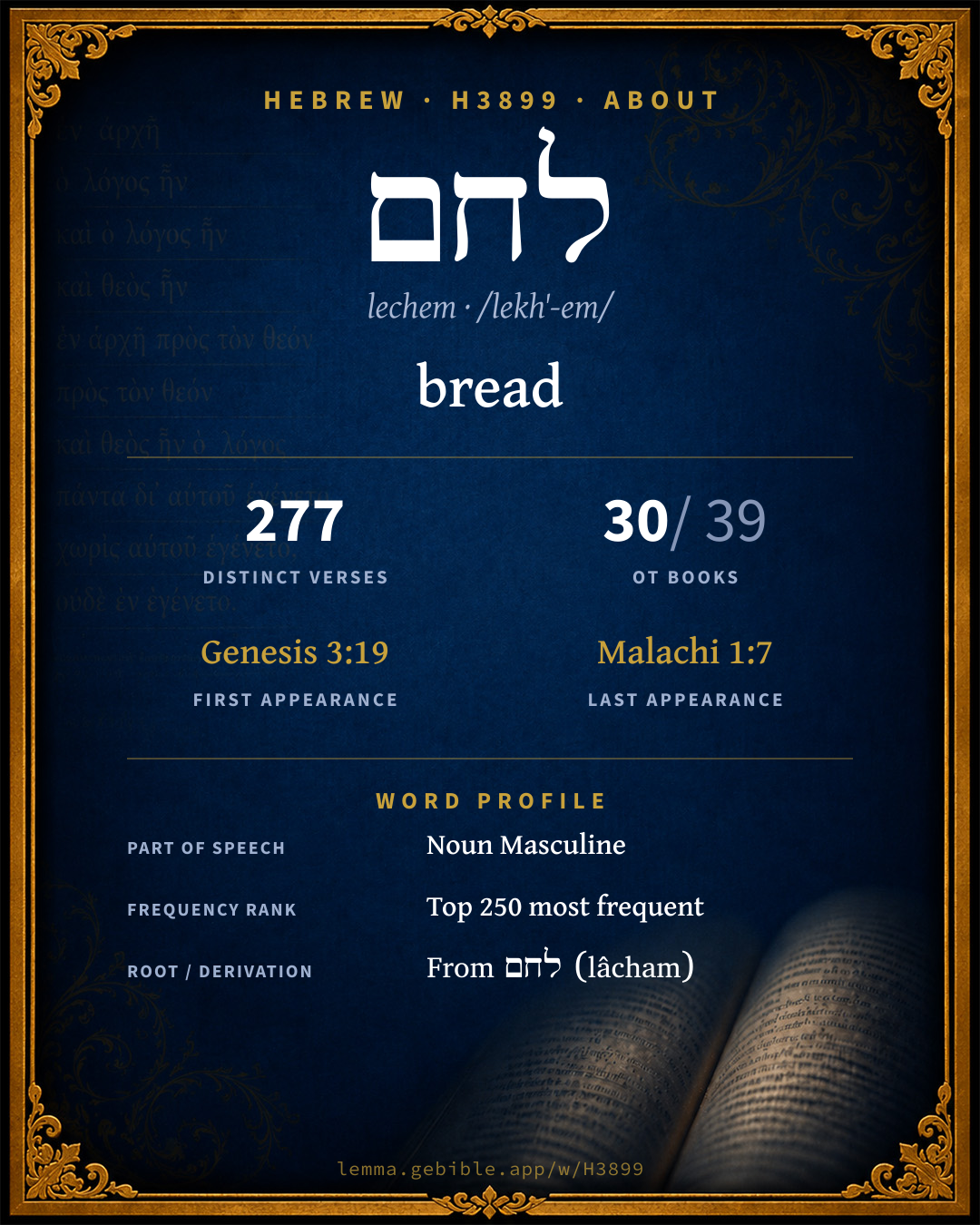
לֶ֫חֶם
bread
also: food, grain fuller range ↓
Full lexicon entry — Brown-Driver-Briggs (BDB)
From Brown-Driver-Briggs (BDB)
Where this word appears
See every Absolute-state word in the Hebrew Bible →
Grammar key — what these labels mean
Part of speech
- Noun
- A naming word — a person, place, thing, or idea.
Noun type
- Common
- A common noun — a general class of person, place, or thing (“king,” “city,” “water”), not a specific name.
Stem
- Qal
- The basic, simple active stem — the plain form of the verb (“he wrote”).
Form
- Infinitive Construct
- A bound verbal noun, frequently with prepositions (“to write / in writing”).
State
- Absolute
- The independent form of a noun, not bound to a following word.
- Construct
- A noun bound to a following noun in a possessive / “of” relationship (the construct chain).
Gender
- Both
- Attested as both masculine and feminine.
Number
- Singular
- One.
Grammatical forms
- Noun, Common, Both, Singular, Absolute 197 times (66%)
- Noun, Common, Both, Singular, Construct 101 times (34%)
- Verb, Qal, Infinitive Construct 1 time (0%)
Parsed forms decoded from the imported morphology (morphhb / Westminster Leningrad Codex — WLC text public domain, morphhb tagging CC BY 4.0), counted across 299 parsed occurrences — not distinct verses.
Page 1 of 2 — showing verses 1–200 of 277 distinct verses where H3899 appears, across 30 books. Click any verse to open its interlinear word-by-word view. Verse text shown in the World English Bible for context — . Each verse’s Hebrew form is shown with its reference; the English is not keyword-highlighted, since the data carries no word-level English alignment. Use “Compare translations” on any verse to read it across multiple English versions. This concordance covers the Hebrew Bible; Septuagint (Greek Old Testament) occurrences are not indexed here.
Genesis 22 verses
- Genesis 3:19 לֶ֔חֶם n c bs By the sweat of your face will you eat bread until you return to the ground, for out of it you were taken. For you are dust, and to dust you shall return."
- Genesis 14:18 לֶ֣חֶם n c bs Melchizedek king of Salem brought forth bread and wine: and he was priest of God Most High.
- Genesis 18:5 לֶ֜חֶם n c bs I will get a morsel of bread so you can refresh your heart. After that you may go your way, now that you have come to your servant." They said, "Very well, do as you have said."
- Genesis 21:14 לֶחֶם֩ n c bs Abraham rose up early in the morning, and took bread and a bottle of water, and gave it to Hagar, putting it on her shoulder, and gave her the child, and sent her away. She departed, and wandered in the wilderness of Beersheba.
- Genesis 25:34 לֶ֚חֶם n c bs Jacob gave Esau bread and stew of lentils. He ate and drank, rose up, and went his way. So Esau despised his birthright.
- Genesis 27:17 הַ/לֶּ֖חֶם ptcl def.art + n c bs She gave the savory food and the bread, which she had prepared, into the hand of her son Jacob.
- Genesis 28:20 לֶ֛חֶם n c bs Jacob vowed a vow, saying, "If God will be with me, and will keep me in this way that I go, and will give me bread to eat, and clothing to put on,
- Genesis 31:54 לָ֑חֶם לֶ֔חֶם n c bs n c bs Jacob offered a sacrifice in the mountain, and called his relatives to eat bread. They ate bread, and stayed all night in the mountain.
- Genesis 37:25 לֶחֶם֒ n c bs They sat down to eat bread, and they lifted up their eyes and looked, and saw a caravan of Ishmaelites was coming from Gilead, with their camels bearing spices and balm and myrrh, going to carry it down to Egypt.
- Genesis 39:6 הַ/לֶּ֖חֶם ptcl def.art + n c bs He left all that he had in Joseph's hand. He didn't concern himself with anything, except for the food which he ate. Joseph was well-built and handsome.
- Genesis 41:54 לָֽחֶם n c bs The seven years of famine began to come, just as Joseph had said. There was famine in all lands, but in all the land of Egypt there was bread.
- Genesis 41:55 לַ/לָּ֑חֶם prep det + n c bs When all the land of Egypt was famished, the people cried to Pharaoh for bread, and Pharaoh said to all the Egyptians, "Go to Joseph. What he says to you, do."
- Genesis 43:25 לָֽחֶם n c bs They made ready the present for Joseph's coming at noon, for they heard that they should eat bread there.
- Genesis 43:31 לָֽחֶם n c bs He washed his face, and came out. He controlled himself, and said, "Serve the meal."
- Genesis 43:32 לֶ֔חֶם n c bs They served him by himself, and them by themselves, and the Egyptians, that ate with him, by themselves, because the Egyptians don't eat bread with the Hebrews, for that is an abomination to the Egyptians.
- Genesis 45:23 וָ/לֶ֧חֶם conj + n c bs To his father, he sent after this manner: ten donkeys loaded with the good things of Egypt, and ten female donkeys loaded with grain and bread and provision for his father by the way.
- Genesis 47:12 לֶ֖חֶם n c bs Joseph nourished his father, his brothers, and all of his father's household, with bread, according to their families.
- Genesis 47:13 וְ/לֶ֤חֶם conj + n c bs There was no bread in all the land; for the famine was very severe, so that the land of Egypt and the land of Canaan fainted by reason of the famine.
- Genesis 47:15 לֶ֔חֶם n c bs When the money was all spent in the land of Egypt, and in the land of Canaan, all the Egyptians came to Joseph, and said, "Give us bread, for why should we die in your presence? For our money fails."
- Genesis 47:17 לֶ֜חֶם בַּ/לֶּ֨חֶם֙ n c bs prep det + n c bs They brought their cattle to Joseph, and Joseph gave them bread in exchange for the horses, and for the flocks, and for the herds, and for the donkeys: and he fed them with bread in exchange for all their cattle for that year.
- Genesis 47:19 בַּ/לָּ֑חֶם prep det + n c bs Why should we die before your eyes, both we and our land? Buy us and our land for bread, and we and our land will be servants to Pharaoh. Give us seed, that we may live, and not die, and that the land won't be desolate."
- Genesis 49:20 לַחְמ֑/וֹ n c bs cs + sfx pers 3ms Out of Asher his bread will be fat, He will yield royal dainties.
Exodus 20 verses
- Exodus 2:20 לָֽחֶם n c bs He said to his daughters, "Where is he? Why is it that you have left the man? Call him, that he may eat bread."
- Exodus 16:3 לֶ֖חֶם n c bs and the children of Israel said to them, "We wish that we had died by the hand of Yahweh in the land of Egypt, when we sat by the flesh-pots, when we ate our fill of bread, for you have brought us out into this wilderness, to kill this whole assembly with hunger."
- Exodus 16:4 לֶ֖חֶם n c bs Then said Yahweh to Moses, "Behold, I will rain bread from the sky for you, and the people shall go out and gather a day's portion every day, that I may test them, whether they will walk in my law, or not.
- Exodus 16:8 וְ/לֶ֤חֶם conj + n c bs Moses said, "Now Yahweh shall give you meat to eat in the evening, and in the morning bread to satisfy you; because Yahweh hears your murmurings which you murmur against him. And who are we? Your murmurings are not against us, but against Yahweh."
- Exodus 16:12 לָ֑חֶם n c bs "I have heard the murmurings of the children of Israel. Speak to them, saying, 'At evening you shall eat meat, and in the morning you shall be filled with bread: and you shall know that I am Yahweh your God.'"
- Exodus 16:15 הַ/לֶּ֔חֶם ptcl def.art + n c bs When the children of Israel saw it, they said one to another, "What is it?" For they didn't know what it was. Moses said to them, "It is the bread which Yahweh has given you to eat."
- Exodus 16:22 לֶ֨חֶם֙ n c bs cs It happened that on the sixth day they gathered twice as much bread, two omers for each one, and all the rulers of the congregation came and told Moses.
- Exodus 16:29 לֶ֣חֶם n c bs cs Behold, because Yahweh has given you the Sabbath, therefore he gives you on the sixth day the bread of two days. Everyone stay in his place. Let no one go out of his place on the seventh day."
- Exodus 16:32 הַ/לֶּ֗חֶם ptcl def.art + n c bs Moses said, "This is the thing which Yahweh has commanded, 'Let an omer-full of it be kept throughout your generations, that they may see the bread with which I fed you in the wilderness, when I brought you forth from the land of Egypt."
- Exodus 18:12 לֶ֛חֶם n c bs Jethro, Moses' father-in-law, took a burnt offering and sacrifices for God. Aaron came with all of the elders of Israel, to eat bread with Moses' father-in-law before God.
- Exodus 23:25 לַחְמְ/ךָ֖ n c bs cs + sfx pers 2ms You shall serve Yahweh your God, and he will bless your bread and your water, and I will take sickness away from your midst.
- Exodus 25:30 לֶ֥חֶם n c bs cs You shall set bread of the presence on the table before me always.
- Exodus 29:2 וְ/לֶ֣חֶם conj + n c bs cs unleavened bread, unleavened cakes mixed with oil, and unleavened wafers anointed with oil: you shall make them of fine wheat flour.
- Exodus 29:23 לֶ֜חֶם לֶ֥חֶם n c bs n c bs cs and one loaf of bread, one cake of oiled bread, and one wafer out of the basket of unleavened bread that is before Yahweh.
- Exodus 29:32 הַ/לֶּ֖חֶם ptcl def.art + n c bs Aaron and his sons shall eat the flesh of the ram, and the bread that is in the basket, at the door of the tent of meeting.
- Exodus 29:34 הַ/לֶּ֖חֶם ptcl def.art + n c bs If anything of the flesh of the consecration, or of the bread, remains to the morning, then you shall burn the remainder with fire: it shall not be eaten, because it is holy.
- Exodus 34:28 לֶ֚חֶם n c bs He was there with Yahweh forty days and forty nights; he neither ate bread, nor drank water. He wrote on the tablets the words of the covenant, the ten commandments.
- Exodus 35:13 לֶ֥חֶם n c bs cs the table with its poles and all its vessels, and the show bread;
- Exodus 39:36 לֶ֥חֶם n c bs cs the table, all its vessels, the show bread,
- Exodus 40:23 לֶ֖חֶם n c bs He set the bread in order on it before Yahweh, as Yahweh commanded Moses.
Leviticus 22 verses
- Leviticus 3:11 לֶ֥חֶם n c bs cs The priest shall burn it on the altar: it is the food of the offering made by fire to Yahweh.
- Leviticus 3:16 לֶ֤חֶם n c bs cs The priest shall burn them on the altar: it is the food of the offering made by fire, for a sweet savor; all the fat is Yahweh's.
- Leviticus 7:13 לֶ֣חֶם n c bs cs With cakes of leavened bread he shall offer his offering with the sacrifice of his peace offerings for thanksgiving.
- Leviticus 8:26 לֶ֥חֶם n c bs cs and out of the basket of unleavened bread, that was before Yahweh, he took one unleavened cake, and one cake of oiled bread, and one wafer, and placed them on the fat, and on the right thigh.
- Leviticus 8:31 הַ/לֶּ֔חֶם ptcl def.art + n c bs Moses said to Aaron and to his sons, "Boil the flesh at the door of the Tent of Meeting, and there eat it and the bread that is in the basket of consecration, as I commanded, saying, 'Aaron and his sons shall eat it.'
- Leviticus 8:32 וּ/בַ/לָּ֑חֶם conj + prep det + n c bs What remains of the flesh and of the bread you shall burn with fire.
- Leviticus 21:6 לֶ֧חֶם n c bs cs They shall be holy to their God, and not profane the name of their God; for they offer the offerings of Yahweh made by fire, the bread of their God; therefore they shall be holy.
- Leviticus 21:8 לֶ֥חֶם n c bs cs You shall sanctify him therefore; for he offers the bread of your God: he shall be holy to you: for I Yahweh, who sanctify you, am holy.
- Leviticus 21:17 לֶ֥חֶם n c bs cs "Say to Aaron, 'None of your seed throughout their generations who has a blemish, may approach to offer the bread of his God.
- Leviticus 21:21 לֶ֣חֶם n c bs cs no man of the seed of Aaron the priest, who has a blemish, shall come near to offer the offerings of Yahweh made by fire. Since has a blemish, he shall not come near to offer the bread of his God.
- Leviticus 21:22 לֶ֣חֶם n c bs cs He shall eat the bread of his God, both of the most holy, and of the holy.
- Leviticus 22:7 לַחְמ֖/וֹ n c bs cs + sfx pers 3ms When the sun is down, he shall be clean; and afterward he shall eat of the holy things, because it is his bread.
- Leviticus 22:11 בְ/לַחְמֽ/וֹ prep + n c bs cs + sfx pers 3ms But if a priest buys a slave, purchased by his money, he shall eat of it; and such as are born in his house, they shall eat of his bread.
- Leviticus 22:13 מִ/לֶּ֥חֶם prep + n c bs cs But if a priest's daughter is a widow, or divorced, and has no child, and has returned to her father's house, as in her youth, she may eat of her father's bread: but no stranger shall eat any of it.
- Leviticus 22:25 לֶ֥חֶם n c bs cs Neither from the hand of a foreigner shall you offer the bread of your God of any of these; because their corruption is in them. There is a blemish in them. They shall not be accepted for you.'"
- Leviticus 23:14 וְ/לֶחֶם֩ conj + n c bs You shall eat neither bread, nor roasted grain, nor fresh grain, until this same day, until you have brought the offering of your God. This is a statute forever throughout your generations in all your dwellings.
- Leviticus 23:17 לֶ֣חֶם n c bs cs You shall bring out of your habitations two wave-loaves of two tenth parts of an ephah: they shall be of fine flour, they shall be baked with yeast, for first fruits to Yahweh.
- Leviticus 23:18 הַ/לֶּ֗חֶם ptcl def.art + n c bs You shall present with the bread seven lambs without blemish a year old, one young bull, and two rams. Yhey shall be a burnt offering to Yahweh, with their meal offering, and their drink offerings, even an offering made by fire, of a sweet aroma to Yahweh.
- Leviticus 23:20 לֶ֨חֶם n c bs cs The priest shall wave them with the bread of the first fruits for a wave offering before Yahweh, with the two lambs. They shall be holy to Yahweh for the priest.
- Leviticus 24:7 לַ/לֶּ֨חֶם֙ prep det + n c bs You shall put pure frankincense on each row, that it may be to the bread for a memorial, even an offering made by fire to Yahweh.
- Leviticus 26:5 לַחְמְ/כֶם֙ n c bs cs + sfx pers 2mp Your threshing shall reach to the vintage, and the vintage shall reach to the sowing time; and you shall eat your bread to the full, and dwell in your land safely.
- Leviticus 26:26 לֶחֶם֒ לַחְמְ/כֶם֙ לַחְמְ/כֶ֖ם n c bs n c bs cs + sfx pers 2mp n c bs cs + sfx pers 2mp When I break your staff of bread, ten women shall bake your bread in one oven, and they shall deliver your bread again by weight: and you shall eat, and not be satisfied.
Numbers 6 verses
- Numbers 4:7 וְ/לֶ֥חֶם conj + n c bs cs On the table of show bread they shall spread a blue cloth, and put on it the dishes, the spoons, the bowls, and the cups with which to pour out; and the continual bread shall be on it.
- Numbers 14:9 לַחְמֵ֖/נוּ n c bs cs + sfx pers 1cp Only don't rebel against Yahweh, neither fear the people of the land; for they are bread for us: their defense is removed from over them, and Yahweh is with us: don't fear them.
- Numbers 15:19 מִ/לֶּ֣חֶם prep + n c bs cs then it shall be that when you eat of the bread of the land, you shall offer up a heave-offering to Yahweh.
- Numbers 21:5 לֶ֨חֶם֙ בַּ/לֶּ֖חֶם n c bs prep det + n c bs The people spoke against God, and against Moses, Why have you brought us up out of Egypt to die in the wilderness? for there is no bread, and there is no water; and our soul loathes this light bread.
- Numbers 28:2 לַחְמִ֜/י n c bs cs + sfx pers 1cs Command the children of Israel, and tell them, My offering, my food for my offerings made by fire, of a sweet savor to me, shall you observe to offer to me in their due season.
- Numbers 28:24 לֶ֛חֶם n c bs After this manner you shall offer daily, for seven days, the food of the offering made by fire, of a sweet savor to Yahweh: it shall be offered besides the continual burnt offering, and the drink-offering of it.
Deuteronomy 8 verses
- Deuteronomy 8:3 הַ/לֶּ֤חֶם ptcl def.art + n c bs He humbled you, and allowed you to hunger, and fed you with manna, which you didn't know, neither did your fathers know; that he might make you know that man does not live by bread only, but by everything that proceeds out of the mouth of Yahweh does man live.
- Deuteronomy 8:9 לֶ֔חֶם n c bs a land in which you shall eat bread without scarceness, you shall not lack anything in it; a land whose stones are iron, and out of whose hills you may dig copper.
- Deuteronomy 9:9 לֶ֚חֶם n c bs When I was gone up onto the mountain to receive the tables of stone, even the tables of the covenant which Yahweh made with you, then I stayed on the mountain forty days and forty nights; I did neither eat bread nor drink water.
- Deuteronomy 9:18 לֶ֚חֶם n c bs I fell down before Yahweh, as at the first, forty days and forty nights; I did neither eat bread nor drink water; because of all your sin which you sinned, in doing that which was evil in the sight of Yahweh, to provoke him to anger.
- Deuteronomy 10:18 לֶ֥חֶם n c bs He does execute justice for the fatherless and widow, and loves the foreigner, in giving him food and clothing.
- Deuteronomy 16:3 לֶ֣חֶם n c bs cs You shall eat no leavened bread with it; seven days shall you eat unleavened bread therewith, even the bread of affliction; for you came forth out of the land of Egypt in haste: that you may remember the day when you came forth out of the land of Egypt all the days of your life.
- Deuteronomy 23:4 בַּ/לֶּ֣חֶם prep det + n c bs because they didn't meet you with bread and with water in the way, when you came forth out of Egypt, and because they hired against you Balaam the son of Beor from Pethor of Mesopotamia, to curse you.
- Deuteronomy 29:6 לֶ֚חֶם n c bs You have not eaten bread, neither have you drunk wine or strong drink; that you may know that I am Yahweh your God.
Joshua 2 verses
- Joshua 9:5 לֶ֣חֶם n c bs cs and old and patched shoes on their feet, and old garments on them; and all the bread of their provision was dry and was become moldy.
- Joshua 9:12 לַחְמֵ֗/נוּ n c bs cs + sfx pers 1cp This our bread we took hot for our provision out of our houses on the day we came forth to go to you; but now, behold, it is dry, and is become moldy:
Judges 7 verses
- Judges 7:13 לֶ֤חֶם n c bs cs When Gideon had come, behold, there was a man telling a dream to his fellow; and he said, Behold, I dreamed a dream; and, behold, a cake of barley bread tumbled into the camp of Midian, and came to the tent, and struck it so that it fell, and turned it upside down, so that the tent lay flat.
- Judges 8:5 לֶ֔חֶם n c bs He said to the men of Succoth, Please give loaves of bread to the people who follow me; for they are faint, and I am pursuing after Zebah and Zalmunna, the kings of Midian.
- Judges 8:6 לָֽחֶם n c bs The princes of Succoth said, Are the hands of Zebah and Zalmunna now in your hand, that we should give bread to your army?
- Judges 8:15 לָֽחֶם n c bs He came to the men of Succoth, and said, See Zebah and Zalmunna, concerning whom you did taunt me, saying, Are the hands of Zebah and Zalmunna now in your hand, that we should give bread to your men who are weary?
- Judges 13:16 בְּ/לַחְמֶ֔/ךָ prep + n c bs cs + sfx pers 2ms The angel of Yahweh said to Manoah, Though you detain me, I won't eat of your bread; and if you will make ready a burnt offering, you must offer it to Yahweh. For Manoah didn't know that he was the angel of Yahweh.
- Judges 19:5 לֶ֖חֶם n c bs It happened on the fourth day, that they arose early in the morning, and he rose up to depart: and the young lady's father said to his son-in-law, Strengthen your heart with a morsel of bread, and afterward you shall go your way.
- Judges 19:19 לֶ֣חֶם n c bs Yet there is both straw and provender for our donkeys; and there is bread and wine also for me, and for your handmaid, and for the young man who is with your servants: there is no want of anything.
Ruth 2 verses
- Ruth 1:6 לָֽחֶם n c bs Then she arose with her daughters-in-law, that she might return from the country of Moab: for she had heard in the country of Moab how that Yahweh had visited his people in giving them bread.
- Ruth 2:14 הַ/לֶּ֔חֶם ptcl def.art + n c bs At meal-time Boaz said to her, Come here, and eat of the bread, and dip your morsel in the vinegar. She sat beside the reapers, and they reached her parched grain, and she ate, and was sufficed, and left of it.
1 Samuel 22 verses
- 1 Samuel 2:5 בַּ/לֶּ֨חֶם֙ prep det + n c bs Those who were full have hired out themselves for bread; Those who were hungry have ceased [to hunger]: Yes, the barren has borne seven; She who has many children languishes.
- 1 Samuel 2:36 לָ֑חֶם לָֽחֶם n c bs n c bs It shall happen, that everyone who is left in your house shall come and bow down to him for a piece of silver and a loaf of bread, and shall say, Please put me into one of the priests' offices, that I may eat a morsel of bread.
- 1 Samuel 9:7 הַ/לֶּ֨חֶם֙ ptcl def.art + n c bs Then said Saul to his servant, But, behold, if we go, what shall we bring the man? for the bread is spent in our vessels, and there is not a present to bring to the man of God: what have we?
- 1 Samuel 10:3 לֶ֔חֶם n c bs Then shall you go on forward from there, and you shall come to the oak of Tabor; and there shall meet you there three men going up to God to Bethel, one carrying three kids, and another carrying three loaves of bread, and another carrying a bottle of wine:
- 1 Samuel 10:4 לֶ֔חֶם n c bs and they will greet you, and give you two loaves of bread, which you shall receive of their hand.
- 1 Samuel 14:24 לֶ֜חֶם לָֽחֶם n c bs n c bs The men of Israel were distressed that day; for Saul had adjured the people, saying, Cursed be the man who eats any food until it be evening, and I be avenged on my enemies. So none of the people tasted food.
- 1 Samuel 14:28 לֶ֖חֶם n c bs Then answered one of the people, and said, Your father directly charged the people with an oath, saying, Cursed be the man who eats food this day. The people were faint.
- 1 Samuel 16:20 לֶ֨חֶם֙ n c bs Jesse took a donkey loaded with bread, and a bottle of wine, and a kid, and sent them by David his son to Saul.
- 1 Samuel 17:17 לֶ֖חֶם n c bs Jesse said to David his son, Take now for your brothers an ephah of this parched grain, and these ten loaves, and carry [them] quickly to the camp to your brothers;
- 1 Samuel 20:24 הַ/לֶּ֖חֶם ptcl def.art + n c bs So David hid himself in the field: and when the new moon was come, the king sat him down to eat food.
- 1 Samuel 20:27 הַ/לָּֽחֶם ptcl def.art + n c bs It happened on the next day after the new moon, [which was] the second [day], that David's place was empty: and Saul said to Jonathan his son, Why doesn't the son of Jesse come to meat, neither yesterday, nor today?
- 1 Samuel 20:34 לֶ֔חֶם n c bs So Jonathan arose from the table in fierce anger, and ate no food the second day of the month; for he was grieved for David, because his father had done him shame.
- 1 Samuel 21:3 לֶ֖חֶם n c bs Now therefore what is under your hand? give me five loaves of bread in my hand, or whatever there is present.
- 1 Samuel 21:4 לֶ֥חֶם לֶ֤חֶם n c bs cs n c bs cs The priest answered David, and said, There is no common bread under my hand, but there is holy bread; if only the young men have kept themselves from women.
- 1 Samuel 21:6 לֶ֗חֶם לֶ֤חֶם לֶ֣חֶם n c bs n c bs cs n c bs cs So the priest gave him holy [bread]; for there was no bread there but the show bread, that was taken from before Yahweh, to put hot bread in the day when it was taken away.
- 1 Samuel 22:13 לֶ֣חֶם n c bs Saul said to him, Why have you conspired against me, you and the son of Jesse, in that you have given him bread, and a sword, and have inquired of God for him, that he should rise against me, to lie in wait, as at this day?
- 1 Samuel 25:11 לַחְמִ/י֙ n c bs cs + sfx pers 1cs Shall I then take my bread, and my water, and my meat that I have killed for my shearers, and give it to men who I don't know where they come from?
- 1 Samuel 25:18 לֶ֜חֶם n c bs Then Abigail made haste, and took two hundred loaves, and two bottles of wine, and five sheep ready dressed, and five measures of parched grain, and one hundred clusters of raisins, and two hundred cakes of figs, and laid them on donkeys.
- 1 Samuel 28:20 לֶ֔חֶם n c bs Then Saul fell immediately his full length on the earth, and was sore afraid, because of the words of Samuel: and there was no strength in him; for he had eaten no bread all the day, nor all the night.
- 1 Samuel 28:22 לֶ֖חֶם n c bs Now therefore, please listen also to the voice of your handmaid, and let me set a morsel of bread before you; and eat, that you may have strength, when you go on your way.
- 1 Samuel 30:11 לֶ֨חֶם֙ n c bs They found an Egyptian in the field, and brought him to David, and gave him bread, and he ate; and they gave him water to drink.
- 1 Samuel 30:12 לֶ֨חֶם֙ n c bs They gave him a piece of a cake of figs, and two clusters of raisins: and when he had eaten, his spirit came again to him; for he had eaten no bread, nor drunk any water, three days and three nights.
2 Samuel 11 verses
- 2 Samuel 3:29 לָֽחֶם n c bs let it fall on the head of Joab, and on all his father's house; and let there not fail from the house of Joab one who has an issue, or who is a leper, or who leans on a staff, or who falls by the sword, or who lacks bread.
- 2 Samuel 3:35 לֶ֖חֶם לֶ֖חֶם n c bs n c bs All the people came to cause David to eat bread while it was yet day; but David swore, saying, God do so to me, and more also, if I taste bread, or anything else, until the sun be down.
- 2 Samuel 6:19 לֶ֨חֶם֙ n c bs He dealt among all the people, even among the whole multitude of Israel, both to men and women, to everyone a cake of bread, and a portion [of flesh], and a cake of raisins. So all the people departed everyone to his house.
- 2 Samuel 9:7 לֶ֛חֶם n c bs David said to him, "Don't be afraid of him; for I will surely show you kindness for Jonathan your father's sake, and will restore you all the land of Saul your father; and you shall eat bread at my table continually."
- 2 Samuel 9:10 לֶּ֨חֶם֙ לֶ֖חֶם n c bs n c bs You shall till the land for him, you, and your sons, and your servants; and you shall bring in [the fruits], that your master's son may have bread to eat: but Mephibosheth your master's son shall eat bread always at my table." Now Ziba had fifteen sons and twenty servants.
- 2 Samuel 12:17 לָֽחֶם n c bs The elders of his house arose, [and stood] beside him, to raise him up from the earth: but he would not, neither did he eat bread with them.
- 2 Samuel 12:20 לֶ֖חֶם n c bs Then David arose from the earth, and washed, and anointed himself, and changed his clothing; and he came into the house of Yahweh, and worshiped: then he came to his own house; and when he required, they set bread before him, and he ate.
- 2 Samuel 12:21 לָֽחֶם n c bs Then said his servants to him, What thing is this that you have done? you did fast and weep for the child, while it was alive; but when the child was dead, you did rise and eat bread.
- 2 Samuel 13:5 לֶ֗חֶם n c bs Jonadab said to him, Lay you down on your bed, and feign yourself sick: and when your father comes to see you, tell him, Please let my sister Tamar come and give me bread to eat, and dress the food in my sight, that I may see it, and eat it from her hand.
- 2 Samuel 16:1 לֶ֜חֶם n c bs When David was a little past the top [of the ascent], behold, Ziba the servant of Mephibosheth met him, with a couple of donkeys saddled, and on them two hundred loaves of bread, and one hundred clusters of raisins, and one hundred summer fruits, and a bottle of wine.
- 2 Samuel 16:2 ו/ל/ה/לחם וְ/הַ/לֶּ֤חֶם conj + prep + ptcl def.art + n c bs conj + ptcl def.art + n c bs The king said to Ziba, What do you mean by these? Ziba said, The donkeys are for the king's household to ride on; and the bread and summer fruit for the young men to eat; and the wine, that such as are faint in the wilderness may drink.
1 Kings 22 verses
- 1 Kings 4:22 לֶֽחֶם n c bs cs Solomon's provision for one day was thirty measures of fine flour, and sixty measures of meal,
- 1 Kings 5:9 לֶ֥חֶם n c bs cs My servants shall bring them down from Lebanon to the sea; and I will make them into rafts to go by sea to the place that you shall appoint me, and will cause them to be broken up there, and you shall receive them; and you shall accomplish my desire, in giving food for my household.
- 1 Kings 7:48 לֶ֥חֶם n c bs cs Solomon made all the vessels that were in the house of Yahweh: the golden altar, and the table whereupon the show bread was, of gold;
- 1 Kings 11:18 וְ/לֶ֨חֶם֙ conj + n c bs They arose out of Midian, and came to Paran; and they took men with them out of Paran, and they came to Egypt, to Pharaoh king of Egypt, who gave him a house, and appointed him food, and gave him land.
- 1 Kings 13:8 לֶ֨חֶם֙ n c bs The man of God said to the king, If you will give me half your house, I will not go in with you, neither will I eat bread nor drink water in this place;
- 1 Kings 13:9 לֶ֖חֶם n c bs for so was it charged me by the word of Yahweh, saying, You shall eat no bread, nor drink water, neither return by the way that you came.
- 1 Kings 13:15 לָֽחֶם n c bs Then he said to him, Come home with me, and eat bread.
- 1 Kings 13:16 לֶ֗חֶם n c bs He said, I may not return with you, nor go in with you; neither will I eat bread nor drink water with you in this place:
- 1 Kings 13:17 לֶ֔חֶם n c bs for it was said to me by the word of Yahweh, You shall eat no bread nor drink water there, nor turn again to go by the way that you came.
- 1 Kings 13:18 לֶ֖חֶם n c bs He said to him, I also am a prophet as you are; and an angel spoke to me by the word of Yahweh, saying, Bring him back with you into your house, that he may eat bread and drink water. [But] he lied to him.
- 1 Kings 13:19 לֶ֛חֶם n c bs So he went back with him, and ate bread in his house, and drank water.
- 1 Kings 13:22 לֶ֨חֶם֙ לֶ֖חֶם n c bs n c bs but came back, and have eaten bread and drunk water in the place of which he said to you, Eat no bread, and drink no water; your body shall not come to the tomb of your fathers.
- 1 Kings 13:23 לֶ֖חֶם n c bs It happened, after he had eaten bread, and after he had drunk, that he saddled for him the donkey, [to wit], for the prophet whom he had brought back.
- 1 Kings 14:3 לֶ֧חֶם n c bs Take with you ten loaves, and cakes, and a jar of honey, and go to him: he will tell you what shall become of the child.
- 1 Kings 17:6 לֶ֤חֶם וְ/לֶ֥חֶם n c bs conj + n c bs The ravens brought him bread and flesh in the morning, and bread and flesh in the evening; and he drank of the brook.
- 1 Kings 17:11 לֶ֖חֶם n c bs As she was going to get it, he called to her, and said, Please bring me a morsel of bread in your hand.
- 1 Kings 18:4 לֶ֥חֶם n c bs for it was so, when Jezebel cut off the prophets of Yahweh, that Obadiah took one hundred prophets, and hid them by fifty in a cave, and fed them with bread and water.)
- 1 Kings 18:13 לֶ֥חֶם n c bs Wasn't it told my lord what I did when Jezebel killed the prophets of Yahweh, how I hid one hundred men of Yahweh's prophets by fifty in a cave, and fed them with bread and water?
- 1 Kings 21:4 לָֽחֶם n c bs Ahab came into his house sullen and angry because of the word which Naboth the Jezreelite had spoken to him; for he had said, I will not give you the inheritance of my fathers. He laid him down on his bed, and turned away his face, and would eat no bread.
- 1 Kings 21:5 לָֽחֶם n c bs But Jezebel his wife came to him, and said to him, Why is your spirit so sad, that you eat no bread?
- 1 Kings 21:7 לֶ֨חֶם֙ n c bs Jezebel his wife said to him, Do you now govern the kingdom of Israel? arise, and eat bread, and let your heart be merry: I will give you the vineyard of Naboth the Jezreelite.
- 1 Kings 22:27 לֶ֤חֶם n c bs and say, Thus says the king, Put this fellow in the prison, and feed him with bread of affliction and with water of affliction, until I come in peace.
2 Kings 6 verses
- 2 Kings 4:8 לָ֑חֶם לָֽחֶם n c bs n c bs It fell on a day, that Elisha passed to Shunem, where was a great woman; and she constrained him to eat bread. So it was, that as often as he passed by, he turned in there to eat bread.
- 2 Kings 4:42 לֶ֤חֶם לֶ֣חֶם n c bs cs n c bs There came a man from Baal Shalishah, and brought the man of God bread of the first fruits, twenty loaves of barley, and fresh ears of grain in his sack. He said, Give to the people, that they may eat.
- 2 Kings 6:22 לֶ֨חֶם n c bs He answered, You shall not strike them: would you strike those whom you have taken captive with your sword and with your bow? set bread and water before them, that they may eat and drink, and go to their master.
- 2 Kings 18:32 לֶ֣חֶם n c bs Until I come and take you away to a land like your own land, a land of grain and new wine, a land of bread and vineyards, a land of olive trees and of honey, that you may live, and not die: and don't listen to Hezekiah, when he persuades you, saying, Yahweh will deliver us.
- 2 Kings 25:3 לֶ֖חֶם n c bs On the ninth day of the [fourth] month the famine was sore in the city, so that there was no bread for the people of the land.
- 2 Kings 25:29 לֶ֧חֶם n c bs and changed his prison garments. [Jehoiachin] ate bread before him continually all the days of his life:
1 Chronicles 4 verses
- 1 Chronicles 9:32 לֶ֣חֶם n c bs cs Some of their brothers, of the sons of the Kohathites, were over the show bread, to prepare it every Sabbath.
- 1 Chronicles 12:40 לֶ֡חֶם n c bs Moreover those who were near to them, [even] as far as Issachar and Zebulun and Naphtali, brought bread on donkeys, and on camels, and on mules, and on oxen, food of meal, cakes of figs, and clusters of raisins, and wine, and oil, and oxen, and sheep in abundance: for there was joy in Israel.
- 1 Chronicles 16:3 לֶ֔חֶם n c bs He dealt to everyone of Israel, both man and woman, to every one a loaf of bread, and a portion [of flesh], and a cake of raisins.
- 1 Chronicles 23:29 וּ/לְ/לֶ֨חֶם conj + prep + n c bs cs for the show bread also, and for the fine flour for a meal-offering, whether of unleavened wafers, or of that which is baked in the pan, or of that which is soaked, and for all manner of measure and size;
2 Chronicles 3 verses
- 2 Chronicles 4:19 לֶ֥חֶם n c bs cs Solomon made all the vessels that were in the house of God, the golden altar also, and the tables whereon was the show bread;
- 2 Chronicles 13:11 לֶ֜חֶם n c bs and they burn to Yahweh every morning and every evening burnt offerings and sweet incense: the show bread also [set they] in order on the pure table; and the lampstand of gold with the lamps of it, to burn every evening: for we keep the charge of Yahweh our God; but you have forsaken him.
- 2 Chronicles 18:26 לֶ֤חֶם n c bs and say, Thus says the king, Put this fellow in the prison, and feed him with bread of affliction and with water of affliction, until I return in peace.
Ezra 1 verse
Nehemiah 6 verses
- Nehemiah 5:14 לֶ֥חֶם n c bs cs Moreover from the time that I was appointed to be their governor in the land of Judah, from the twentieth year even to the two and thirtieth year of Artaxerxes the king, [that is], twelve years, I and my brothers have not eaten the bread of the governor.
- Nehemiah 5:15 בְּ/לֶ֤חֶם prep + n c bs But the former governors who were before me were chargeable to the people, and took of them bread and wine, besides forty shekels of silver; yes, even their servants bore rule over the people: but I didn't do so, because of the fear of God.
- Nehemiah 5:18 לֶ֤חֶם n c bs cs Now that which was prepared for one day was one ox and six choice sheep; also fowls were prepared for me, and once in ten days store of all sorts of wine: yet for all this I didn't demand the bread of the governor, because the bondage was heavy on this people.
- Nehemiah 9:15 וְ֠/לֶחֶם conj + n c bs and gave them bread from the sky for their hunger, and brought forth water for them out of the rock for their thirst, and commanded those who they should go in to possess the land which you had sworn to give them.
- Nehemiah 10:33 לְ/לֶ֣חֶם prep + n c bs cs for the show bread, and for the continual meal-offering, and for the continual burnt-offering, for the Sabbaths, for the new moons, for the set feasts, and for the holy things, and for the sin-offerings to make atonement for Israel, and for all the work of the house of our God.
- Nehemiah 13:2 בַּ/לֶּ֣חֶם prep det + n c bs because they didn't meet the children of Israel with bread and with water, but hired Balaam against them, to curse them: however our God turned the curse into a blessing.
Job 11 verses
- Job 3:24 לַ֭חְמִ/י n c bs cs + sfx pers 1cs For my sighing comes before I eat, My groanings are poured out like water.
- Job 6:7 לַחְמִֽ/י n c bs cs + sfx pers 1cs My soul refuses to touch them; They are as loathsome food to me.
- Job 15:23 לַ/לֶּ֣חֶם prep det + n c bs He wanders abroad for bread, saying, 'Where is it?' He knows that the day of darkness is ready at his hand.
- Job 20:14 לַ֭חְמ/וֹ n c bs cs + sfx pers 3ms Yet his food in his bowels is turned. It is cobra venom within him.
- Job 22:7 לָֽחֶם n c bs You haven't given water to the weary to drink, And you have withheld bread from the hungry.
- Job 24:5 לֶ֝֗חֶם n c bs Behold, as wild donkeys in the desert, They go forth to their work, seeking diligently for food; The wilderness yields them bread for their children.
- Job 27:14 לָֽחֶם n c bs If his children are multiplied, it is for the sword. His offspring shall not be satisfied with bread.
- Job 28:5 לָ֑חֶם n c bs As for the earth, out of it comes bread; Underneath it is turned up as it were by fire.
- Job 30:4 לַ/חְמָֽ/ם prep + Qal inf.cs + sfx pers 3mp They pluck salt herbs by the bushes. The roots of the broom are their food.
- Job 33:20 לָ֑חֶם n c bs So that his life abhors bread, And his soul dainty food.
- Job 42:11 לֶחֶם֮ n c bs Then came there to him all his brothers, and all his sisters, and all those who had been of his acquaintance before, and ate bread with him in his house. They comforted him, and consoled him concerning all the evil that Yahweh had brought on him. Everyone also gave him a piece of money, and everyone a ring of gold.
Psalms 19 verses
- Psalms 14:4 לֶ֑חֶם n c bs Have all the workers of iniquity no knowledge, Who eat up my people as they eat bread, And don't call on Yahweh?
- Psalms 37:25 לָֽחֶם n c bs I have been young, and now am old, Yet I have not seen the righteous forsaken, Nor his children begging for bread.
- Psalms 41:9 לַחְמִ֑/י n c bs cs + sfx pers 1cs Yes, my own familiar friend, in whom I trusted, Who ate bread with me, Has lifted up his heel against me.
- Psalms 42:3 לֶ֭חֶם n c bs My tears have been my food day and night, While they continually ask me, "Where is your God?"
- Psalms 53:4 לֶ֑חֶם n c bs Have the workers of iniquity no knowledge, Who eat up my people as they eat bread, And don't call on God?
- Psalms 78:20 לֶ֭חֶם n c bs Behold, he struck the rock, so that waters gushed out, Streams overflowed. Can he give bread also? Will he provide flesh for his people?"
- Psalms 78:25 לֶ֣חֶם n c bs cs Man ate the bread of angels. He sent them food to the full.
- Psalms 80:5 לֶ֣חֶם n c bs cs You have fed them with the bread of tears, And given them tears to drink in large measure.
- Psalms 102:4 לַחְמִֽ/י n c bs cs + sfx pers 1cs My heart is blighted like grass, and withered, For I forget to eat my bread.
- Psalms 102:9 כַּ/לֶּ֣חֶם prep det + n c bs For I have eaten ashes like bread, And mixed my drink with tears,
- Psalms 104:14 לֶ֝֗חֶם n c bs He causes the grass to grow for the cattle, And plants for man to cultivate, That he may bring forth food out of the earth:
- Psalms 104:15 וְ֝/לֶ֗חֶם conj + n c bs Wine that makes glad the heart of man, Oil to make his face to shine, And bread that strengthens man's heart.
- Psalms 105:16 לֶ֥חֶם n c bs He called for a famine on the land. He destroyed the food supplies.
- Psalms 105:40 וְ/לֶ֥חֶם conj + n c bs cs They asked, and he brought quails, And satisfied them with the bread of the sky.
- Psalms 127:2 לֶ֣חֶם n c bs cs It is vain for you to rise up early, To stay up late, Eating the bread of toil; For he gives sleep to his loved ones.
- Psalms 132:15 לָֽחֶם n c bs I will abundantly bless her provision. I will satisfy her poor with bread.
- Psalms 136:25 לֶ֭חֶם n c bs Who gives food to every creature; For his loving kindness endures forever.
- Psalms 146:7 לֶ֭חֶם n c bs Who executes justice for the oppressed; Who gives food to the hungry. Yahweh frees the prisoners.
- Psalms 147:9 לַחְמָ֑/הּ n c bs cs + sfx pers 3fs He provides food for the cattle, And for the young ravens when they call.
Proverbs 22 verses
- Proverbs 4:17 לֶ֣חֶם n c bs cs For they eat the bread of wickedness, And drink the wine of violence.
- Proverbs 6:8 לַחְמָ֑/הּ n c bs cs + sfx pers 3fs Provides her bread in the summer, And gathers her food in the harvest.
- Proverbs 6:26 לָ֥חֶם n c bs For a prostitute reduces you to a piece of bread. The adulteress hunts for your precious life.
- Proverbs 9:5 בְֽ/לַחֲמִ֑/י prep + n c bs cs + sfx pers 1cs "Come, eat some of my bread, Drink some of the wine which I have mixed!
- Proverbs 9:17 וְ/לֶ֖חֶם conj + n c bs cs "Stolen water is sweet. Food eaten in secret is pleasant."
- Proverbs 12:9 לָֽחֶם n c bs Better is he who is lightly esteemed, and has a servant, Than he who honors himself, and lacks bread.
About this entry
At a glance — auto-summarized from this page’s data, not written by a person. Every figure links to its source below. This summary describes the numbers; it doesn’t interpret them.
לחם (lechem) is a Hebrew noun most often rendered “bread.” Scripture first uses it in Genesis 3:19. Spanning 277 verses in 30 books, it ranks among the common words of the Hebrew Bible. Beyond its headline sense, its full sense range takes in “food” and “grain”. Sharing its root, it stands alongside לחם, לחום and לחם. For the data behind this summary, explore the sense tree and the renderings breakdown below.
Gloss history
Strong's 1890 vs modern scholarship
About this word
Strong's H3899 catalogs a Hebrew word from the Hebrew Old Testament.
These counts are not copied from any lexicon or concordance. They are computed here, from the morphology-tagged Hebrew Old Testament. What Lemma adds →
- 277
- distinct verses
- The word appears in 277 distinct verses.
- 30 / 39
- OT books
- The word appears in 30 of 39 Old Testament books.
- #165
- by frequency
- Top 250 most frequent Hebrew words (rank 165 of 8,640 Hebrew words by occurrence).
View all 277 occurrences in the concordance →
By section of the Old Testament
By traditional corpus
Conventional, traditional groupings — biblical authorship is debated, so this is a traditional corpus grouping, not an authorship claim. Each share is this word’s portion of its verses in that division of the Hebrew canon. Each figure is a share of the word’s 277 distinct verses.
- Prophets (Nevi'im) 122 verses · 44%
- Torah (Pentateuch) 78 verses · 28%
- Writings (Ketuvim) 77 verses · 28%
How translations render this word
Counts come from each version’s own published word-to-Strong’s tagging or interlinear alignment — an approximate guide to how each version renders this word, not a word-level alignment the data otherwise carries. Because each total is that version’s own tagged count, the per-version totals vary from one another and need not match the appearance or distinct-verse counts above. These counts may also differ from a printed concordance because Lemma counts each distinctly tagged rendering and does not collapse phrase taggings into a single head-word total. This is a fixed set of word-tagged versions (KJV, ASV, BSB, ULT) and does not change with the reading translation you choose elsewhere. Each version’s license is shown beside its name below (and on Sources).
- King James Version: Bread 202×, Meat 17×, Food 11×
- American Standard Version: Bread 184×, Food 18×, Loaves of bread 4×
- Berean Standard Bible: Bread 142×, Food 89×, Meal 6×
- unfoldingWord Literal Text: Bread 215×, Bread of 37×, Food 18×
King James Version Public Domain
Renders H3899 across 294 tagged occurrences — most commonly:
Plus 43 renderings that appear only once — usually multi-word phrases or single function words the recovered tagging swept in, not distinct renderings. Not rendered by a distinct English word in 3 further occurrences.
American Standard Version Public Domain
Renders H3899 across 291 tagged occurrences — most commonly:
Plus 66 renderings that appear only once — usually multi-word phrases or single function words the recovered tagging swept in, not distinct renderings.
Berean Standard Bible Public Domain
Renders H3899 across 276 tagged occurrences — most commonly:
Plus 25 renderings that appear only once — usually multi-word phrases or single function words the recovered tagging swept in, not distinct renderings. Not rendered by a distinct English word in 22 further occurrences.
unfoldingWord Literal Text CC BY-SA 4.0
Renders H3899 across 300 tagged occurrences — most commonly:
Plus 22 renderings that appear only once — usually multi-word phrases or single function words the recovered tagging swept in, not distinct renderings.
9 senses and sub-senses in the full BDB
What do BDB’s symbols mean?
BDB uses these scholarly abbreviations:
| Symbol | Meaning |
|---|---|
| 𝔊 | the Septuagint (the ancient Greek translation, LXX) |
| 𝔙 | the Vulgate (the Latin translation) |
| 𝔖 | the Syriac version (the Peshitta) |
| 𝔗 | the Targum (the Aramaic translation) |
| ψ | the Psalms |
| √ | root (the underlying root or stem) |
| ‖ | parallel passage (a synonymous or contrasted parallel) |
| † | the dagger: every passage where the word occurs is cited |
The 9 senses and sub-senses the full Brown-Driver-Briggs lexicon distinguishes for this word, in lexicon order (not ranked by frequency), with BDB’s own verbatim wording and sub-sense lettering. Shown in Hebrew script with BDB’s own scholarly abbreviations. The condensed entry is in the Lexicon Entry tab. See also the Forms in the corpus table below.
- 1.
- a. bread, the ordinary food of early Hebrews (BenzArch. 84 ff. NowArch. i. 109 ff.) Ex 21:14 (E), Nu 21:5 Jos 9:5, 12 (JE), Dt 8:3; 23:5 Ex 16:3 (P) +; כִּכַּר־ל׳ loaf of bread 1 S 2:36 + (vid. כִּכָּר sub כרר), and without ככר (always c. num.) †1 S 10:4; 16:20 (v. Dr), 17:17; 21:4; 25:18 2 S 16:1 1 K 14:3 2 K 4:42†; חַלַּת ל׳ cake of bread 2 S 6:19 Ex 29:23 + (v. חַלָּה sub I. חלל); made from barley (שְׂעֹרִים) Ju 7:13 2 K 4:42 (v. also לָחֶם supr.); from wheat-flour (סֹלֶת חִטִּים) Ex 29:2 (P); cf. the mixture Ez 4:9; made by baking (אפה) Is 44:15, 19 Lv 26:26 (H; cf. Je 37:21); †פַּת־ל׳ a bit of bread 1 S 2:36 1 K 17:11 Pr 28:21, cf. Ez 13:19, as modest term for a hospitable meal Gn 18:5 (J), Ju 19:5 1 S 28:22†; disting. from meat (flesh), Gn 27:17 (J), 1 S 25:11 1 K 17:6(×2) Ex 16:8, 12 (also v 3 supr.), 29:32, 34 Lv 8:31 (all P), 23:18 (H), 1 Ch 12:40 ψ 78:20 Dn 10:3; = a meal 1 S 20:27, אָכַל ל׳ = take a meal Gn 31:54(×2); 37:25; 43:25, 32 +; אכל לַחְמִי ψ 41:10 eat my bread, establishing an obligation, cf. Ob 7 (read אֹכְלֵי ל׳ according to MartiKauAT; del. ל׳ 𝔊 Hi We, cf. VB) עשׂה ל׳ = make a feast Ec 10:19; מַטֵּה ל׳ staff of bread (as support of life), only late †Ez 4:16; 5:16; 14:13 Lv 26:26 (H), ψ 105:16; cf. מִשְׁעַן ל׳ Is 3:1 (gloss)†; leavened bread is ל׳ חָמֵץ Lv 7:13; unleavened bread is ל׳ מַצּוֹת Ex 29:2 (both P); †ל׳ (הַ)פָּנִים bread of the face (of י׳; i. e. in his presence, Di Lv 24:9 Dr 1 S 21:7): in the sanctuary 1 S 21:7 1 K 7:48 = 2 Ch 4:19, Ex 25:30; 35:13; 39:36, without פ׳ 40:23 (all P); = ל׳ הַתָּמִיד Nu 4:7 (P), ל׳ קֹדֶשׁ 1 S 21:5; in Chr ל׳ הַמַּעֲרָ֑כֶת 1 Ch 9:32 cf. 23:29 Ne 10:34, מ׳ ל׳ 2 Ch 13:11; opp. ל׳ חֹל 1 S 21:5†; ל׳ תְּנוּפָה Lv 23:17 wave-loaf; ל׳ (הַ)בִּכֻּרִים v 20 2 K 4:42 bread of first-fruits. e.g. Exodus 21:14
- b. = bread-corn, the material from which bread is made, i.e. wheat, barley, etc.: Gn 41:54, 55 (E), 47:13, 15, 17(×2), 19 (J), 49:20 (poem in J), Is 28:28; 30:23; 55:10 Je 5:17 Ez 48:18 Jb 28:5 Pr 28:3 ψ 104:14; ל׳ הָאָרֶץ Nu 15:19 (P), ארץ ל׳ 2 K 18:32 = Is 36:17†. e.g. Genesis 41:54
- 2. food in general:
- a. of man Ju 13:16 (kid, v 15), 1 S 14:24(×2), 28 (honey), 28:20; 30:12 Pr 27:27(×2) (goat’s milk) +; נֹתֵן ל׳ לְכָל־בָּשָׂר ψ 136:25 Pr 22:9. e.g. Judges 13:16
- b. of animals, Pr 6:8; 30:25 Is 65:25 Jb 24:5 ψ 147:9†. e.g. Proverbs 6:8
- c. of God (in sacrifices): †ל׳ אֱלהֵיהֶם (cf. RSSem i. 207, 2nd ed., 224) Lv 21:6 cf. v 8, 17, 21, 22, 22:13, 25 (all H), Nu 28:2 (P), Ez 16:19; 44:7, and ל׳ מְגֹאָל Mal 1:7; also ל׳ אִשֶּׁה (לי׳) Lv 3:11, 16 Nu 28:24 (all P)†. e.g. Leviticus 21:6
- 3. other phrases and fig. uses are:
- a. ל׳ רֶשַׁע Pr 4:17 (acc. cogn. c. לָחַם), prob. = food gained by wickedness (‖ יֵין חֲמָסִים), cf. ל׳ שָׁ֑קֶר 20:17, ל׳ כְּזָבִים 23:3; ל׳ עַצְלוּת 31:27 = bread of idleness, i. e. unearned; ל׳ חֻקִּי Pr 30:8 (opp. to riches and poverty, v. חֹק); ל׳ לַחַץ 1 K 22:27 = 2 Ch 18:26, vid. לַחַץ infr.; ל׳ הָעֲצָבִים ψ 127:2, vid. ii. עֶצֶב; ל׳ אוֹנִים Ho 9:4, vid. אָוֶן, p. 20a; ל׳ אֲנָשִׁים Ez 24:17, 22 of food offered to mourners, cf. Je 16:7 (where ins. ל׳ 𝔊 Gf Gie); שַׁלַּח לחמך על־פני המים Ec 11:1 usually interpr. of benevolent giving (cf. Now); De al. of sea-commerce in bread stuffs, cf. Pr 31:14. e.g. Proverbs 4:17
- b. fig. לַחְמֵנוּ הֵם Nu 14:9 (JE) our food are they, i. e. we will devour, destroy, them (cf. Dt 7:16); דִּמְעָתִי ל׳ ψ 42:4 cf. 80:6 (vid. אכל, p. 37b supr.); ל׳ of evil deeds of wicked Jb 20:14; עֵץ בְּלַחְמוֹ Je 11:19 appar. fig. of destroying the prophet and his house, but read prob. בְּלֵחוֹ in its freshness (i. e. untimely), so Hi Gf Che Gie (vid. לֵחַ = sub לחח supra). e.g. Numbers 14:9
Senses from the full Brown-Driver-Briggs lexicon (Brown, Driver, Briggs; Oxford 1906 — public domain), digitized via Sefaria, supplemented by the OpenScriptures HebrewLexicon (CC BY 4.0). Full attribution on Sources.
Word origin
n.m. 1 S 9:7 and (rarely) f. Gn 49:20 (vid. infr., and Dr 1 S 10:4) bread, food (Ph. לחם bread; NH לֶחֶם; Aramaic לַחְמָא, ܠܰܚܡܳܐ, as Heb.; Arabic لَحْمٌ flesh, meat (cf. Frä30));—abs. ל׳ Gn 3:19 +; לָ֑חֶם Gn 31:54 +; לֶ֑חֶם ψ 14:4 + 2 times; cstr. לֶחֶם Ho 9:4 +; sf. לַחְמִי Jb 3:24 +, לַחְמְךָ Ob 7 +, לַחְמָם Ho 9:4b, + v 4a (for MT לָהֶם), We GASm Now, + etc.;—
— Brown-Driver-Briggs (Oxford 1906, public domain), digitized via Sefaria, supplemented by the OpenScriptures HebrewLexicon (CC BY 4.0). See Sources.
Derived from לחם (lâcham) (H3898) — to fight.
Jastrow Dictionary
A second Hebrew/Aramaic lexicon for comparison, covering Aramaic and post-biblical (Talmudic, Targumic, Midrashic) usage that the biblical-Hebrew BDB does not. Matched by lemma rather than by Strong’s number, so a lemma may carry more than one Jastrow headword (shown separately below), and the entries cover usage well beyond the Bible.
לָחַם I
- (cmp. לוּחַ), to join, or to be joined, be inserted.
- to fit, insert; to tenon. Y. Sabb. XII, 13ᶜ המַלְחִים את וכ׳ he who inserts the shutters (of a shop); Y. Bets. I, 60ᶜ המלחם (corr. acc.). Cant. R. to V, 12; ib. to IV, 15, v. לְחִי. Lev. R. s. 3 (ref. to the harmonious parallelism of Is. LV, 7) כאדם שהוא מלחים שני נסרים ומדביקן זה לזה as one fits (with tenon and mortise) two boards and glues them to one another; כאדם שהוא מ׳ שתי כרעי המטה (leave out ומדביקן זה לזה, v. Ar. s. v. מלח) as one inserts two legs of a bedstead. e.g. Isaiah 55:7
לָחַם II
- v. preced.) to join.
- (cmp. use of זָוַג Nithpa.) to come in (hostile) contact, to battle; with ל of person, to assist, battle for. Mekh. B’shall. 2 (ref. to Ex. XIV, 14) לא … יִלָּחֵם לכם אלא לעולם ילחם כנגדן וכ׳ not only this time will he assist you, but he will always battle against your enemies. Tanḥ. Masé 6 כשהלך להִלָּחֵם בישראל when he (Sisera) went to war against &c. Ib. Vayera 7 (ref. בלחומו, Job XX, 23) על המלחמות שהיו נִלְחָמִים עם וכ׳ for the battles which they fought against the Lord; a. fr. e.g. Exodus 14:14
- to contest, dispute. Y. M. Kat. III, 81ᵈ top אם חברים מִתְלַחֲמִים וכ׳ if scholars are at variance with one another, what concern is it to you? (B. Mets. 59ᵇ מנצחים זה את זה וכ׳).
לֶחֶם
- fr. לחח to chew, v. Ges. H. Dict.10 s. v. לוע) food, bread; [Arab. meat]. Ber. V, 1 the benediction over bread (פת) reads: המוציא ל׳ וכ׳ who makest food grow out of the earth; ib. 37ᵇ. Men. XI, 1 שתי הל׳ (sub. ככרות) the two loaves of bread (Lev. XXIII, 17). Ib. ל׳ הפנים the show-bread (on the table of the Sanctuary); a. fr.—Trnsf. tribute, tax, salary (cmp. annona). Ruth R. to II, 14 זו לַחְמָהּ של מלכות that is (thou shalt partake of) the royal maintenance. Zeb. 85ᵃ; Meïl. 7ᵇ לַחְמוֹ של מזבח the tribute belonging to the altar (cmp. Lev. XXI, 6; 8; Neh. V, 14).—Pl. לְחָמִים. Y. Ḥag. III, end, 79ᵈ שני ל׳ two sets of show-bread, opp. to לחם אחד. e.g. Leviticus 23:17
לְחֵם
- 1. same. Targ. Gen. XIV, 18. Ib. XLIII, 31; a. fr.—Snh. 100ᵇ (from Ben Sira) אמר במאי איכול ל׳ ל׳ סב מיניה if a man says, ‘wherewith shall I eat bread (to season it)?’, take the bread from him. Ab. Zar. 35ᵇ ל׳ דארמאי (Ms. M. נהמא) bread baked by gentiles, v. פַּת. Ber. 42ᵇ ניזיל וניכול ל׳ וכ׳ (Ms. M. נהמא) let us go and dine at a certain place; a. fr.
- 2. meat, flesh. Ex. R. s. 42 (ref. to לחמם, Zeph. I, 17) בערביא קורין לבשרא ל׳ in Arabia they call meat laḥma e.g. Zephaniah 1:17
A Dictionary of the Targumim, the Talmud Babli and Yerushalmi, and the Midrashic Literature (Marcus Jastrow; London, Luzac, 1903) — Public Domain. Digitized via Sefaria. Digitized via Sefaria. Full attribution on Sources.
Forms in the corpus
The 97 distinct written forms H3899 takes in the Hebrew Bible, most frequent first — each parse links to that state’s occurrences in the concordance. Hebrew forms include their vowel points and cantillation, so a single lemma takes many written forms.
The 60 most common forms are shown; 37 rarer forms follow in the full concordance.
Same root — word family
Other BDB entries built from the same root as H3899, grouped by Strong’s listed origin. These share a root / origin per the lexicon — not necessarily a shared meaning. Each links to that word’s own entry.
Derives from
Shares the same root
Derived from this word
Proper names from this root
People and places named from this root — a name, not an additional meaning of the word.
Compare all same-root words → Showing 4 of 7 — not the complete family. 1 of the same-root words is a proper name (a person or place). They share a root, not necessarily a meaning.
Septuagint verse parallels
This word appears in 264 verses that also exist in the Greek Old Testament (Septuagint), out of the 277 Hebrew verses it occurs in. You can read those verses in Greek by switching the Old Testament edition to the Septuagint.
Read these verses in the Septuagint
- Genesis 3:19
- Exodus 2:20
- Leviticus 3:11
- Numbers 4:7
- Deuteronomy 8:3
- Joshua 9:5
- Judges 7:13
- Ruth 1:6
- 1 Samuel 2:5
- 2 Samuel 3:29
- 1 Kings 5:9
- 2 Kings 4:8
This is a verse-level parallel only — the same verses exist in both the Hebrew and Greek Old Testaments. No word-level Hebrew↔Greek correspondence is claimed: the data carries no such alignment, so no Greek word is shown as this Hebrew word’s translation. Coverage is not total — the Septuagint omits the deuterocanon and renumbers the Psalms, so some Hebrew verses have no direct Greek parallel.