
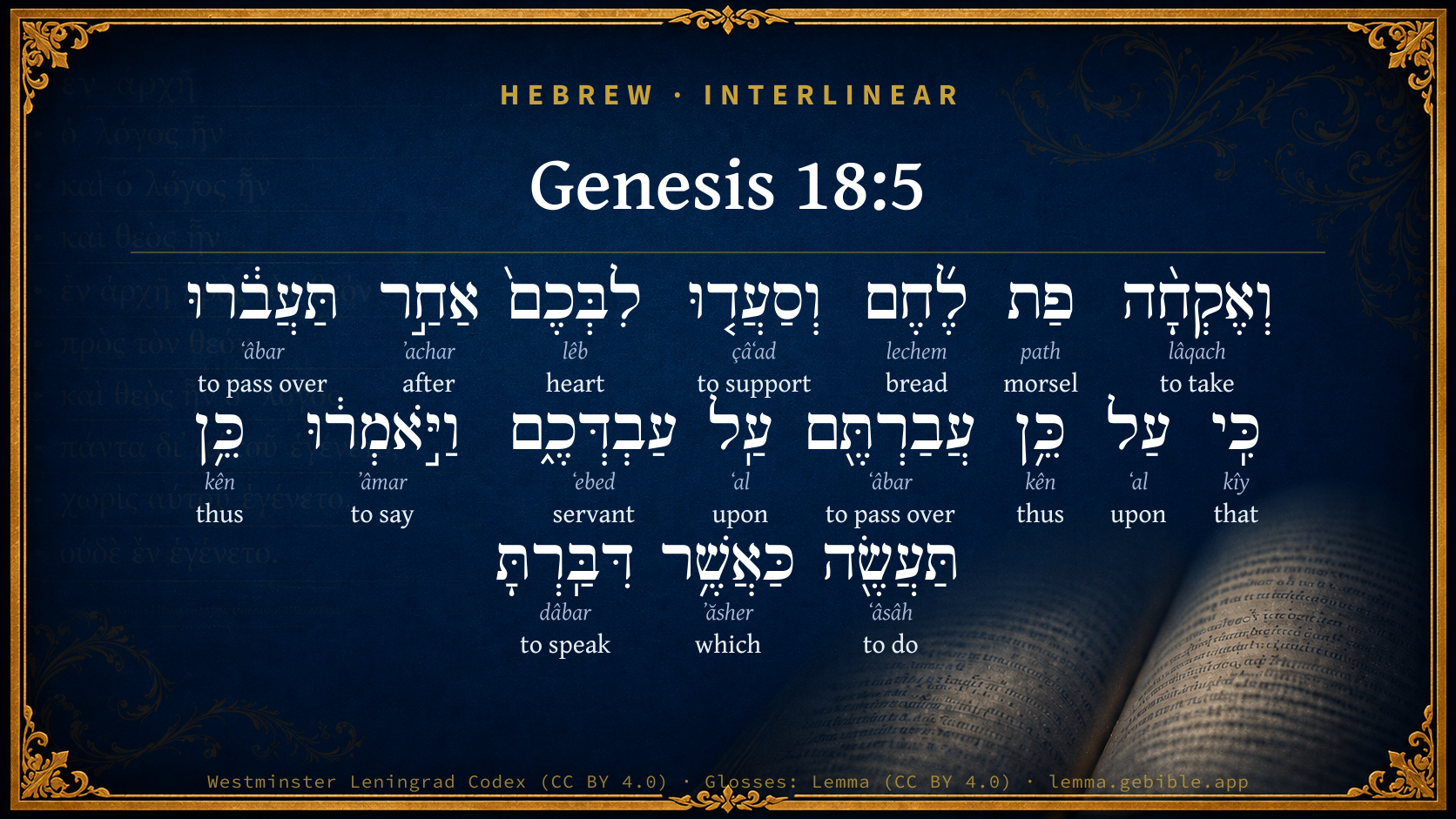
Genesis 18:5

Hebrew (Westminster Leningrad Codex) Genesis 18:5 appears in the Hebrew Old Testament. The text above is from the Westminster Leningrad Codex. Each word links to its Strong’s number, a concise gloss, and parsing drawn from the Open Scriptures Hebrew Bible morphology. Click any word for its full Brown-Driver-Briggs (BDB) entry.
Download image
Cite this verse

Genesis 18:5 (World English Bible). Public Domain. Lemma interlinear Bible study tool, https://lemma.gebible.app/v/genesis/18/5.

Show BibTeX & RIS
BibTeX
RIS
English Translation
I will get a morsel of bread so you can refresh your heart. After that you may go your way, now that you have come to your servant." They said, "Very well, do as you have said."
World English Bible · Public Domain
Highlights
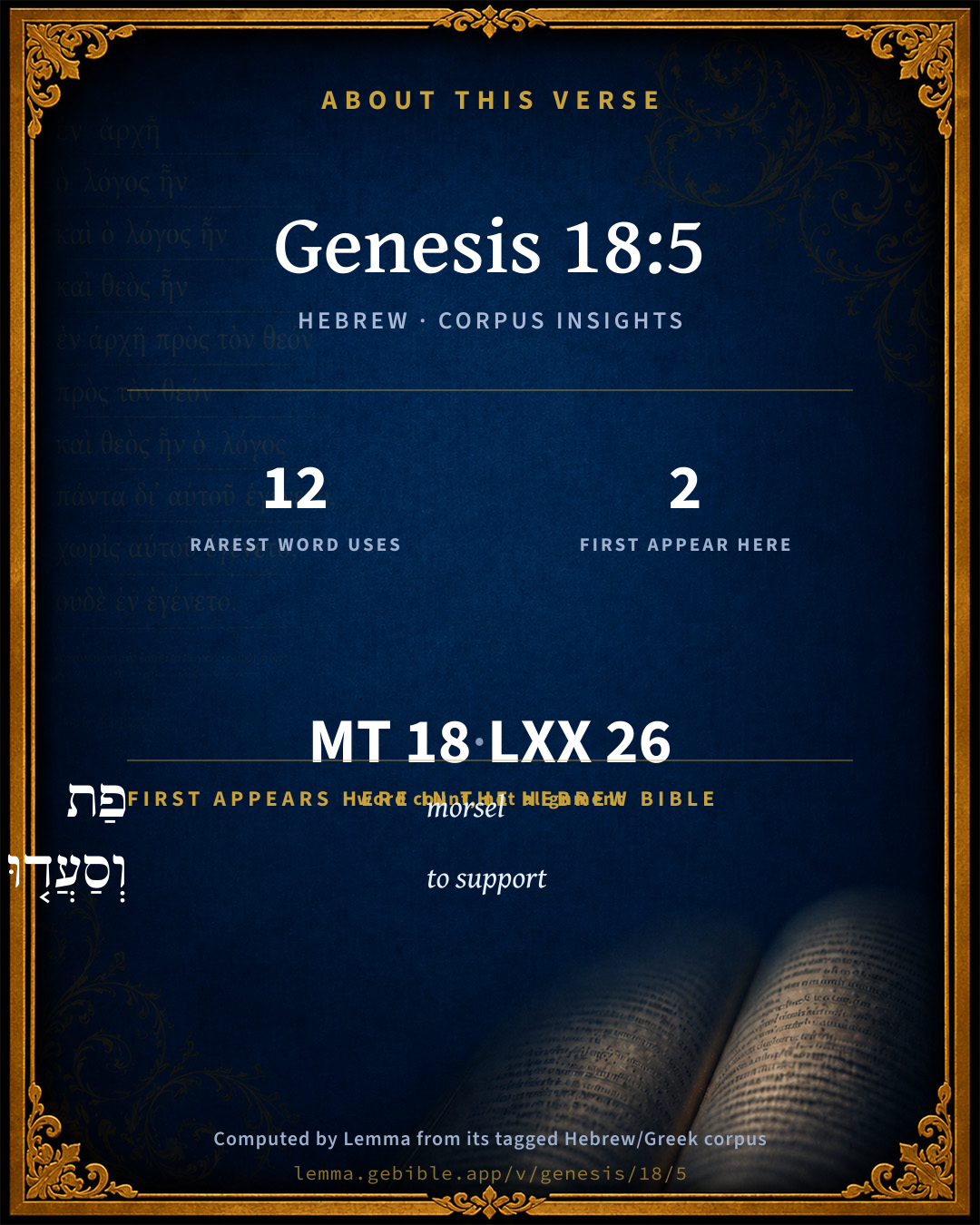
  • 2 first appearances in the Hebrew Bible
Full analysis ↓
Download a study sheet

One document with this verse’s original text, its word-by-word gloss line, the meaning frame, cross-references with their text, attributed commentary, and full source and license credits — printable, and it pastes into notes with its structure intact.

This verse Autodidact and up

Study sheet (.html) Plain text (.txt)

A passage Seminary Student

Up to 50 verses in one chapter. A passage sheet keeps up to 6 commentary sources and 12 cross-references per verse, in the order this page ranks them, and says so on the sheet whenever that leaves anything out. Ask for a single verse and you get the Autodidact verse sheet above.

Everything on this page stays free to read, with no account — the sheet is a download of what is already on screen, not access to it.

Want to remove ads? Support Godless Engineer
Compare translations 3

The same verse in 3 English versions, stacked beneath the original-language interlinear above. Click any original word for its lexicon entry.

Each is an independent rendering of the whole verse — the interlinear is not word-aligned to these translations.

Highlighted words mark where these versions differ — a whole-verse word diff, not a word-by-word alignment.

  • World English Bible Public Domain
    I will get a morsel of bread so you can refresh your heart. After that you may go your way, now that you have come to your servant." They said, "Very well, do as you have said."
  • King James Version Public Domain
    And I will fetch a morsel of bread, and comfort ye your hearts; after that ye shall pass on: for therefore are ye come to your servant. And they said, So do, as thou hast said.
  • unfoldingWord Literal Text CC BY-SA 4.0
    And I will bring a morsel of bread so that you can refresh your hearts before you go away, since you have come to your servant.” And they said, “Alright, do as you have said.”

unfoldingWord Literal Text — © unfoldingWord, licensed CC BY-SA 4.0. Word-aligned USFM3 via Door43 (git.door43.org/unfoldingWord/en_ult).

Versions to compare (up to 4)

3 of 4 selected

Show all 18 translations

Every available English version of this verse, each an independent rendering of the whole verse.

  • World English Bible Public Domain
    I will get a morsel of bread so you can refresh your heart. After that you may go your way, now that you have come to your servant." They said, "Very well, do as you have said."
  • Berean Standard Bible Public Domain
    And I will bring a bit of bread so that you may refresh yourselves. This is why you have passed your servant’s way. After that, you may continue on your way.” “Yes,” they replied, “you may do as you have said.”
  • Majority Standard Bible Public Domain
    And I will bring a bit of bread so that you may refresh yourselves. This is why you have passed your servant’s way. After that, you may continue on your way.” “Yes,” they replied, “you may do as you have said.”
  • King James Version Public Domain
    And I will fetch a morsel of bread, and comfort ye your hearts; after that ye shall pass on: for therefore are ye come to your servant. And they said, So do, as thou hast said.
  • American Standard Version (1901) Public Domain
    and I will fetch a morsel of bread, and strengthen ye your heart; after that ye shall pass on: forasmuch as ye are come to your servant. And they said, So do, as thou hast said.
  • Revised Version (1885) Public Domain
    and I will fetch a morsel of bread, and comfort ye your heart; after that ye shall pass on: forasmuch as ye are come to your servant. And they said, So do, as thou hast said.
  • Geneva Bible (1599) Public Domain
    And I will bring a morsell of bread, that you may comfort your hearts, afterward ye shall go your wayes: for therefore are ye come to your seruant. And they said, Do euen as thou hast said.
  • Douay-Rheims (1899) Public Domain
    But I will fetch a little water, and wash ye your feet, and rest ye under the tree.
  • Young's Literal Translation Public Domain
    and I bring a piece of bread, and support ye your heart; afterwards pass on, for therefore have ye passed over unto your servant;' and they say, `So mayest thou do as thou has spoken.'
  • Literal Standard Version CC BY-SA 4.0
    and I bring a piece of bread, and support Your heart; afterward pass on, for therefore You have passed over to Your servant”; and they say, “So may you do as you have spoken.”
  • Unlocked Literal Bible CC BY-SA 4.0
    Let me bring a little food, so that you may refresh yourselves. Afterwards you can go your way, since you have come to your servant.” They replied, “Do as you have said.”
  • unfoldingWord Literal Text CC BY-SA 4.0
    And I will bring a morsel of bread so that you can refresh your hearts before you go away, since you have come to your servant.” And they said, “Alright, do as you have said.”
  • Darby Bible Public Domain
    And I will fetch a morsel of bread; and refresh yourselves; after that ye shall pass on; for therefore have ye passed on towards your servant. And they said, So do as thou hast said.
  • World Messianic Bible Public Domain
    I will get a piece of bread so you can refresh your heart. After that you may go your way, now that you have come to your servant.” They said, “Very well, do as you have said.”
  • Webster's Bible Public Domain
    And I will bring a morsel of bread, and comfort ye your hearts; after that you shall pass on: for therefore are ye come to your servant. And they said, So do, as thou hast said.
  • Free Bible Version CC BY-SA 4.0
    Also let me bring some food so you can get your strength back before you go on your way, now that you've come to visit me here.” “That would be fine,” they answered. “Please do as you've suggested.”
  • Bible in Basic English Public Domain
    And let me get a bit of bread to keep up your strength, and after that you may go on your way: for this is why you have come to your servant. And they said, Let it be so.
  • JPS Tanakh (1917) Public Domain
    And I will fetch a morsel of bread, and stay ye your heart; after that ye shall pass on; forasmuch as ye are come to your servant.' And they said: 'So do, as thou hast said.'

Literal Standard Version (2020), Covenant Press — licensed CC BY-SA 4.0. Text via the HelloAO Bible API (eBible.org). Unlocked Literal Bible (unfoldingWord) — licensed CC BY-SA 4.0. Text via the HelloAO Bible API (eBible.org). unfoldingWord Literal Text — © unfoldingWord, licensed CC BY-SA 4.0. Word-aligned USFM3 via Door43 (git.door43.org/unfoldingWord/en_ult). Free Bible Version, Dr. Jonathan Gallagher — licensed CC BY-SA 4.0. Text via the HelloAO Bible API (eBible.org).

Word by word

More ways to search: Search by grammar → Find every occurrence → Compare this word →

Practice this passage: Drill this verse → Learn its vocabulary →

וְסַעֲד֤וּ
çâʻad
H5582
“and · support”
Conjunction + Verb, Qal, Imperative, 2nd Person, Masculine, Plural
Part of Speech
Conjunction + Verb
Stem
Qal
Form
Imperative
Person
2nd Person
Gender
Masculine
Number
Plural
Full BDB Definition

Origin: a primitive root

TWOT: 1525

to support, sustain, stay, establish, strengthen, comfort - (Qal) to support, sustain - to sustain, stay (of heart) - to support, uphold (of throne)
  1. וְאֶקְחָ֨ה lâqach H3947 “and · to take” Conjunction + Verb, Qal, Cohortative, 1st Person, Common, Singular
  2. פַת path H6595 “morsel of” Noun, Common, Feminine, Singular, Construct
  3. לֶ֜חֶם lechem H3899 “bread” Noun, Common, Both, Singular, Absolute
  4. לִבְּכֶם֙ lêb H3820 “heart · your” Noun, Common, Masculine, Singular, Construct + Suffix, Personal, 2nd Person, Masculine, Plural
  5. אַחַ֣ר ʼachar H310 “after” Preposition
  6. תַּעֲבֹ֔רוּ ʻâbar H5674 “to pass over” Verb, Qal, Imperfect, 2nd Person, Masculine, Plural
  7. כִּֽי kîy H3588 “that” Conjunction
  8. עַל ʻal H5921 “upon” Preposition
  9. כֵּ֥ן kên H3651 “thus” Particle, Demonstrative
  10. עֲבַרְתֶּ֖ם ʻâbar H5674 “to pass over” Verb, Qal, Perfect, 2nd Person, Masculine, Plural
  11. עַֽל ʻal H5921 “upon” Preposition
  12. עַבְדְּכֶ֑ם ʻebed H5650 “servant · your” Noun, Common, Masculine, Singular, Construct + Suffix, Personal, 2nd Person, Masculine, Plural
  13. וַיֹּ֣אמְר֔וּ ʼâmar H559 “and · to say” Conjunction + Verb, Qal, Sequential Imperfect, 3rd Person, Masculine, Plural
  14. כֵּ֥ן kên H3651 “thus” Particle, Demonstrative
  15. תַּעֲשֶׂ֖ה ʻâsâh H6213 “to do” Verb, Qal, Imperfect, 2nd Person, Masculine, Singular
  16. כַּאֲשֶׁ֥ר ʼăsher H834 “like/as · which” Preposition + Particle, Relative
  17. דִּבַּֽרְתָּ dâbar H1696 “to speak” Verb, Piel, Perfect, 2nd Person, Masculine, Singular

About this verse

These counts appear in no published source. They are computed here, from the morphology-tagged text and Lemma’s own curated glosses. What Lemma adds →

18
words
15
distinct lemmas
Pentateuch
section

Notable vocabulary

The rarest word here is וְסַעֲד֤וּ to support H5582 — appearing just 12 times in the whole Hebrew Bible.

First appearance in Scripture

These words make their first canonical appearance in the Hebrew Bible here:

  • פַת morsel H6595
  • וְסַעֲד֤וּ to support H5582

Shared distinctive vocabulary

וְסַעֲד֤וּ to support H5582 occurs in 12 verses of the Hebrew Bible. Also found in:

Grammatical profile

  • 7 verbs
  • 4 nouns
  • 3 prepositions
  • 1 conjunction
  • 3 particles

Verb forms

  • וְאֶקְחָ֨ה Qal · Cohortative
  • וְסַעֲד֤וּ Qal · Imperative
  • תַּעֲבֹ֔רוּ Qal · Imperfect
  • עֲבַרְתֶּ֖ם Qal · Perfect
  • וַיֹּ֣אמְר֔וּ Qal · Sequential Imperfect
  • תַּעֲשֶׂ֖ה Qal · Imperfect
  • דִּבַּֽרְתָּ Piel · Perfect

Repetition

Words recur within this verse — often emphatic in Hebrew:

  • תַּעֲבֹ֔רוּ to pass over H5674 ×2
  • עַל upon H5921 ×2
  • כֵּ֥ן thus H3651 ×2

Hebrew & Septuagint length

In English translation the verse runs 37 words from the Hebrew and 39 from the Septuagint (LXX English) — closely comparable.

A rough comparison of the two English renderings, which tokenize alike — not a word-level alignment.

Word counts can differ between the Hebrew and the Greek without any difference in meaning — e.g. the Hebrew direct-object marker אֵת has no separate Greek word, and Greek often adds the article ὁ.

In the original languages it is 18 Hebrew tokens and 26 Greek tokens — but the two are counted differently (Hebrew bundles its prefixes and suffixes into one token; the Greek is in lemma form), so that isn’t a like-for-like length.

Cross-references

8

Topical passages linked to Genesis 18:5 in the Treasury of Scripture Knowledge — connected by theme and wording, ordered by reader-vote popularity; previews shown in the World English Bible.

  • Psalms 104:15 Wine that makes glad the heart of man, Oil to make his face to shine, And bread that strengthens man's heart.
  • Judges 6:18 Please don't go away, until I come to you, and bring out my present, and lay it before you. He said, I will wait until you come again.
  • Judges 13:15 Manoah said to the angel of Yahweh, I pray you, let us detain you, that we may make ready a kid for you.
  • Genesis 19:8 See now, I have two virgin daughters. Please let me bring them out to you, and do you to them as is good in your eyes. Only don't do anything to these men, because they have come under the shadow of my roof."
  • Genesis 33:10 Jacob said, "Please, no, if I have now found favor in your sight, then receive my present at my hand, because I have seen your face, as one sees the face of God, and you were pleased with me.
  • Judges 19:5 It happened on the fourth day, that they arose early in the morning, and he rose up to depart: and the young lady's father said to his son-in-law, Strengthen your heart with a morsel of bread, and afterward you shall go your way.
  • Matthew 6:11 Give us today our daily bread.
  • Isaiah 3:1 For, behold, the Lord, Yahweh of Hosts, takes away from Jerusalem and from Judah supply and support, The whole supply of bread, And the whole supply of water;

Cross-references courtesy of OpenBible.info (CC BY 4.0).

Hebrew and Greek witnesses Masoretic Hebrew ↔ Greek Septuagint

The same verse in the two great witnesses to the Old Testament, shown verse-for-verse.

These are two independent witnesses, not word-aligned to each other, and the Septuagint is shown in lemma (dictionary) form.

Hebrew Genesis 18:5 Masoretic · Westminster Leningrad Codex

וְאֶקְחָ֨ה פַת לֶ֜חֶם וְסַעֲד֤וּ לִבְּכֶם֙ אַחַ֣ר תַּעֲבֹ֔רוּ כִּֽי עַל כֵּ֥ן עֲבַרְתֶּ֖ם עַֽל עַבְדְּכֶ֑ם וַיֹּ֣אמְר֔וּ כֵּ֥ן תַּעֲשֶׂ֖ה כַּאֲשֶׁ֥ר דִּבַּֽרְתָּ

I will get a morsel of bread so you can refresh your heart. After that you may go your way, now that you have come to your servant." They said, "Very well, do as you have said."

World English Bible · Public Domain

Greek LXX Genesis 18:5 Septuagint · lemma form

καί λαμβάνω ἄρτος καί ἐσθίω καί μετά οὗτος παραἔρχομαι εἰς ὁ ὁδός σύ ὅς εἵνεκεν ἐκκλίνω πρός ὁ παῖς σύ καί εἶπον οὕτως ποιέω καθώς εἶπον

And I will bring bread, and you⌃ shall eat, and after this you⌃ shall depart on your journey, on account of which refreshment you⌃ have turned aside to your servant. And he said, So do, as you have said.

LXX2012 (modern English Septuagint) · Public Domain

On this verse, The Pulpit Commentary discusses the Septuagint’s reading. Read the note in Commentary ↓

Hebrew: Westminster Leningrad Codex (CC BY 4.0). Greek: Septuagint (public domain); English from LXX2012 (modern English Septuagint) (Public Domain). How the Septuagint differs from the Hebrew →

Targum (Aramaic paraphrase)

2

The Targum is the ancient Jewish Aramaic paraphrase of the Hebrew Scriptures — an interpretive translation, not the Hebrew text itself. Onkelos (literal) and Pseudo-Jonathan (expansive) render the Torah, and Jonathan the Prophets. Coverage is partial: where no permissively-licensed English translation exists for a verse, only the Aramaic is shown. This is verse-level text, not a word-by-word alignment to the Hebrew.

  1. Targum Onkelos Torah (Genesis–Deuteronomy)
    וְאֶסַּב פִּתָּא דְלַחְמָא וּסְעִידוּ לִבְּכוֹן בָּתַר כֵּן תְּעִבְּרוּן אֲרֵי עַל כֵּן עֲבַרְתּוּן עַל עַבְדְּכוֹן וַאֲמָרוּ כֵּן תַּעְבֵּיד כְּמָא דִּי מַלֵּלְתָּא

    (no public-domain English translation for this verse)

    Targum Onkelos — Aramaic: “Onkelos Genesis” (public domain); “Onkelos Exodus” (public domain); “Onkelos Leviticus” (public domain); “Onkelos Numbers” (public domain); “Onkelos Deuteronomy” (public domain). English: “Sefaria Community Translation” (CC0 1.0 (public-domain dedication)); “J.W. Etheridge. The Targums of Onkelos and Jonathan Ben Uzziel on the Pentateuch. London: Longmans, Green, 1862” (public domain). Text via Sefaria.

  2. Targum Pseudo-Jonathan Torah (Genesis–Deuteronomy)
    וְאִיסָב סְעִיד דִלְחֵם וּסְעִידוּ לִבְּכוֹן וְאוֹדוּ לְשׁוּם מֵימְרָא דַיְיָ וּבָתַר כְּדֵין תַּעֲבִירוּן אֲרוּם בְגִין כְּדֵין בְּאִישׁוֹן שֵׁירוּתָא אַזְדַמַנְתּוּן וְעַבַרְתּוּן עַל עַבְדְכוֹן בְּדִיל לְמִסְעוֹד וַאֲמָרוּ יָאוּת מַלֵילְתָּא עֲבִיד כְּפִתְגָמָךְ

    And I will bring food of bread, that you may strengthen your hearts, and give thanks in the Name of the Word of the Lord, and afterwards pass on. For therefore at the time of repast are you come, and have turned aside to your servant to take food. And they said, Thou hast spoken well; do according to thy word.

    Targum Pseudo-Jonathan — Aramaic: “Targum Jonathan on Genesis” (public domain); “Targum Jonathan on Exodus” (public domain); “Targum Jonathan on Leviticus” (public domain); “Targum Jonathan on Numbers” (public domain); “Targum Jonathan on Deuteronomy” (public domain). English: “The Targum of Jonathan ben Uzziel, trans. J. W. Etheridge, London, 1862” (public domain). Text via Sefaria.

Commentary

Notes on Genesis 18:5 from classic Christian and Jewish commentators (each source and its license shown beneath its notes). The classic Christian expositions comment on the surrounding passage and are grouped to its opening verse, so a note may address several verses; the Jewish commentaries on the Tanakh (Rashi and others) are per-verse, so they appear only where the commentator wrote on this verse.

Lemma curates 59 commentaries, every one of them public domain or Creative Commons licensed, each selected and text-cleaned for this edition rather than reprinted as found. About our sources →

Trapp's Complete Commentary

John Trapp

Gen 18:5 And I will fetch a morsel of bread, and comfort ye your hearts; after that ye shall pass on: for therefore are ye come to your servant. And they said, So do, as thou hast said.

Ver. 5. For therefore are ye come to your servant.] He meaneth not, that they therefore came to him to taste of his cheer; but that God, by his providence, had so ordered that he should see them passing, and invite them to his house. How glad was this good man of an occasion to show kindness, acknowledging God’s good providence! And how improvident are we for ourselves, that will not offer a sacrifice, when God sets up an altar before us!

So do as thou hast said.] The angels needed not his courtesy, yet kindly accept of it. Good offers or offices, even from inferiors, are not to be rejected, but regarded, yea, rewarded.

John Trapp, A Commentary or Exposition upon All the Books of the Old and New Testament (1647–1656) — public domain. Text from a community e-Sword module.

Geneva Bible (1599)

Geneva Bible translators

As sent of God, that I should do my duty to you.

Geneva Bible (1599) marginal notes — public domain. Text via Bolls.life.

Jamieson, Fausset & Brown

Robert Jamieson, A. R. Fausset & David Brown

for therefore are ye come--No questions were asked. But Abraham knew their object by the course they took--approaching directly in front of the chief sheik's tent, which is always distinguishable from the rest and thus showing their wish to be his guests.

Jamieson, Fausset & Brown — Commentary Critical and Explanatory on the Whole Bible (1871) — public domain (CC PDM 1.0). Text via the HelloAO Bible API.

Adam Clarke's Commentary

Verse 5. I will fetch a morsel of bread] This was the third requisite, and is introduced in its proper order; as eating immediately after exertion or fatigue is very unwholesome. The strong action of the lungs and heart should have time to diminish before any food is received into the stomach, as otherwise concoction is prevented, and fever in a less or greater degree produced.

For therefore are ye come] In those ancient days every traveller conceived he had a right to refreshment, when he needed it, at the first tent he met with on his journey.

So do as thou hast said.] How exceedingly simple was all this! On neither side is there any compliment but such as a generous heart and sound sense dictate.

Adam Clarke's Commentary on the Bible (1810–1826) — public domain. Text from a community e-Sword/MySword module.

John Calvin's Commentaries

5. For therefore are ye come to your servant He does not mean that they had come designedly, or for the express purpose of seeking to be entertained, as his guests; but he intimates that their coming had occurred opportunely, as if he would say, ‘You have not slipped into this place by chance; but have been led hither by the design and the direction of God.’ He, therefore, refers it to the providence of God, that they had come, so conveniently, to a place where they might refresh themselves a little while, till the heat of the sun should abate. Moreover, as it is certain that Abraham spoke thus in sincerity of mind; let us after his examples conclude that, whenever our brethren, who need our help, meet us, they are sent unto us by God.

John Calvin's Commentaries (1540-1563) — public domain. Text from the Calvin Translation Society English edition (1840s-50s) via the Christian Classics Ethereal Library (ccel.org). Calvin's coverage is partial (roughly two-thirds of the Bible); uncommented books and verses are honest gaps, never fabricated. The 19th-century editor's footnotes and remarks are omitted so the notes are faithfully Calvin's own voice.

Ellicott's Commentary for English Readers

(5) Comfort ye your hearts.—Heb., strengthen ye, the original meaning of comfort, a word formed from the Latin fortis = strong, brave. The heart in Hebrew is the sum total of all the powers, mental and bodily, of the whole man.

After that ye shall pass on.—Coming at noon, the travellers after rest and refreshment would continue their journey. It is quite plain that Abraham still regarded them as passing wayfarers.

Therefore . . . —Abraham thus suggests that his tent was pitched near to the route on purpose that he might exercise that hospitality which was and continues to be the sacred duty of an Arab sheik.

A Bible Commentary for English Readers, edited by Charles John Ellicott (1878–1897) — public domain. Text from a community e-Sword module.

The Cambridge Bible for Schools and Colleges

gen. ed. J. J. S. Perowne

5. a morsel of bread] Cf. Jdg_19:5. With true Oriental subservience of speech Abraham gives this description of the generous entertainment which he intends to provide. For this modesty of speech as a formula of courtesy, cf. Gen_13:9, Gen_23:11; 2Sa_24:22-23.

comfort ye your heart] As in Jdg_19:5; Jdg_19:8; lit. “support your heart,” Lat. confortate cor vestrum. The English word “comfort,” derived from the Lat., originally had the meaning of “strengthen.” The Heb. word here used is found in Psa_104:15, “bread that strengthened man’s heart.”

forasmuch as] Marg. for therefore: cf. Gen_19:8, Gen_33:10 (J). Abraham graciously assumes that the strangers have only honoured him with a visit, in order to allow him to provide for their refreshment and entertainment on their journey.

The Cambridge Bible for Schools and Colleges (gen. ed. J. J. S. Perowne; Cambridge University Press, 1878–1918) — public domain. Text from a community e-Sword module.

John Gill's Exposition

And I will fetch a morsel of bread,.... A piece or a loaf of bread, as De Dieu shows the word signifies; bread being put for all the necessaries of life:

and comfort ye your hearts; eat to refresh your spirits and renew your strength, that ye may be able to pursue your journey: and

after that ye shall pass on your way; I will retard you no longer:

for therefore are ye come to your servant; not that he thought they came this way on purpose to take some refreshment with him, but so it was ordered by the providence of God; and since it was, he desires that they would accept of his invitation:

and they said, so do as thou hast said; they agreed to it, that water should be fetched to wash their feet, and food for them to eat.

John Gill's Exposition of the Whole Bible (1746–1763) — public domain (CC PDM 1.0). Text via the HelloAO Bible API.

Haydock's Catholic Bible Commentary

Therefore, Providence has directed you hither. Abraham promises but little, and gives much, in the true spirit of generous hospitality. (Calmet)

George Leo Haydock (1774–1849), Haydock's Catholic Family Bible and Commentary, 1859 edition — public domain. Excludes Psalms (Douay-Rheims chapter numbering differs from Protestant) and Deuterocanonical books (Catholic canon only).

Matthew Poole's English Annotations

Therefore are ye come to your servant; not that he saith or thought that this was their design, but an effect of Divine Providence. The meaning is, Therefore hath God directed you this way, that I might have an occasion of performing my duty to you, which I cheerfully embrace.

Matthew Poole's English Annotations on the Holy Bible (1683–1685) — public domain. Text from a community e-Sword/MySword module.

Whedon's Commentary on the Bible

Daniel D. Whedon

5. For therefore are ye come to your servant — Or, for therefore have ye passed over to your servant. That is, Abraham recognises a divine providence in their having passed over to him that they might be comforted in their hearts and refreshed by him.

Daniel D. Whedon (gen. ed.), Commentary on the Old and New Testaments (1874–1909) — public domain. Text from a community e-Sword module.

The Pulpit Commentary

And I will fetch a morsel of bread, a modest description of what proved a sumptuous repast (vide Vers. 6, 8)and comfort ye your hearts; literally, strengthen or support them, i.e. by eating and drinking (Jud_1:19:5; 1Ki_21:7) after that ye shall pass on: for therefore KeAlAyKi introduces the ground of what has already been stated, something like quando quidem, forasmuch as (Ewald, "Hebrews Synt.," since, or because (Kalisch), and not = yKiA for this cause that (Gesenius, "Gram.," or "because for this purpose" (Keil) are ye come to (literally, have ye passed before) thy servant. The patriarch"s meaning is not that they had come with the design of receiving his gifts (LXX, A.V), but either that, unconsciously to them, God had ordered their journey so as to give him this opportunity (Calvin, Bush, Wordsworth, "Speaker"s Commentary," Keil), or perhaps simply that since they had passed by his tent they should suffer him to accord them entertainment (Kalisch, Rosenm And they said, So do, as thou but said. Therefore we must believe that Abraham washed the men"s feet, and they did eat (Ver. 8). Here is a mystery (Wordsworth).

The Pulpit Commentary (1880–1919), ed. H.D.M. Spence-Jones & Joseph S. Exell — public domain. Text from a community e-Sword module.

Rashi

Rabbi Shlomo Yitzchaki (Rashi)

וסעדו לבכם AND SUSTAIN YOUR HEARTS — In the Torah, the Prophets and the Hagiographa we find that bread is the sustenance of the heart. In the Torah. “[And I will fetch a morsel of bread] and sustain your heart.” In the Prophets: “Stay thy heart with a morsel of bread” (Judges 19:5). In the Hagiographa: “And bread that sustaineth man’s heart” (Psalms 104:15). R. Hama said: Here is not written לבבכם but לבכם thus teaching that the evil inclination has no power over angels (Genesis Rabbah 48:11)

אחר תעבורו means after that, you may go away.

כי על כן עברתם FORASMUCH AS YE HAVE PASSED —For (כי) I ask you this thing because that (על כן) you have honoured me by calling at my place. כי] על כן] has the same meaning as על אשר “because that”. So, too, is the meaning wherever כי על כן occurs in Scripture, e. g., (Genesis 19:9) “For (כי) I ask you this because that (על כן) they have come under the shadow of my roof”; (Genesis 33:10)

“For (כי) you ought to do this because that (על כן) I have seen thy face”; (Genesis 38:26) “for (כי) she has done right because that (על כן) I gave her not”; (Numbers 10:31) “for (כי) thou ought to accompany us because that (על כן) thou knowest how we are to encamp”.

Rashi on the Tanakh — English translations: “The Judaica Press complete Tanach with Rashi, translated by A. J. Rosenberg” (CC BY 4.0); “Pentateuch with Rashi's commentary by M. Rosenbaum and A.M. Silbermann, 1929-1934” (public domain); “The Metsudah Tanach series, Lakewood, N.J” (CC BY 4.0); and “The Book of Joshua, Metsudah Publications, 1997” (CC BY 4.0). Text via Sefaria.

Ramban (Nachmanides)

Rabbi Moshe ben Nachman (Ramban / Nachmanides)

FORASMUCH AS YE PASSED BY. Since your path crossed near me, it is not proper that you should not rest a little with me.So do, as thou hast said. This is an ethical expression indicating that a morsel of bread will be sufficient. will do as thou hast said,” and instead it says, “So thou do, as thou hast said,” Abraham ibn Ezra takes it to mean “So do, as thou hast spoken: And I will take a morsel of bread, and do not trouble thyself for more.” Thus the language of Rabbi Abraham ibn Ezra.It may be that the verse is stating, “So shalt thou do to us, that we recline under the tree and pass immediately as we are messengers, and therefore do not detain us by making us come into the tent or lodge with you.”

Ramban (Nachmanides) on the Tanakh — English translation: “Commentary on the Torah by Ramban (Nachmanides). Translated and annotated by Charles B. Chavel. New York, Shilo Pub. House, 1971-1976” (CC BY 4.0). Text via Sefaria.

Radak

Rabbi David Kimhi (Radak)

ואקחה פת לחם; from this we learn that the righteous say little but do a lot. (Baba Metzia 87) This is the appropriate manner of conducting oneself. The Torah wrote these details in order to teach us that this is part of good manners, דרך ארץ. Avraham spoke about a piece of bread, whereas in fact he served a sumptuous meal. He had even understated the amount of bread he would serve by not saying ואקח לחם, but ואקחה פת לחם, a reference to less than a whole loaf.

וסעדו לבחם, an imperative mode of a transitive verb, i.e. “refresh your hearts with a little bread.” We know that eating bread is a form of refreshment from Psalms 104,15 ולחם לבב אנוש יסעד, “but bread sustains man’s life.”

כי על כן עברתם, seeing that you have already happened to pass my house, it is not possible that you should not at least accept some refreshment. The formulation על כן is found again when Lot justifies his hosting the angels when the Sodomites remonstrate with him. (Genesis 19,8) We also find this formulation על כן when Yehudah acknowledges his embarrassment with Tamar as a punishment for not giving his third son to Tamar for her to become his wife. (Genesis 38,26)

כאשר דברת, only a piece of bread, do not exert yourself beyond this.

Radak on the Tanakh — English translations: “Sefaria Community Translation” (CC0 1.0 (public-domain dedication)); “Eliyahu Munk, HaChut Hameshulash” (CC BY 4.0); “Rabbi Mike Feuer, Jerusalem Anthology” (CC BY 4.0); and “R. David Kimhi on the first book of Psalms, Translated by R.G. Finch, London, 1919” (public domain). Text via Sefaria.

Lesson kit

Teaching starters — assembled from the data on this page, not authored interpretation. Every prompt links to the verse data it draws on. Edit before teaching.

Genesis, in the Pentateuch, opens this verse with 18 words (15 distinct Hebrew lemmas). Its most distinctive word is çâʻad (“to support”). A historical commentator’s framing appears above. Read the whole chapter for the surrounding context.

Discussion questions

  1. What does “to support” (çâʻad) contribute to the verse as a whole?
  2. 2 words here appear for the first time in Scripture. What is being introduced at this debut?
  3. Judges 19:5 shares the word «to support» with this verse. How do the two illuminate each other?
  4. “to pass over” occurs 2× in this one verse. What is the effect of the repetition?
  5. These translations render this verse differently; the difference is in the English rendering, not the original. What questions does that raise?
  6. The verb «וְאֶקְחָ֨ה» is Qal Cohortative. How does its form color the action?
  7. Reading how Trapp's Complete Commentary and Geneva Bible (1599) read this verse, where do the two commentators agree and where do they part?

Things to notice

Reading settings

Reading text

Shown beneath each verse's original-language words.

Old Testament
Old Testament edition

Read the OT as the Masoretic Hebrew (MT) or the Greek Septuagint (LXX).

English shown for the Greek Septuagint (in the Hebrew ↔ Greek comparison).

Comparing translations? Open the Compare panel on any verse page to stack up to four side by side.